EP0697477A2 - Fadenwahlvorrichtung für eine Webmaschine - Google Patents
Fadenwahlvorrichtung für eine Webmaschine Download PDFInfo
- Publication number
- EP0697477A2 EP0697477A2 EP95101303A EP95101303A EP0697477A2 EP 0697477 A2 EP0697477 A2 EP 0697477A2 EP 95101303 A EP95101303 A EP 95101303A EP 95101303 A EP95101303 A EP 95101303A EP 0697477 A2 EP0697477 A2 EP 0697477A2
- Authority
- EP
- European Patent Office
- Prior art keywords
- signal
- needle
- thread
- detecting
- machine
- Prior art date
- Legal status (The legal status is an assumption and is not a legal conclusion. Google has not performed a legal analysis and makes no representation as to the accuracy of the status listed.)
- Granted
Links
Images



Classifications
-
- D—TEXTILES; PAPER
- D03—WEAVING
- D03C—SHEDDING MECHANISMS; PATTERN CARDS OR CHAINS; PUNCHING OF CARDS; DESIGNING PATTERNS
- D03C3/00—Jacquards
- D03C3/20—Electrically-operated jacquards
-
- D—TEXTILES; PAPER
- D03—WEAVING
- D03D—WOVEN FABRICS; METHODS OF WEAVING; LOOMS
- D03D51/00—Driving, starting, or stopping arrangements; Automatic stop motions
Definitions
- This invention relates to a thread selecting device whereby a weaving machine selects a vertical thread according to a design or pattern.
- a thread selecting device such as for example a jacquard is used to select a vertical thread according to the pattern.
- Tokkai Hei 3-90646 published by the Japanese Patent Office in 1991 for example discloses a device that uses an actuator of an electromagnetic solenoid driven by an electrical signal to select a thread.
- This thread selecting device is installed above the weaving machine, and comprises a knife which ascends and descends in synchronism with the operating cycles of the weaving machine. It further comprises a plurality of thread selecting units provided with a needle driven upwards by the knife, a hook that supports the needle in its raised position, and an electromagnetic solenoid that oscillates the hook between a position wherein the needle is supported and a position wherein the needle is released.
- the needle is connected to vertical threads via a number of mechanisms, a thread being selected when it is supported in its raised position by the hook, and deselected when it is released and descends.
- the knife ascends on each operating cycle of the weaving machine, and lifts the needle.
- the solenoid When the solenoid is energized in the raised position of the needle, the hook engages with the needle, and the needle remains supported by the hook after the knife descends.
- a required vertical thread may be selected from among a large number of candidate vertical threads.
- the controller that energizes the solenoids is programmed to shut off current to the solenoids at the time when operation of the weaving machine is stopped, thereby preventing the solenoids from overheating.
- this invention provides a thread selecting device for use with a weaving machine, comprising a needle for selecting a thread used in the machine according to a displacement of the needle, a mechanism for displacing the needle in synchronism with an operation of the weaving machine, an electromagnetic actuator for maintaining the needle in a predetermined position, and a mechanism for supplying energizing current to the electromagnetic actuator in conjunction with the machine operation.
- the device further comprises a mechanism for detecting an interruption of the machine operation, and a mechanism for oscillating the energizing current when the interruption is detected.
- the interruption detecting mechanism comprises a mechanism for detecting a rotation period of a shaft which rotates in synchronism with the machine operation and a mechanism for comparing the rotation period with a predetermined value.
- the rotation period detecting mechanism comprises for example a mechanism for generating a pulse at an interval proportional to the rotation period and a mechanism for detecting this interval
- the comparing mechanism comprises for example a mechanism for comparing the interval with a predetermined value.
- the supplying mechanism comprises a mechanism for detecting a rotation position of the shaft which rotates in synchronism with the machine operation and a mechanism for outputting a signal for permitting the energizing current supply only when the position is within a predetermined range.
- the interruption detecting mechanism preferably comprises a mechanism for determining if the permitting signal has continued for longer than a predetermined time.
- the interruption determining mechanism may comprises a mechanism for generating a pulse having a constant frequency, a mechanism for counting pulses emitted while the energizing permission continues and a mechanism for determining if the counted number of pulses has exceeded a predetermined value.
- the oscillating mechanism preferably comprises a mechanism for outputting an oscillating signal having a predetermined frequency when the machine operation has been interrupted and outputting a signal having a constant level at other times, a mechanism for outputting a signal being a logical product of the permitting signal and the signal output by the oscillating mechanism, and a mechanism for oscillating the energizing current based on the signal output by the outputting mechanism.
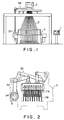
- Fig. 1 is a front view of a weaving machine and thread selecting device according to this invention.
- Fig. 2 is a schematic side view of the thread selecting device.
- Fig. 3 is a vertical sectional view of a thread selecting unit according to this invention.
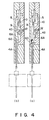
- Fig. 4 is a vertical sectional view of the thread selecting unit viewed from a direction perpendicular to that of Fig. 3.
- Fig. 5 is a block diagram of a controller according to this invention.
- Fig. 6 is a timing chart showing a control operation of the controller, according to this invention.
- Fig. 7 is a timing chart showing a range wherein a solenoid can be energized, according to this invention.
- Fig. 8 is a block diagram of a controller according to a second embodiment of this invention.
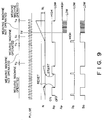
- Fig. 9 is a timing chart showing a range wherein a solenoid can be energized according to the second embodiment of the invention.
- a thread selecting device 2 is installed above a weaving machine 3. It is driven by the weaving machine 3 via a main shaft 30 and shaft 34 connected to the main shaft 30.
- the shaft 34 is connected to knives 7A, 7B via a reflection sleeve 31, arm 32 and link mechanism 33 as shown in Fig. 2, these knives 7A, 7B ascending and descending alternately in synchronism with the weaving cycles of the weaving machine 3.
- a hook 6A is supported free to pivot on a hinge 43 above the knife 7A.
- a hook 6B is supported free to pivot on the hinge 43 alongside the hook 6A above the knife 7B.
- the hooks 6A, 6B can pivot independently of each other.
- a solenoid 5 is installed at an upper location in order to drive the hooks 6A, 6B.
- the hooks 6A, 6B are driven by the solenoid 5 via a mechanism shown in Fig. 4.
- the upper end of the hook 6A (6B) pushed by a spring 12 is in contact with the armature 9. Due to the attraction of the armature to the yoke 10, the hook 6A (6B) pivots against the force of the spring 12 so that a claw 60 at the bottom end is displaced to a forward position. On the other hand, when current to the solenoid 5 is stopped, the hook 6A (6B) is pivoted by the spring 12 as it pushes the armature 9 backward, and the claw 60 is displaced to a backward position.
- the thread 8 is raised via the pulley 41 when the other needle has ascended so that the thread 8 is selected. Further, when the hooks 6A, 6B are in their backward positions, one of the needles 4A, 4B descends when the other needle has ascended, hence the thread 8 is not pulled up and is deselected.
- One of the solenoids 5 is therefore sufficient for both of the hooks 6A, 6B, however separate solenoids may be provided for each hook.
- the supply and interruption of energizing current to each of the solenoids 5 is controlled by a controller 1 shown in Fig. 1.
- the controller 1 comprises a timer 13, comparison means 14, oscillating means 15, energizing permitting means 16, data transfer control means 17, signal processing means 18, storage device 19, AND gates 20, 21 and amplifying means 22, as shown in Fig. 5.
- the signal processing means 18, AND gate 21 and amplifying means 22 are provided for each solenoid 5.
- Thread selecting data i.e. data regarding which vertical thread is selected at which time, is stored in the storage means 19.
- the signal processing means 18 outputs a thread selecting signal Ds to the AND gate 20 based on this data according to a request signal Dt from the data transfer control means 17.
- a rotary encoder 11 that generates a pulse P at an interval proportional to a rotation period is attached to the main shaft 30 which rotates in synchronism with the operation of the weaving machine 3.
- This pulse P is input to the timer 13 of the controller 1 which measures its interval t .
- the timer 13 is reset at every pulse input. If this input does not occur, the interval t become larger and finally exceeds a predetermined value t 1.
- the comparison means 14 compares the interval t with the predetermined value t 1. If the interval t is greater than the predetermined value t 1, it is determined that the main shaft 30 has stopped, and a stop signal St is output to the oscillating means 15.
- the oscillating means 15 If the stop signal St is ON, the oscillating means 15 generates an output signal Ap having a predetermined frequency. On the other hand, if the stop signal St is OFF, a voltage signal (ON signal) having a predetermined level is output as the signal Ap .
- the pulse P is also input to the energizing permitting means 16. From the pulse P , the energizing permitting means 16 determines whether or not the needles 4A, 4B are raised so that they are able to engage with the claws 60 of the hooks 6A, 6B.
- the raised and lowered positions of the needles 4A, 4B correspond to predetermined rotation angles of the main shaft 30 as shown in Fig. 7.
- the means 16 can detect the raised and lowered positions of the needles 4A, 4B by counting the pulses P, and determines whether or not they are within limits where they can engage with the claws 60. When it is determined that they are in an engaging position, the energizing permitting means 16 outputs a drive permission signal Ao .
- the AND gate 20 When the signal Ap from the oscillating means 15 and the drive permission signal Ao from the energizing permitting means 16 are both ON, the AND gate 20 outputs an energizing signal As to the AND gate 21. Therefore, the energizing signal As is output when the signal Ap is generated and the signal Ao is ON.
- the AND gate 21 When the thread selecting signal Ds and the signal As from the AND gate 20 are both ON, the AND gate 21 outputs a drive signal So to the amplifying means 22. In this case, when the energizing signal As is output and the thread selecting signal Ds is ON, the drive signal So is also generated.
- the amplifying means 22 outputs the drive signal So to the solenoid 5 as an oscillating current amplified to a suitable level for energizing the solenoid 5.
- the pulse P from the rotary encoder 11 is output with a predetermined period corresponding to the rotation of the main shaft 30. Also, when the rotation angle of the main shaft 30 is such that the needle can engage with the hook 6A (6B), the drive permission signal Ao has the high level (ON) shown in the figure.
- the signal Ap from the oscillating means 15 always has the high level shown in the figure, so the output signal As from the AND gate 20 also has a high level.
- the thread selecting signal Ds is output from the signal processing means 18, the drive signal output from the AND gate 21 is ON, i.e. it has a high level.
- the solenoid 5 is then energized by the drive signal So amplified by the amplifying means 22, and the hook 6A (6B) engages with the needle 4A (4B) as shown in Figs. 3, 4.
- the hook 6A engages with the needle 4A as shown in Fig. 3(a)
- the thread 8 is pulled up via the pulley 41 when the needle 4B ascends as shown in Fig. 3(b), and the thread 8 is thereby selected.
- the energizing permitting means 16 switches the drive permission signal Ao to OFF.
- the outputs from the AND gates 20, 21 then both drop to low level (OFF), the drive signal So drops to low level, and the energizing of the solenoid 5 is stopped.
- the thread selecting signal Ds is OFF, the drive signal So is permanently OFF regardless of the drive permission signal Ao , so the thread 8 is not selected. During operation of the weaving machine 3, therefore, the thread 8 is selected according to the thread selecting signal Ds .
- the signals output by the AND gates 20 and 21 also oscillate.
- the solenoid 5 therefore switches alternately ON and OFF with a predetermined frequency, and is intermittently energized.
- the oscillating means 15 If operation of the weaving machine 3 stops at a time Td when the drive permission signal Ao is OFF, the oscillating means 15 generates the signal Ap from a time Te when the interval t exceeds the set time t 1. In this case, however, as the drive permission signal Ao is OFF, the signals As , So output by the AND gates 20, 21 are both OFF, and the solenoid 5 is not energized.
- a rotation sensor for detecting the rotation speed of the shaft 34, and an angle sensor for detecting the rotation angle of the shaft 34 corresponding to the energizing permission range shown in Fig. 7, may be provided instead of the rotary encoder 11 as rotation detection means.
- Fig. 8 shows another embodiment of this invention concerning the structure of the controller.
- the controller 1 comprises a pulse generator 23, counter 24 and comparison means 25 instead of the timer 13 and comparison means 14.
- the pulse generator 23 generates a pulse at an interval proportional to the rotation period of the shaft 30.
- the counter 24 counts the pulses after the drive permission signal Ao from the energizing permitting means 16 is ON so as to obtain a count number N , and resets the count number N when the energizing permission signal Ao is OFF.
- the comparison means 25 outputs a stop signal St when the count number N exceeds a set value N 1.
- the counter 24 When the weaving machine 3 stops at a time Tc when the drive permission signal Ao and thread selecting signal Ds are both ON and the solenoid 5 is energized, the counter 24 has counted the pulses from when the drive permission signal Ao is ON. At a time Td when the count number N exceeds the set value N 1, the comparison means 25 switches the stop signal St to ON, and the oscillating means 15 generates the signal Ap with a predetermined frequency.
- the signals As and So output by the AND gates 20, 21 are both oscillated, and the solenoid 5 is intermittently energized at a predetermined frequency. Overheating due to energizing current is therefore prevented while the solenoid 5 supports the needle 4A or 4B.
- the shaft 34 resumes rotation, the drive permission signal Ao switches OFF and the count number N of the counter 24 is reset.
- the oscillating means 15 therefore stops the oscillation of the signal Ap , the signal Ap thereafter being maintained at a high level.
- the weaving machine 3 is determined to have stopped operation by counting the pulses from the time when the drive permission signal Ao changes. This makes it unnecessary to directly detect the rotation speed or period of the main shaft 30 or shaft 34, so the construction of the device is simpler than that of the aforesaid first embodiment.
Landscapes
- Engineering & Computer Science (AREA)
- Textile Engineering (AREA)
- Looms (AREA)
- Sewing Machines And Sewing (AREA)
Applications Claiming Priority (3)
| Application Number | Priority Date | Filing Date | Title |
|---|---|---|---|
| JP19429794A JP3373665B2 (ja) | 1994-08-18 | 1994-08-18 | 織機の経糸選択装置 |
| JP194297/94 | 1994-08-18 | ||
| JP19429794 | 1994-08-18 |
Publications (3)
| Publication Number | Publication Date |
|---|---|
| EP0697477A2 true EP0697477A2 (de) | 1996-02-21 |
| EP0697477A3 EP0697477A3 (de) | 1997-09-03 |
| EP0697477B1 EP0697477B1 (de) | 2000-05-24 |
Family
ID=16322258
Family Applications (1)
| Application Number | Title | Priority Date | Filing Date |
|---|---|---|---|
| EP19950101303 Expired - Lifetime EP0697477B1 (de) | 1994-08-18 | 1995-01-31 | Fadenwahlvorrichtung für eine Webmaschine |
Country Status (3)
| Country | Link |
|---|---|
| EP (1) | EP0697477B1 (de) |
| JP (1) | JP3373665B2 (de) |
| DE (1) | DE69517104T2 (de) |
Cited By (8)
| Publication number | Priority date | Publication date | Assignee | Title |
|---|---|---|---|---|
| EP0781878A1 (de) * | 1995-12-26 | 1997-07-02 | Kayaba Kogyo Kabushiki Kaisha | Fadenwahlvorrichtung für eine Webmaschine |
| EP0801161A1 (de) * | 1996-04-10 | 1997-10-15 | N.V. Michel Van de Wiele | Fachbildungsvorrichtung für eine Textilmaschine |
| GB2320259A (en) * | 1996-12-10 | 1998-06-17 | Mayer Textilmaschf | Electromagnetically-operating jacquard control device |
| US5813441A (en) * | 1996-04-10 | 1998-09-29 | N.V. Michel Van De Wiele | Shed forming device for a textile machine with actuator means |
| EP1302575A3 (de) * | 2001-10-10 | 2003-07-30 | Lindauer Dornier Gesellschaft M.B.H | Verfahren zur Ansteuerung von Betätigungseinrichtungen einer mit einer Webmaschine kombinierten Jaquardvorrichtung |
| US6834681B2 (en) | 2001-10-10 | 2004-12-28 | Staubli Faverges | Method for controlling the shed in a loom with mechanical weft insertion |
| CN102066636B (zh) * | 2008-04-16 | 2012-06-27 | 苏进守 | 纱线喂入方法、经纱喂入方法、喂纱器及织造方法 |
| CN119686020A (zh) * | 2024-12-30 | 2025-03-25 | 吴江万工机电设备有限公司 | 一种基于薄型滑轮组的高密度选针装置及其组件 |
Family Cites Families (5)
| Publication number | Priority date | Publication date | Assignee | Title |
|---|---|---|---|---|
| FR2587045B1 (fr) * | 1985-09-06 | 1987-10-23 | Staubli Verdol | Dispositif pour la formation de la foule d'un metier a tisser comportant un crochet de retenue basculant |
| DD285519A7 (de) * | 1988-01-05 | 1990-12-19 | Veb Webstuhlbau Karl-Marx-Stadt -Kombinat Textima-,Dd | Jaquardmaschine mit elektronischer platinenauswahlsteuerung, insbesondere fuer eine webmaschine |
| DE3833480A1 (de) * | 1988-02-23 | 1989-08-31 | Textima Veb K | Elektromagnetische platinenauswahlsteuerung fuer die jacquardmaschine einer webmaschine |
| IT1238334B (it) * | 1990-01-23 | 1993-07-12 | Dispositivo elettromagnetico a struttura modulare, attuabile tramite elaboratore, per la selezione programmata e la relativa alzata dei fili di ordito nella produzione di tessuti operati | |
| US5095952A (en) * | 1991-01-03 | 1992-03-17 | Yu Hsiu Hsia Cheng | Electromagnetic heald rod retention system for a jacquard system |
-
1994
- 1994-08-18 JP JP19429794A patent/JP3373665B2/ja not_active Expired - Fee Related
-
1995
- 1995-01-31 DE DE1995617104 patent/DE69517104T2/de not_active Expired - Fee Related
- 1995-01-31 EP EP19950101303 patent/EP0697477B1/de not_active Expired - Lifetime
Cited By (12)
| Publication number | Priority date | Publication date | Assignee | Title |
|---|---|---|---|---|
| EP0781878A1 (de) * | 1995-12-26 | 1997-07-02 | Kayaba Kogyo Kabushiki Kaisha | Fadenwahlvorrichtung für eine Webmaschine |
| EP0801161A1 (de) * | 1996-04-10 | 1997-10-15 | N.V. Michel Van de Wiele | Fachbildungsvorrichtung für eine Textilmaschine |
| BE1010133A3 (nl) * | 1996-04-10 | 1998-01-06 | Wiele Michel Van De Nv | Gaapvormingsinrichting voor een textielmachine. |
| US5813441A (en) * | 1996-04-10 | 1998-09-29 | N.V. Michel Van De Wiele | Shed forming device for a textile machine with actuator means |
| US5819813A (en) * | 1996-04-10 | 1998-10-13 | N.V. Michel Van De Wiele | Shed forming device with separate selection and pulley modules |
| GB2320259A (en) * | 1996-12-10 | 1998-06-17 | Mayer Textilmaschf | Electromagnetically-operating jacquard control device |
| US5860454A (en) * | 1996-12-10 | 1999-01-19 | Karl Mayer Textilmachinenfabrik Gmbh | Electromagnetically-operating Jacquard control device |
| EP1302575A3 (de) * | 2001-10-10 | 2003-07-30 | Lindauer Dornier Gesellschaft M.B.H | Verfahren zur Ansteuerung von Betätigungseinrichtungen einer mit einer Webmaschine kombinierten Jaquardvorrichtung |
| US6834681B2 (en) | 2001-10-10 | 2004-12-28 | Staubli Faverges | Method for controlling the shed in a loom with mechanical weft insertion |
| US6863091B2 (en) | 2001-10-10 | 2005-03-08 | Staubli Faverges | Method for controlling the shed in a loom with fluidic weft insertion |
| CN102066636B (zh) * | 2008-04-16 | 2012-06-27 | 苏进守 | 纱线喂入方法、经纱喂入方法、喂纱器及织造方法 |
| CN119686020A (zh) * | 2024-12-30 | 2025-03-25 | 吴江万工机电设备有限公司 | 一种基于薄型滑轮组的高密度选针装置及其组件 |
Also Published As
| Publication number | Publication date |
|---|---|
| DE69517104T2 (de) | 2000-09-21 |
| EP0697477B1 (de) | 2000-05-24 |
| JP3373665B2 (ja) | 2003-02-04 |
| JPH0860481A (ja) | 1996-03-05 |
| DE69517104D1 (de) | 2000-06-29 |
| EP0697477A3 (de) | 1997-09-03 |
Similar Documents
| Publication | Publication Date | Title |
|---|---|---|
| EP0697477B1 (de) | Fadenwahlvorrichtung für eine Webmaschine | |
| US4195500A (en) | Automatic washing machine | |
| JP4204274B2 (ja) | 本縫いミシンにおけるボビン糸監視装置 | |
| EP0107110A1 (de) | Garnspeicher mit Messvorrichtung | |
| JPH05212186A (ja) | ステッチ形成機における下糸監視方法及び装置 | |
| US4196685A (en) | Thread abnormality detection utilizing integrator and comparator in conjunction with rotary thread tension disk | |
| EP0131772B1 (de) | Schaltung zur Fehlerdiagnose eines Schrittmotors ansprechend auf Antriebsimpulse | |
| KR100198903B1 (ko) | 감시장치 | |
| EP0122962B1 (de) | Schussfadeneintragsvorrichtung für Düsenwebmaschinen | |
| BE1001919A3 (nl) | Luchtweefmachine, met een verbeterde voeding voor de inslagdraden. | |
| US5064302A (en) | Temperature control in a wire dot printer | |
| RU2072009C1 (ru) | Устройство для автоматического изменения положения верхней части настила во время переходного состояния после останова ткацкого станка | |
| US4545314A (en) | Control system for sewing machines | |
| BE1027383B1 (nl) | Inrichting en werkwijze voor het detecteren van afwijkingen bij poolvorming in een weefmachine | |
| EP1331295A2 (de) | Verfahren und Vorrichtung zum Vermeiden von Schussstreifen in einer Webmaschine | |
| EP0781878B1 (de) | Fadenwahlvorrichtung für eine Webmaschine | |
| EP1208351B1 (de) | Ein messsystem für eine werkzeugmaschine | |
| KR930004076B1 (ko) | 절단 경사에 대한 바디(筬)위치 검출방법 및 위치 제어장치 | |
| KR910010205B1 (ko) | 일련의 개별 결합 엘레멘트들의 부착 작동을 제어하는 방법 | |
| EP0724032A1 (de) | Fadenwahlvorrichtung für Webmaschinen | |
| JP2531181B2 (ja) | ボタンホ−ル縫い異常状態検出可能なミシン | |
| CN100475676C (zh) | 纱线处理系统和调整方法 | |
| EP0574931A1 (de) | Vorrichtung zur Steuerung eines Motors in Gegenrichtung und Verfahren zur Bestimmung des Zeitpunkts bei dem der Motor wirklich in die Gegenrichtung gedreht wird | |
| US20020195160A1 (en) | Method and apparatus for the regulation of the warp let-off a weaving machine | |
| KR100348261B1 (ko) | 세탁기의 수위 제어장치 및 방법 |
Legal Events
| Date | Code | Title | Description |
|---|---|---|---|
| PUAI | Public reference made under article 153(3) epc to a published international application that has entered the european phase |
Free format text: ORIGINAL CODE: 0009012 |
|
| 17P | Request for examination filed |
Effective date: 19950131 |
|
| AK | Designated contracting states |
Kind code of ref document: A2 Designated state(s): DE FR GB IT |
|
| PUAL | Search report despatched |
Free format text: ORIGINAL CODE: 0009013 |
|
| AK | Designated contracting states |
Kind code of ref document: A3 Designated state(s): DE FR GB IT |
|
| GRAG | Despatch of communication of intention to grant |
Free format text: ORIGINAL CODE: EPIDOS AGRA |
|
| 17Q | First examination report despatched |
Effective date: 19990713 |
|
| GRAG | Despatch of communication of intention to grant |
Free format text: ORIGINAL CODE: EPIDOS AGRA |
|
| GRAH | Despatch of communication of intention to grant a patent |
Free format text: ORIGINAL CODE: EPIDOS IGRA |
|
| GRAH | Despatch of communication of intention to grant a patent |
Free format text: ORIGINAL CODE: EPIDOS IGRA |
|
| GRAA | (expected) grant |
Free format text: ORIGINAL CODE: 0009210 |
|
| AK | Designated contracting states |
Kind code of ref document: B1 Designated state(s): DE FR GB IT |
|
| ITF | It: translation for a ep patent filed | ||
| REF | Corresponds to: |
Ref document number: 69517104 Country of ref document: DE Date of ref document: 20000629 |
|
| ET | Fr: translation filed | ||
| PLBE | No opposition filed within time limit |
Free format text: ORIGINAL CODE: 0009261 |
|
| STAA | Information on the status of an ep patent application or granted ep patent |
Free format text: STATUS: NO OPPOSITION FILED WITHIN TIME LIMIT |
|
| 26N | No opposition filed | ||
| REG | Reference to a national code |
Ref country code: GB Ref legal event code: IF02 |
|
| PGFP | Annual fee paid to national office [announced via postgrant information from national office to epo] |
Ref country code: FR Payment date: 20020110 Year of fee payment: 8 |
|
| PGFP | Annual fee paid to national office [announced via postgrant information from national office to epo] |
Ref country code: GB Payment date: 20020130 Year of fee payment: 8 |
|
| PGFP | Annual fee paid to national office [announced via postgrant information from national office to epo] |
Ref country code: DE Payment date: 20020227 Year of fee payment: 8 |
|
| PG25 | Lapsed in a contracting state [announced via postgrant information from national office to epo] |
Ref country code: GB Free format text: LAPSE BECAUSE OF NON-PAYMENT OF DUE FEES Effective date: 20030131 |
|
| PG25 | Lapsed in a contracting state [announced via postgrant information from national office to epo] |
Ref country code: DE Free format text: LAPSE BECAUSE OF NON-PAYMENT OF DUE FEES Effective date: 20030801 |
|
| GBPC | Gb: european patent ceased through non-payment of renewal fee | ||
| PG25 | Lapsed in a contracting state [announced via postgrant information from national office to epo] |
Ref country code: FR Free format text: LAPSE BECAUSE OF NON-PAYMENT OF DUE FEES Effective date: 20030930 |
|
| REG | Reference to a national code |
Ref country code: FR Ref legal event code: ST |
|
| PG25 | Lapsed in a contracting state [announced via postgrant information from national office to epo] |
Ref country code: IT Free format text: LAPSE BECAUSE OF NON-PAYMENT OF DUE FEES Effective date: 20050131 |