EP0689259A1 - Gasdichter Nickel/Hydrid-Akkumulator vom Rundzellentyp - Google Patents
Gasdichter Nickel/Hydrid-Akkumulator vom Rundzellentyp Download PDFInfo
- Publication number
- EP0689259A1 EP0689259A1 EP95104024A EP95104024A EP0689259A1 EP 0689259 A1 EP0689259 A1 EP 0689259A1 EP 95104024 A EP95104024 A EP 95104024A EP 95104024 A EP95104024 A EP 95104024A EP 0689259 A1 EP0689259 A1 EP 0689259A1
- Authority
- EP
- European Patent Office
- Prior art keywords
- nickel
- cell
- hydride
- electrodes
- negative electrode
- Prior art date
- Legal status (The legal status is an assumption and is not a legal conclusion. Google has not performed a legal analysis and makes no representation as to the accuracy of the status listed.)
- Withdrawn
Links
Images

Classifications
-
- H—ELECTRICITY
- H01—ELECTRIC ELEMENTS
- H01M—PROCESSES OR MEANS, e.g. BATTERIES, FOR THE DIRECT CONVERSION OF CHEMICAL ENERGY INTO ELECTRICAL ENERGY
- H01M10/00—Secondary cells; Manufacture thereof
- H01M10/24—Alkaline accumulators
- H01M10/28—Construction or manufacture
- H01M10/283—Cells or batteries with two cup-shaped or cylindrical collectors
-
- H—ELECTRICITY
- H01—ELECTRIC ELEMENTS
- H01M—PROCESSES OR MEANS, e.g. BATTERIES, FOR THE DIRECT CONVERSION OF CHEMICAL ENERGY INTO ELECTRICAL ENERGY
- H01M10/00—Secondary cells; Manufacture thereof
- H01M10/34—Gastight accumulators
- H01M10/345—Gastight metal hydride accumulators
-
- H—ELECTRICITY
- H01—ELECTRIC ELEMENTS
- H01M—PROCESSES OR MEANS, e.g. BATTERIES, FOR THE DIRECT CONVERSION OF CHEMICAL ENERGY INTO ELECTRICAL ENERGY
- H01M4/00—Electrodes
- H01M4/02—Electrodes composed of, or comprising, active material
- H01M4/24—Electrodes for alkaline accumulators
- H01M4/242—Hydrogen storage electrodes
-
- H—ELECTRICITY
- H01—ELECTRIC ELEMENTS
- H01M—PROCESSES OR MEANS, e.g. BATTERIES, FOR THE DIRECT CONVERSION OF CHEMICAL ENERGY INTO ELECTRICAL ENERGY
- H01M4/00—Electrodes
- H01M4/02—Electrodes composed of, or comprising, active material
- H01M4/24—Electrodes for alkaline accumulators
- H01M4/32—Nickel oxide or hydroxide electrodes
-
- Y—GENERAL TAGGING OF NEW TECHNOLOGICAL DEVELOPMENTS; GENERAL TAGGING OF CROSS-SECTIONAL TECHNOLOGIES SPANNING OVER SEVERAL SECTIONS OF THE IPC; TECHNICAL SUBJECTS COVERED BY FORMER USPC CROSS-REFERENCE ART COLLECTIONS [XRACs] AND DIGESTS
- Y02—TECHNOLOGIES OR APPLICATIONS FOR MITIGATION OR ADAPTATION AGAINST CLIMATE CHANGE
- Y02E—REDUCTION OF GREENHOUSE GAS [GHG] EMISSIONS, RELATED TO ENERGY GENERATION, TRANSMISSION OR DISTRIBUTION
- Y02E60/00—Enabling technologies; Technologies with a potential or indirect contribution to GHG emissions mitigation
- Y02E60/10—Energy storage using batteries
-
- Y—GENERAL TAGGING OF NEW TECHNOLOGICAL DEVELOPMENTS; GENERAL TAGGING OF CROSS-SECTIONAL TECHNOLOGIES SPANNING OVER SEVERAL SECTIONS OF THE IPC; TECHNICAL SUBJECTS COVERED BY FORMER USPC CROSS-REFERENCE ART COLLECTIONS [XRACs] AND DIGESTS
- Y02—TECHNOLOGIES OR APPLICATIONS FOR MITIGATION OR ADAPTATION AGAINST CLIMATE CHANGE
- Y02P—CLIMATE CHANGE MITIGATION TECHNOLOGIES IN THE PRODUCTION OR PROCESSING OF GOODS
- Y02P70/00—Climate change mitigation technologies in the production process for final industrial or consumer products
- Y02P70/50—Manufacturing or production processes characterised by the final manufactured product
Definitions
- the invention relates to a gas-tight nickel / hydride accumulator of the round cell type with a positive nickel hydroxide electrode, a negative electrode, the active material of which comprises a hydrogen storage alloy, and with a separator separating the electrodes.
- the currently commercially available nickel / hydride batteries according to the generic term above are generally based on the design principle of the winding cell.
- thin, large-area and flexible electrodes together with an intermediate separator form a coil which is inserted into a cylindrical housing cup made of nickel-plated steel sheet.
- a cell cover which tightly closes the housing cup and is insulated against it, is in electrical contact with one of the winding electrodes and forms one cell pole, the cup base the other cell pole.
- Ni / Cd batteries do not fundamentally differ from the known Ni / Cd batteries in the round cell version.
- All of the electrodes used therein have in common that they have metallic support structures to which the active material is applied by means of different, sometimes complex, techniques.
- the electrodes of the Ni / Cd accumulator of the round cell type are generally sintered electrodes, the carrier of which consists of a thin, perforated nickel foil with sintered nickel powder.
- Ni / Cd accumulator As well as for those of the Ni / hydride accumulator, other carrier materials such as fine-meshed metal nets, expanded metals or metal foam structures are also available. Thanks to a developed electrode technology, a dry mixture can be rolled out of the respective active material, e.g. of an H2-storable alloy powder and an addition of conductive and binding agents produce very thin laminates and then roll them into a nickel mesh.
- nickel hydroxide electrodes are made from a dry mixture of nickel hydroxide with additives, among others. made of nickel powder and PTFE powder as binders in the form of rolling electrodes.
- a so-called foam electrode has a metal foam support, usually made of nickel.
- the metal foam is characterized by extremely high porosity - its pore volume reaches at least 95% - and by a high electrical conductivity.
- the active mass is introduced into the open pore system of this scaffold body by slurrying in or pasting and the electrode is then dried.
- the metal reinforcements just mentioned are indispensable for current dissipation, mechanical strength and manageability when assembling ribbon or winding electrodes.
- their disadvantage is a considerable dead weight and the manufacturing costs, which make the electrodes more expensive overall.
- This disadvantage also has a secondary cell known from DE-OS 2256077, the electrode assembly of which consists of two sintered ceramic, porous metal tubes which, thanks to a slight taper, are telescopically inserted with the interposition of a separating element and of which one tube with a positive tube and the other with is impregnated with a negative active material. Due to the remaining cylindrical cavity in this electrode arrangement, the known round cell not only has a considerable dead volume, but also because of the extensive metallic framework material of the electrodes, a high energy density cannot be expected.
- Alkaline round cells of this type have not become established in the Ni / Cd system, however, because their current carrying capacity has proven to be inadequate.
- the separator volume between the two ground electrodes is not sufficient to buffer the water of reaction formed during charging and disappearing again when discharged.
- the separator has either a very low (discharged state) or a very high (charged state) degree of electrolyte filling and in the latter case would prevent gas consumption in a dense battery cell.
- the invention is therefore based on the object of making available a nickel / hydride secondary cell which is equipped with inexpensive electrodes, but which is not inferior in terms of current carrying capacity and in its capacity data to the previous accumulators of the round cell type.
- Mass electrodes in the form of powder-pressed tablets are in themselves the typical electrodes of Ni / Cd button cells. These cells have low self-discharge when not in use and storage, but are only suitable for small and medium loads. Even the electrode tablets made of Ni (OH) 2 and Cd (OH) 2 powder used in the button cells require metal mesh reinforcement for reasons of mechanical stability and better current dissipation by being pressed into a basket made of nickel wire mesh.
- any metallic conductor matrix can be dispensed with in the new electrodes.
- the positive electrode of the nickel / hydride rechargeable battery according to the invention is particularly advantageously produced from a dry mixture of nickel hydroxide and nickel metal powder and additions of cobalt and / or cobalt hydroxide and a binder such as PTFE by shaping it into ring-shaped pressed bodies, which are introduced as stacks into the housing cup and pressed again so that they form a tubular cathode.
- a fully cylindrical press body which consists of a dry mixture of powdered hydrogen storage alloy and additives of PTFE and carbon black and is surrounded by a separator, is used as an anode.
- the cross section of the housing cup is used exhaustively by this arrangement of two ground electrodes.
- the anode compact is expediently divided into an equal number of smaller cylinders than that of the cathode rings.
- the anode cylinders have central bores for receiving an arrester nail, the diameter of which is somewhat smaller than that of the arrester nail.
- the arrester nail made of nickel-plated copper or brass is part of the housing cover.
- the housing cup with the lid which is electrically insulated from the cup, is tightly closed, the arrester nail being pressed into all the anode cylinders, thus establishing firm contact with the hydride electrode.
- positions 1 to 12 denote the various work steps in the manufacture of electrodes and the subsequent stages in the assembly of the cell.
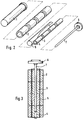
- FIG. 2 illustrates the essential components of the nickel / hydride cell according to the invention, namely the housing cup 1, four cathode rings 2, four anode cylinders 3 with bores 4, the separator 5 and the housing cover 6 with an arrester nail 7.
- FIG 3 shows the cell structure from the parts mentioned, including the separator sleeve 5, in a cross-sectional representation; the housing 1 surrounding the cell components is not shown.
- a particular advantage of the electrode compacts used according to the invention is that they are formed exclusively from positive or negative active material and no reinforcement, e.g. through an additional nickel mesh network. This contributes to a very considerable reduction in manufacturing costs.
- a manufacturing advantage for the new Ni / hydride round cell also results from the fact that largely standardized cell cups, cell covers, drainage nails and separators can be used for their production, as are common in the production of primary alkali manganese cells and are used in large quantities there , especially for the construction of the so-called Mignon cell.
- Their MnO2 rings are geometrically identical to the rings of the positive Ni (OH) 2 electrode in the Ni / hydride cell according to the invention.
- the fully cylindrical powder compacts for the negative hydride electrode can be produced with simple tools and drilled.
- the production of the cell according to the invention is very cost-effective not only because of the usability of existing cell components from primary production, but also because of the use of standard tools from this production area. No further procedural new developments are necessary, but adjustments to existing steps if necessary.
- Ni / hydride round cells of the AA (mignon) format according to the invention can achieve a maximum capacity of 2 Ah with a design ratio of pos.electrode / neg.electrode of 1 / 1.2.
- the current carrying capacity is lower than that of a comparable Ni / hydride winding cell. However, their maximum capacity is only 1.5 Ah.
- the separator Since, in the case of the Ni / hydride accumulator, unlike the Ni / Cd accumulator, no water is included in the current-supplying conversion equation, the separator experiences neither a total filling nor a total emptying of its pores from reaction water formed in the charging / discharging rhythm. The gas consumption is not interrupted, so that the separator fully meets the requirements for a gas-tight cell function despite the small relative volume and the low buffer capacity for water.
Landscapes
- Engineering & Computer Science (AREA)
- Manufacturing & Machinery (AREA)
- Chemical & Material Sciences (AREA)
- Chemical Kinetics & Catalysis (AREA)
- Electrochemistry (AREA)
- General Chemical & Material Sciences (AREA)
- Battery Electrode And Active Subsutance (AREA)
- Secondary Cells (AREA)
- Cell Electrode Carriers And Collectors (AREA)
Abstract
Bei einem gasdichten Ni/Hydrid-Akkumulator vom Rundzellentyp der Baugröße AA und mit Kmax = 2 Ah liegen beiden Elektrodenpolaritäten Masse-Elektroden in Form von Pulverpreßlingen zugrunde, wobei die positive Ni(OH)2-Elektrode aus einem Stapel ringförmiger Preßkörper (2), die negative Elektrode aus einem Stapel zylindrischer Preßkörper (3) aus einer Wasserstoffspeicherlegierung besteht und beide Stapel zusammen mit einem zwischenliegenden Separator (5) eine koaxiale Anordnung bilden, welche den Querschnitt des Gehäusebechers (1) vollständig ausfüllt. Die zylindrischen Preßkörper besitzen Bohrungen (4), in die sich der mit dem Deckel (6) verbundene Ableiternagel (7) beim Schließen der Zelle eindrückt. Die Herstellung der Zelle ist mit Standardbauteilen und Standardmethoden aus der Alkali-Mangan-Primärzellenproduktion (Typ Mignon) möglich und dadurch sehr kostengünstig. <IMAGE>
Description
- Die Erfindung betrifft einen gasdichten Nickel/Hydrid-Akkumulator vom Rundzellentyp mit einer positiven Nickelhydroxidelektrode, einer negativen Elektrode, deren aktives Material eine Wasserstoffspeicherlegierung umfaßt, und mit einem die Elektroden trennenden Separator.
- Den heute handelsüblichen Nickel/Hydrid-Akkumulatoren nach dem vorstehenden Gattungsbegriff liegt im allgemeinen das Konstruktionsprinzip der Wickelzelle zugrunde. Bei dieser bilden dünne, großflächige und flexible Elektroden zusammen mit einem zwischenliegenden Separator einen Wickel, der in einen zylindrischen Gehäusebecher aus vernickeltem Stahlblech eingesetzt ist. Ein Zellendeckel, der den Gehäusebecher dicht verschließt und gegen diesen isoliert ist, steht in elektrischem Kontakt zu einer der Wickelelektroden und bildet den einen Zellenpol, der Becherboden den anderen Zellenpol.
- Insoweit unterscheiden sich gebräuchliche Nickel/Hydrid-Akkumulatoren etwa der in der EP-PS 419221 beschriebenen Art grundsätzlich nicht von den bekannten Ni/Cd-Akkumulatoren in der Rundzellen-Ausführung. Allen darin verwendeten Elektroden ist gemeinsam, daß sie metallische Trägergerüste besitzen, auf welche das aktive Material mittels unterschiedlicher, teils aufwendiger Techniken aufgebracht ist. Die Elektroden des Ni/Cd-Akkumulators vom Rundzellentyp sind im allgemeinen Sinterelektroden, deren Träger aus einer dünnen, gelochten Nickelfolie mit aufgesintertem Nickelpulver besteht.
- Sowohl für die Elektroden des Ni/Cd-Akkumulators als auch für diejenigen des Ni/Hydrid-Akkumulators stehen aber auch andere Trägermaterialien wie feinmaschige Metallnetze, Streckmetalle oder Metallschaumgerüste zur Wahl. So lassen sich dank einer entwickelten Elektrodentechnologie durch Auswalzen einer Trockenmischung aus dem jeweiligen Aktivmaterial, z.B. eines H₂-speicherfähigen Legierungspulvers und eines Zusatzes von Leit- und Bindemitteln sehr dünne Laminate erzeugen und diese anschließend in ein Nickelnetz einwalzen. Auf ähnliche Weise werden Nickelhydroxidelektroden aus einer Trockenmischung von Nickelhydroxid mit Zusätzen u.a. von Nickelpulver und PTFE-Pulver als Bindemittel in Form von Walzelektroden hergestellt.
- Bei einer sogenannten Foam-Elektrode liegt ein Metallschaumträger, gewöhnlich aus Nickel, vor. Der Metallschaum zeichnet sich durch extrem hohe Porosität -sein Porenvolumen erreicht mindestens 95%- und durch ein hohes elektrisches Leitvermögen aus. In das offene Porensystem dieses Gerüstkörpers wird die Aktivmasse durch Einschlämmen oder Einpastieren eingebracht und die Elektrode anschließend getrocknet.
- Für die Stromableitung, die mechanische Festigkeit und Handhabbarkeit bei der Montage von Band- oder Wickelelektroden sind die eben genannten Metallarmierungen unerläßlich. Ihr Nachteil besteht allerdings in einem erheblichen Totgewicht und den Herstellkosten, welche die Elektroden insgesamt empfindlich verteuern.
- Diesen Nachteil besitzt auch eine aus der DE-OS 2256077 bekannte Sekundärzelle, deren Elektrodenbestückung aus zwei sinterkeramischen, porösen Metallrohren besteht, die dank einer leichten Konizität teleskopartig unter Zwischenlage eines Trennelements ineinandergesteckt sind und von denen das eine Rohr mit einem positiven, das andere Rohr mit einem negativen Aktivmaterial imprägniert ist. Durch den verbleibenden zylindrischen Hohlraum bei dieser Elektrodenanordnung weist die bekannte Rundzelle nicht nur ein erhebliches Totvolumen auf, sondern läßt auch wegen des umfangreichen metallischen Gerüstmaterials der Elektroden keine hohe Energiedichte erwarten.
- Schließlich ist aus dem VARTA-Fachbuch "Gasdichte Nickel-Cadmium-Akkumulatoren" (VDI Verlag GmbH, Düsseldorf, 1978), Seite 155/156, eine ganz ähnliche Anordnung von Masse-Elektroden in einer zylindrischen Zelle bekannt, nur mit dem Unterschied, daß positive und negative Elektrode nicht in Form von Rohren, sondern als zu Halbschalen geformte Pulverpreßlinge ineinandergefügt sind.
- Derartige alkalische Rundzellen haben sich beim Ni/Cd-System aber nicht durchgesetzt, weil ihre Strombelastbarkeit sich als unzureichend erwies. Hinzu kommt, daß das Separatorvolumen zwischen den beiden Masse-Elektroden, anders als bei einer Wickelzelle, nicht ausreicht, um gegenüber dem bei der Ladung gebildeten und bei der Entladung wieder verschwindenden Reaktionswasser eine notwendige Pufferung auszuüben. Der Separator hat entweder einen sehr geringen (entladener Zustand) oder sehr hohen (geladener Zustand) Eletrolyt-Füllgrad und würde im letzteren Fall den Gasverzehr in einer dichten Akkumulatorenzelle verhindern.
- Der Erfindung liegt daher die Aufgabe zugrunde, eine Nickel/Hydrid-Sekundärzelle verfügbar zu machen, die mit kostengünstigen Elektroden ausgestattet ist, jedoch in ihrer Strombelastbarkeit und in ihren Kapazitätsdaten den bisherigen Akkumulatoren des Rundzellentyps nicht nachsteht.
- Die Aufgabe wird erfindungsgemäß mit einem Nickel/Hydrid-Akkumulator gelöst, wie er in Patentanspruch 1 definiert ist.
- Danach hat es sich als günstig erwiesen, für beide Elektrodenpolaritäten der Akkumulatorenzelle Masse-Elektroden in Form von Pulverpreßlingen vorzusehen, die in dem zylindrischen Gehäusebecher koaxial ineinandergefügt angeordnet sind und zusammen mit einem zwischenliegenden Separator den Querschnitt des Gehäusebechers vollständig ausfüllen.
- Masse-Elektroden in Gestalt von Pulverpreßtabletten sind an sich die typischen Elektroden von Ni/Cd-Knopfzellen. Diese Zellen besitzen eine geringe Selbstentladung bei Nichtbenutzung und Lagerung, eignen sich aber nur für kleine und mittlere Belastungen. Dabei bedürfen selbst die in den Knopfzellen verwendeten Elektrodentabletten aus Ni(OH)₂- und Cd(OH)₂-Pulver aus Gründen der mechanischen Stabilität und der besseren Stromableitung einer Metallnetzarmierung, indem sie in ein Körbchen aus Nickeldrahtgewebe eingepreßt werden.
- Erfindungsgemäß kann jedoch jegliche metallische Ableitermatrix bei den neuen Elektroden entfallen.
- Besonders vorteilhaft wird die positive Elektrode des erfindungsgemäßen Nickel/Hydrid-Akkumulators aus einer Trockenmischung von Nickelhydroxid und Nickelmetallpulver sowie Zusätzen von Kobalt und/oder Kobalthydroxid und einem Bindemittel wie PTFE durch Formung zu ringförmigen Preßkörpern hergestellt, die als Stapel in den Gehäusebecher eingebracht und nochmals verpreßt werden, so daß sie eine röhrenförmige Kathode bilden.
- In den Hohlraum der Kathode wird als Anode ein vollzylindrischer Preßkörper, der aus einer Trockenmischung aus pulverförmiger Wasserstoffspeicherlegierung und Zusätzen von PTFE und Ruß besteht und von einem Separator umgeben ist, paßgenau eingesetzt. Der Querschnitt des Gehäusebechers wird durch diese Anordnung zweier Masse-Elektroden erschöpfend ausgenutzt.
- Zweckmäßig ist der Anoden-Preßkörper in eine gleiche Anzahl kleinerer Zylinder wie diejenige der Kathodenringe aufgeteilt. Zur Aufnahme eines Ableiternagels besitzen die Anodenzylinder zentrale Bohrungen, deren Durchmesser etwas kleiner als derjenige des Ableiternagels ist. Der Ableiternagel aus vernickeltem Kupfer oder Messing ist Teil des Gehäusedeckels.
- Nach Zudosieren des Elektrolyten wird der Gehäusebecher mit dem Deckel, der gegen den Becher elektrisch isoliert ist, fest verschlossen, wobei der Ableiternagel sich in alle Anoden-Zylinder eindrückt und damit ein fester Kontakt zur Hydridelektrode hergestellt wird.
- Anhand der Figuren wird der Gegenstand der Erfindung im folgenden verdeutlicht.
- Figur 1
- zeigt ein Fließschema für den prinzipiellen Fertigungsgang einer erfindungsgemäßen Ni/Hydrid-Zelle.
- Figur 2
- zeigt die Bestandteile einer erfindungsgemäßen Ni/Hydrid-Zelle in einer Übersicht.
- Figur 3
- Zeigt den Aufbau einer erfindungsgemäßen Ni/Hydrid-Zelle im Schnitt.
- Gemäß Fig. 1 bezeichnen die Positionen 1 bis 12 die verschiedenen Arbeitsgänge bei der Elektrodenfertigung sowie die darauffolgenden Stadien beim Zusammenbau der Zelle.
- So umfaßt die Herstellung der positiven Elektrode die Schritte:
- 1. Mischen von Ni(OH)₂, CoO und PTFE (oder PE)
- 2. Granulieren und Rückführen des anfallenden Feinanteils in das Mischgefäß
- 3. Pressen der Ringe
- 4. Einbringen der Ringe in den Becher.
- Parallel hierzu erfolgt die Herstellung der negativen Elektrode in den Schritten:
- 5. Mischen des Legierungsmaterials mit PTFE und Ruß
- 6. Granulieren und Rückführung des anfallenden Feinanteils in das Mischgefäß
- 7. Pressen der Zylinder
- 8. Verpacken der Zylinder in einen Separator
- Der Zellenbau setzt sich fort mit den Schritten:
- 9. Einbringen der Zylinder in den Becher
- 10. Eindosieren des Elektrolyten
- 11. Becher mit Deckel verschließen
- 12. Zelle aktivieren (laden).
- Fig. 2 veranschaulicht die wesentlichen Bestandteile der erfindungsgemäßen Nickel/Hydrid-Zelle, nämlich den Gehäusebecher 1, vier Kathodenringe 2, vier Anodenzylinder 3 mit Bohrungen 4, den Separator 5 und den Gehäusedeckel 6 mit Ableiternagel 7.
- Fig. 3 gibt den Zellenaufbau aus den genannten Teilen einschließlich der Separatorhülse 5 in einer Querschnittsdarstellung wieder, dabei ist das die Zellenbestandteile umgebende Gehäuse 1 nicht dargestellt.
- Ein besonderer Vorteil der erfindungsgemäß eingesetzten Elektrodenpreßlinge besteht darin, daß sie ausschließlich aus positiven bzw. negativen aktiven Material gebildet sind und keine Armierung, z.B. durch ein zusätzliches Nickelgewebenetz, besitzen. Dies trägt zu einer ganz erheblichen Verbilligung der Herstellkosten bei.
- Ein fertigungstechnischer Vorteil für die neue Ni/Hydrid-Rundzelle ergibt sich weiterhin daraus, daß zu ihrer Fertigung weitgehend standardisierte Zellenbecher, Zellendeckel, Ableiternägel und Separatoren verwendet werden können, wie sie in der Fertigung von primären Alkali-Manganzellen produktionsüblich sind und dort massenweise verwendet werden, namentlich für den Bau der sogenannten Mignon-Zelle. Deren MnO₂-Ringe sind mit den Ringen der positiven Ni(OH)₂-Elektrode in der erfindungsgemäßen Ni/Hydrid-Zelle geometrisch identisch. Die vollzylindrischen Pulverpreßlinge für die negative Hydridelektrode lassen sich mit einfachen Werkzeugen herstellen und mit Bohrungen versehen.
- Insgesamt gestaltet sich die Herstellung der erfindungsgemäßen Zelle nicht nur wegen der Verwertbarkeit bereits vorhandener Zellbauteile aus der Primärfertigung, sondern auch wegen der Einsetzbarkeit von Standardwerkzeugen aus diesem Produktionsbereich sehr kostengünstig. Es sind keine weiteren verfahrenstechnischen Neuentwicklungen notwendig, sondern allenfalls Anpassungen bestehender Schritte.
- Erfindungsgemäße Ni/Hydrid-Rundzellen vom Format AA (Mignon) können bei einem Auslegungsverhältnis Pos.Elektrode/Neg.Elektrode von 1/1,2 eine Kapazität von maximal 2 Ah erreichen.
- Die Strombelastbarkeit ist zwar geringer als bei einer vergleichbaren Ni/Hydrid-Wickelzelle. Deren Kapazitätsmaximum liegt jedoch bei nur 1,5 Ah.
- Da beim Ni/Hydrid-Akkumulator -anders als beim Ni/Cd-Akkumulator- kein Wasser in die stromliefernde Umsetzungsgleichung eingeht, erfährt der Separator weder eine totale Füllung noch eine totale Entleerung seiner Poren von im Lade-/Entladerhythmus gebildetem Reaktionswasser. Der Gasverzehr wird dadurch nicht unterbrochen, so daß der Separator trotz kleinen relativen Volumens und geringer Pufferkapazität für Wasser den Anforderungen für eine gasdichte Zellenfunktion vollauf genügt.
Claims (5)
- Gasdichter Nickel/Hydrid-Akkumulator vom Rundzellentyp mit einer positiven Nickelhydroxidelektrode, einer negativen Elektrode, deren aktives Material eine Wasserstoffspeicherlegierung umfaßt, und mit einem die Elektroden trennenden Separator, dadurch gekennzeichnet, daß beide Elektroden Masse-Elektroden in Form von Pulverpreßlingen sind, die koaxial ineinandergefügt angeordnet sind und zusammen mit einem zwischenliegenden Separator den Querschnitt des Gehäusebechers vollständig ausfüllen.
- Nickel/Hydrid-Akkumulator nach Anspruch 1, dadurch gekennzeichnet, daß die positive Elektrode aus ringzylindrischen Pulverpreßlingen (2) besteht, die als Stapel in das zylindrische Gehäuse (1) eingepreßt sind und eine röhrenförmige Kathode bilden, und daß der Innenraum der röhrenförmigen Kathode unter Zwischenlage des Separators durch das gepreßte aktive Material der negativen Elektrode ausgefüllt ist.
- Nickel/Hydrid-Akkumulator nach Anspruch 2, dadurch gekennzeichnet, daß die negative Elektrode aus zylinderförmigen Pulverpreßlingen eines wasserstoffspeichernden Legierungsmaterials gebildet ist, die ebenfalls einen Stapel bilden und welche zur Aufnahme eines Stromableiters zentrische Bohrungen (4) besitzen.
- Nickel/Hydrid-Akkumulator nach Anspruch 3, dadurch gekennzeichnet, daß der Stromableiter der negativen Elektrode aus einem an den Gehäusedeckel (6) angeschweißten Nagel (7) besteht, der in die zentrischen Bohrungen der negativen Elektrode eingedrückt ist.
- Nickel/Hydrid-Akkumulator nach einem der Ansprüche 1 bis 4, dadurch gekennzeichnet, daß der Pulverpreßkörper der positiven Elektrode aus einer Trockenmischung von Nickelhydroxid, Nickelmetallpulver sowie Zusätzen von Kobaltmetallpulver und/oder Kobalthydroxid gebildet ist.
Applications Claiming Priority (2)
| Application Number | Priority Date | Filing Date | Title |
|---|---|---|---|
| DE4417732 | 1994-05-20 | ||
| DE4417732A DE4417732A1 (de) | 1994-05-20 | 1994-05-20 | Gasdichter Nickel/Hydrid-Akkumulator vom Rundzellentyp |
Publications (1)
| Publication Number | Publication Date |
|---|---|
| EP0689259A1 true EP0689259A1 (de) | 1995-12-27 |
Family
ID=6518602
Family Applications (1)
| Application Number | Title | Priority Date | Filing Date |
|---|---|---|---|
| EP95104024A Withdrawn EP0689259A1 (de) | 1994-05-20 | 1995-03-18 | Gasdichter Nickel/Hydrid-Akkumulator vom Rundzellentyp |
Country Status (5)
| Country | Link |
|---|---|
| EP (1) | EP0689259A1 (de) |
| JP (1) | JPH07320774A (de) |
| KR (1) | KR950034881A (de) |
| CN (1) | CN1115123A (de) |
| DE (1) | DE4417732A1 (de) |
Cited By (3)
| Publication number | Priority date | Publication date | Assignee | Title |
|---|---|---|---|---|
| WO2000024069A1 (en) * | 1998-10-19 | 2000-04-27 | Eveready Battery Company, Inc. | Electrode for an electrochemical cell |
| EP1139477A4 (de) * | 1999-09-16 | 2005-06-29 | Matsushita Electric Industrial Co Ltd | Abgedichtete zylindrische nickel-wasserstoffspeicherbatterie |
| US8357465B2 (en) | 2007-02-16 | 2013-01-22 | Varta Microbattery Gmbh | Galvanic element with a high capacity |
Families Citing this family (2)
| Publication number | Priority date | Publication date | Assignee | Title |
|---|---|---|---|---|
| JP4767515B2 (ja) * | 2004-09-08 | 2011-09-07 | 古河電池株式会社 | ポケット式水素吸蔵合金極及びニッケル/水素蓄電池 |
| KR100749655B1 (ko) * | 2005-12-20 | 2007-08-14 | 삼성에스디아이 주식회사 | 배터리 팩 |
Citations (4)
| Publication number | Priority date | Publication date | Assignee | Title |
|---|---|---|---|---|
| DE2256077A1 (de) * | 1971-12-13 | 1973-06-20 | Gould Inc | Elektrodenanordnung fuer eine sekundaerzelle |
| EP0419220A1 (de) * | 1989-09-18 | 1991-03-27 | Toshiba Battery Co., Ltd. | Nickel-Metallhydridsekundärzelle |
| EP0419221A2 (de) * | 1989-09-18 | 1991-03-27 | Toshiba Battery Co., Ltd. | Sekundäre Nickel-Metallhydrid-Zelle |
| WO1992020111A1 (en) * | 1991-05-07 | 1992-11-12 | Battery Technologies Inc. | Recombination of evolved oxygen in galvanic cells using transfer anode materials |
-
1994
- 1994-05-20 DE DE4417732A patent/DE4417732A1/de not_active Ceased
-
1995
- 1995-03-18 EP EP95104024A patent/EP0689259A1/de not_active Withdrawn
- 1995-03-31 KR KR1019950007177A patent/KR950034881A/ko not_active Withdrawn
- 1995-05-18 JP JP7120285A patent/JPH07320774A/ja active Pending
- 1995-05-19 CN CN95105490A patent/CN1115123A/zh active Pending
Patent Citations (5)
| Publication number | Priority date | Publication date | Assignee | Title |
|---|---|---|---|---|
| DE2256077A1 (de) * | 1971-12-13 | 1973-06-20 | Gould Inc | Elektrodenanordnung fuer eine sekundaerzelle |
| FR2163557A1 (de) * | 1971-12-13 | 1973-07-27 | Gould Inc | |
| EP0419220A1 (de) * | 1989-09-18 | 1991-03-27 | Toshiba Battery Co., Ltd. | Nickel-Metallhydridsekundärzelle |
| EP0419221A2 (de) * | 1989-09-18 | 1991-03-27 | Toshiba Battery Co., Ltd. | Sekundäre Nickel-Metallhydrid-Zelle |
| WO1992020111A1 (en) * | 1991-05-07 | 1992-11-12 | Battery Technologies Inc. | Recombination of evolved oxygen in galvanic cells using transfer anode materials |
Cited By (3)
| Publication number | Priority date | Publication date | Assignee | Title |
|---|---|---|---|---|
| WO2000024069A1 (en) * | 1998-10-19 | 2000-04-27 | Eveready Battery Company, Inc. | Electrode for an electrochemical cell |
| EP1139477A4 (de) * | 1999-09-16 | 2005-06-29 | Matsushita Electric Industrial Co Ltd | Abgedichtete zylindrische nickel-wasserstoffspeicherbatterie |
| US8357465B2 (en) | 2007-02-16 | 2013-01-22 | Varta Microbattery Gmbh | Galvanic element with a high capacity |
Also Published As
| Publication number | Publication date |
|---|---|
| DE4417732A1 (de) | 1995-11-23 |
| CN1115123A (zh) | 1996-01-17 |
| KR950034881A (ko) | 1995-12-28 |
| JPH07320774A (ja) | 1995-12-08 |
Similar Documents
| Publication | Publication Date | Title |
|---|---|---|
| DE3854727T2 (de) | Gasdichte Nickel-Hydridbatterie und Verfahren zur Herstellung. | |
| DE60319999T2 (de) | Batterie mit erhöhter elektrodenoberfläche und mit erhöhter aktivmaterial-dichte | |
| DE69014183T2 (de) | Nickel-Metallhydridsekundärzelle. | |
| DE69220030T2 (de) | Mechanisch wiederaufladbare Batterien und darin verwendbare Anoden | |
| DE4427218C2 (de) | Wiederaufladbare elektrochemische Hochtemperaturzelle | |
| EP3435449B1 (de) | Sekundäre elektrochemische zelle | |
| DE2811183A1 (de) | Metalloxid-wasserstoff-batterie | |
| DE60126039T2 (de) | Spiralförmig aufgerollte Elektroden mit Separator und mit diesen versehene Batterien | |
| DE60129273T2 (de) | Rechteckige alkalische Batterie und Batteriemodul und Batterie-Pack zu seiner Verwendung | |
| EP2122710B1 (de) | Galvanisches element mit hoher kapazität | |
| DE2907262C2 (de) | Geschlossene wartungsfreie Zelle bzw. Batterie | |
| US3170820A (en) | Method of making duplex electrodes for high rate primary batteries | |
| DE4305560A1 (de) | Gasdicht verschlossener Nickel/Hydrid-Akkumulator | |
| DE2544312C3 (de) | Gas- und fltissigkeitsdicht verschlossener alkalischer Akkumulator | |
| DE2261378B2 (de) | Poroese negative kobaltelektrode fuer alkalische akkumulatoren und verfahren zu ihrer herstellung | |
| DE3208011A1 (de) | Elektrochemische zelle | |
| US4383015A (en) | Iron-silver battery having a shunt electrode | |
| DE69702941T2 (de) | Bipolares Element für Batterie mit Gas-Depolarisation | |
| EP0689259A1 (de) | Gasdichter Nickel/Hydrid-Akkumulator vom Rundzellentyp | |
| EP0698937B1 (de) | Gasdicht verschlossener Metalloxid/Metallhydrid-Akkumulator | |
| DE69836660T2 (de) | Alkalische aufladbare Batterie | |
| EP0658949B1 (de) | Gasdicht verschlossener alkalischer Akkumulator in Form einer Knopfzelle | |
| DE102015207552A1 (de) | Sauerstoff-Kathode mit schwammartiger Kohlenstoffgerüststruktur | |
| DE1421623B2 (de) | Verfahren zur Herstellung einer Duplexelektrode | |
| US6653023B1 (en) | Rectangular battery |
Legal Events
| Date | Code | Title | Description |
|---|---|---|---|
| PUAI | Public reference made under article 153(3) epc to a published international application that has entered the european phase |
Free format text: ORIGINAL CODE: 0009012 |
|
| AK | Designated contracting states |
Kind code of ref document: A1 Designated state(s): BE DE FR GB NL |
|
| 17P | Request for examination filed |
Effective date: 19960125 |
|
| 17Q | First examination report despatched |
Effective date: 19960808 |
|
| STAA | Information on the status of an ep patent application or granted ep patent |
Free format text: STATUS: THE APPLICATION IS DEEMED TO BE WITHDRAWN |
|
| 18D | Application deemed to be withdrawn |
Effective date: 19961219 |