EP0686410B1 - Feuerlöscher - Google Patents
Feuerlöscher Download PDFInfo
- Publication number
- EP0686410B1 EP0686410B1 EP95107190A EP95107190A EP0686410B1 EP 0686410 B1 EP0686410 B1 EP 0686410B1 EP 95107190 A EP95107190 A EP 95107190A EP 95107190 A EP95107190 A EP 95107190A EP 0686410 B1 EP0686410 B1 EP 0686410B1
- Authority
- EP
- European Patent Office
- Prior art keywords
- propellant
- extinguisher
- extinguishing
- fire extinguisher
- liquid
- Prior art date
- Legal status (The legal status is an assumption and is not a legal conclusion. Google has not performed a legal analysis and makes no representation as to the accuracy of the status listed.)
- Expired - Lifetime
Links
Images

Classifications
-
- A—HUMAN NECESSITIES
- A62—LIFE-SAVING; FIRE-FIGHTING
- A62C—FIRE-FIGHTING
- A62C13/00—Portable extinguishers which are permanently pressurised or pressurised immediately before use
- A62C13/66—Portable extinguishers which are permanently pressurised or pressurised immediately before use with extinguishing material and pressure gas being stored in separate containers
Definitions
- the invention relates to a fire extinguisher for liquid extinguishing agents Quick mixing.
- Extinguishing agent additives e.g. surfactants
- One way to do this is to Add extinguishing agent in a special container to the extinguisher and propellant from a propellant reservoir through this container to lead into the extinguisher.
- a container is arranged in the extinguisher itself, which is provided with a bursting film, so that when the Löschers destroyed the container with the propellant and the Extinguishing agent additive is introduced into the extinguishing agent.
- a fire extinguisher for liquid extinguishing agents is known according to the preamble of claim 1, in which the extinguishing agent is pressurized by the use of the propellant CO 2 and is expelled from the fire extinguisher.
- the compressed propellant is located in a storage container which is connected to the extinguishing agent container on the side of the extinguishing agent container via a propellant guide tube.
- the CO 2 leaves the outlet openings cold and with powerful jets and is quickly distributed in the extinguishing agent.
- the propellant pipe with a nozzle head at its outlet end has a plurality of openings of small diameter.
- little Diameter means the diameter of the outlet openings is significantly smaller than the diameter of the propellant tube.
- a nozzle head that is an independent part with the Propellant guide tube is connected, facilitates assembly and the Adaptation to different extinguishing agents.
- CO 2 is preferably used as the blowing agent in the previously customary manner. However, this does not mean that the invention is fundamentally dependent on the use of CO 2 . Instead of CO 2 , other blowing agents can also be used.
- the propellant pipe is on Extinguisher head attached.
- the assembly effort for Assembly of the extinguisher significantly reduced.
- all essential components, namely propellant reservoir and Extinguishing agent guide tube, on the extinguisher head see DE-A-30 06 945.
- the inside of the extinguisher arranged container for the extinguishing agent additive can on the surface of the liquid extinguishing agent can be provided floating or on Extinguishing agent head can be attached.
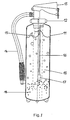
- FIG. 1 An embodiment is shown schematically in Fig. 1.
- the Fire extinguisher 11 has an extinguisher head 12 which is connected to a Operating handle 13 and a hose 14 for dispensing the Extinguishing agent is provided.
- Inside the extinguisher 11 is on the Extinguishing head 12 of the propellant reservoir 15 arranged.
- the storage container can also be on the outside of the extinguisher 11 to be appropriate.
- the propellant guide tube is on the extinguisher head 12 16 attached, which at its outlet end Nozzle head 17 with a plurality of small openings Has diameter.
- a riser pipe is attached (not shown in the drawing) that down to the bottom Area of the reservoir 15 is sufficient.
- the propellant is in the riser after the extinguisher has been triggered by the extinguisher head 12 passed into the propellant guide tube 16 and enters the nozzle head 17 in the extinguishing liquid 19 a.
- Additions to the extinguishing liquid are at this embodiment preferably by a in the Extinguishing liquid floating (not shown in the drawing) Cartridge with a bursting film, which is applied when the extinguisher is loaded Propellant burst from the propellant reservoir 18.
- the propellant guide tube can also be used in Connection with premixed extinguishing agents can be used.
- no separate container is required for an extinguishing agent additive. This is already mixed into the extinguishing agent.
- premixed extinguishing agent has been the use of a Propellant pipe proved to be advantageous. This can be due to this be attributed to separations in the premixed solutions done by the targeted vortexing of the liquid will.
- Through targeted geometric execution of the Propellant pipe and the outlet openings attached to it can the strength of the swirling of the extinguishing agent and thus the Mixing can be set. Depending on the requirement, this is possible Propellant pipe only a few millimeters into the liquid or sufficient almost to the bottom of the extinguisher.
- Fig. 2 schematically shown pressure curve over time.
- the pressure determines essential properties of the extinguishing jet, e.g. B. the Drop size, the drop size distribution, the foaming, above all but the throw range.
- the disproportionate in the entire area of the curve Decrease has the consequence that in the event of fire, which anyway represents a stressful situation, a misconduct in the deletion action can occur.
- the disproportionately decreasing throw range leads to the fact that, especially inexperienced fire fighting personnel, the orientation of the Do not adjust the extinguishing jet optimally to match the throw range can.
- the amount of propellant be greater than that free volume in the fire extinguisher calculated working pressure and density Amount of propellant is increased.
- blowing agent of 70-150 g are preferably used.
- blowing agent in an excess the foaming rate increases (ratio of the foaming agent to produced foam) by a factor of 4-5. This usually means a significant improvement in extinguishing performance.
- Another advantage of the preferred embodiment is that in the bubbles contained in the foam have an increased proportion of blowing agent is included so that reinforced instead of combustion support Breathing air in the room a nitrogen gas mixture is transported into the fire. This also supports the deletion process.
- the pressure loss over time (schematically shown in Fig. 3) has a linear over a wide range Course on. This will ensure the successful handling of the extinguisher significantly supported.
- the deletion process is evened out in achieved even better solution when in the propellant reservoir a riser pipe is arranged through which the extinguishing agent a blowing agent present in predominantly liquid form brought.
Landscapes
- Health & Medical Sciences (AREA)
- Public Health (AREA)
- Business, Economics & Management (AREA)
- Emergency Management (AREA)
- Fire-Extinguishing By Fire Departments, And Fire-Extinguishing Equipment And Control Thereof (AREA)
- Fire-Extinguishing Compositions (AREA)
- Fireproofing Substances (AREA)
Description
- Fig. 1
- ein Ausführungsbeispiel eines erfindungsgemäßen Feuerlöschers
- Fig. 2
- eine schematische Darstellung des Druckverlaufs bei herkömmlichen Feuerlöschern
- Fig. 3
- eine schematische Darstellung des Druckverlaufs bei erhöhter Menge an Treibmittel.
Claims (6)
- Feuerlöscher (11) für flüssige Löschmittel, bestehend aus einem Gehäuse, einem Löscherkopf (12) und einem Treibmittelvorratsbehälter (15), wobei ein Treibmittelführungsrohr (16) in die Löschmittelfüllung (19) hineinragt, wobei wenigstens eine Auslaßöffnung in die Löschmittelfüllung (19) eingetaucht ist und eine oder mehrere Auslaßöffnungen am Treibmittelführungsrohr (16) seitlich angeordnet sind, dadurch gekennzeichnet, daß das
Treibmittelführungsrohr (16) an seinem Auslaßende einen Düsenkopf (17) mit einer Mehrzahl von Öffnungen geringen Durchmessers aufweist. - Feuerlöscher für flüssige Löschmittel mit Treibmittel-Vorratsbehälter, nach Anspruch 1, dadurch gekennzeichnet, daß
die Menge an Treibmittel gegenüber der aus dem freiem Volumen im Löscher, einem Arbeitsdruck von 15 bar und der Dichte des Treibmittels errechneten Treibmittelmenge erhöht ist. - Feuerlöscher für flüssige Löschmittel mit Treibmittel-Vorratsbehälter mit wenigstens einer der Löschmittelfüllung zugewandten Treibmittel-Auslaßöffnung nach Anspruch 2, dadurch gekennzeichnet, daß
das Treibmittel aus dem Vorratsbehälter beim Eintritt in die Löschflüssigkeit im wesentlichen flüssig ist. - Feuerlöscher nach einem der Ansprüche 2 oder 3,
dadurch gekennzeichnet, daß
im Vorratsbehälter des Löschers ein Steigrohr angeordnet ist. - Feuerlöscher nach einem der Ansprüche 1 bis 4,
dadurch gekennzeichnet, daß
der Treibmittelvorratsbehälter (15) und das Treibmittelführungsrohr (16) am Löscherkopf (12) befestigt sind. - Feuerlöscher nach einem der Ansprüche 2 bis 5,
dadurch gekennzeichnet, daß
ein Treibmittel mit guter Löslichkeit in der Löschflüssigkeit, insbesondere CO2, angeordnet ist.
Applications Claiming Priority (4)
| Application Number | Priority Date | Filing Date | Title |
|---|---|---|---|
| DE9407753U | 1994-05-11 | ||
| DE9407753U DE9407753U1 (de) | 1994-05-11 | 1994-05-11 | Feuerlöscher mit Schnelldurchmischung |
| DE29505581U DE29505581U1 (de) | 1995-04-07 | 1995-04-07 | Feuerlöscher mit erhöhter Treibmittelmenge |
| DE9505581U | 1995-04-07 |
Publications (3)
| Publication Number | Publication Date |
|---|---|
| EP0686410A2 EP0686410A2 (de) | 1995-12-13 |
| EP0686410A3 EP0686410A3 (de) | 1996-06-05 |
| EP0686410B1 true EP0686410B1 (de) | 1998-06-24 |
Family
ID=25962058
Family Applications (1)
| Application Number | Title | Priority Date | Filing Date |
|---|---|---|---|
| EP95107190A Expired - Lifetime EP0686410B1 (de) | 1994-05-11 | 1995-05-11 | Feuerlöscher |
Country Status (5)
| Country | Link |
|---|---|
| EP (1) | EP0686410B1 (de) |
| AT (1) | ATE167635T1 (de) |
| DE (1) | DE59502638D1 (de) |
| DK (1) | DK0686410T3 (de) |
| ES (1) | ES2118473T3 (de) |
Families Citing this family (2)
| Publication number | Priority date | Publication date | Assignee | Title |
|---|---|---|---|---|
| NL1008969C2 (nl) * | 1998-04-23 | 1999-10-26 | H T Research B V | Werkwijze voor het blussen van een brand. |
| FR2779656B1 (fr) * | 1998-06-15 | 2000-08-11 | Extincteurs Harden | Tube detasseur pour extincteur a gaz auxiliaire propulseur de poudre extinctrice, tete d'extincteur associee audit tube et extincteur comprenant une telle tete |
Family Cites Families (5)
| Publication number | Priority date | Publication date | Assignee | Title |
|---|---|---|---|---|
| FR969186A (fr) * | 1948-07-13 | 1950-12-15 | Centrale Incendie | Extincteur d'incendie, notamment pour films cinématographiques |
| GB911232A (en) * | 1958-06-07 | 1962-11-21 | John Kerr & Company Manchester | Improvements in or relating to fire extinguishers |
| GB1478602A (en) * | 1975-11-10 | 1977-07-06 | Rampart Eng Co Ltd | Powder type portable fire extinguishers |
| DE3006945A1 (de) * | 1980-02-25 | 1981-09-03 | A. Werner GmbH & Co Spezialfabrik für Feuerlöschtechnik, 5414 Vallendar | Feuerloescher |
| FR2662608B1 (fr) * | 1990-06-05 | 1992-09-11 | Rot | Cartouche frangible pour additifs d'extinction dans des extincteurs a eau mise sous pression au moment de l'emploi par un gaz comprime. |
-
1995
- 1995-05-11 AT AT95107190T patent/ATE167635T1/de active
- 1995-05-11 EP EP95107190A patent/EP0686410B1/de not_active Expired - Lifetime
- 1995-05-11 DE DE59502638T patent/DE59502638D1/de not_active Expired - Lifetime
- 1995-05-11 DK DK95107190T patent/DK0686410T3/da active
- 1995-05-11 ES ES95107190T patent/ES2118473T3/es not_active Expired - Lifetime
Also Published As
| Publication number | Publication date |
|---|---|
| EP0686410A2 (de) | 1995-12-13 |
| ATE167635T1 (de) | 1998-07-15 |
| ES2118473T3 (es) | 1998-09-16 |
| DE59502638D1 (de) | 1998-07-30 |
| DK0686410T3 (da) | 1999-02-01 |
| EP0686410A3 (de) | 1996-06-05 |
Similar Documents
| Publication | Publication Date | Title |
|---|---|---|
| DE69709057T2 (de) | Feuerbekämpfungseinrichtung | |
| DE69210603T2 (de) | Ausrüstung zur brandbekämpfung | |
| DE69319915T2 (de) | Düse mit einer die flüssigkeit zum verwirbeln bringenden schraubenfeder | |
| DE3313855C1 (de) | Beatmungssystem | |
| DE3517284C2 (de) | Verfahren und Vorrichtung zum Herstellen und zur Abgabe von mit einem Zusatzmittel vermischten Löschmitteln | |
| DE29522033U1 (de) | Vorrichtung zum Impuls-Medien-Austrag | |
| EP3337576B1 (de) | Feuerlöscher | |
| DE202017102091U1 (de) | Brandlöschlanze | |
| DE4490297B4 (de) | Mit einem druckgesteuerten Ventil versehener Sprühkopf | |
| DE69900183T2 (de) | Anriebsquelle zur zuführung eines löschmittels zu einem sprühknopf zum löschen eines feuers | |
| DE69732144T2 (de) | Feuerlöschsystem | |
| DE2733601C3 (de) | Chemikalsauerstoffgerät mit Kreislaufatmung | |
| DE69704648T2 (de) | Regler für Tauchatmungsgerät | |
| DE2600295C3 (de) | Flammspritzbrenner zum Pulverflammspritzen | |
| EP0686410A2 (de) | Feuerlöscher | |
| DE4127886C2 (de) | Strahlkopf | |
| DE3933582A1 (de) | Werferrohr | |
| DE4209353C2 (de) | Feuchtstrahlanlage mit einer Strahlpistole | |
| DE631477C (de) | Luftschaumerzeuger fuer Feuerloeschzwecke | |
| DE29505581U1 (de) | Feuerlöscher mit erhöhter Treibmittelmenge | |
| EP3991805B1 (de) | Schaumzufuhreinrichtung | |
| EP0968049B1 (de) | Verfahren und vorrichtung zum austragen eines in einer flüssigkeit gelösten oder fein verteilten mediums | |
| EP0704229B1 (de) | Verfahren und Vorrichtung zum impulsförmigen Austragen einer Flüssigkeit, insbesondere eines Feuerlöschmittels | |
| DE656835C (de) | Sauerstoffatemschutzgeraet | |
| DE9407753U1 (de) | Feuerlöscher mit Schnelldurchmischung |
Legal Events
| Date | Code | Title | Description |
|---|---|---|---|
| PUAI | Public reference made under article 153(3) epc to a published international application that has entered the european phase |
Free format text: ORIGINAL CODE: 0009012 |
|
| 17P | Request for examination filed |
Effective date: 19950612 |
|
| AK | Designated contracting states |
Kind code of ref document: A2 Designated state(s): AT BE CH DE DK ES FR GB IE IT LI NL PT SE |
|
| PUAL | Search report despatched |
Free format text: ORIGINAL CODE: 0009013 |
|
| AK | Designated contracting states |
Kind code of ref document: A3 Designated state(s): AT BE CH DE DK ES FR GB IE IT LI NL PT SE |
|
| 17Q | First examination report despatched |
Effective date: 19961017 |
|
| GRAG | Despatch of communication of intention to grant |
Free format text: ORIGINAL CODE: EPIDOS AGRA |
|
| GRAG | Despatch of communication of intention to grant |
Free format text: ORIGINAL CODE: EPIDOS AGRA |
|
| GRAH | Despatch of communication of intention to grant a patent |
Free format text: ORIGINAL CODE: EPIDOS IGRA |
|
| GRAH | Despatch of communication of intention to grant a patent |
Free format text: ORIGINAL CODE: EPIDOS IGRA |
|
| GRAA | (expected) grant |
Free format text: ORIGINAL CODE: 0009210 |
|
| AK | Designated contracting states |
Kind code of ref document: B1 Designated state(s): AT BE CH DE DK ES FR GB IE IT LI NL PT SE |
|
| REF | Corresponds to: |
Ref document number: 167635 Country of ref document: AT Date of ref document: 19980715 Kind code of ref document: T |
|
| REG | Reference to a national code |
Ref country code: CH Ref legal event code: EP |
|
| REF | Corresponds to: |
Ref document number: 59502638 Country of ref document: DE Date of ref document: 19980730 |
|
| REG | Reference to a national code |
Ref country code: ES Ref legal event code: FG2A Ref document number: 2118473 Country of ref document: ES Kind code of ref document: T3 |
|
| REG | Reference to a national code |
Ref country code: IE Ref legal event code: FG4D Free format text: GERMAN |
|
| GBT | Gb: translation of ep patent filed (gb section 77(6)(a)/1977) |
Effective date: 19980921 |
|
| ET | Fr: translation filed | ||
| REG | Reference to a national code |
Ref country code: PT Ref legal event code: SC4A Free format text: AVAILABILITY OF NATIONAL TRANSLATION Effective date: 19980924 |
|
| REG | Reference to a national code |
Ref country code: DK Ref legal event code: T3 |
|
| PLBE | No opposition filed within time limit |
Free format text: ORIGINAL CODE: 0009261 |
|
| STAA | Information on the status of an ep patent application or granted ep patent |
Free format text: STATUS: NO OPPOSITION FILED WITHIN TIME LIMIT |
|
| 26N | No opposition filed | ||
| PGFP | Annual fee paid to national office [announced via postgrant information from national office to epo] |
Ref country code: SE Payment date: 20000417 Year of fee payment: 6 |
|
| PGFP | Annual fee paid to national office [announced via postgrant information from national office to epo] |
Ref country code: PT Payment date: 20000419 Year of fee payment: 6 |
|
| PGFP | Annual fee paid to national office [announced via postgrant information from national office to epo] |
Ref country code: ES Payment date: 20000509 Year of fee payment: 6 |
|
| PG25 | Lapsed in a contracting state [announced via postgrant information from national office to epo] |
Ref country code: SE Free format text: LAPSE BECAUSE OF NON-PAYMENT OF DUE FEES Effective date: 20010512 Ref country code: ES Free format text: LAPSE BECAUSE OF NON-PAYMENT OF DUE FEES Effective date: 20010512 |
|
| PG25 | Lapsed in a contracting state [announced via postgrant information from national office to epo] |
Ref country code: PT Free format text: LAPSE BECAUSE OF NON-PAYMENT OF DUE FEES Effective date: 20011130 |
|
| REG | Reference to a national code |
Ref country code: GB Ref legal event code: IF02 |
|
| REG | Reference to a national code |
Ref country code: PT Ref legal event code: MM4A Free format text: LAPSE DUE TO NON-PAYMENT OF FEES Effective date: 20011130 |
|
| REG | Reference to a national code |
Ref country code: ES Ref legal event code: FD2A Effective date: 20030303 |
|
| BECN | Be: change of holder's name |
Owner name: *MINIMAX HOLDING G.M.B.H. & CO. K.G. Effective date: 20050928 |
|
| REG | Reference to a national code |
Ref country code: GB Ref legal event code: 732E |
|
| REG | Reference to a national code |
Ref country code: CH Ref legal event code: PUE Owner name: MINIMAX MOBILE SERVICES GMBH & CO. KG Free format text: MINIMAX GMBH & CO. KG#INDUSTRIESTRASSE 10-12#23843 BAD OLDESLOE (DE) -TRANSFER TO- MINIMAX MOBILE SERVICES GMBH & CO. KG#INDUSTRIESTRASSE 10-12#23843 BAD OLDESLOE (DE) Ref country code: CH Ref legal event code: PFA Owner name: MINIMAX GMBH & CO. KG Free format text: MINIMAX GMBH#INDUSTRIESTRASSE 10 - 12#23843 BAD OLDESLOE (DE) -TRANSFER TO- MINIMAX GMBH & CO. KG#INDUSTRIESTRASSE 10-12#23843 BAD OLDESLOE (DE) |
|
| NLS | Nl: assignments of ep-patents |
Owner name: MIMX HOLDINGS GMBH & CO. KG Effective date: 20060307 Owner name: MINIMAX HOLDING GMBH Effective date: 20060307 |
|
| NLT1 | Nl: modifications of names registered in virtue of documents presented to the patent office pursuant to art. 16 a, paragraph 1 |
Owner name: MINIMAX GMBH & CO KG |
|
| REG | Reference to a national code |
Ref country code: FR Ref legal event code: TP Ref country code: FR Ref legal event code: CD |
|
| REG | Reference to a national code |
Ref country code: GB Ref legal event code: 732E |
|
| NLS | Nl: assignments of ep-patents |
Owner name: MINIMAX MOBILE SERVICES GMBH & CO. KG Effective date: 20060627 |
|
| REG | Reference to a national code |
Ref country code: FR Ref legal event code: TP |
|
| BECA | Be: change of holder's address |
Owner name: *MINIMAX MOBILE SERVICES G.M.B.H. & CO. K.G.MINIMA Effective date: 20050928 |
|
| BECH | Be: change of holder |
Owner name: *MINIMAX MOBILE SERVICES G.M.B.H. & CO. K.G. Effective date: 20050928 |
|
| BECN | Be: change of holder's name |
Owner name: *MINIMAX MOBILE SERVICES G.M.B.H. & CO. K.G. Effective date: 20050928 |
|
| PGFP | Annual fee paid to national office [announced via postgrant information from national office to epo] |
Ref country code: NL Payment date: 20120531 Year of fee payment: 18 Ref country code: DK Payment date: 20120521 Year of fee payment: 18 Ref country code: IE Payment date: 20120522 Year of fee payment: 18 Ref country code: CH Payment date: 20120523 Year of fee payment: 18 |
|
| PGFP | Annual fee paid to national office [announced via postgrant information from national office to epo] |
Ref country code: BE Payment date: 20120524 Year of fee payment: 18 Ref country code: FR Payment date: 20120601 Year of fee payment: 18 Ref country code: GB Payment date: 20120522 Year of fee payment: 18 |
|
| PGFP | Annual fee paid to national office [announced via postgrant information from national office to epo] |
Ref country code: IT Payment date: 20120528 Year of fee payment: 18 |
|
| PGFP | Annual fee paid to national office [announced via postgrant information from national office to epo] |
Ref country code: AT Payment date: 20120511 Year of fee payment: 18 |
|
| PGFP | Annual fee paid to national office [announced via postgrant information from national office to epo] |
Ref country code: DE Payment date: 20130527 Year of fee payment: 19 |
|
| BERE | Be: lapsed |
Owner name: *MINIMAX MOBILE SERVICES G.M.B.H. & CO. K.G. Effective date: 20130531 |
|
| REG | Reference to a national code |
Ref country code: NL Ref legal event code: V1 Effective date: 20131201 |
|
| REG | Reference to a national code |
Ref country code: CH Ref legal event code: PL |
|
| GBPC | Gb: european patent ceased through non-payment of renewal fee |
Effective date: 20130511 |
|
| PG25 | Lapsed in a contracting state [announced via postgrant information from national office to epo] |
Ref country code: LI Free format text: LAPSE BECAUSE OF NON-PAYMENT OF DUE FEES Effective date: 20130531 Ref country code: CH Free format text: LAPSE BECAUSE OF NON-PAYMENT OF DUE FEES Effective date: 20130531 |
|
| REG | Reference to a national code |
Ref country code: DK Ref legal event code: EBP Effective date: 20130531 |
|
| REG | Reference to a national code |
Ref country code: IE Ref legal event code: MM4A |
|
| PG25 | Lapsed in a contracting state [announced via postgrant information from national office to epo] |
Ref country code: IT Free format text: LAPSE BECAUSE OF NON-PAYMENT OF DUE FEES Effective date: 20130511 Ref country code: BE Free format text: LAPSE BECAUSE OF NON-PAYMENT OF DUE FEES Effective date: 20130531 Ref country code: NL Free format text: LAPSE BECAUSE OF NON-PAYMENT OF DUE FEES Effective date: 20131201 |
|
| REG | Reference to a national code |
Ref country code: FR Ref legal event code: ST Effective date: 20140131 |
|
| PG25 | Lapsed in a contracting state [announced via postgrant information from national office to epo] |
Ref country code: GB Free format text: LAPSE BECAUSE OF NON-PAYMENT OF DUE FEES Effective date: 20130511 Ref country code: IE Free format text: LAPSE BECAUSE OF NON-PAYMENT OF DUE FEES Effective date: 20130511 Ref country code: DK Free format text: LAPSE BECAUSE OF NON-PAYMENT OF DUE FEES Effective date: 20130531 |
|
| PG25 | Lapsed in a contracting state [announced via postgrant information from national office to epo] |
Ref country code: FR Free format text: LAPSE BECAUSE OF NON-PAYMENT OF DUE FEES Effective date: 20130531 |
|
| REG | Reference to a national code |
Ref country code: DE Ref legal event code: R119 Ref document number: 59502638 Country of ref document: DE |
|
| REG | Reference to a national code |
Ref country code: AT Ref legal event code: MM01 Ref document number: 167635 Country of ref document: AT Kind code of ref document: T Effective date: 20140511 |
|
| REG | Reference to a national code |
Ref country code: DE Ref legal event code: R119 Ref document number: 59502638 Country of ref document: DE Effective date: 20141202 |
|
| PG25 | Lapsed in a contracting state [announced via postgrant information from national office to epo] |
Ref country code: AT Free format text: LAPSE BECAUSE OF NON-PAYMENT OF DUE FEES Effective date: 20140511 |
|
| PG25 | Lapsed in a contracting state [announced via postgrant information from national office to epo] |
Ref country code: DE Free format text: LAPSE BECAUSE OF NON-PAYMENT OF DUE FEES Effective date: 20141202 |