EP0686262B1 - Methods for the diagnosis of diabetes and prediabetic conditions - Google Patents
Methods for the diagnosis of diabetes and prediabetic conditions Download PDFInfo
- Publication number
- EP0686262B1 EP0686262B1 EP94906796A EP94906796A EP0686262B1 EP 0686262 B1 EP0686262 B1 EP 0686262B1 EP 94906796 A EP94906796 A EP 94906796A EP 94906796 A EP94906796 A EP 94906796A EP 0686262 B1 EP0686262 B1 EP 0686262B1
- Authority
- EP
- European Patent Office
- Prior art keywords
- gad
- iddm
- serum
- preparation
- sera
- Prior art date
- Legal status (The legal status is an assumption and is not a legal conclusion. Google has not performed a legal analysis and makes no representation as to the accuracy of the status listed.)
- Expired - Lifetime
Links
- 238000000034 method Methods 0.000 title claims abstract description 45
- 206010012601 diabetes mellitus Diseases 0.000 title claims abstract description 31
- 206010018429 Glucose tolerance impaired Diseases 0.000 title claims abstract description 10
- 238000003745 diagnosis Methods 0.000 title description 4
- 108091022930 Glutamate decarboxylase Proteins 0.000 claims abstract description 283
- 102000008214 Glutamate decarboxylase Human genes 0.000 claims abstract description 282
- 210000002966 serum Anatomy 0.000 claims abstract description 80
- 238000002360 preparation method Methods 0.000 claims abstract description 74
- 239000000539 dimer Substances 0.000 claims abstract description 25
- 102000001708 Protein Isoforms Human genes 0.000 claims abstract description 16
- 108010029485 Protein Isoforms Proteins 0.000 claims abstract description 16
- 238000009007 Diagnostic Kit Methods 0.000 claims abstract description 6
- 210000004556 brain Anatomy 0.000 claims description 23
- 238000001514 detection method Methods 0.000 claims description 10
- 241000282414 Homo sapiens Species 0.000 claims description 7
- 239000000833 heterodimer Substances 0.000 claims description 5
- 210000003169 central nervous system Anatomy 0.000 claims description 3
- 230000000717 retained effect Effects 0.000 claims description 3
- 239000000427 antigen Substances 0.000 abstract description 28
- 108091007433 antigens Proteins 0.000 abstract description 28
- 102000036639 antigens Human genes 0.000 abstract description 28
- 206010067584 Type 1 diabetes mellitus Diseases 0.000 description 109
- 230000009257 reactivity Effects 0.000 description 30
- 238000001114 immunoprecipitation Methods 0.000 description 26
- 238000003556 assay Methods 0.000 description 25
- 238000001556 precipitation Methods 0.000 description 22
- DGVVWUTYPXICAM-UHFFFAOYSA-N β‐Mercaptoethanol Chemical compound OCCS DGVVWUTYPXICAM-UHFFFAOYSA-N 0.000 description 18
- 238000000376 autoradiography Methods 0.000 description 15
- NOESYZHRGYRDHS-UHFFFAOYSA-N insulin Chemical compound N1C(=O)C(NC(=O)C(CCC(N)=O)NC(=O)C(CCC(O)=O)NC(=O)C(C(C)C)NC(=O)C(NC(=O)CN)C(C)CC)CSSCC(C(NC(CO)C(=O)NC(CC(C)C)C(=O)NC(CC=2C=CC(O)=CC=2)C(=O)NC(CCC(N)=O)C(=O)NC(CC(C)C)C(=O)NC(CCC(O)=O)C(=O)NC(CC(N)=O)C(=O)NC(CC=2C=CC(O)=CC=2)C(=O)NC(CSSCC(NC(=O)C(C(C)C)NC(=O)C(CC(C)C)NC(=O)C(CC=2C=CC(O)=CC=2)NC(=O)C(CC(C)C)NC(=O)C(C)NC(=O)C(CCC(O)=O)NC(=O)C(C(C)C)NC(=O)C(CC(C)C)NC(=O)C(CC=2NC=NC=2)NC(=O)C(CO)NC(=O)CNC2=O)C(=O)NCC(=O)NC(CCC(O)=O)C(=O)NC(CCCNC(N)=N)C(=O)NCC(=O)NC(CC=3C=CC=CC=3)C(=O)NC(CC=3C=CC=CC=3)C(=O)NC(CC=3C=CC(O)=CC=3)C(=O)NC(C(C)O)C(=O)N3C(CCC3)C(=O)NC(CCCCN)C(=O)NC(C)C(O)=O)C(=O)NC(CC(N)=O)C(O)=O)=O)NC(=O)C(C(C)CC)NC(=O)C(CO)NC(=O)C(C(C)O)NC(=O)C1CSSCC2NC(=O)C(CC(C)C)NC(=O)C(NC(=O)C(CCC(N)=O)NC(=O)C(CC(N)=O)NC(=O)C(NC(=O)C(N)CC=1C=CC=CC=1)C(C)C)CC1=CN=CN1 NOESYZHRGYRDHS-UHFFFAOYSA-N 0.000 description 12
- 108090000623 proteins and genes Proteins 0.000 description 12
- 230000000875 corresponding effect Effects 0.000 description 11
- 208000037265 diseases, disorders, signs and symptoms Diseases 0.000 description 11
- 239000000499 gel Substances 0.000 description 11
- 235000018102 proteins Nutrition 0.000 description 11
- 102000004169 proteins and genes Human genes 0.000 description 11
- 201000010099 disease Diseases 0.000 description 10
- 238000012360 testing method Methods 0.000 description 10
- 210000004153 islets of langerhan Anatomy 0.000 description 9
- 238000010814 radioimmunoprecipitation assay Methods 0.000 description 8
- 238000000926 separation method Methods 0.000 description 8
- 230000002547 anomalous effect Effects 0.000 description 7
- 238000010790 dilution Methods 0.000 description 7
- 239000012895 dilution Substances 0.000 description 7
- 239000012133 immunoprecipitate Substances 0.000 description 7
- 239000000376 reactant Substances 0.000 description 7
- 238000002415 sodium dodecyl sulfate polyacrylamide gel electrophoresis Methods 0.000 description 7
- 102000004190 Enzymes Human genes 0.000 description 6
- 108090000790 Enzymes Proteins 0.000 description 6
- 102000004877 Insulin Human genes 0.000 description 6
- 108090001061 Insulin Proteins 0.000 description 6
- 241000283973 Oryctolagus cuniculus Species 0.000 description 6
- DBMJMQXJHONAFJ-UHFFFAOYSA-M Sodium laurylsulphate Chemical compound [Na+].CCCCCCCCCCCCOS([O-])(=O)=O DBMJMQXJHONAFJ-UHFFFAOYSA-M 0.000 description 6
- 238000006243 chemical reaction Methods 0.000 description 6
- 238000001962 electrophoresis Methods 0.000 description 6
- 229940125396 insulin Drugs 0.000 description 6
- 239000006228 supernatant Substances 0.000 description 6
- 238000010521 absorption reaction Methods 0.000 description 5
- 230000000890 antigenic effect Effects 0.000 description 5
- BTCSSZJGUNDROE-UHFFFAOYSA-N gamma-aminobutyric acid Chemical compound NCCCC(O)=O BTCSSZJGUNDROE-UHFFFAOYSA-N 0.000 description 5
- 238000003018 immunoassay Methods 0.000 description 5
- 239000008188 pellet Substances 0.000 description 5
- 235000019333 sodium laurylsulphate Nutrition 0.000 description 5
- 230000001363 autoimmune Effects 0.000 description 4
- 238000009835 boiling Methods 0.000 description 4
- 230000006378 damage Effects 0.000 description 4
- 230000001419 dependent effect Effects 0.000 description 4
- 238000002474 experimental method Methods 0.000 description 4
- 229960003692 gamma aminobutyric acid Drugs 0.000 description 4
- 238000010438 heat treatment Methods 0.000 description 4
- 108091005979 iodinated proteins Proteins 0.000 description 4
- 238000001262 western blot Methods 0.000 description 4
- 210000002237 B-cell of pancreatic islet Anatomy 0.000 description 3
- 238000002965 ELISA Methods 0.000 description 3
- PEDCQBHIVMGVHV-UHFFFAOYSA-N Glycerine Chemical compound OCC(O)CO PEDCQBHIVMGVHV-UHFFFAOYSA-N 0.000 description 3
- 239000000020 Nitrocellulose Substances 0.000 description 3
- 102000016227 Protein disulphide isomerases Human genes 0.000 description 3
- 108050004742 Protein disulphide isomerases Proteins 0.000 description 3
- 102000007056 Recombinant Fusion Proteins Human genes 0.000 description 3
- 108010008281 Recombinant Fusion Proteins Proteins 0.000 description 3
- 206010072148 Stiff-Person syndrome Diseases 0.000 description 3
- 230000000599 auto-anti-genic effect Effects 0.000 description 3
- 230000015572 biosynthetic process Effects 0.000 description 3
- 239000003638 chemical reducing agent Substances 0.000 description 3
- 238000004132 cross linking Methods 0.000 description 3
- 238000002405 diagnostic procedure Methods 0.000 description 3
- 230000000694 effects Effects 0.000 description 3
- 230000002255 enzymatic effect Effects 0.000 description 3
- 239000006166 lysate Substances 0.000 description 3
- 239000003550 marker Substances 0.000 description 3
- 239000000463 material Substances 0.000 description 3
- 230000005012 migration Effects 0.000 description 3
- 238000013508 migration Methods 0.000 description 3
- 239000000178 monomer Substances 0.000 description 3
- 229920001220 nitrocellulos Polymers 0.000 description 3
- 238000011160 research Methods 0.000 description 3
- 210000001995 reticulocyte Anatomy 0.000 description 3
- 230000035945 sensitivity Effects 0.000 description 3
- 238000004448 titration Methods 0.000 description 3
- 208000001072 type 2 diabetes mellitus Diseases 0.000 description 3
- 102100035902 Glutamate decarboxylase 1 Human genes 0.000 description 2
- 241000282412 Homo Species 0.000 description 2
- 102000018697 Membrane Proteins Human genes 0.000 description 2
- 108010052285 Membrane Proteins Proteins 0.000 description 2
- 238000004458 analytical method Methods 0.000 description 2
- 230000001580 bacterial effect Effects 0.000 description 2
- 210000004369 blood Anatomy 0.000 description 2
- 239000008280 blood Substances 0.000 description 2
- 210000004027 cell Anatomy 0.000 description 2
- 238000011161 development Methods 0.000 description 2
- 230000006870 function Effects 0.000 description 2
- 238000001502 gel electrophoresis Methods 0.000 description 2
- 230000036541 health Effects 0.000 description 2
- 230000002209 hydrophobic effect Effects 0.000 description 2
- 238000003119 immunoblot Methods 0.000 description 2
- 230000000984 immunochemical effect Effects 0.000 description 2
- 238000000338 in vitro Methods 0.000 description 2
- 238000002955 isolation Methods 0.000 description 2
- 208000001921 latent autoimmune diabetes in adults Diseases 0.000 description 2
- 238000002264 polyacrylamide gel electrophoresis Methods 0.000 description 2
- 239000002244 precipitate Substances 0.000 description 2
- 102000004196 processed proteins & peptides Human genes 0.000 description 2
- 108090000765 processed proteins & peptides Proteins 0.000 description 2
- 235000004252 protein component Nutrition 0.000 description 2
- 230000009467 reduction Effects 0.000 description 2
- 230000002829 reductive effect Effects 0.000 description 2
- 230000000405 serological effect Effects 0.000 description 2
- 238000010561 standard procedure Methods 0.000 description 2
- 239000000126 substance Substances 0.000 description 2
- 238000002560 therapeutic procedure Methods 0.000 description 2
- 238000012546 transfer Methods 0.000 description 2
- 208000035408 type 1 diabetes mellitus 1 Diseases 0.000 description 2
- OGNSCSPNOLGXSM-UHFFFAOYSA-N (+/-)-DABA Natural products NCCC(N)C(O)=O OGNSCSPNOLGXSM-UHFFFAOYSA-N 0.000 description 1
- QKNYBSVHEMOAJP-UHFFFAOYSA-N 2-amino-2-(hydroxymethyl)propane-1,3-diol;hydron;chloride Chemical compound Cl.OCC(N)(CO)CO QKNYBSVHEMOAJP-UHFFFAOYSA-N 0.000 description 1
- 108091006112 ATPases Proteins 0.000 description 1
- 102000057290 Adenosine Triphosphatases Human genes 0.000 description 1
- 101000873533 Arabidopsis thaliana Glutamate decarboxylase 1 Proteins 0.000 description 1
- 208000023275 Autoimmune disease Diseases 0.000 description 1
- 208000008439 Biliary Liver Cirrhosis Diseases 0.000 description 1
- 208000033222 Biliary cirrhosis primary Diseases 0.000 description 1
- 108020004635 Complementary DNA Proteins 0.000 description 1
- 101710088194 Dehydrogenase Proteins 0.000 description 1
- 241000282326 Felis catus Species 0.000 description 1
- 208000034826 Genetic Predisposition to Disease Diseases 0.000 description 1
- 208000030836 Hashimoto thyroiditis Diseases 0.000 description 1
- 101710178376 Heat shock 70 kDa protein Proteins 0.000 description 1
- 101000873546 Homo sapiens Glutamate decarboxylase 1 Proteins 0.000 description 1
- 108010036012 Iodide peroxidase Proteins 0.000 description 1
- WHUUTDBJXJRKMK-VKHMYHEASA-N L-glutamic acid Chemical compound OC(=O)[C@@H](N)CCC(O)=O WHUUTDBJXJRKMK-VKHMYHEASA-N 0.000 description 1
- 241000699666 Mus <mouse, genus> Species 0.000 description 1
- 241000699670 Mus sp. Species 0.000 description 1
- 208000001280 Prediabetic State Diseases 0.000 description 1
- 208000012654 Primary biliary cholangitis Diseases 0.000 description 1
- LCTONWCANYUPML-UHFFFAOYSA-M Pyruvate Chemical compound CC(=O)C([O-])=O LCTONWCANYUPML-UHFFFAOYSA-M 0.000 description 1
- 229920002684 Sepharose Polymers 0.000 description 1
- 102000014267 Thyroid peroxidases Human genes 0.000 description 1
- 230000009471 action Effects 0.000 description 1
- 238000001042 affinity chromatography Methods 0.000 description 1
- 238000001261 affinity purification Methods 0.000 description 1
- 230000002776 aggregation Effects 0.000 description 1
- 238000004220 aggregation Methods 0.000 description 1
- 238000010171 animal model Methods 0.000 description 1
- 238000013459 approach Methods 0.000 description 1
- 238000003149 assay kit Methods 0.000 description 1
- 230000003190 augmentative effect Effects 0.000 description 1
- 201000005000 autoimmune gastritis Diseases 0.000 description 1
- 230000005784 autoimmunity Effects 0.000 description 1
- 210000000227 basophil cell of anterior lobe of hypophysis Anatomy 0.000 description 1
- 230000003915 cell function Effects 0.000 description 1
- 230000004656 cell transport Effects 0.000 description 1
- 238000012512 characterization method Methods 0.000 description 1
- 239000003153 chemical reaction reagent Substances 0.000 description 1
- 238000010367 cloning Methods 0.000 description 1
- 238000002967 competitive immunoassay Methods 0.000 description 1
- 239000002299 complementary DNA Substances 0.000 description 1
- 230000002596 correlated effect Effects 0.000 description 1
- 210000000805 cytoplasm Anatomy 0.000 description 1
- 230000001086 cytosolic effect Effects 0.000 description 1
- 230000003247 decreasing effect Effects 0.000 description 1
- 238000004925 denaturation Methods 0.000 description 1
- 230000036425 denaturation Effects 0.000 description 1
- 230000000779 depleting effect Effects 0.000 description 1
- 239000003599 detergent Substances 0.000 description 1
- 230000037213 diet Effects 0.000 description 1
- 235000005911 diet Nutrition 0.000 description 1
- 208000035475 disorder Diseases 0.000 description 1
- 238000009826 distribution Methods 0.000 description 1
- 230000007717 exclusion Effects 0.000 description 1
- 238000000605 extraction Methods 0.000 description 1
- 238000002523 gelfiltration Methods 0.000 description 1
- 208000004104 gestational diabetes Diseases 0.000 description 1
- 229930195712 glutamate Natural products 0.000 description 1
- 238000004128 high performance liquid chromatography Methods 0.000 description 1
- 238000010166 immunofluorescence Methods 0.000 description 1
- 230000001024 immunotherapeutic effect Effects 0.000 description 1
- 230000002401 inhibitory effect Effects 0.000 description 1
- 239000007924 injection Substances 0.000 description 1
- 238000002347 injection Methods 0.000 description 1
- 230000003993 interaction Effects 0.000 description 1
- 230000003834 intracellular effect Effects 0.000 description 1
- 238000004255 ion exchange chromatography Methods 0.000 description 1
- 238000009533 lab test Methods 0.000 description 1
- 239000003446 ligand Substances 0.000 description 1
- 230000000670 limiting effect Effects 0.000 description 1
- 230000014759 maintenance of location Effects 0.000 description 1
- 238000004519 manufacturing process Methods 0.000 description 1
- 239000012528 membrane Substances 0.000 description 1
- 239000000203 mixture Substances 0.000 description 1
- 230000001537 neural effect Effects 0.000 description 1
- 210000002569 neuron Anatomy 0.000 description 1
- 239000002858 neurotransmitter agent Substances 0.000 description 1
- 210000000056 organ Anatomy 0.000 description 1
- 230000008520 organization Effects 0.000 description 1
- 210000000496 pancreas Anatomy 0.000 description 1
- 230000003076 paracrine Effects 0.000 description 1
- 210000002381 plasma Anatomy 0.000 description 1
- 229920002401 polyacrylamide Polymers 0.000 description 1
- 229920001184 polypeptide Polymers 0.000 description 1
- 230000003389 potentiating effect Effects 0.000 description 1
- 230000001376 precipitating effect Effects 0.000 description 1
- 201000009104 prediabetes syndrome Diseases 0.000 description 1
- 230000035935 pregnancy Effects 0.000 description 1
- 239000000047 product Substances 0.000 description 1
- 230000001681 protective effect Effects 0.000 description 1
- 238000000746 purification Methods 0.000 description 1
- 238000003127 radioimmunoassay Methods 0.000 description 1
- 238000004153 renaturation Methods 0.000 description 1
- 238000012216 screening Methods 0.000 description 1
- 230000003248 secreting effect Effects 0.000 description 1
- 238000001542 size-exclusion chromatography Methods 0.000 description 1
- 239000007787 solid Substances 0.000 description 1
- 241000894007 species Species 0.000 description 1
- 230000006641 stabilisation Effects 0.000 description 1
- 230000004083 survival effect Effects 0.000 description 1
- 208000024891 symptom Diseases 0.000 description 1
- 238000003786 synthesis reaction Methods 0.000 description 1
- 210000001519 tissue Anatomy 0.000 description 1
- 238000013518 transcription Methods 0.000 description 1
- 230000035897 transcription Effects 0.000 description 1
- 230000001052 transient effect Effects 0.000 description 1
- 238000013519 translation Methods 0.000 description 1
- 239000013638 trimer Substances 0.000 description 1
- 238000010200 validation analysis Methods 0.000 description 1
Images



Classifications
-
- C—CHEMISTRY; METALLURGY
- C12—BIOCHEMISTRY; BEER; SPIRITS; WINE; VINEGAR; MICROBIOLOGY; ENZYMOLOGY; MUTATION OR GENETIC ENGINEERING
- C12N—MICROORGANISMS OR ENZYMES; COMPOSITIONS THEREOF; PROPAGATING, PRESERVING, OR MAINTAINING MICROORGANISMS; MUTATION OR GENETIC ENGINEERING; CULTURE MEDIA
- C12N9/00—Enzymes; Proenzymes; Compositions thereof; Processes for preparing, activating, inhibiting, separating or purifying enzymes
- C12N9/88—Lyases (4.)
-
- G—PHYSICS
- G01—MEASURING; TESTING
- G01N—INVESTIGATING OR ANALYSING MATERIALS BY DETERMINING THEIR CHEMICAL OR PHYSICAL PROPERTIES
- G01N33/00—Investigating or analysing materials by specific methods not covered by groups G01N1/00 - G01N31/00
- G01N33/48—Biological material, e.g. blood, urine; Haemocytometers
- G01N33/50—Chemical analysis of biological material, e.g. blood, urine; Testing involving biospecific ligand binding methods; Immunological testing
- G01N33/53—Immunoassay; Biospecific binding assay; Materials therefor
- G01N33/564—Immunoassay; Biospecific binding assay; Materials therefor for pre-existing immune complex or autoimmune disease, i.e. systemic lupus erythematosus, rheumatoid arthritis, multiple sclerosis, rheumatoid factors or complement components C1-C9
-
- G—PHYSICS
- G01—MEASURING; TESTING
- G01N—INVESTIGATING OR ANALYSING MATERIALS BY DETERMINING THEIR CHEMICAL OR PHYSICAL PROPERTIES
- G01N33/00—Investigating or analysing materials by specific methods not covered by groups G01N1/00 - G01N31/00
- G01N33/48—Biological material, e.g. blood, urine; Haemocytometers
- G01N33/50—Chemical analysis of biological material, e.g. blood, urine; Testing involving biospecific ligand binding methods; Immunological testing
- G01N33/53—Immunoassay; Biospecific binding assay; Materials therefor
- G01N33/573—Immunoassay; Biospecific binding assay; Materials therefor for enzymes or isoenzymes
-
- G—PHYSICS
- G01—MEASURING; TESTING
- G01N—INVESTIGATING OR ANALYSING MATERIALS BY DETERMINING THEIR CHEMICAL OR PHYSICAL PROPERTIES
- G01N2800/00—Detection or diagnosis of diseases
- G01N2800/04—Endocrine or metabolic disorders
- G01N2800/042—Disorders of carbohydrate metabolism, e.g. diabetes, glucose metabolism
Definitions
- This invention relates to methods for the identification of persons who have diabetes or a prediabetic status, and in particular it is directed to a diagnostic assay which will provide a simple and effective means of screening large populations of individuals to detect both diabetes and prediabetes (the early stages of diabetes prior to the onset of the clinical disease).
- Diabetes mellitus is a heterogeneous disorder.
- Insulin-dependent (IDDM) and non-insulin-dependent diabetes mellitus (NIDDM) are subtyped physiologically according to patients' dependence for survival on treatment with insulin 1 .
- IDDM is attributed to autoimmunity 2 by reason of disease associations, autoantibodies to pancreatic islet cell antigens, similarities with animal models of IDDM and HLA linkages.
- the disease-relevant autoantigen or antigens in IDDM include a 64,000- M r protein demonstrable by immunoprecipitation from pancreatic islets 3 but hitherto unidentified because of low abundance and assay difficulties.
- Immunoassay for antibody to the 64,000- M r antigen indicated that it was a specific marker for IDDM and preceded symptomatic onset of disease 4 .
- GAD glutamic acid decarboxylase
- Rowley et al . 6 described a high frequency of positive results by radioimmunoprecipitation assay with IDDM sera and a GAD preparation from pig brain and proposed detection of antibodies to GAD as a useful diagnostic test as an autoimmune marker associated with IDDM.
- Insulin-dependent diabetes mellitus is a frequently occurring disease that predominantly affects young individuals, less than age 15 years.
- the disease can, however, have an onset in early or even mid-adult life, hence there is a need for a test that has diagnostic and predictive capacity for IDDM in both childhood and in adult life.
- IDDM occurs at highest frequencies in the developed and economically advanced communities in the world. There is a high incentive to diagnose IDDM at the earliest stage, and even in the preclinical stage before the disease can be recognised by conventional laboratory tests.
- the recognition of antibodies to GAD by a routinely applicable, sensitive and specific immunoassay kit would fulfil this need.
- NIDDM non-insulin dependent form
- LADA latent autoimmune diabetes in adults
- IDDM islet cell antibodies
- ICAs autoantibodies to islet cell antibodies
- 64,000- M r protein now recognised as GAD 3,4
- cytoplasmic ICA demonstrable by immunofluorescence 8
- insulin autoantibodies 9 Antibody to the 64,000- M r molecule has been extremely difficult to assay because of the need to prepare antigen from large quantities of islet cell preparations.
- Rowley et al . 6 showed that with radioiodine-labelled GAD prepared from pig brain, the antibody could be readily and specifically detected by an immunoprecipitation assay.
- the 64,000- M r antigen is an enzyme molecule as are various other disease-relevant autoantigens, most notably thyroid peroxidase in autoimmune thyroiditis 14 , H + K + ATPase in autoimmune gastritis 11 , and pyruvate dehydrogenase in primary biliary cirrhosis 12 .
- GAD is not species specific and, in fact, cDNAs for brain GAD from humans 13 , rat 14 , and cat 15 have such close homology that antibody reactivity could be expected with any mammalian GAD preparation.
- the autoantigen is clearly not organ specific because the source used by Rowley et al . 6 was brain.
- GAD The sequence of GAD from brain and pancreatic islets, the major sites in which GAD is demonstrable, appears to differ only by allelic variations 16,17 .
- GAD exists as at least two isoforms 18 , and the Rowley et al . 6 preparation contained both representatives, as indicated by data by polyacrylamide gel electrophoresis (PAGE).
- GAD ⁇ -aminobutyric acid
- the enzyme has a restricted tissue distribution and is highly expressed in the cytoplasm of GABA-secreting neurons and pancreatic ⁇ -cells.
- the two isoforms of GAD are referred to as GAD 65 and GAD 67 according to their relative molecular masses. These isoforms are the products of two different genes and differ substantially only in their amino-terminal region.
- GAD appears to exist as an integral membrane protein with hydrophobic properties, and is present as a non-covalently linked dimer of MW 96,600 20 .
- This purified membrane form of GAD has been found to be reactive with IDDM sera, however no sequence data are yet available for this integral membrane protein 20 .
- the GAD autoantibody is a valuable predictive marker of the disease
- the predictive capacity for IDDM of a positive test for anti-GAD was remarkably high a relative risk versus a negative test for anti-GAD being 800-fold.
- a study on stored sera from women with gestational diabetes likewise showed that a positive test for anti-GAD was predictive of the occurrence later in life of IDDM in such women 24 .
- PCT/US91/06438 Publication No. WO 92/04632 discloses assays for the detection of diabetes or a prediabetic status relying on exposing patient serum samples to purified ligand capable of binding autoantibodies specific for the 64 kD autoantigen present on pancreatic ⁇ -cells.
- GAD can form monomers, dimers, trimers and tetramers.
- WO 92/19972 discloses assays for the detection of preclinical diabetes using high molecular weight GAD.
- WO 92/14485 relates to the use of GAD to test for autoimmune diseases.
- WO 92/05446 relates to the cloning of GAD cDNA. Kaufman et al., discuss that autoantibodies to 65 kD are associated with diabetes (J. Clin. Invest., 89, 283-292, 1992).
- a method for detecting autoantibodies to glutamic acid decarboxylase (GAD) in the serum of a patient comprising contacting a serum sample from the patient with a GAD preparation and detecting binding of autoantibodies to GAD in said sample by said GAD preparation, characterised in that said GAD preparation comprises an enhanced amount of dimer(s) or oligomer(s) of the 65 kD and/or 67 kD isoforms of GAD, relative to monomeric GAD in preparations of naturally occurring GAD.
- GAD glutamic acid decarboxylase
- the present description of the invention refers specifically to detection of antibodies to GAD in a serum sample, it is to be understood that the term “serum” is used as a non-limiting term, and that the present invention also extends to the detection of autoantibodies to GAD in "blood” samples in general, including blood serum and plasma.
- the method of the invention is carried out under conditions under which the dimeric or oligomeric form of the GAD is retained and is not broken down into monomeric GAD.
- the method of the invention is carried out under non-denaturing conditions, and particularly under non-reducing conditions.
- the detection of binding between the autoantibodies and the GAD antigen is indicative of the presence of the autoantibodies in the serum sample, and hence is diagnostic of a diabetic or prediabetic condition in the patient.
- the method of the present invention uses a non-naturally occurring preparation of GAD antigen which contains an enhanced amount of dimer(s) or oligomer(s) of the 65 kD and/or 67 kD isoforms of GAD.
- the present invention further extends to a diagnostic kit for the detection of autoantibodies to GAD in the serum of a patient, comprising a GAD preparation and means for detecting binding of autoantibodies to GAD in a serum sample from the patient by said GAD preparation, characterised in that said GAD preparation comprises an enhanced amount of dimer(s) or oligomer(s) of the 65 kD and/or 67 kD isoforms of GAD, relative to monomeric GAD in preparations of naturally occurring GAD.
- an "enhanced amount" of dimer(s) or oligomer(s) in the GAD preparation indicate that the amount of dimer(s) or oligomer(s) in the GAD preparation is greater than the amount of dimer(s) or oligomer(s) in preparations of naturally occurring GAD.
- Such greater amounts may be achieved by separation of naturally occurring GAD into fractions having an "enhanced amount” of dimer(s) or oligomer(s), for example by electrophoretic separation on SDS-PAGE gels or by size exclusion chromatography.
- such an "enhanced amount" of dimer(s) or oligomer(s) may be achieved by augmenting the content of dimeric or oligomeric GAD in naturally occurring GAD.
- references herein to GAD preparations having an enhanced amount of dimer(s) or oligomer(s) also include preparations of "substantially pure" GAD having greater than 50% by weight, more particularly greater than 70% by weight or even greater than 90% by weight, of the dimeric or oligomeric form of GAD, with the balance monomeric GAD.
- Such "substantially pure" dimeric or oligomeric GAD may be produced by removal of appropriate amounts of monomeric GAD from naturally occurring GAD using known separation techniques. Alternatively, however, the dimeric or oligomeric GAD may be synthesised by appropriate cross-linking, for example by forming disuiphide bonds or by other means, of naturally occurring or recombinantly produced monomeric GAD.
- a GAD preparation which comprises substantially pure dimer(s) or oligomer(s) of the 65 kD and/or 67 kD isoforms of GAD, and in particular a GAD preparation which comprises substantially pure heterodimer or heterooligomer of the 65 kD and 67 kD isoforms of GAD.
- the dimer(s) or oligomer(s) in the GAD preparation used as antigen in this invention may be an aggregation of one or other of the two isoforms of GAD, or it may be a heterodimer or heterooligomer of both isoforms (65 kD or 67 kD) of GAD.
- the GAD may be either human or non-human mammalian, native or recombinant, and it may be either pancreatic or brain (or other CNS) GAD.
- the GAD preparation used in the work leading to the present invention was obtained from porcine brain and was purified as described in Rowley et al. 6 on an affinity column that contained a monoclonal antibody GAD1 reactive with mammalian GAD 19 .
- This preparation contained predominantly monomeric GAD (65 kD and 67 kD) but also contained some dimeric and oligomeric GAD.
- this preparation may be further processed to provide a preparation containing an enhanced amount of dimeric or oligomeric GAD, for example, by electrophoretic separation.
- GAD When GAD is isolated from natural sources, the major component is monomeric GAD which is not cross-linked. In the work leading to this invention, it was discovered that it is the minor dimeric/oligomeric fraction in such naturally occurring GAD which proves to be the "antigenic" component. Therefore, in order to effectively bind with the autoantibodies present in the sera of diabetic or prediabetic patients, the GAD must exist in the dimeric or oligomeric form, and it has been found that for most diabetic sera there is little or no reactivity with monomeric GAD. This discovery was both unanticipated and unpredictable.
- the essential characteristics of the diagnostic assay for autoantibodies to GAD in accordance with the present invention are the use of an antigen preparation containing an enhanced amount of dimeric or oligomeric GAD instead of monomeric GAD, together with appropriate reaction conditions which avoid the destruction of the dimers or oligomers.
- Enrichment of the dimeric/oligomeric fraction of GAD can be achieved by a number of methods obvious to one skilled in the art of protein biology. These procedures include the purification of the dimeric/oligomeric forms of GAD which can be accomplished by a number of methods including gel filtration, HPLC, affinity chromatography, ion exchange chromatography, etc. The enrichment may also be achieved by the classical cross-linking of monomeric GAD using hetero-bi functional or homo-bi functional reagents known to form co-valent intra-molecular and inter-molecular protein-protein associations.
- the assays of the present invention can be performed using conventional protocols for immunoassays, such as competitive immunoassays, radio-immunoassays, enzyme-linked immunosorbent assays, and the like. Further details of suitable assay protocols in accordance with this invention are described, by way of example, in International Patent Specification No. PCT/US91/06438 (WO 92/04632)
- IDDM sera react preferentially with dimeric or oligomeric forms of molecular GAD.
- any method or procedure that provides a preparation in which the amounts or proportions of dimeric/oligomeric GAD are enhanced would create a more effective reactant for the serological diagnosis of IDDM.
- Such methods for the isolation of GAD include both chemical methods and immunochemical separations such as affinity chromatographic procedures that may be modified to give higher yields of dimers.
- the GAD molecule in the dimeric form may acquire the appropriate "folding" to create the epitope that is optimally reactive with IDDM sera.
- enzymes that react with proteins to produce molecules that are appropriately folded for optimal cellular transport and function of which one example is protein disulphide isomerase (PDI).
- PDI protein disulphide isomerase
- GAD in its monomeric form either as a recombinant molecule or as native monomer, may be susceptible to the folding influences of enzymes such as PDI, so creating an enhanced reactant with IDDM serum.
- both homodimers and heterodimers of GAD 65 and GAD 67 may be prepared, and that the preparation of heterodimers of GAD 65-GAD 67 may provide a reactant of particular utility for serological testing.
- Figure 1 shows the results by autoradiography of 125 I-GAD that was precipitated with three representative IDDM sera and analysed by SDS-PAGE under reducing or non-reducing conditions (see text).
- Lanes 1 and 5 contain non-immunoprecipitated 125 I-GAD and lanes 2, 3, 4 and 6, 7 8 contain 125 I-GAD precipitated with three representative sera from patients with IDDM. It is clearly seen that under reducing conditions there is a strong signal at ⁇ 64 kD, and weak signals at 110-130 kD, whereas under non-reducing conditions there is a weak signal at 64 kD and a strong signal at 110-130 kD.
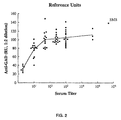
- Figure 2 shows end-point titrations for 68 IDDM sera, including one with Stiff Man Syndrome (SMS), plotted against the value in reference units for the same sera at a 1:2 dilution. Note that a plot of mean values reaches a plateau corresponding to 5-10% of the total GAD added, indicating that not all of the GAD in the preparation can be precipitated, even with high potency sera, as judged by high titre.
- SMS Stiff Man Syndrome
- Figure 3 shows the results by autoradiography of 125 I-GAD that was precipitated with three anomalous sera and analysed by SDS-PAGE under reducing and non-reducing conditions.
- the precipitated 125 I-GAD migrates only as a ⁇ 64 kD component.
- Lanes 1-3 and 5-7 are the anomalous sera.
- Lanes 4 and 8 are a typical IDDM serum.
- the typical IDDM serum (lane 8) has reactivity, as expected, only with the 110-130 kD component under non-reducing conditions, with a weak signal at the exposure time used for this autoradiograph (arrow).
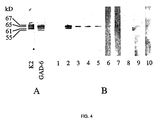
- Figure 4 shows the result by Western blotting after SDS-PAGE electrophoresis of GAD using antibodies to GAD raised experimentally (A) and in humans (B), with serum dilutions of 1:200.
- A Monoclonal mouse antibody GAD-6 raised against GAD 65, and polyclonal rabbit antibody K2 raised against GAD 67;
- B lane 1, healthy person; lane 2, patient with SDS and IDDM; lanes 3-10, patients with IDDM.
- Figure 5 shows the results by dot blotting whereby GAD is spotted onto a nitrocellulose filter and then exposed to the test sera.
- the upper row shows the reaction of IDDM sera with GAD under non-denaturing conditions (see text), wherein all sera show strong reactivity, and in contrast, the lower row (spots 2-10) shows the reaction of the same IDDM sera with GAD treated with ME and boiling wherein only serum 2, and serum 3 (weak) show reactivity.
- Spot 1 represents normal serum.
- the sera depicted here are the same as those depicted in Figure 4.
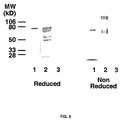
- FIG. 6 shows the results by autoradiography of biosynthetically labelled recombinant GAD ( 35 S-GAD) prepared so as to retain the normal structure of native GAD by expression using rabbit reticulocyte lysate (RRL); precipitation was with a representative positive IDDM serum and a negative serum, and analysed by SDS-PAGE under reducing and non-reducing conditions.
- lane 1 contains the RRL recombinant GAD (19 hour exposure)
- lane 2 contains RRL-expressed GAD precipitated with IDDM serum (7 day exposure)
- lane 3 contains RRL-expressed GAD precipitated with a normal serum (7 day exposure).
- the major signal corresponds to a M.W. of 110-130 kD, indicative of a dimeric form of GAD.
- the nature of the GAD antigen reacting in the radioimmunoprecipitation assay described by Rowley et al . 6 was investigated as follows. The pellet consisting of antigen and antibody that was deposited after immunoprecipitation with Sepharose-protein A was exposed to polyacrylamide gel electrophoresis in the presence of sodium dodecyl sulphate (SDS-PAGE), and the gel was examined by autoradiography. The 125 I-GAD antigen in the precipitate was compared with the GAD labelled with 125 I that had been initially added to the assay.
- Electrophoresis samples were dissolved in a buffer that contained 64 mM Tris-HCl, pH 6.8, 2% SDS, and 10% glycerol with or without 5% 2-mercaptoethanol. Electrophoresis was performed on 10% separating gels. The gels were dried and examined by autoradiography for periods of up to 2 weeks.
- Typical results obtained from autoradiography are shown in Figure 1.
- 125 I-GAD was immunoprecipitated with the IDDM serum and the precipitate was analysed by gel electrophoresis with or without the reducing agent, 2-mercaptoethanol, i.e. reducing or non-reducing conditions. The gel was exposed for autoradiography for 2 weeks.
- lanes 1 and 5 contain non-immunoprecipitated 125 I-GAD and lanes 2, 3, 4 and 6, 7, 8 contain 125 I-GAD precipitated with three representative sera from patients with IDDM.
- the non-precipitated GAD and the immunoprecipitated GAD have a similar migration corresponding to a MW of ⁇ 64 kD.
- the non-precipitated GAD appears as two components that have a migration corresponding to MW of ⁇ 64 kD and ⁇ 110-130 kD, whereas the precipitated GAD has a migration exclusively as a component corresponding to a MW of ⁇ 110-130 kD.
- This Example demonstrates that diabetic sera immuno-precipitate only a small fraction of the total amount of iodinated GAD in a test preparation of affinity-purified porcine brain GAD, irrespective of the amount or potency of serum used for the immunoprecipitation.
- the residual supernatant after immunoprecipitation of 125 I-GAD by IDDM serum regularly contains most of the initial radioactivity added (see above).
- Autoradiography of the residual 125 I-GAD after electrophoresis shows a signal corresponding to a ⁇ 64 kD component, this being precisely comparable with the ⁇ 64 kD signal in the original GAD preparation.
- no other signals corresponding to components of higher molecular weights these components having been completely removed by the first immunoprecipitation.
- the radioimmunoprecipitation assay with 125 I-GAD is carried out under conditions of antibody excess, such that these sera remain reactive at dilutions of 1:100 or 1:1000 or even higher, yet most IDDM sera react with only ⁇ 5-10% of the total iodinated GAD in the preparation.
- GAD preparations derived from porcine brain contain both GAD 65 and GAD 67. This indicates that there would be a substantial amount of the heterodimeric form of GAD, GAD 65-GAD 67 in a porcine brain GAD preparation, given that the monoclonal antibody GAD 1 that is used in the affinity purification is reported to react with only GAD 65. Thus GAD 67 could become bound to the affinity column only through its linkage to GAD 65.
- “Western” transfer immunoblotting is a standard procedure for examining the reactivity of autoimmune sera with protein components, including intracellular proteins. This procedure is usually performed under conditions in which the antigenic protein is denatured by exposure to heat (boiling), a reducing agent (2-mercaptoethanol) and the detergent sodium dodecyl sulphate (SDS).
- the polypeptide epitopes so defined are therefore regarded as “linear” rather than “conformational”, although some degree of renaturation may occur after transfer of the proteins from the gel to the nitrocellulose filter.
- an enzyme is highly dependent on the conformational structure of the molecule since the activity of most enzymes is readily destroyed when the conformational structure is lost, and GAD is completely inactivated by heating for 2 hours at 45° C 20 . Accordingly, an enzymatically active molecule is usually considered to exist folded in its native conformation 30 .
- Recombinant GAD 65 was prepared in the bacterial expression system pMAL (New England Biolabs) 31 .
- the recombinant protein was shown to have strong enzymatic activity as measured by the production of GABA from glutamate labelled with 3 H, according to the procedure described by Rowley et al. 6 , and the specific activity of the recombinant protein was much greater than the specific activity of the purified porcine brain GAD. Nonetheless, when the recombinant GAD antigen was labelled with 125 I and used as antigen in the standard immuno-precipitation assay, it proved to be poorly reactive.
- Recombinant GAD has been used previously with some claimed success in ELISA systems, but the performance of such ELISAs using recombinant GAD is quite inferior to the performance of radioimmunoprecipitation assays using native porcine brain GAD, as judged by published results 32 and results from the First International GAD Antibody Workshop 33 .
- the conformational requirement of the GAD molecule for reactivity with sera from patients with IDDM differs from the conformational requirement for enzymatic activity, indicating that the additional conformational requirement for immunoprecipitation is critically dependent on a dimeric/oligomeric configuration of the GAD molecule.
Landscapes
- Health & Medical Sciences (AREA)
- Life Sciences & Earth Sciences (AREA)
- Engineering & Computer Science (AREA)
- Immunology (AREA)
- Chemical & Material Sciences (AREA)
- Biomedical Technology (AREA)
- Hematology (AREA)
- Molecular Biology (AREA)
- Urology & Nephrology (AREA)
- General Health & Medical Sciences (AREA)
- Biochemistry (AREA)
- Medicinal Chemistry (AREA)
- Biotechnology (AREA)
- Microbiology (AREA)
- Physics & Mathematics (AREA)
- Organic Chemistry (AREA)
- Cell Biology (AREA)
- Analytical Chemistry (AREA)
- Food Science & Technology (AREA)
- Zoology (AREA)
- General Physics & Mathematics (AREA)
- Pathology (AREA)
- Bioinformatics & Cheminformatics (AREA)
- Genetics & Genomics (AREA)
- Wood Science & Technology (AREA)
- Rehabilitation Therapy (AREA)
- General Engineering & Computer Science (AREA)
- Rheumatology (AREA)
- Peptides Or Proteins (AREA)
- Investigating Or Analysing Biological Materials (AREA)
- Medicines Containing Antibodies Or Antigens For Use As Internal Diagnostic Agents (AREA)
- Immobilizing And Processing Of Enzymes And Microorganisms (AREA)
Applications Claiming Priority (4)
| Application Number | Priority Date | Filing Date | Title |
|---|---|---|---|
| AUPL7168/93 | 1993-02-09 | ||
| AUPL716893 | 1993-02-09 | ||
| AUPL716893 | 1993-02-09 | ||
| PCT/AU1994/000056 WO1994018568A1 (en) | 1993-02-09 | 1994-02-09 | Methods for the diagnosis of diabetes and prediabetic conditions |
Publications (3)
| Publication Number | Publication Date |
|---|---|
| EP0686262A1 EP0686262A1 (en) | 1995-12-13 |
| EP0686262A4 EP0686262A4 (en) | 1997-06-04 |
| EP0686262B1 true EP0686262B1 (en) | 2002-12-11 |
Family
ID=3776693
Family Applications (1)
| Application Number | Title | Priority Date | Filing Date |
|---|---|---|---|
| EP94906796A Expired - Lifetime EP0686262B1 (en) | 1993-02-09 | 1994-02-09 | Methods for the diagnosis of diabetes and prediabetic conditions |
Country Status (12)
| Country | Link |
|---|---|
| US (1) | US5770381A (enExample) |
| EP (1) | EP0686262B1 (enExample) |
| JP (1) | JP3510889B2 (enExample) |
| AT (1) | ATE229650T1 (enExample) |
| CA (1) | CA2155677A1 (enExample) |
| DE (1) | DE69431874D1 (enExample) |
| IL (1) | IL108587A (enExample) |
| NZ (1) | NZ261541A (enExample) |
| SG (1) | SG45161A1 (enExample) |
| TW (1) | TW305936B (enExample) |
| WO (1) | WO1994018568A1 (enExample) |
| ZA (1) | ZA94845B (enExample) |
Families Citing this family (4)
| Publication number | Priority date | Publication date | Assignee | Title |
|---|---|---|---|---|
| US5821334A (en) * | 1996-01-26 | 1998-10-13 | Vanderbilt University | Insulin-dependent diabetes mellitus-specific chimeric polypeptides |
| FR2759701B1 (fr) * | 1997-02-19 | 1999-06-04 | Inst Nat Sante Rech Med | Utilisation des proteines ulip dans le diagnostic et la therapie des cancers et des syndromes neurologiques paraneoplasiques |
| EP1102067A4 (en) * | 1999-06-01 | 2001-10-17 | Kyokuto Pharmaceutical Ind Co | ANTI-GAD ANTIBODY ASSAY METHOD AND KIT |
| ES2684976T3 (es) | 2012-04-13 | 2018-10-05 | Diabetomics, Inc. | Biomarcadores maternos para diabetes gestacional |
Family Cites Families (3)
| Publication number | Priority date | Publication date | Assignee | Title |
|---|---|---|---|---|
| US6682906B1 (en) * | 1990-09-21 | 2004-01-27 | The Regents Of The University Of California | Cloned glutamic acid decarboxylase |
| DE69233507T2 (de) * | 1991-02-22 | 2009-09-10 | The Walter And Eliza Hall Institute Of Medical Research, Parkville | Hbgad und higad polypeptide und nukleinsäuren und deren verwendung zur diagnose und behandlung von gad autoantigen assoziierten krankheiten |
| WO1992019972A1 (en) * | 1991-05-03 | 1992-11-12 | Novo Nordisk A/S | Islet cell autoantigen (gad) for the detection of preclinical diabetes |
-
1994
- 1994-02-08 ZA ZA94845A patent/ZA94845B/xx unknown
- 1994-02-08 IL IL108587A patent/IL108587A/en not_active IP Right Cessation
- 1994-02-08 TW TW083101065A patent/TW305936B/zh active
- 1994-02-09 EP EP94906796A patent/EP0686262B1/en not_active Expired - Lifetime
- 1994-02-09 SG SG1996000807A patent/SG45161A1/en unknown
- 1994-02-09 JP JP51744894A patent/JP3510889B2/ja not_active Expired - Fee Related
- 1994-02-09 US US08/495,584 patent/US5770381A/en not_active Expired - Fee Related
- 1994-02-09 AT AT94906796T patent/ATE229650T1/de not_active IP Right Cessation
- 1994-02-09 NZ NZ261541A patent/NZ261541A/en unknown
- 1994-02-09 CA CA002155677A patent/CA2155677A1/en not_active Abandoned
- 1994-02-09 WO PCT/AU1994/000056 patent/WO1994018568A1/en not_active Ceased
- 1994-02-09 DE DE69431874T patent/DE69431874D1/de not_active Expired - Lifetime
Also Published As
| Publication number | Publication date |
|---|---|
| CA2155677A1 (en) | 1994-08-18 |
| NZ261541A (en) | 1996-09-25 |
| DE69431874D1 (de) | 2003-01-23 |
| EP0686262A1 (en) | 1995-12-13 |
| JP3510889B2 (ja) | 2004-03-29 |
| SG45161A1 (en) | 1998-01-16 |
| EP0686262A4 (en) | 1997-06-04 |
| IL108587A0 (en) | 1994-05-30 |
| IL108587A (en) | 1998-01-04 |
| ATE229650T1 (de) | 2002-12-15 |
| JPH08506417A (ja) | 1996-07-09 |
| US5770381A (en) | 1998-06-23 |
| TW305936B (enExample) | 1997-05-21 |
| WO1994018568A1 (en) | 1994-08-18 |
| ZA94845B (en) | 1994-11-11 |
Similar Documents
| Publication | Publication Date | Title |
|---|---|---|
| Rowley et al. | Antibodies to glutamic acid decarboxylase discriminate major types of diabetes mellitus | |
| Hawa et al. | Value of Antibodies to Islet Protein Tyrosine Phosphatase–Like Molecule in Predicting Type 1 Diabetes | |
| Tuomi et al. | Antibodies to glutamic acid decarboxylase and insulin-dependent diabetes in patients with autoimmune polyendocrine syndrome type I. | |
| CA2040555C (en) | Cloned glutamic acid decarboxylase | |
| Hagopian et al. | Autoantibodies in IDDM Primarily Recognize the 65,000-M r Rather Than 67,000-M r Isoform of Glutamic Acid Decarboxylase | |
| Christie et al. | Antibodies to GAD and tryptic fragments of islet 64K antigen as distinct markers for development of IDDM: studies with identical twins | |
| US6011139A (en) | Hybridomas and monoclonal antibodies that specifically bind to glutamic acid decarboxylase peptides | |
| US5849506A (en) | Reagents and methods for the diagnosis and treatment of diabetes and stiff man syndrome | |
| Miao et al. | Role of autoantibodies in type 1 diabetes | |
| US7718386B1 (en) | Methods for the diagnosis of diabetes | |
| Arif et al. | Identification of 3 beta-hydroxysteroid dehydrogenase as a novel target of steroid cell autoantibodies: association of autoantibodies with endocrine autoimmune disease | |
| Zimmet et al. | The ethnic distribution of antibodies to glutamic acid decarboxylase: presence and levels in insulin-dependent diabetes mellitus in Europid and Asian subjects | |
| Ozawa et al. | Detection of autoantibodies to the pancreatic islet heat shock protein 60 in insulin-dependent diabetes mellitus | |
| AU661828B2 (en) | Methods and compositions for early detection and treatment of insulin dependent diabetes mellitus | |
| EP0686262B1 (en) | Methods for the diagnosis of diabetes and prediabetic conditions | |
| Yu et al. | Quantitation of glutamic acid decarboxylase autoantibody levels in prospectively evaluated relatives of patients with type I diabetes | |
| US6391651B1 (en) | Materials and methods for detection of insulin dependent diabetes | |
| AU688304B2 (en) | Methods for the diagnosis of diabetes and prediabetic conditions | |
| Bassendine et al. | Primary biliary cirrhosis: nature of autoantigens | |
| Ziegler et al. | Autoantibodies to glutamate decarboxylase detected in diabetes-prone BB/OK rats do not distinguish onset of diabetes | |
| McEvoy et al. | Anti-islet autoantibodies detected by monoclonal antibody 1A2: further studies suggesting a role in the pathogenesis of IDDM | |
| Ng et al. | Tyrosine phosphatase-like protein (IA-2) and glutamic acid decarboxylase (GAD65) autoantibodies: a study of Chinese patients with diabetes mellitus | |
| Rowley et al. | Diabetic sera react with the glutamic acid decarboxylase molecule in a dimeric‐oligomeric form | |
| Gut et al. | Recombinant human thyroid peroxidase produced in insect cells has similar properties to native human thyroid peroxidase | |
| Scherbaum | Cytoplasmic islet cell antibodies (ICA): towards a molecular understanding of the autoantigens |
Legal Events
| Date | Code | Title | Description |
|---|---|---|---|
| PUAI | Public reference made under article 153(3) epc to a published international application that has entered the european phase |
Free format text: ORIGINAL CODE: 0009012 |
|
| 17P | Request for examination filed |
Effective date: 19950906 |
|
| AK | Designated contracting states |
Kind code of ref document: A1 Designated state(s): AT BE CH DE DK ES FR GB GR IE IT LI LU MC NL PT SE |
|
| A4 | Supplementary search report drawn up and despatched |
Effective date: 19970416 |
|
| AK | Designated contracting states |
Kind code of ref document: A4 Designated state(s): AT BE CH DE DK ES FR GB GR IE IT LI LU MC NL PT SE |
|
| 17Q | First examination report despatched |
Effective date: 20000414 |
|
| GRAG | Despatch of communication of intention to grant |
Free format text: ORIGINAL CODE: EPIDOS AGRA |
|
| GRAG | Despatch of communication of intention to grant |
Free format text: ORIGINAL CODE: EPIDOS AGRA |
|
| GRAH | Despatch of communication of intention to grant a patent |
Free format text: ORIGINAL CODE: EPIDOS IGRA |
|
| GRAH | Despatch of communication of intention to grant a patent |
Free format text: ORIGINAL CODE: EPIDOS IGRA |
|
| GRAA | (expected) grant |
Free format text: ORIGINAL CODE: 0009210 |
|
| AK | Designated contracting states |
Kind code of ref document: B1 Designated state(s): AT BE CH DE DK ES FR GB GR IE IT LI LU MC NL PT SE |
|
| PG25 | Lapsed in a contracting state [announced via postgrant information from national office to epo] |
Ref country code: NL Free format text: LAPSE BECAUSE OF FAILURE TO SUBMIT A TRANSLATION OF THE DESCRIPTION OR TO PAY THE FEE WITHIN THE PRESCRIBED TIME-LIMIT Effective date: 20021211 Ref country code: LI Free format text: LAPSE BECAUSE OF FAILURE TO SUBMIT A TRANSLATION OF THE DESCRIPTION OR TO PAY THE FEE WITHIN THE PRESCRIBED TIME-LIMIT Effective date: 20021211 Ref country code: IT Free format text: LAPSE BECAUSE OF FAILURE TO SUBMIT A TRANSLATION OF THE DESCRIPTION OR TO PAY THE FEE WITHIN THE PRE;WARNING: LAPSES OF ITALIAN PATENTS WITH EFFECTIVE DATE BEFORE 2007 MAY HAVE OCCURRED AT ANY TIME BEFORE 2007. THE CORRECT EFFECTIVE DATE MAY BE DIFFERENT FROM THE ONE RECORDED.SCRIBED TIME-LIMIT Effective date: 20021211 Ref country code: GR Free format text: LAPSE BECAUSE OF FAILURE TO SUBMIT A TRANSLATION OF THE DESCRIPTION OR TO PAY THE FEE WITHIN THE PRESCRIBED TIME-LIMIT Effective date: 20021211 Ref country code: FR Free format text: LAPSE BECAUSE OF NON-PAYMENT OF DUE FEES Effective date: 20021211 Ref country code: CH Free format text: LAPSE BECAUSE OF FAILURE TO SUBMIT A TRANSLATION OF THE DESCRIPTION OR TO PAY THE FEE WITHIN THE PRESCRIBED TIME-LIMIT Effective date: 20021211 Ref country code: BE Free format text: LAPSE BECAUSE OF FAILURE TO SUBMIT A TRANSLATION OF THE DESCRIPTION OR TO PAY THE FEE WITHIN THE PRESCRIBED TIME-LIMIT Effective date: 20021211 Ref country code: AT Free format text: LAPSE BECAUSE OF FAILURE TO SUBMIT A TRANSLATION OF THE DESCRIPTION OR TO PAY THE FEE WITHIN THE PRESCRIBED TIME-LIMIT Effective date: 20021211 |
|
| REF | Corresponds to: |
Ref document number: 229650 Country of ref document: AT Date of ref document: 20021215 Kind code of ref document: T |
|
| REG | Reference to a national code |
Ref country code: GB Ref legal event code: FG4D |
|
| REG | Reference to a national code |
Ref country code: CH Ref legal event code: EP |
|
| REG | Reference to a national code |
Ref country code: IE Ref legal event code: FG4D |
|
| REF | Corresponds to: |
Ref document number: 69431874 Country of ref document: DE Date of ref document: 20030123 |
|
| PG25 | Lapsed in a contracting state [announced via postgrant information from national office to epo] |
Ref country code: LU Free format text: LAPSE BECAUSE OF NON-PAYMENT OF DUE FEES Effective date: 20030209 |
|
| PG25 | Lapsed in a contracting state [announced via postgrant information from national office to epo] |
Ref country code: IE Free format text: LAPSE BECAUSE OF NON-PAYMENT OF DUE FEES Effective date: 20030210 |
|
| PG25 | Lapsed in a contracting state [announced via postgrant information from national office to epo] |
Ref country code: MC Free format text: LAPSE BECAUSE OF NON-PAYMENT OF DUE FEES Effective date: 20030228 |
|
| PG25 | Lapsed in a contracting state [announced via postgrant information from national office to epo] |
Ref country code: SE Free format text: LAPSE BECAUSE OF FAILURE TO SUBMIT A TRANSLATION OF THE DESCRIPTION OR TO PAY THE FEE WITHIN THE PRESCRIBED TIME-LIMIT Effective date: 20030311 Ref country code: PT Free format text: LAPSE BECAUSE OF FAILURE TO SUBMIT A TRANSLATION OF THE DESCRIPTION OR TO PAY THE FEE WITHIN THE PRESCRIBED TIME-LIMIT Effective date: 20030311 Ref country code: GB Free format text: LAPSE BECAUSE OF NON-PAYMENT OF DUE FEES Effective date: 20030311 Ref country code: DK Free format text: LAPSE BECAUSE OF FAILURE TO SUBMIT A TRANSLATION OF THE DESCRIPTION OR TO PAY THE FEE WITHIN THE PRESCRIBED TIME-LIMIT Effective date: 20030311 |
|
| PG25 | Lapsed in a contracting state [announced via postgrant information from national office to epo] |
Ref country code: DE Free format text: LAPSE BECAUSE OF FAILURE TO SUBMIT A TRANSLATION OF THE DESCRIPTION OR TO PAY THE FEE WITHIN THE PRESCRIBED TIME-LIMIT Effective date: 20030312 |
|
| NLV1 | Nl: lapsed or annulled due to failure to fulfill the requirements of art. 29p and 29m of the patents act | ||
| PG25 | Lapsed in a contracting state [announced via postgrant information from national office to epo] |
Ref country code: ES Free format text: LAPSE BECAUSE OF FAILURE TO SUBMIT A TRANSLATION OF THE DESCRIPTION OR TO PAY THE FEE WITHIN THE PRESCRIBED TIME-LIMIT Effective date: 20030627 |
|
| REG | Reference to a national code |
Ref country code: CH Ref legal event code: PL |
|
| PLBE | No opposition filed within time limit |
Free format text: ORIGINAL CODE: 0009261 |
|
| STAA | Information on the status of an ep patent application or granted ep patent |
Free format text: STATUS: NO OPPOSITION FILED WITHIN TIME LIMIT |
|
| GBPC | Gb: european patent ceased through non-payment of renewal fee |
Effective date: 20030311 |
|
| EN | Fr: translation not filed | ||
| 26N | No opposition filed |
Effective date: 20030912 |
|
| REG | Reference to a national code |
Ref country code: IE Ref legal event code: MM4A |
|
| REG | Reference to a national code |
Ref country code: HK Ref legal event code: WD Ref document number: 1013141 Country of ref document: HK |