EP0686101B1 - Moulding process for producing a vehicle seat - Google Patents
Moulding process for producing a vehicle seat Download PDFInfo
- Publication number
- EP0686101B1 EP0686101B1 EP94908218A EP94908218A EP0686101B1 EP 0686101 B1 EP0686101 B1 EP 0686101B1 EP 94908218 A EP94908218 A EP 94908218A EP 94908218 A EP94908218 A EP 94908218A EP 0686101 B1 EP0686101 B1 EP 0686101B1
- Authority
- EP
- European Patent Office
- Prior art keywords
- frame element
- seat
- mold
- frame
- passenger seat
- Prior art date
- Legal status (The legal status is an assumption and is not a legal conclusion. Google has not performed a legal analysis and makes no representation as to the accuracy of the status listed.)
- Expired - Lifetime
Links
Images


Classifications
-
- B—PERFORMING OPERATIONS; TRANSPORTING
- B60—VEHICLES IN GENERAL
- B60N—SEATS SPECIALLY ADAPTED FOR VEHICLES; VEHICLE PASSENGER ACCOMMODATION NOT OTHERWISE PROVIDED FOR
- B60N2/00—Seats specially adapted for vehicles; Arrangement or mounting of seats in vehicles
- B60N2/24—Seats specially adapted for vehicles; Arrangement or mounting of seats in vehicles for particular purposes or particular vehicles
- B60N2/42—Seats specially adapted for vehicles; Arrangement or mounting of seats in vehicles for particular purposes or particular vehicles the seat constructed to protect the occupant from the effect of abnormal g-forces, e.g. crash or safety seats
- B60N2/4249—Seats specially adapted for vehicles; Arrangement or mounting of seats in vehicles for particular purposes or particular vehicles the seat constructed to protect the occupant from the effect of abnormal g-forces, e.g. crash or safety seats fixed structures, i.e. where neither the seat nor a part thereof are displaced during a crash
- B60N2/4256—Seats specially adapted for vehicles; Arrangement or mounting of seats in vehicles for particular purposes or particular vehicles the seat constructed to protect the occupant from the effect of abnormal g-forces, e.g. crash or safety seats fixed structures, i.e. where neither the seat nor a part thereof are displaced during a crash the shape of the seat being specially adapted for a particular purpose or for particular vehicles
- B60N2/4263—Seats specially adapted for vehicles; Arrangement or mounting of seats in vehicles for particular purposes or particular vehicles the seat constructed to protect the occupant from the effect of abnormal g-forces, e.g. crash or safety seats fixed structures, i.e. where neither the seat nor a part thereof are displaced during a crash the shape of the seat being specially adapted for a particular purpose or for particular vehicles with anti-submarining systems
-
- B—PERFORMING OPERATIONS; TRANSPORTING
- B29—WORKING OF PLASTICS; WORKING OF SUBSTANCES IN A PLASTIC STATE IN GENERAL
- B29C—SHAPING OR JOINING OF PLASTICS; SHAPING OF MATERIAL IN A PLASTIC STATE, NOT OTHERWISE PROVIDED FOR; AFTER-TREATMENT OF THE SHAPED PRODUCTS, e.g. REPAIRING
- B29C44/00—Shaping by internal pressure generated in the material, e.g. swelling or foaming ; Producing porous or cellular expanded plastics articles
- B29C44/02—Shaping by internal pressure generated in the material, e.g. swelling or foaming ; Producing porous or cellular expanded plastics articles for articles of definite length, i.e. discrete articles
- B29C44/08—Shaping by internal pressure generated in the material, e.g. swelling or foaming ; Producing porous or cellular expanded plastics articles for articles of definite length, i.e. discrete articles using several expanding or moulding steps
-
- B—PERFORMING OPERATIONS; TRANSPORTING
- B29—WORKING OF PLASTICS; WORKING OF SUBSTANCES IN A PLASTIC STATE IN GENERAL
- B29C—SHAPING OR JOINING OF PLASTICS; SHAPING OF MATERIAL IN A PLASTIC STATE, NOT OTHERWISE PROVIDED FOR; AFTER-TREATMENT OF THE SHAPED PRODUCTS, e.g. REPAIRING
- B29C44/00—Shaping by internal pressure generated in the material, e.g. swelling or foaming ; Producing porous or cellular expanded plastics articles
- B29C44/02—Shaping by internal pressure generated in the material, e.g. swelling or foaming ; Producing porous or cellular expanded plastics articles for articles of definite length, i.e. discrete articles
- B29C44/12—Incorporating or moulding on preformed parts, e.g. inserts or reinforcements
-
- B—PERFORMING OPERATIONS; TRANSPORTING
- B60—VEHICLES IN GENERAL
- B60N—SEATS SPECIALLY ADAPTED FOR VEHICLES; VEHICLE PASSENGER ACCOMMODATION NOT OTHERWISE PROVIDED FOR
- B60N2/00—Seats specially adapted for vehicles; Arrangement or mounting of seats in vehicles
- B60N2/68—Seat frames
- B60N2/686—Panel like structures
-
- B—PERFORMING OPERATIONS; TRANSPORTING
- B60—VEHICLES IN GENERAL
- B60N—SEATS SPECIALLY ADAPTED FOR VEHICLES; VEHICLE PASSENGER ACCOMMODATION NOT OTHERWISE PROVIDED FOR
- B60N2/00—Seats specially adapted for vehicles; Arrangement or mounting of seats in vehicles
- B60N2/70—Upholstery springs ; Upholstery
-
- B—PERFORMING OPERATIONS; TRANSPORTING
- B29—WORKING OF PLASTICS; WORKING OF SUBSTANCES IN A PLASTIC STATE IN GENERAL
- B29C—SHAPING OR JOINING OF PLASTICS; SHAPING OF MATERIAL IN A PLASTIC STATE, NOT OTHERWISE PROVIDED FOR; AFTER-TREATMENT OF THE SHAPED PRODUCTS, e.g. REPAIRING
- B29C44/00—Shaping by internal pressure generated in the material, e.g. swelling or foaming ; Producing porous or cellular expanded plastics articles
- B29C44/02—Shaping by internal pressure generated in the material, e.g. swelling or foaming ; Producing porous or cellular expanded plastics articles for articles of definite length, i.e. discrete articles
- B29C44/12—Incorporating or moulding on preformed parts, e.g. inserts or reinforcements
- B29C44/14—Incorporating or moulding on preformed parts, e.g. inserts or reinforcements the preformed part being a lining
-
- Y—GENERAL TAGGING OF NEW TECHNOLOGICAL DEVELOPMENTS; GENERAL TAGGING OF CROSS-SECTIONAL TECHNOLOGIES SPANNING OVER SEVERAL SECTIONS OF THE IPC; TECHNICAL SUBJECTS COVERED BY FORMER USPC CROSS-REFERENCE ART COLLECTIONS [XRACs] AND DIGESTS
- Y10—TECHNICAL SUBJECTS COVERED BY FORMER USPC
- Y10S—TECHNICAL SUBJECTS COVERED BY FORMER USPC CROSS-REFERENCE ART COLLECTIONS [XRACs] AND DIGESTS
- Y10S297/00—Chairs and seats
- Y10S297/01—Foam
-
- Y—GENERAL TAGGING OF NEW TECHNOLOGICAL DEVELOPMENTS; GENERAL TAGGING OF CROSS-SECTIONAL TECHNOLOGIES SPANNING OVER SEVERAL SECTIONS OF THE IPC; TECHNICAL SUBJECTS COVERED BY FORMER USPC CROSS-REFERENCE ART COLLECTIONS [XRACs] AND DIGESTS
- Y10—TECHNICAL SUBJECTS COVERED BY FORMER USPC
- Y10S—TECHNICAL SUBJECTS COVERED BY FORMER USPC CROSS-REFERENCE ART COLLECTIONS [XRACs] AND DIGESTS
- Y10S297/00—Chairs and seats
- Y10S297/02—Molded
-
- Y—GENERAL TAGGING OF NEW TECHNOLOGICAL DEVELOPMENTS; GENERAL TAGGING OF CROSS-SECTIONAL TECHNOLOGIES SPANNING OVER SEVERAL SECTIONS OF THE IPC; TECHNICAL SUBJECTS COVERED BY FORMER USPC CROSS-REFERENCE ART COLLECTIONS [XRACs] AND DIGESTS
- Y10—TECHNICAL SUBJECTS COVERED BY FORMER USPC
- Y10T—TECHNICAL SUBJECTS COVERED BY FORMER US CLASSIFICATION
- Y10T29/00—Metal working
- Y10T29/48—Upholstered article making
- Y10T29/481—Method
Definitions
- the present invention relates to a seat and particularly to a passenger seat for use in vehicles. More specifically, the present invention relates to a novel passenger seat for vehicles which obviates the need for including a metal frame. The present invention also relates to a process for producing a passenger seat, particularly a passenger seat for use in vehicles (see for example EP-A-0 251 659).
- Passenger seats in vehicles such as automobiles are typically fabricated from a foam (usually polyurethane) material which is molded into the desired shape and covered with an appropriate trim cover.
- the foamed material is selected to provide passenger comfort by providing a resilient seat and the trim cover is selected to provide the desired aesthetic properties.
- Submarining is the term used to describe the tendency of the pelvis of a seated passenger to move forward and down during a collision. When the passenger is wearing a shoulder harness or lap type seatbelt, this tendency can result in the seatbelt strangling the passenger with fatal consequences. Accordingly, it is known in the art to design passenger seats with anti-submarine properties. These properties may be provided by rigid or semi-rigid members embedded in the seat and which provide additional pelvic support to the passenger during a collision. To function properly, these members cannot move and thus, must be fixed (directly or indirectly) to the vehicle.
- prior art vehicular seats typically include a perimeter frame of metal which strengthens the seat. Further, support rails are typically mounted across the metal frame to stiffen the frame and to provide a suitable attachment point for the means used to anchor the seat to the vehicle. Conventionally, the metal frame and/or support rails are substantially completely embedded in the foam material when the seat is molded.
- a passenger seat particularly a vehicle seat, which does not require the presence of a conventional metal frame or support rails.
- the present invention provides a passenger seat comprising: a frame element, vehicle anchorage means connected to the frame element; and a seat body comprising a resilient material fixed with respect of the frame element, characterized in that the frame element is molded from relatively high density, rigid foam having an indentation force deflection at 25% deflection in the range of from 667 to 17792 Newton.
- the resilient material is a relatively low density; resilient foam, more preferably a polyurethane foam.
- the resilient material may be a non-foam material such as fibrous matrices (e.g. horse hair, organic fibres and the like).
- the present invention provides a process for producing a passenger seat in a mold comprising a first mold half and a second mold half engagable to define a mold cavity, the process comprising the steps of:
- a pelvic support element is provided in the seat.
- a pelvic support element is molded foam made of the same material as the frame element.
- the vehicle anchorage means includes a portion which is embedded in either the pelvic support element or the frame element, or both, when they are molded. More preferably, the pelvic support element and the frame element are integrally molded and a portion of vehicle anchorage means is embedded in the integrally molded frame and pelvic support elements when they are molded.
- the process of the present invention comprises the further step of applying a trim cover to the seat.
- the application of a trim cover may be done upon completion of step (iv) of the present process after the seat is removed from the mold.
- the application of a trim cover may be done during the present process.
- Application of a trim cover during production of a foamed seat or padded element is discussed in United States patents 5,089,191, 5,096,639 and 5,132,063. In the context of the present process, this could be done by designating the first mold half as the upper mold and the second mold half as the lower half.
- the trim cover is then affixed to the upper mold and step (i) of the present process would be carried out in the lower mold.
- Step (ii) of the present process would comprise dispensing the liquid foamable composition into the lower mold.
- Step (iv) of the present process would comprise allowing the liquid foamable polymeric composition to expand from the lower mold toward the inner surface of the trim cover affixed in the upper mold.
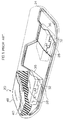
- a prior art automotive passenger rear seat is indicated at 20 in Figure 1.
- the seat includes a metal perimeter frame 24 to which two pairs of support rails 28 are connected. Each pair of support rails 28 is in turn connected to a vehicle attachment rail 32 which is provided to attach the completed seat to the vehicle.
- a pelvic support element 36 rests upon each pair of support rails 28. As is known by those of skill in the art, each pelvic support element 36 may be a rigid hollow plastic or metal member, or a high density foam member whose shape is selected to reduce 'submarining' of passengers.
- the assembly of the perimeter frame 24, support rails 28, pelvic support elements 36 and attachment rails 32 is placed into a mold and an predetermined amount of a liquid foamable polymeric composition is placed into the mold.
- a liquid foamable polymeric composition expands and cures
- the above-mentioned assembly of perimeter frame 24, support rails 28, pelvic support elements 36 and attachment rails 32 is encased by the cured foam 40 with the connection portion 44 of attachment rail 32 extending from cured foam 40.
- the seat is then covered with an appropriate trim cover 48 typically by placing a pre-sewn cover over the seat and attaching the trim cover to the frame 24 using suitable mechanical attachment means (e.g. velcro, hogrings, J-retainers, push pins and the like).
- suitable mechanical attachment means e.g. velcro, hogrings, J-retainers, push pins and the like.
- the completed seat may then be shipped to the vehicle assembler and installed in the vehicle.
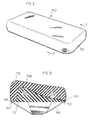
- Figures 2 and 3 illustrate a finished automotive rear passenger seat 100 in accordance with the present invention.
- the seat comprises a frame and pelvic support element 104, a seat body 108, a vehicle anchorage means 112 and a trim cover 116.
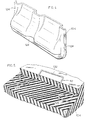
- Frame and pelvic support element 104 is best illustrated in Figures 4 and 5.
- frame and pelvic support element 104 is made from a polymeric foam material, most preferably from a relatively high density, rigid polyurethane foam.
- frame and pelvic support element 104 may be fabricated utilizing a conventional clam-shell foam mold which has been suitably adapted to include means to retain in place vehicle anchorage means 112 in one of the molds.
- an anchor portion 132 of vehicle anchorage means is positioned in a suitable recess (not shown) in one of the molds with S-shaped arms 128 of vehicle anchorage means 112 extending into the mold cavity.
- a liquid foamable polyurethane composition is then dispensed in the cavity of the foam mold using an open pour or closed pour technique.
- the composition then expands to fill substantially the foam mold to produce frame and pelvic support element 104 having S-shaped arms 128 of vehicle anchorage means 112 embedded therein.
- the foam of frame and pelvic support element 104 has an indentation force deflection at 25% in the range of from about 667 to about 17792 Newton (about 150 to about 4.000 pounds), more preferably from 2224 to about 11120 Newton (about 500 to about 2500 pounds), most preferably from about 4003,2 to about 8896 Newton (about 900 to about 2000 pounds), when measured pursuant to ASTM 3574-B 1 .
- the polyurethane foam of frame and support pelvic element 104 preferably has a specific gravity of less than about 0.40, more preferably in the range of from about 0.10 to about 0.25.
- the liquid foamable polyurethane composition used to produce frame and support element 104 has a free rise density of from about 16,01 to about 320,36 kilograms per cubic meter (about one to about twenty pounds per cubic foot), more preferably from about 32,02 to about 128 kilograms per cubic meter (about two to about eight pounds per cubic foot).
- foam core having a density in the range of from about 24 to about 384 kilogram per cubic meter (about 1,5 to about 24 pcf.), more preferably from about 40 to about 192 kg/m 3 (about 2,5 to about 12 pcf).
- Non-limiting and preferred examples of suitable polyurethane foams for use in producing frame and pelvic support element 104 are available from Woodbridge Foam Corporation under the tradename Enerflex.
- the polyurethane foam suitable for use in producing frame and pelvic support element 104 and having the requisite characteristics may be produced from the following general non-limiting formulation: Component Amount Polymer Polyol 100 - 0 parts Polyol 0 - 100 parts Crosslinker 0 - 30 parts/100 parts total polyol Catalyst 0.05 to 3.5 parts/100 parts total polyol Silicone Surfactants 0 - 1.5 parts/100 parts total polyol H 2 O 0.5 to 3.5 parts/100 parts total polyol Isocyanate Adequate quantity for an index of from about .60 to 1.30 ratio of NCO equivalents to the equivalents of NCO reactive sites.
- Suitable polymer polyols, polyols and isocyanates are described in United States patents 3,304,273, 3,383,351, 3,523,093, 3,939,106 and 4,134,610, Belgian patent 788,115, Canadian Patent 785,835 and "Polymer/Polyols, a New Class of Polyurethane Intermediate", Kuryla, W.C. et al., J. Cellular Plastics, March (1966), the contents of which are hereby incorporated by reference.
- crosslinkers Suitable crosslinkers, catalysts and silicone surfactants are described in United States patents 4,107,106 and 4,190,712, the contents of which are hereby incorporated herein by reference.
- the preferred polyurethane foam suitable for use in frame and pelvic support element 104 may be produced from the following formulation: Component Amount Polymer Polyol 20 - 100 parts Polyol 0 - 80 parts Crosslinker 5 - 15 parts/100 parts total polyol Catalyst 0.5 - 1.2 parts/100 parts total polyol Silicone Surfactants 0.3 - 1.1 parts/100 parts total polyol H 2 O 1.75 - 2.75 parts/100 parts total polyol Isocyanate Adequate quantity for an index of from about 0.8 to 1.1 ratio of NCO equivalents to the equivalents of NCO reactive sites.
- frame and pelvic support element 104 includes a flange portion 124 which serves as a rigid edge support to minimize or prevent scalloping of the trim fabric and thereby maintain a smooth appearance in the finished seat.
- the provisions of element 104 serves to stiffen the completed seat obviating the prior art requirement for a perimeter metal frame or the like.
- S-shaped arms 128 of vehicle anchorage means 112 are embedded into the lower side of element 104 with the anchor portion 132 of vehicle anchorage means 112 extending from element 104 as shown in Figure 5.
- the use of an embedded vehicle anchorage means 112 obviates the prior art requirement for support rails or the like.
- a seat in accordance with the present invention may be constructed through the following steps.
- polymeric composition 144 is a polyurethane composition formulated to provided a relatively low density, resilient polyurethane foam.
- foams are conventional and use thereof in the automotive seating industry is well known. Accordingly, the form of liquid foamable polymeric composition 144 suitable for use herein and the manner by which it is dispensed into the lower mold is not particularly restricted.
- the foamable polymeric composition comprises a polyurethane derived from a diphenylmethane diisocyanate (MDI)-based system of low index and of a high molecular weight conventional polyol.
- MDI diphenylmethane diisocyanate
- the polyurethane is a tolylene diisocyanate (TDI)-based system of low index and of a high molecular weight conventional polyol.
- TDI tolylene diisocyanate
- liquid foamable polymeric composition may comprise a mixture of MDI-based and TDI-based systems.
- composition 144 After composition 144 is dispensed in the mold, it expands to fill the mold cavity thereby producing foam body 108 which is bonded to frame and pelvic support element 104.
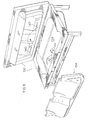
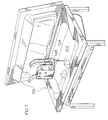
- mold 136 may be opened, as shown in Figure 8, and the assembly of seat body 108 and frame and pelvic support element 104 removed from the mold. As is shown in Figure 8, when properly molded the anchor portion 132 of each vehicle anchorage means 112 still extends beyond seat body 108.
- Trim cover 116 may then be placed on the assembly of seat body 108 and frame and pelvic support element 104 to complete the assembly of seat 100.
- trim cover 116 may be attached in any suitable manner as would be apparent to those of skill in the art seat, it has been found that push pins 152 may be favourably employed.
- push pins 152 are placed such that they engage the higher density foam of flange portion 124 of frame and pelvic support element 104 as shown in Figures 3 and 9.
- bottom flaps 156 may also be employed, in combination with conventional mechanical attachment means (e.g. velcro, J-retainers, push pins and the like), to further assist the attachment of trim cover 116 to complete the assembly of seat 100.
- the trim cover may be attached as the present seat is being molded.
- the trim cover would be placed in the upper half of the mold and the frame and pelvic support element installed in the lower half of the mold.
- the liquid foamable polymeric composition would then be dispensed into the lower half of the mold, the mold closed and the composition expands toward and bonds to the trim cover.
- FIG. 10 A second embodiment of the present invention is shown in Figure 10 wherein separate frame and pelvic support elements are combined to obtain the equivalent of the above-described frame and pelvic support element 104.
- a frame element 200 is molded from the above-mentioned relatively high density, rigid polyurethane foam.
- Frame element 200 is sized and shaped as required by the desired seat design and may be planar or contoured as required.
- Suitable pelvic support elements 204 are placed on frame element 200.
- vehicle anchorage means 208 may be embedded into pelvic support elements 204 as shown.
- vehicle anchorage means 208 may be embedded into frame element 200 when it is molded (not shown) instead of or in addition to similar means embedded in pelvic support elements 204.
- pelvic support elements 204 are appropriately placed on frame element 200 and, if vehicle anchorage means 208 are embedded in pelvic support elements 204, the connection portion 212 of each vehicle anchorage means is inserted through a complementary aperture 216 in frame element 200.
- the assembly of frame element 200 and anti-submarine elements 204 is then placed into a mold, such as mold 136 described above, and the remaining steps in the construction of the seat are the same as those previously described above.
- pelvic support elements 204 and frame element 200 require additional labour to assemble pelvic support elements 204 and frame element 200, it is contemplated that advantages will be obtained in that a single pelvic support element 204 may be designed and pre-manufactured for use in different seats. Further, as will be apparent, it is possible to employ different foam compositions for frame member 200 and pelvic support elements 204 to further optimize the characteristics thereof.
- pelvic support elements 204 are not necessary in all applications of the invention since not all passenger seats are designed to provide anti-submarining.
- the present invention provides an improved passenger seat for use in vehicles which obviates the requirement for a metal frame and/or support rails.
- a seat is constructed which in its preferred embodiment, meets safety requirements for anti-submarining characteristics, and anchoring strength and vehicle assembler requirements for strength and rigidity of the seat during vehicle assembly are met without incurring the penalty of the additional weight of metal frame and support components. Further, the additional costs of tooling and fabricating metal frame and support components is avoided and eventual recycling of the seat is simplified.
Landscapes
- Engineering & Computer Science (AREA)
- Aviation & Aerospace Engineering (AREA)
- Transportation (AREA)
- Mechanical Engineering (AREA)
- Casting Or Compression Moulding Of Plastics Or The Like (AREA)
- Seats For Vehicles (AREA)
- Vehicle Waterproofing, Decoration, And Sanitation Devices (AREA)
- Automobile Manufacture Line, Endless Track Vehicle, Trailer (AREA)
- Processing And Handling Of Plastics And Other Materials For Molding In General (AREA)
- Mattresses And Other Support Structures For Chairs And Beds (AREA)
- Compositions Of Macromolecular Compounds (AREA)
- Manufacture Of Macromolecular Shaped Articles (AREA)
- Chair Legs, Seat Parts, And Backrests (AREA)
Applications Claiming Priority (3)
| Application Number | Priority Date | Filing Date | Title |
|---|---|---|---|
| US23118 | 1993-02-26 | ||
| US08/023,118 US5400490A (en) | 1993-02-26 | 1993-02-26 | Method of molding a seat having anchoring means connected thereto |
| PCT/CA1994/000102 WO1994019209A1 (en) | 1993-02-26 | 1994-02-25 | Moulding process for producing a vehicle seat |
Publications (2)
| Publication Number | Publication Date |
|---|---|
| EP0686101A1 EP0686101A1 (en) | 1995-12-13 |
| EP0686101B1 true EP0686101B1 (en) | 1998-04-29 |
Family
ID=21813233
Family Applications (1)
| Application Number | Title | Priority Date | Filing Date |
|---|---|---|---|
| EP94908218A Expired - Lifetime EP0686101B1 (en) | 1993-02-26 | 1994-02-25 | Moulding process for producing a vehicle seat |
Country Status (12)
| Country | Link |
|---|---|
| US (2) | US5400490A (enExample) |
| EP (1) | EP0686101B1 (enExample) |
| JP (1) | JP3474571B2 (enExample) |
| KR (1) | KR100312891B1 (enExample) |
| AT (1) | ATE165566T1 (enExample) |
| AU (1) | AU714001B2 (enExample) |
| BR (1) | BR9406497A (enExample) |
| CA (1) | CA2116485C (enExample) |
| CZ (1) | CZ216295A3 (enExample) |
| DE (1) | DE69409946T2 (enExample) |
| ES (1) | ES2118388T3 (enExample) |
| WO (1) | WO1994019209A1 (enExample) |
Families Citing this family (70)
| Publication number | Priority date | Publication date | Assignee | Title |
|---|---|---|---|---|
| US5498381A (en) * | 1994-12-21 | 1996-03-12 | Milsco Manufacturing Company | Method of forming and piercing a thermoplastic strip in one step |
| DE4446450C1 (de) * | 1994-12-23 | 1996-04-04 | Johnson Controls Gmbh & Co Kg | Befestigungselement zum Einschäumen in ein Schaumteil |
| GB9525033D0 (en) * | 1995-12-07 | 1996-02-07 | Henlys Group Plc | Safety seat |
| DE19547971A1 (de) * | 1995-12-21 | 1997-06-26 | Basf Ag | Automobilsitz |
| US5788332A (en) * | 1996-04-29 | 1998-08-04 | Hettinga; Siebolt | Seat unit and cushion |
| US5827547A (en) * | 1996-08-30 | 1998-10-27 | Woodbridge Foam Corporation | Mold for production of a passenger seat |
| JP2000517209A (ja) | 1996-08-30 | 2000-12-26 | ウッドブリッヂ フォウム コーポレイション | シート並びにその製造用の方法、モールド及びシステム |
| US5762842A (en) * | 1996-08-30 | 1998-06-09 | Burchi; Charles R. | Process for seat production |
| US5827546A (en) * | 1996-08-30 | 1998-10-27 | Woodbridge Foam Corporation | System for production of a passenger seat |
| US5882073A (en) * | 1996-08-30 | 1999-03-16 | Woodbridge Foam Corporation | Foam passenger seat having trim cover attachment means |
| US6089657A (en) * | 1997-09-11 | 2000-07-18 | Toyo Tire & Rubber Co., Ltd. | Seat cushion pad for automobiles |
| US20040032153A1 (en) * | 1997-10-10 | 2004-02-19 | James Atherley | Light-weight snowmobile seat |
| US6585317B1 (en) | 1997-10-10 | 2003-07-01 | James Atherley | Light-weight snowmobile seat |
| US5989699A (en) * | 1997-12-01 | 1999-11-23 | Woodbridge Foam Corporation | Foam composite material comprising a first foam having an uncontoured surface, and a second, different foam fixed to the first foam at its uncontoured surface |
| AU4903300A (en) | 1999-05-19 | 2000-12-12 | Woodbridge Foam Corporation | Trim cover attachment system |
| FR2795371B1 (fr) | 1999-06-25 | 2001-09-14 | Faure Bertrand Equipements Sa | Siege muni d'une partie en mousse viscoelastique |
| JP4461532B2 (ja) * | 1999-12-08 | 2010-05-12 | 株式会社ブリヂストン | 車両用座席及びその製造方法 |
| US6528002B1 (en) * | 2000-01-31 | 2003-03-04 | Cramer, Inc. | Preformed enclosure for a cushion |
| CA2417993A1 (en) * | 2000-08-04 | 2002-02-14 | Woodbridge Foam Corporation | Foam element having molded gas passageways and process for production thereof |
| NO314764B1 (no) * | 2001-01-15 | 2003-05-19 | Porolon As | Komposittprodukt og fremgangsmate til fremstilling av dette |
| US6685862B1 (en) | 2002-08-28 | 2004-02-03 | Corbin Pacific, Inc. | Method of making a vehicle seat |
| US7100979B2 (en) * | 2002-10-29 | 2006-09-05 | Arctic Cat Inc. | Foam padded seal with storage space |
| DE10354065B4 (de) * | 2003-11-19 | 2006-05-04 | Johnson Controls Gmbh | Fahrzeugsitz, insbesondere für ein Kraftfahrzeug |
| FR2864483B1 (fr) * | 2003-12-24 | 2007-03-30 | Faurecia Sieges Automobile | Matelassure d'assise de siege de vehicule et assise munie d'une telle matelassure |
| DE102004049928B4 (de) * | 2004-10-14 | 2007-01-04 | Dr.Ing.H.C. F. Porsche Ag | Sitz für ein Kraftfahrzeug |
| US20090066142A1 (en) * | 2005-03-30 | 2009-03-12 | Ventura Kevin J | Automobile Vehicle Passenger Seat and Process For Producing A Vehicle Passenger Seat |
| KR100829854B1 (ko) | 2006-09-01 | 2008-05-16 | 민병유 | 시트제조방법 |
| US20080054696A1 (en) * | 2006-09-05 | 2008-03-06 | Mcconnell Thomas E | Infant seat |
| US20090127912A1 (en) * | 2007-11-19 | 2009-05-21 | Lear Corporation | Vehicle seat assembly having a cushion with a colored coating and method of making the same |
| EP2154018B1 (de) * | 2008-08-15 | 2013-01-09 | Scherdel Marienberg GmbH | Fahrzeugsitz |
| US8414053B2 (en) | 2008-12-19 | 2013-04-09 | Toyota Motor Engineering & Manufacturing North America, Inc. | Seat back assembly with integral reinforcement structure |
| US7959233B2 (en) * | 2008-12-19 | 2011-06-14 | Toyota Motor Engineering & Manufacturing North America, Inc. | Seat back assembly with integral reinforcement structure |
| US7954899B2 (en) * | 2008-12-22 | 2011-06-07 | Toyota Motor Engineering & Manufacturing North America, Inc. | Seat back assembly with an adjustable headrest |
| US8157322B2 (en) * | 2008-12-22 | 2012-04-17 | Toyota Motor Engineering & Manufacturing North America, Inc. | Seat back assembly with low density frame |
| DE102009014335A1 (de) * | 2009-03-21 | 2010-09-23 | Dr. Ing. H.C. F. Porsche Aktiengesellschaft | Fahrzeugsitz |
| ES2365581B1 (es) * | 2009-05-07 | 2012-09-17 | Centro Tecnologico De Grupo Copo, S.L.U. | Procedimiento de obtencion de un modulo de asiento apto para su montaje y modulo obtenido |
| US8662560B2 (en) * | 2009-07-27 | 2014-03-04 | Lear Corporation | Vehicle seating attachment assembly |
| US8696067B2 (en) * | 2009-07-27 | 2014-04-15 | Lear Corporation | Vehicle seating frame, assembly, and method of making |
| JP2011036469A (ja) * | 2009-08-12 | 2011-02-24 | Sekisui Plastics Co Ltd | 車両用シート基材 |
| JP5463903B2 (ja) * | 2009-12-24 | 2014-04-09 | トヨタ紡織株式会社 | 車両用シートのクッション材 |
| US8172320B2 (en) * | 2010-02-11 | 2012-05-08 | Nissan North America, Inc. | Impact absorption block for vehicle seatback assembly |
| US8308235B2 (en) * | 2010-03-11 | 2012-11-13 | Honda Motor Co. | Vehicle seat assembly |
| US8439440B2 (en) | 2010-08-27 | 2013-05-14 | Honda Motor Co., Ltd. | Vehicle seat assembly |
| MX2012010426A (es) * | 2010-03-11 | 2012-12-05 | Honda Motor Co Ltd | Conjunto de piezas para asiento de vehiculo. |
| US8408655B2 (en) | 2010-08-27 | 2013-04-02 | Honda Motor Co., Ltd. | Vehicle seat assembly |
| US8398166B2 (en) * | 2010-03-11 | 2013-03-19 | Honda Motor Co., Ltd. | Vehicle seat assembly |
| FR2962948B1 (fr) * | 2010-07-20 | 2013-12-13 | Faurecia Sieges Automobile | Assise de siege de vehicule automobile |
| JP5593567B2 (ja) * | 2010-08-31 | 2014-09-24 | ダイハツ工業株式会社 | シートクッション固定構造 |
| FR2965520A1 (fr) * | 2010-10-04 | 2012-04-06 | Peugeot Citroen Automobiles Sa | Armature de siege |
| US8540318B2 (en) | 2011-01-20 | 2013-09-24 | Lear Corporation | Vehicle seating frame attachment assembly, and method of making the same |
| US10011058B2 (en) * | 2011-11-28 | 2018-07-03 | Ford Global Technologies, Llc | Dual firmness head restraint |
| US8782835B2 (en) * | 2012-03-20 | 2014-07-22 | Be Aerospace, Inc. | Seat cushion with integrated seat frame attachment structure |
| US8974003B2 (en) * | 2012-03-30 | 2015-03-10 | Toyota Motor Engineering & Manufacturing North America, Inc. | Rear seat cushion sound reduction mat |
| JP5956592B2 (ja) * | 2012-09-26 | 2016-07-27 | テイ・エス テック株式会社 | 車両用シート |
| FR2997907B1 (fr) | 2012-11-12 | 2014-11-28 | Faurecia Sieges Automobile | Dispositif antisousmarinage pour siege de vehicule automobile |
| US8998309B2 (en) | 2013-01-10 | 2015-04-07 | Lear Corporation | Vehicle seat assembly having a permeable cushion with a colored coating and method of making the same |
| US8985685B2 (en) * | 2013-07-01 | 2015-03-24 | Ford Global Technologies, Llc | Seat with integrated trim assembly and storage bin |
| FR3011207B1 (fr) * | 2013-10-02 | 2015-10-23 | Faurecia Sieges Automobile | Assise de siege de vehicule comportant un fil de renforcement rigide et siege de vehicule comportant une telle assise |
| US9914382B2 (en) | 2016-02-16 | 2018-03-13 | Lear Corporation | Seat assembly having structural foam with intergrated frame support and method of making the same |
| US10137810B2 (en) | 2016-03-22 | 2018-11-27 | Lear Corporation | Vehicle seating system and method for manufacturing |
| US10086766B2 (en) | 2016-08-30 | 2018-10-02 | Ford Global Technologies, Llc | Structural composite seat cushion frame and storage lid with lockable latch system |
| JP6475278B2 (ja) * | 2017-03-24 | 2019-02-27 | 本田技研工業株式会社 | 車両用シート |
| US11312272B2 (en) * | 2017-08-14 | 2022-04-26 | Ts Tech Co., Ltd. | Conveyance seat |
| CN107470460B (zh) * | 2017-08-16 | 2023-06-09 | 无锡威唐工业技术股份有限公司 | 一种座椅滑轨支架的加工模具 |
| US11691320B2 (en) | 2019-04-09 | 2023-07-04 | Magna Seating Inc | Apparatus and method for molding a foam pad with a wire assembly |
| WO2020210908A1 (en) * | 2019-04-17 | 2020-10-22 | Proprietect L.P. | Vehicular seat |
| US10988061B2 (en) * | 2019-06-03 | 2021-04-27 | Toyota Motor Engineering & Manufacturing North America, Inc. | Resin tip-up seat cushion frames and seat assemblies having resin tip-up seat cushion frames |
| FR3106791B1 (fr) * | 2020-01-31 | 2024-04-05 | Faurecia Sieges Dautomobile | Dispositif anti sous-marinage pour véhicule |
| JP7598016B2 (ja) * | 2021-03-23 | 2024-12-11 | テイ・エス テック株式会社 | 乗物用シート |
| US12636985B2 (en) * | 2022-12-30 | 2026-05-26 | Reiss International, Ltd. | Seat and seat back for multi-passenger vehicle |
Family Cites Families (33)
| Publication number | Priority date | Publication date | Assignee | Title |
|---|---|---|---|---|
| CA501803A (en) * | 1954-04-27 | J. Woltjen Fred | Clothes pin | |
| US777095A (en) * | 1904-07-29 | 1904-12-13 | Henry C Meader | Garment-supporter. |
| US1865175A (en) * | 1929-04-27 | 1932-06-28 | Richard Smith | Retaining device for removable vehicle seat cushions |
| US2120036A (en) * | 1935-12-12 | 1938-06-07 | Murray Corp | Displaceable upholstery trim |
| US2124049A (en) * | 1937-04-06 | 1938-07-19 | Battista Joseph John | Plant support |
| US2651483A (en) * | 1950-07-27 | 1953-09-08 | Ritchie | Typewriter retaining bracket |
| US2832212A (en) * | 1950-10-10 | 1958-04-29 | Anders C Olsen | Building partition |
| US3264382A (en) * | 1963-09-18 | 1966-08-02 | American Seating Co | Method for making foam backrests for vehicle reclining chairs |
| US3327029A (en) * | 1964-04-02 | 1967-06-20 | Kay Mfg Corp | Method for molding and transporting gel state foam |
| FR1539220A (fr) * | 1967-04-06 | 1968-09-13 | Elastomer Ag | Procédé et dispositif pour la fabrication de sièges d'ameublement, de voitures et similaires, et sièges ainsi obtenus |
| US3858370A (en) * | 1971-08-10 | 1975-01-07 | Gen Electric | Retainer clip and closure means |
| US4065182A (en) * | 1976-08-30 | 1977-12-27 | General Motors Corporation | Cushion retention for a vehicle seat |
| US4191417A (en) * | 1978-06-28 | 1980-03-04 | General Motors Corporation | Vehicle seat |
| JPS58119833A (ja) * | 1982-01-08 | 1983-07-16 | Ikeda Bussan Co Ltd | 異硬度パツドの成形方法 |
| WO1983003195A1 (en) * | 1982-03-16 | 1983-09-29 | Jay, Eric, C. | Improved seat cushion |
| US4544126A (en) * | 1984-10-01 | 1985-10-01 | General Motors Corporation | Molding apparatus for simultaneously forming a cavity and encapsulating a frame in a foamed body |
| US4701474A (en) * | 1986-04-09 | 1987-10-20 | Union Carbide Corporation | Reduced reactivity polyols as foam controllers in producing polyurethanes foams |
| JPS6313718A (ja) * | 1986-07-04 | 1988-01-21 | Nanba Press Kogyo Kk | 多層異硬度発泡体の製造方法 |
| GB8627815D0 (en) * | 1986-11-20 | 1986-12-17 | Bp Chem Int Ltd | Preparing polyurethane foams |
| JPH056824Y2 (enExample) * | 1986-12-02 | 1993-02-22 | ||
| FR2620966B1 (fr) * | 1987-09-24 | 1990-03-02 | Duret Fils Ets M | Procede de moulage d'un cadre sur une garniture de siege en vue de la realisation d'un element de siege |
| US4861104A (en) * | 1988-01-29 | 1989-08-29 | General Motors Corporation | Seat cushion construction and method of utilization thereof |
| FR2627426A1 (fr) * | 1988-02-23 | 1989-08-25 | Tachi S Co | Procede de fabrication de sieges moules integralement en mousse |
| JPH01247119A (ja) * | 1988-03-30 | 1989-10-03 | Ikeda Bussan Co Ltd | 表皮一体成形シートの成形方法 |
| EP0341931A3 (en) * | 1988-05-07 | 1991-08-21 | Bridgestone Corporation | Form molding method and mold assembly therefor |
| US5106548A (en) * | 1988-05-26 | 1992-04-21 | Ikeda Bussan Co., Ltd. | Method of producing skin-covered pad for seat |
| DE3823584A1 (de) * | 1988-07-12 | 1990-01-18 | Grammer Sitzsysteme Gmbh | Verfahren zur herstellung eines polsterteils |
| CA2027471C (en) * | 1990-03-28 | 1994-02-15 | Ian L. Hughes | Process for manufacturing a padded element |
| US5096639A (en) * | 1990-03-28 | 1992-03-17 | Woodbridge Foam Corporation | Process for manufacturing a padded element |
| US5089191A (en) * | 1990-03-28 | 1992-02-18 | Woodbridge Foam Corporation | Process for manufacturing a padded element |
| US5132063A (en) * | 1991-01-30 | 1992-07-21 | Woodbridge Foam Corporation | Process for manufacturing a padded element |
| US5389316A (en) * | 1991-08-13 | 1995-02-14 | Woodbridge Foam Corporation | Process for producing an energy absorbing panel |
| US5409649A (en) * | 1992-07-22 | 1995-04-25 | L&P Property Management Company | Method of forming foam buns having no skin on a surface |
-
1993
- 1993-02-26 US US08/023,118 patent/US5400490A/en not_active Expired - Lifetime
-
1994
- 1994-02-25 ES ES94908218T patent/ES2118388T3/es not_active Expired - Lifetime
- 1994-02-25 DE DE69409946T patent/DE69409946T2/de not_active Expired - Lifetime
- 1994-02-25 AU AU61512/94A patent/AU714001B2/en not_active Expired
- 1994-02-25 CZ CZ952162A patent/CZ216295A3/cs unknown
- 1994-02-25 JP JP51851694A patent/JP3474571B2/ja not_active Expired - Fee Related
- 1994-02-25 CA CA002116485A patent/CA2116485C/en not_active Expired - Lifetime
- 1994-02-25 BR BR9406497A patent/BR9406497A/pt not_active IP Right Cessation
- 1994-02-25 EP EP94908218A patent/EP0686101B1/en not_active Expired - Lifetime
- 1994-02-25 WO PCT/CA1994/000102 patent/WO1994019209A1/en not_active Ceased
- 1994-02-25 KR KR1019950703357A patent/KR100312891B1/ko not_active Expired - Lifetime
- 1994-02-25 AT AT94908218T patent/ATE165566T1/de not_active IP Right Cessation
-
1995
- 1995-01-09 US US08/370,256 patent/US5542747A/en not_active Expired - Lifetime
Also Published As
| Publication number | Publication date |
|---|---|
| DE69409946D1 (de) | 1998-06-04 |
| WO1994019209A1 (en) | 1994-09-01 |
| US5542747A (en) | 1996-08-06 |
| ES2118388T3 (es) | 1998-09-16 |
| CA2116485C (en) | 2000-02-22 |
| ATE165566T1 (de) | 1998-05-15 |
| CZ216295A3 (en) | 1996-03-13 |
| JPH08509678A (ja) | 1996-10-15 |
| US5400490A (en) | 1995-03-28 |
| AU6151294A (en) | 1994-09-14 |
| CA2116485A1 (en) | 1994-08-27 |
| BR9406497A (pt) | 1996-01-02 |
| DE69409946T2 (de) | 1999-03-04 |
| AU714001B2 (en) | 1999-12-16 |
| EP0686101A1 (en) | 1995-12-13 |
| JP3474571B2 (ja) | 2003-12-08 |
| KR100312891B1 (ko) | 2001-12-28 |
Similar Documents
| Publication | Publication Date | Title |
|---|---|---|
| US5400490A (en) | Method of molding a seat having anchoring means connected thereto | |
| US5882073A (en) | Foam passenger seat having trim cover attachment means | |
| EP0921960B1 (en) | Seat, and process, mold and system for production thereof | |
| US5989699A (en) | Foam composite material comprising a first foam having an uncontoured surface, and a second, different foam fixed to the first foam at its uncontoured surface | |
| US5762842A (en) | Process for seat production | |
| US5827547A (en) | Mold for production of a passenger seat | |
| CA2374467A1 (en) | Trim cover attachment system | |
| US12459411B2 (en) | Vehicular seat | |
| US20090066142A1 (en) | Automobile Vehicle Passenger Seat and Process For Producing A Vehicle Passenger Seat | |
| US5827546A (en) | System for production of a passenger seat | |
| CA3136680C (en) | Vehicular seat | |
| MXPA00005403A (en) | Foam composite material and process for production thereof | |
| JPH11137365A (ja) | 車両用シートおよびその製造方法 | |
| ITTO20010320A1 (it) | Materiale composito espanso e procedimento per la sua fabbricazione. |
Legal Events
| Date | Code | Title | Description |
|---|---|---|---|
| PUAI | Public reference made under article 153(3) epc to a published international application that has entered the european phase |
Free format text: ORIGINAL CODE: 0009012 |
|
| 17P | Request for examination filed |
Effective date: 19950926 |
|
| AK | Designated contracting states |
Kind code of ref document: A1 Designated state(s): AT BE CH DE DK ES FR GB GR IE IT LI LU MC NL PT SE |
|
| 17Q | First examination report despatched |
Effective date: 19951219 |
|
| GRAG | Despatch of communication of intention to grant |
Free format text: ORIGINAL CODE: EPIDOS AGRA |
|
| GRAG | Despatch of communication of intention to grant |
Free format text: ORIGINAL CODE: EPIDOS AGRA |
|
| GRAH | Despatch of communication of intention to grant a patent |
Free format text: ORIGINAL CODE: EPIDOS IGRA |
|
| GRAH | Despatch of communication of intention to grant a patent |
Free format text: ORIGINAL CODE: EPIDOS IGRA |
|
| GRAA | (expected) grant |
Free format text: ORIGINAL CODE: 0009210 |
|
| AK | Designated contracting states |
Kind code of ref document: B1 Designated state(s): AT BE CH DE DK ES FR GB GR IE IT LI LU MC NL PT SE |
|
| PG25 | Lapsed in a contracting state [announced via postgrant information from national office to epo] |
Ref country code: NL Free format text: LAPSE BECAUSE OF FAILURE TO SUBMIT A TRANSLATION OF THE DESCRIPTION OR TO PAY THE FEE WITHIN THE PRESCRIBED TIME-LIMIT Effective date: 19980429 Ref country code: LI Free format text: LAPSE BECAUSE OF FAILURE TO SUBMIT A TRANSLATION OF THE DESCRIPTION OR TO PAY THE FEE WITHIN THE PRESCRIBED TIME-LIMIT Effective date: 19980429 Ref country code: GR Free format text: LAPSE BECAUSE OF NON-PAYMENT OF DUE FEES Effective date: 19980429 Ref country code: CH Free format text: LAPSE BECAUSE OF FAILURE TO SUBMIT A TRANSLATION OF THE DESCRIPTION OR TO PAY THE FEE WITHIN THE PRESCRIBED TIME-LIMIT Effective date: 19980429 Ref country code: AT Free format text: LAPSE BECAUSE OF FAILURE TO SUBMIT A TRANSLATION OF THE DESCRIPTION OR TO PAY THE FEE WITHIN THE PRESCRIBED TIME-LIMIT Effective date: 19980429 |
|
| REF | Corresponds to: |
Ref document number: 165566 Country of ref document: AT Date of ref document: 19980515 Kind code of ref document: T |
|
| REG | Reference to a national code |
Ref country code: CH Ref legal event code: EP |
|
| REF | Corresponds to: |
Ref document number: 69409946 Country of ref document: DE Date of ref document: 19980604 |
|
| ITF | It: translation for a ep patent filed | ||
| PG25 | Lapsed in a contracting state [announced via postgrant information from national office to epo] |
Ref country code: SE Free format text: LAPSE BECAUSE OF FAILURE TO SUBMIT A TRANSLATION OF THE DESCRIPTION OR TO PAY THE FEE WITHIN THE PRESCRIBED TIME-LIMIT Effective date: 19980729 Ref country code: PT Free format text: LAPSE BECAUSE OF FAILURE TO SUBMIT A TRANSLATION OF THE DESCRIPTION OR TO PAY THE FEE WITHIN THE PRESCRIBED TIME-LIMIT Effective date: 19980729 Ref country code: DK Free format text: LAPSE BECAUSE OF FAILURE TO SUBMIT A TRANSLATION OF THE DESCRIPTION OR TO PAY THE FEE WITHIN THE PRESCRIBED TIME-LIMIT Effective date: 19980729 |
|
| REG | Reference to a national code |
Ref country code: IE Ref legal event code: FG4D Free format text: 80097 |
|
| REG | Reference to a national code |
Ref country code: ES Ref legal event code: FG2A Ref document number: 2118388 Country of ref document: ES Kind code of ref document: T3 |
|
| ET | Fr: translation filed | ||
| NLV1 | Nl: lapsed or annulled due to failure to fulfill the requirements of art. 29p and 29m of the patents act | ||
| REG | Reference to a national code |
Ref country code: CH Ref legal event code: PL |
|
| PG25 | Lapsed in a contracting state [announced via postgrant information from national office to epo] |
Ref country code: LU Free format text: LAPSE BECAUSE OF NON-PAYMENT OF DUE FEES Effective date: 19990225 Ref country code: IE Free format text: LAPSE BECAUSE OF NON-PAYMENT OF DUE FEES Effective date: 19990225 |
|
| PLBE | No opposition filed within time limit |
Free format text: ORIGINAL CODE: 0009261 |
|
| STAA | Information on the status of an ep patent application or granted ep patent |
Free format text: STATUS: NO OPPOSITION FILED WITHIN TIME LIMIT |
|
| 26N | No opposition filed | ||
| PG25 | Lapsed in a contracting state [announced via postgrant information from national office to epo] |
Ref country code: MC Free format text: LAPSE BECAUSE OF NON-PAYMENT OF DUE FEES Effective date: 19990831 |
|
| REG | Reference to a national code |
Ref country code: IE Ref legal event code: MM4A |
|
| REG | Reference to a national code |
Ref country code: GB Ref legal event code: IF02 |
|
| REG | Reference to a national code |
Ref country code: GB Ref legal event code: 732E Free format text: REGISTERED BETWEEN 20100617 AND 20100623 |
|
| REG | Reference to a national code |
Ref country code: FR Ref legal event code: TP |
|
| PG25 | Lapsed in a contracting state [announced via postgrant information from national office to epo] |
Ref country code: IT Free format text: LAPSE BECAUSE OF NON-PAYMENT OF DUE FEES Effective date: 20090225 |
|
| PGRI | Patent reinstated in contracting state [announced from national office to epo] |
Ref country code: IT Effective date: 20110616 |
|
| REG | Reference to a national code |
Ref country code: ES Ref legal event code: PC2A Owner name: PROPRIETECT L.P. Effective date: 20120215 |
|
| PGFP | Annual fee paid to national office [announced via postgrant information from national office to epo] |
Ref country code: IT Payment date: 20120213 Year of fee payment: 19 |
|
| PGFP | Annual fee paid to national office [announced via postgrant information from national office to epo] |
Ref country code: GB Payment date: 20130220 Year of fee payment: 20 Ref country code: FR Payment date: 20130408 Year of fee payment: 20 Ref country code: DE Payment date: 20130220 Year of fee payment: 20 Ref country code: ES Payment date: 20130228 Year of fee payment: 20 |
|
| PGFP | Annual fee paid to national office [announced via postgrant information from national office to epo] |
Ref country code: BE Payment date: 20130222 Year of fee payment: 20 |
|
| REG | Reference to a national code |
Ref country code: DE Ref legal event code: R071 Ref document number: 69409946 Country of ref document: DE |
|
| REG | Reference to a national code |
Ref country code: DE Ref legal event code: R071 Ref document number: 69409946 Country of ref document: DE |
|
| BE20 | Be: patent expired |
Owner name: PROPRIETECT L.P. Effective date: 20140225 |
|
| REG | Reference to a national code |
Ref country code: GB Ref legal event code: PE20 Expiry date: 20140224 |
|
| PG25 | Lapsed in a contracting state [announced via postgrant information from national office to epo] |
Ref country code: GB Free format text: LAPSE BECAUSE OF EXPIRATION OF PROTECTION Effective date: 20140224 Ref country code: DE Free format text: LAPSE BECAUSE OF EXPIRATION OF PROTECTION Effective date: 20140226 |
|
| REG | Reference to a national code |
Ref country code: ES Ref legal event code: FD2A Effective date: 20140509 |
|
| PG25 | Lapsed in a contracting state [announced via postgrant information from national office to epo] |
Ref country code: ES Free format text: LAPSE BECAUSE OF EXPIRATION OF PROTECTION Effective date: 20140226 |