EP0677366B1 - Verfahren zur Herstellung von Werkstücken oder Bauteilen unter Verwendung einer polymeren Ausgangssubstanz, insbesondere von Kunststoff-Kraftstoff-Behältern - Google Patents
Verfahren zur Herstellung von Werkstücken oder Bauteilen unter Verwendung einer polymeren Ausgangssubstanz, insbesondere von Kunststoff-Kraftstoff-Behältern Download PDFInfo
- Publication number
- EP0677366B1 EP0677366B1 EP19940105656 EP94105656A EP0677366B1 EP 0677366 B1 EP0677366 B1 EP 0677366B1 EP 19940105656 EP19940105656 EP 19940105656 EP 94105656 A EP94105656 A EP 94105656A EP 0677366 B1 EP0677366 B1 EP 0677366B1
- Authority
- EP
- European Patent Office
- Prior art keywords
- plasma
- accordance
- polymerized
- layers
- mass
- Prior art date
- Legal status (The legal status is an assumption and is not a legal conclusion. Google has not performed a legal analysis and makes no representation as to the accuracy of the status listed.)
- Expired - Lifetime
Links
Images


Classifications
-
- B—PERFORMING OPERATIONS; TRANSPORTING
- B29—WORKING OF PLASTICS; WORKING OF SUBSTANCES IN A PLASTIC STATE IN GENERAL
- B29B—PREPARATION OR PRETREATMENT OF THE MATERIAL TO BE SHAPED; MAKING GRANULES OR PREFORMS; RECOVERY OF PLASTICS OR OTHER CONSTITUENTS OF WASTE MATERIAL CONTAINING PLASTICS
- B29B13/00—Conditioning or physical treatment of the material to be shaped
- B29B13/08—Conditioning or physical treatment of the material to be shaped by using wave energy or particle radiation
-
- B—PERFORMING OPERATIONS; TRANSPORTING
- B29—WORKING OF PLASTICS; WORKING OF SUBSTANCES IN A PLASTIC STATE IN GENERAL
- B29K—INDEXING SCHEME ASSOCIATED WITH SUBCLASSES B29B, B29C OR B29D, RELATING TO MOULDING MATERIALS OR TO MATERIALS FOR MOULDS, REINFORCEMENTS, FILLERS OR PREFORMED PARTS, e.g. INSERTS
- B29K2023/00—Use of polyalkenes or derivatives thereof as moulding material
-
- B—PERFORMING OPERATIONS; TRANSPORTING
- B29—WORKING OF PLASTICS; WORKING OF SUBSTANCES IN A PLASTIC STATE IN GENERAL
- B29K—INDEXING SCHEME ASSOCIATED WITH SUBCLASSES B29B, B29C OR B29D, RELATING TO MOULDING MATERIALS OR TO MATERIALS FOR MOULDS, REINFORCEMENTS, FILLERS OR PREFORMED PARTS, e.g. INSERTS
- B29K2105/00—Condition, form or state of moulded material or of the material to be shaped
- B29K2105/06—Condition, form or state of moulded material or of the material to be shaped containing reinforcements, fillers or inserts
- B29K2105/16—Fillers
-
- B—PERFORMING OPERATIONS; TRANSPORTING
- B29—WORKING OF PLASTICS; WORKING OF SUBSTANCES IN A PLASTIC STATE IN GENERAL
- B29L—INDEXING SCHEME ASSOCIATED WITH SUBCLASS B29C, RELATING TO PARTICULAR ARTICLES
- B29L2024/00—Articles with hollow walls
-
- B—PERFORMING OPERATIONS; TRANSPORTING
- B29—WORKING OF PLASTICS; WORKING OF SUBSTANCES IN A PLASTIC STATE IN GENERAL
- B29L—INDEXING SCHEME ASSOCIATED WITH SUBCLASS B29C, RELATING TO PARTICULAR ARTICLES
- B29L2031/00—Other particular articles
- B29L2031/30—Vehicles, e.g. ships or aircraft, or body parts thereof
Definitions
- the invention relates to a method for producing workpieces or components, especially plastic fuel tanks, the one with a barrier against permeation be provided by volatile substances, one polymer mass present at least as granules, the previously has been coated at least in part by plasma treatment is used.
- WO-A-86 02023 describes a process for the production of Plastic fuel tanks known to have a barrier against have the permeation of volatile substances should, in which the coating of the surface of a Polymer mass present as granules, after which the container is formed from the plasma-polymerized granules.
- a method for coating the inside of is also known Plastic containers impermeable to organic solvents Layers (DE 39 08 418 A1), in which the inside a low-pressure plasma is applied to the container and the gas atmosphere forming the plasma is one of them Conditions polymerizable gaseous or vaporous organic Component and a group to the polymerizing Layer-releasing gaseous or vaporous compound, which also consist of a uniform connection can.
- DE 39 33 874 A1 also describes a method for Surface modification of polyolefin containers, where one or more containers contain a low pressure plasma in an atmosphere containing a fluorine-containing gas is or will be exposed.
- a method for treating parts is also known, especially the inner surfaces of plastic fuel tanks e.g. Made of polyethylene, with one under normal conditions inert medium (DE 30 27 531 C2), in which as a medium a fluorinated sulfur compound or a halogenated hydrocarbon into a vacuum chamber that also contains the surface introduced and reduced by energy supply Pressure in the vacuum chamber in the plasma state brought.
- inert medium DE 30 27 531 C2
- JP-OS 3-107458 also deals with a barrier process to reduce the permeation of volatile Substances from plastic storage containers using plasma polymerization.
- the invention has for its object a method of to provide the type mentioned at the beginning, in which a Coating the workpieces or components, in particular the plastic fuel tank in the plasma is avoided and to shorten the process time, the production of Product takes place parallel to the introduction of the barrier layer.
- the plasma polymerized mass which, in addition to being granules, also in Form of powder, shredded or non-shredded film made of plastics or composite structures with plastic parts can be present in or on one for production of the workpieces or components used polymeric starting substance is supplied by the plasma polymerized Bulk as powder, granulate or shredded film directly into the entrance zone of an extruder or one Injection molding machine is entered or by the plasma polymerized
- the mass is inserted as a film in a tool or melted directly in a tool and by means of Rotation is brought to the tool walls, and that the Plasma-polymerized layer on the polymer mass in the form of granules, powder or film by the chosen procedure layered longitudinally or transversely to Surface arranged as a closed or open texture becomes.
- the surface-finished polymer mass is preferably made from Polyolefins or based on polyolefin or the Proportionate or total process supplied.
- the proportion of the plasma-coated mass can be by means of coextrusion, Multi-component or push-pull injection molding reduced become.
- Mixtures of powder, granules and / or Films are made by using different Process parameters and monomers from various types Plasma layers exist.
- the plasma-polymerized polymer mass can also be a coherent and / or disjointed layers a component made of organic or inorganic materials applied as sandwich layers or as coherent and / or unrelated layers in the edge area and / or in the middle of the plastic wall of the workpiece or Component are introduced as sandwich layers.
- the plasma-polymerized layer can in each Process with such temperature resistance and mechanical Flexibility should be trained to be permanent remains.
- the plasma-polymerized layer forms in the respective process Fragments or decomposition products and thus causes shielding effects.
- a suitable orientation and local arrangement the plasma layer can be effected in such a way that a locally controllable property as a gradient or discontinuity is produced.
- Soot particles and / or other additives can preferably be used before placing in the batch to increase the packing density of the plasma particles are plasma-coated.
- Powders, granules or films in a polymeric starting matrix improve or refine.
- Conventional Processes suitable for the production of workpieces such as. blow molding preferably from polyolefins existing hollow bodies or components Plastics or composite structures with plastic parts be used.
- the property improvement is due to an appropriately selected texture of the functional layer achieved in the polymeric starting substance.
- permeation-reducing agents are preferred Plasma polymers or plasma polymerized Films in or on the polymeric matrix of Plastic fuel tanks (KKB) introduced or upset.
- the method according to the invention only uses one intermittently feasible plasma inner coating complicated hollow body a simpler, faster and thus more economical continuously feasible Plasma outer coating (e.g. continuous Coil coating) of geometrically proportionate simple bodies to build a permeation barrier. Since the sludge waste is sorted, if from the very low Foreign component (e.g. 0.0025 - 0.005 m% at about 100 nm thick layers) is not a problem to be expected during production recycling. The quality of the Plasma layer on the films, powders and granules can compared to the plasma inner layer on hollow bodies in the Rapid test to be checked. Also rheological process-compliant Online exams, e.g. with the capillary bypass rheograph be made.
- Plasma outer coating e.g. continuous Coil coating
- the coating of the powder or granules can e.g. in the Fluidized bed system (stationary powder or granulate cloud ) or with drum reactors.
- the so pretreated geometrically simple powder or granule particles can be directly, possibly also shredded into the entrance zone of an extrusion blow molding / injection molding machine introduce, i.e. it is a targeted contribution one diffusing towards fuels or other Liquids and gases permeation-reducing layer possible in the matrix material (e.g. PE). Possibly one must orient the plasma polymer and the entire Molding compound (carrier polymer and plasma polymer) not homogeneously mixing process control can be selected.
- the barrier is built up by 2-dimensional (-D) or more effective 3-D barriers in the form of undestroyed plasma layers on additives (fillers) and / or the deformed Matrix elements or their fragments. It is possible to be targeted Plasma growths from germs directly transversely to construct the grain / granulate surface that after Transport in the melt as storage parallel to Surface of the components or workpieces are arranged.
- packing densities must be achieved between the plasma layer fragments Distance less than or equal to the spherulite diameter (e.g. ⁇ 30 ⁇ m).
- transcrystalline are formed Areas whose crystalline portions cross the Shut off or hinder molecules. Proven are diffusion coefficients reduced by a factor of 4.
- a better barrier is that direct connection of the barrier layer as a web or agglomerate.
- the influence on diffusion can be a function of crystallinity, texture, cohesive energy density, free Volume, orientation of the molecular chains, interaction a volatile medium to plastic, relative humidity, Output variable, symmetry factor, damage factor the primary particles, additives and matrix material become. Because of the initial particles arises a size of the barrier particles that from coarse (> 0.5 ⁇ m) can extend into the mm range.
- FIG. 1 shows the possible arrangements / modifications the barriers in the wall of a hollow body forth.
- FIG. 1A shows nearby, elongated plasma layers aligned parallel to the surface.
- 1B, 1C and 1D show diffuse, in the preferred direction Plasma layers oriented parallel to the surface or open or mixed aligned plasma elements.
- Fig. 1E shows plasma layers that are together are connected by bridges.
- 1F touches the particle boundaries of the plasma layer in Art of grain or spherulite boundaries.
- the plasma layers are touching in layers connected.
- the barrier-effective elements mentioned in 1. to 3. are only introduced as thin areas in relation to the total thickness of the components.
- the layer character is depending on the desired property profile to choose ductile or brittle.
- the Temperature control in the subsequent process i.e. after application the essential influence on the carrier material.
- the fragmentation of the layer due to the stretching of the foils is with a suitable layer structure and possible Folding down of the plasma slats counteracted.
- This Coating elements can be in the form of a growing up Texture can be constructed perpendicular to the support surface.
Landscapes
- Health & Medical Sciences (AREA)
- Toxicology (AREA)
- Engineering & Computer Science (AREA)
- Mechanical Engineering (AREA)
- Extrusion Moulding Of Plastics Or The Like (AREA)
Description
- Fig. 1
- Darstellungen A bis G von möglichen Anordnungen/Modifikationen der Barrieren,
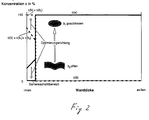
- Fig. 2
- eine Darstellung, aus der der Konzentrationsverlauf eines Matrixwerkstoffs und der aus barriereschichtumhüllten Matrix- und Füllstoffelementen sowie von Fragmenten über die Wanddicke eines Bauteils hervorgeht,
- Fig. 3
- eine schematische Schnittdarstellung einer Vorrichtung zum Extrusions - und Blasformen eines Hohlkörpers und Einbringen einer innenliegenden plasmapolymerisierten Folie, und
- Fig. 4
- eine schematische Schnittansicht einer mit einer Plasmaschicht versehenen Folie.
Claims (14)
- Verfahren zur Herstellung von Werkstücken oder Bauteilen, insbesondere von Kunststoff-Kraftstoff-Behältern, die mit einer Barriere gegen die Permeation von leicht flüchtigen Substanzen versehen werden, wobei eine zumindest als Granulat vorliegende Polymermasse, die zuvor durch Plasmabehandlung zumindest teilflächig beschichtet worden ist, verwendet wird,
dadurch gekennzeichnet, daß
die plasmapolymerisierte Masse, die außer als Granulat auch in Form von Pulvern, zerkleinerten oder unzerkleinerten Folien aus Kunststoffen oder Verbundkonstruktionen mit Kunststoffanteilen vorliegen kann, in bzw. auf eine zur Herstellung der Werkstücke oder Bauteile verwendete polymere Ausgangssubstanz zugeführt wird, indem die plasmapolymerisierte Masse als Pulver, Granulat oder zerkleinerte Folie direkt in die Eingangszone eines Extruders oder einer Spritzgußmaschine eingegeben wird oder indem die plasmapolymerisierte Masse als Folie in ein Werkzeug eingelegt oder direkt in einem Werkzeug aufgeschmolzen und mittels Rotation an die Werkzeugwandungen gebracht wird, und daß die plasmapolymerisierte Schicht auf der Polymermasse in Form von Granulat, Pulver oder Folie durch die gewählte Verfahrensweise schichtförmig longitudinal oder transversal zur Oberfläche als geschlossene oder offene Textur angeordnet wird. - Verfahren nach Anspruch 1, dadurch gekennzeichnet,daß die oberflächenveredelte Polymermasse aus Polyolefinen gebildet wird.
- Verfahren nach Anspruch 1, dadurch gekennzeichnet,daß die oberflächenveredelte Polymermasse auf Polyolefinbasis gebildet wird.
- Verfahren nach Anspruch 1 bis 3, dadurch gekennzeichnet, daß die oberflächenveredelte Polymermasse dem Prozeß anteilig zugeführt wird.
- Verfahren nach Anspruch 1 bis 3, dadurch gekennzeichnet, daß die oberflächenveredelte Polymermasse dem Prozeß insgesamt zugeführt wird.
- Verfahren nach Anspruch 1 bis 5, dadurch gekennzeichnet, daß in dem Vorprozeß die Beschichtung der Oberfläche des Pulvers oder des Granulats teil- oder ganzflächig charchenweise oder kontinuierlich, bzw. der Folien kontinuierlich oder diskontinuierlich ein- oder zweiseitig bandmäßig, mittels Plasmapolymerisation erfolgt.
- Verfahren nach Anspruch 1, dadurch gekennzeichnet,daß der Anteil der plasmabeschichteten Masse mittels Coextrusion, Mehrkomponenten- oder Gegentaktspritzgießen reduziert wird.
- Verfahren nach Anspruch 1 bis 7, dadurch gekennzeichnet, daß Mischungen aus Pulvern, Granulaten und/oder Folien hergestellt werden, die durch Einsatz unterschiedlicher Verfahrensparameter und Monomere aus verschiedenartigen Plasmaschichten bestehen.
- Verfahren nach Anspruch 1 bis 8, dadurch gekennzeichnet, daß die plasmapolymerisierte Polymermasse als zusammenhängende und/oder unzusammenhängende Schichten im Randbereich und/oder inmitten der Kunststoffwandung des Werkstücks oder Bauteils als Sandwichschichten eingebracht wird.
- Verfahren nach Anspruch 1 bis 8, dadurch gekennzeichnet,daß die plasmapolymerisierte Polymermasse als zusammenhängende oder unzusammenhängende Schichten auf ein Bauteil aus organischen oder anorganischen Werkstoffen als Sandwichschichten aufgetragen wird.
- Verfahren nach Anspruch 1 bis 10,dadurch gekennzeichnet,daß die plasmapolymerisierte Schicht in dem jeweiligen Prozeß mit einer solchen Temperaturbeständigkeit und mechanischen Flexibilität ausgebildet wird, daß sie dauerhaft bestehen bleibt.
- Verfahren nach Anspruch 1 bis 10,dadurch gekennzeichnet,daß die plasmapolymerisierte Schicht im jeweiligen Prozeß Fragmente oder Zersetzungsprodukte bildet und somit Abschirmeffekte bewirkt.
- Verfahren nach Anspruch 1 bis 12,dadurch gekennzeichnet,daß eine geeignete Orientierung und lokale Anordnung der Plasmaschicht derart bewirkt werden, daß eine lokal steuerbare Eigenschaft als Gradient oder Unstetigkeit erzeugt wird.
- Verfahren nach Anspruch 1 bis 14,dadurch gekennzeichnet,daß Rußpartikel und/oder andere Additive vor der Einbringung ins Batch zur Erhöhung der Packungsdichte der Plasmateilchen plasmabeschichtet werden.
Priority Applications (2)
| Application Number | Priority Date | Filing Date | Title |
|---|---|---|---|
| DE59408011T DE59408011D1 (de) | 1994-04-13 | 1994-04-13 | Verfahren zur Herstellung von Werkstücken oder Bauteilen unter Verwendung einer polymeren Ausgangssubstanz, insbesondere von Kunststoff-Kraftstoff-Behältern |
| EP19940105656 EP0677366B1 (de) | 1994-04-13 | 1994-04-13 | Verfahren zur Herstellung von Werkstücken oder Bauteilen unter Verwendung einer polymeren Ausgangssubstanz, insbesondere von Kunststoff-Kraftstoff-Behältern |
Applications Claiming Priority (1)
| Application Number | Priority Date | Filing Date | Title |
|---|---|---|---|
| EP19940105656 EP0677366B1 (de) | 1994-04-13 | 1994-04-13 | Verfahren zur Herstellung von Werkstücken oder Bauteilen unter Verwendung einer polymeren Ausgangssubstanz, insbesondere von Kunststoff-Kraftstoff-Behältern |
Publications (2)
| Publication Number | Publication Date |
|---|---|
| EP0677366A1 EP0677366A1 (de) | 1995-10-18 |
| EP0677366B1 true EP0677366B1 (de) | 1999-03-24 |
Family
ID=8215855
Family Applications (1)
| Application Number | Title | Priority Date | Filing Date |
|---|---|---|---|
| EP19940105656 Expired - Lifetime EP0677366B1 (de) | 1994-04-13 | 1994-04-13 | Verfahren zur Herstellung von Werkstücken oder Bauteilen unter Verwendung einer polymeren Ausgangssubstanz, insbesondere von Kunststoff-Kraftstoff-Behältern |
Country Status (2)
| Country | Link |
|---|---|
| EP (1) | EP0677366B1 (de) |
| DE (1) | DE59408011D1 (de) |
Families Citing this family (3)
| Publication number | Priority date | Publication date | Assignee | Title |
|---|---|---|---|---|
| DE19700426C2 (de) * | 1997-01-09 | 2002-03-21 | Inpro Innovations Gmbh | Verfahren zur Herstellung von gegenüber Flüssigkeiten und/oder Gasen permeationssperrenden Schichten auf Innenflächen von Kunststoffhohlbehältern, insbesondere von Kunststoff-Kraftstoffbehältern (KKB) mittels Plasmapolymerisation |
| DE19731771A1 (de) * | 1997-07-24 | 1999-01-28 | Bultykhanova Natalia | Abdichtungsverfahren |
| DE102016000223A1 (de) | 2016-01-14 | 2017-07-20 | Reifenhäuser GmbH & Co. KG Maschinenfabrik | Verfahren und Anlage zum Herstellen eines Bahnförmigen oder Schlauchförmigen Werkstoffes sowie Werkstoff |
Family Cites Families (5)
| Publication number | Priority date | Publication date | Assignee | Title |
|---|---|---|---|---|
| US4264750A (en) * | 1979-08-01 | 1981-04-28 | Massachusetts Institute Of Technology | Process for fluorinating polymers |
| JPS60228576A (ja) * | 1984-04-26 | 1985-11-13 | Toppan Printing Co Ltd | 導電性塗料 |
| FR2570964B1 (fr) * | 1984-10-03 | 1988-11-10 | Air Liquide | Procede et appareil d'impermeabilisation d'une surface constituee d'un polymere. |
| SU1694610A1 (ru) * | 1989-08-07 | 1991-11-30 | Научно-Исследовательский Институт Электромеханических Приборов | Состав рабочего сло носител магнитной записи |
| DE4141805A1 (de) * | 1991-12-18 | 1993-06-24 | Rhein Bonar Kunststoff Technik | Verfahren und vorrichtung zur herstellung von thermoplastischen kunststoffteilen mit hilfe von niedertemperaturplasmen |
-
1994
- 1994-04-13 EP EP19940105656 patent/EP0677366B1/de not_active Expired - Lifetime
- 1994-04-13 DE DE59408011T patent/DE59408011D1/de not_active Expired - Lifetime
Also Published As
| Publication number | Publication date |
|---|---|
| DE59408011D1 (de) | 1999-04-29 |
| EP0677366A1 (de) | 1995-10-18 |
Similar Documents
| Publication | Publication Date | Title |
|---|---|---|
| DE60031828T2 (de) | Verfahren zum Herstellen von Hohlkörpern aus Kunststoff | |
| DE2933231C2 (de) | ||
| DE2113554C3 (de) | Verbundfolie für Schrumpfverpackungen und deren Herstellung | |
| DE69829208T3 (de) | Mikrozellulares schaumstoff-extrusions/blasformverfahren und damit hergestellter gegenstand | |
| DE69805957T2 (de) | Spritzgiessen von mikrozelligem material | |
| DE3502136C2 (de) | Schalenumhüllungsfolie | |
| EP1184157B1 (de) | Verfahren zur Herstellung von Kunststoffhohlkörpern | |
| EP0447423B1 (de) | Formteil aus gespritzten oder extrudierten kunststoffabfällen | |
| DE2643498A1 (de) | Heisschrumpfbare folie | |
| CH618918A5 (de) | ||
| US4272312A (en) | Process for extruding films of thermoplastic polyester film-forming materials | |
| DE2821333A1 (de) | Rohr aus thermoplastischem material wowie verfahren zu seiner herstellung | |
| DE69300812T2 (de) | Blasgeformte mehrschichtige Behälter mit ausgezeichnetem Oberflächenglanz sowie deren Herstellungsverfahren. | |
| DE3881235T2 (de) | Mehrschichtiges Rohr für das Formziehen und daraus hergestellter mehrschichtiger Behälter. | |
| EP2260071B1 (de) | Verfahren zur herstellung eines gefüllten polymermaterials | |
| CH628301A5 (en) | Process for producing a plastic container for packaging goods such as foodstuffs, beverages, medicaments and cosmetics | |
| EP1216812A1 (de) | Verfahren zur Herstellung von Kunststoffhohlkörpern | |
| EP0677366A1 (de) | Verfahren zur Herstellung von Werkstücken oder Bauteilen unter Verwendung einer polymeren Ausgangssubstanz, insbesondere von Kunststoff-Kraftstoff-Behältern | |
| DE69508020T2 (de) | Schräglaminiertes Kunstofferzeugnis | |
| EP4209331A1 (de) | Biaxial-orientierte polyethylenfolien für das thermoformen, verfahren zu ihrer herstellung, ihre verwendung, ein verfahren zum thermoformen und dessen produkte | |
| DE60110442T2 (de) | Verfahren zur herstellung eines rotationskörpers durch rotationsformen und dadurch hergestelltes werkstück | |
| DE102013208235A1 (de) | Verfahren zum Sprühbeschichten | |
| WO2018114757A1 (de) | Hohlkörper umfassend eine wand aus einem mehrschichtigen thermoplastischen kunststoff sowie verfahren zu dessen herstellung | |
| DE202006001454U1 (de) | Polymere Folien mit geringem Gehalt an zyklischen olefinischen Polymeren und andere polymere Folien mit geringer Dichte | |
| DE10357578A1 (de) | Spritzgussanlage und Spritzgussverfahren |
Legal Events
| Date | Code | Title | Description |
|---|---|---|---|
| PUAI | Public reference made under article 153(3) epc to a published international application that has entered the european phase |
Free format text: ORIGINAL CODE: 0009012 |
|
| AK | Designated contracting states |
Kind code of ref document: A1 Designated state(s): CH DE FR GB IT LI NL SE |
|
| 17P | Request for examination filed |
Effective date: 19960401 |
|
| 17Q | First examination report despatched |
Effective date: 19970630 |
|
| GRAG | Despatch of communication of intention to grant |
Free format text: ORIGINAL CODE: EPIDOS AGRA |
|
| GRAG | Despatch of communication of intention to grant |
Free format text: ORIGINAL CODE: EPIDOS AGRA |
|
| GRAH | Despatch of communication of intention to grant a patent |
Free format text: ORIGINAL CODE: EPIDOS IGRA |
|
| GRAH | Despatch of communication of intention to grant a patent |
Free format text: ORIGINAL CODE: EPIDOS IGRA |
|
| GRAA | (expected) grant |
Free format text: ORIGINAL CODE: 0009210 |
|
| AK | Designated contracting states |
Kind code of ref document: B1 Designated state(s): CH DE FR GB IT LI NL SE |
|
| PG25 | Lapsed in a contracting state [announced via postgrant information from national office to epo] |
Ref country code: SE Free format text: THE PATENT HAS BEEN ANNULLED BY A DECISION OF A NATIONAL AUTHORITY Effective date: 19990324 Ref country code: NL Free format text: LAPSE BECAUSE OF FAILURE TO SUBMIT A TRANSLATION OF THE DESCRIPTION OR TO PAY THE FEE WITHIN THE PRESCRIBED TIME-LIMIT Effective date: 19990324 Ref country code: IT Free format text: LAPSE BECAUSE OF FAILURE TO SUBMIT A TRANSLATION OF THE DESCRIPTION OR TO PAY THE FEE WITHIN THE PRESCRIBED TIME-LIMIT;WARNING: LAPSES OF ITALIAN PATENTS WITH EFFECTIVE DATE BEFORE 2007 MAY HAVE OCCURRED AT ANY TIME BEFORE 2007. THE CORRECT EFFECTIVE DATE MAY BE DIFFERENT FROM THE ONE RECORDED. Effective date: 19990324 Ref country code: GB Free format text: LAPSE BECAUSE OF NON-PAYMENT OF DUE FEES Effective date: 19990324 Ref country code: FR Free format text: LAPSE BECAUSE OF FAILURE TO SUBMIT A TRANSLATION OF THE DESCRIPTION OR TO PAY THE FEE WITHIN THE PRESCRIBED TIME-LIMIT Effective date: 19990324 |
|
| REG | Reference to a national code |
Ref country code: CH Ref legal event code: EP |
|
| REF | Corresponds to: |
Ref document number: 59408011 Country of ref document: DE Date of ref document: 19990429 |
|
| PG25 | Lapsed in a contracting state [announced via postgrant information from national office to epo] |
Ref country code: LI Free format text: LAPSE BECAUSE OF NON-PAYMENT OF DUE FEES Effective date: 19990430 Ref country code: CH Free format text: LAPSE BECAUSE OF NON-PAYMENT OF DUE FEES Effective date: 19990430 |
|
| EN | Fr: translation not filed | ||
| NLV1 | Nl: lapsed or annulled due to failure to fulfill the requirements of art. 29p and 29m of the patents act | ||
| GBV | Gb: ep patent (uk) treated as always having been void in accordance with gb section 77(7)/1977 [no translation filed] |
Effective date: 19990324 |
|
| REG | Reference to a national code |
Ref country code: CH Ref legal event code: PL |
|
| PLBE | No opposition filed within time limit |
Free format text: ORIGINAL CODE: 0009261 |
|
| STAA | Information on the status of an ep patent application or granted ep patent |
Free format text: STATUS: NO OPPOSITION FILED WITHIN TIME LIMIT |
|
| 26N | No opposition filed | ||
| PGFP | Annual fee paid to national office [announced via postgrant information from national office to epo] |
Ref country code: DE Payment date: 20101030 Year of fee payment: 17 |
|
| REG | Reference to a national code |
Ref country code: DE Ref legal event code: R119 Ref document number: 59408011 Country of ref document: DE |
|
| REG | Reference to a national code |
Ref country code: DE Ref legal event code: R119 Ref document number: 59408011 Country of ref document: DE |
|
| PG25 | Lapsed in a contracting state [announced via postgrant information from national office to epo] |
Ref country code: DE Free format text: LAPSE BECAUSE OF NON-PAYMENT OF DUE FEES Effective date: 20111031 |