EP0674733B1 - Pavement markers with silicone adhesive - Google Patents
Pavement markers with silicone adhesive Download PDFInfo
- Publication number
- EP0674733B1 EP0674733B1 EP92907814A EP92907814A EP0674733B1 EP 0674733 B1 EP0674733 B1 EP 0674733B1 EP 92907814 A EP92907814 A EP 92907814A EP 92907814 A EP92907814 A EP 92907814A EP 0674733 B1 EP0674733 B1 EP 0674733B1
- Authority
- EP
- European Patent Office
- Prior art keywords
- layer
- sensitive adhesive
- pressure
- pavement
- marker
- Prior art date
- Legal status (The legal status is an assumption and is not a legal conclusion. Google has not performed a legal analysis and makes no representation as to the accuracy of the status listed.)
- Expired - Lifetime
Links
- 239000013464 silicone adhesive Substances 0.000 title description 4
- 239000004820 Pressure-sensitive adhesive Substances 0.000 claims abstract description 153
- 239000010410 layer Substances 0.000 claims abstract description 118
- 230000001070 adhesive effect Effects 0.000 claims abstract description 70
- 239000000853 adhesive Substances 0.000 claims abstract description 68
- 239000003550 marker Substances 0.000 claims abstract description 67
- 239000000463 material Substances 0.000 claims abstract description 35
- 238000000034 method Methods 0.000 claims abstract description 9
- 238000012360 testing method Methods 0.000 claims description 34
- 229920000728 polyester Polymers 0.000 claims description 27
- 239000004567 concrete Substances 0.000 claims description 20
- 239000012790 adhesive layer Substances 0.000 claims description 17
- 229920001971 elastomer Polymers 0.000 claims description 17
- 239000005060 rubber Substances 0.000 claims description 17
- 229910001220 stainless steel Inorganic materials 0.000 claims description 13
- 239000010935 stainless steel Substances 0.000 claims description 13
- NIXOWILDQLNWCW-UHFFFAOYSA-N acrylic acid group Chemical group C(C=C)(=O)O NIXOWILDQLNWCW-UHFFFAOYSA-N 0.000 claims description 9
- 239000004205 dimethyl polysiloxane Substances 0.000 claims description 5
- 229920000435 poly(dimethylsiloxane) Polymers 0.000 claims description 5
- -1 polydimethylsiloxane Polymers 0.000 claims description 5
- 239000006260 foam Substances 0.000 claims description 3
- 229910000831 Steel Inorganic materials 0.000 claims description 2
- 239000010959 steel Substances 0.000 claims description 2
- 238000010030 laminating Methods 0.000 claims 1
- 238000003825 pressing Methods 0.000 abstract 1
- 229920001296 polysiloxane Polymers 0.000 description 83
- 239000011248 coating agent Substances 0.000 description 40
- 238000000576 coating method Methods 0.000 description 40
- 229920005989 resin Polymers 0.000 description 17
- 239000011347 resin Substances 0.000 description 17
- 229920002313 fluoropolymer Polymers 0.000 description 14
- 239000004811 fluoropolymer Substances 0.000 description 14
- 239000002131 composite material Substances 0.000 description 9
- CTQNGGLPUBDAKN-UHFFFAOYSA-N O-Xylene Chemical compound CC1=CC=CC=C1C CTQNGGLPUBDAKN-UHFFFAOYSA-N 0.000 description 6
- 239000008096 xylene Substances 0.000 description 6
- 239000004342 Benzoyl peroxide Substances 0.000 description 5
- OMPJBNCRMGITSC-UHFFFAOYSA-N Benzoylperoxide Chemical compound C=1C=CC=CC=1C(=O)OOC(=O)C1=CC=CC=C1 OMPJBNCRMGITSC-UHFFFAOYSA-N 0.000 description 5
- 229910052782 aluminium Inorganic materials 0.000 description 5
- XAGFODPZIPBFFR-UHFFFAOYSA-N aluminium Chemical compound [Al] XAGFODPZIPBFFR-UHFFFAOYSA-N 0.000 description 5
- 235000019400 benzoyl peroxide Nutrition 0.000 description 5
- 239000011888 foil Substances 0.000 description 5
- 238000005096 rolling process Methods 0.000 description 5
- 239000000758 substrate Substances 0.000 description 5
- IMNFDUFMRHMDMM-UHFFFAOYSA-N N-Heptane Chemical compound CCCCCCC IMNFDUFMRHMDMM-UHFFFAOYSA-N 0.000 description 4
- 230000007812 deficiency Effects 0.000 description 4
- 235000013870 dimethyl polysiloxane Nutrition 0.000 description 4
- 238000009434 installation Methods 0.000 description 4
- BASFCYQUMIYNBI-UHFFFAOYSA-N platinum Chemical compound [Pt] BASFCYQUMIYNBI-UHFFFAOYSA-N 0.000 description 4
- 239000007787 solid Substances 0.000 description 4
- 239000003054 catalyst Substances 0.000 description 3
- 238000010276 construction Methods 0.000 description 3
- 230000001965 increasing effect Effects 0.000 description 3
- 238000004519 manufacturing process Methods 0.000 description 3
- 238000005065 mining Methods 0.000 description 3
- 239000004593 Epoxy Substances 0.000 description 2
- 239000004831 Hot glue Substances 0.000 description 2
- 240000005428 Pistacia lentiscus Species 0.000 description 2
- GWEVSGVZZGPLCZ-UHFFFAOYSA-N Titan oxide Chemical compound O=[Ti]=O GWEVSGVZZGPLCZ-UHFFFAOYSA-N 0.000 description 2
- 239000003522 acrylic cement Substances 0.000 description 2
- 238000007605 air drying Methods 0.000 description 2
- 125000000484 butyl group Chemical group [H]C([*])([H])C([H])([H])C([H])([H])C([H])([H])[H] 0.000 description 2
- 230000001627 detrimental effect Effects 0.000 description 2
- 230000002708 enhancing effect Effects 0.000 description 2
- 238000003475 lamination Methods 0.000 description 2
- 239000003973 paint Substances 0.000 description 2
- 239000002245 particle Substances 0.000 description 2
- 239000000049 pigment Substances 0.000 description 2
- 229910052697 platinum Inorganic materials 0.000 description 2
- 230000035939 shock Effects 0.000 description 2
- 229920002050 silicone resin Polymers 0.000 description 2
- 239000002904 solvent Substances 0.000 description 2
- 238000010186 staining Methods 0.000 description 2
- WRXCBRHBHGNNQA-UHFFFAOYSA-N (2,4-dichlorobenzoyl) 2,4-dichlorobenzenecarboperoxoate Chemical compound ClC1=CC(Cl)=CC=C1C(=O)OOC(=O)C1=CC=C(Cl)C=C1Cl WRXCBRHBHGNNQA-UHFFFAOYSA-N 0.000 description 1
- 229920001875 Ebonite Polymers 0.000 description 1
- 240000002834 Paulownia tomentosa Species 0.000 description 1
- 235000010678 Paulownia tomentosa Nutrition 0.000 description 1
- 239000004952 Polyamide Substances 0.000 description 1
- 239000005062 Polybutadiene Substances 0.000 description 1
- XUIMIQQOPSSXEZ-UHFFFAOYSA-N Silicon Chemical compound [Si] XUIMIQQOPSSXEZ-UHFFFAOYSA-N 0.000 description 1
- 239000002313 adhesive film Substances 0.000 description 1
- 239000010426 asphalt Substances 0.000 description 1
- 239000004568 cement Substances 0.000 description 1
- 150000001875 compounds Chemical class 0.000 description 1
- 238000006482 condensation reaction Methods 0.000 description 1
- 238000004132 cross linking Methods 0.000 description 1
- 230000003247 decreasing effect Effects 0.000 description 1
- 238000001514 detection method Methods 0.000 description 1
- 230000003467 diminishing effect Effects 0.000 description 1
- 239000000428 dust Substances 0.000 description 1
- 229920006332 epoxy adhesive Polymers 0.000 description 1
- 125000003700 epoxy group Chemical group 0.000 description 1
- 239000007888 film coating Substances 0.000 description 1
- 238000009501 film coating Methods 0.000 description 1
- 239000011521 glass Substances 0.000 description 1
- 238000011900 installation process Methods 0.000 description 1
- 239000013521 mastic Substances 0.000 description 1
- 229910052751 metal Inorganic materials 0.000 description 1
- 239000002184 metal Substances 0.000 description 1
- 125000002496 methyl group Chemical group [H]C([H])([H])* 0.000 description 1
- CXQXSVUQTKDNFP-UHFFFAOYSA-N octamethyltrisiloxane Chemical compound C[Si](C)(C)O[Si](C)(C)O[Si](C)(C)C CXQXSVUQTKDNFP-UHFFFAOYSA-N 0.000 description 1
- 238000010422 painting Methods 0.000 description 1
- 230000035515 penetration Effects 0.000 description 1
- 239000010702 perfluoropolyether Substances 0.000 description 1
- 125000001997 phenyl group Chemical group [H]C1=C([H])C([H])=C(*)C([H])=C1[H] 0.000 description 1
- 238000004987 plasma desorption mass spectroscopy Methods 0.000 description 1
- 229920002647 polyamide Polymers 0.000 description 1
- 229920002857 polybutadiene Polymers 0.000 description 1
- 229920000647 polyepoxide Polymers 0.000 description 1
- 229920000642 polymer Polymers 0.000 description 1
- 229920002635 polyurethane Polymers 0.000 description 1
- 239000004814 polyurethane Substances 0.000 description 1
- 230000000750 progressive effect Effects 0.000 description 1
- 230000001681 protective effect Effects 0.000 description 1
- 238000011084 recovery Methods 0.000 description 1
- 230000002787 reinforcement Effects 0.000 description 1
- 230000003014 reinforcing effect Effects 0.000 description 1
- 229910052710 silicon Inorganic materials 0.000 description 1
- 239000010703 silicon Substances 0.000 description 1
- 230000003068 static effect Effects 0.000 description 1
- 239000000126 substance Substances 0.000 description 1
- 230000003746 surface roughness Effects 0.000 description 1
- 238000009864 tensile test Methods 0.000 description 1
- 238000010998 test method Methods 0.000 description 1
- 239000004408 titanium dioxide Substances 0.000 description 1
- 125000000391 vinyl group Chemical group [H]C([*])=C([H])[H] 0.000 description 1
- 229920002554 vinyl polymer Polymers 0.000 description 1
- 239000003190 viscoelastic substance Substances 0.000 description 1
- 238000005303 weighing Methods 0.000 description 1
Images
Classifications
-
- E—FIXED CONSTRUCTIONS
- E01—CONSTRUCTION OF ROADS, RAILWAYS, OR BRIDGES
- E01F—ADDITIONAL WORK, SUCH AS EQUIPPING ROADS OR THE CONSTRUCTION OF PLATFORMS, HELICOPTER LANDING STAGES, SIGNS, SNOW FENCES, OR THE LIKE
- E01F9/00—Arrangement of road signs or traffic signals; Arrangements for enforcing caution
- E01F9/50—Road surface markings; Kerbs or road edgings, specially adapted for alerting road users
- E01F9/576—Traffic lines
- E01F9/578—Traffic lines consisting of preformed elements, e.g. tapes, block-type elements specially designed or arranged to make up a traffic line
-
- E—FIXED CONSTRUCTIONS
- E01—CONSTRUCTION OF ROADS, RAILWAYS, OR BRIDGES
- E01F—ADDITIONAL WORK, SUCH AS EQUIPPING ROADS OR THE CONSTRUCTION OF PLATFORMS, HELICOPTER LANDING STAGES, SIGNS, SNOW FENCES, OR THE LIKE
- E01F9/00—Arrangement of road signs or traffic signals; Arrangements for enforcing caution
- E01F9/50—Road surface markings; Kerbs or road edgings, specially adapted for alerting road users
- E01F9/506—Road surface markings; Kerbs or road edgings, specially adapted for alerting road users characterised by the road surface marking material, e.g. comprising additives for improving friction or reflectivity; Methods of forming, installing or applying markings in, on or to road surfaces
- E01F9/512—Preformed road surface markings, e.g. of sheet material; Methods of applying preformed markings
Definitions
- the present invention relates to pavement marking materials which may be adhered to a roadway surface to provide traffic control marking. It also relates to adhesive layers useful in adhering pavement marking material to a roadway surface.
- Pavement markings convey information to drivers and pedestrians by providing exposed visible and/or reflective surfaces which serve as indicia upon a roadway surface. In the past such a function was typically accomplished by painting portions of a roadway surface. Modern pavement marking materials offer significant advantages over paint such as dramatically increased visibility and/or reflectance, improved durability, and temporary removable marking options. Two examples of modern pavement marking materials are pavement marking sheet materials and raised pavement markers.
- pavement marking sheeting preferably comprising a wear-resistant top layer optionally overlying a flexible base sheet.
- the top layer is generally highly visible, may include reflective elements to enhance detection when illuminated by traffic at night, and serves as indicia when installed upon the roadway surface.
- Application of pavement marking sheeting to a roadway surface has typically been by contact cement or rubber-based pressure-sensitive adhesives.
- a pavement marking is a raised pavement marker (i.e. a discreet marking structure with a rigid, semi-rigid or flexible marking body) which when applied to a roadway surface provides a raised surface.
- the raised surface is both reflective and strategically oriented to enhance reflective efficiency when illuminated by traffic at night.
- attachment of the body of each marker to the pavement surface has involved hot-melt adhesives or epoxy systems.
- Flexible body raised pavement markers have also been attached to pavement surfaces or pavement marking sheeting by soft butyl mastic materials.
- both raised pavement markers and pavement marking sheeting must be applied to a rather troublesome substrate.
- That substrate the roadway surface, varies widely in terms of surface properties because the underlying material may be concrete or asphalt, may be of varying age and temperature, and may, on occasion, be moist or damp or oily. Additionally, the roadway surface may vary in texture from rough to smooth. The substrate surface properties, therefore, represent a considerable challenge for adhesive attachment.
- Some of the deficiencies associated with present pavement marking adhesives include: (1) inability to be applied due to limited adhesive tack at low temperature; (2) limited ability to accommodate surface roughness; (3) reduced durability, particularly at low temperature, when subjected to impact or shear; (4) increasing adhesion over time which in turn limits the duration of a period during which a temporary installation may be efficiently removed; and (5) staining of light colored concrete roadway surfaces by adhesives in removable markers. Additionally, particularly in the case of rigid body raised pavement markers, a rigid adhesive attachment to the pavement surface increases the susceptibility of the body of the marker to shattering upon impact by a vehicle tire. Further, inability of the adhesive to bridge gaps between a rigid raised pavement marker and a rough road surface may lead to early detachment of the marker from the roadway surface.
- the present invention satisfies these requirements with silicone pressure-sensitive adhesive systems which are highly useful for pavement marking tapes and raised pavement markers.
- Silicone pressure-sensitive adhesives have been known for many years but are believed not to have been previously employed as adhesives for pavement markers such as pavement marking sheets or raised pavement markers. At least three factors may have discouraged use of silicone pressure-sensitive adhesives in adhesive systems for pavement markers.
- silicone pressure-sensitive adhesives are relatively more costly than adhesives which have been used for application of pavement markers to pavement.
- silicone pressure-sensitive adhesives have a general reputation for only moderate adhesive properties such as tack and peel strength rather than outstanding adhesive tack and peel which would appear to be necessary by the desired property of durability of application/adhesion.
- silicone pressure-sensitive adhesives generally are characterized by low tack and low peel adhesion at room or cold temperatures. Silicone pressure-sensitive adhesives are better known and have a good reputation as effective adhesives for highly demanding high temperature situations since, when crosslinked, their shear strength remains generally constant at high temperatures.
- silicone pressure-sensitive adhesives have a reputation for some adhesion to nearly all surfaces. Thus, any expectation of handling convenience would require the availability of appropriately coated release surfaces. Typically, release surfaces for silicone pressure-sensitive adhesives have been carried upon separate release sheets. Handling of separate release sheets during application of pavement markers to a roadway surface would be undesirable, particularly in the case of pavement marking sheets.
- the present invention in one embodiment, is a pavement marker.
- the pavement marker includes an object(also referred to as a marking member), which has an upper surface which is useful as a pavement marking indicium and a lower surface, and also includes a bottom layer of polyorganosiloxane ("silicone”) pressure-sensitive adhesive underlying and in intimate contact with the lower surface.
- the object bearing the layer of silicone pressure-sensitive adhesive might be a pavement marking sheet or a raised pavement marker body.
- the pavement marker is a pavement marking sheet including a base layer and a top layer which is overlying the base layer.
- the overlying top layer includes a visibility enhancing pigment and/or partially embedded and partially exposed elements such as reflective elements and/or skid resisting elements.
- the pavement marking sheet also includes a layer of adhesive (i.e., bulk adhesive) which underlies the base layer and defines the bottom surface of the sheet.
- the bulk adhesive layer of the sheet is interposed between the base layer of the sheet and the polyorganosiloxane pressure-sensitive adhesive layer and is in contact with the polyorganosiloxane layer and optionally and most preferably, in contact with the base layer of the sheet.
- the bottom layer of silicone pressure-sensitive adhesive has a thickness of from about 3.0 to about 30 mils (76 to 760 micrometers). If an adhesive layer defining the lower surface of the sheet is present, then the combined thickness of the adhesive layer of the sheet and the bottom layer of silicone pressure-sensitive adhesive is preferably from about 3.0 to about 30 mils (76 to 760 micrometers). In such a combination, the bottom layer of silicone pressure-sensitive adhesive has a thickness of from about 0.5 to about 10 mils (13 to 254 micrometers).
- the combination of a bottom layer of silicone pressure-sensitive adhesive and the lower adhesive layer of the sheet provides the advantage of several of the desirable properties of silicone pressure-sensitive adhesive while avoiding much of the higher material cost of silicone pressure-sensitive adhesive. Further, employing a thin layer of silicone pressure-sensitive in combination with an adhesive layer of the sheet minimizes some of the less desirable properties of the silicone pressure-sensitive adhesive. In particular, in such an arrangement, the detrimental contribution of the relatively weak shear (cohesive) strength of the uncrosslinked silicone pressure-sensitive adhesive is minimized and instead, the lower layer adhesive of the sheet tends to contribute its relatively stronger shear (cohesive) strength.
- the silicone pressure-sensitive adhesive when coated as a 3 mils (76 micrometers) thick layer on a 2 mils (51 micrometers) thick polyester backing, is characterized by a 90° peel strength of from about 1.0 to about 6.0 pounds ("lbs.") per inch-width (1.8 to 10.5 Newtons ("NT") per centimeter (“cm”)) from stainless steel at a peel rate of 21.4 inches (54 cm) per minute at 21°C and more than about 0.25 lbs. per inch-width (0.4 NT per cm-width) when measured at 2°C.
- lbs. pounds
- NT Newtons
- the silicone pressure-sensitive adhesive when coated as a 3 mils (76 micrometers) thick layer on 2 mils (51 micrometers) thick polyester backing, is characterized by a twin cylinder tack strength (as explained below), during a 21.4 inch per minute (54cm per min) pull rate in a standard tensile strength measuring device, of at least about 0.75 lbs. per inch-width (1.3 NT per cm-width) at 21°C and at least about 0.5 lbs. per inch-width (0.8 NT per cm- width) when measured at 2°C.
- a twin cylinder tack strength as explained below
- a preferred silicone pressure-sensitive adhesive is prepared from a polydimethylsiloxane gum.
- the preferred silicone pressure-sensitive adhesive is substantially nonstaining to concrete pavement.
- nonstaining to concrete pavement is meant that subsequent to removal after six months application to concrete pavement, no visually objectionable contrasting mark remains on the concrete pavement.
- the present invention includes a pressure-sensitive adhesive laminate for attaching a pavement marker to a roadway surface.
- the pressure-sensitive adhesive laminate system includes a first layer of pressure-sensitive adhesive material, a second layer of pressure-sensitive adhesive material and a layer of deformable material interposed between the first and second pressure-sensitive adhesive layers.
- the interposed layer of material is characterized by high cohesive strength and high deformability.
- the interposed material is a foamed acrylic adhesive.
- one of the adhesive layers of the pressure-sensitive adhesive laminate includes an acrylic based adhesive.
- one of the adhesive layers of the pressure-sensitive adhesive laminate includes a polyorganosiloxane adhesive. Most especially preferred is an embodiment in which a polyorganosiloxane layer is used to contact and bond to a roadway surface.
- the interposed deformable layer adapts to uneven substrate surfaces to facilitate dependable bonding and may also serve to absorb and/or redistribute a significant portion of the impact or shock of vehicle tires striking the pavement marker.
- the laminate adhesive is particularly useful for attaching rigid raised pavement markers to a roadway surface. It supports the lower surface of the marker.
- the present invention also includes a raised pavement marker including a rigid body having an upper surface useful as a marking indicia and having a base surface; a deformable layer having a first surface supporting the base surface of the rigid body; and a silicone pressure-sensitive adhesive layer laminated to a second surface of the deformable layer.
- the present invention also includes a method of preparing pavement markers and a method of marking a pavement with a roadway surface below 15°C.
- the present invention in one embodiment, is a pavement marker.
- the pavement marker includes a marking member (such as a sheet or backing), which has an upper surface useful as a marking indicium and a lower surface, and a bottom layer of polyorganosiloxane ("silicone") pressure-sensitive adhesive in intimate contact with the lower surface of the sheet.
- Pavement markers according to this invention are useful as pavement marking sheets or tapes and are suited to application to roadway surface substrates over a wide range of temperatures, particularly including lower temperatures than those temperatures at which the pressure-sensitive adhesives currently used in the pavement marking industry.
- the present invention facilitates application of pavement marking sheets or tapes to roadway surfaces at temperatures of 2°C. Additionally, pavement markers of this invention bond more effectively to difficult surfaces then do prior art pavement markers.
- pressure-sensitive adhesive herein is meant those viscoelastic materials which, in solvent free form, remain aggressively and permanently tacky and will adhere to surfaces tenaciously after the application of only very light manual pressure.
- silicone pressure-sensitive adhesive or “polyorganosiloxane pressure-sensitive adhesive” herein is meant pressure-sensitive adhesive materials formed from a silicone "gum” structure and a silicone "resin” structure. Typically, the silicone gum and silicone resin are chemically linked by a condensation reaction. Silicone gum structures may include methyl and/or phenyl moieties. The ratio of silicone resin to silicone gum which is used in the silicone pressure sensitive adhesive may vary as long as the product is tacky at room temperature.
- silicone pressure-sensitive adhesives intended for application to roadway surfaces at or below 15°C
- the silicone pressure sensitive adhesive product should be tacky at the intended application temperature.
- a suitable test method for measuring tack at selected temperatures is described below.
- Silicone pressure-sensitive adhesive films may also be further crosslinked, for example, through the use of benzoyl peroxide or 2,4-dichlorobenzoyl peroxide or a rare metal catalyst. Crosslinking of films tends to increase the cohesive strength and resistance to shear but with loss of tack and sometimes loss of peel strength.
- U.S. Patent No. 2,736,724 (Dexter) and U.S. Patent No. 2,857,356 (Goodwin) represent significant early work in the field in silicone pressure-sensitive adhesives.
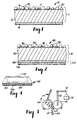
- a pavement marker 10 as shown in Figure 1, includes a sheet 11 and a bottom layer 14.
- the sheet 11, has a base layer 12 and further has an upper surface 16, which is useful as a marking indicium.
- the upper surface 16 is the surface of an optional top layer 17 overlying base layer 12.
- the top layer 17 may be formed of a wide range of polymeric materials such as, for example, polymers including polyamides, polyurethanes, epoxies, polyesters, and vinyls and so forth.
- the top layer 17 has a thickness of from about 3 to about 90 mils (76 to 2300 micrometers); more preferably, from about 3 to 14 mils (76 to 358 micrometers); and most preferably, about 5 mils (125 micrometers).
- Suitable sheets 11, with separate base layers 12 and overlying top layers 17 providing upper surface 16, are disclosed in U.S. Patent No. 4,117,192 (Jorgenson), incorporated herein by reference.
- the sheet 11 has upper surface 16 which is useful as a marking indicium and preferably includes reflecting elements 18 and/or skid-resisting particles 20.
- the top layer 12 also includes a visibility enhancing pigment, such as, for example, 'titanium dioxide. Sheets employing dead soft aluminum are also well known and suitable for use in the present invention.
- pavement markers which obliterate or temporarily cover existing roadmarkings (such as unwanted paint or marking tape which can not be easily removed) by application over the unwanted marking and thereby providing a flat black or gray surface 16 are also known and considered within the scope of this invention.
- the bottom layer 14 includes a silicone or polyorganosiloxane containing pressure-sensitive adhesive.
- the bottom layer 14 When directly adjoining the base layer 12, the bottom layer 14 has a thickness of from about 3.0 to 30 mils (76 to 760 micrometers), preferably a thickness of from about 4.0 to about 15 mils (100 to 380 micrometers) and most preferably a thickness of from about 5.0 to about 10 mils (127 to 254 micrometers).
- the bottom layer 14 may optionally include a reinforcement means to increase tensile strength and thereby enhance removability, such as, for example, a scrim or fibrous web as taught in U.S. Patent No. 4,299,874 (Jones et al.), incorporated herein by reference.
- a pavement marker 40 has a sheet 41, with a base layer 42, an optional top layer 45 which provides an upper surface 46, useful as a marking indicium and carrying partially embedded and partially exposed reflective elements 48 and/or skid-resisting particles 50.
- Sheets employing dead soft aluminum, which is relatively temperature independent in desirable conformance properties, are also well known and suitable for use in the present invention.
- the sheet 41 also includes a bulk layer of adhesive 58 underlying the base sheet 42.
- the adhesive layer 58 of the sheet 41 may be any of the adhesive layers typically provided with pavement marking sheets, for example, the butadiene rubber-based rubber-resin pressure-sensitive adhesive disclosed in example 5 of U.S. Patent No.
- An object, specifically a backing or sheet, which may be employed in forming a pavement marker of this invention is the construction disclosed in U.S. Patent No. 4,248,932 (Tung), or U.S. Patent No. 4,388,359 (Ethen), both of which are incorporated herein by reference.
- the bottom layer 56 of polyorganosiloxane pressure-sensitive adhesive is in contact with the lower surface of adhesive layer 58.
- Layer 58 may be described as defining the lower surface of the sheet 41 and interposed between the base layer 42 and the bottom layer 56.
- the adhesive layer 58 and base layer 42 are in contact with each other, however, other layers may also be present.
- a reinforcing scrim may be present within the adhesive layer 58 in order to facilitate removability by increasing tensile and tear strength.
- the combination 54 of the bottom layer 56 of silicone pressure-sensitive adhesive and adhesive layer 58 has a thickness of from about 3 to about 30 mils (76 to 760 micrometers).
- the bottom layer 56 of silicone pressure-sensitive adhesive has a thickness of from about 0.5 to about 10 mils (13 to 152 micrometers), preferably from about 2.0 to about 6.0 mils (51 to 152 micrometers) and most preferably from about 2.0 to about 3.0 mils (51 to 76 micrometers).
- Silicone pressure-sensitive adhesives are costly relative to other common pressure-sensitive adhesives. Generally, for the purposes of the present invention, it is economically desirable to use as thin a layer of silicone pressure-sensitive adhesive as possible and yet still achieve the overall goals of the invention. This has the additional advantage of minimizing the detrimental effects of the relatively weak shear (cohesive) strength of uncrosslinked silicone pressure-sensitive adhesives and generally substituting the relatively stronger shear (cohesive) strength of the less costly traditional bulk adhesive of the sheet.
- Suitable silicone pressure-sensitive adhesives are those polyorganosiloxane pressure-sensitive adhesives which exhibit pressure-sensitive adhesive behavior at temperatures from 0 to 50°C, have improved impact properties, and form adhesive bonds at low temperatures when compared to pressure-sensitive adhesives which have conventionally been used in pavement marking tapes.
- Preferred polyorganosiloxane pressure-sensitive adhesives enable effective application and adhesion of tapes to roadway surfaces at temperatures significantly lower than those previously accepted as the norms for roadway marking tape application.
- the low temperature advantage of this invention may only be fully available when used in conjunction with pavement marking sheets (such as Foil based tapes) which also remain flexible and conformable at low temperature.
- Suitable silicone pressure-sensitive adhesive when coated as a 3 mils (76 micrometers) thick layer on a 2 mils (51 micrometers) thick polyester backing, is characterized by a 90° peel strength of from about 1.0 to about 6.0 lbs. per inch width (1.8 to 10.5 NT per cm) from stainless steel at a peel rate of 21.4 inches (54 cm) per minute at 21°C and the peel strength is more than 0.25 lbs. per inch width (0.4 NT per cm width) when tested at 2°C.
- the sample is laminated to a stainless steel panel using two passes of a hard rubber (70 shore A durometer) 1.5 inch diameter (3.8 cm) roller and 5 lbs. of pressure. A dwell time (typically 5 minutes) is allowed before peeling.
- Low temperature testing is done in a 2°C cold room and all equipment and material is at 2°C so that application, dwell and removal occur at low temperature.
- Suitable silicone pressure-sensitive adhesive when coated as a 3 mils (76 micrometers) thick layer on 2 mils (51 micrometers) thick polyester backing web, is characterized by a twin cylinder tack strength (as explained below), during a 21.4 inch per minute (54 cm per min) pull rate in a standard tensile strength measuring device, of at least about 0.75 lbs. per inch width (1.3 NT per cm width) at 21°C and at least about 0.5 lbs. per inch width (0.8 NT per cm width) when measured at 2°C.
- the twin cylinder tack test provides a simple measure of the tack in an adhesive sample.
- An apparatus or jig for performing the test is schematically shown in Figure 3 as 60.
- the test is performed as follows. A strip of web 62 coated on one side with an adhesive sample 63 is continuously pulled through a nip 64 between a stainless steel roller 66 and a rubber roller 68. The coated side of the web 62 faces the stainless steel roller 66. During the time the web is pulled through the nip, the successive portions of the coating of adhesive 63 first contact the surface of the stainless steel roller 66, then after a brief dwell time are peeled from the surface by the web 62.
- the test is most conveniently performed with the test jig 60 mounted in a standard tensile testing machine (not shown).
- the testing jig 60 consists of two horizontally mounted, parallel, free-rolling cylinders 66 and 68.
- One of the cylinders 66 has a stainless steel surface; the other cylinder 68 has a rubber surface with a hardness of about 50 when measured by Shore A Durometer.
- the cylinder diameters for the testing jig are both 1.5 inches (3.8 cm).
- the length of both cylinders is 3 inches (7.6 cm).
- the rubber coated cylinder is carried on a hinged support 70 so that it can be brought into contact with the stainless steel cylinder 66 and form a nip 64 with zero loading force.
- the hinged support 70 also includes a rigid perpendicular projecting lever 72 as a means of loading the rubber cylinder toward the nip with a known static force.
- the loading weight 74 is hung on the lever 72 with a loading moment such that the gravitational force exerted on the hanging weight 74 is multiplied by a factor of 1.25 when the force at the nip 64 is determined.
- the two parallel cylinders 66 and 68 are aligned such that in pulling the test sample 63 through the nip 64, the direction of motion of the end of the test sample is tangential to both rolls at their point of contact (i.e., the web is pulled as if it were traveling straight through the nip).
- a test sample consisting of a 1 inch (2.54 cm) wide web 62 coated on one side with pressure-sensitive adhesive 63 is placed in the nip 64 of the testing jig with the adhesive side of the sample in contact with the stainless steel cylinder 66.
- the rubber cylinder 68 is loaded against the web or backing support 62 of the test sample using a 5 lbs. (2.27 Kg) weight 74. This in turn generates a loading force at the nip 64 of about 6.25 lbs. (2.84 Kg).
- One end of the test sample is gripped using a standard tensile tester and the test sample is pulled through the nip 64 of the testing jig 60 at a constant rate of, for example, about 18 inches per minute (46 cm per min).
- the force required to pull the sample 63 through the testing jig 60 is measured.
- the average force per unit width (i.e, 1.0 inch (2.54 cm)) of sample is the twin cylinder tack value for an adhesive.
- the sample 63 actually remains temporarily in contact with the steel roller for some distance, for example about 0.25 of the circumference of the roll.
- the angle between the free tape web and the stainless steel roller increases, until the force on the free tape web overcomes the recently formed bond to the stainless surface of cylinder 66 and the web 62 is peeled at a peel angle ⁇ (i.e., angle between the web and a tangent to the surface at the point where contact is broken) of, for example, approximately 90°.
- a peel angle ⁇ i.e., angle between the web and a tangent to the surface at the point where contact is broken
- the test is representative of the tack property of an adhesive sample 63 since it measures the peel force required shortly after a tacking application of a test sample of adhesive to a surface.
- the dwell time and peel angle ⁇ vary somewhat as a function of speed and tack properties of the silicone pressure sensitive adhesive 63.
- Extremely tacky silicone pressure sensitive adhesives rapidly form bonds to the stainless steel surface.
- the test can easily be performed at various selected temperatures to measure the effectiveness of a pressure sensitive adhesive.
- the angle of arc of contact ⁇ with the stainless steel cylinder 66 is a surprisingly sensitive measure of the aggressivity of tack of a pressure-sensitive adhesive.
- Particularly desirable silicone pressure-sensitive adhesives tend to have high angles of arc of contact ⁇ .
- Preferred silicone pressure-sensitive adhesives have angles of arc of contact ⁇ of at least about 40° when pulled at 21.4 inches per minute (54 cm per min) at cold temperatures (i.e. about -1°C). Most particularly preferred are silicone pressure-sensitive adhesives characterized by angles of arc of contact ⁇ of at least about 60° at 30°F (-1°C).
- the preferred silicone pressure-sensitive adhesives for temporary, removable pavement markers are substantially nonstaining to concrete pavement.
- nonstaining to concrete pavement is meant that subsequent to removal after six months application to concrete pavement, no visually objectionable contrasting mark remains on the concrete pavement.
- a suitable silicone adhesive is polydimethylsiloxane adhesive, such as for example, the polydimethylsiloxane adhesive ("PDMS") sold as Dow Corning X7-2675 Brand Silicone Adhesive available from Dow Corning Corp. of Midland, Michigan.
- PDMS polydimethylsiloxane adhesive
- Other suitable pressure-sensitive adhesives are Dow Corning Q2-7406 and X2-7735 Brand Silicone Pressure-Sensitive Adhesives.
- Silicone pressure-sensitive adhesives have several unique advantages when used in removable pavement marking tapes. These advantages include:
- pavement marking sheets which are to be used as pavement marking tapes are preferably stored and transported to highway project sites as rolls of tape. During the application and installation process, the tape is unwound from the roll.
- handling of the pavement markers of the sheet type may be facilitated by the provision of a suitable low-adhesion backsize coating upon the upper surfaces 16 or 46.
- a suitable backsize coating is SYL-OFFTM Q2-7785 brand coating available from Dow Corning of Midland, Michigan.
- a disposable web bearing a suitable low-adhesion coating may be employed with sheet type markers.
- a suitable coating allows temporary contact with the silicone pressure-sensitive adhesive layer 14 or 56 without any undue diminishing of subsequent tack or other adhesive properties.
- Perfluoropolyether compounds e.g., as disclosed in U.S. Patent No. 4,472,480 (Olson), may be employed to provide such a coating.
- the present invention also includes a pressure-sensitive adhesive laminate 100 as shown in Figure 4.
- the laminate 100 includes a first layer of pressure-sensitive adhesive material 102 and a second layer of pressure-sensitive adhesive material 104 and a layer of deformable, optionally adhesive, material 106 interposed between the first layer 102 and the second layer 104.
- the laminate is particularly useful for applying rigid or nearly rigid objects, such as raised pavement markers to roadway surfaces.
- Raised pavement marker bodies have been previously described in U.S. 4,875,798 and U.S. 4,974,990.
- Older systems of applying rigid objects to roadway surfaces have employed hot-melt adhesive or epoxy adhesive.
- Butyl mastics have also been used as pressure-sensitive adhesives for rigid objects on roadway surfaces. These prior adhesive systems have been awkward to use, time consuming and generally not very durable.
- the layer 106 of deformable material is capable of flowing sufficiently so as to increase contact between the layer of pressure sensitive adhesive 104 and the rough roadway surface. This enables a rigid marker (phantom 101) to be more securely bonded to the roadway surface.
- the deformable, optionally adhesive, layer 106 may also absorb at least some of the impact when a vehicle tire strikes a raised pavement marker employing the laminate 100.
- Adhesive layer 102 may be F9775PC acrylic adhesive available from the Minnesota Mining and Manufacturing Company of St. Paul, Minnesota.
- a suitable polyorganosiloxane pressure-sensitive adhesive is Dow Corning adhesive X7-2675 available from Dow Corning Chemical Company of Midland, Michigan.
- the layer of deformable adhesive material 106 is Y4253 foamed acrylic pressure-sensitive adhesive available from the Minnesota Mining and Manufacturing Company of St. Paul, Minnesota.
- the layer of deformable adhesive material has a thickness from about 10 to about 250 mils (254 to 6350 micrometers), more preferably from about 20 to about 50 mils (508 to 1270 micrometers), and most preferably about 35 mils (890 micrometers).
- the pressure-sensitive adhesive layers 102 or 104 should be from about 3 to about 8 mils (76 to 203 micrometers) in thickness and most preferably about 5 mils (127 micrometers) in thickness.
- polyorganosiloxane pressure-sensitive adhesive layers 104 or 102 such as X7-2675 silicone adhesive, available from Dow Corning
- the layers should be from about 2 to about 8 mils (50 to 203 micrometers) and most preferably about 3 mils (76 micrometers) in thickness.
- the laminate could also be applied to a roadway and the pavement marker subsequently applied to the adhesive laminate on the roadway surface.
- Q2-7406 brand silicone pressure-sensitive adhesive available from Dow Corning Corp. of Midland, Michigan, was handspread coated as supplied in xylene solution onto a fluoropolymer release coated polyester liner (SCOTCHPAKTM1022 release liner which is available from the Minnesota Mining and Manufacturing Company, "3M") using a notched bar coater. The coating was allowed to air dry for about 10 minutes, dried for about 5 minutes at 70°C and dried further for about 2 minutes at a temperature of 175°C. A sheet of unprimed uncoated polyester liner 2 mils (50 micrometers) in thickness was laminated to the Q2-7406 coating. The thickness of the Q2-7406 dry film was measured at 3.0 mils (76 micrometers).
- Q2-7406 brand silicone pressure-sensitive adhesive solution (Dow Corning Corp.), was mixed with a solution of 10 weight percent benzoyl peroxide in xylene so as to produce a solution with a benzoyl peroxide content of 1 weight percent based on Q2-7406 solution (about 2 weight percent based on adhesive solids.)
- This solution was handspread coated onto a fluoropolymer release coated polyester liner (SCOTCHPAKTM1022 release liner) using a notched bar coater. The coating was allowed to air dry for about 10 minutes, dried for about 5 minutes at 70°C and dried further for about 2 minutes at a temperature of 175°C.
- a sheet of unprimed uncoated polyester liner 2 mils (50 micrometers) in thickness was laminated to the Q2-7406 coating. The thickness of the Q2-7406 dry film was measured and found to be 2.1 mils (53 micrometers).
- X2-7735 brand silicone pressure-sensitive adhesive solution (Dow Corning Corp.) was handspread as supplied in xylene solution onto a fluoropolymer release coated polyester liner (SCOTCHPAKTM1022 release liner) using a notched bar coater. The coating was allowed to air dry for about 10 minutes, dried for about 5 minutes at 70°C and dried further for about 2 minutes at a temperature of 175°C. A sheet of unprimed uncoated polyester liner 2 mils (50 micrometers) in thickness was laminated to the X2-7735 coating. The thickness of the X2-7735 dry film was measured and found to be 3.0 mils (76 micrometers).
- X2-7735 brand silicone pressure-sensitive adhesive solution (Dow Corning Corp.) was mixed with a solution of 10 weight percent benzoyl peroxide in xylene so as to produce a solution with a benzoyl peroxide content of 1 weight percent based on X2-7735 solution (about 2 weight percent based on adhesive solids).
- This solution was handspread coated onto a fluoropolymer release coated polyester liner (SCOTCHPAKTM1022 release liner) using a notched bar coater. The coating was allowed to air dry for about 10 minutes, dried for about 5 minutes at 70°C and dried further for about 2 minutes at a temperature of 175°C.
- a sheet of unprimed uncoated polyester liner 2 mils (50 micrometers) in thickness was laminated to the X2-7735 coating. The thickness of the X2-7735 dry film was measured and found to be 1.9 mils (48 micrometers).
- X2-7656 silicone pressure-sensitive adhesive solution (Dow Corning Corp.) was mixed with a solution of 10 weight percent platinum catalyst (#7127 Accelerator also available from Dow Corning Corp.) in xylene so as to produce a solution with a platinum catalyst content of 1 weight percent based on X2-7656 solution (about 2 weight percent based on adhesive solids).
- This solution was handspread coated onto a fluoropolymer release coated polyester liner (SCOTCHPAKTM1022 release liner) using a notched bar coater. The coating was allowed to air dry for about 10 minutes, dried for about 5 minutes at 70°C and dried further for about 2 minutes at a temperature of 175°C.
- a sheet of unprimed uncoated polyester liner 2 mils in thickness was laminated to the X2-7656 coating.
- the thickness of the X2-7656 dry film was 3.0 mils (76 micrometers).
- Rubber resin adhesive used in pavement marking tapes (3M brand STAMARKTM 5730 series pavement marking tapes) was handspread coated as supplied in heptane solution onto a fluoropolymer release coated polyester liner (SCOTCHPAKTM1022 release liner) using a notched bar coater. The coating was allowed to air dry for about 10 minutes, dried for about 5 minutes at 70°C and dried further for about 2 minutes at a temperature of 150°C. A sheet of unprimed uncoated polyester liner 2 mils (50 micrometers) in thickness was laminated to the rubber resin adhesive coating. The thickness of the resulting adhesive dry film was 1.9 mils (48 micrometers).
- Examples 1-6 were tested for peel and tack properties at both 21°C and -1°C. Peel tests were performed at 15.4 inches per minute (38.4 cm per min) pull rate with both 5 and 60 minute dwell times at a 90° peel angle. The tack tests were performed at a pull rate of 21.4 inches per minute (54 cm per min) in a twin cylinder tack testing apparatus as described above. The results are presented in Table 1.
- Q2-7406 brand silicone pressure-sensitive adhesive available from Dow Corning Corp.
- Q2-7406 brand silicone pressure-sensitive adhesive was handspread coated as supplied in xylene solution onto an unprimed uncoated polyester liner 2 mils in thickness using a notched bar coater. The coating was allowed to air dry for about 10 minutes, dried for about 5 minutes at 70°C and dried further for about 2 minutes at a temperature of 150°C.
- a sheet of fluoropolymer release coated polyester liner (SCOTCHPAKTM1022 release liner) was laminated to the Q2-7406 coating. The thickness of the Q2-7406 dry film was 2.4 mils (60 micrometers).
- Rubber resin adhesive used in pavement marking tapes (3M brand STAMARKTM 5730 series) was handspread coated as supplied in heptane solution onto an unprimed uncoated polyester liner 2 mils in thickness using a notched bar coater. The coating was allowed to air dry for about 10 minutes, dried for about 5 minutes at 70°C and dried further for about 2 minutes at a temperature of 150°C. A sheet of fluoropolymer release coated polyester liner (SCOTCHPAKTMl022 release liner) was laminated the rubber resin coating. The thickness of the rubber resin dry film was 2 mils (51 micrometers).
- Examples 7 and 8 were tested for the range of arc of contact, ⁇ , which was observed as the samples were pulled through a twin cylinder tack testing jig at slow (54 cm per min) and fast (540 cm per min) rates at cold (-1°C) and room temperatures (21°C). The results are presented in Table 2 along with the force which was required to pull the samples through the nip. Note that the range of arc of contact observed for Example 7 is substantial even when pulled at a fast rate at cold temperatures indicating superior performance of a marker of this invention relative to a marker with a rubber-resin pressure sensitive adhesive coating. The force required to pull the samples also indicates the superiority of the silicone pressure sensitive adhesive coated sample of Example 7 to the rubber-resin pressure sensitive adhesive coating of Example 8.
- Examples 7 and 8 were also tested using a rolling ball test adapted from ASTM D 3121 (TACK OF PRESSURE-SENSITIVE ADHESIVES BY ROLLING BALL) by substituting a glass ball weighing 2.2832 grams and having a diameter of 0.4772 inches (1.212 cm). The testing was performed at -1°C and at 21°C. At 21°C, the rolling ball stopped at an average distance of 1.3 cm for Example 7 and 25.5 cm for Example 8. At -1°C, the rolling ball stopped at an average distance 2.5 cm for Example 7 but did not stop within 70 cm for Example 8. The relatively short stop distance of Example 7, at both room and cold temperatures indicates the superiority of markers according to the present invention.
- a silicone pressure sensitive adhesive, X7-2675 (available from Dow Corning Corp.) as supplied in about 50 percent solids solution in FreonTM solvent was spread using a hand operated notched bar coater to form an adhesive coating onto a fluoropolymer release coated polyester liner, (SCOTCHPAKTM1022 Release Liner).
- the coating was allowed to air dry at ambient conditions for about 10 minutes followed by about 10 minutes at 70°C.
- the coating had a dry film thickness of about 2 mils (51 micrometers).
- the release liner was stripped from the silicone pressure sensitive adhesive and the composite laminate pavement marking tape was applied to a traffic bearing pavement surface and tamped into place by conventional means.
- This silicone pressure sensitive adhesive film with release liner still in place was laminated to the pressure sensitive adhesive coated surface, the bottom side of a commercially available pavement marking tape with a rubber-resin pressure sensitive adhesive (3M Brand SCOTCHLANETM 5710 pavement marking tape, available from 3M).
- the release liner was stripped from the silicone pressure sensitive adhesive and the composite laminate pavement marking tape was applied to a traffic bearing pavement surface and tamped into place by conventional means.
- the resulting silicone pressure sensitive adhesive film with release liner still in place was laminated to the bottom side of a commercially available pavement marking tape which lacked a pressure-sensitive adhesive (3M Brand STAMARKTM 5760 pavement marking tape).
- the release liner was stripped from the silicone pressure sensitive adhesive and the composite laminate pavement marking tape was applied to a traffic bearing pavement surface and tamped into place by conventional means.
- a silicone pressure sensitive adhesive, Q2-7406, (available from Dow Corning Corp.) was coated as supplied onto a fluoropolymer release coated polyester liner (Scotchpak 1022 Release Liner) using a notched bar coater by means of hand spread coating techniques. The coating was allowed to air dry at ambient conditions for about 15 minutes followed by forced air drying for about 3 minutes at about 150°C. The coating had a dry film thickness of about 2 mils (51 micrometers).
- the silicone pressure sensitive adhesive film of Example 12 with release liner still in place was laminated to the pressure sensitive adhesive coated surface (the bottom side of 3M Brand STAMARKTM 320 series pavement marking tape).
- the release liner was stripped from the silicone pressure sensitive adhesive and the composite laminate pavement marking tape was applied to a concrete pavement surface and tamped into place by conventional means.
- the silicone pressure sensitive adhesive film of Example 12 with release liner still in place was laminated to the pressure sensitive adhesive coated surface (the bottom side of Flex-O-Line Brand Pavement Striping Tape, Wet Reflective, Construction, Economy, pavement marking tape, available from Lukens General Industries, Inc., Flex-O-Lite Division, of St. Louis, Missouri).
- the release liner was stripped from the silicone pressure sensitive adhesive and the composite laminate pavement marking tape was applied to a concrete pavement surface and tamped into place by conventional means.
- Example 12 The silicone pressure sensitive adhesive film of Example 12 with release liner still in place was laminated to 3 mil thick dead soft aluminum foil available from ALCOA of Pittsburgh, Pennsylvania. The release liner was stripped from the silicone pressure sensitive adhesive and the composite laminate was applied to a concrete pavement surface and tamped into place by conventional means used for pavement marking tapes.
- a 3 mil thick layer of rubber resin adhesive (used in 3M brand SCOTCHLANETM 5710 series pavement marking tapes) on a release liner was laminated to a 3 mil (76 micrometer) thick sheet of dead soft aluminum foil available from ALCOA of Pittsburgh, Pennsylvania.
- the release liner was stripped from the rubber resin adhesive and the composite laminate was applied to a concrete pavement surface and tamped into place by conventional means used for pavement marking tapes.
- a 3 mil thick layer of rubber resin adhesive (used in 3M brand SCOTCHLANETM 5710 series pavement marking tapes) on a release liner was laminated to the pressure sensitive adhesive coated surface (i.e., the bottom side) of a commercially available pavement marking tape (3M brand STAMARKTM 320 series pavement marking tape).
- the release liner was stripped from the silicone pressure sensitive adhesive and the composite laminate pavement marking tape was applied to a concrete pavement surface and tamped into place by conventional means.
- a 3 mil thick layer of rubber resin adhesive (used in 3M brand SCOTCHLANETM 5710 series pavement marking tapes) on a release liner was laminated to the pressure sensitive adhesive coated surface (i.e., the bottom side) of a commercially available pavement marking tape (Flex-O-Line Brand Pavement Striping Tape, Wet Reflective, Construction, economy, pavement marking tape).
- the release liner was stripped from the silicone pressure sensitive adhesive and the composite laminate pavement marking tape was applied to a concrete pavement surface and tamped into place by conventional means.
- a raised pavement marker having a marker body with a generally planar bottom surface could be adapted for roadway application by lamination to a pressure-sensitive adhesive laminate prepared as follows:
- Step 1 An acrylic pressure-sensitive adhesive transfer tape of about 5 mils (127 micrometers) in thickness (available from 3M Company, Industrial Specialties Division, part #F9775PC) could be laminated to one side of a suitable deformable layer such as described in U.S. Patent No. 4,415,615 (Esmay), and which is available from 3M, Sumitomo 3M Division, as part number JT1400-7370-4. Lamination should be done at relatively light pressure, preferably about 8 to 10 lbs./in 2 (5.5 to 6.9 NT/cm 2 ).
- a polyorganosiloxane pressure-sensitive adhesive film could be prepared by coating Dow Corning polyorganosiloxane adhesive X7-2675 (available from Dow Corning Corp.) onto a suitable fluoropolymer release coated film (such as 3M SCOTCHPAK 1022 Release liner). This adhesive solution should be coated to a thickness of about 6 mils (152 micrometers). It is then subjected to room temperature (65 to 72°F (18 to 22°C)) for 10 minutes followed by five minutes at 200°F (93°C). The final coating thickness should be about 3 mils (76 micrometers).
- Step 3 To the other side of the conformance layer, the polyorganosiloxane adhesive (from Step 2) should be laminated using light pressure (8 to 10 lbs./in 2 (5.5 to 6.9 NT/cm 2 )).
- Step 4 For application to the bottom of the raised pavement marker the protective film could be removed from the acrylic pressure-sensitive adhesive and applied with pressure to the bottom of the marker, preferably with pressure greater than 10 lbs./in 2 (6.9 NT/cm 2 ).
- the fluoropolymer release film could be removed from the polyorganosiloxane pressure-sensitive adhesive.
- the marker could be positioned with the polyorganosiloxane adhesive against the road surface. Pressure could be applied to the top of the raised pavement marker to facilitate adhesion to the road surface. Sufficient pressure could be exerted by simply standing on the marker for about 15 seconds.
- a raised pavement marker without a generally planar bottom surface the body of which has been previously described in U.S. Patent No. 4,875,798 ( May) could also be prepared.
- a suitable conformance layer for such markers would be Acrylic Foam Tape 5390 (available from 3M). The acrylic foam tape has been previously described in U.S. Patent No. 4,223,067 (Levens) and could be substituted into the method of Example 19.
- a pavement marker including an object may also be supported at the lower surface of the object by a deformable layer and a pressure-sensitive adhesive layer underlying the deformable layer.
- the deformable layer promotes contact between the underlying pressure sensitive adhesive layer and the roadway surface during and after installation. In the case of a rigid marker, it fills the space between the road surface and the marker. In the case of a flexible object such as a sheet, it compensates for deficiencies in deformability of the sheet.
Landscapes
- Engineering & Computer Science (AREA)
- Architecture (AREA)
- Civil Engineering (AREA)
- Structural Engineering (AREA)
- Adhesives Or Adhesive Processes (AREA)
- Adhesive Tapes (AREA)
- Road Signs Or Road Markings (AREA)
- Laminated Bodies (AREA)
Applications Claiming Priority (3)
| Application Number | Priority Date | Filing Date | Title |
|---|---|---|---|
| US66277391A | 1991-02-28 | 1991-02-28 | |
| US662773 | 1991-02-28 | ||
| PCT/US1992/000751 WO1992015756A1 (en) | 1991-02-28 | 1992-01-30 | Pavement markers with silicone adhesive |
Publications (2)
| Publication Number | Publication Date |
|---|---|
| EP0674733A1 EP0674733A1 (en) | 1995-10-04 |
| EP0674733B1 true EP0674733B1 (en) | 1997-09-10 |
Family
ID=24659163
Family Applications (1)
| Application Number | Title | Priority Date | Filing Date |
|---|---|---|---|
| EP92907814A Expired - Lifetime EP0674733B1 (en) | 1991-02-28 | 1992-01-30 | Pavement markers with silicone adhesive |
Country Status (11)
| Country | Link |
|---|---|
| US (2) | US5310278A (enExample) |
| EP (1) | EP0674733B1 (enExample) |
| JP (1) | JP3031710B2 (enExample) |
| CN (1) | CN1064513A (enExample) |
| AU (1) | AU658871B2 (enExample) |
| BR (1) | BR9205658A (enExample) |
| CA (1) | CA2103799A1 (enExample) |
| DE (1) | DE69222189T2 (enExample) |
| ES (1) | ES2106176T3 (enExample) |
| WO (1) | WO1992015756A1 (enExample) |
| ZA (1) | ZA92951B (enExample) |
Cited By (1)
| Publication number | Priority date | Publication date | Assignee | Title |
|---|---|---|---|---|
| CN103898848A (zh) * | 2014-03-15 | 2014-07-02 | 宋小芳 | 一种交通标志线胶贴的制作方法 |
Families Citing this family (54)
| Publication number | Priority date | Publication date | Assignee | Title |
|---|---|---|---|---|
| US6464713B2 (en) * | 1990-06-28 | 2002-10-15 | Peter M. Bonutti | Body tissue fastening |
| CA2170265A1 (en) * | 1993-09-20 | 1995-03-30 | Eric E. Rice | Pavement marking and base sheet |
| US6468678B1 (en) | 1994-11-17 | 2002-10-22 | 3M Innovative Properties Company | Conformable magnetic articles for use with traffic bearing surfaces methods of making same systems including same and methods of use |
| AU695580B2 (en) * | 1995-04-18 | 1998-08-13 | Minnesota Mining And Manufacturing Company | Acid-resistant glass |
| US5540517A (en) * | 1995-05-25 | 1996-07-30 | Reynolds Industries Systems, Incorporated | Pyrotechnic patty and method for attaching pavement markers |
| US6703108B1 (en) | 1995-06-29 | 2004-03-09 | 3M Innovative Properties Company | Wet retroreflective marking material |
| US5618130A (en) * | 1995-07-10 | 1997-04-08 | Flint; Theodore R. | Roadway marker and method of applying a quantum of adhesive to the bottom surface of the marker |
| US5679437A (en) * | 1995-07-31 | 1997-10-21 | Flex-O-Lite, Inc. | Reflective marking tape with mesh layer |
| US5774265A (en) * | 1996-02-05 | 1998-06-30 | Minnesota Mining And Manufacturing Company | Durable retroreflective elements |
| US6407195B2 (en) | 1996-04-25 | 2002-06-18 | 3M Innovative Properties Company | Tackified polydiorganosiloxane oligourea segmented copolymers and a process for making same |
| US6355759B1 (en) | 1996-04-25 | 2002-03-12 | 3M Innovative Properties Company | Polydiorganosiloxane polyurea segmented copolymers and a process for making same |
| US6441118B2 (en) | 1996-04-25 | 2002-08-27 | 3M Innovative Properties Company | Polydiorganosiloxane oligourea segmented copolymers and a process for making same |
| US6664359B1 (en) | 1996-04-25 | 2003-12-16 | 3M Innovative Properties Company | Tackified polydiorganosiloxane polyurea segmented copolymers and a process for making same |
| US6303058B1 (en) | 1996-06-27 | 2001-10-16 | 3M Innovative Properties Company | Method of making profiled retroreflective marking material |
| US5782577A (en) * | 1996-08-07 | 1998-07-21 | Stephens; Dan | Roadway median stripe protective method |
| US5744239A (en) * | 1996-09-27 | 1998-04-28 | Minnesota Mining And Manufacturing Company | Addition of antimicrobial agents to pavement marking materials |
| US6846893B1 (en) | 1996-10-23 | 2005-01-25 | Minnesota Mining And Manufacturing Company | Polymer mixtures containing polydiorganosiloxane urea-containing components |
| US6861141B2 (en) | 1996-12-04 | 2005-03-01 | Gina M. Buccellato | Pavement marking article and raised pavement marker that uses pressure sensitive adhesive |
| EP0891450B1 (en) * | 1996-12-04 | 2006-10-04 | Minnesota Mining And Manufacturing Company | Raised pavement marker that uses pressure sensitive adhesive |
| JP3993269B2 (ja) | 1997-04-18 | 2007-10-17 | スリーエム カンパニー | 透明ビーズおよびその製造方法 |
| WO1998047830A1 (en) | 1997-04-18 | 1998-10-29 | Minnesota Mining And Manufacturing Company | Transparent beads and their production method |
| US5942280A (en) * | 1997-09-16 | 1999-08-24 | 3M Innovative Properties Company | Method of making retroreflective elements |
| WO2000024970A1 (en) * | 1998-10-23 | 2000-05-04 | Minnesota Mining And Manufacturing Company | Transportation surface marker construction and method using a self-supporting primer layer |
| US6245700B1 (en) | 1999-07-27 | 2001-06-12 | 3M Innovative Properties Company | Transparent microspheres |
| US6958179B2 (en) * | 1999-12-30 | 2005-10-25 | 3M Innovative Properties Company | Segmented sheeting and methods of making and using same |
| US6551014B2 (en) | 2000-02-24 | 2003-04-22 | 3M Innovative Properties Company | Raised pavement marker with improved lens |
| US6475316B1 (en) | 2000-07-07 | 2002-11-05 | 3M Innovative Properties Company | Methods of enhancing adhesion |
| US6869981B2 (en) * | 2001-09-21 | 2005-03-22 | Corning Incorporated | Optical fiber coatings with pressure sensitive adhesive characteristics |
| US6832871B2 (en) * | 2002-11-25 | 2004-12-21 | Illinois Tool Works Inc. | Collated road marker assembly, and system and method for automatically applying collated road markers to roadway surfaces |
| US6896444B2 (en) * | 2002-11-25 | 2005-05-24 | Illinois Tool Works Inc. | Collated road marker assembly, and system and method for automatically applying collated road markers to roadway surfaces |
| US6764249B2 (en) | 2002-12-17 | 2004-07-20 | Mary Anna Jane Stone | Temporary pavement marker |
| US6752568B1 (en) | 2002-12-17 | 2004-06-22 | Mary Anna Jane Stone | Device for placement of temporary pavement markers |
| US20040259713A1 (en) | 2003-06-11 | 2004-12-23 | 3M Innovative Properties Company | Microspheres comprising titania and bismuth oxide |
| US7688222B2 (en) | 2003-09-18 | 2010-03-30 | Spot Devices, Inc. | Methods, systems and devices related to road mounted indicators for providing visual indications to approaching traffic |
| US8317956B2 (en) * | 2005-09-14 | 2012-11-27 | Greer Robert W | System, method, and composition for adhering preformed thermoplastic traffic control signage to pavement |
| US7513941B2 (en) | 2005-11-14 | 2009-04-07 | 3M Innovative Properties Company | Pavement marking, reflective elements, and methods of making micospheres |
| US8701441B2 (en) | 2006-08-21 | 2014-04-22 | 3M Innovative Properties Company | Method of making inorganic, metal oxide spheres using microstructured molds |
| US9302448B2 (en) * | 2006-08-23 | 2016-04-05 | United States Gypsum Company | Flexible cementitious membrane composite and associated crack-isolation floor systems |
| US7753616B2 (en) * | 2006-12-21 | 2010-07-13 | Greer Robert F | System, method and composition for adhering preformed thermoplastic traffic control signage to pavement |
| US20080280034A1 (en) * | 2007-05-11 | 2008-11-13 | 3M Innovative Properties Company | Pavement marking and reflective elements having microspheres comprising lanthanum oxide and aluminum oxide with zirconia, titania, or mixtures thereof |
| US20090131183A1 (en) * | 2007-11-16 | 2009-05-21 | Kennedy James R | Maleable obstacle |
| US8397446B2 (en) * | 2009-02-10 | 2013-03-19 | Certainteed Corporation | Composite roofing or other surfacing board, method of making and using and roof made thereby |
| IT1402313B1 (it) * | 2009-03-27 | 2013-08-30 | Casi | Strisce in materiale plastico per segnalazione e sicurezza |
| WO2010151803A1 (en) | 2009-06-25 | 2010-12-29 | Kalkanoglu Husnu M | Roofing products, photovoltaic roofing elements and systems using them |
| CA2770479A1 (en) | 2009-08-10 | 2011-02-17 | Husnu M. Kalkanoglu | Roofing products, photovoltaic roofing elements and systems using them |
| BR112012003662A2 (pt) | 2009-08-21 | 2016-03-29 | 3M Innovative Properties Co | demarcações de pavimentos, elementos refletivos, e métodos de preparo de mocroesferas. |
| CH708221A1 (de) * | 2013-06-19 | 2014-12-31 | Rudolf Stüssi Ag | Mittel und Verfahren zur Verbesserung der Sicherheit von Fussgängerstreifen. |
| KR20170004982A (ko) * | 2014-04-29 | 2017-01-11 | 쓰리엠 이노베이티브 프로퍼티즈 캄파니 | 폴리(에틸렌-코-아크릴산)과 폴리다이유기실록산의 공중합체 |
| US10208439B2 (en) * | 2014-08-14 | 2019-02-19 | Brite-Line Technologies, Llc | Pavement marking tape with widely-distributed, multi-edged relief features for improved retroreflectivity |
| ES1135406Y (es) * | 2014-09-22 | 2015-04-10 | Calvo Carlos Francisco Luzzini | Cinta autoadherente prefabricada para marcas viales y señales horizontales de circulación. |
| CA3141214A1 (en) | 2020-12-07 | 2022-06-07 | Certainteed Llc | Roofing membranes comprising pressure-sensitive adhesives and methods of using same |
| ES2999097T3 (en) * | 2021-03-03 | 2025-02-24 | Heritage Res Group Llc | Layered material |
| JP2023077449A (ja) * | 2021-11-25 | 2023-06-06 | 積水樹脂株式会社 | 道路用標示体の設置構造 |
| WO2023230331A1 (en) * | 2022-05-26 | 2023-11-30 | Patch Rubber Company | Printable signage for traffic and pedestrian areas |
Family Cites Families (34)
| Publication number | Priority date | Publication date | Assignee | Title |
|---|---|---|---|---|
| US2544692A (en) * | 1946-09-07 | 1951-03-13 | Minnesota Mining & Mfg | Pressure-sensitive adhesive tape |
| US2601016A (en) * | 1949-11-25 | 1952-06-17 | Minnesota Mining & Mfg | Oil-resistant adhesive tape |
| US2708192A (en) * | 1952-05-21 | 1955-05-10 | Minnesota Mining & Mfg | Method of making adhesive composition containing a diene rubber and a phenolic resin |
| US2736724A (en) * | 1952-09-18 | 1956-02-28 | Sandoz Ag | Disazo dyestuffs |
| DE1017883B (de) * | 1954-07-08 | 1957-10-17 | Fellows Gear Shaper Co | Schalt- und Vorschubeinrichtung fuer Zahnradherstellungsmaschinen |
| US2956904A (en) * | 1954-11-04 | 1960-10-18 | Minnesota Mining & Mfg | Pressure-sensitive adhesive tapes |
| US3332327A (en) * | 1964-10-23 | 1967-07-25 | Elastic Stop Nut Corp | Pavement marker |
| US3451537A (en) * | 1966-02-28 | 1969-06-24 | Minnesota Mining & Mfg | Pressure-sensitive adhesive tape |
| US4117192A (en) * | 1976-02-17 | 1978-09-26 | Minnesota Mining And Manufacturing Company | Deformable retroreflective pavement-marking sheet material |
| US4123140A (en) * | 1977-06-30 | 1978-10-31 | Ferro Corporation | Reflecting sheeting having wide angle response |
| US4145112A (en) * | 1977-07-14 | 1979-03-20 | Minnesota Mining And Manufacturing Company | Low-profile raised retroreflective sheeting |
| US4223067A (en) * | 1978-03-27 | 1980-09-16 | Minnesota Mining And Manufacturing Company | Foam-like pressure-sensitive adhesive tape |
| US4231830A (en) * | 1978-10-17 | 1980-11-04 | Ferro Corporation | Process for preparing reflecting sheeting having wide angle response |
| US4248932A (en) * | 1979-06-14 | 1981-02-03 | Minnesota Mining And Manufacturing Company | Extended-life pavement-marking sheet material |
| DE3008716A1 (de) * | 1980-03-07 | 1981-09-24 | Licentia Patent-Verwaltungs-Gmbh, 6000 Frankfurt | Verfahren zum transformatorischen ansteuern eines als stellglied arbeitenden schalttransistors eines gleichspannungswandlers |
| US4299874A (en) * | 1980-03-31 | 1981-11-10 | Minnesota Mining And Manufacturing Company | Removable pavement-marking sheet material |
| US4415615A (en) * | 1982-01-15 | 1983-11-15 | Minnesota Mining And Manufacturing Co. | Cellular pressure-sensitive adhesive product and method of making |
| US4681401A (en) * | 1982-02-22 | 1987-07-21 | Wyckoff Charles W | Sheet material marker surface for roadways and the like |
| US4388359A (en) * | 1982-04-23 | 1983-06-14 | Minnesota Mining And Manufacturing Company | Embossed pavement-marking sheet material |
| US4490432A (en) * | 1982-04-23 | 1984-12-25 | Minnesota Mining And Manufacturing Company | Reinforced pavement-marking sheet material |
| US4567073A (en) * | 1982-07-02 | 1986-01-28 | Minnesota Mining And Manufacturing Company | Composite low surface energy liner of perfluoropolyether |
| US4472480A (en) * | 1982-07-02 | 1984-09-18 | Minnesota Mining And Manufacturing Company | Low surface energy liner of perfluoropolyether |
| US4626127A (en) * | 1983-04-11 | 1986-12-02 | May David C | Elastomeric pavement marker |
| US4648689A (en) * | 1983-04-11 | 1987-03-10 | Minnesota Mining And Manufacturing Company | Pavement marking tape |
| US4613534A (en) * | 1983-07-13 | 1986-09-23 | Dow Corning Corporation | Bonding surfaces with permanent-bond adhesive |
| JPH0745723B2 (ja) * | 1984-10-22 | 1995-05-17 | アトム化学塗料株式会社 | 高輝度路面標示用シ−ト材 |
| US4623280A (en) * | 1985-04-25 | 1986-11-18 | Minnesota Mining And Manufacturing Company | Pavement marker applicator |
| US4736048A (en) * | 1986-06-04 | 1988-04-05 | Dow Corning Corporation | Pressure sensitive adhesive release liner and fluorosilicone compounds, compositions and method therefor |
| JPS6421106A (ja) * | 1987-07-17 | 1989-01-24 | アトム化学塗料株式会社 | 2層構造路面標示用シ−ト材 |
| US4873140A (en) * | 1988-04-27 | 1989-10-10 | Minnesota Mining And Manufacturing Company | Articles having low adhesion articles having coatings thereon |
| US4875798A (en) * | 1988-06-30 | 1989-10-24 | Minnesota Mining And Manufacturing Company | Retroreflective pavement marker |
| DE8809631U1 (de) * | 1988-07-28 | 1988-09-29 | Silbernagel, Hermann, 6800 Mannheim | Lösbares Nagelband für Straßenmarkierungen |
| AU618818B2 (en) * | 1988-08-04 | 1992-01-09 | Minnesota Mining And Manufacturing Company | Silicone-based pressure-sensitive adhesives having high solids content |
| US4974990A (en) * | 1989-10-24 | 1990-12-04 | Minnesota Mining And Manufacturing Company | Raised pavement marker applicator |
-
1992
- 1992-01-30 JP JP04507237A patent/JP3031710B2/ja not_active Expired - Lifetime
- 1992-01-30 WO PCT/US1992/000751 patent/WO1992015756A1/en not_active Ceased
- 1992-01-30 ES ES92907814T patent/ES2106176T3/es not_active Expired - Lifetime
- 1992-01-30 AU AU14614/92A patent/AU658871B2/en not_active Ceased
- 1992-01-30 BR BR9205658A patent/BR9205658A/pt not_active IP Right Cessation
- 1992-01-30 CA CA2103799A patent/CA2103799A1/en not_active Abandoned
- 1992-01-30 EP EP92907814A patent/EP0674733B1/en not_active Expired - Lifetime
- 1992-01-30 DE DE69222189T patent/DE69222189T2/de not_active Expired - Fee Related
- 1992-02-10 ZA ZA92951A patent/ZA92951B/xx unknown
- 1992-02-27 CN CN92101175A patent/CN1064513A/zh not_active Withdrawn
- 1992-11-18 US US07/978,451 patent/US5310278A/en not_active Expired - Fee Related
-
1993
- 1993-09-10 US US08/119,876 patent/US5391015A/en not_active Expired - Fee Related
Cited By (1)
| Publication number | Priority date | Publication date | Assignee | Title |
|---|---|---|---|---|
| CN103898848A (zh) * | 2014-03-15 | 2014-07-02 | 宋小芳 | 一种交通标志线胶贴的制作方法 |
Also Published As
| Publication number | Publication date |
|---|---|
| AU1461492A (en) | 1992-10-06 |
| CN1064513A (zh) | 1992-09-16 |
| JPH06505776A (ja) | 1994-06-30 |
| US5391015A (en) | 1995-02-21 |
| DE69222189T2 (de) | 1998-03-12 |
| DE69222189D1 (de) | 1997-10-16 |
| ZA92951B (en) | 1992-11-25 |
| AU658871B2 (en) | 1995-05-04 |
| ES2106176T3 (es) | 1997-11-01 |
| WO1992015756A1 (en) | 1992-09-17 |
| JP3031710B2 (ja) | 2000-04-10 |
| CA2103799A1 (en) | 1992-09-17 |
| EP0674733A1 (en) | 1995-10-04 |
| BR9205658A (pt) | 1994-05-03 |
| US5310278A (en) | 1994-05-10 |
Similar Documents
| Publication | Publication Date | Title |
|---|---|---|
| US5391015A (en) | Pavement markers with silicone adhesive | |
| JP2899457B2 (ja) | 舗道マーキング材料 | |
| JP3162720B2 (ja) | 適合性舗道標識テープ | |
| US4299874A (en) | Removable pavement-marking sheet material | |
| EP0531512B1 (en) | Subsurface printable sheet material for outdoor signage | |
| KR100434678B1 (ko) | 감압성접착제 | |
| EP2504492B1 (en) | Preformed thermoplastic pavement marking and method utilizing large aggregate for improved long term skid resistance and reduced tire tracking | |
| US3565750A (en) | Pressure-sensitive adhesive article with dry-strippable liner | |
| KR20090094819A (ko) | 연신 해제 감압 접착 물품 및 그 사용 방법 | |
| EP0683268A3 (en) | Retroreflective article with non-continuous top coat | |
| EP0725718B1 (en) | Pavement marking and base sheet | |
| US5906889A (en) | Pavement marking material | |
| AU704051B2 (en) | Pavement marking material | |
| KR960701163A (ko) | 반복 탈리가능한 접촉 감응성 파스너(multiple releasable contact responsive fasteners) | |
| WO2000024970A1 (en) | Transportation surface marker construction and method using a self-supporting primer layer | |
| EP1044797A1 (en) | Method for mounting ceramic tiles by means of an acrylic foam pressure sensitive adhesive | |
| JPH0384107A (ja) | 非接着型路面等標示用シート材 | |
| HK1006980B (en) | Pavement marking material | |
| JP2002105917A (ja) | 路面標示材及びその積層(巻回)体 |
Legal Events
| Date | Code | Title | Description |
|---|---|---|---|
| PUAI | Public reference made under article 153(3) epc to a published international application that has entered the european phase |
Free format text: ORIGINAL CODE: 0009012 |
|
| 17P | Request for examination filed |
Effective date: 19930923 |
|
| AK | Designated contracting states |
Kind code of ref document: A1 Designated state(s): DE ES FR GB IT NL |
|
| GRAG | Despatch of communication of intention to grant |
Free format text: ORIGINAL CODE: EPIDOS AGRA |
|
| 17Q | First examination report despatched |
Effective date: 19961112 |
|
| GRAH | Despatch of communication of intention to grant a patent |
Free format text: ORIGINAL CODE: EPIDOS IGRA |
|
| GRAH | Despatch of communication of intention to grant a patent |
Free format text: ORIGINAL CODE: EPIDOS IGRA |
|
| GRAA | (expected) grant |
Free format text: ORIGINAL CODE: 0009210 |
|
| AK | Designated contracting states |
Kind code of ref document: B1 Designated state(s): DE ES FR GB IT NL |
|
| ITF | It: translation for a ep patent filed | ||
| REF | Corresponds to: |
Ref document number: 69222189 Country of ref document: DE Date of ref document: 19971016 |
|
| REG | Reference to a national code |
Ref country code: ES Ref legal event code: FG2A Ref document number: 2106176 Country of ref document: ES Kind code of ref document: T3 |
|
| ET | Fr: translation filed | ||
| PLBE | No opposition filed within time limit |
Free format text: ORIGINAL CODE: 0009261 |
|
| STAA | Information on the status of an ep patent application or granted ep patent |
Free format text: STATUS: NO OPPOSITION FILED WITHIN TIME LIMIT |
|
| 26N | No opposition filed | ||
| PGFP | Annual fee paid to national office [announced via postgrant information from national office to epo] |
Ref country code: NL Payment date: 19981231 Year of fee payment: 8 |
|
| PGFP | Annual fee paid to national office [announced via postgrant information from national office to epo] |
Ref country code: ES Payment date: 19990121 Year of fee payment: 8 |
|
| PG25 | Lapsed in a contracting state [announced via postgrant information from national office to epo] |
Ref country code: ES Free format text: LAPSE BECAUSE OF NON-PAYMENT OF DUE FEES Effective date: 20000131 |
|
| PG25 | Lapsed in a contracting state [announced via postgrant information from national office to epo] |
Ref country code: NL Free format text: LAPSE BECAUSE OF NON-PAYMENT OF DUE FEES Effective date: 20000801 |
|
| NLV4 | Nl: lapsed or anulled due to non-payment of the annual fee |
Effective date: 20000801 |
|
| REG | Reference to a national code |
Ref country code: ES Ref legal event code: FD2A Effective date: 20010910 |
|
| REG | Reference to a national code |
Ref country code: GB Ref legal event code: IF02 |
|
| PGFP | Annual fee paid to national office [announced via postgrant information from national office to epo] |
Ref country code: GB Payment date: 20020104 Year of fee payment: 11 |
|
| PGFP | Annual fee paid to national office [announced via postgrant information from national office to epo] |
Ref country code: FR Payment date: 20021231 Year of fee payment: 12 |
|
| PG25 | Lapsed in a contracting state [announced via postgrant information from national office to epo] |
Ref country code: GB Free format text: LAPSE BECAUSE OF NON-PAYMENT OF DUE FEES Effective date: 20030130 |
|
| PGFP | Annual fee paid to national office [announced via postgrant information from national office to epo] |
Ref country code: DE Payment date: 20030131 Year of fee payment: 12 |
|
| GBPC | Gb: european patent ceased through non-payment of renewal fee | ||
| PG25 | Lapsed in a contracting state [announced via postgrant information from national office to epo] |
Ref country code: DE Free format text: LAPSE BECAUSE OF NON-PAYMENT OF DUE FEES Effective date: 20040803 |
|
| PG25 | Lapsed in a contracting state [announced via postgrant information from national office to epo] |
Ref country code: FR Free format text: LAPSE BECAUSE OF NON-PAYMENT OF DUE FEES Effective date: 20040930 |
|
| REG | Reference to a national code |
Ref country code: FR Ref legal event code: ST |
|
| PG25 | Lapsed in a contracting state [announced via postgrant information from national office to epo] |
Ref country code: IT Free format text: LAPSE BECAUSE OF NON-PAYMENT OF DUE FEES Effective date: 20050130 |