EP0673649A1 - Compositions pharmaceutiques permettant la libération prolongée de trimétazidine après administration par voie orale - Google Patents
Compositions pharmaceutiques permettant la libération prolongée de trimétazidine après administration par voie orale Download PDFInfo
- Publication number
- EP0673649A1 EP0673649A1 EP95400628A EP95400628A EP0673649A1 EP 0673649 A1 EP0673649 A1 EP 0673649A1 EP 95400628 A EP95400628 A EP 95400628A EP 95400628 A EP95400628 A EP 95400628A EP 0673649 A1 EP0673649 A1 EP 0673649A1
- Authority
- EP
- European Patent Office
- Prior art keywords
- pharmaceutical composition
- trimetazidine
- composition according
- release
- plasticizer
- Prior art date
- Legal status (The legal status is an assumption and is not a legal conclusion. Google has not performed a legal analysis and makes no representation as to the accuracy of the status listed.)
- Granted
Links
Images




Classifications
-
- A—HUMAN NECESSITIES
- A61—MEDICAL OR VETERINARY SCIENCE; HYGIENE
- A61K—PREPARATIONS FOR MEDICAL, DENTAL OR TOILETRY PURPOSES
- A61K9/00—Medicinal preparations characterised by special physical form
- A61K9/48—Preparations in capsules, e.g. of gelatin, of chocolate
- A61K9/50—Microcapsules having a gas, liquid or semi-solid filling; Solid microparticles or pellets surrounded by a distinct coating layer, e.g. coated microspheres, coated drug crystals
- A61K9/5073—Microcapsules having a gas, liquid or semi-solid filling; Solid microparticles or pellets surrounded by a distinct coating layer, e.g. coated microspheres, coated drug crystals having two or more different coatings optionally including drug-containing subcoatings
- A61K9/5078—Microcapsules having a gas, liquid or semi-solid filling; Solid microparticles or pellets surrounded by a distinct coating layer, e.g. coated microspheres, coated drug crystals having two or more different coatings optionally including drug-containing subcoatings with drug-free core
-
- A—HUMAN NECESSITIES
- A61—MEDICAL OR VETERINARY SCIENCE; HYGIENE
- A61K—PREPARATIONS FOR MEDICAL, DENTAL OR TOILETRY PURPOSES
- A61K31/00—Medicinal preparations containing organic active ingredients
- A61K31/33—Heterocyclic compounds
- A61K31/395—Heterocyclic compounds having nitrogen as a ring hetero atom, e.g. guanethidine or rifamycins
- A61K31/495—Heterocyclic compounds having nitrogen as a ring hetero atom, e.g. guanethidine or rifamycins having six-membered rings with two or more nitrogen atoms as the only ring heteroatoms, e.g. piperazine or tetrazines
-
- A—HUMAN NECESSITIES
- A61—MEDICAL OR VETERINARY SCIENCE; HYGIENE
- A61K—PREPARATIONS FOR MEDICAL, DENTAL OR TOILETRY PURPOSES
- A61K9/00—Medicinal preparations characterised by special physical form
- A61K9/20—Pills, tablets, discs, rods
- A61K9/28—Dragees; Coated pills or tablets, e.g. with film or compression coating
- A61K9/2806—Coating materials
- A61K9/2833—Organic macromolecular compounds
- A61K9/286—Polysaccharides, e.g. gums; Cyclodextrin
- A61K9/2866—Cellulose; Cellulose derivatives, e.g. hydroxypropyl methylcellulose
-
- A—HUMAN NECESSITIES
- A61—MEDICAL OR VETERINARY SCIENCE; HYGIENE
- A61K—PREPARATIONS FOR MEDICAL, DENTAL OR TOILETRY PURPOSES
- A61K9/00—Medicinal preparations characterised by special physical form
- A61K9/48—Preparations in capsules, e.g. of gelatin, of chocolate
- A61K9/50—Microcapsules having a gas, liquid or semi-solid filling; Solid microparticles or pellets surrounded by a distinct coating layer, e.g. coated microspheres, coated drug crystals
- A61K9/5005—Wall or coating material
- A61K9/5021—Organic macromolecular compounds
- A61K9/5026—Organic macromolecular compounds obtained by reactions only involving carbon-to-carbon unsaturated bonds, e.g. polyvinyl pyrrolidone, poly(meth)acrylates
-
- A—HUMAN NECESSITIES
- A61—MEDICAL OR VETERINARY SCIENCE; HYGIENE
- A61K—PREPARATIONS FOR MEDICAL, DENTAL OR TOILETRY PURPOSES
- A61K9/00—Medicinal preparations characterised by special physical form
- A61K9/48—Preparations in capsules, e.g. of gelatin, of chocolate
- A61K9/50—Microcapsules having a gas, liquid or semi-solid filling; Solid microparticles or pellets surrounded by a distinct coating layer, e.g. coated microspheres, coated drug crystals
- A61K9/5005—Wall or coating material
- A61K9/5021—Organic macromolecular compounds
- A61K9/5036—Polysaccharides, e.g. gums, alginate; Cyclodextrin
- A61K9/5042—Cellulose; Cellulose derivatives, e.g. phthalate or acetate succinate esters of hydroxypropyl methylcellulose
- A61K9/5047—Cellulose ethers containing no ester groups, e.g. hydroxypropyl methylcellulose
-
- A—HUMAN NECESSITIES
- A61—MEDICAL OR VETERINARY SCIENCE; HYGIENE
- A61P—SPECIFIC THERAPEUTIC ACTIVITY OF CHEMICAL COMPOUNDS OR MEDICINAL PREPARATIONS
- A61P43/00—Drugs for specific purposes, not provided for in groups A61P1/00-A61P41/00
-
- A—HUMAN NECESSITIES
- A61—MEDICAL OR VETERINARY SCIENCE; HYGIENE
- A61P—SPECIFIC THERAPEUTIC ACTIVITY OF CHEMICAL COMPOUNDS OR MEDICINAL PREPARATIONS
- A61P9/00—Drugs for disorders of the cardiovascular system
- A61P9/08—Vasodilators for multiple indications
-
- A—HUMAN NECESSITIES
- A61—MEDICAL OR VETERINARY SCIENCE; HYGIENE
- A61P—SPECIFIC THERAPEUTIC ACTIVITY OF CHEMICAL COMPOUNDS OR MEDICINAL PREPARATIONS
- A61P9/00—Drugs for disorders of the cardiovascular system
- A61P9/10—Drugs for disorders of the cardiovascular system for treating ischaemic or atherosclerotic diseases, e.g. antianginal drugs, coronary vasodilators, drugs for myocardial infarction, retinopathy, cerebrovascula insufficiency, renal arteriosclerosis
Definitions
- the subject of the present invention is a pharmaceutical composition allowing the prolonged release of trimetazidine or one of its addition salts with a pharmaceutically acceptable acid.
- Trimetazidine or 1- (2,3,4-trimethoxybenzyl) piperazine, compound of formula: is a molecule which, by preserving the energy metabolisms of the cell exposed to hypoxia or ischemia, prevents the collapse of the intracellular level of adenosine triphosphate (ATP). It thus ensures the functioning of ionic pumps and sodium-potassium transmembrane fluxes and maintains cell homeostasis.
- ATP adenosine triphosphate
- trimetazidine Among the pharmaceutically acceptable salts of trimetazidine, mention will be made more particularly of the dihydrochloride which is used in therapy, as a coronary vasodilator for the prophylactic treatment of angina pectoris attack, during chorioretinal attacks as well as for the treatment of dizziness of origin vascular (Meniere's vertigo, tinnitus).
- Trimetazidine dihydrochloride has so far been administered orally in doses of 40 to 60 mg per day, in the form of tablets dosed at 20 mg, or oral solution dosed at 20 mg / ml. These two forms are immediate release dosage forms.
- Trimetazidine dihydrochloride is rapidly absorbed and eliminated by the body, its plasma half-life being less than 6 hours. This requires splitting the administration of the active ingredient into 2 or 3 doses per day in order to ensure relatively constant plasma levels. However, due to rapid absorption, these immediate-release forms also lead to significant plasma peaks a few moments after administration and to very low blood levels at the time of the next dose.
- a prolonged release form therefore has the advantage of reducing these blood peaks by ensuring regular and constant blood levels. It also allows a single daily administration which is favorable to patient compliance with his treatment. It therefore allows better monitoring of treatment.
- the polymers used are polymers insoluble in water and gastrointestinal fluids. They can be used either in the form of an organic solution or in the form of an aqueous dispersion (latex or pseudo-latex). Methods using compression have also been described.
- the pharmaceutical composition described in the present invention is characterized in that the prolonged release is ensured by the reservoir system which associates with the active principle presented either in the form of tablets or in the form of minigranules, a polymer film of perfectly controlled thickness coating each tablet or minigranule individually, in order to obtain a release of the active principle leading to perfectly defined plasma levels.
- trimetazidine in the base form is 266.33 and the solubility of the dihydrochloride in water greater than 1000 mg / ml. As a result, it was very difficult to obtain matrix tablets controlling the release of the active ingredient over more than 16 hours. This problem has been resolved by the use of the reservoir system described in the present invention.
- Plasticizer (added at 20%) Permeability (mg.cm ⁇ 2.h ⁇ 1) Solubility in water at room temperature (%) Acetyltriethylcitrate 3.8 0.72 Dibutylphthalate 5.4 0.04 Triethyl citrate 6.2 6.9 Triacetin 6.2 7.1 Tributyl citrate 9.0 ⁇ 0.002 Acetyltributylcitrate 11.8 ⁇ 0.002 Diethylphthalate 14.8 0.15
- compositions described in the present invention are more particularly in the form of tablets or reservoir minigranules.
- the tablets are prepared in several stages.
- a prior mixture of the constituents makes it possible to obtain regularity in the final dosage of trimetazidine dihydrochloride.
- a granulation phase then makes it possible to densify the initial powder mixture. This agglomeration can be done using a binder soluble in an aqueous or hydroalcoholic solvent.
- a lubrication phase then allows the machines to produce the tablets to function properly.
- the latter are coated with a solution or a suspension of the polymer chosen as having to ensure the diffusion of the active principle and thus control the kinetics of release.
- a plasticizer is used at this stage in order to achieve good covering of the tablet with the polymer film.
- the minigranules can be prepared according to two methods, either a method using extrusion and spheronization techniques, or a method using techniques for mounting the active principle on a neutral nucleus.
- a wet mass containing trimetazidine dihydrochloride and auxiliary excipients is extruded through a perforated grid.
- the product obtained in the form of elongated cylinders is then spheronized using a spheronizer with a toothed plate.
- the minigranules thus obtained are subsequently dried, either in a ventilated oven or in a fluidized air bed.
- neutral cores are coated with successive layers of active principle by means of a coating turbine, perforated or not, or devices with a fluidized air bed.
- the active principle put in the form of solution or suspension, aqueous or organic, is sprayed on the neutral nuclei and then dried with hot air for example.
- the minigranules prepared by one or other of the methods, are subsequently coated, either in a coating turbine, perforated or not, or in an apparatus of the fluidized air bed type.
- the minigranules are coated by means of a solution or a suspension of the polymer chosen as having to ensure the diffusion of the active principle and thus control the kinetics of release.
- a plasticizer is used at this stage in order to achieve good covering of the minigranules with the polymer film.
- the preparation of the prolonged-release tablets is carried out as follows:
- trimetazidine dihydrochloride of a diluent and of polyvidone acting as a binder then wetting with an aqueous or hydroalcoholic solution.
- the wet mass is then granulated, dried and then calibrated so as to obtain a granule whose physical characteristics allow good filling of the dies of a rapid compressing machine.
- This solution or suspension may also contain a plasticizer.
- the coating is carried out in a coating turbine or a fluidized air bed apparatus.
- An extended-release tablet (LP1) is prepared using the formula given in Table 2, following the operating method described in stages A to C.
- Table 2 LP1 tablet unit formula Constituents Quantities (mg) Trimetazidine dihydrochloride 80 Calcium hydrogen phosphate 80 Polyvidone 8 Colloidal silica 0.4 Magnesium stearate 1.6
- This tablet is then coated in a perforated turbine using an alcoholic solution of ethylcellulose containing acetyltributylcitrate used as a plasticizer.
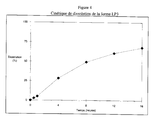
- the in vitro dissolution profile of this form (LP1) is presented in Figure 2 (appendix).
- An extended-release tablet (LP2) is obtained according to the process described above and with the formula described in Table 2. This tablet is then coated in a Manesty perforated turbine of the Accela Cota 10 type using an aqueous suspension of ethylcellulose (Aquacoat®) containing dibutyl sebacate used as a plasticizer.
- Aquacoat® aqueous suspension of ethylcellulose
- FIG 3 The in vitro dissolution profile of this form (LP2) is presented in Figure 3 (appendix).
- the latency time of the kinetics of in vitro dissolution of the active principle is less than one hour.
- the release rate is higher in this example.
- the use of an aqueous ethylcellulose suspension in place of an organic solution makes it possible to obtain a slightly different release profile.
- the preparation of the extended-release minigranules is carried out according to two methods:
- trimetazidine dihydrochloride with microcrystalline cellulose and then wetting with purified water.
- the wet mass is then granulated and then extruded using an extruder.
- the extrudates are then spheronized and dried.
- This coating can be carried out in a coating turbine or in a fluidized bed apparatus.
- Stage B is identical to stage B of the extrusion and spheronization process.
- a capsule containing prolonged release minigranules is prepared using the formula given in Table 3, according to the operating method by extrusion and spheronization.
- Table 3 LP3 capsule formula Constituents Amount (mg) Trimetazidine dihydrochloride 80 Microcrystalline cellulose 80 Ethylcellulose 40 Acetyltributylcitrate 4
- the minigranules obtained in stage A are coated with an alcoholic solution of ethylcellulose (polymer controlling the release of the active ingredient) added with acetyltributylcitrate used as plasticizer.
- Plasma trimetazidine concentrations were measured in twelve subjects after administration of either one LP3 capsule per day or one immediate release tablet (LI) three times a day. The curve of average plasma concentrations is given in Figure 5 (appendix).
- a capsule containing minigranules with sustained release is prepared using the formula given in Table 4, according to the operating procedure by assembly.
- Table 4 LP4 capsule formula Constituents Quantities (mg) Trimetazidine dihydrochloride 80 Sucrose - starch neutral granule 74 Methylhydroxypropyl cellulose 6 Ethylcellulose 16 Acetyltributyl citrate 1.6
- the minigranules obtained in stage A are coated with an alcoholic solution of ethylcellulose supplemented with acetyltributyl citrate.
- An LP5 capsule is prepared using the method described for the LP3 type capsule (Example 3) in which the coating with an alcoholic ethylcellulose solution is replaced by a coating with an aqueous ethylcellulose suspension. (Aquacoat®). Its in vitro dissolution profile is presented in Figure 7 (appendix).
- An LP6 type capsule is prepared using the method described for the LP4 capsule in which the coating with an alcoholic solution of ethylcellulose is replaced by a coating with an aqueous dispersion of poly (methy) acrylates ( Eudragit®). Its in vitro dissolution profile is presented in Figure 8 (appendix).
Landscapes
- Health & Medical Sciences (AREA)
- Engineering & Computer Science (AREA)
- Bioinformatics & Cheminformatics (AREA)
- Chemical & Material Sciences (AREA)
- Medicinal Chemistry (AREA)
- Pharmacology & Pharmacy (AREA)
- Life Sciences & Earth Sciences (AREA)
- Animal Behavior & Ethology (AREA)
- General Health & Medical Sciences (AREA)
- Public Health (AREA)
- Veterinary Medicine (AREA)
- Epidemiology (AREA)
- Chemical Kinetics & Catalysis (AREA)
- General Chemical & Material Sciences (AREA)
- Nuclear Medicine, Radiotherapy & Molecular Imaging (AREA)
- Organic Chemistry (AREA)
- Cardiology (AREA)
- Heart & Thoracic Surgery (AREA)
- Urology & Nephrology (AREA)
- Vascular Medicine (AREA)
- Pharmaceuticals Containing Other Organic And Inorganic Compounds (AREA)
- Medicinal Preparation (AREA)
- Compositions Of Macromolecular Compounds (AREA)
- Macromolecular Compounds Obtained By Forming Nitrogen-Containing Linkages In General (AREA)
- Plural Heterocyclic Compounds (AREA)
Abstract
Description
- La présente invention a pour objet une composition pharmaceutique permettant la libération prolongée de trimétazidine ou d'un de ses sels d'addition à un acide pharmaceutiquement acceptable.
- La trimétazidine, ou 1-(2,3,4-triméthoxybenzyl)pipérazine, composé de formule :

est une molécule qui, en préservant les métabolismes énergétiques de la cellule exposée à l'hypoxie ou à l'ischémie, évite l'effondrement du taux intracellulaire de l'adénosine triphosphate (ATP). Elle assure ainsi le fonctionnement des pompes ioniques et des flux transmembranaires sodium - potassium et maintient l'homéostasie cellulaire. - Parmi les sels pharmaceutiquement acceptables de trimétazidine, on citera plus particulièrement la dichlorhydrate qui est utilisé en thérapeutique, comme vasodilatateur coronarien pour le traitement prophylactique de la crise d'angine de poitrine, lors des atteintes choriorétiniennes ainsi que pour le traitement des vertiges d'origine vasculaire (vertiges de Ménière, acouphènes).
- Le dichlorhydrate de trimétazidine était jusqu'à présent administré par voie orale à des doses de 40 à 60 mg par jour, sous forme de comprimés dosés à 20 mg, ou de solution buvable dosée à 20 mg/ml. Ces deux formes sont des formes galéniques à libération immédiate.
- Le dichlorhydrate de trimétazidine est rapidement absorbé et éliminé par l'organisme, sa demi-vie plasmatique étant inférieure à 6 heures. Ceci impose de fractionner l'administration du principe actif en 2 ou 3 prises par jour afin d'assurer des taux plasmatiques relativement constants. Mais, du fait d'une absorption rapide, ces formes à libération immédiate conduisent également à des pics plasmatiques importants quelques instants après administration et à des taux sanguins très faibles au moment de la prise suivante.
- Une forme à libération prolongée présente donc l'avantage de diminuer ces pics sanguins en assurant des taux sanguins réguliers et constants. Elle permet également une administration journalière unique ce qui est favorable à la compliance du patient à son traitement. Elle permet donc un meilleur suivi du traitement.
- Pour ce faire, il est nécessaire d'assurer une libération prolongée dans le temps, de façon parfaitement contrôlée. La vitesse de libération doit être reproductible et corrélée avec les concentrations sanguines observées après administration.
- Parmi les mécanismes pouvant être invoqués pour le contrôle de la diffusion d'un principe actif soluble, on peut en retenir un principal qui est la diffusion du principe actif à partir d'un réservoir et à travers un film polymérique lorsque la forme galénique est mise au contact du liquide de dissolution (in vitro), ou du liquide gastro-intestinal (in vivo).
- De nombreux polymères ont été décrits comme pouvant permettre une telle diffusion. Les principaux sont l'éthylcellulose et les dérivés métacryliques. Les procédés de fabrication couramment utilisés pour la fabrication de tels systèmes réservoirs font appel à des enrobages: soit enrobage de comprimés nus, la dose de principe actif étant alors répartie dans une seule unité, soit enrobage de minigranules dans ce dernier cas, la dose de principe actif à administrer est répartie dans de nombreuses petites unités regroupées ensuite soit dans une gélule, soit dans un comprimé.
- Afin de former un film barrière permettant la libération prolongée du principe actif, les polymères utilisés sont des polymères insolubles dans l'eau et les liquides gastro-intestinaux. Ils peuvent être utilisés soit sous forme de solution organique, soit sous forme de dispersion aqueuse (latex ou pseudo-latex). Des procédés utilisant la compression ont également été décrits.
- La composition pharmaceutique décrite dans la présente invention est caractérisé par le fait que la libération prolongée est assurée par le système réservoir qui associe au principe actif présenté soit sous forme de comprimés, soit sous forme de minigranules, un film de polymère d'épaisseur parfaitement contrôlée enrobant individuellement chaque comprimé ou minigranule, afin d'obtenir une libération du principe actif conduisant à des taux plasmatiques parfaitement définis.
- De nombreuses études ont été réalisées sur le contrôle de la libération de principes actifs très hydrosolubles. Beaucoup se sont heurtées au problème suivant: lorsque le principe actif est d'une taille relativement réduite (PM < 300) et de plus très solubles dans l'eau, le contrôle de la libération du principe actif est relativement complexe, et en particulier, il n'est pas possible d'assurer une libération du principe actif sur plus de 12 heures.
- Des travaux antérieurs nous ont montré qu'il en était de même avec le dichlorhydrate de trimétazidine.
- Le poids moléculaire de la trimétazidine sous forme de base est de 266,33 et la solubilité du dichlorhydrate dans l'eau supérieure à 1000 mg/ml. De ce fait, il était très difficile d'obtenir des comprimés matriciels contrôlant la libération du principe actif sur plus de 16 heures. Ce problème a été résolu par l'utilisation du système réservoir décrit dans la présente invention.
- Il nous est apparu que la combinaison d'un polymère insoluble dans l'eau, tel que l'éthylcellulose ou un polyméthacrylate, avec un plastifiant permettant l'obtention d'un film relativement perméable au principe actif permettait d'obtenir une libération régulière de ce dernier.
- L'influence d'un plastifiant sur la perméabilité de films de polyméthacylate (Eudragit RS®) mesuré avec du chlorhydrate de phénylpropanolamine a été décrite par K. LEHMAN (dans "Aqueous polymeric coatings for pharmaceutical dosage forms", Ed. J.W. Mc Ginity, Marcel Dekker, Inc., NY, 1989, p.205). Les résultats obtenus par K. LEHMAN sont regroupés dans le tableau ci-dessous.
Plastifiant (ajouté à 20 %) Perméabilité (mg.cm⁻².h⁻¹) Solubilité dans l'eau à température ambiante (%) Acétyltriéthylcitrate 3.8 0.72 Dibutylphtalate 5.4 0.04 Triéthylcitrate 6.2 6.9 Triacétine 6.2 7.1 Tributylcitrate 9.0 <0.002 Acétyltributylcitrate 11.8 <0.002 Diéthylphtalate 14.8 0.15 - Au vu de la solubilité très importante du dichlorhydrate de trimétazidine et des résultats présentés dans le tableau précédent, il apparaissait judicieux d'utiliser les plastifiants ayant la plus faible perméabilité. Or, de façon surprenante, il a été montré que les meilleurs résultats ont été obtenus avec l'acétyltributylcitrate.
En effet, l'utilisation de plastifiants comme l'acétyltriéthylcitrate, le triéthylcitrate ou la triacétine, provoque un temps de latence très long qui peut atteindre quatre heures au bout desquelles la libération est beaucoup plus rapide qu'avec l'acétyltributylcitrate. Ces résultats sont présentés dans la figure 1 (annexe).
Pour les traitements des désordres coronariens auxquels la trimétazidine s'adresse, il était très important que la libération du principe actif puisse commencer dès l'administration de la forme galénique au malade, de manière à lui assurer un traitement rapide et efficace. Un temps de latence supérieur à une heure est donc un handicap que la présente invention a su surmonter. De plus, une libération progressive du principe actif est indispensable si l'on veut obtenir des taux plasmatiques relativement constants. - Les compositions pharmaceutiques décrites dans la présente invention se présentent plus particulièrement sous forme de comprimés ou de minigranules réservoir.
- Les comprimés sont préparés en plusieurs étapes.
- Tout d'abord un mélange préalable des constituants permet d'obtenir une régularité du dosage final en dichlorhydrate de trimétazidine. Une phase de granulation permet ensuite de densifier le mélange de poudre initial. Cette agglomération peut se faire à l'aide d'un liant soluble dans un solvant aqueux ou hydroalcoolique. Une phase de lubrification permet ensuite d'autoriser un bon fonctionnement des machines à produire les comprimés.
- Après obtention des comprimés, ces derniers sont enrobés au moyen d'une solution ou d'une suspension du polymère choisi comme devant assurer la diffusion du principe actif et contrôler ainsi la cinétique de libération. Un plastifiant est utilisé à ce stade afin de réaliser un bon recouvrement du comprimé par le film polymérique.
- Les minigranules peuvent être préparés suivant deux procédés, soit un procédé utilisant des techniques d'extrusion et de sphéronisation, soit un procédé utilisant des techniques de montage du principe actif sur un noyau neutre.
- Dans ce procédé, une masse humide renfermant le dichlorhydrate de trimétazidine et des excipients auxiliaires est extrudée à travers une grille perforée. Le produit obtenu sous forme de cylindres allongés est ensuite sphéronisé au moyen d'un sphéroniseur à plateau denté. Les minigranules ainsi obtenus sont par la suite séchés, soit en étuve ventilée, soit en lit d'air fluidisé.
-
- Dans ce procédé, des noyaux neutres sont enrobés par des couches successives de principe actif au moyen de turbine d'enrobage, perforée ou non, ou d'appareils à lit d'air fluidisé. Le principe actif, mis sous forme de solution ou suspension, aqueuse ou organique, est pulvérisé sur les noyaux neutres puis séché par de l'air chaud par exemple.
- Les minigranules, préparés par l'un ou l'autre des procédés sont ultérieurement enrobés, soit en turbine d'enrobage, perforée ou non, soit en appareil de type lit d'air fluidisé. Les minigranules sont enrobés au moyen d'une solution ou d'une suspension du polymère choisi comme devant assurer la diffusion du principe actif et contrôler ainsi la cinétique de libération. Un plastifiant est utilisé à ce stade afin de réaliser un bon recouvrement des minigranules par le film polymérique.
- Les exemples suivants illustrent l'invention mais ne la limitent en aucune façon.
- La préparation des comprimés à libération prolongée est réalisée de la manière suivante :
- Mélange du dichlorhydrate de trimétazidine, d'un diluant et de polyvidone agissant comme liant puis mouillage au moyen d'une solution aqueuse ou hydroalcoolique. La masse humide est ensuite granulée, séchée puis calibrée de manière à obtenir un granulé dont les caractéristiques physiques permettent un bon remplissage des matrices d'une machine à comprimer rapide.
- Lubrification du granulé obtenu au stade A avec de la silice colloïdale et/ou du stéarate de magnésium.
- Compression du mélange lubrifié obtenu au stade B sur une machine à comprimer alternative ou rotative.
- Enrobage des comprimés obtenus au stade C au moyen d'une solution ou d'une suspension, aqueuse ou organique, d'un polymère assurant la diffusion du principe actif. Cette solution ou suspension peut également renfermer un plastifiant. L'enrobage est réalisé dans une turbine d'enrobage ou un appareil à lit d'air fluidisé.
- Un comprimé à libération prolongée (LP1) est préparé en utilisant la formule donnée dans le tableau 2, suivant le procédé opératoire décrit dans les stades A à C.
Tableau 2 Formule unitaire du comprimé LP1 Constituants Quantités (mg) Dichlorhydrate de trimétazidine 80 Hydrogénophosphate de calcium 80 Polyvidone 8 Silice colloïdale 0.4 Stéarate de magnésium 1.6 - Ce comprimé est ensuite enrobé en turbine perforée au moyen d'une solution alcoolique d'éthylcellulose renfermant de l'acétyltributylcitrate utilisé comme plastifiant. Le profil de dissolution in vitro de cette forme (LP1) est présenté dans la figure 2 (annexe).
- Le temps de latence de cette forme à libération prolongée est égal à une heure. Au-delà, la cinétique de dissolution in vitro est linéaire sur plus de 10 heures.
- Un comprimé à libération prolongée (LP2) est obtenu suivant le procédé décrit ci-dessus et avec la formule décrite dans le tableau 2. Ce comprimé est ensuite enrobé dans une turbine perforée Manesty de type Accela Cota 10 au moyen d'une suspension aqueuse d'éthylcellulose (Aquacoat®) renfermant du dibutyl sébaçate utilisé comme plastifiant. Le profil de dissolution in vitro de cette forme (LP2) est présenté dans la figure 3 (annexe).
- Avec cette forme LP2, le temps de latence de la cinétique de dissolution in vitro du principe actif est inférieur à une heure. La vitesse de libération est plus élevée dans cet exemple. L'utilisation d'une suspension aqueuse d'éthylcellulose à la place d'une solution organique permet d'obtenir un profil de libération un peu différent.
- La préparation des minigranules à libération prolongée est réalisée suivant deux procédés:
- Mélange du dichlorhydrate de trimétazidine avec de la cellulose microcristalline puis mouillage au moyen d'eau purifiée. La masse humide est ensuite granulée puis extrudée au moyen d'une extrudeuse. Les extrudats sont ensuite sphéronisés et séchés.
- Enrobage des minigranules obtenus au stade A au moyen d'une solution organique ou d'une suspension aqueuse de polymère pouvant également renfermer un plastifiant, dans une turbine d'enrobage ou un appareil à lit d'air fluidisé.
- Mise en gélule des minigranules enrobés.
- Enrobage de minigranules neutres composés par exemple de saccharose, ou de saccharose et d'amidon, ou de cellulose microcristalline au moyen d'une solution aqueuse de principe actif pouvant renfermer un liant tel la polyvidone ou la méthylhydroxypropylcellulose. Cet enrobage peut être réalisé en turbine d'enrobage ou dans un appareil à lit fluidisé.
-
- Le stade B est identique au stade B du procédé par extrusion et sphéronisation.
- Mise en gélules des minigranules enrobés.
- Une gélule renfermant des minigranules à libération prolongée (LP3) est préparée en utilisant la formule donnée dans le tableau 3, suivant le procédé opératoire par extrusion et sphéronisation.
Tableau 3 Formule de la gélule LP3 Constituants Quantité (mg) Dichlorhydrate de trimétazidine 80 Cellulose microcristalline 80 Ethylcellulose 40 Acétyltributylcitrate 4 - Les minigranules obtenus au stade A sont enrobés avec une solution alcoolique d'éthylcellulose (polymère contrôlant la libération du principe actif) additionnée d'acétyltributylcitrate utilisé comme plastifiant.
- Le profil de dissolution in vitro de cette forme (LP3) est présenté dans la figure 4 (annexe).
- Les concentrations plasmatiques en trimétazidine ont été mesurées chez douze sujets après administration soit d'une gélule LP3 par jour, soit d'un comprimé à libération immédiate (LI) trois fois par jour. La courbe des concentrations plasmatiques moyennes est donnée dans la figure 5 (annexe).
- Une gélule renfermant des minigranules à libération prolongée (LP4) est préparée en utilisant la formule donnée dans le tableau 4, suivant le procédé opératoire par montage.
Tableau 4 Formule de la gélule LP4 Constituants Quantités (mg) Dichlorhydrate de trimétazidine 80 Granule neutre saccharose - amidon 74 Méthylhydroxypropyl cellulose 6 Ethylcellulose 16 Acétyltributyl citrate 1.6 - Les minigranules obtenus au stade A sont enrobés avec une solution alcoolique d'éthylcellulose additionnée d'acétyltributyl citrate.
- Le profil de dissolution de la forme LP4 est présenté dans la figure 6 (annexe).
- Une gélule LP5 est préparée en utilisant le procédé décrit pour la gélule du type LP3 (exemple 3) dans laquelle l'enrobage au moyen d'une solution alcoolique d'éthylcellulose est remplacé par un enrobage au moyen d'une suspension aqueuse d'éthylcellulose (Aquacoat®). Son profil de dissolution in vitro est présenté dans la figure 7 (annexe).
- Le temps de latence n'existe pas. La cinétique de dissolution in vitro est linéaire après 4 heures.
- Une gélule du type LP6 est préparée en utilisant le procédé décrit pour la gélule LP4 dans laquelle l'enrobage au moyen d'une solution alcoolique d'éthylcellulose est remplacé par un enrobage au moyen d'une dispersion aqueuse de poly(methy)acrylates (Eudragit®). Son profil de dissolution in vitro est présenté dans la figure 8 (annexe).
- Ainsi, avec l'enrobage au moyen d'une suspension aqueuse d'Eudragit®, il n'existe pas de temps de latence. La cinétique de libération in vitro du principe actif est quasiment linéaire sur 12 heures.
Claims (11)
- Composition pharmaceutique pour la libération prolongée de trimétazidine ou d'un de ses sels pharmaceutiquement acceptable caractérisée en ce que la libération prolongée de la trimétazidine est contrôlée par l'utilisation d'un polymère insoluble dans l'eau et d'un plastifiant.
- Composition pharmaceutique selon la revendication 1 caractérisée en ce que la libération contrôlée de la trimétazidine est assurée par un système réservoir dans lequel le mélange du polymère et du plastifiant se présente sous la forme d'un film qui enrobe des comprimés ou des minigranules contenant la trimétazidine ou l'un de ses sels d'addition à un acide pharmaceutiquement acceptable.
- Composition pharmaceutique selon la revendication 1 dans laquelle la trimétazidine se trouve sous la forme d'un dichlorhydrate.
- Composition pharmaceutique selon la revendication 2 telle que le système réservoir est un comprimé réservoir.
- Composition pharmaceutique selon la revendication 2 telle que le système réservoir est une gélule réservoir contenant des minigranules enrobés.
- Composition pharmaceutique selon la revendication 1 telle que le polymère utilisé est de l'éthylcellulose sous forme de solution organique ou de dispersion aqueuse.
- Composition pharmaceutique selon la revendication 1 telle que le polymère utilisé est un dérivé acrylique.
- Composition pharmaceutique selon la revendication 1 telle que le plastifiant est de l'acétyltributylcitrate.
- Composition pharmaceutique selon la revendication 1 telle que le plastifiant est du dibutylsébaçate.
- Composition pharmaceutique selon la revendication l caractérisée en ce qu'elle permet d'obtenir une libération contrôlée et régulière de trimétazidine dès le début de l'administration et sur une durée d'au moins 16 heures.
- Composition pharmaceutique selon la revendication 1 utile dans le traitement prophylactique de la crise d'angine de poitrine, lors des atteintes choriorétiennes ainsi que lors du traitement des vertiges d'origine vasculaire.
Applications Claiming Priority (2)
| Application Number | Priority Date | Filing Date | Title |
|---|---|---|---|
| FR9403434 | 1994-03-24 | ||
| FR9403434A FR2717687B1 (fr) | 1994-03-24 | 1994-03-24 | Compositions pharmaceutiques permettant la libération prolongée de trimétazidine après administration par voie orale. |
Publications (2)
| Publication Number | Publication Date |
|---|---|
| EP0673649A1 true EP0673649A1 (fr) | 1995-09-27 |
| EP0673649B1 EP0673649B1 (fr) | 2002-04-24 |
Family
ID=9461361
Family Applications (1)
| Application Number | Title | Priority Date | Filing Date |
|---|---|---|---|
| EP95400628A Expired - Lifetime EP0673649B1 (fr) | 1994-03-24 | 1995-03-22 | Compositions pharmaceutiques permettant la libération prolongée de trimétazidine après administration par voie orale |
Country Status (15)
| Country | Link |
|---|---|
| EP (1) | EP0673649B1 (fr) |
| JP (1) | JP3017040B2 (fr) |
| CN (1) | CN1056057C (fr) |
| AT (1) | ATE216583T1 (fr) |
| AU (1) | AU684893B2 (fr) |
| CA (1) | CA2145248C (fr) |
| DE (1) | DE69526467T2 (fr) |
| DK (1) | DK0673649T3 (fr) |
| ES (1) | ES2176296T3 (fr) |
| FI (1) | FI116881B (fr) |
| FR (1) | FR2717687B1 (fr) |
| NO (1) | NO306450B1 (fr) |
| NZ (1) | NZ270791A (fr) |
| PT (1) | PT673649E (fr) |
| ZA (1) | ZA952418B (fr) |
Cited By (12)
| Publication number | Priority date | Publication date | Assignee | Title |
|---|---|---|---|---|
| EP1108424A1 (fr) * | 1999-12-17 | 2001-06-20 | Adir Et Compagnie | Comprimé matriciel permettant la libération prolongée de trimétazidine après administration par voie orale |
| EP1195160A1 (fr) * | 2000-10-05 | 2002-04-10 | USV Ltd. | Composition pharmaceutique à effet de retard contenant de la trimétazidine et procédé pour sa préparation |
| WO2003043610A3 (fr) * | 2001-11-21 | 2003-08-21 | Themis Lab Private Ltd | Procede de fabrication d'une composition pharmaceutique a liberation prolongee contenant des microbilles de trimetazidine dihydrochloride |
| WO2006123073A1 (fr) * | 2005-05-18 | 2006-11-23 | Les Laboratoires Servier | Composition pharmaceutique solide a liberation prolongee de 1-(2,3,4-trimethoxybenzyl)piperazine, et procede de preparation. |
| WO2009034541A2 (fr) | 2007-09-11 | 2009-03-19 | Ranbaxy Laboratories Limited | Formes galéniques à libération contrôlée à base de trimétazidine |
| WO2010086868A1 (fr) * | 2009-01-30 | 2010-08-05 | Lupin Limited | Compositions pharmaceutiques de trimétazidine |
| BG1345U1 (bg) * | 2010-05-20 | 2010-08-31 | "Адифарм" Ад | Лекарствена форма с изменено освобождаване |
| WO2011112160A1 (fr) | 2010-03-12 | 2011-09-15 | Ali Raif Ilac Sanayi Ve Ticaret A.S. | Comprimés de trimétazidine à libération lente |
| EP2386302A1 (fr) | 2010-05-11 | 2011-11-16 | Ranbaxy Laboratories Limited | Forme pharmaceutique à libération prolongée de trimetazidine et ses procédés de préparation |
| EP2394644A2 (fr) | 2010-05-04 | 2011-12-14 | Sanovel Ilac Sanayi ve Ticaret A.S. | Formulation de trimetazidine avec différents profils de distribution |
| MD20130005A2 (ro) * | 2012-02-03 | 2013-07-31 | Les Laboratoires Servier | Compoziţie farmaceutică cu eliberare prelungită a trimetazidinei |
| WO2026126227A1 (fr) | 2024-12-10 | 2026-06-18 | Inventia Healthcare Limited | Composition pharmaceutique à libération prolongée de dichlorhydrate de trimétazidine |
Families Citing this family (10)
| Publication number | Priority date | Publication date | Assignee | Title |
|---|---|---|---|---|
| FR2818549B1 (fr) * | 2000-12-26 | 2003-02-07 | Servier Lab | Composition pharmaceutique solide thermoformable pour la liberation controlee de trimetazidine |
| WO2007116243A2 (fr) * | 2006-04-10 | 2007-10-18 | Mintails Limited | Procede de traitement de la fibromyalgie et de pathologies apparentees |
| EP2389167A2 (fr) | 2009-01-20 | 2011-11-30 | Micro Labs Limited | Compositions pharmaceutiques solides à libération modifiée à base de trimétazidine et procédé associé |
| EP2491930A1 (fr) | 2011-02-25 | 2012-08-29 | Deva Holding Anonim Sirketi | Combination pharmaceutique de bétahistine et trimétazidine |
| CN102133195A (zh) * | 2011-03-17 | 2011-07-27 | 王国栋 | 盐酸曲美他嗪的缓控释微丸及其制备方法 |
| CN102319225B (zh) * | 2011-09-23 | 2013-04-03 | 广州白云山光华制药股份有限公司 | 一种盐酸曲美他嗪缓释片及其制备方法 |
| CN102764261A (zh) * | 2012-07-30 | 2012-11-07 | 沈阳药科大学 | 口服控制盐酸曲美他嗪释放的组合物及其制备方法 |
| CN103565751A (zh) * | 2013-10-17 | 2014-02-12 | 广州帝奇医药技术有限公司 | 一种长效缓释微丸及其制备方法 |
| US20190381034A1 (en) * | 2018-06-14 | 2019-12-19 | Ming Fang | Pharmaceutical composition and method for acute on chronic liver failure and related liver diseases |
| CN110237053A (zh) * | 2019-07-26 | 2019-09-17 | 湖北欣泽霏药业有限公司 | 一种盐酸曲美他嗪缓释微丸及其制备方法 |
Citations (2)
| Publication number | Priority date | Publication date | Assignee | Title |
|---|---|---|---|---|
| GB2084019A (en) * | 1980-09-30 | 1982-04-07 | Science Union & Cie | Anti-ischaemic pharmaceutical preparations |
| JPS61212517A (ja) * | 1985-03-18 | 1986-09-20 | Nippon Chemiphar Co Ltd | 持続性錠剤 |
Family Cites Families (3)
| Publication number | Priority date | Publication date | Assignee | Title |
|---|---|---|---|---|
| EP0187703B1 (fr) * | 1985-01-11 | 1992-08-05 | Teijin Limited | Préparations à libération prolongée |
| US5260066A (en) * | 1992-01-16 | 1993-11-09 | Srchem Incorporated | Cryogel bandage containing therapeutic agent |
| US5417983A (en) * | 1992-02-19 | 1995-05-23 | Sagami Chemical Research Center | Drug release controlling material responsive to changes in temperature |
-
1994
- 1994-03-24 FR FR9403434A patent/FR2717687B1/fr not_active Expired - Fee Related
-
1995
- 1995-03-22 AT AT95400628T patent/ATE216583T1/de active
- 1995-03-22 FI FI951357A patent/FI116881B/fi not_active IP Right Cessation
- 1995-03-22 PT PT95400628T patent/PT673649E/pt unknown
- 1995-03-22 ES ES95400628T patent/ES2176296T3/es not_active Expired - Lifetime
- 1995-03-22 DE DE69526467T patent/DE69526467T2/de not_active Expired - Lifetime
- 1995-03-22 CA CA002145248A patent/CA2145248C/fr not_active Expired - Lifetime
- 1995-03-22 EP EP95400628A patent/EP0673649B1/fr not_active Expired - Lifetime
- 1995-03-22 AU AU15029/95A patent/AU684893B2/en not_active Expired
- 1995-03-22 DK DK95400628T patent/DK0673649T3/da active
- 1995-03-23 NZ NZ270791A patent/NZ270791A/xx not_active IP Right Cessation
- 1995-03-23 NO NO951110A patent/NO306450B1/no not_active IP Right Cessation
- 1995-03-24 JP JP7065788A patent/JP3017040B2/ja not_active Expired - Lifetime
- 1995-03-24 ZA ZA952418A patent/ZA952418B/xx unknown
- 1995-03-24 CN CN95103558A patent/CN1056057C/zh not_active Expired - Lifetime
Patent Citations (2)
| Publication number | Priority date | Publication date | Assignee | Title |
|---|---|---|---|---|
| GB2084019A (en) * | 1980-09-30 | 1982-04-07 | Science Union & Cie | Anti-ischaemic pharmaceutical preparations |
| JPS61212517A (ja) * | 1985-03-18 | 1986-09-20 | Nippon Chemiphar Co Ltd | 持続性錠剤 |
Non-Patent Citations (1)
| Title |
|---|
| DATABASE WPI Week 8644, Derwent World Patents Index; AN 86-289031 (44) * |
Cited By (26)
| Publication number | Priority date | Publication date | Assignee | Title |
|---|---|---|---|---|
| EA008223B1 (ru) * | 1999-12-17 | 2007-04-27 | Ле Лаборатуар Сервье | Матричная таблетка с основой для пролонгированного высвобождения триметазидина |
| WO2001043747A1 (fr) * | 1999-12-17 | 2001-06-21 | Les Laboratoires Servier | Comprime matriciel permettant la liberation prolongee de trimetazidine apres administration par voie orale |
| FR2802424A1 (fr) * | 1999-12-17 | 2001-06-22 | Adir | Comprime matriciel permettant la liberation prolongee de trimetazidine apres administration par voie orale |
| GR1003658B (el) * | 1999-12-17 | 2001-09-05 | Adir Et Compagnie | Δισκιο μητρας που καθιστα δυνατη την παρατεταμενη απελευθερωση της τριμεταζιδινης μετα χορηγηση δια της στοματικης οδου |
| ES2176106A1 (es) * | 1999-12-17 | 2002-11-16 | Servier Lab | Comprimido matricial de liberacion prolongada de trimetazidina tras su administracion por via oral. |
| EP1108424A1 (fr) * | 1999-12-17 | 2001-06-20 | Adir Et Compagnie | Comprimé matriciel permettant la libération prolongée de trimétazidine après administration par voie orale |
| CZ299461B6 (cs) * | 1999-12-17 | 2008-08-06 | Les Laboratoires Servier | Matricová tableta umožnující prodloužené uvolnování trimetazidinu po orálním podání |
| EP1195160A1 (fr) * | 2000-10-05 | 2002-04-10 | USV Ltd. | Composition pharmaceutique à effet de retard contenant de la trimétazidine et procédé pour sa préparation |
| WO2003043610A3 (fr) * | 2001-11-21 | 2003-08-21 | Themis Lab Private Ltd | Procede de fabrication d'une composition pharmaceutique a liberation prolongee contenant des microbilles de trimetazidine dihydrochloride |
| EA013645B1 (ru) * | 2005-05-18 | 2010-06-30 | Ле Лаборатуар Сервье | Твердая фармацевтическая композиция с пролонгированным высвобождением 1-(2,3,4-триметоксибензил)пиперазина и способ ее получения |
| FR2885807A1 (fr) * | 2005-05-18 | 2006-11-24 | Mg Pharma | Composition pharmaceutique solide a liberation prolongee de 1-(2,3,4-trimethoxybenzyl) piperazine, et procede de preparation |
| WO2006123073A1 (fr) * | 2005-05-18 | 2006-11-23 | Les Laboratoires Servier | Composition pharmaceutique solide a liberation prolongee de 1-(2,3,4-trimethoxybenzyl)piperazine, et procede de preparation. |
| WO2009034541A2 (fr) | 2007-09-11 | 2009-03-19 | Ranbaxy Laboratories Limited | Formes galéniques à libération contrôlée à base de trimétazidine |
| WO2010086868A1 (fr) * | 2009-01-30 | 2010-08-05 | Lupin Limited | Compositions pharmaceutiques de trimétazidine |
| WO2011112160A1 (fr) | 2010-03-12 | 2011-09-15 | Ali Raif Ilac Sanayi Ve Ticaret A.S. | Comprimés de trimétazidine à libération lente |
| EP2394644A2 (fr) | 2010-05-04 | 2011-12-14 | Sanovel Ilac Sanayi ve Ticaret A.S. | Formulation de trimetazidine avec différents profils de distribution |
| EP2386302A1 (fr) | 2010-05-11 | 2011-11-16 | Ranbaxy Laboratories Limited | Forme pharmaceutique à libération prolongée de trimetazidine et ses procédés de préparation |
| BG1345U1 (bg) * | 2010-05-20 | 2010-08-31 | "Адифарм" Ад | Лекарствена форма с изменено освобождаване |
| MD20130005A2 (ro) * | 2012-02-03 | 2013-07-31 | Les Laboratoires Servier | Compoziţie farmaceutică cu eliberare prelungită a trimetazidinei |
| EP2623096A2 (fr) | 2012-02-03 | 2013-08-07 | Les Laboratoires Servier | Composition pharmaceutique a liberation prolongée de trimetazidine |
| WO2013114053A2 (fr) | 2012-02-03 | 2013-08-08 | Les Laboratoires Servier | Composition pharmaceutique a liberation prolongee de trimetazidine. |
| FR2986431A1 (fr) * | 2012-02-03 | 2013-08-09 | Servier Lab | Composition pharmaceutique a liberation prolongee de trimetazidine, son procede de fabrication et son utilisation dans des traitements therapeutiques |
| EP2623096A3 (fr) * | 2012-02-03 | 2013-10-23 | Les Laboratoires Servier | Composition pharmaceutique a liberation prolongée de trimetazidine |
| WO2013114053A3 (fr) * | 2012-02-03 | 2013-12-19 | Les Laboratoires Servier | Composition pharmaceutique a liberation prolongee de trimetazidine. |
| AU2013200481B2 (en) * | 2012-02-03 | 2015-01-22 | Les Laboratoires Servier | Pharmaceutical Composition for the Prolonged Release of Trimetazidine |
| WO2026126227A1 (fr) | 2024-12-10 | 2026-06-18 | Inventia Healthcare Limited | Composition pharmaceutique à libération prolongée de dichlorhydrate de trimétazidine |
Also Published As
| Publication number | Publication date |
|---|---|
| NO306450B1 (no) | 1999-11-08 |
| CN1124140A (zh) | 1996-06-12 |
| ES2176296T3 (es) | 2002-12-01 |
| DE69526467D1 (de) | 2002-05-29 |
| FR2717687B1 (fr) | 1996-06-14 |
| DE69526467T2 (de) | 2002-12-05 |
| FI951357A0 (fi) | 1995-03-22 |
| CA2145248A1 (fr) | 1995-09-25 |
| EP0673649B1 (fr) | 2002-04-24 |
| ZA952418B (en) | 1995-12-18 |
| AU684893B2 (en) | 1998-01-08 |
| AU1502995A (en) | 1995-10-05 |
| FI951357L (fi) | 1995-09-25 |
| JP3017040B2 (ja) | 2000-03-06 |
| PT673649E (pt) | 2002-08-30 |
| JPH07258086A (ja) | 1995-10-09 |
| NO951110D0 (no) | 1995-03-23 |
| FI116881B (fi) | 2006-03-31 |
| CA2145248C (fr) | 2004-01-06 |
| ATE216583T1 (de) | 2002-05-15 |
| NO951110L (no) | 1995-09-25 |
| FR2717687A1 (fr) | 1995-09-29 |
| DK0673649T3 (da) | 2002-08-05 |
| CN1056057C (zh) | 2000-09-06 |
| NZ270791A (en) | 1996-07-26 |
Similar Documents
| Publication | Publication Date | Title |
|---|---|---|
| EP0673649B1 (fr) | Compositions pharmaceutiques permettant la libération prolongée de trimétazidine après administration par voie orale | |
| US6905708B2 (en) | Controlled release oral dosage form | |
| US6589553B2 (en) | Controlled release oral dosage form | |
| CZ296964B6 (cs) | Farmaceutické formulace tramadolu v násobných jednotkách a zpusob jejich výroby | |
| CA2686094A1 (fr) | Methode de fabrication d'un element semiconducteur | |
| EP1919473A1 (fr) | Association d'un agent hypnotique a duree d'action longue et d'un agent hypnotique a duree d'action courte et son application therapeutique | |
| WO2008113901A2 (fr) | Composition à libération prolongée de lévétiracetam et procédé de préparation. | |
| CA2805471C (fr) | Composition pharmaceutique a liberation prolongee de trimetazidine | |
| JPH01313427A (ja) | ジヒドロピリジン類を含有する徐放性製剤 | |
| HU211478A9 (en) | Pharmaceutical composition and process for the preparation thereof | |
| RU2423105C2 (ru) | Фармацевтическая композиция с контролируемым высвобождением венлафаксина гидрохлорида и способ ее получения | |
| US20030035840A1 (en) | Controlled release oral dosage form | |
| EP2552210B1 (fr) | Formulations de mazindol | |
| CA2685214C (fr) | Forme posologique orale a liberation regulee amelioree | |
| JPS60228410A (ja) | 持続性製剤 | |
| EP1778193B1 (fr) | Composition pharmaceutique a liberation prolongee comprenant de la venlafaxine | |
| OA16427A (en) | Composition pharmaceutique à libération prolongée de trimétazidine. | |
| JP2005510449A (ja) | 改良型制御放出経口剤形 | |
| AU2002253907A1 (en) | Improved controlled release oral dosage form |
Legal Events
| Date | Code | Title | Description |
|---|---|---|---|
| PUAI | Public reference made under article 153(3) epc to a published international application that has entered the european phase |
Free format text: ORIGINAL CODE: 0009012 |
|
| 17P | Request for examination filed |
Effective date: 19950325 |
|
| AK | Designated contracting states |
Kind code of ref document: A1 Designated state(s): AT BE CH DE DK ES FR GB GR IE IT LI LU NL PT SE |
|
| 17Q | First examination report despatched |
Effective date: 20000426 |
|
| GRAG | Despatch of communication of intention to grant |
Free format text: ORIGINAL CODE: EPIDOS AGRA |
|
| GRAG | Despatch of communication of intention to grant |
Free format text: ORIGINAL CODE: EPIDOS AGRA |
|
| GRAG | Despatch of communication of intention to grant |
Free format text: ORIGINAL CODE: EPIDOS AGRA |
|
| GRAH | Despatch of communication of intention to grant a patent |
Free format text: ORIGINAL CODE: EPIDOS IGRA |
|
| GRAH | Despatch of communication of intention to grant a patent |
Free format text: ORIGINAL CODE: EPIDOS IGRA |
|
| RAP1 | Party data changed (applicant data changed or rights of an application transferred) |
Owner name: LES LABORATOIRES SERVIER |
|
| REG | Reference to a national code |
Ref country code: GB Ref legal event code: IF02 |
|
| GRAA | (expected) grant |
Free format text: ORIGINAL CODE: 0009210 |
|
| AK | Designated contracting states |
Kind code of ref document: B1 Designated state(s): AT BE CH DE DK ES FR GB GR IE IT LI LU NL PT SE |
|
| REF | Corresponds to: |
Ref document number: 216583 Country of ref document: AT Date of ref document: 20020515 Kind code of ref document: T |
|
| REG | Reference to a national code |
Ref country code: GB Ref legal event code: FG4D Free format text: NOT ENGLISH |
|
| REG | Reference to a national code |
Ref country code: CH Ref legal event code: NV Representative=s name: A. BRAUN, BRAUN, HERITIER, ESCHMANN AG PATENTANWAE Ref country code: CH Ref legal event code: EP |
|
| REF | Corresponds to: |
Ref document number: 69526467 Country of ref document: DE Date of ref document: 20020529 |
|
| REG | Reference to a national code |
Ref country code: IE Ref legal event code: FG4D Free format text: FRENCH |
|
| REG | Reference to a national code |
Ref country code: DK Ref legal event code: T3 |
|
| GBT | Gb: translation of ep patent filed (gb section 77(6)(a)/1977) |
Effective date: 20020726 |
|
| REG | Reference to a national code |
Ref country code: PT Ref legal event code: SC4A Free format text: AVAILABILITY OF NATIONAL TRANSLATION Effective date: 20020527 |
|
| REG | Reference to a national code |
Ref country code: GR Ref legal event code: EP Ref document number: 20020401491 Country of ref document: GR |
|
| REG | Reference to a national code |
Ref country code: ES Ref legal event code: FG2A Ref document number: 2176296 Country of ref document: ES Kind code of ref document: T3 |
|
| PLBE | No opposition filed within time limit |
Free format text: ORIGINAL CODE: 0009261 |
|
| STAA | Information on the status of an ep patent application or granted ep patent |
Free format text: STATUS: NO OPPOSITION FILED WITHIN TIME LIMIT |
|
| 26N | No opposition filed |
Effective date: 20030127 |
|
| REG | Reference to a national code |
Ref country code: CH Ref legal event code: PFA Owner name: LES LABORATOIRES SERVIER Free format text: LES LABORATOIRES SERVIER#22, RUE GARNIER#92200 NEUILLY SUR SEINE (FR) -TRANSFER TO- LES LABORATOIRES SERVIER#22, RUE GARNIER#92200 NEUILLY SUR SEINE (FR) |
|
| PGFP | Annual fee paid to national office [announced via postgrant information from national office to epo] |
Ref country code: PT Payment date: 20131203 Year of fee payment: 20 Ref country code: IE Payment date: 20131210 Year of fee payment: 20 |
|
| PGFP | Annual fee paid to national office [announced via postgrant information from national office to epo] |
Ref country code: LU Payment date: 20140117 Year of fee payment: 20 |
|
| PGFP | Annual fee paid to national office [announced via postgrant information from national office to epo] |
Ref country code: SE Payment date: 20140311 Year of fee payment: 20 Ref country code: DE Payment date: 20140331 Year of fee payment: 20 Ref country code: DK Payment date: 20140321 Year of fee payment: 20 Ref country code: NL Payment date: 20140326 Year of fee payment: 20 Ref country code: CH Payment date: 20140328 Year of fee payment: 20 |
|
| PGFP | Annual fee paid to national office [announced via postgrant information from national office to epo] |
Ref country code: IT Payment date: 20140324 Year of fee payment: 20 Ref country code: GR Payment date: 20140324 Year of fee payment: 20 Ref country code: AT Payment date: 20140130 Year of fee payment: 20 Ref country code: BE Payment date: 20140226 Year of fee payment: 20 |
|
| PGFP | Annual fee paid to national office [announced via postgrant information from national office to epo] |
Ref country code: GB Payment date: 20140319 Year of fee payment: 20 |
|
| REG | Reference to a national code |
Ref country code: CH Ref legal event code: PCAR Free format text: NEW ADDRESS: HOLBEINSTRASSE 36-38, 4051 BASEL (CH) |
|
| PGFP | Annual fee paid to national office [announced via postgrant information from national office to epo] |
Ref country code: FR Payment date: 20140325 Year of fee payment: 20 Ref country code: ES Payment date: 20140429 Year of fee payment: 20 |
|
| REG | Reference to a national code |
Ref country code: DE Ref legal event code: R071 Ref document number: 69526467 Country of ref document: DE Ref country code: DK Ref legal event code: EUP Effective date: 20150322 |
|
| REG | Reference to a national code |
Ref country code: CH Ref legal event code: PL Ref country code: PT Ref legal event code: MM4A Free format text: MAXIMUM VALIDITY LIMIT REACHED Effective date: 20150322 |
|
| REG | Reference to a national code |
Ref country code: NL Ref legal event code: V4 Effective date: 20150322 |
|
| REG | Reference to a national code |
Ref country code: GB Ref legal event code: PE20 Expiry date: 20150321 |
|
| PG25 | Lapsed in a contracting state [announced via postgrant information from national office to epo] |
Ref country code: PT Free format text: LAPSE BECAUSE OF EXPIRATION OF PROTECTION Effective date: 20150331 |
|
| REG | Reference to a national code |
Ref country code: SE Ref legal event code: EUG |
|
| REG | Reference to a national code |
Ref country code: IE Ref legal event code: MK9A |
|
| REG | Reference to a national code |
Ref country code: AT Ref legal event code: MK07 Ref document number: 216583 Country of ref document: AT Kind code of ref document: T Effective date: 20150322 |
|
| REG | Reference to a national code |
Ref country code: GR Ref legal event code: MA Ref document number: 20020401491 Country of ref document: GR Effective date: 20150323 |
|
| PG25 | Lapsed in a contracting state [announced via postgrant information from national office to epo] |
Ref country code: GB Free format text: LAPSE BECAUSE OF EXPIRATION OF PROTECTION Effective date: 20150321 |
|
| REG | Reference to a national code |
Ref country code: ES Ref legal event code: FD2A Effective date: 20150529 |
|
| PG25 | Lapsed in a contracting state [announced via postgrant information from national office to epo] |
Ref country code: ES Free format text: LAPSE BECAUSE OF EXPIRATION OF PROTECTION Effective date: 20150323 |
|
| PG25 | Lapsed in a contracting state [announced via postgrant information from national office to epo] |
Ref country code: IE Free format text: LAPSE BECAUSE OF EXPIRATION OF PROTECTION Effective date: 20150322 |