EP0673648B1 - Compositions comprising amphotoic salts of alpha-hydroxy acids and glycerol monocaprylate - Google Patents
Compositions comprising amphotoic salts of alpha-hydroxy acids and glycerol monocaprylate Download PDFInfo
- Publication number
- EP0673648B1 EP0673648B1 EP95301864A EP95301864A EP0673648B1 EP 0673648 B1 EP0673648 B1 EP 0673648B1 EP 95301864 A EP95301864 A EP 95301864A EP 95301864 A EP95301864 A EP 95301864A EP 0673648 B1 EP0673648 B1 EP 0673648B1
- Authority
- EP
- European Patent Office
- Prior art keywords
- acid
- skin
- lactic acid
- composition
- compositions
- Prior art date
- Legal status (The legal status is an assumption and is not a legal conclusion. Google has not performed a legal analysis and makes no representation as to the accuracy of the status listed.)
- Expired - Lifetime
Links
- 239000000203 mixture Substances 0.000 title claims description 113
- GHBFNMLVSPCDGN-UHFFFAOYSA-N rac-1-monooctanoylglycerol Chemical class CCCCCCCC(=O)OCC(O)CO GHBFNMLVSPCDGN-UHFFFAOYSA-N 0.000 title claims description 90
- 229940061720 alpha hydroxy acid Drugs 0.000 title claims description 50
- 150000001280 alpha hydroxy acids Chemical class 0.000 title claims description 44
- 150000003839 salts Chemical class 0.000 title claims description 34
- JVTAAEKCZFNVCJ-UHFFFAOYSA-N lactic acid Chemical compound CC(O)C(O)=O JVTAAEKCZFNVCJ-UHFFFAOYSA-N 0.000 claims description 151
- 235000014655 lactic acid Nutrition 0.000 claims description 68
- 239000004310 lactic acid Substances 0.000 claims description 67
- 229940087068 glyceryl caprylate Drugs 0.000 claims description 44
- 239000004264 Petrolatum Substances 0.000 claims description 20
- 229940066842 petrolatum Drugs 0.000 claims description 20
- 235000019271 petrolatum Nutrition 0.000 claims description 20
- KDXKERNSBIXSRK-YFKPBYRVSA-N L-lysine Chemical compound NCCCC[C@H](N)C(O)=O KDXKERNSBIXSRK-YFKPBYRVSA-N 0.000 claims description 19
- 150000001413 amino acids Chemical class 0.000 claims description 19
- HIQIXEFWDLTDED-UHFFFAOYSA-N 4-hydroxy-1-piperidin-4-ylpyrrolidin-2-one Chemical compound O=C1CC(O)CN1C1CCNCC1 HIQIXEFWDLTDED-UHFFFAOYSA-N 0.000 claims description 18
- 238000011282 treatment Methods 0.000 claims description 17
- 239000004472 Lysine Substances 0.000 claims description 16
- AEMRFAOFKBGASW-UHFFFAOYSA-N Glycolic acid Chemical compound OCC(O)=O AEMRFAOFKBGASW-UHFFFAOYSA-N 0.000 claims description 14
- KDXKERNSBIXSRK-UHFFFAOYSA-N Lysine Natural products NCCCCC(N)C(O)=O KDXKERNSBIXSRK-UHFFFAOYSA-N 0.000 claims description 11
- 238000000034 method Methods 0.000 claims description 11
- KRKNYBCHXYNGOX-UHFFFAOYSA-N citric acid Chemical compound OC(=O)CC(O)(C(O)=O)CC(O)=O KRKNYBCHXYNGOX-UHFFFAOYSA-N 0.000 claims description 9
- 150000001875 compounds Chemical class 0.000 claims description 9
- 239000002537 cosmetic Substances 0.000 claims description 8
- 230000000699 topical effect Effects 0.000 claims description 7
- HNDVDQJCIGZPNO-YFKPBYRVSA-N L-histidine Chemical compound OC(=O)[C@@H](N)CC1=CN=CN1 HNDVDQJCIGZPNO-YFKPBYRVSA-N 0.000 claims description 6
- 108010016626 Dipeptides Proteins 0.000 claims description 5
- 229920001184 polypeptide Polymers 0.000 claims description 5
- 108090000765 processed proteins & peptides Proteins 0.000 claims description 5
- 102000004196 processed proteins & peptides Human genes 0.000 claims description 5
- 108090000623 proteins and genes Proteins 0.000 claims description 5
- 102000004169 proteins and genes Human genes 0.000 claims description 5
- 230000001225 therapeutic effect Effects 0.000 claims description 5
- 239000004475 Arginine Substances 0.000 claims description 4
- ODKSFYDXXFIFQN-BYPYZUCNSA-P L-argininium(2+) Chemical compound NC(=[NH2+])NCCC[C@H]([NH3+])C(O)=O ODKSFYDXXFIFQN-BYPYZUCNSA-P 0.000 claims description 4
- ODKSFYDXXFIFQN-UHFFFAOYSA-N arginine Natural products OC(=O)C(N)CCCNC(N)=N ODKSFYDXXFIFQN-UHFFFAOYSA-N 0.000 claims description 4
- HNDVDQJCIGZPNO-UHFFFAOYSA-N histidine Natural products OC(=O)C(N)CC1=CN=CN1 HNDVDQJCIGZPNO-UHFFFAOYSA-N 0.000 claims description 4
- BJEPYKJPYRNKOW-REOHCLBHSA-N (S)-malic acid Chemical compound OC(=O)[C@@H](O)CC(O)=O BJEPYKJPYRNKOW-REOHCLBHSA-N 0.000 claims description 3
- FEWJPZIEWOKRBE-JCYAYHJZSA-N Dextrotartaric acid Chemical compound OC(=O)[C@H](O)[C@@H](O)C(O)=O FEWJPZIEWOKRBE-JCYAYHJZSA-N 0.000 claims description 3
- FEWJPZIEWOKRBE-UHFFFAOYSA-N Tartaric acid Natural products [H+].[H+].[O-]C(=O)C(O)C(O)C([O-])=O FEWJPZIEWOKRBE-UHFFFAOYSA-N 0.000 claims description 3
- BJEPYKJPYRNKOW-UHFFFAOYSA-N alpha-hydroxysuccinic acid Natural products OC(=O)C(O)CC(O)=O BJEPYKJPYRNKOW-UHFFFAOYSA-N 0.000 claims description 3
- 235000015165 citric acid Nutrition 0.000 claims description 3
- 239000001630 malic acid Substances 0.000 claims description 3
- 235000011090 malic acid Nutrition 0.000 claims description 3
- 239000011975 tartaric acid Substances 0.000 claims description 3
- 235000002906 tartaric acid Nutrition 0.000 claims description 3
- 241000124008 Mammalia Species 0.000 claims 1
- 210000003491 skin Anatomy 0.000 description 91
- 229960000448 lactic acid Drugs 0.000 description 70
- 230000014759 maintenance of location Effects 0.000 description 34
- 229940024606 amino acid Drugs 0.000 description 31
- 235000001014 amino acid Nutrition 0.000 description 31
- -1 ammonium lactate Chemical class 0.000 description 29
- 235000019286 ammonium lactate Nutrition 0.000 description 26
- 239000004251 Ammonium lactate Substances 0.000 description 24
- 229940059265 ammonium lactate Drugs 0.000 description 24
- RZOBLYBZQXQGFY-HSHFZTNMSA-N azanium;(2r)-2-hydroxypropanoate Chemical compound [NH4+].C[C@@H](O)C([O-])=O RZOBLYBZQXQGFY-HSHFZTNMSA-N 0.000 description 23
- GBRIDGNTDLIRMN-KNIFDHDWSA-N (2s)-2,6-diaminohexanoic acid;(2s)-2-hydroxypropanoic acid Chemical compound C[C@H](O)C(O)=O.NCCCC[C@H](N)C(O)=O GBRIDGNTDLIRMN-KNIFDHDWSA-N 0.000 description 19
- XLYOFNOQVPJJNP-UHFFFAOYSA-N water Substances O XLYOFNOQVPJJNP-UHFFFAOYSA-N 0.000 description 15
- 239000003795 chemical substances by application Substances 0.000 description 14
- 229960003646 lysine Drugs 0.000 description 14
- 239000000243 solution Substances 0.000 description 13
- 150000003863 ammonium salts Chemical class 0.000 description 10
- DNIAPMSPPWPWGF-UHFFFAOYSA-N Propylene glycol Chemical compound CC(O)CO DNIAPMSPPWPWGF-UHFFFAOYSA-N 0.000 description 9
- 238000009472 formulation Methods 0.000 description 9
- 235000018977 lysine Nutrition 0.000 description 9
- 230000003247 decreasing effect Effects 0.000 description 8
- OVYMWJFNQQOJBU-UHFFFAOYSA-N 1-octanoyloxypropan-2-yl octanoate Chemical compound CCCCCCCC(=O)OCC(C)OC(=O)CCCCCCC OVYMWJFNQQOJBU-UHFFFAOYSA-N 0.000 description 7
- 239000006210 lotion Substances 0.000 description 7
- 229920001285 xanthan gum Polymers 0.000 description 7
- 208000037265 diseases, disorders, signs and symptoms Diseases 0.000 description 6
- 208000035475 disorder Diseases 0.000 description 6
- 239000012530 fluid Substances 0.000 description 6
- 229940074928 isopropyl myristate Drugs 0.000 description 6
- 239000000230 xanthan gum Substances 0.000 description 6
- 235000010493 xanthan gum Nutrition 0.000 description 6
- 229940082509 xanthan gum Drugs 0.000 description 6
- 235000019766 L-Lysine Nutrition 0.000 description 5
- 239000004615 ingredient Substances 0.000 description 5
- JVTAAEKCZFNVCJ-REOHCLBHSA-N L-lactic acid Chemical class C[C@H](O)C(O)=O JVTAAEKCZFNVCJ-REOHCLBHSA-N 0.000 description 4
- GWEVSGVZZGPLCZ-UHFFFAOYSA-N Titan oxide Chemical compound O=[Ti]=O GWEVSGVZZGPLCZ-UHFFFAOYSA-N 0.000 description 4
- 239000002253 acid Substances 0.000 description 4
- 210000004207 dermis Anatomy 0.000 description 4
- 239000003814 drug Substances 0.000 description 4
- 230000000694 effects Effects 0.000 description 4
- 210000002615 epidermis Anatomy 0.000 description 4
- BTCSSZJGUNDROE-UHFFFAOYSA-N gamma-aminobutyric acid Chemical compound NCCCC(O)=O BTCSSZJGUNDROE-UHFFFAOYSA-N 0.000 description 4
- BXWNKGSJHAJOGX-UHFFFAOYSA-N hexadecan-1-ol Chemical compound CCCCCCCCCCCCCCCCO BXWNKGSJHAJOGX-UHFFFAOYSA-N 0.000 description 4
- 229960002885 histidine Drugs 0.000 description 4
- GLDOVTGHNKAZLK-UHFFFAOYSA-N octadecan-1-ol Chemical compound CCCCCCCCCCCCCCCCCCO GLDOVTGHNKAZLK-UHFFFAOYSA-N 0.000 description 4
- AQHHHDLHHXJYJD-UHFFFAOYSA-N propranolol Chemical compound C1=CC=C2C(OCC(O)CNC(C)C)=CC=CC2=C1 AQHHHDLHHXJYJD-UHFFFAOYSA-N 0.000 description 4
- 229940124597 therapeutic agent Drugs 0.000 description 4
- 238000011200 topical administration Methods 0.000 description 4
- VBICKXHEKHSIBG-UHFFFAOYSA-N 1-monostearoylglycerol Chemical compound CCCCCCCCCCCCCCCCCC(=O)OCC(O)CO VBICKXHEKHSIBG-UHFFFAOYSA-N 0.000 description 3
- ILCOCZBHMDEIAI-UHFFFAOYSA-N 2-(2-octadecoxyethoxy)ethanol Chemical compound CCCCCCCCCCCCCCCCCCOCCOCCO ILCOCZBHMDEIAI-UHFFFAOYSA-N 0.000 description 3
- ICIDSZQHPUZUHC-UHFFFAOYSA-N 2-octadecoxyethanol Chemical compound CCCCCCCCCCCCCCCCCCOCCO ICIDSZQHPUZUHC-UHFFFAOYSA-N 0.000 description 3
- HBAQYPYDRFILMT-UHFFFAOYSA-N 8-[3-(1-cyclopropylpyrazol-4-yl)-1H-pyrazolo[4,3-d]pyrimidin-5-yl]-3-methyl-3,8-diazabicyclo[3.2.1]octan-2-one Chemical class C1(CC1)N1N=CC(=C1)C1=NNC2=C1N=C(N=C2)N1C2C(N(CC1CC2)C)=O HBAQYPYDRFILMT-UHFFFAOYSA-N 0.000 description 3
- LFQSCWFLJHTTHZ-UHFFFAOYSA-N Ethanol Chemical compound CCO LFQSCWFLJHTTHZ-UHFFFAOYSA-N 0.000 description 3
- KZSNJWFQEVHDMF-BYPYZUCNSA-N L-valine Chemical compound CC(C)[C@H](N)C(O)=O KZSNJWFQEVHDMF-BYPYZUCNSA-N 0.000 description 3
- OKKJLVBELUTLKV-UHFFFAOYSA-N Methanol Chemical compound OC OKKJLVBELUTLKV-UHFFFAOYSA-N 0.000 description 3
- 206010040880 Skin irritation Diseases 0.000 description 3
- KZSNJWFQEVHDMF-UHFFFAOYSA-N Valine Natural products CC(C)C(N)C(O)=O KZSNJWFQEVHDMF-UHFFFAOYSA-N 0.000 description 3
- 150000007513 acids Chemical class 0.000 description 3
- RZOBLYBZQXQGFY-UHFFFAOYSA-N ammonium lactate Chemical compound [NH4+].CC(O)C([O-])=O RZOBLYBZQXQGFY-UHFFFAOYSA-N 0.000 description 3
- 229960003121 arginine Drugs 0.000 description 3
- 230000015572 biosynthetic process Effects 0.000 description 3
- 238000006243 chemical reaction Methods 0.000 description 3
- 238000009792 diffusion process Methods 0.000 description 3
- 239000003974 emollient agent Substances 0.000 description 3
- 239000000839 emulsion Substances 0.000 description 3
- 239000003623 enhancer Substances 0.000 description 3
- BEFDCLMNVWHSGT-UHFFFAOYSA-N ethenylcyclopentane Chemical compound C=CC1CCCC1 BEFDCLMNVWHSGT-UHFFFAOYSA-N 0.000 description 3
- 239000000499 gel Substances 0.000 description 3
- 229940089463 lac-hydrin Drugs 0.000 description 3
- 229940001447 lactate Drugs 0.000 description 3
- 239000003921 oil Substances 0.000 description 3
- 239000008177 pharmaceutical agent Substances 0.000 description 3
- 235000018102 proteins Nutrition 0.000 description 3
- 230000036556 skin irritation Effects 0.000 description 3
- 231100000475 skin irritation Toxicity 0.000 description 3
- 239000004334 sorbic acid Substances 0.000 description 3
- 235000010199 sorbic acid Nutrition 0.000 description 3
- 229940075582 sorbic acid Drugs 0.000 description 3
- 239000003381 stabilizer Substances 0.000 description 3
- 229940098760 steareth-2 Drugs 0.000 description 3
- 229940100458 steareth-21 Drugs 0.000 description 3
- 229960004295 valine Drugs 0.000 description 3
- 239000004474 valine Substances 0.000 description 3
- RYKSMKFLIHUEBL-UHFFFAOYSA-N 2-(2-ethylhexanoyloxy)propyl 2-ethylhexanoate Chemical compound CCCCC(CC)C(=O)OCC(C)OC(=O)C(CC)CCCC RYKSMKFLIHUEBL-UHFFFAOYSA-N 0.000 description 2
- ULGZDMOVFRHVEP-RWJQBGPGSA-N Erythromycin Chemical compound O([C@@H]1[C@@H](C)C(=O)O[C@@H]([C@@]([C@H](O)[C@@H](C)C(=O)[C@H](C)C[C@@](C)(O)[C@H](O[C@H]2[C@@H]([C@H](C[C@@H](C)O2)N(C)C)O)[C@H]1C)(C)O)CC)[C@H]1C[C@@](C)(OC)[C@@H](O)[C@H](C)O1 ULGZDMOVFRHVEP-RWJQBGPGSA-N 0.000 description 2
- PEDCQBHIVMGVHV-UHFFFAOYSA-N Glycerine Chemical compound OCC(O)CO PEDCQBHIVMGVHV-UHFFFAOYSA-N 0.000 description 2
- DHMQDGOQFOQNFH-UHFFFAOYSA-N Glycine Chemical compound NCC(O)=O DHMQDGOQFOQNFH-UHFFFAOYSA-N 0.000 description 2
- QIGBRXMKCJKVMJ-UHFFFAOYSA-N Hydroquinone Chemical compound OC1=CC=C(O)C=C1 QIGBRXMKCJKVMJ-UHFFFAOYSA-N 0.000 description 2
- 208000001126 Keratosis Diseases 0.000 description 2
- AHLPHDHHMVZTML-BYPYZUCNSA-N L-Ornithine Chemical compound NCCC[C@H](N)C(O)=O AHLPHDHHMVZTML-BYPYZUCNSA-N 0.000 description 2
- AHLPHDHHMVZTML-UHFFFAOYSA-N Orn-delta-NH2 Natural products NCCCC(N)C(O)=O AHLPHDHHMVZTML-UHFFFAOYSA-N 0.000 description 2
- UTJLXEIPEHZYQJ-UHFFFAOYSA-N Ornithine Natural products OC(=O)C(C)CCCN UTJLXEIPEHZYQJ-UHFFFAOYSA-N 0.000 description 2
- 201000004681 Psoriasis Diseases 0.000 description 2
- VYGQUTWHTHXGQB-FFHKNEKCSA-N Retinol Palmitate Chemical compound CCCCCCCCCCCCCCCC(=O)OC\C=C(/C)\C=C\C=C(/C)\C=C\C1=C(C)CCCC1(C)C VYGQUTWHTHXGQB-FFHKNEKCSA-N 0.000 description 2
- 150000004716 alpha keto acids Chemical class 0.000 description 2
- 150000001412 amines Chemical class 0.000 description 2
- 125000003277 amino group Chemical group 0.000 description 2
- 229960000541 cetyl alcohol Drugs 0.000 description 2
- 238000001816 cooling Methods 0.000 description 2
- 230000007423 decrease Effects 0.000 description 2
- 239000007854 depigmenting agent Substances 0.000 description 2
- 229940008099 dimethicone Drugs 0.000 description 2
- 239000004205 dimethyl polysiloxane Substances 0.000 description 2
- 235000013870 dimethyl polysiloxane Nutrition 0.000 description 2
- 239000003995 emulsifying agent Substances 0.000 description 2
- 229960003692 gamma aminobutyric acid Drugs 0.000 description 2
- 239000003906 humectant Substances 0.000 description 2
- 230000036571 hydration Effects 0.000 description 2
- 238000006703 hydration reaction Methods 0.000 description 2
- JYGXADMDTFJGBT-VWUMJDOOSA-N hydrocortisone Chemical compound O=C1CC[C@]2(C)[C@H]3[C@@H](O)C[C@](C)([C@@](CC4)(O)C(=O)CO)[C@@H]4[C@@H]3CCC2=C1 JYGXADMDTFJGBT-VWUMJDOOSA-N 0.000 description 2
- LXCFILQKKLGQFO-UHFFFAOYSA-N methylparaben Chemical compound COC(=O)C1=CC=C(O)C=C1 LXCFILQKKLGQFO-UHFFFAOYSA-N 0.000 description 2
- GOQYKNQRPGWPLP-UHFFFAOYSA-N n-heptadecyl alcohol Natural products CCCCCCCCCCCCCCCCCO GOQYKNQRPGWPLP-UHFFFAOYSA-N 0.000 description 2
- 150000002894 organic compounds Chemical class 0.000 description 2
- 229960003104 ornithine Drugs 0.000 description 2
- 239000012466 permeate Substances 0.000 description 2
- 229920000435 poly(dimethylsiloxane) Polymers 0.000 description 2
- 238000002360 preparation method Methods 0.000 description 2
- 239000003755 preservative agent Substances 0.000 description 2
- 229960003712 propranolol Drugs 0.000 description 2
- QELSKZZBTMNZEB-UHFFFAOYSA-N propylparaben Chemical compound CCCOC(=O)C1=CC=C(O)C=C1 QELSKZZBTMNZEB-UHFFFAOYSA-N 0.000 description 2
- 230000000717 retained effect Effects 0.000 description 2
- 229940012831 stearyl alcohol Drugs 0.000 description 2
- 210000000434 stratum corneum Anatomy 0.000 description 2
- 230000009885 systemic effect Effects 0.000 description 2
- ZFXYFBGIUFBOJW-UHFFFAOYSA-N theophylline Chemical compound O=C1N(C)C(=O)N(C)C2=C1NC=N2 ZFXYFBGIUFBOJW-UHFFFAOYSA-N 0.000 description 2
- 239000002562 thickening agent Substances 0.000 description 2
- 239000004408 titanium dioxide Substances 0.000 description 2
- 230000037303 wrinkles Effects 0.000 description 2
- PUPZLCDOIYMWBV-UHFFFAOYSA-N (+/-)-1,3-Butanediol Chemical compound CC(O)CCO PUPZLCDOIYMWBV-UHFFFAOYSA-N 0.000 description 1
- XMAYWYJOQHXEEK-OZXSUGGESA-N (2R,4S)-ketoconazole Chemical compound C1CN(C(=O)C)CCN1C(C=C1)=CC=C1OC[C@@H]1O[C@@](CN2C=NC=C2)(C=2C(=CC(Cl)=CC=2)Cl)OC1 XMAYWYJOQHXEEK-OZXSUGGESA-N 0.000 description 1
- MTCFGRXMJLQNBG-REOHCLBHSA-N (2S)-2-Amino-3-hydroxypropansäure Chemical compound OC[C@H](N)C(O)=O MTCFGRXMJLQNBG-REOHCLBHSA-N 0.000 description 1
- IVWWFWFVSWOTLP-YVZVNANGSA-N (3'as,4r,7'as)-2,2,2',2'-tetramethylspiro[1,3-dioxolane-4,6'-4,7a-dihydro-3ah-[1,3]dioxolo[4,5-c]pyran]-7'-one Chemical compound C([C@@H]1OC(O[C@@H]1C1=O)(C)C)O[C@]21COC(C)(C)O2 IVWWFWFVSWOTLP-YVZVNANGSA-N 0.000 description 1
- RNIADBXQDMCFEN-IWVLMIASSA-N (4s,4ar,5s,5ar,12ar)-7-chloro-4-(dimethylamino)-1,5,10,11,12a-pentahydroxy-6-methylidene-3,12-dioxo-4,4a,5,5a-tetrahydrotetracene-2-carboxamide Chemical compound C=C1C2=C(Cl)C=CC(O)=C2C(O)=C2[C@@H]1[C@H](O)[C@H]1[C@H](N(C)C)C(=O)C(C(N)=O)=C(O)[C@@]1(O)C2=O RNIADBXQDMCFEN-IWVLMIASSA-N 0.000 description 1
- FFTVPQUHLQBXQZ-KVUCHLLUSA-N (4s,4as,5ar,12ar)-4,7-bis(dimethylamino)-1,10,11,12a-tetrahydroxy-3,12-dioxo-4a,5,5a,6-tetrahydro-4h-tetracene-2-carboxamide Chemical compound C1C2=C(N(C)C)C=CC(O)=C2C(O)=C2[C@@H]1C[C@H]1[C@H](N(C)C)C(=O)C(C(N)=O)=C(O)[C@@]1(O)C2=O FFTVPQUHLQBXQZ-KVUCHLLUSA-N 0.000 description 1
- TZCPCKNHXULUIY-RGULYWFUSA-N 1,2-distearoyl-sn-glycero-3-phosphoserine Chemical compound CCCCCCCCCCCCCCCCCC(=O)OC[C@H](COP(O)(=O)OC[C@H](N)C(O)=O)OC(=O)CCCCCCCCCCCCCCCCC TZCPCKNHXULUIY-RGULYWFUSA-N 0.000 description 1
- IIZPXYDJLKNOIY-JXPKJXOSSA-N 1-palmitoyl-2-arachidonoyl-sn-glycero-3-phosphocholine Chemical compound CCCCCCCCCCCCCCCC(=O)OC[C@H](COP([O-])(=O)OCC[N+](C)(C)C)OC(=O)CCC\C=C/C\C=C/C\C=C/C\C=C/CCCCC IIZPXYDJLKNOIY-JXPKJXOSSA-N 0.000 description 1
- IPDWABJNXLNLRA-UHFFFAOYSA-N 2,3-dihydroxybutanedioic acid;2-hydroxypropane-1,2,3-tricarboxylic acid Chemical compound OC(=O)C(O)C(O)C(O)=O.OC(=O)CC(O)(C(O)=O)CC(O)=O IPDWABJNXLNLRA-UHFFFAOYSA-N 0.000 description 1
- CHHHXKFHOYLYRE-UHFFFAOYSA-M 2,4-Hexadienoic acid, potassium salt (1:1), (2E,4E)- Chemical compound [K+].CC=CC=CC([O-])=O CHHHXKFHOYLYRE-UHFFFAOYSA-M 0.000 description 1
- FLPJVCMIKUWSDR-UHFFFAOYSA-N 2-(4-formylphenoxy)acetamide Chemical compound NC(=O)COC1=CC=C(C=O)C=C1 FLPJVCMIKUWSDR-UHFFFAOYSA-N 0.000 description 1
- MBOJCYWUSZKETP-UHFFFAOYSA-N 2-amino-2-(carbamoylamino)pentanoic acid Chemical compound CCCC(N)(C(O)=O)NC(N)=O MBOJCYWUSZKETP-UHFFFAOYSA-N 0.000 description 1
- SPCKHVPPRJWQRZ-UHFFFAOYSA-N 2-benzhydryloxy-n,n-dimethylethanamine;2-hydroxypropane-1,2,3-tricarboxylic acid Chemical compound OC(=O)CC(O)(C(O)=O)CC(O)=O.C=1C=CC=CC=1C(OCCN(C)C)C1=CC=CC=C1 SPCKHVPPRJWQRZ-UHFFFAOYSA-N 0.000 description 1
- 229940100555 2-methyl-4-isothiazolin-3-one Drugs 0.000 description 1
- HBTAOSGHCXUEKI-UHFFFAOYSA-N 4-chloro-n,n-dimethyl-3-nitrobenzenesulfonamide Chemical compound CN(C)S(=O)(=O)C1=CC=C(Cl)C([N+]([O-])=O)=C1 HBTAOSGHCXUEKI-UHFFFAOYSA-N 0.000 description 1
- 244000215068 Acacia senegal Species 0.000 description 1
- 235000006491 Acacia senegal Nutrition 0.000 description 1
- 208000002874 Acne Vulgaris Diseases 0.000 description 1
- XZWXFWBHYRFLEF-FSPLSTOPSA-N Ala-His Chemical compound C[C@H](N)C(=O)N[C@H](C(O)=O)CC1=CN=CN1 XZWXFWBHYRFLEF-FSPLSTOPSA-N 0.000 description 1
- 239000004342 Benzoyl peroxide Substances 0.000 description 1
- OMPJBNCRMGITSC-UHFFFAOYSA-N Benzoylperoxide Chemical compound C=1C=CC=CC=1C(=O)OOC(=O)C1=CC=CC=C1 OMPJBNCRMGITSC-UHFFFAOYSA-N 0.000 description 1
- QRYRORQUOLYVBU-VBKZILBWSA-N Carnosic acid Natural products CC([C@@H]1CC2)(C)CCC[C@]1(C(O)=O)C1=C2C=C(C(C)C)C(O)=C1O QRYRORQUOLYVBU-VBKZILBWSA-N 0.000 description 1
- 108010087806 Carnosine Proteins 0.000 description 1
- 206010008570 Chloasma Diseases 0.000 description 1
- 229920000742 Cotton Polymers 0.000 description 1
- ZAKOWWREFLAJOT-CEFNRUSXSA-N D-alpha-tocopherylacetate Chemical compound CC(=O)OC1=C(C)C(C)=C2O[C@@](CCC[C@H](C)CCC[C@H](C)CCCC(C)C)(C)CCC2=C1C ZAKOWWREFLAJOT-CEFNRUSXSA-N 0.000 description 1
- 208000001840 Dandruff Diseases 0.000 description 1
- 201000004624 Dermatitis Diseases 0.000 description 1
- XTJFFFGAUHQWII-UHFFFAOYSA-N Dibutyl adipate Chemical compound CCCCOC(=O)CCCCC(=O)OCCCC XTJFFFGAUHQWII-UHFFFAOYSA-N 0.000 description 1
- IIUZTXTZRGLYTI-UHFFFAOYSA-N Dihydrogriseofulvin Natural products COC1CC(=O)CC(C)C11C(=O)C(C(OC)=CC(OC)=C2Cl)=C2O1 IIUZTXTZRGLYTI-UHFFFAOYSA-N 0.000 description 1
- 206010013786 Dry skin Diseases 0.000 description 1
- WJOHZNCJWYWUJD-IUGZLZTKSA-N Fluocinonide Chemical compound C1([C@@H](F)C2)=CC(=O)C=C[C@]1(C)[C@]1(F)[C@@H]2[C@@H]2C[C@H]3OC(C)(C)O[C@@]3(C(=O)COC(=O)C)[C@@]2(C)C[C@@H]1O WJOHZNCJWYWUJD-IUGZLZTKSA-N 0.000 description 1
- JZNWSCPGTDBMEW-UHFFFAOYSA-N Glycerophosphorylethanolamin Natural products NCCOP(O)(=O)OCC(O)CO JZNWSCPGTDBMEW-UHFFFAOYSA-N 0.000 description 1
- ZWZWYGMENQVNFU-UHFFFAOYSA-N Glycerophosphorylserin Natural products OC(=O)C(N)COP(O)(=O)OCC(O)CO ZWZWYGMENQVNFU-UHFFFAOYSA-N 0.000 description 1
- 239000004471 Glycine Substances 0.000 description 1
- UXWOXTQWVMFRSE-UHFFFAOYSA-N Griseoviridin Natural products O=C1OC(C)CC=C(C(NCC=CC=CC(O)CC(O)C2)=O)SCC1NC(=O)C1=COC2=N1 UXWOXTQWVMFRSE-UHFFFAOYSA-N 0.000 description 1
- 229920000084 Gum arabic Polymers 0.000 description 1
- CMBYOWLFQAFZCP-UHFFFAOYSA-N Hexyl dodecanoate Chemical compound CCCCCCCCCCCC(=O)OCCCCCC CMBYOWLFQAFZCP-UHFFFAOYSA-N 0.000 description 1
- HEFNNWSXXWATRW-UHFFFAOYSA-N Ibuprofen Chemical compound CC(C)CC1=CC=C(C(C)C(O)=O)C=C1 HEFNNWSXXWATRW-UHFFFAOYSA-N 0.000 description 1
- IMQLKJBTEOYOSI-GPIVLXJGSA-N Inositol-hexakisphosphate Chemical compound OP(O)(=O)O[C@H]1[C@H](OP(O)(O)=O)[C@@H](OP(O)(O)=O)[C@H](OP(O)(O)=O)[C@H](OP(O)(O)=O)[C@@H]1OP(O)(O)=O IMQLKJBTEOYOSI-GPIVLXJGSA-N 0.000 description 1
- PWWVAXIEGOYWEE-UHFFFAOYSA-N Isophenergan Chemical compound C1=CC=C2N(CC(C)N(C)C)C3=CC=CC=C3SC2=C1 PWWVAXIEGOYWEE-UHFFFAOYSA-N 0.000 description 1
- SHGAZHPCJJPHSC-NUEINMDLSA-N Isotretinoin Chemical compound OC(=O)C=C(C)/C=C/C=C(C)C=CC1=C(C)CCCC1(C)C SHGAZHPCJJPHSC-NUEINMDLSA-N 0.000 description 1
- XUJNEKJLAYXESH-REOHCLBHSA-N L-Cysteine Chemical compound SC[C@H](N)C(O)=O XUJNEKJLAYXESH-REOHCLBHSA-N 0.000 description 1
- QNAYBMKLOCPYGJ-REOHCLBHSA-N L-alanine Chemical compound C[C@H](N)C(O)=O QNAYBMKLOCPYGJ-REOHCLBHSA-N 0.000 description 1
- 150000008575 L-amino acids Chemical class 0.000 description 1
- RHGKLRLOHDJJDR-BYPYZUCNSA-N L-citrulline Chemical compound NC(=O)NCCC[C@H]([NH3+])C([O-])=O RHGKLRLOHDJJDR-BYPYZUCNSA-N 0.000 description 1
- LEVWYRKDKASIDU-IMJSIDKUSA-N L-cystine Chemical compound [O-]C(=O)[C@@H]([NH3+])CSSC[C@H]([NH3+])C([O-])=O LEVWYRKDKASIDU-IMJSIDKUSA-N 0.000 description 1
- 150000008542 L-histidines Chemical class 0.000 description 1
- AGPKZVBTJJNPAG-WHFBIAKZSA-N L-isoleucine Chemical compound CC[C@H](C)[C@H](N)C(O)=O AGPKZVBTJJNPAG-WHFBIAKZSA-N 0.000 description 1
- ROHFNLRQFUQHCH-YFKPBYRVSA-N L-leucine Chemical compound CC(C)C[C@H](N)C(O)=O ROHFNLRQFUQHCH-YFKPBYRVSA-N 0.000 description 1
- AYFVYJQAPQTCCC-GBXIJSLDSA-N L-threonine Chemical compound C[C@@H](O)[C@H](N)C(O)=O AYFVYJQAPQTCCC-GBXIJSLDSA-N 0.000 description 1
- QIVBCDIJIAJPQS-VIFPVBQESA-N L-tryptophane Chemical compound C1=CC=C2C(C[C@H](N)C(O)=O)=CNC2=C1 QIVBCDIJIAJPQS-VIFPVBQESA-N 0.000 description 1
- 239000004166 Lanolin Substances 0.000 description 1
- ROHFNLRQFUQHCH-UHFFFAOYSA-N Leucine Natural products CC(C)CC(N)C(O)=O ROHFNLRQFUQHCH-UHFFFAOYSA-N 0.000 description 1
- NNJVILVZKWQKPM-UHFFFAOYSA-N Lidocaine Chemical compound CCN(CC)CC(=O)NC1=C(C)C=CC=C1C NNJVILVZKWQKPM-UHFFFAOYSA-N 0.000 description 1
- 208000003351 Melanosis Diseases 0.000 description 1
- BYBLEWFAAKGYCD-UHFFFAOYSA-N Miconazole Chemical compound ClC1=CC(Cl)=CC=C1COC(C=1C(=CC(Cl)=CC=1)Cl)CN1C=NC=C1 BYBLEWFAAKGYCD-UHFFFAOYSA-N 0.000 description 1
- CQOVPNPJLQNMDC-UHFFFAOYSA-N N-beta-alanyl-L-histidine Natural products NCCC(=O)NC(C(O)=O)CC1=CN=CN1 CQOVPNPJLQNMDC-UHFFFAOYSA-N 0.000 description 1
- CMWTZPSULFXXJA-UHFFFAOYSA-N Naproxen Natural products C1=C(C(C)C(O)=O)C=CC2=CC(OC)=CC=C21 CMWTZPSULFXXJA-UHFFFAOYSA-N 0.000 description 1
- RHGKLRLOHDJJDR-UHFFFAOYSA-N Ndelta-carbamoyl-DL-ornithine Natural products OC(=O)C(N)CCCNC(N)=O RHGKLRLOHDJJDR-UHFFFAOYSA-N 0.000 description 1
- DDUHZTYCFQRHIY-UHFFFAOYSA-N Negwer: 6874 Natural products COC1=CC(=O)CC(C)C11C(=O)C(C(OC)=CC(OC)=C2Cl)=C2O1 DDUHZTYCFQRHIY-UHFFFAOYSA-N 0.000 description 1
- 208000012641 Pigmentation disease Diseases 0.000 description 1
- 239000004698 Polyethylene Substances 0.000 description 1
- 229920001214 Polysorbate 60 Polymers 0.000 description 1
- 208000003251 Pruritus Diseases 0.000 description 1
- VYGQUTWHTHXGQB-UHFFFAOYSA-N Retinol hexadecanoate Natural products CCCCCCCCCCCCCCCC(=O)OCC=C(C)C=CC=C(C)C=CC1=C(C)CCCC1(C)C VYGQUTWHTHXGQB-UHFFFAOYSA-N 0.000 description 1
- MTCFGRXMJLQNBG-UHFFFAOYSA-N Serine Natural products OCC(N)C(O)=O MTCFGRXMJLQNBG-UHFFFAOYSA-N 0.000 description 1
- 206010040799 Skin atrophy Diseases 0.000 description 1
- 206010040954 Skin wrinkling Diseases 0.000 description 1
- FAPWRFPIFSIZLT-UHFFFAOYSA-M Sodium chloride Chemical compound [Na+].[Cl-] FAPWRFPIFSIZLT-UHFFFAOYSA-M 0.000 description 1
- HVUMOYIDDBPOLL-XWVZOOPGSA-N Sorbitan monostearate Chemical compound CCCCCCCCCCCCCCCCCC(=O)OC[C@@H](O)[C@H]1OC[C@H](O)[C@H]1O HVUMOYIDDBPOLL-XWVZOOPGSA-N 0.000 description 1
- 239000004809 Teflon Substances 0.000 description 1
- 229920006362 Teflon® Polymers 0.000 description 1
- 206010043189 Telangiectasia Diseases 0.000 description 1
- 239000004098 Tetracycline Substances 0.000 description 1
- AYFVYJQAPQTCCC-UHFFFAOYSA-N Threonine Natural products CC(O)C(N)C(O)=O AYFVYJQAPQTCCC-UHFFFAOYSA-N 0.000 description 1
- 239000004473 Threonine Substances 0.000 description 1
- QIVBCDIJIAJPQS-UHFFFAOYSA-N Tryptophan Natural products C1=CC=C2C(CC(N)C(O)=O)=CNC2=C1 QIVBCDIJIAJPQS-UHFFFAOYSA-N 0.000 description 1
- 208000000260 Warts Diseases 0.000 description 1
- 206010048222 Xerosis Diseases 0.000 description 1
- 235000010489 acacia gum Nutrition 0.000 description 1
- 206010000496 acne Diseases 0.000 description 1
- 230000001154 acute effect Effects 0.000 description 1
- 230000002411 adverse Effects 0.000 description 1
- 239000000443 aerosol Substances 0.000 description 1
- 230000032683 aging Effects 0.000 description 1
- 229960003767 alanine Drugs 0.000 description 1
- 235000004279 alanine Nutrition 0.000 description 1
- 108010070944 alanylhistidine Proteins 0.000 description 1
- NDAUXUAQIAJITI-UHFFFAOYSA-N albuterol Chemical compound CC(C)(C)NCC(O)C1=CC=C(O)C(CO)=C1 NDAUXUAQIAJITI-UHFFFAOYSA-N 0.000 description 1
- SHGAZHPCJJPHSC-YCNIQYBTSA-N all-trans-retinoic acid Chemical compound OC(=O)\C=C(/C)\C=C\C=C(/C)\C=C\C1=C(C)CCCC1(C)C SHGAZHPCJJPHSC-YCNIQYBTSA-N 0.000 description 1
- SNAAJJQQZSMGQD-UHFFFAOYSA-N aluminum magnesium Chemical compound [Mg].[Al] SNAAJJQQZSMGQD-UHFFFAOYSA-N 0.000 description 1
- 229940035676 analgesics Drugs 0.000 description 1
- 229940035674 anesthetics Drugs 0.000 description 1
- 239000000730 antalgic agent Substances 0.000 description 1
- 239000000058 anti acne agent Substances 0.000 description 1
- 230000003712 anti-aging effect Effects 0.000 description 1
- 230000000844 anti-bacterial effect Effects 0.000 description 1
- 229940121363 anti-inflammatory agent Drugs 0.000 description 1
- 239000002260 anti-inflammatory agent Substances 0.000 description 1
- 230000001166 anti-perspirative effect Effects 0.000 description 1
- 230000002682 anti-psoriatic effect Effects 0.000 description 1
- 230000002421 anti-septic effect Effects 0.000 description 1
- 230000001153 anti-wrinkle effect Effects 0.000 description 1
- 230000000656 anti-yeast Effects 0.000 description 1
- 229940124340 antiacne agent Drugs 0.000 description 1
- 239000000924 antiasthmatic agent Substances 0.000 description 1
- 229940088710 antibiotic agent Drugs 0.000 description 1
- 229940121375 antifungal agent Drugs 0.000 description 1
- 239000003429 antifungal agent Substances 0.000 description 1
- 239000000739 antihistaminic agent Substances 0.000 description 1
- 239000003213 antiperspirant Substances 0.000 description 1
- 239000003908 antipruritic agent Substances 0.000 description 1
- 229940064004 antiseptic throat preparations Drugs 0.000 description 1
- 239000003443 antiviral agent Substances 0.000 description 1
- 208000010668 atopic eczema Diseases 0.000 description 1
- 235000013871 bee wax Nutrition 0.000 description 1
- 239000012166 beeswax Substances 0.000 description 1
- 229940092738 beeswax Drugs 0.000 description 1
- 229960003328 benzoyl peroxide Drugs 0.000 description 1
- 235000019400 benzoyl peroxide Nutrition 0.000 description 1
- 229960001102 betamethasone dipropionate Drugs 0.000 description 1
- CIWBQSYVNNPZIQ-XYWKZLDCSA-N betamethasone dipropionate Chemical compound C1CC2=CC(=O)C=C[C@]2(C)[C@]2(F)[C@@H]1[C@@H]1C[C@H](C)[C@@](C(=O)COC(=O)CC)(OC(=O)CC)[C@@]1(C)C[C@@H]2O CIWBQSYVNNPZIQ-XYWKZLDCSA-N 0.000 description 1
- SNHRLVCMMWUAJD-SUYDQAKGSA-N betamethasone valerate Chemical compound C1CC2=CC(=O)C=C[C@]2(C)[C@]2(F)[C@@H]1[C@@H]1C[C@H](C)[C@@](C(=O)CO)(OC(=O)CCCC)[C@@]1(C)C[C@@H]2O SNHRLVCMMWUAJD-SUYDQAKGSA-N 0.000 description 1
- 229960004311 betamethasone valerate Drugs 0.000 description 1
- 239000012267 brine Substances 0.000 description 1
- 229940124630 bronchodilator Drugs 0.000 description 1
- 239000000168 bronchodilator agent Substances 0.000 description 1
- LWQQLNNNIPYSNX-UROSTWAQSA-N calcipotriol Chemical compound C1([C@H](O)/C=C/[C@@H](C)[C@@H]2[C@]3(CCCC(/[C@@H]3CC2)=C\C=C\2C([C@@H](O)C[C@H](O)C/2)=C)C)CC1 LWQQLNNNIPYSNX-UROSTWAQSA-N 0.000 description 1
- 229960002882 calcipotriol Drugs 0.000 description 1
- 125000002915 carbonyl group Chemical group [*:2]C([*:1])=O 0.000 description 1
- 229940125692 cardiovascular agent Drugs 0.000 description 1
- 239000002327 cardiovascular agent Substances 0.000 description 1
- 229940044199 carnosine Drugs 0.000 description 1
- CQOVPNPJLQNMDC-ZETCQYMHSA-N carnosine Chemical compound [NH3+]CCC(=O)N[C@H](C([O-])=O)CC1=CNC=N1 CQOVPNPJLQNMDC-ZETCQYMHSA-N 0.000 description 1
- 239000000969 carrier Substances 0.000 description 1
- 229940074979 cetyl palmitate Drugs 0.000 description 1
- 239000002738 chelating agent Substances 0.000 description 1
- 239000003153 chemical reaction reagent Substances 0.000 description 1
- 230000001684 chronic effect Effects 0.000 description 1
- 229960002173 citrulline Drugs 0.000 description 1
- 235000013477 citrulline Nutrition 0.000 description 1
- 229960002227 clindamycin Drugs 0.000 description 1
- KDLRVYVGXIQJDK-AWPVFWJPSA-N clindamycin Chemical compound CN1C[C@H](CCC)C[C@H]1C(=O)N[C@H]([C@H](C)Cl)[C@@H]1[C@H](O)[C@H](O)[C@@H](O)[C@@H](SC)O1 KDLRVYVGXIQJDK-AWPVFWJPSA-N 0.000 description 1
- CBGUOGMQLZIXBE-XGQKBEPLSA-N clobetasol propionate Chemical compound C1CC2=CC(=O)C=C[C@]2(C)[C@]2(F)[C@@H]1[C@@H]1C[C@H](C)[C@@](C(=O)CCl)(OC(=O)CC)[C@@]1(C)C[C@@H]2O CBGUOGMQLZIXBE-XGQKBEPLSA-N 0.000 description 1
- 229960004703 clobetasol propionate Drugs 0.000 description 1
- 229960004022 clotrimazole Drugs 0.000 description 1
- VNFPBHJOKIVQEB-UHFFFAOYSA-N clotrimazole Chemical compound ClC1=CC=CC=C1C(N1C=NC=C1)(C=1C=CC=CC=1)C1=CC=CC=C1 VNFPBHJOKIVQEB-UHFFFAOYSA-N 0.000 description 1
- 229940110456 cocoa butter Drugs 0.000 description 1
- 235000019868 cocoa butter Nutrition 0.000 description 1
- 229940000425 combination drug Drugs 0.000 description 1
- 239000003246 corticosteroid Substances 0.000 description 1
- 229960001334 corticosteroids Drugs 0.000 description 1
- BMCQMVFGOVHVNG-TUFAYURCSA-N cortisol 17-butyrate Chemical compound C1CC2=CC(=O)CC[C@]2(C)[C@@H]2[C@@H]1[C@@H]1CC[C@@](C(=O)CO)(OC(=O)CCC)[C@@]1(C)C[C@@H]2O BMCQMVFGOVHVNG-TUFAYURCSA-N 0.000 description 1
- FZCHYNWYXKICIO-FZNHGJLXSA-N cortisol 17-valerate Chemical compound C1CC2=CC(=O)CC[C@]2(C)[C@@H]2[C@@H]1[C@@H]1CC[C@@](C(=O)CO)(OC(=O)CCCC)[C@@]1(C)C[C@@H]2O FZCHYNWYXKICIO-FZNHGJLXSA-N 0.000 description 1
- ALEXXDVDDISNDU-JZYPGELDSA-N cortisol 21-acetate Chemical compound C1CC2=CC(=O)CC[C@]2(C)[C@@H]2[C@@H]1[C@@H]1CC[C@@](C(=O)COC(=O)C)(O)[C@@]1(C)C[C@@H]2O ALEXXDVDDISNDU-JZYPGELDSA-N 0.000 description 1
- 239000006071 cream Substances 0.000 description 1
- 229960000265 cromoglicic acid Drugs 0.000 description 1
- 229960003338 crotamiton Drugs 0.000 description 1
- DNTGGZPQPQTDQF-XBXARRHUSA-N crotamiton Chemical compound C/C=C/C(=O)N(CC)C1=CC=CC=C1C DNTGGZPQPQTDQF-XBXARRHUSA-N 0.000 description 1
- 229960002433 cysteine Drugs 0.000 description 1
- XUJNEKJLAYXESH-UHFFFAOYSA-N cysteine Natural products SCC(N)C(O)=O XUJNEKJLAYXESH-UHFFFAOYSA-N 0.000 description 1
- 235000018417 cysteine Nutrition 0.000 description 1
- 229960003067 cystine Drugs 0.000 description 1
- ZAKOWWREFLAJOT-UHFFFAOYSA-N d-alpha-Tocopheryl acetate Natural products CC(=O)OC1=C(C)C(C)=C2OC(CCCC(C)CCCC(C)CCCC(C)C)(C)CCC2=C1C ZAKOWWREFLAJOT-UHFFFAOYSA-N 0.000 description 1
- SOROIESOUPGGFO-UHFFFAOYSA-N diazolidinylurea Chemical compound OCNC(=O)N(CO)C1N(CO)C(=O)N(CO)C1=O SOROIESOUPGGFO-UHFFFAOYSA-N 0.000 description 1
- 229960001083 diazolidinylurea Drugs 0.000 description 1
- 229940100539 dibutyl adipate Drugs 0.000 description 1
- 229940031578 diisopropyl adipate Drugs 0.000 description 1
- 229960000520 diphenhydramine Drugs 0.000 description 1
- VLARUOGDXDTHEH-UHFFFAOYSA-L disodium cromoglycate Chemical compound [Na+].[Na+].O1C(C([O-])=O)=CC(=O)C2=C1C=CC=C2OCC(O)COC1=CC=CC2=C1C(=O)C=C(C([O-])=O)O2 VLARUOGDXDTHEH-UHFFFAOYSA-L 0.000 description 1
- 230000037336 dry skin Effects 0.000 description 1
- 229960003276 erythromycin Drugs 0.000 description 1
- 150000002148 esters Chemical class 0.000 description 1
- 238000002474 experimental method Methods 0.000 description 1
- 229960000785 fluocinonide Drugs 0.000 description 1
- 239000003205 fragrance Substances 0.000 description 1
- 239000003349 gelling agent Substances 0.000 description 1
- 239000003193 general anesthetic agent Substances 0.000 description 1
- 235000011187 glycerol Nutrition 0.000 description 1
- 229940075507 glyceryl monostearate Drugs 0.000 description 1
- 229940075529 glyceryl stearate Drugs 0.000 description 1
- 229960002449 glycine Drugs 0.000 description 1
- DDUHZTYCFQRHIY-RBHXEPJQSA-N griseofulvin Chemical compound COC1=CC(=O)C[C@@H](C)[C@@]11C(=O)C(C(OC)=CC(OC)=C2Cl)=C2O1 DDUHZTYCFQRHIY-RBHXEPJQSA-N 0.000 description 1
- 229960002867 griseofulvin Drugs 0.000 description 1
- PXDJXZJSCPSGGI-UHFFFAOYSA-N hexadecanoic acid hexadecyl ester Natural products CCCCCCCCCCCCCCCCOC(=O)CCCCCCCCCCCCCCC PXDJXZJSCPSGGI-UHFFFAOYSA-N 0.000 description 1
- 229940100463 hexyl laurate Drugs 0.000 description 1
- 229940088597 hormone Drugs 0.000 description 1
- 239000005556 hormone Substances 0.000 description 1
- 229960000890 hydrocortisone Drugs 0.000 description 1
- 229960001524 hydrocortisone butyrate Drugs 0.000 description 1
- 229960004337 hydroquinone Drugs 0.000 description 1
- 150000001261 hydroxy acids Chemical class 0.000 description 1
- 229960000930 hydroxyzine Drugs 0.000 description 1
- ZQDWXGKKHFNSQK-UHFFFAOYSA-N hydroxyzine Chemical compound C1CN(CCOCCO)CCN1C(C=1C=CC(Cl)=CC=1)C1=CC=CC=C1 ZQDWXGKKHFNSQK-UHFFFAOYSA-N 0.000 description 1
- 229960001680 ibuprofen Drugs 0.000 description 1
- 206010021198 ichthyosis Diseases 0.000 description 1
- 125000002883 imidazolyl group Chemical group 0.000 description 1
- 238000000338 in vitro Methods 0.000 description 1
- 238000010348 incorporation Methods 0.000 description 1
- 230000002757 inflammatory effect Effects 0.000 description 1
- 239000002085 irritant Substances 0.000 description 1
- 231100000021 irritant Toxicity 0.000 description 1
- 229960000310 isoleucine Drugs 0.000 description 1
- AGPKZVBTJJNPAG-UHFFFAOYSA-N isoleucine Natural products CCC(C)C(N)C(O)=O AGPKZVBTJJNPAG-UHFFFAOYSA-N 0.000 description 1
- 125000001449 isopropyl group Chemical group [H]C([H])([H])C([H])(*)C([H])([H])[H] 0.000 description 1
- 229940093629 isopropyl isostearate Drugs 0.000 description 1
- XUGNVMKQXJXZCD-UHFFFAOYSA-N isopropyl palmitate Chemical compound CCCCCCCCCCCCCCCC(=O)OC(C)C XUGNVMKQXJXZCD-UHFFFAOYSA-N 0.000 description 1
- 229940075495 isopropyl palmitate Drugs 0.000 description 1
- 229960005280 isotretinoin Drugs 0.000 description 1
- 150000004715 keto acids Chemical class 0.000 description 1
- 229960004125 ketoconazole Drugs 0.000 description 1
- 229940039717 lanolin Drugs 0.000 description 1
- 235000019388 lanolin Nutrition 0.000 description 1
- 239000000787 lecithin Substances 0.000 description 1
- 229940067606 lecithin Drugs 0.000 description 1
- 235000010445 lecithin Nutrition 0.000 description 1
- 206010024217 lentigo Diseases 0.000 description 1
- 229960003136 leucine Drugs 0.000 description 1
- 229960004194 lidocaine Drugs 0.000 description 1
- 239000002502 liposome Substances 0.000 description 1
- 239000000314 lubricant Substances 0.000 description 1
- 239000000463 material Substances 0.000 description 1
- 229960000826 meclocycline Drugs 0.000 description 1
- 239000004292 methyl p-hydroxybenzoate Substances 0.000 description 1
- 235000010270 methyl p-hydroxybenzoate Nutrition 0.000 description 1
- BEGLCMHJXHIJLR-UHFFFAOYSA-N methylisothiazolinone Chemical compound CN1SC=CC1=O BEGLCMHJXHIJLR-UHFFFAOYSA-N 0.000 description 1
- 229960002216 methylparaben Drugs 0.000 description 1
- 229960002509 miconazole Drugs 0.000 description 1
- 239000002480 mineral oil Substances 0.000 description 1
- 235000010446 mineral oil Nutrition 0.000 description 1
- 229940042472 mineral oil Drugs 0.000 description 1
- 229960004023 minocycline Drugs 0.000 description 1
- 230000003020 moisturizing effect Effects 0.000 description 1
- 239000001788 mono and diglycerides of fatty acids Substances 0.000 description 1
- VYQNWZOUAUKGHI-UHFFFAOYSA-N monobenzone Chemical compound C1=CC(O)=CC=C1OCC1=CC=CC=C1 VYQNWZOUAUKGHI-UHFFFAOYSA-N 0.000 description 1
- 229960000990 monobenzone Drugs 0.000 description 1
- 239000000178 monomer Substances 0.000 description 1
- 229960002009 naproxen Drugs 0.000 description 1
- CMWTZPSULFXXJA-VIFPVBQESA-N naproxen Chemical compound C1=C([C@H](C)C(O)=O)C=CC2=CC(OC)=CC=C21 CMWTZPSULFXXJA-VIFPVBQESA-N 0.000 description 1
- QJGQUHMNIGDVPM-UHFFFAOYSA-N nitrogen group Chemical group [N] QJGQUHMNIGDVPM-UHFFFAOYSA-N 0.000 description 1
- 239000002674 ointment Substances 0.000 description 1
- NWVVVBRKAWDGAB-UHFFFAOYSA-N p-methoxyphenol Chemical compound COC1=CC=C(O)C=C1 NWVVVBRKAWDGAB-UHFFFAOYSA-N 0.000 description 1
- 239000003961 penetration enhancing agent Substances 0.000 description 1
- 239000008194 pharmaceutical composition Substances 0.000 description 1
- 239000000546 pharmaceutical excipient Substances 0.000 description 1
- WVDDGKGOMKODPV-ZQBYOMGUSA-N phenyl(114C)methanol Chemical compound O[14CH2]C1=CC=CC=C1 WVDDGKGOMKODPV-ZQBYOMGUSA-N 0.000 description 1
- 150000008104 phosphatidylethanolamines Chemical class 0.000 description 1
- 230000008832 photodamage Effects 0.000 description 1
- 229920000573 polyethylene Polymers 0.000 description 1
- 229920001223 polyethylene glycol Polymers 0.000 description 1
- 239000004302 potassium sorbate Substances 0.000 description 1
- 235000010241 potassium sorbate Nutrition 0.000 description 1
- 229940069338 potassium sorbate Drugs 0.000 description 1
- MFDFERRIHVXMIY-UHFFFAOYSA-N procaine Chemical compound CCN(CC)CCOC(=O)C1=CC=C(N)C=C1 MFDFERRIHVXMIY-UHFFFAOYSA-N 0.000 description 1
- 229960004919 procaine Drugs 0.000 description 1
- 229960003910 promethazine Drugs 0.000 description 1
- NEOZOXKVMDBOSG-UHFFFAOYSA-N propan-2-yl 16-methylheptadecanoate Chemical compound CC(C)CCCCCCCCCCCCCCC(=O)OC(C)C NEOZOXKVMDBOSG-UHFFFAOYSA-N 0.000 description 1
- 239000004405 propyl p-hydroxybenzoate Substances 0.000 description 1
- 235000010232 propyl p-hydroxybenzoate Nutrition 0.000 description 1
- 229960003415 propylparaben Drugs 0.000 description 1
- 230000002285 radioactive effect Effects 0.000 description 1
- 239000000376 reactant Substances 0.000 description 1
- 238000005057 refrigeration Methods 0.000 description 1
- 229930002330 retinoic acid Natural products 0.000 description 1
- 229940108325 retinyl palmitate Drugs 0.000 description 1
- 235000019172 retinyl palmitate Nutrition 0.000 description 1
- 239000011769 retinyl palmitate Substances 0.000 description 1
- 238000009666 routine test Methods 0.000 description 1
- 229960002052 salbutamol Drugs 0.000 description 1
- 229960001153 serine Drugs 0.000 description 1
- UQDJGEHQDNVPGU-UHFFFAOYSA-N serine phosphoethanolamine Chemical compound [NH3+]CCOP([O-])(=O)OCC([NH3+])C([O-])=O UQDJGEHQDNVPGU-UHFFFAOYSA-N 0.000 description 1
- 229920002545 silicone oil Polymers 0.000 description 1
- 208000017520 skin disease Diseases 0.000 description 1
- 201000010153 skin papilloma Diseases 0.000 description 1
- HPALAKNZSZLMCH-UHFFFAOYSA-M sodium;chloride;hydrate Chemical compound O.[Na+].[Cl-] HPALAKNZSZLMCH-UHFFFAOYSA-M 0.000 description 1
- 239000001587 sorbitan monostearate Substances 0.000 description 1
- 235000011076 sorbitan monostearate Nutrition 0.000 description 1
- 229940035048 sorbitan monostearate Drugs 0.000 description 1
- 239000007921 spray Substances 0.000 description 1
- 150000003431 steroids Chemical class 0.000 description 1
- WPLOVIFNBMNBPD-ATHMIXSHSA-N subtilin Chemical compound CC1SCC(NC2=O)C(=O)NC(CC(N)=O)C(=O)NC(C(=O)NC(CCCCN)C(=O)NC(C(C)CC)C(=O)NC(=C)C(=O)NC(CCCCN)C(O)=O)CSC(C)C2NC(=O)C(CC(C)C)NC(=O)C1NC(=O)C(CCC(N)=O)NC(=O)C(CC(C)C)NC(=O)C(NC(=O)C1NC(=O)C(=C/C)/NC(=O)C(CCC(N)=O)NC(=O)C(CC(C)C)NC(=O)C(C)NC(=O)CNC(=O)C(NC(=O)C(NC(=O)C2NC(=O)CNC(=O)C3CCCN3C(=O)C(NC(=O)C3NC(=O)C(CC(C)C)NC(=O)C(=C)NC(=O)C(CCC(O)=O)NC(=O)C(NC(=O)C(CCCCN)NC(=O)C(N)CC=4C5=CC=CC=C5NC=4)CSC3)C(C)SC2)C(C)C)C(C)SC1)CC1=CC=CC=C1 WPLOVIFNBMNBPD-ATHMIXSHSA-N 0.000 description 1
- 239000000516 sunscreening agent Substances 0.000 description 1
- 239000004094 surface-active agent Substances 0.000 description 1
- 239000000725 suspension Substances 0.000 description 1
- 208000009056 telangiectasis Diseases 0.000 description 1
- IMCGHZIGRANKHV-AJNGGQMLSA-N tert-butyl (3s,5s)-2-oxo-5-[(2s,4s)-5-oxo-4-propan-2-yloxolan-2-yl]-3-propan-2-ylpyrrolidine-1-carboxylate Chemical compound O1C(=O)[C@H](C(C)C)C[C@H]1[C@H]1N(C(=O)OC(C)(C)C)C(=O)[C@H](C(C)C)C1 IMCGHZIGRANKHV-AJNGGQMLSA-N 0.000 description 1
- 229960002180 tetracycline Drugs 0.000 description 1
- 229930101283 tetracycline Natural products 0.000 description 1
- 235000019364 tetracycline Nutrition 0.000 description 1
- 150000003522 tetracyclines Chemical class 0.000 description 1
- 229960000278 theophylline Drugs 0.000 description 1
- 229960002898 threonine Drugs 0.000 description 1
- 229940042585 tocopherol acetate Drugs 0.000 description 1
- YNDXUCZADRHECN-JNQJZLCISA-N triamcinolone acetonide Chemical compound C1CC2=CC(=O)C=C[C@]2(C)[C@]2(F)[C@@H]1[C@@H]1C[C@H]3OC(C)(C)O[C@@]3(C(=O)CO)[C@@]1(C)C[C@@H]2O YNDXUCZADRHECN-JNQJZLCISA-N 0.000 description 1
- 229960002117 triamcinolone acetonide Drugs 0.000 description 1
- 229960004799 tryptophan Drugs 0.000 description 1
- 229950008396 ulobetasol propionate Drugs 0.000 description 1
- BDSYKGHYMJNPAB-LICBFIPMSA-N ulobetasol propionate Chemical compound C1([C@@H](F)C2)=CC(=O)C=C[C@]1(C)[C@]1(F)[C@@H]2[C@@H]2C[C@H](C)[C@@](C(=O)CCl)(OC(=O)CC)[C@@]2(C)C[C@@H]1O BDSYKGHYMJNPAB-LICBFIPMSA-N 0.000 description 1
- 229930003231 vitamin Natural products 0.000 description 1
- 239000011782 vitamin Substances 0.000 description 1
- 229940088594 vitamin Drugs 0.000 description 1
- 235000013343 vitamin Nutrition 0.000 description 1
- 239000001993 wax Substances 0.000 description 1
Images





Classifications
-
- A—HUMAN NECESSITIES
- A61—MEDICAL OR VETERINARY SCIENCE; HYGIENE
- A61K—PREPARATIONS FOR MEDICAL, DENTAL OR TOILETRY PURPOSES
- A61K45/00—Medicinal preparations containing active ingredients not provided for in groups A61K31/00 - A61K41/00
- A61K45/06—Mixtures of active ingredients without chemical characterisation, e.g. antiphlogistics and cardiaca
-
- A—HUMAN NECESSITIES
- A61—MEDICAL OR VETERINARY SCIENCE; HYGIENE
- A61K—PREPARATIONS FOR MEDICAL, DENTAL OR TOILETRY PURPOSES
- A61K8/00—Cosmetics or similar toiletry preparations
- A61K8/18—Cosmetics or similar toiletry preparations characterised by the composition
- A61K8/30—Cosmetics or similar toiletry preparations characterised by the composition containing organic compounds
- A61K8/31—Hydrocarbons
-
- A—HUMAN NECESSITIES
- A61—MEDICAL OR VETERINARY SCIENCE; HYGIENE
- A61K—PREPARATIONS FOR MEDICAL, DENTAL OR TOILETRY PURPOSES
- A61K8/00—Cosmetics or similar toiletry preparations
- A61K8/18—Cosmetics or similar toiletry preparations characterised by the composition
- A61K8/30—Cosmetics or similar toiletry preparations characterised by the composition containing organic compounds
- A61K8/33—Cosmetics or similar toiletry preparations characterised by the composition containing organic compounds containing oxygen
- A61K8/36—Carboxylic acids; Salts or anhydrides thereof
- A61K8/365—Hydroxycarboxylic acids; Ketocarboxylic acids
-
- A—HUMAN NECESSITIES
- A61—MEDICAL OR VETERINARY SCIENCE; HYGIENE
- A61K—PREPARATIONS FOR MEDICAL, DENTAL OR TOILETRY PURPOSES
- A61K8/00—Cosmetics or similar toiletry preparations
- A61K8/18—Cosmetics or similar toiletry preparations characterised by the composition
- A61K8/30—Cosmetics or similar toiletry preparations characterised by the composition containing organic compounds
- A61K8/33—Cosmetics or similar toiletry preparations characterised by the composition containing organic compounds containing oxygen
- A61K8/37—Esters of carboxylic acids
- A61K8/375—Esters of carboxylic acids the alcohol moiety containing more than one hydroxy group
-
- A—HUMAN NECESSITIES
- A61—MEDICAL OR VETERINARY SCIENCE; HYGIENE
- A61K—PREPARATIONS FOR MEDICAL, DENTAL OR TOILETRY PURPOSES
- A61K8/00—Cosmetics or similar toiletry preparations
- A61K8/18—Cosmetics or similar toiletry preparations characterised by the composition
- A61K8/30—Cosmetics or similar toiletry preparations characterised by the composition containing organic compounds
- A61K8/40—Cosmetics or similar toiletry preparations characterised by the composition containing organic compounds containing nitrogen
- A61K8/44—Aminocarboxylic acids or derivatives thereof, e.g. aminocarboxylic acids containing sulfur; Salts; Esters or N-acylated derivatives thereof
-
- A—HUMAN NECESSITIES
- A61—MEDICAL OR VETERINARY SCIENCE; HYGIENE
- A61K—PREPARATIONS FOR MEDICAL, DENTAL OR TOILETRY PURPOSES
- A61K8/00—Cosmetics or similar toiletry preparations
- A61K8/18—Cosmetics or similar toiletry preparations characterised by the composition
- A61K8/30—Cosmetics or similar toiletry preparations characterised by the composition containing organic compounds
- A61K8/64—Proteins; Peptides; Derivatives or degradation products thereof
-
- A—HUMAN NECESSITIES
- A61—MEDICAL OR VETERINARY SCIENCE; HYGIENE
- A61P—SPECIFIC THERAPEUTIC ACTIVITY OF CHEMICAL COMPOUNDS OR MEDICINAL PREPARATIONS
- A61P17/00—Drugs for dermatological disorders
-
- A—HUMAN NECESSITIES
- A61—MEDICAL OR VETERINARY SCIENCE; HYGIENE
- A61Q—SPECIFIC USE OF COSMETICS OR SIMILAR TOILETRY PREPARATIONS
- A61Q19/00—Preparations for care of the skin
-
- A—HUMAN NECESSITIES
- A61—MEDICAL OR VETERINARY SCIENCE; HYGIENE
- A61Q—SPECIFIC USE OF COSMETICS OR SIMILAR TOILETRY PREPARATIONS
- A61Q19/00—Preparations for care of the skin
- A61Q19/007—Preparations for dry skin
-
- A—HUMAN NECESSITIES
- A61—MEDICAL OR VETERINARY SCIENCE; HYGIENE
- A61Q—SPECIFIC USE OF COSMETICS OR SIMILAR TOILETRY PREPARATIONS
- A61Q19/00—Preparations for care of the skin
- A61Q19/02—Preparations for care of the skin for chemically bleaching or whitening the skin
-
- A—HUMAN NECESSITIES
- A61—MEDICAL OR VETERINARY SCIENCE; HYGIENE
- A61Q—SPECIFIC USE OF COSMETICS OR SIMILAR TOILETRY PREPARATIONS
- A61Q19/00—Preparations for care of the skin
- A61Q19/08—Anti-ageing preparations
-
- A—HUMAN NECESSITIES
- A61—MEDICAL OR VETERINARY SCIENCE; HYGIENE
- A61Q—SPECIFIC USE OF COSMETICS OR SIMILAR TOILETRY PREPARATIONS
- A61Q5/00—Preparations for care of the hair
- A61Q5/006—Antidandruff preparations
Definitions
- This invention relates to topical administration of therapeutic compositions for the treatment of dermatological disorders and to compositions employed for such administration. More particularly, it relates to topical administration of therapeutically effective amounts of amphoteric salts of ⁇ -hydroxy acids, such as lactic acid salts of amino acids, in topical compositions that contain selected amounts of glyceryl monocaprylate (GMC) and have a selected pH range.
- GMC glyceryl monocaprylate
- the compositions provide enhanced permeation of the lactic acid into the skin and substantial retention therein.
- U.S. Patent 5,091,171 describes the employment of various ⁇ -hydroxyacids, ⁇ -ketoacids and their derivatives, in the form of various salts, particularly amphoteric salts obtained by reaction of the hydroxy acids or ketoacids with amines, especially amphoteric amines such as amino acids, dipeptides, polypeptides and proteins.
- Typical therapeutically useful salts described in the patent include, for example, lysine lactate, a salt obtained by reaction between lysine and the ⁇ -hydroxy acid, lactic acid.
- ammonium lactate exhibits less skin permeation of lactic acid than the other amphoteric salts of lactic acid described in the patent.
- ammonium lactate does, in fact, have a high permeation profile for lactic acid.
- amphoteric salts of ⁇ -hydroxy acid and amino acid have a poor skin permeation profile for ⁇ -hydroxy acid as compared to the corresponding ammonium salts.
- ammonium lactate A problem associated with the use of ammonium lactate is that it is a skin irritant to a degree which many patients find unacceptable.
- Amino acids are known to have moisturizing effects on mammalian skin.
- Amphoteric ⁇ -hydroxy acid amino acid salts therefore, should afford less skin irritation than the corresponding ammonium salts.
- they exhibit substantially poorer skin permeation of ⁇ -hydroxy acid than the corresponding ammonium salts.
- the present invention teaches compositions and methods which enhance skin permeation and skin retention of ⁇ -hydroxy acids, particularly lactic acid in the form of amphoteric salts.
- the present invention is the discovery that selected amphoteric amino acid salts of ⁇ -hydroxy acids, particularly lactic acid, offer equal, or even better, skin permeation than the corresponding ammonium salts when incorporated in the dermatologically acceptable compositions described herein.
- a topical composition for the treatment of a dermatological disorder comprising a dermatologically effective amount of an amphoteric salt of an ⁇ -hydroxy acid selected from the group consisting of lactic acid, glycolic acid, citric acid, tartaric acid and malic acid and a compound selected from the group consisting of amino acids, dipeptides, polypeptides and proteins, in a dermatologically acceptable carrier characterised in that the composition further contains from 0.5 to 8% by weight of glyceryl monocaprylate and the pH of the composition is from 3 to 9.
- the ⁇ -hydroxy acid is lactic or glycolic.
- the amino acid is lysine, histidine or arginine.
- compositions are characterized inter alia by a pH range of from about 3 to 9, preferably 3.5 to 6.5 and most preferably 3.8 to 5. Within this pH range, the ⁇ -hydroxy acid forms an amphoteric salt with the selected base.
- the optimum pH for the formation of a specific salt will depend upon the basicity of the selected salt forming reagent, i.e. its pK value.
- the skin permeation of ⁇ -hydroxy acids, present in the compositions of the invention as the ⁇ -hydroxy acid amphoteric salts, is even further improved by addition to such compositions of selected amounts of isopropyl myristate (IPM) (up to 30% by weight of the composition) and/or petrolatum (PET) (up to 80% by weight of the composition).
- IPM isopropyl myristate
- PET petrolatum
- the composition contains from 1 to 7% glyceryl monocaprylate, from 1 to 20% petrolatum, and from 0.5 to 15% isopropyl myristate and the pH of the composition is from 3.5 to 6.5.
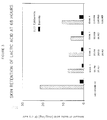
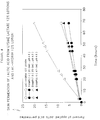
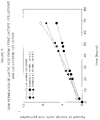
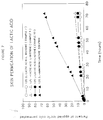
- Figs. 1 through 11 are graphs which will assist in understanding the improved properties of the compositions and methods of this invention.
- compositions employed in this invention are useful for all known utilities for topical administration of ⁇ -hydroxyacids, These include, for example treatment of dry skin, xerosis, ichthyosis, dandruff, acne, keratoses, psoriasis, wrinkles, warts, blemished skin, hyperpigmented skin, inflammatory dermatoses, eczema, pruritis, hyperkerotic skin, lentigines, melasma, age spots, laxity, leathery texture, roughness, sallow complexion, scaling, telangiectasia, mottled pigmentation, skin atrophy caused by steroids, and skin changes associated with intrinsic aging and photodamage.
- skin disorders refers to any of those cited above as well as other conditions treated by cosmetologists or dermatologists with ⁇ -hydroxy acids or salts thereof, in particular amphoteric amino acid salts of such acids. It includes skin conditions the treatment of which might usually be regarded as cosmetic, such as the treatment of hyperpigmented skin areas, as well as more serious skin conditions, such as chronic or acute psoriasis.
- compositions of the invention may contain any of a large number of additional cosmetic and pharmaceutical agents, provided that such additional agents are inert with respect to the formation, stability and activity of the ⁇ -hydroxy acid salts of the invention, i.e., they are reaction inert.
- Cosmetic and pharmaceutical agents include those that improve or eradicate age spots, keratoses and wrinkles; analgesics; anesthetics; antiacne agents; antibacterials; antiyeast agents; antifungal agents; antiviral agents, antidandruff agents; antidermatitis agents; antipruritic agents; antiinflammatory agents; antihyperkeratolytic agents; antidryskin agents; antiperspirants; antipsoriatic agents; antiseborrheic agents; hair conditioners and hair treatment agents; antiaging and antiwrinkle agents; antiphotoaging agents; antiasthmatic agents and bronchodilators; sunscreen agents; antihistamine agents; skin lightening agents; depigmenting agents; vitamins; corticosteroids; tanning agents; hormones; retinoids; and topical cardiovascular agents.
- cosmetic and pharmaceutical agents are clotrimazole, ketoconazole, miconazole, griseofulvin, hydroxyzine, diphenhydramine, pramozine, lidocaine, procaine, monobenzone, erythromycin, tetracycline, clindamycin, meclocycline, hydroquinone, 4-hydroxyanisole, minocycline, naproxen, ibuprofen, theophylline; cromolyn, albuterol, all trans retinoic acid, 13-cis retinoic acid, hydrocortisone, hydrocortisone 21-acetate, hydrocortisone 17-valerate, hydrocortisone 17-butyrate, betamethasone valerate, betamethasone dipropionate, triamcinolone acetonide, fluocinonide, clobetasol propionate, halobetasol propionate, benzoyl peroxide, crotamiton, propranolo
- the salts of this invention may be employed with any of a variety of dermatologically acceptable carriers or excipients normally employed in compositions for topical administration. These are well known to the skilled artisan and include, for example, surfactants, emulsifiers, stabilizers, preservatives, antiseptics, emollients, thickeners, lubricants, humectants, chelating agents, fragrances and skin permeation enhancers.
- compositions may be in the form of solutions, emulsions, suspensions, lotions, creams, gels, sticks, ointments, liposomes, aerosol sprays, polymeric gels, plasters, patches, films or tapes, the preparation of which are well known to those skilled in the art of topical pharmaceutical formulation.
- emulsifiers examples include, steareth-2, steareth-21, polyoxyethylene-4-lauryl ether, polyethylene glycol-23-lauryl ether, sorbitan monostearate and polyoxyethylene-20-sorbitan monostearate.
- preservatives include, methyl paraben, propyl paraben, sorbic acid, potassium sorbate, benzyl alcohol, diazolidinyl urea, methylisothiazolinone and methylchloroiosothiazolinone.
- emollients include, silicone oils, mineral oil, cocoa butter, hexyl laurate, diisopropyl adipate, dibutyl adipate, glyceryl stearate, beeswax, lanolin, sperm wax, cetyl palmitate, isopropyl myristate, isopropyl palmitate, isopropyl isostearate and propylene glycol dioctanoate.
- thickening agents there may be mentioned by way of example, xanthan gum brine tolerant, xanthan gum, and gum acacia, which are excellent as emulsion stabilizers and gelling agents.
- Acceptable humectants include, for example, propylene glycol, glycerin, butylene glycol and polyethylene glycols.
- the term "effective amount" relates to the condition under treatment. Some conditions may require treatment with large amounts of ⁇ -hydroxy acid salts. Others may be effectively treated with smaller amounts. The treatment may require one or multiple dosage units applied all at once or over a period of time. Generally, the dosage requirements will be of the order of magnitude normally employed with similar treatments using ⁇ -hydroxy acid salts. However, because of the rapid onset of permeation and higher permeation concentration achieved, it is often possible to use lesser amounts of ⁇ -hydroxy acid salts, in accordance with the procedures of the present invention. In any event, the skilled artisan will have no difficulty in determining an "effective amount" for the treatment of a specific condition, by the application of the routine test procedures normally employed.
- the skin permeation test was conducted by the. following procedure:
- 14 C-L-lactic acid sodium salt and 14 C-DL-lactic acid sodium salt were used in the skin permeation study.
- the test formulations with L-lactic acid salts and DL-lactic acid salts were spiked and mixed with 14 C-L-lactic acid sodium salt and 14 C-DL-lactic acid sodium salt, respectively, to result in a radioactive concentration of 6 microcurie per ml.
- FDC 400 flat flange Franz diffusion cells
- a diffusional cross-section area of 1.2cm 2 about 60 to 100 mg of test formulation were placed on the stratum corneum surface of the skin in the donor compartment and the receptor compartment was filled with about 11 ml of normal saline.
- the receptor fluid was well stirred throughout the experiment and the temperature was maintained by circulating water at 37°C through the water jacket of the diffusion cells. Precisely 500 ⁇ l of receptor fluid was collected in a scintillation vial at appropriate intervals for a period of 68 hours.
- the stratum corneum surface of the skin was washed three times with 0.5 ml of water. Cotton swabs were used during the rinsing procedure to recover the remaining surface dose. A circular incision was made in the skin exposed to the formulation. The epidermis at the circular edge was slowly lifted using a pointed flat spatula, and then separated from the dermis using forceps. The epidermis and dermis were transferred to previously weighed teflon tape and dried in a desiccator for 72 hours until a constant weight was obtained.
- a principal object of this invention is to achieve a skin permeation and skin retention profile of lactic acid from amphoteric amino acid lactates comparable to that of lactic acid from ammonium lactate.
- ammonium lactate has excellent lactic acid skin permeation and skin retention profiles and is very effective for treating dermatological disorders such as those mentioned above.
- amphoteric salts of ⁇ -hydroxy acid such as amino acid salts of -hydroxy acid, do not have advantageous ⁇ -hydroxy acid skin permeation profiles as compared with the ammonium salts of the corresponding ⁇ -hydroxy acid.
- the amphoteric amino acid salts of ⁇ -hydroxy acids have much poorer ⁇ -hydroxy acid skin permeation profiles than the ammonium salts of such ⁇ -hydroxy acids.
- the specific pH range of operability for the compositions of this invention is from about 3 to 9, preferably about 3.5 to 6.5, and most preferably about 3.8 to 5.
- the specific concentration range of GMC for the compositions of this invention is from about 0.5 to 8%, preferably about 1 to 7%, and most preferably about 2 to 5%.
- GMC is known to assist the skin permeation of several therapeutic agents. There is, however, no predictability as to whether permeation enhancers such as GMC will assist in the permeation of a particular therapeutic agent.
- valine is another material that is known to enhance skin permeation. However, in the absence of GMC, valine does not enhance skin permeation of lactic acid from a composition containing lysine lactate. It is, in fact well recognized by those skilled in the art that skin permeation enhancers that are useful with one therapeutic agent are not predictably useful with another agent.
- GMC has been used principally to achieve complete permeation of the therapeutic agent through the skin for systemic distribution thereof.
- the desidiratum is not systemic distribution. Rather, it is that the -hydroxy acid permeate into the skin and be retained there.
- compositions of this invention will contain a salt of a DL- ⁇ -hydroxy acid, such as DL-lactic acid, and a L-amino acid, such as L-lysine, because lactic acid is commercially available as the racemic mixture and lysine is commercially available as the L-enantiomer.
- a salt of a DL- ⁇ -hydroxy acid such as DL-lactic acid
- L-amino acid such as L-lysine
- lactic acid is commercially available as the racemic mixture
- lysine is commercially available as the L-enantiomer.
- the salt can also be formed from a racemic mixture of the selected amino acid.
- Lysine in the L-form is the presently preferred amino acid for use in this invention, although other amino acids, both natural and synthetic, are also useful.
- useful amino acids include, lysine, histidine, arginine, ornithine and 4-amino butyric acid.
- the reactants used to form the useful salts of this invention may be pure enantiomers, either D or L, or they may be mixtures of enantiomers, including racemic mixtures.
- ⁇ -hydroxy acid salts of amino acids such as the preferred embodiment, lysine lactate. It is, however, applicable to salts of other dermatologically useful ⁇ -hydroxy acids, such as lactic acid, glycolic acid, citric acid tartaric acid and malic acid. It is applicable not only to natural and synthetic amino acids, but also to other amphoteric organic compounds which will form salts with such ⁇ -hydroxy acids, particularly nitrogen containing amphoteric organic compounds particularly amino group containing compounds which also contain an available reactive carbonyl group.
- dipeptides include dipeptides, polypeptides and proteins which contain at least one basic group, such as the amino group, or others including, for example imino, guanidino, imidazolino, imidazolyl or other basic groups which permit the formation of amphoteric salts with selected ⁇ -hydroxy acids.
- basic group such as the amino group, or others including, for example imino, guanidino, imidazolino, imidazolyl or other basic groups which permit the formation of amphoteric salts with selected ⁇ -hydroxy acids.
- Preferred ⁇ -hydroxy acids are lactic acid and glycolic acid. They are readily available and give consistently good results, most preferred is lactic acid.
- the useful salts of this invention may be formed, for example, from lecithin and related types including, for example, phosphatidyl ethanolamine, phosphatidyl serine and sphingomyaline and other bases, such as carnosine (alanylhistidine), 4-aminobutanoic acid and citrulline ( ⁇ -amino- ⁇ -ureidovaleric acid).
- lecithin and related types including, for example, phosphatidyl ethanolamine, phosphatidyl serine and sphingomyaline and other bases, such as carnosine (alanylhistidine), 4-aminobutanoic acid and citrulline ( ⁇ -amino- ⁇ -ureidovaleric acid).
- Representative amino acids that can be used to form salts of ⁇ -hydroxy acids such as lactic acid include for example, glycine, alanine, valine, leucine, isoleucine, serine, threonine, cysteine, cystine, ornithine and tryptophan.
- Preferred salts of the invention area ⁇ -hydroxy salts of the basic amino acids lysine, histidine and arginine with lactic acid or glycolic acid.
- Table 1 shows the compositions of four lysine lactate 12% test lotions containing a number of ingredients, the most important of which, for purposes of this description, are lysine lactate, petrolatum (PET), propylene glycol dioctanoate (PGD), isopropyl myristrate (IPM) and glyceryl monocaprylate (GMC). It will be noted that all of the compositions contain the same amount of GMC and all have a pH of 4.6, but they differ in the amount of petrolatum and the amount of emollients isopropyl myristate and propylene glycol dioctanoate.
- the xanthan gum BT is an excellent emulsion stabilizer.
- Composition of experimental lotions containing lysine lactate equivalent to 12% wt of lactic acid Ingredients % w/w EXAMPLE 1 EXAMPLE 2 EXAMPLE 3 EXAMPLE 4 Lysine Lactate 50.00 50.00 50.00 50.00 Titanium Dioxide 0.15 0.15 0.15 0.15 Petrolatum 3.0 3.0 3.0 5.5 PG Dioctanoate 5.0 3.0 - 2.0 Steareth-2 2.0 2.0 2.0 2.0 2.0 Steareth-21 3.0 3.0 3.0 3.0 Cetyl Alcohol 0.5 0.5 0.5 0.5 0.5 0.5 Stearyl Alcohol 5.0 5.0 5.0 5.0 Dimethicone 200 1.0 1.0 1.0 1.0 Isopropyl Myristate - 3.0 5.0 2.5 Glyceryl Monocaprylate 3.0 3.0 3.0 3.0 Propylene G
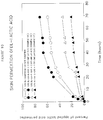
- Fig. 1 shows the permeation profile of the four compositions of Table 1 compared to that of ammonium lactate commercially available from Westwood-Squibb as LAC-HYDRIN 12% lotion. It will be noted that during the entire period of the test the permeation of lactic acid from ammonium lactate was appreciably higher from ammonium lactate than from lysine lactate contained in any of the four test compositions.
- Fig. 2 is a scaled up version of Fig. 1 showing on the abscissa the lactic acid skin permeation range from 0 to 30% instead of the 0 to 100% range of Fig. 1.
- the enlarged scale shows that there are, in fact, differences in skin permeation of lactic acid from compositions all of which are at a pH of 4.6 and contain 3% percent by weight GMC. These differences may be attributed to variations in the amounts of other components in the compositions, such as PET, IPM and PGD.
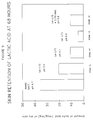
- Fig. 3 shows the results of lactic acid skin retention studies on the same compositions shown in Fig. 1. From the graphs it will be seen that there is excellent skin retention of lactic acid from the compositions containing ammonium lactate. It will be seen, also, that at constant GMC content and pH, there is variation in skin retention which, again, may be attributed to variation in the amounts of PET, IPM and PGD in the compositions. Under the conditions of the test, it is clear that increased PET content markedly increases both skin permeation and skin retention of lactic acid from lysine lactate.
- Example 4 was the best in both skin permeation and skin retention of lactic acid. It is also apparent that IPM is a better skin permeation enhancer for lactic acid than PGD.
- Example 5 is substantially the same as that of Example 4, except for the decreased pH (which is achieved by changing the lactic acid to lysine ratio), and that the composition of Example 6 is substantially the same as that of Example 4, except for the increase in GMC content from 3% to 4%.
- Fig. 4 shows that a decrease in pH, while maintaining the GMC content at a constant value, remarkably increases the skin permeation of lactic acid to a value higher than that for ammonium lactate lotion and that increasing the GMC content at the same pH produces compositions which have substantially the same permeation profile as ammonium lactate (LAC-HYDRIN 12% lotion).
- Fig. 5 is similar to Fig. 4 but on an enlarged scale with respect to the abscissa. It further confirms the conclusions reached concerning increased GMC content at constant pH and concerning decreasing the pH of the composition at constant GMC content.
- Fig. 6 shows the results of a skin retention test on the same compositions studied to produce the skin permeation results shown in Figs. 4 and 5.
- LAC-HYDRIN is best for skin retention, it is evident that a reduction in pH and an increase in GMC content improves skin retention of lactic acid.
- Figs. 7 through 11 record the results of similar studies which further support the unexpected finding of the relationship between GMC content and pH, the discovery of which permits control of both skin retention and skin permeation of lactic acid.
- compositions studied are shown in Table 3.
- Ingredients % w/w EXAMPLE 7
- EXAMPLE 9 EXAMPLE 10
- DL-Lactic Acid (88%) 13.6 13.6 - - L-Lactic Acid (88%) - - 13.6 13.6 L-Histidine 16.52 - 16.52 - L-Lysine H 2 O - 16.14 - 16.14
- Method Mix lactic acid, amino acid and water until uniform. Heat to 60-65 o C and mix for 25 minutes, then mix while cooling to room temperature, QS with water and measure the pH.
- Fig. 7 shows the lactic acid skin permeation profiles of the compositions of Table 3 and of 12% DL-ammonium lactate solution. From the figure and the table, it will be apparent that permeation of lactic acid from ammonium lactate is significantly higher than from the amino acid salts of lactic acid.
- Fig. 8 shows a similar result with respect to lactic acid skin retention of the four compositions of Examples 7 through 10.
- Figs. 7 and 8 show that skin permeation of lactic acid from amphoteric amino acid lactate is 7 to 10 fold less than from ammonium lactate and that lactic acid epidermal retention is five fold less with amphoteric amino acid lactate as compared to ammonium lactate.
- Table 4 shows the formulations of the next compositions studied.
- the study was designed to evaluate the influence of GMC and pH on skin retention of lactic acid from amino acid lactates. It will be noted that the pH increases from the composition of Example 11 to those of Examples 13 and 14, but that the pH of the compositions of Examples 13 and 14 remains constant.
- the compositions of Examples 11, 12 and 13 are free of GMC, whereas the composition of Example 14 contains 2.5% by weight of GMC.
- the increase in pH is accomplished by increasing the concentration of lysine in the composition. All these solution compositions were heated at 60 o C for 5 days to hydrolyze lactalate esters of lactic acid so that the final composition has a lactic acid monomer content greater than 91% of total lactic acid.
- compositions of solutions containing lysine lactate equivalent to 12% DL-lactic acid Ingredients % w/w EXAMPLE 11 EXAMPLE 12 EXAMPLE 13 EXAMPLE 14 DL-Lactic Acid (88%) 13.6 13.6 13.6 13.6 L-Lysine H 2 O 4.3 16.14 20.0 20.0 Glyceryl monocaprylate - - - 2.5 Water qs 100.00 100.00 100.00 pH 3.0 4.2 5.0 5.0 Method: Mix DL-lactic acid, L-Lysine-H 2 O in water until uniform. Then heat In closed container for 5 days at 60 o C. Cool to room temperature, then add glyceryl monocaprylate and mix well.
- Fig. 9 shows the skin retention of lactic acid for the compositions of Examples 11 through 14 of Table 4 and for 12% ammonium lactate solution. It will be seen that ammonium lactate at pH 4.7 is the best composition for lactic acid skin retention. It is also apparent that skin retention of lactic acid from lysine lactate solution is increased by 5-fold when the pH of the composition is decreased from pH 5 (Example 13) to pH 3 (Example 11). At constant pH 5, the retention of lactic acid from lysine lactate was increased about 2.5 fold by the addition of GMC (Example 14).
- compositions of Table 5 were prepared to study the effect of decreasing pH at a fixed GMC content.
- Solution compositions containing lysine lactate equivalent to 12% lactic acid Ingredients % w/w EXAMPLE 15
- EXAMPLE 16 EXAMPLE 17
- DL-Lactic Acid (88%) 13.6 13.6 13.6 L-Lysine H 2 O 4.8 16.14 20.0
- Method Mix DL-lactic acid and L-lysine H 2 O with water until uniform. Then heat in a closed container at 60 o C for 5 days. Cool to room temperature, then add glyceryl monostearate and mix well.
- Fig. 10 shows the skin permeation profile of the compositions of Table 5 and for 12% ammonium lactate solution. It will be seen that at a fixed GMC content of 2.5% by weight, the skin permeation profile was increased by 3.5 fold when the pH was decreased from 5 (Example 17) to 3.2 (Example 15). Most important of all, the lactic acid skin permeation profile of the composition of Example 15 at pH 3.2 was during the entire period of the study, better during the entire period of the study than the lactic acid skin permeation profile of ammonium lactate.
- Fig. 11 shows exactly the same profile for skin retention; i.e., skin retention of lactic acid from lysine lactate solutions was increased by 2.5 fold when the pH was decreased from 5 to 3.2 at a constant GMC content of 2.5%.
- the skin retention of lactic acid from the lysine lactate pH 3.2 composition was equivalent to that from the ammonium lactate composition.
- Petrolatum is an occlusive agent and is known to hydrate the skin and enhance permeation of highly oil soluble compounds. With water soluble compounds like methanol and ethanol, permeation is unaltered by hydration. With a compound such as propranolol hydration decreases the permeation rate by two fold. Thus petrolatum's enhancement of the permeation of lactic acid and other ⁇ -hydroxy acids from their highly water soluble amphoteric salts, expecially their amino acid salts, is surprising.
- PET and IPM which will be effective to further enhance the skin permeation and skin retention of ⁇ -hydroxy acids from specific compositions of this invention may be readily determined by a few simple observations by one skilled in the formulation art.
- PET the amount is typically from about 0 to 80%, preferably 1 to 20%, most preferably 3 to 10%.
- IPM the amount is typically from about 0 to 30%, preferably 0.5 to 15%, most preferably 2 to 10%. Mixtures of PET and IPM can be employed.
Landscapes
- Health & Medical Sciences (AREA)
- Life Sciences & Earth Sciences (AREA)
- Veterinary Medicine (AREA)
- Public Health (AREA)
- General Health & Medical Sciences (AREA)
- Animal Behavior & Ethology (AREA)
- Epidemiology (AREA)
- Birds (AREA)
- Emergency Medicine (AREA)
- Pharmacology & Pharmacy (AREA)
- Chemical & Material Sciences (AREA)
- Dermatology (AREA)
- Medicinal Chemistry (AREA)
- General Chemical & Material Sciences (AREA)
- Chemical Kinetics & Catalysis (AREA)
- Organic Chemistry (AREA)
- Nuclear Medicine, Radiotherapy & Molecular Imaging (AREA)
- Bioinformatics & Cheminformatics (AREA)
- Engineering & Computer Science (AREA)
- Cosmetics (AREA)
- Acyclic And Carbocyclic Compounds In Medicinal Compositions (AREA)
- Medicinal Preparation (AREA)
- Pharmaceuticals Containing Other Organic And Inorganic Compounds (AREA)
Applications Claiming Priority (2)
| Application Number | Priority Date | Filing Date | Title |
|---|---|---|---|
| US08/215,984 US5420106A (en) | 1994-03-22 | 1994-03-22 | Method and composition having enhanced alpha-hydroxy acid skin permeation and retention |
| US215984 | 1994-03-22 |
Publications (2)
| Publication Number | Publication Date |
|---|---|
| EP0673648A1 EP0673648A1 (en) | 1995-09-27 |
| EP0673648B1 true EP0673648B1 (en) | 1998-11-25 |
Family
ID=22805189
Family Applications (1)
| Application Number | Title | Priority Date | Filing Date |
|---|---|---|---|
| EP95301864A Expired - Lifetime EP0673648B1 (en) | 1994-03-22 | 1995-03-21 | Compositions comprising amphotoic salts of alpha-hydroxy acids and glycerol monocaprylate |
Country Status (9)
| Country | Link |
|---|---|
| US (1) | US5420106A (enExample) |
| EP (1) | EP0673648B1 (enExample) |
| JP (1) | JPH07258076A (enExample) |
| AU (1) | AU690957B2 (enExample) |
| CA (1) | CA2142940A1 (enExample) |
| DE (1) | DE69506154T2 (enExample) |
| DK (1) | DK0673648T3 (enExample) |
| ES (1) | ES2123910T3 (enExample) |
| NZ (1) | NZ270728A (enExample) |
Cited By (1)
| Publication number | Priority date | Publication date | Assignee | Title |
|---|---|---|---|---|
| US8440245B2 (en) | 2009-03-26 | 2013-05-14 | Abbott Laboratories | Methods for making nutritional compositions comprising curcuminoids |
Families Citing this family (39)
| Publication number | Priority date | Publication date | Assignee | Title |
|---|---|---|---|---|
| US5505948A (en) * | 1993-06-01 | 1996-04-09 | Dermatology Home Products, Inc. | Home skin peel composition for producing healthy and attractive skin |
| IL109012A (en) * | 1994-03-17 | 1998-09-24 | Fischer Pharma Ltd | Skin whitening composition comprising glycyrrhyza glabra and hydroxy acids |
| DE4444237C2 (de) * | 1994-12-13 | 2000-08-24 | Beiersdorf Ag | Verwendung von Wirkstoffkombinationen zur Bekämpfung durch Propionibacterium acnes hervorgerufener unreiner Haut sowie leichter Formen der Akne |
| FR2729855A1 (fr) * | 1995-01-26 | 1996-08-02 | Oreal | Utilisation d'un antagoniste de cgrp dans une composition cosmetique, pharmaceutique ou dermatologique et composition obtenue |
| AU4868396A (en) * | 1995-02-22 | 1996-09-11 | Bausch & Lomb Incorporated | Skin care composition |
| US5616617A (en) * | 1995-11-27 | 1997-04-01 | Van Moerkerken; Arthur | Face pimples prevention method and compositions |
| GB9524575D0 (en) * | 1995-12-01 | 1996-01-31 | Unilever Plc | Thickener for cosmetic composition |
| ES2110921B1 (es) * | 1996-08-08 | 1998-10-01 | Ternum S C C L | Composicion anti-psoriasica y procedimiento para la preparacion de la misma. |
| FR2756489A1 (fr) * | 1996-12-02 | 1998-06-05 | Eynard Michele | Compositions destinees au traitement des hyperkeratoses |
| FR2759295B1 (fr) | 1997-02-11 | 1999-04-16 | Serobiologiques Lab Sa | Composition active contre les effets du froid et produit cosmetique comportant une telle composition |
| US6143309A (en) | 1998-03-12 | 2000-11-07 | Archimica (Florida), Inc. | Delivery of hydroxy carboxylic acids |
| AUPP583198A0 (en) * | 1998-09-11 | 1998-10-01 | Soltec Research Pty Ltd | Mousse composition |
| WO2000069403A1 (en) * | 1999-05-18 | 2000-11-23 | Klein Marvin E | Alpha amino acid composition and method for the treatment of skin |
| US6353029B1 (en) * | 2000-08-24 | 2002-03-05 | Bristol-Myers Squibb Company | Storage stable tretinoin and 4-hydroxyanisole containing topical composition |
| FR2816837A1 (fr) * | 2000-11-17 | 2002-05-24 | Oreal | Utilisation d'au moins un derive amino sulfonique dans une composition destinee a favoriser la desquamation de la peau |
| US20030017181A1 (en) * | 2001-05-31 | 2003-01-23 | Rood Gloria A. | Dermatological compositions and methods |
| DE10150727A1 (de) * | 2001-10-13 | 2003-04-17 | Cognis Deutschland Gmbh | Kosmetische und/oder pharmazeutische Zubereitungen |
| US20040033253A1 (en) * | 2002-02-19 | 2004-02-19 | Ihor Shevchuk | Acyl opioid antagonists |
| MXPA04012333A (es) * | 2002-06-10 | 2005-02-25 | Euro Celtique Sa | Sistemas de colocacion de dispositivos de liberacion transdermica para prevenir el uso incorrecto de los agentes activos contenidos en los mismos. |
| AU2003268144A1 (en) * | 2002-08-20 | 2004-03-11 | Euro-Celtique, S.A. | Transdermal dosage form comprising an active agent and a salt and free-baseform of an antagonist |
| US20070053848A1 (en) * | 2003-08-26 | 2007-03-08 | Stockel Richard F | Antimicrobial materials for dental care applications |
| ES2222818B1 (es) * | 2003-07-25 | 2007-03-01 | Luis Ucelay Sanz | Emulsion de acido lactico. |
| US20080020028A1 (en) * | 2003-08-20 | 2008-01-24 | Euro-Celtique S.A. | Transdermal dosage form comprising an active agent and a salt and a free-base form of an adverse agent |
| US20070086977A1 (en) * | 2003-12-22 | 2007-04-19 | Stockel Richard F | Method of treating dermatological conditions |
| US20050136024A1 (en) * | 2003-12-22 | 2005-06-23 | Stockel Richard F. | Dermatological compositions |
| JP2007332046A (ja) * | 2006-06-13 | 2007-12-27 | Ogawa & Co Ltd | ヘアシャンプー |
| JP2007332047A (ja) * | 2006-06-13 | 2007-12-27 | Ogawa & Co Ltd | 外用化粧料 |
| US20100087535A1 (en) * | 2007-03-20 | 2010-04-08 | Shiseido Company, Ltd. | External composition for skin |
| US20100331412A1 (en) * | 2009-03-30 | 2010-12-30 | Patricia Lawler Kenet | Two container skin care product |
| US20110152384A1 (en) * | 2009-12-17 | 2011-06-23 | Gunn Euen T | Mild leave-on skin care compositions |
| JP5631837B2 (ja) * | 2010-10-18 | 2014-11-26 | 株式会社ヤクルト本社 | 皮膚中濃度増加剤 |
| DE102011056142A1 (de) * | 2011-12-07 | 2013-06-13 | Manfred Rüdinger | Metabolisierbare Salze und deren Verwendung in Diagnostik und Therapie |
| KR102132544B1 (ko) * | 2015-06-19 | 2020-07-09 | 글로벌 헬스 솔루션즈, 엘엘씨 | 활성 성분들을 위한 페트롤라툼-계 전달 시스템 |
| FR3086172B1 (fr) * | 2018-09-26 | 2021-01-29 | Gallinee | Formulation cosmetique |
| EP3965724A4 (en) * | 2019-05-06 | 2023-05-17 | Spinart, LLC | FORMULATIONS AND PROCESSES FOR THE MANUFACTURE OF STABLE COSMETIC COMPOSITIONS |
| US20200405609A1 (en) * | 2019-06-26 | 2020-12-31 | Johnson & Johnson Consumer Inc. | Topical compositions containing n-acyl dipeptide derivatives and glycolic acid |
| CN118217176A (zh) * | 2019-08-21 | 2024-06-21 | 株式会社Lg生活健康 | 包含共晶混合物的化妆料组合物 |
| FR3130564B1 (fr) * | 2021-12-21 | 2024-07-12 | Oreal | Composition comprenant une argile non modifiée, un sel de magnésium, un alphahydroxyacide et de l’eau. |
| CN116831956A (zh) * | 2023-07-03 | 2023-10-03 | 杭州泽芙雪化妆品有限公司 | 一种可用于缓解皮肤干痒的保湿乳及其制备方法 |
Family Cites Families (18)
| Publication number | Priority date | Publication date | Assignee | Title |
|---|---|---|---|---|
| US3879537A (en) * | 1973-09-04 | 1975-04-22 | Scott Eugene J Van | Treatment of ichthyosiform dermatoses |
| US4363815A (en) * | 1975-07-23 | 1982-12-14 | Yu Ruey J | Alpha hydroxyacids, alpha ketoacids and their use in treating skin conditions |
| US4021572A (en) * | 1975-07-23 | 1977-05-03 | Scott Eugene J Van | Prophylactic and therapeutic treatment of acne vulgaris utilizing lactamides and quaternary ammonium lactates |
| JPS6112621A (ja) * | 1984-06-27 | 1986-01-21 | Lion Corp | パツプ剤 |
| DE3511753A1 (de) * | 1985-03-30 | 1986-10-02 | Bayer Ag, 5090 Leverkusen | Verwendung von efomycinen als wachstumsfoerderer, efomycine und ihre herstellung |
| US4732892A (en) * | 1985-07-12 | 1988-03-22 | American Home Products Corporation | L-α-amino acids as transdermal penetration enhancers |
| AU618517B2 (en) * | 1986-12-23 | 1992-01-02 | Eugene J. Van Scott | Additives enhancing topical actions of therapeutic agents |
| US5091171B2 (en) * | 1986-12-23 | 1997-07-15 | Tristrata Inc | Amphoteric compositions and polymeric forms of alpha hydroxyacids and their therapeutic use |
| JPH0720866B2 (ja) * | 1987-05-15 | 1995-03-08 | 三生製薬株式会社 | エペリゾン又はトルペリゾン或いはそれらの塩類含有経皮適用製剤 |
| US5164406A (en) * | 1988-06-02 | 1992-11-17 | Bristol-Myers Squibb Co. | Method for enhancing transdermal penetration and compositions useful therein |
| JP2794022B2 (ja) * | 1988-11-11 | 1998-09-03 | 三生製薬株式会社 | ブナゾシン或いはその塩類含有経皮適用製剤 |
| FI903483A7 (fi) * | 1989-07-13 | 1991-01-14 | Bristol Myers Squibb Co | Tretinoiinia sisältäviä stabiileja emulsiovoideformuloita |
| FI904753A7 (fi) * | 1989-10-02 | 1991-04-03 | Bristol Myers Squibb Co | Parantuneen pysyvyyden omaavia emulgoituja tretinoiinivoidekoostumuksia |
| US5087620A (en) * | 1990-05-17 | 1992-02-11 | Bristol-Myers Squibb Co. | Controlled dermal penetration enhancement using imidazoles |
| US5254343A (en) * | 1991-03-19 | 1993-10-19 | Bristol-Myers Squibb Company | Reduction of cutaneous atrophy |
| TW218849B (enExample) * | 1991-05-17 | 1994-01-11 | Bristol Myers Squibb Co | |
| US5306729A (en) * | 1992-02-25 | 1994-04-26 | Joslin Diabetes Center | Method for effecting vasodilation with monoglycerides |
| CA2143515A1 (en) * | 1994-03-22 | 1995-09-23 | Prakash Parab | Method for enhancing the rate of skin permeation of lactic acid through use of the l-enantiomer |
-
1994
- 1994-03-22 US US08/215,984 patent/US5420106A/en not_active Expired - Lifetime
-
1995
- 1995-02-20 CA CA002142940A patent/CA2142940A1/en not_active Abandoned
- 1995-03-16 NZ NZ270728A patent/NZ270728A/en not_active IP Right Cessation
- 1995-03-20 JP JP7060323A patent/JPH07258076A/ja active Pending
- 1995-03-21 DK DK95301864T patent/DK0673648T3/da active
- 1995-03-21 AU AU14975/95A patent/AU690957B2/en not_active Ceased
- 1995-03-21 ES ES95301864T patent/ES2123910T3/es not_active Expired - Lifetime
- 1995-03-21 DE DE69506154T patent/DE69506154T2/de not_active Expired - Fee Related
- 1995-03-21 EP EP95301864A patent/EP0673648B1/en not_active Expired - Lifetime
Cited By (1)
| Publication number | Priority date | Publication date | Assignee | Title |
|---|---|---|---|---|
| US8440245B2 (en) | 2009-03-26 | 2013-05-14 | Abbott Laboratories | Methods for making nutritional compositions comprising curcuminoids |
Also Published As
| Publication number | Publication date |
|---|---|
| HK1004473A1 (en) | 1998-11-27 |
| CA2142940A1 (en) | 1995-09-23 |
| DE69506154D1 (de) | 1999-01-07 |
| DE69506154T2 (de) | 1999-05-06 |
| NZ270728A (en) | 1997-10-24 |
| AU1497595A (en) | 1995-09-28 |
| AU690957B2 (en) | 1998-05-07 |
| ES2123910T3 (es) | 1999-01-16 |
| DK0673648T3 (da) | 1999-08-09 |
| JPH07258076A (ja) | 1995-10-09 |
| US5420106A (en) | 1995-05-30 |
| EP0673648A1 (en) | 1995-09-27 |
Similar Documents
| Publication | Publication Date | Title |
|---|---|---|
| US5420106A (en) | Method and composition having enhanced alpha-hydroxy acid skin permeation and retention | |
| US5093360A (en) | Retinal, derivatives and their therapeutic use | |
| DE69023574T2 (de) | Amphotere Zusammensetzungen und Polymerformen von alpha-Hydroxy-Säuren, und ihre therapeutische Anwendung. | |
| US5326566A (en) | Use of dibutyl adipate and isopropyl myristate in topical and transdermal products | |
| JPS5822442B2 (ja) | トレチノインクリ−ムエマルジヨンの安定化方法 | |
| JPH032118A (ja) | ビタミンa酸の局所塗布用保湿性賦形剤 | |
| JPH07277918A (ja) | 化粧用又は皮膚科用の組成物及びその製造法 | |
| AU635071B2 (en) | Tretinoin emulsified cream formulations of improved stability | |
| EP0299756A2 (en) | Anti-acne composition | |
| Foster et al. | Tazarotene. | |
| US5705168A (en) | Enhanced permeation of alpha-hydroxy acid enantiomer | |
| JPH09110628A (ja) | 脂漏症を処理するための活性剤としてアスコルビン酸を含む化粧用および/または皮膚科学用組成物 | |
| EP0513832A1 (en) | Use of dibutyl adipate and isopropyl myristate in topical and transdermal products | |
| JP2960335B2 (ja) | ゲル化した化粧品用および/または皮膚病用の組成物とその使用方法 | |
| AU621763B2 (en) | Stable tretinoin emulsified cream formulations | |
| CA2535724C (en) | Compositions containing topical active agents and pentylene glycol | |
| HK1004473B (en) | Compositions comprising amphotoic salts of alpha-hydroxy acids and glycerol monocaprylate | |
| JPH08295628A (ja) | 脱毛症外用治療剤 | |
| HK1005124A (en) | Dermatological composition containing lactic acid salt |
Legal Events
| Date | Code | Title | Description |
|---|---|---|---|
| PUAI | Public reference made under article 153(3) epc to a published international application that has entered the european phase |
Free format text: ORIGINAL CODE: 0009012 |
|
| AK | Designated contracting states |
Kind code of ref document: A1 Designated state(s): DE DK ES FR GB IT SE |
|
| 17P | Request for examination filed |
Effective date: 19960215 |
|
| 17Q | First examination report despatched |
Effective date: 19960329 |
|
| GRAG | Despatch of communication of intention to grant |
Free format text: ORIGINAL CODE: EPIDOS AGRA |
|
| GRAG | Despatch of communication of intention to grant |
Free format text: ORIGINAL CODE: EPIDOS AGRA |
|
| GRAG | Despatch of communication of intention to grant |
Free format text: ORIGINAL CODE: EPIDOS AGRA |
|
| GRAH | Despatch of communication of intention to grant a patent |
Free format text: ORIGINAL CODE: EPIDOS IGRA |
|
| GRAH | Despatch of communication of intention to grant a patent |
Free format text: ORIGINAL CODE: EPIDOS IGRA |
|
| GRAA | (expected) grant |
Free format text: ORIGINAL CODE: 0009210 |
|
| AK | Designated contracting states |
Kind code of ref document: B1 Designated state(s): DE DK ES FR GB IT SE |
|
| REF | Corresponds to: |
Ref document number: 69506154 Country of ref document: DE Date of ref document: 19990107 |
|
| REG | Reference to a national code |
Ref country code: ES Ref legal event code: FG2A Ref document number: 2123910 Country of ref document: ES Kind code of ref document: T3 |
|
| ITF | It: translation for a ep patent filed | ||
| ET | Fr: translation filed | ||
| REG | Reference to a national code |
Ref country code: DK Ref legal event code: T3 |
|
| PLBE | No opposition filed within time limit |
Free format text: ORIGINAL CODE: 0009261 |
|
| STAA | Information on the status of an ep patent application or granted ep patent |
Free format text: STATUS: NO OPPOSITION FILED WITHIN TIME LIMIT |
|
| 26N | No opposition filed | ||
| REG | Reference to a national code |
Ref country code: GB Ref legal event code: IF02 |
|
| PGFP | Annual fee paid to national office [announced via postgrant information from national office to epo] |
Ref country code: GB Payment date: 20070321 Year of fee payment: 13 |
|
| PGFP | Annual fee paid to national office [announced via postgrant information from national office to epo] |
Ref country code: DK Payment date: 20080314 Year of fee payment: 14 |
|
| PGFP | Annual fee paid to national office [announced via postgrant information from national office to epo] |
Ref country code: SE Payment date: 20080306 Year of fee payment: 14 Ref country code: IT Payment date: 20080326 Year of fee payment: 14 |
|
| PGFP | Annual fee paid to national office [announced via postgrant information from national office to epo] |
Ref country code: FR Payment date: 20080311 Year of fee payment: 14 Ref country code: ES Payment date: 20080418 Year of fee payment: 14 Ref country code: DE Payment date: 20080313 Year of fee payment: 14 |
|
| GBPC | Gb: european patent ceased through non-payment of renewal fee |
Effective date: 20080321 |
|
| PG25 | Lapsed in a contracting state [announced via postgrant information from national office to epo] |
Ref country code: GB Free format text: LAPSE BECAUSE OF NON-PAYMENT OF DUE FEES Effective date: 20080321 |
|
| REG | Reference to a national code |
Ref country code: DK Ref legal event code: EBP |
|
| EUG | Se: european patent has lapsed | ||
| REG | Reference to a national code |
Ref country code: FR Ref legal event code: ST Effective date: 20091130 |
|
| PG25 | Lapsed in a contracting state [announced via postgrant information from national office to epo] |
Ref country code: DE Free format text: LAPSE BECAUSE OF NON-PAYMENT OF DUE FEES Effective date: 20091001 |
|
| PG25 | Lapsed in a contracting state [announced via postgrant information from national office to epo] |
Ref country code: FR Free format text: LAPSE BECAUSE OF NON-PAYMENT OF DUE FEES Effective date: 20091123 Ref country code: DK Free format text: LAPSE BECAUSE OF NON-PAYMENT OF DUE FEES Effective date: 20090331 |
|
| REG | Reference to a national code |
Ref country code: ES Ref legal event code: FD2A Effective date: 20090323 |
|
| PG25 | Lapsed in a contracting state [announced via postgrant information from national office to epo] |
Ref country code: ES Free format text: LAPSE BECAUSE OF NON-PAYMENT OF DUE FEES Effective date: 20090323 |
|
| PG25 | Lapsed in a contracting state [announced via postgrant information from national office to epo] |
Ref country code: IT Free format text: LAPSE BECAUSE OF NON-PAYMENT OF DUE FEES Effective date: 20090321 |
|
| PG25 | Lapsed in a contracting state [announced via postgrant information from national office to epo] |
Ref country code: SE Free format text: LAPSE BECAUSE OF NON-PAYMENT OF DUE FEES Effective date: 20090322 |