EP0665161B1 - Parachute materials - Google Patents
Parachute materials Download PDFInfo
- Publication number
- EP0665161B1 EP0665161B1 EP95104279A EP95104279A EP0665161B1 EP 0665161 B1 EP0665161 B1 EP 0665161B1 EP 95104279 A EP95104279 A EP 95104279A EP 95104279 A EP95104279 A EP 95104279A EP 0665161 B1 EP0665161 B1 EP 0665161B1
- Authority
- EP
- European Patent Office
- Prior art keywords
- zone
- stretched
- parachute
- zones
- bag
- Prior art date
- Legal status (The legal status is an assumption and is not a legal conclusion. Google has not performed a legal analysis and makes no representation as to the accuracy of the status listed.)
- Expired - Lifetime
Links
- 239000000463 material Substances 0.000 title claims abstract description 65
- 230000035939 shock Effects 0.000 claims abstract description 18
- -1 polypropylene Polymers 0.000 claims description 32
- 239000004743 Polypropylene Substances 0.000 claims description 21
- 229920001155 polypropylene Polymers 0.000 claims description 21
- 238000004049 embossing Methods 0.000 claims description 9
- 229920001903 high density polyethylene Polymers 0.000 claims description 8
- 239000004700 high-density polyethylene Substances 0.000 claims description 8
- 229920001169 thermoplastic Polymers 0.000 claims description 3
- 239000004416 thermosoftening plastic Substances 0.000 claims description 3
- 239000010408 film Substances 0.000 description 43
- 238000007373 indentation Methods 0.000 description 32
- 230000000694 effects Effects 0.000 description 15
- 230000006872 improvement Effects 0.000 description 15
- 238000007789 sealing Methods 0.000 description 13
- 229920000642 polymer Polymers 0.000 description 12
- 239000004698 Polyethylene Substances 0.000 description 11
- 239000000203 mixture Substances 0.000 description 11
- 229920000573 polyethylene Polymers 0.000 description 11
- 229920001684 low density polyethylene Polymers 0.000 description 10
- 239000004702 low-density polyethylene Substances 0.000 description 10
- 238000000034 method Methods 0.000 description 10
- 230000009471 action Effects 0.000 description 8
- 230000008569 process Effects 0.000 description 8
- 239000008187 granular material Substances 0.000 description 7
- 229940063583 high-density polyethylene Drugs 0.000 description 7
- 239000010410 layer Substances 0.000 description 7
- 238000012360 testing method Methods 0.000 description 7
- 238000010521 absorption reaction Methods 0.000 description 6
- 238000009958 sewing Methods 0.000 description 6
- 238000010586 diagram Methods 0.000 description 5
- 229920006178 high molecular weight high density polyethylene Polymers 0.000 description 5
- 238000001816 cooling Methods 0.000 description 4
- 230000001419 dependent effect Effects 0.000 description 4
- 229920001971 elastomer Polymers 0.000 description 4
- 239000004705 High-molecular-weight polyethylene Substances 0.000 description 3
- 239000006096 absorbing agent Substances 0.000 description 3
- 239000000853 adhesive Substances 0.000 description 3
- 239000002390 adhesive tape Substances 0.000 description 3
- 229920001577 copolymer Polymers 0.000 description 3
- 229920000092 linear low density polyethylene Polymers 0.000 description 3
- 239000004707 linear low-density polyethylene Substances 0.000 description 3
- 239000000843 powder Substances 0.000 description 3
- 230000009467 reduction Effects 0.000 description 3
- 238000009864 tensile test Methods 0.000 description 3
- FAPWRFPIFSIZLT-UHFFFAOYSA-M Sodium chloride Chemical compound [Na+].[Cl-] FAPWRFPIFSIZLT-UHFFFAOYSA-M 0.000 description 2
- 230000002411 adverse Effects 0.000 description 2
- 238000010276 construction Methods 0.000 description 2
- 238000005520 cutting process Methods 0.000 description 2
- 238000013461 design Methods 0.000 description 2
- 239000000806 elastomer Substances 0.000 description 2
- 239000004744 fabric Substances 0.000 description 2
- 238000003475 lamination Methods 0.000 description 2
- 238000004519 manufacturing process Methods 0.000 description 2
- 239000000155 melt Substances 0.000 description 2
- 230000004048 modification Effects 0.000 description 2
- 238000012986 modification Methods 0.000 description 2
- 238000003892 spreading Methods 0.000 description 2
- 230000007480 spreading Effects 0.000 description 2
- 238000003860 storage Methods 0.000 description 2
- VXNZUUAINFGPBY-UHFFFAOYSA-N 1-Butene Chemical compound CCC=C VXNZUUAINFGPBY-UHFFFAOYSA-N 0.000 description 1
- VGGSQFUCUMXWEO-UHFFFAOYSA-N Ethene Chemical compound C=C VGGSQFUCUMXWEO-UHFFFAOYSA-N 0.000 description 1
- 239000005977 Ethylene Substances 0.000 description 1
- 229920010126 Linear Low Density Polyethylene (LLDPE) Polymers 0.000 description 1
- 230000001070 adhesive effect Effects 0.000 description 1
- IAQRGUVFOMOMEM-UHFFFAOYSA-N butene Natural products CC=CC IAQRGUVFOMOMEM-UHFFFAOYSA-N 0.000 description 1
- 238000003490 calendering Methods 0.000 description 1
- 230000008859 change Effects 0.000 description 1
- 230000000052 comparative effect Effects 0.000 description 1
- 230000007812 deficiency Effects 0.000 description 1
- 238000002474 experimental method Methods 0.000 description 1
- 238000001125 extrusion Methods 0.000 description 1
- 238000010438 heat treatment Methods 0.000 description 1
- 238000011835 investigation Methods 0.000 description 1
- 231100000897 loss of orientation Toxicity 0.000 description 1
- 238000003754 machining Methods 0.000 description 1
- 238000002844 melting Methods 0.000 description 1
- 230000008018 melting Effects 0.000 description 1
- 238000002156 mixing Methods 0.000 description 1
- 150000003839 salts Chemical class 0.000 description 1
- 239000004576 sand Substances 0.000 description 1
- 239000011780 sodium chloride Substances 0.000 description 1
- 239000002344 surface layer Substances 0.000 description 1
- 238000012956 testing procedure Methods 0.000 description 1
- 239000010409 thin film Substances 0.000 description 1
- 230000036962 time dependent Effects 0.000 description 1
Images

Classifications
-
- B—PERFORMING OPERATIONS; TRANSPORTING
- B64—AIRCRAFT; AVIATION; COSMONAUTICS
- B64D—EQUIPMENT FOR FITTING IN OR TO AIRCRAFT; FLIGHT SUITS; PARACHUTES; ARRANGEMENT OR MOUNTING OF POWER PLANTS OR PROPULSION TRANSMISSIONS IN AIRCRAFT
- B64D17/00—Parachutes
- B64D17/02—Canopy arrangement or construction
-
- B—PERFORMING OPERATIONS; TRANSPORTING
- B29—WORKING OF PLASTICS; WORKING OF SUBSTANCES IN A PLASTIC STATE IN GENERAL
- B29C—SHAPING OR JOINING OF PLASTICS; SHAPING OF MATERIAL IN A PLASTIC STATE, NOT OTHERWISE PROVIDED FOR; AFTER-TREATMENT OF THE SHAPED PRODUCTS, e.g. REPAIRING
- B29C55/00—Shaping by stretching, e.g. drawing through a die; Apparatus therefor
- B29C55/02—Shaping by stretching, e.g. drawing through a die; Apparatus therefor of plates or sheets
- B29C55/18—Shaping by stretching, e.g. drawing through a die; Apparatus therefor of plates or sheets by squeezing between surfaces, e.g. rollers
-
- B—PERFORMING OPERATIONS; TRANSPORTING
- B31—MAKING ARTICLES OF PAPER, CARDBOARD OR MATERIAL WORKED IN A MANNER ANALOGOUS TO PAPER; WORKING PAPER, CARDBOARD OR MATERIAL WORKED IN A MANNER ANALOGOUS TO PAPER
- B31F—MECHANICAL WORKING OR DEFORMATION OF PAPER, CARDBOARD OR MATERIAL WORKED IN A MANNER ANALOGOUS TO PAPER
- B31F1/00—Mechanical deformation without removing material, e.g. in combination with laminating
- B31F1/07—Embossing, i.e. producing impressions formed by locally deep-drawing, e.g. using rolls provided with complementary profiles
-
- B—PERFORMING OPERATIONS; TRANSPORTING
- B64—AIRCRAFT; AVIATION; COSMONAUTICS
- B64D—EQUIPMENT FOR FITTING IN OR TO AIRCRAFT; FLIGHT SUITS; PARACHUTES; ARRANGEMENT OR MOUNTING OF POWER PLANTS OR PROPULSION TRANSMISSIONS IN AIRCRAFT
- B64D17/00—Parachutes
- B64D17/22—Load suspension
- B64D17/36—Load suspension incorporating friction devices or frangible connections to reduce shock loading of canopy
-
- B—PERFORMING OPERATIONS; TRANSPORTING
- B65—CONVEYING; PACKING; STORING; HANDLING THIN OR FILAMENTARY MATERIAL
- B65D—CONTAINERS FOR STORAGE OR TRANSPORT OF ARTICLES OR MATERIALS, e.g. BAGS, BARRELS, BOTTLES, BOXES, CANS, CARTONS, CRATES, DRUMS, JARS, TANKS, HOPPERS, FORWARDING CONTAINERS; ACCESSORIES, CLOSURES, OR FITTINGS THEREFOR; PACKAGING ELEMENTS; PACKAGES
- B65D33/00—Details of, or accessories for, sacks or bags
-
- B—PERFORMING OPERATIONS; TRANSPORTING
- B31—MAKING ARTICLES OF PAPER, CARDBOARD OR MATERIAL WORKED IN A MANNER ANALOGOUS TO PAPER; WORKING PAPER, CARDBOARD OR MATERIAL WORKED IN A MANNER ANALOGOUS TO PAPER
- B31F—MECHANICAL WORKING OR DEFORMATION OF PAPER, CARDBOARD OR MATERIAL WORKED IN A MANNER ANALOGOUS TO PAPER
- B31F2201/00—Mechanical deformation of paper or cardboard without removing material
- B31F2201/07—Embossing
- B31F2201/0707—Embossing by tools working continuously
- B31F2201/0715—The tools being rollers
- B31F2201/0723—Characteristics of the rollers
- B31F2201/0733—Pattern
-
- B—PERFORMING OPERATIONS; TRANSPORTING
- B31—MAKING ARTICLES OF PAPER, CARDBOARD OR MATERIAL WORKED IN A MANNER ANALOGOUS TO PAPER; WORKING PAPER, CARDBOARD OR MATERIAL WORKED IN A MANNER ANALOGOUS TO PAPER
- B31F—MECHANICAL WORKING OR DEFORMATION OF PAPER, CARDBOARD OR MATERIAL WORKED IN A MANNER ANALOGOUS TO PAPER
- B31F2201/00—Mechanical deformation of paper or cardboard without removing material
- B31F2201/07—Embossing
- B31F2201/0707—Embossing by tools working continuously
- B31F2201/0715—The tools being rollers
- B31F2201/0723—Characteristics of the rollers
- B31F2201/0738—Cross sectional profile of the embossments
-
- B—PERFORMING OPERATIONS; TRANSPORTING
- B31—MAKING ARTICLES OF PAPER, CARDBOARD OR MATERIAL WORKED IN A MANNER ANALOGOUS TO PAPER; WORKING PAPER, CARDBOARD OR MATERIAL WORKED IN A MANNER ANALOGOUS TO PAPER
- B31F—MECHANICAL WORKING OR DEFORMATION OF PAPER, CARDBOARD OR MATERIAL WORKED IN A MANNER ANALOGOUS TO PAPER
- B31F2201/00—Mechanical deformation of paper or cardboard without removing material
- B31F2201/07—Embossing
- B31F2201/0707—Embossing by tools working continuously
- B31F2201/0715—The tools being rollers
- B31F2201/0741—Roller cooperating with a non-even counter roller
- B31F2201/0743—Roller cooperating with a non-even counter roller having a matching profile
-
- B—PERFORMING OPERATIONS; TRANSPORTING
- B31—MAKING ARTICLES OF PAPER, CARDBOARD OR MATERIAL WORKED IN A MANNER ANALOGOUS TO PAPER; WORKING PAPER, CARDBOARD OR MATERIAL WORKED IN A MANNER ANALOGOUS TO PAPER
- B31F—MECHANICAL WORKING OR DEFORMATION OF PAPER, CARDBOARD OR MATERIAL WORKED IN A MANNER ANALOGOUS TO PAPER
- B31F2201/00—Mechanical deformation of paper or cardboard without removing material
- B31F2201/07—Embossing
- B31F2201/0756—Characteristics of the incoming material, e.g. creped, embossed, corrugated
-
- B—PERFORMING OPERATIONS; TRANSPORTING
- B31—MAKING ARTICLES OF PAPER, CARDBOARD OR MATERIAL WORKED IN A MANNER ANALOGOUS TO PAPER; WORKING PAPER, CARDBOARD OR MATERIAL WORKED IN A MANNER ANALOGOUS TO PAPER
- B31F—MECHANICAL WORKING OR DEFORMATION OF PAPER, CARDBOARD OR MATERIAL WORKED IN A MANNER ANALOGOUS TO PAPER
- B31F2201/00—Mechanical deformation of paper or cardboard without removing material
- B31F2201/07—Embossing
- B31F2201/0758—Characteristics of the embossed product
-
- Y—GENERAL TAGGING OF NEW TECHNOLOGICAL DEVELOPMENTS; GENERAL TAGGING OF CROSS-SECTIONAL TECHNOLOGIES SPANNING OVER SEVERAL SECTIONS OF THE IPC; TECHNICAL SUBJECTS COVERED BY FORMER USPC CROSS-REFERENCE ART COLLECTIONS [XRACs] AND DIGESTS
- Y10—TECHNICAL SUBJECTS COVERED BY FORMER USPC
- Y10S—TECHNICAL SUBJECTS COVERED BY FORMER USPC CROSS-REFERENCE ART COLLECTIONS [XRACs] AND DIGESTS
- Y10S383/00—Flexible bags
- Y10S383/903—Stress relief
-
- Y—GENERAL TAGGING OF NEW TECHNOLOGICAL DEVELOPMENTS; GENERAL TAGGING OF CROSS-SECTIONAL TECHNOLOGIES SPANNING OVER SEVERAL SECTIONS OF THE IPC; TECHNICAL SUBJECTS COVERED BY FORMER USPC CROSS-REFERENCE ART COLLECTIONS [XRACs] AND DIGESTS
- Y10—TECHNICAL SUBJECTS COVERED BY FORMER USPC
- Y10T—TECHNICAL SUBJECTS COVERED BY FORMER US CLASSIFICATION
- Y10T428/00—Stock material or miscellaneous articles
- Y10T428/24—Structurally defined web or sheet [e.g., overall dimension, etc.]
- Y10T428/24479—Structurally defined web or sheet [e.g., overall dimension, etc.] including variation in thickness
-
- Y—GENERAL TAGGING OF NEW TECHNOLOGICAL DEVELOPMENTS; GENERAL TAGGING OF CROSS-SECTIONAL TECHNOLOGIES SPANNING OVER SEVERAL SECTIONS OF THE IPC; TECHNICAL SUBJECTS COVERED BY FORMER USPC CROSS-REFERENCE ART COLLECTIONS [XRACs] AND DIGESTS
- Y10—TECHNICAL SUBJECTS COVERED BY FORMER USPC
- Y10T—TECHNICAL SUBJECTS COVERED BY FORMER US CLASSIFICATION
- Y10T428/00—Stock material or miscellaneous articles
- Y10T428/24—Structurally defined web or sheet [e.g., overall dimension, etc.]
- Y10T428/24479—Structurally defined web or sheet [e.g., overall dimension, etc.] including variation in thickness
- Y10T428/2457—Parallel ribs and/or grooves
Definitions
- the present invention is concerned with ways of spreading the tension and other forces in a film material in such a way as to minimise the risk of rupture.
- a new parachute comprising a hood and strapping for carrying a load in which the strapping or the hood is formed from oriented thermoplastic polymeric film material having a shock absorbing zone comprising
- the film material is not of uniform stretch but is instead given variable degrees of stretch so as to provide the at least one stretched zone and the at least one unstretched zone.
- These unstretched zones have a degree of stretch significantly less than the stretch of the stretched zone, but they may be stretched slightly more than the original film material, before the stretching in the stretched zone.
- the degree of stretch in stretched zone is at least 10% and generally at least 20%, for instance up to 30 or 40% or more relative to the initial film material and preferably the film material in the substantially unstretched zones has little or no stretch relative to the initial film material.
- the initial film material must be orientable, but it may already have been oriented to a limited extent.
- each stretched zone may comprise a series of regularly or irregularly arranged pleats that extend transversely to the length of the stretched zone.
- a convenient way of forming each stretched zone comprises providing a series of transversely extending positions at which the film material is stretched (i.e. it is stretched in the said first direction of the stretched zone). In particular, this is best achieved by stretching each zone by embossing the film material in that zone with teeth that extend transversely to the said direction. Often the stretched zones are longitudinal and extend in the first direction.
- the invention can be applied to the entire area of a sheet material in which event, as indicated, there are preferably a plurality of the stretched and unstretched zones alternating with one another.
- Each unstretched zone may be in the form of a ribbon that may be rectilinear or zig-zag and which may have a width typically of 5 to 150% of the width of each stretched zone.
- each unstretched zone is at least 0.5mm wide and each stretched zone is at least 2mm and preferably at least 5mm wide.
- the unstretched zones are generally not more than about 5mm or sometimes 10mm wide although they can be wider, whilst the stretched zones can frequently be up to 20mm or 30mm wide, or more.
- the impact strength of a seam eg in a bag usually is one of the most critical properties of the bag. "Impact strength” here refers to drop tests performed on a bag filled with the powder or granules for which it is intended. Normally it will not be possible to produce an adequate, simple "peel-type” heat seal (as opposed to the more complicated “shear-type” heat seals) in bags made from relatively rigid polymers (referring to the modulus of elasticity) such as polypropylene or high density polyethylene, even when the mentioned two polymers have been modified by addition of elastomers in amounts economically and practically acceptable.
- the peel strength of such heat seals measured at the low velocities which are customary for tensile testing, normally will show values at generally the same level or even higher than a heat seal of low density polyethylene of similar thickness, while the impact strength of the polypropylene or high density polyethylene seals is very inferior compared to low density polyethylene seals.
- Perforations caused by the stitching in a stitched seal may also cause weaknesses and in this case the resistance to rupture is very dependent on the velocity.
- I attempt to alter the characteristics of the film material in a region near to a seam with the aim that the energy released on impact should be guided to attack another, predetermined and less sensitive part of the film material.
- U.S. patent no.4,039,364 concerns a method of producing a cross laminate of a type different from the cross laminates mentioned above.
- each ply is biaxially oriented, and instead of criss-crossing of directions of uniaxial orientation there is established a criss crossing of "grain of polymer", which grain is primarily produced during the extrusion, but then through the sequence of stretching steps, deflected to a desirable zig-zag course.
- these cross laminates generally are well suited for heat sealing, a matter which can be explained partly by the shrinkability by which the heat sealed and the adjacent areas increase in thickness, and partly by the special zig-zagging grain of polymer. Nevertheless, improvement of the heat seals of such cross laminates are still desirable, as the examples of the present specification will show.
- a preferred bag or tubular material for forming a bag which comprises, in combination with a seam, a stripe pattern of embossment along the seam adjacent but spaced from the seam.
- the embossed pattern consists of rows of teeth-like indentations, in which the film is elongated mainly in the direction of the forces occurring during a critical type of drop, i.e. normally mainly perpendicularly to the seam, separated by ribbons of substantially unaltered film material, to cause a shock absorbing effect which protects the seam itself, when the filled bag is dropped.
- the embossment causes stretching.
- the ribbons of substantially unaltered film material should be sufficiently narrow (compared to the teeth-like indentations), and the degree of local elongation produced by the embossment should be sufficiently high, to secure that the described shock absorbing effect really is established and acts to retard the peeling action, so that a certain orientation can "calmly” develop in the area just adjacent to the seam.
- the optimum design of the pattern (which will hereafter be called “the shock absorber band”) depends on the performance requirements, the film characteristics, the dimensions of the bag, the material which will be filled into the bag, the degree of filling, the sealing or sewing process and the temperature at which the drops are envisaged to take place. In any case, however, this design will cause no principal problems for a skilled person working by trial and error.
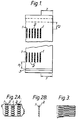
- the ribbons of unaltered film material may be generally straightline ribbons (reference to Figures 1 and 2a) or may be generally zig-zagging as by staggered embossment (reference to Figure 3).
- the former makes the machining of embossment tools easier, while the latter enables the most efficient shock absorption effect, which may be needed when the material is particularly rigid or particularly oriented.
- shock absorbing device is very advantageous in connection with a sewn seam.
- the strength of a sewn seam is essentially dependent on the tear propagation strength in the film, which again for stiff and/or oriented material is critically, dependent on the velocity of tearing.
- the "shock absorber band” therefore can advantageously be used to take up the top of the impact action, reducing the tearing rate to a value below the critical range.
- the pattern and depth of embossment should be adapted to give no less than 15% and preferably more than 25% improvement of "critical drop height” for one drop cycle.
- “Critical drop height” here is defined as the drop height which, statistically, is the limit between no-failure and failure, when one bag with the relevant contents of powdered or granulated goods is dropped 6 times in the following cycle: (1) 1st flat surface, (2) 2nd flat surface, (3) 1st edge, (4) 2nd edge, (5) bottom, (6) top.
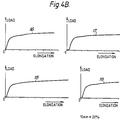
- a bag with the shock-absorber-band can also, in order to improve the anti-slip properties, be supplied with an additional embossment in other selected areas or generally all-over, but in such cases the pattern and depth of embossment in the shock-absorber-band must be adapted to produce a substantially higher shock absorption effect. (The basic features of shock absorption effect are explaned more quantitatively in connection with the graphs in Figures 4A and 4B.)
- U.S. patent no.4,629,525 discloses improved compositions for cross-laminates of this type, consisting of two or more plies, of which each normally has a main layer, a layer to facilitate lamination, and a seal layer.
- a particularly preferred main layer for use in such laminated sheet for the invention is formed of a blend of high molecular weight high density polyethylene with significantly lower molecular weight low density polyethylene, the latter preferably being selected from copolymers and/or branched polyethylenes which have the same or higher elongation of break (tested at room temperature under slow stretching) as the high molecular weight polyethylene and which are capable of distinctly segregating, while forming a distinct microphase, from the high molecular weight polyethylene on cooling of a molten homogeneous blend of the components.
- the blending ratio of the polyethylenes is preferably 25:75 to 75:25.
- the inclusion of polypropylene having significantly lower molecular weight than the high molecular weight polyethylene can also be advantageous, in amounts from 0 to 70%, based on the combined weight of polypropylene and both polyethylenes.
- the high molecular weight high density polyethylene HMHDPE preferably has a melt flow index of about 0.2 or lower by ASTM D1238 condition E, and the low density polyethylene is preferably linear low density polyethylene (LLDPE).
- (1) are rows of teeth-like indentations and (2) unaltered (or substantially unaltered) ribbons, (1) and (2) together forming the shock-absorber-band (hereinafter abbreviated to S-A-B).
- (3) is the heat-seal at the bottom.
- (4) indicates the zone where the bag is predetermined to become closed either by heat-sealing or by sewing.
- X 1 and X 2 from the S-A-B's to (3) and (4) respectively, the lengths of which will be discussed below.
- a zone Y is preferably kept free of embossment. Y should be calculated so that it is sufficient to avoid any essential deformation when the filled bag is carried by the corners in the way by which it is intended to be handled.
- Edge-drop is by far the most critical kind of dropping for top - and bottom heat-seals or sewn seams in pillow bags. (For gussetted bags flat drop is more critical due to the special problem dealt with in connection with Figure 6, and for longitudinal seams bottom-drop and top-drop are most critical).
- edge of the bag filled with powder or granules hits the ground, the contents are with great force spread horizontally. At the moment the bag hits the ground, the spreading is confined to take place almost entirely perpendicularly to the length of the bag, and near top and bottom the impact on the flat surfaces of the bag then will cause a high longitudinal pull, that means strong peeling action on top and bottom seams.
- each of the specimens 11 to 14, of the invention, for the graphs in Figure 4A has been cut through the middle line of two unaltered ribbons (2) and each specimen comprises two rows of teethlike indentations (1) with an unaltered ribbon (2) between. In total therefore, each specimen consists of two rows of teethlike indentations (1) and two unaltered ribbons (2).
- the specimen width is 22mm.
- the initial distance between the jaws of the tensile testing apparatus is 50mm, and the specimen has S-A-B throughout this space. (The width of the S-A-B is also 50mm, see example 4.)
- the comparative set of graphs Figure 4B was also made from 22mm wide specimens 16 to 19 cut from parts of the sack that are free of shock absorber band.
- the ratio between width of ribbon and division in the S-A-B could also have been somewhat higher than the actually used ratio 1:2 and still would have given satisfactory improvements, while it can be necessary to make the ratio much lower in case of much stiffer compositions, e.g., to make it 1:10 or even 1:20 (see example 1 in which it was necessary to use ratio 1:10).
- the elongation in percent at A is essentially equal to the original stretch ratio in the row of indentations, in this case about 28% equalling ratio 1.28:1.
- S-A-B energy One important factor for the function of the S-A-B is the apparent reduction of coefficient of elasticity and yield point, dealt with above, which invites the impact to attack the S-A-B instead of attacking the seam. Another important factor is the energy absorbed by the S-A-B from zero to deflexion point B, which I call "S-A-B energy". This must be sufficiently big to "pacify" the impact caused by the edge drop, so that, after the S-A-B having been in effect, the attack on the seam will not be strong enough to ruin the latter.
- the indentations should preferably be made as deep as practically possible (i.e., the stretching ratio in the rows of indentations highest possible) so that the S-A-B energy per width of the S-A-B becomes highest possible (for any given pattern of embossment) however, there are the following practical limitations:
- the optimum length of S-A-B and ratio between the width or each ribbon and the division in the S-A-B (total width of a ribbon and a row of indentations) must be established by systematical experiments or general experience, and depends, as already mentioned in the summary of the invention, on the performance requirements, the film characteristics, the dimensions of the bag, the material which will be filled into the bag, the degree of filing, the sealing or sewing process, and the temperature at which the drops are envisaged to take place. As regards performance requirements, the balance between the need for good drop performance and the need for form stability of the bag is particularly important.
- the indentations are shown oblong, with their longitudinal direction perpendicular to the longitudinal direction of the ribbons (2).
- This structure will normally be advantageous, but it is also possible to substitute each oblong indentation with two or more generally circular indentations, although this will require more complicated apparatus for the embossment.
- single rows of generally circular indentations can be used in alternation with the ribbons (2).
- the division of the indentations in each row should preferably be as small as practically possible, the lower limit being determined by the obtainable strength of the teeth (ribs) in the apparatus for embossment and the practically obtainable accuracy of this apparatus.
- this division can be down to about 1.5mm, while suitable values for heavy-duty bags generally are between about 2.0 - 4.0mm, although somewhat bigger divisions also are applicable.
- x should never be less, generally speaking, than about the same as the distance between two neighbour "ribbons", i.e., the width of each row of indentations, and preferably x should be a few times, e.g., 2 - 6 times this distance.
- X can also be longer, but since the tensions, when the bag hits the ground on edge, are concentrated near top and bottom, the entire S-A-B should generally be confined to a zone within a distance from the seam (or location predetermined to become seam) not exceeding 25% and preferably not exceeding 15% of the total length of the bag (or, in case the S-A-B is made for protection of the side-seam, of the width of the bag).
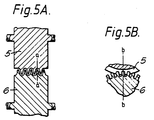
- both wheels (5) and (6) are driven with the same circumferential velocity, and the surfaces of both are formed as circular fins and grooves, the fins on one wheel fitting into the grooves of the other, with space left between for the bag material, so that the bag, when passing between the intermeshing fins, is stretched perpendicularly to the direction of advancing. While the fins on (5) are continuously circular, the fins on (6) are formed in dent-shapes as shown. All corners and edges which get into contact with the bag are carefully rounded and ground to avoid puncturing of the material.
- the bag is passed through the embossing device in a direction parallel to the top or bottom seam, whereby the top or bottom S-A-B shown in Figure 1 is formed. Both can of course be formed simultaneously by use of two sets of embossing wheels.
- the apparatus is preferably supplied with guide wheels (rollers) acting to keep the bag straightened out while counteracting the dragging towards the middle of the wheels (not shown).
- the set of wheels is preferably made to open and close, so that embossing can be avoided near each corner.
- the feeding of the bag into the device, and opening and closing of the wheels can be done manually, semi-automatically or fully automatically.
- a pre-heating device which selectively heats the vicinity of the coming S-A-B.
- This can, e.g., be a device similar to a band-sealer, but operated at a temperature at which sealing does not occur.
- a calendering step to reduce bulk.
- the device here described is the simplest and cheapest apparatus for producing the S-A-B.
- a press can be used having similar intermeshing fins, but of course in rectilinear instead of circular arrangement. This will be the apparatus normally used, if the process is carried out before bag-making.
- the invention has been described with a view to sack applications, where the need is to build in shock-absorbing properties into a selected area near to a seam.
- a need to modify a major proportion of or even the entire article, especially in connection with manufacture of parachutes. This applies in particular to cheap, disposable parachutes for parachuting of materials such as vehicles or containers.
- the strapping can be made from film material (preferably assembled from several layers, which may be only loosely held together) which over a suitably long length is supplied with a pattern of stretched and unstretched zones according to the invention.
- the parachute cloth can be made from polymeric material which is supplied with a pattern of stretched and unstretched zones according to the invention over an essential part of its area, which may be almost the full area.
- the direction of the substantially unstretched zones in this pattern should preferably be mainly parallel to the local directions of force when the parachute unfolds and should preferably be in the form of a plurality of ribbons.
- orientable polymers especially the highly crystaline and stiff ones such as high density polyethylene or polypropylene, exhibit high yield point and at the same time, if drawn slowly, a high elongation at break (up to about 10 times) and a high ultimate tensile strength. Therefore, the energy absorption up to the breaking point is also very high when the polymers are slowly drawn, but during very quick drawing they may rupture almost without any permanent deformation.
- the physical characteristics can be changed very significantly so that, even under the worst impact conditions, a permanent deformation can start at almost zero tension and progress in predetermined way under increasing resistance to a high degree of elongation and to a force close to the ultimate tensile force obtained during slow drawing.
- the substantially unstretched ribbons should preferably be very narrow, and the degree of stretching in the individual boss on the film very smoothly varied from zero at the boundary of the ribbon to the maximum value near the middle of the boss between two ribbons.
- a cross-laminate based on gas-phase-type polypropylene was produced generally as in Example 2 of my U.K. patent no.1,526,722 and the corresponding U.S. patent no.4,039,364, however with the following essential differences:
- the cross-laminate was tubed by use of an extruded melt-adhesive for the side-seam, and the tube was cut into lengths of about 1.0m. Flat width: 500mm.
- the side-seam was positioned very close to the edge.
- the bottom seams for the open-mouth bags were produced manually by impulse-sealing.
- the cooling period in the sealing process was set at zero, so that all cooling took place after release of the pressure on the jaws.
- Each bag was filled with 25kg polyethylene granules, and a piece of the top was cut off to leave about 11 - 12cm free space over the evened-out level of the contents (bag standing upright, major bag faces folded over the level of the contents to the middle, free space measured hereover).
- the bag was closed by overtaping with reinforced adhesive tape. In practical production it should be closed either by heat-sealing or sewing, and a S-A-B provided also at the top, but it was judged that the effect of the S-A-B per se best can be determined by investigations only of such heat-seals or sewn seams which are made prior to filling.
- the drop-testing was carried out at ambient temperature 0°C, and the contents of the bags (the polyethylene granules) were precooled to this temperature.
- embossment was carried out at room temperature, with the fins of the wheels practically in full engagement (exactly the same engagement in all trials) which is believed to have corresponded to stretch ratio about 1.2:1.
- the strength of the heat-seal with and without embossment was determined as the critical drop height, which statistically, is the limit between no-failure and failure, when one bag with the relevant contents is dropped 6 timed in the following cycle: (1) 1st flat surface, (2) 2nd flat surface, (3) 1st edge, (4) 2nd edge, (5) bottom, (6) top.
- the objective of this example is an elaborate drop-strength comparison at room temperature between heat-sealed bags with and without S-A-B, made from biaxially oriented cross-laminates of two different compositions, one based on polypropylene, and the other on polyethylene.
- drop-test comparison are also made between bags having the side-seam 15cm from an edge, and bags with the side seam adjacent to an edge.
- the polypropylene-based cross-laminate was a similar 4-ply as in Example 1, except that the addition to the polypropylene in the middle layer of the coextruded film now was 10% EPDM. The gauge still was 90gsm.
- the polyethylene-based cross-laminate was a combination of high-molecular-weight-high-density-polyethylene (HMHDPE) and lineary low density polyethylene (LLDPE), namely the 2-ply cross-laminate designated as "R 1 " in Example 3 of U.S. patent no.4,629,525.
- HMHDPE high-molecular-weight-high-density-polyethylene
- LLDPE lineary low density polyethylene
- Tubing and bag making was carried out like in example 1.
- the bag width was 490mm for the polypropylene-based bags and 560mm for the polyethylene-based bags.
- the pattern of S-A-B, its distance from the heat-seal, the embossment apparatus and the engagement between the fins of the latter were also exactly as in Example 1.
- the S-A-B extended the bag width. It is believed that the stretch ratio has been about 1.20:1.
- the bags were filled with 50kg of PVC granules plus sand, and the top closure was made with a self-adhesive reinforced tape like in Example 1.
- the critical drop height was determined in the same simplified manner as in Example 1.
- the seal is formed by a Star Impulse Sealer at the Weld Time and Heat Rating Settings quoted, except for the two series sealed with a Doboy Band Sealer.
- the objective of this example is to investigate the improvements in drop-performance of gussetted bags by use of the "Gussett Embossment" alone and in combination with the S-A-B.
- the material for the bags investigated was the "R 1 " cross-laminate also used in example 2, except that the LLDPE of example 2 has been the octene copolymer of ethylene, but in this example was its copolymer with butene.
- the guage of the cross-laminate now was 80 gam.
- Tubing was carried our as in example 1, the tube width being, 56cm before gussetting.
- a 50mm deep gusset was folded by hand, and heat-sealed bags made by use of impulse sealing. The conditions for sealing were optimized and no cooling period applied. The sealing conditions were the same for all bags tested.
- the Gusset Embossment was carried out on the tube before gussetting, while the S-A-B pattern was embossed into the laminate after gussetting.
- the bags were filled with 50 kg salt (sodium chloride). At the top, the gusset was straightened out to give the bag its full width 56 cm, and the bag was closed with a reinforced self adhesive tape. Free space over the level of contents was 10 cm.
- salt sodium chloride
- test-cycle was applied: (1) flat drop one side, (2) flat drop on the other side, (3) drop on one edge, (4) drop on the other edge. It was considered needless to carry out bottom and top-drops, since the latter would not cause or further develop ruptures.
- the first bag tasted was without any embossment, neither Gusset Embossment nor S-A-B. It was dropped flat from 90 cm height and the first drop produced a split about 10 cm long at each of the two critical locations (the junctions between the side gusset and the seam). The drop cycle was interrupted after this first drop.
- a second bag tested was with out Gusset Embossment and S-A-B, and was tried in the above mentioned cycle of four drops from 400 cm. After the two flat drops there was observed very small tears at the two critical locations, and after the subsequent two edge-drops the length of tearing was measured to be 10mm and 12 mm.
- a third bag, also with both Gusset Embossment and S-A-B was tested in the same cycle of four drops, but from 300 cm. There occured no tearing at all.
- a fourth bag was produced with the Gusset Embossment, but without S-A-B and was tested in one single flat drop from 400 cm. There was observed a 5mm tear at one and a 8mm tear at the other critical location which in any case is less than the damage of bag no. 1 tested from 90 cm only and also on one flat drop only.
- the objective of this example is to demonstrate the improvements which the S-A-B causes in a bag with sewn top and/or bottom seam.
- the bags were made from the biaxially oriented cross-laminate, which which is designated as "R 2 " in example 3 of U.S. patent no. 4.629.525. This is stiffer than "R 1 " used in examples 2 and 3, and connected with this higher stiffness exhibits a higher tear propagation resistance.
- the spiral cutting angle 45° used in the mentioned example of the U.S. patent was substituted by spiral cutting angle 30°.
- the stretching and lamination of the plies were carried out by the improved method described in example 3 of my copending PCT application PCT/GB88/00027. The stretch ratios were 1.40 : 1 in both directions, and guage 70 gsm.
- Tubing was carried out as in example 1, to give bag width 56cm.
- the side seam was positioned 6-7cm from the edge, which was the closest that could be made continuously on the tubes actually used.
- the bottom of the bag sewn, while using over-folding of the bag material in the seam and over-taping with crepe paper. The distance between the stitches was 8 mm.
- the S-A-B was embossed in the pattern and by the apparatus described in example 1, except that the pattern was modified so that "ribbon" width equaled "indentation” length, but still giving the same total, namely 11mm (the division of the S-A-B), and the S-A-B was still 50 mm wide.
- This change of embossment pattern was made, not particularly because sewing should be applied, but because the other pattern, which was developed for a polypropylene composition, was considered less suitable for the polyethylene composition.
- the bags were filled with 20kg polyethylene granules and closed by overtaping with reinforced seld adhesive tape.
- the S-A-B can conceivably become stretched so much that the embossment disappears, but the latter will be to some extend revert when the pressure has been released. Further, the stretching caused by the pressure will have oriented the disoriented weak line adjacent to the heat-seal (in the case of heat-sealed bags) so that the seam in any case is reinforced. With properly selected dimensions for the S-A-B, the deformation when the embossment disappears, will not be serious for the quality of stacking.
- full force to eliminate the embossment will cause only 20-30% elongation of a 5 cm wide S-A-B, or with one S-A-B at top and one at bottom, a total elongation of about or less than 3 cm. Since normal length for a 50 kg bag is about 1.0m or slightly less, the total elongation of the bag caused by full stretching-out of the two S-A-B's will be about 3-4% at the highest, all provided the need for S-A-B effect does not exceed the improvements which have been demonstrated by these examples.
Landscapes
- Engineering & Computer Science (AREA)
- Mechanical Engineering (AREA)
- Aviation & Aerospace Engineering (AREA)
- Bag Frames (AREA)
- Manufacture Of Macromolecular Shaped Articles (AREA)
- Making Paper Articles (AREA)
- Laminated Bodies (AREA)
- Shaping By String And By Release Of Stress In Plastics And The Like (AREA)
- Glass Compositions (AREA)
- Moulding By Coating Moulds (AREA)
- Materials For Medical Uses (AREA)
- Lubricants (AREA)
- Wrappers (AREA)
- Extrusion Moulding Of Plastics Or The Like (AREA)
- Polymers With Sulfur, Phosphorus Or Metals In The Main Chain (AREA)
- Compositions Of Macromolecular Compounds (AREA)
- Supplying Of Containers To The Packaging Station (AREA)
Applications Claiming Priority (3)
| Application Number | Priority Date | Filing Date | Title |
|---|---|---|---|
| GB888809077A GB8809077D0 (en) | 1988-04-18 | 1988-04-18 | Polymeric bags & methods & apparatus for their production |
| GB8809077 | 1988-04-18 | ||
| EP89303774A EP0338747B1 (en) | 1988-04-18 | 1989-04-17 | Polymeric film material and its production |
Related Parent Applications (2)
| Application Number | Title | Priority Date | Filing Date |
|---|---|---|---|
| EP89303774.7 Division | 1989-04-17 | ||
| EP89303774A Division EP0338747B1 (en) | 1988-04-18 | 1989-04-17 | Polymeric film material and its production |
Publications (3)
| Publication Number | Publication Date |
|---|---|
| EP0665161A2 EP0665161A2 (en) | 1995-08-02 |
| EP0665161A3 EP0665161A3 (en) | 1995-11-15 |
| EP0665161B1 true EP0665161B1 (en) | 1999-03-10 |
Family
ID=10635358
Family Applications (3)
| Application Number | Title | Priority Date | Filing Date |
|---|---|---|---|
| EP95104279A Expired - Lifetime EP0665161B1 (en) | 1988-04-18 | 1989-04-17 | Parachute materials |
| EP19890904848 Pending EP0411007A1 (en) | 1988-04-18 | 1989-04-17 | Polymeric film material and its production |
| EP89303774A Expired - Lifetime EP0338747B1 (en) | 1988-04-18 | 1989-04-17 | Polymeric film material and its production |
Family Applications After (2)
| Application Number | Title | Priority Date | Filing Date |
|---|---|---|---|
| EP19890904848 Pending EP0411007A1 (en) | 1988-04-18 | 1989-04-17 | Polymeric film material and its production |
| EP89303774A Expired - Lifetime EP0338747B1 (en) | 1988-04-18 | 1989-04-17 | Polymeric film material and its production |
Country Status (25)
| Country | Link |
|---|---|
| US (2) | US5205650A (member.php) |
| EP (3) | EP0665161B1 (member.php) |
| JP (1) | JP2632583B2 (member.php) |
| CN (1) | CN1032800C (member.php) |
| AT (2) | ATE177385T1 (member.php) |
| AU (1) | AU637047B2 (member.php) |
| BR (1) | BR8907379A (member.php) |
| CA (1) | CA1332024C (member.php) |
| DE (2) | DE68928948T2 (member.php) |
| DK (1) | DK174940B1 (member.php) |
| ES (1) | ES2082773T3 (member.php) |
| FI (1) | FI905114A0 (member.php) |
| GB (1) | GB8809077D0 (member.php) |
| GR (1) | GR3019032T3 (member.php) |
| HK (1) | HK1007543A1 (member.php) |
| HU (1) | HU216745B (member.php) |
| IE (1) | IE72159B1 (member.php) |
| IN (1) | IN174401B (member.php) |
| MX (1) | MX169245B (member.php) |
| MY (1) | MY104990A (member.php) |
| NO (1) | NO302876B1 (member.php) |
| PT (1) | PT90306B (member.php) |
| RU (2) | RU2117608C1 (member.php) |
| WO (1) | WO1989010312A1 (member.php) |
| ZA (1) | ZA892795B (member.php) |
Families Citing this family (97)
| Publication number | Priority date | Publication date | Assignee | Title |
|---|---|---|---|---|
| GB8809077D0 (en) * | 1988-04-18 | 1988-05-18 | Rasmussen O B | Polymeric bags & methods & apparatus for their production |
| US6358234B1 (en) | 1990-01-23 | 2002-03-19 | The Procter & Gamble Company | Absorbent article having deformed hinge and zones of extensibility |
| US9381718B2 (en) * | 2011-04-25 | 2016-07-05 | The Glad Products Company | Multi-layered films with visually-distinct regions and methods of making the same |
| US9604429B2 (en) | 2010-11-16 | 2017-03-28 | The Glad Products Company | Ribbed film structures with pigment created visual characteristics |
| US9566760B2 (en) | 2010-11-16 | 2017-02-14 | The Glad Products Company | Ribbed film structures with voiding agent created visual characteristics |
| US9393757B2 (en) * | 2010-11-16 | 2016-07-19 | The Glad Products Company | Discontinuously laminated film structures with improved visual characteristics |
| US5531393A (en) * | 1992-05-19 | 1996-07-02 | Salzsauler; Donald J. | Stretch film |
| US5916663A (en) * | 1993-08-03 | 1999-06-29 | Chappell; Charles W. | Web materials exhibiting elastic-like behavior |
| US5518801A (en) * | 1993-08-03 | 1996-05-21 | The Procter & Gamble Company | Web materials exhibiting elastic-like behavior |
| US5891544A (en) * | 1993-08-03 | 1999-04-06 | The Procter & Gamble Company | Web materials exhibiting elastic-like behavior |
| CA2170492C (en) * | 1993-09-17 | 2000-09-05 | Michele Ann Mansfield | Absorbent articles having panty covering components comprising extensible web materials which exhibit elastic-like behavior |
| CN1114386C (zh) * | 1993-11-19 | 2003-07-16 | 普罗克特和甘保尔公司 | 具有类似于松紧带结构的膜状絮网腰带的吸湿用品 |
| US5554145A (en) | 1994-02-28 | 1996-09-10 | The Procter & Gamble Company | Absorbent article with multiple zone structural elastic-like film web extensible waist feature |
| US6391404B1 (en) | 1995-06-07 | 2002-05-21 | Baxter International Inc. | Coextruded multilayer film materials and containers made therefrom |
| US6083584A (en) * | 1998-01-30 | 2000-07-04 | Baxter International Inc. | Perimeter seals for multi-layer materials and method |
| FR2742416B1 (fr) * | 1995-12-13 | 1998-02-06 | Thimon | Film pre-etire, dispositif et procede de suremballage |
| US6344258B1 (en) * | 1996-11-22 | 2002-02-05 | Ole-Bendt Rasmussen | Heat-sealing polymer films |
| JP4088354B2 (ja) * | 1997-02-27 | 2008-05-21 | 株式会社日立グローバルストレージテクノロジーズ | 情報記録再生装置 |
| USH2042H1 (en) * | 1997-05-09 | 2002-08-06 | The Procter & Gamble Company | Method for forming a breathable film |
| US6056241A (en) * | 1997-08-14 | 2000-05-02 | Ballistic Recovery Systems, Inc. | Thin film parachute with continuous lateral reinforcing fibers |
| US6046521A (en) * | 1998-01-20 | 2000-04-04 | Camco International, Inc. | Electric submergible motor protector having collapse resistant ribbed elastomeric bag |
| EP0963835A1 (en) * | 1998-05-05 | 1999-12-15 | The Procter & Gamble Company | Discontinuously expandable web materials |
| US6391411B1 (en) * | 1999-06-03 | 2002-05-21 | Printpack Illinois, Inc. | Machine direction oriented high molecular weight, high density polyethylene films with enhanced water vapor transmission properties |
| US6220547B1 (en) | 1999-06-08 | 2001-04-24 | Pioneer Aerospace Corporation | Large scale parafoil apparatus with an energy attenuator for controlling initial deployment |
| US6394652B2 (en) * | 1999-06-18 | 2002-05-28 | The Procter & Gamble Company | Flexible bags having stretch-to-fit conformity to closely accommodate contents in use |
| WO2000078624A1 (en) * | 1999-06-18 | 2000-12-28 | The Procter & Gamble Company | Cushioned, stretchable packaging materials |
| WO2000078530A1 (en) * | 1999-06-18 | 2000-12-28 | The Procter & Gamble Company | High surface area insulating films |
| BR0011750A (pt) * | 1999-06-18 | 2002-03-05 | Procter & Gamble | Revestimento interno para recipiente |
| US6150647A (en) * | 1999-06-18 | 2000-11-21 | The Procter & Gamble Company | Flexible, cushioned, high surface area food storage and preparation bags |
| US6394651B2 (en) * | 1999-06-18 | 2002-05-28 | The Procter & Gamble Company | Flexible bags having enhanced capacity and enhanced stability in use |
| US6220753B1 (en) | 1999-08-04 | 2001-04-24 | Michael A. Metzger | Plastic liner bag with mouth retaining means |
| US6513975B1 (en) * | 2000-06-19 | 2003-02-04 | The Procter & Gamble Company | Bag with extensible handles |
| GB0114691D0 (en) * | 2001-06-15 | 2001-08-08 | Rasmussen O B | Laminates of films and methods and apparatus for their manufacture |
| US6966697B2 (en) * | 2002-02-22 | 2005-11-22 | Pactiv Corporation | Trash bags with narrowing seals to facilitate gripping |
| US7179344B1 (en) * | 2002-04-08 | 2007-02-20 | Lako Tool & Manufacturing, Inc. | Method and apparatus for testing the quality of crimped seals |
| US6979482B2 (en) * | 2002-11-08 | 2005-12-27 | Exopack-Technology, Llc | Multiwall bag with zipper and fin |
| US7090904B2 (en) * | 2002-11-08 | 2006-08-15 | Exopack, L.L.C. | Enhanced slider zipper multiwall bag and associated methods |
| US6938309B2 (en) * | 2002-12-13 | 2005-09-06 | 3M Innovative Properties Company | Zoned stretching of a web |
| AU2003294024B2 (en) * | 2002-12-13 | 2009-03-26 | Ole-Bendt Rasmussen | Laminates of films having improved resistance to bending in all directions and methods and apparatus for their manufacture |
| US7938635B2 (en) * | 2002-12-20 | 2011-05-10 | The Procter & Gamble Company | Apparatus for producing a web substrate having indicia disposed thereon and elastic-like behavior imparted thereto |
| NZ543147A (en) | 2003-04-24 | 2007-09-28 | Rasmussen O B | Method of manufacturing oriented films from alloyed thermoplastic polymers, apparatus for such manufacture and resulting products |
| US20050178493A1 (en) * | 2004-02-18 | 2005-08-18 | Broering Shaun T. | Method and apparatus for making flexible articles having elastic-like behavior with visually distinct regions |
| EP1778552A4 (en) * | 2004-07-28 | 2009-06-10 | Sanford Redmond | LOAD-REDUCING NOTCHING FOR VERY THIN THERMOFORMED PLASTIC LAYERS OR FOIL / PLASTIC LAMINATES |
| US7543708B2 (en) * | 2004-08-23 | 2009-06-09 | United States Gypsum Company | Plastic bag for fine powders |
| GB0424355D0 (en) * | 2004-11-03 | 2004-12-08 | Rasmussen O B | Improved method of manufacturing an alloyed film apparatus for the method and resultant products |
| GB0426839D0 (en) * | 2004-12-07 | 2005-01-12 | Rasmussen O B | Small container made from thermoplastic sheet material |
| JP2008526556A (ja) | 2005-01-07 | 2008-07-24 | オレ−ベント ラスムッセン | 貫通性の多孔質性を示す熱可塑性フィルム材料のラミネート |
| US20060165319A1 (en) * | 2005-01-21 | 2006-07-27 | Pactiv Corporation | Polymeric bags with narrowing seals |
| DE602006018797D1 (de) * | 2005-04-08 | 2011-01-20 | Ole-Bendt Rasmussen | Vorrichtung zum Folienstrangpressen |
| ES2411680T3 (es) * | 2005-05-11 | 2013-07-08 | Ole-Bendt Rasmussen | Laminado cruzado de películas orientadas y método para fabricarlo |
| US20070012589A1 (en) * | 2005-07-15 | 2007-01-18 | Cassoni Robert P | Process for manufacture of a flexible package |
| US7607357B2 (en) | 2006-03-02 | 2009-10-27 | Enepay Corporation | Automated test systems configured to evaluate properties of packaging film and related methods |
| US20100154518A1 (en) * | 2006-03-02 | 2010-06-24 | Gary Stewart | Automated packaging-film testing systems with efficient loading configurations and operation and/or service accessible components and related methods and computer program products |
| US7942577B2 (en) | 2006-12-12 | 2011-05-17 | The Procter & Gamble Company | Flexible bag having a drawtape closure |
| US20100040875A1 (en) * | 2006-12-29 | 2010-02-18 | Dow Global Technologies Inc. | Films, articles prepared therefrom, and methods of making the same |
| US8822357B2 (en) * | 2007-05-21 | 2014-09-02 | Automotive Technologies International, Inc. | Film airbags made from ribbons |
| US7820566B2 (en) | 2007-05-21 | 2010-10-26 | Automotive Technologies International, Inc. | Film airbags |
| US20090094943A1 (en) * | 2007-10-10 | 2009-04-16 | The Procter & Gamble Company | Absorbent article package with enhanced grip |
| GB0814308D0 (en) * | 2008-08-05 | 2008-09-10 | Rasmussen O B | Film material exhibiting textile properties, and method and apparatus for its manufacture |
| TWI499497B (zh) | 2008-01-17 | 2015-09-11 | Ole-Bendt Rasmussen | 展現織物性質的膜材料以及用於其之製造的方法及裝置 |
| US9604760B2 (en) | 2008-08-25 | 2017-03-28 | The Glad Products Company | Bag |
| US9016945B2 (en) | 2008-10-20 | 2015-04-28 | The Glad Products Company | Bag and method of making the same |
| US20100098354A1 (en) * | 2008-10-20 | 2010-04-22 | Fraser Robert W | Bag and Methods of Making the Same |
| US8888365B2 (en) | 2009-11-16 | 2014-11-18 | The Glad Products Company | Non-continuously laminated multi-layered bags |
| US9637278B2 (en) * | 2008-10-20 | 2017-05-02 | The Glad Products Company | Non-continuously laminated multi-layered bags with ribbed patterns and methods of forming the same |
| US10023361B2 (en) | 2009-05-26 | 2018-07-17 | The Glad Products Company | Draw tape bag |
| GB0911822D0 (en) | 2009-07-08 | 2009-08-19 | Rasmussen O B | Gas filled crosslaminate and method and apparatus for its manufacture |
| US9522768B2 (en) | 2009-09-03 | 2016-12-20 | The Glad Products | Draw tape bag |
| US8794835B2 (en) * | 2009-09-03 | 2014-08-05 | The Glad Products Company | Draw tape bag |
| US10293981B2 (en) | 2009-11-16 | 2019-05-21 | The Glad Products Company | Non-continuously laminated structures of thermoplastic films with differing material compositions and functional material properties |
| US9114596B2 (en) | 2009-11-16 | 2015-08-25 | The Glad Products Company | Incrementally-stretched adhesively-laminated films and methods for making the same |
| US8940377B2 (en) * | 2009-11-16 | 2015-01-27 | The Glad Products Company | Multi-layered bags with discrete non-continuous lamination |
| US9050783B2 (en) * | 2009-11-16 | 2015-06-09 | The Glad Products Company | Multi-layered bags with shortened inner layer |
| US9272461B2 (en) * | 2010-03-10 | 2016-03-01 | The Glad Products Company | Bag |
| US9272459B2 (en) | 2010-03-10 | 2016-03-01 | The Glad Products Company | Bag |
| ES2746885T3 (es) | 2010-09-09 | 2020-03-09 | Gore & Ass | Método para aumentar la resistencia al desgarro de una película |
| WO2012148916A1 (en) * | 2011-04-25 | 2012-11-01 | The Glad Products Company | Thermoplastic films with visually-distinct stretched regions and methods for making the same |
| KR20140092296A (ko) * | 2011-08-25 | 2014-07-23 | 디비 이큅먼트 에이에스 | 강화 측벽과 가변 길이를 구비하는 액세서리 가방 |
| EP2639063B1 (de) * | 2012-03-15 | 2016-12-14 | pely-plastic GmbH & Co. KG | Stoffmaterial mit Prägungen |
| US9174073B2 (en) | 2013-02-08 | 2015-11-03 | D B Industries, Llc | Energy absorber assembly and components thereof |
| WO2014159602A1 (en) * | 2013-03-13 | 2014-10-02 | The Iams Company | Manufacturing process for packaged pet food |
| US20160039138A1 (en) * | 2013-03-15 | 2016-02-11 | Ole-Bendt Rasmussen | Method of manufacturing a strainable thermoplastic film material, product resulting therefrom, and apparatus to carry out the method |
| US9212520B1 (en) * | 2013-08-26 | 2015-12-15 | The United States Of America As Represented By The Secretary Of The Navy | End guide for cord attachment device |
| US9290303B2 (en) | 2013-10-24 | 2016-03-22 | Poly-America, L.P. | Thermoplastic films with enhanced resistance to puncture and tear |
| US9546277B2 (en) | 2013-10-24 | 2017-01-17 | Poly-America, L.P. | Thermoplastic films and bags |
| US9517862B2 (en) * | 2014-04-02 | 2016-12-13 | Poly-America, L.P. | Thermoplastic bag |
| US10138054B2 (en) * | 2015-03-17 | 2018-11-27 | Poly-America, L.P. | Polymeric bags |
| WO2016196831A1 (en) * | 2015-06-03 | 2016-12-08 | Google Inc. | Hardpoint strain reliefs |
| US9919868B2 (en) | 2015-10-30 | 2018-03-20 | Inteplast Group Corporation | Receptacle liner |
| CN105328922A (zh) * | 2015-11-23 | 2016-02-17 | 安徽国泰印务有限公司 | 一种petg膜生产工艺 |
| CA2959423A1 (en) | 2016-03-10 | 2017-09-10 | Flexopack S.A. | Liner film |
| JP6680587B2 (ja) * | 2016-03-16 | 2020-04-15 | タキロンシーアイ株式会社 | 伸縮フィルム、その製造方法、および複合シート |
| AU2018365772B2 (en) * | 2017-11-08 | 2023-02-16 | The Glad Products Company | Thermoplastic films and bags with complex stretch patterns and methods of making the same |
| US11040778B2 (en) * | 2018-11-16 | 2021-06-22 | Goodrich Corporation | Multi-staged suspension line attenuator |
| CA3127368A1 (en) * | 2019-01-29 | 2020-08-06 | The Glad Products Company | Thermoplastic bags with phased deformation patterns |
| CN110171162B (zh) * | 2019-06-21 | 2024-07-16 | 山东新华医疗器械股份有限公司 | 一种软袋制袋方法及其产品 |
| EP4244151A4 (en) * | 2020-11-12 | 2024-10-23 | Angelcare Canada Inc. | BUCKET BAG CONFIGURATION |
Family Cites Families (42)
| Publication number | Priority date | Publication date | Assignee | Title |
|---|---|---|---|---|
| US2083352A (en) * | 1930-12-18 | 1937-06-08 | Smithe Machine Co Inc F L | Embossing means for envelope making machines |
| FR842665A (fr) * | 1938-02-18 | 1939-06-16 | Perfectionnements aux parachutes | |
| US2161820A (en) * | 1938-05-10 | 1939-06-13 | Gregory J Kessenich | Shock absorbing device |
| US2471166A (en) * | 1944-10-16 | 1949-05-24 | Edward A Neff | Shock absorber webbing |
| US2422440A (en) * | 1945-04-19 | 1947-06-17 | Stanley Switlik | Parachute and elastic suspension line |
| US2474124A (en) * | 1946-03-08 | 1949-06-21 | All American Airways Inc | Parachute leader |
| US2723936A (en) * | 1952-05-06 | 1955-11-15 | Continental Can Co | Knurled seam and method of forming the same |
| US2878013A (en) * | 1956-11-22 | 1959-03-17 | Piodi Roberto | Jerk absorber for tow ropes and similar flexible members |
| US3018015A (en) * | 1957-10-02 | 1962-01-23 | Agriss Norton | Resilient packing sheet |
| US3232516A (en) * | 1963-11-08 | 1966-02-01 | Ex Cell O Corp | Paperboard container |
| US3393861A (en) * | 1966-11-29 | 1968-07-23 | Mobil Oil Corp | Embossed thermoplastic bags |
| US3495761A (en) * | 1968-04-16 | 1970-02-17 | Hudson Pulp & Paper Corp | Embossed kraft paper and paper bags made therefrom |
| US3589653A (en) * | 1969-04-01 | 1971-06-29 | Schjeldahl Co G T | Stress-tailored gores |
| US3605374A (en) * | 1969-04-02 | 1971-09-20 | American Can Co | Method of making multi-unit packages |
| FR2080004A5 (en) * | 1970-02-19 | 1971-11-12 | Johnson & Johnson | Thermoplastic film or sheet with ribs for - container production |
| US3904465A (en) * | 1970-02-20 | 1975-09-09 | Mobil Oil Corp | Process and apparatus for the manufacture of embossed film laminations |
| SE345966B (member.php) * | 1970-04-23 | 1972-06-19 | Goeteborga Bandvaeveri | |
| US3743172A (en) * | 1971-03-23 | 1973-07-03 | Mobil Oil Corp | Quilted laminar films comprising at least two layers of dissimilar material |
| US3760940A (en) * | 1971-07-02 | 1973-09-25 | Mobil Oil Corp | Method of embossing thin, limp plastic film, and disposable and embossed plastic bag product |
| US4000352A (en) * | 1972-06-01 | 1976-12-28 | W. R. Grace & Co. | Battery separator |
| US3832267A (en) * | 1972-09-19 | 1974-08-27 | Hercules Inc | Embossed film |
| JPS5023456U (member.php) * | 1973-06-19 | 1975-03-17 | ||
| US4076121A (en) * | 1973-10-15 | 1978-02-28 | Mobil Oil Corporation | Reinforced thin wall plastic bag, and method and apparatus to make material for such bags |
| US3911187A (en) * | 1973-12-26 | 1975-10-07 | Ethyl Corp | Embossed plastic film |
| US4407877A (en) * | 1974-07-05 | 1983-10-04 | Rasmussen O B | High-strength laminate |
| US3973063A (en) * | 1974-11-21 | 1976-08-03 | Mobil Oil Corporation | Spot blocked thermoplastic film laminate |
| GB1526724A (en) * | 1975-08-27 | 1978-09-27 | Rasmussen O | Method of forming a laminate |
| NL7605878A (nl) * | 1975-08-27 | 1977-03-01 | Mobil Oil Corp | Thermoplastisch filmlaminaat met gekruiste ribben. |
| US4261253A (en) * | 1977-10-26 | 1981-04-14 | Drug Concentrates, Inc. | Method of making openable flexible packet |
| NL7903733A (nl) * | 1979-05-11 | 1980-11-13 | Wavin Bv | Werkwijze voor het vervaardigen van een baan van kunst- stofzakken met twee blokbodems. |
| US4401427A (en) * | 1980-06-13 | 1983-08-30 | Mobil Oil Corporation | Thermoplastic bags and method of making |
| US4367572A (en) * | 1980-06-19 | 1983-01-11 | Zielenski Anthony L | Elastic clamping apparatus |
| US4343848A (en) * | 1980-12-15 | 1982-08-10 | Ethyl Corporation | Embossed thermoplastic material |
| GB2100660B (en) * | 1981-04-20 | 1985-06-12 | Nissen Kagaku Kogyo Kk | Stamped plastics sheet |
| US4465729A (en) * | 1981-08-05 | 1984-08-14 | Clopay Corporation | Cross-tearable plastic films |
| US4563374A (en) * | 1981-10-19 | 1986-01-07 | Gebr, Happich Gmbh | Blow molded decorative or protective strip with temperature compensation |
| GB2111012B (en) * | 1981-12-09 | 1985-09-18 | Secr Defence | Improvements in or relating to lines and braids |
| DK150793C (da) * | 1982-03-26 | 1988-01-04 | Rasmussen Polymer Dev Rpd | Fremgangsmaade og apparat til fremstilling af et ark- eller baneformet plastmateriale med stor styrke |
| JPS6058307A (ja) * | 1983-03-18 | 1985-04-04 | 株式会社太洋商会 | 吊り下げ部成形自動包装方法及びその装置 |
| DE3437414C2 (de) * | 1984-10-12 | 1994-08-04 | Nordenia Verpackung Gmbh | Vorrichtung zur Bearbeitung von als Folienbahn vorliegenden Kunststoffolien sowie bearbeitete Kunststoffolie |
| DE3737968A1 (de) * | 1987-11-07 | 1989-05-18 | Kohmann Gmbh Co Maschbau | Verfahren zur herstellung von folienzuschnitten fuer faltschachteln mit winkelfenstern bzw. solcher faltschachteln und entsprechende vorrichtung |
| GB8809077D0 (en) * | 1988-04-18 | 1988-05-18 | Rasmussen O B | Polymeric bags & methods & apparatus for their production |
-
1988
- 1988-04-18 GB GB888809077A patent/GB8809077D0/en active Pending
-
1989
- 1989-04-13 MY MYPI89000467A patent/MY104990A/en unknown
- 1989-04-13 MX MX015651A patent/MX169245B/es unknown
- 1989-04-13 IN IN281MA1989 patent/IN174401B/en unknown
- 1989-04-17 ES ES89303774T patent/ES2082773T3/es not_active Expired - Lifetime
- 1989-04-17 RU RU94040709A patent/RU2117608C1/ru not_active IP Right Cessation
- 1989-04-17 AU AU34446/89A patent/AU637047B2/en not_active Expired
- 1989-04-17 IE IE122189A patent/IE72159B1/en not_active IP Right Cessation
- 1989-04-17 RU SU894894183A patent/RU2050310C1/ru not_active IP Right Cessation
- 1989-04-17 HU HU892646A patent/HU216745B/hu not_active IP Right Cessation
- 1989-04-17 BR BR898907379A patent/BR8907379A/pt not_active IP Right Cessation
- 1989-04-17 EP EP95104279A patent/EP0665161B1/en not_active Expired - Lifetime
- 1989-04-17 ZA ZA892795A patent/ZA892795B/xx unknown
- 1989-04-17 DE DE68928948T patent/DE68928948T2/de not_active Expired - Fee Related
- 1989-04-17 EP EP19890904848 patent/EP0411007A1/en active Pending
- 1989-04-17 CA CA000596899A patent/CA1332024C/en not_active Expired - Lifetime
- 1989-04-17 AT AT95104279T patent/ATE177385T1/de active
- 1989-04-17 JP JP1504559A patent/JP2632583B2/ja not_active Expired - Lifetime
- 1989-04-17 US US07/435,471 patent/US5205650A/en not_active Expired - Lifetime
- 1989-04-17 EP EP89303774A patent/EP0338747B1/en not_active Expired - Lifetime
- 1989-04-17 WO PCT/GB1989/000394 patent/WO1989010312A1/en not_active Ceased
- 1989-04-17 DE DE68924865T patent/DE68924865T2/de not_active Expired - Fee Related
- 1989-04-17 AT AT89303774T patent/ATE130566T1/de not_active IP Right Cessation
- 1989-04-18 PT PT90306A patent/PT90306B/pt not_active IP Right Cessation
- 1989-04-18 CN CN89102352A patent/CN1032800C/zh not_active Expired - Lifetime
-
1990
- 1990-10-16 NO NO904477A patent/NO302876B1/no not_active IP Right Cessation
- 1990-10-17 FI FI905114A patent/FI905114A0/fi not_active Application Discontinuation
- 1990-10-17 DK DK199002505A patent/DK174940B1/da not_active IP Right Cessation
-
1992
- 1992-12-11 US US07/989,323 patent/US5330133A/en not_active Expired - Fee Related
-
1996
- 1996-02-21 GR GR960400435T patent/GR3019032T3/el unknown
-
1998
- 1998-06-25 HK HK98106673A patent/HK1007543A1/en not_active IP Right Cessation
Also Published As
Similar Documents
| Publication | Publication Date | Title |
|---|---|---|
| EP0665161B1 (en) | Parachute materials | |
| HK1007543B (en) | Polymeric film material and its production | |
| EP1017592B1 (en) | Open mesh bag and process for making it | |
| US3990626A (en) | Gusseted pinch bottom laminated plastic valve bag | |
| EP0146270B1 (en) | Shipping bag | |
| US4629525A (en) | Method and apparatus for preparing a high strength sheet material | |
| AU2003261209B2 (en) | Isolated targeting of problem areas in hermetic seals | |
| EP0260791A2 (en) | Thermoplastic sack | |
| BR0111590B1 (pt) | saco provido de uma vedaÇço tÉrmica tipo descascamento no seu fundo e/ou no seu topo, e, mÉtodo para farbicaÇço de um saco provido de uma vedaÇço tÉrmica tipo descascamento no seu fundo e/ou no seu topo. | |
| US4677007A (en) | Thermoplastic sack | |
| JP4613571B2 (ja) | ヒートシール性ポリプロピレン系樹脂積層フィルム及び包装体 | |
| WO2012094773A1 (en) | Pouch with concave-curved corner. | |
| US3220601A (en) | Thermoplastic film bag | |
| WO2020263727A1 (en) | Flexible container with increased effective hoop strength | |
| JP2006150737A (ja) | ヒートシール性積層体及び包装体 |
Legal Events
| Date | Code | Title | Description |
|---|---|---|---|
| PUAI | Public reference made under article 153(3) epc to a published international application that has entered the european phase |
Free format text: ORIGINAL CODE: 0009012 |
|
| AC | Divisional application: reference to earlier application |
Ref document number: 338747 Country of ref document: EP |
|
| AK | Designated contracting states |
Kind code of ref document: A2 Designated state(s): AT BE CH DE ES FR GB GR IT LI LU NL SE |
|
| PUAL | Search report despatched |
Free format text: ORIGINAL CODE: 0009013 |
|
| AK | Designated contracting states |
Kind code of ref document: A3 Designated state(s): AT BE CH DE ES FR GB GR IT LI LU NL SE |
|
| 17P | Request for examination filed |
Effective date: 19960426 |
|
| GRAG | Despatch of communication of intention to grant |
Free format text: ORIGINAL CODE: EPIDOS AGRA |
|
| 17Q | First examination report despatched |
Effective date: 19980416 |
|
| GRAG | Despatch of communication of intention to grant |
Free format text: ORIGINAL CODE: EPIDOS AGRA |
|
| GRAH | Despatch of communication of intention to grant a patent |
Free format text: ORIGINAL CODE: EPIDOS IGRA |
|
| GRAH | Despatch of communication of intention to grant a patent |
Free format text: ORIGINAL CODE: EPIDOS IGRA |
|
| GRAA | (expected) grant |
Free format text: ORIGINAL CODE: 0009210 |
|
| AC | Divisional application: reference to earlier application |
Ref document number: 338747 Country of ref document: EP |
|
| AK | Designated contracting states |
Kind code of ref document: B1 Designated state(s): AT BE CH DE ES FR GB GR IT LI LU NL SE |
|
| PG25 | Lapsed in a contracting state [announced via postgrant information from national office to epo] |
Ref country code: SE Free format text: THE PATENT HAS BEEN ANNULLED BY A DECISION OF A NATIONAL AUTHORITY Effective date: 19990310 Ref country code: NL Free format text: LAPSE BECAUSE OF FAILURE TO SUBMIT A TRANSLATION OF THE DESCRIPTION OR TO PAY THE FEE WITHIN THE PRESCRIBED TIME-LIMIT Effective date: 19990310 Ref country code: IT Free format text: LAPSE BECAUSE OF FAILURE TO SUBMIT A TRANSLATION OF THE DESCRIPTION OR TO PAY THE FEE WITHIN THE PRE;WARNING: LAPSES OF ITALIAN PATENTS WITH EFFECTIVE DATE BEFORE 2007 MAY HAVE OCCURRED AT ANY TIME BEFORE 2007. THE CORRECT EFFECTIVE DATE MAY BE DIFFERENT FROM THE ONE RECORDED.SCRIBED TIME-LIMIT Effective date: 19990310 Ref country code: GR Free format text: LAPSE BECAUSE OF NON-PAYMENT OF DUE FEES Effective date: 19990310 Ref country code: FR Free format text: LAPSE BECAUSE OF FAILURE TO SUBMIT A TRANSLATION OF THE DESCRIPTION OR TO PAY THE FEE WITHIN THE PRESCRIBED TIME-LIMIT Effective date: 19990310 Ref country code: ES Free format text: THE PATENT HAS BEEN ANNULLED BY A DECISION OF A NATIONAL AUTHORITY Effective date: 19990310 Ref country code: BE Free format text: LAPSE BECAUSE OF FAILURE TO SUBMIT A TRANSLATION OF THE DESCRIPTION OR TO PAY THE FEE WITHIN THE PRESCRIBED TIME-LIMIT Effective date: 19990310 Ref country code: AT Free format text: LAPSE BECAUSE OF FAILURE TO SUBMIT A TRANSLATION OF THE DESCRIPTION OR TO PAY THE FEE WITHIN THE PRESCRIBED TIME-LIMIT Effective date: 19990310 |
|
| REF | Corresponds to: |
Ref document number: 177385 Country of ref document: AT Date of ref document: 19990315 Kind code of ref document: T |
|
| REG | Reference to a national code |
Ref country code: CH Ref legal event code: EP |
|
| REF | Corresponds to: |
Ref document number: 68928948 Country of ref document: DE Date of ref document: 19990415 |
|
| PG25 | Lapsed in a contracting state [announced via postgrant information from national office to epo] |
Ref country code: LU Free format text: LAPSE BECAUSE OF NON-PAYMENT OF DUE FEES Effective date: 19990417 |
|
| NLV1 | Nl: lapsed or annulled due to failure to fulfill the requirements of art. 29p and 29m of the patents act | ||
| EN | Fr: translation not filed | ||
| RAP2 | Party data changed (patent owner data changed or rights of a patent transferred) |
Owner name: RASMUSSEN, OLE-BENDT |
|
| RIN2 | Information on inventor provided after grant (corrected) |
Free format text: RASMUSSEN, OLE-BENDT |
|
| PLBE | No opposition filed within time limit |
Free format text: ORIGINAL CODE: 0009261 |
|
| STAA | Information on the status of an ep patent application or granted ep patent |
Free format text: STATUS: NO OPPOSITION FILED WITHIN TIME LIMIT |
|
| 26N | No opposition filed | ||
| REG | Reference to a national code |
Ref country code: CH Ref legal event code: NV Representative=s name: HIEBSCH & PEEGE AG PATENTANWAELTE |
|
| REG | Reference to a national code |
Ref country code: GB Ref legal event code: IF02 |
|
| PGFP | Annual fee paid to national office [announced via postgrant information from national office to epo] |
Ref country code: GB Payment date: 20040414 Year of fee payment: 16 |
|
| PGFP | Annual fee paid to national office [announced via postgrant information from national office to epo] |
Ref country code: CH Payment date: 20040422 Year of fee payment: 16 |
|
| PGFP | Annual fee paid to national office [announced via postgrant information from national office to epo] |
Ref country code: DE Payment date: 20040426 Year of fee payment: 16 |
|
| PG25 | Lapsed in a contracting state [announced via postgrant information from national office to epo] |
Ref country code: GB Free format text: LAPSE BECAUSE OF NON-PAYMENT OF DUE FEES Effective date: 20050417 |
|
| PG25 | Lapsed in a contracting state [announced via postgrant information from national office to epo] |
Ref country code: LI Free format text: LAPSE BECAUSE OF NON-PAYMENT OF DUE FEES Effective date: 20050430 Ref country code: CH Free format text: LAPSE BECAUSE OF NON-PAYMENT OF DUE FEES Effective date: 20050430 |
|
| PG25 | Lapsed in a contracting state [announced via postgrant information from national office to epo] |
Ref country code: DE Free format text: LAPSE BECAUSE OF NON-PAYMENT OF DUE FEES Effective date: 20051101 |
|
| REG | Reference to a national code |
Ref country code: CH Ref legal event code: PL |
|
| GBPC | Gb: european patent ceased through non-payment of renewal fee |
Effective date: 20050417 |