EP0657040B1 - Polyene mit nichtlinearoptischen eigenschaften - Google Patents
Polyene mit nichtlinearoptischen eigenschaften Download PDFInfo
- Publication number
- EP0657040B1 EP0657040B1 EP93915862A EP93915862A EP0657040B1 EP 0657040 B1 EP0657040 B1 EP 0657040B1 EP 93915862 A EP93915862 A EP 93915862A EP 93915862 A EP93915862 A EP 93915862A EP 0657040 B1 EP0657040 B1 EP 0657040B1
- Authority
- EP
- European Patent Office
- Prior art keywords
- polyene
- radicals
- general formula
- cycloalkenyl
- cycloalkyl
- Prior art date
- Legal status (The legal status is an assumption and is not a legal conclusion. Google has not performed a legal analysis and makes no representation as to the accuracy of the status listed.)
- Expired - Lifetime
Links
- 0 C**CCC(CCC(C)=C)[N+](C)(C)[O-] Chemical compound C**CCC(CCC(C)=C)[N+](C)(C)[O-] 0.000 description 3
- FIVBAFINIPRIQP-UHFFFAOYSA-N CCC(C=C)N=N Chemical compound CCC(C=C)N=N FIVBAFINIPRIQP-UHFFFAOYSA-N 0.000 description 1
Classifications
-
- C—CHEMISTRY; METALLURGY
- C07—ORGANIC CHEMISTRY
- C07C—ACYCLIC OR CARBOCYCLIC COMPOUNDS
- C07C403/00—Derivatives of cyclohexane or of a cyclohexene or of cyclohexadiene, having a side-chain containing an acyclic unsaturated part of at least four carbon atoms, this part being directly attached to the cyclohexane or cyclohexene or cyclohexadiene rings, e.g. vitamin A, beta-carotene, beta-ionone
- C07C403/24—Derivatives of cyclohexane or of a cyclohexene or of cyclohexadiene, having a side-chain containing an acyclic unsaturated part of at least four carbon atoms, this part being directly attached to the cyclohexane or cyclohexene or cyclohexadiene rings, e.g. vitamin A, beta-carotene, beta-ionone having side-chains substituted by six-membered non-aromatic rings, e.g. beta-carotene
-
- C—CHEMISTRY; METALLURGY
- C08—ORGANIC MACROMOLECULAR COMPOUNDS; THEIR PREPARATION OR CHEMICAL WORKING-UP; COMPOSITIONS BASED THEREON
- C08K—Use of inorganic or non-macromolecular organic substances as compounding ingredients
- C08K5/00—Use of organic ingredients
- C08K5/04—Oxygen-containing compounds
- C08K5/07—Aldehydes; Ketones
-
- C—CHEMISTRY; METALLURGY
- C09—DYES; PAINTS; POLISHES; NATURAL RESINS; ADHESIVES; COMPOSITIONS NOT OTHERWISE PROVIDED FOR; APPLICATIONS OF MATERIALS NOT OTHERWISE PROVIDED FOR
- C09D—COATING COMPOSITIONS, e.g. PAINTS, VARNISHES OR LACQUERS; FILLING PASTES; CHEMICAL PAINT OR INK REMOVERS; INKS; CORRECTING FLUIDS; WOODSTAINS; PASTES OR SOLIDS FOR COLOURING OR PRINTING; USE OF MATERIALS THEREFOR
- C09D7/00—Features of coating compositions, not provided for in group C09D5/00; Processes for incorporating ingredients in coating compositions
- C09D7/40—Additives
- C09D7/60—Additives non-macromolecular
- C09D7/63—Additives non-macromolecular organic
-
- G—PHYSICS
- G02—OPTICS
- G02F—OPTICAL DEVICES OR ARRANGEMENTS FOR THE CONTROL OF LIGHT BY MODIFICATION OF THE OPTICAL PROPERTIES OF THE MEDIA OF THE ELEMENTS INVOLVED THEREIN; NON-LINEAR OPTICS; FREQUENCY-CHANGING OF LIGHT; OPTICAL LOGIC ELEMENTS; OPTICAL ANALOGUE/DIGITAL CONVERTERS
- G02F1/00—Devices or arrangements for the control of the intensity, colour, phase, polarisation or direction of light arriving from an independent light source, e.g. switching, gating or modulating; Non-linear optics
- G02F1/35—Non-linear optics
- G02F1/355—Non-linear optics characterised by the materials used
- G02F1/361—Organic materials
Definitions
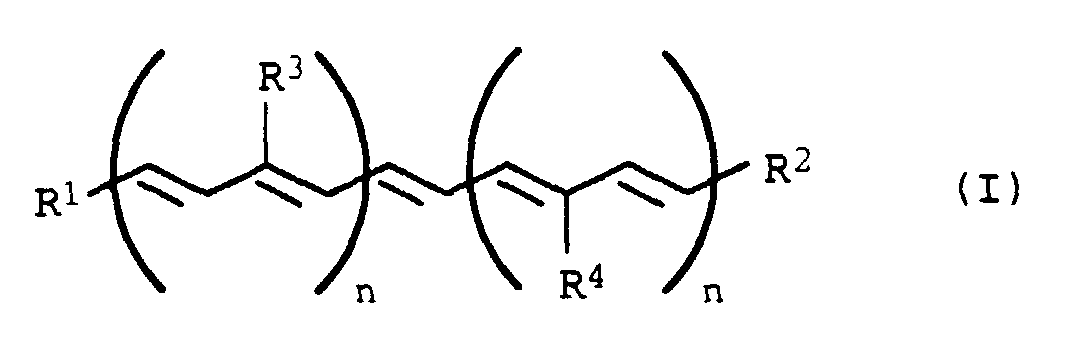
- the present invention relates to polyenes of the general formula I.
- R 1 and R 2 may be the same or different from each other and hydrogen, C 6 - to C 22 aryl, C 5 - to C 10 heteroaryl, C 4 - to C 30 -cycloalkyl, C 4 - to C 30 -cycloalkenyl , C 6 - to C 10 -cycloalkenone, the abovementioned radicals also each having one or more substituents selected from the group consisting of C 1 - to C 30 -alkyl, C 2 - to C 30 -alkenyl, C 1 - to C 30 alkoxy, C 4 to C 30 cycloalkyl, C 4 to C 30 cycloalkenyl, C 6 to C 18 aryl radicals, halogen, OH, COOH, CHO, COOR 5 , CN , -NH 2 , -NHR 6 , -NR 7 R 8 and NO 2 may have, -CHO,
- the present invention also relates to their use as nonlinear optical materials.
- conjugated organic materials produce high nonlinear optical (NLO) effects. Conditionally this fact is due to the easy polarizability of the delocalized ⁇ electrons in these systems.
- the number of double bonds has a decisive one Influence on the nonlinear optical properties of conjugated polyenes. For example, trans retinol with 5 conjugated double bonds poorer nonlinear optical 3rd order coefficients, as trans- ⁇ -carotene with 7th conjugated double bonds (H. Nakanishi, Nonlinear Optics, 1991, 1, 223-236).
- Nonlinear optics is generally concerned with the interaction of electromagnetic fields and matter and can lead to a refractive index that depends on the light intensity is dependent.
- R.N. Prasad and D.J. Give Williams in the book “Introduction to nonlinear optical effects in molecules and polymers (Wiley 1991) "detailed information on this topic.
- the frequency of the emitted light wave is equal to the oscillation frequency of the dipoles. Contain the vibrating dipoles have multiple frequency components this only in the light emitted by the substance in question in front. If the spatial expansion of the substance is greater than is the wavelength of the emitted light, the should in Identical dipoles vibrating in the same material if possible Direction and swing with a phase difference that is for that ensures that the light emitted by a volume element not through destructive interference with that of one other volume element emitted light is extinguished.
- Field E causes macroscopic polarization, which is defined as the dipole moment per unit volume.
- ⁇ (2) and ⁇ (3) are material constants that depend on the molecular structure, on the crystal structure, on the frequency of the light and generally on the temperature.
- SHG frequency doubling
- ⁇ (2) the determination of the Pockels effect
- DFWM Degenerate Four Wave Mixing
- THG Tond Harmonie Generation
- Substances with a non-vanishing dielectric susceptibility ⁇ (3) have an intensity-dependent refractive index and are suitable, among other things, for the production of purely optical switches and thus for use in optically operating computers.
- D.-R. Ulrich under the title "Nonlinear Optical Polymer Systems and Devices” in Molecular Crystals and Devices, Volume 180, pages 1 to 31, 1988.
- nonlinear optical materials here: materials based on a high ⁇ (3)
- a high ⁇ (3) alone does not meet the requirements for an optical component.
- the relaxation and thus the switching time should be very short (in the range of femtoseconds), the optical losses due to absorption, scattering etc. should be minimal and finally the materials should be easy to process in the form of layers, for example in optical fibers.
- polymers are the most extensive conjugated ⁇ systems have e.g. Polydiacetyle, Polythiophenes or polyphenylene vinylidenes (see also: D.R. Ulrich, Polymers tor nonlinear optics, Mol. Cryst. Liq. Cryst. 1990, 189, 3-38). These polymeric materials offer in contrast to low molecular weight substances with NLO properties, the advantage of good mechanical properties and better processability.
- transparent organic polymers offer without special nonlinear optical characteristics the possibility to store non-linear optically active low-molecular substances, which also makes it easy to process or guaranteed mechanical strength of the materials is.
- the matrix polymer can additionally Protective functions necessary for the chemical stabilization of the stored NLO material can be exploited.
- the materials are generally applied by means of various thin film techniques used in the electronics industry for the production of thin layers on different Find substrates application.
- a relatively simple one Process for the production of layers for optical The so-called spin-coat process offers materials.
- This Method leads to homogeneous, transparent layers that either from pure nonlinear optically active materials or a mixture of transparent matrix polymer and NLO material are built up.
- the substances to be coated must either process pure or homogeneously dissolved in combination with a polymer become.
- the layer thickness of those obtained in the spin coat process Layer depends on the rheological properties of the Solutions, as well as the speed of rotation of the substrate when coating.
- the object of the present invention is the synthesis of higher homologues of the carotenoid compound class (number of conjugated double bonds ⁇ 13), the transfer of the synthetic principle to other non-carotenoid polyenes Defined conjugation length and its use as optoelectronic Materials.
- the terminal radicals R 1 and R 2 can be the same or different from one another.
- R 1 and R 2 can be hydrogen or a C 6 to C 22 aryl radical, in particular phenyl, but also a C 5 to C 10 heteroaryl radical, for example pyridyl or thienyl.
- R 1 and R 2 can also represent a C 4 to C 30 cycloalkyl radical such as cyclopentyl, cyclohexyl or cyclododecyl.
- R 1 and R 2 can further be a C 4 to C 30 cycloalkenyl such as cyclohexenyl or cyclooctenyl.
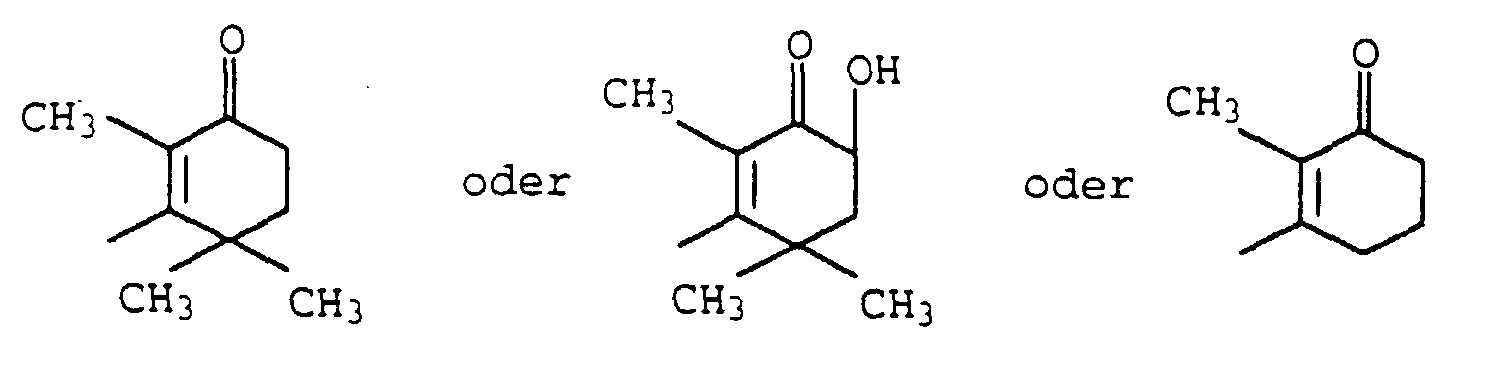
- R 1 and R 2 are preferably a C 6 to C 10 cycloalkenone radical, including cyclohexenone, cycloheptenone, cyclooctenone, cyclodecenone or cyclododecenone.
- the abovementioned radicals can either be unsubstituted or have one or more substituents.
- the substituents include C 1 to C 30 alkyl radicals, for example methyl, ethyl, n-propyl, i-butyl, neopentyl or C 2 to C 30 alkenyl radicals such as ethenyl, n-1-pentenyl, n-4 -Octenyl, n-9,12-docasadienyl or 10-eicosenyl.
- C 1 to C 30 alkoxy groups for example methoxy, ethoxy, n-butoxy or n-decyloxy, can be suitable substituents.
- C 4 to C 30 cycloalkyl such as cyclopentyl, cyclohexyl or cycloheptyl and C 4 to C 30 cycloalkenyl radicals, for example cyclopentenyl, cyclohexenyl or cyclooctenyl, belong to the substituents according to the invention.
- C 6 to C 18 aryl radicals such as phenyl, biphenyl or naphthyl can be substituents.
- the substituents also include halogen atoms, including chlorine and bromine, and the functional groups -OH, -COOH, -CHO, -COOR 5 , CN, -NH 2 , -NHR 6 , -NR 7 R 8 and NO 2 .
- substituted radicals R 1 and R 2 are Among them, the substituted cyclohexenone residues are particularly preferred.
- terminal radicals R 1 and R 2 can also the functional groups -CHO, -COOH or -COOR 9 furthermore R 1 and R 2 can also represent the following unsaturated aldehyde, acid or ester groups:
- the radicals R 3 and R 4 can be identical or different from one another and can be hydrogen, C 1 - to C 30 -alkyl such as methyl, ethyl, n-propyl, n-butyl or i-butyl, C 1 - to C 30 -alkoxy, for example methoxy, ethoxy, n-butoxy or i-butoxy.
- R 3 and R 4 can also represent the groups -SH, -SSH, -NH 2 or -NR 11 R 12 .
- Particularly preferred radicals R 3 and R 4 are hydrogen, methyl, propyl or isopropyl.
- the radicals R 5 to R 12 can be identical or different and independently of one another C 1 to C 30 alkyl such as methyl, ethyl, n-propyl, i-propyl or t-butyl, C 2 to C 30 alkenyl, for example ethenyl , Propenyl, n-1-pentenyl or n-1-octenyl.
- R 5 to R 11 can furthermore be C 4 to C 30 cycloalkyl, including cyclopentyl, cyclohexyl or cyclooctyl or C 4 to C 30 cycloalkenyl, for example cyclohexenyl or cyclooctenyl.
- R 5 to R 12 can likewise denote a C 6 to C 18 aryl radical, such as phenyl or naphthyl.
- n is an integer from 3 to 10, preferred 3 to 8.
- a carbonylolefinification provides a special access option represents, in which ylides are reacted with carbonyl compounds. Examples of this are the Wittig reaction or Wittig reactions similar to the Horner variant.
- the one used Ylides can be the regio- or stereochemical course of the reaction to be influenced. Such reactions are in themselves known.
- Detailed information on carbonyl olefinization For example, Tietze, Eicher: reactions and Synthesen, Thieme Verlag or J. March: Advanced Organic Chemistry, McGraw-Hill.
- the polyenes according to the invention can be prepared, for example, by subjecting alkenes which are substituted by R 3 and R 4 , whose number of double bonds m is less than n and which have one or two terminal aldehydes and / or keto groups to a carbonyl olefinization reaction.
- Suitable bases are, for example, sodium amide or n-butyllithium.
- This manufacturing methodology allows, based on defined polyene building blocks, the setting of defined conjugation lengths and the synthesis of polyenes with high all-trans proportions.
- the solubility of the polyenes can be influenced by the choice of the radicals R 1 to R 4 .
- residues such as isopropyl or ethyl can increase the solubility of the polyenes in N-methylpyrrolidone or chloroform.
- the synthesized materials can be in the form of solution subjected directly to the spin coat process described above become.
- the solids content of the solutions lies in the Usually in the range from 0.5 to 50% by weight, preferably from 0.5 up to 15% by weight.
- the polyenes according to the invention can be transparent organic Be mixed with polymers.
- Suitable Polymer materials are generally polystyrene, Polyvinyl acetate, polyacrylates, non-crystalline polyurethanes, Mixed polyamides, polyimidazoles, but preferably Polymethyl methacrylate or polyvinyl pyrrolidone.
- the salary of NLO-active polyene in the mixture is generally 5 to 95% by weight, preferably 10 to 80% by weight.
- Suitable solvents for the spin coat process is mainly dependent on the solubility of the NLO material and, if the mixture is used, from the solubility of the transparent polymer.
- Suitable solvents in addition to chloroform, N-methylpyrrolidone, diethylene glycol diethyl ether, aliphatic solvents or also solvent mixtures.
- Glass, silicon wafers are generally suitable as carrier materials or also transparent polymers, including polymethyl methacrylate and polystyrene.
- the crystals were dissolved in 400 ml of methylene chloride. Subsequently 900 ml of n-heptane were added and simultaneously the methylene chloride is distilled off via a column, the suspension boiled under reflux for 16 h and then the resulting Aspirated crystals.
- the crystalline product was dissolved in 400 ml of methylene chloride, precipitated again by exchanging the solvent for 900 ml of methanol and, after cooling to 0 ° C., filtered off. After drying, 43.4 g (59.8% of theory) of crystalline C 50 astaxanthin were obtained.
- the physical data of the coating are in Table 1 compiled.
- N-methylpyrrolidone was also used as a coating solvent.
- the solution of 90 mg polymethyl methacrylate eg Targetyl G 66 from BASF
- 90 mg C 60 -astaxanthin Table 2
- 7.5 g NMP also resulted in homogeneous, brown-violet films on glass substrates after spin coating.
- Astaxanthine Compounds of general formula 1 with different numbers of conjugated double bonds according to Table 2
Landscapes
- Chemical & Material Sciences (AREA)
- Organic Chemistry (AREA)
- Physics & Mathematics (AREA)
- Nonlinear Science (AREA)
- Engineering & Computer Science (AREA)
- Materials Engineering (AREA)
- Wood Science & Technology (AREA)
- Life Sciences & Earth Sciences (AREA)
- Health & Medical Sciences (AREA)
- Polymers & Plastics (AREA)
- Medicinal Chemistry (AREA)
- Chemical Kinetics & Catalysis (AREA)
- General Physics & Mathematics (AREA)
- Optics & Photonics (AREA)
- Organic Low-Molecular-Weight Compounds And Preparation Thereof (AREA)
Description




| Physikalische Daten zu den Beispielen 2 - 5 | |||
| Beispiel | d [nm] | UVmax [um] | x3 [esu] |
| 2V | 267 | 404 | 2,2·10-12 |
| 3V | 420 | 479 | 8,7·10-12 |
| 4 | 380 | 513 | 4,5·10-11 |
| 5 | 138 | 531 | 1,2·10-10 |
| Abkürzungen d: Schichtdicke in nm UVmax: Wellenlänge des Maximums der UV Absorption in nm x3: dielektrische Suszeptibilität 3. Ordnung in esu |

Claims (10)
- Polyene der allgemeinen Formel Iworin R1 und R2 gleich oder verschieden voneinander sein können und Wasserstoff, C6- bis C22-Aryl, C5- bis C10-Heteroaryl, C4- bis C30-Cycloalkyl, C4- bis C30-Cycloalkenyl, C6- bis C10-Cycloalkenon, wobei die vorgenannten Reste jeweils auch einen oder mehrere Substituenten ausgewählt aus der Gruppe der C1- bis C30-Alkyl-, C2- bis C30-Alkenyl-, C1- bis C30-Alkoxy-, C4- bis C30-Cycloalkyl-, C4- bis C30-Cycloalkenyl-, C6- bis C18-Arylreste, Halogen, -OH, -COOH, -CHO, -COOR5, CN, -NH2, -NHR6, -NR7R8 und NO2 haben können, -CHO, -COOH, -COOR9 oder einen Rest der allgemeinen Formel
 bedeuten und R3 und R4 gleich oder verschieden voneinander sein können und Wasserstoff, C1- bis C30-Alkyl, C1- bis C30-Alkoxy, -SH, -SSH, -NH2, -NR11R12 bedeuten, wobei die Reste R5 bis R12 gleich oder verschieden und unabhängig voneinander C1- bis C30-Alkyl, C2- bis C30-Alkenyl, C4- bis C30-Cycloalkyl, C4- bis C30-Cycloalkenyl, C6- bis C18-Aryl sein können und n eine ganze Zahl von 3 bis 10 darstellt.
- Polyene nach Anspruch 1, in denen die Reste R1 and R2bedeuten.
- Verfahren zur Herstellung von Polyenen nach Anspruch 1 oder 2, dadurch gekennzeichnet, daß man entsprechend mit R3 und R4 substituierte Alkene mit einer Anzahl von Doppelbindungen m < n und n eine ganze Zahl von 3 bis 10 darstellt, und einer oder zwei endständigen Aldehyd und/oder Ketogruppen einer Carbonylolefinierungsreaktion unterwirft.
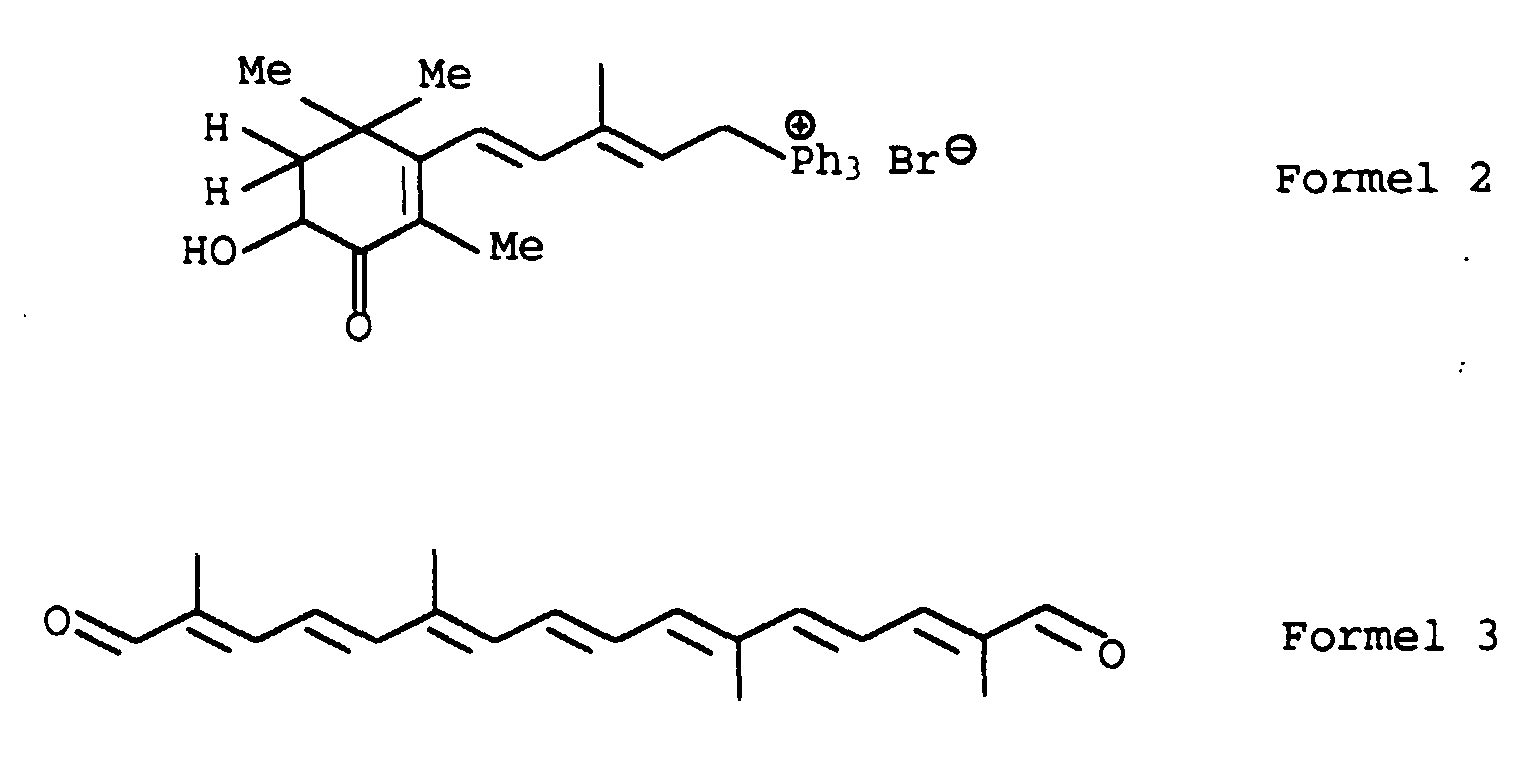
- Verfahren zur Herstellung von Polyenen nach Anspruch 3, dadurch gekennzeichnet, daß man Phosphoniumbromide der allgemeinen Formel IIworin Ph Phenyl bedeutet in Gegenwart einer starken Base mit einem Alken mit zwei endständigen Aldehydgruppen der allgemeinen Formel III umsetzt
 worin m eine ganze Zahl von 1 bis 4 ist.
- Mischungen, enthaltend Polyene gemäß Anspruch 1 und transparente organische Polymere.
- Lösungen, enthaltend Polyene gemäß Anspruch 1 oder Mischungen gemäß Anspruch 5.
- Verwendung der Lösungen gemäß Anspruch 6 zum Beschichten von Trägermaterialien.
- Beschichtete Trägermaterialien, enthaltend Polyene gemäß Anspruch 1.
- Verwendung der beschichteten Trägermaterialien gemäß Anspruch 8 als optoelektrische Bauteile.
- Verwendung der beschichteten Trägermaterialien nach Anspruch 8 als nichtlinear optische Bauteile.
Applications Claiming Priority (3)
| Application Number | Priority Date | Filing Date | Title |
|---|---|---|---|
| DE4224015 | 1992-07-21 | ||
| DE4224015A DE4224015A1 (de) | 1992-07-21 | 1992-07-21 | Polyene mit nichtlinearoptischen Eigenschaften |
| PCT/EP1993/001798 WO1994002881A1 (de) | 1992-07-21 | 1993-07-09 | Polyene mit nichtlinearoptischen eigenschaften |
Publications (2)
| Publication Number | Publication Date |
|---|---|
| EP0657040A1 EP0657040A1 (de) | 1995-06-14 |
| EP0657040B1 true EP0657040B1 (de) | 2000-04-26 |
Family
ID=6463748
Family Applications (1)
| Application Number | Title | Priority Date | Filing Date |
|---|---|---|---|
| EP93915862A Expired - Lifetime EP0657040B1 (de) | 1992-07-21 | 1993-07-09 | Polyene mit nichtlinearoptischen eigenschaften |
Country Status (5)
| Country | Link |
|---|---|
| EP (1) | EP0657040B1 (de) |
| JP (1) | JPH07508992A (de) |
| AU (1) | AU4566993A (de) |
| DE (2) | DE4224015A1 (de) |
| WO (1) | WO1994002881A1 (de) |
Family Cites Families (2)
| Publication number | Priority date | Publication date | Assignee | Title |
|---|---|---|---|---|
| EP0005748B1 (de) * | 1978-06-02 | 1982-12-29 | F. HOFFMANN-LA ROCHE & CO. Aktiengesellschaft | Verfahren zur Herstellung von Cyclohexenderivaten sowie Zwischenprodukte in diesem Verfahren |
| DE4014203A1 (de) * | 1990-05-03 | 1991-11-07 | Basf Ag | Verfahren zur herstellung von canthaxanthin und astaxanthin |
-
1992
- 1992-07-21 DE DE4224015A patent/DE4224015A1/de not_active Withdrawn
-
1993
- 1993-07-09 AU AU45669/93A patent/AU4566993A/en not_active Abandoned
- 1993-07-09 EP EP93915862A patent/EP0657040B1/de not_active Expired - Lifetime
- 1993-07-09 JP JP6503913A patent/JPH07508992A/ja active Pending
- 1993-07-09 WO PCT/EP1993/001798 patent/WO1994002881A1/de not_active Ceased
- 1993-07-09 DE DE59310019T patent/DE59310019D1/de not_active Expired - Lifetime
Also Published As
| Publication number | Publication date |
|---|---|
| WO1994002881A1 (de) | 1994-02-03 |
| DE59310019D1 (de) | 2000-05-31 |
| AU4566993A (en) | 1994-02-14 |
| DE4224015A1 (de) | 1994-01-27 |
| EP0657040A1 (de) | 1995-06-14 |
| JPH07508992A (ja) | 1995-10-05 |
Similar Documents
| Publication | Publication Date | Title |
|---|---|---|
| DE69424170T2 (de) | Suspension zur verwendung in elektrophoretischen bildanzeigesystemen | |
| EP0472990B1 (de) | Auf Trägern angebrachte ein oder mehrlagige Schichtelemente und ihre Herstellung | |
| DE4234230C2 (de) | Substituierte Thieno[3,2-b]thiophene und ihre Verwendung | |
| DE2737682A1 (de) | Elektrophoretische wiedergabevorrichtung mit vergrabenen zufuhrleitungen | |
| DE3610801A1 (de) | Fluessigkristallvorrichtung | |
| EP0467846B1 (de) | Neue elektrochrome Stoffzusammensetzungen auf der Basis von Diketopyrrolopyrrolen | |
| DE69813071T2 (de) | Organisches nichtlinear-optisches Material und dieses verwendende nichtlinear-optisches Element | |
| WO2010136267A1 (de) | Elektrochrome formulierung, herstellungsverfahren dazu und elektrochromes organisches bauelement | |
| DE3925970A1 (de) | Elektrisch leitfaehige polymere und ihre verwendung als orientierungsschicht in fluessigkristall-schalt- und -anzeigeelementen | |
| DE69012755T2 (de) | Ladungsübertragunssalze und Anwendungen derselben. | |
| EP1907446B1 (de) | Polymere 4,4´-bipyridinium-strukturen, formulierung für eine elektrochrom aktive schicht und anwendung dazu | |
| EP0474713B1 (de) | (meth)acrylat-copolymerisate sowie ihre verwendung in der nichtlinearen optik und zur herstellung von langmuir-blodgett-schichten | |
| EP0570366B1 (de) | Verwendung fluorierter aromatischer polyamide als orientierungsschicht für flüssigkristall-schalt- und -anzeigevorrichtungen | |
| WO1991003001A1 (de) | Nlo-aktive polyimide | |
| EP0657040A1 (de) | Polyene mit nichtlinearoptischen eigenschaften | |
| EP0596325A1 (de) | Optisches Bauelement auf Basis von Langmuir-Blodgett-Schichten | |
| EP0359795B1 (de) | Zwitterionische nlo-chromophore | |
| DE3710889A1 (de) | Pyrrolo(1.2-b)azine | |
| EP0432619A2 (de) | Schichtelement und Verfahren zu seiner Herstellung | |
| EP0615152B1 (de) | Verfahren zur Herstellung von Materialien mit guten nichtlinearen optischen Eigenschaften | |
| EP0644907B1 (de) | Polyanile | |
| DE102008049546A1 (de) | Elektrochrome Formulierung, Herstellungsverfahren dazu und elektrochromes organisches Bauelement | |
| WO1993025933A1 (de) | Nichtlinear-optische mischungen | |
| DE2504641A1 (de) | Nematische fluessigkristalle und deren herstellungsverfahren | |
| DE69933127T2 (de) | Polyhalogenid-partikel und diese enthaltende lichtventile |
Legal Events
| Date | Code | Title | Description |
|---|---|---|---|
| PUAI | Public reference made under article 153(3) epc to a published international application that has entered the european phase |
Free format text: ORIGINAL CODE: 0009012 |
|
| 17P | Request for examination filed |
Effective date: 19941217 |
|
| AK | Designated contracting states |
Kind code of ref document: A1 Designated state(s): DE FR GB |
|
| 17Q | First examination report despatched |
Effective date: 19970423 |
|
| GRAG | Despatch of communication of intention to grant |
Free format text: ORIGINAL CODE: EPIDOS AGRA |
|
| GRAG | Despatch of communication of intention to grant |
Free format text: ORIGINAL CODE: EPIDOS AGRA |
|
| GRAH | Despatch of communication of intention to grant a patent |
Free format text: ORIGINAL CODE: EPIDOS IGRA |
|
| GRAH | Despatch of communication of intention to grant a patent |
Free format text: ORIGINAL CODE: EPIDOS IGRA |
|
| GRAA | (expected) grant |
Free format text: ORIGINAL CODE: 0009210 |
|
| AK | Designated contracting states |
Kind code of ref document: B1 Designated state(s): DE FR GB |
|
| REF | Corresponds to: |
Ref document number: 59310019 Country of ref document: DE Date of ref document: 20000531 |
|
| GBT | Gb: translation of ep patent filed (gb section 77(6)(a)/1977) |
Effective date: 20000522 |
|
| PGFP | Annual fee paid to national office [announced via postgrant information from national office to epo] |
Ref country code: FR Payment date: 20000626 Year of fee payment: 8 |
|
| PGFP | Annual fee paid to national office [announced via postgrant information from national office to epo] |
Ref country code: GB Payment date: 20000703 Year of fee payment: 8 |
|
| PGFP | Annual fee paid to national office [announced via postgrant information from national office to epo] |
Ref country code: DE Payment date: 20000714 Year of fee payment: 8 |
|
| ET | Fr: translation filed | ||
| PLBE | No opposition filed within time limit |
Free format text: ORIGINAL CODE: 0009261 |
|
| STAA | Information on the status of an ep patent application or granted ep patent |
Free format text: STATUS: NO OPPOSITION FILED WITHIN TIME LIMIT |
|
| 26N | No opposition filed | ||
| PG25 | Lapsed in a contracting state [announced via postgrant information from national office to epo] |
Ref country code: GB Free format text: LAPSE BECAUSE OF NON-PAYMENT OF DUE FEES Effective date: 20010709 |
|
| PG25 | Lapsed in a contracting state [announced via postgrant information from national office to epo] |
Ref country code: DE Free format text: LAPSE BECAUSE OF THE APPLICANT RENOUNCES Effective date: 20010714 |
|
| GBPC | Gb: european patent ceased through non-payment of renewal fee |
Effective date: 20010709 |
|
| PG25 | Lapsed in a contracting state [announced via postgrant information from national office to epo] |
Ref country code: FR Free format text: LAPSE BECAUSE OF NON-PAYMENT OF DUE FEES Effective date: 20020329 |
|
| REG | Reference to a national code |
Ref country code: FR Ref legal event code: ST |