EP0640708B1 - Improved absorbent nonwoven fabric - Google Patents
Improved absorbent nonwoven fabric Download PDFInfo
- Publication number
- EP0640708B1 EP0640708B1 EP94306345A EP94306345A EP0640708B1 EP 0640708 B1 EP0640708 B1 EP 0640708B1 EP 94306345 A EP94306345 A EP 94306345A EP 94306345 A EP94306345 A EP 94306345A EP 0640708 B1 EP0640708 B1 EP 0640708B1
- Authority
- EP
- European Patent Office
- Prior art keywords
- fiber
- nonwoven fabric
- pattern
- fabric
- fabric according
- Prior art date
- Legal status (The legal status is an assumption and is not a legal conclusion. Google has not performed a legal analysis and makes no representation as to the accuracy of the status listed.)
- Expired - Lifetime
Links
Images




Classifications
-
- D—TEXTILES; PAPER
- D04—BRAIDING; LACE-MAKING; KNITTING; TRIMMINGS; NON-WOVEN FABRICS
- D04H—MAKING TEXTILE FABRICS, e.g. FROM FIBRES OR FILAMENTARY MATERIAL; FABRICS MADE BY SUCH PROCESSES OR APPARATUS, e.g. FELTS, NON-WOVEN FABRICS; COTTON-WOOL; WADDING ; NON-WOVEN FABRICS FROM STAPLE FIBRES, FILAMENTS OR YARNS, BONDED WITH AT LEAST ONE WEB-LIKE MATERIAL DURING THEIR CONSOLIDATION
- D04H18/00—Needling machines
- D04H18/04—Needling machines with water jets
-
- D—TEXTILES; PAPER
- D04—BRAIDING; LACE-MAKING; KNITTING; TRIMMINGS; NON-WOVEN FABRICS
- D04H—MAKING TEXTILE FABRICS, e.g. FROM FIBRES OR FILAMENTARY MATERIAL; FABRICS MADE BY SUCH PROCESSES OR APPARATUS, e.g. FELTS, NON-WOVEN FABRICS; COTTON-WOOL; WADDING ; NON-WOVEN FABRICS FROM STAPLE FIBRES, FILAMENTS OR YARNS, BONDED WITH AT LEAST ONE WEB-LIKE MATERIAL DURING THEIR CONSOLIDATION
- D04H1/00—Non-woven fabrics formed wholly or mainly of staple fibres or like relatively short fibres
- D04H1/40—Non-woven fabrics formed wholly or mainly of staple fibres or like relatively short fibres from fleeces or layers composed of fibres without existing or potential cohesive properties
- D04H1/44—Non-woven fabrics formed wholly or mainly of staple fibres or like relatively short fibres from fleeces or layers composed of fibres without existing or potential cohesive properties the fleeces or layers being consolidated by mechanical means, e.g. by rolling
- D04H1/46—Non-woven fabrics formed wholly or mainly of staple fibres or like relatively short fibres from fleeces or layers composed of fibres without existing or potential cohesive properties the fleeces or layers being consolidated by mechanical means, e.g. by rolling by needling or like operations to cause entanglement of fibres
- D04H1/48—Non-woven fabrics formed wholly or mainly of staple fibres or like relatively short fibres from fleeces or layers composed of fibres without existing or potential cohesive properties the fleeces or layers being consolidated by mechanical means, e.g. by rolling by needling or like operations to cause entanglement of fibres in combination with at least one other method of consolidation
- D04H1/49—Non-woven fabrics formed wholly or mainly of staple fibres or like relatively short fibres from fleeces or layers composed of fibres without existing or potential cohesive properties the fleeces or layers being consolidated by mechanical means, e.g. by rolling by needling or like operations to cause entanglement of fibres in combination with at least one other method of consolidation entanglement by fluid jet in combination with another consolidation means
-
- D—TEXTILES; PAPER
- D04—BRAIDING; LACE-MAKING; KNITTING; TRIMMINGS; NON-WOVEN FABRICS
- D04H—MAKING TEXTILE FABRICS, e.g. FROM FIBRES OR FILAMENTARY MATERIAL; FABRICS MADE BY SUCH PROCESSES OR APPARATUS, e.g. FELTS, NON-WOVEN FABRICS; COTTON-WOOL; WADDING ; NON-WOVEN FABRICS FROM STAPLE FIBRES, FILAMENTS OR YARNS, BONDED WITH AT LEAST ONE WEB-LIKE MATERIAL DURING THEIR CONSOLIDATION
- D04H1/00—Non-woven fabrics formed wholly or mainly of staple fibres or like relatively short fibres
- D04H1/40—Non-woven fabrics formed wholly or mainly of staple fibres or like relatively short fibres from fleeces or layers composed of fibres without existing or potential cohesive properties
- D04H1/44—Non-woven fabrics formed wholly or mainly of staple fibres or like relatively short fibres from fleeces or layers composed of fibres without existing or potential cohesive properties the fleeces or layers being consolidated by mechanical means, e.g. by rolling
- D04H1/46—Non-woven fabrics formed wholly or mainly of staple fibres or like relatively short fibres from fleeces or layers composed of fibres without existing or potential cohesive properties the fleeces or layers being consolidated by mechanical means, e.g. by rolling by needling or like operations to cause entanglement of fibres
- D04H1/492—Non-woven fabrics formed wholly or mainly of staple fibres or like relatively short fibres from fleeces or layers composed of fibres without existing or potential cohesive properties the fleeces or layers being consolidated by mechanical means, e.g. by rolling by needling or like operations to cause entanglement of fibres by fluid jet
- D04H1/495—Non-woven fabrics formed wholly or mainly of staple fibres or like relatively short fibres from fleeces or layers composed of fibres without existing or potential cohesive properties the fleeces or layers being consolidated by mechanical means, e.g. by rolling by needling or like operations to cause entanglement of fibres by fluid jet for formation of patterns, e.g. drilling or rearrangement
-
- D—TEXTILES; PAPER
- D04—BRAIDING; LACE-MAKING; KNITTING; TRIMMINGS; NON-WOVEN FABRICS
- D04H—MAKING TEXTILE FABRICS, e.g. FROM FIBRES OR FILAMENTARY MATERIAL; FABRICS MADE BY SUCH PROCESSES OR APPARATUS, e.g. FELTS, NON-WOVEN FABRICS; COTTON-WOOL; WADDING ; NON-WOVEN FABRICS FROM STAPLE FIBRES, FILAMENTS OR YARNS, BONDED WITH AT LEAST ONE WEB-LIKE MATERIAL DURING THEIR CONSOLIDATION
- D04H1/00—Non-woven fabrics formed wholly or mainly of staple fibres or like relatively short fibres
- D04H1/70—Non-woven fabrics formed wholly or mainly of staple fibres or like relatively short fibres characterised by the method of forming fleeces or layers, e.g. reorientation of fibres
- D04H1/72—Non-woven fabrics formed wholly or mainly of staple fibres or like relatively short fibres characterised by the method of forming fleeces or layers, e.g. reorientation of fibres the fibres being randomly arranged
- D04H1/736—Non-woven fabrics formed wholly or mainly of staple fibres or like relatively short fibres characterised by the method of forming fleeces or layers, e.g. reorientation of fibres the fibres being randomly arranged characterised by the apparatus for arranging fibres
-
- Y—GENERAL TAGGING OF NEW TECHNOLOGICAL DEVELOPMENTS; GENERAL TAGGING OF CROSS-SECTIONAL TECHNOLOGIES SPANNING OVER SEVERAL SECTIONS OF THE IPC; TECHNICAL SUBJECTS COVERED BY FORMER USPC CROSS-REFERENCE ART COLLECTIONS [XRACs] AND DIGESTS
- Y10—TECHNICAL SUBJECTS COVERED BY FORMER USPC
- Y10T—TECHNICAL SUBJECTS COVERED BY FORMER US CLASSIFICATION
- Y10T428/00—Stock material or miscellaneous articles
- Y10T428/24—Structurally defined web or sheet [e.g., overall dimension, etc.]
- Y10T428/24058—Structurally defined web or sheet [e.g., overall dimension, etc.] including grain, strips, or filamentary elements in respective layers or components in angular relation
- Y10T428/24124—Fibers
-
- Y—GENERAL TAGGING OF NEW TECHNOLOGICAL DEVELOPMENTS; GENERAL TAGGING OF CROSS-SECTIONAL TECHNOLOGIES SPANNING OVER SEVERAL SECTIONS OF THE IPC; TECHNICAL SUBJECTS COVERED BY FORMER USPC CROSS-REFERENCE ART COLLECTIONS [XRACs] AND DIGESTS
- Y10—TECHNICAL SUBJECTS COVERED BY FORMER USPC
- Y10T—TECHNICAL SUBJECTS COVERED BY FORMER US CLASSIFICATION
- Y10T428/00—Stock material or miscellaneous articles
- Y10T428/24—Structurally defined web or sheet [e.g., overall dimension, etc.]
- Y10T428/24132—Structurally defined web or sheet [e.g., overall dimension, etc.] including grain, strips, or filamentary elements in different layers or components parallel
-
- Y—GENERAL TAGGING OF NEW TECHNOLOGICAL DEVELOPMENTS; GENERAL TAGGING OF CROSS-SECTIONAL TECHNOLOGIES SPANNING OVER SEVERAL SECTIONS OF THE IPC; TECHNICAL SUBJECTS COVERED BY FORMER USPC CROSS-REFERENCE ART COLLECTIONS [XRACs] AND DIGESTS
- Y10—TECHNICAL SUBJECTS COVERED BY FORMER USPC
- Y10T—TECHNICAL SUBJECTS COVERED BY FORMER US CLASSIFICATION
- Y10T428/00—Stock material or miscellaneous articles
- Y10T428/24—Structurally defined web or sheet [e.g., overall dimension, etc.]
- Y10T428/2419—Fold at edge
- Y10T428/24215—Acute or reverse fold of exterior component
- Y10T428/24231—At opposed marginal edges
- Y10T428/2424—Annular cover
- Y10T428/24248—One piece
-
- Y—GENERAL TAGGING OF NEW TECHNOLOGICAL DEVELOPMENTS; GENERAL TAGGING OF CROSS-SECTIONAL TECHNOLOGIES SPANNING OVER SEVERAL SECTIONS OF THE IPC; TECHNICAL SUBJECTS COVERED BY FORMER USPC CROSS-REFERENCE ART COLLECTIONS [XRACs] AND DIGESTS
- Y10—TECHNICAL SUBJECTS COVERED BY FORMER USPC
- Y10T—TECHNICAL SUBJECTS COVERED BY FORMER US CLASSIFICATION
- Y10T428/00—Stock material or miscellaneous articles
- Y10T428/24—Structurally defined web or sheet [e.g., overall dimension, etc.]
- Y10T428/24273—Structurally defined web or sheet [e.g., overall dimension, etc.] including aperture
-
- Y—GENERAL TAGGING OF NEW TECHNOLOGICAL DEVELOPMENTS; GENERAL TAGGING OF CROSS-SECTIONAL TECHNOLOGIES SPANNING OVER SEVERAL SECTIONS OF THE IPC; TECHNICAL SUBJECTS COVERED BY FORMER USPC CROSS-REFERENCE ART COLLECTIONS [XRACs] AND DIGESTS
- Y10—TECHNICAL SUBJECTS COVERED BY FORMER USPC
- Y10T—TECHNICAL SUBJECTS COVERED BY FORMER US CLASSIFICATION
- Y10T428/00—Stock material or miscellaneous articles
- Y10T428/24—Structurally defined web or sheet [e.g., overall dimension, etc.]
- Y10T428/24479—Structurally defined web or sheet [e.g., overall dimension, etc.] including variation in thickness
-
- Y—GENERAL TAGGING OF NEW TECHNOLOGICAL DEVELOPMENTS; GENERAL TAGGING OF CROSS-SECTIONAL TECHNOLOGIES SPANNING OVER SEVERAL SECTIONS OF THE IPC; TECHNICAL SUBJECTS COVERED BY FORMER USPC CROSS-REFERENCE ART COLLECTIONS [XRACs] AND DIGESTS
- Y10—TECHNICAL SUBJECTS COVERED BY FORMER USPC
- Y10T—TECHNICAL SUBJECTS COVERED BY FORMER US CLASSIFICATION
- Y10T428/00—Stock material or miscellaneous articles
- Y10T428/24—Structurally defined web or sheet [e.g., overall dimension, etc.]
- Y10T428/24479—Structurally defined web or sheet [e.g., overall dimension, etc.] including variation in thickness
- Y10T428/2457—Parallel ribs and/or grooves
-
- Y—GENERAL TAGGING OF NEW TECHNOLOGICAL DEVELOPMENTS; GENERAL TAGGING OF CROSS-SECTIONAL TECHNOLOGIES SPANNING OVER SEVERAL SECTIONS OF THE IPC; TECHNICAL SUBJECTS COVERED BY FORMER USPC CROSS-REFERENCE ART COLLECTIONS [XRACs] AND DIGESTS
- Y10—TECHNICAL SUBJECTS COVERED BY FORMER USPC
- Y10T—TECHNICAL SUBJECTS COVERED BY FORMER US CLASSIFICATION
- Y10T428/00—Stock material or miscellaneous articles
- Y10T428/24—Structurally defined web or sheet [e.g., overall dimension, etc.]
- Y10T428/24479—Structurally defined web or sheet [e.g., overall dimension, etc.] including variation in thickness
- Y10T428/24595—Structurally defined web or sheet [e.g., overall dimension, etc.] including variation in thickness and varying density
-
- Y—GENERAL TAGGING OF NEW TECHNOLOGICAL DEVELOPMENTS; GENERAL TAGGING OF CROSS-SECTIONAL TECHNOLOGIES SPANNING OVER SEVERAL SECTIONS OF THE IPC; TECHNICAL SUBJECTS COVERED BY FORMER USPC CROSS-REFERENCE ART COLLECTIONS [XRACs] AND DIGESTS
- Y10—TECHNICAL SUBJECTS COVERED BY FORMER USPC
- Y10T—TECHNICAL SUBJECTS COVERED BY FORMER US CLASSIFICATION
- Y10T428/00—Stock material or miscellaneous articles
- Y10T428/24—Structurally defined web or sheet [e.g., overall dimension, etc.]
- Y10T428/24479—Structurally defined web or sheet [e.g., overall dimension, etc.] including variation in thickness
- Y10T428/24595—Structurally defined web or sheet [e.g., overall dimension, etc.] including variation in thickness and varying density
- Y10T428/24603—Fiber containing component
-
- Y—GENERAL TAGGING OF NEW TECHNOLOGICAL DEVELOPMENTS; GENERAL TAGGING OF CROSS-SECTIONAL TECHNOLOGIES SPANNING OVER SEVERAL SECTIONS OF THE IPC; TECHNICAL SUBJECTS COVERED BY FORMER USPC CROSS-REFERENCE ART COLLECTIONS [XRACs] AND DIGESTS
- Y10—TECHNICAL SUBJECTS COVERED BY FORMER USPC
- Y10T—TECHNICAL SUBJECTS COVERED BY FORMER US CLASSIFICATION
- Y10T442/00—Fabric [woven, knitted, or nonwoven textile or cloth, etc.]
- Y10T442/60—Nonwoven fabric [i.e., nonwoven strand or fiber material]
- Y10T442/643—Including parallel strand or fiber material within the nonwoven fabric
-
- Y—GENERAL TAGGING OF NEW TECHNOLOGICAL DEVELOPMENTS; GENERAL TAGGING OF CROSS-SECTIONAL TECHNOLOGIES SPANNING OVER SEVERAL SECTIONS OF THE IPC; TECHNICAL SUBJECTS COVERED BY FORMER USPC CROSS-REFERENCE ART COLLECTIONS [XRACs] AND DIGESTS
- Y10—TECHNICAL SUBJECTS COVERED BY FORMER USPC
- Y10T—TECHNICAL SUBJECTS COVERED BY FORMER US CLASSIFICATION
- Y10T442/00—Fabric [woven, knitted, or nonwoven textile or cloth, etc.]
- Y10T442/60—Nonwoven fabric [i.e., nonwoven strand or fiber material]
- Y10T442/682—Needled nonwoven fabric
-
- Y—GENERAL TAGGING OF NEW TECHNOLOGICAL DEVELOPMENTS; GENERAL TAGGING OF CROSS-SECTIONAL TECHNOLOGIES SPANNING OVER SEVERAL SECTIONS OF THE IPC; TECHNICAL SUBJECTS COVERED BY FORMER USPC CROSS-REFERENCE ART COLLECTIONS [XRACs] AND DIGESTS
- Y10—TECHNICAL SUBJECTS COVERED BY FORMER USPC
- Y10T—TECHNICAL SUBJECTS COVERED BY FORMER US CLASSIFICATION
- Y10T442/00—Fabric [woven, knitted, or nonwoven textile or cloth, etc.]
- Y10T442/60—Nonwoven fabric [i.e., nonwoven strand or fiber material]
- Y10T442/689—Hydroentangled nonwoven fabric
Definitions
- Nonwoven fabrics were developed in an attempt to produce an inexpensive fabric by eliminating many of the various steps required to produce woven or knitted fabrics.
- nonwoven fabrics were produced from card or air-laid webs of fibers which were bonded with a chemical binder. Such fabrics have relatively limited usage because their strength characteristics were poor compared to woven or knitted fabrics and their absorbency and softness characteristics left something to be desired because of the use of chemical binders.
- Major advances were made in eliminating or considerably reducing the amount of binder used in a nonwoven fabric by rearranging or entangling the fibers in a fibrous web to produce what are termed "yarn like" fiber segments and entangled fiber areas. Methods and apparatus for producing fabrics of this nature are more fully disclosed in U.S.
- Nonwoven fabrics of the present invention have a generally sinusoidal fiber distribution curve over their cross-sectional area.
- This generally sinusoidal fiber distribution curve of the fabrics of the present invention must meet certain criteria. We have found that one way of defining and measuring these criteria is by mathematically defining the fiber distribution curve. The curve may be defined by the average percentage of area covered by fibers, the cycles or periodicity of the curve and the average amplitude of the curve. We have found that the fabrics of the present invention have a fiber distribution index of at least 600 and preferably at least 800.
- This fiber distribution index is determined by multiplying the average percentage of area of fiber coverage in a specific measured cross-sectional area of the fabric by one-half the number of clearly identifiable points of minimum fiber coverage over said specific cross-sectional area and dividing this figure by the average amplitude of the fiber distribution curve.
- Figure 1 is a photomicrograph of a nonwoven fabric 20 of the present invention at an enlargement of about 20 times.
- the fabric has a repeating pattern of three interconnected fiber arrays.
- the first fiber array 21 is a plurality of parallel fiber segments.
- the second fiber array 22, which is adjacent to the first array, is a plurality of twisted and turned fiber segments that form a band.
- the band is disposed substantially perpendicular to the parallel fiber segments.
- the third fiber array 23 interconnects the first and second arrays and comprises a plurality of highly entangled fiber segments.
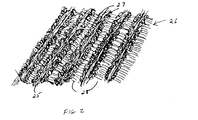
- FIG 2 there is a schematic representation of a nonwoven fabric of the present invention.
- the bands 25 of twisted and turned fiber segments more or less form ribs extending longitudinally of the fabric 26.
- a plurality of highly entangled fiber segments 27 which extend longitudinally of the fabric.
- Adjacent the plurality of highly entangled fiber segment areas and connecting the adjacent areas are a plurality of parallel fiber segments 28. These parallel fiber segments are disposed substantially perpendicular to the bands of twisted and turned fiber segments.
- the fiber distribution of fabrics may be determined by image analysis of the fabric. Imaging analysis using image analyzers such as the Leica Quantimet Q520 have become relatively standard techniques for determining the fiber distribution in fabrics. An image analysis is carried out on a cross-sectional area of the fabric. A piece of fabric is cut to a size of about 1'' in the machine direction of the fabric and 3'' in the cross-direction of the fabric. The fabric is dried to remove moisture and then embedded in a transparent resin as is well known in the art. In the embedding process, the fabric is maintained in a relatively relaxed state. Once the fabric has been appropriately embedded in a resin, a low speed saw may be used to slice off sections in the cross direction of the fabric. The cut or sliced sections have a thickness of from about 6 to 8 mils.
- a number of these sections are then analyzed using a Leica Quantimet Q520 image analyzer.
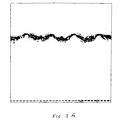
- a typical image formed by such an image analyzer is shown in Figure 3a.
- the image analyzer uses a computer to quantify images.
- the fabric cross section is imaged through a microscope such as an Olympus SZH model equipped with a stabilized transmitter light source.
- a video camera links the microscope to the image analyzer.
- This image is transformed to an electronic signal suitable for analysis.
- the stabilized light source on the microscope is used to produce an image of a suitable visual contrast such that the fiber in the cross section are various shades from gray to black and are readily distinguishable from the pale gray to white resin background as more clearly shown in Figure 3a.
- This image is divided into sample points or pixels for measurement.
- the fiber distribution in the cross-section may be characterized by the variation across the section and can be expressed as the area in square millimeters of fibers in a specified rectangular measuring frame.
- the specific measuring frame is 17 pixels wide by 130 pixels high or approximately 95 square millimeters.
- the fiber cover or the area of fiber within the measured frame is detected and measured.
- the measuring frame is then advanced two pixels across the cross-sectional area and the measurement repeated for that adjacent area. This is accomplished anywhere from 200 to 300 times depending on the size of the cross-section.
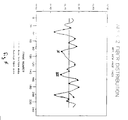
- the fiber area in each specific measured area is then plotted on a graft such as that shown in Figure 4.
- the amount of fiber coverage is plotted along the ordinate or Y axis and the position of the specific measured area from the starting point is plotted along the abscissa or X axis.
- approximately 232 specific sized areas are measured along the cross-section of the fabric.
- the amount of fiber in each specific measured area is plotted and as may be seen in Figure 4 varies from about .10 or 10% of the measured area being covered by fiber to about .30 or 30% of the measured area being covered by fiber.
- the height of the area should be such that it is greater than any fabric thickness.
- the width of the area should be selected to give good resolution of fiber areas. Fiber distribution index of the fabric may then be determined from this graph.
- the curve is a generally sinusoidal curve and the fiber distribution index is determined by multiplying the average fiber area covered by the number of clearly identifiable points of minimum fiber coverage over the cross-sectional area and dividing this figure by the average amplitude of the fiber distribution curve.
- a minimum fiber coverage point is where the slope of the curve changes from a negative slope to a positive slope.
- the change in slope to be considered a maximum or minimum should occur over at least six measuring frames or a twelve pixel distance.
- the average amplitude of the curve in Figure 4 is 0.04.
- the fiber distribution index of this fabric may then be determined by multiplying the average fiber area coverage of .23% times the cycles or periodicity which is 2, divided by the average amplitude of the curve, which is 0.04, to give a fiber distribution index of 1150.
- the fiber distribution index of fabrics of the present invention are greater than 600 and preferably are in the range from about 800 to 3300.
- the fiber distribution index of the fabrics of the prior art are usually considerably lower than 400. In fact, some of the art will have a fiber distribution index of 100 or even lower.
- the fabrics of the present invention will have an average fiber area coverage of from 13% to 24%, a periodicity of from 1.3 to 4, and an average amplitude of from 0.02 to 0.06.
- the fabrics of the present invention have excellent durability, they also surprisingly and unexpectedly have very desirable absorbent characteristics.
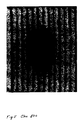
- the fabrics of the present invention have relatively uniform absorbent characteristics in that their pattern of absorption has substantially a round shape. Also the perimeter of absorption pattern is relatively smooth.
- An absorbent pattern of a fabric of the present invention is depicted in Figure 5.
- the absorbent pattern is produced using a test solution of .05% Sandolan Rhodamine Red Dye in water.
- An eye dropper is filled with the test solution.
- One drop of solution is applied to the fabric being tested.
- the eye dropper delivers a drop which results in an absorbent pattern of about one inch diameter.
- the fabric is supported in such a way that there is no contact between fabric and any substrate which could influence the absorbent pattern.
- a series of drops (at least ten on each side of the fabric) are applied and spaced far enough apart that one drop does not interfere with any adjacent drop. In application, the dropper is positioned approximately one centimeter above the fabric surface and a single drop is expelled from the dropper onto the fabric surface.
- the supported fabric is allowed to air dry prior to image analysis.
- the form factor of the absorbent pattern is determined by measuring the area of the absorption pattern and the perimeter of the absorption pattern.
- the form factor is equal to 4 times "pi" times the area of the absorption pattern divided by the perimeter squared of the absorption pattern. For a perfectly smooth circle, the form factor is 1.
- the absorption pattern of the fabrics of the present invention have a mean form factor of at least 0.7 and preferably from about 0.75 to 1.0.
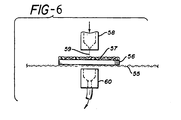
- FIG. 6 is a schematic cross-sectional view of apparatus which may be used to produce fabrics of the present invention.
- the apparatus includes a movable conveyer belt 55. Placed on top of this belt to move with the belt is a topographically novel configured support member 56.
- the support member has a plurality of longitudinally extending raised triangular areas. Holes, or openings extending through the support member, are disposed between triangular areas as will be more fully discussed in conjunction with Figure 8.
- the fiber web 57 to be treated is disposed or supported by the apex of these triangular areas. Openings in the support member are disposed between the triangular areas. Specific forming members will be more fully described hereinafter. As previously mentioned, placed on top of this support member is a web of fibers.
- the web may be a nonwoven web of carded fibers, air-laid fibers, melt blown fibers, or the like.
- a manifold 58 for applying fluid 59, preferably water, through the fibrous web as the fibrous web is supported on the support member and moved on the conveyer belt beneath the manifold. The water may be applied at varying pressures.
- a vacuum manifold 60 Disposed beneath the conveyer belt is a vacuum manifold 60 for removing water from the area as the web and support member are passed under the fluid manifold. In operation, the fiber web is placed on the support member and the fiber web and support member passed under the fluid manifold.
- Water is applied to the fibers to wet out the fiber web to be certain the web is not removed or disrupted from its position on the support member on further treatment. Thereafter, the support member and web are passed beneath the manifold a series of times. During these passes, the pressure of the water of the manifold is increased from a starting pressure of about 7.03 kg/cm 2 (100 PSI) to pressures of 70.3 kg/cm 2 of (1000 PSI) or more.
- the manifold consists of a plurality of orifices of from about 4 to 100 or more holes per 2.54 cm (one inch). Preferably, the number of holes in the manifold is from 13 to 70 per 2.54 cm (one inch).
- FIG 7 there is depicted an apparatus for continuously producing fabrics in accordance with the present invention.
- the schematic representation includes a conveyer belt 80 which serves as the support member in accordance with the present invention.
- the belt is continuously moved in a counterclockwise direction about spaced apart members as is well known in the art.
- a fluid feeding manifold connecting a plurality of lines or groups 81 of orifices. Each group has one or more rows of fine diameter holes with 30 or more holes per 2.54 cm (one inch).
- the manifold is equipped with pressure gauges 87 and control valves 88 for regulating fluid pressure in each line or group of orifices.
- the support member may be made from relatively rigid material and may comprise a plurality of slats.
- Each slat extends across the width of the conveyer and has a lip on one side and a shoulder on the opposite side so that the shoulder of one slot engages with the lip of an adjacent slot to allow for movement between adjacent slots and allow for these relatively rigid members to be used in the conveyer configuration shown in Figure 7.
- Each orifice strip comprises one or more rows of very fine diameter holes of approximately 5.08 x 10 -4 cm (1/5000 of an inch) to 2.54 x 10 -2 cm (10/1000 of an inch) in diameter. There are approximately 50 holes per 2.54 cm (one inch) across the orifice.
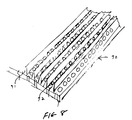
- Figure 8 is a perspective view of one type of support member that may be used to produce the fabrics of the present invention.
- the member comprises a plate 90 having longitudinally spaced apart raised rib areas 91.
- the plate has 12 of these raised rib areas per 2.54 cm (one inch) of width.
- the raised areas have a triangular cross-sectional shape with the width at the bottom of the triangular being approximately 0.0762 cm (.03 inches).
- These ribs are 0.216 cm (.085 inches) in height and come to a point having an occluded angle of about 20 degrees.
- the base of the rib is spaced from the base of the adjacent rib about 0.135 cm (.053 inches). In this area between ribs there are openings 92 or holes in the plate.
- Apparatus as depicted and described in regard to Figure 2 is used to produce the fabric.
- a 84.77 g/m 2 (2 1/2 oz/per square yard) fiber web of 100% cotton is prepared by taking a 50.86 g/m 2 (1 1/2 ounce per square yard) random web and laminating it on top of a 33.91 g/m 2 (one ounce per square yard) carded web.
- This laminated web is placed on a support member as described in conjunction with Figure 8. The support member and web are passed, at a speed of 28.04 m (92 feet) per minute, under columnar jet streams produced from the orifices as depicted in Figure 8.
- the orifices have a 0.018 cm (.007 inch) diameter and there are approximately 30 orifices per 2.54 cm (one inch) so that the energy applied is approximately 4.7365 x 10 6 Joules per kg (.8 horse power hours per pound).
- the web is spaced from the orifices approximately 1.905 cm (.75 inches). After accomplishing this first processing, the web is removed from the support member and turned over so that the opposite side of the web now faces the orifice jets.
- support members used to produce the fabrics described previously all have had longitudinally extending ribs it is not necessary that the ribs be longitudinally extended.
- Support members having horizontal ribs or diagonal ribs or combinations of diagonal, horizontal, and/or longitudinal ribs may be used to produce fabrics in accordance with the present invention.
- FIG. 9 there is shown another type of forming plate that may be used to produce fabrics of the present invention.
- the member comprises a plate 94 having diagonally disposed raised rib areas 95.
- the rib areas are disposed in a herringbone pattern.
- the pattern is made of slanting parallel lines in rows with adjacent rows forming a V or inverted V.
- Each rib has a triangular shape cross-section with the apex 96 of the triangle forming the upper surface of the member.
- Between parallel rows of its areas at the base 97 of the triangle is a plurality of openings 98 or holes extending through the thickness of the plate.
- FIG. 10 there is shown a photomicrograph of a fabric according to the present invention which was produced utilizing the support member depicted in Figure 9.
- the fabric depicted in Figure 10 is prepared from a 79.12 g/m 2 (2 1/3 oz. per sq. yd.) fiber web of 100% cotton.
- the web is pretreated by placing it on a 100 X 92 mesh bronze belt and passing the web under columnar water jet streams at 28.04 m/min (92 feet/min). Three passes under the streams at 7.03 kg/cm 2 guage (100 psig) are made followed by 9 passes at 56.24 kg/cm 2 guage (800 psig).
- the jet streams are produced from 0.018 cm (0.007 in) diameter orifices arranged in a line with 30 orifices per 2.54 cm (one inch).
- the web to orifice spacing is 1.905 cm (0.75 inch).
- the pretreated web is taken from the bronze belt and turned over and the surface of the pretreated web exposed to the water jet streams placed on a forming plate as depicted in Figure 9.
- the web and forming plate are passed under the columnar jet streams as described above at a speed of 27.43 m/minute (90 ft/minute).
- One pass is made at 42.18 kg/cm 2 guage (600 psig) and 7 passes at 98.42 kg/cm 2 guage (1400 psig).
- the treated web is removed from the forming plate and directed to produce the fabric shown in Figure 10.
- the fabric 1000 has a herring-bone pattern of three interconnected fiber arrays.
- the first fiber array 101 comprises a plurality of fiber segments.
- the second fiber array 102 is a band of twisted and turned fiber segments with the band disposed substantially perpendicular to the parallel fiber segments.
- the third fiber array 103 in interconnects the first and second fiber arrays and comprises a plurality of highly entangled fiber segments.
Landscapes
- Engineering & Computer Science (AREA)
- Textile Engineering (AREA)
- Mechanical Engineering (AREA)
- Nonwoven Fabrics (AREA)
- Absorbent Articles And Supports Therefor (AREA)
- Treatments For Attaching Organic Compounds To Fibrous Goods (AREA)
- Orthopedics, Nursing, And Contraception (AREA)
- Polarising Elements (AREA)
- Treatment Of Fiber Materials (AREA)
Applications Claiming Priority (2)
| Application Number | Priority Date | Filing Date | Title |
|---|---|---|---|
| US11292293A | 1993-08-30 | 1993-08-30 | |
| US112922 | 1993-08-30 |
Publications (2)
| Publication Number | Publication Date |
|---|---|
| EP0640708A1 EP0640708A1 (en) | 1995-03-01 |
| EP0640708B1 true EP0640708B1 (en) | 2000-02-02 |
Family
ID=22346567
Family Applications (1)
| Application Number | Title | Priority Date | Filing Date |
|---|---|---|---|
| EP94306345A Expired - Lifetime EP0640708B1 (en) | 1993-08-30 | 1994-08-30 | Improved absorbent nonwoven fabric |
Country Status (19)
| Country | Link |
|---|---|
| US (3) | US5736219A (da) |
| EP (1) | EP0640708B1 (da) |
| JP (2) | JP3691088B2 (da) |
| AT (1) | ATE189490T1 (da) |
| AU (3) | AU689785B2 (da) |
| BR (1) | BR9403384A (da) |
| CA (1) | CA2131063C (da) |
| CZ (1) | CZ289595B6 (da) |
| DE (1) | DE69422865T2 (da) |
| DK (1) | DK0640708T3 (da) |
| ES (1) | ES2143529T3 (da) |
| FI (1) | FI943962L (da) |
| GR (1) | GR3033322T3 (da) |
| HU (1) | HU218724B (da) |
| MY (1) | MY111306A (da) |
| RU (1) | RU2132893C1 (da) |
| SG (1) | SG83077A1 (da) |
| TW (1) | TW276278B (da) |
| ZA (1) | ZA946570B (da) |
Families Citing this family (57)
| Publication number | Priority date | Publication date | Assignee | Title |
|---|---|---|---|---|
| ZA946570B (en) * | 1993-08-30 | 1996-02-28 | Mcneil Ppc Inc | Absorbent nonwoven fabric |
| BR9813315A (pt) | 1997-10-31 | 2001-09-04 | Kimberly Clark Co | Materiais não trançados encrepados e revestimentos |
| CN1293555A (zh) * | 1998-03-19 | 2001-05-02 | 韦尔豪泽公司 | 波纹状复合材料的生产方法 |
| US6630054B1 (en) * | 1998-03-19 | 2003-10-07 | Weyerhaeuser Company | Methods for forming a fluted composite |
| US6649548B1 (en) | 1998-10-02 | 2003-11-18 | Kimberly-Clark Worldwide, Inc. | Nonwoven web and film laminate with improved strength and method of making the same |
| AU1936700A (en) * | 1998-12-09 | 2000-06-26 | Kimberly-Clark Worldwide, Inc. | Creped materials for absorbent article |
| US6387471B1 (en) | 1999-03-31 | 2002-05-14 | Kimberly-Clark Worldwide, Inc. | Creep resistant composite elastic material with improved aesthetics, dimensional stability and inherent latency and method of producing same |
| US7091140B1 (en) | 1999-04-07 | 2006-08-15 | Polymer Group, Inc. | Hydroentanglement of continuous polymer filaments |
| US6547915B2 (en) | 1999-04-15 | 2003-04-15 | Kimberly-Clark Worldwide, Inc. | Creep resistant composite elastic material with improved aesthetics, dimensional stability and inherent latency and method of producing same |
| JP3854754B2 (ja) * | 1999-06-30 | 2006-12-06 | キヤノン株式会社 | 撮像装置、画像処理装置及びその方法、並びにメモリ媒体 |
| US6331268B1 (en) | 1999-08-13 | 2001-12-18 | First Quality Nonwovens, Inc. | Nonwoven fabric with high CD elongation and method of making same |
| US6319455B1 (en) | 1999-08-13 | 2001-11-20 | First Quality Nonwovens, Inc. | Nonwoven fabric with high CD elongation and method of making same |
| US6867346B1 (en) | 1999-09-21 | 2005-03-15 | Weyerhaeuser Company | Absorbent composite having fibrous bands |
| EP1274889A4 (en) * | 1999-09-21 | 2005-08-03 | Nat Inst For Strategic Technol | ABSORBENT COMPOSITE WITH FIBROUS BANDS |
| US6703330B1 (en) | 1999-09-21 | 2004-03-09 | Weyerhaeuser Company | Fluted absorbent composite |
| JP3748743B2 (ja) * | 1999-10-04 | 2006-02-22 | ユニ・チャーム株式会社 | 吸収性物品およびその製造方法 |
| USD446944S1 (en) | 2000-04-03 | 2001-08-28 | Gem Sub Byun | Textile fabric |
| CN1254576C (zh) * | 2000-04-18 | 2006-05-03 | 乐曼两合有限公司 | 包含稳定化的长丝组合体的非织造织物结构体及其制造方法 |
| US8182457B2 (en) * | 2000-05-15 | 2012-05-22 | Kimberly-Clark Worldwide, Inc. | Garment having an apparent elastic band |
| US6833179B2 (en) | 2000-05-15 | 2004-12-21 | Kimberly-Clark Worldwide, Inc. | Targeted elastic laminate having zones of different basis weights |
| US6969441B2 (en) * | 2000-05-15 | 2005-11-29 | Kimberly-Clark Worldwide, Inc. | Method and apparatus for producing laminated articles |
| US6735832B1 (en) | 2000-06-01 | 2004-05-18 | Polymer Group, Inc. | Process to produce imaged scrim composite nonwoven and product thereof |
| WO2002055778A1 (en) | 2001-01-12 | 2002-07-18 | Polymer Group, Inc. | Hydroentanglement of continuous polymer filaments |
| US6939334B2 (en) | 2001-12-19 | 2005-09-06 | Kimberly-Clark Worldwide, Inc. | Three dimensional profiling of an elastic hot melt pressure sensitive adhesive to provide areas of differential tension |
| US6902796B2 (en) | 2001-12-28 | 2005-06-07 | Kimberly-Clark Worldwide, Inc. | Elastic strand bonded laminate |
| EP1504144B1 (en) * | 2002-05-08 | 2012-01-18 | Polymer Group, Inc. | Nonwoven fabrics having intercalated three-dimensional images |
| US7335273B2 (en) | 2002-12-26 | 2008-02-26 | Kimberly-Clark Worldwide, Inc. | Method of making strand-reinforced elastomeric composites |
| US7316840B2 (en) | 2002-07-02 | 2008-01-08 | Kimberly-Clark Worldwide, Inc. | Strand-reinforced composite material |
| US7316842B2 (en) | 2002-07-02 | 2008-01-08 | Kimberly-Clark Worldwide, Inc. | High-viscosity elastomeric adhesive composition |
| US20040006323A1 (en) * | 2002-07-02 | 2004-01-08 | Hall Gregory K. | Garments using elastic strands to enhance performance of elastic barrier adhessive |
| US7015155B2 (en) | 2002-07-02 | 2006-03-21 | Kimberly-Clark Worldwide, Inc. | Elastomeric adhesive |
| US6978486B2 (en) | 2002-07-02 | 2005-12-27 | Kimberly-Clark Worldwide, Inc. | Garment including an elastomeric composite laminate |
| US7005044B2 (en) * | 2002-12-31 | 2006-02-28 | Albany International Corp. | Method of fabricating a belt and a belt used to make bulk tissue and towel, and nonwoven articles and fabrics |
| US6916750B2 (en) | 2003-03-24 | 2005-07-12 | Kimberly-Clark Worldwide, Inc. | High performance elastic laminates made from high molecular weight styrenic tetrablock copolymer |
| WO2005007962A1 (en) * | 2003-07-11 | 2005-01-27 | Nonwovens Innovation & Research Institute Limited | Nonwoven spacer fabric |
| US20050142339A1 (en) * | 2003-12-30 | 2005-06-30 | Price Cindy L. | Reinforced elastic laminate |
| US7601657B2 (en) | 2003-12-31 | 2009-10-13 | Kimberly-Clark Worldwide, Inc. | Single sided stretch bonded laminates, and methods of making same |
| US20060003656A1 (en) * | 2004-06-30 | 2006-01-05 | Kimberly-Clark Worldwide, Inc. | Efficient necked bonded laminates and methods of making same |
| US7651653B2 (en) * | 2004-12-22 | 2010-01-26 | Kimberly-Clark Worldwide, Inc. | Machine and cross-machine direction elastic materials and methods of making same |
| US7562427B2 (en) * | 2005-07-25 | 2009-07-21 | Johnson & Johnson Consumer Companies, Inc. | Low-density, non-woven structures and methods of making the same |
| US7562424B2 (en) * | 2005-07-25 | 2009-07-21 | Johnson & Johnson Consumer Companies, Inc. | Low-density, non-woven structures and methods of making the same |
| US20070123131A1 (en) * | 2005-07-25 | 2007-05-31 | Hien Nguyen | Low-density, non-woven structures and methods of making the same |
| US20070131367A1 (en) * | 2005-12-12 | 2007-06-14 | Mathews Jeffrey D | Tissue containing relatively high basis weight buckled regions |
| US20070130713A1 (en) * | 2005-12-14 | 2007-06-14 | Kimberly-Clark Worldwide, Inc. | Cleaning wipe with textured surface |
| US7426776B2 (en) * | 2007-02-07 | 2008-09-23 | Milliken & Company | Nonwoven towel with microsponges |
| EP1967628B2 (de) † | 2007-03-08 | 2013-07-17 | Reifenhäuser GmbH & Co. KG Maschinenfabrik | Verfahren und Vorrichtung zur Herstellung eines Spinnvlieses |
| DE102008033253A1 (de) * | 2008-07-15 | 2010-01-21 | Fleissner Gmbh | Verfahren und Vorrichtung zur Herstellung strukturierter Vliesstoffe |
| JP5628564B2 (ja) * | 2009-06-19 | 2014-11-19 | ダイワボウホールディングス株式会社 | 不織布およびその製造方法、並びに拭き取り材 |
| JP5823830B2 (ja) * | 2010-11-22 | 2015-11-25 | 花王株式会社 | 嵩高シート及びその製造方法 |
| JP5712195B2 (ja) * | 2012-12-04 | 2015-05-07 | 花王株式会社 | 拭き取りシート用不織布基材 |
| JP5712194B2 (ja) * | 2012-12-04 | 2015-05-07 | 花王株式会社 | 拭き取りシート用不織布基材 |
| AU350385S (en) * | 2013-01-15 | 2013-08-27 | Air China Ltd | Fabric |
| AU350384S (en) * | 2013-01-15 | 2013-08-27 | Air China Ltd | Fabric |
| JP1593349S (da) * | 2016-09-01 | 2017-12-18 | ||
| JP1593350S (da) | 2016-09-01 | 2017-12-18 | ||
| USD913707S1 (en) * | 2019-02-04 | 2021-03-23 | Hunter Douglas Inc. | Fabric with pattern |
| USD1033927S1 (en) * | 2020-04-09 | 2024-07-09 | A-TOP Co., Ltd. | Textile |
Family Cites Families (44)
| Publication number | Priority date | Publication date | Assignee | Title |
|---|---|---|---|---|
| US1978620A (en) | 1931-04-30 | 1934-10-30 | Naugatuck Chem Co | Sheet material and method of making the same |
| US2585692A (en) * | 1949-09-01 | 1952-02-12 | William M Scholl | Cushioning and corrective insole |
| GB695522A (en) | 1950-09-16 | 1953-08-12 | Personal Products Corp | Non-woven fabrics |
| NL198064A (da) | 1954-06-16 | |||
| US3104998A (en) | 1954-12-06 | 1963-09-24 | Kendall & Co | Non-woven fabrics |
| US2862251A (en) * | 1955-04-12 | 1958-12-02 | Chicopee Mfg Corp | Method of and apparatus for producing nonwoven product |
| US3025585A (en) | 1959-11-19 | 1962-03-20 | Chicopec Mfg Corp | Apparatus and method for making nonwoven fabric |
| US3284857A (en) | 1961-03-02 | 1966-11-15 | Johnson & Johnson | Apparatus for producing apertured non-woven fabrics |
| DE1560701C3 (de) | 1961-03-02 | 1973-11-15 | Johnson & Johnson, New Brunswick, N.J. (V.St.A.) | Vorrichtung zur Herstellung eines ungewebten Faserstoffes |
| NL275457A (da) | 1961-03-02 | 1900-01-01 | ||
| US3498874A (en) | 1965-09-10 | 1970-03-03 | Du Pont | Apertured tanglelaced nonwoven textile fabric |
| US3379799A (en) | 1965-10-20 | 1968-04-23 | Papex Corp | Method of making foamed plastics |
| US3486168A (en) * | 1966-12-01 | 1969-12-23 | Du Pont | Tanglelaced non-woven fabric and method of producing same |
| US3485706A (en) | 1968-01-18 | 1969-12-23 | Du Pont | Textile-like patterned nonwoven fabrics and their production |
| US3750236A (en) | 1970-03-24 | 1973-08-07 | Johnson & Johnson | Method and apparatus (discontinuous imperforate portions on backing means of open sandwich) |
| US3681184A (en) | 1970-03-24 | 1972-08-01 | Johnson & Johnson | Nonwoven fabrics comprising bamboo,diamond and the like patterns |
| US3681182A (en) | 1970-03-24 | 1972-08-01 | Johnson & Johnson | Nonwoven fabric comprising discontinuous large holes connected by fiber bundles defining small holes |
| US3679535A (en) | 1970-03-24 | 1972-07-25 | Johnson & Johnson | Nonwoven fabric comprising discontinuous groups of small holes connected by ribbons defining large holes |
| US3750237A (en) | 1970-03-24 | 1973-08-07 | Johnson & Johnson | Method for producing nonwoven fabrics having a plurality of patterns |
| US3787932A (en) | 1970-03-24 | 1974-01-29 | Johnson & Johnson | Method and apparatus (continuous imperforate portions on backing means of closed sandwich) |
| US3800364A (en) | 1970-03-24 | 1974-04-02 | Johnson & Johnson | Apparatus (discontinuous imperforate portions on backing means of closed sandwich) |
| US3873255A (en) | 1971-01-27 | 1975-03-25 | Johnson & Johnson | Apparatus for producing nonwoven fabric |
| JPS526381B2 (da) * | 1972-07-25 | 1977-02-22 | ||
| DE2532576A1 (de) * | 1974-08-09 | 1976-02-26 | Cobra Metals Ltd | Teppichbeschlag |
| US4070235A (en) | 1974-09-17 | 1978-01-24 | Marshall Preston F | Method of making biaxially oriented nonwoven fabrics |
| US4016319A (en) * | 1974-09-17 | 1977-04-05 | The Kendall Company | Biaxially oriented nonwoven fabric having long and short fibers |
| CA1045431A (en) * | 1975-12-19 | 1979-01-02 | Preston F. Marshall | Method of making biaxially oriented nonwoven fabrics |
| CA1045772A (en) * | 1975-12-19 | 1979-01-09 | Preston F. Marshall | Biaxially oriented nonwoven fabric having long and short fibers |
| DE2557765A1 (de) | 1975-12-20 | 1977-06-23 | Hoechst Ag | Omega-alkoxyderivate von lactamen und verfahren zu deren herstellung |
| US4183995A (en) * | 1978-09-21 | 1980-01-15 | The Kendall Company | Octa-directional nonwoven fabric |
| DE3272328D1 (en) | 1981-09-14 | 1986-09-04 | Lely Nv C Van Der | Device for spreading granular and/or powdery material |
| US5149332A (en) * | 1982-06-30 | 1992-09-22 | Richard R. Walton | Absorbent and cushioning products and their manufacture |
| US4465726A (en) * | 1983-06-23 | 1984-08-14 | Chicopee | Ribbed terry cloth-like nonwoven fabric and process and apparatus for making same |
| US4555430A (en) * | 1984-08-16 | 1985-11-26 | Chicopee | Entangled nonwoven fabric made of two fibers having different lengths in which the shorter fiber is a conjugate fiber in which an exposed component thereof has a lower melting temperature than the longer fiber and method of making same |
| US4857379A (en) * | 1986-10-24 | 1989-08-15 | Verseidag Industrietextilien Gmbh | Sheetlike structure of fibers, especially as a reinforcement for plastics components |
| JPH0737702B2 (ja) | 1986-12-31 | 1995-04-26 | ユニ・チヤ−ム株式会社 | 開孔模様を有する不織布 |
| US4925722A (en) * | 1988-07-20 | 1990-05-15 | International Paper Company | Disposable semi-durable nonwoven fabric |
| US5062418A (en) * | 1989-01-31 | 1991-11-05 | Johnson & Johnson Medical, Inc. | Napped nonwoven fabric having high bulk and absorbency |
| US5244711A (en) * | 1990-03-12 | 1993-09-14 | Mcneil-Ppc, Inc. | Apertured non-woven fabric |
| US5098764A (en) * | 1990-03-12 | 1992-03-24 | Chicopee | Non-woven fabric and method and apparatus for making the same |
| US5204158A (en) * | 1991-05-30 | 1993-04-20 | Chicopee | Irregular patterned entangled nonwoven fabrics and their production |
| ZA946570B (en) * | 1993-08-30 | 1996-02-28 | Mcneil Ppc Inc | Absorbent nonwoven fabric |
| AU693461B2 (en) * | 1993-09-13 | 1998-07-02 | Mcneil-Ppc, Inc. | Tricot nonwoven fabric |
| US5674591A (en) * | 1994-09-16 | 1997-10-07 | James; William A. | Nonwoven fabrics having raised portions |
-
1994
- 1994-08-29 ZA ZA946570A patent/ZA946570B/xx unknown
- 1994-08-29 FI FI943962A patent/FI943962L/fi unknown
- 1994-08-29 RU RU94031106A patent/RU2132893C1/ru active
- 1994-08-29 CA CA002131063A patent/CA2131063C/en not_active Expired - Lifetime
- 1994-08-30 EP EP94306345A patent/EP0640708B1/en not_active Expired - Lifetime
- 1994-08-30 MY MYPI94002274A patent/MY111306A/en unknown
- 1994-08-30 BR BR9403384A patent/BR9403384A/pt not_active IP Right Cessation
- 1994-08-30 DE DE69422865T patent/DE69422865T2/de not_active Expired - Lifetime
- 1994-08-30 ES ES94306345T patent/ES2143529T3/es not_active Expired - Lifetime
- 1994-08-30 SG SG9605494A patent/SG83077A1/en unknown
- 1994-08-30 AT AT94306345T patent/ATE189490T1/de active
- 1994-08-30 AU AU71573/94A patent/AU689785B2/en not_active Expired
- 1994-08-30 HU HU9402498A patent/HU218724B/hu unknown
- 1994-08-30 JP JP22865094A patent/JP3691088B2/ja not_active Expired - Lifetime
- 1994-08-30 CZ CZ19942091A patent/CZ289595B6/cs not_active IP Right Cessation
- 1994-08-30 DK DK94306345T patent/DK0640708T3/da active
- 1994-10-07 TW TW083109294A patent/TW276278B/zh not_active IP Right Cessation
-
1996
- 1996-06-11 US US08/661,858 patent/US5736219A/en not_active Expired - Lifetime
-
1997
- 1997-06-26 US US08/883,462 patent/US6030686A/en not_active Expired - Lifetime
-
1998
- 1998-02-20 AU AU55420/98A patent/AU697274B2/en not_active Expired
- 1998-09-23 AU AU87024/98A patent/AU716954B2/en not_active Expired
-
1999
- 1999-10-14 US US09/418,264 patent/US6509079B1/en not_active Expired - Lifetime
-
2000
- 2000-04-26 GR GR20000401006T patent/GR3033322T3/el not_active IP Right Cessation
-
2005
- 2005-04-26 JP JP2005128364A patent/JP2005256273A/ja active Pending
Also Published As
Similar Documents
| Publication | Publication Date | Title |
|---|---|---|
| EP0640708B1 (en) | Improved absorbent nonwoven fabric | |
| US5895623A (en) | Method of producing apertured fabric using fluid streams | |
| EP0626838B1 (en) | Textile-like apertured plastic films | |
| US5997986A (en) | Textile-like apertured plastic films | |
| EP0644288B1 (en) | Tricot nonwoven fabric | |
| US20070173163A1 (en) | Low-density nonwoven fabric and production method and installation therefor and uses | |
| EP0210777A2 (en) | Process for the production of non-woven cotton fabrics having a patterned structure | |
| US6430788B1 (en) | Hydroentangled, low basis weight nonwoven fabric and process for making same | |
| CA2219726A1 (en) | Absorbent articles with reduced cross-directional wrinkles | |
| USRE38505E1 (en) | Nonwoven fabrics having raised portions | |
| US20250268764A1 (en) | Methods of manufacturing zoned webs | |
| HK1004232B (en) | Improved absorbent nonwoven fabric | |
| KR100332443B1 (ko) | 흡수성이개선된부직포 | |
| RU2827023C2 (ru) | Нетканый материал (варианты) | |
| RU2825751C2 (ru) | Трехмерные нетканые материалы и способы их изготовления | |
| RU2826022C2 (ru) | Впитывающее изделие | |
| JP2025125901A (ja) | 吸収性物品、並びに不織布及びその製造方法 | |
| AU689061B2 (en) | Textile-like apertured plastic films | |
| HK1002984B (en) | Tricot nonwoven fabric | |
| AU7170400A (en) | Tricot nonwoven fabric | |
| PL169976B1 (pl) | Sposób formowania folii z tworzywa sztucznego z otworami |
Legal Events
| Date | Code | Title | Description |
|---|---|---|---|
| PUAI | Public reference made under article 153(3) epc to a published international application that has entered the european phase |
Free format text: ORIGINAL CODE: 0009012 |
|
| AK | Designated contracting states |
Kind code of ref document: A1 Designated state(s): AT BE CH DE DK ES GB GR IE IT LI NL SE |
|
| 17P | Request for examination filed |
Effective date: 19950803 |
|
| 17Q | First examination report despatched |
Effective date: 19970918 |
|
| GRAG | Despatch of communication of intention to grant |
Free format text: ORIGINAL CODE: EPIDOS AGRA |
|
| GRAG | Despatch of communication of intention to grant |
Free format text: ORIGINAL CODE: EPIDOS AGRA |
|
| GRAH | Despatch of communication of intention to grant a patent |
Free format text: ORIGINAL CODE: EPIDOS IGRA |
|
| GRAH | Despatch of communication of intention to grant a patent |
Free format text: ORIGINAL CODE: EPIDOS IGRA |
|
| GRAA | (expected) grant |
Free format text: ORIGINAL CODE: 0009210 |
|
| AK | Designated contracting states |
Kind code of ref document: B1 Designated state(s): AT BE CH DE DK ES GB GR IE IT LI NL SE |
|
| REF | Corresponds to: |
Ref document number: 189490 Country of ref document: AT Date of ref document: 20000215 Kind code of ref document: T |
|
| REG | Reference to a national code |
Ref country code: CH Ref legal event code: NV Representative=s name: E. BLUM & CO. PATENTANWAELTE Ref country code: CH Ref legal event code: EP |
|
| REF | Corresponds to: |
Ref document number: 69422865 Country of ref document: DE Date of ref document: 20000309 |
|
| ITF | It: translation for a ep patent filed | ||
| REG | Reference to a national code |
Ref country code: DK Ref legal event code: T3 |
|
| REG | Reference to a national code |
Ref country code: IE Ref legal event code: FG4D |
|
| REG | Reference to a national code |
Ref country code: ES Ref legal event code: FG2A Ref document number: 2143529 Country of ref document: ES Kind code of ref document: T3 |
|
| PLBE | No opposition filed within time limit |
Free format text: ORIGINAL CODE: 0009261 |
|
| STAA | Information on the status of an ep patent application or granted ep patent |
Free format text: STATUS: NO OPPOSITION FILED WITHIN TIME LIMIT |
|
| 26N | No opposition filed | ||
| REG | Reference to a national code |
Ref country code: GB Ref legal event code: IF02 |
|
| PGFP | Annual fee paid to national office [announced via postgrant information from national office to epo] |
Ref country code: GR Payment date: 20060928 Year of fee payment: 13 |
|
| REG | Reference to a national code |
Ref country code: CH Ref legal event code: PFA Owner name: MCNEIL-PPC, INC. Free format text: MCNEIL-PPC, INC.#VAN LIEW AVENUE#MILLTOWN NEW JERSEY 08850 (US) -TRANSFER TO- MCNEIL-PPC, INC.#VAN LIEW AVENUE#MILLTOWN NEW JERSEY 08850 (US) |
|
| PG25 | Lapsed in a contracting state [announced via postgrant information from national office to epo] |
Ref country code: GR Free format text: LAPSE BECAUSE OF NON-PAYMENT OF DUE FEES Effective date: 20080304 |
|
| PGFP | Annual fee paid to national office [announced via postgrant information from national office to epo] |
Ref country code: ES Payment date: 20130826 Year of fee payment: 20 Ref country code: IE Payment date: 20130826 Year of fee payment: 20 Ref country code: DK Payment date: 20130826 Year of fee payment: 20 Ref country code: SE Payment date: 20130828 Year of fee payment: 20 Ref country code: CH Payment date: 20130828 Year of fee payment: 20 Ref country code: AT Payment date: 20130801 Year of fee payment: 20 Ref country code: DE Payment date: 20130828 Year of fee payment: 20 Ref country code: NL Payment date: 20130826 Year of fee payment: 20 |
|
| PGFP | Annual fee paid to national office [announced via postgrant information from national office to epo] |
Ref country code: GB Payment date: 20130827 Year of fee payment: 20 |
|
| PGFP | Annual fee paid to national office [announced via postgrant information from national office to epo] |
Ref country code: IT Payment date: 20130823 Year of fee payment: 20 |
|
| PGFP | Annual fee paid to national office [announced via postgrant information from national office to epo] |
Ref country code: BE Payment date: 20130827 Year of fee payment: 20 |
|
| BE20 | Be: patent expired |
Owner name: *MCNEIL-PPC INC. Effective date: 20140830 |
|
| REG | Reference to a national code |
Ref country code: DK Ref legal event code: EUP Effective date: 20140830 |
|
| REG | Reference to a national code |
Ref country code: DE Ref legal event code: R071 Ref document number: 69422865 Country of ref document: DE |
|
| REG | Reference to a national code |
Ref country code: NL Ref legal event code: V4 Effective date: 20140830 |
|
| REG | Reference to a national code |
Ref country code: CH Ref legal event code: PL |
|
| REG | Reference to a national code |
Ref country code: GB Ref legal event code: PE20 Expiry date: 20140829 Ref country code: IE Ref legal event code: MK9A |
|
| REG | Reference to a national code |
Ref country code: SE Ref legal event code: EUG |
|
| REG | Reference to a national code |
Ref country code: AT Ref legal event code: MK07 Ref document number: 189490 Country of ref document: AT Kind code of ref document: T Effective date: 20140830 |
|
| PG25 | Lapsed in a contracting state [announced via postgrant information from national office to epo] |
Ref country code: IE Free format text: LAPSE BECAUSE OF EXPIRATION OF PROTECTION Effective date: 20140830 Ref country code: DE Free format text: LAPSE BECAUSE OF EXPIRATION OF PROTECTION Effective date: 20140902 |
|
| PG25 | Lapsed in a contracting state [announced via postgrant information from national office to epo] |
Ref country code: GB Free format text: LAPSE BECAUSE OF EXPIRATION OF PROTECTION Effective date: 20140829 |
|
| REG | Reference to a national code |
Ref country code: ES Ref legal event code: FD2A Effective date: 20150107 |
|
| PG25 | Lapsed in a contracting state [announced via postgrant information from national office to epo] |
Ref country code: ES Free format text: LAPSE BECAUSE OF EXPIRATION OF PROTECTION Effective date: 20140831 |