EP0637795B1 - Gebärdenanzeige zur Auswahl graphischer Objekte - Google Patents
Gebärdenanzeige zur Auswahl graphischer Objekte Download PDFInfo
- Publication number
- EP0637795B1 EP0637795B1 EP94305720A EP94305720A EP0637795B1 EP 0637795 B1 EP0637795 B1 EP 0637795B1 EP 94305720 A EP94305720 A EP 94305720A EP 94305720 A EP94305720 A EP 94305720A EP 0637795 B1 EP0637795 B1 EP 0637795B1
- Authority
- EP
- European Patent Office
- Prior art keywords
- gesture
- objects
- selection
- path
- selecting
- Prior art date
- Legal status (The legal status is an assumption and is not a legal conclusion. Google has not performed a legal analysis and makes no representation as to the accuracy of the status listed.)
- Expired - Lifetime
Links
Images



Classifications
-
- G—PHYSICS
- G06—COMPUTING OR CALCULATING; COUNTING
- G06F—ELECTRIC DIGITAL DATA PROCESSING
- G06F3/00—Input arrangements for transferring data to be processed into a form capable of being handled by the computer; Output arrangements for transferring data from processing unit to output unit, e.g. interface arrangements
- G06F3/01—Input arrangements or combined input and output arrangements for interaction between user and computer
- G06F3/048—Interaction techniques based on graphical user interfaces [GUI]
- G06F3/0487—Interaction techniques based on graphical user interfaces [GUI] using specific features provided by the input device, e.g. functions controlled by the rotation of a mouse with dual sensing arrangements, or of the nature of the input device, e.g. tap gestures based on pressure sensed by a digitiser
- G06F3/0488—Interaction techniques based on graphical user interfaces [GUI] using specific features provided by the input device, e.g. functions controlled by the rotation of a mouse with dual sensing arrangements, or of the nature of the input device, e.g. tap gestures based on pressure sensed by a digitiser using a touch-screen or digitiser, e.g. input of commands through traced gestures
- G06F3/04883—Interaction techniques based on graphical user interfaces [GUI] using specific features provided by the input device, e.g. functions controlled by the rotation of a mouse with dual sensing arrangements, or of the nature of the input device, e.g. tap gestures based on pressure sensed by a digitiser using a touch-screen or digitiser, e.g. input of commands through traced gestures for inputting data by handwriting, e.g. gesture or text
-
- G—PHYSICS
- G06—COMPUTING OR CALCULATING; COUNTING
- G06V—IMAGE OR VIDEO RECOGNITION OR UNDERSTANDING
- G06V30/00—Character recognition; Recognising digital ink; Document-oriented image-based pattern recognition
- G06V30/10—Character recognition
- G06V30/32—Digital ink
Definitions
- This invention pertains to a display editing system enabling users to edit images, especially images of text, graphic diagrams, and freehand drawings.
- the image being edited is displayed to the user on a computer screen or other imaging device, and the user performs operations by typing strokes at a keyboard and/or by making gestures and pressing buttons using one or more pointing devices such as a mouse or stylus.
- the object(s) selectable may include any combination of the following: single characters, single words, lines or paragraphs of alpha numeric text such as found in an image of a page of text; graphic symbols, arrowheads, and geometric figures including lines, circles, and rectangles such as found in graphic drawings; and contiguous isolated strokes, stroke fragments bounded by corners, and stroke fragments bounded by junctions such as found in freehand sketches.
- a graphic editing application program maintains a set of selectable image objects during the course of an image editing session.
- This invention relates to enabling the user from time to time to select for further processing one or more of these objects as conveniently as possible.
- Keystrokes are capable of specifying symbolic labels or identities unambiguously, but they are an awkward and unnatural interface for the inherently spatial information contained in a displayed image.
- gestures made with a pointing device are convenient for specifying spatial information in the form of locations on an imaging surface, but can lead to ambiguous specification of the object(s) the user intends to select when several objects occupy the same region of the image.
- Stylus-based selection can be done, for example only, by the following means: (1) having the user touch the stylus or press a mouse button at a single point in the image whereafter the program selects the object or object's whose location parameter lies at or nearest to that point; (2) having the user touch the stylus or press a mouse button at a point in the image whereafter the program selects the object(s) whose spatial extent most nearly approaches the location specified; (3) having the user draw a closed or nearly closed curve whereafter the program either selects all objects sufficiently enclosed by, or else all objects whose location parameters are enclosed by, the closed curve.
- the first two methods fail to support user selection of objects in a very important situation, namely, when the set of objects among which the user may wish to select, shares overlapping support at the level of marks in the image.
- the user may wish to select just a vertical line, just a horizontal line, or an entire corner shape. Specifying a single point on one of these lines does not provide sufficient information to distinguish among the alternatives.
- the third method encircling intended objects becomes unacceptable when additional objects are found within the region enclosing the desired objects.
- US-5,010,500 relates to controlling the retrieval of visual information.
- a user interface is disclosed that permits a user to select recorded visual information, such as video stills or sequences, for playback.
- the user provides gestures thereby indicating a diagram.
- Data identifying the diagram is used to access a data structure to obtain data indicating which of a set of interactive line drawings includes features most closely resembling the diagram.
- the interactive line drawing with features closest to the diagram can be displayed. The user selects a part of the line drawing.
- the invention conjoins two key concepts.
- a first characteristic descriptor representing a parametric "pose” computed for each object.
- a second characteristic descriptor i e. a "gesture matching" function, is provided in order to select the single object, or else the set of objects, that best comports with the user's selection gesture.
- these key characteristic descriptors permit simple and natural user gestures to distinguish among a large set of graphic objects that may overlap spatially.
- User gestures can be simple slashes passing through the object, or quick, coarse approximations of objects shapes.
- primitive curve or line segments having no crossings, junctions or sharp corners are approximately linked end to end to define paths.
- the paths are evaluated to estimate the similarity between them and a selection gesture curve, in order to enable selection of the path that most closely approximates the selection gesture curve.
- the invention is thus achieved by the novel union of user interface design technology with concepts from the field of computer vision.
- Fig. 1 shows a display editing system in accordance with the invention.
- Figs. 2a-e show a plurality of inputted image objects.
- Fig. 3 shows a plurality of overlapping image objects.
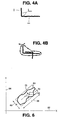
- Figs 4a and b shows a plurality of selectable objects.
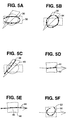
- Figs. 5a-f shows the relationship between gesture and object.
- Fig. 6 shows the factor used in analyzing an image object.
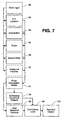
- Fig. 7 is a flow chart illustrating the pose description vector of an object on gesture.
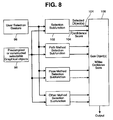
- Fig. 8 schematically illustrates the selection function.
- Fig. 9 is an overall flow chart of the selection routine.
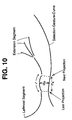
- Fig 10 illustrates an aspect of selection according to the invention.
- FIG. 1 One embodiment of a display editing system which is the subject of the present invention is shown generally in Fig. 1, wherein an input/display component 10 is illustrated, along with a data input device 12.
- the input/display component is a combination display device as well as an input device.
- input data entered by the input device 12 is shown on the display as entered.
- the input device 12 is any form of pointer or pointing device, such as a stylus, mouse, or even the operator's hand, sensed by appropriate proximity or other form of sensing devices. Other forms of input, such as scanned hard copy is also employable.
- data inputted by the input device 12 to the screen 10 and displayed on the screen is entered by means of a digitizer 14 which in turn drives a display driver 16 for creating images on the screen in real time as data is entered.
- the data digitized by the digitizer 14 is conveyed to a CPU 18, wherein it is processed by under control of a program stored in the program memory 20, and the results stored in a data memory 22.
- the display screen 10 can be employed to perform editing or drafting functions as desired by means of a menu selection 24, through the input device 12, and which is displayed directly on the display screen 10, along area 24.
- the foregoing digitizer input and display technique is representative of any of a plurality devices for the input and display of image objects, examples of which are readily apparent in the prior art.
- Fig 8 illustrates generally the procedures employed in accordance with the invention to select an image object, i.e. the selecting of an object or objects in an image that are best indicated by a given user-input selection gesture.
- an overall gesture matching function shown in Fig. 8, chooses among the outputs of a cadre of independent subfunctions.
- Each subfunction provides for a characteristic style or format of user selection gestures. For example, one subfunction may provide for the selection of a set of objects by encircling them, while another may let the user select a single object by drawing a slash through it.
- Each subfunction performs object-gesture matching under its own set of matching criteria, and it computes two items.
- the first item is the single object, or set of objects, that best matches the selection gesture, under that subfunction's criteria.
- the second item is a subfunction-confidence-score that estimates the "confidence or "likelihood" of this subfunction as the gesture selection format intended by the user.
- the overall gesture matching function compares subfunction-confidence-scores across gesture matching subfunctions, and returns the object(s) selected by the highest scoring subfunction (as long as this falls above a threshold value).
- user selection gesture 96 and precompiled or currently constructed selectable graphical objects 98 are each processed through a series of selection subfunction operations 102.
- each selection subfunction is a series of selected objects 104 and the respective confidence score 106 representing each of those objects.
- the series of objects scores are then gated in a final analysis 108 to produce the best match of an object for a gesture.
- this overall gesture matching function permits the present invention to incorporate an extensible set of object selection techniques.
- the user simply executes a selection gesture and the system infers user intent by comparing subfunction-confidence-scores across the available object selection subfunctions.
- subfunction-confidencescores may be compared across subfunctions in a meaningful way, in their design they must be calibrated to a common standard.
- each score ranges between 0 and 1, where 0 indicates that subfunction has no confidence that the object(s) it returns corresponds to the user's intent, while 1 indicates absolute certainty.
- an extremely simple measure of confidence score for an "encircling" gesture may be expressed as one minus the weighted ratio of the distance between the curve's endpoints and the curve's length.
- Two selection subfunctions are disclosed herein that may be used as selection subfunctions 102 to produce selected objects 104 in the above architecture. It is apparent, however, that the invention is not limited to these two embodiments
- a "pose-matching" routine results in a selection of a single object that is most similar to (least different from) the location, orientation, size, and shape of the user selection gesture. This routine is especially useful for singling out objects found in close or overlapping proximity to many other spurious objects.
- a "path-matching" routine selects and computes a set of objects in the image that best corresponds to the path of a selection gesture. This routine is especially useful for quickly selecting several objects lying along a curvilinear path. It is of course apparent that other techniques may alternatively be employed.
- Fig. 2a-e illustrates one aspect of the invention, wherein Fig. 2a is a free hand example of a line drawing graphic image or a structural graphic image. Figs. 2b-e each show objects, as indicated by the solid lines, that a user might wish to select from the image.
- a plurality of overlapping image objects drawn on a display screen is illustrated.
- Object selection by conventional spatial location fails when the objects lie in roughly the same location on the imaging surface, as do the rectangle, circle and triangle in this figure.
- Figs 4a and 4b selection by pointing to a point on an object fails when objects share support.
- Fig. 4a three selectable objects are constructed from two line segments. Conventional selection of the horizontal segment does not distinguish between selection of only the horizontal segment versus selection of the "L”.
- Fig. 4b conventional encircling gestures fail when spurious objects fall within the region enclosed by the target selected objects.
- Figs 5a-f selection of one of a plurality of overlapping image objects, in accordance with the invention, is made by appropriately coupling a gesture to an object.
- the object selected by gesture 30 is the rectangular object 32.
- circle gesture 34 selects the circular object 36.
- the line gesture 38 selects the triangular object 40.
- gesture 41 selects the short line segment 42.
- gesture 44 selects the long line segment 46 passing through the box 48.
- the circle gesture 50 selects the box 52.
- the gesture 38 need not even closely resemble the object selected, but is just a shorthand indication of location, orientation and size of the target object.
- a horizontal gesture could be used to select the rectangle in Fig 5a.
- an effective parametric description of the pose that is, the object or gesture's 60 rough location, orientation, size, and shape, consists of the following five parameters: the x-location (x) on the abscissa 62, y-location (y) on the ordinate 64, orientation 66, scale factors, such as length 68 and or width 69, and aspect ratio (r) parameters of an oriented bounding box 70 associated with the object (with respect to a fixed global coordinate system).
- the x-y location may be computed as the centroid of the ON pixels of the object.
- the orientation parameter may be taken as the orientation of the principal axis of inertia through the centroid.
- the scale parameter may be computed as a linear function of the logarithm of the length of the object (linear extent along the principal axis of inertia).
- the aspect ratio may be taken as the maximum of a fixed minimum value and the ratio of the object's width (linear extent along the axis perpendicular to the principal axis of inertia) and length.
- the pose description vector is extensible and may be imbued with more parameters than the five named above in order to provide more distinguishing information. As shown in Fig.
- the data input 80 is employed to derive x-y location 82, orientation 84, scale 86, aspect ratio 88, and any additional parameters 90 to define a pose description vector 92 which is a characteristic description representative of an object or gesture.
- additional parameters could include higher order geometric moments, angular closure, and contour texture measures.
- the pose description vector defines, for each image object, a first characteristic descriptor, stored in location 94 it also defines, for each user selection gesture, a second characteristic descriptor, stored in a location 96.
- a comparison and analysis function 98 is then performed between the defined graphical objects and the user selection gesture to determine a confidence level for determining that object which best meets the user selection gesture.
- the resultant selected object 100 is then defined.
- the confidence level and selection process is described in more detail in connection with Fig 8.
- the pose-matching routine (Fig. 9) for assessing the similarity/difference of two poses must take account of the relative significance of the location, orientation, scale, and aspect ratio parameters jointly in a highly nonlinear fashion; a simple Euclidian distance measure is inappropriate.
- the difference in the orientation parameters of poses is significant when the aspect ratio of both objects is relatively high (near 0) but becomes insignificant when either object displays low aspect ratio (near 1).
- the difference formula is incorporated in the pose-matching routine by prescreening candidate objects on the basis of spatial location using a spatially- and scale-indexed data structure which is described in the aforementioned copending application based on U.S. S.N. 08/101,646.
- the pose difference between the selection gesture and each of these preselected objects is computed in turn, and the object with the least difference is returned. Since the pose match distance D above ranges from 0 (perfect match) to 1 (no match), the subfunction-confidence-score may be taken simply as 1 - D.
- the overall matching operation as described in Fig. 9, first shows an input gesture applied to the system, block 120.
- the system creates pose parameters for the input gesture, block 122.
- candidate objects are selected based on proximity to the input gesture, block 126.
- the system does a lookup for pose parameters for candidate objects, block 128.
- the system compares the sets of pose parameters for the input gesture with those of candidate objects, block 130, and chooses the most similar object.
- this invention provides a path-matching selection subfunction which collects a set of image objects that best accounts for the path of the selection-gesture-curve
- a path-matching selection subfunction which collects a set of image objects that best accounts for the path of the selection-gesture-curve
- a path-quality measure that estimates the similarity between a path and a selection-gesture-curve.
- the path-quality measure for any path is computed by a set of steps in a routine as follows:
- the path-list consisting of a list of paths along with their actual scores s a , and their. best-possiblescores, s b
- the basic search algorithm proceeds as follows.
Landscapes
- Engineering & Computer Science (AREA)
- Theoretical Computer Science (AREA)
- Physics & Mathematics (AREA)
- General Physics & Mathematics (AREA)
- General Engineering & Computer Science (AREA)
- Computer Vision & Pattern Recognition (AREA)
- Multimedia (AREA)
- Human Computer Interaction (AREA)
- Digital Computer Display Output (AREA)
- User Interface Of Digital Computer (AREA)
- Processing Or Creating Images (AREA)
- Image Analysis (AREA)
Claims (10)
- Verfahren zum Auswählen eines grafischen Objekts (32, 36, 40, 42, 46, 48, 52, 98) in einem Displaysystem, wobei das Objekt zu einer Auswahlgeste (30, 34, 38, 41, 44, 50, 96), die in bezug auf den Display (10) vorgenommen wird, den engsten Bezug aufweist, wobei das Verfahren den Schritt des Eingebens (120) einer Auswahlgeste umfasst,
dadurch gekennzeichnet, dass das Verfahren weiterhin die Schritte umfasst:Erzeugen (122) eines charakteristischen Deskriptors (92) für die eingegebene Geste,Auswählen (126) des Objekts oder der Objekte aus einer Sammlung (124) gespeicherter Objekte, das bzw. die der eingegebenen Geste am nächsten ist bzw. sind,Abrufen (128) von charakteristischen Deskriptoren (92), die die ausgewählten Objekte (104) darstellen, undVergleichen (130) der zwei Sätze von Deskriptoren zum Auswählen des Objekts, das der Auswahlgeste am nächsten entspricht. - Verfahren nach Anspruch 1, weiterhin gekennzeichnet durch den Schritt des Erzeugens des charakteristischen Deskriptors eines Objektes durch:Bestimmen, mit Bezug auf einen festen Ort, des X-Y-Ortes des Objektes,Bestimmen der Orientierung des Objekts,Bestimmen einer Funktion der Länge des Objektes,Bestimmen des Seitenverhältnisses des Objektes, undGenerieren des charakteristischen Deskriptors des Objekts aus den vorangegangenen Bestimmungen.
- Verfahren nach Anspruch 1 oder 2, dadurch gekennzeichnet, dass das Erzeugen des charakteristischen Deskriptors der Geste mit Bezug auf einen festen Ort die folgenden Schritte umfasst:Bestimmen des X-Y-Ortes der Geste,Bestimmen der Orientierung der Geste,Bestimmen der Funktion der Länge der Geste,Bestimmen des Seitenverhältnisses der Geste, undGenerieren des charakteristischen Deskriptors der Geste aus den vorangegangenen Bestimmungen.
- Verfahren nach einem der Ansprüche 1 bis 3, dadurch gekennzeichnet, dass:die Auswahl zum Editieren erfolgt,die Objekte überlappen dürfen,das Verfahren den Schritt des Eingebens einer Vielzahl von Bildobjekten auf der Displayfläche umfasst, unddas Verfahren den Schritt des Speichems des charakteristischen Deskriptors umfasst.
- Verfahren nach einem der Ansprüche 1 bis 4, gekennzeichnet durch die Schritte:Auswählen eines Satzes von der Geste entsprechenden Objekten,Berechnen eines Differenzfaktors zwischen jedem Objekt und der Geste, und Auswählen des einen der ersten charakteristischen Deskriptoren, der den geringsten Differenzfaktor zwischen einem der Objekte und der Geste darstellt.
- Verfahren nach einem der Ansprüche 1 bis 5, weiterhin gekennzeichnet durch den Schritt des Auswählens eines Pfades aus einer Vielzahl von aus Liniensegmenten gebildeten Pfaden, wobei der Pfad aus einer Sammlung primitiver, in geeigneter Weise miteinander in Beziehung stehender Objekte eines Bildes gebildet ist, wobei der Schritt des Auswählens eines Pfades umfasst:Eingeben der Vielzahl primitiver Objekte auf der Displayfläche,Generieren einer Pfadliste, die einer Vielzahl unvollständiger Pfade entspricht, die eine Abfolge primitiver Objekte darstellen;Vergleichen der eingegebenen Auswahlgestenkurve mit Teilkurven der Pfadliste, undAuswählen wenigstens eines der Pfade, der der eingegebenen Auswahlgestenkurve am nächsten entspricht.
- Verfahren nach Anspruch 6, dadurch gekennzeichnet, dass die primitiven Objekte eine Abfolge von primitiven Liniensegmenten, die näherungsweise miteinander verbunden sind, umfassen, wobei keine der primitiven Liniensegmente eine Überkreuzung, Verbindungen oder scharfe Ecken aufweist.
- Verfahren nach Anspruch 6 oder 7, dadurch gekennzeichnet, dass der Schritt des Auswählens das Hinzufügen eines ausgewählten Pfades zu der Liste von Pfaden umfasst, bis die endgültige Linie von Pfaden den besten aller ausgewählten Pfade darstellt.
- Displayeditiersystem zum Auswählen eines grafischen Objekts (32, 36, 42, 46, 48, 52, 98), das den engsten Bezug zu einer Auswahlgeste (30, 34, 38, 41, 44, 50, 96) aufweist, wobei das System umfasst:Displaymittel (10);Mittel zum Eingeben einer Auswahlgeste;Mittel zum Erzeugen eines charakteristischen Deskriptors (92) für die eingegebene Geste;Mittel zum Auswählen des Objekts oder der Objekte aus einer Sammlung gespeicherter Objekte, das bzw. die der eingegebenen Geste am nächsten ist bzw. sind;Mittel zum Abrufen charakteristischer Deskriptoren, die die ausgewählten Objekte darstellen; undMittel zum Vergleichen der zwei Sätze von Deskriptoren zum Auswählen des Objekts, das der Auswahlgeste am nächsten entspricht.
- System nach Anspruch 9, eingerichtet zum Durchführen des Verfahrens nach einem der Ansprüche 1 bis 8.
Applications Claiming Priority (2)
| Application Number | Priority Date | Filing Date | Title |
|---|---|---|---|
| US101645 | 1993-08-04 | ||
| US08/101,645 US5485565A (en) | 1993-08-04 | 1993-08-04 | Gestural indicators for selecting graphic objects |
Publications (3)
| Publication Number | Publication Date |
|---|---|
| EP0637795A2 EP0637795A2 (de) | 1995-02-08 |
| EP0637795A3 EP0637795A3 (de) | 1996-10-02 |
| EP0637795B1 true EP0637795B1 (de) | 2001-04-04 |
Family
ID=22285711
Family Applications (1)
| Application Number | Title | Priority Date | Filing Date |
|---|---|---|---|
| EP94305720A Expired - Lifetime EP0637795B1 (de) | 1993-08-04 | 1994-08-02 | Gebärdenanzeige zur Auswahl graphischer Objekte |
Country Status (4)
| Country | Link |
|---|---|
| US (1) | US5485565A (de) |
| EP (1) | EP0637795B1 (de) |
| JP (1) | JP3857328B2 (de) |
| DE (1) | DE69427004T2 (de) |
Families Citing this family (76)
| Publication number | Priority date | Publication date | Assignee | Title |
|---|---|---|---|---|
| US8352400B2 (en) | 1991-12-23 | 2013-01-08 | Hoffberg Steven M | Adaptive pattern recognition based controller apparatus and method and human-factored interface therefore |
| JPH07160827A (ja) * | 1993-12-09 | 1995-06-23 | Matsushita Electric Ind Co Ltd | 手書きストローク編集装置及び方法 |
| JP3483333B2 (ja) * | 1995-02-23 | 2004-01-06 | キヤノン株式会社 | 図形処理方法及び装置 |
| US5784061A (en) * | 1996-06-26 | 1998-07-21 | Xerox Corporation | Method and apparatus for collapsing and expanding selected regions on a work space of a computer controlled display system |
| SE9803257D0 (sv) | 1998-09-25 | 1998-09-25 | Camp Scandinavia Ab | Knäortos med sagittal justering |
| US7904187B2 (en) | 1999-02-01 | 2011-03-08 | Hoffberg Steven M | Internet appliance system and method |
| US7391422B1 (en) | 1999-12-22 | 2008-06-24 | Adobe Systems Incorporated | Method and apparatus for painting groups of objects |
| US7251775B1 (en) * | 2000-06-30 | 2007-07-31 | Nokia Corporation | System and method for visual history presentation and management |
| US6970828B2 (en) * | 2000-12-19 | 2005-11-29 | Xerox Corporation | Method for mixed human and computer-supported distributed scheduling |
| JP2003162370A (ja) * | 2001-09-14 | 2003-06-06 | Ricoh Co Ltd | 画像処理装置、タッチパネル付きディスプレイ装置、画像処理方法、および画像処理方法をコンピュータに実行させるプログラム |
| US6990639B2 (en) * | 2002-02-07 | 2006-01-24 | Microsoft Corporation | System and process for controlling electronic components in a ubiquitous computing environment using multimodal integration |
| US7086013B2 (en) | 2002-03-22 | 2006-08-01 | Xerox Corporation | Method and system for overloading loop selection commands in a system for selecting and arranging visible material in document images |
| US7093202B2 (en) | 2002-03-22 | 2006-08-15 | Xerox Corporation | Method and system for interpreting imprecise object selection paths |
| US7299424B2 (en) * | 2002-05-14 | 2007-11-20 | Microsoft Corporation | Lasso select |
| US7137077B2 (en) * | 2002-07-30 | 2006-11-14 | Microsoft Corporation | Freeform encounter selection tool |
| US7065718B2 (en) * | 2002-08-08 | 2006-06-20 | International Business Machines Corporation | System and method for configuring time related settings using a graphical interface |
| US7089507B2 (en) * | 2002-08-12 | 2006-08-08 | International Business Machines Corporation | System and method for display views using a single stroke control |
| US7505048B2 (en) * | 2003-04-25 | 2009-03-17 | Microsoft Corporation | Estimation of overlap of polygons |
| EP1639439A2 (de) * | 2003-06-13 | 2006-03-29 | The University Of Lancaster | Benutzerschnittstelle |
| DE10344238A1 (de) * | 2003-09-24 | 2005-04-28 | Oce Printing Systems Gmbh | Verfahren und Einrichtung zur Korrektur der Papierschrumpfung bei der Generierung einer Bitmap |
| US7895537B2 (en) * | 2003-12-29 | 2011-02-22 | International Business Machines Corporation | Method and apparatus for setting attributes and initiating actions through gestures |
| US7631276B2 (en) | 2003-12-29 | 2009-12-08 | International Business Machines Corporation | Method for indication and navigating related items |
| US7496385B2 (en) * | 2003-12-29 | 2009-02-24 | International Business Machines Corporation | Method for viewing information underlying lists and other contexts |
| US7707039B2 (en) * | 2004-02-15 | 2010-04-27 | Exbiblio B.V. | Automatic modification of web pages |
| US8442331B2 (en) | 2004-02-15 | 2013-05-14 | Google Inc. | Capturing text from rendered documents using supplemental information |
| JP4213052B2 (ja) * | 2004-01-28 | 2009-01-21 | 任天堂株式会社 | タッチパネル入力を用いたゲームシステム |
| US10635723B2 (en) | 2004-02-15 | 2020-04-28 | Google Llc | Search engines and systems with handheld document data capture devices |
| US20060041484A1 (en) * | 2004-04-01 | 2006-02-23 | King Martin T | Methods and systems for initiating application processes by data capture from rendered documents |
| US20060122983A1 (en) * | 2004-12-03 | 2006-06-08 | King Martin T | Locating electronic instances of documents based on rendered instances, document fragment digest generation, and digest based document fragment determination |
| US20060041605A1 (en) * | 2004-04-01 | 2006-02-23 | King Martin T | Determining actions involving captured information and electronic content associated with rendered documents |
| US7812860B2 (en) * | 2004-04-01 | 2010-10-12 | Exbiblio B.V. | Handheld device for capturing text from both a document printed on paper and a document displayed on a dynamic display device |
| US20060053097A1 (en) * | 2004-04-01 | 2006-03-09 | King Martin T | Searching and accessing documents on private networks for use with captures from rendered documents |
| JP4159491B2 (ja) * | 2004-02-23 | 2008-10-01 | 任天堂株式会社 | ゲームプログラムおよびゲーム装置 |
| US7990556B2 (en) | 2004-12-03 | 2011-08-02 | Google Inc. | Association of a portable scanner with input/output and storage devices |
| US9143638B2 (en) | 2004-04-01 | 2015-09-22 | Google Inc. | Data capture from rendered documents using handheld device |
| US8146156B2 (en) | 2004-04-01 | 2012-03-27 | Google Inc. | Archive of text captures from rendered documents |
| US9116890B2 (en) | 2004-04-01 | 2015-08-25 | Google Inc. | Triggering actions in response to optically or acoustically capturing keywords from a rendered document |
| US20060098900A1 (en) * | 2004-09-27 | 2006-05-11 | King Martin T | Secure data gathering from rendered documents |
| US9008447B2 (en) * | 2004-04-01 | 2015-04-14 | Google Inc. | Method and system for character recognition |
| US20060081714A1 (en) | 2004-08-23 | 2006-04-20 | King Martin T | Portable scanning device |
| US7894670B2 (en) | 2004-04-01 | 2011-02-22 | Exbiblio B.V. | Triggering actions in response to optically or acoustically capturing keywords from a rendered document |
| US8489624B2 (en) * | 2004-05-17 | 2013-07-16 | Google, Inc. | Processing techniques for text capture from a rendered document |
| US8620083B2 (en) | 2004-12-03 | 2013-12-31 | Google Inc. | Method and system for character recognition |
| US8874504B2 (en) * | 2004-12-03 | 2014-10-28 | Google Inc. | Processing techniques for visual capture data from a rendered document |
| JP2005346467A (ja) * | 2004-06-03 | 2005-12-15 | Nintendo Co Ltd | 図形認識プログラム |
| JP4756876B2 (ja) * | 2004-06-09 | 2011-08-24 | キヤノン株式会社 | 画像表示制御装置、画像表示制御方法、プログラム、及び記憶媒体 |
| US8346620B2 (en) | 2004-07-19 | 2013-01-01 | Google Inc. | Automatic modification of web pages |
| JP4717489B2 (ja) * | 2005-04-07 | 2011-07-06 | 任天堂株式会社 | ゲームプログラム |
| US7779362B1 (en) * | 2005-09-02 | 2010-08-17 | Adobe Systems Inc. | Methods and apparatus for selecting objects by state |
| US7986298B1 (en) * | 2005-12-19 | 2011-07-26 | Adobe Systems Incorporated | Identifying changes to an image file |
| US7982747B1 (en) | 2005-12-19 | 2011-07-19 | Adobe Systems Incorporated | Displaying generated changes to an image file |
| KR100698845B1 (ko) * | 2005-12-28 | 2007-03-22 | 삼성전자주식회사 | 인물 외형 추출 알고리즘을 이용한 영상 편집 방법 및 그장치 |
| EP2067119A2 (de) * | 2006-09-08 | 2009-06-10 | Exbiblio B.V. | Optische scanner, zum beispiel tragbare optische scanner |
| KR101443404B1 (ko) * | 2006-09-15 | 2014-10-02 | 구글 인코포레이티드 | 페이퍼 및 전자 문서내의 주석의 캡처 및 디스플레이 |
| US8269727B2 (en) | 2007-01-03 | 2012-09-18 | Apple Inc. | Irregular input identification |
| US8014607B2 (en) * | 2007-03-23 | 2011-09-06 | Palo Alto Research Center Incorporated | Method and apparatus for creating and editing node-link diagrams in pen computing systems |
| US7907141B2 (en) * | 2007-03-23 | 2011-03-15 | Palo Alto Research Center Incorporated | Methods and processes for recognition of electronic ink strokes |
| US20110145068A1 (en) * | 2007-09-17 | 2011-06-16 | King Martin T | Associating rendered advertisements with digital content |
| WO2009046272A1 (en) * | 2007-10-05 | 2009-04-09 | Kalido, Inc. | Gesture based modeling system and method |
| JP4636141B2 (ja) * | 2008-08-28 | 2011-02-23 | ソニー株式会社 | 情報処理装置および方法、並びにプログラム |
| US8423916B2 (en) * | 2008-11-20 | 2013-04-16 | Canon Kabushiki Kaisha | Information processing apparatus, processing method thereof, and computer-readable storage medium |
| WO2010096193A2 (en) * | 2009-02-18 | 2010-08-26 | Exbiblio B.V. | Identifying a document by performing spectral analysis on the contents of the document |
| EP2406767A4 (de) * | 2009-03-12 | 2016-03-16 | Google Inc | Automatische bereitstellung von mit erfassten informationen, z. b. in echtzeit erfassten informationen, assoziierten inhalten |
| US8447066B2 (en) | 2009-03-12 | 2013-05-21 | Google Inc. | Performing actions based on capturing information from rendered documents, such as documents under copyright |
| US9250788B2 (en) * | 2009-03-18 | 2016-02-02 | IdentifyMine, Inc. | Gesture handlers of a gesture engine |
| US9081799B2 (en) * | 2009-12-04 | 2015-07-14 | Google Inc. | Using gestalt information to identify locations in printed information |
| US9323784B2 (en) * | 2009-12-09 | 2016-04-26 | Google Inc. | Image search using text-based elements within the contents of images |
| US20140181753A1 (en) * | 2011-04-26 | 2014-06-26 | Kyocera Corporation | Electronic device |
| EP2788839A4 (de) * | 2011-12-06 | 2015-12-16 | Thomson Licensing | Verfahren und system zum antworten auf benutzergesten zur auswahl von in drei dimensionen angezeigten objekten |
| US9213420B2 (en) | 2012-03-20 | 2015-12-15 | A9.Com, Inc. | Structured lighting based content interactions |
| US9367124B2 (en) | 2012-03-20 | 2016-06-14 | A9.Com, Inc. | Multi-application content interactions |
| WO2013142625A2 (en) * | 2012-03-20 | 2013-09-26 | A9.Com, Inc. | Structured lighting-based content interactions in multiple environments |
| US9373025B2 (en) | 2012-03-20 | 2016-06-21 | A9.Com, Inc. | Structured lighting-based content interactions in multiple environments |
| US9304646B2 (en) | 2012-03-20 | 2016-04-05 | A9.Com, Inc. | Multi-user content interactions |
| WO2014117384A1 (en) * | 2013-02-01 | 2014-08-07 | Intel Corporation | Techniques for image-based search using touch controls |
| US20140223382A1 (en) * | 2013-02-01 | 2014-08-07 | Barnesandnoble.Com Llc | Z-shaped gesture for touch sensitive ui undo, delete, and clear functions |
Family Cites Families (1)
| Publication number | Priority date | Publication date | Assignee | Title |
|---|---|---|---|---|
| US5010500A (en) * | 1989-01-26 | 1991-04-23 | Xerox Corporation | Gesture-modified diagram for retrieval of image resembling diagram, with parts selectable for further interactive retrieval |
-
1993
- 1993-08-04 US US08/101,645 patent/US5485565A/en not_active Expired - Lifetime
-
1994
- 1994-07-27 JP JP17527994A patent/JP3857328B2/ja not_active Expired - Lifetime
- 1994-08-02 EP EP94305720A patent/EP0637795B1/de not_active Expired - Lifetime
- 1994-08-02 DE DE69427004T patent/DE69427004T2/de not_active Expired - Lifetime
Also Published As
| Publication number | Publication date |
|---|---|
| EP0637795A3 (de) | 1996-10-02 |
| JPH0764756A (ja) | 1995-03-10 |
| JP3857328B2 (ja) | 2006-12-13 |
| DE69427004T2 (de) | 2001-08-02 |
| DE69427004D1 (de) | 2001-05-10 |
| EP0637795A2 (de) | 1995-02-08 |
| US5485565A (en) | 1996-01-16 |
Similar Documents
| Publication | Publication Date | Title |
|---|---|---|
| US5485565A (en) | Gestural indicators for selecting graphic objects | |
| EP0203324B1 (de) | Grafikbetonungslicht angrenzend an ein Positionsanzeigesymbol | |
| JP3471920B2 (ja) | 計算処理上重要な対応を決定するための方法及びプロセッサ制御システムを作動する方法 | |
| US6252598B1 (en) | Video hand image computer interface | |
| KR100554430B1 (ko) | 윈도우 표시장치 | |
| US6842175B1 (en) | Tools for interacting with virtual environments | |
| JP3471919B2 (ja) | 機械作動方法及びプロセッサ制御機械を作動するために使用する方法 | |
| US7750911B2 (en) | Pen-based 3D drawing system with 3D mirror symmetric curve drawing | |
| US6377240B1 (en) | Drawing system using design guides | |
| US20130125069A1 (en) | System and Method for Interactive Labeling of a Collection of Images | |
| US20020080182A1 (en) | Three-dimensional window displaying apparatus and mehtod thereof | |
| EP0661620B1 (de) | Gerät und Verfahren zur Ausführung von vielen verkettenden Befehlsgesten in einen System mit Gestenbenutzerschnittstelle | |
| JPH07182492A (ja) | システム操作方法 | |
| JP3476651B2 (ja) | データ表示装置およびデータ表示プログラムを格納したコンピュータ読み取り可能な記録媒体 | |
| US4939672A (en) | Method and apparatus for classifying graphics segments to facilitate pick and display operation | |
| US7420556B2 (en) | Information processing method and information processing apparatus | |
| JP3237898B2 (ja) | 画像図形編集装置および画像図形編集装置の処理方法 | |
| US6968095B1 (en) | Image search apparatus and method, and computer readable memory | |
| JP3357760B2 (ja) | 文字図形入力編集装置 | |
| EP0559353B1 (de) | Rechnereingabevorrichtung und Methode für Freihandzeichungen | |
| WO2000065461A1 (en) | Tools for interacting with virtual environments | |
| US11430166B1 (en) | Facilitating generation of number-bullet objects | |
| JP2001202403A (ja) | 電子図面データ変換 | |
| JP3139902B2 (ja) | 図形認識方法及び装置 | |
| JP3388524B2 (ja) | イメージ入力装置 |
Legal Events
| Date | Code | Title | Description |
|---|---|---|---|
| PUAI | Public reference made under article 153(3) epc to a published international application that has entered the european phase |
Free format text: ORIGINAL CODE: 0009012 |
|
| AK | Designated contracting states |
Kind code of ref document: A2 Designated state(s): DE FR GB |
|
| PUAL | Search report despatched |
Free format text: ORIGINAL CODE: 0009013 |
|
| AK | Designated contracting states |
Kind code of ref document: A3 Designated state(s): DE FR GB |
|
| 17P | Request for examination filed |
Effective date: 19970402 |
|
| 17Q | First examination report despatched |
Effective date: 20000204 |
|
| GRAG | Despatch of communication of intention to grant |
Free format text: ORIGINAL CODE: EPIDOS AGRA |
|
| GRAG | Despatch of communication of intention to grant |
Free format text: ORIGINAL CODE: EPIDOS AGRA |
|
| GRAH | Despatch of communication of intention to grant a patent |
Free format text: ORIGINAL CODE: EPIDOS IGRA |
|
| GRAG | Despatch of communication of intention to grant |
Free format text: ORIGINAL CODE: EPIDOS AGRA |
|
| GRAH | Despatch of communication of intention to grant a patent |
Free format text: ORIGINAL CODE: EPIDOS IGRA |
|
| GRAH | Despatch of communication of intention to grant a patent |
Free format text: ORIGINAL CODE: EPIDOS IGRA |
|
| GRAA | (expected) grant |
Free format text: ORIGINAL CODE: 0009210 |
|
| AK | Designated contracting states |
Kind code of ref document: B1 Designated state(s): DE FR GB |
|
| REF | Corresponds to: |
Ref document number: 69427004 Country of ref document: DE Date of ref document: 20010510 |
|
| ET | Fr: translation filed | ||
| REG | Reference to a national code |
Ref country code: GB Ref legal event code: IF02 |
|
| PLBE | No opposition filed within time limit |
Free format text: ORIGINAL CODE: 0009261 |
|
| STAA | Information on the status of an ep patent application or granted ep patent |
Free format text: STATUS: NO OPPOSITION FILED WITHIN TIME LIMIT |
|
| 26N | No opposition filed | ||
| PGFP | Annual fee paid to national office [announced via postgrant information from national office to epo] |
Ref country code: DE Payment date: 20130722 Year of fee payment: 20 |
|
| PGFP | Annual fee paid to national office [announced via postgrant information from national office to epo] |
Ref country code: GB Payment date: 20130725 Year of fee payment: 20 Ref country code: FR Payment date: 20130820 Year of fee payment: 20 |
|
| REG | Reference to a national code |
Ref country code: DE Ref legal event code: R071 Ref document number: 69427004 Country of ref document: DE |
|
| REG | Reference to a national code |
Ref country code: GB Ref legal event code: PE20 Expiry date: 20140801 |
|
| PG25 | Lapsed in a contracting state [announced via postgrant information from national office to epo] |
Ref country code: DE Free format text: LAPSE BECAUSE OF EXPIRATION OF PROTECTION Effective date: 20140805 |
|
| PG25 | Lapsed in a contracting state [announced via postgrant information from national office to epo] |
Ref country code: GB Free format text: LAPSE BECAUSE OF EXPIRATION OF PROTECTION Effective date: 20140801 |