EP0628909A2 - Programm zur Ablaufverfolgung und Verfahren zur Ablaufverfolgung - Google Patents
Programm zur Ablaufverfolgung und Verfahren zur Ablaufverfolgung Download PDFInfo
- Publication number
- EP0628909A2 EP0628909A2 EP94108954A EP94108954A EP0628909A2 EP 0628909 A2 EP0628909 A2 EP 0628909A2 EP 94108954 A EP94108954 A EP 94108954A EP 94108954 A EP94108954 A EP 94108954A EP 0628909 A2 EP0628909 A2 EP 0628909A2
- Authority
- EP
- European Patent Office
- Prior art keywords
- address
- evaluation chip
- trace
- signal
- significant
- Prior art date
- Legal status (The legal status is an assumption and is not a legal conclusion. Google has not performed a legal analysis and makes no representation as to the accuracy of the status listed.)
- Withdrawn
Links
Images




Classifications
-
- G—PHYSICS
- G06—COMPUTING OR CALCULATING; COUNTING
- G06F—ELECTRIC DIGITAL DATA PROCESSING
- G06F11/00—Error detection; Error correction; Monitoring
- G06F11/36—Prevention of errors by analysis, debugging or testing of software
- G06F11/362—Debugging of software
- G06F11/3636—Debugging of software by tracing the execution of the program
-
- G—PHYSICS
- G06—COMPUTING OR CALCULATING; COUNTING
- G06F—ELECTRIC DIGITAL DATA PROCESSING
- G06F11/00—Error detection; Error correction; Monitoring
- G06F11/30—Monitoring
- G06F11/34—Recording or statistical evaluation of computer activity, e.g. of down time, of input/output operation ; Recording or statistical evaluation of user activity, e.g. usability assessment
- G06F11/3466—Performance evaluation by tracing or monitoring
- G06F11/348—Circuit details, i.e. tracer hardware
Definitions
- the present invention relates to a circuit and a method for tracing a program, and more specifically, to a circuit and a method for tracing a local variable in a program tracing.
- FIG. 1 there is shown a conventional evaluation system, in which an evaluation chip 1 is coupled through a conventional trace circuit 500 to a trace memory 2.
- the shown conventional trace circuit 500 is configured to record a content on an address bus 3, a content on a data bus 4, an instruction fetch/inverted data access status signal 6, an inverted read signal 5 and an inverted write signal 7 outputted from the evaluation chip 1, into the trace memory 2 in response to a trace strobe signal 10 produced from the inverted read signal 5 and the inverted write signal 10.
- some of evaluation chips are configured to output information for identifying a written register and a written value, in addition to the above mentioned signals.
- an internal register is mapped in an internal RAM space, and when the internal register has been written, information identifying the written register is outputted to the address bus as an internal RAM address, and the written value is outputted to the data bus as data written to the internal RAM.
- FIG. 2A shows a condition of the stack when a function y() is called out from a function x().
- the address of the base of the local variable of each function is stored in a "hl" register which will serve as a base pointer, and the access to the local variable is executed by a relative addressing through the "hl" register.
- the address to the local variable is not definitively fixed, but varies dependently upon the address of the stack top when the function is called out.
- the local variable "a" of the function x() called out when the stack top is 0FF04h as shown in Figure 3D and the local variable "e" of the function y() called out when the stack top is 0FF08h as shown in Figure 3E may have the same address of 0FF02h.
- the newest trace data is written onto the oldest trace data so that the oldest trace data are erased, and therefore, it in some cases becomes impossible to identify the local variables.
- the data is not subjected to the trace, and in certain cases, it is not recorded in the trace memory. In these cases, it is also impossible to identify the local variables.
- Another object of the present invention is to provide a tracing circuit and method capable of easily tracing the local variables.
- a trace circuit coupled between an evaluation chip and a trace memory which receives an accessed address, data and status from the evaluation chip, the trace circuit comprising a first latch means and latching a base pointer of a local variable from the evaluation chip, for outputting the latched base pointer to the trace memory, and a second latch means receiving and latching a program execution address from the evaluation chip, for outputting the latched program execution address to the trace memory, so that at the time of a data accessing, the contents of the first and second latch means are written into the trace memory together with the accessed address, the data and the status.
- a trace method in accordance with the present invention includes the step of calculating a variable offset of a local variable from an address and the value of a base pointer which are recorded in a trace memory, the step of searching a debug information table of a program being debugged, by means of the variable offset and a program execution address recorded in the trace memory, and the step of causing the content of a data access recorded in the trace memory to correspond to the local variable.
- Figure 4 is a block diagram of the evaluation system including a first embodiment of the trace circuit in accordance with the present invention.
- elements similar to those shown in Figure 1 are given the same Reference Numerals.
- an evaluation chip 1 is coupled to a trace memory 2 through a trace circuit 100 in accordance with the present invention.
- the evaluation chip 1 has an address bus 3, a data bus 4, an instruction fetch/inverted data access status signal terminal 6, an inverted read signal terminal 5 and an inverted write signal terminal 7, which are coupled to corresponding input terminals of the trace memory 2 through the trace circuit 100 without modification.
- the inverted read signal 5 and the inverted write signal 7 are supplied through inverters 30 and 31 to an OR gate 32, respectively, which in turn generates a trace strobe signal 10 supplied to the trace memory 2.
- the evaluation chip 1 is configured to output, when an internal register has been written, a register address 11 for identifying the internal register to which the writing was done, a written register data 12, and an inverted register write signal 13 informing the writing to the internal register.
- the trace circuit 100 includes a decoder 19 which receives the register address 11 and outputs a coincidence signal 15 when the register address 11 corresponds to a register (for example, "hl" register) which holds the address of the base of the local variable.
- the coincidence signal 15 is supplied to one input of an AND gate 34, which has its other input connected to receive the inverted register write signal 13 through an inverter 35, so that the AND gate 34 generates a strobe signal 16.
- the trace circuit 100 also includes a base pointer latch 20 which receives the register data 12, and latches the received register data 12 in response to the strobe signal 16.
- An output 14 of the base pointer latch 20 is coupled to a base pointer input of the trace memory 2.
- the trace circuit 100 includes a program execution address latch 18, which is connected to receive an address on the address bus 3 of the evaluation chip 1, and latches the received address in response to a fetch strobe signal 8, which is produced by an AND gate 36 receiving the instruction fetch/inverted data access status signal 6 and an output of the inverter 31.
- An output 14 of the program execution address latch 18 is coupled to a program execution address of the trace memory 2.
- the output 14 of the program execution address latch 18 and the output 17 of the base pointer latch 20 are written to the trace memory 2 together with the content of the address bus 3, the content of the data bus 4, the inverted read signal 5, the instruction fetch/inverted data access status signal 6, and the inverted write signal 7.
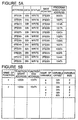
- Figure 5A is a diagrammatic view illustrating the content of the trace memory. In this figure, only the information at the data access is shown for simplification of the description.
- the trace memory In the trace memory, the address, the data, the status, the base pointer and the program execution address are stored.
- Figure 5B is a diagrammatic view illustrating a table of debug information produced by a C compiler.
- This table include names of function, function start addresses and function end addresses, and further has, for each of functions, a sub-table including the name of variable, the variable offset and the size of the variable contained in the function.
- Figure 5C shows a flow chart for identifying the local variable from the content of the trace memory in accordance with the present invention.
- variable offset is calculated by subtracting the value of the base pointer from the value of the address.
- a local variable is searched which fulfils a condition in which the calculated value of the variable offset is in the range from the variable offset of the local variable on the table to a value obtained by adding the variable size to the variable offset.
- the local variable is identified.
- an evaluation chip 1A contains an internal register mapped in an internal RAM space as shown in Figure 7, and has a 8-bit data bus 4 and a 16-bit address bus 3.
- the evaluation chip 1A outputs a register address to the address bus 3 as an internal RAM address and a register data is outputted to the data bus 4 as an internal RAM data, and also supplies an inverted internal RAM write signal 9.
- the evaluation chip 1A is configured to output an instruction fetch/inverted data access status signal 6, an inverted read signal 5 and an inverted write signal 7, similarly to the first embodiment.
- a trace circuit 200 of the second embodiment of the present invention has the program execution address latch 18, the inverter 31 and 32, the OR gate 33 and the AND gate 36, similarly to the first embodiment. Furthermore, since the data bus is 8 bits, the trace circuit 200 is configured in such a way that, the writing to the register (for example, "hl" register) which is allocated to hold the address of the base of the local variable is divided into two writings, that is, the writing to the most significant address register ("h" register) and the writing to the least significant address register ("l" register).
- the register for example, "hl" register
- the trace circuit 200 includes a decoder 25A connected to the address bus 3 of the evaluation chip 1A, for outputting a most significant register address coincidence signal 21 when the content of the address bus 3 coincides with the most significant register address, and a least significant register address coincidence signal 22 when the content of the address bus 3 coincides with the least significant register address.
- the most significant register address coincidence signal 21 is supplied to one input of an AND gate 37, which receives at its other input the inverted internal RAM write signal 9 through an inverter 40 and which generates a most significant register address strobe signal 23.
- the least significant register address coincidence signal 22 is supplied to one input of another AND gate 38, which has its other input connected to an output of the an inverter 40 receiving the inverted internal RAM write signal 9, and which generates and a least significant register address strobe signal 24.
- the trace circuit 200 also includes a most significant base address latch 26 and a least significant base address latch 27, which are coupled to the data bus 4 of the evaluation chip 1A, and which are controlled by the most significant register address strobe signal 23 and the least significant register address strobe signal 24.
- signals on the data bus 4 are latched to the most significant base address latch 26 in response to the most significant register address strobe signal 23, and to the least significant base address latch 27 in response to the least significant register address strobe signal 24.
- An output 14 of the program execution address latch 18 and an output 17 of the base pointer latch thus obtained are supplied to the trace memory 2, and written to the trance memory 2 similarly to the first embodiment.
- the value of the base pointer and the program execution address are written to the trace memory together with the accessed address, data and status. Accordingly, it is possible to easily cause the contents of the data access recorded in the trace memory to correspond to the local variables.
- the trace memory is filled and even in the case that the qualify trace or the section trace is executed, it is always possible to identity the local variables. Therefore, the trace data can be indicated by the name of the local variable in the source program. This is effective in improving the efficiency of the debugging.
Landscapes
- Engineering & Computer Science (AREA)
- Theoretical Computer Science (AREA)
- General Engineering & Computer Science (AREA)
- Computer Hardware Design (AREA)
- Quality & Reliability (AREA)
- Physics & Mathematics (AREA)
- General Physics & Mathematics (AREA)
- Debugging And Monitoring (AREA)
Applications Claiming Priority (2)
| Application Number | Priority Date | Filing Date | Title |
|---|---|---|---|
| JP139735/93 | 1993-06-11 | ||
| JP5139735A JP2669300B2 (ja) | 1993-06-11 | 1993-06-11 | プログラムトレース回路およびプログラムトレース方法 |
Publications (2)
| Publication Number | Publication Date |
|---|---|
| EP0628909A2 true EP0628909A2 (de) | 1994-12-14 |
| EP0628909A3 EP0628909A3 (de) | 1996-01-24 |
Family
ID=15252162
Family Applications (1)
| Application Number | Title | Priority Date | Filing Date |
|---|---|---|---|
| EP94108954A Withdrawn EP0628909A3 (de) | 1993-06-11 | 1994-06-10 | Programm zur Ablaufverfolgung und Verfahren zur Ablaufverfolgung. |
Country Status (2)
| Country | Link |
|---|---|
| EP (1) | EP0628909A3 (de) |
| JP (1) | JP2669300B2 (de) |
Families Citing this family (1)
| Publication number | Priority date | Publication date | Assignee | Title |
|---|---|---|---|---|
| WO2014147742A1 (ja) * | 2013-03-19 | 2014-09-25 | 富士通株式会社 | エラー分析方法、情報処理装置およびエラー分析プログラム |
Family Cites Families (6)
| Publication number | Priority date | Publication date | Assignee | Title |
|---|---|---|---|---|
| US5127103A (en) * | 1987-10-14 | 1992-06-30 | North American Philips Corporation | Real-time tracing of dynamic local data in high level languages in the presence of process context switches |
| JPH01137339A (ja) * | 1987-11-25 | 1989-05-30 | Mitsubishi Electric Corp | マイクロプロセッサ |
| DE69033759T2 (de) * | 1990-01-04 | 2002-05-08 | National Semiconductor Corp., Santa Clara | Vorrichtung die die Beobachtung interner speicherzugeordneten Register ermöglicht |
| JPH0497446A (ja) * | 1990-08-15 | 1992-03-30 | Nec Ibaraki Ltd | ファームウェアトレーサによるレジスタトレース回路 |
| JPH04190430A (ja) * | 1990-11-26 | 1992-07-08 | Mitsubishi Electric Corp | ソフトウェア開発用エミュレータ |
| JPH04350737A (ja) * | 1991-05-29 | 1992-12-04 | Nec Corp | マイクロコンピュータ |
-
1993
- 1993-06-11 JP JP5139735A patent/JP2669300B2/ja not_active Expired - Fee Related
-
1994
- 1994-06-10 EP EP94108954A patent/EP0628909A3/de not_active Withdrawn
Also Published As
| Publication number | Publication date |
|---|---|
| EP0628909A3 (de) | 1996-01-24 |
| JP2669300B2 (ja) | 1997-10-27 |
| JPH06348540A (ja) | 1994-12-22 |
Similar Documents
| Publication | Publication Date | Title |
|---|---|---|
| KR940002755B1 (ko) | 1칩 마이크로 컴퓨터 | |
| KR880000360B1 (ko) | 기억보호 검사방법 및 그 수행 시스템 | |
| US5608867A (en) | Debugging system using virtual storage means, a normal bus cycle and a debugging bus cycle | |
| JPS60168244A (ja) | ブレ−ク点回路 | |
| KR880013065A (ko) | 컴퓨터 리소스 구성방법 및 장치 | |
| US6321290B1 (en) | Program checking method, program checking apparatus, and computer-readable recording medium for recording target program checking program capable of reducing tracing interrupt time | |
| US4748556A (en) | Variable tracking word recognizer for detecting the occurrence of a dynamic-variable address | |
| EP0628909A2 (de) | Programm zur Ablaufverfolgung und Verfahren zur Ablaufverfolgung | |
| KR910014819A (ko) | 듀얼-포트 캐쉬 태그 메모리 | |
| JPS5987566A (ja) | メモリアクセス検出方式 | |
| EP0059758A1 (de) | Numerische steuereinheit | |
| US5126972A (en) | Arrangement and method of ascertaining memory addresses which have been accessed during program execution | |
| EP0463352B1 (de) | Schaltungsinnerer Emulatormikroprozessor mit getrenntem Nutzer- und Schaltungsinnerem Emulatorspeicher | |
| JPH05297911A (ja) | シーケンスコントローラ用シーケンス制御回路 | |
| JPH0581087A (ja) | プロセサのモニタ方式 | |
| JP2720792B2 (ja) | フレーム多重プロトコル用teiマッピング検索方式 | |
| JPH0756766A (ja) | トレース装置 | |
| JP3149575B2 (ja) | インサ−キット・エミュレ−タ | |
| JPH0412855B2 (de) | ||
| JPS60549A (ja) | メモリ試験方式 | |
| JPH02151940A (ja) | トレースメモリ方式 | |
| Wirth | Low-level facilities | |
| EP0644550A2 (de) | DRAM-Steuerschaltung | |
| JPH0341858B2 (de) | ||
| JPS5866162A (ja) | プログラム評価試験装置 |
Legal Events
| Date | Code | Title | Description |
|---|---|---|---|
| PUAI | Public reference made under article 153(3) epc to a published international application that has entered the european phase |
Free format text: ORIGINAL CODE: 0009012 |
|
| AK | Designated contracting states |
Kind code of ref document: A2 Designated state(s): DE FR GB |
|
| PUAL | Search report despatched |
Free format text: ORIGINAL CODE: 0009013 |
|
| AK | Designated contracting states |
Kind code of ref document: A3 Designated state(s): DE FR GB |
|
| STAA | Information on the status of an ep patent application or granted ep patent |
Free format text: STATUS: THE APPLICATION HAS BEEN WITHDRAWN |
|
| 18W | Application withdrawn |
Withdrawal date: 19960306 |