EP0627500B1 - Defluxing agent and cleaning method - Google Patents
Defluxing agent and cleaning method Download PDFInfo
- Publication number
- EP0627500B1 EP0627500B1 EP94108380A EP94108380A EP0627500B1 EP 0627500 B1 EP0627500 B1 EP 0627500B1 EP 94108380 A EP94108380 A EP 94108380A EP 94108380 A EP94108380 A EP 94108380A EP 0627500 B1 EP0627500 B1 EP 0627500B1
- Authority
- EP
- European Patent Office
- Prior art keywords
- acid
- defluxing agent
- cleaning
- organic solvent
- defluxing
- Prior art date
- Legal status (The legal status is an assumption and is not a legal conclusion. Google has not performed a legal analysis and makes no representation as to the accuracy of the status listed.)
- Expired - Lifetime
Links
Images



Classifications
-
- C—CHEMISTRY; METALLURGY
- C11—ANIMAL OR VEGETABLE OILS, FATS, FATTY SUBSTANCES OR WAXES; FATTY ACIDS THEREFROM; DETERGENTS; CANDLES
- C11D—DETERGENT COMPOSITIONS; USE OF SINGLE SUBSTANCES AS DETERGENTS; SOAP OR SOAP-MAKING; RESIN SOAPS; RECOVERY OF GLYCEROL
- C11D7/00—Compositions of detergents based essentially on non-surface-active compounds
- C11D7/22—Organic compounds
- C11D7/26—Organic compounds containing oxygen
- C11D7/261—Alcohols; Phenols
- C11D7/262—Alcohols; Phenols fatty or with at least 8 carbon atoms in the alkyl or alkenyl chain
-
- B—PERFORMING OPERATIONS; TRANSPORTING
- B23—MACHINE TOOLS; METAL-WORKING NOT OTHERWISE PROVIDED FOR
- B23K—SOLDERING OR UNSOLDERING; WELDING; CLADDING OR PLATING BY SOLDERING OR WELDING; CUTTING BY APPLYING HEAT LOCALLY, e.g. FLAME CUTTING; WORKING BY LASER BEAM
- B23K1/00—Soldering, e.g. brazing, or unsoldering
- B23K1/20—Preliminary treatment of work or areas to be soldered, e.g. in respect of a galvanic coating
- B23K1/203—Fluxing, i.e. applying flux onto surfaces
-
- C—CHEMISTRY; METALLURGY
- C11—ANIMAL OR VEGETABLE OILS, FATS, FATTY SUBSTANCES OR WAXES; FATTY ACIDS THEREFROM; DETERGENTS; CANDLES
- C11D—DETERGENT COMPOSITIONS; USE OF SINGLE SUBSTANCES AS DETERGENTS; SOAP OR SOAP-MAKING; RESIN SOAPS; RECOVERY OF GLYCEROL
- C11D7/00—Compositions of detergents based essentially on non-surface-active compounds
- C11D7/22—Organic compounds
- C11D7/26—Organic compounds containing oxygen
- C11D7/261—Alcohols; Phenols
-
- C—CHEMISTRY; METALLURGY
- C11—ANIMAL OR VEGETABLE OILS, FATS, FATTY SUBSTANCES OR WAXES; FATTY ACIDS THEREFROM; DETERGENTS; CANDLES
- C11D—DETERGENT COMPOSITIONS; USE OF SINGLE SUBSTANCES AS DETERGENTS; SOAP OR SOAP-MAKING; RESIN SOAPS; RECOVERY OF GLYCEROL
- C11D7/00—Compositions of detergents based essentially on non-surface-active compounds
- C11D7/22—Organic compounds
- C11D7/26—Organic compounds containing oxygen
- C11D7/263—Ethers
-
- C—CHEMISTRY; METALLURGY
- C11—ANIMAL OR VEGETABLE OILS, FATS, FATTY SUBSTANCES OR WAXES; FATTY ACIDS THEREFROM; DETERGENTS; CANDLES
- C11D—DETERGENT COMPOSITIONS; USE OF SINGLE SUBSTANCES AS DETERGENTS; SOAP OR SOAP-MAKING; RESIN SOAPS; RECOVERY OF GLYCEROL
- C11D7/00—Compositions of detergents based essentially on non-surface-active compounds
- C11D7/22—Organic compounds
- C11D7/26—Organic compounds containing oxygen
- C11D7/264—Aldehydes; Ketones; Acetals or ketals
-
- C—CHEMISTRY; METALLURGY
- C11—ANIMAL OR VEGETABLE OILS, FATS, FATTY SUBSTANCES OR WAXES; FATTY ACIDS THEREFROM; DETERGENTS; CANDLES
- C11D—DETERGENT COMPOSITIONS; USE OF SINGLE SUBSTANCES AS DETERGENTS; SOAP OR SOAP-MAKING; RESIN SOAPS; RECOVERY OF GLYCEROL
- C11D7/00—Compositions of detergents based essentially on non-surface-active compounds
- C11D7/22—Organic compounds
- C11D7/26—Organic compounds containing oxygen
- C11D7/266—Esters or carbonates
-
- C—CHEMISTRY; METALLURGY
- C11—ANIMAL OR VEGETABLE OILS, FATS, FATTY SUBSTANCES OR WAXES; FATTY ACIDS THEREFROM; DETERGENTS; CANDLES
- C11D—DETERGENT COMPOSITIONS; USE OF SINGLE SUBSTANCES AS DETERGENTS; SOAP OR SOAP-MAKING; RESIN SOAPS; RECOVERY OF GLYCEROL
- C11D7/00—Compositions of detergents based essentially on non-surface-active compounds
- C11D7/22—Organic compounds
- C11D7/32—Organic compounds containing nitrogen
- C11D7/3227—Ethers thereof
-
- C—CHEMISTRY; METALLURGY
- C11—ANIMAL OR VEGETABLE OILS, FATS, FATTY SUBSTANCES OR WAXES; FATTY ACIDS THEREFROM; DETERGENTS; CANDLES
- C11D—DETERGENT COMPOSITIONS; USE OF SINGLE SUBSTANCES AS DETERGENTS; SOAP OR SOAP-MAKING; RESIN SOAPS; RECOVERY OF GLYCEROL
- C11D7/00—Compositions of detergents based essentially on non-surface-active compounds
- C11D7/50—Solvents
- C11D7/5004—Organic solvents
- C11D7/5022—Organic solvents containing oxygen
-
- C—CHEMISTRY; METALLURGY
- C11—ANIMAL OR VEGETABLE OILS, FATS, FATTY SUBSTANCES OR WAXES; FATTY ACIDS THEREFROM; DETERGENTS; CANDLES
- C11D—DETERGENT COMPOSITIONS; USE OF SINGLE SUBSTANCES AS DETERGENTS; SOAP OR SOAP-MAKING; RESIN SOAPS; RECOVERY OF GLYCEROL
- C11D7/00—Compositions of detergents based essentially on non-surface-active compounds
- C11D7/50—Solvents
- C11D7/5004—Organic solvents
- C11D7/5027—Hydrocarbons
-
- C—CHEMISTRY; METALLURGY
- C23—COATING METALLIC MATERIAL; COATING MATERIAL WITH METALLIC MATERIAL; CHEMICAL SURFACE TREATMENT; DIFFUSION TREATMENT OF METALLIC MATERIAL; COATING BY VACUUM EVAPORATION, BY SPUTTERING, BY ION IMPLANTATION OR BY CHEMICAL VAPOUR DEPOSITION, IN GENERAL; INHIBITING CORROSION OF METALLIC MATERIAL OR INCRUSTATION IN GENERAL
- C23G—CLEANING OR DE-GREASING OF METALLIC MATERIAL BY CHEMICAL METHODS OTHER THAN ELECTROLYSIS
- C23G5/00—Cleaning or de-greasing metallic material by other methods; Apparatus for cleaning or de-greasing metallic material with organic solvents
- C23G5/02—Cleaning or de-greasing metallic material by other methods; Apparatus for cleaning or de-greasing metallic material with organic solvents using organic solvents
- C23G5/024—Cleaning or de-greasing metallic material by other methods; Apparatus for cleaning or de-greasing metallic material with organic solvents using organic solvents containing hydrocarbons
-
- C—CHEMISTRY; METALLURGY
- C23—COATING METALLIC MATERIAL; COATING MATERIAL WITH METALLIC MATERIAL; CHEMICAL SURFACE TREATMENT; DIFFUSION TREATMENT OF METALLIC MATERIAL; COATING BY VACUUM EVAPORATION, BY SPUTTERING, BY ION IMPLANTATION OR BY CHEMICAL VAPOUR DEPOSITION, IN GENERAL; INHIBITING CORROSION OF METALLIC MATERIAL OR INCRUSTATION IN GENERAL
- C23G—CLEANING OR DE-GREASING OF METALLIC MATERIAL BY CHEMICAL METHODS OTHER THAN ELECTROLYSIS
- C23G5/00—Cleaning or de-greasing metallic material by other methods; Apparatus for cleaning or de-greasing metallic material with organic solvents
- C23G5/02—Cleaning or de-greasing metallic material by other methods; Apparatus for cleaning or de-greasing metallic material with organic solvents using organic solvents
- C23G5/032—Cleaning or de-greasing metallic material by other methods; Apparatus for cleaning or de-greasing metallic material with organic solvents using organic solvents containing oxygen-containing compounds
-
- C—CHEMISTRY; METALLURGY
- C23—COATING METALLIC MATERIAL; COATING MATERIAL WITH METALLIC MATERIAL; CHEMICAL SURFACE TREATMENT; DIFFUSION TREATMENT OF METALLIC MATERIAL; COATING BY VACUUM EVAPORATION, BY SPUTTERING, BY ION IMPLANTATION OR BY CHEMICAL VAPOUR DEPOSITION, IN GENERAL; INHIBITING CORROSION OF METALLIC MATERIAL OR INCRUSTATION IN GENERAL
- C23G—CLEANING OR DE-GREASING OF METALLIC MATERIAL BY CHEMICAL METHODS OTHER THAN ELECTROLYSIS
- C23G5/00—Cleaning or de-greasing metallic material by other methods; Apparatus for cleaning or de-greasing metallic material with organic solvents
- C23G5/02—Cleaning or de-greasing metallic material by other methods; Apparatus for cleaning or de-greasing metallic material with organic solvents using organic solvents
- C23G5/04—Apparatus
-
- H—ELECTRICITY
- H05—ELECTRIC TECHNIQUES NOT OTHERWISE PROVIDED FOR
- H05K—PRINTED CIRCUITS; CASINGS OR CONSTRUCTIONAL DETAILS OF ELECTRIC APPARATUS; MANUFACTURE OF ASSEMBLAGES OF ELECTRICAL COMPONENTS
- H05K3/00—Apparatus or processes for manufacturing printed circuits
- H05K3/22—Secondary treatment of printed circuits
- H05K3/26—Cleaning or polishing of the conductive pattern
-
- C—CHEMISTRY; METALLURGY
- C11—ANIMAL OR VEGETABLE OILS, FATS, FATTY SUBSTANCES OR WAXES; FATTY ACIDS THEREFROM; DETERGENTS; CANDLES
- C11D—DETERGENT COMPOSITIONS; USE OF SINGLE SUBSTANCES AS DETERGENTS; SOAP OR SOAP-MAKING; RESIN SOAPS; RECOVERY OF GLYCEROL
- C11D2111/00—Cleaning compositions characterised by the objects to be cleaned; Cleaning compositions characterised by non-standard cleaning or washing processes
- C11D2111/10—Objects to be cleaned
- C11D2111/14—Hard surfaces
- C11D2111/22—Electronic devices, e.g. PCBs or semiconductors
-
- C—CHEMISTRY; METALLURGY
- C11—ANIMAL OR VEGETABLE OILS, FATS, FATTY SUBSTANCES OR WAXES; FATTY ACIDS THEREFROM; DETERGENTS; CANDLES
- C11D—DETERGENT COMPOSITIONS; USE OF SINGLE SUBSTANCES AS DETERGENTS; SOAP OR SOAP-MAKING; RESIN SOAPS; RECOVERY OF GLYCEROL
- C11D7/00—Compositions of detergents based essentially on non-surface-active compounds
- C11D7/22—Organic compounds
- C11D7/24—Hydrocarbons
-
- C—CHEMISTRY; METALLURGY
- C11—ANIMAL OR VEGETABLE OILS, FATS, FATTY SUBSTANCES OR WAXES; FATTY ACIDS THEREFROM; DETERGENTS; CANDLES
- C11D—DETERGENT COMPOSITIONS; USE OF SINGLE SUBSTANCES AS DETERGENTS; SOAP OR SOAP-MAKING; RESIN SOAPS; RECOVERY OF GLYCEROL
- C11D7/00—Compositions of detergents based essentially on non-surface-active compounds
- C11D7/22—Organic compounds
- C11D7/26—Organic compounds containing oxygen
- C11D7/265—Carboxylic acids or salts thereof
-
- H—ELECTRICITY
- H05—ELECTRIC TECHNIQUES NOT OTHERWISE PROVIDED FOR
- H05K—PRINTED CIRCUITS; CASINGS OR CONSTRUCTIONAL DETAILS OF ELECTRIC APPARATUS; MANUFACTURE OF ASSEMBLAGES OF ELECTRICAL COMPONENTS
- H05K2203/00—Indexing scheme relating to apparatus or processes for manufacturing printed circuits covered by H05K3/00
- H05K2203/02—Details related to mechanical or acoustic processing, e.g. drilling, punching, cutting, using ultrasound
- H05K2203/0257—Brushing, e.g. cleaning the conductive pattern by brushing or wiping
-
- H—ELECTRICITY
- H05—ELECTRIC TECHNIQUES NOT OTHERWISE PROVIDED FOR
- H05K—PRINTED CIRCUITS; CASINGS OR CONSTRUCTIONAL DETAILS OF ELECTRIC APPARATUS; MANUFACTURE OF ASSEMBLAGES OF ELECTRICAL COMPONENTS
- H05K2203/00—Indexing scheme relating to apparatus or processes for manufacturing printed circuits covered by H05K3/00
- H05K2203/07—Treatments involving liquids, e.g. plating, rinsing
- H05K2203/0779—Treatments involving liquids, e.g. plating, rinsing characterised by the specific liquids involved
- H05K2203/0783—Using solvent, e.g. for cleaning; Regulating solvent content of pastes or coatings for adjusting the viscosity
-
- H—ELECTRICITY
- H05—ELECTRIC TECHNIQUES NOT OTHERWISE PROVIDED FOR
- H05K—PRINTED CIRCUITS; CASINGS OR CONSTRUCTIONAL DETAILS OF ELECTRIC APPARATUS; MANUFACTURE OF ASSEMBLAGES OF ELECTRICAL COMPONENTS
- H05K2203/00—Indexing scheme relating to apparatus or processes for manufacturing printed circuits covered by H05K3/00
- H05K2203/08—Treatments involving gases
- H05K2203/086—Using an inert gas
-
- H—ELECTRICITY
- H05—ELECTRIC TECHNIQUES NOT OTHERWISE PROVIDED FOR
- H05K—PRINTED CIRCUITS; CASINGS OR CONSTRUCTIONAL DETAILS OF ELECTRIC APPARATUS; MANUFACTURE OF ASSEMBLAGES OF ELECTRICAL COMPONENTS
- H05K2203/00—Indexing scheme relating to apparatus or processes for manufacturing printed circuits covered by H05K3/00
- H05K2203/15—Position of the PCB during processing
- H05K2203/1518—Vertically held PCB
Definitions
- the present invention relates to a defluxing agent, a cleaning method and a cleaning apparatus, and especially it relates to a defluxing agent, cleaning method and cleaning apparatus for non-chlorine-type defluxing after soldering.
- the post-solder flux has conventionally been cleaned for removal using 1,1,1-trichloroethane.
- 1,1,1-trichloroethane not only has a high ability to dissolve rosin, the main component of post-solder flux, but it also has a low toxicity and no inflammation point, giving it superior safety as a defluxing agent, and it has thus been indispensable for the cleaning of flux.
- the substitute defluxing agent for 1,1,1-trichloroethane must not simply dissolve the rosin prior to heating but must also dissolve the altered flux components which have reacted due to heat.
- WO-A-91/06690 discloses a mixture for cleaning printed circuit boards containing at least one aliphatic hydrocarbon of an average 8 - 20 carbon atoms and at least one organic compound with at least one polar group.
- Carboxylic acid is one example of the polar organic compound.
- US-A-3 994 751 discloses an activator for upgrading the adhesion ability of titanium and stainless steel prior to painting, comprising a solvent, acetic acid and water.
- US-A-4 087 370 discloses a solution for removing a photopolymer film resist from a substrate, which solution comprises a substantial amount of water.
- EP-A-0 052 786 discloses a degreasing agent comprising a solvent and an unsaturated fatty acid.
- EP-A-0 482 890 discloses cleaning equipment for cleaning electronic parts and the like by using a solvent.
- a defluxing agent comprising an organic acid and an organic solvent, said organic acid comprising at least one of acrylic acid, acetic acid, propionic acid and benzoic acid, said organic solvent comprising at least one of aromatic compounds, hydroxy compounds, ketones, ethers and esters, which has a boiling point of 50 to 250°C at one atmosphere and contains no chlorine or fluorine atoms, said defluxing agent containing no water.
- a method including the steps of soldering a member to a substrate using flux, cleaning the flux remaining on the substrate with a defluxing agent containing an acid and an organic solvent, and cleaning the substrate with a liquid (second liquid) which contains no acid and readily mixes with said acid-containing defluxing agent to remove the acid;
- said defluxing agent comprises an organic acid and an organic solvent, said organic acid comprising at least one of acrylic acid, acetic acid, propionic acid and benzoic acid, said organic solvent comprising at least one of aromatic compounds, hydroxy compounds, ketones, ethers and esters, which has a boiling point of 50 to 250°C at one atmosphere and contains no chlorine or fluorine atoms, and wherein said defluxing agent contains no water.
- the present invention provides, with the purpose of overcoming the above mentioned problems, a defluxing agent containing an acid and an organic solvent.
- Flux consists of rosin (which consists mainly of abietic acid and derivatives thereof), an activator (normally an amine hydrochloride or the like) and an organic solvent, and after it is applied to the area to be soldered it is heated for soldering, and the residual flux must be cleaned away lest it become a cause of metal corrosion and impair the overall appearance.
- solvents including monohydric alcohols such as methyl alcohol, ethyl alcohol, n-propanol, isopropanol, n-butanol, etc.; esters such as ethyl acetate, isopropyl acetate, etc.; polyhydric alcohol derivatives such as ethylene glycol monomethyl ether, ethylene glycol monoethyl ether, diethylene glycol monomethyl ether, diethylene glycol monoethyl ether, ethylene glycol dimethyl ether, ethylene glycol diethyl ether, diethylene glycol dimethyl ether, diethylene glycol diethyl ether, etc., and the like.
- monohydric alcohols, esters and polyhydric alcohol derivatives mentioned here cannot dissolve heat-altered flux after soldering.
- the type of acid and the type of solvent used in admixture therewith in the defluxing agent may be freely selected depending on the purpose of use. Also, the acid and organic solvent may each be mixtures of 2 or more components.
- the acid to be used here is not particularly restricted, but acids stronger than abietic acid are preferred because they allow easy cleaning at room temperature, and also because they have a more excellent cleaning effect since most flux has abietic acid or a derivative thereof as a major component, causing the heat-altered flux to contain abietic acid salts of the metal.
- the acid stronger than abietic acid is preferably one which has an acid dissociation index (inverse log value of pK a : acid dissociation constant) of 6 or less as a standard in aqueous solution.
- organic acids have higher compatibility with organic solvents than do inorganic acids, and also have the advantage of less metal (solder) corrosion.
- Organic acids including carboxylic acids are preferred for use.
- acetic acid acrylic acid, benzoic acid, formic acid, propionic acid, butyric acid, isobutyric acid, pivalic acid, valeric acid, isovaleric acid, caproic acid, 2-ethylbutyric acid, caprylic acid, 2-ethylhexanoic acid, oleic acid, citric acid, succinic acid, cinnamic acid, abietic acid, stearic acid, oxalic acid, malonic acid, maleic acid, tartaric acid, sebacic acid, phthalic acid, etc.
- Particularly preferred organic acids are acrylic acid, acetic acid, propionic acid and benzoic acid.
- Acrylic acid and propionic acid have particularly suitable acid strengths, while acetic acid is inexpensive and benzoic acid is preferable from the point of view safety (and odor).
- the organic solvent to be used in combination with the acid is not particularly restricted except as defined in claim 1 so long as it is a component which does not create a phase separation with the above acid, and from the point of view of safety for the environment, etc. and drying speed after cleaning, it contains no halogen elements such as chlorine or fluorine and has a boiling point of 50°C-250°C at one atmospheric pressure.
- aliphatic hydrocarbons such as hexane, heptane, octane, nonane, decane, dodecane, undecane, etc.
- aromatic hydrocarbons such as benzene, toluene, xylene, ethylbenzene, mesitylene, naphthalene, tetralin, naphthaline, etc.
- alcohols such as methyl alcohol, ethyl alcohol, n-propanol, isopropanol, n-butanol, isobutanol, pentanol, hexanol, heptanol, etc.
- phenols such as phenol, cresol, xylenol, etc.
- ethers such as dipropyl ether, dibutyl ether, dihexyl ether, anisole, phenetole, dioxane, tetrahydrofuran, etc.
- plastic parts and adhesives have come to be widely used in the process of assembly of the circuit boards.
- the plastic parts or adhesives of the circuit boards sometimes have problems of swelling and dissolution as a result of the organic solvent mixed with the acid.
- attempts to suppress this effect on the parts often reduces the cleaning properties of the solvent.
- solvents which have no effect on such parts and retain strong cleaning properties are toluene, xylene, benzyl acetate, methyl ⁇ -hydroxyisobutyrate, methyl ⁇ -methoxyisobutyrate, cyclohexanone, methyl acetate, amyl acetate, isopropyl alcohol and their derivatives.
- composition ratio of each of these solvents and acids may be adjusted depending on the purpose, and the acid is preferably used at 0.01-50 parts by weight, and more preferably at 0.1-20 parts by weight, while the solvent in addition to the acid is preferably used at 50-99.99 parts by weight, and more preferably at 80-99.9 parts by weight. If the amount of the acid is too low then the cleaning properties will be impaired, and if too high there will be a high possibility of an adverse effect on the solder joints and other metal parts.
- a particularly preferable concentration is 1-10 parts by weight of the acid and 90-99 parts by weight of the solvent.
- a monohydric alcohol as part of the organic solvent, since this will have the effect of improving the compatibility and improving the gloss of the soldering. It is preferably added in an amount of 5-50 parts by weight. If the amount of the monohydric alcohol added is too low the above effect will be minimal, and if too high the cleaning properties will be impaired.
- the present inventors have, as a result of diligent research, surprisingly discovered that particular effectiveness is achieved with an organic solvent containing 50-95 parts by weight of a C6-C20 aromatic solvent and 5-50 parts by weight of a C3-C15 ester, C2-C15 ketone and/or C1-C15 alcohol solvent, or 50-90 parts by weight of butyl acetate and/or amyl acetate either alone or as a total and 5-50 parts by weight of a C6-C20 aromatic solvent and 5-50 parts by weight of a C3-C15 ester, C2-C15 ketone and/or C1-C15 alcohol solvent, and that defluxing agents containing these organic solvents are capable of satisfactorily dissolving the heat-altered rosin components.
- the dissolution mechanism of the altered rosin components by this defluxing agent is not clear, but it is presumed to be the following. That is, it is thought that the main essential component, an aromatic solvent in which the rosin itself has a high solubility, or inexpensive butyl acetate or benzyl acetate which provides both high solubility and a high degree of safety for humans, combined with the further addition of a polar component, the C3-C15 ester, C2-C15 ketone and/or C1-C15 alcohol solvent for dissociation of metal carboxylic acid salt which is believed to be the cause of the lowered solubility of the heated rosin, results in the dissociation of the metal salt, and the dissociated rosin components are then dissolved by the above mentioned main solvent to display the superior cleaning properties. Also, the organic acid in the defluxing agent further promotes the dissociation of the metal carboxylic acid salt, and thus further improves the cleaning properties.
- the type of the main solvent, polar component and acid used in the defluxing agent may be freely selected depending on the use.
- the solubility parameter (SP) of the mixed solution should be 8.0-11.0, and preferably 8.5-10.0, while preferably the dispersion force solubility parameter ( ⁇ d ) is 7.3-8.7 the polarity solubility parameter ( ⁇ p ) is 0.5-4.2 and the hydrogen bonding solubility parameter ( ⁇ h ) is 1.0-9.5.
- the aromatic solvent to be used as the main component of the organic solvent may be benzene, toluene, xylene, ethylbenzene, cumene, mesitylene, naphthalene, tetralin, benzyl acetate, dibenzyl ether, dodecylbenzene, acetophenone, methyl benzoate, ethyl benzoate, or the like.
- Particularly preferable are xylene, because it is inexpensive, and tetralin, dibenzyl ether, dodecylbenzene and benzyl acetate, because they are inexpensive and have a high inflammation point.
- the polar solvent to be added to the main component aromatic solvent or butyl acetate or amyl acetate is not particularly restricted so long as it does not create a phase separation with the above mentioned components, and from the point of view of safety for the environment, etc. and drying speed after cleaning, it contains no chlorine and has a boiling point of 50°C-250°C at one atmospheric pressure.
- alcohols such as methyl alcohol, ethyl alcohol, n-propanol, isopropanol, n-butanol, isobutanol, pentanol, hexanol, heptanol, etc.
- phenols such as phenol, cresol, xylenol, etc.
- ethers such as dipropyl ether, dibutyl ether, dihexyl ether, anisole, phenetole, dioxane, tetrahydrofuran, etc.
- ketones such as acetone, methyl ethyl ketone, pentanone, hexanone, methyl isobutyl ketone, heptanone, diisobutyl ketone, cyclohexanone, acetophenone, etc.
- esters (Here, the substituent which forms and ester with the above acid is preferably a C 1 - C 10 hydrocarbon
- plastic parts and adhesives have come to be widely used in the process of assembly of the circuit boards.
- the plastic parts or adhesives of the circuit boards sometimes have problems of swelling and dissolution as a result of the organic solvent mixed with the acid. Also, attempts to suppress this effect on the parts often reduces the cleaning properties of the solvent.
- composition ratio of each of these solvents and acids may be adjusted depending on the purpose, and the acid is preferably used at 0.01-50 parts by weight, and more preferably at 1-10 parts by weight. If the amount of the acid is too low then the cleaning properties will be impaired, and if too high there will be a high possibility of an adverse effect on the soldered and other metal parts.
- the most suitable system is one which uses a mixture containing 50-90 parts by weight of xylene, 10-50 parts by weight of cyclohexanone and/or methyl ⁇ -methoxyisobutyrate, and 0.5-10 parts by weight of acetic acid.
- the defluxing agent according to the present invention contains no water since there is a high possibility that it will have an adverse effect on the metal part.
- a corrosion inhibitor may be added if necessary to minimize corrosion of the soldered or other metal.
- Metal phosphates, silicates, chromates, sulfonates, nitrites, vanadium-containing acids, and ammonium salts; organic phosphoric compounds such as alkyl phosphites, triaryl phosphates; C 1 -C 10 alkylamines; thiourea, sorbitan monooleic acid esters, and benzotriazole, etc. are preferably used.
- the amount thereof to be added is preferably 10 ppm - 10%. If too little is added the corrosion inhibiting effect will be small, while if too much is added the cleaning properties will be reduced.
- a dehydrating agent may be added to the acid-added defluxing agent in order to prevent corrosion.
- the dehydrating agent is not particularly restricted so long as it has a dehydrating effect, but preferred for use are phosphorous pentaoxide, magnesium perchlorate, a silica gel or molecular sieve, boron triacetate, anhydrous copper sulfate, chrome (III) acetate, acetic anhydride, and the like.
- a surfactant may be added to the defluxing agent if necessary.
- the presence of the surfactant improves the cleaning properties by lowering the surface tension of the agent and facilitating permeation of the agent into the minute sections.
- the type of the surfactant so long as it is surface active, but it is preferable to use a cationic surfactant or an anionic surfactant such as, for example, a carboxylic acid salt, sulfonate salt, sulfuric acid ester, phosphoric acid ester or the like, a nonionic surfactant such as polyethylene glycol, a polyhydric alcohol or the like, an amphoteric surfactant, fluorine-type surfactant, etc.
- the amount to be added is preferably 1 ppm - 1%, because if it lower it will lower the surface action and if higher it will impair the cleaning properties.
- the temperature of the defluxing agent may be room temperature, and if necessary the temperature may be raised to above room temperature for the cleaning.
- the method of cleaning using this defluxing agent is not particularly limited, but it is preferable to use the immersion method, shower method, spray method, paddle method, bubble method, ultrasonic method, etc.
- the viscosity of the defluxing agent used is preferably 10 cp or lower, and especially 3 cp or lower, in order to allow easy dispersion and increase the cleaning properties.
- the surface tension is preferably 40 dyn/cm or lower, and especially 30 dyn/cm or lower, in order to facilitate permeation.
- the organic solvent itself which was used in the acid-containing defluxing agent is a representative example of what may be used as the rinse liquid, and in addition to other organic solvents which may be used in the defluxing agent, water itself may be used so long as it mixes with the defluxing agent.
- a surfactant may also be added to the rinse liquid if necessary.
- plastic parts and adhesives have come to be widely used in the process of assembly of the circuit boards.
- the plastic parts or adhesives on the circuit boards sometimes have problems of swelling and dissolution as a result of the liquid used for rinsing.
- the solvent used to adjust the effect on these parts is most preferably an aromatic-type solvent such as toluene or xylene, a monohydric alcohol-type solvent such as isopropyl alcohol, an ester-type solvent such as butyl acetate, or water.
- aromatic-type solvent such as toluene or xylene
- monohydric alcohol-type solvent such as isopropyl alcohol
- ester-type solvent such as butyl acetate, or water.
- the rinse liquid may employ two or more types of solvent in admixture. Also, rinsing with a first liquid may be followed by rinsing with a second liquid.
- the temperature of the rinse liquid may be room temperature, or the temperature may be raised as necessary. Alternatively, the rinsing may be performed by vapor.
- the method of rinsing is not particularly restricted, but it is preferable to use the immersion method, shower method, spray method, paddle method, bubble method, ultrasonic method, etc.
- the residual acid concentration on a circuit board is preferably 5 ⁇ g/in 2 or less of residual ion in terms of NaCl.
- granular or cylindrical floating bodies are arranged on the top surface of the defluxing agent so that a method may be provided which allows minimizing of alterations in the composition of the solution of the defluxing agent consisting of a mixture of a plurality of types of organic solvents, and thus stabilizes the defluxing of the circuit board.
- the floating bodies preferably cover the entire surface of the agent or solution, and their shape is spherical, and they preferably consist of a mixture of spheres of differing diameters which are preferably hollow (light) and have electric conductivity (for an anti-static effect).
- the defluxing agent which comprises an acid and an organic solvent satisfactorily dissolves even rosin components which have been partially altered by heat during soldering, for purification of the soldered portion.
- the rosin and corrosive ionic substances residing in soldered portions are purged without exerting an adverse effect on the plastic parts or adhesives of the circuit wiring board.
- the metal is thus dissociated and the rosin components are subsequently dissolved by the above mentioned main solvent to allow satisfactorily dissolution of even the rosin components which have been partially altered by heat during the soldering, thus purifying the soldered portion.
- the evaporation (vaporization) of the cleaning liquid is minimized, and changes in the composition of the liquid are prevented.
- Fig. 1 is an IR analysis chart for flux residue heated together with solder.
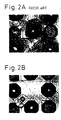
- Fig. 2A is a photograph of the appearance of a soldered portion of a substrate after cleaning with a commercially available defluxing agent
- Fig. 2B is a photograph of the appearance of a soldered portion of a substrate after cleaning with a defluxing agent of the present invention.
- Fig. 3A and 3B are drawings of cleaning apparatuses.
- Fig. 4 is a graph showing the results of placing floating bodies on the cleaning bath.
- Fig. 5 is a front cross-sectional view of a cleaning apparatus.
- Fig. 6 is a side cross-sectional view of a cleaning apparatus.
- Fig. 7 is a drawing showing the pressure-regulating mechanism at the N 2 intake opening of a cleaning apparatus.
- Fig. 8 is a drawing showing the pressure-regulating mechanism at the discharge opening of a cleaning apparatus.
- Fig. 2B choirs the appearance of this substrate after the cleaning with the above defluxing agent.
- Examples 14 and 15 are defluxing agents containing no acid.
- Examples 16-21 are instances of rinsing after cleaning.
- FIG. 3A shows an overall view of a cleaning apparatus which comprises a wash basin 7 filled with cleaning liquid, a rinse basin 8 for rinsing the defluxing agent, and a conveying mechanism 6 for conveying the object to be washed (a circuit wiring board 4), and the inside of the apparatus is an N 2 atmosphere.
- Fig. 3B is a drawing which shows the inside of the cleaning basin 7, where 1 is the defluxing agent, 2 is N 2 gas, 3 is a layer of floating bodies, 4 is a soldered circuit wiring board (object to be cleaned) and 5 is a conveying jig.
- a mixed solution of xylene 70/cyclohexanone 15/methyl ⁇ -methoxyisobutyrate/acetic acid 2.5 was placed in the cleaning basin of the defluxing apparatus, two types of polyethylene hollow balls ( ⁇ 20 mm, ⁇ 50 mm) were floated on the surface of the solution, and the circuit board was cleaned. When the circuit board was pulled out of the cleaning basin, the hollow balls were not taken out with it.
- Figs. 5-8 show cleaning apparatuses.
- Fig. 5 is a front cross-sectional view and
- Fig. 6 is a side cross-sectional view.
- a cleaning basin 11 containing a defluxing agent and a first rinse basin 12 and a second rinse basin 13 containing rinsing solutions are arranged inside an airtight surrounding case 14.
- N 2 gas is introduced from an N 2 source via a pressure-regulating valve 16 and an electromagnetic valve 17, into the compartment through the holes of a perforated copper pipe situated near the inner roof of the surrounding case 14, while it is discharged via a discharge valve 19 out through a discharge duct 20.
- the opening for discharge of the N 2 gas is provided at a position lower than that of the opening for introduction of the N 2 gas, then efficient discharge of the solvent vapor will become possible, and thus the amount of the N 2 gas introduced may be reduced.
- an object to be cleaned work 21 is placed in a wash basket which is hung by a chain 23 and can be moved forward and backward, and up and down, by a motor 25 along a beam 24 equipped with a guide which runs across it near the roof.
- the beam 24 is supported by a supporting leg frame 26.
- a front compartment 29 and a rear compartment 30 are provided outside of the loading aperture 27 and unloading aperture 28, and N 2 is also flow into these front and rear compartments 29, 30 which are used as buffers to overcome the above mentioned problem.
- either the intake or outlet, or both, of the nitrogen gas may be controlled to reduce the amount of nitrogen gas used.
- the same control may be effected by detecting the concentration of the organic solvent gas instead of the oxygen concentration.
- Fig. 7 shows a situation in which an oxygen concentration sensor 35 is used to detect the oxygen concentration in the surrounding case 14, and electromagnetic valves 37, 38 are operated by a microcontroller 36 in response to the detected oxygen concentration to adjust the flow of the N 2 gas introduced into the surrounding case 14.
- an oxygen concentration sensor 35 is used to detect the oxygen concentration in the surrounding case 14
- electromagnetic valves 37, 38 are operated by a microcontroller 36 in response to the detected oxygen concentration to adjust the flow of the N 2 gas introduced into the surrounding case 14.
- the flow of N 2 gas of 2 kgf/cm 2 passing through electromagnetic valve 37 is adjusted to 10 l/min and that passing through electromagnetic valve 38 to 100 l/min
- the O 2 concentration inside the surrounding case 14 will be 3 vol% and 5 vol%, respectively.
- Fig. 8 shows the inside of the pressure-regulating valve at the discharge end.
- the gas inside the surrounding case 14 passes through a discharge duct 41 to reach a discharge valve 42, and finally to reach a discharge disposal section 43.
- the discharge valve 42 is rotatable around a pivot 44, and the valve opens and closes by the balance between its own weight and the force of the gas pushing on the valve from out of the surrounding case 14.
- the pressure inside the surrounding case 14 was 5 hPa greater than the outside air
- the pressure differential between the inside and outside of the surrounding case actually became 2-3 hPa as a result of back pressure of the discharge and leaks in the compartment as a whole.
- F 1 indicates the closing force due to the weight of the discharge valve
- F 2 indicates the raising force of the gas pushing on the valve.
Landscapes
- Chemical & Material Sciences (AREA)
- Engineering & Computer Science (AREA)
- Chemical Kinetics & Catalysis (AREA)
- Organic Chemistry (AREA)
- Wood Science & Technology (AREA)
- Oil, Petroleum & Natural Gas (AREA)
- Life Sciences & Earth Sciences (AREA)
- Health & Medical Sciences (AREA)
- Emergency Medicine (AREA)
- Mechanical Engineering (AREA)
- Metallurgy (AREA)
- Materials Engineering (AREA)
- General Chemical & Material Sciences (AREA)
- Microelectronics & Electronic Packaging (AREA)
- Manufacturing & Machinery (AREA)
- Detergent Compositions (AREA)
- Cleaning By Liquid Or Steam (AREA)
- Manufacturing Of Printed Wiring (AREA)
- Electric Connection Of Electric Components To Printed Circuits (AREA)
- Cleaning And De-Greasing Of Metallic Materials By Chemical Methods (AREA)
Description
Claims (16)
- A defluxing agent comprising an organic acid and an organic solvent, said organic acid comprising at least one of acrylic acid, acetic acid, propionic acid and benzoic acid, said organic solvent comprising at least one of aromatic compounds, hydroxy compounds, ketones, ethers and esters, which has a boiling point of 50 to 250°C at one atmosphere and contains no chlorine or fluorine atoms, said defluxing agent containing no water.
- A defluxing agent according to claim 1, wherein said organic acid essentially consists of at least one of acrylic acid, acetic acid, propionic acid and benzoic acid.
- A defluxing agent according to claim 1 or 2, wherein said organic solvent essentially consists of at least one of said aromatic compounds, hydroxy compounds, ketones, ethers and esters.
- A defluxing agent according to any one of claims 1 to 3 which uses, as said organic solvent, an organic solvent mixture containing 50-95 parts by weight of an aromatic solvent of 6-20 carbon atoms and 5-50 parts by weight of at least one solvent selected from ester solvents of 3-15 carbon atoms, ketone solvents of 2-15 carbon atoms and alcohol solvents of 1-15 carbon atoms, and containing no chlorine or fluorine.
- A defluxing agent according to any one of claims 1 to 3 which uses, as said organic solvent, an organic solvent mixture containing 50-95 parts by weight of butyl acetate and/or amyl acetate and 5-50 parts by weight of at least one solvent selected from ester solvents of 3-15 carbon atoms, ketone solvents of 2-15 carbon atoms and alcohol solvents of 1-15 carbon atoms, and containing no chlorine or fluorine.
- A defluxing agent according to any one of claims 1 to 3 which uses, as said organic solvent, a mixture containing 50-90 parts by weight of xylene, 10-50 parts by weight of cyclohexanone and/or methyl β-methoxyisobutyrate, and 0.5-10 parts by weight of acetic acid.
- Use of a defluxing agent according to any one of claims 1 to 6 in cleaning a soldered member which has been soldered with flux.
- A method including the steps of soldering a member to a substrate using flux, cleaning the flux remaining on the substrate with a defluxing agent containing an acid and an organic solvent, and cleaning the substrate with a liquid (second liquid) which contains no acid and readily mixes with said acid-containing defluxing agent to remove the acid; wherein said defluxing agent comprises an organic acid and an organic solvent, said organic acid comprising at least one of acrylic acid, acetic acid, propionic acid and benzoic acid, said organic solvent comprising at least one of aromatic compounds, hydroxy compounds, ketones, ethers and esters, which has a boiling point of 50 to 250°C at one atmosphere and contains no chlorine or fluorine atoms, and wherein said defluxing agent contains no water.
- A method according to claim 8, wherein said organic acid essentially consists of at least one of acrylic acid, acetic acid, propionic acid and benzoic acid.
- A method according to claim 8 or 9, wherein said organic solvent essentially consists of at least one of said aromatic compunds, hydroxy compounds, ketones, ethers and esters.
- A method according to claim 8, 9 or 10, which uses, as said second liquid, at least one compound selected from aromatic compounds, hydroxy compounds, ketones, ethers and esters whose boiling point at one atmospheric pressure is between 50°C and 250°C and which contains no fluorine or chlorine.
- A method according to claim 8, 9 or 10, which uses water as said second liquid.
- A method according to any of claims 8 to 12 which further contains the steps of, after the cleaning with said second solution, further cleaning with a liquid (third liquid) which readily mixes with said second liquid, to remove the acid.
- A method according to any of claims 8 to 12 which further contains the step of, after the cleaning with said second liquid, further cleaning with vapor of the second liquid of a liquor (third liquid) which readily mixes with second liquid, to remove the acid.
- A method according to any of claims 8 to 14, wherein said substrate is immersed in said defluxing agent to dissolve the flux used in said soldering, and wherein granular or cylindrical floating bodies are arranged on the top surface of said defluxing agent.
- The method according to claim 15, wherein said floating bodies consist of hollow spheres.
Priority Applications (1)
| Application Number | Priority Date | Filing Date | Title |
|---|---|---|---|
| EP97201909A EP0811705B1 (en) | 1993-06-01 | 1994-05-31 | Defluxing agent and cleaning apparatus |
Applications Claiming Priority (4)
| Application Number | Priority Date | Filing Date | Title |
|---|---|---|---|
| JP13073693 | 1993-06-01 | ||
| JP130736/93 | 1993-06-01 | ||
| JP47414/94 | 1994-03-17 | ||
| JP04741494A JP3390245B2 (en) | 1993-06-01 | 1994-03-17 | Cleaning liquid and cleaning method |
Related Child Applications (1)
| Application Number | Title | Priority Date | Filing Date |
|---|---|---|---|
| EP97201909A Division EP0811705B1 (en) | 1993-06-01 | 1994-05-31 | Defluxing agent and cleaning apparatus |
Publications (2)
| Publication Number | Publication Date |
|---|---|
| EP0627500A1 EP0627500A1 (en) | 1994-12-07 |
| EP0627500B1 true EP0627500B1 (en) | 1998-03-04 |
Family
ID=26387570
Family Applications (2)
| Application Number | Title | Priority Date | Filing Date |
|---|---|---|---|
| EP97201909A Expired - Lifetime EP0811705B1 (en) | 1993-06-01 | 1994-05-31 | Defluxing agent and cleaning apparatus |
| EP94108380A Expired - Lifetime EP0627500B1 (en) | 1993-06-01 | 1994-05-31 | Defluxing agent and cleaning method |
Family Applications Before (1)
| Application Number | Title | Priority Date | Filing Date |
|---|---|---|---|
| EP97201909A Expired - Lifetime EP0811705B1 (en) | 1993-06-01 | 1994-05-31 | Defluxing agent and cleaning apparatus |
Country Status (5)
| Country | Link |
|---|---|
| US (3) | US5695571A (en) |
| EP (2) | EP0811705B1 (en) |
| JP (1) | JP3390245B2 (en) |
| KR (1) | KR0168889B1 (en) |
| DE (2) | DE69408724T2 (en) |
Families Citing this family (25)
| Publication number | Priority date | Publication date | Assignee | Title |
|---|---|---|---|---|
| JP3390245B2 (en) * | 1993-06-01 | 2003-03-24 | 富士通株式会社 | Cleaning liquid and cleaning method |
| KR100387930B1 (en) * | 1998-12-29 | 2003-09-19 | 주식회사 포스코 | Dross cleaning solution composition of plating roll |
| GB2349984A (en) | 1999-03-04 | 2000-11-15 | Ibm | Decontamination of electronic cards from copper salts |
| JP4516176B2 (en) * | 1999-04-20 | 2010-08-04 | 関東化学株式会社 | Substrate cleaning solution for electronic materials |
| JP2001332575A (en) * | 2000-05-19 | 2001-11-30 | Sony Corp | Flux cleaning method and semiconductor device manufacturing method |
| US6776852B2 (en) * | 2002-01-14 | 2004-08-17 | International Business Machines Corporation | Process of removing holefill residue from a metallic surface of an electronic substrate |
| US7144802B2 (en) * | 2003-04-01 | 2006-12-05 | Texas Instruments Incorporated | Vapor deposition of benzotriazole (BTA) for protecting copper interconnects |
| US20040229762A1 (en) * | 2003-05-13 | 2004-11-18 | Rohm And Haas Electronic Materials, L.L.C. | Polymer remover |
| US20060001011A1 (en) * | 2004-07-02 | 2006-01-05 | Wilson Neil R | Surface conditioner for powder coating systems |
| JP4236198B2 (en) * | 2004-12-28 | 2009-03-11 | 東京応化工業株式会社 | Lithographic cleaning liquid and semiconductor substrate forming method using the same |
| JP4557742B2 (en) * | 2005-02-15 | 2010-10-06 | 三洋電機株式会社 | Distillation equipment with solvent recovery function |
| JP4835191B2 (en) * | 2005-02-18 | 2011-12-14 | 東洋インキScホールディングス株式会社 | Cleaning liquid for pigment dispersion type colored resin composition |
| US7767025B2 (en) * | 2007-09-30 | 2010-08-03 | Intel Corporation | Nozzle array configuration to facilitate deflux process improvement in chip attach process |
| DE102009055610A1 (en) * | 2009-11-25 | 2011-05-26 | Behr Gmbh & Co. Kg | Method for the quantitative determination of solder residues |
| US8444868B2 (en) * | 2010-01-28 | 2013-05-21 | International Business Machines Corporation | Method for removing copper oxide layer |
| US8128755B2 (en) * | 2010-03-03 | 2012-03-06 | L'air Liquide Societe Anonyme Pour L'etude Et L'exploitation Des Procedes Georges Claude | Cleaning solvent and cleaning method for metallic compound |
| EP2630206A1 (en) * | 2010-12-17 | 2013-08-28 | Dow Global Technologies LLC | Acidic microemulsion stripping formulations |
| WO2012099126A1 (en) * | 2011-01-18 | 2012-07-26 | 電気化学工業株式会社 | Ultrasonic cleaning method and apparatus |
| US20140048103A1 (en) * | 2012-08-20 | 2014-02-20 | Kyle J. Doyel | Method and apparatus for continuous separation of cleaning solvent from rinse fluid in a dual-solvent vapor degreasing system |
| JP6450366B2 (en) | 2013-03-29 | 2019-01-09 | ライフ テクノロジーズ コーポレーション | Method for processing a semiconductor device |
| JP2015207712A (en) | 2014-04-22 | 2015-11-19 | 三菱電機株式会社 | Cleaning solvent, cleaning equipment, and method for cleaning mounting substrate |
| EP3274699B1 (en) | 2015-03-26 | 2023-12-20 | Life Technologies Corporation | Method for treating fet sensor arrays and resulting sensor devices |
| DE102016118247A1 (en) * | 2016-09-27 | 2018-03-29 | Endress + Hauser Gmbh + Co. Kg | Printed circuit board and method for producing the printed circuit board |
| CN114080570B (en) * | 2019-07-08 | 2025-02-28 | 默克专利股份有限公司 | Rinsing agent for removing edge protection layer and residual metal hard mask components and method of using the same |
| WO2022055302A1 (en) * | 2020-09-10 | 2022-03-17 | 주식회사 카텍에이치 | Method and apparatus for decomposing and washing off thermoplastic resin solids |
Family Cites Families (65)
| Publication number | Priority date | Publication date | Assignee | Title |
|---|---|---|---|---|
| US2528230A (en) * | 1949-02-26 | 1950-10-31 | Robert J King Company Inc | Liquid cleaner |
| FR1081438A (en) * | 1953-07-20 | 1954-12-20 | Stripper for removing oil-based paint and varnish from wood, metal, fabric or glass | |
| DK128856A (en) * | 1969-08-06 | |||
| US3886099A (en) * | 1972-03-13 | 1975-05-27 | Griffin Bros Inc | Water soluble flux remover |
| BE835203A (en) * | 1974-11-04 | 1976-05-04 | PHOTO RESISTIVE REMOVAL SYSTEMS | |
| US3994751A (en) * | 1975-10-28 | 1976-11-30 | The United States Of America As Represented By The Secretary Of The Navy | Solvent-based activator for ensuring paint adhesion to titanium and stainless steel |
| US4153545A (en) * | 1977-08-18 | 1979-05-08 | Ppg Industries, Inc. | Method for cleaning membrane filter |
| US4249107A (en) * | 1977-12-29 | 1981-02-03 | Gte Laboratories Incorporated | Cathode ray tube having amorphous resistive film on internal surfaces and method of forming the film |
| DE2847691C2 (en) * | 1978-11-03 | 1986-05-22 | Licentia Patent-Verwaltungs-Gmbh, 6000 Frankfurt | Washing liquid for cleaning the surfaces of printed circuits |
| JPS5789487A (en) * | 1980-11-25 | 1982-06-03 | Ibm | Removal of grease |
| DE3145815C2 (en) * | 1981-11-19 | 1984-08-09 | AGA Gas GmbH, 2102 Hamburg | Process for removing peelable layers of material from coated objects, |
| US4483783A (en) * | 1982-04-15 | 1984-11-20 | United Industries Corporation | Solvent preparation |
| GB8409055D0 (en) * | 1984-04-07 | 1984-05-16 | Procter & Gamble | Cleaning compositions |
| US4710232A (en) * | 1984-06-01 | 1987-12-01 | Tahbaz John A | Process for cleaning metal articles |
| JPS61238298A (en) * | 1985-04-17 | 1986-10-23 | 今井 守 | Method for cleaning futon |
| US4640719A (en) * | 1985-07-01 | 1987-02-03 | Petroleum Fermentations N.V. | Method for printed circuit board and/or printed wiring board cleaning |
| US4604144A (en) * | 1985-09-11 | 1986-08-05 | At&T Technologies, Inc. | Process for cleaning a circuit board |
| JPS62227593A (en) * | 1986-03-28 | 1987-10-06 | Harima Chem Inc | Organic solder |
| JP2604593B2 (en) * | 1986-05-19 | 1997-04-30 | ハリマ化成 株式会社 | Method of forming solder coating on metal surface |
| JPS62281396A (en) * | 1986-05-30 | 1987-12-07 | 古河電気工業株式会社 | Method of metallizing conductive paste circuit |
| US4683075A (en) * | 1986-07-23 | 1987-07-28 | Allied Corporation | Azeotrope-like compositions of trichlorotrifluoroethane, methanol, nitromethane, acetone, and methyl acetate |
| JPS6334933A (en) * | 1986-07-30 | 1988-02-15 | Furukawa Electric Co Ltd:The | Formation of bump on lead |
| JPS6335780A (en) * | 1986-07-30 | 1988-02-16 | Furukawa Electric Co Ltd:The | Noble metal plating method |
| JPS6356353A (en) * | 1986-08-26 | 1988-03-10 | Matsushita Electric Works Ltd | Removal of solder flux residue |
| US4738732A (en) * | 1987-02-04 | 1988-04-19 | Hughes Aircraft Co. | Self cleaning liquid solder flux |
| JPH0666539B2 (en) * | 1987-03-12 | 1994-08-24 | 古河電気工業株式会社 | Soldering method |
| JP2618398B2 (en) * | 1987-07-06 | 1997-06-11 | 古河電気工業株式会社 | Electroless solder plating method |
| JPH0821769B2 (en) * | 1987-07-13 | 1996-03-04 | 古河電気工業株式会社 | Electronic component soldering method |
| JPH0747233B2 (en) * | 1987-09-14 | 1995-05-24 | 古河電気工業株式会社 | Solder deposition composition and solder deposition method |
| JPH088162B2 (en) * | 1988-07-22 | 1996-01-29 | 松下電器産業株式会社 | Thermal head and manufacturing method thereof |
| US5120371A (en) * | 1990-11-29 | 1992-06-09 | Petroferm Inc. | Process of cleaning soldering flux and/or adhesive tape with terpenet and monobasic ester |
| US4830772A (en) * | 1988-06-10 | 1989-05-16 | Hoechst Celanese Corporation | Stripper composition for removal of protective coatings |
| US4867800B1 (en) * | 1988-07-21 | 1995-02-14 | Du Pont | Cleaning composition of terpene compound and dibasic ester |
| JPH02114531A (en) * | 1988-10-24 | 1990-04-26 | Fujitsu Ltd | Manufacture of semiconductor device |
| US4983224A (en) * | 1988-10-28 | 1991-01-08 | Rd Chemical Company | Cleaning compositions and methods for removing soldering flux |
| JPH02155201A (en) * | 1988-12-07 | 1990-06-14 | Matsushita Electric Ind Co Ltd | thermal head |
| US5026753A (en) * | 1989-02-22 | 1991-06-25 | Union Camp Corporation | Resinous binders comprising a metal rosin resinate and a carboxylated polystyrene resin |
| US5026754A (en) * | 1989-04-18 | 1991-06-25 | Union Camp Corporation | Resinous binders comprising a metal rosin resinate and a pendant tertiary amine polymer |
| DE69004521T2 (en) * | 1989-08-07 | 1994-05-05 | Du Pont | Detergent based on a dibasic ester and a hydrocarbon solvent and cleaning method. |
| US5062988A (en) * | 1989-08-07 | 1991-11-05 | E. I. Du Pont De Nemours And Company | Cleaning composition of dibasic ester, hydrocarbon solvent and compatibilizing component |
| JPH03146597A (en) * | 1989-11-01 | 1991-06-21 | Henkel Hakusui Kk | Cleaning composition of printed circuit board |
| JP2789046B2 (en) * | 1989-11-08 | 1998-08-20 | 荒川化学工業株式会社 | Cleaning agent for rosin solder flux |
| JP2797567B2 (en) * | 1989-12-15 | 1998-09-17 | 松下電器産業株式会社 | Method of forming electrode pattern |
| FR2658532B1 (en) * | 1990-02-20 | 1992-05-15 | Atochem | APPLICATION OF (PERFLUOROALKYL) -ETHYLENES AS CLEANING OR DRYING AGENTS, AND COMPOSITIONS FOR USE THEREOF. |
| US5085365B1 (en) * | 1990-05-15 | 1995-08-08 | Hughes Aircraft Co | Water soluble soldering flux |
| US5452840A (en) * | 1990-05-15 | 1995-09-26 | Hughes Aircraft Company | Water-soluble soldering flux |
| JPH0468090A (en) * | 1990-07-09 | 1992-03-03 | Asahi Chem Ind Co Ltd | Degreasing detergent |
| EP0466054B1 (en) * | 1990-07-10 | 1995-06-14 | Kao Corporation | Composition for cleaning electronic and precision parts, and cleaning process |
| US5304253A (en) * | 1990-09-12 | 1994-04-19 | Baxter International Inc. | Method for cleaning with a volatile solvent |
| US5082497A (en) * | 1990-09-24 | 1992-01-21 | Westvaco Corporation | Solution rosin resinate for publication gravure inks |
| DE69121245D1 (en) * | 1990-10-17 | 1996-09-12 | Bush Boake Allen Ltd | METHOD AND COMPOSITION FOR CLEANING OBJECTS |
| EP0482890B1 (en) * | 1990-10-23 | 1995-03-15 | Tokyo Special Wire Netting Co. Ltd. | Cleaning equipment |
| JPH04178267A (en) * | 1990-11-13 | 1992-06-25 | Furukawa Electric Co Ltd:The | Line for forming solder layer to circuit board |
| US5080722A (en) * | 1991-02-26 | 1992-01-14 | At&T Bell Laboratories | Method for cleaning electrical connectors |
| JPH04357899A (en) * | 1991-06-04 | 1992-12-10 | Furukawa Electric Co Ltd:The | Manufacture of circuit substrate with auxiliary solder layer |
| DE69228183T2 (en) * | 1991-06-14 | 1999-07-29 | Petroferm Inc., Fernandina Beach, Fla. | COMPOSITION AND METHOD FOR REMOVING ROSINE SOLDER FLOW WITH TERPEN AND HYDROCARBONS |
| US5196136A (en) * | 1991-06-20 | 1993-03-23 | E. I. Du Pont De Nemours And Company | Cleaning composition of hydrocarbon component, surfactant and multibasic ester additive |
| JP2871899B2 (en) * | 1991-06-21 | 1999-03-17 | 古河電気工業株式会社 | Cream solder |
| US5221362A (en) * | 1991-08-23 | 1993-06-22 | E. I. Du Pont De Nemours And Company | Non-halogenated aqueous cleaning systems |
| US5125560A (en) * | 1991-11-04 | 1992-06-30 | At&T Bell Laboratories | Method of soldering including removal of flux residue |
| JP2652298B2 (en) * | 1992-04-30 | 1997-09-10 | 花王株式会社 | Cleaning composition for precision parts or jigs |
| JP3390245B2 (en) * | 1993-06-01 | 2003-03-24 | 富士通株式会社 | Cleaning liquid and cleaning method |
| US5612303B1 (en) * | 1993-06-15 | 2000-07-18 | Nitto Chemical Industry Co Ltd | Solvent composition |
| KR100354301B1 (en) * | 1993-08-16 | 2002-12-31 | 다이낑 고오교 가부시키가이샤 | Cleaning solvent composition and a method for cleaning or drying articles |
| JPH08231989A (en) * | 1995-02-23 | 1996-09-10 | Kurita Water Ind Ltd | Detergent composition and cleaning method |
-
1994
- 1994-03-17 JP JP04741494A patent/JP3390245B2/en not_active Expired - Lifetime
- 1994-05-31 EP EP97201909A patent/EP0811705B1/en not_active Expired - Lifetime
- 1994-05-31 DE DE69408724T patent/DE69408724T2/en not_active Expired - Lifetime
- 1994-05-31 EP EP94108380A patent/EP0627500B1/en not_active Expired - Lifetime
- 1994-05-31 DE DE69425764T patent/DE69425764T2/en not_active Expired - Lifetime
- 1994-06-01 US US08/252,174 patent/US5695571A/en not_active Expired - Lifetime
- 1994-06-01 KR KR1019940012269A patent/KR0168889B1/en not_active Expired - Lifetime
-
1997
- 1997-05-30 US US08/865,125 patent/US6140286A/en not_active Expired - Lifetime
- 1997-12-08 US US08/987,134 patent/US6050479A/en not_active Expired - Lifetime
Also Published As
| Publication number | Publication date |
|---|---|
| KR0168889B1 (en) | 1999-01-15 |
| KR950002541A (en) | 1995-01-04 |
| US5695571A (en) | 1997-12-09 |
| EP0811705A1 (en) | 1997-12-10 |
| JPH0748599A (en) | 1995-02-21 |
| US6140286A (en) | 2000-10-31 |
| EP0627500A1 (en) | 1994-12-07 |
| DE69425764D1 (en) | 2000-10-05 |
| DE69408724D1 (en) | 1998-04-09 |
| JP3390245B2 (en) | 2003-03-24 |
| DE69408724T2 (en) | 1998-06-25 |
| US6050479A (en) | 2000-04-18 |
| EP0811705B1 (en) | 2000-08-30 |
| DE69425764T2 (en) | 2000-12-28 |
Similar Documents
| Publication | Publication Date | Title |
|---|---|---|
| US6050479A (en) | Defluxing agent cleaning method and cleaning apparatus | |
| US5269850A (en) | Method of removing organic flux using peroxide composition | |
| US5196136A (en) | Cleaning composition of hydrocarbon component, surfactant and multibasic ester additive | |
| US5244000A (en) | Method and system for removing contaminants | |
| EP0643780B1 (en) | Multiple solvent cleaning system | |
| US5456760A (en) | Cleaning process for electronic and electrical assemblies | |
| WO1998050517A1 (en) | Environmentally-safe solvent compositions utilizing 1-bromopropane that are stabilized, non-flammable, and have desired solvency characteristics | |
| US5221362A (en) | Non-halogenated aqueous cleaning systems | |
| AU693453B2 (en) | Multiple solvent cleaning system | |
| US5411595A (en) | Post-etch, printed circuit board cleaning process | |
| EP0458948B1 (en) | Peroxide composition for removing flux residue and method of using same | |
| JP4079719B2 (en) | Cleaning liquid | |
| CN1200141A (en) | Metal cleaning methods and compositions | |
| WO2009097519A1 (en) | Methods and compositions for depositing silver onto a metal surface | |
| AU650818B2 (en) | Inorganic oxidant compositions for removing contaminants | |
| JPH0598297A (en) | Washing soap | |
| KR20170071671A (en) | Composition for cleaning solder flux remaining in FPCB and cleaning method using the same | |
| AU651253B2 (en) | Method and system for removing contaminants | |
| JPH08330265A (en) | Flux cleaning method | |
| JP2002173700A (en) | Flux cleaning composition and flux cleaning method | |
| JP2715769B2 (en) | Substrate cleaning method | |
| IE67182B1 (en) | Cleaning compositions | |
| JP3491656B2 (en) | Pretreatment agent for drying metal and drying method | |
| JP2001200293A (en) | Stabilized non-flammable cleaning agent, cleaning method and cleaning apparatus | |
| JP2003176498A (en) | Hydrocarbon cleaning liquid composition |
Legal Events
| Date | Code | Title | Description |
|---|---|---|---|
| PUAI | Public reference made under article 153(3) epc to a published international application that has entered the european phase |
Free format text: ORIGINAL CODE: 0009012 |
|
| AK | Designated contracting states |
Kind code of ref document: A1 Designated state(s): DE FR GB |
|
| 17P | Request for examination filed |
Effective date: 19950602 |
|
| 17Q | First examination report despatched |
Effective date: 19960411 |
|
| GRAG | Despatch of communication of intention to grant |
Free format text: ORIGINAL CODE: EPIDOS AGRA |
|
| GRAG | Despatch of communication of intention to grant |
Free format text: ORIGINAL CODE: EPIDOS AGRA |
|
| GRAH | Despatch of communication of intention to grant a patent |
Free format text: ORIGINAL CODE: EPIDOS IGRA |
|
| GRAH | Despatch of communication of intention to grant a patent |
Free format text: ORIGINAL CODE: EPIDOS IGRA |
|
| GRAA | (expected) grant |
Free format text: ORIGINAL CODE: 0009210 |
|
| AK | Designated contracting states |
Kind code of ref document: B1 Designated state(s): DE FR GB |
|
| DX | Miscellaneous (deleted) | ||
| REF | Corresponds to: |
Ref document number: 69408724 Country of ref document: DE Date of ref document: 19980409 |
|
| ET | Fr: translation filed | ||
| PLBE | No opposition filed within time limit |
Free format text: ORIGINAL CODE: 0009261 |
|
| STAA | Information on the status of an ep patent application or granted ep patent |
Free format text: STATUS: NO OPPOSITION FILED WITHIN TIME LIMIT |
|
| 26N | No opposition filed | ||
| REG | Reference to a national code |
Ref country code: GB Ref legal event code: IF02 |
|
| PGFP | Annual fee paid to national office [announced via postgrant information from national office to epo] |
Ref country code: GB Payment date: 20130529 Year of fee payment: 20 Ref country code: DE Payment date: 20130529 Year of fee payment: 20 |
|
| PGFP | Annual fee paid to national office [announced via postgrant information from national office to epo] |
Ref country code: FR Payment date: 20130531 Year of fee payment: 20 |
|
| REG | Reference to a national code |
Ref country code: DE Ref legal event code: R071 Ref document number: 69408724 Country of ref document: DE |
|
| REG | Reference to a national code |
Ref country code: GB Ref legal event code: PE20 Expiry date: 20140530 |
|
| PG25 | Lapsed in a contracting state [announced via postgrant information from national office to epo] |
Ref country code: GB Free format text: LAPSE BECAUSE OF EXPIRATION OF PROTECTION Effective date: 20140530 |
|
| PG25 | Lapsed in a contracting state [announced via postgrant information from national office to epo] |
Ref country code: DE Free format text: LAPSE BECAUSE OF EXPIRATION OF PROTECTION Effective date: 20140603 |