EP0615296B1 - Non-aqueous electrolyte secondary battery and method of producing the same - Google Patents
Non-aqueous electrolyte secondary battery and method of producing the same Download PDFInfo
- Publication number
- EP0615296B1 EP0615296B1 EP94301699A EP94301699A EP0615296B1 EP 0615296 B1 EP0615296 B1 EP 0615296B1 EP 94301699 A EP94301699 A EP 94301699A EP 94301699 A EP94301699 A EP 94301699A EP 0615296 B1 EP0615296 B1 EP 0615296B1
- Authority
- EP
- European Patent Office
- Prior art keywords
- aqueous electrolyte
- lithium
- active material
- charge
- silicon
- Prior art date
- Legal status (The legal status is an assumption and is not a legal conclusion. Google has not performed a legal analysis and makes no representation as to the accuracy of the status listed.)
- Expired - Lifetime
Links
Images




Classifications
-
- H—ELECTRICITY
- H01—ELECTRIC ELEMENTS
- H01M—PROCESSES OR MEANS, e.g. BATTERIES, FOR THE DIRECT CONVERSION OF CHEMICAL ENERGY INTO ELECTRICAL ENERGY
- H01M4/00—Electrodes
- H01M4/02—Electrodes composed of, or comprising, active material
- H01M4/36—Selection of substances as active materials, active masses, active liquids
- H01M4/48—Selection of substances as active materials, active masses, active liquids of inorganic oxides or hydroxides
- H01M4/485—Selection of substances as active materials, active masses, active liquids of inorganic oxides or hydroxides of mixed oxides or hydroxides for inserting or intercalating light metals, e.g. LiTi2O4 or LiTi2OxFy
-
- H—ELECTRICITY
- H01—ELECTRIC ELEMENTS
- H01M—PROCESSES OR MEANS, e.g. BATTERIES, FOR THE DIRECT CONVERSION OF CHEMICAL ENERGY INTO ELECTRICAL ENERGY
- H01M10/00—Secondary cells; Manufacture thereof
- H01M10/05—Accumulators with non-aqueous electrolyte
- H01M10/052—Li-accumulators
- H01M10/0525—Rocking-chair batteries, i.e. batteries with lithium insertion or intercalation in both electrodes; Lithium-ion batteries
-
- H—ELECTRICITY
- H01—ELECTRIC ELEMENTS
- H01M—PROCESSES OR MEANS, e.g. BATTERIES, FOR THE DIRECT CONVERSION OF CHEMICAL ENERGY INTO ELECTRICAL ENERGY
- H01M10/00—Secondary cells; Manufacture thereof
- H01M10/05—Accumulators with non-aqueous electrolyte
- H01M10/056—Accumulators with non-aqueous electrolyte characterised by the materials used as electrolytes, e.g. mixed inorganic/organic electrolytes
- H01M10/0564—Accumulators with non-aqueous electrolyte characterised by the materials used as electrolytes, e.g. mixed inorganic/organic electrolytes the electrolyte being constituted of organic materials only
- H01M10/0566—Liquid materials
- H01M10/0569—Liquid materials characterised by the solvents
-
- H—ELECTRICITY
- H01—ELECTRIC ELEMENTS
- H01M—PROCESSES OR MEANS, e.g. BATTERIES, FOR THE DIRECT CONVERSION OF CHEMICAL ENERGY INTO ELECTRICAL ENERGY
- H01M10/00—Secondary cells; Manufacture thereof
- H01M10/05—Accumulators with non-aqueous electrolyte
- H01M10/058—Construction or manufacture
-
- H—ELECTRICITY
- H01—ELECTRIC ELEMENTS
- H01M—PROCESSES OR MEANS, e.g. BATTERIES, FOR THE DIRECT CONVERSION OF CHEMICAL ENERGY INTO ELECTRICAL ENERGY
- H01M4/00—Electrodes
- H01M4/02—Electrodes composed of, or comprising, active material
- H01M4/13—Electrodes for accumulators with non-aqueous electrolyte, e.g. for lithium-accumulators; Processes of manufacture thereof
- H01M4/131—Electrodes based on mixed oxides or hydroxides, or on mixtures of oxides or hydroxides, e.g. LiCoOx
-
- H—ELECTRICITY
- H01—ELECTRIC ELEMENTS
- H01M—PROCESSES OR MEANS, e.g. BATTERIES, FOR THE DIRECT CONVERSION OF CHEMICAL ENERGY INTO ELECTRICAL ENERGY
- H01M4/00—Electrodes
- H01M4/02—Electrodes composed of, or comprising, active material
- H01M4/36—Selection of substances as active materials, active masses, active liquids
- H01M4/48—Selection of substances as active materials, active masses, active liquids of inorganic oxides or hydroxides
- H01M4/50—Selection of substances as active materials, active masses, active liquids of inorganic oxides or hydroxides of manganese
- H01M4/505—Selection of substances as active materials, active masses, active liquids of inorganic oxides or hydroxides of manganese of mixed oxides or hydroxides containing manganese for inserting or intercalating light metals, e.g. LiMn2O4 or LiMn2OxFy
-
- H—ELECTRICITY
- H01—ELECTRIC ELEMENTS
- H01M—PROCESSES OR MEANS, e.g. BATTERIES, FOR THE DIRECT CONVERSION OF CHEMICAL ENERGY INTO ELECTRICAL ENERGY
- H01M4/00—Electrodes
- H01M4/02—Electrodes composed of, or comprising, active material
- H01M4/36—Selection of substances as active materials, active masses, active liquids
- H01M4/48—Selection of substances as active materials, active masses, active liquids of inorganic oxides or hydroxides
- H01M4/52—Selection of substances as active materials, active masses, active liquids of inorganic oxides or hydroxides of nickel, cobalt or iron
- H01M4/525—Selection of substances as active materials, active masses, active liquids of inorganic oxides or hydroxides of nickel, cobalt or iron of mixed oxides or hydroxides containing iron, cobalt or nickel for inserting or intercalating light metals, e.g. LiNiO2, LiCoO2 or LiCoOxFy
-
- Y—GENERAL TAGGING OF NEW TECHNOLOGICAL DEVELOPMENTS; GENERAL TAGGING OF CROSS-SECTIONAL TECHNOLOGIES SPANNING OVER SEVERAL SECTIONS OF THE IPC; TECHNICAL SUBJECTS COVERED BY FORMER USPC CROSS-REFERENCE ART COLLECTIONS [XRACs] AND DIGESTS
- Y02—TECHNOLOGIES OR APPLICATIONS FOR MITIGATION OR ADAPTATION AGAINST CLIMATE CHANGE
- Y02E—REDUCTION OF GREENHOUSE GAS [GHG] EMISSIONS, RELATED TO ENERGY GENERATION, TRANSMISSION OR DISTRIBUTION
- Y02E60/00—Enabling technologies; Technologies with a potential or indirect contribution to GHG emissions mitigation
- Y02E60/10—Energy storage using batteries
Definitions
- the present invention relates to non-aqueous electrolyte secondary batteries using a non-aqueous electrolyte with lithium ion conductivity wherein a material capable of incorporating and releasing lithium is used as a negative active material.
- battery is taken to include a single cell as well as two or more series-connected cells.
- Non-aqueous electrolyte batteries using lithium as a negative active material have various advantages, namely a high reliability over long period due to a smaller amount of self-discharge in addition to a high voltage and higher energy density. Therefore they have widely been used as primary batteries of power supplies for memory backup, in cameras and the like.
- various kinds of equipment have been produced which require larger current outputs from the batteries used in their power supply. It is therefore considered highly desirable from the economic viewpoint, and from the viewpoint of size reduction and weight reduction, to produce a high energy density secondary battery capable of repeated recharging and discharging.
- the research and development of more satisfactory non-aqueous electrolyte secondary batteries have been considerably promoted, and such batteries are now in practical use. However their energy density, charge and discharge cycle service lives, and reliability are still unsatisfactory.
- each type has a different charge and discharge reaction, characteristic.
- metal chalcogenides such as TiS 2 , MoS 2 , NbSe 3 and the like
- metal oxide such as MnO 2 , MoO 3 , V 2 O 5 , Li x CoO 2 , Li x NiO 2 , Li x Mn 2 O 4 , and the like.
- both anions and lithium cations can be input and output as in the case of layer-like structure graphite compounds and conductive polymers such as polyacene and the like (involving intercalation, deintercalation, or doping and un-doping or the like).
- Uncombined metallic lithium gives the most negative electrode potential in a battery of this kind and is preferred in order to achieve the highest voltage and highest energy density.
- the problem of considerable deterioration with charge and discharge arises and results in a shorter cyclic life because of occurrence of dendrites or passivated compounds on the negative electrode due to the charge and discharge.
- the operating voltage of the battery is reduced in comparison with the voltage of a battery utilising uncombined metallic lithium, because the negative active material is nobler than metallic lithium.
- the operating voltage is lowered by 0.2 to 0.8 V when using alloys of lithium with Al, Zn, Pb, Sn, Bi, Cd or the like, and 0 to 1 V when using a lithium intercalation compound of carbon, and 0.5 to 1.5 V when using a lithium ion insertion compound such as MoO 2 or WO 2 .
- a negative active material having a larger effective charge and discharge capacity, that is, an enhanced capability of reversibly incorporating and releasing lithium ions with a low (negative) electrode potential approaching that of lithium.
- the material should desirably be free from deterioration mechanisms such as decay of the crystal structure and generation of irreversible substances and the like due to incorporating or releasing of the lithium ions on charging or discharging.
- the present invention provides a non-aqueous electrolyte secondary battery comprising at least a negative electrode, a positive electrode, and a non-aqueous electrolyte with lithium ion conductivity, wherein a composite oxide containing lithium of formula Li x Si 1-y M y O z is used as an active material of said negative electrode, wherein M is one or more oxide-forming elements selected from the group consisting of:
- the secondary battery of the invention has an improved charge and discharge characteristic under high current conditions, a high voltage and a high energy density as well as a service life of many charge-discharge cycles.
- the present invention provides a method as defined in claim 10 of the accompanying claims.
- a composite oxide which is capable of incorporating and releasing lithium ions, and represented by a composition formula Li x Si 1-y M y O z (where 0 ⁇ x, 0 ⁇ y ⁇ 1, 0 ⁇ z ⁇ 2 are satisfied), containing lithium (Li), composed of silicon (Si) and one or more element(s) M which are oxide-forming elements and may for example be metal(s) other than alkali metal(s), and/or metalloid(s) other than silicon.
- the lithium may be contained in a crystal structure or in an amorphous structure, composed of silicon and element M, and capable of incorporating/releasing lithium ions by electrochemical reaction within a non-aqueous electrolyte.
- the lithium in the oxide is mainly in the form of ions. However, this is not essential.
- the variable "x" can have any value which is compatible with stability of the oxide.
- Japanese patent application numbers Hei 5-35851 (filed in 1993) and Hei 5-162958 (filed in 1993) teach that a silicon oxide containing lithium, represented by a composition formula Li x SiO z (where 0 ⁇ x, 0 ⁇ z ⁇ 2 are satisfied), is capable of repeatedly incorporating/releasing lithium ions in an electrochemically stable manner in a range of electrode potential of at least 0 to 3 V versus the lithium standard electrode (metal lithium) in a non-aqueous electrolyte. Due to such charge and discharge reactions a high charge and discharge capacity is provided particularly in the 0 to 1 V region.
- the silicon (Si) of the oxide of formula Li x SiO z is replaced with one or more oxide-forming element(s) M (e.g. metals or metalloids) other than alkali metal(s) or silicon, or the silicon is supplemented by one or more such element(s) M to produce the composite oxide of formula Li x Si 1-y M y O z , a larger charge and discharge capacity is obtained.
- the resulting negative acting material has a higher charge and discharge efficiency in the base potential region of 0 to 1 V (versus the lithium standard electrode), together with an enhanced charge and discharge characteristic with a smaller polarisation (internal resistance).
- the negative electrode using as an active material the composite oxide of silicon and element(s) M containing lithium according to the present invention is capable of repeatedly stably incorporating and releasing lithium ions in a range of electrode potential of at least 0 to 3 V relative to a metal lithium electrode in non-aqueous electrolyte.
- Such an electrode reaction enables it to be utilised as a negative electrode of a secondary battery, which is capable of repeatedly charging and discharging.
- advantages arise in the variation of the operation voltage and decrease of the capacity and the like (even using large currents) with smaller polarisation on charging and discharging in addition to an enhanced capability of reversibly incorporating and releasing lithium ions.
- a considerably large effective charge and discharge capacity and efficiency in the base potential region of 0 to 1 V relative to a standard lithium electrode (metal lithium) is obtained in comparison with that obtained by using the oxide of only silicon and lithium (Li x SiO z ) or the oxide of only element M and lithium Li x MO z . Further, an extremely stable secondary battery having a long service life is obtained almost without deterioration due to generation of irreversible substances by the over-charging and over-discharging.
- the silicon oxide SiO z has a larger capacity for incorporating and releasing lithium ions, ie. a large charge and discharge capacity, but it has lower electron conductivity because, being an insulating substance or semiconductor it has a relatively large polarisation on charging and discharging.
- the novel negative active material Li x Si 1-y M y O z being the composite oxide according to the invention where silicon and element(s) M coexist, provides a large number of sites capable of incorporating lithium ions simultaneously together with a higher mobility of lithium ions and higher electron conductivity, which facilitates incorporating and releasing lithium ions.
- transition metals such as Ti, V, W, Mn, Fe, Co, Ni, Cu, and Nb for example, metals other than alkali metals such as Zn, Cd, Mg, Ba, Pb, Sn, and Al for example, and metalloids or non-metals other than silicon such as B, C, Ge, Sb, and P for example.
- M is one or more element(s) selected from the group consisting of transition metals of group 4 to group 10 and metals and metalloids of group 13 and group 14 in the Periodic Table (Inorganic Chemical Naming for Element(s) published by International Union of Pure and Applied Chemistry, IUPAC, revised in 1989).
- the ratio "y" of the number of M atoms versus a sum of the number of atoms of metal or metalloid M plus the number of silicon Si atoms in the composite oxide is preferably in the range of 0 ⁇ y ⁇ 1.
- a considerably upgraded charge/discharge characteristic can be obtained when 0 ⁇ y ⁇ 0.75, and more preferably 0 ⁇ y ⁇ 0.5.
- the ratio "z" of the number of oxygen (O) atoms versus the sum of the number of atoms of element M plus the number of silicon (Si) atoms, is in the range of 0 ⁇ z ⁇ 2. Particularly enhanced charge and discharge characteristic can be obtained in the case 0 ⁇ z ⁇ 1.5. Therefore these ranges are preferred, but not essential.
- the composite oxide Li x Si 1-y M y O z used as a negative active material of the battery according to the present invention can be produced by two general methods, as described below. However, it is to be understood that the invention is not limited to these preparation methods.
- silicon, said element(s) M and lithium, or silicon compound, said M element compound and a lithium compound are mixed at a predetermined mol ratio, and thereafter or while mixing the same, the product is thermally treated in a non-oxidising atmosphere such as inert atmosphere or vacuum or in an atmosphere controlled of oxygen amount so as to obtain the predetermined oxidation number with respect to silicon, element(s) M and lithium to produce the composite oxide of silicon, element(s) M and lithium.
- the respective compounds of silicon and element(s) M and lithium used as starting materials are preferably oxides or hydroxides of the respective elements, or salts such as carbonate or nitrate, or organic compounds and the like, which are capable of producing the oxide of each element by thermally treating the materials in non-oxidising atmosphere.
- One method of mixing these starting materials is to dissolve or disperse these materials in water, alcohol or the other solvent to be mixed and reacted uniformly in such solution and thereafter to dry them.
- Another method is to atomise or ionise these materials by heating by electromagnetic radiation or the like and simultaneously or alternatively to vaporise and deposit the same.
- various other methods are available.
- the temperature of the thermal treatment after or while these materials are mixed differs depending on the starting materials or the thermal treatment environment.
- the materials may be synthesised at a temperature equal to or more than 400°C, more preferably at a temperature equal to or more than 600°C.
- silicon and quadrivalent silicon oxide are generated by disproportionation reactions at a temperature equal to or more than 800°C in inert atmosphere or vacuum or the like, the preferred temperature range is 600°C to 800°C.
- the lithium compound eg. lithium hydroxide LiOH, a salt such as Li 2 CO 3 or LiNO 3 , or a hydrate thereof, elemental silicon or a silicon compound eg. silicon lower oxide SiO z' (where 0 ⁇ z' ⁇ 2) and elemental M or an M lower valence oxide MO z'' (where 0 ⁇ z'' ⁇ 2) can be mixed and thermally treated in a substantially oxygen-free atmosphere, eg. an inert atmosphere or a partial vacuum in order to synthesise the composite oxide.
- a substantially oxygen-free atmosphere eg. an inert atmosphere or a partial vacuum
- the oxygen content of the oxide product is controlled by controlling the partial oxygen pressure in the thermal treatment atmosphere.
- the composite oxide of silicon and element(s) M thus obtained containing lithium can be used as a negative active material as it is or after processes such as grinding, regulating grain size or granulation or the like. Further, in accordance with the second method described below, preferably the negative active material has its lithium content increased or decreased by electrochemical reaction.
- composite oxide Si 1-y M y O z (where 0 ⁇ y ⁇ 1 and 0 ⁇ z ⁇ 2) of silicon and element(s) M (which does not contain lithium) is previously synthesised, and by electrochemically reacting the thus-obtained composite oxide Si 1-y M y O z with lithium or material containing lithium, lithium ions are incorporated into the composite oxide Si 1-y M y O z to produce a composite oxide Li x Si 1-y M y O z containing lithium.
- the initial composite oxide Si 1-y M y O z can be synthesised by thermal treatment as in the first method described above, (but permitting any addition of lithium or lithium compound). Specifically, after or during the mixing of the silicon or silicon compound with the element(s) M or compound(s) thereof at a predetermined mol ratio the initial composite oxide is obtained through thermal treatment in a non-oxidising atmosphere such as an inert atmosphere or vacuum or the like, or in an atmosphere where the oxygen amount is controlled to oxidise the silicon and element(s) M to a predetermined oxidation number.
- a non-oxidising atmosphere such as an inert atmosphere or vacuum or the like
- the oxygen amount is controlled to oxidise the silicon and element(s) M to a predetermined oxidation number.
- Each compound of silicon and element(s) M used as the starting materials, and each temperature of thermal treatment, and the like are as in the first method.
- the composite oxide without lithium can be synthesised by thermal-treatment of the mixture in an inert atmosphere or (partial) vacuum where oxygen is eliminated or its partial pressure controlled.
- the oxygen content is controlled more easily if the partial oxygen pressure in the thermal treatment atmosphere is controlled, which also results in an enhanced charge and discharge characteristic.
- the composite oxide of silicon and element(s) M or a mixed agent of the same with conductive agent and binding agent and the like is formed in a predetermined shape and the material thus obtained is used as one electrode (the working electrode).
- Metallic lithium or, a material containing lithium is used as the other electrode (counter electrode), which electrodes are opposite each other, in contact with non-aqueous electrolyte with a lithium ion conductivity to constitute the electrochemical cell.
- a suitable current is then applied in a direction to allow the working electrode to conduct the cathode reaction, thereby the lithium ions are electrochemically incorporated into the composite oxide of silicon and element(s) M.
- the resulting working electrode is used as a negative electrode as it is, or used as negative active material in a negative electrode of the non-aqueous electrolyte secondary battery.
- Variant (2) is a method in which the composite oxide of silicon and element(s) M or a mixed agent of the same with a conductive agent and a binding agent is formed into a predetermined shape, to which lithium or lithium alloy or the like is allowed to press or contact to produce a laminated electrode, which is used as a negative electrode and assembled into the non-aqueous electrolyte secondary battery, where, by contacting the laminated electrode with the electrolyte within the battery, a self-discharging local cell is formed. The lithium is thus electrochemically incorporated into the composite oxide of silicon and element(s) M.
- a non-aqueous electrolyte secondary battery is constituted by employing a composite oxide of silicon and element(s) M as a negative active material and a material containing lithium and capable of incorporating and releasing lithium ions as a positive active material.
- a composite oxide of silicon and element(s) M as a negative active material
- a material containing lithium and capable of incorporating and releasing lithium ions as a positive active material.
- the resulting composite oxide Li x Si 1-y M y O z of silicon and element(s) M containing lithium is used as a negative active material.
- the positive active material there can be utilised various kinds of material capable of incorporating and releasing lithium ions and/or anions, such as metal chalcogenide material eg. TiS 2 , MoS 2 , and NbSe 2 , and a metal oxide eg. MnO 2 , V 2 O 5 , Li x CoO 2 , Li x NiO 2 or Li x Mn 2 O 4 , and a conductive polymer eg. polyanilin, polypyrrole, polyparaphenylene or polyacen or a graphite layer-like structure compound for example.
- metal chalcogenide material eg. TiS 2 , MoS 2 , and NbSe 2
- a metal oxide eg. MnO 2 , V 2 O 5
- Li x CoO 2 Li x NiO 2 or Li x Mn 2 O 4
- a conductive polymer eg. polyanilin, polypyrrole, polyparaphenylene or polyacen
- the battery of the present invention preferably utilises a positive electrode having a noble active material which has an electrode potential equal to or greater than 2 V with respect to metal lithium, such as a metal oxide or metal chalcogenide for example. More preferably the electrode potential of the (noble) active material is 3 V to 4 V, as exhibited by V 2 O 5 , MnO 2 , Li x CoO 2 , Li x NiO 2 or Li x Mn 2 O 4 for example.
- a positive electrode which uses as a positive active material a composite oxide having layer-like structure containing lithium represented by composition formula Li a T b L c O 2 , is preferably utilised wherein T represents one or more transition metal element(s), L represents one or more metalloid element(s) selected from boron B and silicon Si, and a, b and c satisfy 0 ⁇ a ⁇ 1.15, 0.85 ⁇ b+c ⁇ 1.3, and ⁇ c respectively.
- T represents one or more transition metal element(s)
- L represents one or more metalloid element(s) selected from boron B and silicon Si
- a, b and c satisfy 0 ⁇ a ⁇ 1.15, 0.85 ⁇ b+c ⁇ 1.3, and ⁇ c respectively.
- the composite oxide Li a T b L c O 2 used for the positive active material of the battery of this embodiment of the invention is obtained by a synthesis process in which the lithium (Li), the transition metal T and/or element L, or oxides, hydroxides or salts (such as carbonate or nitrate) of the above element substances are mixed at a predetermined ratio and heated to a temperature of more than 600°C (preferably 700°C to 900°C) in air or an oxygen containing atmosphere.
- Thermal synthesis is also possible in an inert atmosphere when using the oxide of Li, T and L or other starting compounds containing oxygen as a supply source of such element(s).
- a heating period of about 4 to 50 hours is ordinarily sufficient, in order to promote the synthesis reaction and to promote its uniformity, it is preferred to repeat several times the processes of heating, cooling, grinding and mixing.
- the stoichometric amount of Li corresponds to a value "a" of 1
- available non-stoichiometric compositions encompass a range in "a” of ⁇ 15%.
- compositions are available in which 0 ⁇ a ⁇ 1.15 by electrochemical intercalation, deintercalation and the like.
- Co, Ni, Fe, Mn, Cr and V and the like may be preferable for the transition metal T, in particular, Co and Ni may be preferable for their superior charge and discharge characteristics.
- the boron and/or silicon content "c" and the transition metal T content "b” are preferably defined by 0 ⁇ c and simultaneously 0.85 ⁇ b+c ⁇ 1.3 to reduce the polarisation (internal resistance) on charging and discharging. This also effects a considerable improvement in the cycle characteristic. On the other hand, the charge and discharge capacity per cycle is lowered when an excess amount of the boron and/or silicon amount "c" and is maximum on 0 ⁇ c ⁇ 0.5, and thus such range may be preferable.
- the electrolyte may preferably be a non-aqueous electrolyte with lithium ion conductivity such as; a non-aqueous (organic) electrolyte solution in which a lithium salt capable of dissociating into lithium ions, such as LiClO 4 , LiPF 6 , LiBF 4 , or LiCF 3 SO 3 for example is dissolved in eg. a single or mixed organic solvent such as ⁇ -butyrolactone, propylene carbonate, ethylene carbonate, butylene carbonate, dimethyl carbonate, diethyl carbonate, methylformate, 1, 2-dimethoxyethane, tetrahydrofuran, dioxolane, or dimethylformamide for example.
- a lithium salt capable of dissociating into lithium ions such as LiClO 4 , LiPF 6 , LiBF 4 , or LiCF 3 SO 3
- a single or mixed organic solvent such as ⁇ -butyrolactone, propylene carbonate, ethylene carbonate, but
- a polymeric solid electrolyte may be employed, wherein the lithium salt is a solid dissolved in a polymer such as polyethylene oxide, or a oxide, or a polyphosphasen cross-linked substance for example.
- a polymer such as polyethylene oxide, or a oxide, or a polyphosphasen cross-linked substance for example.
- an inorganic solid electrolyte such as Li 3 N or LiI for example can be used.
- the negative electrode using as an active material the composite oxide Li x Si 1- y M y O z of silicon and element(s) M when using non-aqueous electrolyte solution (organic electrolyte solution) containing ethylene carbonate (EC) as an organic solvent, has a graded charge and discharge characteristic and has the further advantage that a secondary battery using such material has a service life of many cycles.
- EC (having a high freezing point) preferably comprises less than 80% by volume of the entire solvent of the electrolyte solution.
- the supporting electrolyte in the electrolyte solution may be, as described above be a salt capable of dissociating into Li+ ion in the solution without chemically reacting directly with the negative and positive electrodes.
- the use of the preferred salts LiPF 6 or LiClO 4 provides a particularly enhanced charge and discharge characteristic.
- Figure 1 is a sectional view of a coin type test cell showing one example of a test cell used for evaluating a performance of a negative active material of a non-aqueous electrolyte secondary cell according to the present invention.
- numeral 1 depicts a counter electrode case simultaneously used for counter electrode terminal, where a plate made of stainless steel whose outer surface is Ni-plated is shown diminished in size.
- 2 depicts a counter electrode collector formed of stainless steel mesh and spot-welded to the counter electrode case 1.
- a counter electrode 3 is produced in that predetermined thickness of aluminum plate is punched with a diameter of 15mm to be fixed on the counter electrode collector 2 and the resultant is press-contacted thereon with lithium foil having a predetermined thickness punched into a diameter of 14mm.
- FIG. 7 depicts a working electrode case made of stainless steel whose one-side outer surface is Ni-plated, and which is also used as a working electrode terminal.
- 5 depicts a working electrode formed of active material according to the invention described later or of comparison active material by the conventional method.
- 6 depicts a working electrode collector made of conductive adhesive agent using carbon as conductive filler, and is electrically connected with the working electrode 5 and the working electrode case 7 each of which is adhered together.
- 4 depicts a separator made of porous film of polypropylene and is impregnated with electrolyte solution.
- the electrolyte is produced in which one mol/l of lithium perchrorate LiClO 4 is dissolved into a mixture solvent of volume ratio of 1 : 1 : 2 of propylenecarbonate, ethylenecarbonate and 1,2-dimethoxyethane.
- the cell has an outer diameter of 20 mm with a thickness of 1.6 mm.
- composite oxide of silicon shown by the composition formula Si 1-y M y O z (0 ⁇ y ⁇ 1, 0 ⁇ z ⁇ 2) whose element(s) M are tungsten W, tin Sn, lead Pb and boron B, as shown in the following.
- test cells are aged for one week at room temperature.
- lithium-aluminum laminated electrode being the counter electrode is allowed to contact with the non-aqueous electrolyte solution within the cells to proceed alloying sufficiently, this substantially allows the entire lithium foil to become Li-Al alloy. Consequently, a cell voltage is reduced by about 0.4 V to come stable compared to using metal lithium in a simple substance as a counter electrode.
- test cells are made respectively as test cells A, B, C, and D corresponding to active materials "a”, "b", "c” and "d".
- the cells A, B, C and D thus produced are tested of charge and discharge, as follows.
- a charging and discharging cycle test performed under the condition of a constant current of 1 mA, final voltage -0.4 V of charging (a current direction for cell reaction where lithium ions are incorporated into the working electrode from the electrolyte solution), a final voltage of 2.5 V of discharging (a current direction of cell reaction where lithium ions are released into the electrolyte solution from the working electrode).
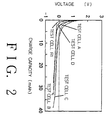
- a charge characteristic and discharge characteristic each on the third cycle are shown in figures 2 and 3 respectively.
- a rate of discharge capacity loss to charge capacity of the first cycle of the test cell B ((charge capacity - discharge capacity)/charge capacity) is shown in Table 1, where the charge and discharge cycle is started from charging.
- lithium ions are released from Li - Al alloy of the counter electrode into the electrolyte solution by charging, and the lithium ions move in the electrolyte solution to electrode-react with the active material Si 1-y M y O z of the working electrode, thereby the lithium ions are electrochemically incorporated into the active material Si 1-y M y O z to produce composite oxide Li x Si 1-y M y O z (x>o) of silicon and the element(s) M containing lithium.
- the lithium ions are released into the electrolyte solution from the composite oxide Li x Si 1-y M y O z to move in the electrolyte solution and to be incorporated into the counter electrode Li - Al alloy, this consequently enables a repeated stable charge and discharge.
- the active material Si 1- y M y O z after producing Li x Si 1-y M y O z of silicon and element(s) M containing lithium by the first charge, forms composite oxide Li x Si 1-y M y O z of silicon and element(s) M containing lithium on thereafter discharge - charge cycle other than when completely discharged.
- active material r1 silicon monoxide SiO (hereinafter referred to simply as “active material r1") obtained commercially as an active material of a working electrode instead of the active materials "a" to “d” according to the invention described, the same test cell R1 as said (Embodiment 1) is produced.
- active material r1 silicon monoxide SiO
- the same test of charge and discharge as above is performed, where a charge characteristic and a discharge characteristic each on the third cycle are shown in figures 2 and 3 respectively, a rate of discharge capacity loss for charge capacity of the first cycle is shown in Table 1.
- Cell a rate of discharge capacity loss for charge capacity of the first cycle Cell B 30.7 %
- the active materials "a” to "d” of the working electrode of the embodiment 1 instead of the active materials "a" to “d” of the working electrode of the embodiment 1, the active materials synthesised as described below are used and the same entire test cells as in the embodiment 1 are produced with exception of the active material of the working electrode.
- the active materials of the working electrode are produced as follows. Silicon monoxide (SiO) and manganese monoxide (MnO) each obtained commercially are weighed at a mol ratio of Si : Mn of 1 : 1, and sufficiently mixed in a mortar, thereafter the mixture is heated and burned in 12 hours at a temperature of 700°C in a nitrogen atmosphere, after cooled, it is ground and graded into a diameter equal to or less than 53 ⁇ m to produce an active material "e" having formula Si 0.5 Mn 0.5 O according to the invention.
- this embodiment uses the same graphite (hereinafter referred to simply as “comparison active material r4") as used for conductive agent in the embodiment 1 and uses the active material in which silicon monoxide SiO (the formerly described active material r1) and manganese monoxide (referred to simply as “comparison active material r2”) each obtained in the market are ground and graded into a diameter equal to or less than 53 ⁇ m respectively and used as an active material, and with exception of the above, the same test cell (comparison test cell) as is the case of the cell in the present invention is produced.
- test cells E, R1, R2, and R4 corresponding to active materials "e”, r1, r2, and r4 of the working electrode.
- a charge characteristic and discharge characteristic each on third cycle when performing charge and discharge cycle for the test cells E, R1, R2, and R4 under the same condition as in the embodiment 1, are shown in figures 4 and 5.
- the test cell E according to the invention has a considerably larger charge and discharge capacities with an extreme enlargement of the reversible region of charge and discharge compared to the comparison test cells R1 and R4.
- a difference between operating voltages of charge and discharge is considerably smaller ranging entire charge and discharge region, this produces extremely smaller cell polarisation (internal resistance) to facilitate larger current charge and discharge.
- test cell R2 has the same extent of charge and discharge capacity as the test cell E, but, the operating potential of charge and discharge is high (noble).
- the charge and discharge capacity of base potential region of less than 1.1 V (corresponding to about 1.5 V for the lithium standard electrode) is considerably higher than the test cell R2, the active material E according to the invention is found particularly superior as a negative active material.
- an active material synthesised as described below is used instead of the active materials "a" to "d" of the working electrode of the embodiment 1, thus, entirely the same test cell as in the embodiment 1 is produced with exception of the active material of the working electrode.
- An active material of working electrode of the present embodiment is produced as follows. Silicon monoxide SiO and titanium monoxide TiO each obtained commercially are weighed for a predetermined mol ratio of Si : Ti and thereafter fully ground and mixed by an automatic mortar, thus obtained mixture is thermal-treated in 12 hours at a temperature of 700°C in a nitrogen gas atmosphere, and after cooled, it is ground and graded into a particle diameter equal to or less than 53 ⁇ m. In this way, the produced (Si 1-y Ti y O) is used as an active material according to the present invention.
- three kinds of active materials of the working electrode having a mol ratio of Si : Ti are produced for comparison as follows, namely, (f1) 3 : 1 (Si 0.75 Ti 0.25 O), (f2) 1 : 1 (Si 0.5 Ti 0.5 O), and (f3) 1 : 3 (Si 0.25 Ti 0.75 O).
- this embodiment uses as comparison active materials r1 and r3 the silicon monoxide SiO and titanium monoxide TiO respectively ground and graded into a particle diameter equal to or less than 53 ⁇ m the same as used in synthesis material described above.
- the similar test cells are produced in the same way as in the test cell according to the present invention described above.
- test cells F1, F2, F3, R1 and R3 corresponding to active materials f1, f2, f3, r1 and r3 of the working electrode respectively used.
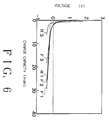
- a charge characteristic and discharge characteristic each on third cycle when performing the charge and discharge cycle test for the test cells F1 to F3 and R1 to R3 under the same condition as in the embodiments 1 and 2, are shown in figures 6 and 7 respectively.
- the charge and discharge characteristic is upgraded in case of range 0 ⁇ y ⁇ 1 as titanium amount "y" and this range may be satisfied, and preferably in 0 ⁇ y ⁇ 0.75, and more preferably the larger current charge and discharge characteristic in the case of 0 ⁇ y ⁇ 0.5 is fully upgraded together with larger charge and discharge capacity, therefore, such range is particularly preferable.
- novel negative active material Li x Si 1-y Ti y O z being the composite oxide according to the invention where silicon and titanium coexist as described above, it is facilitated to incorporate and release lithium ions because of a higher mobility of lithium ions, higher electro conductivity, and in addition large amount of sites capable of incorporating lithium ions.
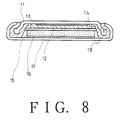
- FIG. 8 is a sectional view of a coin type battery showing one example of a non-aqueous electrolyte secondary battery according to the invention.
- 11 depicts a negative electrode case simultaneously used as a negative electrode terminal, where a stainless steel plate whose one-side outer surfaces is Ni-plated is shown reduced in size.
- Numeral 13 depicts a negative electrode formed of a negative active material according to the invention described later and adhered to a negative electrode case 11 by a negative electrode collector 12 formed of conductive adhesive agent using carbon as a conductive filler.
- 17 depicts a positive electrode case made of stainless steel whose one-side outer surface is Ni-plated, and the case is used simultaneously as a positive electrode terminal.
- a positive electrode formed of a positive active material according to the invention described later depicts a positive electrode formed of a positive active material according to the invention described later, and is adhered to the positive electrode case 17 by a positive electrode collector 16 made of conductive adhesive agent using carbon as conductive filler.
- 14 depicts a separator made of porous film of polypropylene and is impregnated with electrolyte solution.
- 18 depicts a gasket mainly made of polypropylene, and is placed between the negative electrode case 11 and the positive electrode case 17, maintaining electric insulation between the negative electrode and the positive electrode, and sealing cell content by allowing the positive electrode case opening edge to bed and caulk inside.
- the electrolyte solution is used in which 1 mol/1g lithium hexafluorophosphate LiPF 6 is dissolved in a mixed solvent of ethylene carbonate and methyl-ethyl-carbonate of volume ratio of 1 : 1.
- the cell has an outer diameter of 20 mm and a thickness of 1.6 mm.
- the negative electrode 13 is produced as follows.
- the active material "a" (Si 0.9 W 0.1 O 1.1 ) produced in the embodiment 1 is used as a negative active material of the present embodiment according to the present invention.
- silicon monoxide SiO (comparison active material r1) used as the comparison example of the embodiment 1 is used as a negative active material for comparison.
- These negative active materials "a” and r1 are mixed with graphite as a conductive agent and with cross-linked type acrylic acid resin and the like as a binder at a mixture rate of weight ratio of 45 : 40 : 15 respectively, to produce negative electrode mixtures, and next these negative electrode mixtures are pressed to form into pellets having a diameter of 15 mm with a thickness of 0.14 mm by adding 2 tonne/cm 2 , and thereafter the resultants depressurised and thermal-dried for 10 hours at 200°C to produce a negative electrode.
- the positive electrode 15 is produced as follows. Lithium hydroxide LiOH ⁇ H 2 O, cobalt carbonate CoCO 3 and boron oxide B 2 O 3 are weighed for a mol ratio of Li : Co : B of 1 : 0.9 : 0.1, and fully mixed in a mortar, thereafter the mixture obtained is heated and baked for 12 hours at a temperature of 850°C in air, and after cooled, the resultant is ground to form into a particle diameter equal to or less than 53 ⁇ m. The heating and grinding are repeated two times to synthesise the positive active material LiCo 0.9 B 0.1 O 2 of the present embodiment.
- This product is used as a positive active material, and added with graphite as a conductive agent and fluororesin and the like as a binder at a weight ratio of 80 : 15 : 5 to be mixed and to produce a positive electrode mixture, and next, this positive electrode mixture is formed into a pellet having a diameter of 16.2 mm with a thickness of 0.70 mm by compression at 2 tonne/cm 2 and thereafter depressurised and thermal-dried for 10 hours at 100°C to produce a positive electrode.
- batteries (these correspond to negative active materials "a” and r1 respectively used and are made as batteries G and S) remain aged in one week at a room temperature and then are subjected to a charge and discharge test as mentioned below.
- the charge and discharge cycle starts from charge.
- lithium ions are released into the electrolyte solution from the positive active material LiCo 0.9 B 0.1 O 2 by charging, the resulted lithium ions are moved in the electrolyte solution to electrode-react with the negative active material, the lithium ions are electrochemically incorporated into the negative active material to produce composite oxide Li x Si 0.9 W 0.1 O 1.1 of silicon and an element M (tungsten W) containing lithium.
- the negative active material after producing the composite oxide Li x Si 0.9 W 0.1 O 1.1 containing lithium by the first charge, forms composite oxide Li x Si 0.9 W 0.1 O 1.1 of silicon and the element M containing lithium on thereafter discharge - charge cycle other than when completely discharged.
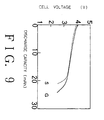
- the battery G according to the invention has a larger discharge capacity and higher operating voltage compared to the comparison battery S, this therefore provides an upgraded charge and discharge characteristic. Also, it was found that, when this charge and discharge was performed up to 20 cycles, then in the comparison battery S, the discharge capacity was lowered to about 90% of an initial capacity, while in the battery G, the capacity was hardly lowered, a cycle service life was considerably improved.
- metal chalcogenides such as TiS 2 , MoS 2 , and NbSe 3 , for example; metal oxides such as MnO 2 , MoO 3 , V 2 O 5 , Li x CoO 2 (x>0), Li x NiO 2 (x>0), and Li x Mn 2 O 4 (x >0) for example; conductive polymers such as polyanilin, polypyrrole, polyparaphenylene, and polyacene for example; and graphite intercalation compounds and the like.
- the present invention provides negative active material for use in a non-aqueous electrolyte secondary battery, the material having the composition formula Li x Si 1-y M y O z (where 0 ⁇ x, 0 ⁇ y ⁇ 1, and 0 ⁇ z ⁇ 2) and M is an oxide-forming element other than Li or Si and may for example be a metal or a metalloid.
- M is an oxide-forming element other than Li or Si and may for example be a metal or a metalloid.
- the capacity for reversibly incorporating and releasing lithium ions by charge and discharge i.e. the charge and discharge capacity, is considerably enhanced together with smaller polarisation during the charge and discharge.
- this material can be used in a secondary battery having an upgraded high-current charge and discharge characteristic with a high voltage and high energy density.
- an extremely stable secondary battery with a service life of many cycles can be produced almost free of deterioration by mechanisms such as the generation of irreversible substances due to over charging and over discharging.
Landscapes
- Chemical & Material Sciences (AREA)
- Engineering & Computer Science (AREA)
- Chemical Kinetics & Catalysis (AREA)
- Electrochemistry (AREA)
- General Chemical & Material Sciences (AREA)
- Materials Engineering (AREA)
- Manufacturing & Machinery (AREA)
- Inorganic Chemistry (AREA)
- Battery Electrode And Active Subsutance (AREA)
- Secondary Cells (AREA)
Description
| Cell | a rate of discharge capacity loss for charge capacity of the first cycle |
| Cell B | 30.7 % |
| Cell R1 | 54.0 % |
Claims (14)
- A non-aqueous electrolyte secondary battery comprising at least a negative electrode (13), a positive electrode (15), and a non-aqueous electrolyte with lithium ion conductivity, wherein a composite oxide of formula LixSi1-yMyOz is used as an active material of said negative electrode, wherein M is one or more oxide-forming elements selected from the group consisting of:and wherein x, y and z satisfy 0 ≦ x, 0 < y < 1 and 0 < z < 2.(i) metal elements other than alkali metals,(ii) metalloids and non-metals other than silicon, and(iii) boron, carbon and phosphorous,
- A non-aqueous electrolyte secondary battery as claimed in claim 1, wherein 0 < z ≦ 1.5.
- A non-aqueous electrolyte secondary cell as claimed in claim 1 or claim 2, wherein 0 <y < 0.75.
- A non-aqueous electrolyte secondary cell as claimed in any of claims 1 to 3, wherein M represents one or more elements selected from the group consisting of transition metal elements, and metal and metalloid elements of group 13 and group 14 in the IUPAC Periodic Table.
- A non-aqueous electrolyte secondary battery as claimed in claim 4, wherein M represents one or more elements selected from the group consisting of titanium (Ti), tungsten (W), manganese (Mn), iron (Fe), nickel (Ni), boron (B), tin (Sn) and lead (Pb).
- A non-aqueous electrolyte secondary battery as claimed in any of claims 1 to 5, wherein a composite oxide having a layer-like structure and the formula LiaTbLcO2 is used as an active material of said positive electrode (3), T is one or more transition metal elements, L is one or more metalloid elements, selected from boron B and silicon Si, and a, b and c satisfy 0 < a ≦ 1.15, 0.85 ≦ b+c ≦ 1.3, and 0 ≦ c respectively.
- A non-aqueous electrolyte secondary battery as claimed in any of claims 1 to 6, wherein a non-aqueous electrolyte solution comprising at least a non-aqueous solvent containing ethylene carbonate and a supporting electrolyte containing lithium ions is used as said non-aqueous electrolyte.
- A non-aqueous electrolyte secondary battery as claimed in claim 7, wherein said non-aqueous electrolyte solution also contains an R R' type alkyl carbonate represented by the formula:wherein R and R' (which may be the same or different) are alkyl groups.

- A non-aqueous electrolyte secondary battery as claimed in claim 8, wherein said R · R' type alkyl carbonate is dimethyl carbonate, diethyl carbonate or methyl-ethyl carbonate.
- A method for producing a non-aqueous electrolyte secondary battery, wherein inside the battery after assembling the battery, or inside or outside the battery during production of the battery, a composite oxide represented by formula Si1-yMyOz is electrochemically reacted with lithium or a material containing lithium to incorporate lithium ions into the composite oxide Si1-yMyOz and to produce a composite oxide of formula LixSi1-yMyOz, which functions as an active material of a negative electrode (5) of the battery, wherein M is one or more oxide-forming elements selected from the group consisting of:and wherein x, y and z satisfy 0 < x, 0 < y < 1 and 0 < z < 2.(i) metal elements other than alkali metals,(ii) metalloids and non-metals other than silicon, and(iii) boron, carbon and phosphorous,
- A method according to claim 10 wherein 0 < z < 1.5
- A method according to claim 10 or 11 wherein 0 < y < 0.75.
- A method according to claim 10, 11 or 12 wherein M represents one or more elements selected from the group consisting of transition metal elements, and metal and metalloid elements of group 13 and group 14 in the IUPAC Periodic Table.
- A method according to claim 10, 11, 12 or 13 wherein M represents one or more elements selected from the group consisting of titanium (Ti), tungsten (W), manganese (Mn), iron (Fe), nickel (Ni), boron (B), tin (Sn) and lead (Pb).
Applications Claiming Priority (10)
| Application Number | Priority Date | Filing Date | Title |
|---|---|---|---|
| JP4971693 | 1993-03-10 | ||
| JP49716/93 | 1993-03-10 | ||
| JP8094493 | 1993-04-07 | ||
| JP80944/93 | 1993-04-07 | ||
| JP8368293 | 1993-04-09 | ||
| JP83682/93 | 1993-04-09 | ||
| JP32837993 | 1993-12-24 | ||
| JP328379/93 | 1993-12-24 | ||
| JP6006023A JP3010226B2 (en) | 1993-03-10 | 1994-01-24 | Non-aqueous electrolyte secondary battery and method of manufacturing the same |
| JP6023/94 | 1994-01-24 |
Publications (2)
| Publication Number | Publication Date |
|---|---|
| EP0615296A1 EP0615296A1 (en) | 1994-09-14 |
| EP0615296B1 true EP0615296B1 (en) | 1998-01-28 |
Family
ID=27518664
Family Applications (1)
| Application Number | Title | Priority Date | Filing Date |
|---|---|---|---|
| EP94301699A Expired - Lifetime EP0615296B1 (en) | 1993-03-10 | 1994-03-10 | Non-aqueous electrolyte secondary battery and method of producing the same |
Country Status (4)
| Country | Link |
|---|---|
| US (1) | US5506075A (en) |
| EP (1) | EP0615296B1 (en) |
| JP (1) | JP3010226B2 (en) |
| DE (1) | DE69408179T2 (en) |
Families Citing this family (50)
| Publication number | Priority date | Publication date | Assignee | Title |
|---|---|---|---|---|
| US5618640A (en) * | 1993-10-22 | 1997-04-08 | Fuji Photo Film Co., Ltd. | Nonaqueous secondary battery |
| JPH07240200A (en) * | 1994-02-28 | 1995-09-12 | Fuji Photo Film Co Ltd | Non-aqueous secondary battery |
| JPH07263028A (en) * | 1994-03-25 | 1995-10-13 | Fuji Photo Film Co Ltd | Nonaqueous secondary battery |
| CA2122770C (en) * | 1994-05-03 | 2000-10-03 | Moli Energy (1990) Limited | Carbonaceous host compounds and use as anodes in rechargeable batteries |
| CA2127621C (en) * | 1994-07-08 | 1999-12-07 | Alfred Macdonald Wilson | Carbonaceous insertion compounds and use as anodes in rechargeable batteries |
| JPH08213052A (en) * | 1994-08-04 | 1996-08-20 | Seiko Instr Inc | Non-aqueous electrolyte secondary battery |
| CA2144037C (en) * | 1995-03-03 | 2000-12-05 | Jiayu Simon Xue | Carbonaceous insertion compounds and use as anodes in rechargeable batteries |
| US6068949A (en) * | 1995-04-13 | 2000-05-30 | Rentech, Inc. | Alkali metal ion battery electrode material |
| DE69636595T2 (en) * | 1995-04-19 | 2008-02-14 | Ube Industries, Ltd., Ube | SECONDARY BATTERY WITH NON-ACID ELECTROLYTES |
| JPH097638A (en) * | 1995-06-22 | 1997-01-10 | Seiko Instr Inc | Non-aqueous electrolyte secondary battery |
| JP3756232B2 (en) * | 1996-01-17 | 2006-03-15 | 宇部興産株式会社 | Nonaqueous electrolyte secondary battery |
| JP3713900B2 (en) * | 1996-07-19 | 2005-11-09 | ソニー株式会社 | Negative electrode material and non-aqueous electrolyte secondary battery using the same |
| US5783333A (en) | 1996-11-27 | 1998-07-21 | Polystor Corporation | Lithium nickel cobalt oxides for positive electrodes |
| JPH10312826A (en) | 1997-03-10 | 1998-11-24 | Sanyo Electric Co Ltd | Nonaqueous electrolyte battery and charging method therefor |
| US6242132B1 (en) * | 1997-04-16 | 2001-06-05 | Ut-Battelle, Llc | Silicon-tin oxynitride glassy composition and use as anode for lithium-ion battery |
| EP0880187B1 (en) * | 1997-05-22 | 2004-11-24 | Matsushita Electric Industrial Co., Ltd. | Non-aqueous electrolyte secondary battery |
| JPH1140150A (en) * | 1997-07-17 | 1999-02-12 | Sanyo Electric Co Ltd | Lithium secondary battery |
| US5958624A (en) * | 1997-12-18 | 1999-09-28 | Research Corporation Technologies, Inc. | Mesostructural metal oxide materials useful as an intercalation cathode or anode |
| EP2219253B1 (en) * | 1998-09-18 | 2015-06-10 | Canon Kabushiki Kaisha | Electrode material |
| JP2000228196A (en) * | 1998-11-30 | 2000-08-15 | Matsushita Electric Ind Co Ltd | Non-aqueous electrolyte secondary battery |
| US7416803B2 (en) * | 1999-01-22 | 2008-08-26 | California Institute Of Technology | Solid acid electrolytes for electrochemical devices |
| JP3649996B2 (en) * | 2000-05-24 | 2005-05-18 | 三洋電機株式会社 | Cathode active material for non-aqueous electrolyte secondary battery |
| JP4754782B2 (en) * | 2001-08-01 | 2011-08-24 | カリフォルニア・インスティテュート・オブ・テクノロジー | Solid acid electrolytes for electrochemical devices |
| JP4702510B2 (en) * | 2001-09-05 | 2011-06-15 | 信越化学工業株式会社 | Lithium-containing silicon oxide powder and method for producing the same |
| CN1284262C (en) * | 2001-12-27 | 2006-11-08 | 日本合成化学工业株式会社 | Lithium polymer cell and manufacturing method thereof |
| DE10222348A1 (en) * | 2002-05-21 | 2003-12-04 | Mitsubishi Polyester Film Gmbh | Biaxially oriented, hydrolysis-resistant film made of a thermoplastic with a hydrolysis stabilizer, process for its production, its use and capacitors made from the film |
| JP4135074B2 (en) | 2002-10-25 | 2008-08-20 | ソニー株式会社 | Negative electrode manufacturing method and battery manufacturing method |
| JP4186115B2 (en) | 2003-06-11 | 2008-11-26 | ソニー株式会社 | Lithium ion secondary battery |
| JP3786273B2 (en) | 2003-06-23 | 2006-06-14 | ソニー株式会社 | Negative electrode material and battery using the same |
| US8377591B2 (en) | 2003-12-26 | 2013-02-19 | Nec Corporation | Anode material for secondary battery, anode for secondary battery and secondary battery therewith |
| JP4022889B2 (en) | 2004-02-12 | 2007-12-19 | ソニー株式会社 | Electrolyte and battery |
| JP4270109B2 (en) | 2004-11-05 | 2009-05-27 | ソニー株式会社 | battery |
| JP4264567B2 (en) | 2004-11-05 | 2009-05-20 | ソニー株式会社 | Secondary battery |
| TWI291778B (en) | 2004-11-08 | 2007-12-21 | Sony Corp | Secondary battery |
| JP4851707B2 (en) * | 2004-12-15 | 2012-01-11 | セイコーインスツル株式会社 | Method for producing alkaline battery |
| JP5068459B2 (en) * | 2006-01-25 | 2012-11-07 | Necエナジーデバイス株式会社 | Lithium secondary battery |
| JP4359780B2 (en) * | 2006-06-29 | 2009-11-04 | ソニー株式会社 | Lithium ion secondary battery |
| KR100759401B1 (en) * | 2006-11-20 | 2007-09-19 | 삼성에스디아이 주식회사 | Anode active material for lithium secondary battery, manufacturing method thereof and lithium secondary battery comprising same |
| KR100759410B1 (en) * | 2006-11-20 | 2007-09-19 | 삼성에스디아이 주식회사 | Anode active material for lithium secondary battery, manufacturing method thereof and lithium secondary battery comprising same |
| KR100778450B1 (en) * | 2006-11-22 | 2007-11-28 | 삼성에스디아이 주식회사 | Anode active material for lithium secondary battery, preparation method thereof and lithium secondary battery comprising same |
| KR100814880B1 (en) * | 2006-11-22 | 2008-03-18 | 삼성에스디아이 주식회사 | Anode active material for lithium secondary battery, preparation method thereof and lithium secondary battery comprising same |
| WO2008093777A1 (en) | 2007-02-02 | 2008-08-07 | Panasonic Corporation | Lithium cell electrode, and method for manufacturing the lithium cell electrode |
| KR100805123B1 (en) * | 2007-02-15 | 2008-02-21 | 삼성에스디아이 주식회사 | Lithium secondary battery |
| JP4334579B2 (en) | 2007-03-28 | 2009-09-30 | 株式会社東芝 | Anode active material for non-aqueous electrolyte battery, non-aqueous electrolyte battery, battery pack and automobile |
| JP5511128B2 (en) * | 2007-06-07 | 2014-06-04 | 三星エスディアイ株式会社 | Anode material for non-aqueous secondary battery and non-aqueous secondary battery |
| KR100898291B1 (en) * | 2007-09-12 | 2009-05-18 | 삼성에스디아이 주식회사 | Lithium secondary battery |
| JP2013008586A (en) * | 2011-06-24 | 2013-01-10 | Sony Corp | Lithium ion secondary battery, negative electrode for lithium ion secondary battery, battery pack, electric vehicle, power storage system, electric power tool, and electronic device |
| JP6213980B2 (en) * | 2013-03-14 | 2017-10-18 | セイコーインスツル株式会社 | Electrochemical cell |
| JP6222433B2 (en) * | 2013-08-08 | 2017-11-01 | 日本電気硝子株式会社 | Method for producing negative electrode active material for power storage device |
| JP7657719B2 (en) * | 2019-08-29 | 2025-04-07 | 株式会社Eneosマテリアル | Binder composition for power storage device, slurry for power storage device electrode, power storage device electrode, and power storage device |
Family Cites Families (9)
| Publication number | Priority date | Publication date | Assignee | Title |
|---|---|---|---|---|
| IT1131478B (en) * | 1980-05-13 | 1986-06-25 | Consiglio Nazionale Ricerche | HIGH SPECIFIC ENERGY RECHARGEABLE BATTERIES WITH INTERCALATION ANODE AND CATHODE |
| DE4025208A1 (en) * | 1990-08-09 | 1992-02-13 | Varta Batterie | ELECTROCHEMICAL SECONDARY ELEMENT |
| JP3162437B2 (en) * | 1990-11-02 | 2001-04-25 | セイコーインスツルメンツ株式会社 | Non-aqueous electrolyte secondary battery |
| CA2055305C (en) * | 1990-11-17 | 2002-02-19 | Naoyuki Sugeno | Nonaqueous electrolyte secondary battery |
| US5256504A (en) * | 1991-09-13 | 1993-10-26 | Matsushita Electric Industrial Co., Ltd. | Monaqueous electrolyte secondary batteries |
| JP2997741B2 (en) * | 1992-07-29 | 2000-01-11 | セイコーインスツルメンツ株式会社 | Non-aqueous electrolyte secondary battery and method of manufacturing the same |
| US5401599A (en) * | 1992-10-02 | 1995-03-28 | Seiko Instruments Inc. | Non-aqueous electrolyte secondary battery and method of producing the same |
| US5294503A (en) * | 1992-10-13 | 1994-03-15 | The United States Of America As Represented By The National Aeronautics And Space Administration | Anode for rechargeable ambient temperature lithium cells |
| US5370949A (en) * | 1993-07-09 | 1994-12-06 | National Research Council Of Canada | Materials for use as cathodes in lithium electrochemical cells |
-
1994
- 1994-01-24 JP JP6006023A patent/JP3010226B2/en not_active Expired - Lifetime
- 1994-03-03 US US08/205,948 patent/US5506075A/en not_active Expired - Lifetime
- 1994-03-10 DE DE69408179T patent/DE69408179T2/en not_active Expired - Lifetime
- 1994-03-10 EP EP94301699A patent/EP0615296B1/en not_active Expired - Lifetime
Also Published As
| Publication number | Publication date |
|---|---|
| DE69408179T2 (en) | 1998-05-14 |
| EP0615296A1 (en) | 1994-09-14 |
| US5506075A (en) | 1996-04-09 |
| DE69408179D1 (en) | 1998-03-05 |
| JPH07230800A (en) | 1995-08-29 |
| JP3010226B2 (en) | 2000-02-21 |
Similar Documents
| Publication | Publication Date | Title |
|---|---|---|
| US5506075A (en) | Non-aqueous electrolyte secondary battery and method of producing the same | |
| US5401599A (en) | Non-aqueous electrolyte secondary battery and method of producing the same | |
| EP0696075B1 (en) | Non-aqueous electrolyte secondary battery | |
| JP3079343B2 (en) | Non-aqueous electrolyte secondary battery and method of manufacturing the same | |
| US5286582A (en) | Monaqueous electrolyte secondary battery and process for producing positive active materials | |
| JP2997741B2 (en) | Non-aqueous electrolyte secondary battery and method of manufacturing the same | |
| EP1494302A1 (en) | Nonaqueous electrolyte secondary battery | |
| EP0870339B1 (en) | Electrode material for electrochemical lithium intercalation | |
| US8298707B2 (en) | Positive active material and nonaqueous electrolyte secondary battery | |
| JPH05174818A (en) | Manufacture of nonaqueous electrolyte secondary battery and negative electrode active material thereof | |
| EP0874410B1 (en) | Non-aqueous electrolyte secondary batteries | |
| USRE35818E (en) | Non-aqueous electrolyte secondary battery and method of producing the same | |
| JP3169102B2 (en) | Non-aqueous electrolyte secondary battery | |
| JP2887632B2 (en) | Non-aqueous electrolyte secondary battery | |
| JP3079344B2 (en) | Non-aqueous electrolyte secondary battery and method of manufacturing the same | |
| JPH06275265A (en) | Nonaqueous electrolyte secondary battery | |
| JPH0696759A (en) | Non-aqueous electrolyte secondary battery and method for producing active material used therein | |
| JPH0487268A (en) | Nonaqueous electrolyte secondary battery | |
| JP3081981B2 (en) | Non-aqueous electrolyte secondary battery and method of manufacturing the same | |
| JP3354611B2 (en) | Non-aqueous electrolyte secondary battery and method of manufacturing the same | |
| JP3013209B2 (en) | Non-aqueous electrolyte secondary battery and method for producing negative electrode active material thereof | |
| JP2952367B2 (en) | Non-aqueous electrolyte secondary battery | |
| JP2000082459A (en) | Nonaqueous electrolyte secondary battery and its manufacture | |
| JP3017847B2 (en) | Non-aqueous solvent secondary battery | |
| JP2000077075A (en) | Nonaqueous electrolyte secondary battery and its manufacture |
Legal Events
| Date | Code | Title | Description |
|---|---|---|---|
| PUAI | Public reference made under article 153(3) epc to a published international application that has entered the european phase |
Free format text: ORIGINAL CODE: 0009012 |
|
| AK | Designated contracting states |
Kind code of ref document: A1 Designated state(s): DE FR GB |
|
| RIN1 | Information on inventor provided before grant (corrected) |
Inventor name: TAHARA, KENSUKE, C/O SEIKO ELEC. COMPONENTS LTD Inventor name: SAKAI, TSUGIO, C/O SEIKO ELEC. COMPONENTS LTD Inventor name: ISHIKAWA, HIDEKI, C/O SEIKO ELEC. COMPONENTS LTD Inventor name: CHINONE, KAZUO, C/O SEIKO ELEC. COMPONENTS LTD Inventor name: SAKATA, AKIFUMI Inventor name: YAHAGI, SEIJI Inventor name: IWASAKI, FUMIHARU |
|
| RIN1 | Information on inventor provided before grant (corrected) |
Inventor name: TAHARA, KENSUKE, C/O SEIKO ELEC. COMPONENTS LTD Inventor name: SAKAI, TSUGIO, C/O SEIKO ELEC. COMPONENTS LTD Inventor name: ISHIKAWA, HIDEKI, SEIKO ELEC. COMPONENTS LTD Inventor name: SAKATA, AKIFUMI Inventor name: YAHAGI, SEIJI Inventor name: IWASAKI, FUMIHARU |
|
| 17P | Request for examination filed |
Effective date: 19950110 |
|
| 17Q | First examination report despatched |
Effective date: 19960319 |
|
| GRAG | Despatch of communication of intention to grant |
Free format text: ORIGINAL CODE: EPIDOS AGRA |
|
| GRAH | Despatch of communication of intention to grant a patent |
Free format text: ORIGINAL CODE: EPIDOS IGRA |
|
| GRAH | Despatch of communication of intention to grant a patent |
Free format text: ORIGINAL CODE: EPIDOS IGRA |
|
| GRAH | Despatch of communication of intention to grant a patent |
Free format text: ORIGINAL CODE: EPIDOS IGRA |
|
| GRAA | (expected) grant |
Free format text: ORIGINAL CODE: 0009210 |
|
| AK | Designated contracting states |
Kind code of ref document: B1 Designated state(s): DE FR GB |
|
| REF | Corresponds to: |
Ref document number: 69408179 Country of ref document: DE Date of ref document: 19980305 |
|
| ET | Fr: translation filed | ||
| PLBE | No opposition filed within time limit |
Free format text: ORIGINAL CODE: 0009261 |
|
| STAA | Information on the status of an ep patent application or granted ep patent |
Free format text: STATUS: NO OPPOSITION FILED WITHIN TIME LIMIT |
|
| 26N | No opposition filed | ||
| REG | Reference to a national code |
Ref country code: GB Ref legal event code: IF02 |
|
| REG | Reference to a national code |
Ref country code: GB Ref legal event code: 732E |
|
| REG | Reference to a national code |
Ref country code: FR Ref legal event code: TP Ref country code: FR Ref legal event code: CA |
|
| REG | Reference to a national code |
Ref country code: FR Ref legal event code: TP |
|
| PGFP | Annual fee paid to national office [announced via postgrant information from national office to epo] |
Ref country code: DE Payment date: 20130306 Year of fee payment: 20 Ref country code: FR Payment date: 20130325 Year of fee payment: 20 Ref country code: GB Payment date: 20130306 Year of fee payment: 20 |
|
| REG | Reference to a national code |
Ref country code: DE Ref legal event code: R071 Ref document number: 69408179 Country of ref document: DE |
|
| REG | Reference to a national code |
Ref country code: DE Ref legal event code: R071 Ref document number: 69408179 Country of ref document: DE |
|
| REG | Reference to a national code |
Ref country code: GB Ref legal event code: PE20 Expiry date: 20140309 |
|
| PG25 | Lapsed in a contracting state [announced via postgrant information from national office to epo] |
Ref country code: DE Free format text: LAPSE BECAUSE OF EXPIRATION OF PROTECTION Effective date: 20140311 Ref country code: GB Free format text: LAPSE BECAUSE OF EXPIRATION OF PROTECTION Effective date: 20140309 |