EP0614971A2 - Neuartige Cyclodextrin-glukanotransferase, Verfahren zu ihrer Herstellung und Verfahren zur Herstellung von Cyclodexrin mittels dieser - Google Patents
Neuartige Cyclodextrin-glukanotransferase, Verfahren zu ihrer Herstellung und Verfahren zur Herstellung von Cyclodexrin mittels dieser Download PDFInfo
- Publication number
- EP0614971A2 EP0614971A2 EP94101978A EP94101978A EP0614971A2 EP 0614971 A2 EP0614971 A2 EP 0614971A2 EP 94101978 A EP94101978 A EP 94101978A EP 94101978 A EP94101978 A EP 94101978A EP 0614971 A2 EP0614971 A2 EP 0614971A2
- Authority
- EP
- European Patent Office
- Prior art keywords
- cyclodextrin
- glucanotransferase
- starch
- substrate
- solution
- Prior art date
- Legal status (The legal status is an assumption and is not a legal conclusion. Google has not performed a legal analysis and makes no representation as to the accuracy of the status listed.)
- Granted
Links
Images




Classifications
-
- C—CHEMISTRY; METALLURGY
- C12—BIOCHEMISTRY; BEER; SPIRITS; WINE; VINEGAR; MICROBIOLOGY; ENZYMOLOGY; MUTATION OR GENETIC ENGINEERING
- C12N—MICROORGANISMS OR ENZYMES; COMPOSITIONS THEREOF; PROPAGATING, PRESERVING, OR MAINTAINING MICROORGANISMS; MUTATION OR GENETIC ENGINEERING; CULTURE MEDIA
- C12N9/00—Enzymes; Proenzymes; Compositions thereof; Processes for preparing, activating, inhibiting, separating or purifying enzymes
- C12N9/10—Transferases (2.)
- C12N9/1048—Glycosyltransferases (2.4)
- C12N9/1051—Hexosyltransferases (2.4.1)
- C12N9/1074—Cyclomaltodextrin glucanotransferase (2.4.1.19)
-
- C—CHEMISTRY; METALLURGY
- C12—BIOCHEMISTRY; BEER; SPIRITS; WINE; VINEGAR; MICROBIOLOGY; ENZYMOLOGY; MUTATION OR GENETIC ENGINEERING
- C12P—FERMENTATION OR ENZYME-USING PROCESSES TO SYNTHESISE A DESIRED CHEMICAL COMPOUND OR COMPOSITION OR TO SEPARATE OPTICAL ISOMERS FROM A RACEMIC MIXTURE
- C12P19/00—Preparation of compounds containing saccharide radicals
- C12P19/18—Preparation of compounds containing saccharide radicals produced by the action of a glycosyl transferase, e.g. alpha-, beta- or gamma-cyclodextrins
-
- Y—GENERAL TAGGING OF NEW TECHNOLOGICAL DEVELOPMENTS; GENERAL TAGGING OF CROSS-SECTIONAL TECHNOLOGIES SPANNING OVER SEVERAL SECTIONS OF THE IPC; TECHNICAL SUBJECTS COVERED BY FORMER USPC CROSS-REFERENCE ART COLLECTIONS [XRACs] AND DIGESTS
- Y10—TECHNICAL SUBJECTS COVERED BY FORMER USPC
- Y10S—TECHNICAL SUBJECTS COVERED BY FORMER USPC CROSS-REFERENCE ART COLLECTIONS [XRACs] AND DIGESTS
- Y10S435/00—Chemistry: molecular biology and microbiology
- Y10S435/8215—Microorganisms
- Y10S435/822—Microorganisms using bacteria or actinomycetales
- Y10S435/84—Brevibacterium
Definitions
- This invention relates to a substantially pure novel cyclodextrin glucanotransferase (EC 2.4.1.19, to be referred to as "CGTase” hereinafter), a process for the production of the novel enzyme and a process for the production of cyclodextrin (to be referred to as "CD” hereinafter) using the novel enzyme.
- CCTase substantially pure novel cyclodextrin glucanotransferase
- CD cyclodextrin
- ⁇ -CD ⁇ -cyclodextrin
- CD is a non-reducing circular maltooligosaccharide which is formed from glucose molecules by ⁇ -1,4-glucoside bonding. Since CD can form an inclusion compound by incorporating various guest molecules into the cavity of the circle of host molecules and change physical and chemical properties of the incorporated guest molecules, use of CD renders possible stabilization of compounds which are sensitive to oxidation or optical decomposition, fixation of volatile compounds, solubilization of hardly soluble compounds and deodorization of odor substances. Because of such capabilities, CD is used broadly in the field of pharmaceutical preparations, cosmetics, agricultural chemicals and food.
- typical CD includes ⁇ -CD consisting of 6 glucose molecules, ⁇ -CD consisting of 7 glucose molecules and ⁇ -CD consisting of 8 glucose molecules, of which ⁇ -CD is considered most useful in the field of pharmaceutical preparations, cosmetics, agricultural chemicals, food industries and the like due to its high solubility and excellent capability to form inclusion compounds.
- CGTases known to date are those which produce ⁇ -CD and ⁇ -CD, and a CGTase capable of producing only ⁇ -CD or ⁇ -CD as a main product ( ⁇ -cyclodextrin glucanotransferase; to be referred to as " ⁇ -CGTase” hereinafter) is known only in a few strains belonging to the genus Bacillus , namely a CGTase produced by Bacillus sp. AL6 ( J . Ferment . Bioeng ., 70 , 150-154 (1990) and J . Ferment . Bioeng ., 70 , 190-192 (1990), reference 1), a CGTase produced by Bacillus sp.
- JP-A as used herein means an "unexamined published Japanese patent application”.
- Another object of the present invention is to solve the problem that the ⁇ -CD content in a reaction system decreases and the ⁇ -CD content increases when concentration of starch as the substrate is increased or the enzyme reaction time is prolonged for the purpose of providing ⁇ -CD at a low cost using the novel ⁇ -CGTase of the present invention.
- Fig. 1 is a graph showing a relationship between the reaction time and the amount of cyclodextrins formed when the ⁇ -CGTase of the present invention is allowed to react with starch.
- Fig. 2 is a graph showing an optimum pH profile of the ⁇ -CGTase of the present invention.
- a black circle indicates use of McIlvaine buffer
- a black triangle indicates use of Atkins & Pantin buffer
- a black square indicates use of KCl-NaOH buffer.
- Fig. 3 is a graph showing an optimum temperature profile of the ⁇ -CGTase of the present invention.
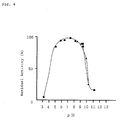
- Fig. 4 is a graph showing a pH stability profile of the ⁇ -CGTase of the present invention.
- a black circle indicates use of McIlvaine buffer
- a black triangle indicates use of Atkins & Pantin buffer
- a black square indicates use of KCl-NaOH buffer.
- Fig. 5 is a graph showing a temperature stability profile of the ⁇ -CGTase of the present invention.
- a solid line indicates a result when the ⁇ -CGTase was used alone and a dotted line indicates a result when 20 mM of calcium chloride was added.
- Fig. 6 is a chromatogram showing results of a high performance liquid chromatographic analysis of various cyclodextrins formed by the reaction of the ⁇ -CGTase of the present invention with starch.
- (1) indicates a peak of ⁇ -CD
- (2) indicates a peak of ⁇ -CD.
- the inventors of the present invention have examined a broad range of natural sources to screen microorganisms capable of producing a novel ⁇ -CGTase which can produce ⁇ -CD and found a strain belonging to the genus Brevibacterium which can produce the intended ⁇ -CGTase. Thereafter, the present inventors succeeded in culturing the strain with the production of the ⁇ -CGTase in the resulting culture, and collected the enzyme therefrom and confirmed novel properties of the enzyme. Further, the inventors established an industrial process for the production of ⁇ -CD making use of this novel enzyme.
- the present inventors have made an attempt to enhance production of ⁇ -CD by adding ethyl alcohol to a reaction solution in which ⁇ -CD and ⁇ -CD are produced from a high concentration of starch by the action of the ⁇ -CGTase of the present invention, and found for the first time that the effect of the addition of ethyl alcohol was not only to simply enhance production of ⁇ -CD but also to repress production of ⁇ -CD while enhancing production of ⁇ -CD, namely found an effect of ethyl alcohol to enhance production of ⁇ -CD without increasing yield of T-CD.
- the present invention was accomplished based on these findings.
- the present invention which provides a process in which yield of ⁇ -CD is increased while repressing formation of ⁇ -CD is useful and novel.
- the present inventors have accomplished the present invention by establishing a method for increasing yield of ⁇ -CD in which formation of ⁇ -CD is enhanced without increasing yield of T-CD, namely with repression of ⁇ -CD formation.
- any known ⁇ -CGTase may be used for the method described above provided that it can form ⁇ -CD and ⁇ -CD from starch by its enzyme reaction, it is preferable to use the ⁇ -CGTase produced by the Brevibacterium species which has been isolated by the present inventors from a soil sample.
- Shape and size of cell slender bacillary cell with swelling at the both ends of the cell, a size of 0.5 - 0.7 ⁇ 5.0 - 20 ⁇ m
- Pleomorphism recognizable Motility: motile (peritrichous flagella) Spore: no sporulation Gram-staining: negative Acid fastness: negative
- Bouillon agar plate culture slightly weak growth with smooth-surfaced viscous colonies (2 to 3 mm in diameter) having translucent periphery
- Bouillon agar slant culture slightly weak growth with straight, raw color and translucent surface
- Bouillon broth culture slight turbidness of whole liquid medium with viscous cell precipitate in the bottom Litmus milk culture: no changes
- the microorganism is cultured in a synthetic or natural medium containing a carbon source, a nitrogen source, inorganic salts and other nutrients which are necessary for obtaining good growth of the strain and proper production of the enzyme.
- the carbon source may be selected from carbohydrates such as starches or compositional fractions (amylose, amylopectin, etc.) thereof, roasted dextrins, modified starches, starch derivatives, physically treated starches, ⁇ -starches and the like.
- the carbohydrates include soluble starch, corn starch, potato starch, sweet potato starch, dextrin, amylopectin, amylose and the like.
- nitrogen source examples include organic nitrogen sources such as peptone, casein, meat extract, yeast extract, corn steep liquor, soybean or a soybean cake and the like, inorganic salts of nitrogen compounds such as ammonium sulfate, ammonium phosphate and the like and amino acids such as glutamic acid and the like.
- inorganic salts include phosphates such as potassium dihydrogenphosphate, dipotassium hydrogenphosphate and the like, magnesium salts such as magnesium sulfate and the like, calcium salts such as calcium chloride and the like and sodium salts such as sodium carbonate and the like.
- ⁇ -CGTase When cultured under such conditions, ⁇ -CGTase is produced in the culture medium generally 2 to 7 days after starting the culturing. Thereafter, cells are removed from the culture medium to obtain a culture filtrate, and the enzyme of interest is recovered from the filtrate by subjecting it to desalting and concentration using ultrafiltration membranes and then to ammonium sulfate salting out, organic solvent precipitation or the like.
- the thus obtained crude ⁇ -CGTase as such can be used in the CD forming reaction, it may optionally be further purified by, for example, an absorption/elution technique using DEAE-Sephadex (a trademark, manufactured by Pharmacia) or Butyl-Toyopearl (a trade name, manufactured by Tosoh Corporation), by a fractionation technique using Sephadex (a trademark, manufactured by Pharmacia) or Toyopearl (a trade name, manufactured by Tosoh Corporation) or by an affinity chromatography using ⁇ -CD-Sepharose.
- DEAE-Sephadex a trademark, manufactured by Pharmacia
- Butyl-Toyopearl a trade name, manufactured by Tosoh Corporation
- Sephadex a trademark, manufactured by Pharmacia
- Toyopearl a trade name, manufactured by Tosoh Corporation
- the enzyme of the present invention (5 units) was added to 2% by weight soluble starch aqueous solution (pH 7.0) and incubated at 40°C to measure the time-course of amounts of CD formed during the reaction by a high performance liquid chromatography.
- the conditions for the HPLC is the same as those employed in Example 2 described below.
- the results are shown in Fig. 1 in which a black square indicates the ratio of formed ⁇ -CD, a black triangle indicates the ratio of formed ⁇ -CD and a black circle indicates the ratio of formed ⁇ -CD.
- Each CD formation ratio is expressed as a weight percentage to the substrate starch.
- this enzyme acts upon starch and forms mainly ⁇ -CD, as well as ⁇ -CD, but does not form ⁇ -CD.
- Optimum temperature The enzyme of the present invention (1 unit/ml aqueous solution) was added to 1.5% by weight soluble starch aqueous solution and incubated for 30 minutes at pH 10.0 with varied temperature conditions to measure the enzyme activity under each condition. The results are shown in Fig. 3. As is evident from the results shown in Fig. 3, this enzyme has an optimum temperature of around 45°C.
- Stable pH range A solution of the enzyme of the present invention (5 units/ml aqueous solution) was incubated for 30 minutes at 40°C with varied pH conditions of from 3 to 13 to measure residual enzyme activity under each condition. The results are shown in Fig. 4. As is evident from the results shown in Fig. 4, this enzyme has a stable pH range of from about 6 to about 8.
- a 0.05 ml portion of an aqueous solution of the enzyme was added to 0.5 ml of a substrate solution (1.5% by weight soluble starch in 0.1 M Atkins & Pantin buffer, pH 10.0) and incubated at 40°C for 30 minutes. After adding 5 ml of 0.1 N hydrochloric acid to terminate the reaction, a 0.5 ml portion of the reaction mixture was taken out and mixed with 5 ml of an iodine solution (0.005% iodine in 0.05% potassium iodide solution) to measure decrease in the absorbance at 660 nm.
- One unit of the activity was defined as the amount of enzyme which decreases 1% of the absorbance at 660 nm within 1 minute under these conditions.
- the enzyme of the present invention has a molecular weight of about 75,000 (by SDS-electrophoresis).
- Isoelectric point The enzyme of the present invention has an isoelectric point (pI) of 2.8 (by isoelectric focusing).
- Enzymological properties of the enzyme of the present invention are shown in Table 3 together with those of the prior art CGTases which form ⁇ -CD as the main product.
- TABLE 3 Enzyme of reference 1 ( Bacillus sp. AL6)
- Enzyme of reference 2 Bacillus sp. No.313)
- Enzyme of reference 3 Bacillus firmus 29
- Enzyme of this invention ( Brevibacterium sp. No. 9605)
- Optimum temp 60°C 65°C 50°C 45°C Stable pH 6 - 10.7 6 - 8 - 6 - 8 Stable temp.
- the enzyme of the present invention is a novel enzyme which is different from all of the prior art CGTases which form ⁇ -CD as the main product.
- an enzyme itself or a solution of the enzyme of the present invention is added in an amount of from 0.5 to 20 units (per 1 g of dry starch) to an aqueous solution containing 1 to 30% by weight of starch (or a compositional fraction thereof, a modified starch or the like such as dextrin, amylopectin, amylose, glycogen, oligosaccharides, etc.), and the enzyme reaction is carried out at a pH value of from 4 to 10 and at a temperature of from 20 to 70°C for a period of from 1 to 50 hours.
- the starch material may be used after liquefying it with heat.
- the present invention has rendered possible production of ⁇ -CD in an industrial scale, but with a newly found problem that the ⁇ -CD content in a reaction system decreases and the ⁇ -CD content increases when concentration of starch as the substrate is increased and the enzyme reaction time is prolonged for the purpose of providing ⁇ -CD in a more larger amount.
- the inventors of the present invention have conducted extensive studies with the aim of producing ⁇ -CD at a low cost and found that the above problem can be solved by employing a process in which ethyl alcohol is added to a reaction solution for use in the ⁇ -CGTase reaction under a condition of high starch concentration or prolonged reaction period, thereby effecting enhanced formation of ⁇ -CD while simultaneously repressing formation of ⁇ -CD.
- ethyl alcohol in an amount of from about 5 to 30% (v/v), preferably from about 15 to 25% (v/v), as the final concentration based on the substrate solution, independent of the type of enzyme and concentration of the substrate.
- ethyl alcohol may be effected at any time during the course of the reaction with no particular limitation, it may be added preferably at an early stage of the reaction, for example simultaneously with the reaction.
- Test Examples and Examples are provided to further illustrate the present invention. It is to be understood, however, that they are for purpose of illustration only and the present invention is not to be construed as being limited thereto.
- Each of 500 ml capacity Shaking flask was charged with 100 ml of a culture medium (pH 10.0) consisting of 1.0% soluble starch, 0.5% polypeptone, 0.25% yeast extract, 0.1% ammonium sulfate, 0.05% K2HPO4, 0.025% MgSO4 ⁇ 7H2O, 0.01% CaCl2 and 1.0% Na2CO3 (separate sterilization).
- the thus prepared medium was sterilized in the usual way (at about 121°C, 10 to 20 minutes) and then inoculated with cells of Brevibacterium sp. No. 9605 (FERM P-13141, FERM BP-4537 under the Budapest Treaty).
- the cultured cells were removed by centrifugation to obtain two liters of culture filtrate. Thereafter, the thus prepared culture filtrate was passed through an ultrafiltration membrane (Module SIP, manufactured by Asahi Kasei Kogyo Kabushiki Kaisha) to obtain 30 ml of a concentrated solution which showed a CGTase activity of 6.7 units/ml.
- Module SIP manufactured by Asahi Kasei Kogyo Kabushiki Kaisha
- u/g ⁇ DS means unit of enzyme per 1 g of dry starch
- CD forming ratio is expressed by weight ratio (%) based on the substrate.
- the enzyme of the present invention can form ⁇ -CD with a yield of 16 to 18%.
- Example 2 The solution of ⁇ -CGTase obtained in Example 1 (2.5 units per 1 g of dry starch) was added to 10 ml of 5% potato starch solution (0.01 M H3BO3 ⁇ KCl-NaOH aqueous buffer, pH 8.0), and the enzyme reaction was carried out for 44 hours at 55°C. Yields of the ⁇ -CD and ⁇ -CD formed by this reaction (weight ratio to the substrate) were found to be 9.0% and 4.9%, respectively, with no formation of ⁇ -CD.
- Example 2 The solution of ⁇ -CGTase obtained in Example 1 (5 units per 1 g of dry starch) was added to 10 ml of 2 to 15% soluble starch solution (0.01 M McIlvaine buffer, pH 7.0), and the enzyme reaction was carried out for 3 to 44 hours at 40°C to examine formation ratio of each CD. Formation ratio of each CD by the Brevibacterium sp. ⁇ -CGTase is shown in Table 5. In the table, each CD formation ratio is expressed as a weight ratio to the substrate.
- ⁇ -CD is formed with a high yield when the substrate is used in a low concentration of 2%, but the yield of ⁇ -CD decreases and the ⁇ -CD yield increases when the substrate concentration is increased or the reaction time is prolonged even at a substrate concentration of 2%.
- ⁇ -CGTase obtained in Example 1 (5.0 units per 1 g of dry starch) was added to 10 ml of 10% soluble starch solution (0.01 M McIlvaine buffer, pH 7.0) containing 20% (v/v) ethyl alcohol, and the enzyme reaction was carried out for 20 hours at 40°C. Yields of the ⁇ -CD and ⁇ -CD formed by this reaction (weight ratio to the substrate) were found to be 16.5% and 3.5%, respectively, with no formation of ⁇ -CD.
- a process for the production of a novel ⁇ -CGTase which comprises culturing a strain belonging to the genus Brevibacterium capable of producing ⁇ -CGTase, thereby allowing the strain to produce the novel ⁇ -CGTase in a culture medium, and subsequently collecting the enzyme, as well as a process for the production of ⁇ -CD in which the novel ⁇ -CGTase is used.
- the present invention has succeeded in providing a process for the production of ⁇ -CD in an industrial scale at a low cost without accompanying yield increment of T-CD by adding ethyl alcohol to a reaction solution in which ⁇ -CD and ⁇ -CD are formed by the reaction of ⁇ -CGTase with a high concentration of starch, thereby repressing formation of ⁇ -CD and enhancing formation of ⁇ -CD.
Landscapes
- Chemical & Material Sciences (AREA)
- Organic Chemistry (AREA)
- Life Sciences & Earth Sciences (AREA)
- Engineering & Computer Science (AREA)
- Health & Medical Sciences (AREA)
- Zoology (AREA)
- Wood Science & Technology (AREA)
- Genetics & Genomics (AREA)
- Bioinformatics & Cheminformatics (AREA)
- General Health & Medical Sciences (AREA)
- Biochemistry (AREA)
- General Engineering & Computer Science (AREA)
- Microbiology (AREA)
- Biotechnology (AREA)
- Chemical Kinetics & Catalysis (AREA)
- General Chemical & Material Sciences (AREA)
- Medicinal Chemistry (AREA)
- Molecular Biology (AREA)
- Biomedical Technology (AREA)
- Preparation Of Compounds By Using Micro-Organisms (AREA)
- Enzymes And Modification Thereof (AREA)
Applications Claiming Priority (3)
| Application Number | Priority Date | Filing Date | Title |
|---|---|---|---|
| JP4574793 | 1993-02-09 | ||
| JP45747/93 | 1993-02-09 | ||
| JP04574793A JP3360291B2 (ja) | 1993-02-09 | 1993-02-09 | γ−サイクロデキストリンの増収方法 |
Publications (3)
| Publication Number | Publication Date |
|---|---|
| EP0614971A2 true EP0614971A2 (de) | 1994-09-14 |
| EP0614971A3 EP0614971A3 (de) | 1994-11-02 |
| EP0614971B1 EP0614971B1 (de) | 2002-09-04 |
Family
ID=12727910
Family Applications (1)
| Application Number | Title | Priority Date | Filing Date |
|---|---|---|---|
| EP94101978A Expired - Lifetime EP0614971B1 (de) | 1993-02-09 | 1994-02-09 | Neuartige Cyclodextrin-glukanotransferase, Verfahren zu ihrer Herstellung und Verfahren zur Herstellung von Cyclodexrin mittels dieser |
Country Status (4)
| Country | Link |
|---|---|
| US (1) | US5707833A (de) |
| EP (1) | EP0614971B1 (de) |
| JP (1) | JP3360291B2 (de) |
| DE (1) | DE69431267T2 (de) |
Cited By (5)
| Publication number | Priority date | Publication date | Assignee | Title |
|---|---|---|---|---|
| FR2728268A1 (fr) * | 1994-12-14 | 1996-06-21 | American Maize Prod Co | Procede de preparation de gamma-cyclodextrine |
| WO1996033267A1 (en) * | 1995-04-21 | 1996-10-24 | Novo Nordisk A/S | Cyclomaltodextrin glucanotransferase variants |
| EP0802259A1 (de) * | 1996-04-18 | 1997-10-22 | Consortium für elektrochemische Industrie GmbH | Cyclodextringlycosyltransferasen zur Produktion von gamma-Cyclodextrin |
| EP1284293A3 (de) * | 2001-07-11 | 2003-11-05 | Nihon Shokuhin Kako Co., Ltd. | Gen, das für eine Cyclodextrin-Glucanotransferase kodiert, die hauptsächlich gamma-Cyclodextrin produziert, und dessen Verwendung |
| CN102827900A (zh) * | 2012-09-10 | 2012-12-19 | 江南大学 | 一种生物法生产γ-环糊精的生产工艺 |
Families Citing this family (1)
| Publication number | Priority date | Publication date | Assignee | Title |
|---|---|---|---|---|
| JP3934851B2 (ja) * | 2000-05-23 | 2007-06-20 | 日本食品化工株式会社 | 新規シクロテ゛キストリン・ク゛ルカノトランスフェラーセ゛、その製造方法及びこの酵素を用いるシクロテ゛キストリンの製造方法 |
Family Cites Families (4)
| Publication number | Priority date | Publication date | Assignee | Title |
|---|---|---|---|---|
| JPS6025118B2 (ja) * | 1979-05-25 | 1985-06-17 | 東洋醸造株式会社 | サイクロデキストリンの増収法 |
| JPS61274680A (ja) * | 1985-05-29 | 1986-12-04 | Daiwa Kasei Kk | サイクロデキストリングリコシルトランスフエラ−ゼの製造法 |
| JPH0632611B2 (ja) * | 1985-07-29 | 1994-05-02 | 理化学研究所 | γ―サイクロデキストリン合成酵素及びその製造法 |
| DE3716181A1 (de) * | 1987-05-14 | 1988-12-08 | Consortium Elektrochem Ind | Verfahren zur herstellung von cyclooctaamylose |
-
1993
- 1993-02-09 JP JP04574793A patent/JP3360291B2/ja not_active Expired - Fee Related
-
1994
- 1994-02-09 EP EP94101978A patent/EP0614971B1/de not_active Expired - Lifetime
- 1994-02-09 DE DE69431267T patent/DE69431267T2/de not_active Expired - Fee Related
-
1995
- 1995-06-06 US US08/471,235 patent/US5707833A/en not_active Expired - Fee Related
Cited By (9)
| Publication number | Priority date | Publication date | Assignee | Title |
|---|---|---|---|---|
| FR2728268A1 (fr) * | 1994-12-14 | 1996-06-21 | American Maize Prod Co | Procede de preparation de gamma-cyclodextrine |
| US5550222A (en) * | 1994-12-14 | 1996-08-27 | American Maize-Products Company | Process for producing gamma-cyclodextrin |
| WO1996033267A1 (en) * | 1995-04-21 | 1996-10-24 | Novo Nordisk A/S | Cyclomaltodextrin glucanotransferase variants |
| US6004790A (en) * | 1995-04-21 | 1999-12-21 | Novo Nordisk A/S | Cyclomaltodextrin glucanotransferase variants |
| EP1632566A3 (de) * | 1995-04-21 | 2006-08-16 | Novozymes A/S | Varianten der Cyclomaltodextrin-Glucanotransferase |
| EP0802259A1 (de) * | 1996-04-18 | 1997-10-22 | Consortium für elektrochemische Industrie GmbH | Cyclodextringlycosyltransferasen zur Produktion von gamma-Cyclodextrin |
| EP1284293A3 (de) * | 2001-07-11 | 2003-11-05 | Nihon Shokuhin Kako Co., Ltd. | Gen, das für eine Cyclodextrin-Glucanotransferase kodiert, die hauptsächlich gamma-Cyclodextrin produziert, und dessen Verwendung |
| US6960461B2 (en) | 2001-07-11 | 2005-11-01 | Nihon Shokuhin Kako Co., Ltd. | Gene coding for cyclodextrin glucanotransferase chiefly producing γ-cyclodextrin and use thereof |
| CN102827900A (zh) * | 2012-09-10 | 2012-12-19 | 江南大学 | 一种生物法生产γ-环糊精的生产工艺 |
Also Published As
| Publication number | Publication date |
|---|---|
| EP0614971B1 (de) | 2002-09-04 |
| JP3360291B2 (ja) | 2002-12-24 |
| EP0614971A3 (de) | 1994-11-02 |
| DE69431267D1 (de) | 2002-10-10 |
| US5707833A (en) | 1998-01-13 |
| DE69431267T2 (de) | 2003-07-31 |
| JPH06233692A (ja) | 1994-08-23 |
Similar Documents
| Publication | Publication Date | Title |
|---|---|---|
| EP0017242B1 (de) | Verfahren zur Herstellung von Cyclodextrinen | |
| US5252469A (en) | Process for producing a transglutaminase derived from streptomyces | |
| EP0327099A2 (de) | Cyclomaltodextrin-Glucanotransferase, Verfahren zu ihrer Herstellung und für das Verfahren nützlicher Mikroorganismus | |
| EP0614971B1 (de) | Neuartige Cyclodextrin-glukanotransferase, Verfahren zu ihrer Herstellung und Verfahren zur Herstellung von Cyclodexrin mittels dieser | |
| US5093255A (en) | Acid urease and production thereof | |
| US5188956A (en) | Thermostable amylase | |
| US5939308A (en) | Heat resistant maltose phosphorylase, process for preparation thereof, bacteria used for preparation thereof, and methods for using the enzyme | |
| EP0558036B1 (de) | Enzym für Spaltung und Verfahren zu seiner Herstellung | |
| US5352602A (en) | Isoamylase and process for producing the same | |
| JP3544383B2 (ja) | アルカリに安定なサイクロデキストリン グルカノトランスフェラーゼ及びその製造法 | |
| US5110734A (en) | Purified cyclodextrinase | |
| EP0492426B1 (de) | Klebsiella Oxytoca Nr. 19-1 und Verfahren zur Herstellung von Alpha-Cyclodextrin | |
| EP0158435B1 (de) | Thermostabile Pullulanase mit einem breiten Wirkungs-PH-Bereich und Verfahren zur Herstellung derselben | |
| US5492829A (en) | Klebsiella oxytoca No. 19-1 capable of producing α-cyclodextrin | |
| US5238825A (en) | Preparation and use of a cyclodextrinase for preparing maltooligosaccharides | |
| JP3250852B2 (ja) | バチルス・メガテリウムの生産する新規サイクロデキストリン・グルカノトランスフェラーゼ、その製造法及び該酵素を用いるサイクロデキストリンの製造法 | |
| EP0350737A2 (de) | Thermostabile Amylase und deren Verwendung | |
| JP3272416B2 (ja) | 新規サイクロデキストリン・グルカノトランスフェラーゼ、その製造法及び該酵素を用いるサイクロデキストリンの製造法 | |
| KR830002250B1 (ko) | 사이클로덱스트린(Cyclodextrine)의 제조법 | |
| KR960007741B1 (ko) | 신규 α-1, 6-글루코시다제 및 그의 제조방법 | |
| JP3027449B2 (ja) | 新規シクロマルトデキストリナーゼ、その製造法及び該酵素を生産する微生物 | |
| JPH072116B2 (ja) | ジフルクト−ス、ジアンヒドリド▲iii▼の製造法 | |
| JPH0632611B2 (ja) | γ―サイクロデキストリン合成酵素及びその製造法 | |
| JPH0358784A (ja) | 新規なシクロマルトデキストリナーゼ及びその製造方法 | |
| JPH07183A (ja) | コリネバクテリウムの生産するサイクロデキストリン・グルカノトランスフェラーゼの製造法及び該酵素の利用 |
Legal Events
| Date | Code | Title | Description |
|---|---|---|---|
| PUAI | Public reference made under article 153(3) epc to a published international application that has entered the european phase |
Free format text: ORIGINAL CODE: 0009012 |
|
| AK | Designated contracting states |
Kind code of ref document: A2 Designated state(s): DE FR |
|
| PUAL | Search report despatched |
Free format text: ORIGINAL CODE: 0009013 |
|
| AK | Designated contracting states |
Kind code of ref document: A3 Designated state(s): DE FR |
|
| 17P | Request for examination filed |
Effective date: 19950428 |
|
| 17Q | First examination report despatched |
Effective date: 19991209 |
|
| GRAG | Despatch of communication of intention to grant |
Free format text: ORIGINAL CODE: EPIDOS AGRA |
|
| GRAG | Despatch of communication of intention to grant |
Free format text: ORIGINAL CODE: EPIDOS AGRA |
|
| RAP1 | Party data changed (applicant data changed or rights of an application transferred) |
Owner name: AMANO ENZYME INC. |
|
| GRAG | Despatch of communication of intention to grant |
Free format text: ORIGINAL CODE: EPIDOS AGRA |
|
| GRAH | Despatch of communication of intention to grant a patent |
Free format text: ORIGINAL CODE: EPIDOS IGRA |
|
| GRAH | Despatch of communication of intention to grant a patent |
Free format text: ORIGINAL CODE: EPIDOS IGRA |
|
| GRAA | (expected) grant |
Free format text: ORIGINAL CODE: 0009210 |
|
| AK | Designated contracting states |
Kind code of ref document: B1 Designated state(s): DE FR |
|
| REF | Corresponds to: |
Ref document number: 69431267 Country of ref document: DE Date of ref document: 20021010 |
|
| ET | Fr: translation filed | ||
| PLBE | No opposition filed within time limit |
Free format text: ORIGINAL CODE: 0009261 |
|
| STAA | Information on the status of an ep patent application or granted ep patent |
Free format text: STATUS: NO OPPOSITION FILED WITHIN TIME LIMIT |
|
| 26N | No opposition filed |
Effective date: 20030605 |
|
| PG25 | Lapsed in a contracting state [announced via postgrant information from national office to epo] |
Ref country code: DE Free format text: LAPSE BECAUSE OF NON-PAYMENT OF DUE FEES Effective date: 20030902 |
|
| PG25 | Lapsed in a contracting state [announced via postgrant information from national office to epo] |
Ref country code: FR Free format text: LAPSE BECAUSE OF NON-PAYMENT OF DUE FEES Effective date: 20031031 |
|
| REG | Reference to a national code |
Ref country code: FR Ref legal event code: ST |