EP0612602A2 - Verfahren zur Herstellung von bewitterbaren, starren Extrusionsprofilen mit verbesserter Oberflächenerscheinung - Google Patents
Verfahren zur Herstellung von bewitterbaren, starren Extrusionsprofilen mit verbesserter Oberflächenerscheinung Download PDFInfo
- Publication number
- EP0612602A2 EP0612602A2 EP94102755A EP94102755A EP0612602A2 EP 0612602 A2 EP0612602 A2 EP 0612602A2 EP 94102755 A EP94102755 A EP 94102755A EP 94102755 A EP94102755 A EP 94102755A EP 0612602 A2 EP0612602 A2 EP 0612602A2
- Authority
- EP
- European Patent Office
- Prior art keywords
- chlorine
- chlorinated
- blend
- molecular weight
- extruded
- Prior art date
- Legal status (The legal status is an assumption and is not a legal conclusion. Google has not performed a legal analysis and makes no representation as to the accuracy of the status listed.)
- Withdrawn
Links
Images

Classifications
-
- C—CHEMISTRY; METALLURGY
- C08—ORGANIC MACROMOLECULAR COMPOUNDS; THEIR PREPARATION OR CHEMICAL WORKING-UP; COMPOSITIONS BASED THEREON
- C08L—COMPOSITIONS OF MACROMOLECULAR COMPOUNDS
- C08L27/00—Compositions of homopolymers or copolymers of compounds having one or more unsaturated aliphatic radicals, each having only one carbon-to-carbon double bond, and at least one being terminated by a halogen; Compositions of derivatives of such polymers
- C08L27/22—Compositions of homopolymers or copolymers of compounds having one or more unsaturated aliphatic radicals, each having only one carbon-to-carbon double bond, and at least one being terminated by a halogen; Compositions of derivatives of such polymers modified by chemical after-treatment
- C08L27/24—Compositions of homopolymers or copolymers of compounds having one or more unsaturated aliphatic radicals, each having only one carbon-to-carbon double bond, and at least one being terminated by a halogen; Compositions of derivatives of such polymers modified by chemical after-treatment halogenated
-
- B—PERFORMING OPERATIONS; TRANSPORTING
- B29—WORKING OF PLASTICS; WORKING OF SUBSTANCES IN A PLASTIC STATE IN GENERAL
- B29C—SHAPING OR JOINING OF PLASTICS; SHAPING OF MATERIAL IN A PLASTIC STATE, NOT OTHERWISE PROVIDED FOR; AFTER-TREATMENT OF THE SHAPED PRODUCTS, e.g. REPAIRING
- B29C48/00—Extrusion moulding, i.e. expressing the moulding material through a die or nozzle which imparts the desired form; Apparatus therefor
-
- B—PERFORMING OPERATIONS; TRANSPORTING
- B29—WORKING OF PLASTICS; WORKING OF SUBSTANCES IN A PLASTIC STATE IN GENERAL
- B29C—SHAPING OR JOINING OF PLASTICS; SHAPING OF MATERIAL IN A PLASTIC STATE, NOT OTHERWISE PROVIDED FOR; AFTER-TREATMENT OF THE SHAPED PRODUCTS, e.g. REPAIRING
- B29C48/00—Extrusion moulding, i.e. expressing the moulding material through a die or nozzle which imparts the desired form; Apparatus therefor
- B29C48/001—Combinations of extrusion moulding with other shaping operations
- B29C48/0017—Combinations of extrusion moulding with other shaping operations combined with blow-moulding or thermoforming
-
- B—PERFORMING OPERATIONS; TRANSPORTING
- B29—WORKING OF PLASTICS; WORKING OF SUBSTANCES IN A PLASTIC STATE IN GENERAL
- B29C—SHAPING OR JOINING OF PLASTICS; SHAPING OF MATERIAL IN A PLASTIC STATE, NOT OTHERWISE PROVIDED FOR; AFTER-TREATMENT OF THE SHAPED PRODUCTS, e.g. REPAIRING
- B29C48/00—Extrusion moulding, i.e. expressing the moulding material through a die or nozzle which imparts the desired form; Apparatus therefor
- B29C48/03—Extrusion moulding, i.e. expressing the moulding material through a die or nozzle which imparts the desired form; Apparatus therefor characterised by the shape of the extruded material at extrusion
- B29C48/06—Rod-shaped
-
- B—PERFORMING OPERATIONS; TRANSPORTING
- B29—WORKING OF PLASTICS; WORKING OF SUBSTANCES IN A PLASTIC STATE IN GENERAL
- B29C—SHAPING OR JOINING OF PLASTICS; SHAPING OF MATERIAL IN A PLASTIC STATE, NOT OTHERWISE PROVIDED FOR; AFTER-TREATMENT OF THE SHAPED PRODUCTS, e.g. REPAIRING
- B29C48/00—Extrusion moulding, i.e. expressing the moulding material through a die or nozzle which imparts the desired form; Apparatus therefor
- B29C48/03—Extrusion moulding, i.e. expressing the moulding material through a die or nozzle which imparts the desired form; Apparatus therefor characterised by the shape of the extruded material at extrusion
- B29C48/12—Articles with an irregular circumference when viewed in cross-section, e.g. window profiles
-
- B—PERFORMING OPERATIONS; TRANSPORTING
- B29—WORKING OF PLASTICS; WORKING OF SUBSTANCES IN A PLASTIC STATE IN GENERAL
- B29K—INDEXING SCHEME ASSOCIATED WITH SUBCLASSES B29B, B29C OR B29D, RELATING TO MOULDING MATERIALS OR TO MATERIALS FOR MOULDS, REINFORCEMENTS, FILLERS OR PREFORMED PARTS, e.g. INSERTS
- B29K2027/00—Use of polyvinylhalogenides or derivatives thereof as moulding material
- B29K2027/06—PVC, i.e. polyvinylchloride
-
- B—PERFORMING OPERATIONS; TRANSPORTING
- B29—WORKING OF PLASTICS; WORKING OF SUBSTANCES IN A PLASTIC STATE IN GENERAL
- B29K—INDEXING SCHEME ASSOCIATED WITH SUBCLASSES B29B, B29C OR B29D, RELATING TO MOULDING MATERIALS OR TO MATERIALS FOR MOULDS, REINFORCEMENTS, FILLERS OR PREFORMED PARTS, e.g. INSERTS
- B29K2995/00—Properties of moulding materials, reinforcements, fillers, preformed parts or moulds
- B29K2995/0037—Other properties
- B29K2995/0072—Roughness, e.g. anti-slip
-
- C—CHEMISTRY; METALLURGY
- C08—ORGANIC MACROMOLECULAR COMPOUNDS; THEIR PREPARATION OR CHEMICAL WORKING-UP; COMPOSITIONS BASED THEREON
- C08L—COMPOSITIONS OF MACROMOLECULAR COMPOUNDS
- C08L23/00—Compositions of homopolymers or copolymers of unsaturated aliphatic hydrocarbons having only one carbon-to-carbon double bond; Compositions of derivatives of such polymers
- C08L23/26—Compositions of homopolymers or copolymers of unsaturated aliphatic hydrocarbons having only one carbon-to-carbon double bond; Compositions of derivatives of such polymers modified by chemical after-treatment
- C08L23/28—Compositions of homopolymers or copolymers of unsaturated aliphatic hydrocarbons having only one carbon-to-carbon double bond; Compositions of derivatives of such polymers modified by chemical after-treatment by reaction with halogens or halogen-containing compounds
- C08L23/286—Chlorinated polyethylene
Definitions
- This invention pertains to blends of post-chlorinated polyvinyl chloride (CPVC) and chlorinated polyethylene (CPE), and methods for making extruded rigid profiles from the blends and exhibiting smooth satin surface appearance.
- CPVC post-chlorinated polyvinyl chloride
- CPE chlorinated polyethylene
- Blends of PVC and chlorinated polyethylene are recognized as contributing both impact modifying characteristics as well as ease of melt processing.
- Chlorinated polyethylene is not particularly efficient when utilized as the sole impact modifier with PVC, hence an amount needed to boost notched Izod Impact strength to at least about 10 lb.-ft./inch notch will lead to appreciable loss in rigidity, measured as tensile of flexural modulus.
- Klug and Frey disclosed in U.S. Patent No. 4,280,940 the combination of PVC and two CPE's to provide improved transparency for weatherable blends. They noted that the incorporation of CPE with methylcyclohexane (MCH) swell of more than 10% lead to reduced transparency. Klug and Frey also noted that the combination of CPE and PVC with K value 70 is difficult and can lead to rough extrudate. They proposed a combination of PVC (K 55-65) and two CPE's, one having a low MCH swell, and both containing 37-42% chlorine.
- MCH methylcyclohexane
- CPE and CPVC were precipitated from cements, dried, milled and pressed for determination of heat distortion temperature (HDT) and IZOD impact strength.
- the CPE chlorine content from 30-40% was preferred and impact strength was maximized using most types of base polyethylene having about 35% chlorine content. Exceptions to this trend occurred with a copolymer of ethylene and butene having a relatively high melt index.
- the preferred Zeigler type polyethylenes chlorinated to about 30-32% always gave higher impact strength than those with higher chlorine content. It was noted that extrusion speed and appearance of the extrudate was best at 7 phr CPE, while at 10 phr and higher, chemical resistance and HDT were detrimentally altered.
- One aspect of the '347 patent was to obtain a combination of HDT and impact resistance with from 5 to 10 phr CPE. A small effective amount, on the order of 1 to 2 phr of the amorphous rubbery epoxide imparted higher melt flow rates.
- the working examples were prepared by milling and compression molding, while melt flow rate was measured by a small extrusion rheometer. The best melt flow rate/ HDT/ impact strength balance was observed at CPE use levels of 7.75 phr.
- Buning, et al have taught in U.S. Pat. No. 3,459,692 that due to the higher crystallinity of stereo-regular CPVC and the tendency of a cooling melt to re-crystallize, molded articles from a blend of CPE and stereo-regular CPVC are more brittle than blends with atactic CPVC. They found that milled, pressed sheets of a blend of CPE and CPVC, where the CPVC was derived from 55 to 85% syndiotactic PVC were shown to exhibit toughness, no re-crystallization tendency and had higher corresponding Vicat softening temperatures than with the atactic CPVC blend.
- Blends of PVC and CPE exhibit more consistent melt characteristics than blends of post-chlorinated PVC and CPE.
- CPE imparts improved impact strength and processibility under low shear extrusion
- the behavior of extrudates containing more than 10 phr CPE under higher shear conditions is different.
- the differences with PVC can not be extrapolated to CPVC blends.
- Good processibility suggests lower viscosity, torque and work input, hence processing stability, however this does take account of the variations in extrusion quality observed over varied conditions, varying chlorination level or molecular weight of CPE and CPVC.
- chlorinated PVC exhibits higher density, higher Tg, improved resistance to solvent and chemical attack, requires higher extrusion temperature with greater susceptibility to degradation, higher melt viscosity and brittleness, these properties vary with different chlorine content of CPVC.
- the heat distortion temperature for homo-PVC is about 75°C whereas it is 80°C to 180°C for chlorinated PVC, and is proportionate with chlorine content.
- Vicat softening point for PVC is at least about 30°C lower for chlorinated PVC. As the temperature of processing increases with CPVC chlorine content, blend morphology with CPE varies.
- CPVC has a characteristic viscosity range for given molecular weight, its structure is uniform, made up of repeating units having the following structure: whereas chlorinated PVC is a combination of three structures, one of which corresponds to the repeating unit of PVC (I), and two other repeating unit types: The proportion of structures I, II and III for CPVC varies with chlorine content, the higher the chlorine content the higher proportion of structures II and III and the lesser proportion of structure I.
- chlorinated PVC with a chlorine content of about 61% contains about 80% of structure I that corresponds to non post-chlorinated PVC, about 17% of structure II, and about 1% of structure III whereas at 72% chlorine content, chlorinated PVC contains about 5% of structure I, more than 60% of structure II, and more than 35% of structure III.
- chlorinated polyethylene can be combined with CPVC in small amounts less that 10 phr to obtain processing improvements.
- the art also teaches the combination of PVC and lower amounts of chlorinated polyethylene with a core/shell impact modifier to obtain impact strength with less loss in HDT.
- the prior art recognizes the maximum impact strength improvement for CPVC with CPE containing 30-32% chlorine, and that good appearance and extrusion speed are obtained when the CPE is present at about 7 phr.
- An object of the present invention is to provide specified blends for rigid profile extrusion of appearance parts such as window spacers, glazing beads, window lineals, and track lights, having smooth surface characteristics.
- the object is achieved by a method of extruding blends in a specified range of shear rate generally from about 100 sec ⁇ 1 to about 4,000 sec ⁇ 1, the blends comprising 100 weight parts of CPVC having an I.V. of the precursor PVC of from about 0.4 to about 1.6, preferably 0.5 to 1.2 and most preferably from 0.7 to 1.0, and a CPVC chlorine content of from 62% to 72%, preferably greater than 65% up to 71%, in combination with from about 10 phr to about 30 phr of a single chlorinated polyethylene.
- Another object of the invention is defined by a method of preparing an extruded profile from a blend comprising 100 weight parts CPVC containing from 62% to 72%, preferably greater than 65% up to 71% chlorine and 10 to 30 weight parts chlorinated polyethylene containing from 25% to 45% chlorine and extruding the blend in a specified range of shear rate depending on the specific CPVC and CPE present.
- the preferred embodiments of the invention are further defined by the particular combination wherein the chlorine content of CPVC, the real weight average molecular weight of CPE (M w ) and polydispersity (M w /M n ), defined as the ratio of the weight average to number average molecular weight, and shear range are as follows for embodiments (a) through (m): CPVC Cl level CPE M w X 105 CPE M w /M n shear range (S ⁇ 1) (a) 62% - 64% 90 - 130 4 - 8 100 - 600 (b) 62% - 64% 150 - 200 3 - 8 100 - 500 (c) 64.1% - 66% 90 - 130 4 - 8 100 - 4,000 (d) 64.1% - 66% 170 - 2201 6 - 9 100 - 500 (e) 64.1% - 66% 170 - 2102 8 - 11 100 -550 (f) 66.1% - 69% 90 - 130 4 - 8
- the more preferred embodiment of (b) contains a chlorinated polyethylene having a real average molecular weight of from 175,000 to 195,000 and a polydispersity of from 5 - 6.
- the more preferred embodiment of (c) contains a chlorinated polyethylene having a real average molecular weight of from 310,000 to 325,000 and a polydispersity of from 10 - 13.
- the more preferred embodiment of (d) contains a chlorinated polyethylene having a real average molecular weight of from 190,000 to 205,000 and a polydispersity of 9 - 10.
- Fig. 1 is a photomicrograph at 15X magnification of a section of a 0.046 in. extruded rod which is representative of a very smooth surface appearance.
- Fig. 2 is a photomicrograph at 15X magnification of a section of a 0.046 in. extruded rod which is representative a smooth surface appearance.
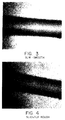
- Fig. 3 is a photomicrograph at 15X magnification of a section of a 0.046 in. extruded rod which is representative of a semi-smooth surface appearance.
- Fig. 4 is a photomicrograph at 15X magnification of a section of a 0.046 in. extruded rod which is representative a slightly rough surface appearance.
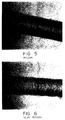
- Fig. 5 is a photomicrograph at 15X magnification of a section of a 0.046 in. extruded rod which is representative a rough surface appearance.
- Fig. 6 is a photomicrograph at 15X magnification of a section of a 0.046 in. extruded rod which is representative a very rough surface appearance.
- the rigid thermoplastic CPVC/CPE compounds specified herewith are defined as compositions having a modulus of elasticity, either in flexure or in tension, greater than 700 Mpa (100,000 psi), and preferably greater than 1,400 MPa at 23°C and 50% relative humidity when tested in accordance with ASTM Method D747, Test for Stiffness of Plastics by Means of a Cantilever Beam, ASTM Methods D790, Test for Flexural Properties of Plastics and Electrical Insulating Materials, ASTM Method D638, Test for Tensile Properties of Plastics, or ASTM Methods D882, Test for Tensile Properties of Thin Plastic Sheeting.
- ASTM Method D638 Test for Tensile Properties of Plastics
- ASTM Methods D882 Test for Tensile Properties of Thin Plastic Sheeting.
- the compounds herein may exhibit a modulus of from 70 to 700 MPa (10,000 to 100,000 PSI). Rigid versions are most preferred.
- the articles of manufacture are extruded profiles in any shape comprising CPVC as the major component and chlorinated polyethylene as the second component.
- CPVC chlorinated polyethylene
- halopolymers selected from the group consisting of homopolymers and copolymers of: polyvinyl chloride, polyvinyl fluoride, polyvinylidene chloride, and polyvinylidene fluoride.
- halopolymers enumerated above are commercially available from sources listed in Chemical Week Buyers' Guide , October-1990, Vol. 147 No. 18, New York.
- other halopolymer materials are described in detail in the following U.S.
- Patents polyvinylidene fluoride - U.S. 4,585,701; polyvinyl chloride - U.S. 5,036,121; chlorinated polyethylene - U.S. 3,299,182 and 4,749,751; and polyvinylidene chloride - U.S. 4,362,834.
- Post-chlorinated PVC is available commercially worldwide from a variety of sources including Atochem S.A., The B.F. Goodrich Co., Nippon Carbide Industries, Co., Ltd., and Tokuyama Sekisui Industry Co., Ltd.
- Post-chlorinated PVC for use herein is preferably prepared by the post-chlorination of suspension polymerized PVC.
- Suspension polymerization techniques are well established in the art and set forth in the Encyclopedia of PVC , pp. 76-85 published by Marcel Decker, Inc. (1976) and need not be discussed in great detail here.
- Chlorinated polyvinyl chloride is obtained by chlorinating homopolymers or copolymers containing less than 50% by weight of one or more copolymerizable comonomers.
- Suitable comonomers for vinyl chloride include acrylic and methacrylic acids; esters of acrylic and methacrylic acid, wherein the ester portion has from 1 to 12 carbon atoms, for example methyl-, ethyl-, butyl-, ethylhexyl acrylates and the like; methyl-, ethyl- , butyl methacrylates and the like; hydroxyalkyl esters of acrylic and methacrylic acid, for example hydroxymethyl acrylate, hydroxyethyl acrylate, hydroxyethyl methacrylate and the like; glycidyl esters of acrylic and methacrylic acid, for example glycidyl acrylate, glycidyl methacrylate and the like; alpha, beta-unsatur
- the molecular weight as measured by I.V., of precursor polyvinyl chloride for the post-chlorinated polymer will range from about 0.4 to about 1.6, preferably 0.5 to 1.2 and most preferredly from about 0.7 to 1.0 I.V..
- the inherent viscosity is a representative measure of the molecular weight of a polymer and is obtained in accordance with ASTM procedure No. D-1243-66.
- the choice of molecular weight is made by considering the shape and intricacy of the profile, the processing conditions and the physical property balance desired. If the molecular weight is too low, there may be insufficient melt strength and dimensional stability of the hot extrudate will suffer, and if the molecular weight is too,high, the compound may not be processible under the desired conditions. Excellent results are obtained under a variety of conditions and cross-sectional shapes using an I.V. of the PVC precursor of about 0.85 to 0.95.
- Chlorination of PVC can be carried out in any conventional manner as known to the art and to the literature to obtain a chlorinated base polymer having higher than 57 percent by weight chlorine up to about 74 percent by weight based upon the total weight of the polymer, however, in the practice of the invention, the use of a major amount of CPVC having a chlorine content of greater than 65% and up to 74% is preferred, and more preferably from 67% to about 71% chlorine.
- the preferred method of post-chlorination is by the aqueous suspension chlorination method.
- the preferred mode of chlorination employs a relatively concentrated aqueous suspension of the precursor PVC.
- the most preferred method results in a CPVC resin having a density which does not deviate more than about 20 percent from the mean density, and a surface area which does not deviate more than 30 percent from the mean surface area is more desirable.
- a concentration of about 15 to about 35 weight percent of solids in the suspension is preferred.
- concentration of the suspension higher than the specified range results in less uniform chlorinated product, while concentrations below 15 percent yield uniform product, but are not as economical.
- aqueous suspension of PVC base polymer we refer to a slurry-like mixture of base polymer macrogranules suspended in water. This process is particularly directed to a batch process.
- oxygen be removed from the aqueous suspension before chlorination is initiated. This may be effected in any convenient manner, and assisted with agitation. Heating as may be required is preferably done after Cl2 is sparged into suspension from a liquid Cl2 cylinder until the pressure in the reactor reaches about 25 psig, at which point the suspension is saturated with Cl2. It is preferred that this pressure be somewhat higher, that is in the range from about 35 psig to about 100 psig, to get the optimum results, though a pressure as low as 10 psig and higher than 100 psig may be employed. The amount of Cl2 charged to the reactor is determined by weight loss in the Cl2 cylinder.
- the reactor is preferably brought up to a "soak" temperature in the range from about 60°C to about 75°C at which soak temperature the suspension is maintained under agitation for a soak period in the range from about 1 minute to about 45 minutes. Excessive pressure adversely affects the porosity of the macrogranules to the detriment of the stability of the chlorinated product.
- Chlorination proceeds at a rate which depends upon the pressure and temperature within the reactor, higher rates being favored at higher temperature and pressure. It is most preferred to adjust the soak temperature, the mass of resin, and the level of photo-illumination so that the temperature is "ramped" by the heat of reaction until it levels off at a finishing temperature of about 100°C.
- the suspension is preferably not cooled but dumped to be centrifuged and the chlorinated polymer freed from the aqueous phase, after which Hcl is removed from the product, preferably by neutralizing with an aqueous solution of an alkali metal hydroxide.
- the product is then washed with water to free the chlorinated polymer of residual alkali, and dried, all in a conventional manner, except that the temperatures at which the operations are carried out may be in the range from about 60°C to about 100°C, which are higher than conventionally used.
- Chlorinated polyethylene used herein has a specific gravity of from about 1.13 to 1.4, preferably about 1.16, a residual crystallinity of from about O to about 25%, preferably 0 to 10%, and a chlorine content from about 25% to about 45%, preferably 35% to 44%.
- the chlorination can be either homogeneous or heterogenous preferably to a small extent. Surface appearance of extrudates depended on CPE molecular weight and polydispersity as measured by gel permeation chromatography and on the extrusion conditions used as illustrated below. Chlorination methods for CPE include aqueous suspension, solution, or gas phase methods, with the preferred method by way of suspension chlorination. CPE is commercially available from Dow Chemical Inc.
- the amount of CPE present ranges from about 10 to about 30 phr, preferably from about 12 to about to 25 phr, still more preferred are levels from 15 to 25 phr.
- the particular combination of CPVC and CPE within the scope of the present invention will be described below.
- the core/shell type impact modifiers can be present but are preferably absent. These include acrylonitrile butadiene styrene terpolymers (ABS), methacrylate, acrylonitrile, butadiene, styrene (MABS) polymers and methacrylate butadiene styrene polymer (MBS).
- ABS acrylonitrile butadiene styrene terpolymers
- MABS acrylonitrile butadiene
- MABS acrylonitrile butadiene
- MBS methacrylate butadiene styrene polymer
- MBS methacrylate butadiene styrene polymer
- Other impact modifiers are disclosed in Plastics compounding , Nov./Dec., 1983: “Update: Impact Modifiers for Rigid PVC," by Mary C. McMurrer.
- MBS grades include Paraloid® KM-653, BTA-733 from Rohm and Haas
- Thermal stabilizers are employed in the compounds herein and can be selected from various organic compounds, for example dibutyltin-S-S'-bi-(isooctylmercaptoacetate), dibutyl tin dilaurate, di-butyltin di-2-ethylhexyl thioglycolate dimethyl tin di-isooctyl-thioglycolate, and the like. Tin compounds are generally used at from 1 to 5 phr, preferably about 2.0 to 4.0 phr. Secondary stabilizers may be included for example a metal salt of phosphoric acid, polyols, or epoxidized oils.
- salts include water-soluble, alkali metal phosphate salts, disodium hydrogen phosphate, orthophosphates such as mono-,di-, and tri-orthophosphates of said alkali metals, alkali metal polyphosphates, - tetrapolyphosphates and -metaphosphates and the like.
- the most preferred secondary stabilizer is disodium hydrogen phosphate and is used by treating the CPVC resin.
- Polyols such as sugar alcohols, and epoxides such as epoxidized soya oil can be used.
- Typical levels of secondary stabilizers can range from about 0.1 wt. parts to about 7.0 wt. parts per 100 wt. parts halopolymer (phr).
- commercially available antioxidants are used such as phenolics, BHT, BHA, various hindered phenols and various inhibitors like substituted benzophenones.
- Antistats may be used and are commercially available under the Glycolube® trademark of Lonza Corp.
- Exemplary lubricants are the various hydrocarbons, such as paraffins, paraffin oils, low molecular weight polyethylene, oxidized polyethylenes, fatty acids and their salts such as stearic acid and calcium stearate, fatty alcohols such as cetyl, stearyl, or octadecyl alcohol; metal soaps such as calcium or zinc salts of oleic acid; fatty amides of organic acids such as stearamide, ethylene-bis-stearamide; preferred fatty esters and partial esters such as butyl stearate, polyol esters such as glycerol monostearate, hexaglycerol distearate; and fatty ester waxes such as stearyl esters.
- the most preferred lubricant is oxidized polyethylene. Henkel Co. produces a variety of preferred fatty ester formulations under the Loxiol® mark. Combinations of internal and external lubricants may also be used. Lubrication of the halopolymer compounds of the present invention is a complex art. Since several lubricants can be combined in countless variations, the total amount of lubricant may vary generally from about 2 to 10 phr, preferably from 2 to about 6 phr. Optimization of particular individual lubricant formulations is beyond the scope of the present invention, and can be achieved as one skilled in the art prefers.
- Adjustment of melt viscosity can be achieved as well as increasing melt strength by optionally employing commercial acrylic process aids such as those from Rohm and Haas under the Paraloid® Trademark, for example Paraloid® K-120ND, K-120N, K-175.
- commercial acrylic process aids such as those from Rohm and Haas under the Paraloid® Trademark, for example Paraloid® K-120ND, K-120N, K-175.
- Exemplary fillers are optional and include clay, wollastonite, mica, barytes, calcium carbonate and talc and silica including precipitated silicas, silica gels, metallic silicates, pyrogenic or fumed silicas and the like. These have the general formulae: SiO2, M n (SiO3) x .
- the values of n and x can vary with the oxidation state of the metal associated with the SiO3 ion.
- the values n and x are usually integers from about 1 to about 4.
- Preferred pigments are the various titanium dioxides (TiO2) and carbon blacks which are commercially available.
- Preferred TiO2 types are coated or uncoated, rutile titanium dioxide powder.
- An exemplary commercial grade is Ti-Pure® R-100 from E.I. DuPont De Nemours and Co. Inc. (DuPont). If used, pigments such as TiO2 are present in an amount ranging from 1 to 25 phr, more typically 3 to 15 phr, and most typically from 3 to about 8 phr. Optional coloring pigments can be used.
- the method of compounding is straightforward as any high intensity method to uniformly mix and fuse the components into a homogeneous compound such as with a Banbury/mill, followed by sheeting, slitting or extrusion into pellets, or cubes.
- the differences in process handling of CPVC compared with polyvinyl chloride-based compounds relate mainly to the temperature and viscosity differences and care must be taken to avoid too much work and shear burning.
- the components can be combined and mixed with a Banbury and milled on a heated roll mill.
- the fused compound can be extruded and chopped into cubes.
- the components can be combined in a compounding twin screw extruder.
- the compounds are extruded into final form at conventional stock temperatures from about 175°C to about 235°C, and preferably from about 200°C to about 225°C.
- a ramped barrel temperature profile is advisable with a zone nearest the hopper set at 180° C and the zone nearest the die at about 195°C for 0.75 inch diameter screw.
- calibrating blocks at the exit end can be used to assist in proper dimension sizing as the hot profile is cooled.
- Air streams can be used to improve heat loss, and for more close tolerances, vacuum water sizing devices can be used.
- the extent to which one chooses to employ calibrator blocks and air or water sizing will depend on dimension tolerances for the particular profile shape, the intended output volume of any one profile article and the number of different profiles made with a particular production set. These considerations are beyond the scope of the disclosure.
- the compounds used in the examples contained one of the following CPVC resins. Resin No. Resin Chlorine Content, % Resin I.V. Wt. Amount 1 63.1 0.92 100 2 65.2 0.92 100 3 68.3 0.92 100 4 70.3 0.92 100
- Component Amount CPVC 100 Component (A-J) 20 Tin Thioglycolate 2.25 Oxidized polyethylene 1.5 Glycerol ester 1.0 Antioxidant 0.25 T1O2 5.0 Carbon black 0.25
- Percent die swell measurements were taken by comparing the actual diameter of the extrudate after cooling and the die diameter. The following results were reported as (extrudate dia. - die dia.) / die dia. x 100. % DIE SWELL EXAMPLE RPM 5 10 15 20 25 30 40 50 1-A 41 35 30 39 43 46 48 50 1-B 39 41 41 43 46 46 43 43 1-C 57 48 48 48 52 50 52 50 1-D 61 54 50 55 74 57 54 Fail* 1-E 52 48 50 55 40 57 59 Fail* 1-F 50 43 46 44 96 49 50 50 1-G 70 59 54 55 97 59 61 Fail* 1-H 33 33 33 33 33 77 39 39 39 1-I 35 37 37 33 99 37 35 33 * too irregular to measure - Lumpy flow Example 1-A exhibits a desirable reduced level of swell.
- Table A represents the extrusion appearance ratings of the compound containing CPVC with a chlorine content of 63.1;
- Table B illustrates the appearance of extrudate from compounds made with a 65.2% chlorine level;
- Table C illustrates the appearance of extrudate from compounds made with 68.3% chlorine level, and
- table D illustrates the appearance of extrudates from compounds made with 70.3% chlorine CPVC.
- the preferred embodiments are made with a CPVC containing from 67 to 72% chlorine, with the most preferred CPVC contains from 67% to 70% chlorine.
- the most preferred chlorinated polyethylene contains from 35% to 37% chlorine and has a real weight average molecular weight of from 90,000 to 130,000, more preferably 115,000 to 125,000 and most preferably about 120,000, with a polydispersity of from 5 to 7 as in CPE number A above.
Landscapes
- Chemical & Material Sciences (AREA)
- General Chemical & Material Sciences (AREA)
- Health & Medical Sciences (AREA)
- Chemical Kinetics & Catalysis (AREA)
- Medicinal Chemistry (AREA)
- Polymers & Plastics (AREA)
- Organic Chemistry (AREA)
- Engineering & Computer Science (AREA)
- Mechanical Engineering (AREA)
- Compositions Of Macromolecular Compounds (AREA)
- Extrusion Moulding Of Plastics Or The Like (AREA)
Applications Claiming Priority (2)
| Application Number | Priority Date | Filing Date | Title |
|---|---|---|---|
| US2354293A | 1993-02-26 | 1993-02-26 | |
| US23542 | 2001-12-17 |
Publications (2)
| Publication Number | Publication Date |
|---|---|
| EP0612602A2 true EP0612602A2 (de) | 1994-08-31 |
| EP0612602A3 EP0612602A3 (en) | 1996-01-24 |
Family
ID=21815732
Family Applications (1)
| Application Number | Title | Priority Date | Filing Date |
|---|---|---|---|
| EP94102755A Withdrawn EP0612602A3 (en) | 1993-02-26 | 1994-02-24 | Method for the manufacture of weatherable, rigid extrusion profiles having improved surface appearance. |
Country Status (4)
| Country | Link |
|---|---|
| US (1) | US5641826A (de) |
| EP (1) | EP0612602A3 (de) |
| JP (1) | JP3462559B2 (de) |
| BR (1) | BR9400694A (de) |
Cited By (11)
| Publication number | Priority date | Publication date | Assignee | Title |
|---|---|---|---|---|
| US5587419A (en) * | 1993-02-26 | 1996-12-24 | The B.F. Goodrich Company | Method for the manufacture of weatherable, rigid extrusion profiles having improved surface appearance |
| US5591497A (en) * | 1991-02-15 | 1997-01-07 | The B. F. Goodrich Company | Chlorinated polyvinyl chloride rigid pipe and method of forming such pipe |
| US5604278A (en) * | 1992-12-23 | 1997-02-18 | The B. F. Goodrich Company | CPVC compounds and articles made therefrom for design stress rating above 180° F. |
| EP0808851A3 (de) * | 1996-05-24 | 1998-05-06 | The B.F. Goodrich Company | Zusammensetzung aus chloriertem Polyvinylchlorid mit ausgezeichneter physikalisch-chemischer Beständigkeit und verbesserten Verarbeitungseigenschaften |
| WO1999050316A1 (en) * | 1998-03-31 | 1999-10-07 | The B.F. Goodrich Company | Blocky chlorinated polyolefins, process for making and use as impact modifier compatibilizer for pvc or cpvc |
| US5981663A (en) * | 1996-05-24 | 1999-11-09 | The B.F. Goodrich Company | Chlorinated polyvinyl chloride compound having excellent physical, chemical resistance and processing properties |
| US6187868B1 (en) | 1996-05-24 | 2001-02-13 | The B. F. Goodrich Company | Chlorinated polyvinyl chloride compound having excellent physical, chemical resistance and processing properties |
| US6277915B1 (en) | 1999-09-29 | 2001-08-21 | Pmd Holdings Corporation | Block chlorinated polyolefins for use as impact modifier enhancers for PVC or CPVC |
| CN110283412A (zh) * | 2019-06-25 | 2019-09-27 | 潍坊亚星化学股份有限公司 | 一种共混改性氯化聚氯乙烯材料及其制备方法 |
| CN113554216A (zh) * | 2021-06-28 | 2021-10-26 | 南京工业大学 | 一种Kfold-LSTM混合变异寻优高分子混合制造多目标优化方法 |
| CN113667249A (zh) * | 2021-08-27 | 2021-11-19 | 山东高信化学股份有限公司 | 一种高强度耐高温氯化聚氯乙烯棒材及其制备方法 |
Families Citing this family (6)
| Publication number | Priority date | Publication date | Assignee | Title |
|---|---|---|---|---|
| US6180708B1 (en) | 1996-06-28 | 2001-01-30 | W. R. Grace & Co.-Conn. | Thermoplastic adsorbent compositions containing wax and insulating glass units containing such compositions |
| US5924455A (en) * | 1996-08-01 | 1999-07-20 | Certainteed Corporation | Folded PVC-based conduit and conduit liner composition |
| US6316118B1 (en) * | 1998-05-11 | 2001-11-13 | Takiron Co., Ltd. | Fire-retardant vinyl chloride resin molding |
| US20050153122A1 (en) * | 2004-01-12 | 2005-07-14 | Detterman Robert E. | High temperature exterior building products |
| JP6795709B2 (ja) | 2018-09-28 | 2020-12-02 | 積水化学工業株式会社 | 窓枠用塩素化塩化ビニル系樹脂組成物及び窓枠部材 |
| WO2022210365A1 (ja) * | 2021-03-29 | 2022-10-06 | 積水化学工業株式会社 | 塩素化塩化ビニル系樹脂組成物及び塩素化塩化ビニル系樹脂成形体 |
Family Cites Families (24)
| Publication number | Priority date | Publication date | Assignee | Title |
|---|---|---|---|---|
| CA626534A (en) * | 1961-08-29 | H. Hankey Ernest | Rigid polyvinyl chloride compositions having improved impact strength | |
| GB123135A (en) * | 1918-02-07 | 1919-02-07 | W J Fraser & Company Ltd | Improvements in and relating to Machines for Mixing Granulated or Triturated Materials. |
| NL112643C (de) * | 1956-01-03 | |||
| NL250535A (de) * | 1959-04-18 | |||
| BE617223A (de) * | 1961-05-05 | |||
| BE633818A (de) * | 1962-06-21 | |||
| DE1544752B2 (de) * | 1964-01-10 | 1974-05-30 | Dynamit Nobel Ag, 5210 Troisdorf | Verfahren zur Herstellung von geformten Gebilden aus thermoplastischen Massen auf der Basis von nachchloriertem Polyvinylchlorid |
| US3283035A (en) * | 1964-06-17 | 1966-11-01 | Dow Chemical Co | High impact strength vinyl chloride polymer compositions containing an ethylene-vinyl alkanoate copolymer and a chlorinated polyolefin |
| DE1544782A1 (de) * | 1965-05-21 | 1969-08-07 | Dynamit Nobel Ag | Verfahren zur Herstellung verformbarer Massen auf der Basis von nachcloriertem Polyvinylchlorid |
| US3467732A (en) * | 1966-06-20 | 1969-09-16 | Dow Chemical Co | Polymers of vinyl chloride blended with chlorinated polymers |
| DE1720749A1 (de) * | 1967-11-16 | 1970-05-14 | Hoechst Ag | Verfahren zur Herstellung von chlorierten Polyaethylenen |
| US3453347A (en) * | 1968-01-02 | 1969-07-01 | Goodrich Co B F | Blends of postchlorinated vinyl chloride resin and a postchlorinated linear polyethylene containing a small amount of a rubbery,amorphous polyepoxide |
| DE1719330B2 (de) * | 1968-01-12 | 1972-06-29 | Wacker-Chemie GmbH, 8000 München | Schlagfeste formmassen aus chloriertem polyvinylchlorid |
| DE1769376A1 (de) * | 1968-05-16 | 1971-08-12 | Dynamit Nobel Ag | Thermoplastische Formmassen auf Basis von nachchloriertem Polyvinylchlorid |
| US3856891A (en) * | 1972-03-15 | 1974-12-24 | Dow Chemical Co | Inherently flexible, high strength sheeting from blends of a suspension chlorinated olefin polymer and post-chlorinated polyvinyl chloride |
| US3940456A (en) * | 1973-08-31 | 1976-02-24 | Hoechst Aktiengesellschaft | Thermoplastic composition comprising PVC and chlorinated polyethylene |
| US4213891A (en) * | 1978-12-18 | 1980-07-22 | The General Tire & Rubber Company | Thermoformable, high impact low-smoke plastic |
| DE2937178A1 (de) * | 1979-09-14 | 1981-04-02 | Hoechst Ag, 6000 Frankfurt | Thermoplastische masse |
| DE3248731A1 (de) * | 1982-12-31 | 1984-07-05 | Hoechst Ag, 6230 Frankfurt | Thermoplastische masse |
| US4710533A (en) * | 1986-08-11 | 1987-12-01 | The B. F. Goodrich Company | Melt processable CPVC blends |
| US4749751A (en) * | 1987-07-20 | 1988-06-07 | E. I. Du Pont De Nemours And Company | Process for bimodal chlorination of polyethylene |
| US5194471A (en) * | 1991-02-15 | 1993-03-16 | The B. F. Goodrich Company | Rigid chlorinated polyvinyl chloride compound and articles derived therefrom |
| JPH05138708A (ja) * | 1991-11-21 | 1993-06-08 | Sekisui Chem Co Ltd | 塩素含有樹脂成形品の製造方法 |
| EP0568922A1 (de) * | 1992-05-04 | 1993-11-10 | The B.F. Goodrich Company | Steife thermoplastische Halopolymerzusammensetzungen sowie Methode zur Herabsetzung der Wärmefreisetzung |
-
1994
- 1994-02-24 EP EP94102755A patent/EP0612602A3/en not_active Withdrawn
- 1994-02-25 BR BR9400694A patent/BR9400694A/pt not_active IP Right Cessation
- 1994-02-25 JP JP05112894A patent/JP3462559B2/ja not_active Expired - Fee Related
-
1995
- 1995-10-11 US US08/540,690 patent/US5641826A/en not_active Expired - Lifetime
Cited By (16)
| Publication number | Priority date | Publication date | Assignee | Title |
|---|---|---|---|---|
| US5591497A (en) * | 1991-02-15 | 1997-01-07 | The B. F. Goodrich Company | Chlorinated polyvinyl chloride rigid pipe and method of forming such pipe |
| US5604278A (en) * | 1992-12-23 | 1997-02-18 | The B. F. Goodrich Company | CPVC compounds and articles made therefrom for design stress rating above 180° F. |
| US5587419A (en) * | 1993-02-26 | 1996-12-24 | The B.F. Goodrich Company | Method for the manufacture of weatherable, rigid extrusion profiles having improved surface appearance |
| US6187868B1 (en) | 1996-05-24 | 2001-02-13 | The B. F. Goodrich Company | Chlorinated polyvinyl chloride compound having excellent physical, chemical resistance and processing properties |
| EP0808851A3 (de) * | 1996-05-24 | 1998-05-06 | The B.F. Goodrich Company | Zusammensetzung aus chloriertem Polyvinylchlorid mit ausgezeichneter physikalisch-chemischer Beständigkeit und verbesserten Verarbeitungseigenschaften |
| US5981663A (en) * | 1996-05-24 | 1999-11-09 | The B.F. Goodrich Company | Chlorinated polyvinyl chloride compound having excellent physical, chemical resistance and processing properties |
| US6204334B1 (en) | 1998-03-31 | 2001-03-20 | The B. F. Goodrich Company | Blocky chlorinated polyolefins, process for making and use as impact modifier compatibilizer for PVC or CPVC |
| US6124406A (en) * | 1998-03-31 | 2000-09-26 | The B. F. Goodrich Company | Blocky chlorinated polyolefins, process for making and use as impact modifier compatibilizer for PVC or CPVC |
| WO1999050316A1 (en) * | 1998-03-31 | 1999-10-07 | The B.F. Goodrich Company | Blocky chlorinated polyolefins, process for making and use as impact modifier compatibilizer for pvc or cpvc |
| US6313229B1 (en) | 1998-03-31 | 2001-11-06 | Pmd Group Inc. | Blocky chlorinated polyolefins, process for making and use as impact modifier compatibilizer for PVC or CPVC |
| US6277915B1 (en) | 1999-09-29 | 2001-08-21 | Pmd Holdings Corporation | Block chlorinated polyolefins for use as impact modifier enhancers for PVC or CPVC |
| CN110283412A (zh) * | 2019-06-25 | 2019-09-27 | 潍坊亚星化学股份有限公司 | 一种共混改性氯化聚氯乙烯材料及其制备方法 |
| CN110283412B (zh) * | 2019-06-25 | 2021-04-13 | 潍坊亚星化学股份有限公司 | 一种共混改性氯化聚氯乙烯材料及其制备方法 |
| CN113554216A (zh) * | 2021-06-28 | 2021-10-26 | 南京工业大学 | 一种Kfold-LSTM混合变异寻优高分子混合制造多目标优化方法 |
| CN113554216B (zh) * | 2021-06-28 | 2023-07-28 | 南京工业大学 | 一种Kfold-LSTM混合变异寻优高分子混合制造多目标优化方法 |
| CN113667249A (zh) * | 2021-08-27 | 2021-11-19 | 山东高信化学股份有限公司 | 一种高强度耐高温氯化聚氯乙烯棒材及其制备方法 |
Also Published As
| Publication number | Publication date |
|---|---|
| JP3462559B2 (ja) | 2003-11-05 |
| EP0612602A3 (en) | 1996-01-24 |
| JPH06287391A (ja) | 1994-10-11 |
| US5641826A (en) | 1997-06-24 |
| BR9400694A (pt) | 1994-09-27 |
Similar Documents
| Publication | Publication Date | Title |
|---|---|---|
| US5641826A (en) | Rigid extrusion profiles of chlorinated polyvinyl chloride polymer blends having improved surface properties and method of manufacture | |
| CA1107928A (en) | Weather resistant composites | |
| US9580589B2 (en) | Polyvinyl chloride mixture and preparation method therefor | |
| US5549948A (en) | Melt-processable fluoroplastic | |
| EP2995646B1 (de) | Polyvinylchloridmodifikator und verbundstoff und herstellungsverfahren dafür | |
| EP0927616B1 (de) | Schlagzähmodifiziertes Polyvinylchlorid mit verbesserter Niedrigschmelztemperatur | |
| KR102134168B1 (ko) | 중금속이 없는 씨피브이씨 조성물 | |
| EP0512610B1 (de) | Chlorierte PVC-Mischungen | |
| US5587419A (en) | Method for the manufacture of weatherable, rigid extrusion profiles having improved surface appearance | |
| US8742020B2 (en) | Impact modifier composition, an impact resistant composition, method of producing the same, and articles made therefrom | |
| DE69619363T2 (de) | Zusammensetzung aus chloriertem Polyvinylchlorid mit ausgezeichneter physikalisch-chemischer Beständigkeit und verbesserten Verarbeitungseigenschaften | |
| JP2022087259A (ja) | 光沢度および表面仕上げの改質のための官能化アクリル加工助剤 | |
| CN102112543B (zh) | 高流动性聚卤乙烯配混物及其制造和使用方法 | |
| US4052482A (en) | Vinyl chloride polymer composition | |
| US3969469A (en) | Vinyl halide resin compositions | |
| EP0603753B1 (de) | CPVC-Zusammensetzung für die Rohr-Extrusion sowie daraus hergestelltes Rohr | |
| KR100570430B1 (ko) | 열가소성 수지 조성물 및 그의 제조방법 | |
| EP0850740B1 (de) | Schlagzähmodifiziertes Polyvinylchlorid mit verbesserter Niedrigschmelztemperatur | |
| US3407171A (en) | Manufacture of rigid high impact resistant polyvinyl chloride-chlorinated polyethylene products | |
| US4517339A (en) | Blend of impact modifier, vinyl chloride polymer, and glassy amorphous polymer | |
| US3356634A (en) | Decorative surface coverings containing imbedded chips comprising vinyl chloride polymer, chlorinated polyethylene and filler | |
| DE69803848T2 (de) | Zusammensetzung aus chloriertem polyvinylchlorid mit ausgezeichneter physikalischer und chemischer beständigkeit und ausgezeichneten verarbeitungseigenschaften | |
| US5712319A (en) | Resin composition for low expansion moldings | |
| US6140423A (en) | Chlorinated vinyl chloride resin composition | |
| EP0366271B1 (de) | Wetterbeständige thermoplastische Harzzusammensetzung |
Legal Events
| Date | Code | Title | Description |
|---|---|---|---|
| PUAI | Public reference made under article 153(3) epc to a published international application that has entered the european phase |
Free format text: ORIGINAL CODE: 0009012 |
|
| AK | Designated contracting states |
Kind code of ref document: A2 Designated state(s): BE DE ES FR GB IT NL |
|
| PUAL | Search report despatched |
Free format text: ORIGINAL CODE: 0009013 |
|
| AK | Designated contracting states |
Kind code of ref document: A3 Designated state(s): BE DE ES FR GB IT NL |
|
| 17P | Request for examination filed |
Effective date: 19960626 |
|
| RAP1 | Party data changed (applicant data changed or rights of an application transferred) |
Owner name: NOVEON IP HOLDINGS CORP. |
|
| 17Q | First examination report despatched |
Effective date: 20030516 |
|
| STAA | Information on the status of an ep patent application or granted ep patent |
Free format text: STATUS: THE APPLICATION HAS BEEN WITHDRAWN |
|
| 18W | Application withdrawn |
Effective date: 20031108 |