EP0611271B1 - Natriumbenzoat als Nukleierungsmittel für monoaxial orientierten Polypropenfilm - Google Patents
Natriumbenzoat als Nukleierungsmittel für monoaxial orientierten Polypropenfilm Download PDFInfo
- Publication number
- EP0611271B1 EP0611271B1 EP94870025A EP94870025A EP0611271B1 EP 0611271 B1 EP0611271 B1 EP 0611271B1 EP 94870025 A EP94870025 A EP 94870025A EP 94870025 A EP94870025 A EP 94870025A EP 0611271 B1 EP0611271 B1 EP 0611271B1
- Authority
- EP
- European Patent Office
- Prior art keywords
- polypropylene
- sodium benzoate
- film
- recited
- mil
- Prior art date
- Legal status (The legal status is an assumption and is not a legal conclusion. Google has not performed a legal analysis and makes no representation as to the accuracy of the status listed.)
- Expired - Lifetime
Links
- 239000004299 sodium benzoate Substances 0.000 title claims description 37
- WXMKPNITSTVMEF-UHFFFAOYSA-M sodium benzoate Chemical compound [Na+].[O-]C(=O)C1=CC=CC=C1 WXMKPNITSTVMEF-UHFFFAOYSA-M 0.000 title claims description 35
- 235000010234 sodium benzoate Nutrition 0.000 title claims description 35
- 239000005026 oriented polypropylene Substances 0.000 title claims description 7
- 239000002667 nucleating agent Substances 0.000 title description 19
- -1 polypropylene Polymers 0.000 claims description 43
- 239000004743 Polypropylene Substances 0.000 claims description 39
- 229920001155 polypropylene Polymers 0.000 claims description 39
- 238000000034 method Methods 0.000 claims description 22
- 239000000203 mixture Substances 0.000 claims description 14
- 230000008569 process Effects 0.000 claims description 12
- 239000000654 additive Substances 0.000 claims description 7
- 230000000996 additive effect Effects 0.000 claims description 6
- 238000002844 melting Methods 0.000 claims description 5
- 230000008018 melting Effects 0.000 claims description 5
- 238000001644 13C nuclear magnetic resonance spectroscopy Methods 0.000 claims description 3
- 238000001125 extrusion Methods 0.000 claims description 3
- 239000002245 particle Substances 0.000 claims description 3
- 238000004611 spectroscopical analysis Methods 0.000 claims description 3
- XLYOFNOQVPJJNP-UHFFFAOYSA-N water Substances O XLYOFNOQVPJJNP-UHFFFAOYSA-N 0.000 claims description 3
- 238000001816 cooling Methods 0.000 claims 1
- 239000010408 film Substances 0.000 description 27
- 229920000642 polymer Polymers 0.000 description 16
- 238000009472 formulation Methods 0.000 description 9
- 125000002496 methyl group Chemical group [H]C([H])([H])* 0.000 description 5
- 229920001576 syndiotactic polymer Polymers 0.000 description 5
- 230000006872 improvement Effects 0.000 description 4
- 238000005481 NMR spectroscopy Methods 0.000 description 3
- MUBZPKHOEPUJKR-UHFFFAOYSA-N Oxalic acid Chemical compound OC(=O)C(O)=O MUBZPKHOEPUJKR-UHFFFAOYSA-N 0.000 description 3
- 239000003963 antioxidant agent Substances 0.000 description 3
- 230000003078 antioxidant effect Effects 0.000 description 3
- 235000006708 antioxidants Nutrition 0.000 description 3
- 229920001585 atactic polymer Polymers 0.000 description 3
- 230000000052 comparative effect Effects 0.000 description 3
- 238000013329 compounding Methods 0.000 description 3
- 238000002425 crystallisation Methods 0.000 description 3
- 230000008025 crystallization Effects 0.000 description 3
- 230000007423 decrease Effects 0.000 description 3
- 229920001580 isotactic polymer Polymers 0.000 description 3
- 230000003287 optical effect Effects 0.000 description 3
- OFOBLEOULBTSOW-UHFFFAOYSA-N Malonic acid Chemical compound OC(=O)CC(O)=O OFOBLEOULBTSOW-UHFFFAOYSA-N 0.000 description 2
- CTQNGGLPUBDAKN-UHFFFAOYSA-N O-Xylene Chemical compound CC1=CC=CC=C1C CTQNGGLPUBDAKN-UHFFFAOYSA-N 0.000 description 2
- 238000005299 abrasion Methods 0.000 description 2
- 125000004432 carbon atom Chemical group C* 0.000 description 2
- 239000004519 grease Substances 0.000 description 2
- 239000011256 inorganic filler Substances 0.000 description 2
- 229910003475 inorganic filler Inorganic materials 0.000 description 2
- 239000000155 melt Substances 0.000 description 2
- 229910052751 metal Inorganic materials 0.000 description 2
- 239000002184 metal Substances 0.000 description 2
- 230000006911 nucleation Effects 0.000 description 2
- 238000010899 nucleation Methods 0.000 description 2
- 229920000139 polyethylene terephthalate Polymers 0.000 description 2
- 239000005020 polyethylene terephthalate Substances 0.000 description 2
- 229920000098 polyolefin Polymers 0.000 description 2
- 229920005629 polypropylene homopolymer Polymers 0.000 description 2
- 239000000843 powder Substances 0.000 description 2
- 239000008096 xylene Substances 0.000 description 2
- HZVFRKSYUGFFEJ-YVECIDJPSA-N (2r,3r,4s,5r)-7-phenylhept-6-ene-1,2,3,4,5,6-hexol Chemical class OC[C@@H](O)[C@@H](O)[C@H](O)[C@@H](O)C(O)=CC1=CC=CC=C1 HZVFRKSYUGFFEJ-YVECIDJPSA-N 0.000 description 1
- XDTMQSROBMDMFD-UHFFFAOYSA-N Cyclohexane Chemical compound C1CCCCC1 XDTMQSROBMDMFD-UHFFFAOYSA-N 0.000 description 1
- 239000004952 Polyamide Substances 0.000 description 1
- 239000004698 Polyethylene Substances 0.000 description 1
- 239000002253 acid Substances 0.000 description 1
- 229910052782 aluminium Inorganic materials 0.000 description 1
- XAGFODPZIPBFFR-UHFFFAOYSA-N aluminium Chemical compound [Al] XAGFODPZIPBFFR-UHFFFAOYSA-N 0.000 description 1
- CSJKPFQJIDMSGF-UHFFFAOYSA-K aluminum;tribenzoate Chemical compound [Al+3].[O-]C(=O)C1=CC=CC=C1.[O-]C(=O)C1=CC=CC=C1.[O-]C(=O)C1=CC=CC=C1 CSJKPFQJIDMSGF-UHFFFAOYSA-K 0.000 description 1
- 229920006125 amorphous polymer Polymers 0.000 description 1
- 230000005540 biological transmission Effects 0.000 description 1
- 230000015572 biosynthetic process Effects 0.000 description 1
- NMZURFAPYNEBQQ-UHFFFAOYSA-N bis(4-tert-butylphenyl) hydrogen phosphate Chemical compound C1=CC(C(C)(C)C)=CC=C1OP(O)(=O)OC1=CC=C(C(C)(C)C)C=C1 NMZURFAPYNEBQQ-UHFFFAOYSA-N 0.000 description 1
- 238000005266 casting Methods 0.000 description 1
- 230000008859 change Effects 0.000 description 1
- 238000010622 cold drawing Methods 0.000 description 1
- 239000013078 crystal Substances 0.000 description 1
- QSAWQNUELGIYBC-UHFFFAOYSA-N cyclohexane-1,2-dicarboxylic acid Chemical compound OC(=O)C1CCCCC1C(O)=O QSAWQNUELGIYBC-UHFFFAOYSA-N 0.000 description 1
- 230000006378 damage Effects 0.000 description 1
- 230000003247 decreasing effect Effects 0.000 description 1
- 150000001991 dicarboxylic acids Chemical class 0.000 description 1
- 239000006185 dispersion Substances 0.000 description 1
- 238000009826 distribution Methods 0.000 description 1
- 230000000694 effects Effects 0.000 description 1
- 239000006260 foam Substances 0.000 description 1
- 238000004519 manufacturing process Methods 0.000 description 1
- 238000002156 mixing Methods 0.000 description 1
- 238000012986 modification Methods 0.000 description 1
- 230000004048 modification Effects 0.000 description 1
- 150000002894 organic compounds Chemical class 0.000 description 1
- 235000006408 oxalic acid Nutrition 0.000 description 1
- 238000003921 particle size analysis Methods 0.000 description 1
- 239000008188 pellet Substances 0.000 description 1
- 239000004033 plastic Substances 0.000 description 1
- 229920003023 plastic Polymers 0.000 description 1
- 229920002647 polyamide Polymers 0.000 description 1
- 229920001748 polybutylene Polymers 0.000 description 1
- 229920000573 polyethylene Polymers 0.000 description 1
- 229920006254 polymer film Polymers 0.000 description 1
- 229920005606 polypropylene copolymer Polymers 0.000 description 1
- 238000005381 potential energy Methods 0.000 description 1
- 238000010791 quenching Methods 0.000 description 1
- 150000003839 salts Chemical class 0.000 description 1
- 239000000126 substance Substances 0.000 description 1
- 239000000454 talc Substances 0.000 description 1
- 229910052623 talc Inorganic materials 0.000 description 1
- 125000000999 tert-butyl group Chemical group [H]C([H])([H])C(*)(C([H])([H])[H])C([H])([H])[H] 0.000 description 1
- 239000010409 thin film Substances 0.000 description 1
- 229920002554 vinyl polymer Polymers 0.000 description 1
- 239000002759 woven fabric Substances 0.000 description 1
Images


Classifications
-
- C—CHEMISTRY; METALLURGY
- C08—ORGANIC MACROMOLECULAR COMPOUNDS; THEIR PREPARATION OR CHEMICAL WORKING-UP; COMPOSITIONS BASED THEREON
- C08J—WORKING-UP; GENERAL PROCESSES OF COMPOUNDING; AFTER-TREATMENT NOT COVERED BY SUBCLASSES C08B, C08C, C08F, C08G or C08H
- C08J5/00—Manufacture of articles or shaped materials containing macromolecular substances
- C08J5/18—Manufacture of films or sheets
-
- C—CHEMISTRY; METALLURGY
- C08—ORGANIC MACROMOLECULAR COMPOUNDS; THEIR PREPARATION OR CHEMICAL WORKING-UP; COMPOSITIONS BASED THEREON
- C08K—Use of inorganic or non-macromolecular organic substances as compounding ingredients
- C08K5/00—Use of organic ingredients
- C08K5/04—Oxygen-containing compounds
- C08K5/09—Carboxylic acids; Metal salts thereof; Anhydrides thereof
- C08K5/098—Metal salts of carboxylic acids
-
- C—CHEMISTRY; METALLURGY
- C08—ORGANIC MACROMOLECULAR COMPOUNDS; THEIR PREPARATION OR CHEMICAL WORKING-UP; COMPOSITIONS BASED THEREON
- C08J—WORKING-UP; GENERAL PROCESSES OF COMPOUNDING; AFTER-TREATMENT NOT COVERED BY SUBCLASSES C08B, C08C, C08F, C08G or C08H
- C08J2323/00—Characterised by the use of homopolymers or copolymers of unsaturated aliphatic hydrocarbons having only one carbon-to-carbon double bond; Derivatives of such polymers
- C08J2323/02—Characterised by the use of homopolymers or copolymers of unsaturated aliphatic hydrocarbons having only one carbon-to-carbon double bond; Derivatives of such polymers not modified by chemical after treatment
- C08J2323/10—Homopolymers or copolymers of propene
- C08J2323/12—Polypropene
Definitions
- This invention relates to polypropylene film, specifically to mono-axially oriented polypropylene film with sodium benzoate as a nucleating agent to reduce shrinkage and increase stretchability.
- Polypropylene copolymers and homopolymers are produced in numerous grades and formulations. Among the outstanding properties of polypropylene are low density, high melting point, high tensile strength, rigidity, stress crack resistance, abrasion resistance, low creep and a surface which is highly resistance to chemical attack.
- Polypropylene film (usually 1.27.10 -5 to 2.54.10 -5 m (0.5 to 1.0 mil) in thickness) is made by tubular and casting film extrusion methods. Two forms of polypropylene film are produced, oriented and unoriented. Unoriented film has good transparency, tensile strength, machinability, electrical properties, high gloss, resistant to grease and oil, heat resistance and can be printed, coated and heat-sealed.
- Orienting polypropylene film improves some of its properties, particularly tensile strength, stiffness, moisture- and gas-barrier properties, grease and oil resistance, low-temperature impact strength, abrasion resistance, optical properties and heat shrinkability.
- inorganic fillers to improve the mechanical properties of polyolefin films is known. Using very small amounts (below 0.5wt%) a significant improvement in transparency is attained. This improvement is attributed to the formation of smaller, more numerous spherulites as the polymer solidifies from the molten state. Accompanying this change in morphology is a marked increase in crystallization rate and a higher crystallization temperature. In addition to the improved optical properties, nucleation results in better processing characteristics and improved strength.
- Certain inorganic fillers and organic compounds serve as nucleating agents for polyethylene, polyethylene terephthalate (PET), polyamides, polypropylene and polybutylene.
- nucleating agents additive of these nucleating agents to olefin polymers provides an increase in the crystallization temperature and/or an improvement in the optical properties of the polymer.
- the use of nucleating agents can allow a shorter cycle time and better productivity.
- the use of certain nucleating agents may be limited by costs, processing problems or acceptability in medical or food applications.
- Nucleating agents allow the polymer to be crystallized at a higher temperature during processing.
- nucleating agents are aromatic carboxylic acids and their metal salts, such as sodium benzoate, aluminum p-tert-butyl benzoate, and aluminum benzoate; metal organophosphates such as di(4-tert-butylphenyl) phosphate; benzylidene sorbitol compounds; talc, polyvinyl cyclohexane; and organic dicarboxylic acids such as oxalic acid, 1,2-cyclohexanedicarboxylic acid, phathalic acid and malonic acid.
- the size of polymer spherulites can be adjusted by incorporating nucleating agents.
- the use of nucleating agents favors smaller spherulite sizes.
- sodium benzoate is a known nucleating agent.
- Japanese Patent publication number J58,080,329 discloses a specific method of dispersing sodium benzoate as a nucleating agent in polypropylene to improve transparency.
- sodium benzoate is a higher melting nucleating agent that has dispersion problems.
- Japanese Patent Application J01,292,047 discloses the manufacture of transparent films by blending powdered polypropylene and powdered sodium benzoate.
- Nucleating agents are typically used to stiffen polymer film. While film of formulations using nucleating agents such as sodium benzoate may show an increase in the modulus of elasticity over that for unnucleated film, such formulations, as disclosed in U.S. Patent No. 5,118,566, do not result in a decrease in shrinkage. In fact, as demonstrated by the data in U.S. Patent No. 5,118,566, an increase in shrinkage may result.
- this invention provides a uni- or mono-axially oriented polypropylene film with sodium benzoate as an additive to reduce shrinkage and a process for producing this film.
- a mono-axially oriented polypropylene film consisting essentially of:
- the polypropylene of the present invention is a commercially available crystalline polypropylene. Crystalline polypropylene exists in two basic structures : isotactic and syndiotactic.
- the isotactic structure is typically described as having the methyl groups attached to the tertiary carbon atoms of successive monomeric units on the same side of a hypothetical plane through the main chain of the polymer, i.e., the methyl groups are all above or all below the plane.
- the stereochemical sequence of isotactic polypropylene is described as follows: Another way of describing the structure is through the use of NMR spectroscopy. Bovey's NMR nomenclature for an isotactic pentad is ...mmmm... with each "m” representing a "meso" dyad or successive methyl groups on the same side in the plane. As known in the art, any deviation or inversion in the structure of the chain lowers the degree of isotacticity and crystallinity of the polymer.
- syndiotactic polymers are those in which the methyl groups attached to the tertiary carbon atoms of successive monomeric units in the chain lie on alternate sides of the plane of the polymer.
- Fischer projection formula the structure of a syndiotactic polymer is designated as:
- the percentage of r dyads in the chain determines the degree of syndiotacticity of the polymer.
- Syndiotactic polymers are crystalline and, like the isotactic polymers, are insoluble in xylene.
- This crystallinity distinguishes both syndiotactic and isotactic polymers from amorphous or atactic polymer which is soluble in xylene. Atactic polymer exhibits no regular order of repeating unit configurations in the polymer chain and forms essentially a waxy product.
- the polypropylene polymer of the present invention is isotactic polypropylene.
- the polypropylene component of the present invention comprises an isotactic polypropylene having an isotacticity exceeding 97% as determined by C 13 -NMR spectroscopy.
- the film of the present invention is prepared in single stage draw process.
- the polypropylene is plastified and compressed in a extruder.
- the melt is then extruded through a flat sheet die and water quenched.
- the polypropylene sheet so produced is thereafter uni- or mono-axially drawn, i.e., longitudinally with respect to the direction of extrusion at temperatures below the melting point of the polypropylene used, the draw ratio in the longitudinal direction being at least about 4:1.
- the film may have any predetermined thickness; however, thicknesses of about 1.27.10 -5 to 1.27.10 -4 m (0.5 mil to 5.0 mil) and preferably 2.54.10 -5 to 7.62.10 -5 m (1.0 mil to 3.0 mil) are particularly useful in the intended field of the present invention.
- the sodium benzoate of the present invention has a purity of 99% and particle size of from about 10 -6 m (1.0 microns) to 3x10 -6 m (3.0 microns).
- the particle size analysis indicates the following distribution: Range meters x 10 -6 (microns) 0 - 1.0 81.51% 1 - 2.0 15.0% 2.0 - 3.0 1.08% 3.0 - 4.0 0.65%
- the powder and the additives were blended in a high intensity mixer at low speed for 0.5 minutes and 1.5 minutes at high speed. The mixture was then melt blended and pelletized using an extruder.
- Polypropylene pellets are melted in a 6.35 cm (2-1/2"), 30:1 L/D extruder.
- the melt is forced through a slot opening die and forms a thin film.
- the film is then passed through a slitter bar where razor blades slit the film into predetermined widths.
- the split tapes continue to pass through a convection oven, which heats the polymer close to the melting point and allows the tapes to be stretched.
- the stretch ratio is typically between 5:1 and 7:1
- the stretched tapes are heated, annealed and relaxed.
- Each of the tapes is wound on a separated winder system.
- Example 1 The procedure for Example 1 was followed except 0.015 wt% of sodium benzoate was added. The results are shown in Table I below.
- Example 1 The procedure for Example 1 was followed except 0.025 wt% of sodium benzoate was added. The results are shown in Table I below.
- Example 1 The procedure for Example 1 was followed except 0.050 wt% of sodium benzoate was added. The results are shown in Table I below.
- Example 5 The procedure for Example 5 was followed except 0.015 wt% of sodium benzoate was added. The results are shown in Table I below.
- Example 5 The procedure for Example 5 was followed except 0.025 wt% of sodium benzoate was added. The results are shown in Table I below.
- Figure 1 shows per cent shrinkage decreases as the sodium benzoate concentration increases.
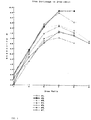
- Figure 2 illustrates the values of tenacity at break at various draw ratios.
- Figure 3 shows that the per cent crystallinity increases as the concentration of sodium benzoate increases.
- the concentration of sodium benzoate seem to be optimum at 0.025 wt% (250 ppm).
- the shrinkage decreases as the sodium benzoate concentration increases.
- the formulation with 0.050 wt% sodium benzoate exhibited a plateout problem.
Landscapes
- Chemical & Material Sciences (AREA)
- Engineering & Computer Science (AREA)
- Manufacturing & Machinery (AREA)
- Health & Medical Sciences (AREA)
- Chemical Kinetics & Catalysis (AREA)
- Medicinal Chemistry (AREA)
- Polymers & Plastics (AREA)
- Organic Chemistry (AREA)
- Materials Engineering (AREA)
- Manufacture Of Macromolecular Shaped Articles (AREA)
- Compositions Of Macromolecular Compounds (AREA)
- Shaping By String And By Release Of Stress In Plastics And The Like (AREA)
Claims (11)
- Ein monoaxial orientierter Polypropylenfilm im wesentlichen bestehend auswobei das Natriumbenzoat im Bereich von bis zu 250 ppm liegt.1) Polypropylen und2) Natriumbenzoat als ein Additiv zum Reduzieren von Schrumpfung,
- Ein Polypropylenfilm nach Anspruch 1, wobei das Polypropylen eine Isotaktizität hat, die 97% übersteigt, wie mittels C13-NMR Spektroskopie bestimmt.
- Ein Polypropylenfilm nach Anspruch 1, wobei der Film eine Dicke von etwa 1,27 x 10⁻⁵ bis 1,27 x 10⁻⁴ m (0,5 Mil bis 5,0 Mil) hat.
- Ein Polypropylenfilm nach Anspruch 1, wobei der Film eine Dicke von etwa 2,54 x 10⁻⁵ bis 7,62 x 10⁻⁵ m (1,0 Mil bis 3,0 Mil) hat.
- Ein Polypropylenfilm nach Anspruch 1, wobei das Natriumbenzoat eine Teilchengröße von etwa 10-6 m (1 Mikrometer) bis 3 x 10⁻⁶ m (3 Mikrometer) hat.
- Ein Verfahren zum Herstellen eines monoaxial orientierten Polypropylenfilms, umfassend:1) Herstellen einer Mischung, welche im wesentlichen aus Polypropylen und Natriumbenzoat als ein Additiv zum Reduzieren von Schrumpfung bei einem Spiegel von bis zu 250 ppm besteht,2) Weichmachen der Polypropylen-Natriumbenzoatmischung in einem Extruder,3) Extrudieren der Polypropylen-Natriumbenzoatmischung durch eine Breitschlitzdüse unter Herstellen einer Polypropylenlage,4) in Berührung bringen der Polypropylenlage mit einem Kühlzylinder oder einem Wasserabschreckungsbad,5) longitudinales Ziehen der Polypropylenlage im Hinblick auf die Extrusionsrichtung bei einer Temperatur unterhalb des Schmelzpunktes des Polypropylens und bei einem Ziehverhältnis in der longitudinalen Richtung von mindestens etwa 4:1.
- Ein Verfahren nach Anspruch 6, wobei das Polypropylen eine Isotaktizität hat, die 97% übersteigt, wie mittels C13-NMR Spektroskopie bestimmt.
- Ein Verfahren nach Anspruch 6, wobei der Film eine Dicke von etwa 1,27 x 10⁻⁵ bis 1,27 x 10⁻⁴ m (5,0 Mil) hat.
- Ein Verfahren nach Anspruch 6, wobei der Film eine Dicke von etwa 2,54 x 10⁻⁵ bis 7,62 x 10⁻⁵ m (1,0 Mil bis 3,0 Mil) hat.
- Ein Verfahren nach Anspruch 6, wobei das Natriumbenzoat eine Reinheit von 99% hat.
- Ein Verfahren nach Anspruch 6, wobei das Natriumbenzoat eine Teilchengröße von etwa 10-6 m (1,0 Mikrometer) bis 3 x 10⁻⁶ (3 Mikrometer) hat.
Applications Claiming Priority (2)
| Application Number | Priority Date | Filing Date | Title |
|---|---|---|---|
| US34794 | 1993-02-10 | ||
| US08/034,794 US5912292A (en) | 1993-02-10 | 1993-02-10 | Sodium benzoate as a nucleating agent for monoaxially oriented polypropylene film |
Publications (2)
| Publication Number | Publication Date |
|---|---|
| EP0611271A1 EP0611271A1 (de) | 1994-08-17 |
| EP0611271B1 true EP0611271B1 (de) | 1998-12-09 |
Family
ID=21878647
Family Applications (1)
| Application Number | Title | Priority Date | Filing Date |
|---|---|---|---|
| EP94870025A Expired - Lifetime EP0611271B1 (de) | 1993-02-10 | 1994-02-10 | Natriumbenzoat als Nukleierungsmittel für monoaxial orientierten Polypropenfilm |
Country Status (4)
| Country | Link |
|---|---|
| US (2) | US5912292A (de) |
| EP (1) | EP0611271B1 (de) |
| JP (1) | JP3456667B2 (de) |
| DE (1) | DE69415052T2 (de) |
Families Citing this family (40)
| Publication number | Priority date | Publication date | Assignee | Title |
|---|---|---|---|---|
| DE4420991A1 (de) * | 1994-06-16 | 1995-12-21 | Danubia Petrochem Deutschland | Thermoformen von ß-nukleierten Polypropylenen |
| CN1117120C (zh) * | 1997-01-17 | 2003-08-06 | 新日本理化株式会社 | 在聚烯烃树脂中重结晶二缩醛的方法 |
| DE19718900A1 (de) * | 1997-05-05 | 1998-11-12 | Targor Gmbh | Polypropylen Formmasse mit ausgezeichneter Steifigkeits-Zähigkeitsrelation |
| JP3338924B2 (ja) * | 1997-07-07 | 2002-10-28 | アサヒビール株式会社 | 乳酸菌検出用オリゴヌクレオチド及びそれを用いた判定法 |
| US6383425B1 (en) * | 1998-09-03 | 2002-05-07 | Bp Corporation North America Inc. | Method for extruding foamed polypropylene sheet having improved surface appearance |
| KR100634223B1 (ko) * | 1999-11-27 | 2006-10-13 | 삼성토탈 주식회사 | 유동성 및 내충격성이 우수한 고강성 폴리프로필렌 수지조성물 |
| US6656404B2 (en) * | 2001-05-17 | 2003-12-02 | Milliken & Company | Methods of making low-shrink polypropylene fibers |
| EP1401938B1 (de) * | 2001-05-17 | 2010-02-17 | Milliken & Company | Schrumpfarme polypropylenfasern, daraus hergestellte textile flächengebilde und verfahren zu ihrer herstellung |
| US6541554B2 (en) * | 2001-05-17 | 2003-04-01 | Milliken & Company | Low-shrink polypropylene fibers |
| US20030114831A1 (en) * | 2001-12-14 | 2003-06-19 | Scimed Life Systems, Inc. | Catheter having improved curve retention and method of manufacture |
| US6998081B2 (en) * | 2001-12-21 | 2006-02-14 | Milliken & Company | Method of producing low-shrink polypropylene tape fibers |
| US20030134118A1 (en) * | 2001-12-21 | 2003-07-17 | Morin Brian G. | Low-shrink polypropylene tape fibers |
| US20030134082A1 (en) * | 2001-12-21 | 2003-07-17 | Morin Brian G. | Carpet comprising a low-shrink backing of polypropylene tape fibers |
| JP3952797B2 (ja) * | 2002-02-14 | 2007-08-01 | 住友化学株式会社 | ポリプロピレン系樹脂組成物 |
| US6881793B2 (en) * | 2002-07-16 | 2005-04-19 | Fina Technology, Inc. | Polyproplylene materials and method of preparing polypropylene materials |
| WO2004033509A1 (en) * | 2002-10-07 | 2004-04-22 | Dow Global Technologies Inc. | Highly crystalline polypropylene with low xylene solubles |
| US20040084802A1 (en) * | 2002-11-02 | 2004-05-06 | Morin Brian G. | Method of producing low-shrink polypropylene tape fibers comprising high amounts of nucleating agents |
| US6887567B2 (en) * | 2002-11-02 | 2005-05-03 | Milliken & Company | Low-shrink polypropylene tape fibers comprising high amounts of nucleating agents |
| RU2360933C2 (ru) * | 2002-11-08 | 2009-07-10 | Полимерс Острейлиа Пти. Лимитед | Способ приготовления полиолефиновых нанокомпозитов |
| US6863976B2 (en) * | 2002-11-16 | 2005-03-08 | Milliken & Company | Polypropylene monofilament and tape fibers exhibiting certain creep-strain characteristics and corresponding crystalline configurations |
| US6759124B2 (en) | 2002-11-16 | 2004-07-06 | Milliken & Company | Thermoplastic monofilament fibers exhibiting low-shrink, high tenacity, and extremely high modulus levels |
| US20040096639A1 (en) * | 2002-11-16 | 2004-05-20 | Morin Brian G. | Uniform production methods for colored and non-colored polypropylene fibers |
| US20040152815A1 (en) * | 2002-11-17 | 2004-08-05 | Morin Brian G. | High speed spinning procedures for the manufacture of low denier polypropylene fibers and yarns |
| US7041368B2 (en) * | 2002-11-17 | 2006-05-09 | Milliken & Company | High speed spinning procedures for the manufacture of high denier polypropylene fibers and yarns |
| US20040096621A1 (en) * | 2002-11-17 | 2004-05-20 | Dai Weihua Sonya | High denier textured polypropylene fibers and yarns |
| US7405784B2 (en) * | 2003-02-12 | 2008-07-29 | 3M Innovative Properties Company | Compensators for liquid crystal displays with biaxially stretched single film with crystallization modifier |
| US6965474B2 (en) * | 2003-02-12 | 2005-11-15 | 3M Innovative Properties Company | Polymeric optical film |
| US7132065B2 (en) * | 2003-02-12 | 2006-11-07 | 3M Innovative Properties Company | Process for manufacturing polymeric optical film |
| US20050048281A1 (en) * | 2003-08-30 | 2005-03-03 | Royer Joseph R. | Thermoplastic fibers exhibiting durable high color strength characteristics |
| US20050046065A1 (en) * | 2003-08-30 | 2005-03-03 | Cowan Martin E. | Thermoplastic fibers exhibiting durable high color strength characteristics |
| US6849330B1 (en) | 2003-08-30 | 2005-02-01 | Milliken & Company | Thermoplastic fibers exhibiting durable high color strength characteristics |
| US7601285B2 (en) * | 2003-12-31 | 2009-10-13 | Boston Scientific Scimed, Inc. | Medical device with varying physical properties and method for forming same |
| US7754814B2 (en) * | 2005-05-16 | 2010-07-13 | Fina Technology, Inc. | Polypropylene materials and method of preparing polypropylene materials |
| DE102006044041A1 (de) * | 2006-07-21 | 2008-01-24 | Tesa Ag | Monoaxial verstreckte Polypropylenfolie mit hohem Weiterreißwiderstand in Querrichtung |
| DE102006034252A1 (de) * | 2006-07-21 | 2008-01-24 | Tesa Ag | Monoaxial verstreckte Polypropylenfolie mit hohem Weiterreißwiderstand in Querrichtung |
| JP5551088B2 (ja) * | 2008-01-22 | 2014-07-16 | テーザ・ソシエタス・ヨーロピア | 特に接着テープ用の支持フィルムおよびその使用 |
| US8026305B2 (en) * | 2008-10-01 | 2011-09-27 | Fina Technology Inc | Articles formed from nucleated polyethylene |
| US8114932B2 (en) * | 2009-11-10 | 2012-02-14 | Fina Technology | Neutralizer modified propylene based polymers and processes of forming the same |
| EP3184449B1 (de) | 2015-12-21 | 2019-11-06 | Borealis AG | Artikel mit verbesserten optischen eigenschaften |
| WO2017132122A1 (en) | 2016-01-28 | 2017-08-03 | Dow Global Technologies Llc | Fluid useful as coolant containing carbon nanoparticles and dispersed semi-crystalline polymer particles |
Citations (1)
| Publication number | Priority date | Publication date | Assignee | Title |
|---|---|---|---|---|
| EP0406642A2 (de) * | 1989-06-29 | 1991-01-09 | Hoechst Aktiengesellschaft | Biaxial orientierte Polypropylenfolie mit hoher mechanischer Festigkeit |
Family Cites Families (4)
| Publication number | Priority date | Publication date | Assignee | Title |
|---|---|---|---|---|
| US3540979A (en) * | 1966-07-11 | 1970-11-17 | Phillips Petroleum Co | Laminates of similarly constituted films of different crystal structure |
| US4761462A (en) * | 1983-09-20 | 1988-08-02 | Sumitomo Chemical Company, Limited | Packaging propylene copolymer film |
| JPS60166455A (ja) * | 1983-12-29 | 1985-08-29 | 住友化学工業株式会社 | ポリプロピレン積層フイルム |
| JPH01292047A (ja) * | 1988-05-18 | 1989-11-24 | Showa Denko Kk | ポリプロピレン組成物の製造方法 |
-
1993
- 1993-02-10 US US08/034,794 patent/US5912292A/en not_active Expired - Fee Related
-
1994
- 1994-02-09 JP JP03523294A patent/JP3456667B2/ja not_active Expired - Fee Related
- 1994-02-10 EP EP94870025A patent/EP0611271B1/de not_active Expired - Lifetime
- 1994-02-10 DE DE69415052T patent/DE69415052T2/de not_active Expired - Fee Related
-
1995
- 1995-06-07 US US08/477,023 patent/US6358450B1/en not_active Expired - Fee Related
Patent Citations (1)
| Publication number | Priority date | Publication date | Assignee | Title |
|---|---|---|---|---|
| EP0406642A2 (de) * | 1989-06-29 | 1991-01-09 | Hoechst Aktiengesellschaft | Biaxial orientierte Polypropylenfolie mit hoher mechanischer Festigkeit |
Also Published As
| Publication number | Publication date |
|---|---|
| US5912292A (en) | 1999-06-15 |
| JPH07179690A (ja) | 1995-07-18 |
| EP0611271A1 (de) | 1994-08-17 |
| DE69415052D1 (de) | 1999-01-21 |
| US6358450B1 (en) | 2002-03-19 |
| DE69415052T2 (de) | 1999-06-10 |
| JP3456667B2 (ja) | 2003-10-14 |
Similar Documents
| Publication | Publication Date | Title |
|---|---|---|
| EP0611271B1 (de) | Natriumbenzoat als Nukleierungsmittel für monoaxial orientierten Polypropenfilm | |
| DE69919834T2 (de) | Polypropylenzusammensetzung zur herstellung von festkörperorientierter folie | |
| DE69834726T2 (de) | Pha-zusammensetzungen und deren verwendung zur herstellung von pha-filmen | |
| EP0896022B1 (de) | Methode zur Verbesserung der Kristallisationsgeschwindigkeit von syndiotaktischem Polypropylen, sPP mit verbesserter Tc, daraus gefertigte Produkte | |
| JPH0784502B2 (ja) | β―結晶形ポリプロピレン組成物又はエチレン―プロピレンブロック共重合体組成物及びその製法 | |
| WO1999024496A1 (en) | Method of molding gel of oriented polyolefin resin composition and molded object obtained by the method | |
| KR20080034991A (ko) | 필름 및 필름 제조방법 | |
| US4645792A (en) | Nucleating agents for stereoregular elastomeric butene-1 polymer compositions | |
| KR100435942B1 (ko) | 폴리프로필렌계 미연신 성형체 | |
| US5319012A (en) | Polyolefin compositions and method and compositions for their preparation | |
| WO2007044122A1 (en) | Film and methods of making film | |
| JP3341358B2 (ja) | β晶系ポリプロピレン延伸フィルム及びその製造方法 | |
| JPH06184371A (ja) | プロピレン重合体製延伸フィルム | |
| JPH0547384B2 (de) | ||
| WO2016013726A1 (ko) | 고분자 수지 조성물 및 불화비닐리덴계 고분자 수지 성형품 | |
| JPWO1999057195A1 (ja) | ポリプロピレン系成形品 | |
| JP3448127B2 (ja) | 結晶性ポリプロピレン樹脂組成物 | |
| KR100374685B1 (ko) | 폴리아미드 필름의 제조방법 | |
| US7745527B2 (en) | Polyethylene-syndiotactic polypropylene composition and processing thereof | |
| CN115947991A (zh) | 一种非晶相强润滑高屈服伸长率的聚丙烯组合物及其制备方法 | |
| JPH01198650A (ja) | ポリプロピレン樹脂組成物 | |
| JPS59129241A (ja) | 新規なポリエチレン組成物 | |
| KR20030055809A (ko) | 폴리아미드 수지조성물의 제조방법 | |
| KR19980075559A (ko) | 폴리프로필렌 필름 및 그 제조방법 | |
| MXPA00003291A (es) | Composicion de polipropileno, util para obtener peliculas orientadas de estado solido |
Legal Events
| Date | Code | Title | Description |
|---|---|---|---|
| PUAI | Public reference made under article 153(3) epc to a published international application that has entered the european phase |
Free format text: ORIGINAL CODE: 0009012 |
|
| 17P | Request for examination filed |
Effective date: 19940217 |
|
| AK | Designated contracting states |
Kind code of ref document: A1 Designated state(s): BE DE FR GB IT NL |
|
| 17Q | First examination report despatched |
Effective date: 19960711 |
|
| GRAG | Despatch of communication of intention to grant |
Free format text: ORIGINAL CODE: EPIDOS AGRA |
|
| GRAG | Despatch of communication of intention to grant |
Free format text: ORIGINAL CODE: EPIDOS AGRA |
|
| GRAG | Despatch of communication of intention to grant |
Free format text: ORIGINAL CODE: EPIDOS AGRA |
|
| GRAH | Despatch of communication of intention to grant a patent |
Free format text: ORIGINAL CODE: EPIDOS IGRA |
|
| GRAH | Despatch of communication of intention to grant a patent |
Free format text: ORIGINAL CODE: EPIDOS IGRA |
|
| GRAA | (expected) grant |
Free format text: ORIGINAL CODE: 0009210 |
|
| AK | Designated contracting states |
Kind code of ref document: B1 Designated state(s): BE DE FR GB IT NL |
|
| REF | Corresponds to: |
Ref document number: 69415052 Country of ref document: DE Date of ref document: 19990121 |
|
| ET | Fr: translation filed | ||
| ITF | It: translation for a ep patent filed | ||
| PLBE | No opposition filed within time limit |
Free format text: ORIGINAL CODE: 0009261 |
|
| STAA | Information on the status of an ep patent application or granted ep patent |
Free format text: STATUS: NO OPPOSITION FILED WITHIN TIME LIMIT |
|
| 26N | No opposition filed | ||
| REG | Reference to a national code |
Ref country code: GB Ref legal event code: IF02 |
|
| PGFP | Annual fee paid to national office [announced via postgrant information from national office to epo] |
Ref country code: IT Payment date: 20060228 Year of fee payment: 13 |
|
| PGFP | Annual fee paid to national office [announced via postgrant information from national office to epo] |
Ref country code: NL Payment date: 20070213 Year of fee payment: 14 |
|
| PGFP | Annual fee paid to national office [announced via postgrant information from national office to epo] |
Ref country code: GB Payment date: 20070216 Year of fee payment: 14 Ref country code: DE Payment date: 20070216 Year of fee payment: 14 |
|
| PGFP | Annual fee paid to national office [announced via postgrant information from national office to epo] |
Ref country code: BE Payment date: 20070316 Year of fee payment: 14 |
|
| PGFP | Annual fee paid to national office [announced via postgrant information from national office to epo] |
Ref country code: FR Payment date: 20070212 Year of fee payment: 14 |
|
| BERE | Be: lapsed |
Owner name: *FINA TECHNOLOGY INC. Effective date: 20080228 |
|
| GBPC | Gb: european patent ceased through non-payment of renewal fee |
Effective date: 20080210 |
|
| NLV4 | Nl: lapsed or anulled due to non-payment of the annual fee |
Effective date: 20080901 |
|
| PG25 | Lapsed in a contracting state [announced via postgrant information from national office to epo] |
Ref country code: NL Free format text: LAPSE BECAUSE OF NON-PAYMENT OF DUE FEES Effective date: 20080901 |
|
| REG | Reference to a national code |
Ref country code: FR Ref legal event code: ST Effective date: 20081031 |
|
| PG25 | Lapsed in a contracting state [announced via postgrant information from national office to epo] |
Ref country code: DE Free format text: LAPSE BECAUSE OF NON-PAYMENT OF DUE FEES Effective date: 20080902 |
|
| PG25 | Lapsed in a contracting state [announced via postgrant information from national office to epo] |
Ref country code: BE Free format text: LAPSE BECAUSE OF NON-PAYMENT OF DUE FEES Effective date: 20080228 |
|
| PG25 | Lapsed in a contracting state [announced via postgrant information from national office to epo] |
Ref country code: FR Free format text: LAPSE BECAUSE OF NON-PAYMENT OF DUE FEES Effective date: 20080229 |
|
| PG25 | Lapsed in a contracting state [announced via postgrant information from national office to epo] |
Ref country code: GB Free format text: LAPSE BECAUSE OF NON-PAYMENT OF DUE FEES Effective date: 20080210 |
|
| PG25 | Lapsed in a contracting state [announced via postgrant information from national office to epo] |
Ref country code: IT Free format text: LAPSE BECAUSE OF NON-PAYMENT OF DUE FEES Effective date: 20070210 |