EP0593901B2 - Oligoribonucleotid- und Ribozym-Analoga mit terminalen 3'-3'-bzw.5'-5'-Verknüpfungen - Google Patents
Oligoribonucleotid- und Ribozym-Analoga mit terminalen 3'-3'-bzw.5'-5'-Verknüpfungen Download PDFInfo
- Publication number
- EP0593901B2 EP0593901B2 EP93114773A EP93114773A EP0593901B2 EP 0593901 B2 EP0593901 B2 EP 0593901B2 EP 93114773 A EP93114773 A EP 93114773A EP 93114773 A EP93114773 A EP 93114773A EP 0593901 B2 EP0593901 B2 EP 0593901B2
- Authority
- EP
- European Patent Office
- Prior art keywords
- formula
- oligoribonucleotide
- alkyl
- radical
- groups
- Prior art date
- Legal status (The legal status is an assumption and is not a legal conclusion. Google has not performed a legal analysis and makes no representation as to the accuracy of the status listed.)
- Expired - Lifetime
Links
- 0 C*C1[C@@](CO)OCC1 Chemical compound C*C1[C@@](CO)OCC1 0.000 description 5
- TUXYFTVBENYTFC-UHFFFAOYSA-N CC[NH+](C(CC1)CCC1O)[O-] Chemical compound CC[NH+](C(CC1)CCC1O)[O-] TUXYFTVBENYTFC-UHFFFAOYSA-N 0.000 description 1
Images


Classifications
-
- C—CHEMISTRY; METALLURGY
- C07—ORGANIC CHEMISTRY
- C07H—SUGARS; DERIVATIVES THEREOF; NUCLEOSIDES; NUCLEOTIDES; NUCLEIC ACIDS
- C07H21/00—Compounds containing two or more mononucleotide units having separate phosphate or polyphosphate groups linked by saccharide radicals of nucleoside groups, e.g. nucleic acids
-
- A—HUMAN NECESSITIES
- A61—MEDICAL OR VETERINARY SCIENCE; HYGIENE
- A61P—SPECIFIC THERAPEUTIC ACTIVITY OF CHEMICAL COMPOUNDS OR MEDICINAL PREPARATIONS
- A61P31/00—Antiinfectives, i.e. antibiotics, antiseptics, chemotherapeutics
- A61P31/12—Antivirals
-
- A—HUMAN NECESSITIES
- A61—MEDICAL OR VETERINARY SCIENCE; HYGIENE
- A61P—SPECIFIC THERAPEUTIC ACTIVITY OF CHEMICAL COMPOUNDS OR MEDICINAL PREPARATIONS
- A61P35/00—Antineoplastic agents
Definitions
- the invention relates to oligoribonucleotide analogs having terminal 3'-3 'and 5'5' internucleotide linkages, respectively. This modification stabilizes the molecules thus altered, including ribozymes, without adversely affecting their properties, including, where appropriate, catalytic activities.
- Antisense oligonucleotides are nucleic acid fragments whose sequence is complementary to the coding or "sense" sequence of a messenger RNA or to the codogenic strand of the DNA. Such oligonucleotides are increasingly being used to inhibit gene expression, mostly from a medical-therapeutic point of view, in vitro, in cell culture systems, and in vivo (1. E. Uhlmann, A. Peyman, Chem. Rev. 90 (1990) 543-584 ; Second J. Goodchild, Bioconjugate Chem. 1 (1990) 165-187 ; Third L.Whitesell, A. Rosolen, L.Neckers, Antisense Research and Development 1 (1991) 343 ).
- Unmodified oligonucleotides, and in particular unmodified oligoribonucleotides, are highly nucleolytically degraded. Investigations were therefore carried out early on to structurally modify oligonucleotides in such a way that they better fulfill the abovementioned requirements, in particular that they are better protected against nuclease degradation. For this purpose, a large number of oligonucleotide analogues were prepared, sometimes with enormous synthetic effort (1. E. Uhlmann, A. Peyman, Chem. Rev. 90 (1990) 543-584 ; Second J. Goodchild, Bioconjugate Chem. 1 (1990) 165-187 ).
- the international Patent Application WO 92/13869 describes methylene phosphonate nucleoside and oligonucleotide analogs prepared therefrom.
- the described oligonucleotides may be substituted at the 2'-position with H, OH, F OMe, SMe, O-allyl, S-allyl.
- Aryl is to be understood in this context, for example phenyl, phenyl substituted (1-3 times) with C 1 -C 6 alkyl, C 1 -C 6 alkoxy and / or halogen.
- oligoribonucleotides of the formula I where R 3 is F in all U and C nucleosides. Also preferred are oligoribonucleotides of the formula I in which R 2 is a radical of the formula III and R 1 is hydrogen; R 1 or R 2 is a radical of the formulas II or III; where either W or Z is not oxygen in the last case and X is OH or H.
- oligoribonucleotides of the formula I may also be mentioned, in which W is oxygen or Z and W are both oxygen.
- oligoribonucleotides of the formula I may be mentioned whose base sequence B 1 , B 2 ,... B n corresponds to the sequence requirements for ribozymes.
- hammerhead ribozymes eg Uhlenbeck, Nature 328 (1987) 596 ; Haseloff, Gerlach, Nature 334 (1988) 585
- the "hairpin ribozymes” eg Hampel et al., Nucl. Acids. Res. 18 (1990) 299
- the "human hepatitis ⁇ virus ribozyme” eg Branch, Robertson, Proc. Natl.Acad.Sci. USA 88 (1991) 10163
- the "external guide sequence for RNase P” eg Forster, Altman, Science 249 (1990) 783
- oligoribonucleotides of the formula I in which R 2 is a radical of the formula III and R 1 is hydrogen. Also to be mentioned are oligoribonucleotides of the formula I which are additionally substituted by groups which promote intracellular uptake, which serve as reporter groups in vitro or in vivo, and / or groups which, upon hybridization of the oligoribonucleotide to biological DNA or RNA, produce these DNA residues. or attack RNA molecules under binding or cleavage.
- exemplary of groups which favor intracellular uptake are lipophilic radicals such as alkyl radicals of, for example, up to 18 C atoms or cholesteryl, or thiocholesteryl ( E. Uhlmann, A. Peyman, Chem. Rev. 90 (1990) 543-584 ; J. Goodchild, Bioconjugate Chem. 1 (1990) 165-187 ; B. Oberhauser, E. Wagner, Nucl. Acids Res. 20 (1992) 533 ; C. MacKellar et al. Nucl. Acids Res. 20 (1992) 3411 ) or conjugates that utilize natural carrier systems, such as bile acid or peptides for the corresponding receptor (eg, receptor-mediated endocytosis).
- reporter groups are fluorescent groups (eg acridinyl, dansyl, fluoresceinyl) or chemiluminescent groups such as acridinium ester groups.
- oligonucleotide conjugates that bind to and / or cleave nucleic acids can be found in the following references.
- Conjugate partners include acridine, psoralen, chloroethylaminoaryl, phenanthridine, azidophenazyl, azidoproflavine, phenazine, phenanthroline / Cu, porphyrin / Fe, benzo [e] pyridoindole, EDTA / Fe ( Mergny et al, Science 256 (1992) 1681 ).
- the characteristic structural modification of the oligoribonucleotides of the invention is that the internucleotide linkages at the two chain ends are altered, ie 3'-3 'instead of 3'-5' biological linkages. 5'-5 'links are. Surprisingly, it has been found that this minimal structure modification is sufficient to stabilize such compounds against nuclease degradation, without adversely affecting other properties, such as enzymatic activities.
- a carrier resin is used, to which the first nucleoside monomer is linked via the 5'-OH group.
- carrier resin preferably silica gel or "controlled pore glass", which is functionalized with amino groups. It is reacted with a nucleoside derivative protected at the nucleobase and at the 3'-OH group which had previously been converted to 5'-p-nitro-phenylsuccinate.
- acyl groups for example benzoyl, isobutyryl or phenoxyacetyl.
- the 3'-position is preferably protected by the dimethoxytrityl protecting group, which after MD Matteucci, MH Carters, Tetrahedron Letters 21 (1980) pp.3243-3246 , can be imported.
- oligoribonucleotide chain to the penultimate chain member is carried out according to methods known from the literature ( Beaucage, Iyer, Tetrahedron 48 (1992) 2223 ), preferably using nucleoside 3'-phosphorous ester amides protected at the 5'-OH group by dimethoxytrityl groups, or nucleoside 3'-H-phosphonates.
- the 2'-hydroxy group is preferably protected by the tert-butyldimethylsilyl group.
- the last chain member used is again a nucleoside 5'-phosphorous ester amide or nucleoside H-phosphonate protected on the 3'-OH group, preferably with dimethoxytrityl.
- the representation of such a oligoribonucleotide chain with terminally twisted internucleotide bonds is shown schematically below. (Phosphoramidase cycle for the preparation of oligonucleotides with 3'-3 'and 5'-5' linkages at the ends).
- the representation of Oligoribonucleotiden with 3'-3 'or 5'-5' linkages is carried out accordingly.
- the oligoribonucleotides are terminally labeled as described in Example 4 below. This is done by radioactive labeling, preferably with the aid of 5'- ⁇ 32 P-ATP / polynucleotide kinase. This radioactive labeling is carried out on the free 5'-OH group, ie against an oligonucleotide with only biological 3'-5 'linkages at the reverse end of the nucleotide chain.
- sequences with a 3'-3 'inversion have on both sides a 5'-OH group and are therefore partially phosphorylated on both sides.
- oligonucleotides of the formula I are used for hybridization-based methods based on the attachment to double- or single-stranded nucleic acids or their cleavage method of regulation or suppression of the biological function of nucleic acids and for the selective suppression of the expression of viral genome functions and for the prophylaxis and therapy of virus functions, for the suppression of oncogene function and for the treatment of cancer.
- the protected succinylated deoxytribonucleoside was added to a solution of p-nitrophenol in 5 ml of absolute dioxane and 0.2 ml of pyridine, followed by the addition of DCCI as a condensing agent. After 3 hours, the reaction was complete.
- the precipitated dicyclohexylurea was filtered off with suction under argon and the filtrate directly added to a suspension of the functionalized support material in 15 ml of absolute DMF. 0.8 ml of triethylamine was added and the batch was shaken overnight. The loaded carrier was then filtered off with suction, washed with methanol and ether and dried in a desiccator.
- the loaded carrier was shaken with a solution of 1 ml of acetic anhydride and 50 mg of dimethylaminopyridine in 15 ml of absolute pyridine for 1 hour at room temperature, then filtered off with suction, washed with methanol and ether and dried.
- the synthesis of the modified "hammerhead" ribozyme (Tab.1) was carried out on a 0.2 ⁇ mol scale with the DNA synthesizer Gene Assember Puls from Pharmacia.
- the support material for the synthesis was functionalized with the deoxyadenosine building block suspended via the 5'-hydroxyl group; in the synthesis, this results in an inverted structure at the 3 'terminus of the oligonucleotide.
- the preparation was carried out according to the standard protocol for Oligoribonucleotidsynthesen in Phosphorigklamidmaschine.
- the Phosphorigkladesteramide of 2'-fluoro-2'-deoxynucleoside were used 0.12 M in acetonitrile.
- 0.1 ml of the amidophosphite is reacted with 0.37 ml of the tetrazole solution (0.5 M) with the support-bound 5'-hydroxyl groups of the oligonucleotide.
- capping is performed by default, oxidized and detritylated to prepare for the next coupling step. The coupling yields averaged 99%.
- the support is transferred after the synthesis in a screw-Eppendorf reaction vessel.
- a screw-Eppendorf reaction vessel At 55 ° C incubated for 12 hours with 2 ml of a 3: 1 - mixture of 32% ammonia and ethanol.
- the supernatant solution was lifted, cooled to -20 ° C and carefully lyophilized.
- the dry residue was suspended in 0.4 ml of a 1.1 M TBAF solution in THF and incubated for a further 16 hours at room temperature.
- the reaction was stopped by adding the same volume of a triethylammonium acetate buffer (TEAA buffer). The solution was cooled to -70 ° C and carefully concentrated to 0.4 ml.
- TEAA buffer triethylammonium acetate buffer
- oligonucleotide was extracted with a 1: 1 mixture of formamide blue marker and water to give it on an acrylamide gel (20%, 7M urea). To identify and cut out the product band, the gel was covered with cellophane films. Elution was at 40 ° C with ammonium acetate solution. After 5 hours, the solution was precipitated as described above. The oligonucleotide was rinsed with 70% ethanol, resuspended in 70% ethanol and stored at -70 ° C.
- the ribozyme p53 and modified oligoribonucleotides p53-INV and INV-FP53 were enzymatically by T4 polynucleotide kinase in the presence of (- 32 P) (dATP specific activity: 4500 Ci (mmol) radiolabeled
- the sequences with a 3 '. 3 'Inverting have on both sides a 5'-hydroxy group and are therefore partially phosphorylated at both ends.
- the phenolated samples were lyophilized, taken up in 95% formamide loading buffer and electrophoresed on a 20% polyacrylamide gel with 8 M urea at 55 ° C.
- the intensity of the bands on the X-ray film was determined by means of a laser densitometer (s. Fig. 1 ).
- the cleavage reaction of SB-1 by various ribozymes was performed as follows: The reaction conditions were 50 mM Tris HCl, pH 7.5, 20 mM MgCl 2 at 50 ° C.
- the substrate concentration SB-1 was 0.025 ⁇ M (varied to 0.05, 0.1 and 0.25 ⁇ M), the ribozyme concentration was 0.02 ⁇ M. During 30 min, one sample was taken at 1 min, 5 min, 10 min, 15 min and 30 min and mixed with loading-buffer. The samples were electrophoresed on a 20% polyacrylamide gel (8M urea) at 55 ° C. The decrease in the intensity of the bands of SB-1 was determined on the X-ray film by means of a laser densitometer.
- p53-INV As ribozymes were used: p53-INV; Fp53-INV (see above); p53 and Fp53 p53: 5'-r (AAGA UCUGA UGAGG CCGUU AGGCC GAAAC AGGGA) -3 ' Fp53: 5'-r (AAAGA FUCFUGA FUGAGG CCGfUfU AGGCC GAAAC AGGGA) -3 '
- the rate of cleavage of SB-1 is no different when using p53 and p53-INV.
- Fp53 and Fp53-INV have the same activity, but about a factor of 5 is lower than that of p53.
- the measurement of the preliminary preliminary reaction rates was performed with 40 nM substrate and 4 nM enzyme in 50 nM Tris-Cl (pH 7.5). The reaction was started by adding 10 nM MgCl 2 . The amount of cleavage product at 55 ° C was measured after 1, 2, 5, 10 and 15 minutes.
- the initial reaction rate was determined at 5 different substrate concentrations for the early phase of the progression curve at the time when the product formation rate was linear (after 4 minutes). Typical results from these kinetic measurements shows FIG. 2 , Since in our experiments the reactions were started by addition of divalent cations to the reaction mixture and thus the formation of the enzyme conformation was not allowed, a lag phase was usually observed 5 to 10 minutes after the start of the reaction. The following enzymatic parameters were determined from an Eadie-Hofstee assignment.
- Substrate and enzymes were labeled efficiently with [ ⁇ - 32 P] ATP and polynucleotide kinase. Unincorporated nucleotides were removed by phenol extraction followed by ethanol precipitation.
- the kinetics of modified ribozyme degradation was determined by dissolving the radiolabelled oligoribonucleotides in pooled, fresh and undiluted human serum at a final concentration of 20,000 cpm / ⁇ l. After an initial sample was taken, the reaction mixture was incubated at 37 ° C. After certain time periods, 1 ⁇ l aliquots were removed and the reaction stopped with phenol. After phenol extraction and ethanol precipitation, samples were suspended in 80% formamide containing 20 nM EDTA, 0.01% bromophenol blue and 0.01% hylencyanot. The cleavage products were separated on a 20% polyacrylamide gel (PAGE) with 7 M urea.
- PAGE polyacrylamide gel
- AAAGAUCUGA UGAGGCCGUU AGGCCGAAAC AGGGA
Landscapes
- Chemical & Material Sciences (AREA)
- Health & Medical Sciences (AREA)
- Life Sciences & Earth Sciences (AREA)
- Organic Chemistry (AREA)
- Molecular Biology (AREA)
- Biochemistry (AREA)
- General Health & Medical Sciences (AREA)
- Pharmacology & Pharmacy (AREA)
- Nuclear Medicine, Radiotherapy & Molecular Imaging (AREA)
- Animal Behavior & Ethology (AREA)
- Medicinal Chemistry (AREA)
- Public Health (AREA)
- Veterinary Medicine (AREA)
- General Chemical & Material Sciences (AREA)
- Chemical Kinetics & Catalysis (AREA)
- Engineering & Computer Science (AREA)
- Biotechnology (AREA)
- Genetics & Genomics (AREA)
- Virology (AREA)
- Communicable Diseases (AREA)
- Oncology (AREA)
- Saccharide Compounds (AREA)
- Pharmaceuticals Containing Other Organic And Inorganic Compounds (AREA)
- Measuring Or Testing Involving Enzymes Or Micro-Organisms (AREA)
- Enzymes And Modification Thereof (AREA)
- Medicines That Contain Protein Lipid Enzymes And Other Medicines (AREA)
- Polyesters Or Polycarbonates (AREA)
- Shaping Of Tube Ends By Bending Or Straightening (AREA)
- Macromolecular Compounds Obtained By Forming Nitrogen-Containing Linkages In General (AREA)
- Preparation Of Compounds By Using Micro-Organisms (AREA)
Description
- Die Erfindung betrifft Oligoribonucleotidanaloga mit terminalen 3'-3'- bzw. 5'5'-Internucleotidverknüpfungen. Diese Modifikation stabilisiert die so veränderten Moleküle, darunter auch Ribozyme, ohne ihre Eigenschaften, darunter auch gegebenenfalls katalytische Aktivitäten, nachteilig zu verändern.
- Als antisense-Oligonucleotide bezeichnet man Nucleinsäurefragmente, deren Sequenz komplementär zur codierenden oder "sense"-Sequenz einer Messenger-RNA bzw. zum codogenen Strang der DNA ist. Solche Oligonucleotide finden in wachsendem Maße Anwendung zur Inhibition der Genexpression, meist unter medizintherapeutischen Gesichtspunkt, in vitro, in Zellkultursystemen und in vivo (1. E.Uhlmann, A.Peyman, Chem.Rev.90 (1990) 543-584; 2. J.Goodchild, Bioconjugate Chem. 1 (1990) 165-187; 3. L.Whitesell, A.Rosolen, L.Neckers, Antisense Research and Development 1 (1991) 343).
- Variationen des antisense-Prinzips sind:
- I. Tripelhelix-bildende Oligonucleotide: Nucleinsäurefragmente, die unter Ausbildung einer Tripelhelix an den DNA-Doppelstrang bilden können und die durch Inhibierung der Transkription die Genexpression modulieren (J.Chubb and M.Hogan, TIBTECH 10 (1992) 132-136).
- II. Ribozyme: Ribonucleinsäurefragmente mit enzymatischer Aktivität, die darin besteht, daß die Ziel-RNA, z.B. eine m-RNA, nach der spezifischen Anbindung des Ribozyms von demselben gespalten wird (T.R.Cech, J.Am.Med. Assoc.260 (1988) 3030).
- Damit antisense-Oligonucleotide, Tripelhelixbildende Oligonucleotide und Ribozyme in biologischen Systemen eingesetzt werden können, müssen allerdings folgende Voraussetzungen erfüllt sein (E.Uhlmann, A.Peyman, Chem. Rev. 90 (1990, 543-584):
- 1. sie müssen einerseits gut wasserlöslich sein, andererseits aber die lipophile Zellmembran leicht passieren,
- 2. sie müssen innerhalb der Zelle hinreichend abbaustabil, d.h. stabil gegen Nucleasen sein,
- 3. sie müssen mit intrazellulären Nucleinsäuren bei physiologischen Temperaturen stabile Hybride bilden,
- 4. die Hybridisierung muß selektiv sein; der Unterschied der Dissoziationstemperatur zu einem Oligonucleotid, das eine Fehlpaarung ergibt, muß hinreichend groß sein, so daß letzteres noch spezifisch abgewaschen werden kann,
- 5. bei Ribozymen muß die katalytische Aktivität erhalten bleiben.
- Unmodifizierte Oligonucleotide und insbesondere unmodifizierte Oligoribonucleotide sind in hohem Maße nukleolytischem Abbau unterworfen. Schon früh wurden daher Untersuchungen durchgeführt, Oligonucleotide strukturell so zu modifizieren, daß sie die obengenannten Anforderungen besser erfüllen, insbesondere gegen Nuclease-Abbau besser geschützt sind. Zu diesem Zweck wurde eine große Zahl von Oligonucleotid-Analogen, teilweise unter enormem synthetischem Aufwand, hergestellt (1. E.Uhlmann, A.Peyman, Chem.Rev.90 (1990) 543-584; 2. J.Goodchild, Bioconjugate Chem. 1 (1990) 165-187).
- Aus der
europäischen Patentanmeldung EP 0 552 767 A2 sind 3'-derivatisierte Oligonukleotidanaloga mit nicht nukleotidischen Gruppierungen, deren Herstellung und Verwendung bekannt. - Aus der
europäischen Patentanmeldung EP 0 399 330 A1 ist ein modifiziertes Phosphoramiditverfahren zur Synthese von Nukleotidsequenzen bekannt. Durch Einsatz eines modifizierten Nukleosidphosphoramidits ist es demgemäß möglich Nukleotidsequenzen herzustellen, die einen modifizierten Phosphatrest aufweisen. - S. Agrawal (TIBTECH 10: 152-158, 1992) beschreibt das Wirkprinzip von verschiedenen Typen von Antisense Oligonukleotidanaloga. Da manche Vertreter dieser Verbindungsklassen relativ Nuklease stabil sind, stellen die erhaltenen Verbindungen die Entwicklung einer neuen Klasse antiviraler Chemotherapeutika in Aussicht.
- Die internationale
Patentanmeldung WO 92/13869 - Kürzlich wurde gezeigt, daß 3'-3'- bzw. 5'-5'-terminal verknüpfte Oligodesoxynucleotide bzw. deren Analoga eine deutlich erhöhte Stabilität gegen nucleolytischen Abbau aufweisen (1. H. Seeliger, A. Fröhlich, M. Montenarh: Nucleosides & Nucleotides 10 (1991) 469-477; 2.
H. Rösch, A. Fröhlich, J. Ramalho-Ortigao, J. Flavio, M. Montenarh, H. Seeliger: EP 0 464 638 A2 ). Überraschend wurde nun gefunden, daß der gleiche, synthetisch leicht zugängliche, terminale Verknüpfungstypus - a) auch die sehr viel labileren Oligoribonucleotide gegen Nucleasen zu stabilisieren vermag,
- b) Ribozyme (Oligoribonucleotide mit besonderer Sequenzanforderung) gegen Nucleasen zu stabilisieren vermag, ohne die katalytische Aktivität zu beeinträchtigen.
- c) Oligoribonucleotide bzw. Ribozyme, die durch chemische Modifikation gegen Nucleasen geschützt wurden, zusätzlich zu stabilisieren vermag.
- Die Erfindung betrifft daher Oligoribonucleotide der Formel I

- R1
- Wasserstoff oder einen Rest der Formel II bedeutet

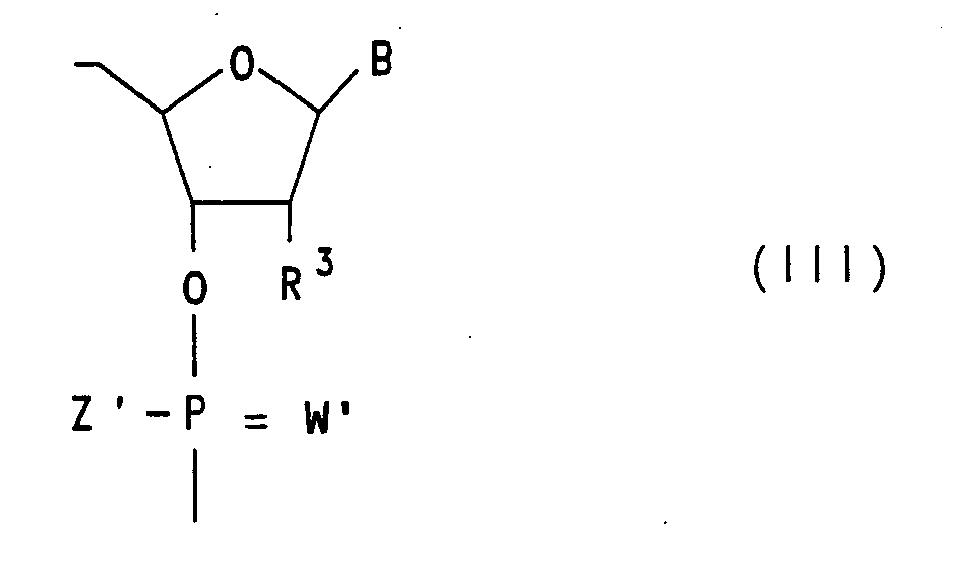
- R2
- einen Rest der Formel III bedeutet,

- B für eine Base, wie natürliche Basen wie Adenin, Thymin, Cytosin, Guanin oder unnatürliche Basen, wie Purin, 2,6-Diaminopurin, 7-Deazaadenin, 7-Deazaguanin, N4, N4-Ethanacytosin bzw. deren Prodrugformen steht; wobei die Base Uracil oder Cytosin im Oligoribonukleotid enthalten ist;
- R3 unabhängig voneinander OH, Wasserstoff oder F bedeutet, höchstens ein
- R3-Rest gleich H ist, und entweder bei allen U-Nukleosiden oder bei sowohl allen U-als auch C-Nukleosiden R3 gleich F ist;
- W und W'
- unabhängig voneinander Sauerstoff oder Schwefel bedeutet;
- Z und Z'
- unabhängig voneinander O-; S-; C1-C18-Alkoxy, bevorzugt C1-C8-Alkoxy, C1-C18-Alkyl, bevorzugt C1-C8-Alkyl, NHR4, mit R4 = C1-C18-Alkyl, oder C1-C4-Alkoxy-C1-C6-Alkyl, bevorzugt Methoxyethyl; NR4R5, worin R4 wie oben definiert ist und R5 C1-C18-Alkyl, bevorzugt C1-C8-Alkyl bedeutet oder worin R4 und R5 zusammen mit dem sie tragenden Stickstoffatom einen 5-6-gliedrigen heterozyklischen Ring bedeutet, der zusätzlich ein weiteres Heteroatom aus der Reihe O, S, N enthalten kann, wie z.B. Morpholin;
- wobei X steht für
- OH, H, F, Cl, Br, NH2, N3, O-C(O)-(C1-C18)-Alkyl, O-C(O)-(C2-C18)-Alkenyl, O-C(O)-(C2-C18)Alkinyl, O-C(O)-(C6-C18)Aryl, O-(C1-C18)-Alkyl, O-(C2-C18)-Alkenyl, O-(C2-C18)Alkinyl, O-(C6-C18)Aryl, P(O)YY', wobei Y und Y' wie Z und Z' definiert sind. In Formel II können R3 und X zusammen einen cyclischen Phosphorsäurediester bilden.
- n
- eine ganze Zahl von 5-60, bevorzugt 15-25 bedeutet,
- Unter Aryl soll in diesem Zusammenhang verstanden werden z.B. Phenyl, Phenyl substituiert (1-3 fach) mit C1-C6-Alkyl, C1-C6-Alkoxy und/oder Halogen.
- Bevorzugt sind die Oligoribonucleotide der Formel I, wobei R3 bei allen U- und C-Nucleosiden gleich F ist. Ferner sind Oligoribonucleotide der Formel I bevorzugt, worin R2 für einen Rest der Formel III steht und R1 Wasserstoff bedeutet; R1 bzw. R2 für einen Rest der Formeln II bzw. III steht; wobei entweder W oder Z im letzten Fall nicht Sauerstoff bedeuten und X für OH oder H steht.
- Insbesondere seien ferner Oligoribonucleotide der Formel I genannt, worin W für Sauerstoff steht oder Z und W beide für Sauerstoff stehen.
- Insbesondere seien ferner Oligoribonucleotide der Formel I genannt, deren Basenfolge B1, B2,.....Bn den Sequenzanforderungen für Ribozyme entspricht.
- Hierbei sollen "Hammerhead-Ribozyme" (z.B. Uhlenbeck, Nature 328 (1987) 596; Haseloff, Gerlach, Nature 334 (1988) 585), die "Hairpin-Ribozyme", (z.B. Hampel et al., Nucl. Acids. Res. 18 (1990) 299) das "Human Hepatitis α-Virus-Ribozym" (z.B.Branch, Robertson, Proc. Natl.Acad.Sci. USA 88 (1991) 10163) und die "external guide sequence für RNase P" (z.B. Forster, Altman, Science 249 (1990) 783) hervorgehoben werden, ganz besonders jedoch die "Hammerhead-Ribozyme".
- Ganz besonders bevorzugt sind Oligoribonucleotide der Formel I, worin R2 für einen Rest der Formel III steht und R1 Wasserstoff bedeutet.
Ferner seien Oligoribonucleotide der Formel I genannt, die zusätzlich durch Gruppen substituiert sind, die die intrazelluläre Aufnahme begünstigen, die in vitro oder in vivo als Reportergruppen dienen, und/oder Gruppen, die bei der Hybridisierung des Oligoribonucleotids an biologische DNA oder RNA diese DNA- oder RNA Moleküle unter Bindung oder Spaltung angreifen. - Beispielhaft für Gruppen, die die intrazelluläre Aufnahme begünstigen, sind lipophile Reste wie Alkylreste z.B. mit bis zu 18 C-Atomen oder Cholesteryl, oder Thiocholesteryl (E.Uhlmann, A.Peyman, Chem.Rev.90 (1990) 543-584; J.Goodchild, Bioconjugate Chem. 1 (1990) 165-187; B.Oberhauser, E.Wagner, Nucl.Acids Res. 20 (1992) 533; C.MacKellar et al. Nucl.Acids Res. 20 (1992) 3411) oder Konjugate, die natürliche Carrier-Systeme ausnutzen, wie z.B. Gallensäure oder Peptide für den entsprechenden Rezeptor (z.B. rezeptorvermittelte Endozytose).
Beispiele für Reportergruppen sind fluoreszierende Gruppen (z.B. Acridinyl, Dansyl, Fluoresceinyl) oder chemilumineszierende Gruppen wie z.B. Acridiniumester-Gruppen. - Beispiele für Oligonucleotid-Konjugate, die an Nucleinsäuren binden und/oder spalten, finden sich in nachstehenden Zitaten. (E.Uhlmann, A.Peyman, Chem.Rev.90 (1990) 543-584; J.Goodchild, Bioconjugate Chem. 1 (1990) 165-187; Helene, Toulme, Biochim. Biophys, Acta 1049 (1990) 99).
Konjugatpartner sind u.a. Acridin, Psoralen, Chlorethylaminoaryl, Phenanthridin, Azidophenazyl, Azidoproflavin, Phenazin, Phenanthrolin/Cu, Porphyrin/Fe, Benzo[e]pyridoindol, EDTA/Fe (Mergny et al, Science 256 (1992) 1681). - Die charakteristische strukturelle Modifikation der erfindungsgemäßen Oligoribonucleotide besteht darin, daß die Internucleotidverknüpfungen an den beiden Kettenenden verändert sind, d.h. statt biologischer 3'-5'-Verknüpfungen 3'-3'-bzw. 5'-5'-Verknüpfungen sind. Überraschenderweise wurde gefunden, daß diese minimale Strukturmodifikation genügt, um solche Verbindungen gegen Nuclease-Abbau zu stabilisieren, ohne andere Eigenschaften, z.B. enzymatische Aktivitäten nachteilig zu verändern.
- Wie nachstehend beschrieben wird, bewirkt die nur geringfügige Strukturmodifikation ein Hybridisierungsverhalten, das fast dem der biologischen Oligoribonucleotide gleicht. Hieraus resultiert auch die allgemeine Anwendbarkeit dieser Verbindungen als Inhibitoren der Genexpression.
- Die Darstellung der Verbindungen der Formel I erfolgt in gleicher Weise wie die Synthese biologischer Oligonucleotide in Lösung oder vorzugsweise an fester Phase, gegebenenfalls unter Zuhilfenahme eines automatischen Synthesegeräts. Gegenstand der Erfindung ist daher weiterhin ein Verfahren zur Herstellung der Oligoribonucleotide der Formel I, dadurch gekennzeichnet, daß man
- a) eine Nucleotideinheit mit 3'-bzw. 5'-terminaler Phosphor(III)- oder Phosphor(V)-Gruppierungen oder deren aktiviertes Derivat mit einer weiteren Nucleotideinheit mit 3'- bzw. 5'-terminaler freier Hydroxygruppe umsetzt oder
- b) das Oligonucleotid durch Fragmente in gleicher Weise aufbaut, in den nach (a) oder (b) erhaltenen Oligonucleotiden gegebenenfalls eine oder mehrere zum Schutz anderer Funktionen temporär eingeführte Schutzgruppen abspaltet und die so erhaltenen Oligonucleotide der Formel I gegebenenfalls in ihr physiologisch verträgliches Salz überführt.
- Als Ausgangskomponente zur Herstellung von Oligoribonucleotiden mit terminal invertierter 3'3' Bindung wird für die Festphasensynthese ein Trägerharz eingesetzt, an welches das erste Nucleosidmonomere über die 5'-OH-Gruppe angeknüpft ist. Zur Herstellung dieser Komponente verwendet man ein nach literaturbekannten Methoden (T. Atkinson, M Smith in Oligonucleotide Synthesis, M.J. Gait (ed), 35-49 (1984)) dargestelltes Trägerharz, vorzugsweise Kieselgel oder "controlled pore glass", das mit Aminogruppen funktionalisiert ist. Es wird mit einem an der Nucleobase und an der 3'-OH Gruppe geschützten Nucleosidderivat umgesetzt, das zuvor ins 5'-p-Nitro-phenylsuccinat umgewandelt worden war. Als Basenschutzgruppen werden vorzugsweise Acylgruppen, z.B. Benzoyl, Isobutyryl oder Phenoxyacetyl eingesetzt. Die 3'-Position wird vorzugsweise durch die Dimethoxytrityl-Schutzgruppe geschützt, die nach M.D.Matteucci, M.H.Caruthers, Tetrahedron Letters 21 (1980) S.3243-3246, eingeführt werden kann.
- Der weitere Aufbau der Oligoribonucleotidkette bis zum vorletzten Kettenglied erfolgt nach literaturbekannten Methoden (Beaucage, lyer, Tetrahedron 48 (1992) 2223), vorzugsweise unter Verwendung von an der 5'-OH Gruppe durch Dimethoxytritylgruppen geschützten Nucleosid-3'-phosphorigsäureesteramiden oder Nucleosid-3'-H-phosphonaten. Die 2'-Hydroxygruppe wird vorzugsweise durch die tert.-Butyldimethylsilylgruppe geschützt. (M.Lytttle et al., J.Org.Chem. 56 (1991) 4608; Scaringe et al., Nucl. Acids Res. 18 (1990) 5433). Als letztes Kettenglied wird wieder ein an der 3'-OH-Gruppe, vorzugsweise mit Dimethoxytrityl geschützes Nucleosid-5'-phosphorigsäureesteramid bzw. Nucleosid-H-phosphonat eingesetzt. Die Darstellung einer solchen Oligoribonucleotidkette mit terminal verdrehten Internucleotidbindungen ist nachfolgend schematisch wiedergegeben. (Phosphoramiditzyklus zur Darstellung von Oligonucleotiden mit 3'-3'- und 5'-5'-Verknüpfungen an den Enden). Die Darstellung von Oligoribonucleotiden mit 3'-3'- oder 5'-5'-Verknüpfungen erfolgt entsprechend.

- Ebenfalls nach literaturbekannten Methoden erfolgt der Einbau 2'-modifizierter Ribonucleotideinheiten wie z.B. 2'-O-Alkyl 2'-deoxyribonucleotiden (Iribarren et al., Proc. Natl. Acad. Sci. USA 87 (1990) 7747; Sproat, Lamond in Oligonucleotides and Analogues: F.Eckstein, Ed., IRL Press, Ocford 1991); 2'-F-2'deoxyribonucleotiden (Benseler et al., Nucleosides & Nucleotides 11 (1992) 1333; Pieken et al., Science 253 (1991) 314; Olsen et al., Biochemistry 30 (1991) 9735).
- Für Struktur- und Sequenzanalysen werden die Oligoribonucleotide terminal markiert, wie nachstehend in Beispiel 4 beschrieben. Dies geschieht durch radioaktive Markierung, vorzugsweise mit Hilfe von 5'-γ32P-ATP/Polynucleotidkinase. Diese radioaktive Markierung erfolgt an der freien 5'-OH-Gruppe, d.h. gegenüber einem Oligonucleotid mit nur biologischem 3'-5'-Verknüpfungen am umgekehrten Ende der Nucleotidkette.
- Die Sequenzen mit einer 3'-3'-Invertierung besitzen beidseitig eine 5'-OH-Gruppe und werden daher teilweise an beiden Seiten phosphoryliert.
- Die Oligonucleotide der Formel I finden Anwendung für hybridisierungschemische, auf der Anlagerung an doppel- oder einzelsträngige Nucleinsäuren bzw. deren Spaltung beruhende Verfahren der Regulation oder Unterdrückung der biologischen Funktion von Nucleinsäuren sowie zur selektiven Unterdrückung der Expression viraler Genomfunktionen und zur Prophylaxe und Therapie von Virusfunktionen, zur Unterdrückung der Onkogenfunktion und zur Therapie von Krebserkrankungen.
- Als Maß für die Stabilität in vivo kann das Verhalten eines im Blutserum gelösten erfindungsgemäß aufgebauten Oligoribonucleotids der Formel I angesehen werden. Der allgemeine Test ist in Beispiel 4 beschrieben. Die erfindungsgemäßen Oligoribonucleotide werden im Gegensatz zu den 3'-5'-Oligoribonucleotiden viel langsamer abgebaut.
- In Beispiel 5 wird demonstriert, daß die erfindungsgemäßen Oligoribonucleotide, die den Sequenzanforderungen für Hammerhead-Ribozyme genügen, sich in ihrer enzymatischen Aktivität nicht von den unmodifizierten Ribozymen unterscheiden.
- Beschreibung der Figuren:
- Fig. 1:
- Stabilität von p53-INV in Serum
- Fig. 2:
- Kinetik der Substratspaltung durch modifizierte Ribozyme
- Fig. 3:
- Nucleolytischer Abbau von p53-1 und p53-INV
- Fig. 4:
- Nucleolytischer Abbau von Fp 53- INV und p53-F(U,C),INV
- In einem 50 ml Schlenkkolben werden 0,5 g (ca. 2 mMol) 2'-Fluor-2'-desoxyuridin mit zwei mal 10 ml abs. Pyridin coevaporiert. Das getrocknete Nucleosid wird mit 25 ml abs. Pyridin aufgenommen und bei Raumtemperatur mit 0,66 g (ca.2,2 mMol) Dimethoxytritylchlorid und 10 mg 4-Dimethylaminopyridin versetzt. Nach drei Stunden wurde dem Ansatz 1 ml Methanol zugesetzt und danach im Vakuum bis zur Trockne eingeengt. Das zurückbleibende Öl wird in 50 ml Methylenchlorid (über Aluminiumoxid entsäuert) aufgenommen und drei mal mit 50 ml Wasser extrahiert. Die organische Phase trocknet man über Natriumsulfat. Nach dem Abziehen des Methylenchlorids blieb das Rohprodukt als fester Schaum zurück. Zur Entfernung höher tritylierter Bestandteile und des Tritanols wurde das Rohprodukt bei 40-50°C mit 30 ml abs. Benzol digeriert.
Man erhält 0.75 g entsprechend 67% der Theorie eines weißen Feststoffs. - In einem 100 ml Schlenkkolben wird 1 g (ca. 4 mMol) 2'-Fluor-2'-desoxycytidin-Hydrochlorid zwei mal mit 20 ml abs. Pyridin und zwei mal mit je 10 ml abs. Acetonitril coevaporiert. Man suspendiert das getrocknete nucleosidische Material in 40 ml abs. DMF und gibt 0,6 ml (ca.4,4 mMol) Acetanhydrid zu. Im Verlauf von einem Tag tropft man 0.5 ml (4,4 mMol) abs. Triethylamin dem Ansatz zu. Das Lösungsmittel wird anschließend im Ölpumpenvakuum abgezogen. Das Rohprodukt wäscht man mit 50 ml Dieethylether und trocknet es anschließend. Die Reinigung erfolgte säulenchromatographisch (Kieselgel 60H, Säule 4 x 10 cm, Laufmittel Methylenchlorid mit 0.1% Pyridin, Gradient Methanol); das Produkt wird bei 8% Methanol eluiert.
Beim Abziehen des Lösungsmittels bleiben 0.83 g (71% der theor. Ausbeute) produkt zurück. - In einem 100 ml Schlenkkolben werden 4 mMol des 4-N-Acetyl-2'-fluor-2'-desoxycytidin mit 25 ml abs. Pyridin aufgenommen und bei Raumtemperatur mit 1,3g (ca. 4,4 mMol) Dimethoxytritylchlorid und 20 mg 4-Dimethylaminopyridin versetzt. Nach drei Stunden wurde dem Ansatz 1 ml Methanol zugesetzt und danach im Vakuum bis zur Trockne eingeengt. Das zurückbleibende Öl wird in 50ml Methylenchlorid (über Aluminiumoxid entsäuert) aufgenommen und drei mal mit 50 ml Wasser extrahiert. Die organische Phase trocknet man über Natriumsulfat. Nach dem Abziehen des Methylenchlorids blieb das Rohprodukt als fester Schaum zurück. Zur Aufreinigung des Rohproduktes wird an Kieselgel 60H chromatographiert (Säule 2 x 20 cm, Laufmittel Methylenchlorid mit 0.1% Pyridin, Gradient Methanol). Das Produkt wurde mit 3% Methanol in Methylenchlorid eluiert. Nach dem Abziehen des Lösungsmittels bleiben 1.39 g (59% der Theorie) eines weißen schaumigen Feststoffs zurück.
- 1 mMol des geschützten Monomeren wird in 5 ml abs. Methylenchlorid und 1 ml abs. Diisopropylamin gelöst. Unter Argon tropft man mit einer Einwegspritze 1,2 mMol Chloro-N,N-diisopropylamino-β-cyanoethoxyphosphin zu. Nach einer Stunde ist der Umsatz nahezu quantitativ und man kann die reaktion mit 0,1 ml Methanol abbrechen. Der Ansatz wird in 20 ml Essigsäureethylester aufgenommen und dreimal mit je 20 ml gesättigter NaCl-Lösung extrahiert. Die organische Phase wird über Natriumsulfat getrocknet und das Lösungsmittel abgezogen. Das Rohprodukt wird in 5 ml Methylenchlorid aufgenommen und aus 400 ml abs. Petrolether bei Raumtemperatur ausgefällt. Nach dem Abfritten des Niederschlags wird er an der Ölpumpe getrocknet und bei -20°C gelagert.
- Ansatz: 0,59 g (1 mMol) 5'-O-(Dimethoxytrityl)-4-N-acetyl-2'-fluor-2'-desoxycytidin
Ausbeute: 0,60 g (0.78 mMol, 78% d.Th.) - Ansatz: 0,55 g (1 mMol) 5'-O-(Dimethoxytrityl)-2'-fluor-2'-desoxyuridin
Ausbeute: 0,61 g (0.83 mMol, 83% d.Th.) -
Ansatz: 1,0 mMol 3'-O-DMTr-dN 0,8 mMol Bernsteinsäureanhydrid(80 mg) 0,5 mMol Dimethylaminopyridin (61 mg) - Die Reaktion von Bernsteinsäureanhydrid mit der 5'-OH-Gruppe der Desoxyribonucleoside wurde jeweils in 5 ml absolutem Pyridin mit DMAP als Katalysator über Nacht bei Raumtemperatur durchgeführt. Nach vollständiger Umsetzung wurde die Lösung eingeengt und das Pyridin durch 3malige azeotrope Destillation mit Toluol entfernt. Der Rückstand wurde in Dichlormethan aufgenommen, mit 10 %iger eiskalter Citronensäurelösung und H2O gewaschen und die organische Phase im Vakuum einrotiert. Das Rohprodukt wurde in ca. 3 ml Toluol gelöst und in 200 ml n-Hexan ausgefällt.
-
Ansatz: 0,8 mMol 3'-O-DMTr-dN-5'-O-succinat 0,8 mMol p-Nitrophenol (112 mg) 2,0 mMol Dicyclohexylcarbodiimid 3 g aminopropyliertes CPG 10-1400 - Das geschütze succinylierte Desoxytribonucleosid wurde zu einer Lösung von p-Nitrophenol in 5 ml absolutem Dioxan und 0,2 ml Pyridin gegeben und anschließend DCCI als Kondensationsmittel zugefügt. Nach 3 Stunden war die Umsetzung vollständig. Der ausgefallene Dicyclohexylharnstoff wurde unter Argon abgesaugt und das Filtrat direkt zu einer Suspension des funktionalisierten Trägermaterials in 15 ml absolutem DMF gegeben. Man fügte 0,8 ml Triethylamin hinzu und schüttelte den Ansatz über Nacht. Der beladene Träger wurde dann abgesaugt, mit Methanol und Ether gewaschen und im Exsikkator getrocknet. Zur Blockierung nicht umgesetzter Aminogruppen wurde der beladene Träger mit einer Lösung von 1 ml Essigsäureanhydrid und 50 mg Dimethylaminopyridin in 15 ml absolutem Pyridin 1 Stunde bei Raumtemperatur geschüttelt, anschließend abgesaugt, mit Methanol und Ether gewaschen und getrocknet.
- Die Synthese des modifizierten "Hammerhead"-Ribozyms (Tab.1) wurde im 0,2 µMol Maßstab mit dem DNA-Synthesizer Gene Assember Puls der Firma Pharmacia durchgeführt. Das Trägermaterial für die Synthese war mit dem über die 5'-Hydroxylgruppe aufgehängten Desoxyadenosinbaustein funktionalisiert; in der Synthese resultiert hieraus eine invertierte Struktur am 3'-Terminus des Oligonucleotids. Die Darstellung erfolgte nach dem Standardprotokoll für Oligoribonucleotidsynthesen im Phosphorigsäureesteramidverfahren.

- Die Phosphorigsäureesteramide der 2'-Fluor-2'-desoxynucleoside wurden 0,12 M in Acetonitril eingesetzt. Im Kettenverlängerungsschritt wird 0.1 ml des Amidophosphits mit 0.37 ml der Tetrazollösung (0,5 M) mit den trägergebundenen 5'-Hydroxylgruppen des Oligonucleotids umgesetzt. Nach einer Kopplungsdauer von 12 Minuten wird standardmäßig gekappt, oxidiert und zur Vorbereitung des nächsten Kopplungsschrittes detrityliert. Die Kopplungsausbeuten betrugen durchschnittlich 99%.
- Zur Abspaltung der basenlabilen Schutzgruppen und zur Spaltung der Aufhängung wird der Träger nach der Synthese in ein verschraubbares Eppendorf-Reaktionsgefäß überführt. Bei 55°C inkubierte man 12 Stunden mit 2 ml einer 3:1 - Mischung aus 32%igem Ammoniak und Ethanol. Die überstehende Lösung wurde abgehoben, auf -20°C abgekühlt und vorsichtig lyophilisiert. Der trockene Rückstand wurde in 0,4 ml einer 1,1 M TBAF-Lösung in THF suspendiert und weitere 16 Stunden bei Raumtemperatur inkubiert. Die Reaktion wurde durch Zugabe des gleichen Volumens eines Triethylammoniumacetatpuffers (TEAA-Puffer) abgebrochen. Die Lösung wurde auf -70°C abgekühlt und vorsichtig auf 0,4 ml eingeengt. Nach der Zugabe von 40 µl Natriumacetat, 1.4 ml Ethanol und 5 µl Essigsäure wurde das Produkt über Nacht bei -20°C gefällt. Die Probe wurde zentrifugiert und der Überstand verworfen. Das trockene Oligonucleotid nahm man mit einer 1:1 Mischung aus Formamidblaumarker und Wasser aus, um es auf ein Acrylamidgel aufzugeben (20%ig, 7M Harnstoff). Um die Produktbande zu identifizieren und auszuschneiden wurde das Gel mit Cellophanfolien abgedeckt. Die Elution erfolgte bei 40°C mit Ammoniumacetatlösung. Nach 5 Stunden wurde die Lösung wie oben beschrieben gefällt. Das Oligonucleotid wurde mit 70 %igem Ethanol nachgewaschen, in 70 %igem Ethanol resuspendiert und bei -70°C gelagert.
- Das Ribozym p53 sowie die modifizierten Oligoribonucleotide p53-INV und Fp53-INV wurden enzymatisch durch T4-Polynucleotidkinase in Gegenwart von ( -32P)-dATP (spezifische Aktivität: 4500 Ci(mmol)radioaktiv markiert. Die Sequenzen mit einer 3'-3'-Invertierung besitzen beidseitig eine 5'-Hydroxygruppe und werden daher z.T. an beiden Enden phosphoryliert.
- Die markierten Ribozyme wurden mit frischem menschlichem Serum behandelt.
Ansatz: 1 pMol phosphoryliertes Ribozym 20 µl Serum - Die Proben wurden bei 37 °C inkubiert. Nach folgenden Zeiten wurden jeweils 2 µl entnommen und phenolisiert:
p53: 0, 1, 2, 5, 10, 15, 30, 60 Min.
p53-INV und Fp53-INV: 0, 1, 2, 5, 10, 15, 30, 60, 120, 240 Min. - Die phenolisierten Proben wurden lyophylisiert, in 95% Formamid - loading buffer aufgenommen und auf einem 20 %igen Polyacrylamidgel mit 8 M Harnstoff bei 55°C elektrophoretisch aufgetrennt.
- Die Intensität der Banden auf dem Röntgenfilm wurde mit Hilfe eines Laserdensitometers ermittelt (s.
Fig. 1 ). Die Halbwertszeiten der untersuchten Ribozyme (t1/2 = 30 min für Fp53-INV, 1 min für P53-INV und < < 1 min für das biologische Oligoribonucleotid p-53 (s.Bsp.5) zeigen klar den protektiven Effekt der terminalen Invertierung. - Ein 20-meres Substrat-Oligoribonucleotid, SB-1 5'-r(GC CCC UGU CAU CUU UUG UCC)-3' wurde enzymatisch mit T4 Polynucleotid-Kinase in Gegenwart von 32P-ATP (spezifische Aktivität: 4500 Ci/mmol am 5'- Ende radioaktiv markiert.
Die Spaltungsreaktion von SB-1 durch verschiedene Ribozyme wurde wie folgt durchgeführt: Die Reaktionsbedingungen waren 50mM Tris HCl, pH 7,5, 20mM MgCl2 bei 50°C. Die Substratkonzentration SB-1 betrug 0.025 µM (Variiert auf 0,05, 0,1 und 0,25 µM), die Ribozymkonzentration war 0,02 µM. Während 30 min wurde bei 1 min, 5 min, 10 min, 15 min und 30 min je eine Probe entnommen und mit loading-buffer versetzt. Die Proben wurden auf einem 20% Polyacrylamidgel (8M Harnstoff) bei 55°C elektrophoretisch aufgetrennt. Die Abnahme der Intensität der Banden von SB-1 wurde auf dem Röntgenfilm mittels eines Laserdensitometers bestimmt. Als Ribozyme wurden eingesetzt:
p53-INV; Fp53-INV (s. jew. oben); p53 und Fp53
p53: 5' -r(AAGA UCUGA UGAGG CCGUU AGGCC GAAAC AGGGA)-3'
Fp53: 5' -r(AAAGA fUCfUGA fUGAGG CCGfUfU AGGCC GAAAC AGGGA)-3'
Die Geschwindigkeit der Spaltung von SB-1 unterscheidet sich nicht beim Einsatz von p53 und p53-INV. Auch Fp53 und Fp53-INV besitzen gleiche Aktivität, die jedoch etwa um den Faktor 5 geringer ist, als die von p53. - Die Messung der vorläufigen Anfangsgeschwindigkeiten der Reaktion wurde mit 40 nM Substrat und 4 nM Enzym in 50 nM Tris-Cl (pH 7,5) durchgeführt. Die Reaktion wurde durch Zugabe von 10 nM MgCl2 gestartet. Die Menge des Spaltungsproduktes bei 55°C wurde nach 1, 2, 5, 10 und 15 Minuten gemessen.
- Aus diesem Experiment wurde der Km-Wert näherungsweise bestimmt. Genauere Messungen der Anfangsreaktionsgeschwindigkeiten wurden gemäß Suelter, C. H. (1985) in " A practical Guide Enzymology", J. Wiley New York, 231 durchgeführt. Hierbei wurden 40 nM Enzym in sechs getrennten Reaktionen mit jeweils 25 nM, 50 nM, 100 nM, 200 nM, 500 nM und 1000 nM Substrat durchgeführt. Nach bestimmten Zeitintervallen wurde ein Aliquot von 2 µl entnommen und die Reaktion durch Phenolzugabe gestoppt. Danach wurden die Proben auf einem denaturierenden Gel (20 % PAGE, 7 M Harnstoff) aufgetrennt und analysiert.
- Substrat:
- SB-1 (Beispiel 5)
- Ribozyme:
- p53-INV (Beispiel 3)

- Die Anfangsreaktionsgeschwindigkeit wurde bei 5 verschiedenen Substratkonzentrationen für die frühe Phase der Progressionskurve zu dem Zeitpunkt bestimmt, als die Produktbildungsrate linear war (nach 4 Minuten). Typische Ergebnisse aus diesen kinetischen Messungen zeigt
Figur 2 . Da in unseren Experimenten die Reaktionen durch Zugabe von zweiwertigen Kationen zu der Reaktionsmischung gestartet wurde und die Bildung der Enzymkonformation somit nicht erlaubt wurde, wurde eine Lag-Phase gewöhnlich 5 bis 10 Minuten nach dem Reaktionsbeginn beobachtet.
Die folgenden enzymatischen Parameter wurden aus einem Eadie-Hofstee-Auftrag bestimmt.Tabelle 2 Ribozym Km (nM) Vmax (min-1) Kcat (min-1) Kcat/Km (µM-1 min-1) p53-1 24 8.6 0.21 8.75 p53-INV 230 52.3 1.30 5.65 p53-F(U,C),INV 180 40.9 1.02 5.56 - Substrat und Enzyme wurden ratioaktiv mit [γ-32P]ATP und Polynukleotidkinase markiert. Nicht-eingebaute Nucleotide wurden durch Phenolextration mit anschließender Ethanol-Fällung entfernt.
- Die Kinetik des Abbaus mit modifizierten Ribozymen wurde dadurch bestimmt, daß die radioaktiv-markierten Oligoribonukleotide in vereinigtem, frischem und nichtverdünntem Humanserum mit einer Endkonzentration von 20.000 cpm/µl gelöst wurde. Nachdem eine Anfangsprobe genommen worden war, wurde die Reaktionsmischung bei 37°C inkubiert. Nach bestimmten Zeitabschnitten wurden 1 µl Aliquote entnommen und die Reaktion mit Phenol gestoppt. Nach der Phenolextraktion und Ethanolfällung wurden die Proben in 80 % Formamid, das 20 nM EDTA, 0,01 % Bromphenolblau und 0,01 % Hylencyanot enthielt, suspendiert. Die Spaltprodukte wurden auf einem 20 %igen Polyacrylamidgel (PAGE) mit 7 M Harnstoff aufgetrennt.
- Die Ergebnisse der Inkubation von p53-1 und p53-INV sind in der
Figur 3 gezeigt. Aus der Figur erkennt man, daß eine invertierte Struktur am 3'-Terminus allein bereits eine Stabilitätsverbesserung der Ribozyme in Anwesenheit von Serum von weniger als 10 Sekunden bis zu mehreren Minuten bewirkt. - Die Experimente wurden mit 1 pmol unmodifizierten (p53-1) und modifizierten (p53-INV) Ribozymen in 10 µl unverdünnten Humanserum bei 37°C durchgeführt. Die Zahlen am Gelrand entsprechen den Positionen von entsprechenden Längenstandards.
- Die Ergebnisse der Inkubation von Fp53 und p53-F(U,C),INV sind in der
Figur 4 gezeigt. Daraus ist zu entnehmen, daß p53-F(U,C),INV nach einer Inkubation von 4 Stunden in unverdünntem Serum kein Abbau beobachtet wurde. Nach 48 Stunden wurden weniger als 10 % Abbau beobachtet. Die Experimente wurden mit 1 pmol modifizierten Ribozymen durchgeführt, wobei Fp53 eine invertierte Struktur am 3'-Terminus besitzt und an den Positionen U6, U8, U11, U19 und U20 fluoriniert ist. p53-F(U,C),INV ist zusätzlich an den Cytosinresten C7 und C30 fluoriniert. -


-

-
- Anmelder:
- Hoechst Aktiengesellschaft
65926 Frankfurt am Main
Tel.: (069) 305-6031
Telefax: (069) 357175 - Bezeichnung der Erfindung:
- Oligoribonucleotid- und Ribozym-Analoga mit terminalen 3'-3'- bzw. 5'- 5'- Verknüpfungen
- Sequenzkennzeichen:
- Länge:
- 35 Nukleotide
- Art:
- Ribonukleinsäure
- Strangform:
- Einzelstrang
- Topologie:
- linear
- Herkunft:
- "Hammerhead"- Ribozym
- Merkmal:
- invertierte Struktur am
3'-Terminus mit oder ohne
2'-Fluor-2-desoxynucleoside -
AAAGAUCUGA UGAGGCCGUU AGGCCGAAAC AGGGA
- Sequenzkennzeichen:
- Länge:
- 34 Nukleotide
- Art:
- Ribonukleinsäure
- Strangform:
- Einzelstrang
- Topologie:
- linear
- Herkunft:
- "Hammerhead"- Ribozym
- Merkmal:
- um ein Nucleotid verkürztes Ribozym
-
AAGAUCUGAU GAGGCCGUUA GGCCGAAACA GGGA
- Sequenzkennzeichen:
- Länge:
- 34 Nukleotide
- Art:
- Ribonukleinsäure
- Strangform:
- Einzelstrang
- Topologie:
- linear
- Herkunft:
- "Hammerhead"- Ribozym
- Merkmal:
- um ein Nucleotid verkürztes Ribozym
-
AAAGAUCUGA UGAGGCCGUU AGGCCGAAAC AGGG
und wobei
Computerlesbare Fassung:
Datenträger: 3,5" HD Diskette
Computer: 386 SX
Betriebssystem: MS-DOS
Software: ASC II
Claims (10)
- Oligoribonucleotide der Formel I
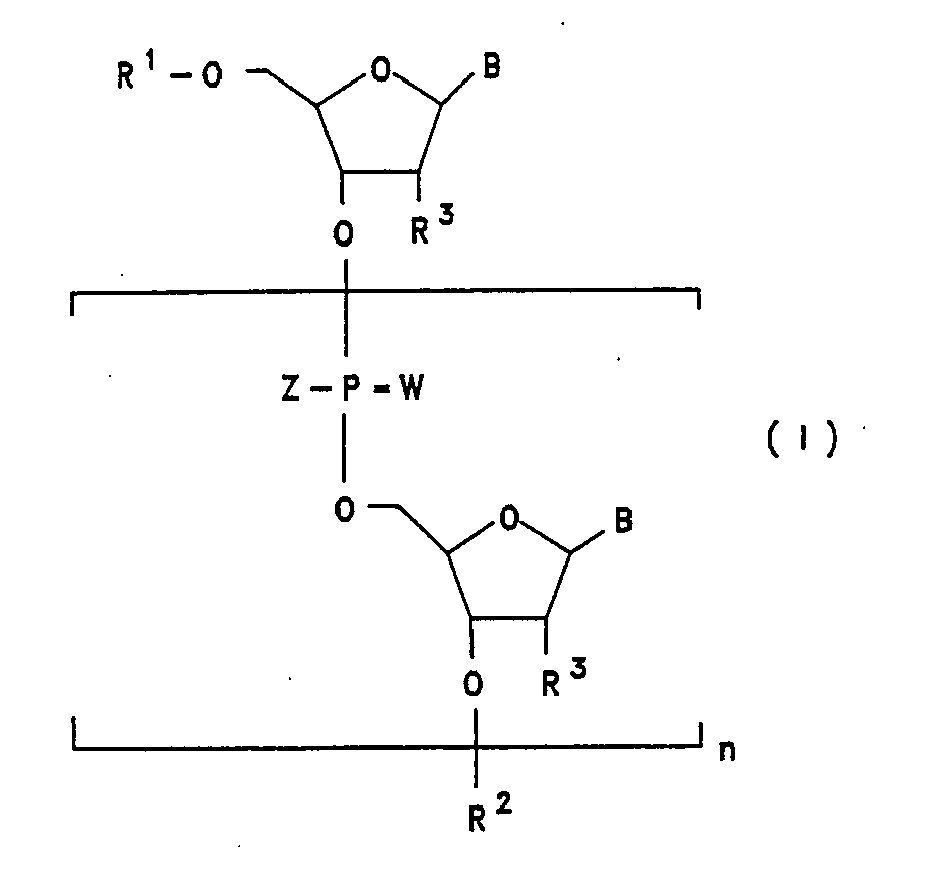 R1 Wasserstoff oder einen Rest der Formel II bedeutet
 R2 einen Rest der Formel III bedeutet,
 B für eine Base, wie natürliche Basen wie Adenin, Thymin, Cytosin, Guanin oder unnatürliche Basen, wie Purin, 2,6-Diaminopurin, 7-Deazaadenin, 7-Deazaguanin, N4, N4-Ethanacytosin bzw. deren Prodrugformen steht; wobei die Base Uracil oder Cytosin im Oligoribonukleotid enthalten ist;R3 unabhängig voneinander OH, Wasserstoff oder F bedeutet, höchstens einR3-Rest gleich H ist, und entweder bei allen U-Nukleosiden oder bei sowohl allen U-als auch C-Nukleosiden R3 gleich F ist;W und W' unabhängig voneinander Sauerstoff oder Schwefel bedeutet;Z und Z' unabhängig voneinander O-; S-; C1-C18-Alkoxy, bevorzugt C1-C8-Alkoxy, C1-C18-Alkyl, bevorzugt C1-C8-Alkyl, NHR4, mit R4 = C1-C18-Alkyl, oder C1-C4-Alkoxy-C1-C6-Alkyl, bevorzugt Methoxyethyl; NR4R5, worin R4 wie oben definiert ist und R5 C1-C18-Alkyl, bevorzugt C1-C8-Alkyl bedeutet oder worin R4 und R5 zusammen mit dem sie tragenden Stickstoffatom einen 5-6-gliedrigen heterozyklischen Ring bedeutet, der zusätzlich ein weiteres Heteroatom aus der Reihe O, S, N enthalten kann, wie z.B. Morpholin;wobei X steht für OH, H, F, Cl, Br, NH2, N3, O-C(O)-(C1-C18)-Alkyl, O-C(O)-(C2-C18)-Alkenyl, O-C(O)-(C2-C18)Alkinyl, O-C(O)-(C6-C18)Aryl, O-(C1-C18)-Alkyl, O-(C2-C18)-Alkenyl, O-(C2-C18)Alkinyl, O-(C6-C18)Aryl, P(O)YY', wobei Y und Y' wie Z und Z' definiert sind, in Formel II können R3 und X zusammen einen cyclischen Phosphorsäurediester bilden; bevorzugt steht X für OH, H, F;n eine ganze Zahl von 5-60, bevorzugt 15-25 bedeutet,sowie deren physiologisch verträglichen Salze.
 - Oligoribonukleotide der Formel I gemäß Anspruch 1, wobei R3 bei allen U- und C-Nukleosiden gleich F ist.
- Oligoribonucleotide der Formel I gemäß einem der Ansprüche 1 oder 2, dadurch gekennzeichnet, daß R2 für einen Rest der Formel III steht und R1 Wasserstoff bedeutet; R1 bzw. R2 für einen Rest der Formeln II bzw. III steht; wobei entweder W oder Z im letzten Fall nicht Sauerstoff bedeuten und X für OH oder H steht.
- Oligoribonucleotide der Formel I gemäß einem der Ansprüche 1 bis 3, dadurch gekennzeichnet, daß W für Sauerstoff steht, oder Z und W beide für Sauerstoff stehen.
- Oligoribonucleotide der Formel I gemäß den Ansprüchen 1 bis 4, dadurch gekennzeichnet, daß R2 für einen Rest der Formel III steht und R1 Wasserstoff bedeutet.
- Oligoribonucleotide der Formel I nach den Ansprüchen 1 bis 5, dadurch gekennzeichnet, daß diese zusätzlich durch Gruppen substituiert sind, die die intrazelluläre Aufnahme begünstigen, die in vitro oder in vivo als Reportergruppen dienen, und/oder Gruppen, die bei der Hybridisierung des Oligonucleotids an biologische DNA oder RNA diese DNA- oder RNA Moleküle unter Bindung oder Spaltung angreifen.
- Oligoribonucleotide nach Anspruch 1, dadurch gekennzeichnet, daß ein Ribozym mit synthetischem 5' und/oder 3' Ende resultiert.
- Verfahren zur Herstellung der Oligoribonucleotide der Formel I, gemäß den Ansprüchen 1 bis 6, dadurch gekennzeichnet, daß mana) eine Nucleotideinheit mit 3'- bzw. 5'-terminaler Phosphor(III)- oder Phosphor(V)-Gruppierungen oder deren aktiviertes Derivat mit einer weiteren Nucleotideinheit mit 3'- bzw. 5'-terminaler freier Hydroxygruppe umsetzt oderb) das Oligonucleotid durch Fragmente in gleicher Weise aufbaut, in den nach (a) oder (b) erhaltenen Oligonucleotiden gegebenenfalls eine oder mehrere zum Schutz anderer Funktionen temporär eingeführte Schutzgruppen abspaltet und die so erhaltenen Oligonucleotide der Formel I gegebenenfalls in ihr physiologisch verträgliches Salz überführt.
- Oligoribonucleotide der Formel I, gemäß den Ansprüchen 1 bis 6 zur Anwendung für hybridisierungschemische, auf der Anlagerung an doppel- oder einzelsträngige Nucleinsäuren beruhende Verfahren der Regulation oder Unterdrückung der biologischen Funktion von Nucleinsäuren sowie zur selektiven Unterdrückung der Expression viraler Genomfunktionen und zur Prophylaxe und Therapie von Virusfunktionen, zur Unterdrückung der Onkogenfunktion und zur Therapie von Krebserkrankungen.
- Arzneimittel enthaltend eine oder mehrere der Verbindungen gemäß den Ansprüchen 1-7, gegebenenfalls zusammen mit physiologisch verträglichen Hilfs- und/oder Trägerstoffen vorzugsweise für die intravenöse oder topische Verabreichung.
Applications Claiming Priority (2)
| Application Number | Priority Date | Filing Date | Title |
|---|---|---|---|
| DE4231949 | 1992-09-24 | ||
| DE4231949 | 1992-09-24 |
Publications (4)
| Publication Number | Publication Date |
|---|---|
| EP0593901A2 EP0593901A2 (de) | 1994-04-27 |
| EP0593901A3 EP0593901A3 (en) | 1994-09-28 |
| EP0593901B1 EP0593901B1 (de) | 1997-04-16 |
| EP0593901B2 true EP0593901B2 (de) | 2008-04-09 |
Family
ID=6468696
Family Applications (1)
| Application Number | Title | Priority Date | Filing Date |
|---|---|---|---|
| EP93114773A Expired - Lifetime EP0593901B2 (de) | 1992-09-24 | 1993-09-14 | Oligoribonucleotid- und Ribozym-Analoga mit terminalen 3'-3'-bzw.5'-5'-Verknüpfungen |
Country Status (14)
| Country | Link |
|---|---|
| US (1) | US6420546B1 (de) |
| EP (1) | EP0593901B2 (de) |
| JP (1) | JP3653102B2 (de) |
| AT (1) | ATE151773T1 (de) |
| AU (1) | AU665113B2 (de) |
| CA (1) | CA2106819C (de) |
| DE (1) | DE59306170D1 (de) |
| DK (1) | DK0593901T3 (de) |
| ES (1) | ES2103408T3 (de) |
| FI (1) | FI115400B (de) |
| GR (1) | GR3023858T3 (de) |
| HU (1) | HU219638B (de) |
| NO (1) | NO307656B1 (de) |
| NZ (1) | NZ248739A (de) |
Families Citing this family (22)
| Publication number | Priority date | Publication date | Assignee | Title |
|---|---|---|---|---|
| US5646042A (en) * | 1992-08-26 | 1997-07-08 | Ribozyme Pharmaceuticals, Inc. | C-myb targeted ribozymes |
| US5998203A (en) * | 1996-04-16 | 1999-12-07 | Ribozyme Pharmaceuticals, Inc. | Enzymatic nucleic acids containing 5'-and/or 3'-cap structures |
| ES2221942T3 (es) * | 1996-05-24 | 2005-01-16 | Aventis Pharma Deutschland Gmbh | Reactivo y metodo para inhibir la expresion de n-ras. |
| US7572582B2 (en) | 1997-09-12 | 2009-08-11 | Exiqon A/S | Oligonucleotide analogues |
| CA2326823A1 (en) * | 1998-04-20 | 1999-10-28 | Ribozyme Pharmaceuticals, Inc. | Nucleic acid molecules with novel chemical compositions capable of modulating gene expression |
| DE19935303A1 (de) | 1999-07-28 | 2001-02-08 | Aventis Pharma Gmbh | Oligonukleotide zur Inhibierung der Expression von humanem eg5 |
| WO2002026932A2 (en) | 2000-09-26 | 2002-04-04 | Duke University | Rna aptamers and methods for identifying the same |
| PT2070939E (pt) | 2001-05-25 | 2014-06-09 | Univ Duke | Moduladores de agentes farmacológicos |
| US20070167384A1 (en) | 2003-04-02 | 2007-07-19 | Dharmacon, Inc. | Modified polynucleotides for use in rna interference |
| CN1980947B (zh) | 2004-04-22 | 2013-01-30 | 雷加多生物科学公司 | 改良的凝血因子调节物 |
| US7923207B2 (en) | 2004-11-22 | 2011-04-12 | Dharmacon, Inc. | Apparatus and system having dry gene silencing pools |
| US20060166234A1 (en) | 2004-11-22 | 2006-07-27 | Barbara Robertson | Apparatus and system having dry control gene silencing compositions |
| US7935811B2 (en) | 2004-11-22 | 2011-05-03 | Dharmacon, Inc. | Apparatus and system having dry gene silencing compositions |
| EP1820804A1 (de) * | 2006-02-20 | 2007-08-22 | Humboldt-Universität zu Berlin | Lipophile Oligonukleotide |
| EP2081949B1 (de) | 2006-09-22 | 2014-12-10 | GE Healthcare Dharmacon, Inc. | Dreiteilige oligonukleotidkomplexe und verfahren zum gene-silencing durch rna-interferenz |
| US7845686B2 (en) * | 2007-12-17 | 2010-12-07 | S & B Technical Products, Inc. | Restrained pipe joining system for plastic pipe |
| US8188060B2 (en) | 2008-02-11 | 2012-05-29 | Dharmacon, Inc. | Duplex oligonucleotides with enhanced functionality in gene regulation |
| EP2781523A1 (de) | 2013-03-18 | 2014-09-24 | Miltenyi Biotec GmbH | Lipophile Oligonukleotid-Analoga |
| WO2018035380A1 (en) | 2016-08-17 | 2018-02-22 | Solstice Biologics, Ltd. | Polynucleotide constructs |
| US11597744B2 (en) | 2017-06-30 | 2023-03-07 | Sirius Therapeutics, Inc. | Chiral phosphoramidite auxiliaries and methods of their use |
| US11104941B2 (en) * | 2018-09-28 | 2021-08-31 | Bioo Scientific Corporation | 5′ adapter comprising an internal 5′-5′ linkage |
| CN118373865B (zh) * | 2024-06-25 | 2024-11-08 | 苏州诺维康生物科技有限公司 | 一种4-乙酰氨基-1-(2-脱氧-2-氟-beta-D-阿拉伯呋喃基)-2(1H)-嘧啶酮的新合成方法 |
Family Cites Families (6)
| Publication number | Priority date | Publication date | Assignee | Title |
|---|---|---|---|---|
| DE3916871A1 (de) | 1989-05-24 | 1990-11-29 | Boehringer Mannheim Gmbh | Modifiziertes phosphoramidit-verfahren zur herstellung von modifizierten nukleinsaeuren |
| US5399676A (en) * | 1989-10-23 | 1995-03-21 | Gilead Sciences | Oligonucleotides with inverted polarity |
| EP0464638B1 (de) * | 1990-07-02 | 1997-04-02 | Hoechst Aktiengesellschaft | Oligonucleotid-analoge mit terminalen 3'-3'-bzw. 5'-5'-Internucleotidverknüpfungen |
| US5672697A (en) * | 1991-02-08 | 1997-09-30 | Gilead Sciences, Inc. | Nucleoside 5'-methylene phosphonates |
| US5646261A (en) * | 1992-01-22 | 1997-07-08 | Hoechst Aktiengesellschaft | 3'-derivatized oligonucleotide analogs with non-nucleotidic groupings, their preparation and use |
| NZ245720A (en) * | 1992-01-22 | 1995-12-21 | Hoechst Ag | Oligonucleotide analogues; use as gene expression inhibitor or dna probe |
-
1993
- 1993-09-14 DK DK93114773.0T patent/DK0593901T3/da active
- 1993-09-14 AT AT93114773T patent/ATE151773T1/de not_active IP Right Cessation
- 1993-09-14 ES ES93114773T patent/ES2103408T3/es not_active Expired - Lifetime
- 1993-09-14 EP EP93114773A patent/EP0593901B2/de not_active Expired - Lifetime
- 1993-09-14 DE DE59306170T patent/DE59306170D1/de not_active Expired - Lifetime
- 1993-09-22 FI FI934154A patent/FI115400B/fi active IP Right Grant
- 1993-09-22 NZ NZ248739A patent/NZ248739A/xx not_active IP Right Cessation
- 1993-09-23 NO NO933397A patent/NO307656B1/no unknown
- 1993-09-23 AU AU47551/93A patent/AU665113B2/en not_active Ceased
- 1993-09-23 CA CA002106819A patent/CA2106819C/en not_active Expired - Fee Related
- 1993-09-24 HU HU9302697A patent/HU219638B/hu not_active IP Right Cessation
- 1993-09-24 JP JP23801093A patent/JP3653102B2/ja not_active Expired - Lifetime
-
1997
- 1997-06-20 GR GR970401499T patent/GR3023858T3/el unknown
-
1998
- 1998-04-14 US US09/059,331 patent/US6420546B1/en not_active Expired - Fee Related
Non-Patent Citations (2)
| Title |
|---|
| Antisense Research and Development, Bd. 2, 1992, Seiten 129-146, J.F.R. Ortigao et al. † |
| Biochemistry, Bd. 23, 1984, Seiten 6153-6159, J.G. Nadeau et al. † |
Also Published As
| Publication number | Publication date |
|---|---|
| US6420546B1 (en) | 2002-07-16 |
| ATE151773T1 (de) | 1997-05-15 |
| NO307656B1 (no) | 2000-05-08 |
| NO933397L (no) | 1994-03-25 |
| CA2106819A1 (en) | 1994-03-25 |
| AU665113B2 (en) | 1995-12-14 |
| NZ248739A (en) | 1995-08-28 |
| FI934154A7 (fi) | 1994-03-25 |
| JPH06189753A (ja) | 1994-07-12 |
| FI934154A0 (fi) | 1993-09-22 |
| JP3653102B2 (ja) | 2005-05-25 |
| ES2103408T3 (es) | 1997-09-16 |
| EP0593901B1 (de) | 1997-04-16 |
| HU9302697D0 (en) | 1993-12-28 |
| GR3023858T3 (en) | 1997-09-30 |
| NO933397D0 (no) | 1993-09-23 |
| EP0593901A2 (de) | 1994-04-27 |
| DK0593901T3 (da) | 1997-10-27 |
| HUT66458A (en) | 1994-11-28 |
| CA2106819C (en) | 2007-04-17 |
| DE59306170D1 (de) | 1997-05-22 |
| AU4755193A (en) | 1994-03-31 |
| EP0593901A3 (en) | 1994-09-28 |
| HU219638B (hu) | 2001-06-28 |
| FI115400B (fi) | 2005-04-29 |
Similar Documents
| Publication | Publication Date | Title |
|---|---|---|
| EP0593901B1 (de) | Oligoribonucleotid- und Ribozym-Analoga mit terminalen 3'-3'-bzw.5'-5'-Verknüpfungen | |
| DE69127903T2 (de) | Neue mit polyamin konjugierte oligonukleotide | |
| DE69027443T2 (de) | Oligonukleotidanaloga mit neuartigen bindungen | |
| EP0845476B1 (de) | Synthetische katalytische Oligonukleotide | |
| EP0464638B1 (de) | Oligonucleotid-analoge mit terminalen 3'-3'-bzw. 5'-5'-Internucleotidverknüpfungen | |
| DE69307495T2 (de) | Oligothionukleotide | |
| EP0552766B1 (de) | Oligonucleotidanaloga, deren Herstellung und Verwendung | |
| DE69433626T2 (de) | N-2 substituierte purine | |
| DE69126530T2 (de) | Nuklease resistente, pyrimidin modifizierte oligonukleotide, die die gen-expression detektieren und modulieren | |
| DE3855275T4 (de) | Nichtnukleotides Bindungsreagenz für nukleotide Proben | |
| DE69331946T2 (de) | Nukleozyme | |
| EP0626387B1 (de) | Nukleoside und Oligonukleotide mit 2'-Ethergruppen | |
| DE69033495T2 (de) | 2'-modifizierte nukleotide | |
| US5955599A (en) | Process for making oligonucleotides containing o- and s- methylphosphotriester internucleoside linkages | |
| DE69403642T2 (de) | 7-deazapurin modifizierte oligonukleotide | |
| DE69432315T2 (de) | ANTISENSE NUKLEINSÄUREN ZUR VORBEUGUNG UND BEHANDLUNG VON BESCHWERDEN IN WELCHEN DIE EXPRIMIERUNG VON C-erbB-2 EINE ROLLE SPIELT | |
| DE69724218T2 (de) | Universale feste träger und verfahren zu ihrer verwendung | |
| DE4110085A1 (de) | 2'-o-alkyl-oligoribonukleotide, verfahren zu deren herstellung und deren verwendung als antisense-oligonukleotide | |
| EP0552767B1 (de) | 3'-Derivatisierte Oligonucleotidanaloga mit nichtnucleotidischen Gruppierungen, deren Herstellung und Verwendung | |
| EP0688784A2 (de) | Neue 3'-Modifizierte Oligonucleotid-Derivate | |
| CA2210031C (en) | Solid phase synthesis of oligonucleotides | |
| EP0749436A1 (de) | Kompositionen und methoden zur verwendung in der synthese der oligonukleotide | |
| DE69733150T2 (de) | Verfahren zur herstellung von nukleotiden oder oligonukleotiden phosphoramitiden | |
| EP0649855A1 (de) | Verwendung von mit enzymatisch abspaltbaren Schutzgruppen versehenen Nukleosiden und Nukleosid-Derivaten in der Synthese von Oligonukleotiden | |
| EP0530614A1 (de) | Neuartige Antisense-Oligonukleotide mit durchgängiger Phosphoramidat-Internukleotidbindung |
Legal Events
| Date | Code | Title | Description |
|---|---|---|---|
| PUAI | Public reference made under article 153(3) epc to a published international application that has entered the european phase |
Free format text: ORIGINAL CODE: 0009012 |
|
| AK | Designated contracting states |
Kind code of ref document: A2 Designated state(s): AT BE CH DE DK ES FR GB GR IE IT LI LU MC NL PT SE |
|
| PUAL | Search report despatched |
Free format text: ORIGINAL CODE: 0009013 |
|
| AK | Designated contracting states |
Kind code of ref document: A3 Designated state(s): AT BE CH DE DK ES FR GB GR IE IT LI LU MC NL PT SE |
|
| 17P | Request for examination filed |
Effective date: 19950328 |
|
| 17Q | First examination report despatched |
Effective date: 19950504 |
|
| GRAG | Despatch of communication of intention to grant |
Free format text: ORIGINAL CODE: EPIDOS AGRA |
|
| GRAH | Despatch of communication of intention to grant a patent |
Free format text: ORIGINAL CODE: EPIDOS IGRA |
|
| GRAH | Despatch of communication of intention to grant a patent |
Free format text: ORIGINAL CODE: EPIDOS IGRA |
|
| GRAA | (expected) grant |
Free format text: ORIGINAL CODE: 0009210 |
|
| AK | Designated contracting states |
Kind code of ref document: B1 Designated state(s): AT BE CH DE DK ES FR GB GR IE IT LI LU MC NL PT SE |
|
| REF | Corresponds to: |
Ref document number: 151773 Country of ref document: AT Date of ref document: 19970515 Kind code of ref document: T |
|
| REG | Reference to a national code |
Ref country code: CH Ref legal event code: EP |
|
| REF | Corresponds to: |
Ref document number: 59306170 Country of ref document: DE Date of ref document: 19970522 |
|
| ET | Fr: translation filed | ||
| GBT | Gb: translation of ep patent filed (gb section 77(6)(a)/1977) |
Effective date: 19970619 |
|
| REG | Reference to a national code |
Ref country code: IE Ref legal event code: FG4D Free format text: 73323 |
|
| REG | Reference to a national code |
Ref country code: GR Ref legal event code: FG4A Free format text: 3023858 |
|
| REG | Reference to a national code |
Ref country code: ES Ref legal event code: FG2A Ref document number: 2103408 Country of ref document: ES Kind code of ref document: T3 |
|
| REG | Reference to a national code |
Ref country code: DK Ref legal event code: T3 |
|
| PLBQ | Unpublished change to opponent data |
Free format text: ORIGINAL CODE: EPIDOS OPPO |
|
| PLBI | Opposition filed |
Free format text: ORIGINAL CODE: 0009260 |
|
| PLBF | Reply of patent proprietor to notice(s) of opposition |
Free format text: ORIGINAL CODE: EPIDOS OBSO |
|
| 26 | Opposition filed |
Opponent name: NEXSTAR PHARMACEUTICALS INC. Effective date: 19980113 |
|
| NLR1 | Nl: opposition has been filed with the epo |
Opponent name: NEXSTAR PHARMACEUTICALS INC. |
|
| PLBF | Reply of patent proprietor to notice(s) of opposition |
Free format text: ORIGINAL CODE: EPIDOS OBSO |
|
| RAP2 | Party data changed (patent owner data changed or rights of a patent transferred) |
Owner name: AVENTIS PHARMA DEUTSCHLAND GMBH |
|
| NLT2 | Nl: modifications (of names), taken from the european patent patent bulletin |
Owner name: AVENTIS PHARMA DEUTSCHLAND GMBH |
|
| REG | Reference to a national code |
Ref country code: PT Ref legal event code: PC4A Free format text: AVENTIS PHARMA DEUTSCHLAND GMBH DE Effective date: 20010322 |
|
| REG | Reference to a national code |
Ref country code: GB Ref legal event code: IF02 |
|
| NLS | Nl: assignments of ep-patents |
Owner name: AVENTIS PHARMA DEUTSCHLAND GMBH |
|
| REG | Reference to a national code |
Ref country code: FR Ref legal event code: TP |
|
| REG | Reference to a national code |
Ref country code: GB Ref legal event code: 732E |
|
| PLAW | Interlocutory decision in opposition |
Free format text: ORIGINAL CODE: EPIDOS IDOP |
|
| RAP2 | Party data changed (patent owner data changed or rights of a patent transferred) |
Owner name: SANOFI-AVENTIS DEUTSCHLAND GMBH |
|
| NLT1 | Nl: modifications of names registered in virtue of documents presented to the patent office pursuant to art. 16 a, paragraph 1 |
Owner name: SANOFI-AVENTIS DEUTSCHLAND GMBH |
|
| NLT2 | Nl: modifications (of names), taken from the european patent patent bulletin |
Owner name: SANOFI-AVENTIS DEUTSCHLAND GMBH Effective date: 20051221 |
|
| PGFP | Annual fee paid to national office [announced via postgrant information from national office to epo] |
Ref country code: PT Payment date: 20060717 Year of fee payment: 14 |
|
| PGFP | Annual fee paid to national office [announced via postgrant information from national office to epo] |
Ref country code: NL Payment date: 20060721 Year of fee payment: 14 Ref country code: AT Payment date: 20060721 Year of fee payment: 14 |
|
| PGFP | Annual fee paid to national office [announced via postgrant information from national office to epo] |
Ref country code: IE Payment date: 20060726 Year of fee payment: 14 Ref country code: CH Payment date: 20060726 Year of fee payment: 14 |
|
| PGFP | Annual fee paid to national office [announced via postgrant information from national office to epo] |
Ref country code: BE Payment date: 20060807 Year of fee payment: 14 |
|
| PGFP | Annual fee paid to national office [announced via postgrant information from national office to epo] |
Ref country code: MC Payment date: 20060817 Year of fee payment: 14 |
|
| PGFP | Annual fee paid to national office [announced via postgrant information from national office to epo] |
Ref country code: GR Payment date: 20060914 Year of fee payment: 14 |
|
| PGFP | Annual fee paid to national office [announced via postgrant information from national office to epo] |
Ref country code: ES Payment date: 20060920 Year of fee payment: 14 |
|
| PGFP | Annual fee paid to national office [announced via postgrant information from national office to epo] |
Ref country code: LU Payment date: 20060921 Year of fee payment: 14 |
|
| PGFP | Annual fee paid to national office [announced via postgrant information from national office to epo] |
Ref country code: IT Payment date: 20060930 Year of fee payment: 14 |
|
| PUAH | Patent maintained in amended form |
Free format text: ORIGINAL CODE: 0009272 |
|
| REG | Reference to a national code |
Ref country code: FR Ref legal event code: CD Ref country code: FR Ref legal event code: CA |
|
| REG | Reference to a national code |
Ref country code: PT Ref legal event code: MM4A Free format text: LAPSE DUE TO NON-PAYMENT OF FEES Effective date: 20080314 |
|
| BERE | Be: lapsed |
Owner name: *SANOFI-AVENTIS DEUTSCHLAND G.M.B.H. Effective date: 20070930 |
|
| 27A | Patent maintained in amended form |
Effective date: 20080409 |
|
| AK | Designated contracting states |
Kind code of ref document: B2 Designated state(s): AT BE CH DE DK ES FR GB GR IE IT LI LU MC NL PT SE |
|
| PG25 | Lapsed in a contracting state [announced via postgrant information from national office to epo] |
Ref country code: SE Free format text: LAPSE BECAUSE OF NON-PAYMENT OF DUE FEES Effective date: 20070915 Ref country code: MC Free format text: LAPSE BECAUSE OF NON-PAYMENT OF DUE FEES Effective date: 20070930 |
|
| PGFP | Annual fee paid to national office [announced via postgrant information from national office to epo] |
Ref country code: DK Payment date: 20060727 Year of fee payment: 14 |
|
| REG | Reference to a national code |
Ref country code: CH Ref legal event code: AEN Free format text: AUFRECHTERHALTUNG DES PATENTES IN GEAENDERTER FORM |
|
| REG | Reference to a national code |
Ref country code: CH Ref legal event code: PL |
|
| EUG | Se: european patent has lapsed | ||
| PG25 | Lapsed in a contracting state [announced via postgrant information from national office to epo] |
Ref country code: PT Free format text: LAPSE BECAUSE OF NON-PAYMENT OF DUE FEES Effective date: 20080314 Ref country code: NL Free format text: LAPSE BECAUSE OF NON-PAYMENT OF DUE FEES Effective date: 20080401 |
|
| NLV4 | Nl: lapsed or anulled due to non-payment of the annual fee |
Effective date: 20080401 |
|
| REG | Reference to a national code |
Ref country code: IE Ref legal event code: MM4A |
|
| PG25 | Lapsed in a contracting state [announced via postgrant information from national office to epo] |
Ref country code: AT Free format text: LAPSE BECAUSE OF NON-PAYMENT OF DUE FEES Effective date: 20070914 |
|
| PGFP | Annual fee paid to national office [announced via postgrant information from national office to epo] |
Ref country code: SE Payment date: 20060726 Year of fee payment: 14 |
|
| PG25 | Lapsed in a contracting state [announced via postgrant information from national office to epo] |
Ref country code: LI Free format text: LAPSE BECAUSE OF NON-PAYMENT OF DUE FEES Effective date: 20070930 Ref country code: CH Free format text: LAPSE BECAUSE OF NON-PAYMENT OF DUE FEES Effective date: 20070930 |
|
| PG25 | Lapsed in a contracting state [announced via postgrant information from national office to epo] |
Ref country code: BE Free format text: LAPSE BECAUSE OF NON-PAYMENT OF DUE FEES Effective date: 20070930 |
|
| PG25 | Lapsed in a contracting state [announced via postgrant information from national office to epo] |
Ref country code: IE Free format text: LAPSE BECAUSE OF NON-PAYMENT OF DUE FEES Effective date: 20070914 Ref country code: ES Free format text: LAPSE BECAUSE OF FAILURE TO SUBMIT A TRANSLATION OF THE DESCRIPTION OR TO PAY THE FEE WITHIN THE PRESCRIBED TIME-LIMIT Effective date: 20080720 |
|
| ET3 | Fr: translation filed ** decision concerning opposition | ||
| PG25 | Lapsed in a contracting state [announced via postgrant information from national office to epo] |
Ref country code: DK Free format text: LAPSE BECAUSE OF FAILURE TO SUBMIT A TRANSLATION OF THE DESCRIPTION OR TO PAY THE FEE WITHIN THE PRESCRIBED TIME-LIMIT Effective date: 20080709 |
|
| PG25 | Lapsed in a contracting state [announced via postgrant information from national office to epo] |
Ref country code: GR Free format text: LAPSE BECAUSE OF NON-PAYMENT OF DUE FEES Effective date: 20080402 |
|
| PG25 | Lapsed in a contracting state [announced via postgrant information from national office to epo] |
Ref country code: LU Free format text: LAPSE BECAUSE OF NON-PAYMENT OF DUE FEES Effective date: 20070914 Ref country code: IT Free format text: LAPSE BECAUSE OF NON-PAYMENT OF DUE FEES Effective date: 20070914 |
|
| REG | Reference to a national code |
Ref country code: DK Ref legal event code: EBP |
|
| PG25 | Lapsed in a contracting state [announced via postgrant information from national office to epo] |
Ref country code: DK Free format text: LAPSE BECAUSE OF FAILURE TO SUBMIT A TRANSLATION OF THE DESCRIPTION OR TO PAY THE FEE WITHIN THE PRESCRIBED TIME-LIMIT Effective date: 20070930 |
|
| PGFP | Annual fee paid to national office [announced via postgrant information from national office to epo] |
Ref country code: GB Payment date: 20120912 Year of fee payment: 20 |
|
| PGFP | Annual fee paid to national office [announced via postgrant information from national office to epo] |
Ref country code: FR Payment date: 20120926 Year of fee payment: 20 Ref country code: DE Payment date: 20120912 Year of fee payment: 20 |
|
| REG | Reference to a national code |
Ref country code: DE Ref legal event code: R071 Ref document number: 59306170 Country of ref document: DE |
|
| REG | Reference to a national code |
Ref country code: GB Ref legal event code: PE20 Expiry date: 20130913 |
|
| PG25 | Lapsed in a contracting state [announced via postgrant information from national office to epo] |
Ref country code: DE Free format text: LAPSE BECAUSE OF EXPIRATION OF PROTECTION Effective date: 20130917 |
|
| PG25 | Lapsed in a contracting state [announced via postgrant information from national office to epo] |
Ref country code: GB Free format text: LAPSE BECAUSE OF EXPIRATION OF PROTECTION Effective date: 20130913 |