EP0591902B1 - Beschichtetes Schleifmittel und Verfahren zu dessen Herstellung - Google Patents
Beschichtetes Schleifmittel und Verfahren zu dessen Herstellung Download PDFInfo
- Publication number
- EP0591902B1 EP0591902B1 EP93116026A EP93116026A EP0591902B1 EP 0591902 B1 EP0591902 B1 EP 0591902B1 EP 93116026 A EP93116026 A EP 93116026A EP 93116026 A EP93116026 A EP 93116026A EP 0591902 B1 EP0591902 B1 EP 0591902B1
- Authority
- EP
- European Patent Office
- Prior art keywords
- adhesive
- adhesive layer
- resin
- layer
- curing
- Prior art date
- Legal status (The legal status is an assumption and is not a legal conclusion. Google has not performed a legal analysis and makes no representation as to the accuracy of the status listed.)
- Expired - Lifetime
Links
Images

Classifications
-
- B—PERFORMING OPERATIONS; TRANSPORTING
- B24—GRINDING; POLISHING
- B24D—TOOLS FOR GRINDING, BUFFING OR SHARPENING
- B24D3/00—Physical features of abrasive bodies, or sheets, e.g. abrasive surfaces of special nature; Abrasive bodies or sheets characterised by their constituents
- B24D3/02—Physical features of abrasive bodies, or sheets, e.g. abrasive surfaces of special nature; Abrasive bodies or sheets characterised by their constituents the constituent being used as bonding agent
- B24D3/20—Physical features of abrasive bodies, or sheets, e.g. abrasive surfaces of special nature; Abrasive bodies or sheets characterised by their constituents the constituent being used as bonding agent and being essentially organic
- B24D3/28—Resins or natural or synthetic macromolecular compounds
-
- B—PERFORMING OPERATIONS; TRANSPORTING
- B29—WORKING OF PLASTICS; WORKING OF SUBSTANCES IN A PLASTIC STATE IN GENERAL
- B29C—SHAPING OR JOINING OF PLASTICS; SHAPING OF MATERIAL IN A PLASTIC STATE, NOT OTHERWISE PROVIDED FOR; AFTER-TREATMENT OF THE SHAPED PRODUCTS, e.g. REPAIRING
- B29C35/00—Heating, cooling or curing, e.g. crosslinking or vulcanising; Apparatus therefor
- B29C35/02—Heating or curing, e.g. crosslinking or vulcanizing during moulding, e.g. in a mould
-
- C—CHEMISTRY; METALLURGY
- C09—DYES; PAINTS; POLISHES; NATURAL RESINS; ADHESIVES; COMPOSITIONS NOT OTHERWISE PROVIDED FOR; APPLICATIONS OF MATERIALS NOT OTHERWISE PROVIDED FOR
- C09J—ADHESIVES; NON-MECHANICAL ASPECTS OF ADHESIVE PROCESSES IN GENERAL; ADHESIVE PROCESSES NOT PROVIDED FOR ELSEWHERE; USE OF MATERIALS AS ADHESIVES
- C09J161/00—Adhesives based on condensation polymers of aldehydes or ketones; Adhesives based on derivatives of such polymers
- C09J161/04—Condensation polymers of aldehydes or ketones with phenols only
Definitions
- the present invention relates to a coated abrasive article and a process for producing the same.
- Coated abrasive articles e.g., abrasive cloth and abrasive paper, etc.
- abrasive cloth and abrasive paper, etc. are produced by applying a first adhesive on a backing (e.g., paper, cloth, etc.), applying abrasive grains to the first adhesive by electrostatic coating or gravity coating, curing the first adhesive with drying, applying a second adhesive over the first adhesive and abrasive grains, and then curing the second adhesive with drying.
- a synthetic resin e.g., phenolic resin, epoxy resin, urea resin, etc.
- glue e.g., glue
- a water soluble resol phenolic resin is widely used, because it is cheap and is superior in strength and heat resistance.
- the curing rate of the resol phenolic resin is low, and it requires long time for drying and curing.
- boiling of water (as a solvent) as well as vapor of condensate formed on curing cause blisters (or little foams) in the cured resin layer, which results in a decrease of strength. As described above, it is difficult to reduce the drying time.
- resol phenolic resins containing about 65 to 82 % solids and having a viscosity of about 700 to 10,000 mPa.s (cps) are used for abrasive cloth and paper. Most popularly, water is used as a solvent.
- alcoholic solvent e.g., methanol, etc.
- the second adhesive containing phenolic resin is applied, the second adhesive is cured by heating at a temperature of from about 50 to 110°C for about 50 minutes to several hours in a festoon oven, which can contain hundreds or thousands meters of web. After the web is wound, the second adhesive is completely cured by heating to a temperature of about 60 to 130°C for several hours to 20 hours.
- a method for accelerating heating and curing by applying some modifications and additives to the resol phenolic resin For example, there is a method comprising the steps of adding another resin to the phenolic resin to accelerate gelation, winding the coated abrasive product, and then curing the phenolic resin by after-cure (post-cure).
- a mixture of a water based resol and a condensate product which is made from a phenol component including phenol or polyfunctional phenol having high reactivity and formaldehyde be used as a binder.
- a method for accelerating curing by acidifying the resol phenolic resin with an acid such as p-toluenesulfonic acid is also used.
- the present invention provides a coated abrasive article comprising a backing, a first adhesive layer formed on the backing, a layer of abrasive grains formed on the first adhesive layer, and a second adhesive layer covering the layer of abrasive grains, wherein the second adhesive layer is formed from an adhesive comprising a water soluble resol phenolic resin having a weight-average molecular weight of from 1,400 to 3,500 and an organic solvent having a boiling point of from 110 to 175°C.
- the present invention also provides a process for producing a coated abrasive article comprising the steps of:
- the coated abrasive article of the present invention comprises a backing, a first adhesive layer formed on the backing, a layer of abrasive grains formed on the first adhesive layer, and a second adhesive layer covering the layer of abrasive grains.
- the backing for example, paper, cloth, or the like is generally used.
- Film or non-woven fabric for example, polyethylene terephthalate, may also be used. Further, it is important that the backing have sufficient strength to stand use in a coated abrasive article, as well as suitable flexibility.
- the first adhesive layer formed on the backing comprises a synthetic resin (e.g., phenolic resin, epoxy resin, urea resin, etc.) or glue. It is preferred that the first adhesive be dried at a temperature of from 50 to 110°C for about 30 seconds to several minutes for phenolic resin, at a temperature of from 70 to 140°C for about 30 seconds to several minutes for urea resin, and at a temperature of from 50 to 110°C for 30 seconds to several tens of minutes for glue.
- a synthetic resin e.g., phenolic resin, epoxy resin, urea resin, etc.
- glue glue
- a layer of abrasive grains is formed on the first adhesive layer.
- the layer of abrasive grains can be composed of abrasive grains containing aluminum oxide, silicon nitride, silicon carbide, alumina-zirconia, alumina obtained by sol-gel method as a main component [e.g., "Cubitron” (trade name), manufactured by Minnesota Mining and Manufacturing Company, etc.], garnet, diamond, CBN (cubic boron nitride), and the like, or combinations thereof.
- the coated abrasive article can be formed by applying a layer of the second adhesive on the aforementioned layer of abrasive grains and curing the second adhesive by heating.
- the second adhesive used in the present invention contains a water soluble resol phenolic resin having a weight-average molecular weight of from 1,400 to 3,500 and an organic solvent having a boiling point of 110 to 175°C.
- the water soluble resol phenolic resin may be prepared by mixing phenol with formaldehyde to form an aqueous solution and subjecting the solution to the condensation reaction by heating in the presence of a basic catalyst (e.g., sodium hydroxide, potassium hydroxide, etc.).
- viscosity and molecular weight of the resin solution can be adjusted by controlling the heating temperature and the heating time.
- the molecular weight can be measured by GPC (gel permeation chromatography) and the viscosity can be measured by a B type viscometer.
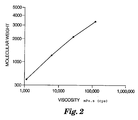
- a relation between viscosity and weight-average molecular weight of the resol phenolic resin is shown in Fig 2.
- the weight-average molecular weight of the resol phenolic resin is from 1,400 to 3,500, that is, it has the viscosity of 10,000 to 100,000, preferably 15,000 to 50,000 mPa.s (cps) (25°C) at 75 % solids.
- the weight-average molecular weight exceeds 3,500, viscosity becomes high, whereby a large amount of the solvent is required for dilution so as to adjust the viscosity within an appropriate range, and variability in properties of the product becomes large, which is not preferred.
- the weight-average molecular weight is less than 1,400, the property of the phenolic resin is the same as that of a conventional second adhesive as shown in Fig 1, and the drying step is prolonged.
- the second adhesive of the present invention also contains an organic solvent having a high boiling point, particularly 110 to 175°C.
- organic solvents suitable for the adhesive compositions include cyclohexanol, cyclohexanone, 2-buthoxyethanol, 2-ethoxyethanol, n-butanol, and the like.
- the organic solvents that are most preferred for the second adhesive of the present invention are cyclohexanone (boiling point of 156°C) and cyclohexanol (boiling point of 161.1°C).
- any additives such as fillers (e.g., calcium carbonate, silicon oxide, talc, etc.), grinding aids (e.g., cryolite, potassium borofluoride, etc.), colorants (e.g., pigment, dye, etc.), and the like, may be added to the second adhesive in the present invention.
- the amount of these additives is preferably not more than 70 % by weight, based on % solids of the second adhesive. When the amount of additives exceeds 70 % by weight, strength of the second adhesive is liable to be decreased.
- the second adhesive thus obtained is coated, for example, by a roll coater, curing is conducted by heating at a temperature of 120 to 160°C for a short period of time (1.5 to 3 minutes).
- the coated abrasive article is wound on a jumbo roll according to the same manner as that of a conventional method, and then the coated abrasive article is subjected to an after-cure (post-cure) treatment to obtain a coated abrasive article.
- the curing step following application of the second adhesive can be completed in a remarkably short period of time and productivity can be largely improved. Further, a large drying device is not required as a production facility and the product can be produced by a simple device.
- the resulting coated abrasive article has the same performance as that of a conventional coated abrasive article.
- a water soluble resol phenolic resin (PR-53074, manufactured by Sumitomo Durez K.K.) was reacted by heating to obtain a high molecular weight resin. Samples of resin PR-53074 were reacted at 45°C for 5 days, 6 days, and 7 days to obtain a "resin 1", "resin 2", “resin 3", respectively. Properties of resin PR-53074 are shown below: Water soluble phenolic resin PR-53074; 75 % solids; viscosity of 720 mPa.s (cps).
- Viscosities of resins 1, 2, and 3 and viscosities of solutions thereof when diluted with cyclohexanone (60 % solids) are shown in Table 1.
- Table 1 Viscosity mPa.s (cps) Measuring temperature (% solids) Resin 1 [reacted at 45°C, 5 days] Resin 2 [reacted at 45°C, 6 days] Resin 3 [reacted at 45°C, 7 days] 45°C (75 %) (undiluted) 1,850 3,640 9,540 25°C (75 %) (undiluted) 20,000 41,200 123,600 25°C (60%) (diluted with cyclohexanone) 1,135 1,640 3,630
- composition for the second adhesive solution was made by using PR-53074 and resins 1 to 3. Formulations are shown in Tables 2 and 4. Table 2 Formulation of the second adhesive (parts by weight) Raw Materials Comp. Ex.1 Comp. Ex.2 Ex. 1 Ex. 2 Comp.
- the second adhesive of the articles of Comparative Examples 1 and 2 and Examples 1 and 2 was coated on the sample, which had been subjected to the first adhesive coating step and abrasive grain coating step.
- the first adhesive an epoxy resin
- SA FEPA #100 single crystal alumina, manufactured by Showa Denko K.K.
- the adhesive in the first adhesive layer was cured by heating at a temperature of 120 to 150°C. Changes of the state of cure with time were observed. The state of cure was evaluated according to the following criteria: A, hard; B, tack free; C, slightly tacky; D, tacky. The results are shown in Table 3.
- requisite drying time is 5 minutes or more at a temperature of less than 130°C, although drying time varies depending on the kind of a solvent.
- the cured state (tack free) suitable for winding can be obtained by drying at 150°C for 2 minutes.
- the adhesive had high viscosity even though % solids was decreased to 60%, and, therefore, coating was not conducted.
- a sample of the article of Example 1 and a sample of the article of Comparative Example 4 (formulation of which is shown in Table 4) were prepared by applying the second adhesive on a sample coated with the same first adhesive as that of Example 1 and curing the second adhesive at a temperature of 80°C for 2 hours, then at a temperature of 90°C for 2 hours, and then at a temperature of 100°C for 15 hours. Then, a loop material was laminated on the back surface of the backing, which was punched to form a disc having a diameter of 12,7 cm (5 inches). Then, a sanding test was conducted. The results of the test are shown in Table 5.
Landscapes
- Engineering & Computer Science (AREA)
- Mechanical Engineering (AREA)
- Chemical & Material Sciences (AREA)
- Organic Chemistry (AREA)
- Physics & Mathematics (AREA)
- Health & Medical Sciences (AREA)
- Oral & Maxillofacial Surgery (AREA)
- Thermal Sciences (AREA)
- Polishing Bodies And Polishing Tools (AREA)
- Manufacture Of Macromolecular Shaped Articles (AREA)
- Adhesives Or Adhesive Processes (AREA)
Claims (3)
- Beschichteter Schleifgegenstand, umfassend eine Unterlage, eine erste Klebstoffschicht, die auf der Unterlage erzeugt wird, eine Schicht aus Schleifkörnern, die auf der ersten Klebstoffschicht erzeugt wird, und eine zweite Klebstoffschicht, die die Schicht aus Schleifkörnern bedeckt, wobei die zweite Klebstoffschicht aus einer Zusammensetzung erzeugt wird, die ein in Wasser lösliches phenolisches Resolharz mit einem Gewichtsmittel des Molekulargewichts von 1400 bis 3500 und ein organisches Lösungsmittel mit einem Siedepunkt von 110 bis 175°C umfaßt.
- Verfahren zur Herstellung eines beschichteten Schleifgegenstandes umfassend die Schritte:(a) Auftragen eines ersten Klebstoffs auf eine Unterlage, wobei eine erste Klebstoffschicht erzeugt wird;(b) Auftragen einer Schicht aus Schleifkörnern auf die erste Klebstoffschicht;(c) Härten des ersten Klebstoffs durch Erhitzen;(d) Auftragen eines zweiten Klebstoffs über die erste Klebstoffschicht und die Schicht aus Schleifkörnern, wobei eine zweite Klebstoffschicht erzeugt wird;(e) Härten der zweiten Klebstoffschicht, wobei ein beschichteter Schleifgegenstand erzeugt wird;(f) Aufwickeln des beschichteten Schleifgegenstandes; und(g) Nachhärten des Gegenstandes bei einer Temperatur von 60 bis 130°C;wobei die zweite Klebstoffschicht aus einer Zusammensetzung, die ein in Wasser lösliches phenolisches Resolharz mit einem Gewichtsmittel des Molekulargewichts von 1400 bis 3500 und ein organisches Lösungsmittel mit einem Siedepunkt von 110 bis 175°C umfaßt, erzeugt wird.
- Verfahren nach Anspruch 2, wobei der Schritt (e) durch 1,5 bis 3 Minuten langes Erhitzen bei einer Temperatur von 120 bis 160°C durchgeführt wird, nachdem der zweite Klebstoff aufgetragen ist.
Applications Claiming Priority (2)
| Application Number | Priority Date | Filing Date | Title |
|---|---|---|---|
| JP4265905A JPH06114747A (ja) | 1992-10-05 | 1992-10-05 | 研磨材およびその製法 |
| JP265905/92 | 1992-10-05 |
Publications (2)
| Publication Number | Publication Date |
|---|---|
| EP0591902A1 EP0591902A1 (de) | 1994-04-13 |
| EP0591902B1 true EP0591902B1 (de) | 1995-12-06 |
Family
ID=17423733
Family Applications (1)
| Application Number | Title | Priority Date | Filing Date |
|---|---|---|---|
| EP93116026A Expired - Lifetime EP0591902B1 (de) | 1992-10-05 | 1993-10-04 | Beschichtetes Schleifmittel und Verfahren zu dessen Herstellung |
Country Status (9)
| Country | Link |
|---|---|
| US (1) | US5397369A (de) |
| EP (1) | EP0591902B1 (de) |
| JP (1) | JPH06114747A (de) |
| KR (1) | KR100276135B1 (de) |
| AU (1) | AU665274B2 (de) |
| BR (1) | BR9303977A (de) |
| CA (1) | CA2105832A1 (de) |
| DE (1) | DE69300960T2 (de) |
| ES (1) | ES2080570T3 (de) |
Families Citing this family (17)
| Publication number | Priority date | Publication date | Assignee | Title |
|---|---|---|---|---|
| US5858549A (en) * | 1997-01-07 | 1999-01-12 | National Starch And Chemical Investment Holding Corporation | (Hydroxyalkyl)urea crosslinking agents |
| US5840822A (en) * | 1997-09-02 | 1998-11-24 | National Starch And Chemical Investment Holding Corporation | Mono(hydroxyalkyl)urea and oxazolidone crosslinking agents |
| US8062098B2 (en) | 2000-11-17 | 2011-11-22 | Duescher Wayne O | High speed flat lapping platen |
| US8256091B2 (en) * | 2000-11-17 | 2012-09-04 | Duescher Wayne O | Equal sized spherical beads |
| US8545583B2 (en) * | 2000-11-17 | 2013-10-01 | Wayne O. Duescher | Method of forming a flexible abrasive sheet article |
| US7632434B2 (en) | 2000-11-17 | 2009-12-15 | Wayne O. Duescher | Abrasive agglomerate coated raised island articles |
| US7520800B2 (en) * | 2003-04-16 | 2009-04-21 | Duescher Wayne O | Raised island abrasive, lapping apparatus and method of use |
| JP5072257B2 (ja) * | 2006-04-24 | 2012-11-14 | スリーエム イノベイティブ プロパティズ カンパニー | 耐熱性不織布研磨材 |
| US9643127B2 (en) | 2010-01-15 | 2017-05-09 | Board Of Regents Of The University Of Texas System | Simultaneous removal of oil and gases from liquid sources using a hollow fiber membrane |
| US9149772B2 (en) | 2010-01-15 | 2015-10-06 | Board Of Regents, The University Of Texas Systems | Enhancing flux of a microporous hollow fiber membrane |
| EP2523737A4 (de) * | 2010-01-15 | 2015-10-14 | Univ Texas | Nichtdispersives verfahren zur gewinnung unlöslicher öle aus wässrigen schlämmen |
| US8491792B2 (en) * | 2010-01-15 | 2013-07-23 | Board Of Regents, The University Of Texas System | Non-dispersive process for insoluble oil recovery from aqueous slurries |
| US8617396B2 (en) * | 2010-01-15 | 2013-12-31 | Board Of Regents, The University Of Texas System | Non-dispersive process for insoluble oil recovery from aqueous slurries |
| US9688921B2 (en) | 2013-02-26 | 2017-06-27 | Board Of Regents, The University Of Texas System | Oil quality using a microporous hollow fiber membrane |
| US9782726B2 (en) | 2010-01-15 | 2017-10-10 | Board Of Regents, The University Of Texas System | Non-dispersive process for oil recovery |
| WO2013188849A1 (en) | 2012-06-14 | 2013-12-19 | Board Of Regents, The University Of Texas System | Non-dispersive oil recovery from oil industry liquid sources |
| CN104227509A (zh) * | 2014-09-11 | 2014-12-24 | 衢州学院 | 一种光纤连接器的可溶性固着软质磨粒薄膜抛光方法 |
Family Cites Families (21)
| Publication number | Priority date | Publication date | Assignee | Title |
|---|---|---|---|---|
| US942808A (en) * | 1907-10-26 | 1909-12-07 | Leo H Baekeland | Abrasive composition and method of making same. |
| US4047903A (en) * | 1972-09-26 | 1977-09-13 | Hoechst Aktiengesellschaft | Process for the production of abrasives |
| US4690692A (en) * | 1977-08-25 | 1987-09-01 | Hoechst Aktiengesellschaft | Synthetic resin binders and their use for the manufacture of abrasives |
| DE2738267C3 (de) * | 1977-08-25 | 1986-04-17 | Hoechst Ag, 6230 Frankfurt | Verwendung von Kunstharzbindemitteln |
| EP0009519B1 (de) * | 1978-10-09 | 1984-12-12 | Hoechst Aktiengesellschaft | Verwendung von Kunstharzbindemitteln zur Herstellung von Schleifmitteln und so hergestellte Schleifmittel |
| DE2853761B1 (de) * | 1978-12-13 | 1980-03-27 | Hoechst Ag | Verfahren zur Herstellung von Schleifmitteln |
| US4457766A (en) * | 1980-10-08 | 1984-07-03 | Kennecott Corporation | Resin systems for high energy electron curable resin coated webs |
| DE3106979C1 (de) * | 1981-02-25 | 1982-11-11 | Th. Goldschmidt Ag, 4300 Essen | Haertbares Phenolformaldehydharz mit verbesserten elastischen Eigenschaften nach der Aushaertung |
| DD206387A1 (de) * | 1981-08-03 | 1984-01-25 | Sprela Werke Spremberg Veb | Verfahren zur kontinuierlichen herstellung fluessiger resole |
| US4437865A (en) * | 1982-08-27 | 1984-03-20 | Carborundum Abrasive Company | Flexible backing material for use in coated abrasives |
| US4696692A (en) * | 1986-12-10 | 1987-09-29 | Corning Glass Works | Kinematically determinate glass pressing mold assembly and method of use |
| US4802896A (en) * | 1987-12-08 | 1989-02-07 | Minnesota Mining And Manufacturing Company | Modified resins and abrasive articles made with the same as a bond system |
| US4871376A (en) * | 1987-12-14 | 1989-10-03 | Minnesota Mining And Manufacturing Company | Resin systems for coated products; and method |
| US4974373A (en) * | 1988-03-14 | 1990-12-04 | Tokyo Magnetic Printing Co., Ltd. | Abrasive tools |
| JP2542264B2 (ja) * | 1989-08-10 | 1996-10-09 | 富士写真フイルム株式会社 | 研磨テ―プ |
| US5110320A (en) * | 1990-02-13 | 1992-05-05 | Minnesota Mining And Manufacturing Company | Abrasive products bonded with color stabilized base catalyzed phenolic resin |
| CA2043283A1 (en) * | 1990-07-06 | 1992-01-07 | William F. Mccutcheon | Coated abrasives |
| US5182346A (en) * | 1990-08-02 | 1993-01-26 | Borden, Inc. | Accelerators for curing phenolic resole resins |
| US5096983A (en) * | 1990-08-02 | 1992-03-17 | Borden, Inc. | Method for making a phenolic resole resin composition having extended work life |
| US5271964A (en) * | 1991-06-26 | 1993-12-21 | Minnesota Mining And Manufacturing Company | Process for manufacturing abrasive tape |
| US5368618A (en) * | 1992-01-22 | 1994-11-29 | Minnesota Mining And Manufacturing Company | Method of making a coated abrasive article |
-
1992
- 1992-10-05 JP JP4265905A patent/JPH06114747A/ja active Pending
-
1993
- 1993-08-27 US US08/112,536 patent/US5397369A/en not_active Expired - Fee Related
- 1993-09-09 CA CA002105832A patent/CA2105832A1/en not_active Abandoned
- 1993-09-28 AU AU48678/93A patent/AU665274B2/en not_active Ceased
- 1993-09-30 BR BR9303977A patent/BR9303977A/pt unknown
- 1993-10-04 KR KR1019930020383A patent/KR100276135B1/ko not_active Expired - Fee Related
- 1993-10-04 DE DE69300960T patent/DE69300960T2/de not_active Expired - Fee Related
- 1993-10-04 ES ES93116026T patent/ES2080570T3/es not_active Expired - Lifetime
- 1993-10-04 EP EP93116026A patent/EP0591902B1/de not_active Expired - Lifetime
Also Published As
| Publication number | Publication date |
|---|---|
| AU665274B2 (en) | 1995-12-21 |
| DE69300960D1 (de) | 1996-01-18 |
| EP0591902A1 (de) | 1994-04-13 |
| CA2105832A1 (en) | 1994-04-06 |
| DE69300960T2 (de) | 1996-05-23 |
| KR100276135B1 (ko) | 2001-01-15 |
| KR940009312A (ko) | 1994-05-20 |
| BR9303977A (pt) | 1994-04-12 |
| ES2080570T3 (es) | 1996-02-01 |
| US5397369A (en) | 1995-03-14 |
| AU4867893A (en) | 1994-04-21 |
| JPH06114747A (ja) | 1994-04-26 |
Similar Documents
| Publication | Publication Date | Title |
|---|---|---|
| EP0591902B1 (de) | Beschichtetes Schleifmittel und Verfahren zu dessen Herstellung | |
| US5551961A (en) | Abrasive articles and methods of making same | |
| JP3626506B2 (ja) | 反応性希釈剤で変性した塗装性熱硬化性バインダープレカーサー溶液から形成される研磨物品 | |
| US4927431A (en) | Binder for coated abrasives | |
| EP0193296B1 (de) | Schleifscheiben | |
| KR100996802B1 (ko) | 경화성 에멀젼 및 그로부터의 연마 물품 | |
| EP0660850B1 (de) | Beschichtete Schleifmittel, hergestellt aus beschichtbaren Harnstoff-Aldehyd-Zusammensetzungen, welche einen Cokatalysator enthalten, und Verfahren zu ihrer Herstellung | |
| US20030079415A1 (en) | Binder for abrasive articles, abrasive articles including the same and method of making same | |
| US4239503A (en) | Soft acting phenol-formaldehyde resin bonded grinding wheel | |
| US6692547B2 (en) | Method for preparing abrasive articles | |
| US4126428A (en) | Coated abrasive containing isocyanurate binder and method of producing same | |
| WO2006127728A1 (en) | Abrasive articles and methods of making and using the same | |
| US2468056A (en) | Abrasive articles and method of manufacturing the same | |
| US2592954A (en) | Method of making flexible abrasive articles | |
| US20030163957A1 (en) | Coating process and abrasive articles made therewith | |
| US2496234A (en) | Abrasive articles and methods of manufacturing the same | |
| JP3100075B2 (ja) | 研磨テープの製造方法 | |
| USH1678H (en) | Abrasive article including a polyvinyl carbamate coating, and methods for making and using the same | |
| US2452793A (en) | Abrasive products | |
| JP3067039B2 (ja) | 研磨テープの製造方法 | |
| JPH09300221A (ja) | レジノイド砥石の製造方法 | |
| JPH05104449A (ja) | 研磨テープの製造方法 |
Legal Events
| Date | Code | Title | Description |
|---|---|---|---|
| PUAI | Public reference made under article 153(3) epc to a published international application that has entered the european phase |
Free format text: ORIGINAL CODE: 0009012 |
|
| AK | Designated contracting states |
Kind code of ref document: A1 Designated state(s): CH DE ES FR GB IT LI |
|
| 17P | Request for examination filed |
Effective date: 19940831 |
|
| 17Q | First examination report despatched |
Effective date: 19950314 |
|
| ITF | It: translation for a ep patent filed | ||
| GRAA | (expected) grant |
Free format text: ORIGINAL CODE: 0009210 |
|
| AK | Designated contracting states |
Kind code of ref document: B1 Designated state(s): CH DE ES FR GB IT LI |
|
| REF | Corresponds to: |
Ref document number: 69300960 Country of ref document: DE Date of ref document: 19960118 |
|
| REG | Reference to a national code |
Ref country code: ES Ref legal event code: FG2A Ref document number: 2080570 Country of ref document: ES Kind code of ref document: T3 |
|
| ET | Fr: translation filed | ||
| REG | Reference to a national code |
Ref country code: CH Ref legal event code: NV Representative=s name: E. BLUM & CO. PATENTANWAELTE |
|
| PLBE | No opposition filed within time limit |
Free format text: ORIGINAL CODE: 0009261 |
|
| STAA | Information on the status of an ep patent application or granted ep patent |
Free format text: STATUS: NO OPPOSITION FILED WITHIN TIME LIMIT |
|
| PG25 | Lapsed in a contracting state [announced via postgrant information from national office to epo] |
Ref country code: LI Effective date: 19961031 Ref country code: CH Effective date: 19961031 |
|
| 26N | No opposition filed | ||
| REG | Reference to a national code |
Ref country code: CH Ref legal event code: PL |
|
| PGFP | Annual fee paid to national office [announced via postgrant information from national office to epo] |
Ref country code: ES Payment date: 19981014 Year of fee payment: 6 |
|
| PG25 | Lapsed in a contracting state [announced via postgrant information from national office to epo] |
Ref country code: ES Free format text: LAPSE BECAUSE OF NON-PAYMENT OF DUE FEES Effective date: 19991005 |
|
| REG | Reference to a national code |
Ref country code: GB Ref legal event code: IF02 |
|
| PGFP | Annual fee paid to national office [announced via postgrant information from national office to epo] |
Ref country code: FR Payment date: 20020918 Year of fee payment: 10 |
|
| PGFP | Annual fee paid to national office [announced via postgrant information from national office to epo] |
Ref country code: GB Payment date: 20020927 Year of fee payment: 10 |
|
| PGFP | Annual fee paid to national office [announced via postgrant information from national office to epo] |
Ref country code: DE Payment date: 20021031 Year of fee payment: 10 |
|
| PG25 | Lapsed in a contracting state [announced via postgrant information from national office to epo] |
Ref country code: GB Free format text: LAPSE BECAUSE OF NON-PAYMENT OF DUE FEES Effective date: 20031004 |
|
| REG | Reference to a national code |
Ref country code: ES Ref legal event code: FD2A Effective date: 20001113 |
|
| PG25 | Lapsed in a contracting state [announced via postgrant information from national office to epo] |
Ref country code: DE Free format text: LAPSE BECAUSE OF NON-PAYMENT OF DUE FEES Effective date: 20040501 |
|
| GBPC | Gb: european patent ceased through non-payment of renewal fee |
Effective date: 20031004 |
|
| PG25 | Lapsed in a contracting state [announced via postgrant information from national office to epo] |
Ref country code: FR Free format text: LAPSE BECAUSE OF NON-PAYMENT OF DUE FEES Effective date: 20040630 |
|
| REG | Reference to a national code |
Ref country code: FR Ref legal event code: ST |
|
| PG25 | Lapsed in a contracting state [announced via postgrant information from national office to epo] |
Ref country code: IT Free format text: LAPSE BECAUSE OF NON-PAYMENT OF DUE FEES;WARNING: LAPSES OF ITALIAN PATENTS WITH EFFECTIVE DATE BEFORE 2007 MAY HAVE OCCURRED AT ANY TIME BEFORE 2007. THE CORRECT EFFECTIVE DATE MAY BE DIFFERENT FROM THE ONE RECORDED. Effective date: 20051004 |