EP0585022B1 - Verfahren und Vorrichtung zur seitlichen Registrierung von aufeinanderfolgenden Bildern mit einem Vielfach-LED-Zeilendrucksystem in einem einzelnen Durchgang - Google Patents
Verfahren und Vorrichtung zur seitlichen Registrierung von aufeinanderfolgenden Bildern mit einem Vielfach-LED-Zeilendrucksystem in einem einzelnen Durchgang Download PDFInfo
- Publication number
- EP0585022B1 EP0585022B1 EP93306434A EP93306434A EP0585022B1 EP 0585022 B1 EP0585022 B1 EP 0585022B1 EP 93306434 A EP93306434 A EP 93306434A EP 93306434 A EP93306434 A EP 93306434A EP 0585022 B1 EP0585022 B1 EP 0585022B1
- Authority
- EP
- European Patent Office
- Prior art keywords
- pixel
- apertures
- image
- image forming
- Prior art date
- Legal status (The legal status is an assumption and is not a legal conclusion. Google has not performed a legal analysis and makes no representation as to the accuracy of the status listed.)
- Expired - Lifetime
Links
Images


Classifications
-
- H—ELECTRICITY
- H04—ELECTRIC COMMUNICATION TECHNIQUE
- H04N—PICTORIAL COMMUNICATION, e.g. TELEVISION
- H04N1/00—Scanning, transmission or reproduction of documents or the like, e.g. facsimile transmission; Details thereof
- H04N1/04—Scanning arrangements, i.e. arrangements for the displacement of active reading or reproducing elements relative to the original or reproducing medium, or vice versa
- H04N1/047—Detection, control or error compensation of scanning velocity or position
- H04N1/053—Detection, control or error compensation of scanning velocity or position in main scanning direction, e.g. synchronisation of line start or picture elements in a line
-
- G—PHYSICS
- G06—COMPUTING OR CALCULATING; COUNTING
- G06K—GRAPHICAL DATA READING; PRESENTATION OF DATA; RECORD CARRIERS; HANDLING RECORD CARRIERS
- G06K15/00—Arrangements for producing a permanent visual presentation of the output data, e.g. computer output printers
- G06K15/02—Arrangements for producing a permanent visual presentation of the output data, e.g. computer output printers using printers
- G06K15/12—Arrangements for producing a permanent visual presentation of the output data, e.g. computer output printers using printers by photographic printing, e.g. by laser printers
- G06K15/129—Colour printing
-
- H—ELECTRICITY
- H04—ELECTRIC COMMUNICATION TECHNIQUE
- H04N—PICTORIAL COMMUNICATION, e.g. TELEVISION
- H04N1/00—Scanning, transmission or reproduction of documents or the like, e.g. facsimile transmission; Details thereof
- H04N1/46—Colour picture communication systems
- H04N1/50—Picture reproducers
- H04N1/506—Reproducing the colour component signals picture-sequentially, e.g. with reproducing heads spaced apart from one another in the subscanning direction
-
- H—ELECTRICITY
- H04—ELECTRIC COMMUNICATION TECHNIQUE
- H04N—PICTORIAL COMMUNICATION, e.g. TELEVISION
- H04N2201/00—Indexing scheme relating to scanning, transmission or reproduction of documents or the like, and to details thereof
- H04N2201/04—Scanning arrangements
- H04N2201/047—Detection, control or error compensation of scanning velocity or position
- H04N2201/04701—Detection of scanning velocity or position
- H04N2201/04703—Detection of scanning velocity or position using the scanning elements as detectors, e.g. by performing a prescan
- H04N2201/04705—Detection of scanning velocity or position using the scanning elements as detectors, e.g. by performing a prescan using inactive scanning elements, e.g. elements outside the scanning area
-
- H—ELECTRICITY
- H04—ELECTRIC COMMUNICATION TECHNIQUE
- H04N—PICTORIAL COMMUNICATION, e.g. TELEVISION
- H04N2201/00—Indexing scheme relating to scanning, transmission or reproduction of documents or the like, and to details thereof
- H04N2201/04—Scanning arrangements
- H04N2201/047—Detection, control or error compensation of scanning velocity or position
- H04N2201/04701—Detection of scanning velocity or position
- H04N2201/04715—Detection of scanning velocity or position by detecting marks or the like, e.g. slits
- H04N2201/04722—Detection of scanning velocity or position by detecting marks or the like, e.g. slits on a photoconductive drum or belt
-
- H—ELECTRICITY
- H04—ELECTRIC COMMUNICATION TECHNIQUE
- H04N—PICTORIAL COMMUNICATION, e.g. TELEVISION
- H04N2201/00—Indexing scheme relating to scanning, transmission or reproduction of documents or the like, and to details thereof
- H04N2201/04—Scanning arrangements
- H04N2201/047—Detection, control or error compensation of scanning velocity or position
- H04N2201/04701—Detection of scanning velocity or position
- H04N2201/04732—Detecting at infrequent intervals, e.g. once or twice per line for main-scan control
-
- H—ELECTRICITY
- H04—ELECTRIC COMMUNICATION TECHNIQUE
- H04N—PICTORIAL COMMUNICATION, e.g. TELEVISION
- H04N2201/00—Indexing scheme relating to scanning, transmission or reproduction of documents or the like, and to details thereof
- H04N2201/04—Scanning arrangements
- H04N2201/047—Detection, control or error compensation of scanning velocity or position
- H04N2201/04701—Detection of scanning velocity or position
- H04N2201/04749—Detecting position relative to a gradient, e.g. using triangular-shaped masks, marks or gratings
-
- H—ELECTRICITY
- H04—ELECTRIC COMMUNICATION TECHNIQUE
- H04N—PICTORIAL COMMUNICATION, e.g. TELEVISION
- H04N2201/00—Indexing scheme relating to scanning, transmission or reproduction of documents or the like, and to details thereof
- H04N2201/04—Scanning arrangements
- H04N2201/047—Detection, control or error compensation of scanning velocity or position
- H04N2201/04753—Control or error compensation of scanning position or velocity
- H04N2201/04756—Control or error compensation of scanning position or velocity by controlling the position or movement of the sheet, the sheet support or the photoconductive surface
-
- H—ELECTRICITY
- H04—ELECTRIC COMMUNICATION TECHNIQUE
- H04N—PICTORIAL COMMUNICATION, e.g. TELEVISION
- H04N2201/00—Indexing scheme relating to scanning, transmission or reproduction of documents or the like, and to details thereof
- H04N2201/04—Scanning arrangements
- H04N2201/047—Detection, control or error compensation of scanning velocity or position
- H04N2201/04753—Control or error compensation of scanning position or velocity
- H04N2201/04758—Control or error compensation of scanning position or velocity by controlling the position of the scanned image area
- H04N2201/04787—Control or error compensation of scanning position or velocity by controlling the position of the scanned image area by changing or controlling the addresses or values of pixels, e.g. in an array, in a memory, by interpolation
Definitions
- the present invention relates to registration of plural image exposures formed on a photoreceptor belt in a single pass by a plurality of LED print bars and, more particularly, to improvements in lateral registration by use of high resolution print bars.
- the print bar generally consists of a linear array of a plurality of discrete light emitting sources.
- Light emitting diode (LED) arrays are preferred for many recording applications.
- a large number of light emitting diodes, or pixels are arranged in a linear array on a common substrate.
- the orientation of the print bar is transverse to the movement of the photoreceptor (transverse to the process direction).
- Each LED in a central, or image forming area of the array is used to expose a corresponding area on a moving photoreceptor to an exposure value defined by the video data information applied to the drive circuits of the print bars.
- the photoreceptor is advanced in the process direction to provide a desired image by the formation of sequential scan lines.
- a plurality of LED print bars are positioned adjacent to a photoreceptor belt surface and selectively energized to create successive image exposures. If two bars are used, the system typically provides one highlight color and one black color. For full color, four bars are used, one for each of the three basic colors and a fourth print bar for black images.
- each color image must be precisely aligned (registered) so that all corresponding pixels in each image area are registered.
- Current requirements are for registration tolerance of approximately 100 ⁇ m. This is a cumulative total which includes 25 ⁇ m for lateral motion of the photoreceptor, 25 ⁇ m for the skew motion of the photoreceptor, and the remainder for the photoreceptor motion quality in the process direction and lateral belt motion (cross process direction).
- the present invention is directed towards a method and apparatus for improved registration of the print bar areas in the lateral or cross process direction.
- EP-A-0,547,854 discloses LED print bar registration techniques which utilize hole sensors to generate registration correction signals which are used to drive stepper motors which provide transverse and rotational motion to an associated image bar.
- EP-A-0,494,105 discloses lateral registration techniques which include physical shifting of the print bar by operation of piezoelectric stacks.
- Co-pending European patent application No. 93 302 407.7 discloses lateral registration of print bars by use of pairs of oppositely aligned holes formed on the photoreceptor, beneath which are placed sensors which detect light from selected print bar pixels.
- the present invention is directed towards an improved technique for obtaining lateral registration of multiple print bars in a single pass printer.
- the present invention is defined in appended claims 1 and 3 and involves a method for lateral registration of sequential images formed in a single pass on the surface of a photoreceptor belt moving in a process direction including the steps of:
- the technique of the invention does not require mechanisms for lateral movement of the print bars to obtain registration nor the use of hole pairs on opposite sides of the photoreceptor belt.
- the invention isolates two tolerances, the pixel position and the lateral motion components (collective total of 50 ⁇ m) and provides a print bar control system which establishes an initial registration for each print bar that places it within the 50 ⁇ m tolerance, and then maintains print bar operation within that tolerance range by detecting subsequent lateral motion of the print bar and/or the photoreceptor and generate corrective signals within a control system to maintain the registration within the prescribed tolerances.
- FIG. 1 is a side view of the single pass LED image bar printer of the present invention.
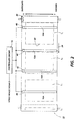
- FIG. 2 is a top view of the printer of FIG. 1 omitting the xerographic stations excepting the exposure station.
- FIG. 3 is an enlarged view of a print bar location adjacent the photoreceptor belt.
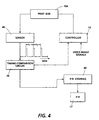
- FIG. 4 is a block diagram of the control circuitry.
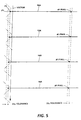
- FIG. 5 is a top view of the belt showing location of fiduciary pixels for each print bar.
- FIG. 1 shows a side view of the single pass, color printing system of the present invention having four exposure stations 10, 12, 14, 16, each station including an LED print bar 10A, 12A, 14A, 16A.
- FIG. 2 shows a top view of the system of FIG. 1, absent some of the xerographic stations, for ease of description.
- each print bar is selectively addressed by video image signals processed through controller circuit 15, to produce a modulated output which is coupled through a gradient index lens array 10B, 12B, 14B, 16B, onto the surface of previously charged photoreceptor belt 17.
- the length of belt 17 is designed to accept an integral number of full page image areas; e.g. I 1 -I 4 , represented by dashed lines.
- each exposure station Upstream of each exposure station are charge devices 18, 19, 20, 21, ( Figure 1) which place a predetermined electrical charge on the surface of belt 17.
- each image area moves past each of the print bars, with each bar providing its own exposure pattern, in response to the video data input.
- the exposure pattern begins when the leading edge of an image area reaches a transverse start-of-exposure line, represented in image frame I 1 by a line 23.
- the exposure pattern is formed of a plurality of closely spaced transverse scan lines.
- a development system 26, 27, 28, 29, develops a latent image of the last exposure without disturbing previously developed images.
- a fully developed color image is then transferred at transfer station 33, by means not shown, to an output sheet. Further details of xerographic stations in a multiple exposure single pass system are disclosed in U.S. Patent Publications US-A-4,660,059 and US-A-4,833,503.
- each color image I 1 -I 4 must be precisely aligned (registered) so that all corresponding pixels in the image areas are registered.
- the print bar alignment requirements are for 25 ⁇ m, the pixels of each bar to be aligned in the lateral or Y-direction of Figure 2, as well as the 25 ⁇ m for process or X-direction. This alignment must be maintained within this tolerance through continuous revolutions (passes) of the photoreceptor. Also, the accuracy of the pixel output formed at the photoreceptor is a function of the accuracy of the pixel placement on the print bar and the focusing tolerance of the associated lens array.
- a Z-shaped registration pattern 30 is formed in a non-image area of belt 17.
- Pattern 30 comprises a first, second and third angled slot aperture aligned in a process direction, whose function is disclosed in greater detail in conjunction with the description of Figure 3.
- Fixed in place beneath each of the print bars are registration sensors 40, 42, 44, 46.
- print bar 10A has associated sensor 46
- print bar 12A has sensor 44
- print bar 14A has sensor 42
- print bar 16A sensor 40.
- the sensors are used to detect the passage of pattern 30, coincident with the pulsing of predetermined pixels at the end of each image bar. Signals generated by each sensor are used to provide initial lateral registration and to maintain subsequent lateral registration.
- print bars 10A, 12A, 14A, 16A each comprise a linear array of pixels which emit radiation, when addressed, to form images at a 24 spots per mm (600 spots per inch (spi)) resolution, focused by the associated lens array at the photoreceptor.
- each print bar includes an image forming segment which overlies the image area I 1 - I 4 and an end segment located at the outboard end which is outside the image area.
- Sensors 40 - 46 are PIN-type silicon detectors.
- pattern 30 consists of three angled slots 30A, 30B, 30C.
- Print bar 10A has a single array of pixels which include an image forming segment 50 and an end segment 52 outside the image area.
- Belt 17 is moved in the indicated direction with a first trial pixel, P2 energized. Pixel P2 will be visible at detector 46 successively through apertures 30A, 30B, 30C, producing three voltage pulses along a sensor trace path 60.
- Pixel P4 produces sensor trace path 62 and Pixel P6 path 64.
- signals from sensor 46 are sent to a timing/comparison circuit 70.
- the circuit compares the output waveform signals over time to establish equality or lack of same between inter-signal times.
- the time between the first two pulses, which defines time t 1 , and the time between the second two pulses, t 2 will be determined by the lateral position of the print bar 10A with respect to Z-shaped pattern 30. Under nominal conditions, t 1 and t 2 will be the same when a lit pixel transverses the center of the Z-shaped pattern.
- Pixel P4 is then designated as the fiduciary pixel F1 for print bar 10A and the timing signal for this pixel is stored in controller 15 memory.
- controller 15 Upon identification of pixel F1, controller 15 identifies the #1 pixel (first data pixel) of the image forming array 50. This pixel is a fixed preset distance from the fiduciary pixel F1.
- the photoreceptor motion continues carrying Z-shaped pattern 30 successively past print bars 12A, 14A, 16A, and the fiduciary pixel and the associated first data pixels are identified for each print bar; e.g. a pixel F2 for bar 12A, F3 for bar 14A and F4 for bar 16A.
- all the fiduciary pixels and all the first pixels should be aligned within 1/2 of the center-to-center spacing of the pixels or about 22 ⁇ m. With this initial alignment, the print bars are laterally registered within tolerance.
- one of the print bars may move laterally due to, for example, shifting of the printer housing. This motion will effect the position of the fiduciary pixels.
- the comparison circuit in timing/comparison circuit 70 has been set to ignore t 1 - t 2 differences smaller than 22 ⁇ m. However, if the motion does position one or more of the fiduciary pixels beyond the 22 ⁇ m limit, a correction is made to both the fiduciary and the number 1 pixel. As shown in Figure 5, it is assumed that print bar 10A has been moved laterally in the outboard direction, causing pixel F1 to be placed outside of the 22 ⁇ m limit. #1 pixel will be moved the same distance in the same direction.
- circuit 70 Upon detecting this out of tolerance shift, circuit 70 generates a signal to controller 15 to increment, or "jump" one pixel in the opposite direction to minimize this error. Thus, from Fig. 3, the next pixel P5 is selected as the new fiduciary pixel and the next outboard pixel is identified as the new #1 pixel. Thus, print bar 10A would continue operation with this new fiduciary, #1 pixel pair. Similar corrections would be made for print bars 12A, 14A, 16A.
- circuit 70 has sufficient discrimination and comparison circuitry to compare the readings for all four print bars and to recognize that if two print bars happen to move in the same direction and close to the same amount and these two happen to align near a third print bar, the circuit will increment the fiduciary pixel of the fourth print bar to match the other three. The intent is to maintain fiduciary pixels within a 22 ⁇ m "envelope".
- the photoreceptor may begin to "walk" laterally in a linear fashion.
- the detection signal in this case will also vary linearly. For example, if the change in signal at bar 10A is 5 ⁇ m, at bar 12A 10 ⁇ m, at bar 14A 15 ⁇ m, at bar 16A 20 ⁇ m, this would indicate a belt walk condition as opposed to the constant change in signal resulting from a bar shift.
- the comparison circuit 70 is designed to identify this progression as a belt walk condition and generate a signal which is sent to the photoreceptor steering circuit 80, which generates an output to a stepper motor, or the like, for steering the belt back, by means not shown, so as to place the fiduciary pixel back into the tolerance position.
Landscapes
- Engineering & Computer Science (AREA)
- Multimedia (AREA)
- Signal Processing (AREA)
- Physics & Mathematics (AREA)
- Optics & Photonics (AREA)
- General Engineering & Computer Science (AREA)
- General Physics & Mathematics (AREA)
- Theoretical Computer Science (AREA)
- Printers Or Recording Devices Using Electromagnetic And Radiation Means (AREA)
- Color Electrophotography (AREA)
Claims (4)
- Verfahren zum seitlichen Ausrichten aufeinanderfolgender Bilder, die in einem Durchlauf auf der Oberfläche eines Photorezeptorbandes (17) hergestellt werden, das sich in einer Prozeßrichtung bewegt und sich in einer Querrichtung quer zur Prozeßrichtung erstreckt, das die folgenden Schritte einschließt:(a) Positionieren einer Vielzahl von Leuchtdioden(light emitting diode-LED)-Druckbalken (10A, 12A, 14A, 16A) in bildherstellender Beziehung zu dem Band, wobei jeder Druckbalken ein erstes lineares Segment (50) von Leuchtelementen aufweist, die selektiv angesteuert werden, um die aufeinanderfolgenden Bilder herzustellen, wobei der Druckbalken ein zweites nichtbildherstellendes Segment (52) von Leuchtelementen an einem Ende hat, das sich an das bildherstellende Segment anschließt,(b) Anordnen einer Z-förmigen Struktur (30) von Öffnungen an einem seitlichen Ende des Photorezeptorbandes, wobei die Struktur eine erste, eine zweite und eine dritte Schlitzöffnung (30A, 30B, 30C) aufweist, die in der Prozeßrichtung ausgerichtet sind, wobei jede Öffnung in bezug auf die Prozeß- und die Querrichtung angewinkelt ist, so daß die 2-förmige Struktur entsteht,(c) Bewegen des Photorezeptorbandes, so daß Licht von den nichtbildherstellenden Elementen (52) periodisch durch die Schlitzöffnungen sichtbar ist, wenn das Band die Öffnungen an den Druckbalken vorbeibewegt,(d) selektives Erregen wenigstens eines der nichtbildherstellenden Elemente (52) eines ersten Druckbalkens (104), um einen Lichtausgang zu erzeugen,(e) Erfassen (46) des Durchtretens von Licht durch die Öffnungen,(f) Messen der Zeit zwischen dem Erfassen des Lichts, das durch die erste und die zweite Öffnung (30A, 30B) hindurchtritt, die unter dem momentan erregten Element hindurchlaufen, um eine Zeit t1 zu bestimmen,(g) Messen der Zeit zwischen dem Erfassen der zweiten und der dritten Öffnung (30B, 30C), die unter dem momentan erregten Pixel hindurchlaufen, um eine Zweitzeit t2 zu ermitteln,(h) veränderliches selektives Erregen des wenigstens einen Elementes in dem nichtbildherstellenden Segment (52), bis im wesentlichen t1 = t2, um so das momentan erregte Element als Bezugspixel zu bestimmen,(i) Festlegen eines Pixels in dem ersten linearen Segment (50) als ein Abtastanfangspixel zum Herstellen einer Zeile eines Bildes in der Querrichtung in einem vorgegebenen Abstand zu dem Bezugspixel.(j) Wiederholen der Schritte (d) bis (i) für jeden der Vielzahl von Druckbalken (12A, 14A, 16A) nach dem ersten (10A),(k) Bestimmen eines Toleranzwertes, innerhalb dessen in Schritt (h) t1 als gleich t2 betrachtet wird,(l) periodisches Wiederholen der Schritte (d) bis (h), um einen Zustand zu erfassen, in dem t1 innerhalb der festgelegten Toleranz für wenigstens einen Druckbalken nicht mehr gleich t2 ist, und(m) Bestimmen eines neuen Bezugspixels und eines neuen Abtastanfangspixels, um zu dem Zustand t1 = t2 innerhalb des vorgegebenen Toleranzbereiches zurückzukehren.
- Verfahren nach Anspruch 1, das die weiteren Schritte des Erfassens einer sich linear ändernden Abweichung des (t1 - t2)-Wertes zwischen aufeinanderfolgenden Druckbalken oder über eine Reihe von Messungen und des Erzeugens eines Korrektursignals einschließt, um eine Steuerkorrektur des Photorezeptorbandes vornehmen zu können.
- Vorrichtung zum seitlichen Ausrichten aufeinanderfolgender Bilder, die in einem Durchlauf auf der Oberfläche eines Photorezeptorbandes (17) erzeugt werden, das sich in einer Prozeßrichtung (24) bewegt und sich in einer Querrichtung (Y) quer zu der Prozeßrichtung erstreckt, wobei die Vorrichtung enthält:(a) eine Vielzahl von Leuchtdioden-(light emitting diode-LED)-Druckbalken (10A, 12A, 14A, 16A), die in bildherstellender Beziehung zu dem Band angeordnet sind, wobei jeder Druckbalken ein erstes lineares Segment (50) von Leuchtelementen aufweist, die selektiv angesteuert werden, um die aufeinanderfolgenden Bilder herzustellen, wobei der Druckbalken ein zweites nichtbildherstellendes Segment (52) von Leuchtelementen an einem Ende hat, das sich an das bildherstellende Segment anschließt,(b) eine Z-förmige Struktur (30) von Öffnungen an einem seitlichen Ende des Photorezeptorbandes, wobei die Struktur eine erste, eine zweite und eine dritte winklige Schlitzöffnungen (30A, 30B, 30C) umfaßt, die in der Prozeßrichtung ausgerichtet sind, wobei jede Öffnung in bezug auf die Prozeß- und die Querrichtung angewinkelt ist, so daß die Z-förmige Struktur entsteht,(c) eine Einrichtung, die das Photorezeptorband (17) so bewegt, daß Licht von den nichtbildherstellenden Elementen (52) periodisch durch die Schlitzöffnungen hindurch sichtbar ist, wenn das Band die Öffnungen an den Druckbalken vorbeibewegt,(d) eine Einrichtung, die wenigstens eines der nichtbildherstellenden Elemente (52) eines ersten Druckbalkens (10A) selektiv erregt, um einen Lichtausgang zu erzeugen,(e) eine Einrichtung (46), die das Hindurchtreten des Lichtes durch die Öffnungen hindurch erfaßt und Ausgangssignale erzeugt, die dafür stehen,(f) eine Schaltungseinrichtung (70), die die Zeit zwischen dem Erfassen des Lichtes, das durch die erste und die zweite Öffnung (30A, 30B) hindurchtritt, die unter dem momentan erregten Element hindurchlaufen, mißt, um eine Zeit t1 zu bestimmen, und die Zeit zwischen dem Erfassen der zweiten und der dritten Öffnung (30B, 30C) die unter dem momentan erregten Element hindurchlaufen, mißt, um eine zweite Zeit t2 zu bestimmen, und(h) eine Einrichtung zum Verändern des selektiven Erregens des wenigstens einen Elementes in dem nichtbildherstellenden Segment, um im wesentlichen t1 = t2 herzustellen, und eine Vergleichseinrichtung (70), die einen Zustand feststellt, in dem im wesentlichen t1 = t2, wobei die Vergleichseinrichtung ein Ausgangssignal erzeugt, um das momentan erregte Element als ein Bezugspixel in dem nichtbildherstellenden Segment (52) zu bestimmen, und ein Pixel in dem bildherstellenden Segment (50) als ein Abtastanfangspixel zum Herstellen einer Zeile eines Bildes in der Querrichtung in einem vorgegebenen Abstand zu dem Bezugspixel.
- Vorrichtung nach Anspruch 3, wobei die Vergleichseinrichtung eine lineare Abweichung der Differenz zwischen t1 und t2 zwischen aufeinanderfolgenden Druckbalken oder über eine Reihe von Messungen erfaßt und ein Photorezeptorband-Steuerungskorrektursignal erzeugt.
Applications Claiming Priority (2)
| Application Number | Priority Date | Filing Date | Title |
|---|---|---|---|
| US07/931,802 US5278625A (en) | 1992-08-18 | 1992-08-18 | Method and apparatus for lateral registration of sequential images in a singles pass, multi-LED print bar printer |
| US931802 | 1992-08-18 |
Publications (2)
| Publication Number | Publication Date |
|---|---|
| EP0585022A1 EP0585022A1 (de) | 1994-03-02 |
| EP0585022B1 true EP0585022B1 (de) | 1997-05-28 |
Family
ID=25461370
Family Applications (1)
| Application Number | Title | Priority Date | Filing Date |
|---|---|---|---|
| EP93306434A Expired - Lifetime EP0585022B1 (de) | 1992-08-18 | 1993-08-16 | Verfahren und Vorrichtung zur seitlichen Registrierung von aufeinanderfolgenden Bildern mit einem Vielfach-LED-Zeilendrucksystem in einem einzelnen Durchgang |
Country Status (4)
| Country | Link |
|---|---|
| US (1) | US5278625A (de) |
| EP (1) | EP0585022B1 (de) |
| JP (1) | JP3480744B2 (de) |
| DE (1) | DE69311028T2 (de) |
Families Citing this family (27)
| Publication number | Priority date | Publication date | Assignee | Title |
|---|---|---|---|---|
| JP3186255B2 (ja) * | 1992-09-28 | 2001-07-11 | 富士ゼロックス株式会社 | カラー画像形成装置 |
| US5384592A (en) * | 1992-11-16 | 1995-01-24 | Xerox Corporation | Method and apparatus for tandem color registration control |
| US5404202A (en) * | 1993-09-29 | 1995-04-04 | Xerox Corporation | Apparatus for registering images in a xerographic system |
| US5715498A (en) * | 1994-09-16 | 1998-02-03 | Canon Kabushiki Kaisha | Color image forming apparatus and method for forming a color image corrected for aberration in registration of image stations for each color |
| US6020948A (en) * | 1994-11-03 | 2000-02-01 | Gipco S.R.L. | Method for acquiring and printing electronic images on a photosensitive medium, and an apparatus to carry out said method |
| US6133932A (en) * | 1994-12-19 | 2000-10-17 | Xerox Corporation | Method and apparatus for adjusting a line synchronization signal in response to photoreceptor motion |
| JPH09160334A (ja) * | 1995-12-06 | 1997-06-20 | Konica Corp | カラー画像形成装置 |
| US5893658A (en) * | 1997-10-17 | 1999-04-13 | Kellie; Truman F. | Image plane registration system for electrographic systems |
| EP0946041A3 (de) * | 1998-03-23 | 2002-01-23 | Hewlett-Packard Company, A Delaware Corporation | Elektronischer Bildabtaster mit Positionskodierung unter Anwendung von Mustern |
| US6198897B1 (en) | 1999-09-17 | 2001-03-06 | Lexmark International, Inc. | Method and apparatus for correcting transfer belt position via stored parameters |
| US6275244B1 (en) | 2000-09-14 | 2001-08-14 | Xerox Corporation | Color printing image bearing member color registration system |
| MXPA01008717A (es) * | 2000-09-14 | 2004-08-12 | Xerox Corp | Sistema de registro de color de direccion de proceso de impresion de color con colas de milano expandidas. |
| US7898695B1 (en) | 2000-10-06 | 2011-03-01 | Lexmark International, Inc. | Method of compensating for electronic printhead skew and bow correction in an imaging machine to reduce print artifacts |
| US6909516B1 (en) | 2000-10-20 | 2005-06-21 | Xerox Corporation | Two dimensional surface motion sensing system using registration marks and linear array sensor |
| US20030011795A1 (en) * | 2001-06-27 | 2003-01-16 | Bobo Wang | Belt control means for an image forming apparatus |
| US20030189611A1 (en) * | 2002-04-08 | 2003-10-09 | Fan Tai-Lin | Jet printer calibration |
| US6793310B2 (en) * | 2002-04-08 | 2004-09-21 | Creo Americas, Inc. | Certified proofing |
| US7032988B2 (en) | 2002-04-08 | 2006-04-25 | Kodak Graphic Communications Canada Company | Certified proofing |
| JP4548115B2 (ja) * | 2004-12-27 | 2010-09-22 | 富士ゼロックス株式会社 | 間隔検知方法及び画像形成装置 |
| US8270049B2 (en) | 2006-08-01 | 2012-09-18 | Xerox Corporation | System and method for high resolution characterization of spatial variance of color separation misregistration |
| US8274717B2 (en) * | 2006-08-01 | 2012-09-25 | Xerox Corporation | System and method for characterizing color separation misregistration |
| US7894109B2 (en) | 2006-08-01 | 2011-02-22 | Xerox Corporation | System and method for characterizing spatial variance of color separation misregistration |
| US7826095B2 (en) * | 2007-01-16 | 2010-11-02 | Xerox Corporation | System and method for estimating color separation misregistration utilizing frequency-shifted halftone patterns that form a moiré pattern |
| US7630672B2 (en) * | 2007-05-21 | 2009-12-08 | Xerox Corporation | System and method for determining and correcting color separation registration errors in a multi-color printing system |
| US8228559B2 (en) * | 2007-05-21 | 2012-07-24 | Xerox Corporation | System and method for characterizing color separation misregistration utilizing a broadband multi-channel scanning module |
| US8200131B2 (en) * | 2008-06-25 | 2012-06-12 | Xerox Corporation | Use of registration marks and a linear array sensor for in-situ raster output scanner scan line nonlinearity detection |
| JP4877371B2 (ja) * | 2009-07-31 | 2012-02-15 | ブラザー工業株式会社 | 画像形成装置 |
Family Cites Families (21)
| Publication number | Priority date | Publication date | Assignee | Title |
|---|---|---|---|---|
| US3785730A (en) * | 1972-03-27 | 1974-01-15 | Cellophene | Method and system for varying the positions of image-forming surfaces on an elongate flexible electrophotographic support belt for different runs thereof |
| JPS5499641A (en) * | 1978-01-24 | 1979-08-06 | Nec Corp | Electrostatic recorder |
| US4429985A (en) * | 1981-02-20 | 1984-02-07 | Ricoh Company, Ltd. | Recording system provided with a device for correcting deviation of recording member in endless belt form |
| US4569584A (en) * | 1982-11-24 | 1986-02-11 | Xerox Corporation | Color electrographic recording apparatus |
| US4804979A (en) * | 1985-04-12 | 1989-02-14 | Benson, Inc. | Single-pass color plotter |
| CA1279624C (en) * | 1985-11-04 | 1991-01-29 | David M. Emmett | Registration system for an electrostatic printer/plotter |
| US4660059A (en) * | 1985-11-25 | 1987-04-21 | Xerox Corporation | Color printing machine |
| JPH0695241B2 (ja) * | 1986-08-18 | 1994-11-24 | 松下電送株式会社 | カラ−電子写真記録方法及び装置 |
| JPH06100862B2 (ja) * | 1986-08-18 | 1994-12-12 | 松下電送株式会社 | カラ−画像記録装置 |
| JP2690075B2 (ja) * | 1986-08-21 | 1997-12-10 | 松下電送 株式会社 | カラー画像記録装置 |
| GB2195179B (en) * | 1986-09-11 | 1991-05-15 | Synergy Computer Graphics | Registration system for a moving substrate |
| DE3854093T2 (de) * | 1987-04-28 | 1995-11-16 | Canon Kk | Multibilderzeugungsgerät. |
| JPS63300259A (ja) * | 1987-05-30 | 1988-12-07 | Canon Inc | 画像形成装置 |
| US4912491A (en) * | 1987-05-30 | 1990-03-27 | Canon Kabushiki Kaisha | Apparatus for forming superimposed images |
| US4833503A (en) * | 1987-12-28 | 1989-05-23 | Xerox Corporation | Electronic color printing system with sonic toner release development |
| JPH01178979A (ja) * | 1987-12-29 | 1989-07-17 | Canon Inc | 画像形成装置 |
| JPH01185564A (ja) * | 1988-01-19 | 1989-07-25 | Matsushita Electric Ind Co Ltd | カラー静電記録装置 |
| US5040003A (en) * | 1990-06-04 | 1991-08-13 | Eastman Kodak Company | Method and apparatus for recording color with plural printheads |
| US5300961A (en) * | 1991-12-16 | 1994-04-05 | Xerox Corporation | Method and apparatus for aligning multiple print bars in a single pass system |
| US5225877A (en) * | 1992-06-12 | 1993-07-06 | Xerox Corporation | Low cost and high precision scheme for photoreceptor belt steering control |
| JPH06210898A (ja) * | 1993-01-21 | 1994-08-02 | Ricoh Co Ltd | 画像形成装置 |
-
1992
- 1992-08-18 US US07/931,802 patent/US5278625A/en not_active Expired - Lifetime
-
1993
- 1993-06-23 JP JP15251193A patent/JP3480744B2/ja not_active Expired - Fee Related
- 1993-08-16 EP EP93306434A patent/EP0585022B1/de not_active Expired - Lifetime
- 1993-08-16 DE DE69311028T patent/DE69311028T2/de not_active Expired - Fee Related
Also Published As
| Publication number | Publication date |
|---|---|
| JPH06106781A (ja) | 1994-04-19 |
| DE69311028D1 (de) | 1997-07-03 |
| JP3480744B2 (ja) | 2003-12-22 |
| US5278625A (en) | 1994-01-11 |
| EP0585022A1 (de) | 1994-03-02 |
| DE69311028T2 (de) | 1997-11-13 |
Similar Documents
| Publication | Publication Date | Title |
|---|---|---|
| US5278625A (en) | Method and apparatus for lateral registration of sequential images in a singles pass, multi-LED print bar printer | |
| US5260725A (en) | Method and apparatus for registration of sequential images in a single pass, color xerographic printer | |
| EP0617547B1 (de) | Verbesserte Markendetektionsschaltung für elektrografische Druckmaschinen | |
| US5300961A (en) | Method and apparatus for aligning multiple print bars in a single pass system | |
| CA2077832C (en) | Method and apparatus for image registration in a single pass ros system | |
| US4721969A (en) | Process of correcting for color misregistering in electrostatic color recording apparatus | |
| US6909516B1 (en) | Two dimensional surface motion sensing system using registration marks and linear array sensor | |
| EP0943969B1 (de) | Gerät und Verfahren zur Farbflächenausrichtung in einem Farbdruckgerät mit einem Umlauf | |
| EP0617342B1 (de) | Feststellung der Naht bei einem Photoleiterband | |
| EP0552007B1 (de) | Verfahren und Mittel um seitliche Ausrichtungsfehler zu korrigieren | |
| EP0596641B1 (de) | Verfahren und Vorrichtung zur Bildausrichtung | |
| JP3449573B2 (ja) | 静電写真システムにイメージを記録するための装置 | |
| EP1103862B1 (de) | Positionsmessung eines Photorezeptorbandes | |
| US5272493A (en) | Method and apparatus for registration of sequential images in a single pass, multi-LED printbar printer | |
| US5342715A (en) | Color printer having reduced first copy out time and extended photoreceptor life | |
| EP0589650B1 (de) | Farbdrucker | |
| US5355154A (en) | Electronic color printers multiple-pass image self-registration | |
| US20010043261A1 (en) | Light beam scanning apparatus and image forming apparatus | |
| US5321434A (en) | Digital color printer with improved lateral registration | |
| EP0435640A2 (de) | Vorrichtung zur Bildung von Farbbildern | |
| JPH0423265B2 (de) | ||
| US20030151775A1 (en) | Method and system for tracking a photoconductor belt loop in an image forming apparatus | |
| US20030011795A1 (en) | Belt control means for an image forming apparatus | |
| CA1279624C (en) | Registration system for an electrostatic printer/plotter | |
| US5394175A (en) | Transverse image registration for a digital color printer |
Legal Events
| Date | Code | Title | Description |
|---|---|---|---|
| PUAI | Public reference made under article 153(3) epc to a published international application that has entered the european phase |
Free format text: ORIGINAL CODE: 0009012 |
|
| AK | Designated contracting states |
Kind code of ref document: A1 Designated state(s): DE FR GB |
|
| 17P | Request for examination filed |
Effective date: 19940901 |
|
| GRAG | Despatch of communication of intention to grant |
Free format text: ORIGINAL CODE: EPIDOS AGRA |
|
| 17Q | First examination report despatched |
Effective date: 19961216 |
|
| GRAH | Despatch of communication of intention to grant a patent |
Free format text: ORIGINAL CODE: EPIDOS IGRA |
|
| GRAH | Despatch of communication of intention to grant a patent |
Free format text: ORIGINAL CODE: EPIDOS IGRA |
|
| GRAA | (expected) grant |
Free format text: ORIGINAL CODE: 0009210 |
|
| AK | Designated contracting states |
Kind code of ref document: B1 Designated state(s): DE FR GB |
|
| REF | Corresponds to: |
Ref document number: 69311028 Country of ref document: DE Date of ref document: 19970703 |
|
| ET | Fr: translation filed | ||
| PLBE | No opposition filed within time limit |
Free format text: ORIGINAL CODE: 0009261 |
|
| STAA | Information on the status of an ep patent application or granted ep patent |
Free format text: STATUS: NO OPPOSITION FILED WITHIN TIME LIMIT |
|
| 26N | No opposition filed | ||
| REG | Reference to a national code |
Ref country code: GB Ref legal event code: IF02 |
|
| REG | Reference to a national code |
Ref country code: GB Ref legal event code: 746 Effective date: 20050512 |
|
| PGFP | Annual fee paid to national office [announced via postgrant information from national office to epo] |
Ref country code: DE Payment date: 20080829 Year of fee payment: 16 |
|
| PGFP | Annual fee paid to national office [announced via postgrant information from national office to epo] |
Ref country code: FR Payment date: 20080818 Year of fee payment: 16 |
|
| PGFP | Annual fee paid to national office [announced via postgrant information from national office to epo] |
Ref country code: GB Payment date: 20080827 Year of fee payment: 16 |
|
| GBPC | Gb: european patent ceased through non-payment of renewal fee |
Effective date: 20090816 |
|
| REG | Reference to a national code |
Ref country code: FR Ref legal event code: ST Effective date: 20100430 |
|
| PG25 | Lapsed in a contracting state [announced via postgrant information from national office to epo] |
Ref country code: FR Free format text: LAPSE BECAUSE OF NON-PAYMENT OF DUE FEES Effective date: 20090831 Ref country code: DE Free format text: LAPSE BECAUSE OF NON-PAYMENT OF DUE FEES Effective date: 20100302 |
|
| PG25 | Lapsed in a contracting state [announced via postgrant information from national office to epo] |
Ref country code: GB Free format text: LAPSE BECAUSE OF NON-PAYMENT OF DUE FEES Effective date: 20090816 |