EP0574852B1 - Spezifischer Nachweis von Neisseria gonorrhoeae - Google Patents
Spezifischer Nachweis von Neisseria gonorrhoeae Download PDFInfo
- Publication number
- EP0574852B1 EP0574852B1 EP93109451A EP93109451A EP0574852B1 EP 0574852 B1 EP0574852 B1 EP 0574852B1 EP 93109451 A EP93109451 A EP 93109451A EP 93109451 A EP93109451 A EP 93109451A EP 0574852 B1 EP0574852 B1 EP 0574852B1
- Authority
- EP
- European Patent Office
- Prior art keywords
- probe
- gonorrhoeae
- seq
- probes
- neisseria
- Prior art date
- Legal status (The legal status is an assumption and is not a legal conclusion. Google has not performed a legal analysis and makes no representation as to the accuracy of the status listed.)
- Expired - Lifetime
Links
Images

Classifications
-
- C—CHEMISTRY; METALLURGY
- C12—BIOCHEMISTRY; BEER; SPIRITS; WINE; VINEGAR; MICROBIOLOGY; ENZYMOLOGY; MUTATION OR GENETIC ENGINEERING
- C12Q—MEASURING OR TESTING PROCESSES INVOLVING ENZYMES, NUCLEIC ACIDS OR MICROORGANISMS; COMPOSITIONS OR TEST PAPERS THEREFOR; PROCESSES OF PREPARING SUCH COMPOSITIONS; CONDITION-RESPONSIVE CONTROL IN MICROBIOLOGICAL OR ENZYMOLOGICAL PROCESSES
- C12Q1/00—Measuring or testing processes involving enzymes, nucleic acids or microorganisms; Compositions therefor; Processes of preparing such compositions
- C12Q1/68—Measuring or testing processes involving enzymes, nucleic acids or microorganisms; Compositions therefor; Processes of preparing such compositions involving nucleic acids
- C12Q1/6876—Nucleic acid products used in the analysis of nucleic acids, e.g. primers or probes
- C12Q1/6888—Nucleic acid products used in the analysis of nucleic acids, e.g. primers or probes for detection or identification of organisms
- C12Q1/689—Nucleic acid products used in the analysis of nucleic acids, e.g. primers or probes for detection or identification of organisms for bacteria
Definitions
- the invention relates to specific nucleic acid probes for detection of the pathogen Neisseria gonorrhoeae and a method for Detection of Neisseria gonorrhoeae using these probes.
- N.gonorrhoeae is the causative agent of gonorrhea, a venereal disease the most common infectious diseases subject to reporting the world counts.
- the number of new infections alone is around 60-65 million a year (World Health Statisticals Annual, 1979; Herrmann, internal medicine in practice and clinic; Hornbostel H., Kaufmann W., Siegenthaler W., eds., Thieme Verlag, 1985, 59-62).
- the symptoms depend on the gender of the Infectious carrier. While in men there is genital infection mainly due to purulent inflammation and swelling of the Urethral mouth noticeable occur mainly in women Inflammation of the cervix, sometimes but also the urethra.
- the Neisseria genus represents a group of closely related, gram-negative Diplococci, which include both pathogenic and non-pathogenic Species belong.
- Apathogenic Neisseries such as Neisseria flava and elongata colonize the mucous membranes of the oral cavity, the Respiratory tract, as well as the genital tract and count to the microbial Human normal flora (Kayser, in: Medical microbiology, Wiesmann E., ed., Thieme Verlag, 1986, 104-144).
- the close relationship the Neisseries was among others by DNA-DNA hybridization experiments detected (Hoke and Vedros, Int.J.System.Bacteriol. 32: 57-66 (1982).
- the cultivation of N. gonorrhoeae requires a selective medium (e.g. Thayer-Martin Medium), on which also apathogenic Neisseria species, such as. N.lactamica can grow.
- the definitive one Diagnostic proof is therefore carried out by means of differentiation Carbohydrate use, antigen detection, oxidase reaction or Fluorescence antibody screening. All of these detection systems as well the required cultivation of the microorganisms to be tested are time consuming and have to be largely in microbiological Specialized laboratories.
- Nucleic acid probes appear to be particularly suitable, which are complementary to ribosomal RNA (rRNA). These probes have the advantage of high sensitivity, as in every cell 1000 to 10,000 copies of this rRNA, as well as several copies of the genes coding for this rRNA (rDNA) are present.
- rRNA ribosomal RNA
- Each cell has multiple rRNA operons in eubacteria are usually constructed as follows: at the 5 'end of the operon locates the 16S rRNA gene followed by the 23S rRNA gene; the 5S rRNA gene is located at the 3 'end of the operon.
- the single ones Genes are separated from each other by spacer regions, in some of them transfer RNA (tRNA) genes and signal sequences for the post-transcriptional processing can be found.
- tRNA transfer RNA
- the rRNA Operon is first rewritten into a single precursor RNA. The primary transcript is then replaced by Endo- and Exoribonucleases processed into the mature products. That means, that the 23S rRNA sequences and the spacer regions both present as DNA in the genome as well as RNA transcripts.
- Probes were also used to detect Neisseria gonorrhoeae Sequences complementary to parts of the rRNA are used (EP-A 0 272 009). With the probes described in EP-A 0 272 009 however, no clear test results could be achieved. In addition, the sensitivity of the detection is using this Subordinate probes to those of the cultivation method (Panke et al., J.Clin.Microbiol. 29, (1991), 883-888).
- Oligonucleotide probes specific for Neisseria gonorrhoeae are described in EP-A 0 408 077. These probes correspond to partial areas the 16S rRNA from Neisseria gonorrhoeae. Nucleic acid probes, that hybridize with the Neisseria gonorrhoeae 23S rRNA, were not described in EP-A 0 408 077. Such Probes are of interest, however, because of the length of the Sequences allow a larger selection of specific probes.
- WO 90/14442 describes nucleic acid probes which Sequences of the 16S rRNA, as well as from the 5 'region of the 23S rRNA Correspond to gens. To differentiate the Neisseria species To achieve this, however, extremely stringent hybridization conditions must be met applied (hybridization in the presence of 0.9 mol / l NaCl at 60 ° C, washing in the presence of 0.03 mol / l NaCl 60 ° C). Some of the probes described in WO 90/14442 hybridize even under these highly stringent conditions of the non-pathogenic species N.flava.
- EP-A 0 337 896 described 23S rRNA-specific nucleic acid probes highly stringent hybridization conditions and hybridize not even specifically under these conditions N.gonorrhoeae, but also with other Neisseria species like e.g. N. meningitidis.
- EP-A 0 452 596 describes a nucleic acid probe from the spacer region between the 16S and 23S rRNA gene proposed for the detection of N.gonorrhoeae, but also with the nucleic acid from some strains of the apathogenic species Neisseria cinerea hybridizes. This 23S rRNA described so far or rRNA spacer-specific probes are therefore for one specific detection of N.gonorrhoeae unsuitable.
- the object of the present invention was therefore to use nucleic acid probes to provide for Neisseria gonorrhoeae, which under the usual hybridization conditions a high specificity and Possess sensitivity and thus a safe qualitative and enable quantitative detection of this pathogen.
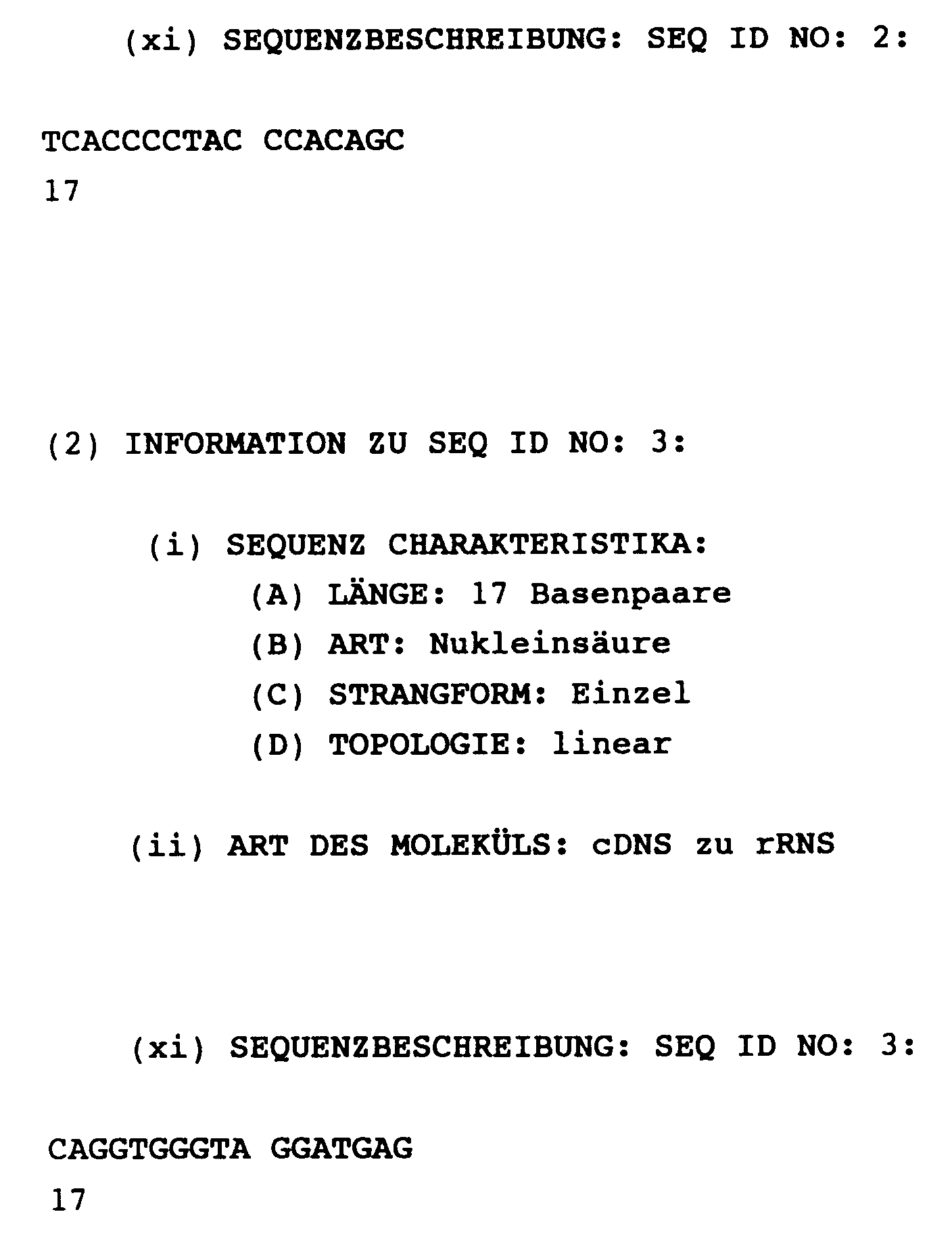
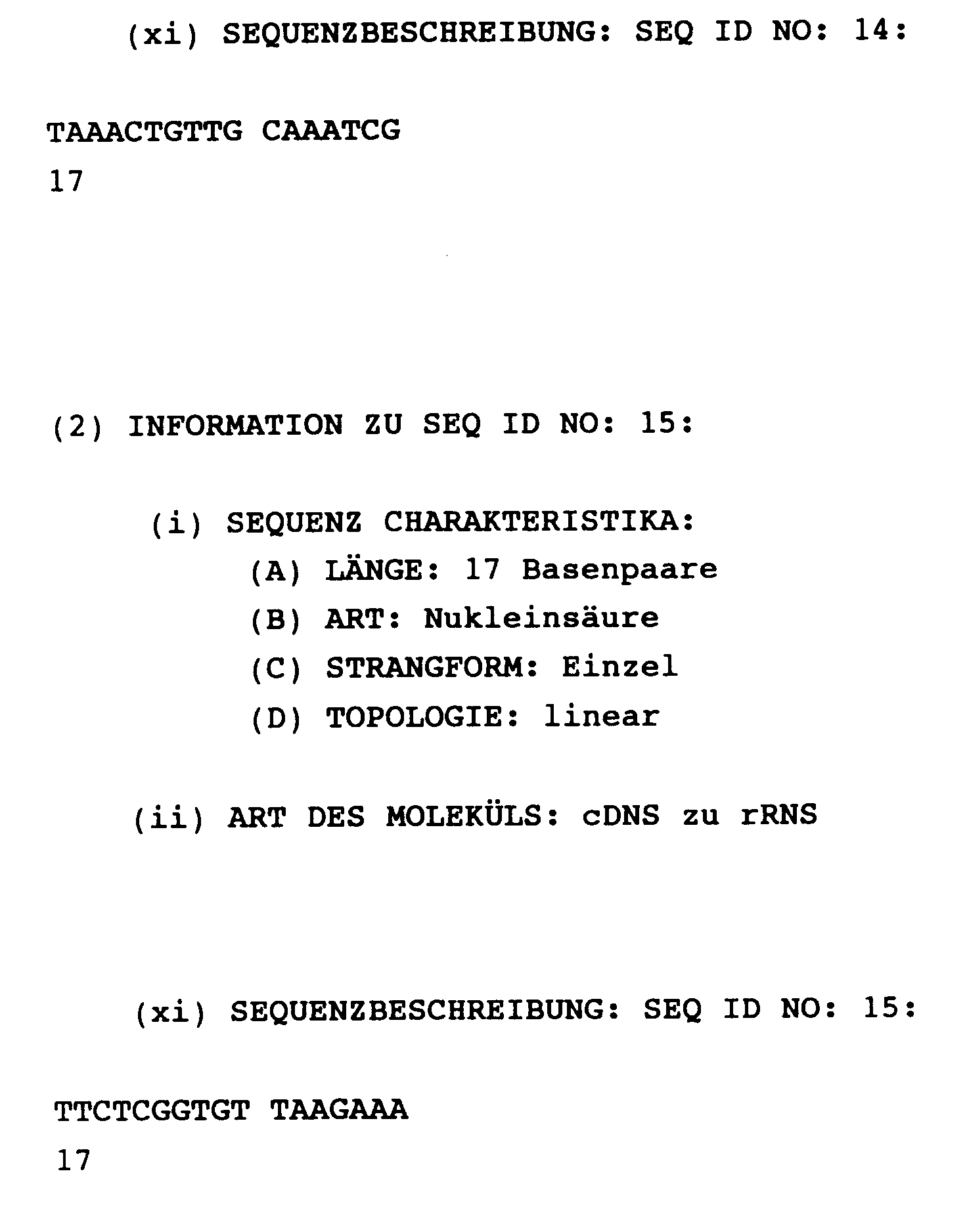
- This task is solved by one for Neisseria gonorrhoeae specific nucleic acid probe, which at least one of the in SEQ ID NO 1-15 sequences shown.
- the sequence of the oligonucleotides correspond to the subgroup SEQ ID NO 1, 3, 5, 7, 9, 11, 13 Portions of the 23S rRNA gene or the 3 'thereof Spacer region.
- the sequences of the oligonucleotides of the subset SEQ ID NO 2, 4, 6, 8, 10, 12, 14 and 15 are complementary to these subareas.
- the cellular rRNA or its precursor can only be used in a direct hybridization approach with the demonstrate the latter subgroup while demonstrating the genomic DNA, which codes for the corresponding RNA, with both subgroups is possible.
- the probes according to the invention succeed in specifically to detect Neisseria gonorrhoeae. Even with the usual low stringent hybridization conditions (Hybridization in the presence of 0.9 mol / l NaCl at 40 ° C, washing in the presence of 0.36 mol / l NaCl at 42-60 ° C) these probes show no hybridization with closely related Neisseria species like e.g. N.flava and N.cinerea. The resulting high Specificity is of great importance because in the too investigating sample besides the pathogen N.gonorrhoeae also many non-pathogenic Neisseria species can occur which constituent of the human mucosa.
- the probes according to the invention are at least 14 nucleotides long. However, at their 5 'and / or 3' end you can add further nucleotides, preferably have up to 8 nucleotides. A total length however, it should not exceed 30 nucleotides.
- Another object of the invention is therefore a Neisseria gonorrhoeae-specific nucleic acid probe, which at least one of the sequences shown in SEQ ID NO 1-15, as well as on their 5 'and / or 3' end further nucleotides, preferably up to 8 has further nucleotides.
- the additional nucleotides of the probe can be any Be nucleotides, but preferred are those nucleotides that the nucleotides on the rDNA at the 5 'or 3' end or their complementary nucleotides.
- the nucleic acid probes according to the invention which are specific for N.gonorrhoeae can exist in different forms: as single-stranded Oligonucleotides or as double-stranded Oligonucleotide fragments associated with other sequences that have no homology to DNA or RNA from Neisseria gonorrhoeae, such as. Cloning vectors. When using double-stranded Probes is before performing the actual Detection reaction denaturation of the probe is essential.
- the Nucleic acid probes according to the invention can be either modified as well as unmodified ribonucleotides and / or deoxyribonucleotides contain.
- Another object of the invention is a Neisseria gonorrhoeae-specific Nucleic acid probe, which is characterized is that it is one or more copies of the SEQ ID NO 1-15 sequences shown in a single or double strand Vector cloned contains.
- the nucleic acid probes are marked. All of them are suitable for the expert known types of marking, such as the installation of radioactive Isotopes, or the incorporation of a non-radioactive label, such as. of a digoxigenin-coupled nucleotide, which via detected an enzyme or fluorescent labeled antibody can be.
- Another object of the invention is a method for detection of N. gonorrhoeae by hybridizing DNA or RNA to the sample to be examined with at least one inventive Probe under normal hybridization conditions and detection of Hybrid formation.
- the nucleic acid probes according to the invention both hybridize with the rRNA as well as with the corresponding rRNA genes on the bacterial genome. It is therefore in the process according to the invention possible, the presence and absence of both nucleic acid types of N.gonorrhoeae quantitatively and qualitatively.
- Evidence of hybridization with at least one of the Probes according to the invention is carried out according to the usual methods Detection of nucleic acids via hybridization (Southern, J.Mol.Biol. 98, 1975, 503). All known hybridization variants, such as. Solid phase hybridization, hybridization in solution, Sandwich hybridization, two-component hybridization can be used. Evidence is provided in the usual way via radioactive or non-radioactive labeling of the probe.
- the invention is illustrated by the following examples with the sequence listing 1-15, which the invention Nucleic acid probes, and Fig. 1, which is a non-radioactive Evidence from Neisseria gonorrhoeae shows closer explained.
- the filters are washed with 2 x buffers (2x buffers: 2 mol / l NaCl, 50 mmol / l Tris-HCl, pH 7.5 and 1 mmol / l EDTA) moistened and clamped and a vacuum created.
- the DNA concentration 0.1 - 1 ⁇ g / ⁇ l
- 50 ⁇ l 50 mmol / l Tris-HCl, pH 7.5 / 5 mmol / l EDTA added and boiled for 3 minutes for denaturation.
- the mixture is immediately transferred to ice, 50 ⁇ l 2x buffer added and this solution into the slots of the slot blot apparatus pipetted.
- the slots are filled with 100 ⁇ l 1x buffer (2x buffer 1: 1 diluted with water), the filter of the apparatus removed, air dried and in vacuo for 2 hours at 80 ° C baked.
- Hybridization with the oligonucleotides according to the invention is carried out in the usual way.
- the nitrocellulose filters are first prehybridized in 1xVHP for two hours (2xVHP: 0.1% bovine serum albumin, 0.1% Ficoll 400,000, 0.1% polyvinyl propylidone, 1% glycerol, 1.8 mol / l NaCl, 50 mmol / l Na 2 HPO 4 , 50 mmol / l NaH 2 PO 4 , 10 mmol / l EDTA and 10 mg / ml heat-denatured herring sperm DNA).
- hybridization buffer HP: 1xVHP; labeling of the sample with the Random Primed DNA Labeling kit, Boehringer Mannheim GmbH, catalog no. 1004 760, according to Manufacturer information.
- Hybridization takes place in a hybridization oven at 40 ° C. The HP is heated to 80 ° C before use.
- the filters are washed in washing buffer (WP: 0.36 mol / l NaCl, 10 mmol / l Na 2 HPO 4 , 10 mmol / l NaH 2 PO 4 , 2 mmol / l EDTA, 0.05% SDS) washed twice at room temperature and then twice at 42 ° C.
- WP 0.36 mol / l NaCl
- 10 mmol / l Na 2 HPO 4 10 mmol / l NaH 2 PO 4 , 2 mmol / l EDTA, 0.05% SDS
- WP 0.36 mol / l NaCl
- 10 mmol / l Na 2 HPO 4 10 mmol / l NaH 2 PO 4
- 2 mmol / l EDTA 0.05% SDS
- the filters are then against one another in the usual way X-ray film exposed and evaluated.
- Table III shows the results of the hybridization of the various nucleic acid probes with pathogenic and non-pathogenic species.
- species strain / isolate no.
- Probe SEQ ID NO ..
- N.gonorrhoeae MS11 + + + + + + + + + + + + + + + + + N.gonorrhoeae r2 + + + + + + + + N.gonorrhoeae R16 + + + + + + + + + + + + + + + + + + + + + + + + + + + + + + + + + + + + + + + + + + + + + + + + + + + + + + + + + + + + + + + + + + + + + + + + + + + + N.gonorrhoeae 514 + + + + + + + + + + + + + + + N.
- meningitidis B - - - - - - - N. meningitidis C. - - - - - - N. meningitidis D - - - - - - N. meningitidis 2-4 - - - - - - - N. meningitidis 3-1 - - - - - - - N.lactamica 1855 - - - - - - - N.lactamica 3272 - - - - - - N. mucosa 112 - - - - - - - N.
- Neisseria gonorrhoeae For a non-radioactive detection of Neisseria gonorrhoeae is first a specific DNA fragment via a polymerase chain reaction amplified, the fragments being incorporated be marked simultaneously by DIG-11-dUTP. These marked Fragments are then added to oligonucleotides using these Can hybridize fragments and thus as a capture sample act. The immobilization then takes place via a coupling of these oligonucleotides at the 3 'end with biotin, via which this Oligonucleotides on a streptavidin-coated Microtiter plate are bound. Non-specific PCR fragments, those not with the oligonucleotide acting as a capture sample can hybridize in subsequent washing steps away.
- Detection of bound specific DNA fragments is done above the digoxigenin label after adding a POD-conjugated Antibody against digoxigenin and ABTS® substrate solution for the peroxidase reaction. Binding of the amplified DNA fragments to the capture group is then about implementation of the substrate, which can be measured in the photometer (see Fig. 1).
- the oligonucleotides SEQ ID NO 1 and 15 are selected as PCR primers for the amplification of a specific DNA fragment from chromosomal gonococcal DNA. These primers are hybridized at a temperature of 57 ° C. The further PCR is carried out in a known manner. The product thus obtained has a length of 750 bp. 20 ⁇ l of the amplification mixture are mixed with 20 ⁇ l TE buffer and 10 ⁇ l 0.5 mol / l NaOH to denature the DNA fragments and incubated for 10 min at room temperature.
- This denaturation approach is carried out by adding 450 ⁇ l acidified hybridization solution (50 mmol / l Na phosphate buffer, pH 6.8, 0.05 mol / l HCl, 0.75 mol / l NaCl, 75 mmol / l Na citrate, 0, 05% RSA, pH 5.4) neutralized.
- the biotin-labeled oligonucleotide ("capture sample", SEQ ID NO 5) is added to this solution (100 ng / ml). 200 ⁇ l of this hybridization mixture are placed in streptavidin-coated microtiter plates and incubated at 37 ° C. for 3 h.
- the DNA fragment is bound to the streptavidin coating of the microtiter plate via the biotin-labeled oligonucleotide.
- the substrate reaction is carried out by adding 200 ⁇ l ABTS® substrate solution (2,2'-azino-di- [3-ethyl-benzothiazoline sulfonate] (1.9 mmol / l) ) (ABTS®: Boehringer Mannheim GmbH, catalog No. 756407 in ABTS® buffer: Boehringer Mannheim GmbH, catalog No. 1204530). After 5-15 min incubation at 37 ° C, the color change is measured in the photometer (Easy Reader EAR 400 FW microtiter plate reader, SLT-Labinstruments, Groedig / Salzburg) at 405 nm.
Landscapes
- Chemical & Material Sciences (AREA)
- Life Sciences & Earth Sciences (AREA)
- Analytical Chemistry (AREA)
- Proteomics, Peptides & Aminoacids (AREA)
- Organic Chemistry (AREA)
- Zoology (AREA)
- Wood Science & Technology (AREA)
- Health & Medical Sciences (AREA)
- Engineering & Computer Science (AREA)
- Microbiology (AREA)
- Bioinformatics & Cheminformatics (AREA)
- Molecular Biology (AREA)
- Biotechnology (AREA)
- Biophysics (AREA)
- Physics & Mathematics (AREA)
- Biochemistry (AREA)
- Immunology (AREA)
- General Engineering & Computer Science (AREA)
- General Health & Medical Sciences (AREA)
- Genetics & Genomics (AREA)
- Measuring Or Testing Involving Enzymes Or Micro-Organisms (AREA)
- Measuring Pulse, Heart Rate, Blood Pressure Or Blood Flow (AREA)
- Measurement Of The Respiration, Hearing Ability, Form, And Blood Characteristics Of Living Organisms (AREA)
Description
| Bezeichnung | Nukleotidsequenz | rDNA-Bereich |
| SEQ ID NO 1 | GCTGTGGGTAGGGGTGA | R |
| SEQ ID NO 2 | TCACCCCTACCCACAGC | R |
| SEQ ID NO 3 | CAGGTGGGTAGGATGAG | R |
| SEQ ID NO 4 | CTCATCCTACCCACCTG | R |
| SEQ ID NO 5 | GTAGGCTGATGAAGGT | R |
| SEQ ID NO 6 | ACCTTCATCAGCCTAC | R |
| SEQ ID NO 7 | ATCCGGGTTTTCTTAACA | R |
| SEQ ID NO 8 | TGTTAAGAAAACCCGGAT | R |
| SEQ ID NO 9 | ACAAGTCGGGCAGGTGC | R |
| SEQ ID NO 10 | GCACCTGCCCGACTTGT | R |
| SEQ ID NO 11 | GAAGGACTTCAAGAGAT | S |
| SEQ ID NO 12 | ATCTCTTGAAGTCCTTC | S |
| SEQ ID NO 13 | CGATTTGCAACAGTTTA | S |
| SEQ ID NO 14 | TAAACTGTTGCAAATCG | S |
| SEQ ID NO 15 | TTCTCGGTGTTAAGAAA | R |
- pathogene Neisseria-Spezies:
- Neisseria gonorrhoeae
- Neisseria meningitidis
- apathogene Neisseria-Spezies:
- N.lactamica
- N.mucosa
- N.subflava
- N.sicca
- N.elongata
- N.cinerea
- N.flava
- N.denitrificans
| Sonde | Waschtemperatur (°C) |
| SEQ ID NO 1 | 52 |
| SEQ ID NO 3 | 52 |
| SEQ ID NO 6 | 48 |
| SEQ ID NO 7 | 48 |
| SEQ ID NO 9 | 58 |
| SEQ ID NO 11 | 48 |
| SEQ ID NO 13 | 48 |
| Spezies (Stamm/Isolat Nr.) | Sonde (SEQ ID NO..) | |||||||
| 1 | 3 | 6 | 7 | 9 | 11 | 13 | ||
| N.gonorrhoeae | MS11 | + | + | + | + | + | + | + |
| N.gonorrhoeae | r2 | + | + | + | + | + | + | + |
| N.gonorrhoeae | R16 | + | + | + | + | + | + | + |
| N.gonorrhoeae | r21 | + | + | + | + | + | + | + |
| N.gonorrhoeae | 510 | + | + | + | + | + | + | + |
| N.gonorrhoeae | 514 | + | + | + | + | + | + | + |
| N.meningitidis | B | - | - | - | - | - | - | - |
| N.meningitidis | C | - | - | - | - | - | - | - |
| N.meningitidis | D | - | - | - | - | - | - | - |
| N.meningitidis | 2-4 | - | - | - | - | - | - | - |
| N.meningitidis | 3-1 | - | - | - | - | - | - | - |
| N.lactamica | 1855 | - | - | - | - | - | - | - |
| N.lactamica | 3272 | - | - | - | - | - | - | - |
| N.mucosa | 112 | - | - | - | - | - | - | - |
| N.mucosa | 114 | - | - | - | - | - | - | - |
| N.subflava | 124 | - | - | - | - | - | - | - |
| N.sicca | 118 | - | - | - | - | - | - | - |
| N.sicca | 2844 | - | - | - | - | - | - | - |
| N.elongata | 129 | - | - | - | - | - | - | - |
| N.cinerea | 126 | - | - | - | - | - | - | - |
| N.cinerea | 2199 | - | - | - | - | - | - | - |
| N.flava | 122 | - | - | - | - | - | - | - |
| N.flava | 123 | - | - | - | - | - | - | - |
| N.denitrificans | 2950 | - | - | - | - | - | - | - |
| Spezies (Stamm/Isolat Nr.) | Sonde (SEQ ID NO ...) | |||||||
| 1 | 3 | 6 | 7 | 9 | 11 | 13 | ||
| N.gonorrhoeae | R16 | + | + | + | + | + | + | + |
| N.gonorrhoeae | 514 | + | + | + | + | + | + | + |
| N.lactamica | 3272 | - | - | - | - | - | - | - |
| N.elongata | 129 | - | - | - | - | - | - | - |
| N.sicca | 2844 | - | - | - | - | - | - | - |
| N.cinerea | 2199 | - | - | - | - | - | - | - |
| N.denitrificans | 2950 | - | - | - | - | - | - | - |
| Moraxella bovis | D1931 | - | - | - | - | - | - | - |
| E.coli | GM 48 | - | - | - | - | - | - | - |
| Haemophilus influenzae | 2214 | - | - | - | - | - | - | - |
| Haemophilus parainfluenzae | 1207 | - | - | - | - | - | - | - |
| Proteus vulgaris | 770 | - | - | - | - | - | - | - |
| Pseudomonas putida | 574 | - | - | - | - | - | - | - |
| Bacillus alvei | 3006 | - | - | - | - | - | - | - |
| Leuconostoc mesenteroides | 83 | - | - | - | - | - | - | - |
| Listeria monocytogenes | 1/2a | - | - | - | - | - | - | - |
| Staphylococcus aureus | D1901 | - | - | - | - | - | - | - |
| Staphylococcus epidermidis | 1050 | - | - | - | - | - | - | - |
| Streptococcus pneumoniae | 3028 | - | - | - | - | - | - | - |
| Steptomyces griseus | A | - | - | - | - | - | - | - |
| Isolat aus Mundabstrich | - | - | - | - | - | - | - |



Claims (9)
- Neisseria gonorrhoeae-spezifische Nukleinsäuresonde dadurch gekennzeichnet, daß sie mindestens eine der in SEQ ID NO 1-15 gezeigten Sequenzen enthält.
- Sonde nach Anspruch 1 dadurch gekennzeichnet, daß sie an ihrem 5'- und/oder 3'-Ende weitere Nukleotide aufweist.
- Sonde nach Anspruch 2 dadurch gekennzeichnet, daß sie an ihrem 5'- und/oder 3'-Ende bis zu 8 weitere Nukleotide aufweist.
- Sonde nach Anspruch 2 oder 3 dadurch gekennzeichnet, daß die weiteren Nukleotide denjenigen Nukleotiden entsprechen, die an dieser Stelle im natürlichen 23S rRNA-Gen, von dem sich diese Sonden ableiten, vorhanden sind.
- Sonde nach einem der Ansprüche 1-4 dadurch gekennzeichnet, daß sie aus modifizierten oder nicht-modifizierten Ribonukleotiden oder Desoxyribonukleotiden besteht.
- Sonde nach einem der Ansprüche 1-5 dadurch gekennzeichnet, daß sie in einer oder mehreren Kopien auf einem einzel- oder doppelsträngigen Vektor enthalten ist.
- Sonde nach einem der Ansprüche 1-6 dadurch gekennzeichnet, daß sie in markierter Form vorliegt.
- Verfahren zum Nachweis der pathogenen Neisseria-Spezies N.gonorrhoeae durch Hybridisierung von DNA oder RNA der zu untersuchenden Probe mit einer Sonde und Nachweis der Hybridbildung, dadurch gekennzeichnet, daß man eine Sonde nach einem der Ansprüche 1-7 verwendet.
- Verfahren nach Anspruch 8 dadurch gekennzeichnet, daß man die Hybridbildung über die Markierung der Sonden nachweist.
Applications Claiming Priority (2)
| Application Number | Priority Date | Filing Date | Title |
|---|---|---|---|
| DE4219821A DE4219821A1 (de) | 1992-06-17 | 1992-06-17 | Spezifischer Nachweis von Neisseria Gonorrhoeae |
| DE4219821 | 1992-06-17 |
Publications (3)
| Publication Number | Publication Date |
|---|---|
| EP0574852A2 EP0574852A2 (de) | 1993-12-22 |
| EP0574852A3 EP0574852A3 (en) | 1994-07-13 |
| EP0574852B1 true EP0574852B1 (de) | 2000-03-15 |
Family
ID=6461209
Family Applications (1)
| Application Number | Title | Priority Date | Filing Date |
|---|---|---|---|
| EP93109451A Expired - Lifetime EP0574852B1 (de) | 1992-06-17 | 1993-06-14 | Spezifischer Nachweis von Neisseria gonorrhoeae |
Country Status (6)
| Country | Link |
|---|---|
| US (1) | US5378606A (de) |
| EP (1) | EP0574852B1 (de) |
| JP (1) | JPH0817720B2 (de) |
| AT (1) | ATE190669T1 (de) |
| DE (2) | DE4219821A1 (de) |
| ES (1) | ES2145018T3 (de) |
Families Citing this family (12)
| Publication number | Priority date | Publication date | Assignee | Title |
|---|---|---|---|---|
| EP0452596A1 (de) | 1990-04-18 | 1991-10-23 | N.V. Innogenetics S.A. | Hibridizierungssonden aus dem Abstandsbereich zwischen den 16S- und 23S-rRNA-Genen und Nachweis von nichtviralen Mikroorganismen |
| US5550040A (en) * | 1993-06-23 | 1996-08-27 | Hoffman-La Roche Inc. | Method, reagents and kits for the detection of Neisseria gonorrhoeae |
| AU2522095A (en) | 1994-05-19 | 1995-12-18 | Dako A/S | Pna probes for detection of neisseria gonorrhoeae and chlamydia trachomatis |
| US5888733A (en) * | 1995-11-16 | 1999-03-30 | Dako A/S | In situ hybridization to detect specific nucleic acid sequences in eucaryotic samples |
| DE19632041A1 (de) * | 1996-08-08 | 1998-02-12 | Boehringer Mannheim Gmbh | Verfahren zur Amplifikation von Neisseria gonorrhoeae Nukleinsäuresequenzen |
| US5976805A (en) * | 1998-04-27 | 1999-11-02 | Becton Dickinson And Company | Neisseria gonorrhoeae specific DNA fragment--GC3 |
| US8063190B2 (en) * | 1998-06-02 | 2011-11-22 | Tom Robin Caine Boyde | Nucleic acid-linked conjugates and methods for making and using them |
| US6756493B1 (en) * | 1998-09-01 | 2004-06-29 | Antex Biologics, Inc. | Nucleic acid sequence and uses thereof |
| US6693186B2 (en) * | 1998-09-01 | 2004-02-17 | Antex Biologics Inc | Neisseria meningitidis polypeptide, nucleic acid sequence and uses thereof |
| KR100532665B1 (ko) * | 2002-11-28 | 2005-12-02 | 주식회사 바이오메드랩 | 나이세리아속 균 탐지용 프로브, 이를 이용한나이세리아속 균의 유전형 분석키트 및 유전형 분석방법 |
| CU23236A1 (es) * | 2003-12-03 | 2007-09-26 | Ct Ingenieria Genetica Biotech | PROTEINA NMB0928 Y SU USO EN FORMULACIONES FARMACéUTICAS P |
| US7229800B2 (en) * | 2004-04-16 | 2007-06-12 | Becton, Dickinson And Company | Neisseria gonorrhoeae assay |
Family Cites Families (5)
| Publication number | Priority date | Publication date | Assignee | Title |
|---|---|---|---|---|
| US4900659A (en) * | 1986-01-30 | 1990-02-13 | Enzo Biochem, Inc. | Nucleotide sequence composition and method for detection of Neisseria gonorrhoeae and method for screening for a nucleotide sequence that is specific for a genetically distinct group |
| JPH02203800A (ja) * | 1988-04-15 | 1990-08-13 | Innogenetics Sa:Nv | ナイセリア菌株を検出するための交雑プローブ |
| DE69022362T2 (de) * | 1989-05-24 | 1996-05-09 | Amoco Corp | Nukleinsäuresonden für die detektion von neisseria gonorrhoeae. |
| DE3923341A1 (de) * | 1989-07-14 | 1991-01-24 | Boehringer Mannheim Gmbh | Neisseria gonorrhoeae-nachweis |
| EP0452596A1 (de) * | 1990-04-18 | 1991-10-23 | N.V. Innogenetics S.A. | Hibridizierungssonden aus dem Abstandsbereich zwischen den 16S- und 23S-rRNA-Genen und Nachweis von nichtviralen Mikroorganismen |
-
1992
- 1992-06-17 DE DE4219821A patent/DE4219821A1/de not_active Withdrawn
-
1993
- 1993-06-14 DE DE59309971T patent/DE59309971D1/de not_active Expired - Lifetime
- 1993-06-14 AT AT93109451T patent/ATE190669T1/de not_active IP Right Cessation
- 1993-06-14 ES ES93109451T patent/ES2145018T3/es not_active Expired - Lifetime
- 1993-06-14 EP EP93109451A patent/EP0574852B1/de not_active Expired - Lifetime
- 1993-06-15 US US08/076,891 patent/US5378606A/en not_active Expired - Lifetime
- 1993-06-17 JP JP5146050A patent/JPH0817720B2/ja not_active Expired - Lifetime
Also Published As
| Publication number | Publication date |
|---|---|
| EP0574852A2 (de) | 1993-12-22 |
| JPH0817720B2 (ja) | 1996-02-28 |
| ES2145018T3 (es) | 2000-07-01 |
| EP0574852A3 (en) | 1994-07-13 |
| ATE190669T1 (de) | 2000-04-15 |
| DE4219821A1 (de) | 1993-12-23 |
| DE59309971D1 (de) | 2000-04-20 |
| JPH0662899A (ja) | 1994-03-08 |
| US5378606A (en) | 1995-01-03 |
Similar Documents
| Publication | Publication Date | Title |
|---|---|---|
| DE69113261T3 (de) | Hybridizierungssonden von dem abstand zwischen den 16s und 23s rna genen und nachweis von nicht-viralen mikroorganismen. | |
| DE3752172T2 (de) | Nukleinsäuresonden zum Nachweis und/oder zur Quantifizierung von nicht-viralen Organismen | |
| DE68907772T2 (de) | Hybridisationssonden zum nachweis von neisseria-staemme. | |
| DE69022180T2 (de) | Universelle nukleinsäuresonden für eubakterien sowie methoden. | |
| DE3850055T2 (de) | Mittel und Verfahren zur Erhöhung der Nukleinsäure-Hybridisierung. | |
| DE69433201T2 (de) | Oligonukleotide und Verfahren zum Nachweis von Bakterien | |
| DE69630786T2 (de) | Nukleinsäuresonden zum nachweis von e. coli 0157:h7 | |
| DE3785590T2 (de) | Campylobacter-sonde. | |
| DE69407187T2 (de) | Identifizierung von salmonella durch die polymerase-ketten-reaktion | |
| EP0739988B1 (de) | Verfahren zur Gattungs- und speziesspezifische Identifizierung von Legionellen | |
| DE69026716T2 (de) | Nukleinsäurefragmente von einem genom eines geeigneten mykobakteriums, ihre verwendung zur diagnose von mykobakterieninfektionen sowie diese fragmente enthaltende plasmide | |
| DE69514883T2 (de) | Spezies-spezifischer Nachweis von Mycobacterium Kansasii | |
| EP0574852A2 (de) | Spezifischer Nachweis von Neisseria Gonorrhoeae | |
| EP0408077B1 (de) | Neisseria gonorrhoeae-spezifische Oligonuleotid-Sonden | |
| DE69121975T2 (de) | Spezifischer Nachweis von Mycobacterium Tuberculosis | |
| EP0404161B1 (de) | Neisseria-spezifische DNA-Sonden | |
| DE69022362T2 (de) | Nukleinsäuresonden für die detektion von neisseria gonorrhoeae. | |
| DE69215863T2 (de) | Nukleinsäure Sonden für den Nachweis von Mycoplasma Pneumoniae | |
| EP1232286B1 (de) | Test auf mikroorganismen zur diagnose von sepsis | |
| DE69230880T2 (de) | Nukleinsäure sonden welche bei nachweis von shigellabakterien verwendbar sind | |
| WO2002102824A2 (de) | Verfahren zum spezifischen schnellnachweis von trinkwasser relevanten bakterien | |
| DE69636917T2 (de) | Nucleinsäuresonden und Amplifizierungsoligonukleotide für Neisseria Spezies | |
| EP1335991B1 (de) | Verfahren zum nachweis von protozoen der gattung naegleria | |
| EP1012156B1 (de) | Nucleinsäure-sequenzen und verfahren zum nachweis von bakterien der gattung pseudomonas aeruginosa | |
| EP0991781B1 (de) | Nukleinsäuremolekülsatz für salmonella-nachweis, nukleinsäuren, kit und verwendung |
Legal Events
| Date | Code | Title | Description |
|---|---|---|---|
| PUAI | Public reference made under article 153(3) epc to a published international application that has entered the european phase |
Free format text: ORIGINAL CODE: 0009012 |
|
| 17P | Request for examination filed |
Effective date: 19930614 |
|
| AK | Designated contracting states |
Kind code of ref document: A2 Designated state(s): AT BE CH DE DK ES FR GB GR IE IT LI LU NL PT SE |
|
| PUAL | Search report despatched |
Free format text: ORIGINAL CODE: 0009013 |
|
| AK | Designated contracting states |
Kind code of ref document: A3 Designated state(s): AT BE CH DE DK ES FR GB GR IE IT LI LU NL PT SE |
|
| 17Q | First examination report despatched |
Effective date: 19981026 |
|
| RAP3 | Party data changed (applicant data changed or rights of an application transferred) |
Owner name: ROCHE DIAGNOSTICS GMBH |
|
| GRAG | Despatch of communication of intention to grant |
Free format text: ORIGINAL CODE: EPIDOS AGRA |
|
| GRAG | Despatch of communication of intention to grant |
Free format text: ORIGINAL CODE: EPIDOS AGRA |
|
| GRAH | Despatch of communication of intention to grant a patent |
Free format text: ORIGINAL CODE: EPIDOS IGRA |
|
| GRAH | Despatch of communication of intention to grant a patent |
Free format text: ORIGINAL CODE: EPIDOS IGRA |
|
| GRAA | (expected) grant |
Free format text: ORIGINAL CODE: 0009210 |
|
| AK | Designated contracting states |
Kind code of ref document: B1 Designated state(s): AT BE CH DE DK ES FR GB GR IE IT LI LU NL PT SE |
|
| PG25 | Lapsed in a contracting state [announced via postgrant information from national office to epo] |
Ref country code: SE Free format text: THE PATENT HAS BEEN ANNULLED BY A DECISION OF A NATIONAL AUTHORITY Effective date: 20000315 Ref country code: GR Free format text: LAPSE BECAUSE OF NON-PAYMENT OF DUE FEES Effective date: 20000315 |
|
| REF | Corresponds to: |
Ref document number: 190669 Country of ref document: AT Date of ref document: 20000415 Kind code of ref document: T |
|
| REG | Reference to a national code |
Ref country code: CH Ref legal event code: EP |
|
| REF | Corresponds to: |
Ref document number: 59309971 Country of ref document: DE Date of ref document: 20000420 |
|
| REG | Reference to a national code |
Ref country code: CH Ref legal event code: NV Representative=s name: F. HOFFMANN-LA ROCHE AG |
|
| REG | Reference to a national code |
Ref country code: IE Ref legal event code: FG4D Free format text: GERMAN |
|
| ET | Fr: translation filed | ||
| GBT | Gb: translation of ep patent filed (gb section 77(6)(a)/1977) |
Effective date: 20000419 |
|
| ITF | It: translation for a ep patent filed | ||
| PG25 | Lapsed in a contracting state [announced via postgrant information from national office to epo] |
Ref country code: LU Free format text: LAPSE BECAUSE OF NON-PAYMENT OF DUE FEES Effective date: 20000614 Ref country code: AT Free format text: LAPSE BECAUSE OF NON-PAYMENT OF DUE FEES Effective date: 20000614 |
|
| PG25 | Lapsed in a contracting state [announced via postgrant information from national office to epo] |
Ref country code: PT Free format text: LAPSE BECAUSE OF FAILURE TO SUBMIT A TRANSLATION OF THE DESCRIPTION OR TO PAY THE FEE WITHIN THE PRESCRIBED TIME-LIMIT Effective date: 20000615 Ref country code: DK Free format text: LAPSE BECAUSE OF FAILURE TO SUBMIT A TRANSLATION OF THE DESCRIPTION OR TO PAY THE FEE WITHIN THE PRESCRIBED TIME-LIMIT Effective date: 20000615 |
|
| PG25 | Lapsed in a contracting state [announced via postgrant information from national office to epo] |
Ref country code: BE Free format text: LAPSE BECAUSE OF NON-PAYMENT OF DUE FEES Effective date: 20000630 |
|
| REG | Reference to a national code |
Ref country code: ES Ref legal event code: FG2A Ref document number: 2145018 Country of ref document: ES Kind code of ref document: T3 |
|
| BERE | Be: lapsed |
Owner name: ROCHE DIAGNOSTICS G.M.B.H. Effective date: 20000630 |
|
| PLBE | No opposition filed within time limit |
Free format text: ORIGINAL CODE: 0009261 |
|
| STAA | Information on the status of an ep patent application or granted ep patent |
Free format text: STATUS: NO OPPOSITION FILED WITHIN TIME LIMIT |
|
| 26N | No opposition filed | ||
| REG | Reference to a national code |
Ref country code: IE Ref legal event code: FD4D |
|
| REG | Reference to a national code |
Ref country code: GB Ref legal event code: IF02 |
|
| PGFP | Annual fee paid to national office [announced via postgrant information from national office to epo] |
Ref country code: NL Payment date: 20120620 Year of fee payment: 20 Ref country code: CH Payment date: 20120427 Year of fee payment: 20 |
|
| PGFP | Annual fee paid to national office [announced via postgrant information from national office to epo] |
Ref country code: GB Payment date: 20120525 Year of fee payment: 20 Ref country code: FR Payment date: 20120614 Year of fee payment: 20 |
|
| PGFP | Annual fee paid to national office [announced via postgrant information from national office to epo] |
Ref country code: IT Payment date: 20120619 Year of fee payment: 20 |
|
| PGFP | Annual fee paid to national office [announced via postgrant information from national office to epo] |
Ref country code: ES Payment date: 20120618 Year of fee payment: 20 Ref country code: DE Payment date: 20120629 Year of fee payment: 20 |
|
| REG | Reference to a national code |
Ref country code: DE Ref legal event code: R071 Ref document number: 59309971 Country of ref document: DE |
|
| REG | Reference to a national code |
Ref country code: NL Ref legal event code: V4 Effective date: 20130614 |
|
| REG | Reference to a national code |
Ref country code: CH Ref legal event code: PL |
|
| REG | Reference to a national code |
Ref country code: GB Ref legal event code: PE20 Expiry date: 20130613 |
|
| PG25 | Lapsed in a contracting state [announced via postgrant information from national office to epo] |
Ref country code: DE Free format text: LAPSE BECAUSE OF EXPIRATION OF PROTECTION Effective date: 20130615 Ref country code: GB Free format text: LAPSE BECAUSE OF EXPIRATION OF PROTECTION Effective date: 20130613 |
|
| REG | Reference to a national code |
Ref country code: ES Ref legal event code: FD2A Effective date: 20140828 |
|
| PG25 | Lapsed in a contracting state [announced via postgrant information from national office to epo] |
Ref country code: ES Free format text: LAPSE BECAUSE OF EXPIRATION OF PROTECTION Effective date: 20130615 |