EP0562800A2 - Determining a base line of a measurement curve - Google Patents
Determining a base line of a measurement curve Download PDFInfo
- Publication number
- EP0562800A2 EP0562800A2 EP93302152A EP93302152A EP0562800A2 EP 0562800 A2 EP0562800 A2 EP 0562800A2 EP 93302152 A EP93302152 A EP 93302152A EP 93302152 A EP93302152 A EP 93302152A EP 0562800 A2 EP0562800 A2 EP 0562800A2
- Authority
- EP
- European Patent Office
- Prior art keywords
- template
- arc
- measurement curve
- base line
- moving
- Prior art date
- Legal status (The legal status is an assumption and is not a legal conclusion. Google has not performed a legal analysis and makes no representation as to the accuracy of the status listed.)
- Withdrawn
Links
Images


Classifications
-
- G—PHYSICS
- G06—COMPUTING OR CALCULATING; COUNTING
- G06F—ELECTRIC DIGITAL DATA PROCESSING
- G06F18/00—Pattern recognition
-
- G—PHYSICS
- G06—COMPUTING OR CALCULATING; COUNTING
- G06F—ELECTRIC DIGITAL DATA PROCESSING
- G06F2218/00—Aspects of pattern recognition specially adapted for signal processing
- G06F2218/02—Preprocessing
Definitions
- This invention relates to determining a base line of a measurement curve, for example a data curve recorded by a measurement.
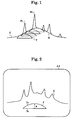
- a measurement curve including a peak or peaks is obtained. Due to various factors, the base line of a measurement curve often deviates from a zero line of the measurement apparatus or recorder. In this event, it is necessary to determine the base line first to measure the true height (or to measure the area) of the peak or peaks. Determining the base line is especially difficult when, as shown in Fig. 1 of the accompanying drawings, the base line B of a measurement curve C (on which a peak or peaks P1, P2 stand) curves.
- a previously proposed method of determining a base line is as follows. First, a peak is detected by detecting the rising point and the falling point at which the absolute value of the slope of the measurement curve becomes greater than a certain reference value and becomes less than another reference value. The starting point of the peak is determined as the point which is a preset distance before the rising point, and the ending point of the peak is determined as the point which is a preset distance after the falling point. The base line in this case is determined as the line connecting the starting point and the ending point.
- the starting point and the ending point of a peak should be determined first.
- the operator In order to determine these points, the operator must determine beforehand various parameters, such as reference values for the slope of the rising point and of the falling point or the values of the preset distances. If the parameters are once determined, then the base line can be determined automatically. But, many operators find difficulty in determining appropriate values for the various parameters because the values are not apparent from the measurement curve.
- a method of determining a base line of a measurement curve comprising the steps of: preparing a template having an upwardly convex arc; moving, without rotating, the template with the arc of the template always contacting the measurement curve; and determining the base line as the envelope of the arc of the template.
- a data processing apparatus for determining a base line of a measurement curve, the apparatus comprising: measurement curve generating means; template generating means for generating a template having an upwardly convex arc; moving means for moving, without rotating, the template so that the arc of the template always contacts the measurement curve; and envelope generating means for generating an envelope curve of the arc of the template while the template is moved, whereby the envelope is the base line of the measurement curve.
- the method and apparatus alleviate the operator's burden in determining the base line of a measurement curve, and provide an easier way of determining the base line. That is, since the operator can prepare (or determine the shape of) the template having regard to the measurement curve, and the determination of the shape of the template need not be so strict, the operator's burden is greatly alleviated.
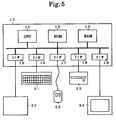
- the data analyzer 10 is equipped with a microprocessor (CPU) 11, a read only memory (ROM) 12, a random access memory (RAM) 13 and several interface circuits (I/F) 15 to 19 for external devices including a keyboard 21, a mouse (or a joystick) 22, a disk memory device 23 and a display device 24.
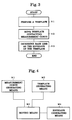
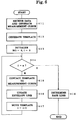
- the CPU 11 of the data analyzer 10 realizes respective elements M1 to M4 (namely a measurement curve generating means M1, a template generating means M2, a moving means M3 and an envelope generating means M4) of a block diagram of Fig. 4 and performs process steps of a flowchart of Fig. 3.
- a measurement curve generating means M1 namely a measurement curve generating means M1, a template generating means M2, a moving means M3 and an envelope generating means M4
- a measurement curve generating means M1 namely a measurement curve generating means M1, a template generating means M2, a moving means M3 and an envelope generating means M4
- the CPU 11 receives data from the measurement apparatus 20 and stores the data in a measurement data memory area provided in the RAM 13. Instead of receiving data from the measurement apparatus 20, it is possible to retrieve data previously stored in the disk memory device 23. Then the CPU 11 generates a measurement curve C and show it on the display screen 24, as in Fig. 2, by plotting the data against an appropriate parameter (such as time, wavelength, etc.) used in the measurement (step S11). In this phase, the CPU 11 functions as the measurement curve generating means M1.
- the operator of the data analyzer 10 gives the CPU 11 a parameter for generating a template T using the keyboard 21 (or the mouse or joystick 22) (step S12).
- the chord Tb of the template T is fixed at a preset length, and the arc Ta of the template T is presumed to be parabolic for simplicity.
- the CPU 11 can generate a fixed shape of template T on the display screen 24.
- the CPU 11 functions as the template generating means M2.
- the operator Before finally fixing the shape of the template T, the operator tentatively determines the shape of the template T. Then, moving the template T on the display screen 24 using the keyboard 21 or mouse 22, the operator applies the template T on the part of the measurement curve C having an ostensibly largest curvature.
- the operator determines the final value of the parameter A (or the final shape of the template T) as the smallest value of A with which the arc Ta of the template T does not cross the measurement curve C and contacts it at as many points as possible. It should be stressed here that this adjusting operation need not be so strict. Even if the height A is a little larger or smaller, there is little difference in the finally determined base line B. Therefore the burden of the operator for determining the parameter A is far less than the case for determining the non-apparent parameters in the conventional method.
- the geometry of the measurement curve C and the template T is defined as in Fig. 9.
- the height of the base line B is denoted as B(i).
- the template T is assigned its own coordinate system in which the unit length of the abscissa j is the same as that of i but the origin O is taken at the centre of the chord Tb.
- T(0) - T(j) k ⁇ j2 where k is a constant.
- T(0) A.
- the CPU 11 uses other formulae than those used above, but there is no significant difference in the computing time for recent high-performance microprocessors.
- the CPU 11 contacts the template T to the measurement curve C (step S15) at the sampling point i.
- the method of detecting the contact point is detailed later.
- the CPU 11 updates the envelope line of the template T (step S16).
- the method of updating the envelope line is also detailed later.
- the CPU 11 at steps S17 and S15 functions as the moving means M3, and at step S16 functions as the envelope generating means M4.
- the final shape of the envelope line represents the base line B of the measurement curve C (step S18).
- the data analyzer 10 processes the measurement data D(i) according to a preset program. For example, the true height of a peak P1, P2 is obtained by subtracting the value of the data by the height of the base line B at the same sampling point, and the area of a peak can be defined by the area surrounded by the measurement curve C and the base line B.
- the method of contacting the arc Ta of the template T to the measurement curve C is now explained referring to Fig. 7.
- the chord Tb of the template T is assumed to be on the zero line Z of the measurement curve C (though they are shown separate in Fig. 9 for better visibility).
- the template T need not be actually moved vertically on the display screen 24, but it can be performed in the background.
- the method of updating the envelope line is then explained referring to Fig. 8.
- the arc Ta of the template T at the sampling point i-1 contacts the measurement curve C at the point [i-1+jc1] if the template T is moved vertically by the distance [D(i-1+jc1) - T(jc1)] .
- the template T is moved horizontally to the next sampling point i, it contacts the measurement curve C at a point [i+jc1] if moved vertically by the distance [D(i+jc2) - T(jc2)] .
- the arc Ta1 at the sampling point i-1 and the arc Ta2 at the sampling point i do not coincide (because the template T is moved horizontally), and there is a portion of the arc Ta2 that is superior to (above) the arc Ta1.
- the CPU 11 stores the ordinate T(j) of the portion of the arc Ta2 (that is superior to the arc Ta1) to the memory cell B(i) of the base line memory.
Landscapes
- Engineering & Computer Science (AREA)
- Theoretical Computer Science (AREA)
- Data Mining & Analysis (AREA)
- Bioinformatics & Cheminformatics (AREA)
- Bioinformatics & Computational Biology (AREA)
- Computer Vision & Pattern Recognition (AREA)
- Life Sciences & Earth Sciences (AREA)
- Evolutionary Biology (AREA)
- Evolutionary Computation (AREA)
- Physics & Mathematics (AREA)
- General Engineering & Computer Science (AREA)
- General Physics & Mathematics (AREA)
- Artificial Intelligence (AREA)
- Length Measuring Devices With Unspecified Measuring Means (AREA)
- Recording Measured Values (AREA)
Applications Claiming Priority (2)
| Application Number | Priority Date | Filing Date | Title |
|---|---|---|---|
| JP97191/92 | 1992-03-24 | ||
| JP4097191A JPH05272993A (ja) | 1992-03-24 | 1992-03-24 | 測定データのベースライン決定方法 |
Publications (2)
| Publication Number | Publication Date |
|---|---|
| EP0562800A2 true EP0562800A2 (en) | 1993-09-29 |
| EP0562800A3 EP0562800A3 (enExample) | 1995-02-15 |
Family
ID=14185695
Family Applications (1)
| Application Number | Title | Priority Date | Filing Date |
|---|---|---|---|
| EP93302152A Withdrawn EP0562800A2 (en) | 1992-03-24 | 1993-03-22 | Determining a base line of a measurement curve |
Country Status (3)
| Country | Link |
|---|---|
| US (1) | US5442574A (enExample) |
| EP (1) | EP0562800A2 (enExample) |
| JP (1) | JPH05272993A (enExample) |
Cited By (3)
| Publication number | Priority date | Publication date | Assignee | Title |
|---|---|---|---|---|
| EP1059522A1 (en) * | 1999-06-11 | 2000-12-13 | F. Hoffmann-La Roche Ag | Method and apparatus for examining fluids of biological origin |
| FR2984509A1 (fr) * | 2011-12-14 | 2013-06-21 | IFP Energies Nouvelles | Procede d'analyse de signaux issus de chromatographie ou de diffraction par estimation de la ligne de base |
| RU2676769C2 (ru) * | 2014-06-23 | 2019-01-11 | Басф Се | Композиции, их получение и применение, и подходящие компоненты |
Families Citing this family (1)
| Publication number | Priority date | Publication date | Assignee | Title |
|---|---|---|---|---|
| JP3226743B2 (ja) * | 1995-02-27 | 2001-11-05 | 株式会社日立製作所 | クロマトグラフ用データ処理装置 |
Family Cites Families (2)
| Publication number | Priority date | Publication date | Assignee | Title |
|---|---|---|---|---|
| US5121443A (en) * | 1989-04-25 | 1992-06-09 | Spectra-Physics, Inc. | Neural net system for analyzing chromatographic peaks |
| US5119316A (en) * | 1990-06-29 | 1992-06-02 | E. I. Du Pont De Nemours And Company | Method for determining dna sequences |
-
1992
- 1992-03-24 JP JP4097191A patent/JPH05272993A/ja active Pending
-
1993
- 1993-03-08 US US08/028,930 patent/US5442574A/en not_active Expired - Fee Related
- 1993-03-22 EP EP93302152A patent/EP0562800A2/en not_active Withdrawn
Non-Patent Citations (2)
| Title |
|---|
| IEEE TRANSACTIONS ON BIO-MEDICAL ENGINEERING vol. 36, no. 2 , February 1989 , NEW YORK US pages 262 - 273 CHEE-HUNG HENRY CHU 'Impulsive Noise Suppression and Background Normalization of Electrocardiogram Signals Using Morphological Operators' * |
| PROCEEDINGS COMPUTERS IN CARDIOLOGY September 1990 , CHICAGO, US pages 313 - 316 D. L. WILSON, C. BERTRAM 'Morphological Enhancement of Coronary Angiograms' * |
Cited By (5)
| Publication number | Priority date | Publication date | Assignee | Title |
|---|---|---|---|---|
| EP1059522A1 (en) * | 1999-06-11 | 2000-12-13 | F. Hoffmann-La Roche Ag | Method and apparatus for examining fluids of biological origin |
| WO2000077494A1 (en) * | 1999-06-11 | 2000-12-21 | F. Hoffmann-La Roche Ag | Method and apparatus for examining fluids of biological origin |
| US6882425B1 (en) | 1999-06-11 | 2005-04-19 | Roche Diagnostics Corporation | Method and apparatus for examining fluids of biological origin |
| FR2984509A1 (fr) * | 2011-12-14 | 2013-06-21 | IFP Energies Nouvelles | Procede d'analyse de signaux issus de chromatographie ou de diffraction par estimation de la ligne de base |
| RU2676769C2 (ru) * | 2014-06-23 | 2019-01-11 | Басф Се | Композиции, их получение и применение, и подходящие компоненты |
Also Published As
| Publication number | Publication date |
|---|---|
| JPH05272993A (ja) | 1993-10-22 |
| US5442574A (en) | 1995-08-15 |
| EP0562800A3 (enExample) | 1995-02-15 |
Similar Documents
| Publication | Publication Date | Title |
|---|---|---|
| EP0339527B1 (en) | Fingerprint processing system capable of detecting a core of a fingerprint image by curvature parameters | |
| US4956870A (en) | Pattern selecting device capable of selecting favorable candidate patterns | |
| KR100367303B1 (ko) | 화상중의패턴을자동으로위치시키기위한벡터상관시스템 | |
| US6252563B1 (en) | Coordinate input apparatus, coordinate input method and computer-readable recording medium including a coordinate input control program recorded therein | |
| KR100255758B1 (ko) | 삼각 그리드로 표현된 지형상을 이동하는 물체의 위치가 존재하는 삼각형 탐색방법 | |
| CN107608508B (zh) | 一种信息处理方法及电子设备 | |
| US4566125A (en) | Apparatus and method for pattern location | |
| EP0112415B1 (en) | A method and apparatus for continuously updating a display of the coordinates of a light pen | |
| US5442574A (en) | Method and apparatus for determining a base line of a measurement | |
| EP0584776A2 (en) | Information processing method and apparatus | |
| US12243286B2 (en) | Pattern image detection method | |
| EP4152019A1 (en) | Current-sampling method, chip, and sampling apparatus for phase current of motor | |
| CN113342407A (zh) | 一种屏幕控制方法、装置、电子设备及可读存储介质 | |
| JPH10307660A (ja) | ウィジェットフォント変更方法 | |
| CN110539056B (zh) | 焊接状态判定装置、焊接状态判定方法和具有程序的介质 | |
| JP2987984B2 (ja) | クロマトグラフ用データ処理装置 | |
| CN115204061A (zh) | 自动确定冲压建模规模方法、装置、设备及存储介质 | |
| JPH06230001A (ja) | クロマトグラフ用データ処理装置 | |
| CN113010046A (zh) | 一种多窗模式下信号源的适配方法、电子设备、存储介质 | |
| EP0113556B1 (en) | Apparatus and method for pattern location | |
| CN119376559B (zh) | 触控面积计算方法及相关装置 | |
| CN117810110B (zh) | 检测窗口确定方法及装置 | |
| JP2590999B2 (ja) | 画像信号の動ベクトル検出装置 | |
| CN117072238A (zh) | 基于多因素参量的综采工作面支护区域划分方法和装置 | |
| JP2555813B2 (ja) | 熱分析データ処理装置 |
Legal Events
| Date | Code | Title | Description |
|---|---|---|---|
| PUAI | Public reference made under article 153(3) epc to a published international application that has entered the european phase |
Free format text: ORIGINAL CODE: 0009012 |
|
| AK | Designated contracting states |
Kind code of ref document: A2 Designated state(s): DE FR GB |
|
| PUAL | Search report despatched |
Free format text: ORIGINAL CODE: 0009013 |
|
| AK | Designated contracting states |
Kind code of ref document: A3 Designated state(s): DE FR GB |
|
| 17P | Request for examination filed |
Effective date: 19950727 |
|
| STAA | Information on the status of an ep patent application or granted ep patent |
Free format text: STATUS: THE APPLICATION HAS BEEN WITHDRAWN |
|
| 18W | Application withdrawn |
Withdrawal date: 19980119 |