EP0545303A1 - Verfahren zur Herstellung eines hochmolekularen Olefinpolymers - Google Patents
Verfahren zur Herstellung eines hochmolekularen Olefinpolymers Download PDFInfo
- Publication number
- EP0545303A1 EP0545303A1 EP92120288A EP92120288A EP0545303A1 EP 0545303 A1 EP0545303 A1 EP 0545303A1 EP 92120288 A EP92120288 A EP 92120288A EP 92120288 A EP92120288 A EP 92120288A EP 0545303 A1 EP0545303 A1 EP 0545303A1
- Authority
- EP
- European Patent Office
- Prior art keywords
- group
- metallocene
- formula
- different
- hydrogen
- Prior art date
- Legal status (The legal status is an assumption and is not a legal conclusion. Google has not performed a legal analysis and makes no representation as to the accuracy of the status listed.)
- Granted
Links
- 229920000098 polyolefin Polymers 0.000 title claims description 8
- 238000004519 manufacturing process Methods 0.000 title description 7
- 239000001257 hydrogen Substances 0.000 claims abstract description 22
- 229910052739 hydrogen Inorganic materials 0.000 claims abstract description 22
- 239000003054 catalyst Substances 0.000 claims abstract description 18
- 125000004435 hydrogen atom Chemical class [H]* 0.000 claims abstract description 17
- 150000001336 alkenes Chemical class 0.000 claims abstract description 13
- 125000003118 aryl group Chemical group 0.000 claims abstract description 9
- 229910052735 hafnium Inorganic materials 0.000 claims abstract description 5
- 229910052726 zirconium Inorganic materials 0.000 claims abstract description 3
- 238000006116 polymerization reaction Methods 0.000 claims description 40
- -1 rac-dimethylsilyl (2-methyl-4,6-diisopropyl-1-indenyl) Chemical group 0.000 claims description 37
- 125000002496 methyl group Chemical group [H]C([H])([H])* 0.000 claims description 26
- 238000000034 method Methods 0.000 claims description 20
- 125000005843 halogen group Chemical group 0.000 claims description 16
- 150000001875 compounds Chemical class 0.000 claims description 15
- UFHFLCQGNIYNRP-UHFFFAOYSA-N Hydrogen Chemical compound [H][H] UFHFLCQGNIYNRP-UHFFFAOYSA-N 0.000 claims description 14
- 239000000725 suspension Substances 0.000 claims description 10
- 125000000008 (C1-C10) alkyl group Chemical group 0.000 claims description 9
- 229910052801 chlorine Inorganic materials 0.000 claims description 9
- CPOFMOWDMVWCLF-UHFFFAOYSA-N methyl(oxo)alumane Chemical compound C[Al]=O CPOFMOWDMVWCLF-UHFFFAOYSA-N 0.000 claims description 9
- 125000000041 C6-C10 aryl group Chemical group 0.000 claims description 8
- 125000004429 atom Chemical group 0.000 claims description 8
- 239000000460 chlorine Substances 0.000 claims description 8
- 239000007789 gas Substances 0.000 claims description 8
- 125000001997 phenyl group Chemical group [H]C1=C([H])C([H])=C(*)C([H])=C1[H] 0.000 claims description 7
- ZAMOUSCENKQFHK-UHFFFAOYSA-N Chlorine atom Chemical compound [Cl] ZAMOUSCENKQFHK-UHFFFAOYSA-N 0.000 claims description 6
- JRZJOMJEPLMPRA-UHFFFAOYSA-N olefin Natural products CCCCCCCC=C JRZJOMJEPLMPRA-UHFFFAOYSA-N 0.000 claims description 6
- 239000004215 Carbon black (E152) Substances 0.000 claims description 5
- XUIMIQQOPSSXEZ-UHFFFAOYSA-N Silicon Chemical compound [Si] XUIMIQQOPSSXEZ-UHFFFAOYSA-N 0.000 claims description 5
- 229910052732 germanium Inorganic materials 0.000 claims description 5
- GNPVGFCGXDBREM-UHFFFAOYSA-N germanium atom Chemical compound [Ge] GNPVGFCGXDBREM-UHFFFAOYSA-N 0.000 claims description 5
- 229930195733 hydrocarbon Natural products 0.000 claims description 5
- 125000001449 isopropyl group Chemical group [H]C([H])([H])C([H])(*)C([H])([H])[H] 0.000 claims description 5
- 229910052751 metal Inorganic materials 0.000 claims description 5
- 239000002184 metal Substances 0.000 claims description 5
- 229910052710 silicon Inorganic materials 0.000 claims description 5
- 125000000027 (C1-C10) alkoxy group Chemical group 0.000 claims description 4
- ATJFFYVFTNAWJD-UHFFFAOYSA-N Tin Chemical compound [Sn] ATJFFYVFTNAWJD-UHFFFAOYSA-N 0.000 claims description 4
- 125000001495 ethyl group Chemical group [H]C([H])([H])C([H])([H])* 0.000 claims description 4
- 239000010703 silicon Substances 0.000 claims description 4
- 229910052718 tin Inorganic materials 0.000 claims description 4
- 125000002023 trifluoromethyl group Chemical group FC(F)(F)* 0.000 claims description 4
- 125000006374 C2-C10 alkenyl group Chemical group 0.000 claims description 3
- 125000001797 benzyl group Chemical group [H]C1=C([H])C([H])=C(C([H])=C1[H])C([H])([H])* 0.000 claims description 3
- 229910052799 carbon Inorganic materials 0.000 claims description 3
- 125000004432 carbon atom Chemical group C* 0.000 claims description 3
- 238000007334 copolymerization reaction Methods 0.000 claims description 3
- 125000003709 fluoroalkyl group Chemical group 0.000 claims description 3
- 230000000737 periodic effect Effects 0.000 claims description 3
- 238000002360 preparation method Methods 0.000 claims description 3
- 150000003623 transition metal compounds Chemical class 0.000 claims description 3
- 125000004169 (C1-C6) alkyl group Chemical group 0.000 claims description 2
- 125000003710 aryl alkyl group Chemical group 0.000 claims description 2
- 125000004104 aryloxy group Chemical group 0.000 claims description 2
- 125000004122 cyclic group Chemical group 0.000 claims description 2
- 125000000217 alkyl group Chemical group 0.000 abstract description 6
- 229910052736 halogen Inorganic materials 0.000 abstract description 3
- 150000002367 halogens Chemical class 0.000 abstract description 3
- 125000005842 heteroatom Chemical group 0.000 abstract 1
- VLKZOEOYAKHREP-UHFFFAOYSA-N n-Hexane Chemical compound CCCCCC VLKZOEOYAKHREP-UHFFFAOYSA-N 0.000 description 90
- YMWUJEATGCHHMB-UHFFFAOYSA-N Dichloromethane Chemical compound ClCCl YMWUJEATGCHHMB-UHFFFAOYSA-N 0.000 description 42
- YXFVVABEGXRONW-UHFFFAOYSA-N Toluene Chemical compound CC1=CC=CC=C1 YXFVVABEGXRONW-UHFFFAOYSA-N 0.000 description 42
- 239000000203 mixture Substances 0.000 description 39
- YBYIRNPNPLQARY-UHFFFAOYSA-N 1H-indene Natural products C1=CC=C2CC=CC2=C1 YBYIRNPNPLQARY-UHFFFAOYSA-N 0.000 description 29
- 239000004743 Polypropylene Substances 0.000 description 27
- 230000000694 effects Effects 0.000 description 23
- WYURNTSHIVDZCO-UHFFFAOYSA-N Tetrahydrofuran Chemical compound C1CCOC1 WYURNTSHIVDZCO-UHFFFAOYSA-N 0.000 description 20
- HEDRZPFGACZZDS-MICDWDOJSA-N Trichloro(2H)methane Chemical compound [2H]C(Cl)(Cl)Cl HEDRZPFGACZZDS-MICDWDOJSA-N 0.000 description 18
- 239000002904 solvent Substances 0.000 description 18
- RTZKZFJDLAIYFH-UHFFFAOYSA-N Diethyl ether Chemical compound CCOCC RTZKZFJDLAIYFH-UHFFFAOYSA-N 0.000 description 17
- MZRVEZGGRBJDDB-UHFFFAOYSA-N N-Butyllithium Chemical compound [Li]CCCC MZRVEZGGRBJDDB-UHFFFAOYSA-N 0.000 description 16
- 239000003446 ligand Substances 0.000 description 13
- OKKJLVBELUTLKV-UHFFFAOYSA-N Methanol Chemical compound OC OKKJLVBELUTLKV-UHFFFAOYSA-N 0.000 description 12
- CSNNHWWHGAXBCP-UHFFFAOYSA-L Magnesium sulfate Chemical compound [Mg+2].[O-][S+2]([O-])([O-])[O-] CSNNHWWHGAXBCP-UHFFFAOYSA-L 0.000 description 10
- VSCWAEJMTAWNJL-UHFFFAOYSA-K aluminium trichloride Chemical compound Cl[Al](Cl)Cl VSCWAEJMTAWNJL-UHFFFAOYSA-K 0.000 description 10
- 238000001819 mass spectrum Methods 0.000 description 10
- 239000000843 powder Substances 0.000 description 10
- 239000003921 oil Substances 0.000 description 9
- 229920001155 polypropylene Polymers 0.000 description 9
- 238000000425 proton nuclear magnetic resonance spectrum Methods 0.000 description 9
- 239000007787 solid Substances 0.000 description 9
- 229920000642 polymer Polymers 0.000 description 8
- PMZURENOXWZQFD-UHFFFAOYSA-L Sodium Sulfate Chemical compound [Na+].[Na+].[O-]S([O-])(=O)=O PMZURENOXWZQFD-UHFFFAOYSA-L 0.000 description 7
- 238000006243 chemical reaction Methods 0.000 description 7
- 230000000052 comparative effect Effects 0.000 description 7
- 239000003480 eluent Substances 0.000 description 7
- 239000007788 liquid Substances 0.000 description 7
- 239000012074 organic phase Substances 0.000 description 7
- QQONPFPTGQHPMA-UHFFFAOYSA-N propylene Natural products CC=C QQONPFPTGQHPMA-UHFFFAOYSA-N 0.000 description 7
- 125000004805 propylene group Chemical group [H]C([H])([H])C([H])([*:1])C([H])([H])[*:2] 0.000 description 7
- 229910052938 sodium sulfate Inorganic materials 0.000 description 7
- 235000011152 sodium sulphate Nutrition 0.000 description 7
- XFNIQDLAPZZUMH-UHFFFAOYSA-N 2-methyl-4,6-di(propan-2-yl)-1h-indene Chemical compound CC(C)C1=CC(C(C)C)=CC2=C1C=C(C)C2 XFNIQDLAPZZUMH-UHFFFAOYSA-N 0.000 description 6
- VGGSQFUCUMXWEO-UHFFFAOYSA-N Ethene Chemical compound C=C VGGSQFUCUMXWEO-UHFFFAOYSA-N 0.000 description 6
- 239000005977 Ethylene Substances 0.000 description 6
- IJKVHSBPTUYDLN-UHFFFAOYSA-N dihydroxy(oxo)silane Chemical compound O[Si](O)=O IJKVHSBPTUYDLN-UHFFFAOYSA-N 0.000 description 6
- 238000004821 distillation Methods 0.000 description 6
- XOJVVFBFDXDTEG-UHFFFAOYSA-N pristane Chemical compound CC(C)CCCC(C)CCCC(C)CCCC(C)C XOJVVFBFDXDTEG-UHFFFAOYSA-N 0.000 description 6
- 238000010992 reflux Methods 0.000 description 6
- YACBQDSJEQTNRJ-UHFFFAOYSA-N 2,5,7-trimethyl-2,3-dihydroinden-1-one Chemical compound CC1=CC(C)=C2C(=O)C(C)CC2=C1 YACBQDSJEQTNRJ-UHFFFAOYSA-N 0.000 description 5
- 239000005457 ice water Substances 0.000 description 5
- QNXSIUBBGPHDDE-UHFFFAOYSA-N indan-1-one Chemical class C1=CC=C2C(=O)CCC2=C1 QNXSIUBBGPHDDE-UHFFFAOYSA-N 0.000 description 5
- 229910052943 magnesium sulfate Inorganic materials 0.000 description 5
- 235000019341 magnesium sulphate Nutrition 0.000 description 5
- 238000001953 recrystallisation Methods 0.000 description 5
- 125000004178 (C1-C4) alkyl group Chemical group 0.000 description 4
- OSNBXQPGMJVNOI-UHFFFAOYSA-N 2,4,6-trimethyl-1h-indene Chemical compound C1=C(C)C=C(C)C2=C1CC(C)=C2 OSNBXQPGMJVNOI-UHFFFAOYSA-N 0.000 description 4
- LYGOMMCGNNRRQD-UHFFFAOYSA-N 2-methyl-5,7-di(propan-2-yl)-2,3-dihydroinden-1-one Chemical compound CC(C)C1=CC(C(C)C)=CC2=C1C(=O)C(C)C2 LYGOMMCGNNRRQD-UHFFFAOYSA-N 0.000 description 4
- 238000005727 Friedel-Crafts reaction Methods 0.000 description 4
- VYPSYNLAJGMNEJ-UHFFFAOYSA-N Silicium dioxide Chemical compound O=[Si]=O VYPSYNLAJGMNEJ-UHFFFAOYSA-N 0.000 description 4
- 229910052782 aluminium Inorganic materials 0.000 description 4
- 239000012230 colorless oil Substances 0.000 description 4
- KGDCHNBUAFRQKF-UHFFFAOYSA-N dimethyl-bis[2-methyl-4,6-di(propan-2-yl)-1h-inden-1-yl]silane Chemical compound CC1=CC(C(=CC(=C2)C(C)C)C(C)C)=C2C1[Si](C)(C)C1C(C=C(C=C2C(C)C)C(C)C)=C2C=C1C KGDCHNBUAFRQKF-UHFFFAOYSA-N 0.000 description 4
- 229910052731 fluorine Inorganic materials 0.000 description 4
- 239000011737 fluorine Substances 0.000 description 4
- 150000002431 hydrogen Chemical class 0.000 description 4
- 239000012442 inert solvent Substances 0.000 description 4
- 125000000959 isobutyl group Chemical group [H]C([H])([H])C([H])(C([H])([H])[H])C([H])([H])* 0.000 description 4
- 239000012279 sodium borohydride Substances 0.000 description 4
- 229910000033 sodium borohydride Inorganic materials 0.000 description 4
- 239000007858 starting material Substances 0.000 description 4
- 238000003756 stirring Methods 0.000 description 4
- JOXIMZWYDAKGHI-UHFFFAOYSA-N toluene-4-sulfonic acid Chemical compound CC1=CC=C(S(O)(=O)=O)C=C1 JOXIMZWYDAKGHI-UHFFFAOYSA-N 0.000 description 4
- DUNKXUFBGCUVQW-UHFFFAOYSA-J zirconium tetrachloride Chemical compound Cl[Zr](Cl)(Cl)Cl DUNKXUFBGCUVQW-UHFFFAOYSA-J 0.000 description 4
- VPGLGRNSAYHXPY-UHFFFAOYSA-L zirconium(2+);dichloride Chemical compound Cl[Zr]Cl VPGLGRNSAYHXPY-UHFFFAOYSA-L 0.000 description 4
- YAZRQPVPGIIJRN-UHFFFAOYSA-N 2-methyl-1-[1-[2-methyl-4,6-di(propan-2-yl)-1h-inden-1-yl]butan-2-yl]-4,6-di(propan-2-yl)-1h-indene Chemical compound CC1=CC(C(=CC(=C2)C(C)C)C(C)C)=C2C1C(CC)CC1C(C=C(C=C2C(C)C)C(C)C)=C2C=C1C YAZRQPVPGIIJRN-UHFFFAOYSA-N 0.000 description 3
- WKBOTKDWSSQWDR-UHFFFAOYSA-N Bromine atom Chemical compound [Br] WKBOTKDWSSQWDR-UHFFFAOYSA-N 0.000 description 3
- PYLJALCCEVZPPL-UHFFFAOYSA-N CC(C)C1=CC(C(C(C)=C2)[Zr](C)(C(C(C)=C3)C4=C3C(C(C)C)=CC(C(C)C)=C4)[SiH2]C3=CC=CC=C3)=C2C(C(C)C)=C1.Cl.Cl Chemical compound CC(C)C1=CC(C(C(C)=C2)[Zr](C)(C(C(C)=C3)C4=C3C(C(C)C)=CC(C(C)C)=C4)[SiH2]C3=CC=CC=C3)=C2C(C(C)C)=C1.Cl.Cl PYLJALCCEVZPPL-UHFFFAOYSA-N 0.000 description 3
- CZPSTFVUNSZYCA-UHFFFAOYSA-L CC(C)c1cc2C(C(C)=Cc2c(c1)C(C)C)[Zr](Cl)(Cl)(C1C(C)=Cc2c1cc(cc2C(C)C)C(C)C)=[Si](C)C Chemical compound CC(C)c1cc2C(C(C)=Cc2c(c1)C(C)C)[Zr](Cl)(Cl)(C1C(C)=Cc2c1cc(cc2C(C)C)C(C)C)=[Si](C)C CZPSTFVUNSZYCA-UHFFFAOYSA-L 0.000 description 3
- XEKOWRVHYACXOJ-UHFFFAOYSA-N Ethyl acetate Chemical compound CCOC(C)=O XEKOWRVHYACXOJ-UHFFFAOYSA-N 0.000 description 3
- YCKRFDGAMUMZLT-UHFFFAOYSA-N Fluorine atom Chemical compound [F] YCKRFDGAMUMZLT-UHFFFAOYSA-N 0.000 description 3
- MUBZPKHOEPUJKR-UHFFFAOYSA-N Oxalic acid Chemical compound OC(=O)C(O)=O MUBZPKHOEPUJKR-UHFFFAOYSA-N 0.000 description 3
- FAPWRFPIFSIZLT-UHFFFAOYSA-M Sodium chloride Chemical compound [Na+].[Cl-] FAPWRFPIFSIZLT-UHFFFAOYSA-M 0.000 description 3
- QAOWNCQODCNURD-UHFFFAOYSA-N Sulfuric acid Chemical compound OS(O)(=O)=O QAOWNCQODCNURD-UHFFFAOYSA-N 0.000 description 3
- YVQPUXMWIMJFBY-UHFFFAOYSA-L [Cl-].[Cl-].CC1=Cc2c(cc(C)cc2C)C1[Zr++](C1C(C)=Cc2c1cc(C)cc2C)=[Si](C)C Chemical compound [Cl-].[Cl-].CC1=Cc2c(cc(C)cc2C)C1[Zr++](C1C(C)=Cc2c1cc(C)cc2C)=[Si](C)C YVQPUXMWIMJFBY-UHFFFAOYSA-L 0.000 description 3
- 229910052794 bromium Inorganic materials 0.000 description 3
- 239000006227 byproduct Substances 0.000 description 3
- 150000001768 cations Chemical class 0.000 description 3
- 239000013078 crystal Substances 0.000 description 3
- 238000002425 crystallisation Methods 0.000 description 3
- 230000008025 crystallization Effects 0.000 description 3
- IDASTKMEQGPVRR-UHFFFAOYSA-N cyclopenta-1,3-diene;zirconium(2+) Chemical compound [Zr+2].C=1C=C[CH-]C=1.C=1C=C[CH-]C=1 IDASTKMEQGPVRR-UHFFFAOYSA-N 0.000 description 3
- XRTCHIPNYUJZQS-UHFFFAOYSA-N dimethyl-bis(2,4,6-trimethyl-1h-inden-1-yl)silane Chemical compound CC1=CC(C(=CC(C)=C2)C)=C2C1[Si](C)(C)C1C(C=C(C)C=C2C)=C2C=C1C XRTCHIPNYUJZQS-UHFFFAOYSA-N 0.000 description 3
- 238000002474 experimental method Methods 0.000 description 3
- 150000002430 hydrocarbons Chemical class 0.000 description 3
- 150000002469 indenes Chemical class 0.000 description 3
- 239000000178 monomer Substances 0.000 description 3
- SYSQUGFVNFXIIT-UHFFFAOYSA-N n-[4-(1,3-benzoxazol-2-yl)phenyl]-4-nitrobenzenesulfonamide Chemical class C1=CC([N+](=O)[O-])=CC=C1S(=O)(=O)NC1=CC=C(C=2OC3=CC=CC=C3N=2)C=C1 SYSQUGFVNFXIIT-UHFFFAOYSA-N 0.000 description 3
- OFBQJSOFQDEBGM-UHFFFAOYSA-N n-pentane Natural products CCCCC OFBQJSOFQDEBGM-UHFFFAOYSA-N 0.000 description 3
- 239000012071 phase Substances 0.000 description 3
- 230000037048 polymerization activity Effects 0.000 description 3
- 239000000047 product Substances 0.000 description 3
- 239000011877 solvent mixture Substances 0.000 description 3
- 125000001424 substituent group Chemical group 0.000 description 3
- YLQBMQCUIZJEEH-UHFFFAOYSA-N tetrahydrofuran Natural products C=1C=COC=1 YLQBMQCUIZJEEH-UHFFFAOYSA-N 0.000 description 3
- 238000010792 warming Methods 0.000 description 3
- XLYOFNOQVPJJNP-UHFFFAOYSA-N water Substances O XLYOFNOQVPJJNP-UHFFFAOYSA-N 0.000 description 3
- 125000006273 (C1-C3) alkyl group Chemical group 0.000 description 2
- 125000006656 (C2-C4) alkenyl group Chemical group 0.000 description 2
- LIKMAJRDDDTEIG-UHFFFAOYSA-N 1-hexene Chemical compound CCCCC=C LIKMAJRDDDTEIG-UHFFFAOYSA-N 0.000 description 2
- KWKAKUADMBZCLK-UHFFFAOYSA-N 1-octene Chemical compound CCCCCCC=C KWKAKUADMBZCLK-UHFFFAOYSA-N 0.000 description 2
- YOCIJWAHRAJQFT-UHFFFAOYSA-N 2-bromo-2-methylpropanoyl bromide Chemical compound CC(C)(Br)C(Br)=O YOCIJWAHRAJQFT-UHFFFAOYSA-N 0.000 description 2
- ALGLPEWJXUNUOJ-UHFFFAOYSA-N 2-methyl-4,6-di(propan-2-yl)-2,3-dihydroinden-1-one Chemical compound CC(C)C1=CC(C(C)C)=CC2=C1CC(C)C2=O ALGLPEWJXUNUOJ-UHFFFAOYSA-N 0.000 description 2
- KSJULJVHQBLVFF-UHFFFAOYSA-N 2-methyl-5,7-di(propan-2-yl)-1h-indene Chemical compound CC(C)C1=CC(C(C)C)=CC2=C1CC(C)=C2 KSJULJVHQBLVFF-UHFFFAOYSA-N 0.000 description 2
- UQRONKZLYKUEMO-UHFFFAOYSA-N 4-methyl-1-(2,4,6-trimethylphenyl)pent-4-en-2-one Chemical group CC(=C)CC(=O)Cc1c(C)cc(C)cc1C UQRONKZLYKUEMO-UHFFFAOYSA-N 0.000 description 2
- WSSSPWUEQFSQQG-UHFFFAOYSA-N 4-methyl-1-pentene Chemical compound CC(C)CC=C WSSSPWUEQFSQQG-UHFFFAOYSA-N 0.000 description 2
- IJGRMHOSHXDMSA-UHFFFAOYSA-N Atomic nitrogen Chemical compound N#N IJGRMHOSHXDMSA-UHFFFAOYSA-N 0.000 description 2
- IMNFDUFMRHMDMM-UHFFFAOYSA-N N-Heptane Chemical compound CCCCCCC IMNFDUFMRHMDMM-UHFFFAOYSA-N 0.000 description 2
- 239000007832 Na2SO4 Substances 0.000 description 2
- ATUOYWHBWRKTHZ-UHFFFAOYSA-N Propane Chemical compound CCC ATUOYWHBWRKTHZ-UHFFFAOYSA-N 0.000 description 2
- RTAQQCXQSZGOHL-UHFFFAOYSA-N Titanium Chemical compound [Ti] RTAQQCXQSZGOHL-UHFFFAOYSA-N 0.000 description 2
- XAGFODPZIPBFFR-UHFFFAOYSA-N aluminium Chemical compound [Al] XAGFODPZIPBFFR-UHFFFAOYSA-N 0.000 description 2
- 229920001400 block copolymer Polymers 0.000 description 2
- GDTBXPJZTBHREO-UHFFFAOYSA-N bromine Substances BrBr GDTBXPJZTBHREO-UHFFFAOYSA-N 0.000 description 2
- 125000000484 butyl group Chemical group [H]C([*])([H])C([H])([H])C([H])([H])C([H])([H])[H] 0.000 description 2
- 239000012876 carrier material Substances 0.000 description 2
- 239000007795 chemical reaction product Substances 0.000 description 2
- 238000004587 chromatography analysis Methods 0.000 description 2
- 238000004140 cleaning Methods 0.000 description 2
- 238000004440 column chromatography Methods 0.000 description 2
- 238000001816 cooling Methods 0.000 description 2
- LIKFHECYJZWXFJ-UHFFFAOYSA-N dimethyldichlorosilane Chemical compound C[Si](C)(Cl)Cl LIKFHECYJZWXFJ-UHFFFAOYSA-N 0.000 description 2
- 229920001971 elastomer Polymers 0.000 description 2
- 125000004407 fluoroaryl group Chemical group 0.000 description 2
- VBJZVLUMGGDVMO-UHFFFAOYSA-N hafnium atom Chemical compound [Hf] VBJZVLUMGGDVMO-UHFFFAOYSA-N 0.000 description 2
- 229920006158 high molecular weight polymer Polymers 0.000 description 2
- 229920001580 isotactic polymer Polymers 0.000 description 2
- IVSZLXZYQVIEFR-UHFFFAOYSA-N m-xylene Chemical group CC1=CC=CC(C)=C1 IVSZLXZYQVIEFR-UHFFFAOYSA-N 0.000 description 2
- UAEPNZWRGJTJPN-UHFFFAOYSA-N methylcyclohexane Chemical compound CC1CCCCC1 UAEPNZWRGJTJPN-UHFFFAOYSA-N 0.000 description 2
- 230000007935 neutral effect Effects 0.000 description 2
- 238000006384 oligomerization reaction Methods 0.000 description 2
- 125000000538 pentafluorophenyl group Chemical group FC1=C(F)C(F)=C(*)C(F)=C1F 0.000 description 2
- 125000001436 propyl group Chemical group [H]C([*])([H])C([H])([H])C([H])([H])[H] 0.000 description 2
- 239000011541 reaction mixture Substances 0.000 description 2
- 238000000926 separation method Methods 0.000 description 2
- 239000000741 silica gel Substances 0.000 description 2
- 229910002027 silica gel Inorganic materials 0.000 description 2
- 238000010557 suspension polymerization reaction Methods 0.000 description 2
- 229910052719 titanium Inorganic materials 0.000 description 2
- 239000010936 titanium Substances 0.000 description 2
- 125000003944 tolyl group Chemical group 0.000 description 2
- 229910052723 transition metal Inorganic materials 0.000 description 2
- 150000003624 transition metals Chemical class 0.000 description 2
- 229910052845 zircon Inorganic materials 0.000 description 2
- GFQYVLUOOAAOGM-UHFFFAOYSA-N zirconium(iv) silicate Chemical compound [Zr+4].[O-][Si]([O-])([O-])[O-] GFQYVLUOOAAOGM-UHFFFAOYSA-N 0.000 description 2
- 125000006274 (C1-C3)alkoxy group Chemical group 0.000 description 1
- 125000000229 (C1-C4)alkoxy group Chemical group 0.000 description 1
- CZWSZZHGSNZRMW-UHFFFAOYSA-N 1,2-dibromobutane Chemical compound CCC(Br)CBr CZWSZZHGSNZRMW-UHFFFAOYSA-N 0.000 description 1
- PAAZPARNPHGIKF-UHFFFAOYSA-N 1,2-dibromoethane Chemical compound BrCCBr PAAZPARNPHGIKF-UHFFFAOYSA-N 0.000 description 1
- UNEATYXSUBPPKP-UHFFFAOYSA-N 1,3-Diisopropylbenzene Chemical compound CC(C)C1=CC=CC(C(C)C)=C1 UNEATYXSUBPPKP-UHFFFAOYSA-N 0.000 description 1
- WGAIKEHHOKCOJR-UHFFFAOYSA-N 2-methyl-5-propan-2-yl-2,3-dihydroinden-1-one Chemical compound CC(C)C1=CC=C2C(=O)C(C)CC2=C1 WGAIKEHHOKCOJR-UHFFFAOYSA-N 0.000 description 1
- 101100058670 Aeromonas hydrophila subsp. hydrophila (strain ATCC 7966 / DSM 30187 / BCRC 13018 / CCUG 14551 / JCM 1027 / KCTC 2358 / NCIMB 9240 / NCTC 8049) bsr gene Proteins 0.000 description 1
- PNEYBMLMFCGWSK-UHFFFAOYSA-N Alumina Chemical class [O-2].[O-2].[O-2].[Al+3].[Al+3] PNEYBMLMFCGWSK-UHFFFAOYSA-N 0.000 description 1
- 229910015900 BF3 Inorganic materials 0.000 description 1
- TVYAZEYCGZYYNC-UHFFFAOYSA-N CC(C)C1=CC(C(C)C)=C(C=C(C)C2[Zr](C)(C3=CC=CC=C3)[SiH3])C2=C1.Cl.Cl Chemical compound CC(C)C1=CC(C(C)C)=C(C=C(C)C2[Zr](C)(C3=CC=CC=C3)[SiH3])C2=C1.Cl.Cl TVYAZEYCGZYYNC-UHFFFAOYSA-N 0.000 description 1
- KZBUYRJDOAKODT-UHFFFAOYSA-N Chlorine Chemical compound ClCl KZBUYRJDOAKODT-UHFFFAOYSA-N 0.000 description 1
- VYZAMTAEIAYCRO-UHFFFAOYSA-N Chromium Chemical compound [Cr] VYZAMTAEIAYCRO-UHFFFAOYSA-N 0.000 description 1
- FKLJPTJMIBLJAV-UHFFFAOYSA-N Compound IV Chemical compound O1N=C(C)C=C1CCCCCCCOC1=CC=C(C=2OCCN=2)C=C1 FKLJPTJMIBLJAV-UHFFFAOYSA-N 0.000 description 1
- XDTMQSROBMDMFD-UHFFFAOYSA-N Cyclohexane Chemical compound C1CCCCC1 XDTMQSROBMDMFD-UHFFFAOYSA-N 0.000 description 1
- ZAFNJMIOTHYJRJ-UHFFFAOYSA-N Diisopropyl ether Chemical compound CC(C)OC(C)C ZAFNJMIOTHYJRJ-UHFFFAOYSA-N 0.000 description 1
- PXGOKWXKJXAPGV-UHFFFAOYSA-N Fluorine Chemical compound FF PXGOKWXKJXAPGV-UHFFFAOYSA-N 0.000 description 1
- 229910021578 Iron(III) chloride Inorganic materials 0.000 description 1
- NHTMVDHEPJAVLT-UHFFFAOYSA-N Isooctane Chemical compound CC(C)CC(C)(C)C NHTMVDHEPJAVLT-UHFFFAOYSA-N 0.000 description 1
- ZOKXTWBITQBERF-UHFFFAOYSA-N Molybdenum Chemical compound [Mo] ZOKXTWBITQBERF-UHFFFAOYSA-N 0.000 description 1
- 238000005481 NMR spectroscopy Methods 0.000 description 1
- NBIIXXVUZAFLBC-UHFFFAOYSA-N Phosphoric acid Chemical compound OP(O)(O)=O NBIIXXVUZAFLBC-UHFFFAOYSA-N 0.000 description 1
- 229910003074 TiCl4 Inorganic materials 0.000 description 1
- 229910021627 Tin(IV) chloride Inorganic materials 0.000 description 1
- 229910007932 ZrCl4 Inorganic materials 0.000 description 1
- RHCKTFQGHZBIAW-UHFFFAOYSA-L [Cl-].[Cl-].C=C.C1=CC(CCCC2)=C2C1[Hf+2]C1C=CC2=C1CCCC2 Chemical compound [Cl-].[Cl-].C=C.C1=CC(CCCC2)=C2C1[Hf+2]C1C=CC2=C1CCCC2 RHCKTFQGHZBIAW-UHFFFAOYSA-L 0.000 description 1
- GHNLLKNVWYRCCG-UHFFFAOYSA-L [Cl-].[Cl-].C=C.C1=CC2=CC=CC=C2C1[Hf+2]C1C2=CC=CC=C2C=C1 Chemical compound [Cl-].[Cl-].C=C.C1=CC2=CC=CC=C2C1[Hf+2]C1C2=CC=CC=C2C=C1 GHNLLKNVWYRCCG-UHFFFAOYSA-L 0.000 description 1
- 239000002253 acid Substances 0.000 description 1
- 150000007513 acids Chemical class 0.000 description 1
- 230000004913 activation Effects 0.000 description 1
- 125000001931 aliphatic group Chemical group 0.000 description 1
- 150000001338 aliphatic hydrocarbons Chemical class 0.000 description 1
- 125000003342 alkenyl group Chemical group 0.000 description 1
- PQLAYKMGZDUDLQ-UHFFFAOYSA-K aluminium bromide Chemical compound Br[Al](Br)Br PQLAYKMGZDUDLQ-UHFFFAOYSA-K 0.000 description 1
- 150000008064 anhydrides Chemical class 0.000 description 1
- 150000001450 anions Chemical class 0.000 description 1
- VMPVEPPRYRXYNP-UHFFFAOYSA-I antimony(5+);pentachloride Chemical compound Cl[Sb](Cl)(Cl)(Cl)Cl VMPVEPPRYRXYNP-UHFFFAOYSA-I 0.000 description 1
- 150000004945 aromatic hydrocarbons Chemical class 0.000 description 1
- 229920001585 atactic polymer Polymers 0.000 description 1
- 238000009835 boiling Methods 0.000 description 1
- WTEOIRVLGSZEPR-UHFFFAOYSA-N boron trifluoride Chemical compound FB(F)F WTEOIRVLGSZEPR-UHFFFAOYSA-N 0.000 description 1
- 244000309464 bull Species 0.000 description 1
- 239000001273 butane Substances 0.000 description 1
- 239000000969 carrier Substances 0.000 description 1
- 239000003638 chemical reducing agent Substances 0.000 description 1
- 125000001309 chloro group Chemical group Cl* 0.000 description 1
- 229910052804 chromium Inorganic materials 0.000 description 1
- 239000011651 chromium Substances 0.000 description 1
- 239000002826 coolant Substances 0.000 description 1
- 239000000498 cooling water Substances 0.000 description 1
- 229920001577 copolymer Polymers 0.000 description 1
- 239000012043 crude product Substances 0.000 description 1
- GNEPOXWQWFSSOU-UHFFFAOYSA-N dichloro-methyl-phenylsilane Chemical compound C[Si](Cl)(Cl)C1=CC=CC=C1 GNEPOXWQWFSSOU-UHFFFAOYSA-N 0.000 description 1
- 239000002283 diesel fuel Substances 0.000 description 1
- JVSWJIKNEAIKJW-UHFFFAOYSA-N dimethyl-hexane Natural products CCCCCC(C)C JVSWJIKNEAIKJW-UHFFFAOYSA-N 0.000 description 1
- 238000009826 distribution Methods 0.000 description 1
- HQQADJVZYDDRJT-UHFFFAOYSA-N ethene;prop-1-ene Chemical group C=C.CC=C HQQADJVZYDDRJT-UHFFFAOYSA-N 0.000 description 1
- QUPDWYMUPZLYJZ-UHFFFAOYSA-N ethyl Chemical compound C[CH2] QUPDWYMUPZLYJZ-UHFFFAOYSA-N 0.000 description 1
- 239000000835 fiber Substances 0.000 description 1
- 239000011888 foil Substances 0.000 description 1
- 238000005194 fractionation Methods 0.000 description 1
- 238000010528 free radical solution polymerization reaction Methods 0.000 description 1
- 238000004817 gas chromatography Methods 0.000 description 1
- 239000000499 gel Substances 0.000 description 1
- 230000009477 glass transition Effects 0.000 description 1
- 125000001188 haloalkyl group Chemical group 0.000 description 1
- 125000002887 hydroxy group Chemical group [H]O* 0.000 description 1
- YIAPLDFPUUJILH-UHFFFAOYSA-N indan-1-ol Chemical class C1=CC=C2C(O)CCC2=C1 YIAPLDFPUUJILH-UHFFFAOYSA-N 0.000 description 1
- 125000003454 indenyl group Chemical group C1(C=CC2=CC=CC=C12)* 0.000 description 1
- 229910052740 iodine Inorganic materials 0.000 description 1
- PNDPGZBMCMUPRI-UHFFFAOYSA-N iodine Chemical compound II PNDPGZBMCMUPRI-UHFFFAOYSA-N 0.000 description 1
- RBTARNINKXHZNM-UHFFFAOYSA-K iron trichloride Chemical compound Cl[Fe](Cl)Cl RBTARNINKXHZNM-UHFFFAOYSA-K 0.000 description 1
- 125000000956 methoxy group Chemical group [H]C([H])([H])O* 0.000 description 1
- ZJHVYPYPZXMOPK-UHFFFAOYSA-N methyl-bis[2-methyl-4,6-di(propan-2-yl)-1h-inden-1-yl]-phenylsilane Chemical compound CC1=CC=2C(C(C)C)=CC(C(C)C)=CC=2C1[Si](C)(C1C2=C(C(=CC(=C2)C(C)C)C(C)C)C=C1C)C1=CC=CC=C1 ZJHVYPYPZXMOPK-UHFFFAOYSA-N 0.000 description 1
- GYNNXHKOJHMOHS-UHFFFAOYSA-N methyl-cycloheptane Natural products CC1CCCCCC1 GYNNXHKOJHMOHS-UHFFFAOYSA-N 0.000 description 1
- 239000002808 molecular sieve Substances 0.000 description 1
- 229910052750 molybdenum Inorganic materials 0.000 description 1
- 239000011733 molybdenum Substances 0.000 description 1
- TVMXDCGIABBOFY-UHFFFAOYSA-N n-Octanol Natural products CCCCCCCC TVMXDCGIABBOFY-UHFFFAOYSA-N 0.000 description 1
- IJDNQMDRQITEOD-UHFFFAOYSA-N n-butane Chemical compound CCCC IJDNQMDRQITEOD-UHFFFAOYSA-N 0.000 description 1
- 229910052758 niobium Inorganic materials 0.000 description 1
- 239000010955 niobium Substances 0.000 description 1
- GUCVJGMIXFAOAE-UHFFFAOYSA-N niobium atom Chemical compound [Nb] GUCVJGMIXFAOAE-UHFFFAOYSA-N 0.000 description 1
- 229910052757 nitrogen Inorganic materials 0.000 description 1
- JFNLZVQOOSMTJK-KNVOCYPGSA-N norbornene Chemical compound C1[C@@H]2CC[C@H]1C=C2 JFNLZVQOOSMTJK-KNVOCYPGSA-N 0.000 description 1
- 230000000269 nucleophilic effect Effects 0.000 description 1
- 125000002524 organometallic group Chemical group 0.000 description 1
- 235000006408 oxalic acid Nutrition 0.000 description 1
- TWNQGVIAIRXVLR-UHFFFAOYSA-N oxo(oxoalumanyloxy)alumane Chemical compound O=[Al]O[Al]=O TWNQGVIAIRXVLR-UHFFFAOYSA-N 0.000 description 1
- 235000011007 phosphoric acid Nutrition 0.000 description 1
- 239000002574 poison Substances 0.000 description 1
- 231100000614 poison Toxicity 0.000 description 1
- 239000002685 polymerization catalyst Substances 0.000 description 1
- 229920000137 polyphosphoric acid Polymers 0.000 description 1
- 238000003825 pressing Methods 0.000 description 1
- 239000001294 propane Substances 0.000 description 1
- 230000035484 reaction time Effects 0.000 description 1
- 230000002040 relaxant effect Effects 0.000 description 1
- 230000004043 responsiveness Effects 0.000 description 1
- 150000003839 salts Chemical class 0.000 description 1
- 229920006395 saturated elastomer Polymers 0.000 description 1
- 239000000377 silicon dioxide Substances 0.000 description 1
- URGAHOPLAPQHLN-UHFFFAOYSA-N sodium aluminosilicate Chemical compound [Na+].[Al+3].[O-][Si]([O-])=O.[O-][Si]([O-])=O URGAHOPLAPQHLN-UHFFFAOYSA-N 0.000 description 1
- 239000011780 sodium chloride Substances 0.000 description 1
- 150000003413 spiro compounds Chemical class 0.000 description 1
- 229920006301 statistical copolymer Polymers 0.000 description 1
- 239000000126 substance Substances 0.000 description 1
- 238000006467 substitution reaction Methods 0.000 description 1
- 235000011149 sulphuric acid Nutrition 0.000 description 1
- 229910052715 tantalum Inorganic materials 0.000 description 1
- GUVRBAGPIYLISA-UHFFFAOYSA-N tantalum atom Chemical compound [Ta] GUVRBAGPIYLISA-UHFFFAOYSA-N 0.000 description 1
- 230000036962 time dependent Effects 0.000 description 1
- HPGGPRDJHPYFRM-UHFFFAOYSA-J tin(iv) chloride Chemical compound Cl[Sn](Cl)(Cl)Cl HPGGPRDJHPYFRM-UHFFFAOYSA-J 0.000 description 1
- XJDNKRIXUMDJCW-UHFFFAOYSA-J titanium tetrachloride Chemical compound Cl[Ti](Cl)(Cl)Cl XJDNKRIXUMDJCW-UHFFFAOYSA-J 0.000 description 1
- 125000002088 tosyl group Chemical group [H]C1=C([H])C(=C([H])C([H])=C1C([H])([H])[H])S(*)(=O)=O 0.000 description 1
- VOITXYVAKOUIBA-UHFFFAOYSA-N triethylaluminium Chemical compound CC[Al](CC)CC VOITXYVAKOUIBA-UHFFFAOYSA-N 0.000 description 1
- JLTRXTDYQLMHGR-UHFFFAOYSA-N trimethylaluminium Chemical compound C[Al](C)C JLTRXTDYQLMHGR-UHFFFAOYSA-N 0.000 description 1
- WFKWXMTUELFFGS-UHFFFAOYSA-N tungsten Chemical compound [W] WFKWXMTUELFFGS-UHFFFAOYSA-N 0.000 description 1
- 229910052721 tungsten Inorganic materials 0.000 description 1
- 239000010937 tungsten Substances 0.000 description 1
- 229910052720 vanadium Inorganic materials 0.000 description 1
- GPPXJZIENCGNKB-UHFFFAOYSA-N vanadium Chemical compound [V]#[V] GPPXJZIENCGNKB-UHFFFAOYSA-N 0.000 description 1
- 238000013022 venting Methods 0.000 description 1
- 238000005406 washing Methods 0.000 description 1
- 125000005023 xylyl group Chemical group 0.000 description 1
- 239000011592 zinc chloride Substances 0.000 description 1
- 235000005074 zinc chloride Nutrition 0.000 description 1
- JIAARYAFYJHUJI-UHFFFAOYSA-L zinc dichloride Chemical compound [Cl-].[Cl-].[Zn+2] JIAARYAFYJHUJI-UHFFFAOYSA-L 0.000 description 1
Classifications
-
- C—CHEMISTRY; METALLURGY
- C08—ORGANIC MACROMOLECULAR COMPOUNDS; THEIR PREPARATION OR CHEMICAL WORKING-UP; COMPOSITIONS BASED THEREON
- C08F—MACROMOLECULAR COMPOUNDS OBTAINED BY REACTIONS ONLY INVOLVING CARBON-TO-CARBON UNSATURATED BONDS
- C08F10/00—Homopolymers and copolymers of unsaturated aliphatic hydrocarbons having only one carbon-to-carbon double bond
- C08F10/04—Monomers containing three or four carbon atoms
- C08F10/06—Propene
-
- C—CHEMISTRY; METALLURGY
- C07—ORGANIC CHEMISTRY
- C07C—ACYCLIC OR CARBOCYCLIC COMPOUNDS
- C07C13/00—Cyclic hydrocarbons containing rings other than, or in addition to, six-membered aromatic rings
- C07C13/28—Polycyclic hydrocarbons or acyclic hydrocarbon derivatives thereof
- C07C13/32—Polycyclic hydrocarbons or acyclic hydrocarbon derivatives thereof with condensed rings
- C07C13/45—Polycyclic hydrocarbons or acyclic hydrocarbon derivatives thereof with condensed rings with a bicyclo ring system containing nine carbon atoms
- C07C13/465—Indenes; Completely or partially hydrogenated indenes
-
- C—CHEMISTRY; METALLURGY
- C07—ORGANIC CHEMISTRY
- C07C—ACYCLIC OR CARBOCYCLIC COMPOUNDS
- C07C45/00—Preparation of compounds having >C = O groups bound only to carbon or hydrogen atoms; Preparation of chelates of such compounds
- C07C45/45—Preparation of compounds having >C = O groups bound only to carbon or hydrogen atoms; Preparation of chelates of such compounds by condensation
- C07C45/46—Friedel-Crafts reactions
-
- C—CHEMISTRY; METALLURGY
- C07—ORGANIC CHEMISTRY
- C07C—ACYCLIC OR CARBOCYCLIC COMPOUNDS
- C07C45/00—Preparation of compounds having >C = O groups bound only to carbon or hydrogen atoms; Preparation of chelates of such compounds
- C07C45/61—Preparation of compounds having >C = O groups bound only to carbon or hydrogen atoms; Preparation of chelates of such compounds by reactions not involving the formation of >C = O groups
- C07C45/67—Preparation of compounds having >C = O groups bound only to carbon or hydrogen atoms; Preparation of chelates of such compounds by reactions not involving the formation of >C = O groups by isomerisation; by change of size of the carbon skeleton
-
- C—CHEMISTRY; METALLURGY
- C07—ORGANIC CHEMISTRY
- C07F—ACYCLIC, CARBOCYCLIC OR HETEROCYCLIC COMPOUNDS CONTAINING ELEMENTS OTHER THAN CARBON, HYDROGEN, HALOGEN, OXYGEN, NITROGEN, SULFUR, SELENIUM OR TELLURIUM
- C07F17/00—Metallocenes
-
- C—CHEMISTRY; METALLURGY
- C08—ORGANIC MACROMOLECULAR COMPOUNDS; THEIR PREPARATION OR CHEMICAL WORKING-UP; COMPOSITIONS BASED THEREON
- C08F—MACROMOLECULAR COMPOUNDS OBTAINED BY REACTIONS ONLY INVOLVING CARBON-TO-CARBON UNSATURATED BONDS
- C08F10/00—Homopolymers and copolymers of unsaturated aliphatic hydrocarbons having only one carbon-to-carbon double bond
-
- C—CHEMISTRY; METALLURGY
- C07—ORGANIC CHEMISTRY
- C07C—ACYCLIC OR CARBOCYCLIC COMPOUNDS
- C07C2602/00—Systems containing two condensed rings
- C07C2602/02—Systems containing two condensed rings the rings having only two atoms in common
- C07C2602/04—One of the condensed rings being a six-membered aromatic ring
- C07C2602/08—One of the condensed rings being a six-membered aromatic ring the other ring being five-membered, e.g. indane
-
- C—CHEMISTRY; METALLURGY
- C08—ORGANIC MACROMOLECULAR COMPOUNDS; THEIR PREPARATION OR CHEMICAL WORKING-UP; COMPOSITIONS BASED THEREON
- C08F—MACROMOLECULAR COMPOUNDS OBTAINED BY REACTIONS ONLY INVOLVING CARBON-TO-CARBON UNSATURATED BONDS
- C08F110/00—Homopolymers of unsaturated aliphatic hydrocarbons having only one carbon-to-carbon double bond
- C08F110/04—Monomers containing three or four carbon atoms
- C08F110/06—Propene
-
- C—CHEMISTRY; METALLURGY
- C08—ORGANIC MACROMOLECULAR COMPOUNDS; THEIR PREPARATION OR CHEMICAL WORKING-UP; COMPOSITIONS BASED THEREON
- C08F—MACROMOLECULAR COMPOUNDS OBTAINED BY REACTIONS ONLY INVOLVING CARBON-TO-CARBON UNSATURATED BONDS
- C08F210/00—Copolymers of unsaturated aliphatic hydrocarbons having only one carbon-to-carbon double bond
- C08F210/04—Monomers containing three or four carbon atoms
- C08F210/06—Propene
-
- C—CHEMISTRY; METALLURGY
- C08—ORGANIC MACROMOLECULAR COMPOUNDS; THEIR PREPARATION OR CHEMICAL WORKING-UP; COMPOSITIONS BASED THEREON
- C08F—MACROMOLECULAR COMPOUNDS OBTAINED BY REACTIONS ONLY INVOLVING CARBON-TO-CARBON UNSATURATED BONDS
- C08F4/00—Polymerisation catalysts
- C08F4/42—Metals; Metal hydrides; Metallo-organic compounds; Use thereof as catalyst precursors
- C08F4/44—Metals; Metal hydrides; Metallo-organic compounds; Use thereof as catalyst precursors selected from light metals, zinc, cadmium, mercury, copper, silver, gold, boron, gallium, indium, thallium, rare earths or actinides
- C08F4/60—Metals; Metal hydrides; Metallo-organic compounds; Use thereof as catalyst precursors selected from light metals, zinc, cadmium, mercury, copper, silver, gold, boron, gallium, indium, thallium, rare earths or actinides together with refractory metals, iron group metals, platinum group metals, manganese, rhenium technetium or compounds thereof
- C08F4/62—Refractory metals or compounds thereof
- C08F4/639—Component covered by group C08F4/62 containing a transition metal-carbon bond
- C08F4/63912—Component covered by group C08F4/62 containing a transition metal-carbon bond in combination with an organoaluminium compound
-
- C—CHEMISTRY; METALLURGY
- C08—ORGANIC MACROMOLECULAR COMPOUNDS; THEIR PREPARATION OR CHEMICAL WORKING-UP; COMPOSITIONS BASED THEREON
- C08F—MACROMOLECULAR COMPOUNDS OBTAINED BY REACTIONS ONLY INVOLVING CARBON-TO-CARBON UNSATURATED BONDS
- C08F4/00—Polymerisation catalysts
- C08F4/42—Metals; Metal hydrides; Metallo-organic compounds; Use thereof as catalyst precursors
- C08F4/44—Metals; Metal hydrides; Metallo-organic compounds; Use thereof as catalyst precursors selected from light metals, zinc, cadmium, mercury, copper, silver, gold, boron, gallium, indium, thallium, rare earths or actinides
- C08F4/60—Metals; Metal hydrides; Metallo-organic compounds; Use thereof as catalyst precursors selected from light metals, zinc, cadmium, mercury, copper, silver, gold, boron, gallium, indium, thallium, rare earths or actinides together with refractory metals, iron group metals, platinum group metals, manganese, rhenium technetium or compounds thereof
- C08F4/62—Refractory metals or compounds thereof
- C08F4/639—Component covered by group C08F4/62 containing a transition metal-carbon bond
- C08F4/6392—Component covered by group C08F4/62 containing a transition metal-carbon bond containing at least one cyclopentadienyl ring, condensed or not, e.g. an indenyl or a fluorenyl ring
- C08F4/63922—Component covered by group C08F4/62 containing a transition metal-carbon bond containing at least one cyclopentadienyl ring, condensed or not, e.g. an indenyl or a fluorenyl ring containing at least two cyclopentadienyl rings, fused or not
- C08F4/63927—Component covered by group C08F4/62 containing a transition metal-carbon bond containing at least one cyclopentadienyl ring, condensed or not, e.g. an indenyl or a fluorenyl ring containing at least two cyclopentadienyl rings, fused or not two cyclopentadienyl rings being mutually bridged
-
- C—CHEMISTRY; METALLURGY
- C08—ORGANIC MACROMOLECULAR COMPOUNDS; THEIR PREPARATION OR CHEMICAL WORKING-UP; COMPOSITIONS BASED THEREON
- C08F—MACROMOLECULAR COMPOUNDS OBTAINED BY REACTIONS ONLY INVOLVING CARBON-TO-CARBON UNSATURATED BONDS
- C08F4/00—Polymerisation catalysts
- C08F4/42—Metals; Metal hydrides; Metallo-organic compounds; Use thereof as catalyst precursors
- C08F4/44—Metals; Metal hydrides; Metallo-organic compounds; Use thereof as catalyst precursors selected from light metals, zinc, cadmium, mercury, copper, silver, gold, boron, gallium, indium, thallium, rare earths or actinides
- C08F4/60—Metals; Metal hydrides; Metallo-organic compounds; Use thereof as catalyst precursors selected from light metals, zinc, cadmium, mercury, copper, silver, gold, boron, gallium, indium, thallium, rare earths or actinides together with refractory metals, iron group metals, platinum group metals, manganese, rhenium technetium or compounds thereof
- C08F4/62—Refractory metals or compounds thereof
- C08F4/64—Titanium, zirconium, hafnium or compounds thereof
- C08F4/659—Component covered by group C08F4/64 containing a transition metal-carbon bond
- C08F4/65908—Component covered by group C08F4/64 containing a transition metal-carbon bond in combination with an ionising compound other than alumoxane, e.g. (C6F5)4B-X+
-
- Y—GENERAL TAGGING OF NEW TECHNOLOGICAL DEVELOPMENTS; GENERAL TAGGING OF CROSS-SECTIONAL TECHNOLOGIES SPANNING OVER SEVERAL SECTIONS OF THE IPC; TECHNICAL SUBJECTS COVERED BY FORMER USPC CROSS-REFERENCE ART COLLECTIONS [XRACs] AND DIGESTS
- Y10—TECHNICAL SUBJECTS COVERED BY FORMER USPC
- Y10S—TECHNICAL SUBJECTS COVERED BY FORMER USPC CROSS-REFERENCE ART COLLECTIONS [XRACs] AND DIGESTS
- Y10S526/00—Synthetic resins or natural rubbers -- part of the class 520 series
- Y10S526/943—Polymerization with metallocene catalysts
Definitions
- the invention relates to a process for the preparation of olefin polymers with high isotacticity, narrow molecular weight distribution and high molecular weight.
- Polyolefins with a high molecular weight are of particular importance for the production of foils, plates or large hollow bodies, e.g. Pipes or fittings.
- Catalysts based on ethylene bisindenyl hafnium dichloride and ethylene bis (4,5,6,7-tetrahydro-1-indenyl) hafnium dichloride and methylaluminoxane are also known, with which higher molecular weight polypropylenes can be prepared by suspension polymerization (cf. JA Ewen et al., J. Am. Chem. Soc. 109 (1987) 6544). Under technically relevant polymerization conditions however, the grain morphology of the polymers produced in this way is unsatisfactory and the activity of the catalysts used is comparatively low. Combined with the high catalyst costs, low-cost polymerization is therefore not possible with these systems.
- a significant increase in the molecular weight could be achieved by using metallocenes in which the aromatic ⁇ ligands fixed by a bridge are in the 2-position (DE-P 40 35 886.0) or in the 2- and 4-position (DE-P 41 28 238.8) bear substituents.
- the object was to find a process or a catalyst system which produces polymers with good grain morphology and high molar mass in high yield.
- hydrogen as a molecular weight regulator, the entire range of molecular weights can then be covered with only one metallocene.
- Halogen means fluorine, chlorine, bromine or iodine, preferably fluorine or chlorine.
- the substituents R4 - R6 on the two indenyl radicals can be different despite the same name (cf. definition of R3).
- the present invention further relates to the polyolefins produced by the process described.
- the catalyst to be used for the process according to the invention consists of a cocatalyst and a metallocene of the formula I.
- M1 is a metal from group IVb, Vb or VIb of the periodic table, for example titanium, zircon, hafnium, vanadium, niobium, tantalum, chromium, molybdenum, tungsten, preferably zircon, hafnium and titanium.
- R1 and R2 are the same or different and represent a hydrogen atom, a C1-C10, preferably C1-C3 alkyl group, a C1-C10, preferably C1-C3 alkoxy group, a C6-C10, preferably C6-C8 aryl group , a C6-C10-, preferably C6-C8-aryloxy group, a C2-C10, preferably C2-C4-alkenyl group, a C7-C40-, preferably C7-C10-arylalkyl group, a C7-C40-, preferably C7-C12 -Alkylaryl group, a C8-C40-, preferably C8-C12-arylalkenyl group or a halogen atom, preferably chlorine.
- the radicals R3 are the same or different and represent a hydrogen atom, a halogen atom, preferably a fluorine, chlorine or bromine atom, a C1-C10-, preferably C1-C4-alkyl group, which can be halogenated, a C6-C10-, preferably C6-C9-aryl group, which can be halogenated a -NR210, -SR10, -OSiR310, -SiR310 or -PR210 radical, wherein R10 is a halogen atom , preferably chlorine atom, or a C1-C10, preferably C1-C3 alkyl group or C6-C10, preferably C6-C8 aryl group. R3 is particularly preferably hydrogen, C1-C4-alkyl or C6-C9-aryl.
- R4 to R6 are the same or different and have the meaning described for R3, with the proviso that R4 and R6 must not be hydrogen.
- R4 to R6 (C1-C4) alkyl or C6-C9-aryl are preferred, both of which can be halogenated, such as methyl, ethyl, propyl, isopropyl, butyl, isobutyl, trifluoromethyl, phenyl, tolyl or mesityl, in particular methyl, isopropyl or phenyl.
- M2 is silicon, germanium or tin, preferably silicon and germanium.
- R8 and R9 are the same or different and have the meaning given for R11.
- n and n are identical or different and mean zero, 1 or 2, preferably zero or 1, where m plus n is zero, 1 or 2, preferably zero or 1.
- the particularly preferred metallocenes are thus the compounds of the formulas A, B and C.
- M1 Zr, Hf
- R1, R2 methyl, chlorine
- R4 and R6 methyl, isopropyl, phenyl, ethyl, trifluoromethyl
- R5 hydrogen and the meanings given for R4 and R6, and R8, R9, R11 and R12 with the meanings given above, in particular the compounds I listed in the exemplary embodiments.
- R5 is preferably not hydrogen and has the meanings of R4 and R6.
- the chiral metallocenes are preferably used as a racemate.
- the pure R or S shape can also be used. With these pure stereoisomeric forms, optically active polymer can be produced.
- the meso form of the metallocenes should be separated, since the polymerization-active center (the metal atom) in these compounds is no longer chiral due to mirror symmetry at the central metal and therefore cannot produce a highly isotactic polymer. If the meso form is not separated, isotactic polymers are formed also atactic polymer. For certain applications - soft molded articles, for example - this can be desirable.
- the compounds H2R c , H2R d are prepared by reacting a compound IV with a connection V or their anhydride in the presence of a Friedel-Crafts catalyst.
- X1 and X2 stand for a nucleophilic leaving group such as halogen, hydroxyl group or a tosyl group; especially for bromine or chlorine.
- the indanones VI and VIa are obtained Depending on the substitution pattern on the aromatic, the indanones can be obtained in the form of two constitutional isomers of the formula VI or VIa. These can be reduced to the corresponding indanols in pure form or as a mixture according to methods known from the literature with reducing agents such as NaBH4 or LiAIH4 and then with acids such as sulfuric acid, oxalic acid, p-toluenesulfonic acid or also by treatment with dehydrating substances such as magnesium sulfate, sodium sulfate, aluminum oxide, silica gel or Molecular sieves to indenes of the formula VII or VIIa (H2R c / H2R d ) are dehydrated (Bull.
- reducing agents such as NaBH4 or LiAIH4
- acids such as sulfuric acid, oxalic acid, p-toluenesulfonic acid
- dehydrating substances such as magnesium sulfate, sodium sulf
- Suitable Friedel-Crafts catalysts are, for example, AlCl3, AlBr3, FeCl3, SbCl5, SnCl4, BF3, TiCl4, ZnCl2, HF, H2SO4, polyphosphoric acid, H3PO4 or an AlCl3 / NaCl melt; in particular AlCl3.
- reaction is carried out in an inert solvent.
- Methylene chloride or CS2 is preferably used. If the starting components are liquid, a solvent can also be dispensed with.
- the molar ratios of the starting compounds can vary within wide limits.
- the molar ratio of compound I: II: catalyst 1: 0.5-1.5: 1-5 is preferred; especially 1: 1: 2.5-3.
- the reaction temperature is preferably 0 ° C to 130 ° C, in particular 25 ° C to 80 ° C.
- reaction times usually vary between 30 min and 100 h, preferably between 2 h and 30 h.
- a mixture of the compounds IV and V is preferably initially introduced and the Friedel-Crafts catalyst is metered in.
- the reverse order of addition is also possible.
- the indanones of the formula VI or VIa can be purified by distillation, column chromatography or crystallization.
- the substituted indenes can be obtained as double bond isomers (VII / VIIa). These can be purified from by-products by distillation, column chromatography or crystallization.
- the metallocenes I are prepared by processes known from the literature (cf. AU-A-31478/89, J. Organomet. Chem. 342 (1988) 21, EP -A 284 707 and the exemplary embodiments) according to the reaction scheme indicated.
- an aluminoxane of the formula (II) is preferably used as the cocatalyst for the linear type and / or the formula (III) used for the cyclic type, wherein in the formulas (II) and (III) the radicals R14 may be the same or different and denote a C1-C6 alkyl group, a C6-C18 aryl group, benzyl or hydrogen, and p is an integer from 2 to 50, preferably 10 to 35.
- the radicals R14 are preferably the same and are methyl, isobutyl, phenyl or benzyl, particularly preferably methyl.
- radicals R14 are different, they are preferably methyl and hydrogen or alternatively methyl and isobutyl, hydrogen or isobutyl preferably containing 0.01 to 40% (number of the radicals R14).
- the aluminoxane can be prepared in various ways by known methods.
- One of the methods is, for example, that an aluminum hydrocarbon compound and / or a hydridoaluminum hydrocarbon compound is reacted with water (gaseous, solid, liquid or bound - for example as water of crystallization) in an inert solvent (such as toluene).
- an inert solvent such as toluene
- To produce an aluminoxane with various alkyl groups R14 two different aluminum trialkyls (AlR3 + AlR'3) are reacted with water according to the desired composition (see S. Pasynkiewicz, Polyhedron 9 (1990) 429 and EP-A 302 424).
- the transition metal compound is preactivated in solution.
- the metallocene is preferably dissolved in a solution of the aluminoxane in an inert hydrocarbon.
- An aliphatic or aromatic hydrocarbon is suitable as the inert hydrocarbon.
- Toluene is preferably used.
- the concentration of the aluminoxane in the solution is in the range from about 1% by weight to the saturation limit, preferably from 5 to 30% by weight, based in each case on the total solution.
- the metallocene can be used in the same concentration, but it is preferably used in an amount of 10-1 mol per mol of aluminoxane.
- the preactivation time is 5 minutes to 60 hours, preferably 5 to 60 minutes. One works at a temperature of -78 ° C to 100 ° C, preferably 0 to 70 ° C.
- the metallocene can also be prepolymerized or applied to a support.
- the prepolymerization preferably uses the (or one of the) olefin (s) used in the polymerization.
- Suitable carriers are, for example, silica gels, aluminum oxides, solid aluminoxane or other inorganic carrier materials.
- a suitable carrier material is also a polyolefin powder in finely divided form.
- x is a number from 1 to 4, preferably 3, the radicals R are the same or different, preferably the same, and are C1-C10-alkyl, C6-C18-aryl or 2 radicals R together with the atom connecting them a ring, and the radicals R 'are the same or different, preferably the same, and are C6-C18 aryl, which may be substituted by alkyl, haloalkyl or fluorine.
- R represents ethyl, propyl, butyl or phenyl and R 'represents phenyl, pentafluorophenyl, 3,5-bistrifluoromethylphenyl, mesityl, xylyl or tolyl (cf. EP-A 277 003, EP-A 277 004 and EP-A 426 638 ).
- the actual (active) polymerization catalyst consists of the reaction product of metallocene and one of the compounds mentioned. Therefore, this reaction product is preferably prepared outside the polymerization reactor in a separate step using a suitable solvent.
- any compound is suitable as a cocatalyst according to the invention which, because of its Lewis acidity, can convert the neutral metallocene into a cation and stabilize it ("unstable coordination").
- the cocatalyst or the anion formed from it should not undergo any further reactions with the metallocene cation formed (cf. EP-A 427 697).
- cleaning with an aluminum alkyl for example AlMe3 or AlEt3, is advantageous. This cleaning can take place both in the polymerization system itself, or the olefin is brought into contact with the Al compound before being added to the polymerization system and then separated off again.
- the polymerization or copolymerization is carried out in a known manner in solution, in suspension or in the gas phase, continuously or batchwise, in one or more stages at a temperature of -60 to 200 ° C., preferably 30 to 80 ° C., particularly preferably 50 to 80 ° C, performed.
- R a and R b are the same or different and represent a hydrogen atom or an alkyl radical having 1 to 14 carbon atoms. However, R a and R b can also form a ring with the C atoms connecting them.
- olefins examples include ethylene, propylene, 1-butene, 1-hexene, 4-methyl-1-pentene, 1-octene, norbornene or norbonadiene.
- propylene and ethylene are polymerized.
- hydrogen is added as a molecular weight regulator and / or to increase the activity.
- the total pressure in the polymerization system is 0.5 to 100 bar. Polymerization in the technically particularly interesting pressure range from 5 to 64 bar is preferred.
- the metallocene is used in a concentration, based on the transition metal, of 10 ⁇ 3 to 10 ⁇ 8, preferably 10 ⁇ 4 to 10 ⁇ 7 mol of transition metal per dm3 solvent or per dm3 reactor volume.
- the aluminoxane is used in a concentration of 10 ⁇ 5 to 10 ⁇ 1 mol, preferably 10 ⁇ 4 to 10 ⁇ 2 mol per dm3 solvent or per dm3 reactor volume.
- the other cocatalysts mentioned are used in approximately equimolar amounts to the metallocene. In principle, however, higher concentrations are also possible.
- an inert solvent customary for the Ziegler low-pressure process is used.
- an aliphatic or cycloaliphatic hydrocarbon such as propane, butane, pentane, hexane, heptane, isooctane, cyclohexane, methylcyclohexane.
- a gasoline or hydrogenated diesel oil fraction can also be used.
- Toluene can also be used.
- Polymerization is preferably carried out in the liquid monomer.
- the monomers are added in gaseous or liquid form.
- the duration of the polymerization is arbitrary, since the catalyst system to be used according to the invention shows only a slight time-dependent drop in the polymerization activity.
- the process according to the invention is characterized in that the metallocenes described have high molecular weight, high molecular weight polymers in the technically particularly interesting temperature range between 50 and 80 ° C. Generate stereo specificity and good grain morphology.
- the zirconocenes according to the invention advance into or even exceed a molar mass range which was previously reserved for the hafnocenes in the prior art.
- these had the disadvantage of only low polymerization activity and very high catalyst costs and the polymers produced with them had poor powder morphology.
- the reaction mixture was evaporated completely and dried in an oil pump vacuum.
- the solid residue consisted of a mixture of the racemic with the meso form in a ratio of 1: 1. This was first washed with a small amount of hexane. The mixture was then extracted with a total of 120 ml of toluene. The solution was concentrated and left to crystallize at -35 ° C. 800 mg (28%) of zirconocene 8 could be obtained as a pure racemate in the form of orange crystals.
- the wine-red solution was then added to the reactor, heated to 75 ° C. by adding heat (10 ° C./min) and the polymerization system was kept at 75 ° C. for 1 hour by cooling. The polymerization was stopped by venting off the excess monomer. 2.11 kg of polypropylene were obtained.
- the activity of the metallocene was thus 603 kg PP / g metallocene x h.
- Example 1 was repeated with the metallocene rac-dimethylsilyl (2-methyl-1-indenyl) 2 zirconium dichloride.
- the isotactic index (II) was 96.0%.
- Example 1 was repeated with the metallocene rac-dimethylsilyl (2-methyl-4-isopropyl-1-indenyl) 2zirconium dichloride.
- Example 1 was repeated with the metallocene rac-dimethylsilyl (1-indenyl) 2zirconium dichloride.
- Example 1 was repeated with the metallocene rac-dimethylsilyl (4,7-dimethyl-1-indenyl) 2 zirconium dichloride.
- Example 1 was repeated with the metallocene rac-dimethylsilyl (3-methyl-1-indenyl) 2 zirconium dichloride. A polypropylene with an unacceptable isotactic index and a low molecular weight was obtained.
- Example 1 was repeated with 5.1 mg (0.008 mmol) of the metallocene rac-dimethylsilyl (2-methyl-4,6-diisopropyl-1-indenyl) 2zirconium dichloride.
- the polymerization temperature was 50 ° C. 0.85 kg of polypropylene, corresponding to a metallocene activity of 166.7 kg PP / g metallocene xh, were obtained.
- VZ 454 cm3 / g
- M w 498 500 g / mol
- M w / M n 2.2
- II 97.1%
- MFI (230/5) 1.7 dg / min.
- Example 1 was repeated with 4.5 mg (0.007 mmol) of the metallocene rac-dimethylsilyl (2-methyl-4,6-diisopropyl-1-indenyl) 2-zirconium dichloride at 60 ° C polymerization temperature.
- Example 1 was repeated with 4.4 mg (0.006 mmol) of the metallocene rac-phenyl (methyl) silyl (2-methyl-4,6-diisopropyl-1-indenyl) 2zirconium dichloride at 70 ° C polymerization temperature.
- VZ 263 cm3 / g
- M w 385 500 g / mol
- M w / M n 2.5
- mp 145 ° C
- MFI (230/5) 8.5 dg / min.
- Example 6 was repeated with 7.9 mg (0.011 mmol) of the metallocene at 50 ° C. polymerization temperature.
- the metallocene activity was 156 kg PP / g metallocene x h.
- Example 6 was repeated with 12.0 mg (0.017 mmol) of the metallocene at a polymerization temperature of 30 ° C.
- the metallocene activity was 58.3 kg PP / g metallocene x h.
- Example 7 was repeated with 3.5 mg of the metallocene and with 60 Ndm3 hydrogen.
- the metallocene activity was 650 kg PP / g metallocene x h.
- Examples 9 and 10 demonstrate the excellent hydrogen responsiveness of the metallocene for setting a desired molar mass. With small amounts of hydrogen, the chain length can be varied within wide limits up to the wax range.
- a dry 150 dm3 reactor was flushed with nitrogen and filled at 20 ° C with 80 dm3 of a dearomatized gasoline cut with a boiling range of 100-120 ° C.
- the gas space was then flushed nitrogen-free by pressing 2 bar propylene 5 times and relaxing.
- 64 cm 3 of toluene methylaluminoxane solution (corresponding to 100 mmol of Al, molar mass according to cryoscopic determination 1050 g (mol)) were added and the reactor contents were heated to 50 ° C.
- a hydrogen content in the gas space of the reactor of 0.2% was set by metering in hydrogen and later kept constant during the entire polymerization time by metering in (checking on-line by gas chromatography).
- the reactor was kept at 50 ° C. polymerization temperature for 18 hours by cooling, then the polymerization was stopped by adding 2 bar of CO2 gas and the polymer formed was separated off from the suspension medium on a pressure filter.
- the product was dried for 24 h at 80 ° C / 200 mbar. 20.9 kg of polymer powder, corresponding to a metallocene activity of 74.9 kg PP / g metallocene xh, were obtained.
- VZ 424 cm3 / g
- M w 518,000 g / mol
- M w / M n 2.0
- mp 149 ° C
- MFI (230/5) 4.1 dg / min.
- the solution was then added to the reactor and polymerization was carried out at 60 ° C. for 1 hour with the continuous addition of 60 g of ethylene.
- the metallocene activity was 398 kg PP / g metallocene x h.
- the ethylene content of the copolymer was 2.0%.
- the block copolymer contained 10.8% by weight of ethylene.
- the fractionation gave a content of 27.5% by weight of ethylene / propylene rubber.
- the glass transition temperature of the rubber was -51 ° C.
- Example 1 was repeated at 70 ° C. polymerization temperature with 4.0 mg of the metallocene rac-1,2-ethanediylbis (2-methyl-4,6-diisopropyl-1-indenyl) zirconium dichloride.
- the metallocene activity was 529 kg PP / g metallocene x h.
- VZ 149 cm3 / g
- M w 174 500 g / mol
- M w / M n 1.9
- mp 141 ° C
- MFI (230/5) 74 dg / min.
- Example 14 was repeated with 4.0 mg of the metallocene rac-1,2-butanediylbis (2-methyl-4,6-diisopropyl-1-indenyl) zirconium dichloride.
- the metallocene activity was 319 kg PP / g metallocene x h.
- VZ 295 cm3 / g
- M w 368 500 g / mol
- M w / M n 2.1
- mp 142 ° C
- MFI (230/5) 4.0 dg / min.
Landscapes
- Chemical & Material Sciences (AREA)
- Organic Chemistry (AREA)
- Chemical Kinetics & Catalysis (AREA)
- Health & Medical Sciences (AREA)
- Medicinal Chemistry (AREA)
- Polymers & Plastics (AREA)
- Transition And Organic Metals Composition Catalysts For Addition Polymerization (AREA)
- Organic Low-Molecular-Weight Compounds And Preparation Thereof (AREA)
- Addition Polymer Or Copolymer, Post-Treatments, Or Chemical Modifications (AREA)
- Polymerisation Methods In General (AREA)
Abstract
Description
- Die Erfindung bezieht sich auf ein Verfahren zur Herstellung von Olefinpolymeren mit hoher Isotaktizität, enger Molmassenverteilung und hoher Molmasse.
- Polyolefine mit hoher Molmasse besitzen insbesondere Bedeutung für die Herstellung von Folien, Platten oder Großhohlkörpern wie z.B. Rohre oder Formteile.
- Aus der Literatur ist die Herstellung von Polyolefinen mit löslichen Metallocenverbindungen in Kombination mit Aluminoxanen oder anderen Cokatalysatoren, die aufgrund ihrer Lewis-Acidität das neutrale Metallocen in ein Kation überführen und stabilisieren können, bekannt.
- Beispielsweise wurde eine spezielle Voraktivierungsmethode des Metallocens mit einem Aluminoxan vorgeschlagen, welche zu einer beachtlichen Steigerung der Aktivität des Katalystorsystems und zu einer deutlichen Verbesserung der Kornmorphologie des Polymeren führt (vgl. DE 37 26 067). Die Voraktivierung erhöht zwar die Molmasse, jedoch ist keine wesentliche Steigerung erreichbar.
- Eine weitere, aber noch nicht ausreichende, Steigerung der Molmasse konnte durch Verwendung speziell heteroatomverbrückter Metallocene bei hoher Metallocenaktivität realisiert werden (EP-A 0 336 128).
- Weiterhin sind Katalysatoren auf Basis Ethylenbisindenylhafniumdichlorid und Ethylen-bis(4,5,6,7-tetrahydro-1-indenyl)hafniumdichlorid und Methylaluminoxan bekannt, mit denen durch Suspensionspolymerisation höhermolekulare Polypropylene hergestellt werden können (vgl. J.A. Ewen et al., J. Am.Chem.Soc. 109 (1987) 6544). Unter technisch relevanten Polymerisationsbedingungen ist jedoch die Kornmorphologie der derart erzeugten Polymeren nicht befriedigend und die Aktivität der eingesetzten Katalysatoren vergleichsweise gering. Verbunden mit den hohen Katalysatorkosten ist somit mit diesen Systemen eine kostengünstige Polymerisation nicht möglich.
- Eine deutliche Steigerung der Molmasse konnte durch die Verwendung von Metallocenen erreicht werden, bei denen die durch eine Brücke fixierten aromatischen π-Liganden in 2-Stellung (DE-P 40 35 886.0) oder in 2- und 4-Stellung (DE-P 41 28 238.8) Substituenten tragen.
- Unter dem Zwang großtechnisch kostengünstiger Produktion muß bei möglichst hohen Reaktionstemperaturen polymerisiert werden, da bei höheren Polymerisationstemperaturen die entstehende Polymerisationswärme mit weniger Kühlmedium abgeführt werden kann und daher mit einer deutlich geringeren Dimensionierung des Kühlwasserkreislaufes realisierbar ist.
- Die letztgenannten Metallocene mit Substituenten in 2- bzw. 2- und 4-Stellung zur Brücke sind in dieser Hinsicht bei 70°C Polymerisationstemperatur bereits sehr leistungsfähig, trotzdem sind die erzielbaren Molmassen bei technisch relevanten Polymerisationstemperaturen (z.B. 70°C) für einige technische Anwendungen wie beispielsweise die Herstellung von Polymeren für Rohre und Großhohlkörper sowie spezielle Fasern noch zu gering.
- Es bestand die Aufgabe, ein Verfahren bzw. ein Katalysatorsystem zu finden, das Polymere mit guter Kornmorphologie und hoher Molmasse in großer Ausbeute erzeugt. Durch Verwendung von Wasserstoff als Molmassenregler kann dann die gesamte Molmassenpalette mit nur einem Metallocen abgedeckt werden.
- Es wurde gefunden, daß unter Verwendung von in der Ligandsphäre in bestimmter Weise substituierten, verbrückten Metallocensystemen diese Aufgabe gelöst werden kann.
- Die Erfindung betrifft somit ein Verfahren zur Herstellung eines Olefinpolymers durch Polymerisation oder Copolymerisation eines Olefins der Formel Ra-CH=CH-Rb, worin Ra und Rb gleich oder verschieden sind und ein Wasserstoffatom oder einen Kohlenwasserstoffrest mit 1 bis 14 C-Atomen bedeuten, oder Ra und Rb mit den sie verbindenden Atomen einen Ring bilden können, bei einer Temperatur von -60 bis 200°C, bei einem Druck von 0,5 bis 100 bar, in Lösung, in Suspension oder in der Gasphase, in Gegenwart eines Katalysators, welcher aus einem Metallocen als Übergangsmetallverbindung und einem Cokatalysator gebildet wird, dadurch gekennzeichnet, daß das Metallocen eine Verbindung der Formel I ist,

worin - M¹
- ein Metall der Gruppe IVb, Vb oder VIb des Periodensystems ist,
- R¹ und R²
- gleich oder verschieden sind und ein Wasserstoffatom, eine C₁-C₁₀-Alkylgruppe, eine C₁₋C₁₀-Alkoxygruppe, eine C₆-C₁₀-Arylgruppe, eine C₆-C₁₀-Aryloxygruppe, eine C₂-C₁₀-Alkenylgruppe, eine C₇-C₄₀-Arylalkylgruppe, eine C₇-C₄₀-Alkylarylgruppe, eine C₈-C₄₀-Arylalkenylgruppe oder ein Halogenatom bedeuten,
- die Reste R³
- gleich oder verschieden sind und ein Wasserstoffatom, ein Halogenatom, eine C₁-C₁₀-Alkylgruppe, die halogeniert sein kann, eine C₆-C₁₀-Arylgruppe, die halogeniert sein kann, einen -NR₂¹⁰, -SR¹⁰, -OSiR₃¹⁰, -SiR₃¹⁰ oder -PR₂¹⁰-Rest bedeuten, worin R¹⁰ ein Halogenatom, eine C₁-C₁₀-Alkylgruppe oder eine C₆-C₁₀-Arylgruppe ist,
- R⁴ bis R⁶
- gleich oder verschieden sind und die für R³ genannte Bedeutung haben, mit der Maßgabe, daß R⁴ und R⁶ nicht Wasserstoff sind,
- R⁷
-

- R¹¹, R¹² und R¹³
- gleich oder verschieden sind und ein Wasserstoffatom, ein Halogenatom, eine C₁-C₁₀-Alkylgruppe, C₁-C₁₀-Fluoralkylgruppe, eine C₆-C₁₀-Arylgruppe, eine C₆-C₁₀-Fluorarylgruppe, eine C₁-C₁₀-Alkoxygruppe, eine C₂-C₁₀-Alkenylgruppe, eine C₇-C₄₀-Arylalkylgruppe, eine C₈-C₄₀-Arylalkenylgruppe, eine C₇-C₄₀-Alkylarylgruppe bedeuten oder R¹¹ und R¹² oder R¹¹ und R¹³ jeweils mit den sie verbindenden Atomen einen Ring bilden,
- M²
- Silizium, Germanium oder Zinn ist,
- R⁸ und R⁹
- gleich oder verschieden sind und die für R¹¹ genannte Bedeutung haben und
- m und n
- gleich oder verschieden sind und null, 1 oder 2 sind, wobei m plus n null, 1 oder 2 ist.
- Alkyl steht für geradkettiges oder verzweigtes Alkyl. Halogen (halogeniert) bedeutet Fluor, Chlor, Brom oder Jod, bevorzugt Fluor oder Chlor.
- Die Substituenten R⁴ - R⁶ an den beiden Indenylresten können trotz gleicher Bezeichnung verschieden sein (vgl. Definition von R³).
- Gegenstand der vorliegenden Erfindung sind ferner die nach dem beschriebenen Verfahren hergestellten Polyolefine.
- Der für das erfindungsgemäße Verfahren zu verwendende Katalysator besteht aus einem Cokatalysator und einem Metallocen der Formel I.
- In Formel I ist M¹ ein Metall der Gruppe IVb, Vb oder VIb des Periodensystems, beispielsweise Titan, Zirkon, Hafnium, Vanadium, Niob, Tantal, Chrom, Molybdän, Wolfram, vorzugsweise Zirkon, Hafnium und Titan.
- R¹ und R² sind gleich oder verschieden und bedeuten ein Wasserstoffatom, eine C₁-C₁₀-, vorzugsweise C₁-C₃-Alkylgruppe, eine C₁-C₁₀-, vorzugsweise C₁-C₃-Alkoxygruppe, eine C₆-C₁₀-, vorzugsweise C₆-C₈-Arylgruppe, eine C₆-C₁₀-, vorzugsweise C₆-C₈-Aryloxygruppe, eine C₂-C₁₀-, vorzugsweise C₂-C₄-Alkenylgruppe, eine C₇-C₄₀-, vorzugsweise C₇-C₁₀-Arylalkylgruppe, eine C₇-C₄₀-, vorzugsweise C₇-C₁₂-Alkylarylgruppe, eine C₈-C₄₀-, vorzugsweise C₈-C₁₂-Arylalkenylgruppe oder ein Halogenatom, vorzugsweise Chlor.
- Die Reste R³ sind gleich oder verschieden und bedeuten ein Wasserstoffatom, ein Halogenatom, bevorzugt ein Fluor-, Chlor- oder Bromatom, eine C₁-C₁₀-, vorzugsweise C₁-C₄-Alkylgruppe, die halogeniert sein kann, eine C₆-C₁₀-, vorzugsweise C₆-C₉-Arylgruppe, die halogeniert sein einen -NR₂¹⁰, -SR¹⁰, -OSiR₃¹⁰, -SiR₃¹⁰ oder -PR₂¹⁰-Rest, worin R¹⁰ ein Halogenatom, vorzugsweise Chloratom, oder eine C₁-C₁₀-, vorzugsweise C₁-C₃-Alkylgruppe oder C₆-C₁₀-, vorzugsweise C₆-C₈-Arylgruppe ist. Besonders bevorzugt ist R³ Wasserstoff, C₁-C₄-Alkyl oder C₆-C₉-Aryl.
- R⁴ bis R⁶ sind gleich oder verschieden und haben die für R³ beschriebene Bedeutung, mit der Maßgabe, daß R⁴ und R⁶ nicht Wasserstoff sein dürfen. Bevorzugt sind R⁴ bis R⁶ (C₁-C₄)-Alkyl oder C₆-C₉-Aryl, die beide halogeniert sein können, wie Methyl, Ethyl, Propyl, Isopropyl, Butyl, Isobutyl, Trifluormethyl, Phenyl, Tolyl oder Mesityl, insbesondere Methyl, Isopropyl oder Phenyl.
- R⁷ ist

=BR¹¹, =AIR¹¹, -Ge-, -Sn-, -O-, -S-, =SO, =SO₂, =NR¹¹, =CO,
=PR¹¹ oder =P(O)R¹¹, wobei R¹¹, R¹² und R¹³ gleich oder verschieden sind und ein Wasserstoffatom, ein Halogenatom, eine C₁-C₁₀-, vorzugsweise C₁-C₄-Alkylgruppe, insbesondere Methylgruppe, eine C₁-C₁₀-Fluoralkylgruppe, vorzugsweise CF₃-Gruppe, eine C₆-C₁₀-, vorzugsweise C₆-C₈-Arylgruppe, eine C₆-C₁₀-Fluorarylgruppe, vorzugsweise Pentafluorphenylgruppe, eine C₁-C₁₀-, vorzugsweise C₁-C₄-Alkoxygruppe, insbesondere Methoxygruppe, eine C₂-C₁₀-, vorzugsweise C₂-C₄-Alkenylgruppe, eine C₇-C₄₀-, vorzugsweise C₇-C₁₀-Arylalkylgruppe, eine C₈-C₄₀-, vorzugsweise C₈-C₁₂-Arylalkenylgruppe oder eine C₇-C₄₀-, vorzugsweise C₇-C₁₂-Alkylarylgruppe bedeuten, oder R¹¹ und R¹² oder R¹¹ und R¹³ bilden jeweils zusammen mit den sie verbindenden Atomen einen Ring. - M² ist Silizium, Germanium oder Zinn, bevorzugt Silizium und Germanium.
- R⁷ ist vorzugsweise =CR¹¹R¹², =SiR¹¹R¹², =GeR¹¹R¹², -O-, -S-, SO, =PR¹¹ oder =P(O)R¹¹.
- R⁸ und R⁹ sind gleich oder verschieden und haben die für R¹¹ genannte Bedeutung.
- m und n sind gleich oder verschieden und bedeuten null, 1 oder 2, bevorzugt null oder 1, wobei m plus n null, 1 oder 2, bevorzugt null oder 1 ist.
- Somit sind die besonders bevorzugten Metallocene die Verbindungen der Formeln A, B und C


mit
M¹ = Zr, Hf; R¹, R² = Methyl, Chlor, R⁴ und R⁶ = Methyl, Isopropyl, Phenyl, Ethyl, Trifluormethyl; R⁵ = Wasserstoff und den für R⁴ und R⁶ genannten Bedeutungen,
und R⁸, R⁹, R¹¹ und R¹² mit den obengenannten Bedeutungen, insbesondere die in den Ausführungsbeispielen aufgeführten Verbindungen I.
Vorzugsweise ist R⁵ ungleich Wasserstoff und hat die Bedeutungen von R⁴ und R⁶. - Das bedeutet, daß die Indenylreste der Verbindungen I insbesondere in 2,4,6-Stellung substituiert sind (R³ = H).
- Die chiralen Metallocene werden bevorzugt als Racemat eingesetzt. Verwendet werden kann aber auch die reine R- oder S-Form. Mit diesen reinen stereoisomeren Formen ist optisch aktives Polymeres herstellbar. Abgetrennt werden sollte jedoch die meso-Form der Metallocene, da das polymerisationsaktive Zentrum (das Metallatom) in diesen Verbindungen wegen Spiegelsymmetrie am Zentralmetall nicht mehr chiral ist und daher kein hochisotaktisches Polymeres erzeugen kann. Wird die meso-Form nicht abgetrennt, entsteht neben isotaktischen Polymeren auch ataktisches Polymer. Für bestimmte Anwendungen - weiche Formkörper beispielsweise - kann dies durchaus wünschenswert sein.
- Die Trennung der Stereoisomeren ist im Prinzip bekannt.
- Die vorstehend beschriebenen Metallocene können nach folgendem Reaktionsschema hergestellt werden:

X = Cl, Br, I, O-Tosyl;
Die Herstellungsverfahren sind ausgehend von H₂Rc/H₂Rd literaturbekannt; vgl. Journal of Organometallic Chem. 288 (1985) 63-67, EP-A 320 762 und die Ausführungsbeispiele. - Die Herstellung der Verbindungen H₂Rc, H₂Rd erfolgt durch Umsetzung einer Verbindung IV

mit einer Verbindung V
oder deren Anhydrid in Gegenwart eines Friedel-Crafts-Katalysators. Dabei stehen X¹ und X² für eine nucleophile Abgangsgruppe wie z.B. Halogen, Hydroxygruppe oder eine Tosylgruppe; insbesondere für Brom oder Chlor. - Man erhält die Indanone VI bzw. VIa
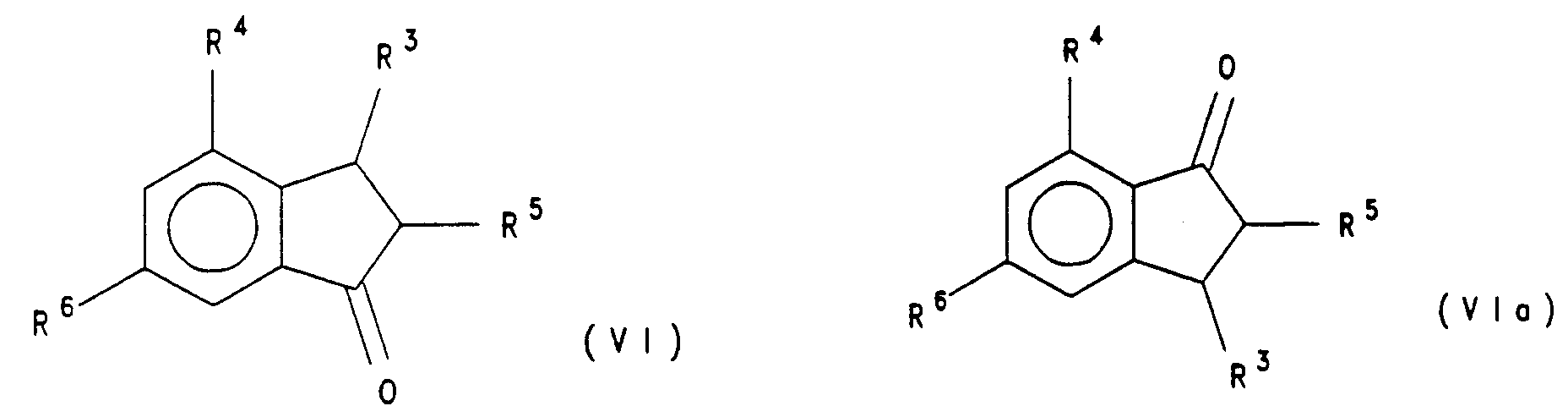
Die Indanone können in Abhängigkeit des Substitutionsmusters am Aromaten in Form zweier Konstitutionsisomere der Formel VI bzw. VIa anfallen. Diese können in reiner Form oder als Gemisch nach literaturbekannten Methoden mit Reduktionsmitteln wie NaBH₄ oder LiAIH₄ zu den entsprechenden Indanolen reduziert und anschließend mit Säuren wie Schwefelsäure, Oxalsäure, p-Toluolsulfonsäure oder auch durch Behandlung mit wasserentziehenden Substanzen wie Magnesiumsulfat, Natriumsulfat, Aluminiumoxid, Kieselgel oder Molekularsiebe zu Indenen der Formel VII bzw. VIIa (H₂Rc/H₂Rd) dehydratisiert werden (Bull. Soc. Chim. Fr. 11(1973) 3092; Organomet. 9 (1990) 3098 und die Ausführungsbeispiele).
Geeignete Friedel-Crafts-Katalysatoren sind z.B. AlCl₃, AlBr₃, FeCl₃, SbCl₅, SnCl₄, BF₃, TiCl₄, ZnCl₂, HF, H₂SO₄, Polyphosphorsäure, H₃PO₄ oder eine AlCl₃/NaCl-Schmelze; insbesondere AlCl₃. - Die Ausgangsverbindungen der Formeln IV und V sind bekannt und im Handel erhältlich, oder sie lassen sich nach literaturbekannten Verfahren herstellen.
- Die Umsetzung wird in einem inerten Lösemittel durchgeführt. Bevorzugt wird Methylenchlorid oder CS₂ eingesetzt. Sind die Ausgangskomponenten flüssig, kann auch auf ein Lösemittel verzichtet werden.
- Die Molverhältnisse der Ausgangsverbindungen einschließlich des Friedel-Crafts-Katalysators können innerhalb weiter Grenzen schwanken. Bevorzugt ist das Molverhältnis von Verbindung I:II:Katalysator = 1:0,5-1,5:1-5; insbesondere 1:1:2,5-3.
- Die Reaktionstemperatur beträgt bevorzugt 0°C bis 130°C, insbesondere 25°C bis 80°C.
- Die Reaktionszeiten schwanken in der Regel zwischen 30 min und 100 h, vorzugsweise zwischen 2 h und 30 h.
- Bevorzugt wird eine Mischung der Verbindungen IV und V vorgelegt und der Friedel-Crafts-Katalysator zudosiert. Auch die umgekehrte Zugabefolge ist möglich.
- Die Indanone der Formel VI bzw. VIa können durch Destillation, Säulenchromatographie oder Kristallisation gereinigt werden.
- Die substituierten Indene können als Doppelbindungsisomere anfallen (VII/VIIa). Diese können von Nebenprodukten durch Destillation, Säulenchromatographie oder Kristallisation gereinigt werden.
- Ausgehend von den Indenen der Formeln VII und VIIa, die als Isomerengemisch eingesetzt werden können, verläuft die Herstellung der Metallocene I nach literaturbekannten Verfahren (vgl. AU-A-31478/89, J. Organomet. Chem. 342 (1988) 21, EP-A 284 707 und die Ausführungsbeispiele) entsprechend dem angegebenen Reaktionsschema.
- Erfindungsgemäß wird als Cokatalysator bevorzugt ein Aluminoxan der Formel (II)

für den linearen Typ und/oder der Formel (III)
für den cyclischen Typ verwendet, wobei in den Formeln (II) und (III) die Reste R¹⁴ gleich oder verschieden sein können und eine C₁-C₆-Alkylgruppe, eine C₆-C₁₈-Arylgruppe, Benzyl oder Wasserstoff bedeuten, und p eine ganze Zahl von 2 bis 50, bevorzugt 10 bis 35 bedeutet. - Bevorzugt sind die Reste R¹⁴ gleich und bedeuten Methyl, Isobutyl, Phenyl oder Benzyl, besonders bevorzugt Methyl.
- Sind die Reste R¹⁴ unterschiedlich, so sind sie bevorzugt Methyl und Wasserstoff oder alternativ Methyl und Isobutyl, wobei Wasserstoff bzw. Isobutyl bevorzugt zu 0,01 - 40 % (Zahl der Reste R¹⁴) enthalten sind.
- Das Aluminoxan kann auf verschiedene Arten nach bekannten Verfahren hergestellt werden. Eine der Methoden ist beispielsweise, daß eine Aluminiumkohlenwasserstoffverbindung und/oder eine Hydridoaluminiumkohlenwasserstoffverbindung mit Wasser (gasförmig, fest, flüssig oder gebunden - beispielsweise als Kristallwasser) in einem inerten Lösungsmittel (wie z.B. Toluol) umgesetzt wird. Zur Herstellung eines Aluminoxans mit veschiedenen Alkylgruppen R¹⁴ werden entsprechend der gewünschten Zusammensetzung zwei verschiedene Aluminiumtrialkyle (AlR₃ + AlR'₃) mit Wasser umgesetzt (vgl. S. Pasynkiewicz, Polyhedron 9 (1990) 429 und EP-A 302 424).
- Die genaue Struktur der Aluminoxane II und III ist nicht bekannt.
- Unabhängig von der Art der Herstellung ist allen Aluminoxanlösungen ein wechselnder Gehalt an nicht umgesetzter Aluminiumausgangsverbindung, die in freier Form oder als Addukt vorliegt, gemeinsam.
- Es ist möglich, das Metallocen vor dem Einsatz in der Polymerisationsreaktion mit einem Aluminoxan der Formel (II) und/oder (III) vorzuaktivieren. Dadurch wird die Polymerisationsaktivität deutlich erhöht und die Kornmorphologie verbessert.
- Die Voraktivierung der Übergangsmetallverbindung wird in Lösung vorgenommen. Bevorzugt wird dabei das Metallocen in einer Lösung des Aluminoxans in einem inerten Kohlenwasserstoff aufgelöst. Als inerter Kohlenwasserstoff eignet sich ein aliphatischer oder aromatischer Kohlenwasserstoff. Bevorzugt wird Toluol verwendet.
- Die Konzentration des Aluminoxans in der Lösung liegt im Bereich von ca. 1 Gew.-% bis zur Sättigungsgrenze, vorzugsweise von 5 bis 30 Gew.-%, jeweils bezogen auf die Gesamtlösung. Das Metallocen kann in der gleichen Konzentration eingesetzt werden, vorzugsweise wird es jedoch in einer Menge von 10⁻⁴ - 1 mol pro mol Aluminoxan eingesetzt. Die Voraktivierungszeit beträgt 5 Minuten bis 60 Stunden, vorzugsweise 5 bis 60 Minuten. Man arbeitet bei einer Temperatur von -78°C bis 100°C, vorzugsweise 0 bis 70°C.
- Das Metallocen kann auch vorpolymerisiert oder auf einen Träger aufgebracht werden. Zur Vorpolymerisation wird bevorzugt das (oder eines der) in der Polymerisation eingesetzte(n) Olefin(e) verwendet.
- Geeignete Träger sind beispielsweise Silikagele, Aluminiumoxide, festes Aluminoxan oder andere anorganische Trägermaterialien. Ein geeignetes Trägermaterial ist auch ein Polyolefinpulver in feinverteilter Form.
- Erfindungsgemäß können an Stelle oder neben eines Aluminoxans Verbindungen der Formeln RxNH4-xBR'₄, RxPH4-xBR'₄, R₃CBR'₄ oder BR'₃ als geeignete Cokatalysatoren verwendet werden. In diesen Formeln bedeutet x eine Zahl von 1 bis 4, bevorzugt 3, die Reste R sind gleich oder verschieden, bevorzugt gleich, und bedeuten C₁-C₁₀-Alkyl, C₆-C₁₈-Aryl oder 2 Reste R bilden zusammen mit dem sie verbindenden Atom einen Ring, und die Reste R' sind gleich oder verschieden, bevorzugt gleich, und stehen für C₆-C₁₈-Aryl, das durch Alkyl, Haloalkyl oder Fluor substituiert sein kann.
- Insbesondere steht R für Ethyl, Propyl, Butyl oder Phenyl und R' für Phenyl, Pentafluorphenyl, 3,5-Bistrifluormethylphenyl, Mesityl, Xylyl oder Tolyl (vgl. EP-A 277 003, EP-A 277 004 und EP-A 426 638).
- Bei Verwendung der obengenannten Cokatalysatoren besteht der eigentliche (aktive) Polymerisationskatalysator aus dem Reaktionsprodukt von Metallocen und einer der genannten Verbindungen. Daher wird zunächst dieses Reaktionsprodukt bevorzugt außerhalb des Polymerisationsreaktors in einem separaten Schritt unter Verwendung eines geeigneten Lösungsmittels hergestellt.
- Prinzipiell ist als Cokatalysator erfindungsgemäß jede Verbindung geeignet, die aufgrund ihrer Lewis-Acidität das neutrale Metallocen in ein Kation überführen und dieses stabilisieren kann ("labile Koordination"). Darüberhinaus soll der Cokatalysator bzw. das aus ihm gebildete Anion keine weiteren Reaktionen mit dem gebildeten Metallocenkation eingehen (vgl. EP-A 427 697).
- Zur Entfernung von im Olefin vorhandener Katalystorgifte ist eine Reinigung mit einem Aluminiumalkyl, beispielsweise AlMe₃ oder AlEt₃ vorteilhaft. Diese Reinigung kann sowohl im Polymerisationssystem selbst erfolgen, oder das Olefin wird vor der Zugabe in das Polymerisationssystem mit der Al-Verbindung in Kontakt gebracht und anschließend wieder abgetrennt.
- Die Polymerisation oder Copolymerisation wird in bekannter Weise in Lösung, in Suspension oder in der Gasphase, kontinuierlich oder diskontinuierlich, ein- oder mehrstufig bei einer Temperatur von -60 bis 200°C, vorzugsweise 30 bis 80°C, besonders bevorzugt 50 bis 80°C, durchgeführt. Polymerisiert oder copolymerisiert werden Olefine der Formel Ra-CH=CH-Rb. In dieser Formel sind Ra und Rb gleich oder verschieden und bedeuten ein Wasserstoffatom oder einen Alkylrest mit 1 bis 14 C-Atomen. Ra und Rb können jedoch auch mit den sie verbindenden C-Atomen einen Ring bilden. Beispiele für solche Olefine sind Ethylen, Propylen, 1-Buten, 1-Hexen, 4-Methyl-1-penten, 1-Octen, Norbornen oder Norbonadien. Insbesondere werden Propylen und Ethylen polymerisiert.
- Als Molmassenregler und/oder zur Aktivitätserhöhung wird, falls erforderlich, Wasserstoff zugegeben. Der Gesamtdruck im Polymerisationssystem beträgt 0,5 bis 100 bar. Bevorzugt ist die Polymerisation in dem technisch besonders interessanten Druckbereich von 5 bis 64 bar.
- Dabei wird das Metallocen in einer Konzentration, bezogen auf das Übergangsmetall, von 10⁻³ bis 10⁻⁸, vorzugsweise 10⁻⁴ bis 10⁻⁷ mol Übergangsmetall pro dm³ Lösemittel bzw. pro dm³ Reaktorvolumen angewendet. Das Aluminoxan wird in einer Konzentration von 10⁻⁵ bis 10⁻¹ mol, vorzugsweise 10⁻⁴ bis 10⁻² mol pro dm³ Lösemittel bzw. pro dm³ Reaktorvolumen verwendet. Die anderen genannten Cokatalysatoren werden in etwa äquimolaren Mengen zum Metallocen verwendet. Prinzipiell sind aber auch höhere Konzentrationen möglich.
- Wenn die Polymerisation als Suspensions- oder Lösungspolymerisation durchgeführt wird, wird ein für das Ziegler- Niederdruckverfahren gebräuchliches inertes Lösemittel verwendet. Beispielsweise arbeitet man in einem aliphatischen oder cycloaliphatischen Kohlenwasserstoff; als solcher sei beispielsweise Propan, Butan, Pentan, Hexan, Heptan, Isooctan, Cyclohexan, Methylcyclohexan, genannt.
- Weiterhin kann eine Benzin- bzw. hydrierte Dieselölfraktion benutzt werden. Brauchbar ist auch Toluol. Bevorzugt wird im flüssigen Monomeren polymerisiert.
- Werden inerte Lösemittel verwendet, werden die Monomeren gasförmig oder flüssig zudosiert.
- Die Dauer der Polymerisation ist beliebig, da das erfindungsgemaß zu verwendende Katalysatorsystem einen nur geringen zeitabhängigen Abfall der Polymerisationsaktivität zeigt.
- Das erfindungsgemäße Verfahren zeichnet sich dadurch aus, daß die beschriebenen Metallocene im technisch besonders interessanten Temperaturbereich zwischen 50 und 80°C Polymere mit hoher Molmasse, hoher Stereospezifität und guter Kornmorphologie erzeugen.
- Insbesondere die erfindungsgemäßen Zirkonocene stoßen in einen Molmassenbereich vor, oder übertreffen diesen sogar, der beim bisherigen Stand der Technik den Hafnocenen vorbehalten war. Diese hatten jedoch den Nachteil nur geringer Polymerisationsaktivität und sehr hoher Katalysatorkosten und die damit hergestellten Polymeren wiesen eine schlechte Pulvermorphologie auf.
- Die nachfolgenden Beispiele sollen die Erfindung näher erläutern.
- Es bedeuten:

- Eine Lösung von 34,4 g (324 mmol) m-Xylol (99 %) und 74 g (324 mmol) 2-Bromisobuttersäurebromid (98 %) in 600 ml Methylenchlorid p. a. wurde bei Raumtemperatur unter kräftigem Rühren über einen Feststoffdosiertrichter langsam mit 107 g (810 mmol) AlCl₃ versetzt, wobei eine heftige Gasentwicklung einsetzte. Die Mischung wurde 15 h bei Raumtemperatur gerührt, auf Eiswasser gegossen, das mit 25 ml konz. HCl angesäuert wurde und mehrmals ausgeethert. Die vereinigten organischen Phasen wurden zunächst mit einer gesättigten NaHCO₃₋ Lösung und dann mit einer gesättigten NaCl-Lösung gewaschen und mit Magnesiumsulfat getrocknet. Das nach Abziehen des Lösemittels unter vermindertem Druck zurückgebliebene Öl wurde über eine kurze Destillationsbrücke destilliert. Bei 81-90°C/0,1-0,2 mbar gingen 52,4 g des Indanons 1 in Form eines farblosen Öls über, das bei Raumtemperatur kristallisierte. Die Ausbeute betrug 93 %.
¹H-NMR-Spektrum (100 MHz, CDCl₃): 7,05 (1,s), 6,87 (1,s), 3,25 (1,q), 2,43-2,80 (2,m), 2,57 (3,s), 2,35 (3,s), 1,25 (3,d).
Massenspektrum: 174 M⁺, korrektes Zerfallsmuster. - 20,4 g (117 mmol) 2,5,7-Trimethyl-1-indanon (1) wurden in 300 ml einer Mischung aus Tetrahydrofuran/Methanol (2:1) gelöst und bei Raumtemperatur mit 6,6 g (175 mmol) NaBH₄ versetzt. Die Mischung wurde noch 1 h gerührt, mit 50 ml halbkonz. HCl versetzt und ausgeethert. Die vereinigten organischen Phasen wurden über Natriumsulfat getrocknet und vom Lösemittel befreit. Der Rückstand wurde in eine Destillationsapparatur überführt und mit 13 g Magnesiumsulfat versetzt. Es wurde ein Vakuum von ca. 10 mbar angelgt und hochgeheizt, bis das Produkt überdestillierte (130-150°C). Die Destillation ergab 17,7 g des Indens 2 als farbloses Öl. Die Ausbeute betrug 96 %.
Massenspektrum: 158 M⁺, korrektes Zerfallsmuster. - Eine Lösung von 84,8 g (523 mmol) 1,3-Diisopropylbenzol und 120 g (523 mmol) 2-Bromisobuttersäurebromid (98 %) in 600 ml Methylenchlorid p. a. wurde bei Raumtemperatur über einen Feststoffdosiertrichter langsam mit 174 g (1300 mmol) AlCl₃ versetzt. Die Mischung wurde noch 20 h zum Rückfluß erhitzt und dann analog Beispiel A aufgearbeitet. Das Rohprodukt wurde an 3 kg Kieselgel 60 chromatographiert. Die Indanone 3 und 3a konnten mit einem Laufmittelgemisch aus Hexan/15 % Essigester separat eluiert werden. Mit dem gleichen Laufmittel folgte in einer weiteren Zone als Nebenprodukt die Verbindung 2-Methyl-5-isopropyl-1-indanon. Eine Trennung der beiden Isomere ist für die weiteren Umsetzungen jedoch nicht erforderlich. Die Gesamtausbeute betrug 93 g (78 %). ¹H-NMR-Spektrum (360 MHz, CDCl₃): Isomerenmischung (3:2) 7,49 (d), 7,36 (d), 7,13 (s), 7,10 (s), 4,15 (sept.), 3,25-3,40 (m), 3,10 (sept.), 2,90-3,00 (m), 2,60-2,73 (m), 1,22-1,30 (m).
Massenspektrum: 230 M⁺, korrektes Zerfallsmuster. - Eine Lösung von 78,5 g (341 mmol) der Isomerenmischung 3/3a in 700 ml eines Lösemittelgemisches aus Tetrahydrofuran/Methanol p.a. (2:1) wurde bei Raumtemperatur mit 19,3 g (511 mmol) NaBH₄ versetzt. Nach 2 h Rühren bei Raumtemperatur wurden 120-130 ml halbkonz. HCl zugesetzt und ausgeethert. Die vereinigten organischen Phasen wurden mit Na₂SO₄ getrocknet. Der nach Abziehen des Lösemittels verbliebene Rückstand wurde in 500 ml Methylenchlorid aufgenommen und mit 6,5 g (34 mmol) p-Toluolsulfonsäure 15 min zum Rückfluß erhitzt. Der nach Abziehen des Lösemittels verbliebene Rückstand wurde an 1,5 kg Kieselgel 60 chromatographiert. Mit einem Laufmittelgemisch aus Hexan/Diisopropylether 20:1 ließen sich 56 g der Isomerenmischung 4/4a in Form eines farblosen Öls isolieren. Die Gesamtausbeute betrug 86 %.
¹H-NMR-Spektrum (100 MHz, CDCl₃): Doppelbindungsisomere (1:1) 7,1 (m), 6,95 (m), 6,60 (m), 6,43 (m), 3,25 (br), 2,75-3,20 (m), 2,12 (d), 1,28 (d), 1,25 (d).
Massenspektrum: 214 M⁺, korrektes Zerfallsmuster. - Eine Lösung von 78,5 g (341 mmol) der Isomerenmischung 3/3a in 700 ml eines Lösemittelgemisches aus Tetrahydrofuran/Methanol p.a. (2:1) wurde bei Raumtemperatur mit 19,3 g (511 mmol) NaBH₄ versetzt. Nach 2 h Rühren bei Raumtemperatur wurden 120-130 ml halbkonz. HCl zugesetzt und ausgeethert. Die vereinigten organischen Phasen wurden mit Na₂SO₄ getrocknet. Der nach Abziehen des Lösemittels verbliebene Rückstand wurde in eine Destillationsapparatur überführt und mit 50 g Magnesiumsulfat versetzt. Nach Anlegen eines Vakuums von ca. 1 mbar wurde hochgeheizt, bis das Produkt überging (ca. 130°C). Man erhielt 65 g der Isomerenmischung 4/4a als farbloses Öl. Die Ausbeute betrug 90 %.
- Eine Lösung von 4,9 g (22,8 mmol) der Isomerenmischung 4/4a in 25 ml THF wurde bei 0°C unter Ar-Schutz mit 9,2 ml (22,8 mmol) einer 2,5 M Butyllithiumlösung in Hexan versetzt und noch 1 h zum Rückfluß erhitzt. Die rote Lösung wurde anschließend bei Raumtemperatur zu einer Lösung von 1,5 g (11,4 ml) Dimethyldichlorsilan in 10 ml THF getropft und 8 h unter Rückfluß erhitzt. Der Ansatz wurde auf Eiswasser gegossen und ausgeethert. Die über Magnesiumsulfat getrocknete Etherphase wurde unter vermindertem Druck eingedampft. Das zurückgebliebene gelbliche Öl wurde anschließend an 500 g Kieselgel 60 chromatographiert. Mit einem Laufmittelgemisch aus Hexan/5 % Methylenchlorid konnten zunächst 1,4 g der Indenmischung 4/4a eluiert werden. Mit Hexan/8 % Methylenchlorid folgte das Ligandsystem 11. Das nach Abziehen des Laufmittels verbliebene viskose Öl konnte durch Verrühren mit Methanol im Eisbad kristallisiert werden. Es wurden 3,1 g eines gelblichen Feststoffs erhalten. Die Ausbeute betrug 56 % bzw. 84 % bezüglich umgesetztem Inden.
¹H-NMR-Spektrum (100 MHz, CDCl₃): Doppelbindungsisomere (3:1) 6,82-7,32 (m), 6,70 (m), 6,62 (m), 6,52 (m), 3,75 (s,br), 3,65 (s,br), 3,35 (s), 2,70-3,30 (m), 2,05-2,25 (m), 1,10-1,45 (m), 0,10-0,22 (m), -0,15 bis -0,32 (m).
Massenspektrum: 484 M⁺, korrekter Zerfall. - Eine Lösung von 3,1 g (6,5 mmol) des Ligandsystems 5 in 25 ml Diethylether wurde bei Raumtemperatur unter Ar-Schutz mit 6,3 ml (16,2 mmol) einer 2,5 M Butyllithiumlösung in Hexan versetzt und über Nacht gerührt. Nach Zusatz von 10 ml Hexan wurde die beigefarbene Suspension filtriert und der Rückstand mit 20 ml Hexan gewaschen. Das Dilithiosalz wurde lange im Ölpumpenvakuum getrocknet und dann bei -78°C zu einer Suspension von 1,6 g (6,8 mmol) ZrCl₄ in 30 ml Methylenchlorid gegeben. Die Mischung wurde innerhalb 1 h auf Raumtemperatur erwärmt und noch 30 min bei dieser Temperatur gerührt. Nach dem Abziehen des Lösemittels wurde der orangebraune Rückstand mit 50 ml Hexan extrahiert. Nach Abziehen des Lösemittels erhielt man 2,6 g (60 %) des Komplexes 12 in Form eines gelben Pulvers. Das Verhältnis des Racemats zur meso-Form war 3:1. Durch Umkristallisation aus Hexan konnten 1,3 g (30 %) des Komplexes 12 als reines Racemat gewonnen werden (gelbes Kristallpulver). ¹H-NMR-Spektrum (100 MHz, CDCl₃): 7,27 (2,s,Arom.-H), 7,05 (2,s,Arom.-H), 6,80 (2,s,ß-Ind-H), 2,6-3,2 (4,m,i-Pr-CH), 2,22 (6,s,Ind-CH₃), 1,15-1,40 (30,m,i-Pr-CH₃, Si-CH₃). Massenspektrum: 642 M⁺ (bzgl.⁹⁰Zr), korrektes Isotopenmuster, korrekter Zerfall.
- Eine Lösung von 10,1 g (64 mmol) des Indens 2 in 50 ml THF wurde bei Raumtemperatur unter Ar-Schutz mit 25,5 ml (63,7 mmol) einer 2,5 M Butyllithiumlösung in Hexan versetzt und 1 h zum Rückfluß erhitzt. Die so erhaltene Lösung wurde bei Raumtemperatur zu einer Lösung von 4,1 g (32 mmol) Dimethyldichlorsilan in 20 ml THF getropft und 3 h zum Rückfluß erhitzt. Die Reaktionsmischung wurde auf Eiswasser gegossen und mehrmals ausgeethert. Die vereinigten organischen Phasen wurden über Natriumsulfat getrocknet und unter vermindertem Druck eingedampft. Der Rückstand wurde an 450 g Kieselgel 60 chromatographiert. Mit einem Laufmittelgemisch aus Hexan/5 % Methylenchlorid ließen sich zunächst 2,5 g des Indens 2 eluieren. Mit Hexan/8 % Methylenchlorid folgten 6,5 g des Ligandsystems 7 (Isomere). Die Ausbeute betrug 54 % bzw. 72 % bezüglich umgesetztem Inden 2.
- Eine Lösung von 2,0 g (5,4 mmol) des Ligandsystems 7 in 30 ml Diethylether wurde bei Raumtemperatur unter Ar-Schutz mit 6,6 ml (16,2 mmol) einer 2,5 M Butyllithiumlösung in Hexan versetzt und 5-6 h bei dieser Temperatur gerührt. Die Lösung wurde vollständig eingedampft. Der verbleibende feste Rückstand wurde portionsweise mit insgesamt 30 ml Hexan gewaschen und lange im Ölpumpenvakuum getrocknet. Das so erhaltene beigefarbene Pulver wurde bei - 78°C zu einer Suspension von 1,23 g (5,5 mmol) Zirkontetrachlorid in 30 ml Methylenchlorid gegeben. Nach dem Aufwärmen auf Raumtemperatur wurde die Reaktionsmischung vollständig eingedampft und im Ölpumpenvakuum getrocknet. Der feste Rückstand bestand aus einer Mischung der racemischen mit der meso-Form im Verhältnis 1:1. Dieser wurde zunächst mit einer kleinen Menge Hexan gewaschen. Anschließend wurde mit insgesamt 120 ml Toluol extrahiert. Die Lösung wurde eingeengt und bei -35°C der Kristallisation überlassen. Es ließen sich 800 mg (28 %) des Zirkonocens 8 als reines Racemat in Form orangefarbener Kristalle gewinnen.
¹H-NMR-Spektrum des Racemats (100 MHz, CDCl₃): 7,20 (s,2,Arom.-H), 6,97 (s,2,Arom.-H), 6,70 (s,2,ß-Ind-H), 2,32 (s,6,CH₃), 2,27 (s,6,CH₃), 2,20 (s,6,CH₃), 1,27 (s,6,Si-CH₃).
Massenspektrum: 530 M⁺ (bzgl. ⁹⁰Zr), korrektes Isotopenmuster, korrekter Zerfall. - Eine Lösung von 10 g (46 mmol) des Indens 4/4a in 200 ml THF wurde unter Ar-Schutz bei Raumtemperatuzr mit 18,6 ml (46 mmol) einer 2,5 M Butyllithiumlösung in Hexan versetzt und 1 h zum Rückfluß erhitzt. Die Lösung wurde bei Raumtemperatur zu einer Lösung von 4,48 g (23 mmol) Methylphenyldichlorsilan in 30 ml THF getropft und 3 h zum Rückfluß erhitzt. Die Mischung wurde auf Eiswasser gegossen und mehrmals ausgeethert. Die vereinigten organischen Phasen wurden mit Natriumsulfat getrocknet und eingedampft. Der Rückstand wurde an 450 g Kieselgel 60 chromatographiert. Mit einem Laufmittelgemisch aus Hexan/Methylenchlorid (10:1) konnten zunächst 1,9 g nicht umgesetztes Inden 4/4a zurückgewonnen werden. Anschließend folgten 7,4 g des Ligandsystems 9 (Isomerengemsich). Die Ausbeute betrug 57 % bzw. 73 % bezüglich umgesetztem Inden.
- Eine Lösung von 7,4 g (13,5 mmol) des Ligandsystems 9 in 30 ml Diethylether wurde bei Raumtemperatur unter Ar-Schutz mit 11,2 ml (28 mmol) einer 2,5 M Butyllithiumlösung in Hexan versetzt und 16 h bei Raumtemperatur gerührt. Nach dem Abziehen des Lösemittels wurde der verbleibende Rückstand 3-4 h bei 40-50°C getrocknet und anschließend bei -78°C zu einer Suspension von 3,2 g (13,5 mmol) Zirkontetrachlorid in 40 ml Methylenchlorid gegeben. Nach dem Aufwärmen auf Raumtemperatur wurde das Lösemittel unter vermindertem Druck abgezogen. Der verbleibende feste Rückstand wurde im Ölpumpenvakuum getrocknet und mit 100 ml Hexan extrahiert. Nach Abziehen des Lösemittels erhält man 5,4 g (55 %) des Zirkonocens 10 als Mischung der racemischen mit der meso-Form im Verhältnis 2:1 (orangebraunes Kristallpulver). Durch Umkristallisation aus Hexan ist die reine racemische Form erhältlich.
¹H-NMR-Spektrum der Isomerenmischung (100 MHz, CDCl₃): 6,6-8,2 (m,Arom.-H,β-Ind-H), 2,5-3,2 (m,i-Pr-H), 2,52 (s,CH₃), 2,32 (s,CH₃), 2,20 (s,CH₃), 1,90 (s,CH₃), 1,0-1,5 (m,i-Pr-CH₃,Si-CH₃).
Massenspektrum: 704 M⁺ (bzgl. ⁹⁰Zr), korrektes Isotopenmuster, korrekter Zerfall. - Eine Lösung von 5,0 g (23,3 mmol) des Indens 4/4a in 50 ml THF wurde unter Ar-Schutz bei Raumtemperatur mit 18,6 ml (46 mmol) einer 2,5 M Butyllithiumlösung in Hexan versetzt und 1 h zum Rückfluß erhitzt. Die Lösung wurde bei -78°C zu einer Lösung von 2,18 g (11,0 mmol) 1,2-Dibromethan gegeben. Die Lösung wurde langsam auf Raumtemperatur erwärmt und über Nacht bei dieser Temperatur gerührt. Die Mischung wurde auf Eiswasser gegossen und mehrmals ausgeethert. Die vereinigten organischen Phasen wurden mit Natriumsulfat getrocknet und eingedampft. Der Rückstand wurde an 450 g Kieselgel 60 chromatographiert. Mit einem Laufmittelgemisch aus Hexan/Methylenchlorid (20:1 bis 10:1) konnten zunächst 1,2 g nicht umgesetztes Inden 4/4a zurückgewonnen werden. Anschließend folgten 1,7 g des Ligandsystems 11 (farbloser Feststoff). Die Ausbeute betrug 35 % bzw. 45 % bezüglich umgesetztem Inden.
- Eine Lösung von 1,6 g (3,52 mmol) des Ligandsystems 11 in 20 ml Diethylether wurde bei Raumtemperatur unter Ar-Schutz mit 3,5 ml (8,8 mmol) einer 2,5 M Butyllithiumlösung in Hexan versetzt und über Nacht gerührt. Der nach Abziehen des Lösemittels verbleibende Rückstand wurde mit Hexan gewaschen und lange im Ölpumpenvakuum getrocknet. Das so erhaltene Pulver wurde bei -78°C zu einer Suspension von 815 mg (3,5 mmol) Zirkontetrachlorid in 15 ml Methylenchlorid gegeben. Nach dem Erwärmen auf Raumtemperatur wurde noch 1 h gerührt und das Lösemittel unter vermindertem Druck entfernt. Der im Ölpumpenvakuum getrocknete Rückstand wurde mit Toluol extrahiert. Nach Abziehen des Lösemittels und Waschen mit Hexan erhielt man 1,5 g (70 %) des Zirkonocens 18 als Mischung der racemischen mit de meso-Form im Verhältnis 2:1 (orangefarbenes Pulver). Durch Umkristallisation aus einem Toluol/Hexan-Gemisch ließen sich 700 mg (32 %) des reinen Racemats gewinnen.
¹H-NMR-Spektrum des Racemats (100 MHz,CDCl₃): 7,3 (s,Arom.-H), 7,0 (s,Arom.-H), 6,55 (s,ß-Ind-H), 3,6 (s,C₂H₄), 2,6-3,2 (m,i-Pr-H), 2,2 (s,CH₃), 1,0-1,5 (m,i-Pr-CH₃)
Massenspektrum: 612 M⁺ (bzgl. ⁹⁰Zr), korrektes Isotopenmuster, korrekter Zerfall. - Eine Lösung von 5,0 g (23,3 mmol) des Indens 4/4a wurde analog Beispiel M mit 2,37 g (11 mmol) 1,2-Dibrombutan (97 %) umgesetzt. Die Chromatographie an Kieselgel lieferte mit Hexan als Laufmittel nach Edukt und einem Nebenprodukt (Spiroverbindung) 1,16 g (22 %) des Liganden 13 als Isomerengemisch. Die Isomere konnten durch eine nochmalige Chromatographie an einer langen Säule getrennt bzw. angereichert werden.
- Eine Lösung von 1,0 g (2,07 mmol) des Ligandsystems 13 (2 Isomere) in 15 ml Diethylether wurde analog Beispiel N umgesetzt. Die Umkristallisation aus Toluol/Hexan-Mischungen lieferte bei -35°C insgesamt 1,24 g (60 %) des Metallocens 14 als Mischung der verschiedenen Diastereomere der racemischen und der meso-Form. Durch nochmalige Umkristallisation konnte das Racemat 14 als 2 Diastereomere erhalten werden.
¹H-NMR-Spektrum (100 MHz, CDCl₃): 7,0-7,4 (m,Aromaten-H) 6,5 und 6,6 (s,β-Ind-H), 3,3-3,7 (m,C₂H₃), 1,0-2,8 (m,CH₃,i-Pr, C₂H₅). Massenspektrum: 640 M⁺, korrektes Isotopenmuster, korrekter Zerfall. - Ein trockener 24 dm³-Reaktor wurde mit Propylen gespült und mit 12 dm³ flüssigem Propylen befüllt. Dann wurden 35 cm³ toluolische Methylaluminoxanlösung (entsprechend 52 mmol Al, mittlerer Oligomerisierungsgrad p = 20) Zugegeben und der Ansatz bei 30°C 15 Minuten gerührt.
- Parallel du wurden 3,5 mg (0,005 mmol) rac-Dimethylsilyl (2-methyl-4,6-diisopropyl-1-indenyl)₂ zirkondichlorid in 13,5 cm³ toluolischer Methylaluminoxanlösung (20 mmol Al) gelöst und durch 15 minütiges Stehenlassen voraktiviert.
- Die weinrote Lösung wurde dann in den Reaktor gegeben, durch Wärmezufuhr auf 75°C aufgeheirt (10°C/min) und das Polymerisationssystem 1 h durch Kühlung bei 75°C gehalten. Gestoppt wurde die Polymerisation durch Abgasen des überschüssigen Monomeren. Es wurden 2,11 kg Polypropylen erhalten. Die Aktivität des Metallocens betrug somit 603 kgPP/g Metallocen x h.
VZ = 259 cm³/g, Mw = 305 000 g/mol; Mw/Mn = 2,0;
II = 96,0 %, MFI (230/5) = 8,5 dg/min. - Beispiel 1 wurde mit dem Metallocen rac-Dimethylsilyl(2-methyl-1-indenyl)₂ zirkondichlorid wiederholt. Die Metallocenaktivität war 395 kg PP/g Metallocen x h, VZ = 159 cm³/g, Mw = 158 000 g/mol, Mw/Mn = 2,1 und der MFI (230/5) war 48 dg/min. Der isotaktische Index (II) betrug 96,0 %.
- Beispiel 1 wurde mit dem Metallocen rac-Dimethylsilyl(2-methyl-4-isopropyl-1-indenyl)₂zirkondichlorid wiederholt. Die Metallocenaktivität war 460 kg PP/g Metallocen x h, VZ = 152 cm³/g, Mw = 147 500 g/mol, Mw/Mn = 2,3 und MFI (230/5) = 51 dg/min.
- Beispiel 1 wurde mit dem Metallocen rac-Dimethylsilyl(1-indenyl)₂zirkondichlorid wiederholt. Die Metallocenaktivität war 695 kg PP/g Metallocen x h, VZ = 31 cm³/g, Mw = 18 500 g/mol, Mw/Mn = 2,2, MFI (230/5) war nicht mehr meßbar.
- Beispiel 1 wurde mit dem Metallocen rac-Dimethylsilyl(4,7-dimethyl-1-indenyl)₂ zirkondichlorid wiederholt. Die Metallocenaktivität war 195 kg PP/g Metallocen x h, VZ = 16 cm³/g, Mw = 9 500 g/mol, Mw/Mn = 2,0, II = 87 %, der MFI (230/5) war nicht mehr meßbar.
- Die vier Vergleichsversuche Zeigen, daß mit den am Indenylliganden in unterschiedlicher Weise substituierten Metallocenen bzw. mit dem unsubstituierten Metallocen hergestellte Polypropylene deutliche Molmassenunterschiede aufweisen. Unter Einbeziehung des erfindungsgemäßen Metallocens aus Beispiel 1 reicht die Spanne vom Wachsbereich (Vergleichsbeispiel 4) bis zum sehr hochmolekularen erfindungsgemäßen Polymer (Beispiel 1).
Diese Versuche belegen die Überlegenheit der in 2,4,6-Stellung substituierten Metallocene. - Beispiel 1 wurde mit dem Metallocen rac-Dimethylsilyl(3-methyl-1-indenyl)₂ zirkondichlorid wiederholt.
Es wurde ein Polypropylen mit nicht akzeptablem isotaktischen Index und mit niedriger Molmasse erhalten. - Beispiel 1 wurde mit 5,1 mg (0,008 mmol) des Metallocens rac-Dimethylsilyl(2-methyl-4,6-diisopropyl-1-indenyl)₂zirkondichlorid wiederholt. Die Polymerisationstemperatur war 50°C. Es wurden 0,85 kg Polypropylen, entsprechend einer Metallocenaktivität von 166,7 kg PP/g Metallocen x h erhalten.
VZ = 454 cm³/g, Mw = 498 500 g/mol, Mw/Mn = 2,2, II = 97,1 %, MFI (230/5) = 1,7 dg/min. - Beispiel 1 wurde mit 4,5 mg (0,007 mmol) des Metallocens rac-Dimethylsilyl(2-methyl-4,6-diisopropyl-1-indenyl)₂-zirkondichlorid bei 60°C Polymerisationstemperatur wiederholt. Es wurden 1,34 kg Polypropylen, entsprechend einer Metallocenaktivität von 298 kg PP/g Metallocen x h erhalten.
VZ = 347 cm³/g; Mw = 444500 g/mol, Mw/Mn = 2,1; II = 97,0 %; MFI (230/5) = 3,2 dg/min, Schmp. = 145°C. - Beispiel 1 wurde mit 9,6 mg (0,015 mmol) des Metallocens rac-Dimethylsilyl(2-methyl-4,6-diisopropyl-1-indenyl)₂-zirkondichlorid bei 30°C Polymerisationstemperatur wiederholt. Diese Polymerisationstemperatur ist zwar großtechnisch weniger geeignet, der Versuch belegt jedoch das Molmassenpotential und die hohe Aktivität des Metallocens.
Es wurden 0,61 kg Polypropylen, entsprechend einer Metallocenaktivität von 63,5 kg PP/g Metallocen x h erhalten.
VZ = 645 cm³/g; Mw = 867000 g/mol, Mw/Mn = 2,1; II = 97,7 %; MFI (2320/5) = 0,26 dg/min. - Beispiel 1 wurde mit 3,3 mg (0,006 mmol) des Metallocens rac-Dimethylsilyl(2,4,6-trimethyl-1-indenyl)₂zirkondichlorid wiederholt. Es wurden 1,83 kg Polypropylen erhalten. Die Metallocenaktivität war somit 555 kg PP/g Metallocen x h.
VZ = 165 cm³/g, Mw = 186 000 g/mol; Mw/Mn = 2,0; Schmp. = 145°C; MFI (230/5) = 40 dg/min. - Beispiel 1 wurde mit 4,4 mg (0,006 mmol) des Metallocens rac-Phenyl(Methyl)silyl(2-methyl-4,6-diisopropyl-1-indenyl)₂zirkondichlorid bei 70°C Polymerisationstemperatur wiederholt. Es wurden 2,05 kg Polypropylen, entsprechend einer Metallocenaktivität von 466 kg PP/g Metallocen x h erhalten.
VZ = 263 cm³/g, Mw = 385 500 g/mol, Mw/Mn = 2,5, Schmp. = 145°C, MFI (230/5) = 8,5 dg/min. - Beispiel 6 wurde mit 7,9 mg (0,011 mmol) des Metallocens bei 50°C Polymerisationstemperatur wiederholt. Die Metallocenaktivität war 156 kg PP/g Metallocen x h.
VZ = 498 cm³/g, Mw = 586 000 g/mol, Mw/Mn = 3.0, Schmp. = 147°C, MFI (230/5) = 1,5 dg/min. - Beispiel 6 wurde mit 12,0 mg (0,017 mmol) des Metallocens bei 30°C Polymerisationstemperatur wiederholt. Die Metallocenaktivität war 58,3 kg PP/g Metallocen x h.
VZ = 811 cm³/g, Mw = 1 020 000 g/mol, Mw/Mn = 2,3, Schmp. = 148°C, MFI (230/5) = 0,2 dg/min. - Beispiel 7 wurde mit 2,8 mg des Metallocens wiederholt. In den Reaktor wurde vor der Polymerisation 24 Ndm³ Wasserstoff eindosiert. Die Metallocenaktivität war 600 kg PP/g Metallocen x h.
VZ = 30 cm³/g, Mw = 18 250 g/mol, Mw/Mn = 2,5, Schmp. = 144°C. - Beispiel 7 wurde mit 3,5 mg des Metallocens und mit 60 Ndm³ Wasserstoff wiederholt. Die Metallocenaktivität war 650 kg PP/g Metallocen x h.
VZ = 14 cm³/g, Mw = 6300 g/mol, Mw/Mn = 2,2, Schmp. = 145°C. - Die Beispiele 9 und 10 belegen die excellente Wasserstoffansprechbarkeit des Metallocens zur Einstellung einer gewünschten Molmasse. Mit geringen Mengen Wasserstoff läßt sich die Kettenlänge in weiten Grenzen bis in den Wachsbereich variieren.
- Ein trockener 150 dm³-Reaktor wurde mit Stickstoff gespült und bei 20°C mit 80 dm³ eines entaromatisierten Benzinschnittes mit dem Siedebereich 100-120°C gefüllt. Dann wurde der Gasraum durch 5-maliges Aufdrücken von 2 bar Propylen und Entspannen stickstofftrei gespült.
Nach Zugabe von 50 l flüssigem Propylen wurden 64 cm³ toluolische Methylaluminoxanlösung (entsprechend 100 mmol Al, Molmasse nach kryoskopischer Bestimmung 1050 g (mol)) zugegeben und der Reaktorinhalt auf 50°C aufgeheizt. Durch Zudosierung von Wasserstoff wurde ein Wasserstoffgehalt im Gasraum des Reaktors von 0,2 % eingestellt und später dann durch Nachdosierung während der gesamten Polymerisationszeit konstant gehalten (Überprüfung on-Line durch Gaschromatographie).
15,5 mg rac-Phenyl(Methyl)silyl(2-methyl-4,6-diisopropyl-1-indenyl)₂zirkondichlorid wurden in 32 ml toluolischer Methylaluminoxanlösung (entsprechend 50 mmol Al) gelöst und nach 15 Minuten in den Reaktor gegeben. - Durch Kühlung wurde der Reaktor 18 h bei 50°C Polymeristionstemperatur gehalten, dann wurde durch Zugabe von 2 bar CO₂-Gas die Polymerisation gestoppt und das gebildete Polymere auf einer Druckmutsche vom Suspensionsmedium abgetrennt. Die Trocknung des Produktes erfolgte 24 h bei 80°C/200 mbar. Es wurden 20,9 kg Polymerpulver, entsprechend einer Metallocenaktivität von 74,9 kg PP/g Metallocen x h erhalten.
VZ = 424 cm³/g, Mw = 518 000 g/mol, Mw/Mn = 2,0, Smp. = 149°C, MFI (230/5) = 4,1 dg/min. - Ein trockener 24 dm³-Reaktor wurde mit Propylen gespült und mit 2,4 Ndm³ Wasserstoff und 12 dm³ flüssigem Propylen befüllt. Dann wurden 35 cm³ toluolische Methylaluminoxanlösung (entsprechend 52 mmol Al, mittlerer Oligomerisierungsgrad p = 20) zugegeben.
Parallel dazu wurden 6,5 mg rac-Phenyl(Methyl)-silyl(2-methyl-4,6-diisopropyl-1-indenyl)zirkondichlorid in 13,5 cm³ toluolischer Methylaluminoxanlösung (20 mmol Al) gelöst und durch 5 minütiges Stehenlassen voraktiviert.
Die Lösung wurde dann in den Reaktor gegeben und unter kontinuierlicher Zugabe von 60 g Ethylen wurde 1 h bei 60°C polymerisiert. Die Metallocenaktivität betrug 398 kg PP/g Metallocen x h. Der Ethylengehalt des Copolymeren betrug 2,0 %.
VZ = 503 cm³/g, Mw = 384 000 g/mol, Mw/Mn = 2,0, Smp. = 139°C, laut NMR-Spektroskopie wurde das Ethylen überwiegend isoliert (statistisches Copolymer) eingebaut. - Ein trockener 150 dm³-Reaktor wurde wie in Beispiel 11 befüllt.
18,9 mg rac-Phenyl(Methyl)silyl(2-methyl-4,6-diisopropyl-1-indenyl)₂zirkondichlorid wurden in 32 ml toluolischer Methylaluminoxanlösung (50 mmol) gelöst und in den Reaktor gegeben.
Die Polymerisation erfolgte in einer 1. Stufe bei 70°C 5 Stunden lang. In einer 2. Stufe wurden dann bei 55°C 3 kg Ethylen schnell zugegeben und nach weiteren 3 h Polymerisation bei 55°C wurde mit CO₂-Gas gestoppt. Es wurden 25,9 kg Blockcopolymerpulver erhalten.
VZ = 344 cm³/g, Mw = 399 000 g/mol, Mw/Mn = 3,8, MFI (230/5) = 5,0 dg/min. - Das Blockcopolymer enthielt 10,8 Gew.-% Ethylen. Die Fraktionierung ergab einen Gehalt von 27,5 Gew.-% Ethylen/Propylen-Kautschuk. Die Glastemperatur des Kautschuks war -51 °C.
- Beispiel 1 wurde bei 70°C Polymerisationstemperatur mit 4,0 mg des Metallocens rac-1,2-Ethandiylbis(2-methyl-4,6-diisopropyl-1-indenyl)zirkondichlorid wiederholt. Die Metallocenaktivität war 529 kg PP/g Metallocen x h.
VZ = 149 cm³/g, Mw = 174 500 g/mol, Mw/Mn = 1,9, Schmp. = 141 °C, MFI (230/5) = 74 dg/min. - Beispiel 14 wurde mit 4,0 mg des Metallocens rac-1,2-Butandiylbis(2-methyl-4,6-diisopropyl-1-indenyl)zirkondichlorid wiederholt. Die Metallocenaktivität war 319 kgPP/g Metallocen x h.
VZ = 295 cm³/g, Mw = 368 500 g/mol, Mw/Mn = 2,1, Schmp. = 142°C, MFI (230/5) = 4,0 dg/min.
=PR¹¹ oder = P(O)R¹¹ ist,
wobei
Claims (8)
- Verfahren zur Herstellung eines Olefinpolymers durch Polymerisation oder Copolymerisation eines Olefins der Formel Ra-CH=CH-Rb, worin Ra und Rb gleich oder verschieden sind und ein Wasserstoffatom oder einen Kohlenwasserstoffrest mit 1 bis 14 C-Atomen bedeuten, oder Ra und Rb mit den sie verbindenden Atomen einen Ring bilden können, bei einer Temperatur von -60 bis 200°C, bei einem Druck von 0,5 bis 100 bar, in Lösung, in Suspension oder in der Gasphase, in Gegenwart eines Katalysators, welcher aus einem Metallocen als Übergangsmetallverbindung und einem Cokatalysator gebildet wird, dadurch gekennzeichnet, daß das Metallocen eine Verbindung der Formel I ist
 M¹ ein Metall der Gruppe IVb, Vb oder VIb des Periodensystems ist,R¹ und R² gleich oder verschieden sind und ein Wasserstoffatom, eine C₁-C₁₀-Alkylgruppe, eine C₁-C₁₀-Alkoxygruppe, eine C₆-C₁₀-Arylgruppe, eine C₆-C₁₀-Aryloxygruppe, eine C₂-C₁₀-Alkenylgruppe, eine C₇-C₄₀-Arylalkylgruppe, eine C₇-C₄₀-Alkylarylgruppe, eine C₈-C₄₀-Arylalkenylgruppe oder ein Halogenatom bedeuten,die Reste R³ gleich oder verschieden sind und ein Wasserstoffatom, ein Halogenatom, eine C₁-C₁₀-Alkylgruppe, die halogeniert sein kann, eine C₆-C₁₀-Arylgruppe, die halogeniert sein kann, einen -NR₂¹⁰, -SR¹⁰, -OSiR₃¹⁰, -SiR₃¹⁰ oder -PR₂¹⁰-Rest bedeuten, worin R¹⁰ ein Halogenatom, eine C₁-C₁₀-Alkylgruppe oder eine C₆-C₁₀-Arylgruppe ist,R⁴ bis R⁶ gleich oder verschieden sind und die für R³ genannte Bedeutung haben, mit der Maßgabe, daß R⁴ und R⁶ nicht Wasserstoff sind,R⁷=BR¹¹, =AIR¹¹, -Ge-, -Sn-, -O-, -S-, =SO, =SO₂, =NR¹¹, =CO,
= PR¹¹ oder = P(O)R¹¹ ist,
wobeiR¹¹, R¹² und R¹³ gleich oder verschieden sind und ein Wasserstoffatom, ein Halogenatom, eine C₁-C₁₀-Alkylgruppe, C₁-C₁₀-Fluoralkylgruppe, eine C₆-C₁₀-Arylgruppe, eine C₆-C₁₀-Fluorarylgruppe, eine C₁-C₁₀-Alkoxygruppe, eine C₂-C₁₀-Alkenylgruppe, eine C₇-C₄₀-Arylalkylgruppe, eine C₈-C₄₀-Arylalkenylgruppe, eine C₇-C₄₀-Alkylarylgruppe bedeuten oder R¹¹ und R¹² oder R¹¹ und R¹³ jeweils mit den sie verbindenden Atomen einen Ring bilden,M² Silizium, Germanium oder Zinn ist,R⁸ und R⁹ gleich oder verschieden sind und die für R¹¹ genannte Bedeutung haben undm und n gleich oder verschieden sind und null, 1 oder 2 sind, wobei m plus n null, 1 oder 2 ist. - Verfahren gemäß Anspruch 1, dadurch gekennzeichnet, daß in Formel I R³ Wasserstoff bedeutet.
- Verfahren gemäß Anspruch 1 oder 2, dadurch gekennzeichnet, daß in Formel I M¹ Zr oder Hf, R¹ und R² gleich oder verschieden sind und Methyl oder Chlor, R⁴ und R⁶ gleich oder verschieden sind und Methyl, Isopropyl, Phenyl, Ethyl oder Trifluormethyl,R⁵ Wasserstoff ist oder die für R⁴ und R⁶ genannten Bedeutengen hat, R⁷ einen Rest


- Verfahren gemäß einem oder mehreren der Ansprüche 1 bis 3, dadurch gekennzeichnet, daß als Metallocen der Formel I rac-Dimethylsilyl(2-methyl-4,6-diisopropyl-1-indenyl)₂-zirkondichlorid verwendet wird.
- Verfahren gemäß einem oder mehreren der Ansprüche 1 bis 4, dadurch gekennzeichnet, daß als Cokatalysator ein Aluminoxan der Formel (II)


wobei in den Formeln (II) und (III) die Reste R¹⁴ gleich oder verschieden sind und eine C₁-C₆-Alkylgruppe, eine C₆-C₁₈-Arylgruppe, Benzyl oder Wasserstoff bedeuten und p eine ganze Zahl von 2 bis 50 ist. - Verfahren gemäß einem oder mehreren der Ansprüche 1 bis 5, dadurch gekennzeichnet, daß als Cokatalysator Methylaluminoxan verwendet wird.
- Verfahren gemäß Anspruch 5 oder 6, dadurch gekennzeichnet, daß das Metallocen der Formel I vor dem Einsatz in der Polymerisationsreaktion mit einem Aluminoxan der Formel II und/oder III voraktiviert wird.
- Verwendung eines Metallocens der Formel I gemäß einem oder mehreren der Ansprüche 1 bis 4 als Katalysator bei der Olefinpolymerisation.
Priority Applications (1)
| Application Number | Priority Date | Filing Date | Title |
|---|---|---|---|
| EP97101673A EP0770587B1 (de) | 1991-11-30 | 1992-11-27 | Verfahren zur Herstellung einer Indenverbindung und deren Verwendung zur Herstellung eines Metallocenkatalysator |
Applications Claiming Priority (2)
| Application Number | Priority Date | Filing Date | Title |
|---|---|---|---|
| DE4139596 | 1991-11-30 | ||
| DE4139596 | 1991-11-30 |
Related Child Applications (2)
| Application Number | Title | Priority Date | Filing Date |
|---|---|---|---|
| EP97101673A Division EP0770587B1 (de) | 1991-11-30 | 1992-11-27 | Verfahren zur Herstellung einer Indenverbindung und deren Verwendung zur Herstellung eines Metallocenkatalysator |
| EP97101673.8 Division-Into | 1997-02-04 |
Publications (2)
| Publication Number | Publication Date |
|---|---|
| EP0545303A1 true EP0545303A1 (de) | 1993-06-09 |
| EP0545303B1 EP0545303B1 (de) | 1997-10-01 |
Family
ID=6446020
Family Applications (2)
| Application Number | Title | Priority Date | Filing Date |
|---|---|---|---|
| EP97101673A Expired - Lifetime EP0770587B1 (de) | 1991-11-30 | 1992-11-27 | Verfahren zur Herstellung einer Indenverbindung und deren Verwendung zur Herstellung eines Metallocenkatalysator |
| EP92120288A Expired - Lifetime EP0545303B1 (de) | 1991-11-30 | 1992-11-27 | Verfahren zur Herstellung eines hochmolekularen Olefinpolymers |
Family Applications Before (1)
| Application Number | Title | Priority Date | Filing Date |
|---|---|---|---|
| EP97101673A Expired - Lifetime EP0770587B1 (de) | 1991-11-30 | 1992-11-27 | Verfahren zur Herstellung einer Indenverbindung und deren Verwendung zur Herstellung eines Metallocenkatalysator |
Country Status (12)
| Country | Link |
|---|---|
| US (2) | US5328969A (de) |
| EP (2) | EP0770587B1 (de) |
| JP (1) | JP3464231B2 (de) |
| KR (1) | KR100261362B1 (de) |
| AT (2) | ATE321015T1 (de) |
| AU (1) | AU651914B2 (de) |
| CA (1) | CA2084015A1 (de) |
| DE (2) | DE59210004D1 (de) |
| ES (2) | ES2256866T3 (de) |
| RU (1) | RU2111211C1 (de) |
| TW (1) | TW318184B (de) |
| ZA (1) | ZA929214B (de) |
Cited By (15)
| Publication number | Priority date | Publication date | Assignee | Title |
|---|---|---|---|---|
| EP0646604A1 (de) * | 1993-10-01 | 1995-04-05 | Hoechst Aktiengesellschaft | Verfahren zur Olefinpolymerisation |
| WO1996000243A1 (en) * | 1994-06-24 | 1996-01-04 | Exxon Chemical Patents Inc. | Polymerization catalyst systems, their production and use |
| US5532396A (en) * | 1993-12-27 | 1996-07-02 | Hoechst Aktiengesellschaft | Metallocene compound |
| US5543373A (en) * | 1993-12-27 | 1996-08-06 | Hoechst Ag | Metallocene compound |
| US5585508A (en) * | 1993-11-24 | 1996-12-17 | Hoechst Ag | Metallocenes, process for their preparation and their use as catalysts |
| DE19544709A1 (de) * | 1995-11-30 | 1997-06-05 | Basf Ag | Biaxial orientierte Polypropylenfolie aus Metallocen-Polypropylen |
| EP0781783A1 (de) | 1995-12-27 | 1997-07-02 | Basf Aktiengesellschaft | Metallocenkatalysatorsysteme mit sterisch gehinderten Lewis-Basen |
| EP0784073A2 (de) | 1995-12-27 | 1997-07-16 | Hoechst Aktiengesellschaft | Folien und Schichten |
| EP0742799B1 (de) * | 1994-06-20 | 1998-08-19 | Montell Technology Company bv | Ethylen copolymere |
| EP0584609B1 (de) * | 1992-08-15 | 1999-03-10 | TARGOR GmbH | Verfahren zur Herstellung von Polyolefinen |
| RU2133758C1 (ru) * | 1993-06-30 | 1999-07-27 | Монтелл Текнолоджи Компани Б.В. | Сополимеры этилена с пропиленом, способ их получения, формованные изделия |
| WO2000039170A1 (en) * | 1998-12-30 | 2000-07-06 | Union Carbide Chemicals & Plastics Technology Corporation | Compositions of preactivated unsupported catalyst having a given concentration and methods of using them |
| RU2152421C1 (ru) * | 1994-05-19 | 2000-07-10 | Мицуи Петрокемикал Индастриз Лтд. | СПОСОБ ОЧИСТКИ α-ОЛЕФИНОВ ДЛЯ ПОЛИМЕРИЗАЦИИ И СПОСОБ ПОЛУЧЕНИЯ ПОЛИ-α-ОЛЕФИНОВ |
| RU2153507C2 (ru) * | 1994-06-24 | 2000-07-27 | Эксон Кемикэл Пейтентс Инк. | Каталитическая система для полимеризации олефинов, ее получение и способ полимеризации пропилена |
| US6355725B2 (en) | 1998-04-10 | 2002-03-12 | Chisso Corporation | Propylene-ethylene block copolymer compositions and processes for production thereof |
Families Citing this family (89)
| Publication number | Priority date | Publication date | Assignee | Title |
|---|---|---|---|---|
| US5700896A (en) * | 1988-07-30 | 1997-12-23 | Hoechst Aktiengesellschaft | Polymer having long isotactic sequences and randomly-distributed ethylene content obtained by polymerizing propylene in presence of specific catalysts |
| USRE37573E1 (en) * | 1990-11-12 | 2002-03-05 | Basell Polyolefin Gmbh | Process for the preparation of an olefin polymer using metallocenes containing specifically substituted indenyl ligands |
| US5466766A (en) * | 1991-05-09 | 1995-11-14 | Phillips Petroleum Company | Metallocenes and processes therefor and therewith |
| JP3402473B2 (ja) * | 1991-08-20 | 2003-05-06 | 日本ポリケム株式会社 | オレフィン重合用触媒 |
| TW309523B (de) * | 1991-11-30 | 1997-07-01 | Hoechst Ag | |
| TW294669B (de) * | 1992-06-27 | 1997-01-01 | Hoechst Ag | |
| JPH072936A (ja) * | 1992-07-10 | 1995-01-06 | Fina Technol Inc | アイソタクチツクポリオレフイン製造のための方法及び触媒 |
| DE59308494D1 (de) * | 1992-08-03 | 1998-06-10 | Targor Gmbh | Verfahren zur Herstellung eines Olefinpolymers unter Verwendung von Metallocenen mit speziell substituierten Indenylliganden |
| ATE198207T1 (de) * | 1992-08-03 | 2001-01-15 | Targor Gmbh | Verfahren zur herstellung eines olefinpolymers unter verwendung spezieller metallocene |
| USRE39156E1 (en) * | 1992-08-15 | 2006-07-04 | Basell Polyolefine Gmbh | Process for the preparation of polyolefins |
| DE69328996T2 (de) * | 1992-09-04 | 2000-11-16 | Bp Chemicals Ltd., London | Katalysatorzusammensetzung und Verfahren zur Herstellung von Polyolefinen |
| TW275076B (de) * | 1992-12-02 | 1996-05-01 | Hoechst Ag | |
| JPH06271594A (ja) * | 1993-03-22 | 1994-09-27 | Mitsui Petrochem Ind Ltd | シクロペンタジエニル基含有ケイ素化合物またはシクロペンタジエニル基含有ゲルマニウム化合物の製造方法 |
| DE69431222T2 (de) * | 1993-06-07 | 2003-04-17 | Mitsui Chemicals, Inc. | Übergangsmetallverbindung, und diese enthaltender Polymerisationkatalysator |
| CA2125247C (en) * | 1993-06-07 | 2001-02-20 | Daisuke Fukuoka | Transition metal compound, olefin polymerization catalyst component comprising said compound, olefin polymerization catalyst containing said catalyst component, process for olefinpolymerization using said catalyst , propylene homopolymer, propylene copolymer and propylene elastomer |
| IT1271406B (it) * | 1993-09-13 | 1997-05-28 | Spherilene Srl | Procedimento per la preparazione di polimeri dell'etilene e prodotti ottenuti |
| DE4333128A1 (de) * | 1993-09-29 | 1995-03-30 | Hoechst Ag | Verfahren zur Herstellung von Polyolefinen |
| JP3423378B2 (ja) * | 1993-11-12 | 2003-07-07 | 三井化学株式会社 | 新規な遷移金属化合物および該遷移金属化合物からなるオレフィン重合用触媒成分、該オレフィン重合用触媒成分を含むオレフィン重合用触媒ならびにオレフィンの重合方法 |
| ES2199966T3 (es) | 1994-02-21 | 2004-03-01 | Basell Polyolefine Gmbh | Lamina de varias capas poliolefinica sellable, un procedimiento para su obtencion y su empleo. |
| TW454020B (en) * | 1994-08-09 | 2001-09-11 | Mitsui Chemicals Inc | Olefin polymerization catalyst |
| US5563284A (en) * | 1994-09-09 | 1996-10-08 | Phillips Petroleum Company | Cyclopentadienyl-type ligands, metallocenes, catalyst systems, preparation, and use |
| EP0739897A1 (de) | 1995-04-27 | 1996-10-30 | Hoechst Aktiengesellschaft | Mehrkernige Metallocenverbindung, Verfahren zu ihrer Herstellung und ihre Anwendung als Katalysator |
| US6787618B1 (en) | 1995-12-01 | 2004-09-07 | Basell Polypropylen Gmbh | Metallocene compound and high molecular weight copolymers of propylene and olefins having two or four to thirty-two carbon atoms |
| US5869570A (en) * | 1996-03-19 | 1999-02-09 | Energy & Environmental International, L.C. | Composition of and process for forming polyalphaolefin drag reducing agents |
| US6015779A (en) | 1996-03-19 | 2000-01-18 | Energy & Environmental International, L.C. | Methods for forming amorphous ultra-high molecular weight polyalphaolefin drag reducing agents |
| US6225426B1 (en) * | 1996-04-10 | 2001-05-01 | Uniroyal Chemical Company, Inc. | Process for producing polyolefin elastomer employing a metallocene catalyst |
| DE19617230A1 (de) | 1996-04-30 | 1997-11-06 | Basf Ag | Oxidierte Metallocen-Polyolefin-Wachse |
| US5945365A (en) * | 1996-05-20 | 1999-08-31 | Fina Technology, Inc. | Stereorigid bis-fluorenyl metallocenes |
| US6107501A (en) * | 1997-01-30 | 2000-08-22 | Fina Technology, Inc. | Synthesis of metallocenes and enrichment of their rac isomer |
| DE19738051A1 (de) | 1997-09-01 | 1999-03-04 | Targor Gmbh | Spritzgieß-Artikel aus Metallocen-Polypropylen |
| US6784269B2 (en) | 1998-05-13 | 2004-08-31 | Exxonmobil Chemical Patents Inc. | Polypropylene compositions methods of making the same |
| EP1078009B1 (de) | 1998-05-13 | 2004-06-16 | ExxonMobil Chemical Patents Inc. | Propylenhomopolymere und herstellungsverfahren |
| US6306960B1 (en) | 1998-05-13 | 2001-10-23 | Exxonmobil Chemical Patents Inc. | Articles formed from foamable polypropylene polymer |
| EP1115761B1 (de) * | 1998-08-26 | 2013-09-18 | ExxonMobil Chemical Patents Inc. | Verzweigte polypropylenzusammensetzungen |
| US6225427B1 (en) | 1998-10-15 | 2001-05-01 | Uniroyal Chemical Company, Inc. | Olefin polymerization process employing metallocene catalyst provided by cocatalyst activation of a metallocene procatalyst |
| US6174930B1 (en) | 1999-04-16 | 2001-01-16 | Exxon Chemical Patents, Inc. | Foamable polypropylene polymer |
| US6500563B1 (en) | 1999-05-13 | 2002-12-31 | Exxonmobil Chemical Patents Inc. | Elastic films including crystalline polymer and crystallizable polymers of propylene |
| ATE412793T1 (de) | 1999-05-13 | 2008-11-15 | Exxonmobil Chem Patents Inc | Elastische fasern und daraus hergestellte artikel,die kristalline und kristallisierbare propylenpolymere enthalten |
| US6750284B1 (en) | 1999-05-13 | 2004-06-15 | Exxonmobil Chemical Patents Inc. | Thermoplastic filled membranes of propylene copolymers |
| WO2001032758A1 (en) | 1999-11-04 | 2001-05-10 | Exxon Chemical Patents Inc. | Propylene copolymer foams and their use |
| JP2003516440A (ja) * | 1999-12-10 | 2003-05-13 | エクソンモービル・ケミカル・パテンツ・インク | プロピレンジエン共重合ポリマー |
| US6809168B2 (en) * | 1999-12-10 | 2004-10-26 | Exxonmobil Chemical Patents Inc. | Articles formed from propylene diene copolymers |
| US6977287B2 (en) * | 1999-12-10 | 2005-12-20 | Exxonmobil Chemical Patents Inc. | Propylene diene copolymers |
| EP1263909A2 (de) * | 1999-12-22 | 2002-12-11 | ExxonMobil Chemical Patents Inc. | Polypropylen klebstoffe |
| CN1406241A (zh) * | 2000-02-08 | 2003-03-26 | 埃克森美孚化学专利公司 | 制备14族桥连双环戊二烯基配体的方法 |
| US6858767B1 (en) | 2000-08-11 | 2005-02-22 | Uniroyal Chemical Company, Inc. | Process for producing liquid polyalphaolefin polymer, metallocene catalyst therefor, the resulting polymer and lubricant containing same |
| ATE353379T1 (de) * | 2000-08-22 | 2007-02-15 | Exxonmobil Chem Patents Inc | Polypropylenfasern und gewebe |
| US6815011B2 (en) | 2000-11-27 | 2004-11-09 | Energy & Environmental International, L.C. | Alpha olefin monomer partitioning agents for drag reducing agents and methods of forming drag reducing agents using alpha olefin monomer partitioning agents |
| CN1310960C (zh) | 2001-01-16 | 2007-04-18 | 能源及环境国际有限公司 | 用作减阻剂的无定形超高分子量聚烯烃的形成方法 |
| US7037615B2 (en) * | 2001-02-12 | 2006-05-02 | Delphi Technologies, Inc. | Trapping method and system for energy conversion devices |
| DE10126265A1 (de) | 2001-05-29 | 2002-12-05 | Basell Polyolefine Gmbh | Verfahren zur Abreicherung von anorganischen Nebenprodukten und organometallischen Nebenprodukten bei der Herstellung von Metallocenen sowie der wirtschaftlichen Rückgewinnung der eingesetzten Edukte |
| US7012046B2 (en) * | 2001-06-08 | 2006-03-14 | Eaton Gerald B | Drag reducing agent slurries having alfol alcohols and processes for forming drag reducing agent slurries having alfol alcohols |
| CA2447769C (en) | 2001-06-13 | 2011-07-26 | Energy & Environmental International, L.C. | Bulk polymerization reactors and methods for polymerization |
| US6916892B2 (en) * | 2001-12-03 | 2005-07-12 | Fina Technology, Inc. | Method for transitioning between Ziegler-Natta and metallocene catalysts in a bulk loop reactor for the production of polypropylene |
| US20030236365A1 (en) * | 2002-06-24 | 2003-12-25 | Fina Technology, Inc. | Polyolefin production with a high performance support for a metallocene catalyst system |
| US8008412B2 (en) * | 2002-09-20 | 2011-08-30 | Exxonmobil Chemical Patents Inc. | Polymer production at supersolution conditions |
| US20080153997A1 (en) * | 2006-12-20 | 2008-06-26 | Exxonmobil Research And Engineering | Polymer production at supercritical conditions |
| US7195806B2 (en) * | 2003-01-17 | 2007-03-27 | Fina Technology, Inc. | High gloss polyethylene articles |
| JP2005099712A (ja) * | 2003-08-28 | 2005-04-14 | Sharp Corp | 表示装置の駆動回路および表示装置 |
| US20050234198A1 (en) * | 2004-04-20 | 2005-10-20 | Fina Technology, Inc. | Heterophasic copolymer and metallocene catalyst system and method of producing the heterophasic copolymer using the metallocene catalyst system |
| US7169864B2 (en) * | 2004-12-01 | 2007-01-30 | Novolen Technology Holdings, C.V. | Metallocene catalysts, their synthesis and their use for the polymerization of olefins |
| US7232869B2 (en) * | 2005-05-17 | 2007-06-19 | Novolen Technology Holdings, C.V. | Catalyst composition for olefin polymerization |
| US7868197B2 (en) | 2005-12-14 | 2011-01-11 | Exxonmobil Chemical Patents Inc. | Halogen substituted heteroatom-containing metallocene compounds for olefin polymerization |
| EP1847555A1 (de) * | 2006-04-18 | 2007-10-24 | Borealis Technology Oy | Mehrfach verzweigtes Polypropylen |
| US7601255B2 (en) | 2006-09-06 | 2009-10-13 | Chemtura Corporation | Process for removal of residual catalyst components |
| US8242237B2 (en) | 2006-12-20 | 2012-08-14 | Exxonmobil Chemical Patents Inc. | Phase separator and monomer recycle for supercritical polymerization process |
| WO2008124040A1 (en) | 2007-04-09 | 2008-10-16 | Exxonmobil Chemical Patents Inc. | Soft heterogeneous isotactic polyroplene compositions |
| JP2010529253A (ja) * | 2007-06-04 | 2010-08-26 | エクソンモービル・ケミカル・パテンツ・インク | 非常に均一なプロピレンの溶液重合法 |
| US20090053959A1 (en) * | 2007-08-21 | 2009-02-26 | Sudhin Datta | Soft and Elastic Nonwoven Polypropylene Compositions |
| US7906588B2 (en) * | 2007-10-26 | 2011-03-15 | Exxonmobil Chemical Patents Inc. | Soft heterogeneous isotactic polypropylene compositions |
| US8318875B2 (en) | 2008-01-18 | 2012-11-27 | Exxonmobil Chemical Patents Inc. | Super-solution homogeneous propylene polymerization and polypropylenes made therefrom |
| US7812104B2 (en) * | 2008-01-18 | 2010-10-12 | Exxonmobil Chemical Patents Inc. | Production of propylene-based polymers |
| US7872080B2 (en) | 2008-03-06 | 2011-01-18 | Sumitomo Chemical Company, Limited | Processes for producing a catalyst component for addition polymerization, a catalyst and an addition polymer |
| DE102008040736B4 (de) | 2008-07-25 | 2019-03-28 | Symrise Ag | Verfahren zur Herstellung Alkoxy-substituierter 1-Indanone |
| JP5181104B2 (ja) * | 2008-12-10 | 2013-04-10 | 株式会社プライムポリマー | プロピレン系ブロック共重合体 |
| SG174602A1 (en) | 2009-03-30 | 2011-11-28 | Mitsui Chemicals Inc | Copolymer of olefin and conjugated diene, and process for producing same |
| US8067652B2 (en) | 2009-08-13 | 2011-11-29 | Chemtura Corporation | Processes for controlling the viscosity of polyalphaolefins |
| JP2011213804A (ja) | 2010-03-31 | 2011-10-27 | Sumitomo Chemical Co Ltd | 予備重合方法、予備重合済付加重合触媒成分およびそれを用いる付加重合体の製造方法 |
| CN102971454B (zh) | 2010-06-15 | 2015-05-27 | 埃克森美孚化学专利公司 | 由聚合物共混物制造的非织造织物及其制造方法 |
| US9469791B2 (en) | 2011-04-28 | 2016-10-18 | Adherent Laboratories, Inc. | Polyolefin based hot melt adhesive composition |
| EP2573091A1 (de) | 2011-09-23 | 2013-03-27 | Lummus Novolen Technology Gmbh | Verfahren zur Wiedergewinnung freier Liganden aus ihren jeweiligen Metallocenkomplexen |
| JP2013082891A (ja) | 2011-09-28 | 2013-05-09 | Sumitomo Chemical Co Ltd | 洗浄方法、付加重合方法、予備重合方法、予備重合済付加重合触媒成分およびそれを用いる付加重合体の製造方法 |
| JP6295506B2 (ja) | 2011-12-07 | 2018-03-20 | 住友化学株式会社 | 界面活性剤含有粒子を用いた重合方法 |
| EP2824107B1 (de) | 2012-05-08 | 2017-01-18 | Lg Chem, Ltd. | Ansa-metallocen-verbindung und verfahren zur herstellung eines geträgerten katalysators damit |
| US20150299525A1 (en) | 2014-04-18 | 2015-10-22 | IFS Industries Inc. | Low density and high performance packaging hot melt |
| WO2020056119A1 (en) | 2018-09-14 | 2020-03-19 | Fina Technology, Inc. | Polyethylene and controlled rheology polypropylene polymer blends and methods of use |
| JP7572961B2 (ja) | 2019-02-20 | 2024-10-24 | フイナ・テクノロジー・インコーポレーテツド | 低い反りを有するポリマー組成物 |
| KR20220094212A (ko) | 2019-10-30 | 2022-07-05 | 차이나 페트로리움 앤드 케미컬 코포레이션 | 메탈로센 화합물, 및 이의 제조 방법 및 적용 |
| US12559599B2 (en) | 2021-04-26 | 2026-02-24 | Fina Technology, Inc. | Thin single-site catalyzed polymer sheets |
Citations (1)
| Publication number | Priority date | Publication date | Assignee | Title |
|---|---|---|---|---|
| EP0363029A2 (de) * | 1988-09-14 | 1990-04-11 | Mitsui Petrochemical Industries, Ltd. | Bestandteil eines Olefinpolymerisationskatalysators, Katalysator und Verfahren für die Olefinpolymerisation |
Family Cites Families (16)
| Publication number | Priority date | Publication date | Assignee | Title |
|---|---|---|---|---|
| BE754556A (fr) * | 1969-08-08 | 1971-02-08 | Merck & Co Inc | Acides indenyl-acetiques et procede pour les |
| DE2244761A1 (de) * | 1972-09-09 | 1974-03-14 | Schering Ag | Indan- und tetralinderivate |
| JPS5684748A (en) * | 1979-12-14 | 1981-07-10 | Japan Atom Energy Res Inst | Radiation-resistant resin composition |
| JPS6015655B2 (ja) * | 1979-12-14 | 1985-04-20 | 日本原子力研究所 | 難燃性高分子組成物成形体の製造方法 |
| DE3726067A1 (de) * | 1987-08-06 | 1989-02-16 | Hoechst Ag | Verfahren zur herstellung von 1-olefinpolymeren |
| DE3808268A1 (de) * | 1988-03-12 | 1989-09-21 | Hoechst Ag | Verfahren zur herstellung eines 1-olefinpolymers |
| IL89525A0 (en) * | 1988-03-21 | 1989-09-10 | Exxon Chemical Patents Inc | Silicon-bridged transition metal compounds |
| US5017714A (en) * | 1988-03-21 | 1991-05-21 | Exxon Chemical Patents Inc. | Silicon-bridged transition metal compounds |
| DE3826075A1 (de) * | 1988-07-30 | 1990-02-01 | Hoechst Ag | 1-olefin-isoblockpolymer und verfahren zu seiner herstellung |
| DE4005947A1 (de) * | 1990-02-26 | 1991-08-29 | Basf Ag | Loesliche katalysatorsysteme zur polymerisation von c(pfeil abwaerts)2(pfeil abwaerts)- bis c(pfeil abwaerts)1(pfeil abwaerts)(pfeil abwaerts)0(pfeil abwaerts)-alk-1-enen |
| US5243001A (en) * | 1990-11-12 | 1993-09-07 | Hoechst Aktiengesellschaft | Process for the preparation of a high molecular weight olefin polymer |
| DE4120009A1 (de) * | 1991-06-18 | 1992-12-24 | Basf Ag | Loesliche katalysatorsysteme zur herstellung von polyalk-1-enen mit hohen molmassen |
| DE4121368A1 (de) * | 1991-06-28 | 1993-01-07 | Hoechst Ag | Katalysator und verfahren zur herstellung von hochmolekularen polyolefinen |
| TW300901B (de) * | 1991-08-26 | 1997-03-21 | Hoechst Ag | |
| EP0537686B1 (de) * | 1991-10-15 | 2005-01-12 | Basell Polyolefine GmbH | Verfahren zur Herstellung eines Olefinpolymers unter Verwendung von Metallocenen mit speziell substituierten Indenylliganden |
| EP0549900B1 (de) * | 1991-11-30 | 1996-08-21 | Hoechst Aktiengesellschaft | Metallocene mit benzokondensierten Indenylderivaten als Liganden, Verfahren zu ihrer Herstellung und ihre Verwendung als Katalysatoren |
-
1992
- 1992-09-30 TW TW081107757A patent/TW318184B/zh active
- 1992-11-24 US US07/980,643 patent/US5328969A/en not_active Expired - Lifetime
- 1992-11-27 DE DE59210004T patent/DE59210004D1/de not_active Expired - Fee Related
- 1992-11-27 AU AU29726/92A patent/AU651914B2/en not_active Ceased
- 1992-11-27 JP JP31910092A patent/JP3464231B2/ja not_active Expired - Fee Related
- 1992-11-27 ES ES97101673T patent/ES2256866T3/es not_active Expired - Lifetime
- 1992-11-27 EP EP97101673A patent/EP0770587B1/de not_active Expired - Lifetime
- 1992-11-27 ZA ZA929214A patent/ZA929214B/xx unknown
- 1992-11-27 ES ES92120288T patent/ES2108072T3/es not_active Expired - Lifetime
- 1992-11-27 AT AT97101673T patent/ATE321015T1/de not_active IP Right Cessation
- 1992-11-27 DE DE59208944T patent/DE59208944D1/de not_active Expired - Fee Related
- 1992-11-27 AT AT92120288T patent/ATE158800T1/de not_active IP Right Cessation
- 1992-11-27 CA CA002084015A patent/CA2084015A1/en not_active Abandoned
- 1992-11-27 EP EP92120288A patent/EP0545303B1/de not_active Expired - Lifetime
- 1992-11-28 KR KR1019920022690A patent/KR100261362B1/ko not_active Expired - Fee Related
- 1992-11-30 RU RU92004481A patent/RU2111211C1/ru not_active IP Right Cessation
-
1994
- 1994-04-25 US US08/232,368 patent/US5374752A/en not_active Expired - Lifetime
Patent Citations (1)
| Publication number | Priority date | Publication date | Assignee | Title |
|---|---|---|---|---|
| EP0363029A2 (de) * | 1988-09-14 | 1990-04-11 | Mitsui Petrochemical Industries, Ltd. | Bestandteil eines Olefinpolymerisationskatalysators, Katalysator und Verfahren für die Olefinpolymerisation |
Cited By (27)
| Publication number | Priority date | Publication date | Assignee | Title |
|---|---|---|---|---|
| EP0584609B1 (de) * | 1992-08-15 | 1999-03-10 | TARGOR GmbH | Verfahren zur Herstellung von Polyolefinen |
| RU2133758C1 (ru) * | 1993-06-30 | 1999-07-27 | Монтелл Текнолоджи Компани Б.В. | Сополимеры этилена с пропиленом, способ их получения, формованные изделия |
| RU2145613C1 (ru) * | 1993-10-01 | 2000-02-20 | Хехст АГ | Способ получения полиэтилена |
| EP0646604A1 (de) * | 1993-10-01 | 1995-04-05 | Hoechst Aktiengesellschaft | Verfahren zur Olefinpolymerisation |
| US5693730A (en) * | 1993-11-24 | 1997-12-02 | Hoechst Aktiengesellschaft | Metallocenes, process for their preparation and their use as catalysts |
| US5776851A (en) * | 1993-11-24 | 1998-07-07 | Targor Gmbh | Metallocenes, process for their preparation and their use as catalysts |
| US5585508A (en) * | 1993-11-24 | 1996-12-17 | Hoechst Ag | Metallocenes, process for their preparation and their use as catalysts |
| US5612428A (en) * | 1993-12-27 | 1997-03-18 | Hoechst Aktiengesellschaft | Process for preparing olefin polymer with catalyst containing metallocene |
| US5532396A (en) * | 1993-12-27 | 1996-07-02 | Hoechst Aktiengesellschaft | Metallocene compound |
| RU2142466C1 (ru) * | 1993-12-27 | 1999-12-10 | Хехст АГ | Металлоцены, содержащая их каталитическая система, способ полимеризации олефинов, полиолефин, формованное изделие |
| US5543373A (en) * | 1993-12-27 | 1996-08-06 | Hoechst Ag | Metallocene compound |
| US5576260A (en) * | 1993-12-27 | 1996-11-19 | Hoechst Aktiengesellschaft | Metallocene-based catalysts |
| US5741868A (en) * | 1993-12-27 | 1998-04-21 | Hoechst Aktiengesellschaft | Olefin polymerization process by using a substituted indenyl containing metallocene catalyst |
| RU2152421C1 (ru) * | 1994-05-19 | 2000-07-10 | Мицуи Петрокемикал Индастриз Лтд. | СПОСОБ ОЧИСТКИ α-ОЛЕФИНОВ ДЛЯ ПОЛИМЕРИЗАЦИИ И СПОСОБ ПОЛУЧЕНИЯ ПОЛИ-α-ОЛЕФИНОВ |
| US6136936A (en) * | 1994-06-20 | 2000-10-24 | Montell Technology Company B.V. | Ethylene copolymers, process for the preparation of ethylene-based polymers and catalyst system used therein |
| EP0742799B1 (de) * | 1994-06-20 | 1998-08-19 | Montell Technology Company bv | Ethylen copolymere |
| US6664351B1 (en) | 1994-06-20 | 2003-12-16 | Basell Technology Company B.V. | Ethylene copolymers, process for the preparation of ethylene-based polymers and catalyst system used therein |
| AU685649B2 (en) * | 1994-06-24 | 1998-01-22 | Exxon Chemical Patents Inc. | Polymerization catalyst systems, their production and use |
| WO1996000243A1 (en) * | 1994-06-24 | 1996-01-04 | Exxon Chemical Patents Inc. | Polymerization catalyst systems, their production and use |
| CN1112370C (zh) * | 1994-06-24 | 2003-06-25 | 埃克森美孚化学专利公司 | 聚合催化剂体系、它们的制备和用途 |
| RU2153507C2 (ru) * | 1994-06-24 | 2000-07-27 | Эксон Кемикэл Пейтентс Инк. | Каталитическая система для полимеризации олефинов, ее получение и способ полимеризации пропилена |
| DE19544709A1 (de) * | 1995-11-30 | 1997-06-05 | Basf Ag | Biaxial orientierte Polypropylenfolie aus Metallocen-Polypropylen |
| EP0781783A1 (de) | 1995-12-27 | 1997-07-02 | Basf Aktiengesellschaft | Metallocenkatalysatorsysteme mit sterisch gehinderten Lewis-Basen |
| EP0784073A2 (de) | 1995-12-27 | 1997-07-16 | Hoechst Aktiengesellschaft | Folien und Schichten |
| US6355725B2 (en) | 1998-04-10 | 2002-03-12 | Chisso Corporation | Propylene-ethylene block copolymer compositions and processes for production thereof |
| WO2000039170A1 (en) * | 1998-12-30 | 2000-07-06 | Union Carbide Chemicals & Plastics Technology Corporation | Compositions of preactivated unsupported catalyst having a given concentration and methods of using them |
| US6624266B2 (en) | 1998-12-30 | 2003-09-23 | Union Carbide Chemicals & Plastics Technology Corporation | Compositions and methods of using preactivated unsupported catalyst compositions having a given concentration |
Also Published As
| Publication number | Publication date |
|---|---|
| ATE158800T1 (de) | 1997-10-15 |
| AU2972692A (en) | 1993-06-03 |
| EP0770587A3 (de) | 1997-08-20 |
| CA2084015A1 (en) | 1993-05-31 |
| JPH07258321A (ja) | 1995-10-09 |
| RU2111211C1 (ru) | 1998-05-20 |
| ES2256866T3 (es) | 2006-07-16 |
| KR930010061A (ko) | 1993-06-22 |
| KR100261362B1 (ko) | 2000-07-01 |
| ATE321015T1 (de) | 2006-04-15 |
| EP0770587A2 (de) | 1997-05-02 |
| DE59208944D1 (de) | 1997-11-06 |
| US5374752A (en) | 1994-12-20 |
| AU651914B2 (en) | 1994-08-04 |
| EP0545303B1 (de) | 1997-10-01 |
| EP0770587B1 (de) | 2006-03-22 |
| TW318184B (de) | 1997-10-21 |
| ZA929214B (en) | 1993-05-26 |
| JP3464231B2 (ja) | 2003-11-05 |
| DE59210004D1 (de) | 2006-05-11 |
| ES2108072T3 (es) | 1997-12-16 |
| US5328969A (en) | 1994-07-12 |
Similar Documents
| Publication | Publication Date | Title |
|---|---|---|
| EP0545303B1 (de) | Verfahren zur Herstellung eines hochmolekularen Olefinpolymers | |
| EP0549900B1 (de) | Metallocene mit benzokondensierten Indenylderivaten als Liganden, Verfahren zu ihrer Herstellung und ihre Verwendung als Katalysatoren | |
| EP0485821B1 (de) | Metallocene mit Liganden aus 2-substituierten Indenylderivaten, Verfahren zu ihrer Herstellung und ihre Verwendung als Katalysatoren | |
| EP0485823B1 (de) | 2-Substituierte Bisindenylmetallocene, Verfahren zu ihrer Herstellung und ihre Verwendung als Katalysatoren bei der Olefinpolymerisation | |
| EP0537686B1 (de) | Verfahren zur Herstellung eines Olefinpolymers unter Verwendung von Metallocenen mit speziell substituierten Indenylliganden | |
| EP0485822B1 (de) | Verfahren zur Herstellung eines hochmolekularen Olefinpolymers | |
| EP0659757B1 (de) | Metallocenverbindung | |
| EP0659756B1 (de) | Metallocenverbindung | |
| EP0399347B1 (de) | Verfahren zur Herstellung eines Syndio-Isoblockpolymeren | |
| EP0582195B1 (de) | Verfahren zur Herstellung eines Olefinpolymers unter Verwendung spezieller Metallocene | |
| EP0530647B1 (de) | Metallocene, diese enthaltende Katalysatoren und Verfahren zur Herstellung eines Olefinpolymers unter Verwendung dieser Katalysatoren | |
| EP0582194B1 (de) | Verfahren zur Herstellung eines Olefinpolymers unter Verwendung von Metallocenen mit speziell substituierten Indenylliganden | |
| EP0528287B1 (de) | Verbrückte, chirale Metallocene, Verfahren zu ihrer Herstellung und ihre Verwendung als Katalysatoren | |
| EP0722956B1 (de) | Verfahren zur Herstellung eines Olefinpolymers | |
| EP0545304B1 (de) | Verfahren zur Herstellung substituierter Indene und ihre Verwendung als Ligandsysteme für Metallocen-Katalysatoren | |
| EP0654476B1 (de) | Metallocene, Verfahren zu ihrer Herstellung und ihrer Verwendung als Katalysatoren | |
| EP0576970A1 (de) | Metallocene mit arylsubstituierten Indenylderivaten als Liganden, Verfahren zu ihrer Herstellung und ihre Verwendung als Katalysatoren | |
| EP0882731A2 (de) | Verbrückte Metallocenverbindungen und ihre Verwendung als Olefinpolymerisationskatalysatore | |
| EP0490256A1 (de) | Metallocene mit bicyclischen Cyclopentadienderivaten als Liganden, Verfahren zu ihrer Herstellung und ihre Verwendung als Katalysatoren | |
| EP0553757A1 (de) | Katalysator und Verfahren zur Polymerisation und copolymerisation von Olefinen | |
| DE4340018A1 (de) | Metallocene, Verfahren zu ihrer Herstellung und ihre Verwendung als Katalysatoren | |
| DE4344687A1 (de) | Metallocene, Verfahren zu ihrer Herstellung und ihre Verwendung als Katalysatoren | |
| DE4344708A1 (de) | Metallocene, Verfahren zu ihrer Herstellung und ihre Verwendung als Katalysatoren |
Legal Events
| Date | Code | Title | Description |
|---|---|---|---|
| PUAI | Public reference made under article 153(3) epc to a published international application that has entered the european phase |
Free format text: ORIGINAL CODE: 0009012 |
|
| AK | Designated contracting states |
Kind code of ref document: A1 Designated state(s): AT BE CH DE ES FR GB IT LI LU NL SE |
|
| 17P | Request for examination filed |
Effective date: 19930814 |
|
| 17Q | First examination report despatched |
Effective date: 19931108 |
|
| GRAG | Despatch of communication of intention to grant |
Free format text: ORIGINAL CODE: EPIDOS AGRA |
|
| GRAH | Despatch of communication of intention to grant a patent |
Free format text: ORIGINAL CODE: EPIDOS IGRA |
|
| GRAH | Despatch of communication of intention to grant a patent |
Free format text: ORIGINAL CODE: EPIDOS IGRA |
|
| GRAA | (expected) grant |
Free format text: ORIGINAL CODE: 0009210 |
|
| DX | Miscellaneous (deleted) | ||
| AK | Designated contracting states |
Kind code of ref document: B1 Designated state(s): AT BE CH DE ES FR GB IT LI LU NL SE |
|
| REF | Corresponds to: |
Ref document number: 158800 Country of ref document: AT Date of ref document: 19971015 Kind code of ref document: T |
|
| REG | Reference to a national code |
Ref country code: CH Ref legal event code: EP |
|
| REF | Corresponds to: |
Ref document number: 59208944 Country of ref document: DE Date of ref document: 19971106 |
|
| ITF | It: translation for a ep patent filed | ||
| REG | Reference to a national code |
Ref country code: ES Ref legal event code: FG2A Ref document number: 2108072 Country of ref document: ES Kind code of ref document: T3 |
|
| GBT | Gb: translation of ep patent filed (gb section 77(6)(a)/1977) |
Effective date: 19971203 |
|
| ET | Fr: translation filed | ||
| PLBE | No opposition filed within time limit |
Free format text: ORIGINAL CODE: 0009261 |
|
| STAA | Information on the status of an ep patent application or granted ep patent |
Free format text: STATUS: NO OPPOSITION FILED WITHIN TIME LIMIT |
|
| 26N | No opposition filed | ||
| PGFP | Annual fee paid to national office [announced via postgrant information from national office to epo] |
Ref country code: SE Payment date: 20011018 Year of fee payment: 10 |
|
| PGFP | Annual fee paid to national office [announced via postgrant information from national office to epo] |
Ref country code: CH Payment date: 20011019 Year of fee payment: 10 |
|
| PGFP | Annual fee paid to national office [announced via postgrant information from national office to epo] |
Ref country code: AT Payment date: 20011024 Year of fee payment: 10 |
|
| PGFP | Annual fee paid to national office [announced via postgrant information from national office to epo] |
Ref country code: LU Payment date: 20011031 Year of fee payment: 10 |
|
| REG | Reference to a national code |
Ref country code: GB Ref legal event code: IF02 |
|
| PG25 | Lapsed in a contracting state [announced via postgrant information from national office to epo] |
Ref country code: AT Free format text: LAPSE BECAUSE OF NON-PAYMENT OF DUE FEES Effective date: 20021127 Ref country code: LU Free format text: LAPSE BECAUSE OF NON-PAYMENT OF DUE FEES Effective date: 20021127 |
|
| PG25 | Lapsed in a contracting state [announced via postgrant information from national office to epo] |
Ref country code: SE Free format text: LAPSE BECAUSE OF NON-PAYMENT OF DUE FEES Effective date: 20021128 |
|
| PG25 | Lapsed in a contracting state [announced via postgrant information from national office to epo] |
Ref country code: CH Free format text: LAPSE BECAUSE OF NON-PAYMENT OF DUE FEES Effective date: 20021130 Ref country code: LI Free format text: LAPSE BECAUSE OF NON-PAYMENT OF DUE FEES Effective date: 20021130 |
|
| EUG | Se: european patent has lapsed | ||
| REG | Reference to a national code |
Ref country code: CH Ref legal event code: PL |
|
| PGFP | Annual fee paid to national office [announced via postgrant information from national office to epo] |
Ref country code: NL Payment date: 20051029 Year of fee payment: 14 |
|
| REG | Reference to a national code |
Ref country code: GB Ref legal event code: 732E |
|
| REG | Reference to a national code |
Ref country code: FR Ref legal event code: CD Ref country code: FR Ref legal event code: TP |
|
| PG25 | Lapsed in a contracting state [announced via postgrant information from national office to epo] |
Ref country code: NL Free format text: LAPSE BECAUSE OF NON-PAYMENT OF DUE FEES Effective date: 20070601 |
|
| NLV4 | Nl: lapsed or anulled due to non-payment of the annual fee |
Effective date: 20070601 |
|
| BECH | Be: change of holder |
Owner name: *NOVOLEN TECHNOLOGY HOLDINGS C.V. Effective date: 20070614 |
|
| PGFP | Annual fee paid to national office [announced via postgrant information from national office to epo] |
Ref country code: DE Payment date: 20081118 Year of fee payment: 17 |
|
| PGFP | Annual fee paid to national office [announced via postgrant information from national office to epo] |
Ref country code: ES Payment date: 20081126 Year of fee payment: 17 |
|
| PGFP | Annual fee paid to national office [announced via postgrant information from national office to epo] |
Ref country code: GB Payment date: 20081128 Year of fee payment: 17 |
|
| PGFP | Annual fee paid to national office [announced via postgrant information from national office to epo] |
Ref country code: IT Payment date: 20091128 Year of fee payment: 18 Ref country code: FR Payment date: 20091201 Year of fee payment: 18 |
|
| GBPC | Gb: european patent ceased through non-payment of renewal fee |
Effective date: 20091127 |
|
| PG25 | Lapsed in a contracting state [announced via postgrant information from national office to epo] |
Ref country code: DE Free format text: LAPSE BECAUSE OF NON-PAYMENT OF DUE FEES Effective date: 20100601 |
|
| PG25 | Lapsed in a contracting state [announced via postgrant information from national office to epo] |
Ref country code: GB Free format text: LAPSE BECAUSE OF NON-PAYMENT OF DUE FEES Effective date: 20091127 |
|
| REG | Reference to a national code |
Ref country code: FR Ref legal event code: ST Effective date: 20110801 |
|
| PG25 | Lapsed in a contracting state [announced via postgrant information from national office to epo] |
Ref country code: FR Free format text: LAPSE BECAUSE OF NON-PAYMENT OF DUE FEES Effective date: 20101130 |
|
| REG | Reference to a national code |
Ref country code: ES Ref legal event code: FD2A Effective date: 20111116 |
|
| PG25 | Lapsed in a contracting state [announced via postgrant information from national office to epo] |
Ref country code: ES Free format text: LAPSE BECAUSE OF NON-PAYMENT OF DUE FEES Effective date: 20091128 Ref country code: IT Free format text: LAPSE BECAUSE OF NON-PAYMENT OF DUE FEES Effective date: 20101127 |
|
| PGFP | Annual fee paid to national office [announced via postgrant information from national office to epo] |
Ref country code: BE Payment date: 20111124 Year of fee payment: 20 |
|
| BE20 | Be: patent expired |
Owner name: *NOVOLEN TECHNOLOGY HOLDINGS C.V. Effective date: 20121127 |