EP0535457B1 - Colored article of aluminum or aluminum alloy and method for production thereof - Google Patents
Colored article of aluminum or aluminum alloy and method for production thereof Download PDFInfo
- Publication number
- EP0535457B1 EP0535457B1 EP92115915A EP92115915A EP0535457B1 EP 0535457 B1 EP0535457 B1 EP 0535457B1 EP 92115915 A EP92115915 A EP 92115915A EP 92115915 A EP92115915 A EP 92115915A EP 0535457 B1 EP0535457 B1 EP 0535457B1
- Authority
- EP
- European Patent Office
- Prior art keywords
- aluminum
- oxide film
- aluminum alloy
- range
- pores
- Prior art date
- Legal status (The legal status is an assumption and is not a legal conclusion. Google has not performed a legal analysis and makes no representation as to the accuracy of the status listed.)
- Expired - Lifetime
Links
Images
Classifications
-
- C—CHEMISTRY; METALLURGY
- C25—ELECTROLYTIC OR ELECTROPHORETIC PROCESSES; APPARATUS THEREFOR
- C25D—PROCESSES FOR THE ELECTROLYTIC OR ELECTROPHORETIC PRODUCTION OF COATINGS; ELECTROFORMING; APPARATUS THEREFOR
- C25D11/00—Electrolytic coating by surface reaction, i.e. forming conversion layers
- C25D11/02—Anodisation
- C25D11/04—Anodisation of aluminium or alloys based thereon
- C25D11/18—After-treatment, e.g. pore-sealing
- C25D11/20—Electrolytic after-treatment
- C25D11/22—Electrolytic after-treatment for colouring layers
-
- B—PERFORMING OPERATIONS; TRANSPORTING
- B60—VEHICLES IN GENERAL
- B60N—SEATS SPECIALLY ADAPTED FOR VEHICLES; VEHICLE PASSENGER ACCOMMODATION NOT OTHERWISE PROVIDED FOR
- B60N2/00—Seats specially adapted for vehicles; Arrangement or mounting of seats in vehicles
- B60N2/80—Head-rests
- B60N2/806—Head-rests movable or adjustable
- B60N2/809—Head-rests movable or adjustable vertically slidable
- B60N2/812—Head-rests movable or adjustable vertically slidable characterised by their locking devices
- B60N2/818—Head-rests movable or adjustable vertically slidable characterised by their locking devices with stepwise positioning
-
- B—PERFORMING OPERATIONS; TRANSPORTING
- B60—VEHICLES IN GENERAL
- B60N—SEATS SPECIALLY ADAPTED FOR VEHICLES; VEHICLE PASSENGER ACCOMMODATION NOT OTHERWISE PROVIDED FOR
- B60N2/00—Seats specially adapted for vehicles; Arrangement or mounting of seats in vehicles
- B60N2/80—Head-rests
- B60N2/806—Head-rests movable or adjustable
- B60N2/838—Tiltable
- B60N2/841—Tiltable characterised by their locking devices
- B60N2/847—Tiltable characterised by their locking devices with stepwise positioning
Definitions
- This invention relates to a colored article of aluminum or an aluminum alloy (hereinafter referred to collectively as "aluminum”) and a method for the production thereof. More particularly, this invention relates to a method for imparting a fast and bright color to an anodic oxide film of aluminum by filling the pores in the oxide film to the deepest recesses thereof with a high-quality organic pigment or carbon black.
- Japanese Patent Publication No. SHO 52-5010 proposes a method for effecting the coloration of aluminum by subjecting aluminum to anodic oxidation in an aqueous phosphoric acid solution and immersing the treated aluminum in a bath of fine dispersion of an aqueous pigment thereby inducing adsorption of the pigment to a porous anodic oxide film formed on the surface of aluminum or a method which further coats the colored aluminum obtained as described above with a thermosetting resin.
- SHO 51-35177 proposes a method for attaining the coloration of aluminum by immersing aluminum which has undergone anodic oxidation in a nonionic or nonionic-cationic bath of fine dispersion of an aqueous organic pigment and passing a direct current or an alternating current through the aluminum in the bath thereby inducing adsorption of the pigment to a porous anodic oxide film formed on the surface of aluminum or a method which further coats the colored aluminum obtained as described above with a thermosetting resin.
- the coloration of aluminum occurs in such a manner that the pigment is deposited by adsorption in the form of a layer at the mouths of pores in the anodic oxide film and on the surface of the oxide film.
- the colored and pore-sealed aluminum of such a method therefore, poses a problem of poor fastness of the imparted color to the impact of abrasion and consequent ready release of the pigment and, moreover, entails the disadvantage that fast coloration is not obtained unless the colored oxide film is coated with resin as disclosed in the patent publications mentioned above.
- DE-A-1521755 foresees an aluminium alloy base with a porous anodic oxide film formed thereon by anodization, the resistance of the anodized surface being improved by vitrification, an electrophoretic treatment in the presence of carbon black particles having an average diameter of 13 nm.
- the anodization is carried out at a voltage of 12 volts.
- FR-A-2086122 discloses a process for coloring anodic oxide layers of aluminum or aluminum alloy with organic dyestuffs, in which process at least one undissolved meltable organic dyestuff is brought into contact with said oxide layer by means of electrophoresis, for example, and is melted into the pores of said oxide layer by heating.
- An object of this invention is to provide a colored article of aluminum which is freed from such drawbacks of the prior art as described above and which is endowed with an oxide film colored fast and brightly in a desired hue and enabled to acquire various durability properties which facing materials for buildings are required to possess and, at the same time, prevented from yielding to discoloration or decolorization.
- a further object of this invention is to provide a method of producing a colored article of aluminum which is capable of depositing and filling a pertinent pigment in the deep recesses of the pores of the porous anodic oxide film of aluminum, thereby imparting a fast and bright color in a desired hue to the oxide film of aluminum.
- a method of producing a colored article of aluminum characterized by comprising the steps of anodizing aluminum at high voltage in the range between DC 60 V and 200 V in an aqueous solution of at least one mineral acid or organic acid thereby forming on the surface of aluminum a porous anodic oxide film which contains pores having a diameter in the range between 50 and 200 nm, immersing the anodized aluminum in an aqueous dispersion of an organic pigment finely divided into particles of a size in the range between 3 and 150 nm and dispersed in an aqueous medium, and then subjecting the anodized aluminum to an electrophoretic treatment to cause the organic pigment to be migrated and deposited in the pores of the anodic oxide film thereby obtaining the colored article of aluminum.
- a method of producing a colored article of aluminum characterized by comprising the steps of anodizing aluminum in an aqueous solution of at least one mineral acid or organic acid thereby forming a porous anodic oxide film on the surface of aluminum, subjecting the anodized aluminum to a pore-widening treatment effected either by immersing the anodized aluminum in an aqueous solution of at least one acid selected from among phosphoric acid, sulfuric acid, oxalic acid, and sulfamic acid or by repeating a combination treatment of immersion and AC electrolysis in a fullest possible depth, the present inventors have pursued a study on fine grinding of pigment particles and ample dispersion in water thereof, adjustment of the pores to be formed in the anodic oxide film and utilized for deposition of the pigment (treatment for enlarging the pores in diameter), and means for depositing the pigment in the pores to the deepest recesses thereof and, as a result of this study,
- this invention attains a colored oxide film of aluminum possessing such ideal properties as mentioned above by using the aqueous solution of an organic pigment or carbon black finely divided into particles of a size in the range between 3 and 150 nm, forming on the surface of aluminum an anodic oxide film having pores larger in diameter than ordinary pores, and causing the aforementioned organic pigment or carbon black to be migrated and deposited in the pores of the oxide film by the electrophoretic process.
- the formation of the anodic oxide film containing the pores larger in diameter than ordinary pores as described above is accomplished in the first method by anodizing aluminum at high voltage in an aqueous solution of at least one mineral acid or organic acid and in the second method by forming a porous anodic oxide film on the surface of aluminum and then immersing the anodized aluminum in the aqueous solution of at least one acid selected from among phosphoric acid, sulfuric acid, oxalic acid, and sulfamic acid or subjecting it to a combination immersion and AC electrolysis treatment in a prescribed number of cycles in said solution thereby enlarging the pores in the aforementioned porous anodic oxide film.
- a colored article of aluminum or aluminum alloy produced by the method of claim 1 or 3, which comprises an aluminum or aluminum alloy base and a porous anodic oxide film formed thereon, said film containing pores having a diameter in the range between 50 and 200 nm and having organic pigment particles of a diameter in the range between 3 and 150 nm deposited in the pores of said porous oxide film to the deepest recesses thereof.
- the high-grade pigment to be used as a coloring agent herein is a pigment of high quality which has attained a marked advance in recent years and which is excellent in tinting property and such durability properties as lightfastness, weatherability, heatproofness, and resistance to solvents.
- the pigments belonging to this category include condensed azo type pigments, phthalocyanine type pigments, and perylene type, perinone type, quinacridone type, thioindigo type, dioxazine type, isoindolinone type, isoindoline type, quinophthalone type, and metal complex type condensed polycyclic pigments, for example.
- These pigments are generally in the form of an aggregate of primary particles having a size in the range between 10 and 500 nm. It is very difficult for this aggregate to be dispersed into particles of the original size of primary particles. Further, these pigments have small surface polarity and encounter unusual difficulty in being dispersed in a stable state in polar solvents represented by water.
- the primary particles of these pigments have a diameter equal to or much larger than the diameter of the pores in the anodic oxide film of aluminum which is obtained by the conventional method. The particles of such a pigment, therefore, must be finely divided and dispersed to prepare a stable aqueous dispersion.
- a stable aqueous dispersion of pigment particles is obtained by dispersing the pigment particles in the aqueous medium with a sand mill using as a dispersant an anionic high-molecular surface-active agent such as, for example, a formal in condensate of naphthalenesulfonic acid, polystyrene sulfonates, or polyacrylates.
- an anionic high-molecular surface-active agent such as, for example, a formal in condensate of naphthalenesulfonic acid, polystyrene sulfonates, or polyacrylates.
- This aqueous dispersion is produced with better quality when the pigment is given a surface treatment such as with plasma prior to the dispersion with the sand mill.
- Most high-quality organic pigments are soluble in concentrated sulfuric acid.
- a method which comprises dissolving the pigment in concentrated sulfuric acid and adding the resultant solution to water thereby inducing precipitation therein of pigment particles of a smaller size may be adopted in addition to the method of dispersion mentioned above.
- a stable aqueous dispersion of pigment particles having a diameter in the range between 3 and 150 nm, preferably between 3 and 100 nm, is prepared.
- the anodic oxide film of aluminum provided with pores capable of allowing deposition therein of pigment must be such that the pores contained therein possess a diameter in the range between 20 and 200 nm, preferably between 50 and 150 nm.
- the aqueous solution of at least one acid selected from among mineral acids and organic acids such as, for example, sulfuric acid, phosphoric acid, oxalic acid, malonic acid, and maleic acid can be used.
- a bath formed mainly of the aqueous oxalic acid solution is used desirably.
- aluminum is anodized at high voltage in the range between DC 60 V and 200 V, preferably between DC 150 V and 200 V in the aqueous solution of at least one acid selected from among the mineral acids and organic acids mentioned above to form on the surface of aluminum a porous anodic oxide film whose pores have a diameter larger than the diameter of ordinary pores.
- the pores formed in the anodic oxide film which is produced by the ordinary treatment of anodic oxidation have a diameter of not more than 50 nm. It is, therefore, generally difficult for the aforementioned pigment to deposit and fill these pores, though depending on the particular magnitude of average diameter of the pigment.
- the produced anodic oxide film contains pores having a diameter generally exceeding 120 nm. These pores are, therefore, capable of being deposited and filled substantially completely with the aforementioned pigment. If the voltage used in the treatment for anodic oxidation is lower than 60 V, the disadvantage arises that the pores formed in the oxide film have no large diameter enough for the desired deposition of and filling with the pigment. Conversely, if the voltage exceeds 200 V, the disadvantage ensues that the pores have an adverse effect on such physical properties of the anodic oxide film as strength.
- aluminum is first anodized in the aqueous solution of at least one acid selected from among the mineral acids and organic acids mentioned above to form a porous anodic oxide film on the surface of aluminum.
- high voltage exceeding 35 V, preferably in the range between 50 and 160 V, for the electrolysis involved in the treatment, the anodic oxide film to be produced is allowed to acquire a large cell size and a large pore diameter.
- the anodized aluminum is immersed in the aqueous solution of at least one acid selected from among phosphoric acid, sulfuric acid, oxalic acid, and sulfamic acid, preferably in the aqueous solution containing phosphoric acid in a concentration in the range between 3 and 10 W/V%, to enlarge the pores in the anodic oxide film eventually to a diameter in the range between 20 and 200 nm, preferably between 50 and 150 nm, and obtain the anodic oxide film fit for the coloration aimed at by this invention (pore-widening treatment).
- at least one acid selected from among phosphoric acid, sulfuric acid, oxalic acid, and sulfamic acid preferably in the aqueous solution containing phosphoric acid in a concentration in the range between 3 and 10 W/V%
- the time to be used for the treatment of enlarging the pores in the oxide film can be decreased comparatively by alternately repeating the immersion in the aforementioned aqueous solution of acid, preferably in the aqueous solution containing phosphoric acid in a concentration in the range between 3 and 10 W/V%, and AC electrolysis at brief intervals.
- the time of immersion is desired to be longer than that of AC electrolysis and the AC electrolysis is desired to be carried out at a voltage of not more than 20 V.
- the AC electrolysis is carried out at a lower voltage, the time thereof may be prolonged. It is preferable that the load of AC electrolysis per one cycle does not exceed 20 V-min., though depending on the temperature of electrolyte to be used. In any case, the application of AC electrolysis should be restrained within the bounds in which the breakage of the anodic oxide film does not occur.
- the electrophoretic treatment performed in the aqueous dispersion of a high-grade organic pigment or carbon black using as an anode the aluminum to be pigmented which is endowed with the aforementioned anodic oxide film induces deposition of the dispersed pigment in the pores of the anodic oxide film to the deepest recesses thereof and give birth to a brightly colored film.
- the methods which are effectively usable for the electrophoresis include the DC voltage scanning method which consists in shifting a DC voltage from low voltage to high voltage, for example, from 0 V to a voltage in the range between 1 and 200 V, at a fixed voltage increasing rate, preferably at the rate of from 0.1 to 5 V/sec.
- the DC constant-voltage method which consists in continuing electrolysis at a constant voltage, preferably at a voltage between 1 and 200 V until the desired color is obtained, for example.
- the combination of the DC voltage scanning method and the DC constant-voltage method may be used for the electrophoresis.
- the anodic oxide film colored in accordance with the present invention may be further subjected to the conventional pore-sealing treatment and/or the finish clear coating, as occasion demands.
- the pigment which is incorporated in the oxide film colored by the method of this invention is deposited in the pores of the oxide film to the deepest recesses thereof.
- the method is capable of producing a brightly colored film which keeps the pigment in the colored oxide film from ready removal as by friction and, therefore, excels in fastness and durability.
- the oxide film can be colored to a varying desired color such as red, black, and blue by selecting the kind of pigment to be used, this invention sufficiently meets the needs for wide variation in color of the colored articles of aluminum.
- the method heretofore developed for coloration of aluminum with pigment has not been reduced to practical use. This invention has conferred feasibility upon this method and, therefore, may well be called an achievement of extremely high economic utility.
- Example 1 (not according to the invention):
- An industrial grade pure aluminum plate (JIS A1050P-H24, 50 x 20 mm in size) was pretreated as conventionally practiced and then subjected to constant-voltage electrolysis at DC 160 V in a 5% oxalic acid bath at 30°C for five minutes to form an anodic oxide film thereon in a thickness of 10 ⁇ m. Then, the aluminum plate was subjected to electrophoresis using this aluminum plate as an anode at DC 60 V in a bath of an aqueous dispersion of 10% carbon black at 25°C for one minute to give rise to an anodic oxide film of aluminum brightly colored in black. A carbon electrode identical in size with the anode was used as a cathode. The colored oxide film consequently obtained excelled in fastness and durability.
- the aqueous dispersion of carbon black had been obtained by preparing an aqueous solution containing 100 g of carbon black and 5 g as solids of sodium polyacrylate as a dispersant per 1 liter of the solution and stirring this aqueous solution in a sand mill for five hours.
- the average particle diameter of the carbon black in the aqueous dispersion was 60 nm.
- the aforementioned industrial grade pure aluminum plate was pretreated as conventionally practiced and then subjected to constant-voltage electrolysis at DC 160 V in a mixed aqueous solution of 5% oxalic acid - 10% phosphoric acid at 30°C for 10 minutes to form an anodic oxide film thereon in a thickness of 10 ⁇ m. Then, the aluminum plate was subjected to electrophoresis in an aqueous dispersion of 10% carbon black at 25°C in the same manner as in Example 1, to give rise to an anodic oxide film of aluminum colored in black.
- the aforementioned industrial grade pure aluminum plate was pretreated as conventionally practiced and then subjected to constant-voltage electrolysis at DC 150 V in a bath of 0.3% oxalic acid at 20°C for six minutes to form an anodic oxide film thereon in a thickness of 10 ⁇ m. Then, the aluminum plate was kept immersed in an aqueous 5% phosphoric acid solution for a varying duration in the range between 0 and 300 minutes to enlarge the pores in the oxide film. The aluminum plate was subsequently subjected to electrophoresis using this aluminum plate as an anode in the same aqueous dispersion of 10% carbon black at 25°C as used in Example 1 under the conditions shown in Table 1, to give rise to an anodic oxide film of aluminum colored in black.
- a carbon electrode identical in size with the anode was used as a cathode.
- the results are shown in Table 1.
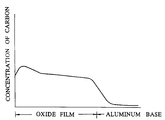
- the colored oxide film obtained in the test run using 100 minutes' immersion for enlarging pores in the oxide film was subjected to the analysis for carbon in the oxide film by the EPMA.
- the graph showing the results of this linear analysis is shown in the accompanying drawing.
- An aluminum alloy 63S plate was pretreated as conventionally practiced and then subjected to constant-voltage electrolysis at DC 150 V in a bath of 0.3% oxalic acid at 20°C for six minutes to form an anode oxide film thereon in a thickness of 10 ⁇ m. Then, the aluminum alloy plate was kept immersed in an aqueous 5% phosphoric acid solution at 30°C for 120 minutes to enlarge the pores in the oxide film. The plate was subsequently subjected to electrophoresis using the plate as an anode at a constant voltage of DC 80 V in one liter of a bath of an aqueous dispersion containing 10% of dioxazine violet at 25°C to obtain an oxide film colored in purple.
- the aqueous dispersion of dioxazine violet had been prepared by adding an aqueous solution of 1% sodium polystyrenesulfonate to 100 g of dioxazine violet to a total volume of one liter and stirring the resultant solution in a sand mill for 10 hours.
- the dioxazine violet particles dispersed therein had an average diameter of 55 nm.
- An aluminum alloy 63S plate was pretreated as conventionally practiced and then treated by following the procedure of Example 3 to form an anodic oxide film and enlarge the pores in the oxide film.
- the resultant anodized aluminum alloy plate was immersed as an anode in an aqueous dispersion containing 50 g/liter of copper phthalocyanine blue at 30°C and subjected to electrophoresis at DC 80 V, to give rise to an anodic oxide film colored in blue.
- a carbon electrode was used as a cathode. The duration of the electrophoresis was two minutes.
- the aqueous dispersion of pigment was prepared by dissolving 50 g of copper phthalocyanine blue in 600 ml of 98% sulfuric acid, adding the resultant solution as stirred into 5 liters of an aqueous 0.5% sodium polyacrylate solution thereby inducing precipitation of phthalocyanine particles therein, washing the phthalocyanine particles with water until sulfate radical ceased to exist therein, adjusting the cleaned phthalocyanine particles with sodium hydroxide to pH 9, diluting the pH-adjusted phthalocyanine particles with an aqueous 0.5% sodium acrylate solution to a total volume of one liter, and stirring the aqueous solution with a sand mill for thorough dispersion of the particles.
- the copper phthalocyanine blue particles had an average diameter of 50 nm.
- the aforementioned industrial grade pure aluminum plate was subjected to an anodic oxidation in the same manner as in Example 2 and then subjected to electrophoresis in an aqueous dispersion containing 50 g/liter of copper phthalocyanine blue at 30°C in the same manner as in Example 5, to give rise to an anodic oxide film colored in blue.
- An aluminum alloy 63S plate was pretreated as conventionally practiced and then subjected to constant-voltage electrolysis at DC 150 V in a bath of 0.3% oxalic acid at 20°C for six minutes to form an anode oxide film thereon in a thickness of 10 ⁇ m.
- the anodized aluminum alloy plate was repeatedly subjected to a composite treatment consisting of one minute's electrolysis at AC 8 V in an aqueous 8% phosphoric acid solution at 25°C and two minutes' standing therein at AC 0 V for a total period of 30 minutes to enlarge the pores in the oxide film.
- the aluminum plate disposed as an anode and a carbon electrode as a cathode were operated to effect electrophoresis at a constant voltage of DC 80 V for two minutes, to give rise to an anodic oxide film colored in blue.
- An aluminum alloy 63S plate was pretreated as conventionally practiced and then subjected to constant-voltage electrolysis at DC 150 V in a bath of 0.3% oxalic acid at 20°C for six minutes to form an anodic oxide film thereon in a thickness of 10 ⁇ m. Then, the aluminum alloy plate was kept immersed in an aqueous 5% phosphoric acid solution at 30°C for a varying duration in the range between 0 and 100 minutes to enlarge the pores in the oxide film. The plate was subsequently subjected to electrophoresis by immersing the plate in the same aqueous dispersion of copper phthalocyanine blue as used in Example 5, increasing the voltage applied from DC 0 V to DC 20 V at the voltage increasing rate of 1 V/sec.
- Table 2 Duration of immersion for enlarging pores in oxide film (in bath of 5% H3PO4 at 30°C) Coloration by electrophoresis State of coloration of oxide film 0 minute Voltage scanning from DC 0V to DC 20V (increasing rate: 1 V/sec.) and thereafter 80 seconds' application of DC 20V in aqueous dispersion of 50 g/liter of copper phthalocyanine blue at 30°C No coloration 20 minutes No coloration 40 minutes Light blue 60 minutes Light blue 80 minutes Blue 100 minutes Blue
- An aluminum alloy 63S plate was treated by faithfully repeating the procedure of Example 5, except that 50 g/liter of quinacridone red was used in the place of copper phthalocyanine blue in the aqueous dispersion, to produce an anodic oxide film colored in red.
- quinacridone particles had an average diameter of 70 nm.
- an anodic oxide film colored in green was produced by faithfully following the procedure of Example 5, except that highly chlorinated copper phthalocyanine green was used in the place of copper phthalocyanine blue and formalin condensate of sodium naphthalenesulfonate was used in the place of sodium polyacrylate as a dispersant in the aqueous dispersion.
Landscapes
- Engineering & Computer Science (AREA)
- Aviation & Aerospace Engineering (AREA)
- Transportation (AREA)
- Mechanical Engineering (AREA)
- Chemical & Material Sciences (AREA)
- Electrochemistry (AREA)
- Chemical Kinetics & Catalysis (AREA)
- Materials Engineering (AREA)
- Metallurgy (AREA)
- Organic Chemistry (AREA)
- Application Of Or Painting With Fluid Materials (AREA)
- Printing Plates And Materials Therefor (AREA)
- Pigments, Carbon Blacks, Or Wood Stains (AREA)
Applications Claiming Priority (2)
| Application Number | Priority Date | Filing Date | Title |
|---|---|---|---|
| JP276490/91 | 1991-09-30 | ||
| JP3276490A JP2759897B2 (ja) | 1991-09-30 | 1991-09-30 | アルミニウム又はアルミニウム合金の着色体の製造方法 |
Publications (3)
| Publication Number | Publication Date |
|---|---|
| EP0535457A2 EP0535457A2 (en) | 1993-04-07 |
| EP0535457A3 EP0535457A3 (en) | 1994-05-25 |
| EP0535457B1 true EP0535457B1 (en) | 1996-04-17 |
Family
ID=17570186
Family Applications (1)
| Application Number | Title | Priority Date | Filing Date |
|---|---|---|---|
| EP92115915A Expired - Lifetime EP0535457B1 (en) | 1991-09-30 | 1992-09-17 | Colored article of aluminum or aluminum alloy and method for production thereof |
Country Status (5)
| Country | Link |
|---|---|
| US (1) | US5334297A (enExample) |
| EP (1) | EP0535457B1 (enExample) |
| JP (1) | JP2759897B2 (enExample) |
| DE (1) | DE69209956T2 (enExample) |
| TW (1) | TW222682B (enExample) |
Cited By (1)
| Publication number | Priority date | Publication date | Assignee | Title |
|---|---|---|---|---|
| DE10132089A1 (de) * | 2001-07-05 | 2003-01-30 | Cemecon Ceramic Metal Coatings | Metallisches Bauteil mit äußerer Funktionsschicht und Verfahren zu seiner Herstellung |
Families Citing this family (34)
| Publication number | Priority date | Publication date | Assignee | Title |
|---|---|---|---|---|
| JP2995711B2 (ja) * | 1994-03-01 | 1999-12-27 | ワイケイケイ株式会社 | アルミニウム又はアルミニウム合金の着色方法 |
| TW311925B (enExample) * | 1994-06-02 | 1997-08-01 | Sakura Color Prod Corp | |
| JPH08325792A (ja) * | 1995-05-30 | 1996-12-10 | Sakura Color Prod Corp | アルミニウム又はアルミニウム合金酸化皮膜の充填着色用顔料分散体組成物 |
| ATE327097T1 (de) * | 2000-04-07 | 2006-06-15 | Fuji Photo Film Co Ltd | Wärmeempfindlicher lithographischer druckplattevorläufer |
| US6875800B2 (en) * | 2001-06-18 | 2005-04-05 | Ppg Industries Ohio, Inc. | Use of nanoparticulate organic pigments in paints and coatings |
| US7612124B2 (en) | 2003-06-24 | 2009-11-03 | Ppg Industries Ohio, Inc. | Ink compositions and related methods |
| US7605194B2 (en) * | 2003-06-24 | 2009-10-20 | Ppg Industries Ohio, Inc. | Aqueous dispersions of polymer-enclosed particles, related coating compositions and coated substrates |
| US7745514B2 (en) * | 2003-06-24 | 2010-06-29 | Ppg Industries Ohio, Inc. | Tinted, abrasion resistant coating compositions and coated articles |
| US7671109B2 (en) | 2003-06-24 | 2010-03-02 | Ppg Industries Ohio, Inc. | Tinted, abrasion resistant coating compositions and coated articles |
| US7635727B2 (en) * | 2003-06-24 | 2009-12-22 | Ppg Industries Ohio, Inc. | Composite transparencies |
| US20100184911A1 (en) * | 2009-01-22 | 2010-07-22 | Ppg Industries Ohio, Inc. | Aqueous dispersions of polymer-enclosed particles, related coating compositions and coated substrates |
| US7910634B2 (en) * | 2004-03-25 | 2011-03-22 | Ppg Industries Ohio, Inc. | Aqueous dispersions of polymer-enclosed particles, related coating compositions and coated substrates |
| US7288582B2 (en) * | 2004-04-05 | 2007-10-30 | Ppg Industries Ohio, Inc. | Colored compositions with substrate-hiding materials |
| US7981505B2 (en) * | 2004-06-24 | 2011-07-19 | Ppg Industries Ohio, Inc. | Coated articles and multi-layer coatings |
| US7438972B2 (en) * | 2004-06-24 | 2008-10-21 | Ppg Industries Ohio, Inc. | Nanoparticle coatings for flexible and/or drawable substrates |
| KR100648731B1 (ko) * | 2005-03-21 | 2006-11-23 | 삼성에스디아이 주식회사 | 이차전지 및 이의 제조 방법 |
| US7465288B2 (en) * | 2005-06-28 | 2008-12-16 | St. Jude Medical, Atrial Fibrillation Division, Inc. | Actuation handle for a catheter |
| US7347592B2 (en) | 2005-07-14 | 2008-03-25 | Hewlett-Packard Development Company, L.P. | Light source for a projection system having a light absorption layer |
| US8007651B2 (en) * | 2005-10-12 | 2011-08-30 | Transys, Llc | Method for preparing thermally transmissive anodized surface and products therefrom |
| US20100129524A1 (en) * | 2006-01-20 | 2010-05-27 | Steven Sternberger | Methods of dispensing powder coating compositions and articles coated therewith |
| US8178160B2 (en) * | 2006-01-20 | 2012-05-15 | Ppg Industries Ohio, Inc. | Decorative and durable coating having a homogeneous hue, methods for their preparation, and articles coated therewith |
| US8507050B2 (en) * | 2008-11-12 | 2013-08-13 | Ppg Industries Ohio, Inc. | Methods for depositing ultra thin coatings exhibiting low haze and methods for the preparation of such coatings |
| TWI442014B (zh) * | 2010-11-24 | 2014-06-21 | 財團法人工業技術研究院 | 散熱元件及散熱元件的處理方法 |
| JP6093523B2 (ja) * | 2011-09-29 | 2017-03-08 | 電化皮膜工業株式会社 | 着色アルミニウム製品または着色アルミニウム合金製品の製造方法 |
| CN102505136A (zh) * | 2011-11-10 | 2012-06-20 | 肇庆亚洲铝厂有限公司 | 一种消光电泳的生产工艺 |
| TWI444508B (zh) * | 2012-05-07 | 2014-07-11 | Catcher Technology Co Ltd | 具止滑皮革質感表面之金屬工件製造方法 |
| US20130299353A1 (en) * | 2012-05-12 | 2013-11-14 | Catcher Technology Co., Ltd. | Method of forming interference film on surface of aluminum alloy substrate |
| JP6306897B2 (ja) * | 2014-02-28 | 2018-04-04 | 株式会社サクラクレパス | 着色アルミニウム成形体及びその製造方法 |
| US20180080138A1 (en) * | 2016-09-22 | 2018-03-22 | Apple Inc. | Processes for reducing surface concentration of dyes in anodic oxides |
| CN107964673A (zh) * | 2016-10-19 | 2018-04-27 | 宁波瑞隆表面技术有限公司 | 一种铝合金微弧氧化制备黑色陶瓷膜层的方法 |
| WO2019022924A2 (en) * | 2017-07-26 | 2019-01-31 | Pacific Light & Hologram, Inc. | LOW REFLECTION ARTICLES AND ASSOCIATED SYSTEMS AND METHODS |
| IT201900000352A1 (it) * | 2019-01-10 | 2020-07-10 | I A F Italian Aluminium Finishes S R L | Metodo di lavorazione superficiale di un articolo in alluminio |
| CN114088703B (zh) * | 2020-08-24 | 2024-04-02 | 台湾永光化学工业股份有限公司 | 用于检测铝阳极染液活性的快筛套组及方法 |
| CN114351207A (zh) * | 2020-10-12 | 2022-04-15 | 广州市汉科建材科技有限公司 | 一种铝及铝合金阳极氧化荧光膜的制备工艺 |
Family Cites Families (16)
| Publication number | Priority date | Publication date | Assignee | Title |
|---|---|---|---|---|
| DE656566C (de) * | 1935-11-01 | 1938-02-09 | Siemens & Halske Akt Ges | Verfahren zur Porenausfuellung oxydischer Schutzschichten auf Aluminium und dessen Legierungen und anderen geeigneten Metallen |
| NL6403649A (enExample) * | 1961-12-26 | 1965-10-07 | ||
| US3622473A (en) * | 1964-10-15 | 1971-11-23 | Honny Chemicals Co Ltd | Method of providing aluminum surfaces with coatings |
| CH520782A (de) * | 1970-04-16 | 1972-03-31 | Alusuisse | Verfahren zum Einfärben von Anodisierschichten auf Aluminium |
| JPS525010B2 (enExample) * | 1971-12-24 | 1977-02-09 | ||
| JPS5135177B2 (enExample) * | 1972-05-11 | 1976-09-30 | ||
| JPS5135177A (ja) * | 1974-09-20 | 1976-03-25 | Hitachi Ltd | Kogukaitensochi |
| JPS606117B2 (ja) * | 1974-10-05 | 1985-02-15 | 日本電気株式会社 | 注入型半導体発光素子 |
| JPS525010A (en) * | 1975-07-01 | 1977-01-14 | Hiyoshi Kogyo Kk | Connecting process of high pressure hoses and its device |
| CA1112600A (en) * | 1975-11-13 | 1981-11-17 | Shyoichi Anada | Electrolytically treating aluminium surface in bath of hydroxide or salt with acid |
| NZ189336A (en) * | 1978-01-17 | 1980-08-26 | Alcan Res & Dev | Coloured anodic oxide films on aluminium |
| JPS58147592A (ja) * | 1982-02-27 | 1983-09-02 | Mitsubishi Alum Co Ltd | アルミニウム又はアルミニウム合金の着色方法 |
| JPS63203795A (ja) * | 1987-02-17 | 1988-08-23 | Toshiro Takahashi | アルミニウム又はアルミニウム合金の着色法 |
| JPH0665759B2 (ja) * | 1988-02-08 | 1994-08-24 | 株式会社日本アルミ | アルミニウムまたはアルミニウム合金の着色方法 |
| JPH0344496A (ja) * | 1989-07-11 | 1991-02-26 | Furukawa Alum Co Ltd | 塗膜密着性に優れたアルミニウム又はアルミニウム合金材及びその製造方法 |
| US5237618A (en) * | 1990-05-11 | 1993-08-17 | General Electric Company | Electronic compensation system for elimination or reduction of inter-channel interference in noise cancellation systems |
-
1991
- 1991-09-30 JP JP3276490A patent/JP2759897B2/ja not_active Expired - Fee Related
-
1992
- 1992-09-17 DE DE69209956T patent/DE69209956T2/de not_active Expired - Fee Related
- 1992-09-17 EP EP92115915A patent/EP0535457B1/en not_active Expired - Lifetime
- 1992-09-24 TW TW081107565A patent/TW222682B/zh active
-
1993
- 1993-09-13 US US08/119,559 patent/US5334297A/en not_active Expired - Fee Related
Cited By (1)
| Publication number | Priority date | Publication date | Assignee | Title |
|---|---|---|---|---|
| DE10132089A1 (de) * | 2001-07-05 | 2003-01-30 | Cemecon Ceramic Metal Coatings | Metallisches Bauteil mit äußerer Funktionsschicht und Verfahren zu seiner Herstellung |
Also Published As
| Publication number | Publication date |
|---|---|
| EP0535457A2 (en) | 1993-04-07 |
| DE69209956D1 (de) | 1996-05-23 |
| JP2759897B2 (ja) | 1998-05-28 |
| DE69209956T2 (de) | 1996-10-31 |
| EP0535457A3 (en) | 1994-05-25 |
| US5334297A (en) | 1994-08-02 |
| JPH0593296A (ja) | 1993-04-16 |
| TW222682B (enExample) | 1994-04-21 |
Similar Documents
| Publication | Publication Date | Title |
|---|---|---|
| EP0535457B1 (en) | Colored article of aluminum or aluminum alloy and method for production thereof | |
| US3844908A (en) | Process for coloring aluminum and aluminum alloys | |
| US5585189A (en) | Pigment dispersion composition | |
| EP0978576B1 (en) | Corrosion-resistant, magnesium-based product exhibiting luster of base metal and method for producing the same | |
| CA1054089A (en) | Process for electrolytically coloring aluminum and aluminum alloys | |
| AU633132B2 (en) | Improved electrolytic method for coloring anodized aluminum | |
| JP2995711B2 (ja) | アルミニウム又はアルミニウム合金の着色方法 | |
| JP4223088B2 (ja) | 金属素地の光沢を呈する耐食性マグネシウム材料製品及びその製造方法 | |
| JPS63312998A (ja) | 陽極酸化アルミニウムの電解着色 | |
| TWI238858B (en) | Process for the production of gold-colored surfaces of aluminum or aluminum alloys by means of silver salt-containing formulations | |
| JP2937963B2 (ja) | アルミニウム又はアルミニウム合金の着色体 | |
| US4180443A (en) | Method for coloring aluminum | |
| US4632735A (en) | Process for the electrolytic coloring of aluminum or aluminum alloys | |
| US1962339A (en) | Process of making colored metallic article | |
| JP3410548B2 (ja) | アルミニウム又はアルミニウム合金酸化皮膜の充填着色用顔料分散体 | |
| JP3512872B2 (ja) | アルミニウム又はアルミニウム合金酸化皮膜の充填着色用赤色系顔料分散体 | |
| EP0015279B1 (en) | Coating system | |
| KR20090115034A (ko) | 마그네슘계 금속의 착색 및 광택이 가능한 표면 처리 방법 | |
| JPH10265996A (ja) | アルミニウムまたはその合金のアルカリ耐食性の良好な陽極酸化処理方法 | |
| JPS58147592A (ja) | アルミニウム又はアルミニウム合金の着色方法 | |
| EP0936288A2 (en) | A process for producing colour variations on electrolytically pigmented anodized aluminium | |
| JPH1149982A (ja) | アルミニウム顔料およびその製造方法 | |
| RU2467096C2 (ru) | Способ электрохимического окрашивания анодированного алюминия под действием тока переменной полярности (варианты) | |
| US3281342A (en) | Method of dyeing aluminum black | |
| KR102361921B1 (ko) | 레저 용품, 스포츠 용품, 캠핑 용품 또는 자전거용 알루미늄 합금 표면에 선명한 색상 구현 개선방법 |
Legal Events
| Date | Code | Title | Description |
|---|---|---|---|
| PUAI | Public reference made under article 153(3) epc to a published international application that has entered the european phase |
Free format text: ORIGINAL CODE: 0009012 |
|
| AK | Designated contracting states |
Kind code of ref document: A2 Designated state(s): DE FR GB IT |
|
| PUAL | Search report despatched |
Free format text: ORIGINAL CODE: 0009013 |
|
| AK | Designated contracting states |
Kind code of ref document: A3 Designated state(s): DE FR GB IT |
|
| 17P | Request for examination filed |
Effective date: 19940825 |
|
| RAP1 | Party data changed (applicant data changed or rights of an application transferred) |
Owner name: YKK CORPORATION |
|
| 17Q | First examination report despatched |
Effective date: 19941102 |
|
| GRAH | Despatch of communication of intention to grant a patent |
Free format text: ORIGINAL CODE: EPIDOS IGRA |
|
| GRAA | (expected) grant |
Free format text: ORIGINAL CODE: 0009210 |
|
| AK | Designated contracting states |
Kind code of ref document: B1 Designated state(s): DE FR GB IT |
|
| ITF | It: translation for a ep patent filed | ||
| ET | Fr: translation filed | ||
| REF | Corresponds to: |
Ref document number: 69209956 Country of ref document: DE Date of ref document: 19960523 |
|
| PLBE | No opposition filed within time limit |
Free format text: ORIGINAL CODE: 0009261 |
|
| 26N | No opposition filed | ||
| PGFP | Annual fee paid to national office [announced via postgrant information from national office to epo] |
Ref country code: FR Payment date: 20010911 Year of fee payment: 10 |
|
| PGFP | Annual fee paid to national office [announced via postgrant information from national office to epo] |
Ref country code: GB Payment date: 20010919 Year of fee payment: 10 |
|
| PGFP | Annual fee paid to national office [announced via postgrant information from national office to epo] |
Ref country code: DE Payment date: 20011001 Year of fee payment: 10 |
|
| REG | Reference to a national code |
Ref country code: GB Ref legal event code: IF02 |
|
| PG25 | Lapsed in a contracting state [announced via postgrant information from national office to epo] |
Ref country code: GB Free format text: LAPSE BECAUSE OF NON-PAYMENT OF DUE FEES Effective date: 20020917 |
|
| PG25 | Lapsed in a contracting state [announced via postgrant information from national office to epo] |
Ref country code: DE Free format text: LAPSE BECAUSE OF NON-PAYMENT OF DUE FEES Effective date: 20030401 |
|
| GBPC | Gb: european patent ceased through non-payment of renewal fee |
Effective date: 20020917 |
|
| PG25 | Lapsed in a contracting state [announced via postgrant information from national office to epo] |
Ref country code: FR Free format text: LAPSE BECAUSE OF NON-PAYMENT OF DUE FEES Effective date: 20030603 |
|
| REG | Reference to a national code |
Ref country code: FR Ref legal event code: ST |
|
| PG25 | Lapsed in a contracting state [announced via postgrant information from national office to epo] |
Ref country code: IT Free format text: LAPSE BECAUSE OF NON-PAYMENT OF DUE FEES;WARNING: LAPSES OF ITALIAN PATENTS WITH EFFECTIVE DATE BEFORE 2007 MAY HAVE OCCURRED AT ANY TIME BEFORE 2007. THE CORRECT EFFECTIVE DATE MAY BE DIFFERENT FROM THE ONE RECORDED. Effective date: 20050917 |