EP0522399A2 - Pyridon-Azo-Reaktivfarbstoffe - Google Patents
Pyridon-Azo-Reaktivfarbstoffe Download PDFInfo
- Publication number
- EP0522399A2 EP0522399A2 EP92110961A EP92110961A EP0522399A2 EP 0522399 A2 EP0522399 A2 EP 0522399A2 EP 92110961 A EP92110961 A EP 92110961A EP 92110961 A EP92110961 A EP 92110961A EP 0522399 A2 EP0522399 A2 EP 0522399A2
- Authority
- EP
- European Patent Office
- Prior art keywords
- dyes
- so3h
- formula
- radical
- och3
- Prior art date
- Legal status (The legal status is an assumption and is not a legal conclusion. Google has not performed a legal analysis and makes no representation as to the accuracy of the status listed.)
- Granted
Links
- 0 C[C@]1(/C=C/C(N=N[C@]2OCC(S(O)(=O)=O)=C(C)C=C2N)=C*CBC1)N Chemical compound C[C@]1(/C=C/C(N=N[C@]2OCC(S(O)(=O)=O)=C(C)C=C2N)=C*CBC1)N 0.000 description 3
- WRCFIDBISFALLD-NVNVXXOGSA-N CC(CC1[N-][N+](C(C=C(CC2)Nc3cc(F)nc(F)n3)=C2S(O)(=O)=O)=C)=C(C)C2O[C@H]2N(C)C1O Chemical compound CC(CC1[N-][N+](C(C=C(CC2)Nc3cc(F)nc(F)n3)=C2S(O)(=O)=O)=C)=C(C)C2O[C@H]2N(C)C1O WRCFIDBISFALLD-NVNVXXOGSA-N 0.000 description 1
Classifications
-
- C—CHEMISTRY; METALLURGY
- C09—DYES; PAINTS; POLISHES; NATURAL RESINS; ADHESIVES; COMPOSITIONS NOT OTHERWISE PROVIDED FOR; APPLICATIONS OF MATERIALS NOT OTHERWISE PROVIDED FOR
- C09B—ORGANIC DYES OR CLOSELY-RELATED COMPOUNDS FOR PRODUCING DYES, e.g. PIGMENTS; MORDANTS; LAKES
- C09B62/00—Reactive dyes, i.e. dyes which form covalent bonds with the substrates or which polymerise with themselves
- C09B62/02—Reactive dyes, i.e. dyes which form covalent bonds with the substrates or which polymerise with themselves with the reactive group directly attached to a heterocyclic ring
- C09B62/20—Reactive dyes, i.e. dyes which form covalent bonds with the substrates or which polymerise with themselves with the reactive group directly attached to a heterocyclic ring to a pyrimidine ring
- C09B62/24—Azo dyes
Definitions
- the invention relates to reactive dyes with a difluoropyrimidine residue.
- DE-A 3 542 001 and DE-A 2 123 061 have already disclosed pyridone-azo reactive dyes. These dyes are also in need of improvement.
- Z can be bound to either D or Y or R.
- Monoazo reactive dyes of the formula (5) are particularly preferred wherein X and R have the meaning given for (3) and (4).
- the azo dyes according to the invention can exist in several tautomeric forms. For the sake of simplicity, the dyes are only given in one of these tautomeric forms.
- Azo group-containing amino compounds D-NH2 such as is obtained by diazotizing aniline derivatives of the formula (10) and coupling the diazonium compounds to a compound of formula (11).
- Amino compounds of the formula D-NH2 for the preparation of compound 4 are, like pyridone derivatives free of radicals Z, known from the literature, for example DOS 2 123 061 (US Pat. No. 4,067,864).
- Z-substituted pyridone derivatives are prepared by condensing 2,4,6-trifluoropyrimidine with pyridones which have a primary or secondary amine function on one of the substituents.
- Monoazo reactive dyes of the formula (5) are prepared either by condensation of aminoazo dyes of the formula with 2,4,6-trifluoropyrimidine in the presence of acid-binding agents, such as soda or bicarbonate, or by diazotizing amino compounds of the formula (13) and coupling of the diazonium compounds to pyridones of the formula (14) or (15), as described, for example, in DE-A-2 162 612 (US Pat. No. 3,994,906).
- Connections (13) are e.g. by condensation of 2,4-diaminobenzenesulfonic acid or 2,4-diamino-1,5-benzenedisulfonic acid with 2,4,6-trifluoropyrimidine at temperatures from 20 ° to 50 ° C and pH values from 4.5 to 10.0 accessible.
- the new monofunctional azopyridone dyes with the fiber-reactive 2,6-difluoro-4-pyrimidinyl residue are suitable for dyeing and printing materials containing hydroxyl or amide groups, such as textile fibers, threads and fabrics made of wool, silk, synthetic polyamide and polyurethane fibers and true-to-color dyeing and printing of native or regenerated cellulose, the treatment of cellulose materials expediently being carried out in the presence of acid-binding agents and, if appropriate, by exposure to heat by the methods customary for reactive dyes.
- the formulas given for the dyes are those for the corresponding free acids.
- the dyes are generally in the form of the alkali salts, e.g. the lithium, sodium or potassium salts, isolated and used as such for dyeing and printing.
- the dyes can be used in the dyeing both as a powder and as a concentrated aqueous dye solution.
- the temperature is raised to 60 ° C., 40 parts of calcined soda and another 60 parts of sodium chloride being added after 30 minutes.
- the temperature is kept at 60 ° C. for 30 minutes, rinsed and the soap is then soaped for 15 minutes in a 0.3% boiling solution of an ion-free detergent, rinsed and dried. A brilliant greenish yellow color with good fastness properties is obtained.
- Example 2 4 parts of the reactive dye prepared in Example 1 are dissolved in 50 parts of water. 50 parts of a solution are added, which contains 5 g of sodium hydroxide and 10 g of calcined soda per liter. A cotton fabric is padded with the solution obtained so that it increases by 70% in weight, and then wound onto a drum. The cotton fabric is like this stored for 3 to 12 h at room temperature. The dyed goods are then rinsed, soaped at the boil with a nonionic detergent for a quarter of an hour, rinsed again and dried. A brilliant greenish yellow color with good fastness properties is obtained.
- 27.3 g of 2,4-diaminobenzenesulfonic acid are suspended in 150 ml of water and dissolved with dilute sodium hydroxide solution at pH 6.5.
- 1 g of sodium dihydrogenphosphate and 1 g of disodium hydrogenphosphate are added as buffer substances and the mixture is heated to 35.degree. 23.2 g of 2,4,6-trifluoropyrimidine are metered in over the course of an hour, and the pH is kept constant between 6.2 and 6.5 with soda solution and in the post-reaction phase.
- the temperature rises to 40 ° C. during the acylation and drops again to 35 ° C. after one hour of stirring.
- the dye has the structure
- Example 10 If instead of 5-aminomethyl-2-amino-1-naphthalenesulfonic acid is used as the diazo component in Example 10, equimolar amounts of 2-amino-4- (N-methylaminomethyl) benzenesulfonic acid are used and the reaction is carried out analogously to Example 10, a dye is obtained the structure which provides brilliant greenish yellow dyeings on cotton.
- 130 g of the saline pyridone dye of the structure which is described in European application EP 281 892 (Example 1) are dissolved in 400 ml of water and mixed with a solution of 60 g of sodium (2-aminoethyl) sulfonate in 200 ml of water. It is heated to 40 ° C and stirred at 40 ° C for one hour. The pH is subsequently adjusted to 6.0 with hydrochloric acid and 140 g of sodium chloride are added. The precipitated dye is filtered off, and the isolated moist dye paste is stirred in 400 ml of water. The pH is corrected to 8.0 and the solution heated to 35 ° C. 25.0 g of 2,4,6-trifluoropyrimidine are now added in portions and the pH is kept constant between 7.5 and 8.5 in the after-reaction phase with soda solution.
- the condensation reaction is complete after about 1 hour. It is cooled to 20 ° C. and salted out with 50 g sodium chloride and 50 g potassium chloride. The dye is suctioned off and dried. It dyes cotton in a greenish-yellow hue and has the structure
- a diazonium salt mixture prepared by diazotizing 25.1 g of 3-aminobenzenesulfonic acid becomes a neutral mixture of 50.0 g of the condensation product of 2,4-diaminobenzenesulfonic acid (Na salt) and 2,4,6-trifluoropyrimidine (see Example 1) metered in 250 ml of water.
- the pH is kept at 6.0 to 6.5 by the constant addition of solid sodium hydrogen carbonate.
- the dye becomes the structure isolated by salting out with table salt and suction.
- the moist paste of the intermediate is suspended in 200 ml of water and 200 g of ice and adjusted to pH 2.3 to 2.5 at 0 ° C. with hydrochloric acid.
- the pH value is kept at 6.5 to 7.5 by the dropwise addition of soda solution. After adding the diazotization, stirring is continued for 15 minutes and the dye is isolated by salting out (100 g of potassium chloride) and suction filtering. After drying at 60 ° C, 145 g of a saline red dye powder result, which has the following structure: The new disazopyridone dye dyes cotton in brilliant orange tones.
- Example 13 If the first diazo component and the pyridone derivative are varied in Example 13 and the reactions are carried out as in Example 13, the following reactive dyes which are also valuable are obtained.
Landscapes
- Chemical & Material Sciences (AREA)
- Organic Chemistry (AREA)
- Coloring (AREA)
Abstract
Description
- Die Erfindung betrifft Reaktivfarbstoffe mit einem Difluorpyrimidinrest.
- Derartige Reaktivreste sind zwar bereits aus DE-A-1 644 204 (US-A 3 669 951) und DE-A 2 114 158 (US-A-4 065 446) bekannt, jedoch weisen sie zum Teil noch anwendungstechnische Probleme auf.
- Weiterhin sind aus DE-A 3 542 001 und DE-A 2 123 061 (US-A 4 067 864) bereits Pyridon-Azo-Reaktivfarbstoffe bekannt. Auch diese Farbstoffe sind noch verbesserungswürdig.
- Die vorliegende Erfindung betrifft mono-reaktive Mono- und Disazoreaktivfarbstoffe, die als freie Säuren der Formel entsprechen:
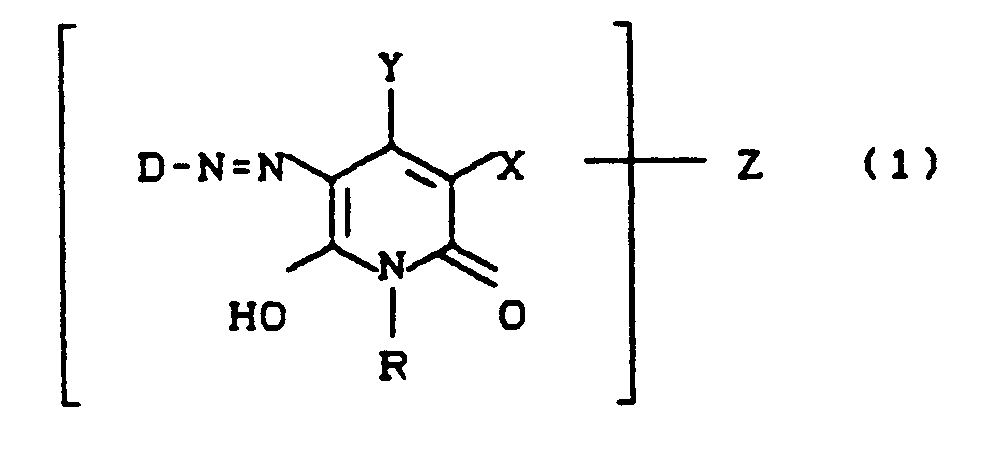
worin bedeuten - D =
- Rest einer Diazokomponente,
- R =
- H, ein gegebenenfalls durch OH, SO₃H, OSO₃H, NH₂, CO₂H, NH(C₁-C₄-Alkyl) oder C₁-C₄-Alkoxy substituierter C₁-C₆-Alkylrest, ein cycloaliphatischer C₃-C₆-Kohlenwasserstoffrest, ein gegebenenfalls durch SO₃H, CO₂H, CH₃, Cl, Br, OCH₃, OC₂H₅, NH₂, NH(C₁-C₄-Alkyl) substituierter Phenyl-oder Hetarylrest,
- X =
- H, Cl, Br, CH₃, CH₂SO₃H, CH(CH₃)-SO₃H, CONH₂, CN,
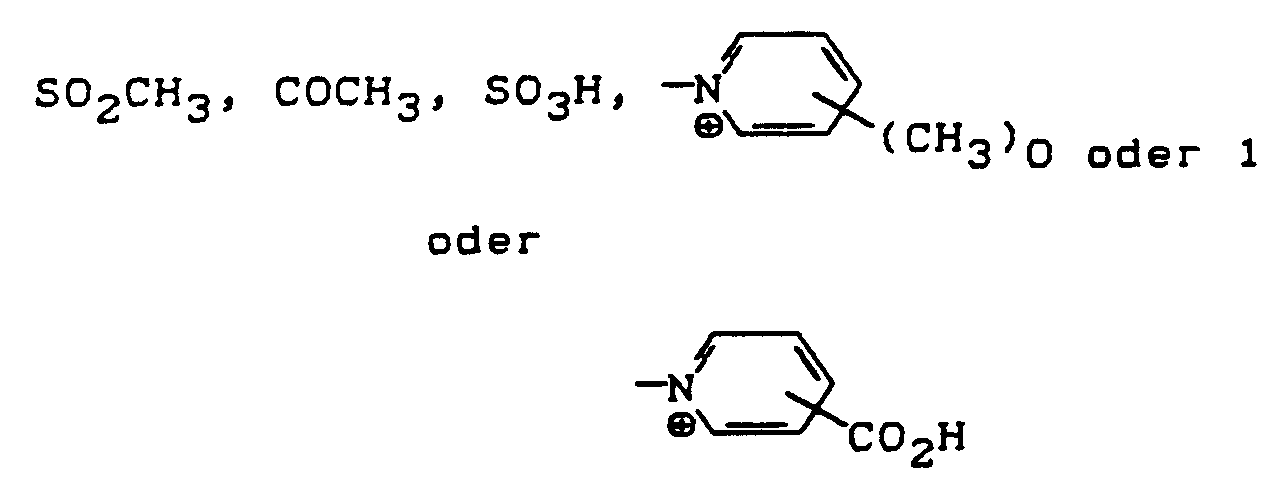
- Y =
- H, OH, ein gegebenenfalls durch Cl, OH, SO₃H, OSO₃H, CO₂H substituierter C₁-C₄-Alkylrest; ein gegebenenfalls durch SO₃H, CO₂H, CH₃, Cl, Br, OCH₃, OC₂H₅, NH₂, NH(C₁-C₄-Alkyl) substituierter Phenyl- bzw. Benzylrest oder CO₂H und
- Z =
- faserreaktiver Rest der Formel (2)
- Z kann sowohl an D als auch an Y oder R gebunden sein.
- In einer bevorzugten Ausführungsform entsprechen die Verbindungen der Formel (1) folgender Formel (3):

worin
D =
m = 0 oder 1
R, R¹ = gleich oder verschieden H, CH₃, C₂H₅, C₃H₇, C₄H₉, CH₂CH₂OH, CH₂CH₂SO₃H, CH₂CH₂OSO₃H oder CH₂CH₂CH₂-OCH₃
X = H, SO₃H, CONH₂ oder CH₂SO₃H,
W = H, CH₃, OCH₃, OC₂H₅, Cl, Br, NHCOCH₃ oder NHCONH₂. - In einer weiteren bevorzugten Ausführungsform entsprechen die Verbindungen der Formel (1) folgender Formel (4):

worin
D =
n = 2, 3 oder 4,
R² = H, CH₃, C₂H₅, C₃H₇, C₄H₉, CH₂CH₂OH, CH₂CH₂SO₃H, CH₂CH₂OSO₃H oder CH₂CH₂CH₂-OCH₃
X = H, SO₃H, CONH₂ oder CH₂SO₃H,
W = H, CH₃, OCH₃, OC₂H₅, Cl, Br, NHCOCH₃ oder NHCONH₂. - Besonders bevorzugt sind Monoazoreaktivfarbstoffe der Formel (5)

worin X und R die zu (3) und (4) genannte Bedeutung haben. - Die erfindungsgemäßen Azofarbstoffe können in mehreren tautomeren Formen existieren. Der Einfachheit halber werden die Farbstoffe nur in einer dieser tautomeren Formen angegeben.
- Die Herstellung der Farbstoffe (1) erfolgt, indem man aminogruppenhaltige Pyridonfarbstoffe der Formel

worin D, Y, X und R obengenannte Bedeutung haben und eine acylierbare Aminogrupppe aufweisen, mit 2,4,6-Trifluor-pyrimidin in Gegenwart von säurebindenden Mitteln im pH-Bereich von 3,5-9,5 kondensiert oder aber eine mit Z (= 2,6-difluor-4-pyrimidinyl-Rest) substituierte Aminoverbindung D-NH₂, diazotiert und in bekannter Weise auf ein Pyridonderivat kuppelt, das keinen Rest Z enthält,
oder eine Aminoverbindung D-NH₂, die keinen Rest Z enthält, diazotiert und in bekannter Weise auf ein mit Z substituiertes Pyridonderivat kuppelt. - Aminoverbindungen D-NH₂ zur Herstellung von Verbindung (3), z.B. solche der Formel
(7, Q=Z) bzw. (8, Q=2) erhält man, indem Diaminoverbindungen der Formel (7, Q=H) bzw. (8, Q=H) mit 2,4,6-Trifluorpyrimidin in Gegenwart säurebindender Mittel kondensiert:
Azogruppenhaltige Aminoverbindungen D-NH₂, wie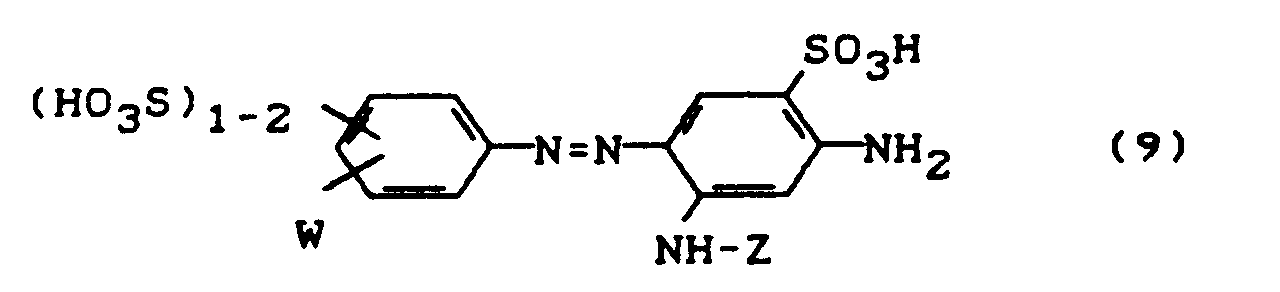
erhält man durch Diazotieren von Anilinderivaten der Formel (10) und Kuppeln der Diazonium
verbindungen auf eine Verbindung der Formel (11). - Aminoverbindungen der Formel D-NH₂ zur Herstellung von Verbindung 4 sind ebenso wie von Resten Z freie Pyridonderivate literaturbekannt z.B. DOS 2 123 061 (US-A 4 067 864). Die Herstellung von Z-substituierten Pyridonderivaten erfolgt durch Kondensation von 2,4,6-Trifluorpyrimidin mit Pyridonen, die eine primäre oder sekundäre Aminfunktion an einem der Substituenten aufweisen.
- Die Herstellung von Monoazoreaktivfarbstoffen der Formel (5) erfolgt entweder durch Kondensation von Aminoazo-Farbstoffen der Formel

mit 2,4,6-Trifluorpyrimidin in Gegenwart von säurebindenden Mitteln, wie Soda oder Bicarbonat,
oder aber durch Diazotieren von Aminoverbindungen der Formel (13)
und Kuppeln der Diazoniumverbindungen auf Pyridone der Formel (14) bzw. (15), wie es z.B. in der DE-A-2 162 612 (US-A 3 994 906) beschrieben ist. - Verbindungen (13) sind z.B. durch Kondensation von 2,4-Diaminobenzolsulfonsäure bzw. 2,4-Diamino-1,5-benzoldisulfonsäure mit 2,4,6-Trifluorpyrimidin bei Temperaturen von 20° bis 50°C und pH-Werten von 4,5 bis 10,0 zugänglich.
- Die neuen monofunkionellen Azopyridonfarbstoffe mit dem faserreaktiven 2,6-Difluor-4-pyrimidinyl-Rest eignen sich zum Färben und Bedrucken von Hydroxyl- oder Amidgruppen enthaltenden Materialien, wie Textilfasern, Fäden und Geweben aus Wolle, Seide, synthetischen Polyamid- und Polyurethanfasern und zum waschechten Färben und Bedrucken von nativer oder regenerierter Cellulose, wobei die Behandlung von Cellulosematerialien zweckmäßig in Gegenwart säurebindender Mittel und gegebenenfalls durch Hitzeeinwirkung nach den für Reaktivfarbstoffe üblichen Verfahren erfolgt.
- Die angegebenen Formeln der Farbstoffe sind die der entsprechenden freien Säuren. Die Farbstoffe werden im allgemeinen in Form der Alkalisalze, z.B. der Lithium-, Natrium- oder Kaliumsalze, isoliert und als solche zum Färben und Bedrucken eingesetzt.
- Die Farbstoffe lassen sich sowohl als Pulver wie auch als konzentrierte wässrige Farbstofflösung in der Färberei einsetzen.
- Die in den folgenden Beispielen angegebenen Färbungen werden unter folgenden Bedingungen durchgeführt:
- 2 Teile des gemäß Beispiel 1 erhältlichen Farbstoffes werden in 100 ml Wasser gelöst. Die Lösung gibt man zu 1900 Teilen kaltem Wasser, fügt 60 Teile Natriumchlorid zu und geht mit 100 Teilen eines Baumwollgewebes in dieses Färbebad ein.
- Man steigert die Temperatur auf 60°C, wobei nach 30 Minuten 40 Teile kalzinierte Soda und nochmals 60 Teile Natriumchlorid zugegeben werden. Man hält die Temperatur 30 Minuten auf 60°C, spült und seift dann die Färbung während 15 Minuten in einer 0,3 %igen kochenden Lösung eines ionenfreien Waschmittels, spült und trocknet. Man erhält eine brillante grünstichig gelbe Färbung mit guten Echtheitseigenschaften.
- 4 Teile des in Beispiel 1 hergestellten Reaktivfarbstoffes werden in 50 Teilen Wasser gelöst. Dazu gibt man 50 Teile einer Lösung, die pro Liter 5 g Natriumhydroxyd und 10 g kalziniertes Soda enthält. Mit der erhaltenen Lösung wird ein Baumwollgewebe foulardiert, so daß es um 70 % seines Gewichtes zunimmt, und dann auf eine Kaule aufgewickelt. Das Baumwollgewebe wird so während 3 bis 12 h bei Raumtemperatur gelagert. Danach wird die gefärbte Ware gespült, wahrend einer Viertelstunde mit einem nichtionogenen Waschmittel kochend geseift, nochmals gespült und getrocknet. Man erhält eine brillante grünstichig gelbe Färbung mit guten Echtheitseigenschaften.
- 27,3 g 2,4-Diaminobenzolsulfonsäure werden in 150 ml Wasser suspendiert und mit verdünnter Natronlauge bei pH 6,5 gelöst. Man fügt 1 g Natriumdihydrogenphosphat und 1 g Dinatriumhydrogenphosphat als Puffersubstanzen zu und erwärmt auf 35°C. Innerhalb einer Stunde dosiert man 23,2 g 2,4,6-Trifluorpyrimidin zu und hält dabei sowie in der Nachreaktionsphase den pH-Wert mit Sodalösung konstant zwischen 6,2 und 6,5. Die Temperatur steigt während der Acylierung auf 40°C an und fällt nach einer einstündigen Nachrührzeit wieder auf 35°C ab.
- Zur Acylierungsmischung gibt man 200 g Eis und 40 ml 25%ige Salzsäure und tropft dann innerhalb von 15 Minuten 35 ml einer Natriumnitritlösung (300 g/l) zu. Durch gelegentliche Eiszugabe hält man die Reaktionstemperatur unterhalb von 5°C. Die Diazotierung ist nach ca. 30 Minuten beendet. Die Diazoverbindung ist in hellgelber kristalliner Form ausgefallen. Der Überschuß an Nitrit wird mit Amidosulfonsäurelösung entfernt.
- 41,2 g 1,4-Dimethyl-3-aminocarbonyl-5-sulfomethyl-6-hydroxy-2-pyridon-Natriumsalz werden in 250 ml Wasser bei pH 7 gelöst und diese Lösung zur obigen Diazoniumsalzsuspension zudosiert. Durch Zutropfen von Sodalösung hält man den pH-Wert bei 6,5. Nach 30 Minuten ist die Kupplung beendet. Es resultiert eine klare gelbe Lösung. Der Farbstoff wird durch Zugabe von 90 g Kochsalz ausgesalzen und bei 40°C durch Abnutschen isoliert. Trocknen bei 50°C im Vakuum liefert 135 g salzhaltiges gelbes Farbstoffpulver, das Baumwolle nach dem für Reaktivfarbstoffe praktizierten Färbeverfahren in brillanten grünstichig gelbem Farbton färbt (λmax = 420 nm in H₂O).
- Der Farbstoff besitzt die Struktur

- Ähnlich wertvolle Reaktivfarbstoffe mit vergleichbarer Nuance erhält man, wenn man anstelle von 1,1-Dimethyl-3-aminocarbonyl-5-sulfomethyl-6-hydroxy-2-pyridon in Beispiel 1 nun als Kupplungskomponente 1-Ethyl-4-methyl-3-aminocarbonyl-5-sulfomethyl-6-hydroxy-2-pyridon (Beispiel 2, λmax = 420 nm), 1-n-Butyl-4-methyl-3-aminocarbonyl-5-sulfomethyl-6-hydroxy-2-pyridon (Beispiel 3, λmax = 422 nm), 1,4-Dimethyl-3-sulfo-6-hydroxy-2-pyridon (Beispiel 4, λmax = 421 nm), 1-(2-Sulfoethyl)-4-methyl-3-aminocarbonyl-6-hydroxy-2-pyridon (Beispiel 5), 1-(2'-Sulfatoethyl)-4-methyl-6-hydroxy-2-pyridon (Beispiel 6) oder 4-Carboxy-6-hydroxy-2-pyridon (= Citrazinsäure) (Beispiel 7) einsetzt.
- 38,9 g 2,5-Diamino-1,4-benzoldisulfonsäure werden ganz analog zur 2,4-Diaminobenzolsulfonsäure in Beispiel 1 mit 23,2 g 2,4,6-Trifluorpyrimidin bei 40°C kondensiert, das Kondensationsprodukt diazotiert und analog Beispiel 1 auf 18,1 g 1,4-Dimethyl-6-hydroxy-2-pyridon gekuppelt. Es wird ein Farbstoff der Struktur

isoliert, der Baumwolle mit gelbem Farbton färbt. - Beim Einsatz von 2,4-Diamino-1,5-benzoldisulfonsäure, 2,4,6-Trifluorpyrimidin und 1,4-Dimethyl-3-aminocarbonyl-6-hydroxy-2-pyridon in entsprechenden Mengenverhältnissen und Durchführung der drei Reaktionsschritte analog Beispiel 1 bzw. 8 erhält man einen Farbstoff der Struktur

- 36,5 g 5-Aminomethyl-2-amino-1-naphthalinsulfonsäure werden in 300 ml Wasser, 100 g Eis und 80 ml 25%iger Salzsäure angerührt und mit 35 ml einer 30%igen Natriumnitritlösung diazotiert. Die resultierende Lösung des Diazoniumsalzes wird nach Entfernen des Nitritüberschusses zu einer Lösung von 41,2 g 1,4-Dimethyl-3-aminocarbonyl-5-sulfomethyl-6-hydroxy-2-pyridon (Na-Salz) in 250 ml Wasser zudosiert. Dabei hält man den pH-Wert durch Zutropfen von Sodalösung konstant zwischen 6,5 bis 7,5. Die Kupplungsreaktion ist nach 30 Minuten beendet.
- Anschließend erwärmt man auf 35°C und fügt portionsweise 23,2 g 2,4,6-Trifluorpyrimidin zu. Gleichzeitig dosiert man Sodalösung so zu, daß der pH-Wert sich im Bereich von 7,5 bis 8,5 befindet. Der Farbstoff kristallisiert langsam aus. Es werden nach einstündiger Nachrührzeit 40 g Natriumchlorid zugefügt, 30 Minuten gerührt und der Farbstoff isoliert. Das trockene Farbstoffpulver, dem die Struktur

zukommt, liefert auf Baumwolle eine klare, grünstichig gelbe Färbung (λmax = 432 nm). - Verwendet man in Beispiel 10 anstelle von 5-Aminomethyl-2-amino-1-naphthalinsulfonsäure als Diazokomponente nun äquimolare Mengen an 2-Amino-4-(N-methylaminomethyl)-benzolsulfonsäure und setzt analog zu Beispiel 10 um, so erhält man einen Farbstoff der Struktur

der auf Baumwolle brillante grünstichig gelbe Färbungen liefert. - 130 g des salzhaltigen Pyridonfarbstoffes der Struktur

der in der europäischen Anmeldung EP 281 892 (Beispiel 1) beschrieben ist, werden in 400 ml Wasser gelöst und mit einer Lösung von 60 g Natrium-(2-aminoethyl)-sulfonat in 200 ml Wasser versetzt. Es wird auf 40°C erwärmt und für eine Stunde bei 40°C gerührt. Mit Salzsäure stellt man anschießend auf pH 6,0 und fügt 140 g Kochsalz hinzu. Der ausgefallene Farbstoff wird abgesaugt, und die isolierte feuchte Farbstoffpaste in 400 ml Wasser angerührt. Der pH-Wert wird auf 8,0 korrigiert und die Lösung auf 35°C erwärmt. Portionsweise fügt man nun 25,0 g 2,4,6-Trifluorpyrimidin zu und hält dabei sowie in der Nachreaktionsphase den pH-Wert mit Sodalösung konstant zwischen 7,5 und 8,5. - Nach ca. 1 Stunde ist die Kondensationsreaktion beendet. Es wird auf 20°C abgekühlt und mit 50 g Natriumchlorid und 50 g Kaliumchlorid ausgesalzen. Der Farbstoff wird abgesaugt und getrocknet. Er färbt Baumwolle in grünstichig gelbem Farbton und besitzt die Struktur

- Eine Diazoniumsalzmischung, die durch Diazotieren von 25,1 g 3-Aminobenzolsulfonsäure bereitet wurde, wird zu einer neutralen Mischung von 50,0 g des Kondensationsproduktes aus 2,4-Diaminobenzolsulfonsäure (Na-Salz) und 2,4,6-Trifluorpyrimidin (siehe Beispiel 1) in 250 ml Wasser zudosiert. Der pH-Wert wird dabei durch stetige Zugabe von festem Natriumhydrogencarbonat bei 6,0 bis 6,5 gehalten. Nach sechsstündiger Reaktionszeit wird der Farbstoff der Struktur

durch Aussalzen mit Kochsalz und Absaugen isoliert. Die feuchte Paste des Zwischenproduktes wird in 200 ml Wasser und 200 g Eis suspendiert und bei 0°C mit Salzsäure auf pH 2,3 bis 2,5 gestellt. Es wird langsam mit 35 ml einer Natriumnitritlösung (300 g/l) diazotiert, wobei sowohl die Temperatur bei 0°C wie auch der pH-Wert bei 2,3 bis 2,5 konstant gehalten wird. Es wird eine Stunde nachgerührt, der Nitritüberschuß entfernt und die Diazotierung innerhalb von 30 Minuten zu einer Lösung von 41,2 g 1,4-Dimethyl-3-aminocarbonyl-5-sulfomethyl-6-hydroxy-2-pyridon (Na-Salz) in 250 ml Wasser gegeben. - Durch Zutropfen von Sodalösung hält man den pH-Wert bei 6,5 bis 7,5. Nach Zugabe der Diazotierung rührt man 15 Minuten nach und isoliert den Farbstoff durch Aussalzen (100 g Kaliumchlorid) und Abnutschen. Nach dem Trocknen bei 60°C resultieren 145 g eines salzhaltigen roten Farbstoffpulvers, dem folgende Struktur zukommt:

Der neue Disazopyridonfarbstoff färbt Baumwolle in brillanten orangenen Farbtönen. - Variiert man in Beispiel 13 die erste Diazokomponente sowie das Pyridonderivat und verfährt bei den Umsetzungen wie in Beispiel 13, so erhält man folgende, ebenfalls wertvolle Reaktivfarbstoffe.

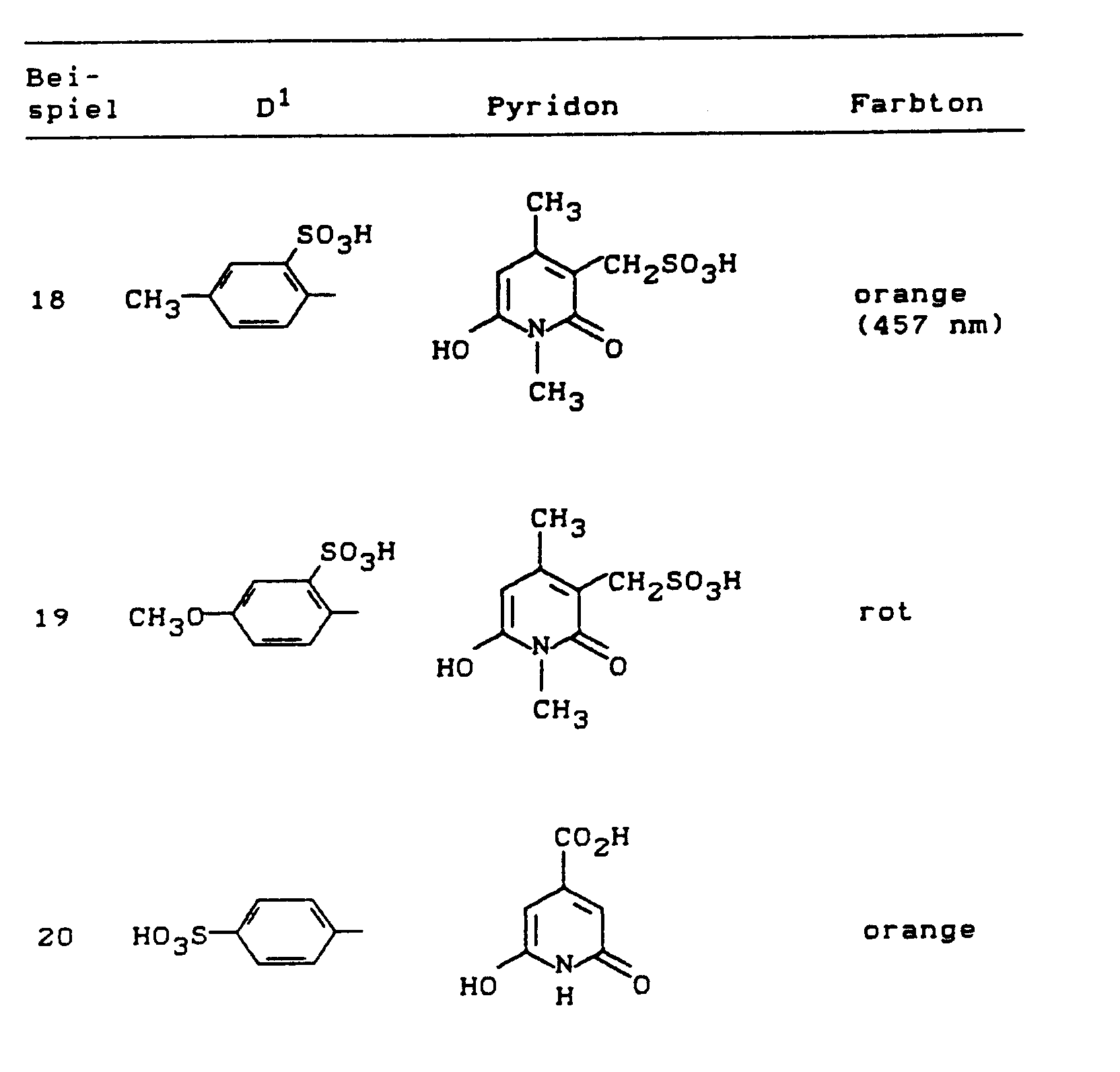
- 28,6 g 1-(2-Aminoethyl)-3-aminocarbonyl-4-methyl-6-hydroxy-2-pyridon werden in 250 ml Wasser neutral gelöst und die Lösung auf 35°C erwärmt. Bei konstantem pH 8,0 fügt man portionsweise 23,2 g 2,4,6-Trifluorpyrimidin zu. Der pH-Wert wird durch Zugabe von Sodalösung kontrolliert. Es wird 30 Minuten bei 35°C nachgerührt, wobei das Kondensationsprodukt der Struktur

teilweise auskristallisiert. Man erwärmt auf 60°C und fügt dann bei pH 7 55 ml einer neutralen 37%igen Hydroxymethansulfonsäurelösung zu, Es wird bei konstantem pH 7 für eine weitere Stunde bei 60°C erwärmt, wobei eine klare Reaktionslösung resultiert. Die Lösung des neuen Zwischenproduktes der Struktur
wird auf Raumtemperatur abgekühlt und mit einer Diazoniumsalzmischung, die durch Diazotieren von 47,1 g 2-Amino-1,5-naphthalindisulfonsäure-Na-Salz bereitet wurde, umgesetzt. Während der Kupplung hält man den pH-Wert mit Sodalösung konstant bei 6,5 bis 7,5. Nach Reaktionsende salzt man mit Natriumchlorid aus und saugt den ausgefallenen Farbstoff ab. Nach dem Trocknen erhält man ca. 150 g eines gelben Farbstoffpulvers der Struktur
das Baumwolle in klaren gelben Tönen mit hohem Echtheitsniveau färbt.
λmax = 430 nm (H₂O)
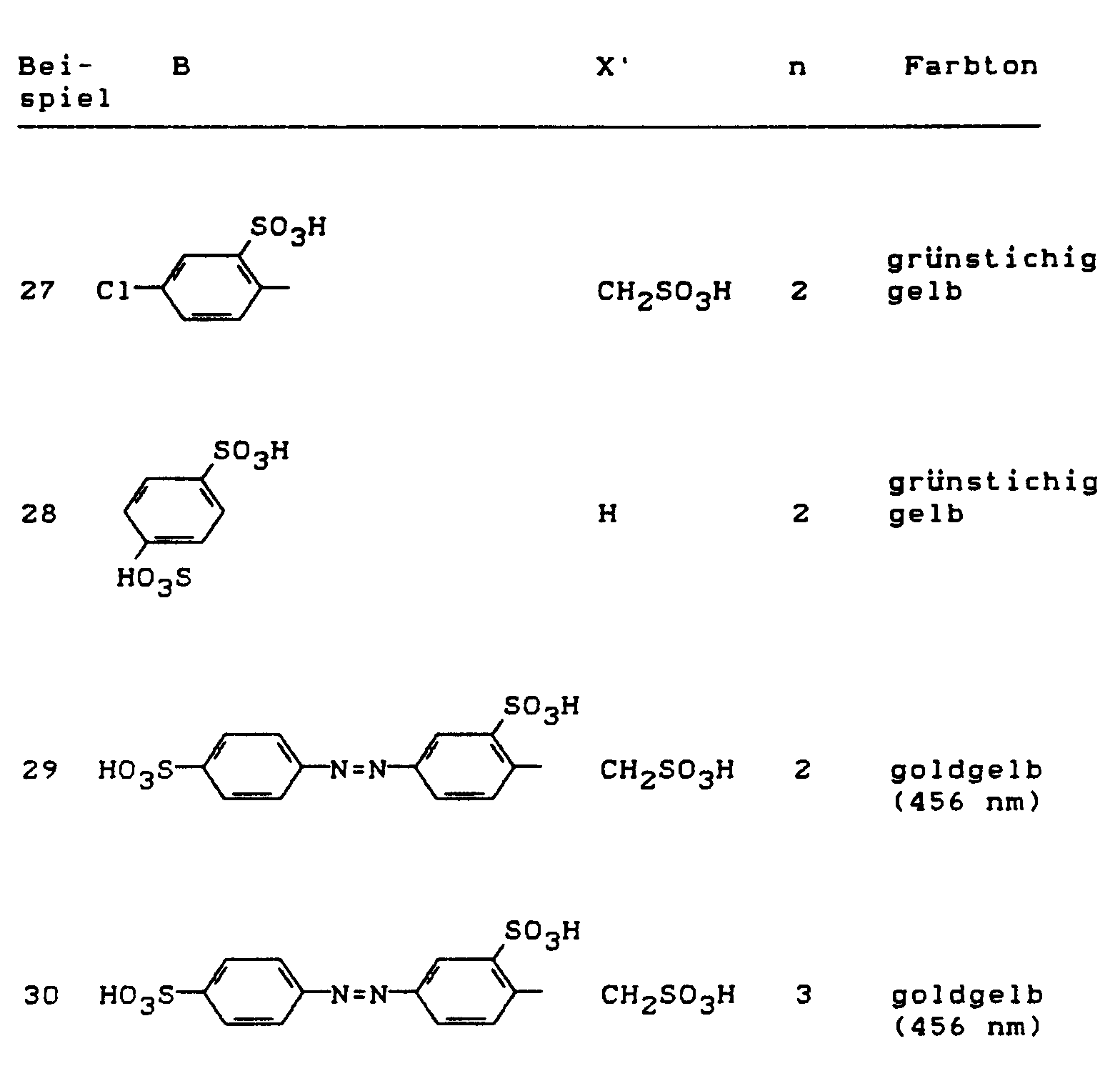
Durch Variation der Diazokomponente sowie der Pyridonsubstitution sind in Analogie zu Beispiel 21 weitere wertvolle Reaktivfarbstoffe zugänglich: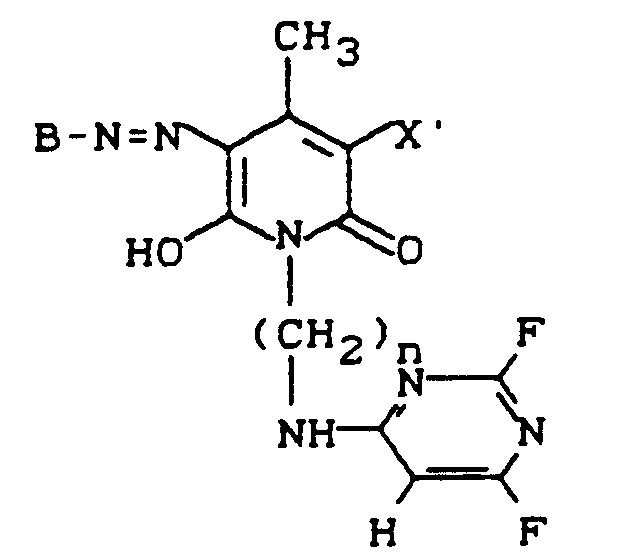


D steht bevorzugt für einen sulfogruppenhaltigen Rest der Benzol-, Naphthalin- oder Azobenzolreihe und kann zusätzlich durch weitere Substituenten, beispielsweise SO₃H, CO₂H, C₁-C₄-Alkyl, Halogen, C₁-C₄-Alkoxy, Acylamino, Ureido, Mesylamino, Amino, C₁-C₄-Alkylamino, Amino-C₁-C₄-alkyl, C₁-C₄-Alkylamino-C₁-C₄-alkyl, speziell Aminomethyl bzw. (Methylamino)methyl, oder 2-Aminoethylsulfonyl bzw. 2-(N-Alkylamino)ethylsulfonyl substituiert sein.
Claims (6)
- Monoreaktive Mono- und Disazoreaktivfarbstoffe der Formel
 D = Rest einer Diazokomponente,R = H, ein gegebenenfalls durch OH, SO₃H, OSO₃H, NH₂, CO₂H, NH(C₁-C₄-Alkyl) oder C₁-C₄-Alkoxy substituierter C₁-C₆-Alkylrest, ein cycloaliphatischer C₃-C₆-Kohlenwasserstoffrest, ein gegebenenfalls durch SO₃H, CO₂H, CH₃, Cl, Br, OCH₃, OC₂H₅, NH₂, NH(C₁-C₄-Alkyl) substituierter Phenyl-oder Hetarylrest,X = H, Cl, Br, CH₃, CH₂SO₃H, CH(CH₃)-SO₃H, CONH₂, CN,
 Y = H, OH, ein gegebenenfalls durch Cl, OH, SO₃H, OSO₃H, CO₂H substituierter C₁-C₄-Alkylrest; ein gegebenenfalls durch SO₃H, CO₂H, CH₃, Cl, Br, OCH₃, OC₂H₅, NH₂, NH(C₁-C₄-Alkyl) substituierter Phenyl-bzw. Benzylrest oder CO₂H undZ für den faserreaktiven Rest der Formel (2)
- Farbstoffe des Anspruchs 1 der Formel

 m = 0 oder 1R, R¹ = gleich oder verschieden H, CH₃, C₂H₅, C₃H₇, C₄H₉, CH₂CH₂OH, CH₂CH₂SO₃H, CH₂CH₂OSO₃H oder CH₂CH₂CH₂-OCH₃X = H, SO₃H, CONH₂ oder CH₂SO₃H,W = H, CH₃, OCH₃, OC₂H₅, Cl, Br, NHCOCH₃ oder NHCONH₂.
 - Farbstoffe des Anspruchs 1 der Formel
 D =
D = n = 2, 3 oder 4,R² = H, CH₃, C₂H₅, C₃H₇, C₄H₉, CH₂CH₂OH, CH₂CH₂SO₃H, CH₂CH₂OSO₃H oder CH₂CH₂CH₂-OCH₃X = H, SO₃H, CONH₂ oder CH₂SO₃H,W = H, CH₃, OCH₃, OC₂H₅, Cl, Br, NHCOCH₃ oder NHCONH₂.
 - Farbstoffe des Anspruchs 1 der Formel

- Verfahren zum Herstellen von Reaktivfarbstoffen gemäß Anspruch 1, dadurch gekennzeichnet, daß man aminogruppenhaltige Pyridonfarbstoffe der Formel

oder eine Aminoverbindung D-NH₂, die keinen Rest Z enthält, diazotiert und in bekannter Weise auf ein mit Z substituiertes Pyridonderivat kuppelt. - Verfahren zum Färben oder Bedrucken von Materialien mit einem Reaktivfarbstoff, dadurch gekennzeichnet, daß man einen Farbstoff gemäß Anspruch 1 verwendet.
Applications Claiming Priority (2)
| Application Number | Priority Date | Filing Date | Title |
|---|---|---|---|
| DE4122866 | 1991-07-11 | ||
| DE4122866A DE4122866A1 (de) | 1991-07-11 | 1991-07-11 | Monoreaktive mono- und disazoreaktivfarbstoffe |
Publications (3)
| Publication Number | Publication Date |
|---|---|
| EP0522399A2 true EP0522399A2 (de) | 1993-01-13 |
| EP0522399A3 EP0522399A3 (en) | 1993-05-12 |
| EP0522399B1 EP0522399B1 (de) | 1996-08-21 |
Family
ID=6435851
Family Applications (1)
| Application Number | Title | Priority Date | Filing Date |
|---|---|---|---|
| EP92110961A Expired - Lifetime EP0522399B1 (de) | 1991-07-11 | 1992-06-29 | Pyridon-Azo-Reaktivfarbstoffe |
Country Status (4)
| Country | Link |
|---|---|
| US (1) | US5359041A (de) |
| EP (1) | EP0522399B1 (de) |
| JP (1) | JPH05222307A (de) |
| DE (2) | DE4122866A1 (de) |
Cited By (2)
| Publication number | Priority date | Publication date | Assignee | Title |
|---|---|---|---|---|
| FR2696752A1 (fr) * | 1992-10-12 | 1994-04-15 | Sandoz Sa | Composés azoïques, leur préparation et leur utilisation comme colorants. |
| WO2003006560A3 (de) * | 2001-07-11 | 2003-11-13 | Dystar Textilfarben Gmbh & Co | Wässrige tintenformulierungen für das tintenstrahldruck-verfahren |
Families Citing this family (4)
| Publication number | Priority date | Publication date | Assignee | Title |
|---|---|---|---|---|
| TW279889B (de) * | 1993-10-07 | 1996-07-01 | Ciba Geigy Ag | |
| GB9804175D0 (en) * | 1998-02-28 | 1998-04-22 | Zeneca Ltd | Compounds |
| CN105504869A (zh) * | 2015-11-27 | 2016-04-20 | 天津德凯化工股份有限公司 | 一种黄色活性染料 |
| CN105504870A (zh) * | 2015-11-27 | 2016-04-20 | 天津德凯化工股份有限公司 | 一种黄色活性染料及其制备方法 |
Family Cites Families (14)
| Publication number | Priority date | Publication date | Assignee | Title |
|---|---|---|---|---|
| DE1644171A1 (de) * | 1966-09-10 | 1970-07-30 | Bayer Ag | Reaktivfarbstoffe und Verfahren zu deren Herstellung |
| US4067864A (en) * | 1970-05-15 | 1978-01-10 | Ciba-Geigy Ag | Fiber-reactive 2-hydroxy-pyrid-6-on-(3)-yl azo dyestuffs |
| US4039523A (en) * | 1970-12-22 | 1977-08-02 | Ciba-Geigy Ag | 3-Sulfoalkyl-6-hydroxy-pyrid-(2)-one-containing azo dyestuffs |
| DE2114158A1 (de) * | 1971-03-24 | 1972-09-28 | Bayer Ag | Reaktivfarbstoffe |
| BE787350A (fr) * | 1971-08-10 | 1973-02-09 | Ciba Geigy | Composes azoiques, leur procede de preparation et leur emploi |
| US4283331A (en) * | 1978-01-25 | 1981-08-11 | Ciba-Geigy Corporation | Azo dyes, their preparation and use |
| DE2831912A1 (de) * | 1978-07-20 | 1980-02-07 | Bayer Ag | Azoreaktivfarbstoffe |
| DE2903021A1 (de) * | 1979-01-26 | 1980-07-31 | Bayer Ag | Azoreaktivfarbstoffe |
| DE2906191A1 (de) * | 1979-02-17 | 1980-08-28 | Bayer Ag | Azoreaktivfarbstoffe |
| US4560388A (en) * | 1983-04-20 | 1985-12-24 | Ciba-Geigy Corporation | Process for dyeing silk or fibre blends containing silk |
| DE3542001A1 (de) * | 1985-11-28 | 1987-06-04 | Bayer Ag | Reaktivfarbstoffe |
| DE3707550A1 (de) * | 1987-03-10 | 1988-09-22 | Bayer Ag | Reaktivfarbstoffe |
| DE4034993A1 (de) * | 1989-11-13 | 1991-05-16 | Sandoz Ag | Faserreaktive monoazoverbindungen |
| GB2238056B (en) * | 1989-11-13 | 1992-07-01 | Sandoz Ltd | Fibre-reactive monoazo dyestuffs |
-
1991
- 1991-07-11 DE DE4122866A patent/DE4122866A1/de not_active Withdrawn
-
1992
- 1992-06-29 DE DE59206936T patent/DE59206936D1/de not_active Expired - Fee Related
- 1992-06-29 EP EP92110961A patent/EP0522399B1/de not_active Expired - Lifetime
- 1992-07-01 US US07/907,277 patent/US5359041A/en not_active Expired - Fee Related
- 1992-07-06 JP JP4200183A patent/JPH05222307A/ja active Pending
Cited By (3)
| Publication number | Priority date | Publication date | Assignee | Title |
|---|---|---|---|---|
| FR2696752A1 (fr) * | 1992-10-12 | 1994-04-15 | Sandoz Sa | Composés azoïques, leur préparation et leur utilisation comme colorants. |
| US5721343A (en) * | 1992-10-12 | 1998-02-24 | Clariant Finance (Bvi) Limited | Fibre-reactive azo dyestuffs containing a halo substituted pyrimidine substituent |
| WO2003006560A3 (de) * | 2001-07-11 | 2003-11-13 | Dystar Textilfarben Gmbh & Co | Wässrige tintenformulierungen für das tintenstrahldruck-verfahren |
Also Published As
| Publication number | Publication date |
|---|---|
| EP0522399B1 (de) | 1996-08-21 |
| DE4122866A1 (de) | 1993-01-14 |
| JPH05222307A (ja) | 1993-08-31 |
| US5359041A (en) | 1994-10-25 |
| DE59206936D1 (de) | 1996-09-26 |
| EP0522399A3 (en) | 1993-05-12 |
Similar Documents
| Publication | Publication Date | Title |
|---|---|---|
| EP0048355A1 (de) | Wasserlösliche Disazoverbindungen, Verfahren zu deren Herstellung und ihre Verwendung als Farbstoffe | |
| EP0065732B1 (de) | Wasserlösliche Disazoverbindungen, Verfahren zu deren Herstellung und ihre Verwendung als Farbstoffe | |
| DE2748929C2 (de) | Wasserlösliche Farbstoffe, Verfahren zu ihrer Herstellung, deren Verwendung als faserreaktive Farbstoffe zum Färben und Bedrucken von Fasermaterialien | |
| EP0526792B1 (de) | Fluorpyrimidin-Reaktivfarbstoffe | |
| EP0545219A1 (de) | Reaktivfarbstoffe, deren Herstellung und Verwendung | |
| DE1289930B (de) | Verfahren zur Herstellung von Azofarbstoffen und deren Metallkomplexverbindungen | |
| DE3717814A1 (de) | Reaktivfarbstoffe | |
| EP0522399B1 (de) | Pyridon-Azo-Reaktivfarbstoffe | |
| EP0377902B1 (de) | Reaktivfarbstoffe | |
| EP0169457B1 (de) | Wasserlösliche Pyridon-Monoazoverbindungen, Verfahren zu ihrer Herstellung und ihre Verwendung als Farbstoffe | |
| DE1289206B (de) | Verfahren zur Herstellung von wasserloeslichen Azophthalocyaninfarbstoffen | |
| DE3045789A1 (de) | Faseraktive azofarbstoffe, verfahren zu ihrer herstellung und ihre verwendung zum faerben und bedrucken von hydroxylgruppen- und/oder stickstoffhaltigen fasermaterialien | |
| EP0231836B1 (de) | Wasserlösliche Disazoverbindungen, Verfahren zu ihrer Herstellung und ihre Verwendung als Farbstoffe | |
| EP0554746A1 (de) | Reaktivfarbstoffe, deren Herstellung und Verwendung | |
| EP0568892B1 (de) | Monoazoreaktivfarbstoffe | |
| EP0641841B1 (de) | Azo-Reaktivfarbstoffe | |
| DE4309554A1 (de) | Faserreaktive Azofarbstoffe | |
| DE19515251B4 (de) | Faserreaktive Disazofarbstoffe | |
| EP0360003B1 (de) | Wasserlösliche Azoverbindungen, Verfahren zu ihrer Herstellung und ihre Verwendung als Farbstoffe | |
| DE3604858A1 (de) | Wasserloesliche azoverbindungen, verfahren zu ihrer herstellung und ihre verwendung als farbstoffe | |
| EP0168739B1 (de) | Reaktivfarbstoffe | |
| DE1180868B (de) | Verfahren zur Herstellung von Phthalocyaninfarbstoffen | |
| DE3707550A1 (de) | Reaktivfarbstoffe | |
| DE4327006B4 (de) | Faserreaktive Monoazofarbstoffe | |
| DE2705631A1 (de) | Azofarbstoffe |
Legal Events
| Date | Code | Title | Description |
|---|---|---|---|
| PUAI | Public reference made under article 153(3) epc to a published international application that has entered the european phase |
Free format text: ORIGINAL CODE: 0009012 |
|
| AK | Designated contracting states |
Kind code of ref document: A2 Designated state(s): CH DE FR GB LI |
|
| PUAL | Search report despatched |
Free format text: ORIGINAL CODE: 0009013 |
|
| AK | Designated contracting states |
Kind code of ref document: A3 Designated state(s): CH DE FR GB LI |
|
| 17P | Request for examination filed |
Effective date: 19930525 |
|
| GRAG | Despatch of communication of intention to grant |
Free format text: ORIGINAL CODE: EPIDOS AGRA |
|
| GRAH | Despatch of communication of intention to grant a patent |
Free format text: ORIGINAL CODE: EPIDOS IGRA |
|
| 17Q | First examination report despatched |
Effective date: 19960118 |
|
| GRAH | Despatch of communication of intention to grant a patent |
Free format text: ORIGINAL CODE: EPIDOS IGRA |
|
| GRAA | (expected) grant |
Free format text: ORIGINAL CODE: 0009210 |
|
| AK | Designated contracting states |
Kind code of ref document: B1 Designated state(s): CH DE FR GB LI |
|
| REG | Reference to a national code |
Ref country code: CH Ref legal event code: NV Representative=s name: E. BLUM & CO. PATENTANWAELTE |
|
| REF | Corresponds to: |
Ref document number: 59206936 Country of ref document: DE Date of ref document: 19960926 |
|
| GBT | Gb: translation of ep patent filed (gb section 77(6)(a)/1977) |
Effective date: 19960906 |
|
| ET | Fr: translation filed |
Free format text: CORRECTIONS |
|
| PLBE | No opposition filed within time limit |
Free format text: ORIGINAL CODE: 0009261 |
|
| STAA | Information on the status of an ep patent application or granted ep patent |
Free format text: STATUS: NO OPPOSITION FILED WITHIN TIME LIMIT |
|
| 26N | No opposition filed | ||
| REG | Reference to a national code |
Ref country code: GB Ref legal event code: IF02 |
|
| REG | Reference to a national code |
Ref country code: CH Ref legal event code: PUE Owner name: DYSTAR TEXTILFARBEN GMBH & CO. DEUTSCHLAND KG Free format text: BAYER AG# #51368 LEVERKUSEN (DE) -TRANSFER TO- DYSTAR TEXTILFARBEN GMBH & CO. DEUTSCHLAND KG#INDUSTRIEPARK HOECHST#65926 FRANKFURT AM MAIN (DE) Ref country code: CH Ref legal event code: NV Representative=s name: PATENTANWAELTE SCHAAD, BALASS, MENZL & PARTNER AG |
|
| REG | Reference to a national code |
Ref country code: GB Ref legal event code: 732E |
|
| PGFP | Annual fee paid to national office [announced via postgrant information from national office to epo] |
Ref country code: FR Payment date: 20060608 Year of fee payment: 15 |
|
| PGFP | Annual fee paid to national office [announced via postgrant information from national office to epo] |
Ref country code: DE Payment date: 20060622 Year of fee payment: 15 |
|
| PGFP | Annual fee paid to national office [announced via postgrant information from national office to epo] |
Ref country code: GB Payment date: 20060628 Year of fee payment: 15 |
|
| REG | Reference to a national code |
Ref country code: FR Ref legal event code: TP |
|
| PGFP | Annual fee paid to national office [announced via postgrant information from national office to epo] |
Ref country code: CH Payment date: 20070627 Year of fee payment: 16 |
|
| GBPC | Gb: european patent ceased through non-payment of renewal fee |
Effective date: 20070629 |
|
| REG | Reference to a national code |
Ref country code: FR Ref legal event code: ST Effective date: 20080229 |
|
| PG25 | Lapsed in a contracting state [announced via postgrant information from national office to epo] |
Ref country code: DE Free format text: LAPSE BECAUSE OF NON-PAYMENT OF DUE FEES Effective date: 20080101 |
|
| PG25 | Lapsed in a contracting state [announced via postgrant information from national office to epo] |
Ref country code: GB Free format text: LAPSE BECAUSE OF NON-PAYMENT OF DUE FEES Effective date: 20070629 |
|
| PG25 | Lapsed in a contracting state [announced via postgrant information from national office to epo] |
Ref country code: FR Free format text: LAPSE BECAUSE OF NON-PAYMENT OF DUE FEES Effective date: 20070702 |
|
| REG | Reference to a national code |
Ref country code: CH Ref legal event code: PL |
|
| PG25 | Lapsed in a contracting state [announced via postgrant information from national office to epo] |
Ref country code: LI Free format text: LAPSE BECAUSE OF NON-PAYMENT OF DUE FEES Effective date: 20080630 Ref country code: CH Free format text: LAPSE BECAUSE OF NON-PAYMENT OF DUE FEES Effective date: 20080630 |