EP0513186B1 - Process for oxidation of materials in water at supercritical temperatures - Google Patents
Process for oxidation of materials in water at supercritical temperatures Download PDFInfo
- Publication number
- EP0513186B1 EP0513186B1 EP91904256A EP91904256A EP0513186B1 EP 0513186 B1 EP0513186 B1 EP 0513186B1 EP 91904256 A EP91904256 A EP 91904256A EP 91904256 A EP91904256 A EP 91904256A EP 0513186 B1 EP0513186 B1 EP 0513186B1
- Authority
- EP
- European Patent Office
- Prior art keywords
- reactor
- stream
- water
- oxidation
- pressure
- Prior art date
- Legal status (The legal status is an assumption and is not a legal conclusion. Google has not performed a legal analysis and makes no representation as to the accuracy of the status listed.)
- Expired - Lifetime
Links
- 238000000034 method Methods 0.000 title claims abstract description 84
- XLYOFNOQVPJJNP-UHFFFAOYSA-N water Substances O XLYOFNOQVPJJNP-UHFFFAOYSA-N 0.000 title claims abstract description 68
- 229910001868 water Inorganic materials 0.000 title claims abstract description 66
- 238000007254 oxidation reaction Methods 0.000 title claims abstract description 57
- 230000003647 oxidation Effects 0.000 title claims abstract description 55
- 239000000463 material Substances 0.000 title claims abstract description 30
- 230000008569 process Effects 0.000 title description 53
- 230000001590 oxidative effect Effects 0.000 claims abstract description 34
- 239000007800 oxidant agent Substances 0.000 claims abstract description 29
- 229910010272 inorganic material Inorganic materials 0.000 claims abstract description 8
- 239000011147 inorganic material Substances 0.000 claims abstract description 7
- 239000007787 solid Substances 0.000 claims description 37
- 239000007788 liquid Substances 0.000 claims description 29
- 239000007789 gas Substances 0.000 claims description 24
- 239000000470 constituent Substances 0.000 claims description 12
- QVGXLLKOCUKJST-UHFFFAOYSA-N atomic oxygen Chemical group [O] QVGXLLKOCUKJST-UHFFFAOYSA-N 0.000 claims description 11
- 239000001301 oxygen Substances 0.000 claims description 11
- 229910052760 oxygen Inorganic materials 0.000 claims description 11
- 239000007795 chemical reaction product Substances 0.000 claims description 7
- 239000000047 product Substances 0.000 claims description 5
- MHAJPDPJQMAIIY-UHFFFAOYSA-N Hydrogen peroxide Chemical compound OO MHAJPDPJQMAIIY-UHFFFAOYSA-N 0.000 claims description 4
- 150000001768 cations Chemical class 0.000 claims description 3
- GRYLNZFGIOXLOG-UHFFFAOYSA-N Nitric acid Chemical compound O[N+]([O-])=O GRYLNZFGIOXLOG-UHFFFAOYSA-N 0.000 claims description 2
- CBENFWSGALASAD-UHFFFAOYSA-N Ozone Chemical compound [O-][O+]=O CBENFWSGALASAD-UHFFFAOYSA-N 0.000 claims description 2
- 229910017604 nitric acid Inorganic materials 0.000 claims description 2
- VLTRZXGMWDSKGL-UHFFFAOYSA-M perchlorate Inorganic materials [O-]Cl(=O)(=O)=O VLTRZXGMWDSKGL-UHFFFAOYSA-M 0.000 claims description 2
- VLTRZXGMWDSKGL-UHFFFAOYSA-N perchloric acid Chemical compound OCl(=O)(=O)=O VLTRZXGMWDSKGL-UHFFFAOYSA-N 0.000 claims description 2
- 230000003197 catalytic effect Effects 0.000 claims 3
- 239000002245 particle Substances 0.000 claims 2
- 150000001449 anionic compounds Chemical class 0.000 claims 1
- 229910001412 inorganic anion Inorganic materials 0.000 claims 1
- 238000006243 chemical reaction Methods 0.000 abstract description 29
- 239000012530 fluid Substances 0.000 abstract description 18
- 238000001556 precipitation Methods 0.000 abstract description 5
- 238000009279 wet oxidation reaction Methods 0.000 description 26
- HEMHJVSKTPXQMS-UHFFFAOYSA-M Sodium hydroxide Chemical compound [OH-].[Na+] HEMHJVSKTPXQMS-UHFFFAOYSA-M 0.000 description 21
- 238000002485 combustion reaction Methods 0.000 description 20
- 239000000446 fuel Substances 0.000 description 20
- 239000003570 air Substances 0.000 description 18
- 239000012071 phase Substances 0.000 description 17
- 239000003245 coal Substances 0.000 description 15
- 238000010438 heat treatment Methods 0.000 description 14
- 238000009284 supercritical water oxidation Methods 0.000 description 14
- 238000002474 experimental method Methods 0.000 description 13
- 239000003513 alkali Substances 0.000 description 12
- 150000003839 salts Chemical class 0.000 description 12
- KFZMGEQAYNKOFK-UHFFFAOYSA-N Isopropanol Chemical compound CC(C)O KFZMGEQAYNKOFK-UHFFFAOYSA-N 0.000 description 11
- 239000003054 catalyst Substances 0.000 description 11
- 239000000203 mixture Substances 0.000 description 11
- 238000011084 recovery Methods 0.000 description 10
- 238000000926 separation method Methods 0.000 description 10
- OKTJSMMVPCPJKN-UHFFFAOYSA-N Carbon Chemical compound [C] OKTJSMMVPCPJKN-UHFFFAOYSA-N 0.000 description 9
- 230000006378 damage Effects 0.000 description 9
- 239000007791 liquid phase Substances 0.000 description 9
- 239000002002 slurry Substances 0.000 description 9
- FAPWRFPIFSIZLT-UHFFFAOYSA-M Sodium chloride Chemical group [Na+].[Cl-] FAPWRFPIFSIZLT-UHFFFAOYSA-M 0.000 description 8
- 230000008901 benefit Effects 0.000 description 8
- 239000002699 waste material Substances 0.000 description 8
- 241000196324 Embryophyta Species 0.000 description 7
- 229910052799 carbon Inorganic materials 0.000 description 7
- 239000000126 substance Substances 0.000 description 7
- -1 acetic acid Chemical class 0.000 description 6
- 150000001875 compounds Chemical class 0.000 description 6
- 230000000977 initiatory effect Effects 0.000 description 6
- 238000010248 power generation Methods 0.000 description 6
- QAOWNCQODCNURD-UHFFFAOYSA-L Sulfate Chemical compound [O-]S([O-])(=O)=O QAOWNCQODCNURD-UHFFFAOYSA-L 0.000 description 5
- 239000012808 vapor phase Substances 0.000 description 5
- QAOWNCQODCNURD-UHFFFAOYSA-N Sulfuric acid Chemical compound OS(O)(=O)=O QAOWNCQODCNURD-UHFFFAOYSA-N 0.000 description 4
- 229910002091 carbon monoxide Inorganic materials 0.000 description 4
- VNWKTOKETHGBQD-UHFFFAOYSA-N methane Chemical compound C VNWKTOKETHGBQD-UHFFFAOYSA-N 0.000 description 4
- 238000002156 mixing Methods 0.000 description 4
- 239000000376 reactant Substances 0.000 description 4
- 230000001172 regenerating effect Effects 0.000 description 4
- 239000011780 sodium chloride Substances 0.000 description 4
- 238000012360 testing method Methods 0.000 description 4
- 238000012546 transfer Methods 0.000 description 4
- QTBSBXVTEAMEQO-UHFFFAOYSA-N Acetic acid Chemical compound CC(O)=O QTBSBXVTEAMEQO-UHFFFAOYSA-N 0.000 description 3
- UGFAIRIUMAVXCW-UHFFFAOYSA-N Carbon monoxide Chemical compound [O+]#[C-] UGFAIRIUMAVXCW-UHFFFAOYSA-N 0.000 description 3
- PMZURENOXWZQFD-UHFFFAOYSA-L Sodium Sulfate Chemical compound [Na+].[Na+].[O-]S([O-])(=O)=O PMZURENOXWZQFD-UHFFFAOYSA-L 0.000 description 3
- 239000008346 aqueous phase Substances 0.000 description 3
- 239000012267 brine Substances 0.000 description 3
- 239000006227 byproduct Substances 0.000 description 3
- 239000003518 caustics Substances 0.000 description 3
- 230000003247 decreasing effect Effects 0.000 description 3
- 238000010790 dilution Methods 0.000 description 3
- 239000012895 dilution Substances 0.000 description 3
- 230000000694 effects Effects 0.000 description 3
- 230000006872 improvement Effects 0.000 description 3
- 238000004064 recycling Methods 0.000 description 3
- 239000010802 sludge Substances 0.000 description 3
- 229910052938 sodium sulfate Inorganic materials 0.000 description 3
- HPALAKNZSZLMCH-UHFFFAOYSA-M sodium;chloride;hydrate Chemical compound O.[Na+].[Cl-] HPALAKNZSZLMCH-UHFFFAOYSA-M 0.000 description 3
- 239000002689 soil Substances 0.000 description 3
- 231100000331 toxic Toxicity 0.000 description 3
- 230000002588 toxic effect Effects 0.000 description 3
- QGZKDVFQNNGYKY-UHFFFAOYSA-N Ammonia Chemical compound N QGZKDVFQNNGYKY-UHFFFAOYSA-N 0.000 description 2
- IJGRMHOSHXDMSA-UHFFFAOYSA-N Atomic nitrogen Chemical compound N#N IJGRMHOSHXDMSA-UHFFFAOYSA-N 0.000 description 2
- MYMOFIZGZYHOMD-UHFFFAOYSA-N Dioxygen Chemical compound O=O MYMOFIZGZYHOMD-UHFFFAOYSA-N 0.000 description 2
- GQPLMRYTRLFLPF-UHFFFAOYSA-N Nitrous Oxide Chemical compound [O-][N+]#N GQPLMRYTRLFLPF-UHFFFAOYSA-N 0.000 description 2
- WCUXLLCKKVVCTQ-UHFFFAOYSA-M Potassium chloride Chemical compound [Cl-].[K+] WCUXLLCKKVVCTQ-UHFFFAOYSA-M 0.000 description 2
- 241000220317 Rosa Species 0.000 description 2
- 239000002956 ash Substances 0.000 description 2
- 239000003250 coal slurry Substances 0.000 description 2
- 238000009833 condensation Methods 0.000 description 2
- 230000005494 condensation Effects 0.000 description 2
- 230000007797 corrosion Effects 0.000 description 2
- 238000005260 corrosion Methods 0.000 description 2
- 230000005484 gravity Effects 0.000 description 2
- 229910003480 inorganic solid Inorganic materials 0.000 description 2
- 238000002844 melting Methods 0.000 description 2
- 230000008018 melting Effects 0.000 description 2
- 244000005700 microbiome Species 0.000 description 2
- 239000002244 precipitate Substances 0.000 description 2
- 230000035484 reaction time Effects 0.000 description 2
- 239000010865 sewage Substances 0.000 description 2
- CDBYLPFSWZWCQE-UHFFFAOYSA-L sodium carbonate Substances [Na+].[Na+].[O-]C([O-])=O CDBYLPFSWZWCQE-UHFFFAOYSA-L 0.000 description 2
- 235000011152 sodium sulphate Nutrition 0.000 description 2
- 239000000243 solution Substances 0.000 description 2
- 238000001179 sorption measurement Methods 0.000 description 2
- 230000000153 supplemental effect Effects 0.000 description 2
- 239000003440 toxic substance Substances 0.000 description 2
- GDDNTTHUKVNJRA-UHFFFAOYSA-N 3-bromo-3,3-difluoroprop-1-ene Chemical compound FC(F)(Br)C=C GDDNTTHUKVNJRA-UHFFFAOYSA-N 0.000 description 1
- 241000609240 Ambelania acida Species 0.000 description 1
- CPELXLSAUQHCOX-UHFFFAOYSA-M Bromide Chemical compound [Br-] CPELXLSAUQHCOX-UHFFFAOYSA-M 0.000 description 1
- 239000007832 Na2SO4 Substances 0.000 description 1
- NINIDFKCEFEMDL-UHFFFAOYSA-N Sulfur Chemical compound [S] NINIDFKCEFEMDL-UHFFFAOYSA-N 0.000 description 1
- 240000008042 Zea mays Species 0.000 description 1
- 235000005824 Zea mays ssp. parviglumis Nutrition 0.000 description 1
- 235000002017 Zea mays subsp mays Nutrition 0.000 description 1
- 239000002253 acid Substances 0.000 description 1
- 230000009471 action Effects 0.000 description 1
- 239000012080 ambient air Substances 0.000 description 1
- 229910021529 ammonia Inorganic materials 0.000 description 1
- BFNBIHQBYMNNAN-UHFFFAOYSA-N ammonium sulfate Chemical compound N.N.OS(O)(=O)=O BFNBIHQBYMNNAN-UHFFFAOYSA-N 0.000 description 1
- 229910052921 ammonium sulfate Inorganic materials 0.000 description 1
- 235000011130 ammonium sulphate Nutrition 0.000 description 1
- 239000010828 animal waste Substances 0.000 description 1
- 238000013459 approach Methods 0.000 description 1
- 239000010905 bagasse Substances 0.000 description 1
- 230000015572 biosynthetic process Effects 0.000 description 1
- 238000009835 boiling Methods 0.000 description 1
- 238000003889 chemical engineering Methods 0.000 description 1
- 239000007806 chemical reaction intermediate Substances 0.000 description 1
- 231100000481 chemical toxicant Toxicity 0.000 description 1
- 239000010849 combustible waste Substances 0.000 description 1
- 230000000295 complement effect Effects 0.000 description 1
- 238000007906 compression Methods 0.000 description 1
- 230000006835 compression Effects 0.000 description 1
- 230000003750 conditioning effect Effects 0.000 description 1
- 239000004035 construction material Substances 0.000 description 1
- 238000001816 cooling Methods 0.000 description 1
- 235000005822 corn Nutrition 0.000 description 1
- 230000008878 coupling Effects 0.000 description 1
- 238000010168 coupling process Methods 0.000 description 1
- 238000005859 coupling reaction Methods 0.000 description 1
- 230000009849 deactivation Effects 0.000 description 1
- 230000007423 decrease Effects 0.000 description 1
- 239000008367 deionised water Substances 0.000 description 1
- 229910021641 deionized water Inorganic materials 0.000 description 1
- 230000008021 deposition Effects 0.000 description 1
- 238000010612 desalination reaction Methods 0.000 description 1
- 238000011161 development Methods 0.000 description 1
- 230000018109 developmental process Effects 0.000 description 1
- 238000010586 diagram Methods 0.000 description 1
- 238000005516 engineering process Methods 0.000 description 1
- 238000001704 evaporation Methods 0.000 description 1
- 230000008020 evaporation Effects 0.000 description 1
- 238000000605 extraction Methods 0.000 description 1
- 230000002349 favourable effect Effects 0.000 description 1
- 210000003608 fece Anatomy 0.000 description 1
- 238000001914 filtration Methods 0.000 description 1
- 239000010881 fly ash Substances 0.000 description 1
- 239000007792 gaseous phase Substances 0.000 description 1
- 239000003502 gasoline Substances 0.000 description 1
- 231100001261 hazardous Toxicity 0.000 description 1
- 239000000383 hazardous chemical Substances 0.000 description 1
- 239000002638 heterogeneous catalyst Substances 0.000 description 1
- 239000002815 homogeneous catalyst Substances 0.000 description 1
- 239000001257 hydrogen Substances 0.000 description 1
- 229910052739 hydrogen Inorganic materials 0.000 description 1
- 125000004435 hydrogen atom Chemical class [H]* 0.000 description 1
- 150000002484 inorganic compounds Chemical class 0.000 description 1
- 150000004694 iodide salts Chemical class 0.000 description 1
- 230000001535 kindling effect Effects 0.000 description 1
- 239000012263 liquid product Substances 0.000 description 1
- 239000010871 livestock manure Substances 0.000 description 1
- 239000011159 matrix material Substances 0.000 description 1
- 238000005259 measurement Methods 0.000 description 1
- 230000007246 mechanism Effects 0.000 description 1
- 229910044991 metal oxide Inorganic materials 0.000 description 1
- 150000004706 metal oxides Chemical class 0.000 description 1
- 239000003595 mist Substances 0.000 description 1
- 239000003345 natural gas Substances 0.000 description 1
- 238000006386 neutralization reaction Methods 0.000 description 1
- 150000002823 nitrates Chemical class 0.000 description 1
- 150000002825 nitriles Chemical class 0.000 description 1
- 150000002826 nitrites Chemical class 0.000 description 1
- 229910052757 nitrogen Inorganic materials 0.000 description 1
- 239000001272 nitrous oxide Substances 0.000 description 1
- 239000003758 nuclear fuel Substances 0.000 description 1
- 239000003415 peat Substances 0.000 description 1
- 238000011020 pilot scale process Methods 0.000 description 1
- 239000010908 plant waste Substances 0.000 description 1
- 239000001103 potassium chloride Substances 0.000 description 1
- 235000011164 potassium chloride Nutrition 0.000 description 1
- 230000001376 precipitating effect Effects 0.000 description 1
- 230000002028 premature Effects 0.000 description 1
- 230000002035 prolonged effect Effects 0.000 description 1
- 238000005086 pumping Methods 0.000 description 1
- 238000000746 purification Methods 0.000 description 1
- 239000012429 reaction media Substances 0.000 description 1
- 239000011541 reaction mixture Substances 0.000 description 1
- 230000009467 reduction Effects 0.000 description 1
- 238000002407 reforming Methods 0.000 description 1
- 230000008929 regeneration Effects 0.000 description 1
- 238000011069 regeneration method Methods 0.000 description 1
- 238000012552 review Methods 0.000 description 1
- 239000011833 salt mixture Substances 0.000 description 1
- 229920006395 saturated elastomer Polymers 0.000 description 1
- 238000005201 scrubbing Methods 0.000 description 1
- 239000013049 sediment Substances 0.000 description 1
- 238000004088 simulation Methods 0.000 description 1
- 239000011734 sodium Substances 0.000 description 1
- 229910000029 sodium carbonate Inorganic materials 0.000 description 1
- 239000007790 solid phase Substances 0.000 description 1
- 239000004449 solid propellant Substances 0.000 description 1
- 239000002904 solvent Substances 0.000 description 1
- 230000001954 sterilising effect Effects 0.000 description 1
- 238000004659 sterilization and disinfection Methods 0.000 description 1
- 239000010907 stover Substances 0.000 description 1
- 229910052717 sulfur Inorganic materials 0.000 description 1
- 239000011593 sulfur Substances 0.000 description 1
- 150000003467 sulfuric acid derivatives Chemical class 0.000 description 1
- 231100000167 toxic agent Toxicity 0.000 description 1
- 238000011144 upstream manufacturing Methods 0.000 description 1
- 239000002023 wood Substances 0.000 description 1
- 239000002916 wood waste Substances 0.000 description 1
Images


Classifications
-
- F—MECHANICAL ENGINEERING; LIGHTING; HEATING; WEAPONS; BLASTING
- F01—MACHINES OR ENGINES IN GENERAL; ENGINE PLANTS IN GENERAL; STEAM ENGINES
- F01K—STEAM ENGINE PLANTS; STEAM ACCUMULATORS; ENGINE PLANTS NOT OTHERWISE PROVIDED FOR; ENGINES USING SPECIAL WORKING FLUIDS OR CYCLES
- F01K3/00—Plants characterised by the use of steam or heat accumulators, or intermediate steam heaters, therein
- F01K3/18—Plants characterised by the use of steam or heat accumulators, or intermediate steam heaters, therein having heaters
- F01K3/188—Plants characterised by the use of steam or heat accumulators, or intermediate steam heaters, therein having heaters using heat from a specified chemical reaction
-
- C—CHEMISTRY; METALLURGY
- C02—TREATMENT OF WATER, WASTE WATER, SEWAGE, OR SLUDGE
- C02F—TREATMENT OF WATER, WASTE WATER, SEWAGE, OR SLUDGE
- C02F11/00—Treatment of sludge; Devices therefor
- C02F11/06—Treatment of sludge; Devices therefor by oxidation
- C02F11/08—Wet air oxidation
- C02F11/086—Wet air oxidation in the supercritical state
Definitions
- This invention relates to the oxidation of materials in aqueous feed streams. More specifically, it relates to a process of completely oxidising materials in an aqueous feed stream at supercritical temperatures and subcritical pressures, in reference to pure water.
- the process of wet oxidation has been used for the treatment of aqueous streams for over thirty years. It involves the addition of an oxidising agent, typically air or oxygen, to an aqueous stream at elevated temperatures and pressures, with the resultant "combustion" of oxidizable materials directly within the aqueous phase.
- the wet oxidation process is characterised by operating pressures of 30 to 250 bar (440 to 3630 psia) and operating temperatures of 150° to 370°C. Reaction is primarily carried out in the liquid phase since gas phase oxidation is quite slow.
- the reactor operating pressure is typically maintained at or above the saturated water vapour pressure, so that at least part of the water is present in liquid form.
- wet oxidation is applicable to streams with a chemical oxygen demand (COD) as low as 20 grams/liter (Perkow, H., R. Steiner and H. Vollmuller, "Wet Air Oxidation - A Review", German Chemical Engineering, 1981, 4, 193-201). Below this level energy inputs to the process are excessive, and other technologies such as biological treatment or carbon adsorption become more economical.
- the advantages of wet oxidation over biological treatment and adsorption are reduced time and space requirements for treatment, destruction of chemicals toxic to microorganisms, destruction of non-biodegradable chemicals, and potential recovery or inorganic materials.
- the upper limit of wet oxidation applicability is set by the temperature rise due to reaction, and is about 200 grams/liter of utilized chemical oxygen demand (COD).
- wet oxidation The largest single application of wet oxidation is for the conditioning of municipal sludge.
- the COD reduction in this process is only 5 to 15%, the primary objective being sterilization and disruption of the organic matrix to improve the dewatering properties of the sludge.
- the sludge is used for soil improvement or landfill, or is incinerated.
- Other uses of wet oxidation are for the treatment of night soil, pulp and paper mill effluents, regeneration of activated carbon, and treatment of chemical plant effluents. In these applications, COD removal is typically 90% or less.
- Catalysts are frequently used in this process. While the process may be advantageous in the context of a wet oxidation plant, as a stand-alone process the Barton invention is of limited utility because its usefulness is constrained to clean, volatile fuels. Such materials are too expensive for power generation on a large scale, and when occurring as a waste stream, are more economically treated by other means. The limited usefulness of the Barton process appears to be indicated by the lack of literature reports on commercial application.
- Dickinson U.S. Patent 4,292,953 proposed a modified wet oxidation process for power generation from coal and other slurry fuels in which, as heat is liberated by combustion, the entire reaction mixture exceeds the critical temperature (374°C) of water. The higher temperature would result in accelerated reaction rates, allowing shorter residence times and smaller reactors as compared to conventional wet oxidation.
- Dickinson's process teaches a process range of between 1000 and 10,000 psi, which covers the range both above and below the critical pressure of water (3206 psi or 221 bar).
- the reaction commences at subcritical temperatures so that, similar to wet oxidation, the bulk of the oxidizing gas is found in a separate phase above the aqueous slurry. This feature results in a slow reaction initiation and a requirement for prolonged residence time in the reactor, though some improvement over conventional wet oxidation would be expected.
- Dickinson proposed the use of alkali catalyst.
- Aqueous feed streams containing organic or inorganic combustible materials, such as coal, sewage and toxic chemicals, may be substantially completely oxidized in a rapid, self-sustaining reaction without a catalyst.
- the conditions of this reaction may be generally characterised as supercritical temperatures and subcritical pressures for water.
- Supercritical temperatures for complete oxidation range from 500-800°C, depending on the fuel used.
- Pressures are in the subcritical range of from about (25 bar to 220 bar).
- the process typically provides virtually complete oxidation of the aqueous feed stream in a residence time of less than 5 minutes, preferably less than about 0.5 minutes.
- a self-sustaining method for substantially completely oxidizing combustible materials in which an aqueous stream bearing the combustible materials is brought to a pressure between 2.5MPa (25 bar) and the critical pressure of water and reacted in the presence of an oxidant at a temperature greater than 374°C within a reactor for a period of less than 5 minutes to produce a reaction product stream, characterised in that the method is carried out in the absence of a fluidized bed of solids.
- the present invention also provides a self-sustaining method for removing dissolved non-combustible inorganic materials from water, which method comprises introducing an aqueous feed stream containing dissolved non-combustible inorganic materials to a reactor at a pressure of between 2.5MPa (25 bar) and the critical pressure of water; introducing combustibles to the reactor as a separate stream or as a constituent of the aqueous feed stream; reacting the combustibles in the presence of an oxidant at a temperature greater than 374°C; and removing non-combustible inorganic constituents from the hot reaction product stream, including those originally dissolved in the aqueous feed stream, characterised in that the method is carried out in the absence of a fluidized bed of solids.
- the invention further provides a self-sustaining method for obtaining oxidation products from a combustible material in which an aqueous stream bearing combustible materials in brought to a pressure between 2.5MPa (25 bar) and the critical pressure of water and reacted in the presence of an oxidant at a temperature greater than 374°C within a reactor for a period of less than 5 minutes, characterised in that the aqueous stream bearing combustible materials is incompletely reacted with the oxidant, so as to obtain partial oxidation products, and in that the method is carried out in the absence of a fluidized bed of solids.
- the useful lower limit of pressure for supercritical temperature water oxidation will depend on the particular material being oxidized and its concentration in the aqueous stream.
- the ignition temperature the lowest temperature for self-sustaining combustion
- Increasing pressure typically decreases ignition temperature for a given material in near-ambient pressure combustion.
- Increasing pressure serves to increase reactant concentration (moles per liter) and thereby may enable self-sustaining reaction for streams with a low fraction of conbustible material. Pressures as low as approximately 25 bar (360 psi) are expected to be useful for the supercritical temperature water oxidation process.
- the density of the reaction medium will be less than 0.2 g/cc except in the immediate vicinity (within a few bar and a fes °C) of the critical point, i.e., where the pressure is close to the critical pressure and the temperature is close to the critical temperature of water.
- This region of temperature and pressure space is known as the near critical region, and encompasses densities near the critical density of water of 0.32 g/cc.
- densities of less than about 0.2 g/cc are preferred.
- densities of less than about 0.147 g/cc are utilized, and most preferably, densities of less than about 0.076 g/cc are utilized.
- Supercritical temperature water oxidation and supercritical water oxidation have many similarities. Both processes operate at similar temperatures. In both processes, gases and nonsolid combustibles are completely miscible in the aqueous phase, allowing intimate reactant contact and high reaction rates. For a given feed, the choice between operating at subcritical or supercritical pressure will not usually depend on the extent of reaction attainable. More typically, it will depend on the behavior of inorganic compounds within the reactor. These inorganics are introduced as feed constituents or generated as reaction products. At a given temperature inorganics such as salts or metal oxides will typically have a lower solubility at subcritical as compared to supercritical pressures, allowing the recovery of a cleaner liquid product with supercritical temperature water oxidation.
- a brine rather than a solid may be desirable.
- Pressures below critical can allow separation of fluid phases which are completely miscible at supercritical conditions because for a given temperature at elevated pressures, the vapor-liquid envelope of salt water systems typically broadens as pressure is decreased over a substantial range.
- a 5 wt.% solution of salt may exist as a single fluid phase at 600°C and 250 bar, but split into vapor and liquid phases at 600°C and 150 bar. This liquid phase is typically highly concentrated in salt, while the vapor phase has a very low salt content. Separating the phases thus allows an effective desalination of the process stream. Separation of the liquid and vapor phases may be carried out by conventional means, e.g., gravity settling, cyclonic action, or mist extraction.
- subcritical pressures may have other advantages over the use of supercritical pressures. While supercritical water oxidation requires a thicker walled vessel due to higher operating pressure, the less dense process stream in supercritical temperature water oxidation necessitates a larger vessel to achieve a comparable residence time. Thus, reactor costs may be roughly equivalent for the two schemes. In other portions of the plant, however, capital and operating expenses will be reduced by the lower pressures utilized with supercritical temperature water oxidation. Because dissolved solids in the supercritical temperature water oxidation process effluent will be lower, this stream becomes more useful for power or heat recovery, or recycling. The less extreme pressure should also make it easier to adapt supercritical temperature water oxidation to power recovery. If power is not recovered, the process effluent from supercritical temperature water oxidation is frequently more compatible with the requirements for generating plant or process steam.
- the present invention may also be applied in a deep well reactor configuration. With the combination of supercritical temperature but subcritical pressure, it represents an improvement in that short residence times may be used in relatively shallow wells.
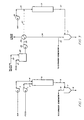
- Figure 1 depicts an embodiment of the invention useful for the generation of power or high pressure steam from coal.
- the system is brought to operating conditions using an auxiliary furnace.
- the furnace is used to produce steam, which is run through the system to provide heatup.
- Mass flows and temperatures during normal operation are given in Table 1.
- a 13 wt.% slurry of pulverized coal is brought to pressure by slurry pump 1, and enters the vessel reactor 5.
- An air stream which was pressurized by compressor 3 enters the reactor separately.
- the multiphase mixture is rapidly brought to reacting conditions by mixing with a portion of the reactor contents. Particulate ash will precipitate in the reactor as the coal is combusted.
- reduced sulfur in the coal is converted to sulfate anion, which only partially pairs with cations available in the native coal.
- the surplus sulfate is present as sulfuric acid, which, depending upon concentration, can lead to accelerated corrosion within the reactor or equipment further downstream.
- a cation supplier such as sodium hydroxide may be added to the feed before it is pressurized, or directly to the reactor to allow the precipitation of sodium sulfate within the reactor (not shown in Fig. 1).
- a cation supplier such as sodium hydroxide may be added to the feed before it is pressurized, or directly to the reactor to allow the precipitation of sodium sulfate within the reactor (not shown in Fig. 1).
- neutralization may then be carried out on the cool effluent liquid.
- the reactor 5 may be designed to allow for simultaneous combustion and solids removal as per U.S. Patent 4,822,497 assigned to MODAR, Inc.
- Fig. 1 shows the alternative of a discrete solids separator 7, which may be a settling column, cyclone, filter or equivalent device.
- Dry solids are removed from the solids separator via stream 8, while the entire fluid portion of the reactor effluent passes to an expander-generator for power and/or heat recovery. Note that in generating power by this scheme, heat is transferred to the working fluid without the intervention of heat transfer surfaces. In addition to inherent efficiency, the traditional problems of scaling and hot spots on heat transfer surfaces has been avoided. Because of the solids removal step at 7 and the intimate contact of gas and liquid streams during pressure/temperature letdown, another benefit of this scheme is that scrubbing of off-gases, even for "dirty" fuels, is not required. Furthermore, the temperatures attained in the supercritical temperature water oxidation reactor are considerably lower than those associated with conventional combustion processes, and NO x and SO 2 gases are formed only in negligible amounts.
- Fig. 1 is particularly suited to feeds with a relatively high fuel content, in the range of 4200 kJ/kg (1800 Btu/lb.).
- FIG. 2 shows two sets of curves defining this relationship, with heating value on the vertical axis. Pressure is shown on the horizontal axis.
- the upper set of curves shows the adiabatic heating value requirement when no preheating of the cold feed is carried out.
- a flow scheme was considered in Example 1 above, and illustrated in Fig. 1.
- the required heating value is about 4.2 kJ/g
- the required heating value is reduced to about 3.5 kJ/g.
- the heating value is reduced with oxygen because there is no need to heat the nitrogen component of air.
- required heating value is roughly constant with pressure from 50 bar up to the supercritical pressure of 250 bar.
- the lower set of curves pertains to the case in which incoming feed is heat exchanged with reactor effluent.
- This process configuration is particularly suited to feeds with relatively low fuel value, in the range of 1 kJ/g.
- required heating value is no longer pressure independent. This is a result of the presence of noncondensible gases in the hot stream, which make it more difficult to condense water vapor and recycle this heat of condensation.
- higher pressures facilitate water condensation, heat recovery is more efficient and higher preheat temperatures are attainable.
- feed with an isopropanol content of about 1 wt.% is suitable.
- an isopropanol content of nearly 5 wt.% is required.
- FIG. 3 A process scheme utilizing regenerative heat exchange is depicted in Fig. 3.
- the waste stream 21 is mixed with dilution water 22 in feed reservoir 23, the purpose of the dilution water being to attain the appropriate temperature rise within the reactor. This step would be omitted if the feed material already had a suitably low heating value.
- the mixed stream is brought up to system pressure by pump 24, and then passed to heat exchanger 26.
- the aqueous feed stream is heated to a temperature sufficient to guarantee both complete miscibility with air and the attainment of the desired temperature at the reactor exit. Frequently, the temperature of stream 27 will be high enough to cause organic molecules to pyrolyze or reform. Note that the hot stream passing through the heat exchanger 26 is a portion of the reactor effluent.
- Oxidant for the process is provided by ambient air, brought to system pressure by compressor 28. Oxidant is provided in stoichiometric or greater quantity to allow for complete combustion.
- the compressed air, stream 29, is mixed with the preheated aqueous stream 27, and then enters the open tubular reactor 31. The heat of combustion raises the fluid to an appropriate temperature at the reactor exit.
- the effluent stream 32 Upon leaving the reactor, the effluent stream 32 enters a solids separator 33, if necessary, and is split into two portions -- stream 34 passes through the heat exchanger 26 to provide preheating, while stream 35 is directed to an expander-generator for power recovery or else for use as process steam.
- the preheating step must provide for kindling of the reaction by heating the feed to a temperature at which air is completely miscible, and at which oxidative reaction will commence as soon as air is introduced. This is because little backmixing of fluid occurs within the reactor. This feature also makes plug flow reactors favored in cases where high oxidation efficiency of the feed material must be assured. As illustrated in Example 1, in cases where feed is more concentrated and the reactor is designed to allow some backmixing of fluid and reaction intermediates, it is possible to dispense with the preheating step.
- the scheme of Fig. 1 is also preferable for feeds which may cause scaling in preheat exchangers.
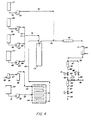
- Fig. 4 is a schematic of the unit used for this work.
- the high pressure pumps and oxidant compressor are on the left side of the diagram.
- the oxidant compressor 56 can be operated with room air or with gas supplied directly from cylinders.
- Deionized water is pumped up to system pressure by the water pump 52 and passed through superheater 54 to bring it to a supercritical temperature.
- This water is mixed with oxidant, which has also been pressurized and preheated, and the combined stream is then injected through line 60 into the first stage reactor/solids separator.
- Waste feed, fuel and caustic are pumped up to pressure separately through pumps 63, 67 and 71. No feed preheating is carried out on this apparatus.
- the feed, fuel and caustic are mixed in line 74 and injected into the first stage reactor/solids separator 75 where they contact the oxidant/supercritical temperature water stream, initiating a rapid reaction.
- Inorganic solids precipitate from the supercritical fluid, impinge on the walls and settle to the reactor bottom.
- the particle-free fluid leaves the first stage reactor/solids separator through line 76 and passes to a second stage plug flow reactor 82 to ensure adequate residence time.
- Auxiliary fuel is sometimes added via pump 79 near the inlet of the second stage reactor to offset heat losses or achieve a higher temperature than in the first stage.
- the phases are separated in a high pressure liquid/vapor separator 86 which operates at system pressure.
- the gas stream pressure is reduced to near ambient through valve 88, while the liquid stream is reduced to about 7 bar pressure through valve 91, leading to the further evolution of gas (mostly CO 2 ) in line 92.
- This two-phase stream then enters a low pressure liquid/vapor separator 93.
- the liquid stream exiting this vessel through line 97 and valve 98 is sampled or disposed of, while the gas stream leaving the vessel through line 94 and valve 95 mixes with the gas stream from the high pressure separator in line 89 and is sampled or vented.
- the first stage reactor/solids separator 75 is opened and any accumulated solids are removed.
- Table 2 shows the results of the two experiments, the first at an average first stage reactor temperature of 620°C and the second at an average first stage reactor temperature of 595°C.
- system operating pressure was reduced in several steps. CO was expected to rise as pressure was decreased due to the lower fluid density and therefore reduced reactor residence time.
- the CO level remained constant at 20 ppm down to a pressure of 172 bar (2500 psi), corresponding to a residence time of about 11.5 seconds in the first stage reactor. As pressure was decreased further, CO rose at a somewhat increasing rate. This is illustrated in Fig. 5, which is a plot of the natural logarithm of CO concentration versus reactor residence time.
- alkali catalyst is not a general requirement for rapid and efficient reaction at supercritical temperatures, as would be inferred from U.S. Patent 4,380,960.
- Fig. 6 gives an example of one type of binary (two chemical components) phase behavior which is likely to occur at a temperature supercritical with respect to water.
- the amount of the non-water component is shown on the horizontal axis while pressure is varied along the vertical axis.
- the single-phase and two-phase vapor-liquid regions are separated by the curve envelope shown.
- Within the two-phase region the endpoints of a horizontal line will intersect the curve envelope at two points. The left endpoint gives the vapor composition while the right endpoint shows the liquid composition of the coexisting phases.
- the process is suited to a wide variety of feeds, including the following:
- these feeds will be introduced as is, while in others they will be mixed with other constituents.
Landscapes
- Engineering & Computer Science (AREA)
- Chemical & Material Sciences (AREA)
- Life Sciences & Earth Sciences (AREA)
- Combustion & Propulsion (AREA)
- Mechanical Engineering (AREA)
- General Engineering & Computer Science (AREA)
- Chemical Kinetics & Catalysis (AREA)
- Hydrology & Water Resources (AREA)
- Environmental & Geological Engineering (AREA)
- Water Supply & Treatment (AREA)
- Organic Chemistry (AREA)
- Treatment Of Water By Oxidation Or Reduction (AREA)
- Organic Low-Molecular-Weight Compounds And Preparation Thereof (AREA)
- Physical Or Chemical Processes And Apparatus (AREA)
Applications Claiming Priority (3)
| Application Number | Priority Date | Filing Date | Title |
|---|---|---|---|
| US47276690A | 1990-01-31 | 1990-01-31 | |
| US472766 | 1990-01-31 | ||
| PCT/US1991/000606 WO1991011394A1 (en) | 1990-01-31 | 1991-01-28 | Process for oxidation of materials in water at supercritical temperatures |
Publications (3)
| Publication Number | Publication Date |
|---|---|
| EP0513186A1 EP0513186A1 (en) | 1992-11-19 |
| EP0513186A4 EP0513186A4 (en) | 1992-12-09 |
| EP0513186B1 true EP0513186B1 (en) | 1997-07-30 |
Family
ID=23876855
Family Applications (1)
| Application Number | Title | Priority Date | Filing Date |
|---|---|---|---|
| EP91904256A Expired - Lifetime EP0513186B1 (en) | 1990-01-31 | 1991-01-28 | Process for oxidation of materials in water at supercritical temperatures |
Country Status (7)
| Country | Link |
|---|---|
| EP (1) | EP0513186B1 (enExample) |
| JP (1) | JP3048385B2 (enExample) |
| AT (1) | ATE156101T1 (enExample) |
| BR (1) | BR9105972A (enExample) |
| CA (1) | CA2074947C (enExample) |
| DE (1) | DE69127071T2 (enExample) |
| WO (1) | WO1991011394A1 (enExample) |
Cited By (8)
| Publication number | Priority date | Publication date | Assignee | Title |
|---|---|---|---|---|
| US6958122B1 (en) | 1999-09-03 | 2005-10-25 | Chematur Engineering Ab | High pressure and high temperature reaction system |
| US7915474B2 (en) | 2009-04-01 | 2011-03-29 | Earth Renewal Group, Llc | Aqueous phase oxidation process |
| US7951988B2 (en) | 2009-04-01 | 2011-05-31 | Earth Renewal Group, Llc | Aqueous phase oxidation process |
| US8115047B2 (en) | 2009-04-01 | 2012-02-14 | Earth Renewal Group, Llc | Aqueous phase oxidation process |
| US8168847B2 (en) | 2009-04-01 | 2012-05-01 | Earth Renewal Group, Llc | Aqueous phase oxidation process |
| US8481800B2 (en) | 2009-04-01 | 2013-07-09 | Earth Renewal Group, Llc | Aqueous phase oxidation process |
| WO2014189818A1 (en) * | 2013-05-24 | 2014-11-27 | Invista Technologies S.À.R.L. | Power recovery for use in start-up or re-start of a pure terephthalic acid production process |
| US9611158B2 (en) | 2009-04-01 | 2017-04-04 | Earth Renewal Group, Llc | Waste treatment process |
Families Citing this family (27)
| Publication number | Priority date | Publication date | Assignee | Title |
|---|---|---|---|---|
| US5232604A (en) * | 1990-01-31 | 1993-08-03 | Modar, Inc. | Process for the oxidation of materials in water at supercritical temperatures utilizing reaction rate enhancers |
| JP3225238B2 (ja) | 1990-09-08 | 2001-11-05 | 株式会社神戸製鋼所 | 合成高分子化合物の熱分解方法 |
| WO1992021621A1 (en) * | 1991-06-03 | 1992-12-10 | Abb Lummus Crest Inc. | Method for suspercritical water oxidation |
| US6103129A (en) * | 1994-01-14 | 2000-08-15 | 3500764 Canada Inc. | Method for the critical water oxidation of organic compounds |
| US5501799A (en) * | 1994-06-07 | 1996-03-26 | Abitibi-Price, Inc. | Method to remove inorganic scale from a supercritical water oxidation reactor |
| US5551472A (en) | 1994-08-01 | 1996-09-03 | Rpc Waste Management Services, Inc. | Pressure reduction system and method |
| US5543057A (en) * | 1995-03-13 | 1996-08-06 | Abitibi-Price, Inc. | Supercritical water oxidation of organics using a mobile surface |
| US5746926A (en) * | 1996-03-22 | 1998-05-05 | Sri International | Method for hydrothermal oxidation of halogenated organic compounds with addition of specific reactants |
| US6017460A (en) | 1996-06-07 | 2000-01-25 | Chematur Engineering Ab | Heating and reaction system and method using recycle reactor |
| WO2000025913A1 (en) * | 1998-10-30 | 2000-05-11 | Yukihiko Matsumura | Carbon type catalyst or carbon type additive for use in super-critical hydrothermal oxidation and sub-critical hydrothermal oxidation |
| DE19910211C2 (de) * | 1999-03-09 | 2001-02-22 | Karlsruhe Forschzent | Verfahren zur Behandlung eines Salze enthaltenden wäßrigen Abfallstroms |
| JP3496049B2 (ja) * | 1999-09-13 | 2004-02-09 | 独立行政法人産業技術総合研究所 | 無触媒新有機合成反応法 |
| DE10061388A1 (de) * | 2000-12-09 | 2002-06-20 | Daimler Chrysler Ag | Verfahren und Vorrichtung zur überkritischen Nassoxidation |
| DE10061386A1 (de) * | 2000-12-09 | 2002-09-05 | Daimler Chrysler Ag | Verfahren und Vorrichtung zur überkritischen Nassoxidation |
| RU2212919C1 (ru) * | 2002-06-07 | 2003-09-27 | Военная академия Ракетных войск стратегического назначения им. Петра Великого | Способ гидротермального сверхкритического разрушения токсичных веществ |
| DE10240410B3 (de) * | 2002-09-02 | 2004-02-05 | Lar Analytik Und Umweltmesstechnik Gmbh | Verfahren zur Bestimmung des Sauerstoffbedarfs einer wässrigen Lösung für einen Klärprozess |
| DE10361877A1 (de) * | 2003-12-19 | 2005-07-14 | INSTITUT FüR ANGEWANDTE CHEMIE BERLIN-ADLERSHOF E.V. | Verfahren zur Entfernung organischer Bestandteile aus Elektronikschrott |
| EP1716920A4 (en) * | 2004-02-13 | 2013-11-06 | Univ Osaka Prefect Public Corp | METHOD FOR PRODUCING A PRODUCT DECOMPOSED WITH SUBCITRIC WATER AND DECORATIVE TREATMENT DEVICE WITH UNDERCRITICAL WATER |
| JP4355246B2 (ja) * | 2004-03-25 | 2009-10-28 | メタウォーター株式会社 | 有機性廃棄物の高温高圧処理装置 |
| DE102005037469B4 (de) * | 2005-08-09 | 2008-01-10 | Forschungszentrum Karlsruhe Gmbh | Vorrichtung und Verfahren zur Abscheidung von anorganischen Feststoffen aus einer wässrigen Lösung |
| RU2309009C2 (ru) * | 2005-08-30 | 2007-10-27 | Институт Катализа Им. Г.К. Борескова Сибирского Отделения Российской Академии Наук | Способ осуществления реакций окисления органических соединений |
| JP4673874B2 (ja) * | 2007-08-20 | 2011-04-20 | 株式会社東芝 | 廃棄物処理方法 |
| US20130126442A1 (en) * | 2011-11-17 | 2013-05-23 | General Electric Company | Methods for removing contaminants from water |
| EP2740529A1 (en) | 2012-12-07 | 2014-06-11 | HYDROTHERMA Swiss Ecological Technologies SA | Methods and equipment for hydrothermal processing and disposal of highly toxic substances, waste and metal powders |
| EP4440996A4 (en) | 2021-11-30 | 2025-11-05 | 374Water Inc | APPLICATION OF CHEMICAL OXYGEN DEMAND AND CLOSURE VALUE DIAGNOSTICS FOR IMPROVING THE PERFORMANCE OF A SUPERCRITICAL WATER OXIDATION PROCESS |
| US20230192524A1 (en) * | 2021-12-20 | 2023-06-22 | 374Water Inc. | Scwo system for treatment of high-strength wastes |
| CN115180706B (zh) * | 2022-07-06 | 2023-07-25 | 深圳市华尔信环保科技有限公司 | 一种处理含大颗粒有机废弃物的超临界水氧化系统 |
Citations (1)
| Publication number | Priority date | Publication date | Assignee | Title |
|---|---|---|---|---|
| US4377066A (en) * | 1980-05-27 | 1983-03-22 | Dickinson Norman L | Pollution-free pressurized fluidized bed combustion utilizing a high concentration of water vapor |
Family Cites Families (14)
| Publication number | Priority date | Publication date | Assignee | Title |
|---|---|---|---|---|
| NL203871A (enExample) * | 1955-02-09 | 1900-01-01 | ||
| US3449247A (en) * | 1965-10-23 | 1969-06-10 | William J Bauer | Process for wet oxidation of combustible waste materials |
| US3804756A (en) * | 1972-06-22 | 1974-04-16 | Standard Oil Co | Environmentally safe disposal of organic pollutants |
| US4272383A (en) * | 1978-03-17 | 1981-06-09 | Mcgrew Jay Lininger | Method and apparatus for effecting subsurface, controlled, accelerated chemical reactions |
| US4380960A (en) * | 1978-10-05 | 1983-04-26 | Dickinson Norman L | Pollution-free low temperature slurry combustion process utilizing the super-critical state |
| US4292953A (en) * | 1978-10-05 | 1981-10-06 | Dickinson Norman L | Pollutant-free low temperature slurry combustion process utilizing the super-critical state |
| US4543190A (en) * | 1980-05-08 | 1985-09-24 | Modar, Inc. | Processing methods for the oxidation of organics in supercritical water |
| US4564458A (en) * | 1983-11-10 | 1986-01-14 | Burleson James C | Method and apparatus for disposal of a broad spectrum of waste featuring oxidation of waste |
| US4543199A (en) * | 1984-11-16 | 1985-09-24 | Texaco Inc. | Water base hydraulic fluid |
| US4594164A (en) * | 1985-05-23 | 1986-06-10 | Titmas James A | Method and apparatus for conducting chemical reactions at supercritical conditions |
| US4714032A (en) * | 1985-12-26 | 1987-12-22 | Dipac Associates | Pollution-free pressurized combustion utilizing a controlled concentration of water vapor |
| US4792408A (en) * | 1987-04-13 | 1988-12-20 | James A. Titmas Associates Incorporated | Method and apparatus for enhancing chemical reactions at supercritical conditions |
| US4774006A (en) * | 1987-06-22 | 1988-09-27 | Vertech Treatment Systems, Inc. | Fluid treatment method |
| US4822497A (en) * | 1987-09-22 | 1989-04-18 | Modar, Inc. | Method for solids separation in a wet oxidation type process |
-
1991
- 1991-01-28 DE DE69127071T patent/DE69127071T2/de not_active Expired - Fee Related
- 1991-01-28 WO PCT/US1991/000606 patent/WO1991011394A1/en not_active Ceased
- 1991-01-28 EP EP91904256A patent/EP0513186B1/en not_active Expired - Lifetime
- 1991-01-28 CA CA002074947A patent/CA2074947C/en not_active Expired - Fee Related
- 1991-01-28 AT AT91904256T patent/ATE156101T1/de not_active IP Right Cessation
- 1991-01-28 JP JP3504472A patent/JP3048385B2/ja not_active Expired - Lifetime
- 1991-01-28 BR BR919105972A patent/BR9105972A/pt not_active Application Discontinuation
Patent Citations (1)
| Publication number | Priority date | Publication date | Assignee | Title |
|---|---|---|---|---|
| US4377066A (en) * | 1980-05-27 | 1983-03-22 | Dickinson Norman L | Pollution-free pressurized fluidized bed combustion utilizing a high concentration of water vapor |
Cited By (9)
| Publication number | Priority date | Publication date | Assignee | Title |
|---|---|---|---|---|
| US6958122B1 (en) | 1999-09-03 | 2005-10-25 | Chematur Engineering Ab | High pressure and high temperature reaction system |
| US7915474B2 (en) | 2009-04-01 | 2011-03-29 | Earth Renewal Group, Llc | Aqueous phase oxidation process |
| US7951988B2 (en) | 2009-04-01 | 2011-05-31 | Earth Renewal Group, Llc | Aqueous phase oxidation process |
| US8115047B2 (en) | 2009-04-01 | 2012-02-14 | Earth Renewal Group, Llc | Aqueous phase oxidation process |
| US8168847B2 (en) | 2009-04-01 | 2012-05-01 | Earth Renewal Group, Llc | Aqueous phase oxidation process |
| US8481800B2 (en) | 2009-04-01 | 2013-07-09 | Earth Renewal Group, Llc | Aqueous phase oxidation process |
| US9611158B2 (en) | 2009-04-01 | 2017-04-04 | Earth Renewal Group, Llc | Waste treatment process |
| US9902632B2 (en) | 2009-04-01 | 2018-02-27 | Earth Renewal Group, Llc | Waste treatment method |
| WO2014189818A1 (en) * | 2013-05-24 | 2014-11-27 | Invista Technologies S.À.R.L. | Power recovery for use in start-up or re-start of a pure terephthalic acid production process |
Also Published As
| Publication number | Publication date |
|---|---|
| DE69127071T2 (de) | 1998-01-29 |
| CA2074947C (en) | 2000-10-17 |
| AU7253791A (en) | 1991-08-21 |
| AU658819B2 (en) | 1995-05-04 |
| EP0513186A4 (en) | 1992-12-09 |
| ATE156101T1 (de) | 1997-08-15 |
| DE69127071D1 (de) | 1997-09-04 |
| BR9105972A (pt) | 1992-10-13 |
| JPH05504093A (ja) | 1993-07-01 |
| JP3048385B2 (ja) | 2000-06-05 |
| CA2074947A1 (en) | 1991-08-01 |
| WO1991011394A1 (en) | 1991-08-08 |
| EP0513186A1 (en) | 1992-11-19 |
Similar Documents
| Publication | Publication Date | Title |
|---|---|---|
| US5106513A (en) | Process for oxidation of materials in water at supercritical temperatures and subcritical pressures | |
| CA2074947C (en) | Process for oxidation of materials in water at supercritical temperatures | |
| US5232604A (en) | Process for the oxidation of materials in water at supercritical temperatures utilizing reaction rate enhancers | |
| NL192037C (nl) | Oxidatie van organisch materiaal in superkritisch water. | |
| US4543190A (en) | Processing methods for the oxidation of organics in supercritical water | |
| JP3354438B2 (ja) | 有機物を含有する水媒体の処理方法及び水熱反応装置 | |
| US5339621A (en) | Waste treatment system and method utilizing pressurized fluid | |
| KR20220024012A (ko) | 산화 공정을 통한 pfas의 파괴 및 오염된 장소로의 운송에 적합한 장치 | |
| KR100812623B1 (ko) | 초임계 수 반응물로 유기물-귀금속 조성물로부터 귀금속회수 | |
| US6709602B2 (en) | Process for hydrothermal treatment of materials | |
| EP0739313B1 (en) | Method for the supercritical water oxidation of organic compounds | |
| US5269235A (en) | Three stage combustion apparatus | |
| Gidner et al. | Supercritical water oxidation of sewage sludge–State of the art | |
| AU658819C (en) | Process for oxidation of materials in water at supercritical temperatures | |
| Patterson et al. | Pilot-scale supercritical water oxidation of sewage sludge | |
| May | Hydrothermal Oxidation | |
| Pleşu et al. | DISTILLERY CC, ALCOHOLS RESIDUES REMOVAL BY SUPER CRITICAL WATER OXIDATION | |
| MAY | proposed. There are several oxidation processes carried out at elevated temperature in | |
| JPS6053806B2 (ja) | 硫酸スラツジの処理方法 | |
| WO1992005119A1 (en) | Adiabatic process for the extraction of aqueous wastes |
Legal Events
| Date | Code | Title | Description |
|---|---|---|---|
| PUAI | Public reference made under article 153(3) epc to a published international application that has entered the european phase |
Free format text: ORIGINAL CODE: 0009012 |
|
| 17P | Request for examination filed |
Effective date: 19920821 |
|
| AK | Designated contracting states |
Kind code of ref document: A1 Designated state(s): AT BE CH DE DK ES FR GB GR IT LI LU NL SE |
|
| A4 | Supplementary search report drawn up and despatched |
Effective date: 19921022 |
|
| AK | Designated contracting states |
Kind code of ref document: A4 Designated state(s): AT BE CH DE DK ES FR GB GR IT LI LU NL SE |
|
| 17Q | First examination report despatched |
Effective date: 19950707 |
|
| GRAG | Despatch of communication of intention to grant |
Free format text: ORIGINAL CODE: EPIDOS AGRA |
|
| GRAH | Despatch of communication of intention to grant a patent |
Free format text: ORIGINAL CODE: EPIDOS IGRA |
|
| GRAH | Despatch of communication of intention to grant a patent |
Free format text: ORIGINAL CODE: EPIDOS IGRA |
|
| GRAA | (expected) grant |
Free format text: ORIGINAL CODE: 0009210 |
|
| RAP1 | Party data changed (applicant data changed or rights of an application transferred) |
Owner name: MODAR, INC. |
|
| AK | Designated contracting states |
Kind code of ref document: B1 Designated state(s): AT BE CH DE DK ES FR GB GR IT LI LU NL SE |
|
| PG25 | Lapsed in a contracting state [announced via postgrant information from national office to epo] |
Ref country code: NL Free format text: LAPSE BECAUSE OF FAILURE TO SUBMIT A TRANSLATION OF THE DESCRIPTION OR TO PAY THE FEE WITHIN THE PRESCRIBED TIME-LIMIT Effective date: 19970730 Ref country code: LI Effective date: 19970730 Ref country code: CH Effective date: 19970730 Ref country code: DK Effective date: 19970730 Ref country code: GR Free format text: LAPSE BECAUSE OF FAILURE TO SUBMIT A TRANSLATION OF THE DESCRIPTION OR TO PAY THE FEE WITHIN THE PRESCRIBED TIME-LIMIT Effective date: 19970730 Ref country code: BE Effective date: 19970730 Ref country code: AT Effective date: 19970730 Ref country code: ES Free format text: THE PATENT HAS BEEN ANNULLED BY A DECISION OF A NATIONAL AUTHORITY Effective date: 19970730 |
|
| REF | Corresponds to: |
Ref document number: 156101 Country of ref document: AT Date of ref document: 19970815 Kind code of ref document: T |
|
| REG | Reference to a national code |
Ref country code: CH Ref legal event code: EP |
|
| ITF | It: translation for a ep patent filed | ||
| REF | Corresponds to: |
Ref document number: 69127071 Country of ref document: DE Date of ref document: 19970904 |
|
| ET | Fr: translation filed | ||
| NLV1 | Nl: lapsed or annulled due to failure to fulfill the requirements of art. 29p and 29m of the patents act | ||
| PG25 | Lapsed in a contracting state [announced via postgrant information from national office to epo] |
Ref country code: LU Free format text: LAPSE BECAUSE OF NON-PAYMENT OF DUE FEES Effective date: 19980128 |
|
| REG | Reference to a national code |
Ref country code: CH Ref legal event code: PL |
|
| PLBE | No opposition filed within time limit |
Free format text: ORIGINAL CODE: 0009261 |
|
| STAA | Information on the status of an ep patent application or granted ep patent |
Free format text: STATUS: NO OPPOSITION FILED WITHIN TIME LIMIT |
|
| 26N | No opposition filed | ||
| REG | Reference to a national code |
Ref country code: GB Ref legal event code: IF02 |
|
| PGFP | Annual fee paid to national office [announced via postgrant information from national office to epo] |
Ref country code: GB Payment date: 20080319 Year of fee payment: 18 |
|
| PGFP | Annual fee paid to national office [announced via postgrant information from national office to epo] |
Ref country code: DE Payment date: 20080407 Year of fee payment: 18 |
|
| PGFP | Annual fee paid to national office [announced via postgrant information from national office to epo] |
Ref country code: IT Payment date: 20080329 Year of fee payment: 18 |
|
| PGFP | Annual fee paid to national office [announced via postgrant information from national office to epo] |
Ref country code: SE Payment date: 20080328 Year of fee payment: 18 |
|
| PGFP | Annual fee paid to national office [announced via postgrant information from national office to epo] |
Ref country code: FR Payment date: 20080327 Year of fee payment: 18 |
|
| EUG | Se: european patent has lapsed | ||
| GBPC | Gb: european patent ceased through non-payment of renewal fee |
Effective date: 20090128 |
|
| PG25 | Lapsed in a contracting state [announced via postgrant information from national office to epo] |
Ref country code: DE Free format text: LAPSE BECAUSE OF NON-PAYMENT OF DUE FEES Effective date: 20090801 |
|
| REG | Reference to a national code |
Ref country code: FR Ref legal event code: ST Effective date: 20091030 |
|
| PG25 | Lapsed in a contracting state [announced via postgrant information from national office to epo] |
Ref country code: GB Free format text: LAPSE BECAUSE OF NON-PAYMENT OF DUE FEES Effective date: 20090128 |
|
| PG25 | Lapsed in a contracting state [announced via postgrant information from national office to epo] |
Ref country code: FR Free format text: LAPSE BECAUSE OF NON-PAYMENT OF DUE FEES Effective date: 20090202 |
|
| PG25 | Lapsed in a contracting state [announced via postgrant information from national office to epo] |
Ref country code: IT Free format text: LAPSE BECAUSE OF NON-PAYMENT OF DUE FEES Effective date: 20090128 |
|
| PG25 | Lapsed in a contracting state [announced via postgrant information from national office to epo] |
Ref country code: SE Free format text: LAPSE BECAUSE OF NON-PAYMENT OF DUE FEES Effective date: 20090129 |