EP0504784A1 - Polyetheresteramide, Verfahren zu ihrer Herstellung und deren Verwendung - Google Patents
Polyetheresteramide, Verfahren zu ihrer Herstellung und deren Verwendung Download PDFInfo
- Publication number
- EP0504784A1 EP0504784A1 EP92104544A EP92104544A EP0504784A1 EP 0504784 A1 EP0504784 A1 EP 0504784A1 EP 92104544 A EP92104544 A EP 92104544A EP 92104544 A EP92104544 A EP 92104544A EP 0504784 A1 EP0504784 A1 EP 0504784A1
- Authority
- EP
- European Patent Office
- Prior art keywords
- weight
- acid
- polyamide
- block
- caprolactam
- Prior art date
- Legal status (The legal status is an assumption and is not a legal conclusion. Google has not performed a legal analysis and makes no representation as to the accuracy of the status listed.)
- Granted
Links
- 229920006146 polyetheresteramide block copolymer Polymers 0.000 title claims abstract description 20
- 238000000034 method Methods 0.000 title claims abstract description 12
- 238000002360 preparation method Methods 0.000 title claims description 5
- JBKVHLHDHHXQEQ-UHFFFAOYSA-N epsilon-caprolactam Chemical compound O=C1CCCCCN1 JBKVHLHDHHXQEQ-UHFFFAOYSA-N 0.000 claims abstract description 32
- NAQMVNRVTILPCV-UHFFFAOYSA-N hexane-1,6-diamine Chemical compound NCCCCCCN NAQMVNRVTILPCV-UHFFFAOYSA-N 0.000 claims abstract description 28
- -1 saturated aliphatic dicarboxylic acids Chemical class 0.000 claims abstract description 24
- 239000004952 Polyamide Substances 0.000 claims abstract description 19
- 229920002647 polyamide Polymers 0.000 claims abstract description 19
- 239000000178 monomer Substances 0.000 claims abstract description 16
- CXMXRPHRNRROMY-UHFFFAOYSA-N sebacic acid Chemical compound OC(=O)CCCCCCCCC(O)=O CXMXRPHRNRROMY-UHFFFAOYSA-N 0.000 claims abstract description 16
- 239000002202 Polyethylene glycol Substances 0.000 claims abstract description 14
- 229920001223 polyethylene glycol Polymers 0.000 claims abstract description 14
- SLXKOJJOQWFEFD-UHFFFAOYSA-N 6-aminohexanoic acid Chemical compound NCCCCCC(O)=O SLXKOJJOQWFEFD-UHFFFAOYSA-N 0.000 claims abstract description 13
- 229960002684 aminocaproic acid Drugs 0.000 claims abstract description 13
- GUOSQNAUYHMCRU-UHFFFAOYSA-N 11-Aminoundecanoic acid Chemical compound NCCCCCCCCCCC(O)=O GUOSQNAUYHMCRU-UHFFFAOYSA-N 0.000 claims abstract description 12
- 239000004753 textile Substances 0.000 claims abstract description 12
- OFOBLEOULBTSOW-UHFFFAOYSA-N Malonic acid Chemical compound OC(=O)CC(O)=O OFOBLEOULBTSOW-UHFFFAOYSA-N 0.000 claims abstract description 10
- 125000004432 carbon atom Chemical group C* 0.000 claims abstract description 9
- 238000007789 sealing Methods 0.000 claims abstract description 5
- 150000002009 diols Chemical class 0.000 claims description 14
- 239000004721 Polyphenylene oxide Substances 0.000 claims description 9
- 229920000570 polyether Polymers 0.000 claims description 9
- 239000003054 catalyst Substances 0.000 claims description 8
- 239000000203 mixture Substances 0.000 claims description 6
- 239000004745 nonwoven fabric Substances 0.000 claims description 5
- 125000003178 carboxy group Chemical group [H]OC(*)=O 0.000 claims description 3
- 239000007795 chemical reaction product Substances 0.000 claims description 2
- 238000004519 manufacturing process Methods 0.000 abstract description 3
- 239000004744 fabric Substances 0.000 abstract description 2
- 230000000052 comparative effect Effects 0.000 description 10
- IJGRMHOSHXDMSA-UHFFFAOYSA-N Atomic nitrogen Chemical compound N#N IJGRMHOSHXDMSA-UHFFFAOYSA-N 0.000 description 8
- 239000004831 Hot glue Substances 0.000 description 6
- 239000000853 adhesive Substances 0.000 description 5
- 230000001070 adhesive effect Effects 0.000 description 5
- 125000001931 aliphatic group Chemical group 0.000 description 5
- 239000000047 product Substances 0.000 description 5
- 239000000758 substrate Substances 0.000 description 5
- JHWNWJKBPDFINM-UHFFFAOYSA-N Laurolactam Chemical compound O=C1CCCCCCCCCCCN1 JHWNWJKBPDFINM-UHFFFAOYSA-N 0.000 description 4
- WNLRTRBMVRJNCN-UHFFFAOYSA-N adipic acid Chemical compound OC(=O)CCCCC(O)=O WNLRTRBMVRJNCN-UHFFFAOYSA-N 0.000 description 4
- 229910052757 nitrogen Inorganic materials 0.000 description 4
- 239000000843 powder Substances 0.000 description 4
- XLYOFNOQVPJJNP-UHFFFAOYSA-N water Substances O XLYOFNOQVPJJNP-UHFFFAOYSA-N 0.000 description 4
- 239000007864 aqueous solution Substances 0.000 description 3
- 150000004985 diamines Chemical class 0.000 description 3
- 239000000155 melt Substances 0.000 description 3
- 239000000243 solution Substances 0.000 description 3
- 238000005406 washing Methods 0.000 description 3
- DPUOLQHDNGRHBS-UHFFFAOYSA-N Brassidinsaeure Natural products CCCCCCCCC=CCCCCCCCCCCCC(O)=O DPUOLQHDNGRHBS-UHFFFAOYSA-N 0.000 description 2
- 229920001634 Copolyester Polymers 0.000 description 2
- 229920000742 Cotton Polymers 0.000 description 2
- 235000011037 adipic acid Nutrition 0.000 description 2
- 239000001361 adipic acid Substances 0.000 description 2
- 150000007933 aliphatic carboxylic acids Chemical class 0.000 description 2
- 125000000217 alkyl group Chemical group 0.000 description 2
- 230000000903 blocking effect Effects 0.000 description 2
- 238000004140 cleaning Methods 0.000 description 2
- 238000009833 condensation Methods 0.000 description 2
- 230000005494 condensation Effects 0.000 description 2
- 150000001991 dicarboxylic acids Chemical class 0.000 description 2
- RTZKZFJDLAIYFH-UHFFFAOYSA-N ether Substances CCOCC RTZKZFJDLAIYFH-UHFFFAOYSA-N 0.000 description 2
- 238000002474 experimental method Methods 0.000 description 2
- 238000001125 extrusion Methods 0.000 description 2
- RLSSMJSEOOYNOY-UHFFFAOYSA-N m-cresol Chemical compound CC1=CC=CC(O)=C1 RLSSMJSEOOYNOY-UHFFFAOYSA-N 0.000 description 2
- 239000000463 material Substances 0.000 description 2
- 238000002844 melting Methods 0.000 description 2
- 230000008018 melting Effects 0.000 description 2
- BDJRBEYXGGNYIS-UHFFFAOYSA-N nonanedioic acid Chemical compound OC(=O)CCCCCCCC(O)=O BDJRBEYXGGNYIS-UHFFFAOYSA-N 0.000 description 2
- 229920000728 polyester Polymers 0.000 description 2
- 229920006395 saturated elastomer Polymers 0.000 description 2
- 239000000126 substance Substances 0.000 description 2
- DXNCZXXFRKPEPY-UHFFFAOYSA-N tridecanedioic acid Chemical compound OC(=O)CCCCCCCCCCCC(O)=O DXNCZXXFRKPEPY-UHFFFAOYSA-N 0.000 description 2
- 210000002268 wool Anatomy 0.000 description 2
- 239000002253 acid Substances 0.000 description 1
- 150000001408 amides Chemical class 0.000 description 1
- 239000000470 constituent Substances 0.000 description 1
- 238000001816 cooling Methods 0.000 description 1
- 229920001577 copolymer Polymers 0.000 description 1
- 239000006185 dispersion Substances 0.000 description 1
- 238000005516 engineering process Methods 0.000 description 1
- 150000002148 esters Chemical class 0.000 description 1
- 239000011888 foil Substances 0.000 description 1
- 230000004927 fusion Effects 0.000 description 1
- 239000008187 granular material Substances 0.000 description 1
- 238000000227 grinding Methods 0.000 description 1
- 125000004108 n-butyl group Chemical group [H]C([H])([H])C([H])([H])C([H])([H])C([H])([H])* 0.000 description 1
- 239000002245 particle Substances 0.000 description 1
- 229920003023 plastic Polymers 0.000 description 1
- 239000004033 plastic Substances 0.000 description 1
- 229920001281 polyalkylene Polymers 0.000 description 1
- 229920001296 polysiloxane Polymers 0.000 description 1
- 229920000909 polytetrahydrofuran Polymers 0.000 description 1
- 238000003825 pressing Methods 0.000 description 1
- 238000012545 processing Methods 0.000 description 1
- 238000010926 purge Methods 0.000 description 1
- 239000011541 reaction mixture Substances 0.000 description 1
- 238000012216 screening Methods 0.000 description 1
- 230000035945 sensitivity Effects 0.000 description 1
- 238000007711 solidification Methods 0.000 description 1
- 230000008023 solidification Effects 0.000 description 1
- 238000009987 spinning Methods 0.000 description 1
- 238000003756 stirring Methods 0.000 description 1
- 238000012360 testing method Methods 0.000 description 1
- 238000004804 winding Methods 0.000 description 1
Classifications
-
- C—CHEMISTRY; METALLURGY
- C08—ORGANIC MACROMOLECULAR COMPOUNDS; THEIR PREPARATION OR CHEMICAL WORKING-UP; COMPOSITIONS BASED THEREON
- C08G—MACROMOLECULAR COMPOUNDS OBTAINED OTHERWISE THAN BY REACTIONS ONLY INVOLVING UNSATURATED CARBON-TO-CARBON BONDS
- C08G69/00—Macromolecular compounds obtained by reactions forming a carboxylic amide link in the main chain of the macromolecule
- C08G69/44—Polyester-amides
Definitions
- the present invention relates to copolyether ester amides which consist of caprolactam or aminocaproic acid, 11-aminoundecanoic acid and an adduct of hexamethylenediamine and decanedicarboxylic acid as the amide-forming component and of equimolar amounts of a polyethylene glycol diol and a saturated aliphatic dicarboxylic acid as the ether-ester-forming component.
- the present invention further relates to a process for the preparation of these copolyetheresteramides and their use for the production of spunbonded nonwovens which are suitable for heat sealing textiles.
- copolyether ester amides which are to be used as hot melt adhesives for textiles. These copolyetheresteramides contain at least 30% by weight laurolactam in the polyamide part.
- these copolyether ester amides have the disadvantage that they have unsatisfactory normal tensile strengths and washing resistance, in particular at lower adhesive temperatures, and the copolyamides must be prepared at high pressures and temperatures.
- the copolyether ester amides of this invention cannot be wound into spunbonded webs without release films, since this leads to the webs sticking together.
- copolyether ester amides which are to be used as hot melt adhesives for textiles.
- these consist of caprolactam and / or ⁇ -aminocaproic acid, equimolar amounts of adipic acid and primary aliphatic and / or cycloaliphatic diamines, equimolar mixtures of azelaic and / or sebacic acid and primary aliphatic and / or cycloaliphatic diamines and decimolar carbons / or brassylic acid and primary aliphatic and / or cycloaliphatic diamines, and a polyetherester block which is formed from polyalkylene oxidiols and saturated aliphatic, linear dicarboxylic acids.
- the copolyester ether ester amides of this invention also have low adhesive temperatures unsatisfactory normal tear strength and wash resistance. Nor can they be wound into spunbonded webs without inserting a separating film, which
- the present invention is therefore based on the object of finding hot melt adhesives for bonding textiles which, compared to the known polyether ester amide hot melt adhesives, have sufficient normal tear strengths and resistance even at low bonding temperatures and their processing into spunbonded webs is readily possible, i.e. that the spun fleece can be wound up, stored and shipped immediately at the end of the conveyor belt without inserting a release film.
- copolyether ester amides consisting of 60 to 80% by weight of a polyamide block obtainable from the following monomers: 20 to 40% by weight of caprolactam or aminocaproic acid 30 to 50% by weight 11-aminoundecanoic acid 20 to 40% by weight adduct of hexamethylenediamine and decanedicarboxylic acid, the total amount of these polyamide-forming monomers being 100% by weight, and from 20 to 40% by weight of a polyether diol / dicarboxylic acid block obtainable from equimolar amounts of polyethylene glycol with a molecular weight M n ⁇ from 400 to 2000 and one or more saturated aliphatic dicarboxylic acids having 6 to 36 carbon atoms.
- the amounts of the abovementioned polyamide-forming components are preferably 30 to 40% by weight of caprolactam or aminocaproic acid 30 to 40 wt .-% 11-aminodecanoic acid and 25 to 35 wt .-% adduct of hexamethylenediaminedecanedicarboxylic acid.
- the amounts are particularly preferred as follows: 33 to 37% by weight of caprolactam or aminocaproic acid 33 to 37% by weight 11-aminoundecanoic acid 28 to 32 wt .-% adduct of hexamethylenediamine and decanedicarboxylic acid.
- polyether ester amides which consist of 65 to 75% by weight of the polyamide block and 25 to 35% by weight of the polyether diol / dicarboxylic acid block.
- Polyether ester amides which consist of 68 to 72% by weight of the polyamide block and 32 to 28% by weight of the polyether diol / dicarboxylic acid block are particularly preferred.
- the process for the preparation of the polyetheresteramides according to the invention is characterized in that, based on the total amount of the reacted components, from 60 to 80% by weight of a monomer mixture 20 to 40% by weight of caprolactam or aminocaproic acid 30 to 50% by weight 11-aminoundecanoic acid 20 to 40% by weight adduct of hexamethylenediamine and decanedicarboxylic acid, the total amount of these polyamide-forming monomers being 100% by weight, and 20 to 40% by weight equimolar amounts of a polyethylene glycol diol having a molecular weight M n ⁇ polycondensed from 400 to 2000 and one or more saturated aliphatic dicarboxylic acids having 6 to 36 carbon atoms, the polyamide-forming monomers and the saturated aliphatic dicarboxylic acids first being reacted in a manner known per se to form a polyamide with terminal carboxyl groups, and the reaction product is then reacted with the polyethylene glycol dio
- Linear dicarboxylic acids having 6 to 13 carbon atoms which are known from the references mentioned at the outset, are used as preferred saturated aliphatic carboxylic acids of the polyether diol / dicarboxylic acid block. Brassylic acid and especially decanedicarboxylic acid are preferred.
- the invention further relates to spunbonded webs which are formed from these polyether ester amides.
- spunbonded nonwovens are produced in a manner known per se, cf. Manual of the textile fixation pads from Dr. Peter Sroka, Sinus-Verlag, 1980. The production is described in more detail below. These spunbonded nonwovens are used for heat sealing textiles.
- the copolyether ester amides according to the invention even after chemical cleaning, washing processes and at low adhesive temperatures, have a very high bond strength. Furthermore, it was surprising that the copolyether ester amides of the present invention can be used to produce spunbonded webs immediately, i.e. at the end of the conveyor belt. can be wound, stored and shipped without inserting the release silicone paper that is normally used. This represents a tremendous technical advance for the person skilled in the art compared to the copolyetheresteramides of the prior art, the use of which in this process, as comparative experiments show, leads to the bonding of the nonwoven layers.
- the copolyether ester amides as polyamide-forming component must contain at least 30% by weight laurolactam, which is not necessary according to the invention. Although not included in the copolyether ester amides according to the invention, these have the above-mentioned improved properties.
- the copolyether ester amides melt in the range from about 90 to 130 ° C., determined by the DSC method (differential scanning calometry method).
- the melting point is preferably in the range from 100 to 120.degree.
- Low melting products are particularly suitable for the fusion of heat sensitive textiles.
- the polyether ester amides produced according to the invention have very good properties, such as that, compared to the prior art copolyester amides - especially at the low bonding temperatures preferred for heat-sensitive textiles Show comparative experiments. In particular, the normal tear strength and the resistance to washing processes and chemical cleaning are significantly improved at low adhesive temperatures compared to the copolyetheresteramides of the prior art.
- the copolyether ester amides advantageously have a relative solution viscosity of 1.3 to 1.75.
- the lower limit is preferably 1.45.
- the upper limit is expediently at 1.65.
- the relative solution viscosity of a 0.5% solution in m-cresol at 20 ° C in an Ostwald viscometer is measured.
- copolyetheresteramides expediently have a melt index at 150 ° C. at 21.2 N according to DIN 53735 of about 5 to 40 g / 10 min.
- the upper limit is expediently 30, the lower expedient about 7 g / 10 min.
- the copolyetheresteramides are prepared as described in the prior art.
- the preparation is expedient as follows: First, the copolyamide-forming constituents and the saturated aliphatic carboxylic acids having 6 to 36 carbon atoms are reacted to form a copolyamide having terminal carboxyl groups.
- the reaction is expediently carried out at temperatures of 180 to 300 ° C., preferably about 200 to 260 ° C. This creates internal pressures of 5 to 10 bar, which are held for about two hours. After this precondensation time, the pressure is slowly reduced to normal pressure by opening the valve and the remaining water is distilled off within 1 to 2 hours.
- the polyethylene glycol is then added, and a conventional catalyst is expediently added, and the mixture is heated to about 180 to 300 ° C., preferably about 260 ° C., in the course of 20 to 60 minutes under a gentle stream of nitrogen. Then condensation is carried out under reduced pressure ( ⁇ 10 mbar) within 20 to 60 minutes, preferably 30 minutes.
- the polycondensates obtained are spun through a perforated nozzle into a water bath and granulated.
- the catalysts known from the prior art for the reaction are used as catalysts.
- Dialkyl zirconates are preferred, the alkyl groups being branched or linear and containing 1 to 24 carbon atoms.
- Tetraalkyl orthotitanates can also be used.
- Alkyl groups with 4 carbon atoms, in particular n-butyl compounds, are preferred.
- the amount of the catalyst is in the known range from about 0.01 to 5% by weight, based on the weight of the reaction mixture.
- the amount of the catalyst is preferably below about 1% by weight.
- copolyether ester amides according to the invention can be extruded with commercially available extrusion systems at melt temperatures of approximately 200 ° C. and processed to form spunbonded nonwovens which are immediately tack-free and can be wound up without the use of intermediate films and can be sent immediately.
- copolyether ester amides textiles of various types can be glued together. Examples include natural materials and / or plastics such as wool, silk, cotton and / or polyester, polyamides and the like. Furs and the like can also be glued as substrates.
- a copolymer ether amide according to the invention preferably in the form of a spunbonded nonwoven, is placed between the surfaces to be bonded.
- the copolyamide can of course also be used in the form of films, threads, short-cut threads and powders. Dispersions can also be prepared from powders in a manner known per se and used for heat sealing.
- the adhesive is applied using elevated temperature and pressure. The pressing temperature depends primarily on the temperature sensitivity of the substrate, but must be so high that it melts and sticks. When cooling to room temperature, solidification occurs by connecting the bonded substrates.
- the powders are produced in the same way as is known for polyamide hotmelt adhesives.
- the granules were ground on a commercially available cold grinding plant.
- the powder obtained was separated into different particle size ranges on a commercially available screening plant.
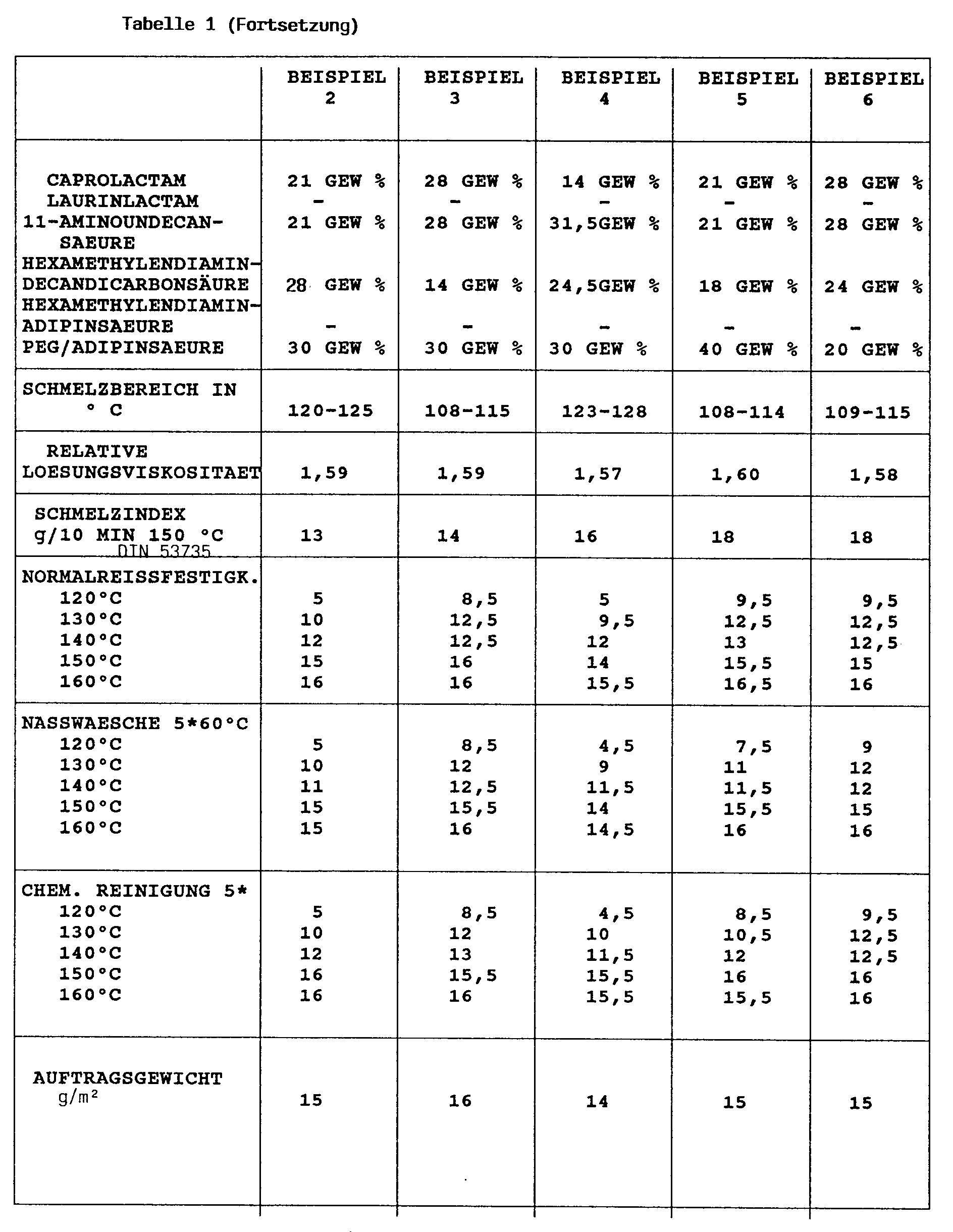
- the 80-200 ⁇ m fraction was examined using textile technology. The values determined can be found in Table 1 below.
- Examples 2-6 were prepared in an analogous manner with the weight ratios given in Table 1 under the same conditions as Example 1. In particular, work was carried out under the same pressure, temperature and time conditions.
- the polyethylene glycol had the same number average molecular mass as the polyethylene glycol in Example 1 in all examples.
- the weight ratio of polyether ester amide-forming components to the amount of catalyst (di-n-butyl zirconate) was as in Example 1 in all examples.
- Example 2 The following components were weighed in as described in Example 1 21.0 kg caprolactam 28.0 kg laurolactam 7.0 kg of hexamethylenediamine as an 80% aqueous solution 22.1 kg decanedicarboxylic acid and heated to a temperature of 290 ° C. An internal pressure of 25 bar was established. After a two-hour precondensation, the pressure was reduced to normal pressure within one hour. After a half-hour dewatering phase (possibly under a slight nitrogen flow or reduced pressure), the temperature was reduced to 260 ° C.
- the temperature data when measuring the strengths are the plate temperatures between the substrates to be bonded. It was heat sealed at 350 mbar for 15 seconds. The tensile strength is given in Newtons per 50 mm specimen width based on DIN 54310.
- the bonded substrates were: interlining material consisting of 100% cotton; Outer fabric made of blended polyester / virgin wool 55% / 45%. Application weight: g hot melt adhesive per m2 bonded area.
- Example 1 and Comparative Examples 1 and 2 were extruded at a melt temperature of 200 ° C. on a commercially available laboratory extrusion plant which was equipped with a spinning beam with 50 nozzles. After leaving the nozzle, the threads which were slightly swirled in the air flow were placed on a conveyor belt and pulled off. The dwell time on the tape was about 3 minutes.
- the fleece was wound onto a cardboard tube using a narrow winding system. It turned out that only the nonwoven of the composition according to the invention could be wound without the addition of an additional release film and could also be unrolled immediately.
- the fleece obtained was dry and non-blocking.
- the comparative tests according to the prior art could not be wrapped without a release film and were dry and non-blocking only after several hours. Folding it together without a release film led to the fleece sticking together.
Landscapes
- Chemical & Material Sciences (AREA)
- Health & Medical Sciences (AREA)
- Chemical Kinetics & Catalysis (AREA)
- Medicinal Chemistry (AREA)
- Polymers & Plastics (AREA)
- Organic Chemistry (AREA)
- Polyamides (AREA)
- Adhesives Or Adhesive Processes (AREA)
Abstract
Description
- Die vorliegende Erfindung betrifft Copolyetheresteramide, die aus Caprolactam oder Aminocapronsäure, 11-Aminoundecansäure und einem Addukt von Hexamethylendiamin und Decandicarbonsäure als amidbildende Komponente und aus äquimolaren Mengen eines Polyethylenglykoldiols und einer gesättigten aliphatischen Dicarbonsäure als etheresterbildende Komponente bestehen. Die vorliegende Erfindung betrifft weiterhin ein Verfahren zur Herstellung dieser Copolyetheresteramide, sowie ihre Verwendung zur Herstellung von Spinnvliesen, die zum Heißsiegeln von Textilien geeignet sind.
- Aus DE-C-2949064 sind Copolyetheresteramide bekannt, die als Heißschmelzkleber für Textilien verwendet werden sollen. Diese Copolyetheresteramide enthalten im Polyamidteil mindestens 30 Gew.-% Laurinlactam. Diese Copolyetheresteramide besitzen jedoch den Nachteil, daß sie insbesondere bei niedrigeren Verklebungstemperaturen unbefriedigende Normalreißfestigkeiten und Waschbeständigkeiten besitzen und die Herstellung der Copolyamide bei hohen Drücken und Temperaturen durchgeführt werden muß. Weiterhin lassen sich die Copolyetheresteramide dieser Erfindung nicht ohne Trennfolien zu Spinnvliesen wickeln, da dies zum Verkleben der Vliese führt.
- Aus DE-A-3247755 sind Copolyetheresteramide bekannt, die als Heißschmelzkleber für Textilien verwendet werden sollen. Diese bestehen im Polyamidblock aus Caprolactam und/oder ε-Aminocapronsäure, äquimolaren Mengen von Adipinsäure und primären aliphatischen und/oder cycloaliphatischen Diaminen, äquimolaren Gemischen aus Azelain- und/oder Sebazinsäure und primären aliphatischen und/oder cycloaliphatischen Diaminen und äquimolaren Gemischen aus Decandicarbon- und/oder Brassylsäure und primären aliphatischen und/oder cycloaliphatischen Diaminen, sowie einem Polyetheresterblock, der aus Polyalkylenoxidiolen und gesättigten aliphatischen, linearen Dicarbonsäuren gebildet wird. Die Copolyesteretheresteramide dieser Erfindung besitzen ebenfalls bei niedrigen Verklebungstemperaturen unbefriedigende Normalreißfestigkeiten und Waschbeständigkeiten. Auch lassen sie sich nicht ohne Einlegen einer Trennfolie zu Spinnvliesen wickeln, was zum Verkleben der Vliese führen würde.
- Der vorliegenden Erfindung liegt daher die Aufgabenstellung zugrunde, Heißschmelzkleber zum Verkleben von Textilien zu finden, die gegenüber den bekannten Polyetheresteramid-Heißschmelzklebern ausreichende Normalreißfestigkeiten und Beständigkeiten auch bei niedrigen Verklebungstemperaturen aufweisen und deren Verarbeitung zu Spinnvliesen ohne weiteres möglich ist, d.h. daß das gesponnene Vlies am Ende des Transportbandes sofort ohne Einlegen einer Trennfolie aufgewickelt, gelagert und verschickt werden kann.
- Es wurde nun überraschenderweise gefunden, daß die obige Aufgabe durch Copolyetheresteramide gelöst wird, bestehend aus 60 bis 80 Gew.-% eines Polyamidblockes erhältlich aus folgenden Monomeren:
20 bis 40 Gew.-% Caprolactam oder Aminocapronsäure
30 bis 50 Gew.-% 11-Aminoundecansäure
20 bis 40 Gew.-% Addukt aus Hexamethylendiamin und Decandicarbonsäure,
wobei die Gesamtmenge dieser polyamidbildenden Monomeren 100 Gew.-% ergibt, und aus 20 bis 40 Gew.-% eines Polyetherdiol/Dicarbonsäure-Blockes erhältlich aus äquimolaren Mengen Polyethylenglykol mit einem Molekulargewicht
- Vorzugsweise betragen die Mengen der obengenannten polyamidbildenden Komponenten
30 bis 40 Gew.-% Caprolactam oder Aminocapronsäure
30 bis 40 Gew.-% 11-Aminodecansäure und
25 bis 35 Gew.-% Addukt aus Hexamethylendiamindecandicarbonsäure. - Besonders bevorzugt sind die Mengen wie folgt:
33 bis 37 Gew.-% Caprolactam oder Aminocapronsäure
33 bis 37 Gew.-% 11-Aminoundecansäure
28 bis 32 Gew.-% Addukt aus Hexamethylendiamin und Decandicarbonsäure. - Bevorzugt sind Polyetheresteramide, die aus 65 bis 75 Gew.-% des Polyamid-Blockes und 25 bis 35 Gew.-% des Polyetherdiol/Dicarbonsäureblockes bestehen.
- Besonders bevorzugt sind Polyetheresteramide, die aus 68 bis 72 Gew.-% des Polyamid-Blockes und aus 32 bis 28 Gew.-% des Polyetherdiol/Dicarbonsäure-Blockes bestehen.
- Das Verfahren zur Herstellung der Polyetheresteramide gemäß der Erfindung ist dadurch gekennzeichnet, daß man, bezogen auf die Gesamtmenge der umgesetzten Komponenten 60 bis 80 Gew.-% eines Monomerengemisches aus
20 bis 40 Gew.-% Caprolactam oder Aminocapronsäure
30 bis 50 Gew.-% 11-Aminoundecansäure
20 bis 40 Gew.-% Addukt aus Hexamethylendiamin und Decandicarbonsäure,
wobei die Gesamtmenge dieser polyamidbildenden Monomeren 100 Gew.-% ergibt, und 20 bis 40 Gew.-% äquimolare Mengen eines Polyethylenglykoldiols mit einem Molekulargewicht
- Bevorzugt wird ein Polyethylenglykoldiol mit einem zahlenmittleren Molekulargewicht von

- Als bevorzugte gesättigte aliphatische Carbonsäuren des Polyetherdiol/Dicarbonsäure-Blockes werden lineare Dicarbonsäuren mit 6 bis 13 Kohlenstoffatomen eingesetzt, die aus den eingangs genannten Literaturstellen bekannt sind. Bevorzugt ist Brassylsäure und besonders Decandicarbonsäure.
- Gegenstand der Erfindung sind weiterhin Spinnvliese, die aus diesen Polyetheresteramiden gebildet sind. Die Herstellung dieser Spinnvliese erfolgt in an sich bekannter Weise, vgl. Handbuch der textilen Fixiereinlagen von Dr. Peter Sroka, Sinus-Verlag, 1980. Die Herstellung wird nachfolgend genauer beschrieben. Diese Spinnvliese werden zum Heißsiegeln von Textilien verwendet.
- Es zeigte sich überraschenderweise, daß die Copolyetheresteramide gemäß der Erfindung, auch nach chemischen Reinigungen, Waschvorgängen und bei niedrigen Verklebungstemperaturen eine sehr große Klebkraft haben. Weiterhin war es überraschend, daß sich mit den Copolyetheresteramiden der vorliegenden Erfindung ohne weiteres Spinnvliese herstellen lassen, die am Ende des Transportbandes sofort, d.h. ohne Einlegen des üblicherweise verwendeten Trennsilikonpapieres aufgewickelt, gelagert und verschickt werden können. Dies stellt einen für den Fachmann überraschenden enormen technischen Fortschritt gegenüber den Copolyetheresteramiden des Stands der Technik dar, deren Verwendung in diesem Verfahren, wie Vergleichsversuche zeigen, zum Verkleben der Vlieslagen führt. Dieses Ergebnis ist besonders deshalb unerwartet, weil gemäß der oben zitierten DE-A-2949064 die Copolyetheresteramide als polyamidbildende Komponente mindestens 30 Gew.-% Laurinlactam enthalten müssen, was gemäß der Erfindung nicht nötig ist. Obwohl es gemäß der Erfindung nicht in den Copolyetheresteramiden enthalten ist, besitzen diese die obengenannten verbesserten Eigenschaften.
- Die Copolyetheresteramide schmelzen im Bereich von etwa 90 bis 130°C, bestimmt nach der DSC-Methode (Differential-Scanning-Calometrie-Methode). Bevorzugt liegt der Schmelzpunkt im Bereich von 100 bis 120°C. Niedrig schmelzende Produkte sind zur Verschmelzung von wärmeempfindlichen Textilien besonders geeignet. Die erfindungsgemäß hergestellten Polyetheresteramide haben gegenüber den Copolyesteramiden des Stands der Technik - besonders bei den bei wärmeempfindlichen Textilien bevorzugten niedrigen Verklebungstemperaturen - sehr gute Eigenschaften, wie die Vergleichsversuche zeigen. Besonders die Normalreißfestigkeiten, sowie die Beständigkeit gegenüber Waschvorgängen und chemischen Reinigungen sind bei niedrigen Verklebungstemperaturen gegenüber den Copolyetheresteramiden des Stands der Technik deutlich verbessert.
- Die Copolyetheresteramide haben zweckmäßig eine relative Lösungsviskosität von 1.3 bis 1.75. Die untere Grenze liegt bevorzugt bei 1.45. Die obere Grenze liegt zweckmäßig bei 1.65. Gemessen wird die relative Lösungsviskosität einer 0.5 %igen Lösung in m-Kresol bei 20°C im Ostwald-Viskosimeter.
- Die Copolyetheresteramide haben zweckmäßig einen Schmelzindex bei 150°C bei 21.2 N nach DIN 53735 von etwa 5 bis 40 g/10 min. Die obere Grenze liegt zweckmäßig bei 30, die untere zweckmäßig bei etwa 7 g/10 min.
- Die Herstellung der Copolyetheresteramide erfolgt wie im Stand der Technik beschrieben. Zweckmäßig ist die Herstellung wie folgt: Zunächst werden die copolyamidbildenden Bestandteile sowie die gesättigten aliphatischen Carbonsäuren mit 6 bis 36 Kohlenstoffatomen unter Bildung eines Copolyamids mit endständigen Carboxylgruppen umgesetzt. Die Umsetzung erfolgt zweckmäßig bei Temperaturen von 180 bis 300°C, bevorzugt etwa 200 bis 260°C. Dabei stellen sich Innendrücke von 5 bis 10 bar ein, welche ca. zwei Stunden gehalten werden. Nach dieser Vorkondensationszeit wird der Druck langsam durch öffnen des Ventils auf Normaldruck reduziert und innerhalb von 1 bis 2 Stunden das restliche Wasser abdestilliert. Anschließend wird das Polyethylenglykol zugefügt sowie zweckmäßig ein üblicher Katalysator, und unter leichtem Stickstoffstrom wird innerhalb von 20 bis 60 Minuten auf etwa 180 bis 300°C, bevorzugt etwa 260°C, aufgeheizt. Dann wird unter reduziertem Druck (< 10 mbar) innerhalb von 20 bis 60 Minuten, bevorzugt 30 Minuten, nachkondensiert. Die erhaltenen Polykondensate werden durch eine Lochdüse in ein Wasserbad ausgesponnen und granuliert.
- Als Katalysatoren werden die gemäß dem Stand der Technik für die Reaktion bekannte Katalysatoren eingesetzt. Bevorzugt sind Dialkylzirconate, wobei die Alkylgruppen verzweigt oder linear sein können und 1 bis 24 C-Atome enthalten. Es können auch Tetraalkylorthotitanate eingesetzt werden. Bevorzugt sind Alkylgruppen mit 4 C-Atomen, insbesondere n-Butylverbindungen.
- Die Menge des Katalysators liegt im bekannten Bereich von etwa 0.01 bis 5 Gew.-%, bezogen auf das Gewicht des Reaktionsgemisches. Bevorzugt liegt die Menge des Katalysators unter etwa 1 Gew.-%.
- Die Copolyetheresteramide gemäß der Erfindung lassen sich mit handelsüblichen Extrusionsanlagen bei Massetemperaturen von ca. 200°C extrudieren und zu Spinnvliesen verarbeiten, die sofort klebfrei sind und ohne Einlage von Zwischenfolien aufgewickelt und sofort verschickt werden können.
- Mit Hilfe der Copolyetheresteramide gemäß der Erfindung lassen sich Textilien vielfältiger Art miteinander verkleben. Beispiele hierfür sind Naturstoffe und/oder Kunststoffe wie Wolle, Seide, Baumwolle und/oder Polyester, Polyamide und dergleichen. Auch Felle und dergleichen können als Substrate mitverklebt werden. Zwischen die zu verklebenden Flächen wird ein Coplyetheresteramid gemäß der Erfindung, bevorzugt in Form eines Spinnvlieses gegeben. Das Copolyamid kann natürlich auch in Form von Folien, Fäden, kurzgeschnittenen Fäden und Pulvern eingesetzt werden. Aus Pulvern können auch in an sich bekannter Weise Dispersionen hergestellt und zum Heißsiegeln verwendet werden. Die Verklebung erfolgt unter Anwendung von erhöhter Temperatur und Druck. Die Preßtemperatur richtet sich in erster Linie nach der Temperaturempfindlichkeit des Substrats, muß aber so hoch liegen, daß ein Schmelzen und Verkleben erfolgt. Beim Erkalten auf Raumtemperatur tritt Verfestigung unter Verbindung der verklebten Substrate ein.
- Die Herstellung der Pulver erfolgt in gleicher Weise, wie dies bei den Polyamidheißschmelzklebern bekannt ist.
- In einem mit Rührwerk und Kolonne versehenen Autoklaven werden folgende Komponenten eingewogen:
24,5 kg Caprolactam
24,5 kg 11-Aminoundecansäure
7,0 kg Hexamethylendiamin als 80 %ige wäßrige Lösung
22,1 kg Decandicarbonsäure. - Nach Spülung des Reaktors mit Stickstoff wurde das geschlossene System unter Rühren auf 230°C aufgeheizt. Dabei stellte sich ein Innendruck von ca. 6 bar ein, welcher über 2 Stunden gehalten wurde. Nach dieser zweistündigen Vorkondensationszeit wurde der Druck langsam durch öffnen eines Ventils auf Normaldruck reduziert. Anschließend wurde innerhalb von einer Stunde das restliche Wasser abdestilliert. Nach Zugabe von
21,9 kg Polyethylenglykol (
0,4 kg Di-n-Butylzirkonat
wurde unter einem leichten Stickstoffstrom innerhalb von 30 Minuten auf 260°C aufgeheizt. Anschließend wurde unter reduziertem Druck (< 10 mbar) innerhalb von 30 Minuten nachkondensiert. Das erhaltene Polykondensat wurde durch eine Lochdüse in ein Wasserbad ausgesponnen und granuliert. Die ermittelten physikalischen Meßwerte finden sich in der nachfolgenden Tabelle. - Das Granulat wurde auf einer handelsüblichen Kaltmahlanlage vermahlen. Das erhaltene Pulver wurde auf einer handelsüblichen Siebanlage in verschiedene Korngrößenbereiche getrennt. Die Fraktion 80-200 µm wurde textiltechnologisch untersucht. Die ermittelten Werte finden sich in der nachfolgenden Tabelle 1.
- Die Beispiele 2 - 6 wurden in analoger Weise mit den in Tabelle 1 genannten Gewichtsverhältnissen unter gleichen Bedingungen wie Beispiel 1 hergestellt. Insbesondere wurde unter den gleichen Druck-, Temperatur- und zeitlichen Bedingungen gearbeitet. Das Polyethylenglykol hatte in allen Beispielen dieselbe zahlenmittlere Molekularmasse wie das Polyethylenglykol in Beispiel 1. Das Gewichtsverhältnis von Polyetheresteramid-bildenden Komponenten zur Menge des Katalysators (Di-n-butylzirkonat) war in allen Beispielen wie im Beispiel 1.
- Wie im Beispiel 1 beschrieben wurden folgende Komponenten eingewogen
21,0 kg Caprolactam
28,0 kg Laurinlactam
7,0 kg Hexamethylendiamin als 80 %ige wässrige Lösung
22,1 kg Decandicarbonsäure
und auf eine Temperatur von 290°C aufgeheizt. Es stellte sich ein Innendruck von 25 bar ein. Nach einer zweistündigen Vorkondensation wurde innerhalb von einer Stunde auf Normaldruck reduziert. Nach einer halbstündigen Entwässerungsphase (ggf. unter leichtem Stickstoffstrom oder reduziertem Druck) wurde die Temperatur auf 260°C reduziert. Danach wurden folgende Komponenten eingewogen:
21,9 kg Polyethylenglykol
0,4 kg Di-n-Butylzirkonat
Danach wurde unter reduziertem Druck (< 10 mbar) bei 260°C innerhalb von einer Stunde bis zur gewünschten Endviskosität nachkondensiert. Das erhaltene Polykondensat wurde wie in Beispiel 1 beschrieben granuliert, vermahlen und untersucht. Die ermittelten Werte finden sich in der nachfolgenden Tabelle 1. - Wie in Vergleichsbeispiel 1 beschrieben wurde ein Copolyetheresteramid gemäß der DE-C-2949064 Beispiel 5 aus folgenden Komponenten hergestellt:
11,52 kg Laurinlactam
6,40 kg Caprolactam
3,40 kg Hexamethylendiamin als 80 %ige wässrige Lösung
5,66 kg Polytetrahydrofuran Mn= 1000
5,01 kg Adipinsäure
0,13 kg Di-n-Butylzirkonat
Das vermahlene und klassifizierte Produkt wurde wie in Beispiel 1 beschrieben untersucht. Die ermittelten Wert finden sich in der nachfolgenden Tabelle 1. - Von den in der Tabelle aufgeführten Produkten wurden auf einem Laborextruder bei Massetemperaturen von 140° C Flachfolien mit einer Dicke von 100 µm extrudiert. Es wurde die Zeit vom Austritt aus der Düse bis zum Erreichen einer blockfreien (nicht klebrigen) Oberfläche ermittelt.
Beispiel Nr. Zeit in sek. 1 65 2 65 3 70 4 65 5 65 6 80 Vergleichsbeispiel 1 125 2 130 - In der nachfolgenden Tabelle sind die Temperaturangaben bei der Messung der Festigkeiten die Plattentemperaturen zwischen den zu verklebenden Substraten. Es wurde 15 Sekunden bei 350 mbar heißgesiegelt. Die Reißfestigkeit ist angegeben in Newton pro 50 mm Prüfkörperbreite in Anlehnung an DIN 54310. Die verklebten Substrate waren: Einlagestoff bestehend aus 100 % Baumwolle; Oberstoff aus Mischgewebe Polyester/Schurwolle 55%/45%. Auftragsgewicht: g Heißschmelzkleber pro m² verklebte Fläche.

- Die in Beispiel 1 und den Vergleichsbeispielen 1 und 2 beschriebenen Produkte wurden auf einer handelsüblichen Laborextrusionsanlage, welche mit einem Spinnbalken mit 50 Düsen ausgerüstet war, bei Massetemperaturen von 200° C extrudiert. Nach Verlassen der Düse wurden die im Luftstrom leicht verwirbelten Fäden auf ein Transportband abgelegt und abgezogen. Die Verweilzeit auf dem Band betrug etwa 3 Minuten. Am Ende des Transportbandes wurde das Vlies mittels enger Wickelanlage auf eine Papphülse aufgewickelt. Dabei stellte sich heraus, daß sich nur das Vlies der erfindungsgemäßen Zusammensetzung ohne Einbringung einer zusätzlichen Trennfolie problemlos wickeln ließ und auch sofort wieder abrollbar war. Das erhaltene Vlies war trocken und blockfrei. Die Vergleichsversuche gemäß dem Stand der Technik ließen sich nicht ohne Trennfolie wickeln und waren erst nach mehreren Stunden trocken und blockfrei. Ein Zusammenlegen ohne Trennfolie führte zum Verkleben des Vlieses.
Claims (12)
- Polyetheresteramide bestehend aus 60 bis 80 Gew.-% eines Polyamidblockes erhältlich aus folgenden Monomeren:
20 bis 40 Gew.-% Caprolactam oder Aminocapronsäure
30 bis 50 Gew.-% 11-Aminoundecansäure
20 bis 40 Gew.-% Addukt aus Hexamethylendiamin und Decandicarbonsäure,
wobei die Gesamtmenge dieser polyamidbildenden Monomeren 100 Gew.-% ergibt, und aus 20 bis 40 Gew.-% eines Polyetherdiol/ Dicarbonsäure-Blockes erhältlich aus äquimolaren Mengen Polyethylenglykol mit einem Molekulargewicht
- Polyetheresteramide nach Anspruch 1, dadurch gekennzeichnet, daß der Polyamidblock aus folgenden Monomeren erhältlich ist :
30 bis 40 Gew.-% Caprolactam oder Aminocapronsäure,
30 bis 40 Gew.-% 11-Aminoundecansäure
25 bis 35 Gew.-% Addukt aus Hexamethylendiamin und Decandicarbonsäure,
wobei die Gesamtmenge dieser polyamidbildenden Monomeren 100 Gew.-% ergibt. - Polyetheresteramide nach Anspruch 1, dadurch gekennzeichnet, daß der Polyamidblocks aus folgenden Monomeren erhältlich ist:
33 bis 37 Gew.-% Caprolactam oder Aminocapronsäure
33 bis 37 Gew.-% 11-Aminoundecansäure
28 bis 32 Gew.-% Addukt aus Hexamethylendiamin und Decandicarbonsäure
wobei die Gesamtmenge dieser polyamidbildenden Monomeren 100 Gew.-% ergibt. - Polyetheresteramide nach Anspruch 1, dadurch gekennzeichnet, daß sie aus 65 bis 75 Gew.-% des Polyamidblockes und 25 bis 35 Gew.-% des Polyetherdiol/Dicarbonsäure-Blockes bestehen.
- Polyetheresteramide nach Anspruch 1, dadurch gekennzeichent, daß sie aus 68 bis 72 Gew.-% des Polyamidblockes und 32 bis 28 Gew.-% des Polyetherdiol/Dicarbonsäure-Blockes bestehen.
- Verfahren zur Herstellung von Polyetheresteramiden, dadurch gekennzeichnet, daß man, bezogen auf die Gesamtmenge der umgesetzten Komponenten, 60 bis 80 Gew.-% eines Monomerengemisches aus
20 bis 40 Gew.-% Caprolactam oder Aminocapronsäure
30 bis 50 Gew.-% 11-Aminoundecansäure
20 bis 40 Gew.-% Addukt aus Hexamethylendiamin und Decandicarbonsäure,
wobei die Gesamtmenge dieser polyamidbildenden Monomeren 100 Gew.-% ergibt, und 20 bis 40 Gew.-% äquimolare Mengen eines Polyethylenglykoldiols mit einem Molekulargewicht
- Verfahren nach Anspruch 6, dadurch gekennzeichnet, daß der Polyamidblock aus
30 bis 40 Gew.-% Caprolactam oder Aminocapronsäure
30 bis 40 Gew.-% 11-Aminoundecansäure
25 bis 35 Gew.-% Addukt aus Hexamethylendiamin und Decandicarbonsäure
umgesetzt wird. - Verfahren nach Anspruch 6, dadurch gekennzeichnet, daß der Polyamidblock aus
33 bis 37 Gew.-% Caprolactam oder Aminocapronsäure
33 bis 37 Gew.-% 11-Aminoundecansäure
28 bis 22 Gew.-% Addukt aus Hexamethylendiamin und Decandicarbonsäure
umgesetzt wird. - Verfahren nach Ansprüchen 6 bis 8, dadurch gekennzeichnet, daß das Polyetheresteramid aus 65 bis 75 Gew.-% des Polyamidblockes und 25 bis 35 Gew.-% des Polyetherdiol/Dicarbonsäure-Blockes gebildet wird.
- Verfahren nach Ansprüchen 6 bis 8, dadurch gekennzeichnet, daß das Polyetheresteramid aus 68 bis 72 Gew.-% des Polyamidblockes und 32 bis 28 Gew.-% des Polyetheresterblockes gebildet wird.
- Spinnvliese aus den Polyetheresteramiden nach den Ansprüchen 1 bis 10.
- Verwendung von Polyetheresteramiden nach den Ansprüchen 1 bis 11 zum Heißsiegeln von Textilien.
Applications Claiming Priority (2)
| Application Number | Priority Date | Filing Date | Title |
|---|---|---|---|
| DE4108874A DE4108874A1 (de) | 1991-03-19 | 1991-03-19 | Polyetheresteramide, verfahren zu ihrer herstellung und deren verwendung |
| DE4108874 | 1991-03-19 |
Publications (2)
| Publication Number | Publication Date |
|---|---|
| EP0504784A1 true EP0504784A1 (de) | 1992-09-23 |
| EP0504784B1 EP0504784B1 (de) | 1996-02-14 |
Family
ID=6427625
Family Applications (1)
| Application Number | Title | Priority Date | Filing Date |
|---|---|---|---|
| EP92104544A Expired - Lifetime EP0504784B1 (de) | 1991-03-19 | 1992-03-17 | Polyetheresteramide, Verfahren zu ihrer Herstellung und deren Verwendung |
Country Status (3)
| Country | Link |
|---|---|
| EP (1) | EP0504784B1 (de) |
| JP (1) | JP3186822B2 (de) |
| DE (2) | DE4108874A1 (de) |
Cited By (6)
| Publication number | Priority date | Publication date | Assignee | Title |
|---|---|---|---|---|
| DE4424864A1 (de) * | 1994-07-14 | 1996-01-18 | Atochem Elf Deutschland | Kunststoffverbundmaterial, Verfahren zu seiner Herstellung und Verwendung dieses Materials |
| EP0837088A1 (de) * | 1996-10-18 | 1998-04-22 | Ems-Inventa Ag | Haftvermittler für Polyamid-Verbunde |
| WO1999033659A1 (fr) * | 1997-12-24 | 1999-07-08 | Elf Atochem S.A. | Structure multicouches comprenant un materiau recouvert par un copolymere a blocs polyamides et blocs hydrophiles |
| CN103321050A (zh) * | 2013-06-07 | 2013-09-25 | 张家港市德宝化工有限公司 | 用于聚酯纤维的浴中抗皱剂及其制备方法 |
| CN103451944A (zh) * | 2013-08-22 | 2013-12-18 | 张家港市德宝化工有限公司 | 用于涤纶织物的耐久性阳离子抗静电剂及其制备方法 |
| WO2018031229A1 (en) | 2016-08-09 | 2018-02-15 | Invista North America S.A R.L. | Nylon polymer |
Families Citing this family (1)
| Publication number | Priority date | Publication date | Assignee | Title |
|---|---|---|---|---|
| CN108774318B (zh) * | 2018-07-12 | 2021-01-22 | 中仑塑业(福建)有限公司 | 一种抗静电尼龙6及其制备方法 |
Citations (5)
| Publication number | Priority date | Publication date | Assignee | Title |
|---|---|---|---|---|
| FR2401947A1 (fr) * | 1977-09-02 | 1979-03-30 | Ato Chimie | Procede de preparation de polyether-ester-amides sequences utilisables, entre autres, comme produits a mouler, a extruder ou a filer |
| EP0025487A1 (de) * | 1979-09-13 | 1981-03-25 | Chemische Werke Hüls Ag | Verfahren zur Herstellung von Polyether(ester)amiden |
| EP0025828A2 (de) * | 1979-09-13 | 1981-04-01 | Chemische Werke Hüls Ag | Verfahren zur Herstellung von Polyether(ester)amiden und ihre Verwendung |
| DE3247755A1 (de) * | 1982-12-23 | 1984-06-28 | Plate Bonn Gmbh, 5300 Bonn | Copolyetheresteramide, verfahren zu ihrer herstellung und deren verwendung zum heisssiegeln von textilien |
| FR2555186A1 (fr) * | 1983-11-18 | 1985-05-24 | Daicel Chem | Procede pour la fabrication d'une polyetheresteramide |
Family Cites Families (1)
| Publication number | Priority date | Publication date | Assignee | Title |
|---|---|---|---|---|
| DE2949064C2 (de) * | 1979-12-06 | 1985-10-31 | Chemische Werke Hüls AG, 4370 Marl | Verwendung von Copolyetheresteramiden als Schmelzkleber zum Heißsiegeln von Textilien |
-
1991
- 1991-03-19 DE DE4108874A patent/DE4108874A1/de not_active Withdrawn
-
1992
- 1992-03-17 JP JP06038692A patent/JP3186822B2/ja not_active Expired - Fee Related
- 1992-03-17 EP EP92104544A patent/EP0504784B1/de not_active Expired - Lifetime
- 1992-03-17 DE DE59205326T patent/DE59205326D1/de not_active Expired - Fee Related
Patent Citations (5)
| Publication number | Priority date | Publication date | Assignee | Title |
|---|---|---|---|---|
| FR2401947A1 (fr) * | 1977-09-02 | 1979-03-30 | Ato Chimie | Procede de preparation de polyether-ester-amides sequences utilisables, entre autres, comme produits a mouler, a extruder ou a filer |
| EP0025487A1 (de) * | 1979-09-13 | 1981-03-25 | Chemische Werke Hüls Ag | Verfahren zur Herstellung von Polyether(ester)amiden |
| EP0025828A2 (de) * | 1979-09-13 | 1981-04-01 | Chemische Werke Hüls Ag | Verfahren zur Herstellung von Polyether(ester)amiden und ihre Verwendung |
| DE3247755A1 (de) * | 1982-12-23 | 1984-06-28 | Plate Bonn Gmbh, 5300 Bonn | Copolyetheresteramide, verfahren zu ihrer herstellung und deren verwendung zum heisssiegeln von textilien |
| FR2555186A1 (fr) * | 1983-11-18 | 1985-05-24 | Daicel Chem | Procede pour la fabrication d'une polyetheresteramide |
Cited By (10)
| Publication number | Priority date | Publication date | Assignee | Title |
|---|---|---|---|---|
| DE4424864A1 (de) * | 1994-07-14 | 1996-01-18 | Atochem Elf Deutschland | Kunststoffverbundmaterial, Verfahren zu seiner Herstellung und Verwendung dieses Materials |
| US5750232A (en) * | 1994-07-14 | 1998-05-12 | Elf Atochem Deutschland Gmbh | Plastic composite material, a method of producing it and the use of this material |
| EP0837088A1 (de) * | 1996-10-18 | 1998-04-22 | Ems-Inventa Ag | Haftvermittler für Polyamid-Verbunde |
| WO1999033659A1 (fr) * | 1997-12-24 | 1999-07-08 | Elf Atochem S.A. | Structure multicouches comprenant un materiau recouvert par un copolymere a blocs polyamides et blocs hydrophiles |
| US6420045B1 (en) | 1997-12-24 | 2002-07-16 | Atofina | Multilayer structure comprising a material covered with a copolymer having polyamide blocks and hydrophilic blocks |
| CN103321050A (zh) * | 2013-06-07 | 2013-09-25 | 张家港市德宝化工有限公司 | 用于聚酯纤维的浴中抗皱剂及其制备方法 |
| CN103321050B (zh) * | 2013-06-07 | 2015-04-22 | 张家港市德宝化工有限公司 | 用于聚酯纤维的浴中抗皱剂及其制备方法 |
| CN103451944A (zh) * | 2013-08-22 | 2013-12-18 | 张家港市德宝化工有限公司 | 用于涤纶织物的耐久性阳离子抗静电剂及其制备方法 |
| CN103451944B (zh) * | 2013-08-22 | 2015-07-01 | 张家港市德宝化工有限公司 | 用于涤纶织物的耐久性阳离子抗静电剂及其制备方法 |
| WO2018031229A1 (en) | 2016-08-09 | 2018-02-15 | Invista North America S.A R.L. | Nylon polymer |
Also Published As
| Publication number | Publication date |
|---|---|
| DE59205326D1 (de) | 1996-03-28 |
| JP3186822B2 (ja) | 2001-07-11 |
| EP0504784B1 (de) | 1996-02-14 |
| DE4108874A1 (de) | 1992-09-24 |
| JPH05156011A (ja) | 1993-06-22 |
Similar Documents
| Publication | Publication Date | Title |
|---|---|---|
| DE3247755C2 (de) | ||
| DE4318047C2 (de) | Verwendung von Copolyamiden als Schmelzkleber zum Heißsiegeln | |
| DE2324160C2 (de) | ||
| DE2324159C2 (de) | ||
| CH618200A5 (de) | ||
| AT395615B (de) | Schmelzkleber fuer textilien | |
| DE10022701B4 (de) | Niedrigschmelzende Copolyamide sowie deren Verwendung als Schmelzklebemittel | |
| US5489667A (en) | Polyetheresteramides and process for making and using the same | |
| DE3917017C2 (de) | ||
| DE3730504C1 (en) | Copolyamides containing caprolactam and laurolactam, process for the preparation thereof and use thereof for heat-sealing textiles | |
| EP0504784B1 (de) | Polyetheresteramide, Verfahren zu ihrer Herstellung und deren Verwendung | |
| EP0972814A1 (de) | Tiefschmelzende Copolyester- bzw. Copolyetheresterschmelzklebemassen | |
| EP0045383B1 (de) | Schmelzkleber für die Verklebung von Textilien | |
| DE2346185A1 (de) | Lineares mischpolyamid und dessen verwendung als waermeschmelzbarer klebstoff | |
| DE2904508A1 (de) | Polyamidklebstoff und verfahren zu seiner anwendung | |
| EP0146106A2 (de) | Thermoplastische Polyamide als Duftstoffträger | |
| EP0177694B1 (de) | Verwendung von Blockcopolyesteramiden als Textilschmelzkleber | |
| DE2416743A1 (de) | Polyurethane und das beschichten von glasbehaeltern damit | |
| DE1253449C2 (de) | Verwendung von copolyamiden zum heissiegeln von textilien | |
| DE1594233A1 (de) | Verwendung von Copolyamiden hoher Klebkraft | |
| DE1719192A1 (de) | Klebfolien | |
| DE3738495C1 (de) | Gesaettigte,zur Herstellung von Klebemassen geeignete Copolyester | |
| DE4033480A1 (de) | Heisssiegeln von textilien | |
| DE2534121C3 (de) | Verwendung von Polyamiden für die Verklebung von Textilien | |
| DE3315529A1 (de) | Verwendung von copolyamiden zum heisssiegeln von textilien |
Legal Events
| Date | Code | Title | Description |
|---|---|---|---|
| PUAI | Public reference made under article 153(3) epc to a published international application that has entered the european phase |
Free format text: ORIGINAL CODE: 0009012 |
|
| AK | Designated contracting states |
Kind code of ref document: A1 Designated state(s): BE CH DE FR GB LI NL |
|
| 17P | Request for examination filed |
Effective date: 19930313 |
|
| RAP1 | Party data changed (applicant data changed or rights of an application transferred) |
Owner name: ELF ATOCHEM DEUTSCHLAND GMBH |
|
| RAP1 | Party data changed (applicant data changed or rights of an application transferred) |
Owner name: ELF ATOCHEM DEUTSCHLAND GMBH |
|
| 17Q | First examination report despatched |
Effective date: 19950412 |
|
| GRAA | (expected) grant |
Free format text: ORIGINAL CODE: 0009210 |
|
| AK | Designated contracting states |
Kind code of ref document: B1 Designated state(s): BE CH DE FR GB LI NL |
|
| PG25 | Lapsed in a contracting state [announced via postgrant information from national office to epo] |
Ref country code: NL Free format text: LAPSE BECAUSE OF FAILURE TO SUBMIT A TRANSLATION OF THE DESCRIPTION OR TO PAY THE FEE WITHIN THE PRESCRIBED TIME-LIMIT Effective date: 19960214 Ref country code: BE Effective date: 19960214 |
|
| REF | Corresponds to: |
Ref document number: 59205326 Country of ref document: DE Date of ref document: 19960328 |
|
| REG | Reference to a national code |
Ref country code: CH Ref legal event code: NV Representative=s name: DIETLIN & CIE S.A. |
|
| GBT | Gb: translation of ep patent filed (gb section 77(6)(a)/1977) |
Effective date: 19960305 |
|
| ET | Fr: translation filed | ||
| NLV1 | Nl: lapsed or annulled due to failure to fulfill the requirements of art. 29p and 29m of the patents act | ||
| PLBE | No opposition filed within time limit |
Free format text: ORIGINAL CODE: 0009261 |
|
| STAA | Information on the status of an ep patent application or granted ep patent |
Free format text: STATUS: NO OPPOSITION FILED WITHIN TIME LIMIT |
|
| 26N | No opposition filed | ||
| REG | Reference to a national code |
Ref country code: GB Ref legal event code: IF02 |
|
| PGFP | Annual fee paid to national office [announced via postgrant information from national office to epo] |
Ref country code: GB Payment date: 20070314 Year of fee payment: 16 Ref country code: CH Payment date: 20070314 Year of fee payment: 16 |
|
| PGFP | Annual fee paid to national office [announced via postgrant information from national office to epo] |
Ref country code: DE Payment date: 20070315 Year of fee payment: 16 |
|
| PGFP | Annual fee paid to national office [announced via postgrant information from national office to epo] |
Ref country code: FR Payment date: 20070308 Year of fee payment: 16 |
|
| REG | Reference to a national code |
Ref country code: CH Ref legal event code: PL |
|
| GBPC | Gb: european patent ceased through non-payment of renewal fee |
Effective date: 20080317 |
|
| REG | Reference to a national code |
Ref country code: FR Ref legal event code: ST Effective date: 20081125 |
|
| PG25 | Lapsed in a contracting state [announced via postgrant information from national office to epo] |
Ref country code: DE Free format text: LAPSE BECAUSE OF NON-PAYMENT OF DUE FEES Effective date: 20081001 Ref country code: LI Free format text: LAPSE BECAUSE OF NON-PAYMENT OF DUE FEES Effective date: 20080331 Ref country code: CH Free format text: LAPSE BECAUSE OF NON-PAYMENT OF DUE FEES Effective date: 20080331 |
|
| PG25 | Lapsed in a contracting state [announced via postgrant information from national office to epo] |
Ref country code: FR Free format text: LAPSE BECAUSE OF NON-PAYMENT OF DUE FEES Effective date: 20080331 |
|
| PG25 | Lapsed in a contracting state [announced via postgrant information from national office to epo] |
Ref country code: GB Free format text: LAPSE BECAUSE OF NON-PAYMENT OF DUE FEES Effective date: 20080317 |