EP0503003B1 - Appareil et methode de nettoyage de sondes de distribution de reactifs - Google Patents
Appareil et methode de nettoyage de sondes de distribution de reactifs Download PDFInfo
- Publication number
- EP0503003B1 EP0503003B1 EP91902530A EP91902530A EP0503003B1 EP 0503003 B1 EP0503003 B1 EP 0503003B1 EP 91902530 A EP91902530 A EP 91902530A EP 91902530 A EP91902530 A EP 91902530A EP 0503003 B1 EP0503003 B1 EP 0503003B1
- Authority
- EP
- European Patent Office
- Prior art keywords
- probe
- cleaning solution
- primer liquid
- cleaning
- outside
- Prior art date
- Legal status (The legal status is an assumption and is not a legal conclusion. Google has not performed a legal analysis and makes no representation as to the accuracy of the status listed.)
- Expired - Lifetime
Links
Images
Classifications
-
- B—PERFORMING OPERATIONS; TRANSPORTING
- B08—CLEANING
- B08B—CLEANING IN GENERAL; PREVENTION OF FOULING IN GENERAL
- B08B3/00—Cleaning by methods involving the use or presence of liquid or steam
- B08B3/04—Cleaning involving contact with liquid
- B08B3/08—Cleaning involving contact with liquid the liquid having chemical or dissolving effect
-
- G—PHYSICS
- G01—MEASURING; TESTING
- G01N—INVESTIGATING OR ANALYSING MATERIALS BY DETERMINING THEIR CHEMICAL OR PHYSICAL PROPERTIES
- G01N35/00—Automatic analysis not limited to methods or materials provided for in any single one of groups G01N1/00 - G01N33/00; Handling materials therefor
- G01N35/10—Devices for transferring samples or any liquids to, in, or from, the analysis apparatus, e.g. suction devices, injection devices
- G01N35/1004—Cleaning sample transfer devices
-
- G—PHYSICS
- G01—MEASURING; TESTING
- G01N—INVESTIGATING OR ANALYSING MATERIALS BY DETERMINING THEIR CHEMICAL OR PHYSICAL PROPERTIES
- G01N35/00—Automatic analysis not limited to methods or materials provided for in any single one of groups G01N1/00 - G01N33/00; Handling materials therefor
- G01N35/10—Devices for transferring samples or any liquids to, in, or from, the analysis apparatus, e.g. suction devices, injection devices
- G01N35/1081—Devices for transferring samples or any liquids to, in, or from, the analysis apparatus, e.g. suction devices, injection devices characterised by the means for relatively moving the transfer device and the containers in an horizontal plane
- G01N35/1083—Devices for transferring samples or any liquids to, in, or from, the analysis apparatus, e.g. suction devices, injection devices characterised by the means for relatively moving the transfer device and the containers in an horizontal plane with one horizontal degree of freedom
Definitions
- the present invention relates to a process of cleaning a reagent delivery probe and an apparatus for practicing the process.
- EP-A-251087 discloses an apparatus for cleaning a reagent or sample delivery probe. This apparatus passes a cleaning/purging fluid via a tube to the probe and expels it out through the probe where it is deflected so that it contacts the outer surface of the probe.
- a cleaning/purging fluid such as water there is no separate rinsing step.
- Such a fluid may not be suitable for dislodging a clotting protein such as thrombin.
- US-A-4574850 discloses an apparatus for washing and rising a probe, there is no means for deflecting the expelled solution against the outer surface of the probe.
- a cleaning apparatus for a hollow delivery probe which is used repeatedly in an automatic system for dispensing protein-containing reagents comprising: a bath of a cleaning solution for a protein-containing reagent; a device for immersing the probe in the cleaning solution to aspirate cleaning solution into the probe and to coat the outside of the probe; a device for raising the probe from the cleaning solution; a device for forcing primer liquid through the probe for expelling aspirated cleaning solution followed by primer liquid from the probe for washing the inside of the probe; and a device for deflecting cleaning solution and primer liquid expelled from the probe onto the outside of the probe for washing the outside of the probe.
- a process for cleaning a hollow delivery probes which is repeatedly used in an automatic system for dispensing protein-containing reagents comprising the steps of: immersing the probe, contaminated with a protein-containing reagent, in a cleaning solution for removing protein-containing reagents; aspirating the cleaning solution into the probe and coating the cleaning solution on the outside of the probe; raising the probe from the cleaning solution; forcing a primer liquid through the probe to expel the aspirated cleaning solution followed by primer liquid from the probe to clean the inside of the probe; and deflecting the expelled cleaning solution primer liquid onto the outside of the probe to clean the outside of the probe.
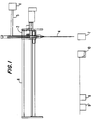
- Figure 1 is a schematic diagram of a probe type reagent dispensing system employing a cleaning apparatus according to one embodiment of the invention.
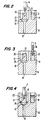
- Figure 2 is a sectional view of part of the apparatus of Figure 1 during one sequence of the cleaning process according to the invention.
- Figure 3 is another sectional view of part of the apparatus of Figure 1 during another sequence of the cleaning process according to the invention.
- Figure 4 is another sectional view of part of the apparatus of Figure 1 during another sequence of the cleaning process according to the invention.
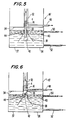
- Figure 5 is a sectional view of another embodiment of the invention during a sequence of the cleaning process according to the invention.
- Figure 6 is another sectional view of the embodiment of the invention shown in Figure 5 during another sequence in the cleaning process.
- Figure 1 illustrates a protein-containing reagent dispensing device 2 having a pipette or hollow probe 4 for dispensing a protein-containing reagent, such as thromboplastin, thrombin, etc.
- Dispensing device 2 may be moved horizontally along a track 6, which may be a horizontal lead screw, or up and down along a vertical lead screw.
- probe 4 is lowered into a reagent container 8 to aspirate a first reagent into probe by means of a displacement pump 5 controlled by a controller 11.
- Probe 4 is then moved over a reaction vessel 7 and is lowered into reaction vessel 7 so that reagent can be dispensed into reaction vessel 7 by forcing air or a primer liquid such as water through probe 4 by means of displacement pump 5.
- probe 4 After a first reagent is dispensed into reaction vessel 7, probe 4 is cleaned both inside and outside at a wash station 10. After being cleaned, probe 4 may aspirate a second reagent in a second container 9. After dispensing the second reagent into reaction vessel 7, probe 4 is again cleaned at wash station 10 so that another reagent may again be aspirated.
- FIG. 2 A first embodiment of the invention is illustrated in detail in Figures 2, 3 and 4.
- residual protein-containing reagent 3 is preferably expelled from probe 4 prior to aspirating cleaning solution 14 from cleaning solution bath 12.
- probe 4 After expelling residual reagent into a recess 20, having a bottom 24 and located in a trough 13, probe 4 is moved to a position shown in Figure 3 and lowered into cleaning solution bath 12.
- Cleaning solution 16 is then aspirated into probe 4.
- Probe 4 is then raised and moved to a position above recess 20.
- Probe 4 is then lowered until it is surrounded by walls 22 of recess 20.
- Cleaning solution is then forced through probe 4 by means of a primer liquid injected into probe.
- a preferred primer liquid is water.
- a cleaning solution is a bleach (sodium hypochlorite) solution, preferably a 10% bleach solution.
- a 10% bleach solution is the cleaning solution, the amount of bleach solution used is preferably about half of the amount of reagent delivered.
- the amount of water forced through the probe is preferably about 10 times the amount of bleach solution used.
- FIGS 5 and 6 illustrate a second embodiment of the invention which provides a modified wash station 10′.
- the remaining parts of the apparatus are identical to those illustrated in Figure 1 and their functions are described above.
- probe 4 is lowered into wash station 10′ through a passage 32 which passes through the top 34 of a container 37 which contains a bath 36 of cleaning solution. At the bottom of passage 32 is an opening 33.
- the end of probe 4 dislodges a ball 42 from an opening 44, which in the embodiment shown is a cylindrical passage.
- opening 44 which in the embodiment shown is a cylindrical passage.
- Frustoconical passage 38 acts to constrain the movement of ball 42 so that it will follow probe 4 up as probe 4 is raised.
- Frustoconical passage 38 is supported in place by means of support members 40 and may consist of separate bent vertical strips with spaces between the strips or may be a unitary cone.
- the level of cleaning solution in bath 36 is maintained by means of an inflow pipe 52 and an outflow pipe 50.
- a probe was used to aspirate approximately 66 ⁇ l (6.6x10 ⁇ 8m3) of thrombin from a reservoir. The thrombin was then delivered to a cuvette. Next, the probe was moved over a bleach reservoir and lowered into the reservoir to pipette 35 ⁇ l (3.5x10 ⁇ 8m3) of a 10% solution of bleach into the probe. The probe was then moved over a deflection recess and lowered into the recess. Finally, approximately 300 ⁇ l (3x10 ⁇ 7m2) of water was forced through the probe to clear bleach and reagent from the inside of the probe and to cause bleach and water to fountain over the outside of the probe to clean the outside of the probe.
Landscapes
- Chemical & Material Sciences (AREA)
- Immunology (AREA)
- Physics & Mathematics (AREA)
- Health & Medical Sciences (AREA)
- Analytical Chemistry (AREA)
- Biochemistry (AREA)
- General Health & Medical Sciences (AREA)
- Life Sciences & Earth Sciences (AREA)
- General Physics & Mathematics (AREA)
- Pathology (AREA)
- Chemical Kinetics & Catalysis (AREA)
- General Chemical & Material Sciences (AREA)
- Automatic Analysis And Handling Materials Therefor (AREA)
- Sampling And Sample Adjustment (AREA)
- Cleaning In General (AREA)
- Investigating Or Analysing Biological Materials (AREA)
- Non-Silver Salt Photosensitive Materials And Non-Silver Salt Photography (AREA)
Claims (21)
- Un appareil de nettoyage pour une sonde de distribution creuse (4) qui est utilisée de façon répétitive dans un système automatique pour délivrer des réactifs contenant des protéines, comprenant:
un bain (12) d'une solution de nettoyage (14) pour un réactif contenant des protéines;
des moyens pour plonger la sonde dans ladite solution de nettoyage (14) pour introduire la solution de nettoyage dans la sonde, et pour recouvrir l'extérieur de la sonde;
des moyens pour retirer la sonde (4) de ladite solution de nettoyage;
des moyens pour expulser la solution de nettoyage de la sonde;
des moyens pour introduire du liquide de départ dans la sonde pour laver l'intérieur de la sonde;
des moyens pour expulser le liquide de départ de la sonde; et
des moyens (22, 20) pour dévier sur l'extérieur de la sonde la solution de nettoyage et le liquide de départ expulsés de la sonde, afin de laver l'extérieur de la sonde. - L'appareil selon la revendication 1, dans lequel ladite solution de nettoyage comprend un décolorant.
- L'appareil selon la revendication 1, dans lequel ladite solution de nettoyage comprend environ 10% de décolorant.
- L'appareil selon la revendication 1, dans lequel lesdits moyens de déviation comprennent un corps contenant intérieurement une cavité présentant des parois qui entourent la sonde lorsque la sonde est descendue dans ladite cavité.
- L'appareil selon la revendication 1, comprenant en outre un conteneur pour contenir ledit bain, et loger lesdits moyens de déviation, ledit conteneur comportant une partie supérieure située au-dessus de ladite solution de nettoyage, ladite partie supérieure définissant une ouverture pour permettre à la sonde d'être descendue dans ladite solution de nettoyage, ledit conteneur comportant des moyens définissant un passage tronconique inversé situé dans ladite solution de nettoyage, et communiquant avec ladite ouverture, dans lequel lesdits moyens de déviation comprennent une bille qui flotte sur ladite solution de nettoyage pour fermer ladite ouverture, ladite bille étant contrainte par lesdits moyens de passage tronconique, et étant susceptible d'être déplacée vers le bas par la sonde lorsque la sonde est descendue dans ladite solution de nettoyage, pour permettre à la solution de nettoyage d'être aspirée dans la sonde.
- L'appareil selon la revendication 1, dans lequel ledit appareil comporte en outre des moyens pour expulser le réactif en excès de la sonde, avant de plonger la sonde dans ladite solution de nettoyage.
- L'appareil selon la revendication 1, dans lequel ledit bain de solution de nettoyage est situé dans une première position, et lesdits moyens de déviation sont situés dans une seconde position, et ledit appareil comporte en outre des moyens pour amener la sonde entre lesdites première et seconde positions.
- L'appareil selon la revendication 1, comprenant en outre un réceptacle pour recevoir la solution de nettoyage et le liquide de départ usés, déviés par lesdits moyens de déviation, et des moyens pour évacuer la solution de nettoyage et le liquide de départ usés desdits moyens formant réceptacle.
- Le procédé pour nettoyer une sonde creuse de distribution (4), qui est utilisé de façon répétitive dans un système automatique pour distribuer des réactifs contenant des protéines, comprenant les étapes consistant:
à immerger une sonde creuse, contaminée à l'intérieur et à l'extérieur par un réactif contenant des protéines, dans un bain (12) d'une solution de nettoyage (14) pour éliminer les réactifs contenant des protéines;
à introduire de la solution de nettoyage dans la sonde et à déposer la solution de nettoyage sur l'extérieur de la sonde;
à retirer la sonde de la solution de nettoyage;
à introduire un liquide de départ dans la sonde;
à expulser la solution de nettoyage de la sonde;
à expulser le liquide de départ de la sonde pour laver l'intérieur de la sonde; et
à devier sur l'extérieur de la sonde la solution de nettoyage et le liquide de départ expulsés, pour nettoyer l'extérieur de la sonde. - Le procédé selon la revendication 9, dans lequel la solution de nettoyage est aspirée dans la sonde.
- Le procédé selon la revendication 9, dans lequel le liquide de départ est refoulé à travers la sonde.
- Le procédé selon la revendication 11, dans lequel la solution de nettoyage est expulsée de la sonde par le liquide de départ.
- Le procédé selon la revendication 9, dans lequel la solution de nettoyage comprend un décolorant.
- Le procédé selon la revendication 9, dans lequel la solution de nettoyage comprend environ 10% de décolorant.
- Le procédé selon la revendication 9, dans lequel le liquide de départ comprend de l'eau.
- Le procédé selon la revendication 9, dans lequel le bain est contenu dans un conteneur comportant une partie supérieure située au-dessus de ladite solution de nettoyage, la partie supérieure définissant une ouverture pour permettre à la sonde d'être descendue dans la solution de nettoyage, le conteneur comprenant des moyens définissant un passage tronconique inversé situé dans la solution de nettoyage, et communiquant avec l'ouverture, le conteneur logeant une bille qui flotte sur la solution de nettoyage pour fermer ladite ouverture, la bille étant contrainte par les moyens de passage tronconique, et étant susceptible d'être déplacée vers le bas par la sonde lorsque la sonde est descendue dans la solution de nettoyage, pour permettre à la solution de nettoyage d'être aspirée dans la sonde, et dans lequel
ladite étape d'immersion comprend en outre l'étape consistant à déplacer dans la solution de nettoyage la bille qui ferme le conteneur contenant le bain de solution de nettoyage, de manière à permettre à la solution de nettoyage d'être aspirée dans la sonde, et ladite étape consistant à dévier comprend la déviation du liquide de départ expulsé par la bille qui ferme le conteneur après que la sonde ait été levée. - Le procédé selon la revendication 14, dans lequel environ 10 µl (1 x 10⁻⁸ m³) de liquide de départ est refoulé à travers la sonde pour chaque 1 µl (1 x 10⁻⁹ m³) de décolorant aspiré dans ladite sonde.
- Le procédé selon la revendication 9, dans lequel ladite étape d'aspiration est réalisée dans une première position et ladite étape consistant à dévier, est réalisée dans une seconde position, et ledit procédé comprend en outre l'étape consistant à déplacer la sonde entre la première position et la seconde position.
- Le procédé selon la revendication 18, comprenant en outre les étapes consistant à expulser le réactif résiduel présent dans la sonde à ladite seconde position avant ladite étape d'immersion et de déplacement de la sonde vers la première position après expulsion du réactif résiduel.
- Le procédé selon la revendication 9, comprenant en outre l'étape consistant à expulser le réactif résiduel de la sonde avant ladite étape consistant à immerger.
- Le procédé selon la revendication 9, comprenant en outre l'étape consistant à évacuer la solution de nettoyage et le liquide de départ usés, en dehors desdits moyens de déviation.
Applications Claiming Priority (3)
| Application Number | Priority Date | Filing Date | Title |
|---|---|---|---|
| US443954 | 1989-12-01 | ||
| US07/443,954 US4989623A (en) | 1989-12-01 | 1989-12-01 | Apparatus and method for cleaning reagent delivery probes |
| PCT/US1990/007062 WO1991008061A1 (fr) | 1989-12-01 | 1990-12-03 | Appareil et methode de nettoyage de sondes de distribution de reactifs |
Publications (3)
| Publication Number | Publication Date |
|---|---|
| EP0503003A1 EP0503003A1 (fr) | 1992-09-16 |
| EP0503003A4 EP0503003A4 (en) | 1992-12-02 |
| EP0503003B1 true EP0503003B1 (fr) | 1995-09-20 |
Family
ID=23762875
Family Applications (1)
| Application Number | Title | Priority Date | Filing Date |
|---|---|---|---|
| EP91902530A Expired - Lifetime EP0503003B1 (fr) | 1989-12-01 | 1990-12-03 | Appareil et methode de nettoyage de sondes de distribution de reactifs |
Country Status (12)
| Country | Link |
|---|---|
| US (1) | US4989623A (fr) |
| EP (1) | EP0503003B1 (fr) |
| JP (1) | JPH05502726A (fr) |
| KR (1) | KR920703223A (fr) |
| AT (1) | ATE128242T1 (fr) |
| AU (1) | AU629736B2 (fr) |
| CA (1) | CA2069484A1 (fr) |
| DE (1) | DE69022600D1 (fr) |
| FI (1) | FI922477L (fr) |
| IE (1) | IE904227A1 (fr) |
| WO (1) | WO1991008061A1 (fr) |
| ZA (1) | ZA909569B (fr) |
Families Citing this family (26)
| Publication number | Priority date | Publication date | Assignee | Title |
|---|---|---|---|---|
| US5646046A (en) * | 1989-12-01 | 1997-07-08 | Akzo Nobel N.V. | Method and instrument for automatically performing analysis relating to thrombosis and hemostasis |
| IT1239193B (it) * | 1990-04-09 | 1993-09-28 | Corrado Zizola | Distributore automatico di prodotti alimentari pastosi, particolarmente per vetrine espositrici di gelato |
| US5156813A (en) * | 1990-07-13 | 1992-10-20 | Medical Laboratory Automation, Inc. | Cup for use with a pipette probe |
| JPH04105066A (ja) * | 1990-08-24 | 1992-04-07 | Olympus Optical Co Ltd | プローブ洗浄容器 |
| DE69225940T2 (de) * | 1991-09-30 | 1998-11-19 | Olympus Optical Co | Verfahren zum Regenerieren von zur Handhabung von biologischen Substanzen verwendeten Geräten |
| JPH05126836A (ja) * | 1991-10-31 | 1993-05-21 | Toshiba Corp | プローブ洗浄槽 |
| US5344036A (en) * | 1992-06-04 | 1994-09-06 | Akzo N.V. | Container system |
| US5525515A (en) * | 1993-02-03 | 1996-06-11 | Blattner; Frederick R. | Process of handling liquids in an automated liquid handling apparatus |
| US5334353A (en) * | 1993-02-03 | 1994-08-02 | Blattner Frederick R | Micropipette device |
| US5518438A (en) * | 1993-10-08 | 1996-05-21 | United States Surgical Corporation | Apparatus and method for grinding needle workpieces |
| CA2218366A1 (fr) * | 1995-04-17 | 1996-10-31 | Romaine R. Maiefski | Aiguille pour prelevement a la pipette et poste de rincage associe, pour le transfert de fluides dans des operations sous atmosphere inerte |
| JP2001504749A (ja) * | 1995-07-14 | 2001-04-10 | ベックマン コールター,インコーポレイティド | ピペットプローブを洗浄するための装置及び方法 |
| JP3572792B2 (ja) * | 1996-04-04 | 2004-10-06 | 東ソー株式会社 | 前処理装置 |
| EP1073892B1 (fr) * | 1998-02-27 | 2010-11-24 | Ventana Medical Systems, Inc. | Appareil automatisé d'anatomie pathologique moléculaire avec dispositifs de chauffage indépendants de microplaquettes |
| US6575181B1 (en) | 1999-10-25 | 2003-06-10 | Merck & Co., Inc. | Probe wash vessel having removable inner cannula |
| JP2004305076A (ja) * | 2003-04-04 | 2004-11-04 | Canon Inc | 対象物に対する修飾装置 |
| WO2005124366A1 (fr) * | 2004-06-14 | 2005-12-29 | Parker-Hannifin Corporation | Systeme et procede de manipulation robotique a outils detachables fonctionnant separement |
| US7621282B2 (en) * | 2004-06-17 | 2009-11-24 | Abbott Laboratories, Inc. | Probe washing cups and methods |
| US8057756B2 (en) * | 2005-01-28 | 2011-11-15 | Parker-Hannifin Corporation | Sampling probe, gripper and interface for laboratory sample management systems |
| EP1901075A4 (fr) * | 2005-04-21 | 2013-11-13 | Wako Pure Chem Ind Ltd | Dispositif de nettoyage de pipette et procédé de nettoyage |
| US20090032065A1 (en) * | 2005-12-08 | 2009-02-05 | Bantz Daniel L | Syringe wash station for analytical applications |
| WO2008140707A1 (fr) | 2007-05-11 | 2008-11-20 | Bio-Rad Laboratories, Inc. | Anneau de lavage et sa méthode d'utilisation |
| JP6427271B2 (ja) * | 2015-06-29 | 2018-11-21 | 株式会社日立ハイテクノロジーズ | 超音波洗浄器およびこれを用いた自動分析装置 |
| JP6916677B2 (ja) * | 2017-06-27 | 2021-08-11 | アークレイ株式会社 | ノズル洗浄装置、分注装置、分析装置、ノズルの洗浄方法 |
| WO2023204224A1 (fr) * | 2022-04-20 | 2023-10-26 | 富士レビオ株式会社 | Dispositif de nettoyage et procédé de nettoyage par buse |
| CN118045796B (zh) * | 2024-02-02 | 2026-06-12 | 深圳市新产业生物医学工程股份有限公司 | 清洗装置和清洗方法 |
Family Cites Families (12)
| Publication number | Priority date | Publication date | Assignee | Title |
|---|---|---|---|---|
| SE371983B (fr) * | 1972-09-22 | 1974-12-09 | Tetra Pak Int | |
| GB1445389A (en) * | 1973-10-16 | 1976-08-11 | Chemlab Mfg Ltd | Sampling arrangements |
| US4076503A (en) * | 1974-08-22 | 1978-02-28 | The Perkin-Elmer Corporation | Pipetting system for use in kinetic analysis apparatus and the like |
| US3960020A (en) * | 1974-12-30 | 1976-06-01 | Technicon Instruments Corporation | Liquid aspirating probe assembly of a supply analyzer |
| US4217780A (en) * | 1979-07-09 | 1980-08-19 | Ortho Diagnostic, Inc. | Automated, self-cleaning fluid sampling apparatus |
| US4463615A (en) * | 1980-04-24 | 1984-08-07 | Beckman Instruments, Inc. | Liquid transfer valve |
| DE3144083A1 (de) * | 1980-11-14 | 1982-06-24 | Corning Glass Works, 14830 Corning, N.Y. | Vorrichtung zur entnahme von proben |
| US4516437A (en) * | 1983-03-23 | 1985-05-14 | Coulter Corporation | Microsample handling apparatus |
| US4574850A (en) * | 1985-01-17 | 1986-03-11 | E. I. Du Pont De Nemours And Company | Method of and apparatus for dispensing liquid |
| US4820497A (en) * | 1986-06-23 | 1989-04-11 | E. I. Du Pont De Nemours And Company | Movable cleaning assembly for an aspirating needle |
| FR2606885B1 (fr) * | 1986-11-14 | 1989-08-04 | Abx Sarl | Dispositif de nettoyage d'une aiguille de prelevement d'un liquide |
| FR2630216A1 (fr) * | 1988-04-14 | 1989-10-20 | Ibal | Installation robotisee d'analyses, notamment medicales |
-
1989
- 1989-12-01 US US07/443,954 patent/US4989623A/en not_active Expired - Lifetime
-
1990
- 1990-11-22 IE IE422790A patent/IE904227A1/en unknown
- 1990-11-28 ZA ZA909569A patent/ZA909569B/xx unknown
- 1990-12-03 JP JP91502692A patent/JPH05502726A/ja active Pending
- 1990-12-03 EP EP91902530A patent/EP0503003B1/fr not_active Expired - Lifetime
- 1990-12-03 KR KR1019920701274A patent/KR920703223A/ko not_active Ceased
- 1990-12-03 AT AT91902530T patent/ATE128242T1/de not_active IP Right Cessation
- 1990-12-03 CA CA002069484A patent/CA2069484A1/fr not_active Abandoned
- 1990-12-03 AU AU71597/91A patent/AU629736B2/en not_active Ceased
- 1990-12-03 FI FI922477A patent/FI922477L/fi not_active Application Discontinuation
- 1990-12-03 DE DE69022600T patent/DE69022600D1/de not_active Expired - Lifetime
- 1990-12-03 WO PCT/US1990/007062 patent/WO1991008061A1/fr not_active Ceased
Also Published As
| Publication number | Publication date |
|---|---|
| CA2069484A1 (fr) | 1991-06-02 |
| KR920703223A (ko) | 1992-12-17 |
| US4989623A (en) | 1991-02-05 |
| ATE128242T1 (de) | 1995-10-15 |
| DE69022600D1 (de) | 1995-10-26 |
| FI922477A7 (fi) | 1992-05-29 |
| AU7159791A (en) | 1991-06-26 |
| ZA909569B (en) | 1991-11-27 |
| EP0503003A4 (en) | 1992-12-02 |
| FI922477A0 (fi) | 1992-05-29 |
| WO1991008061A1 (fr) | 1991-06-13 |
| JPH05502726A (ja) | 1993-05-13 |
| AU629736B2 (en) | 1992-10-08 |
| EP0503003A1 (fr) | 1992-09-16 |
| FI922477L (fi) | 1992-05-29 |
| IE904227A1 (en) | 1991-06-05 |
Similar Documents
| Publication | Publication Date | Title |
|---|---|---|
| AU629736B2 (en) | Apparatus and method for cleaning reagent delivery probes | |
| US5133373A (en) | Apparatus and method for cleaning reagent delivery probes | |
| US7300525B2 (en) | Device for cleaning pipette probes or stirrers | |
| AU666052B2 (en) | Fluid probe washing apparatus and method | |
| US5066336A (en) | Method for cleaning reagent delivery probes | |
| JP3419431B2 (ja) | 生化学自動分析装置における洗浄装置 | |
| JP2008281480A (ja) | ノズル洗浄方法およびノズル洗浄装置ならびに自動分析装置 | |
| EP3455003B1 (fr) | Station de lavage de sonde pour instrumentation analytique | |
| JP3448436B2 (ja) | 生化学自動分析装置における洗浄装置 | |
| CN104841672A (zh) | 清洁管嘴的方法以及用于清洁管嘴的装置 | |
| US11353473B2 (en) | Automatic analyzer and automatic analysis method | |
| CN113711055A (zh) | 自动分析装置 | |
| JP4585078B2 (ja) | 自動分析装置及び反応管の洗浄方法 | |
| EP1335853B1 (fr) | Distributeur d'echantillons de liquide sans contamination | |
| JP3029718B2 (ja) | 自動化学分析装置のサンプリングシステム | |
| JP2003107095A (ja) | セルの洗浄方法及びセルの洗浄装置 | |
| JPH07103984A (ja) | 自動化学分析装置 | |
| JPH02223860A (ja) | サンプリング管洗浄装置 | |
| JPH0128461Y2 (fr) | ||
| JPH04160367A (ja) | 試薬分注装置 |
Legal Events
| Date | Code | Title | Description |
|---|---|---|---|
| PUAI | Public reference made under article 153(3) epc to a published international application that has entered the european phase |
Free format text: ORIGINAL CODE: 0009012 |
|
| 17P | Request for examination filed |
Effective date: 19920512 |
|
| AK | Designated contracting states |
Kind code of ref document: A1 Designated state(s): AT BE CH DE DK ES FR GB GR IT LI LU NL SE |
|
| A4 | Supplementary search report drawn up and despatched |
Effective date: 19921009 |
|
| AK | Designated contracting states |
Kind code of ref document: A4 Designated state(s): AT BE CH DE DK ES FR GB GR IT LI LU NL SE |
|
| RAP1 | Party data changed (applicant data changed or rights of an application transferred) |
Owner name: AKZO NOBEL N.V. |
|
| 17Q | First examination report despatched |
Effective date: 19941123 |
|
| GRAA | (expected) grant |
Free format text: ORIGINAL CODE: 0009210 |
|
| AK | Designated contracting states |
Kind code of ref document: B1 Designated state(s): AT BE CH DE DK ES FR GB GR IT LI LU NL SE |
|
| PG25 | Lapsed in a contracting state [announced via postgrant information from national office to epo] |
Ref country code: GR Free format text: LAPSE BECAUSE OF FAILURE TO SUBMIT A TRANSLATION OF THE DESCRIPTION OR TO PAY THE FEE WITHIN THE PRESCRIBED TIME-LIMIT Effective date: 19950920 Ref country code: IT Free format text: LAPSE BECAUSE OF FAILURE TO SUBMIT A TRANSLATION OF THE DESCRIPTION OR TO PAY THE FEE WITHIN THE PRE;WARNING: LAPSES OF ITALIAN PATENTS WITH EFFECTIVE DATE BEFORE 2007 MAY HAVE OCCURRED AT ANY TIME BEFORE 2007. THE CORRECT EFFECTIVE DATE MAY BE DIFFERENT FROM THE ONE RECORDED.SCRIBED TIME-LIMIT Effective date: 19950920 Ref country code: DK Effective date: 19950920 Ref country code: AT Effective date: 19950920 Ref country code: BE Effective date: 19950920 Ref country code: ES Free format text: THE PATENT HAS BEEN ANNULLED BY A DECISION OF A NATIONAL AUTHORITY Effective date: 19950920 Ref country code: FR Effective date: 19950920 Ref country code: NL Free format text: LAPSE BECAUSE OF NON-PAYMENT OF DUE FEES Effective date: 19950920 |
|
| REF | Corresponds to: |
Ref document number: 128242 Country of ref document: AT Date of ref document: 19951015 Kind code of ref document: T |
|
| REF | Corresponds to: |
Ref document number: 69022600 Country of ref document: DE Date of ref document: 19951026 |
|
| PG25 | Lapsed in a contracting state [announced via postgrant information from national office to epo] |
Ref country code: SE Effective date: 19951220 Ref country code: GB Effective date: 19951220 |
|
| PG25 | Lapsed in a contracting state [announced via postgrant information from national office to epo] |
Ref country code: DE Effective date: 19951221 |
|
| PG25 | Lapsed in a contracting state [announced via postgrant information from national office to epo] |
Ref country code: LU Free format text: LAPSE BECAUSE OF NON-PAYMENT OF DUE FEES Effective date: 19951231 Ref country code: LI Effective date: 19951231 Ref country code: CH Effective date: 19951231 |
|
| EN | Fr: translation not filed | ||
| NLV1 | Nl: lapsed or annulled due to failure to fulfill the requirements of art. 29p and 29m of the patents act | ||
| PLBE | No opposition filed within time limit |
Free format text: ORIGINAL CODE: 0009261 |
|
| STAA | Information on the status of an ep patent application or granted ep patent |
Free format text: STATUS: NO OPPOSITION FILED WITHIN TIME LIMIT |
|
| GBPC | Gb: european patent ceased through non-payment of renewal fee |
Effective date: 19951220 |
|
| REG | Reference to a national code |
Ref country code: CH Ref legal event code: PL |
|
| 26N | No opposition filed |