EP0493136B1 - Interframe-coded output data amount control system - Google Patents
Interframe-coded output data amount control system Download PDFInfo
- Publication number
- EP0493136B1 EP0493136B1 EP19910312074 EP91312074A EP0493136B1 EP 0493136 B1 EP0493136 B1 EP 0493136B1 EP 19910312074 EP19910312074 EP 19910312074 EP 91312074 A EP91312074 A EP 91312074A EP 0493136 B1 EP0493136 B1 EP 0493136B1
- Authority
- EP
- European Patent Office
- Prior art keywords
- data amount
- amount
- frames
- activity
- frame
- Prior art date
- Legal status (The legal status is an assumption and is not a legal conclusion. Google has not performed a legal analysis and makes no representation as to the accuracy of the status listed.)
- Expired - Lifetime
Links
- 238000013139 quantization Methods 0.000 claims description 95
- 230000001419 dependent effect Effects 0.000 claims description 58
- 230000000694 effects Effects 0.000 claims description 45
- 230000015654 memory Effects 0.000 claims description 22
- 238000000034 method Methods 0.000 claims description 11
- 230000008859 change Effects 0.000 claims description 9
- 230000008569 process Effects 0.000 claims description 6
- 238000001514 detection method Methods 0.000 claims description 5
- 230000003247 decreasing effect Effects 0.000 claims 2
- 230000033001 locomotion Effects 0.000 description 10
- 238000004364 calculation method Methods 0.000 description 3
- 230000003111 delayed effect Effects 0.000 description 3
- 238000010586 diagram Methods 0.000 description 2
- 230000006870 function Effects 0.000 description 2
- 230000005540 biological transmission Effects 0.000 description 1
- 230000006866 deterioration Effects 0.000 description 1
- 230000004048 modification Effects 0.000 description 1
- 238000012986 modification Methods 0.000 description 1
- 238000010606 normalization Methods 0.000 description 1
- 238000005070 sampling Methods 0.000 description 1
Images


Classifications
-
- H—ELECTRICITY
- H04—ELECTRIC COMMUNICATION TECHNIQUE
- H04N—PICTORIAL COMMUNICATION, e.g. TELEVISION
- H04N19/00—Methods or arrangements for coding, decoding, compressing or decompressing digital video signals
- H04N19/90—Methods or arrangements for coding, decoding, compressing or decompressing digital video signals using coding techniques not provided for in groups H04N19/10-H04N19/85, e.g. fractals
-
- H—ELECTRICITY
- H04—ELECTRIC COMMUNICATION TECHNIQUE
- H04N—PICTORIAL COMMUNICATION, e.g. TELEVISION
- H04N19/00—Methods or arrangements for coding, decoding, compressing or decompressing digital video signals
- H04N19/10—Methods or arrangements for coding, decoding, compressing or decompressing digital video signals using adaptive coding
- H04N19/102—Methods or arrangements for coding, decoding, compressing or decompressing digital video signals using adaptive coding characterised by the element, parameter or selection affected or controlled by the adaptive coding
- H04N19/115—Selection of the code volume for a coding unit prior to coding
-
- H—ELECTRICITY
- H04—ELECTRIC COMMUNICATION TECHNIQUE
- H04N—PICTORIAL COMMUNICATION, e.g. TELEVISION
- H04N19/00—Methods or arrangements for coding, decoding, compressing or decompressing digital video signals
- H04N19/10—Methods or arrangements for coding, decoding, compressing or decompressing digital video signals using adaptive coding
- H04N19/102—Methods or arrangements for coding, decoding, compressing or decompressing digital video signals using adaptive coding characterised by the element, parameter or selection affected or controlled by the adaptive coding
- H04N19/124—Quantisation
-
- H—ELECTRICITY
- H04—ELECTRIC COMMUNICATION TECHNIQUE
- H04N—PICTORIAL COMMUNICATION, e.g. TELEVISION
- H04N19/00—Methods or arrangements for coding, decoding, compressing or decompressing digital video signals
- H04N19/10—Methods or arrangements for coding, decoding, compressing or decompressing digital video signals using adaptive coding
- H04N19/134—Methods or arrangements for coding, decoding, compressing or decompressing digital video signals using adaptive coding characterised by the element, parameter or criterion affecting or controlling the adaptive coding
- H04N19/136—Incoming video signal characteristics or properties
- H04N19/14—Coding unit complexity, e.g. amount of activity or edge presence estimation
-
- H—ELECTRICITY
- H04—ELECTRIC COMMUNICATION TECHNIQUE
- H04N—PICTORIAL COMMUNICATION, e.g. TELEVISION
- H04N19/00—Methods or arrangements for coding, decoding, compressing or decompressing digital video signals
- H04N19/10—Methods or arrangements for coding, decoding, compressing or decompressing digital video signals using adaptive coding
- H04N19/134—Methods or arrangements for coding, decoding, compressing or decompressing digital video signals using adaptive coding characterised by the element, parameter or criterion affecting or controlling the adaptive coding
- H04N19/146—Data rate or code amount at the encoder output
- H04N19/149—Data rate or code amount at the encoder output by estimating the code amount by means of a model, e.g. mathematical model or statistical model
-
- H—ELECTRICITY
- H04—ELECTRIC COMMUNICATION TECHNIQUE
- H04N—PICTORIAL COMMUNICATION, e.g. TELEVISION
- H04N19/00—Methods or arrangements for coding, decoding, compressing or decompressing digital video signals
- H04N19/10—Methods or arrangements for coding, decoding, compressing or decompressing digital video signals using adaptive coding
- H04N19/169—Methods or arrangements for coding, decoding, compressing or decompressing digital video signals using adaptive coding characterised by the coding unit, i.e. the structural portion or semantic portion of the video signal being the object or the subject of the adaptive coding
- H04N19/17—Methods or arrangements for coding, decoding, compressing or decompressing digital video signals using adaptive coding characterised by the coding unit, i.e. the structural portion or semantic portion of the video signal being the object or the subject of the adaptive coding the unit being an image region, e.g. an object
- H04N19/172—Methods or arrangements for coding, decoding, compressing or decompressing digital video signals using adaptive coding characterised by the coding unit, i.e. the structural portion or semantic portion of the video signal being the object or the subject of the adaptive coding the unit being an image region, e.g. an object the region being a picture, frame or field
-
- H—ELECTRICITY
- H04—ELECTRIC COMMUNICATION TECHNIQUE
- H04N—PICTORIAL COMMUNICATION, e.g. TELEVISION
- H04N19/00—Methods or arrangements for coding, decoding, compressing or decompressing digital video signals
- H04N19/10—Methods or arrangements for coding, decoding, compressing or decompressing digital video signals using adaptive coding
- H04N19/169—Methods or arrangements for coding, decoding, compressing or decompressing digital video signals using adaptive coding characterised by the coding unit, i.e. the structural portion or semantic portion of the video signal being the object or the subject of the adaptive coding
- H04N19/17—Methods or arrangements for coding, decoding, compressing or decompressing digital video signals using adaptive coding characterised by the coding unit, i.e. the structural portion or semantic portion of the video signal being the object or the subject of the adaptive coding the unit being an image region, e.g. an object
- H04N19/176—Methods or arrangements for coding, decoding, compressing or decompressing digital video signals using adaptive coding characterised by the coding unit, i.e. the structural portion or semantic portion of the video signal being the object or the subject of the adaptive coding the unit being an image region, e.g. an object the region being a block, e.g. a macroblock
-
- H—ELECTRICITY
- H04—ELECTRIC COMMUNICATION TECHNIQUE
- H04N—PICTORIAL COMMUNICATION, e.g. TELEVISION
- H04N19/00—Methods or arrangements for coding, decoding, compressing or decompressing digital video signals
- H04N19/10—Methods or arrangements for coding, decoding, compressing or decompressing digital video signals using adaptive coding
- H04N19/169—Methods or arrangements for coding, decoding, compressing or decompressing digital video signals using adaptive coding characterised by the coding unit, i.e. the structural portion or semantic portion of the video signal being the object or the subject of the adaptive coding
- H04N19/177—Methods or arrangements for coding, decoding, compressing or decompressing digital video signals using adaptive coding characterised by the coding unit, i.e. the structural portion or semantic portion of the video signal being the object or the subject of the adaptive coding the unit being a group of pictures [GOP]
-
- H—ELECTRICITY
- H04—ELECTRIC COMMUNICATION TECHNIQUE
- H04N—PICTORIAL COMMUNICATION, e.g. TELEVISION
- H04N19/00—Methods or arrangements for coding, decoding, compressing or decompressing digital video signals
- H04N19/50—Methods or arrangements for coding, decoding, compressing or decompressing digital video signals using predictive coding
-
- H—ELECTRICITY
- H04—ELECTRIC COMMUNICATION TECHNIQUE
- H04N—PICTORIAL COMMUNICATION, e.g. TELEVISION
- H04N19/00—Methods or arrangements for coding, decoding, compressing or decompressing digital video signals
- H04N19/60—Methods or arrangements for coding, decoding, compressing or decompressing digital video signals using transform coding
- H04N19/61—Methods or arrangements for coding, decoding, compressing or decompressing digital video signals using transform coding in combination with predictive coding
-
- H—ELECTRICITY
- H04—ELECTRIC COMMUNICATION TECHNIQUE
- H04N—PICTORIAL COMMUNICATION, e.g. TELEVISION
- H04N19/00—Methods or arrangements for coding, decoding, compressing or decompressing digital video signals
- H04N19/10—Methods or arrangements for coding, decoding, compressing or decompressing digital video signals using adaptive coding
- H04N19/134—Methods or arrangements for coding, decoding, compressing or decompressing digital video signals using adaptive coding characterised by the element, parameter or criterion affecting or controlling the adaptive coding
- H04N19/146—Data rate or code amount at the encoder output
- H04N19/152—Data rate or code amount at the encoder output by measuring the fullness of the transmission buffer
Definitions
- One high-efficiency coding system that is conventionally known uses variable length coding so that the data amount per sampling is made smaller.
- prediction error signals obtained by a predictive coding or orthogonal transform coefficient signals obtained by orthogonal transform have a significant amount of discrepancy in the level distribution of these signals.
- variable length codes When the variable length codes are used, it is possible to greatly reduce the data amount for the larger the discrepancies in the generation frequency of data. In addition, when compared to the case where the fixed length codes are used, the average data amount by the variable length codes can be made smaller while maintaining the same quality for reproduced signals.
- variable length codes are not constant and so when it is desired that a data amount for each predetermined certain division be constant, it is necessary to control the amount of generated data so as to make it constant.
- This activity is used as the basis for determining a temporary quantization step so that the data amount inside one frame becomes constant. This is feed forward control.
- this activity is used as the basis for determining the predictive data amount for each block.
- the predictive data amount is subtracted from the data amount for each actual block obtained by quantization of the orthogonal transform coefficients and variable length coding thereof thus quantized, and this result is then accumulated.
- the accumulated result is used as the basis to change the quantization step.
- a final quantization step is obtained which is used for quantization of the orthogonal transform coefficients. This is feedback control.
- the orthogonal transform coefficients are stored once in a coefficient memory for the purpose of compensation of delay by feed forward control, and these stored orthogonal transform coefficients are quantized.
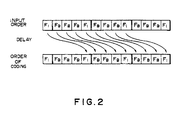
- a coding system for coding a video signal having a group of frames including a predetermined number of successive dependent frames and an independent frame which follows the dependent frames to obtain coded data of the group of frames, by interframe and intraframe coding, and for controlling a data amount of the group of frames by feedback control and feed forward control by means of an activity expressing a degree of change of an image in each of blocks composed of a predetermined number of pixels in the independent frame
- the system comprising first processing means for changing a number of quantization steps for the dependent frames on the basis of a rate of a total data amount of the group of frames and a data amount of the dependent frames for the feedback control; second processing means for determining a temporary number of quantization steps of the independent frame for the feed forward control; block data prediction means for determining a data amount predictive value for each of the blocks in the independent frame by means of the activity and the temporary number of quantization steps; subtraction means for subtracting the data amount predictive value from the total data amount and outputting a subtraction result for each
- the system further comprises an activity memory for storing the activity until the coding of the dependent frames is completed.
- video signals incoming from an image input terminal 1 are supplied to a switch 2 and a synchronizing signal separator 3.
- the synchronizing signal separator 3 separates vertical (frame) synchronizing signals from the input video signals and supplies the vertical synchronizing signals to a frame counter 4.
- a video signal incoming from the image input terminal 1 is supplied from the switch 2 to a frame memory 7 and stored.
- a video signal that has been stored in the frame memory 7 up till that time is moved to another frame memory 8 and stored.
- a video signal incoming from the image input terminal 1 is supplied from the switch 2 to a frame delay 9 and is delayed by N frame portions, and is supplied to a predictor 10.
- the video signals of the independent frames each supplied from the frame memories 7 and 8 are used to perform prediction of an input video signal to obtain a predictive error signal.
- the predictive error signal is supplied to an orthogonal transformer 11 via the switch 5 for intraframe coding.
- the orthogonal transformer 11 converts the input video signal into orthogonal transform coefficients for each block of 8 ⁇ 8 pixels.
- the orthogonal transform method is a known method such as discrete cosine transform (DCT) or the like.
- One orthogonal transform coefficient is a DC coefficient (mean) and all other orthogonal transform coefficients are AC coefficients (alternating).
- the coefficients that are the output signals of the orthogonal transformer 11 are supplied to a quantizer 12.
- the quantizer 12 quantizes the output signals of the orthogonal transformer 11 by a quantization step that is set by a method to be described later. Output signals of the quantizer 12 are supplied to a variable length encoder 13. In the variable length encoder 13, each of the coefficients is converted into a Huffman code or the like that has been set beforehand. Output signals of the variable length encoder 13 are supplied to a buffer 14. The variable length encoder 13 also outputs an actual data amount D n which is to be described later.
- the buffer 14 is a FIFO (First In First Out) memory by which an input data rate changes along with the amount of data that is output from the variable length encoder 13 and the ouput rate of the data that has been stored once in the buffer 14 is converted into a constant rate. Efficiently coded image date is then output via a data output terminal 15.
- the buffer 14 also supplies a data amount D B of the dependent frame to a F.B. (feedback) controller 16 and a F.F. (forward feed) controller 17.
- the F.B. controller 16 performs feedback control with respect to the dependent frames described later, and obtains a quantization step S B for the dependent frames, which is supplied to the switch 6.
- the switch 6 switches the quantization step S B for the dependent frames and a quantization step S I for the independent frames described later. Either step is supplied to the quantizer 12 and the F.B. controller 16, and also is output via an output terminal 18.
- the data amount prediction value D nl is a substracted from the actual data amount D n supplied by the variable length quantizer 13, and a difference (D n - D nl ) is supplied to the quantization step controller 24.
- the quantization step controller 24 stores the difference (D n - D nl ) and determines a compensation amount ⁇ S depending upon the size of the difference (D n -D nl ) and supplies the amount ⁇ S to an adder 22.
- the activity is a quantity that expresses the degree of change of an image, so any kind of quantity which corresponds to change of an amount of data is available. Many examples of the activity have been known.
- the U.S. Patent No. 5,016,010 by the same inventor of this invention discloses the normalization information D as the activity which is obtained by normalizing the difference between the maximal and minimal values of the AC coefficients by the DC coefficient.
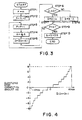
- the temporary quantization step S l for the independent frame needs to be determined in the F.F. controller 17 during vertical (frame) synchronization before the coding for the independent frames commences.
- a shift amount A becomes 8 ⁇ 4 ⁇ 2 ⁇ 1 in the data amount calculations for five quantization steps, and the quantization step No. S l is obtained for which the data amount is smaller than and is the closest to the objective value D. More specifically, if the number of the step kinds in the m'th power of 2 (m being a positive integral number) the quantization step No. S l can be determined by m number of data amount calculations.
- FIG. 5 is a view showing the control processing timing.
- FIG. 5 has F I expressing the independent frames and F B expressing the dependent frames.
- the spaces between F I and F B , and F B and F B are the vertical (frame) synchronizing divisions, and in the case of NTSC signals and the like, are time of about 8% of a single frame cycle (the vertical synchronizing cycle + even field scanning cycle + vertical synchronizing cycle + odd field scanning cycle).
- the time of more than half of a single frame cycle is equivalent to this space.
- the system fixes the data amount of an independent frame to a constant amount using a combination of feed forward control and feedback control.
- D n can be made less than D nl by partially truncating the data of a block when the actual data amount D n is greater than the data amount predictive value D nl for each block.
- the surplus data makes no large loss since it is added to the next D nl .
- the data truncation can be realized by stopping the zig-zag scan when there is the coding of the orthogonal transform coefficient.
- the data amount of the group of frames can be fixed to a constant amount at an interval of the independent frames, while at the same time maintaining a high coding efficiency.
- the present invention can be applied to storage media and the like.
Landscapes
- Engineering & Computer Science (AREA)
- Multimedia (AREA)
- Signal Processing (AREA)
- Physics & Mathematics (AREA)
- Algebra (AREA)
- General Physics & Mathematics (AREA)
- Mathematical Analysis (AREA)
- Mathematical Optimization (AREA)
- Pure & Applied Mathematics (AREA)
- Compression Or Coding Systems Of Tv Signals (AREA)
- Compression, Expansion, Code Conversion, And Decoders (AREA)
Applications Claiming Priority (2)
| Application Number | Priority Date | Filing Date | Title |
|---|---|---|---|
| JP2417571A JP2514111B2 (ja) | 1990-12-28 | 1990-12-28 | フレ―ム間符号化出力デ―タ量制御方式及び画像符号化出力デ―タ量制御方法 |
| JP417571/90 | 1990-12-28 |
Publications (3)
| Publication Number | Publication Date |
|---|---|
| EP0493136A2 EP0493136A2 (en) | 1992-07-01 |
| EP0493136A3 EP0493136A3 (en) | 1993-06-30 |
| EP0493136B1 true EP0493136B1 (en) | 1996-10-23 |
Family
ID=18525656
Family Applications (1)
| Application Number | Title | Priority Date | Filing Date |
|---|---|---|---|
| EP19910312074 Expired - Lifetime EP0493136B1 (en) | 1990-12-28 | 1991-12-27 | Interframe-coded output data amount control system |
Country Status (5)
| Country | Link |
|---|---|
| US (1) | US5267037A (enExample) |
| EP (1) | EP0493136B1 (enExample) |
| JP (1) | JP2514111B2 (enExample) |
| KR (1) | KR950002674B1 (enExample) |
| DE (1) | DE69122847T2 (enExample) |
Families Citing this family (35)
| Publication number | Priority date | Publication date | Assignee | Title |
|---|---|---|---|---|
| WO1992022986A1 (en) * | 1991-06-13 | 1992-12-23 | Intel Corporation | Method for encoding a sequence of images of a digital motion video signal |
| US5265180A (en) * | 1991-06-13 | 1993-11-23 | Intel Corporation | Method of encoding a sequence of images of a digital motion video signal |
| US5784107A (en) * | 1991-06-17 | 1998-07-21 | Matsushita Electric Industrial Co., Ltd. | Method and apparatus for picture coding and method and apparatus for picture decoding |
| US5475501A (en) * | 1991-09-30 | 1995-12-12 | Sony Corporation | Picture encoding and/or decoding method and apparatus |
| US5231484A (en) * | 1991-11-08 | 1993-07-27 | International Business Machines Corporation | Motion video compression system with adaptive bit allocation and quantization |
| JP2646921B2 (ja) * | 1991-11-15 | 1997-08-27 | 日本ビクター株式会社 | 適応量子化装置 |
| EP0545651A3 (en) * | 1991-12-02 | 1993-08-11 | Matsushita Electric Industrial Co., Ltd. | Recorder and player for video digital video signals |
| DE69334288D1 (de) * | 1992-01-29 | 2009-07-30 | Mitsubishi Electric Corp | Hochleistungscodierer und Vorrichtung zur Videodatenaufzeichnung/-wiedergabe |
| US6870884B1 (en) | 1992-01-29 | 2005-03-22 | Mitsubishi Denki Kabushiki Kaisha | High-efficiency encoder and video information recording/reproducing apparatus |
| US5592302A (en) * | 1992-03-23 | 1997-01-07 | Canon Kabushiki Kaisha | Coding method for coding pixel blocks and apparatus therefor |
| KR0152013B1 (ko) * | 1992-05-08 | 1998-10-15 | 강진구 | 가변장부호화를 고려한 움직임추정장치 |
| JP2611607B2 (ja) * | 1992-06-29 | 1997-05-21 | 日本ビクター株式会社 | シーンチェンジ検出装置 |
| JP3308990B2 (ja) * | 1992-07-03 | 2002-07-29 | 松下電器産業株式会社 | 動画像の予測符号化方法及び予測符号化装置 |
| JP3315766B2 (ja) * | 1992-09-07 | 2002-08-19 | 富士通株式会社 | 画像データ符号化方法、その方法を用いた画像データ符号化装置、画像データ復元方法、その方法を用いた画像データ復元装置、シーン変化検出方法、その方法を用いたシーン変化検出装置、シーン変化記録装置、及び画像データのシーン変化記録・再生装置 |
| EP0959629A3 (en) * | 1992-10-28 | 2003-01-02 | Victor Company Of Japan, Limited | Variable transfer rate information reproducing apparatus |
| KR0166727B1 (ko) * | 1992-11-27 | 1999-03-20 | 김광호 | 영상움직임관련정보를 양자화제어에 이용하는 부호화방법 및 장치 |
| JP3358835B2 (ja) * | 1992-12-14 | 2002-12-24 | ソニー株式会社 | 画像符号化方法及び装置 |
| JPH06233277A (ja) * | 1993-02-05 | 1994-08-19 | Sharp Corp | 画像符号化装置 |
| JP2979900B2 (ja) * | 1993-05-26 | 1999-11-15 | 日本ビクター株式会社 | 記録媒体 |
| FR2711879B1 (fr) * | 1993-10-22 | 1995-12-15 | Thomson Csf | Procédé et dispositif de codage inter-trame avec régulation de débit pour l'enregistrement d'images sur magnétoscope. |
| JP3224465B2 (ja) * | 1993-12-22 | 2001-10-29 | シャープ株式会社 | 画像符号化装置 |
| JPH07203428A (ja) * | 1993-12-28 | 1995-08-04 | Canon Inc | 画像処理方法及び装置 |
| JPH07226026A (ja) * | 1994-02-15 | 1995-08-22 | Sony Corp | ディジタル信号記録再生装置 |
| EP0670663A1 (fr) * | 1994-03-02 | 1995-09-06 | Laboratoires D'electronique Philips S.A.S. | Procédé et dispositif de codage de signaux numériques représentatifs d'une séquence d'images |
| FR2717029A1 (fr) * | 1994-03-02 | 1995-09-08 | Philips Laboratoire Electroniq | Procédé et dispositif de codage à longueur variable de signaux numériques. |
| FR2718315B1 (fr) * | 1994-03-30 | 1996-06-21 | Sgs Thomson Microelectronics | Circuit de compression d'image. |
| US5654760A (en) * | 1994-03-30 | 1997-08-05 | Sony Corporation | Selection of quantization step size in accordance with predicted quantization noise |
| FR2720582B1 (fr) * | 1994-05-27 | 1996-08-14 | Sgs Thomson Microelectronics | Circuit de détermination du coefficient de quantification dans une chaîne de compression d'image. |
| JP3050047B2 (ja) * | 1994-06-24 | 2000-06-05 | 日本ビクター株式会社 | 動画像符号化装置及び動画像符号化方法 |
| JPH09261648A (ja) * | 1996-03-21 | 1997-10-03 | Fujitsu Ltd | シーンチェンジ検出装置 |
| DE69721373T2 (de) * | 1996-05-14 | 2004-04-15 | Daewoo Electronics Corp. | Quantisierer für ein Videokodierungssystem |
| JP3676525B2 (ja) * | 1996-10-30 | 2005-07-27 | 日本ビクター株式会社 | 動画像符号化復号化装置及びその方法 |
| KR100227336B1 (ko) * | 1997-02-20 | 1999-11-01 | 서평원 | 고정 전송율 mpeg 영상 송신기용 전송율 제어 방법 및 그 장치 |
| JPH1118083A (ja) | 1997-06-25 | 1999-01-22 | Sony Corp | ディジタル信号符号化方法及び装置、信号記録媒体並びに信号伝送方法 |
| TW501022B (en) * | 1998-03-16 | 2002-09-01 | Mitsubishi Electric Corp | Moving picture coding system |
Family Cites Families (12)
| Publication number | Priority date | Publication date | Assignee | Title |
|---|---|---|---|---|
| US5041541A (en) * | 1988-05-05 | 1991-08-20 | The Procter & Gamble Company | Functional sugar substituted with reduced calories |
| US4984076A (en) * | 1988-07-27 | 1991-01-08 | Kabushiki Kaisha Toshiba | Image compression coding system |
| JPH0832037B2 (ja) * | 1988-10-07 | 1996-03-27 | 富士写真フイルム株式会社 | 画像データ圧縮装置 |
| US4985768A (en) * | 1989-01-20 | 1991-01-15 | Victor Company Of Japan, Ltd. | Inter-frame predictive encoding system with encoded and transmitted prediction error |
| JPH0797753B2 (ja) * | 1989-01-24 | 1995-10-18 | 日本ビクター株式会社 | 符号化出力データ量の制御方式 |
| JPH07109990B2 (ja) * | 1989-04-27 | 1995-11-22 | 日本ビクター株式会社 | 適応型フレーム間予測符号化方法及び復号方法 |
| JPH0832047B2 (ja) * | 1989-04-28 | 1996-03-27 | 日本ビクター株式会社 | 予測符号化装置 |
| US5144426A (en) * | 1989-10-13 | 1992-09-01 | Matsushita Electric Industrial Co., Ltd. | Motion compensated prediction interframe coding system |
| US5063608A (en) * | 1989-11-03 | 1991-11-05 | Datacube Inc. | Adaptive zonal coder |
| JPH07112284B2 (ja) * | 1990-01-20 | 1995-11-29 | 日本ビクター株式会社 | 予測符号化装置及び復号化装置 |
| JP3071205B2 (ja) * | 1990-01-23 | 2000-07-31 | オリンパス光学工業株式会社 | 画像データの符号化装置および符号化方法 |
| US5144424A (en) * | 1991-10-15 | 1992-09-01 | Thomson Consumer Electronics, Inc. | Apparatus for video data quantization control |
-
1990
- 1990-12-28 JP JP2417571A patent/JP2514111B2/ja not_active Expired - Fee Related
-
1991
- 1991-12-27 US US07/814,877 patent/US5267037A/en not_active Expired - Lifetime
- 1991-12-27 DE DE69122847T patent/DE69122847T2/de not_active Expired - Fee Related
- 1991-12-27 EP EP19910312074 patent/EP0493136B1/en not_active Expired - Lifetime
- 1991-12-28 KR KR1019910024884A patent/KR950002674B1/ko not_active Expired - Fee Related
Also Published As
| Publication number | Publication date |
|---|---|
| KR920013386A (ko) | 1992-07-29 |
| EP0493136A3 (en) | 1993-06-30 |
| JP2514111B2 (ja) | 1996-07-10 |
| DE69122847D1 (de) | 1996-11-28 |
| DE69122847T2 (de) | 1997-02-20 |
| KR950002674B1 (ko) | 1995-03-24 |
| EP0493136A2 (en) | 1992-07-01 |
| US5267037A (en) | 1993-11-30 |
| JPH04227186A (ja) | 1992-08-17 |
Similar Documents
| Publication | Publication Date | Title |
|---|---|---|
| US5267037A (en) | Interframe-coded output data amount control system | |
| EP0677969B1 (en) | Moving picture coding method and an apparatus therefor | |
| KR100343352B1 (ko) | 일정 비트 레이트 혹은 가변 비트 레이트를 위한 디지털 동영상 시퀀스 2-패스 부호화 방법 | |
| US6072835A (en) | Variable transfer rate control coding apparatus | |
| KR100756596B1 (ko) | 비디오 데이터 부호화 장치 및 비디오 데이터 부호화 방법 | |
| US5805224A (en) | Method and device for transcoding video signals | |
| US6181742B1 (en) | Single pass target allocation for video encoding | |
| US6100931A (en) | Method and apparatus for controlling a target amount of code and for compressing video data | |
| JP3934712B2 (ja) | 映像信号符号化方法及び装置 | |
| US5592302A (en) | Coding method for coding pixel blocks and apparatus therefor | |
| US6226327B1 (en) | Video coding method and apparatus which select between frame-based and field-based predictive modes | |
| EP0597647B1 (en) | Video signal encoding | |
| US5283656A (en) | Data compression apparatus for video signal and method of data compression for video signal | |
| JP2516082B2 (ja) | デ―タ圧縮装置 | |
| JPH10191343A (ja) | 映像データ圧縮装置およびその方法 | |
| JP3511893B2 (ja) | 映像信号符号化方法及び装置 | |
| EP1148714A2 (en) | Scene change detection method and apparatus, and image coding apparatus and recording medium using the corresponding program | |
| JPH0410788A (ja) | 画像信号符号量制御方法 | |
| JP3767007B2 (ja) | 符号化装置および符号化方法 | |
| JP3765129B2 (ja) | 符号化装置および符号化方法 | |
| JP3651302B2 (ja) | データ符号化方法及び装置 | |
| JPH04175085A (ja) | 動画像符号化方式 | |
| JPH04267684A (ja) | 動画データの圧縮符号化方式 | |
| JPH1066068A (ja) | 映像データ圧縮装置およびその方法 | |
| JPH1066084A (ja) | 映像データ圧縮装置およびその方法 |
Legal Events
| Date | Code | Title | Description |
|---|---|---|---|
| PUAI | Public reference made under article 153(3) epc to a published international application that has entered the european phase |
Free format text: ORIGINAL CODE: 0009012 |
|
| 17P | Request for examination filed |
Effective date: 19920117 |
|
| AK | Designated contracting states |
Kind code of ref document: A2 Designated state(s): DE FR GB |
|
| PUAL | Search report despatched |
Free format text: ORIGINAL CODE: 0009013 |
|
| AK | Designated contracting states |
Kind code of ref document: A3 Designated state(s): DE FR GB |
|
| GRAG | Despatch of communication of intention to grant |
Free format text: ORIGINAL CODE: EPIDOS AGRA |
|
| 17Q | First examination report despatched |
Effective date: 19960130 |
|
| GRAH | Despatch of communication of intention to grant a patent |
Free format text: ORIGINAL CODE: EPIDOS IGRA |
|
| GRAH | Despatch of communication of intention to grant a patent |
Free format text: ORIGINAL CODE: EPIDOS IGRA |
|
| GRAA | (expected) grant |
Free format text: ORIGINAL CODE: 0009210 |
|
| AK | Designated contracting states |
Kind code of ref document: B1 Designated state(s): DE FR GB |
|
| REF | Corresponds to: |
Ref document number: 69122847 Country of ref document: DE Date of ref document: 19961128 |
|
| ET | Fr: translation filed | ||
| PLBE | No opposition filed within time limit |
Free format text: ORIGINAL CODE: 0009261 |
|
| STAA | Information on the status of an ep patent application or granted ep patent |
Free format text: STATUS: NO OPPOSITION FILED WITHIN TIME LIMIT |
|
| 26N | No opposition filed | ||
| REG | Reference to a national code |
Ref country code: GB Ref legal event code: IF02 |
|
| PGFP | Annual fee paid to national office [announced via postgrant information from national office to epo] |
Ref country code: FR Payment date: 20081212 Year of fee payment: 18 |
|
| PGFP | Annual fee paid to national office [announced via postgrant information from national office to epo] |
Ref country code: DE Payment date: 20081229 Year of fee payment: 18 |
|
| PGFP | Annual fee paid to national office [announced via postgrant information from national office to epo] |
Ref country code: GB Payment date: 20081224 Year of fee payment: 18 |
|
| GBPC | Gb: european patent ceased through non-payment of renewal fee |
Effective date: 20091227 |
|
| REG | Reference to a national code |
Ref country code: FR Ref legal event code: ST Effective date: 20100831 |
|
| PG25 | Lapsed in a contracting state [announced via postgrant information from national office to epo] |
Ref country code: FR Free format text: LAPSE BECAUSE OF NON-PAYMENT OF DUE FEES Effective date: 20091231 |
|
| PG25 | Lapsed in a contracting state [announced via postgrant information from national office to epo] |
Ref country code: DE Free format text: LAPSE BECAUSE OF NON-PAYMENT OF DUE FEES Effective date: 20100701 |
|
| PG25 | Lapsed in a contracting state [announced via postgrant information from national office to epo] |
Ref country code: GB Free format text: LAPSE BECAUSE OF NON-PAYMENT OF DUE FEES Effective date: 20091227 |