EP0488951B1 - Stabilisierte chlorhaltige Polymere - Google Patents
Stabilisierte chlorhaltige Polymere Download PDFInfo
- Publication number
- EP0488951B1 EP0488951B1 EP91810908A EP91810908A EP0488951B1 EP 0488951 B1 EP0488951 B1 EP 0488951B1 EP 91810908 A EP91810908 A EP 91810908A EP 91810908 A EP91810908 A EP 91810908A EP 0488951 B1 EP0488951 B1 EP 0488951B1
- Authority
- EP
- European Patent Office
- Prior art keywords
- tert
- butyl
- polymer composition
- composition according
- alkyl
- Prior art date
- Legal status (The legal status is an assumption and is not a legal conclusion. Google has not performed a legal analysis and makes no representation as to the accuracy of the status listed.)
- Expired - Lifetime
Links
- 0 C*(C)(CCN(C)*(C)(C)*1)**1N(C)C Chemical compound C*(C)(CCN(C)*(C)(C)*1)**1N(C)C 0.000 description 3
Classifications
-
- C—CHEMISTRY; METALLURGY
- C08—ORGANIC MACROMOLECULAR COMPOUNDS; THEIR PREPARATION OR CHEMICAL WORKING-UP; COMPOSITIONS BASED THEREON
- C08K—Use of inorganic or non-macromolecular organic substances as compounding ingredients
- C08K5/00—Use of organic ingredients
- C08K5/04—Oxygen-containing compounds
- C08K5/09—Carboxylic acids; Metal salts thereof; Anhydrides thereof
- C08K5/098—Metal salts of carboxylic acids
-
- C—CHEMISTRY; METALLURGY
- C08—ORGANIC MACROMOLECULAR COMPOUNDS; THEIR PREPARATION OR CHEMICAL WORKING-UP; COMPOSITIONS BASED THEREON
- C08K—Use of inorganic or non-macromolecular organic substances as compounding ingredients
- C08K5/00—Use of organic ingredients
- C08K5/16—Nitrogen-containing compounds
- C08K5/34—Heterocyclic compounds having nitrogen in the ring
- C08K5/3412—Heterocyclic compounds having nitrogen in the ring having one nitrogen atom in the ring
- C08K5/3432—Six-membered rings
- C08K5/3435—Piperidines
Definitions
- the invention relates to stabilized chlorine-containing polymer compositions containing a sterically hindered amine in combination with a zinc compound.
- sterically hindered amines for example derivatives of 2,2,6,6-tetramethylpiperidine, are excellent stabilizers for polymers against damage by short-wave light.
- polyvinyl chloride or other chlorine-containing polymers however, the addition of such sterically hindered amines leads to discoloration during thermoplastic processing or in use. It is only by adding costabilizers that this discoloration can be prevented or reduced.
- JP-A-82/168933 describes films made of plasticized polyvinyl chloride, which are protected against light with a sterically hindered amine and a UV absorber and contain zinc stearate, barium stearate and epoxidized soybean oil as costabilizers.
- JP-A-86/163965 describes the stabilization of PVC with a sterically hindered amine and a Ca / Zn stabilizer or an organotin compound.
- JP-A-88/178155 also describes the stabilization of PVC with a hindered amine and calcium stearate, zinc stearate and an organotin compound.
- EP-A-237 485 recommends the combination of sterically hindered amines with organotin stabilizers for stabilizing rigid PVC, it being possible to use titanium dioxide and calcium stearate as further additives.
- EP-A-432 096 proposes the combination of sterically hindered amines with zinc compounds and a blowing agent or foaming agent, it also being possible to use calcium compounds and 1,3-diketones.
- the polymer composition also preferably contains d) at least one 1,3-dicarbonyl compound.
- This 1,3-dicarbonyl compound can also be present as a chelate of the divalent metals zinc, calcium, magnesium or barium.
- the chlorine-containing polymer can be, for example, a homopolymer or copolymer of vinyl chloride or vinylidene chloride or a post-chlorinated polymer or copolymer of vinyl chloride or vinylidene chloride, a chlorinated polyolefin, such as chlorinated polyethylene, a chlorinated polymer or copolymer of styrene or butadiene or a chlorinated rubber or a rubber hydrochloride, and a mixture of such a chlorine-containing polymer with another other chlorine-containing or chlorine-free polymer.
- the chlorine-containing polymer is preferably a polyvinyl chloride or a copolymer containing at least 80% vinyl chloride or a mixture (polyblend) of such Polymers with another chlorine-containing or chlorine-free polymer.
- the chlorine-containing polymer can be an emulsion, suspension or bulk polymer.
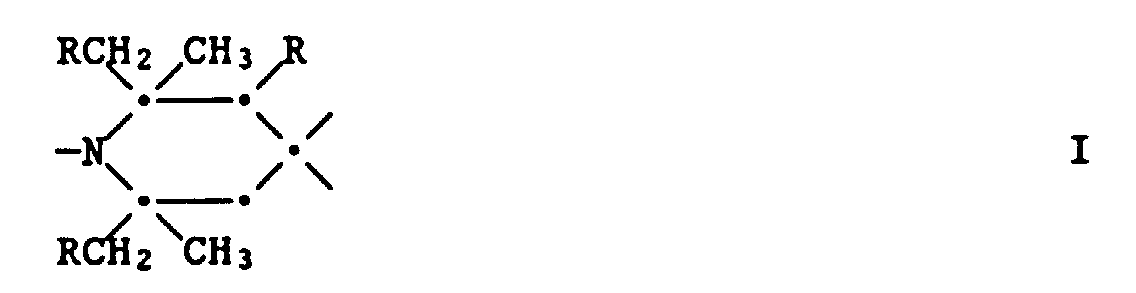
- the sterically hindered amine is a polyalkylpiperidine derivative and contains at least one group of the formula I. wherein R is hydrogen or methyl, and is in particular a derivative of 2,2,6,6-tetramethylpiperidine of the formula I, wherein R is hydrogen.
- R is hydrogen or methyl
- these compounds are preferably substituted with one or two polar groups or a spiro ring system. These compounds can be low molecular weight or oligomeric or polymeric compounds.
- n is a number from 1 to 4, preferably 1 or 2
- R is hydrogen or methyl
- R 11 is hydrogen, oxyl, hydroxyl, C 1 -C 12 alkyl, C 3 -C 8 alkenyl, C 3 -C 8 - Alkynyl, C 7 -C 12 aralkyl, C 1 -C 18 alkoxy, C 5 -C 8 cycloalkoxy, C 7 -C 9 phenylalkoxy, C 1 -C 8 alkanoyl, C 3 -C 5 alkenoyl, C 1 -C 18 alkanoyloxy, benzyloxy, glycidyl or a group -CH 2 CH (OH) -Z, where Z is hydrogen, methyl or phenyl, where R 11 is preferably H, C 1 -C 4 alkyl, allyl , Benzyl, acetyl or acryloyl and R 12 , if n is a number from 1
- any substituents are C 1 -C 12 -alkyl, they are, for example, methyl, ethyl, n-propyl, n-butyl, sec-butyl, tert-butyl, n-hexyl, n-octyl, 2-ethyl-hexyl , n-nonyl, n-decyl, n-undecyl or n-dodecyl.
- R 11 or R 12 can represent, for example, the groups mentioned above and, in addition, for example n-tridecyl, n-tetradecyl, n-hexadecyl or n-octadecyl.
- R 11 is C 3 -C 8 alkenyl, it can be, for example, 1-propenyl, allyl, methallyl, 2-butenyl, 2-pentenyl, 2-hexenyl, 2-octenyl, 4-tert-butyl-2 -butenyl act.
- R 11 as C 3 -C 8 alkynyl is preferably propargyl.
- R 11 is especially phenethyl and especially benzyl.
- R 11 is as C 1 -C 8 alkanoyl, for example formyl, propionyl, butyryl, octanoyl, but preferably acetyl and as C 3 -C 5 alkenoyl, in particular acryloyl.
- R 12 is a monovalent radical of a carboxylic acid, it is, for example, acetic, caproic, stearic, acrylic, methacrylic, benzoic or ⁇ - (3,5-di-tert-butyl-4-hydroxyphenyl) -propionic acid residue.
- R 12 is a divalent residue of a dicarboxylic acid, it represents, for example, malonic, succinic, glutaric, adipic, suberic, sebacic, maleic, itaconic, phthalic, dibutylmalonic, dibenzylmalonic, butyl ( 3,5-di-tert-butyl-4-hydroxybenzyl) -malonic acid or bicycloheptenedicarboxylic acid residue.
- R 12 represents a trivalent carboxylic acid residue, it means, for example, a trimellitic acid, citric acid or nitrilotriacetic acid residue.
- R 12 represents a tetravalent residue of a tetracarboxylic acid, it means, for example, the tetravalent residue of butane-1,2,3,4-tetracarboxylic acid or of pyromellitic acid.
- R 12 is a divalent radical of a dicarbamic acid, it represents, for example, a hexamethylene dicarbamic acid or a 2,4-tolylene dicarbamic acid radical.
- R 13 is hydrogen, C 1 -C 12 alkyl, C 2 -C 5 hydroxyalkyl, C 5 -C 7 cycloalkyl, C 7 -C 8 aralkyl, C 2 -C 18 alkanoyl, C 3 -C 5 alkenoyl, benzoyl or a group of the formula and R 14 when n is 1 is hydrogen, C 1 -C 18 alkyl, C 3 -C 8 alkenyl, C 5 -C 7 cycloalkyl, C 1 substituted with a hydroxy, cyano, alkoxycarbonyl or carbamide group -C 4 alkyl, glycidyl, a group of the formula -CH 2 -CH (OH) -Z or of the formula -CONH-Z, wherein Z is hydrogen, methyl or phenyl; when n is 2, C 2 -C
- any substituents are C 5 -C 7 cycloalkyl, they are in particular cyclohexyl.
- R 13 is in particular phenylethyl or especially benzyl.
- R 13 is in particular 2-hydroxyethyl or 2-hydroxypropyl.
- R 13 as C 2 -C 18 alkanoyl is, for example, propionyl, butyryl, octanoyl, dodecanoyl, hexadecanoyl, octadecanoyl, but preferably acetyl, and as C 3 -C 5 alkenoyl especially acryloyl.
- R 14 is C 2 -C 8 alkenyl, then it is, for example, allyl, methallyl, 2-butenyl, 2-pentenyl, 2-hexenyl or 2-octenyl.
- R 14 as a C 1 -C 4 alkyl substituted by a hydroxyl, cyano, alkoxycarbonyl or carbamide group can, for example, 2-hydroxyethyl, 2-hydroxypropyl, 2-cyanoethyl, methoxycarbonylmethyl, 2-ethoxycarbonylethyl, 2-aminocarbonylpropyl or 2- ( Be dimethylaminocarbonyl) ethyl.
- Any C 2 -C 12 alkylene substituents are, for example, ethylene, propylene, 2,2-dimethylpropylene, tetramethylene, hexamethylene, octamethylene, decamethylene or dodecamethylene.
- Any C 6 -C 15 arylene substituents are, for example, o-, m- or p-phenylene, 1,4-naphthylene or 4,4'-diphenylene.
- D is in particular cyclohexylene.
- n is the number 1 or 2
- R and R 11 have the meaning given under a) and R 15 , if n is 1, C 2 -C 8 alkylene or hydroxyalkylene or C 4 -C 22 acyloxyalkylene, if n 2, the group means (-CH 2 ) 2 C (CH 2 -) 2 .
- R 15 is C 2 -C 8 -alkylene or -hydroxyalkylene, it is, for example, ethylene, 1-methyl-ethylene, propylene, 2-ethyl-propylene or 2-ethyl-2-hydroxymethylpropylene.
- R 15 means, for example, 2-ethyl-2-acetoxymethylpropylene.
- R 16 is hydrogen, C 1 -C 12 alkyl, allyl, benzyl, glycidyl or C 2 -C 6 alkoxyalkyl and R 17 , when n is 1, hydrogen, C 1 -C 12 alkyl, C 3 -C 5 alkenyl, C 7 -C 9 aralkyl, C 5 -C 7 cycloalkyl, C 2 -C 4 hydroxyalkyl, C 2 - C 6 alkoxyalkyl, C 6 -C 10 aryl, glycidyl or a group of the formula - (CH 2 ) p -COO-Q or of the formula - (CH 2 ) p -O-CO-Q, wherein p is 1 or 2 and QC 1 -C 4 alkyl or phenyl, if n is 2, C 2
- any substituents are C 1 -C 12 -alkyl, they are, for example, methyl, ethyl, n-propyl, n-butyl, sec-butyl, tert-butyl, n-hexyl, n-octyl, 2-ethyl-hexyl , n-nonyl, n-decyl, n-undecyl or n-dodecyl.
- C 1 -C 18 alkyl can represent, for example, the groups mentioned above and, for example, n-tridecyl, n-tetradecyl, n-hexadecyl or n-octadecyl.
- any substituents are C 2 -C 6 -alkoxyalkyl, they are, for example, methoxymethyl, ethoxymethyl, propoxymethyl, tert-butoxymethyl, ethoxyethyl, ethoxypropyl, n-butoxyethyl, tert-butoxyethyl, isopropoxyethyl or propoxypropyl.
- R 17 is C 3 -C 5 alkenyl, it means, for example, 1-propenyl, allyl, methallyl, 2-butenyl or 2-pentenyl.
- R 17 , T 1 and T 2 are in particular phenethyl or especially benzyl. If T 1 and T 2 form a cycloalkane ring together with the C atom, this can be, for example, a cyclopentane, cyclohexane, cyclooctane or cyclododecane ring. If R 17 is C 2 -C 4 -hydroxyalkyl, it is, for example, 2-hydroxyethyl, 2-hydroxypropyl, 2-hydroxybutyl or 4-hydroxybutyl.
- R 17 , T 1 and T 2 are in particular phenyl, ⁇ - or B-naphthyl, which are optionally substituted by halogen or C 1 -C 4 alkyl.
- R 17 is C 2 -C 12 alkylene, it is, for example, ethylene, propylene, 2,2-dimethylpropylene, tetramethylene, hexamethylene, octamethylene, decamethylene or dodecamethylene.
- R 17 is in particular 2-butenylene, 2-pentenylene or 3-hexenylene.
- R 17 is C 6 -C 12 arylene, it is, for example, o-, m- or p-phenylene, 1,4-naphthylene or 4,4'-diphenylene.
- Z ' is C 2 -C 12 alkanoyl, it is, for example, propionyl, butyryl, octanoyl, dodecanoyl, but preferably acetyl.
- C 2 -C 10 alkylene, C 6 -C 15 arylene or C 6 -C 12 cycloalkylene has the meaning given under b).
- n is the number 1 or 2 and R 18 is a group of the formula means in which R and R 11 have the meaning given under a)
- E is -O- or -NR 21 -, AC 2 -C 6 -alkylene or - (CH 2 ) 3 -O- and x is the number 0 or 1 mean
- R 19 is R 18 or one of the groups -NR 21 R 22 , -OR 23 , -NHCH 2 OR 23 or -N (CH 2 OR 23 ) 2
- any substituents are C 1 -C 12 -alkyl, they are, for example, ethyl, ethyl, n-propyl, n-butyl, sec-butyl, tert-butyl, n-hexyl, n-octyl, 2-ethylhexyl, n -Nonyl, n-decyl, n-undecyl or n-dodecyl.
- substituents are C 1 -C 4 -hydroxyalkyl, they are, for example, 2-hydroxyethyl, 2-hydroxypropyl, 3-hydroxypropyl, 2-hydroxybutyl or 4-hydroxybutyl.
- AC 2 -C 6 denotes alkylene, it represents, for example, ethylene, propylene, 2,2-dimethylpropylene, tetramethylene or hexamethylene.
- R 21 and R 22 together represent C 4 -C 5 alkylene or oxaalkylene, this means, for example, tetramethylene, pentamethylene or 3-oxapentamethylene.
- R 18 and R 19 are preferred are a group mean where R 11 is hydrogen or methyl and R 21 is hydrogen or C 1 -C 6 alkyl, and R 20 is the tetravalent radical of an aliphatic tetramine.
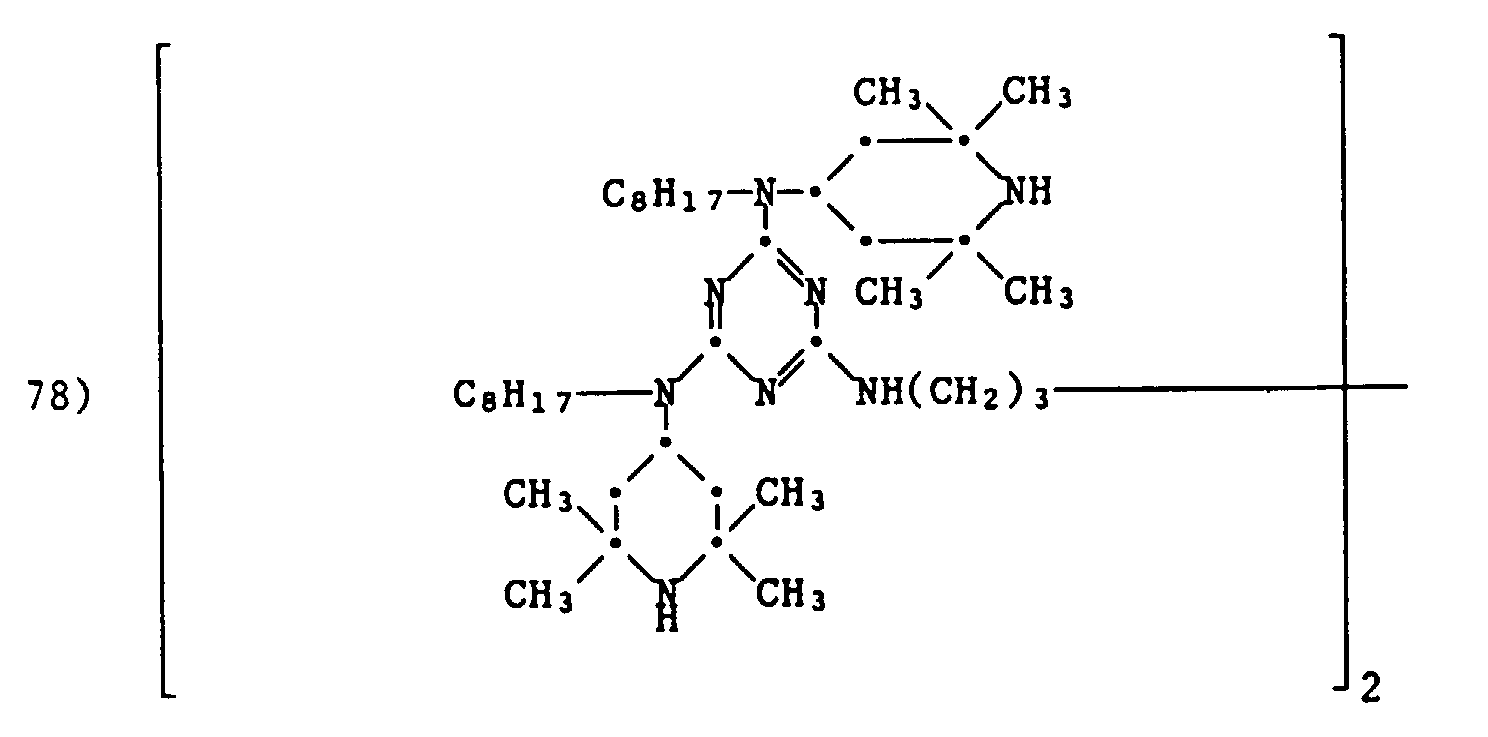
- class e) polyalkylpiperidine compounds are the compounds of the following formulas:
- oligomers or polymeric compounds whose recurring structural unit contains a polyalkylpiperidine radical of the formula (I), in particular polyesters, polyethers, polyamides, polyamines, polyurethanes, polyureas, polyaminotriazines, poly (meth) acrylates, poly (meth) acrylamides and their copolymers, the contain such residues.
- polyesters and polyaminotriazines are preferred.
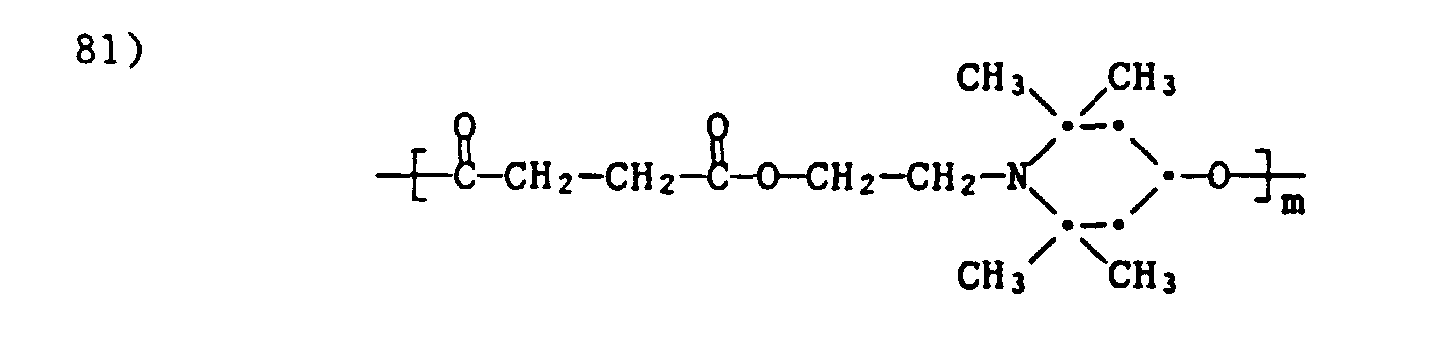
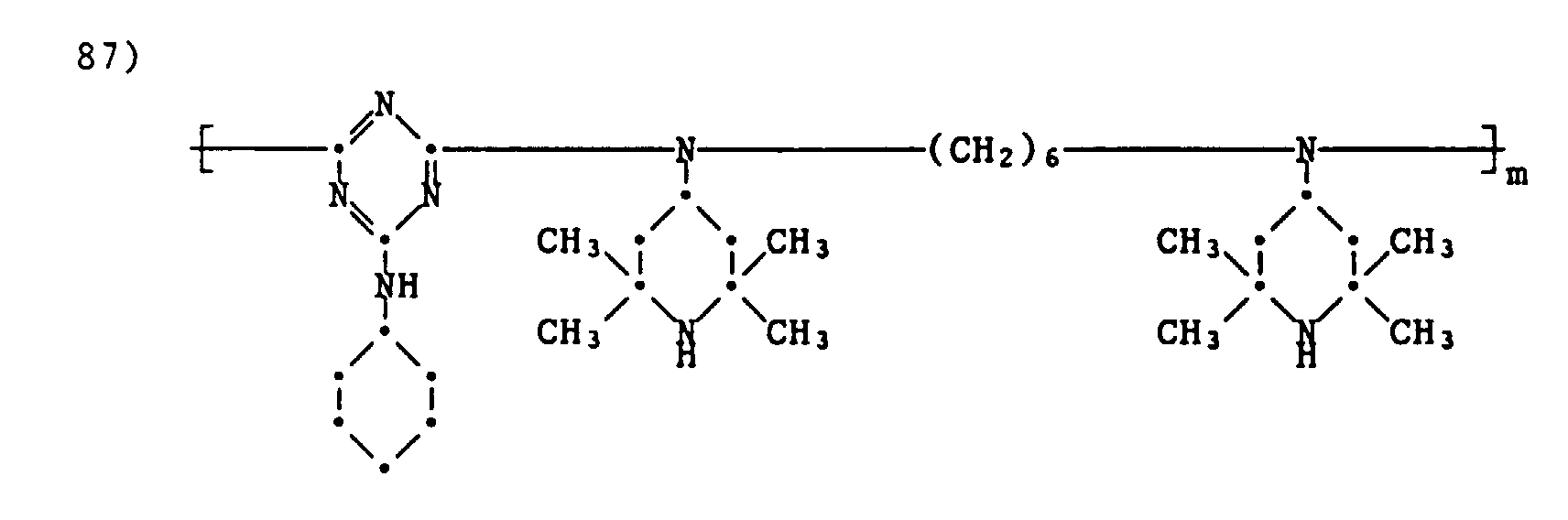
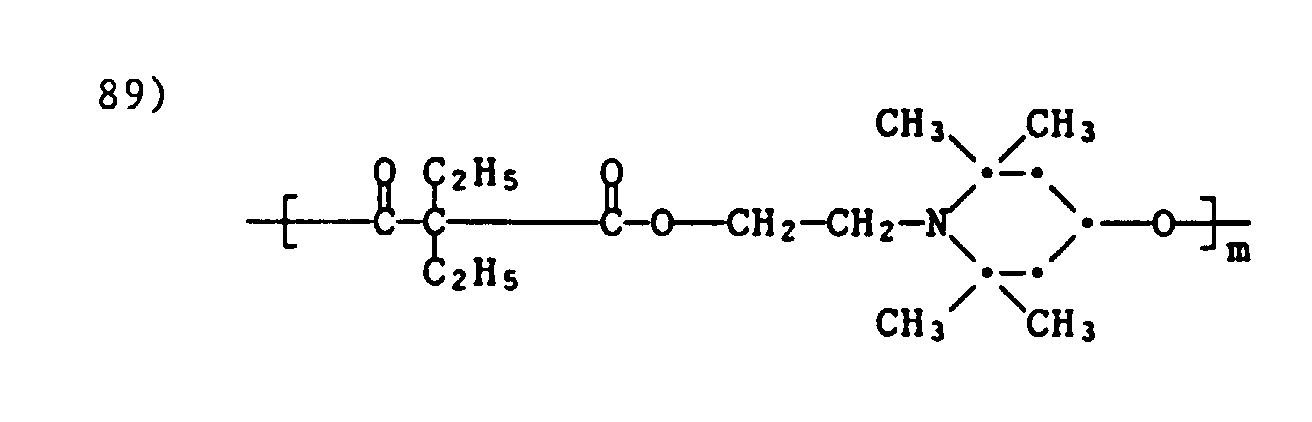
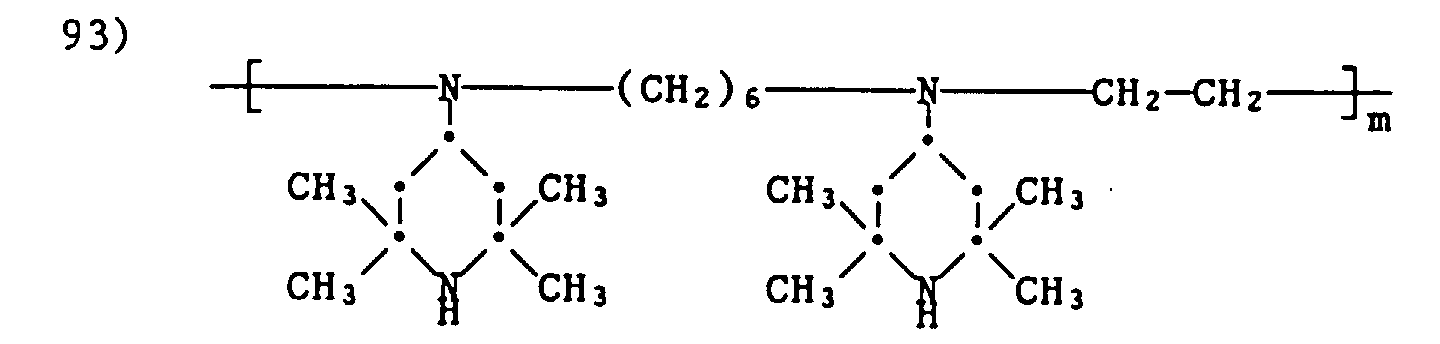
- 2,2,6,6-polyalkylpiperidine light stabilizers of this class are the compounds of the following formulas, where m is a number from 2 to about 200.
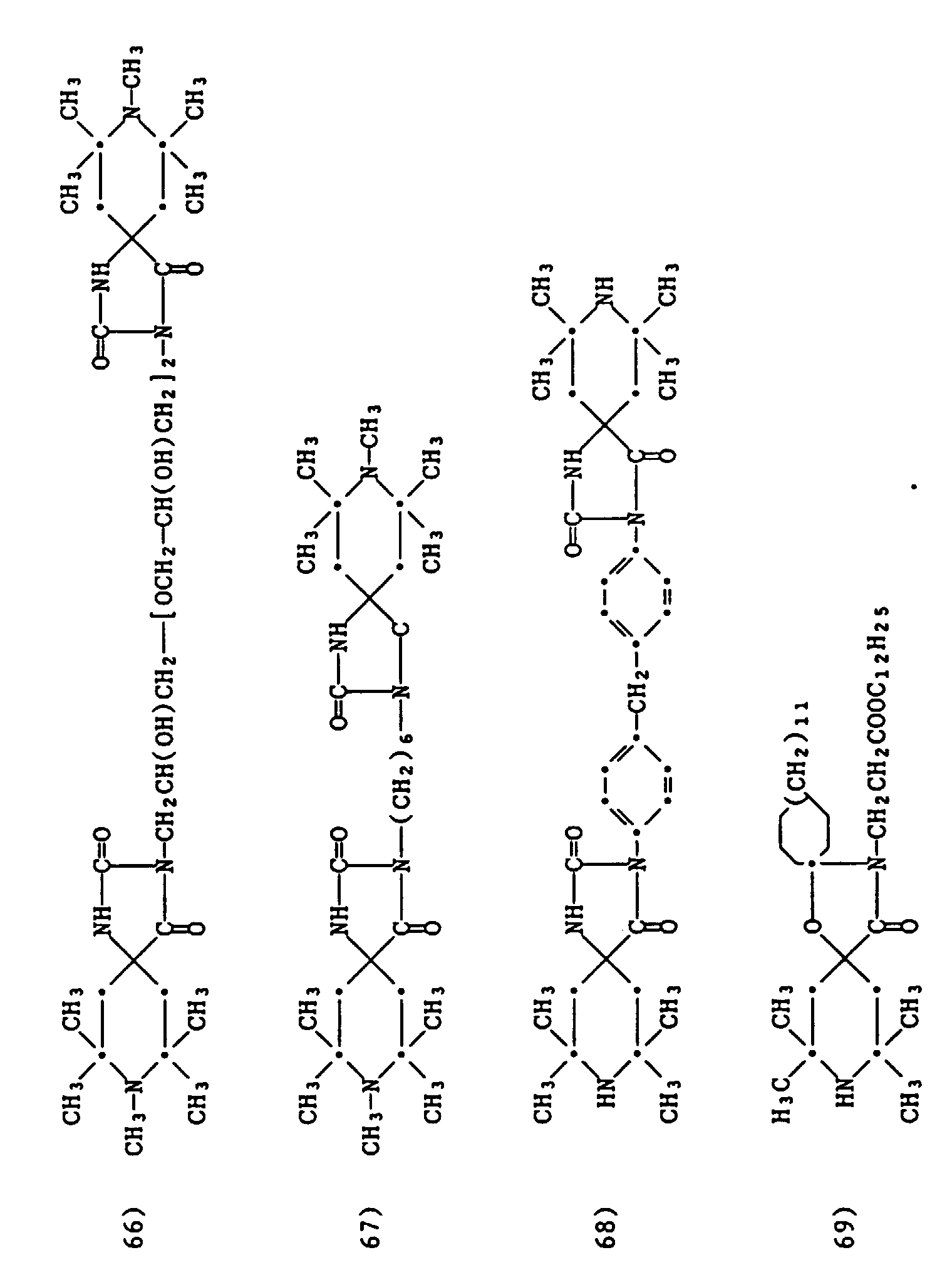
- classes a), d), e) and f) are particularly preferred, in particular compounds 10, 13, 14, 23, 24, 28, 29, 63, 65, 75, 77, 81, 84 and 92 .
- hindered amines are known compounds, many of which are commercially available. Two different sterically hindered amines can also be used, for example one of low and one of higher molecular weight, as described in US-A-4,692,486.
- the zinc compound used as component c) can be an organic zinc compound, for example the zinc salt of a carboxylic acid, sulfonic acid, Phosphonic acid, phosphorous acid or phosphinic acid or the zinc salt of a phenol or a zinc chelate, such as the enolate of a 1,3-diketo compound.
- Component c) can also be an inorganic zinc compound, for example an oxide, hydroxide, carbonate, basic carbonate, phosphate, phosphite, sulfate, chloride, fluoride or hypophosphite.
- the carboxylic acid can be a saturated or unsaturated aliphatic or cycloaliphatic carboxylic acid or an aromatic or aromatic-aliphatic carboxylic acid. Amine acids and their derivatives are also suitable.
- Examples of these are formic acid, acetic acid, propionic acid, butyric acid, caproic acid, 2-ethylhexanoic acid, caprylic acid, lauric acid, myristic acid, oenanthic acid, neodecanoic acid, palmitic acid, stearic acid, isostearic acid, 12-hydroxystearic acid, oleic acid, behenic acid, montanic acid, benzoic acid, benzoic acid .
- Zinc salts of long chain ⁇ -aminocarboxylic acids and N-acylamino acids, e.g. N-stearoyl-glycine are suitable for this.
- C 6 -C 18 phenols are phenol, cresol, xylenol, 4-tert. Butylphenol, 4-nonylphenol, 4-dodecylphenol, 4-chlorophenol or 2-hydroxydiphenyl.
- the C 5 -C 30 -1,3-diketones are described by Formula VII (see below). Examples include acetylacetone, butanoylacetone, benzoyl-6-hydroxy-hexamoylmethane, stearoylacetone, lauroylacetone, benzoylacetone, dibenzoylmethane, lauroyl-benzoylmethane. Stearoyl benzoyl methane or bis (4-methylbenzoyl) methane.
- the zinc salt of a C 7 -C 20 carboxylic acid is preferred.
- Mixtures of zinc compounds can also be used, for example the zinc salts of technical carboxylic acid mixtures or technical alkylphenol mixtures.
- Zinc stearate, zinc laurate, zinc oleate, zinc 2-ethylhexanoate and zinc neodecanoate are particularly preferred.
- R 1 and R 3 as alkyl can in particular be C 1 -C 18 alkyl, such as methyl, ethyl, n-propyl, isopropyl, n-butyl, tert. Butyl, pentyl, hexyl, heptyl, octyl, decyl, dodecyl or octadecyl.
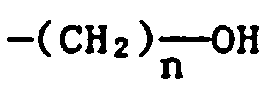
- R 1 and R 3 as hydroxyalkyl represent in particular one group where n is 5, 6 or 7.
- R 1 and R 3 as alkenyl can mean, for example, vinyl, allyl, methallyl, 1-butenyl, 1-hexenyl or oleyl, preferably allyl.
- R 1 and R 3 as phenyl substituted by OH, alkyl, alkoxy or halogen can, for example, tolyl, xylyl, tert. Butylphenyl, methoxyphenyl, ethoxyphenyl, hydroxyphenyl, chlorophenyl or dichlorophenyl.
- R 1 and R 3 as phenylalkyl are in particular benzyl.
- R 2 and R 3 as cycloalkyl or alkyl-cycloalkyl are in particular cyclohexyl or methylcyclohexyl.
- R 2 as alkyl can in particular be C 1 -C 4 alkyl.
- R 2 as C 2 -C 12 alkenyl can in particular be allyl.
- R 2 as alkylphenyl can in particular be tolyl.
- R 2 as phenylalkyl can in particular be benzyl.
- R 2 is preferably hydrogen.
- R 3 as alkoxy can be, for example, methoxy, ethoxy, butoxy, hexyloxy, octyloxy, dodecyloxy, tridecyloxy, tetradecyloxy or octadecyloxy.
- R 5 as C 1 -C 10 alkylene is in particular C 2 -C 4 alkylene.
- R 6 as alkyl is in particular C 4 -C 12 alkyl, such as butyl, hexyl, octyl, decyl or dodecyl.
- R 6 as alkylphenyl is especially tolyl.
- R 6 as phenylalkyl is in particular benzyl.
- 1,3-dicarbonyl compounds of formula VII are acetylacetone, butanoylacetone, heptanoylacetone, stearoylacetone, palmitoylacetone, lauroylacetone, 7-tert.nonylthio-heptanedione-2,4, benzoylacetone, dibenzoylmethane, lauroylbenzoylmethane, palmitoyl-benzoylmethane-benzoylmethane -hexanoylmethane, stearoylbenzoylmethane, 5-hydroxycapronylbenzoylmethane, tribenzoylmethane, bis (4-methylbenzoyl) methane, benzoyl-p-chlorobenzoylmethane, bis (2-hydroxybenzoyl) methane, 4-methoxybenzoyl-benzoylmethane, bis ( , 1-Benzoyl-1-acetylnonan
- component d) are compounds of the formula VII in which R 1 is C 1 -C 18 alkyl, C 2 -C 18 oxaalkyl, C 2 -C 18 thiaalkyl, phenyl, phenyl substituted by OH, methyl or methoxy, C 7 -C 10 phenylalkyl or cyclohexyl, R 2 is hydrogen and R 3 has one of the meanings given for R 1 .
- compositions according to the invention preferably contain 0.01 to 3 parts by weight of component (b) and 0.02 to 4 parts by weight of component (c), in particular 0.1, to 100 parts by weight of component (a) to 2 parts by weight of component (b) and 0.1 to 2 parts by weight of component (c).
- composition also contains a 1,3-dicarbonyl compound as component (d), it preferably contains 0.05 to 1 part by weight, in particular 0.1 to 0.5, per 100 parts by weight of component (a) Parts by weight of component (d). If this 1,3-dicarbonyl compound is present in part as zinc chelate, the amount used is 0.1 to 2.5 parts by weight.
- composition can contain further additives as are known and customary for the processing and stabilization of chlorine-containing polymers.
- additives e.g. Plasticizers, phosphites, metal-free PVC stabilizers, impact modifiers, heat resistance improvers, epoxy compounds, antioxidants, UV absorbers and light stabilizers, pigments, dyes, fillers, solvents, lubricants or flame retardants.
- the composition contains no metal carboxylates, as are often used to stabilize chlorine-containing polymers, such as, for example, carboxylic acid salts of calcium, magnesium, barium, cadmium or lead, or organotin compounds.
- the composition may contain chelates of the metals calcium, magnesium and barium. These chelates are preferably derived from 1,3-diketones of the formula VII. The acetylacetonates of calcium, magnesium and barium are particularly preferred.
- the amounts used per 100 parts by weight of component a) are between 0.05 and 3, in particular between 0.1 and 2 parts by weight.
- plasticizers are the esters of phthalic acid, adipic, azelaic, sebacic or trimellitic acid, polyesters from aliphatic diols and dicarboxylic acids, phosphoric acid esters, chlorinated paraffins or epoxidized fatty acid esters. Further examples may be found in the "Taschenbuch der Kunststoff-Additive", R. Gumbleter, H. Müller, Hanser-Verlag 1983, pages 280-307. The plasticizers can be used in an amount of 15 to 100 parts by weight based on 100 parts by weight of the chlorine-containing polymer.
- Organic phosphites are known costabilizers for chlorine-containing polymers stabilized with metal carboxylates, in particular in combination with zinc, barium or cadmium stabilizers.
- phosphites are trioctyl, tridecyl, tridodecyl phosphite, decyl diphenyl phosphite, triphenyl phosphite, phenyl didecyl phosphite, tris (nonylphenyl) phosphite, trilauryl phosphite, trioctadecyl phosphite, distearyl-pentaerythritol diphyldiphyl diphyllophosphite (dodecyl) phosphite, tris (2,4-di-tert.butylphenyl) phosphite, diisodecylpentaerythritol diphos
- Metal-free stabilizers for chlorine-containing polymers are e.g. aliphatic polyols, such as pentaerythritol, dipentaerythritol, trimethylolpropane, tris (2-hydroxyethyl) isocyanurate, sorbitol, mannitol or furan; Aminocrotonic acid esters; Mercaptobenzoic acid esters; Dehydroacetic acid; 2,4-dihydroxybenzophenone; Enol carbonates as described in EP-A-224 438; aromatic amides as described in EP-A-122 228 and 174 412; and nitrogen-containing heterocycles, as described in EP-A-2007, 22087, 22749, 41479, 65934, 260 226, 354 179, DE-A-3 048 659, 3 124 853, GB-A-2 170 203 and US-A-4 908 398. Also mercaptobenzoic acid esters such as Thiosalicy
- Impact modifiers are, for example, polyacrylates, ethylene-vinyl acetate copolymers or chlorinated polyethylene.
- Heat resistance improver are, for example, poly (meth) acrylates, acrylate-N-methyl-maleimide copolymers or acrylonitrile-methylstyrene copolymers.
- Epoxy compounds are also known costabilizers for chlorine-containing polymers. With a suitable structure, they can also act as plasticizers at the same time.
- Examples of epoxy stabilizers are epoxidized polybutadiene, epoxidized soybean oil, epoxidized linseed oil, epoxidized fish oil, epoxidized tallow, ethylbutyl or 2-ethylhexylepoxystearate, tris (epoxyropyl) isocyanurate, epoxidized castor oil, epoxidized sunflower oil, 3-, 2-phenoxy oil, 3-, 2-phenoxy oil.
- 2-epoxypropane bisphenol A polyglycidyl ether, vinyl cyclohexene diepoxide, dicyclopentadiene diepoxide or 3,4-epoxycyclohexylmethyl-3,4-epoxycyclohexane carboxylate.
- an epoxy compound in particular epoxidized soybean oil, is a preferred embodiment of the present invention.
- the pigments used can be inorganic or organic pigments, they can also be metallic pigments.
- Fillers are e.g. Chalk, carbon black, graphite, talc, kaolin or silicate minerals. However, the compositions according to the invention contain no hydrotalcite compounds.
- Lubricants are mainly fatty acids and their, esters and amides, fatty alcohols, paraffins and polyethylene waxes. Flame retardants are primarily antimony oxide, aromatic bromine compounds and phosphoric acid esters.
- compositions according to the invention can be produced in a manner known per se.
- the stabilizer system is incorporated into the polymer, for which purpose a number of known devices, such as calenders, mixers, kneaders and the like, exist.
- compositions stabilized according to the present invention can be brought into the desired shape in a known manner.
- Such processes are, for example, calendering, extruding, injection molding, sintering or spinning, furthermore extrusion blowing or processing according to the plastisol process.
- compositions according to the invention are particularly suitable in the form of hard formulations for hollow bodies (bottles), packaging films (thermoformed films), blown films, crash pad films (automobiles), pipes, heavy profiles (window frames), light wall profiles, building profiles, sidings, fittings, office films and Apparatus housing (computers, household appliances).
- compositions in the form of soft formulations are suitable for wire jackets, cable insulation, decorative films, roofing films, agricultural films, hoses, sealing profiles, office films and films for air-inflated halls.
- compositions according to the invention are synthetic leather, floors, textile coatings, wallpapers, coil coatings and underbody protection for motor vehicles.
- Examples of sintered PVC applications of the compositions according to the invention are slush, slush mold and coil coatings.
- the ingredients are homogenized for 5 minutes at 180 ° C on a mixing roller to form a 0.3 mm thick film. Test strips are cut from the film and heated to 180 ° C in a test oven (Mathis Thermotester® LTF-ST). The discoloration that occurs is measured at regular time intervals in accordance with ASTMD 1925-70 as a yellowness index. The higher this index, the stronger the discoloration.
- the basic recipe is the same as in Example 2, but different stabilizer combinations are used.
- the samples are prepared and tested as described in Example 1.
- the results are shown in Table 3.
- Table 4 Hindered amine *) Zn connection *) Diketone *) Yellowness index after 0 5 10th 20th 30 min - - - 18th 24th 76 - - 0.3 H-3 - - 14 28 92 - - 0.3 H-3 0.25 Zn-1 - 2nd 4th 7 22 70 0.3 H-3 0.25 Zn-1 0.3 D-1 0.5 1 2nd 5 56 0.3 H-3 0.35 Zn-1 - 1.5 4th 5 11 26 0.3 H-2 0.35 Zn-1 0.3 D-1 0.8 1 1 5 26 *) Parts per 100 parts PVC
- the basic recipe is the same as in Example 3, but different stabilizer combinations are used.
- the samples are prepared and tested as described in Example 1.
- the results are shown in Table 5.
- Table 5 Hindered amine *) Zn connection *) Yellowness index after 0 5 10th 20th 30th 40 50 60 min 0.3 H-1 0.35 Zn-1 8th 15 26 32 50 - - - 0.6 H-1 0.7 Zn-1 7 12th 15 24th 36 55 1.2 H-1 1.4 Zn-1 8th 12th 16 28 37 47 57 70 0.3 H-2 0.35 Zn-1 5 12th 15 64 - - - 0.6 H-2 0.7 Zn-1 4th 6 10th 49 86 - - - 1.2 H-2 1.4 Zn-1 5 6 9 23 68 90 - - *) Parts per 100 parts PVC
- a hard PVC composition is prepared from 100 parts of suspension PVC with a K value of 60 (Corvic® S 60/104) and 3 parts of an epoxidized soybean oil (Reoplast® 39). In addition, there are the stabilizers specified in Table 6. The homogenization takes place on the mixing roller at 190 ° C / 5 min to form a 0.3 mm thick film. The samples are tested as described in Example 1.
Landscapes
- Chemical & Material Sciences (AREA)
- Health & Medical Sciences (AREA)
- Chemical Kinetics & Catalysis (AREA)
- Medicinal Chemistry (AREA)
- Polymers & Plastics (AREA)
- Organic Chemistry (AREA)
- Compositions Of Macromolecular Compounds (AREA)
Description
- Die Erfindung betrifft stabilisierte chlorhaltige Polymerzusammensetzungen enthaltend ein sterisch gehindertes Amin in Kombination mit einer Zinkverbindung.
- Es ist bekannt, dass sterisch gehinderte Amine, beispielsweise Derivate des 2,2,6,6-Tetramethylpiperidins, ausgezeichnete Stabilisatoren für Polymere gegen Schädigung durch kurzwelliges Licht sind. In Polyvinylchlorid oder anderen chlorhaltigen Polymeren führt der Zusatz solcher sterisch gehinderter Amine jedoch zu Verfärbungen während der thermoplastischen Verarbeitung oder im Gebrauch. Erst durch Zusatz von Costabilisatoren gelingt es, diese Verfärbungen zu verhindern oder zu vermindern.
- So sind in der JP-A-82/168933 Folien aus weichgemachtem Polyvinylchlorid beschrieben, die mit einem sterisch gehinderten Amin und einem UV-Absorber gegen Licht geschützt sind und als Costabilisatoren Zinkstearat, Bariumstearat und epoxydiertes Soyaöl enthalten. In der JP-A-86/163965 wird die Stabilisierung von PVC mit einem sterisch gehinderten Amin und einem Ca/Zn-Stabilisator oder einer Organozinnverbindung beschrieben.
- In der JP-A-88/178155 wird ebenfalls die Stabilisierung von PVC mit einem gehinderten Amin und Calciumstearat, Zinkstearat und einer Organozinnverbindung beschrieben. In der EP-A-237 485 wird die Kombination von sterisch gehinderten Aminen mit Organozinn-Stabilisatoren zur Stabilisierung von Hart-PVC empfohlen, wobei als weitere Zusätze Titandioxid und Calciumstearat verwendet werden können.
- In der EP-A-421 933 wird die Kombination von sterisch gehinderten Aminen mit Zinkverbindungen und einem Hydrotalcit zur Stabilisierung chlorhaltiger Polymere vorgeschlagen, wobei als weitere Zusätze 1,3-Diketone und Calciumverbindungen verwendet werden können.
- In der EP-A-432 096 wird die Kombination von sterisch gehinderten Aminen mit Zinkverbindungen und einem Treibmittel oder Schäumungsmittel vorgeschlagen, wobei zusätzlich auch Calciumverbindungen und 1,3-Diketone verwendet werden können.
- Es wurde nunmehr gefunden, dass Kombinationen von sterisch gehinderten Aminen mit Zinkverbindungen auch ohne eine zweite Metallverbindung und ohne Hydrotalcit und ohne Treibmittel sehr gute Thermostabilität liefern.
- Die Erfindung betrifft daher eine stabilisierte chlorhaltige Polymerzusammensetzung, enthaltend
- a) mindestens ein chlorhaltiges Polymer,
- b) mindestens ein sterisch gehindertes Amin und
- c) mindestens eine organische oder anorganische Zinkverbindung in Abwesenheit einer organischen Metallverbindung, die Carboxylat ist, in Abwesenheit einer Verbindung aus der Reihe der Hydrotalcite und in Abwesenheit eines Treibmittels oder Schäumungsmittels, sowie ein Verfahren zum Stabilisieren von chlorhaltigen Polymeren gegen Schädigung durch Wärme und licht durch Zusatz von b) und c), gegebenenfalls mit weiteren Zusatzstoffen.
- Bevorzugt enthält die Polymerzusammensetzung ausserdem
d) mindestens eine 1,3-Dicarbonylverbindung. Diese 1,3-Dicarbonylverbindung kann auch als Chelat der zweiwertigen Metalle Zink, Calcium, Magnesium oder Barium vorliegen. - Das chlorhaltige Polymer kann z.B. ein Homopolymer bzw. Copolymer des Vinylchlorids oder des Vinylidenchlorids sein oder ein nachchloriertes Polymer bzw. Copolymer des Vinylchlorids oder des Vinylidenchlorids, ein chloriertes Polyolefin, wie z.B. ein chloriertes Polyethylen, ein chloriertes Polymer bzw. Copolymer des Styrols oder des Butadiens oder ein chlorierter Kautschuk oder ein Kautschuk-Hydrochlorid, sowie eine Mischung eines solchen chlorhaltigen Polymers mit einem anderen anderen chlorhaltigen oder chlorfreien Polymeren. Bevorzugt ist das chlorhaltige Polymer ein Polyvinylchlorid oder ein mindestens 80 % Vinylchlorid enthaltendes Copolymer oder eine Mischung (Polyblend) eines solchen Polymers mit einem anderen chlorhaltigen oder chlorfreien Polymeren. Das chlorhaltige Polymer kann ein Emulsions-, Suspensions-oder Massepolymerisat sein.
- Das sterisch gehinderte Amin ist ein Polyalkylpiperidinderivat und enthält mindestens eine Gruppe der Formel I
- Von Bedeutung sind insbesondere die folgenden Klassen von Polyalkylpiperidinen.
- a) Verbindungen der Formel II,
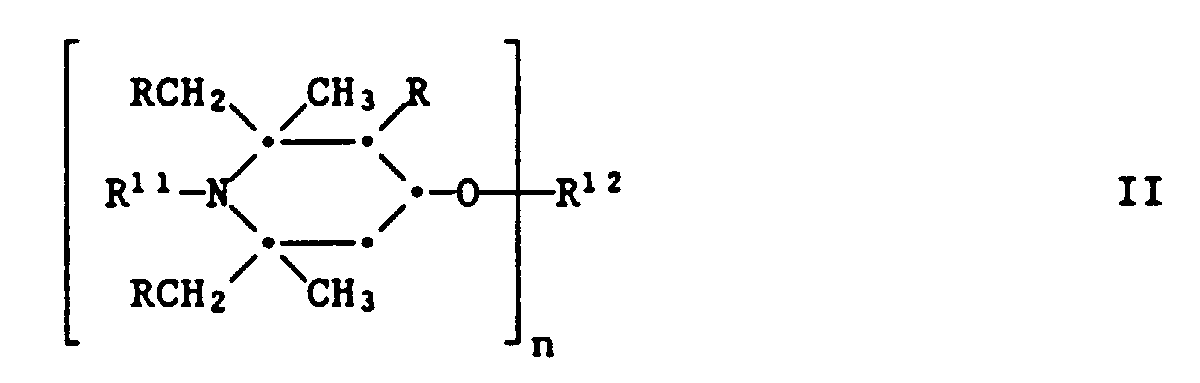
- Bedeuten etwaige Substituenten C1-C12-Alkyl, so stellen sie z.B. Methyl, Ethyl, n-Propyl, n-Butyl, sek.-Butyl, tert.-Butyl, n-Hexyl, n-Octyl, 2-Ethyl-hexyl, n-Nonyl, n-Decyl, n-Undecyl oder n-Dodecyl dar.
- In der Bedeutung von C1-C18-Alkyl kann R11 oder R12 z.B. die oben angeführten Gruppen und dazu noch beispielsweise n-Tridecyl, n-Tetradecyl, n-Hexadecyl oder n-Octadecyl darstellen.
- Wenn R11 C3-C8-Alkenyl bedeutet, so kann es sich z.B. um 1-Propenyl, Allyl, Methallyl, 2-Butenyl, 2-Pentenyl, 2-Hexenyl, 2-Octenyl, 4-tert.-Butyl-2-butenyl handeln.
- R11 ist als C3-C8-Alkinyl bevorzugt Propargyl.
- Als C7-C12-Aralkyl ist R11 insbesondere Phenethyl und vor allem Benzyl.
- R11 ist als C1-C8-Alkanoyl beispielsweise Formyl, Propionyl, Butyryl, Octanoyl, aber bevorzugt Acetyl und als C3-C5-Alkenoyl insbesondere Acryloyl.
- Bedeutet R12 einen einwertigen Rest einer Carbonsäure, so stellt es beispielsweise einen Essigsäure-, Capronsäure-, Stearinsäure-, Acrylsäure-, Methacrylsäure-, Benzoe- oder β-(3,5-Di-tert.-butyl-4-hydroxyphenyl)-propionsäurerest dar.
- Bedeutet R12 einen zweiwertigen Rest einer Dicarbonsäure, so stellt es beispielsweise einen Malonsäure-, Bernsteinsäure-, Glutarsäure-, Adipinsäure-, Korksäure-, Sebacinsäure-, Maleinsäure-, Itaconsäure-, Phthalsäure-, Dibutylmalonsäure-, Dibenzylmalonsäure-, Butyl-(3,5-di-tert.-butyl-4-hydroxybenzyl)-malonsäure- oder Bicycloheptendicarbonsäurerest dar.
- Stellt R12 einen dreiwertigen Rest einer Tricarbonsäure dar, so bedeutet es z.B. einen Trimellitsäure-, Citronensäure- oder Nitrilotriessigsäurerest.
- Stellt R12 einen vierwertigen Rest einer Tetracarbonsäure dar, so bedeutet es z.B. den vierwertigen Rest von Butan-1,2,3,4-tetracarbonsäure oder von Pyromellitsäure.
- Bedeutet R12 einen zweiwertigen Rest einer Dicarbaminsäure, so stellt es beispielsweise einen Hexamethylendicarbaminsäure- oder einen 2,4-Toluylen-dicarbaminsäurerest dar.
- Bevorzugt sind Verbindungen der Formel II, worin R Wasserstoff ist, R11 Wasserstoff oder Methyl ist, n 2 ist und R12 der Diacylrest einer aliphatischen Dicarbonsäure mit 4-12 C-Atomen ist.
- Beispiele für Polyalkylpiperidin-Verbindungen dieser Klasse sind folgende Verbindungen:
- 1) 4-Hydroxy-2,2,6,6-tetramethylpiperidin
- 2) 1-Allyl-4-hydroxy-2,2,6,6-tetramethylpiperidin
- 3) 1-Benzyl-4-hydroxy-2,2,6,6-tetramethylpiperidin
- 4) 1-(4-tert.-Butyl-2-butenyl)-4-hydroxy-2,2,6,6-tetramethylpiperidin
- 5) 4-Stearoyloxy-2,2,6,6-tetramethylpiperidin
- 6) 1-Ethyl-4-salicyloyloxy-2,2,6,6-tetramethylpiperidin
- 7) 4-Methacryloyloxy-1,2,2,6,6-pentamethylpiperidin
- 8) 1,2,2,6,6-Pentamethylpiperidin-4-yl-β-(3,5-di-tert.-butyl-4-hydroxyphenyl)-propionat
- 9) Di-(1-benzyl-2,2,6,6-tetramethylpiperidin-4-yl)-maleinat
- 10) Di-(2,2,6,6-tetramethylpiperidin-4-yl)-succinat
- 11) Di-(2,2,6,6-tetramethylpiperidin-4-yl)-glutarat
- 12) Di-(2,2,6,6-tetramethylpiperidin-4-yl)-adipat
- 13) Di-(2,2,6,6-tetramethylpiperidin-4-yl)-sebacat
- 14) Di-(1,2,2,6,6-pentamethylpiperidin-4-yl)-sebacat
- 15) Di-(1,2,3,6-tetramethyl-2,6-diethyl-piperidin-4-yl)-sebacat
- 16) Di-(1-allyl-2,2,6,6-tetramethylpiperidin-4-yl)-phthalat
- 17) 1-Hydroxy-4-β-cyanoethyloxy-2,2,6,6-tetramethylpiperidin
- 18) 1-Acetyl-2,2,6,6-tetramethylpiperidin-4-yl-acetat
- 19) Trimellithsäure-tri-(2,2,6,6-tetramethylpiperidin-4-yl)-ester
- 20) 1-Acryloyl-4-benzyloxy-2,2,6,6-tetramethylpiperidin
- 21) Diethylmalonsäure-di(2,2,6,6-tetramethylpiperidin-4-yl)-ester
- 22) Dibutyl-malonsäure-di-(1,2,2,6,6-pentamethylpiperidin-4-yl)-ester
- 23) Butyl-(3,5-di-tert.-butyl-4-hydroxybenzyl)-malonsäure-di-(1,2,2,6,6-pentamethylpiperidin-4-yl)-ester
- 24) Di-(1-octyloxy-2,2,6,6-tetramethylpiperidin-4-yl)-sebacat
- 25) Di-(1-cyclohexyloxy-2,2,6,6-tetramethylpiperidin-4-yl)-sebacat
- 26) Hexan-1',6'-bis-(4-carbamoyloxy-1-n-butyl-2,2,6,6-tetramethylpiperidin)
- 27) Toluol-2',4'-bis-(4-carbamoyloxy-1-n-propyl-2,2,6,6-tetramethylpiperidin)
- 28) Tetra-(2,2,6,6-tetramethylpiperidin-4-yl)-butantetracarboxylat
- 29) Tetra-(1,2,2,6,6-pentamethylpiperidin-4-yl)-butantetracarboxylat
- 30) Tris-(1-propyl-2,2,6,6-tetramethylpiperidin-4-yl)-phosphit
- 31) Tris-(1-propyl-2,2,6,6-tetramethylpiperidin-4-yl)phosphat
- 32) Phenyl-[bis-(1,2,2,6,6-pentamethylpiperidin-4-yl)]-phosphonat
- 33) 4-Hydroxy-1,2,2,6,6-pentamethylpiperidin
- 34) 4-Hydroxy-N-hydroxyethyl-2,2,6,6-tetramethylpiperidin
- 35) 4-Hydroxy-N-(2-hydroxypropyl)-2,2,6,6-tetramethylpiperidin
- 36) 1-Glycidyl-4-hydroxy-2,2,6,6-tetramethylpiperidin
- b) Verbindungen der Formel III,


- Stellen etwaige Substituenten C1-C12- oder C1-C18-Alkyl dar, so haben sie die bereits unter a) angegebene Bedeutung.
- Bedeuten etwaige Substituenten C5-C7-Cycloalkyl, so stellen sie insbesondere Cyclohexyl dar.
- Als C7-C8-Aralkyl ist R13 insbesondere Phenylethyl oder vor allem Benzyl. Als C2-C5-Hydroxyalkyl ist R13 insbesondere 2-Hydroxyethyl oder 2-Hydroxypropyl.
- R13 ist als C2-C18-Alkanoyl beispielsweise Propionyl, Butyryl, Octanoyl, Dodecanoyl, Hexadecanoyl, Octadecanoyl, aber bevorzugt Acetyl und als C3-C5-Alkenoyl insbesondere Acryloyl.
- Bedeutet R14 C2-C8-Alkenyl, dann handelt es sich z.B. um Allyl, Methallyl, 2-Butenyl, 2-Pentenyl, 2-Hexenyl oder 2-Octenyl.
- R14 als mit einer Hydroxy-, Cyano-, Alkoxycarbonyl- oder Carbamidgruppe substituiertes C1-C4-Alkyl kann z.B. 2-Hydroxyethyl, 2-Hydroxypropyl, 2-Cyanethyl, Methoxycarbonylmethyl, 2-Ethoxycarbonylethyl, 2-Aminocarbonylpropyl oder 2-(Dimethylaminocarbonyl)-ethyl sein.
- Stellen etwaige Substituenten C2-C12-Alkylen dar, so handelt es sich z.B um Ethylen, Propylen, 2,2-Dimethylpropylen, Tetramethylen, Hexamethylen, Octamethylen, Decamethylen oder Dodecamethylen.
- Bedeuten etwaige Substituenten C6-C15-Arylen, so stellen sie z.B. o-, m- oder p-Phenylen, 1,4-Naphthylen oder 4,4′-Diphenylen dar.
- Als C6-C12-Cycloalkylen ist D insbesondere Cyclohexylen.
- Bevorzugt sind Verbindungen der Formel III, worin n 1 oder 2 ist, R Wasserstoff ist, R11 Wasserstoff oder Methyl ist, R13 Wasserstoff, C1-C12-Alkyl oder eine Gruppe der Formel

- Beispiele für Polyalkylpiperidin-Verbindungen dieser Klasse sind folgende Verbindungen:
- 37) N,N'-Bis-(2,2,6,6-tetramethylpiperidin-4-yl)-hexamethylen-1,6-diamin
- 38) N,N'-Bis-(2,2,6,6-tetramethylpiperidin-4-yl)-hexamethylen-1,6-diacetamid
- 39) Bis-(2,2,6,6-tetramethylpiperidin-4-yl)-amin
- 40) 4-Benzoylamino-2,2,6,6-tetramethylpiperidin
- 41) N,N'-Bis-(2,2,6,6-tetramethylpiperidin-4-yl)-N,N'-dibutyl-adipamid
- 42) N,N'-Bis-(2,2,6,6-tetramethylpiperidin-4-yl)-N,N'-dicyclohexyl-2-hydroxypropylen-1,3-diamin
- 43) N,N'-Bis-(2,2,6,6-tetramethylpiperidin-4-yl)-p-xylylen-diamin
- 44) N,N'-Bis-(2,2,6,6-tetramethylpiperidin-4-yl)-succindiamid
- 45) N-(2,2,6,6-Tetramethylpiperidin-4-yl)-β-aminodipropionsäure-di-(2,2,6,6-tetramethylpiperidin-4-yl)-ester
- 46) Die Verbindung der Formel

- 47) 4-(Bis-2-hydroxyethyl-amino)-1,2,2,6,6-pentamethylpiperidin
- 48) 4-(3-Methyl-4-hydroxy-5-tert.-butyl-benzoesäureamido)-2,2,6,6-tetramethylpiperidin
- 49) 4-Methacrylamido-1,2,2,6,6-pentamethylpiperidin
- c) Verbindungen der Formel IV,
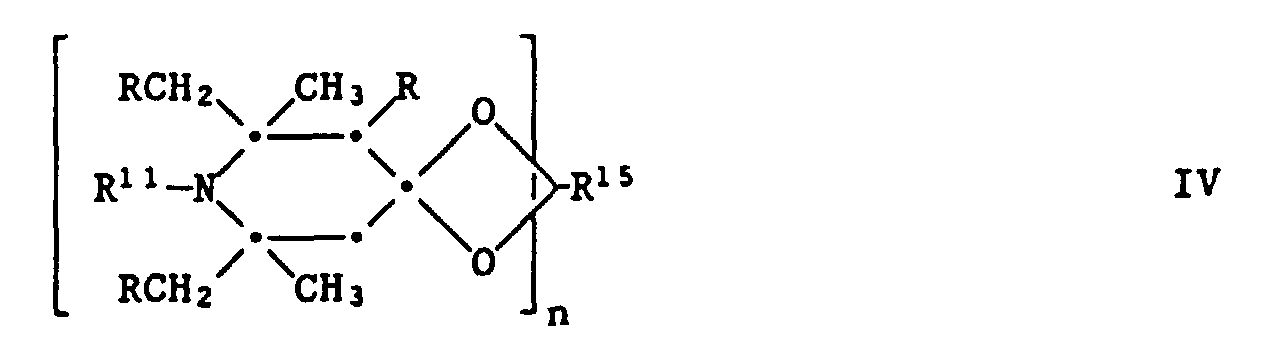
- Bedeutet R15 C2-C8-Alkylen oder -Hydroxyalkylen, so stellt es beispielsweise Ethylen, 1-Methyl-ethylen, Propylen, 2-Ethyl-propylen oder 2-Ethyl-2-hydroxymethylpropylen dar.
- Als C4-C22-Acyloxyalkylen bedeutet R15 z.B. 2-Ethyl-2-acetoxymethylpropylen.
- Beispiele für Polyalkylpiperidin-Verbindungen dieser Klasse sind folgende Verbindungen:
- 50) 9-Aza-8,8,10,10-tetramethyl-1,5-dioxaspiro[5.5]undecan
- 51) 9-Aza-8,8,10,10-tetramethyl-3-ethyl-1,5-dioxaspiro[5.5]undecan
- 52) 8-Aza-2,7,7,8,9,9-hexamethyl-1,4-dioxaspiro[4.5]decan
- 53) 9-Aza-3-hydroxymethyl-3-ethyl-8,8,9,10,10-pentamethyl-1,5-dioxaspiro [5.5]undecan
- 54) 9-Aza-3-ethyl-3-acetoxymethyl-9-acetyl-8,8,10,10-tetramethyl-1,5-dioxaspiro[5.5]undecan
- 55) 2,2,6,6-Tetramethylpiperidin-4-spiro-2'-(1',3'-dioxan)-5'-spiro-5"-(1",3"-dioxan)-2"-spiro-4"'-(2"',2'",6"',6"'-tetramethylpiperidin).
- d) Verbindungen der Formeln VA, VB und VC


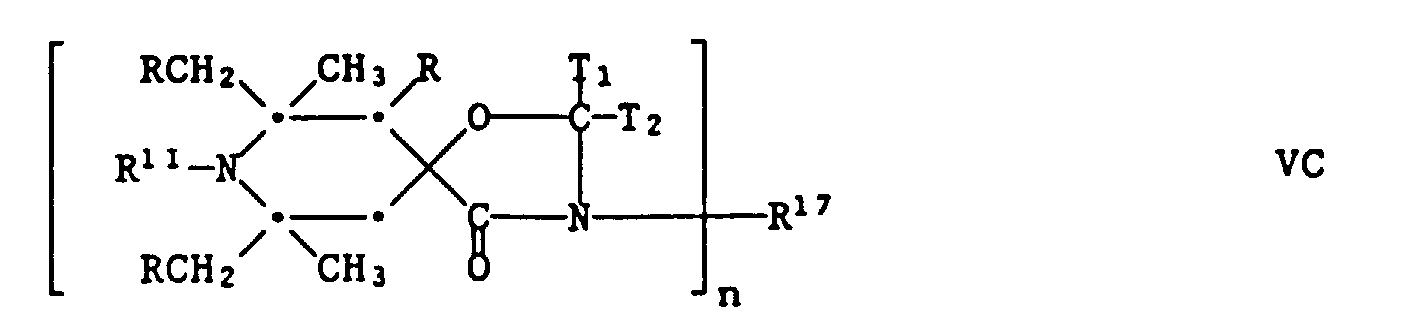
- Bedeuten etwaige Substituenten C1-C12-Alkyl, so stellen sie z.B. Methyl, Ethyl, n-Propyl, n-Butyl, sek.-Butyl, tert.-Butyl, n-Hexyl, n-Octyl, 2-Ethyl-hexyl, n-Nonyl, n-Decyl, n-Undecyl oder n-Dodecyl dar.
- Etwaige Substituenten in der Bedeutung von C1-C18-Alkyl können z.B. die oben angeführten Gruppen und dazu noch beispielsweise n-Tridecyl, n-Tetradecyl, n-Hexadecyl oder n-Octadecyl darstellen.
- Bedeuten etwaige Substituenten C2-C6-Alkoxyalkyl, so stellen sie z.B. Methoxymethyl, Ethoxymethyl, Propoxymethyl, tert.-Butoxymethyl, Ethoxyethyl, Ethoxypropyl, n-Butoxyethyl, tert.-Butoxyethyl, Isopropoxyethyl oder Propoxypropyl dar.
- Stellt R17 C3-C5-Alkenyl dar, so bedeutet es z.B. 1-Propenyl, Allyl, Methallyl, 2-Butenyl oder 2-Pentenyl.
- Als C7-C9-Aralkyl sind R17, T1 und T2 insbesondere Phenethyl oder vor allem Benzyl. Bilden T1 und T2 zusammen mit dem C-Atom einen Cycloalkanring, so kann dies z.B. ein Cyclopentan-, Cyclohexan-, Cyclooctan- oder Cyclododecanring sein. Bedeutet R17 C2-C4-Hydroxyalkyl, so stellt es z.B. 2-Hydroxyethyl, 2-Hydroxypropyl, 2-Hydroxybutyl oder 4-Hydroxybutyl dar.
- Als C6-C10-Aryl bedeuten R17, T1 und T2 insbesondere Phenyl, α- oder B-Naphthyl, die gegebenenfalls mit Halogen oder C1-C4-Alkyl substituiert sind.
- Stellt R17 C2-C12-Alkylen dar, so handelt es sich z.B. um Ethylen, Propylen, 2,2-Dimethylpropylen, Tetramethylen, Hexamethylen, Octamethylen, Decamethylen oder Dodecamethylen. Als C4-C12-Alkenylen bedeutet R17 insbesondere 2-Butenylen, 2-Pentenylen oder 3-Hexenylen.
- Bedeutet R17 C6-C12 Arylen, so stellt es beispielsweise o-, m- oder p-Phenylen, 1,4-Naphthylen oder 4,4'-Diphenylen dar.
- Bedeutet Z' C2-C12 Alkanoyl, so stellt es beispielsweise Propionyl, Butyryl, Octanoyl, Dodecanoyl, aber bevorzugt Acetyl dar.
- D hat als C2-C10 Alkylen, C6-C15 Arylen oder C6-C12 Cycloalkylen die unter b) angegebene Bedeutung.
- Beispiele für Polyalkylpiperidin-Verbindungen dieser Klasse sind folgende Verbindungen:
- 56) 3-Benzyl-1,3,8-triaza-7,7,9,9-tetramethylspiro[4.5]decan-2,4-dion
- 57) 3-n-Octyl-1,3,8-triaza-7,7,9,9-tetramethylspiro[4.5]decan-2,4-dion
- 58) 3-Allyl-1,3,8-triaza-1,7,7,9,9-pentamethylspiro[4.5]decan-2,4-dion
- 59) 3-Glycidyl-1,3,8-triaza-7,7,8,9,9-pentamethylspiro[4.5]decan-2,4-dion
- 60) 1,3,7,7,8,9,9-Heptamethyl-1,3,8-triazaspiro[4.5]decan-2,4-dion
- 61) 2-Iso-propyl-7,7,9,9-tetramethyl-1-oxa-3,8-diaza-4-oxo-spiro-[4.5]decan
- 62) 2,2-Dibutyl-7,7,9,9-tetramethyl-1-oxa-3,8-diaza-4-oxo-spiro-[4.5]-decan
- 63) 2,2,4,4-Tetramethyl-7-oxa-3,20-diaza-21-oxo-dispiro[5.1.11.2]-heneicosan
- 64) 2-Butyl-7,7,9,9-tetramethyl-1-oxa-4,8-diaza-3-oxo-spiro-[4,5]decan
- 65) 8-Acetyl-3-dodecyl-1,3,8-triaza-7,7,9,9-tetramethylspiro[4,5]-decan-2,4-dion
- e) Verbindungen der Formel VI,


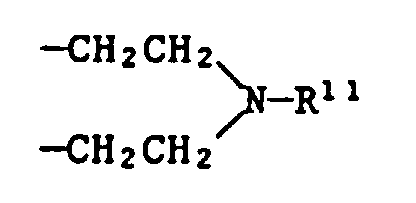

- Bedeuten etwaige Substituenten C1-C12-Alkyl, so stellen sie beispielsweise Hethyl, Ethyl, n-Propyl, n-Butyl, sek.-Butyl, tert.-Butyl, n-Hexyl, n-Octyl, 2-Ethylhexyl, n-Nonyl, n-Decyl, n-Undecyl oder n-Dodecyl dar.
- Bedeuten etwaige Substituenten C1-C4-Hydroxyalkyl, so stellen sie z.B. 2-Hydroxyethyl, 2-Hydroxypropyl, 3-Hydroxypropyl, 2-Hydroxybutyl oder 4-Hydroxybutyl dar.
- Bedeutet A C2-C6 Alkylen, so stellt es beispielsweise Ethylen, Propylen, 2,2-Dimethylpropylen, Tetramethylen oder Hexamethylen dar.
- Stellen R21 und R22 zusammen C4-C5-Alkylen oder -Oxaalkylen dar, so bedeutet dies z.B. Tetramethylen, Pentamethylen oder 3-Oxapentamethylen.
- Bevorzugt sind Verbindungen der Formel VI, worin n 4 ist, R18 und R19 eine Gruppe

- Beispiele für Polyalkylpiperidin-Verbindungen der Klasse e) sind die Verbindungen der folgenden Formeln:
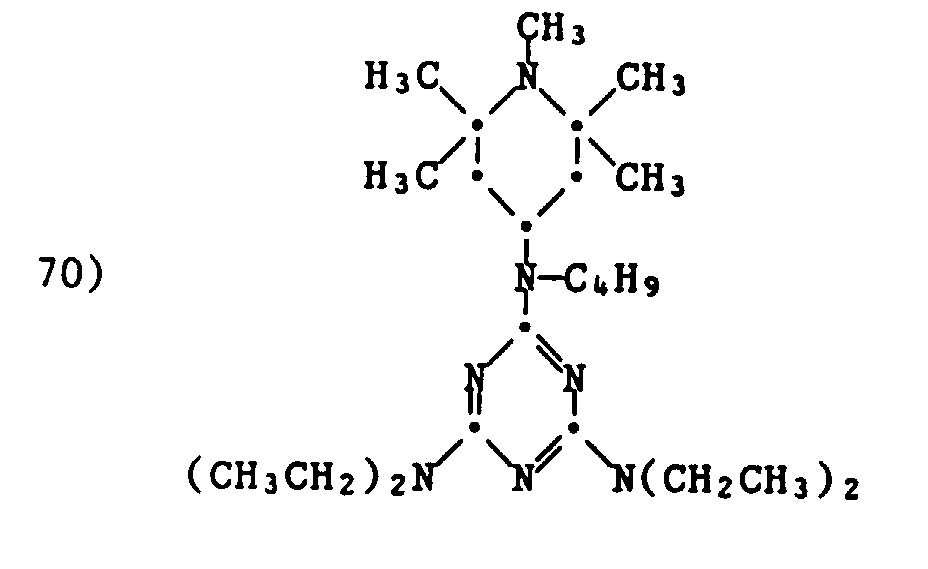
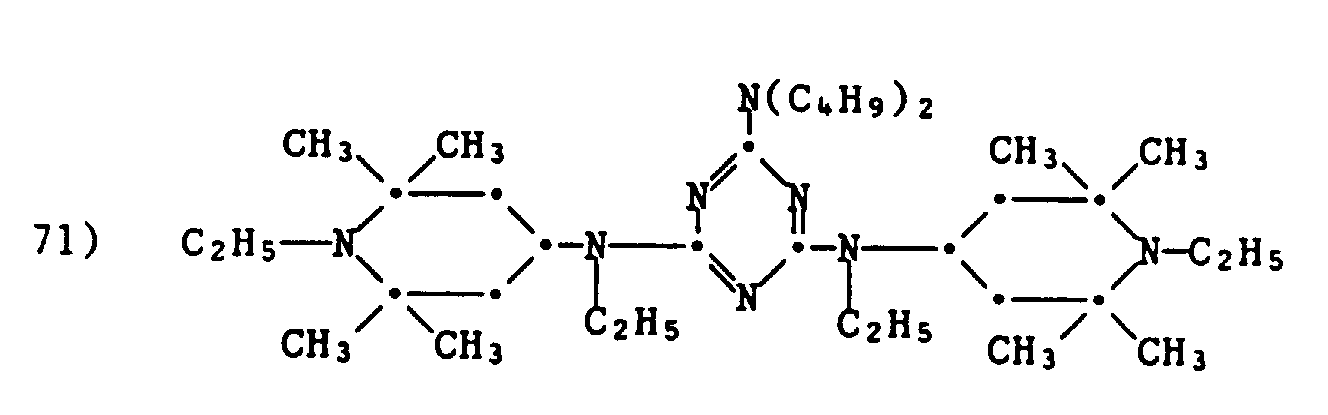

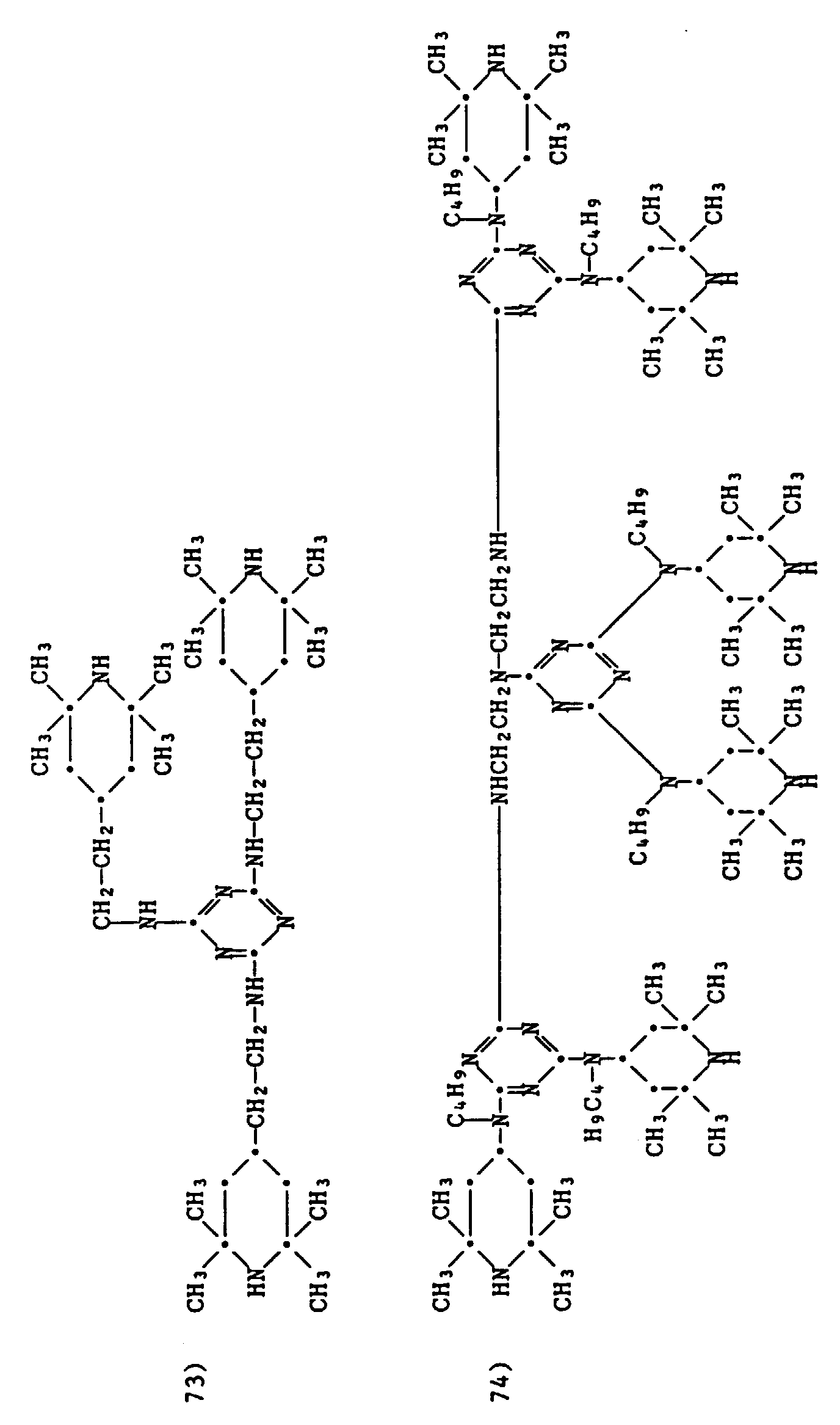




- f) Oligomere oder polymere Verbindungen, deren wiederkehrende Struktureinheit einen Polyalkylpiperidinrest der Formel (I) enthält, insbesondere Polyester, Polyäther, Polyamide, Polyamine, Polyurethane, Polyharnstoffe, Polyaminotriazine, Poly(meth)acrylate, Poly(meth)acrylamide und deren Copolymere, die solche Reste enthalten. Darunter sind die Polyester und Polyaminotriazine bevorzugt.
- Beispiele für 2,2,6,6-Polyalkylpiperidin-Lichtschutzmittel dieser Klasse sind die Verbindungen der folgenden Formeln, wobei m eine Zahl von 2 bis etwa 200 bedeutet.






- Von diesen Klassen sind die Klassen a), d), e) und f) besonders bevorzugt, insbesondere die Verbindungen 10, 13, 14, 23, 24, 28, 29, 63, 65, 75, 77, 81, 84 und 92.
- Diese sterisch gehinderten Amine sind bekannte Verbindungen, viele davon sind kommerziell erhältlich. Es können auch zwei verschiedene sterisch gehinderte Amine verwendet werden, beispielsweise eines von niedrigem und eines von höherem Molekulargewicht, wie dies im US-A-4 692 486 beschrieben ist.
- Die als Komponente c) verwendete Zinkverbindung kann eine organische Zinkverbindung sein, z.B. das Zinksalz einer Carbonsäure, Sulfonsäure, Phosphonsäure, Phosphorigsäure oder Phosphinsäure oder das Zinksalz eines Phenols oder ein Zinkchelat, wie z.B. das Enolat einer 1,3-Diketoverbindung. Die Komponente c) kann auch eine anorganische Zinkverbindung sein, z.B. ein Oxid, Hydroxid, Carbonat, basisches Carbonat, Phosphat, Phosphit, Sulfat, Chlorid, Fluorid oder Hypophosphit.
- Bevorzugt ist c) das Zinksalz einer C1-C22-Carbonsäure, eines C6-C18-Phenols oder eines C5-C30-1,3-Diketons. Die Carbonsäure kann eine gesättigte oder ungesättigte aliphatische oder cycloaliphatische Carbonsäure sein oder eine aromatische oder aromatisch-aliphatische Carbonsäure sein. Auch Aminsäuren und deren Derivate kommen infrage.
- Beispiele hierfür sind Ameisensäure, Essigsäure, Propionsäure, Buttersäure, Capronsäure, 2-Ethylhexansäure, Caprylsäure, Laurinsäure, Myristylsäure, Oenanthsäure, Neodecansäure, Palmitinsäure, Stearinsäure, Isostearinsäure, 12-Hydroxystearinsäure, Ölsäure, Behensäure, Montansäure, Benzoesäure, Chlorbenzoesäure, p-tert. Butylbenzoesäure, p-Dodecylbenzoesäure, Salicylsäure, 3,4-Di-tert.butyl-4-hydroxybenzoesäure, Tolylsäure, Dimethylbenzoesäure, p-Dimethylaminobenzoesäure, Thioglykolsäure, Milchsäure, Abietinsäure, β-Hercaptopropionsäure, β-Dodecylmercaptopropionsäure, Phenylessigsäure oder der Halbester oder das Halbamid einer Dicarbonsäure. Auch Zinksalze von langkettigen α-Aminocarbonsäuren und N-Acyl-aminosäuren, z.B. N-Stearoyl-glycin, sind hierfür geeignet.
- Beispiele für C6-C18-Phenole sind Phenol, Kresol, Xylenol, 4-tert. Butylphenol, 4-Nonylphenol, 4-Dodecylphenol, 4-Chlorphenol oder 2-Hydroxydiphenyl.
- Die C5-C30-1,3-Diketone sind durch die Formel VII (siehe unten) beschrieben. Beispielhaft genannt seien Acetylaceton, Butanoylaceton, Benzoyl-6-hydroxy-hexamoylmethan, Stearoylaceton, Lauroylaceton, Benzoylaceton, Dibenzoylmethan, Lauroyl-benzoylmethan. Stearoyl-benzoylmethan oder Bis(4-methylbenzoyl)-methan.
- Bevorzugt ist c) das Zinksalz einer C7-C20-Carbonsäure. Es können auch Gemische von Zinkverbindungen verwendet werden, z.B. die Zinksalze technischer Carbonsäuregemische oder technischer Alkylphenolgemische. Besonders bevorzugt sind Zinkstearat, Zinklaurat, Zinkoleat, Zink-2-ethylhexanoat und Zinkneodecanoat.
- Als Komponete d) verwendbare 1,3-Dicarbonylverbindungen können lineare oder cyclische Dicarbonylverbindungen sein. Bevorzugt werden Dicarbonylverbindungen der Formel VII verwendet,

- worin R1 C1-C22-Alkyl, C5-C10-Hydroxyalkyl, C2-C18-Alkenyl, Phenyl, durch OH, C1-C4-Alkyl, C1-C4-Alkoxy oder Halogen substituiertes Phenyl, C7-C10-Phenylalkyl, C5-C12-Cycloalkyl, durch C1-C4-Alkyl substituiertes C5-C12-Cycloalkyl oder eine Gruppe -R5-S-R6 oder -R5-O-R6 bedeutet,
- R2 Wasserstoff, C1-C8-Alkyl, C2-C12-Alkenyl, Phenyl, C7-C12-Alkylphenyl, C7-C10-Phenylalkyl oder eine Grupe -CO-R4 bedeutet,
- R3 eine der für R1 gegebenen Bedeutungen hat oder C1-C18-Alkoxy bedeutet,
- R4 C1-C4-Alkyl oder Phenyl bedeutet,
- R5 C1-C10-Alkylen bedeutet und
- R6 C1-C12-Alkyl, Phenyl, C7-C18-Alkylphenyl oder C7-C10-Phenylalkyl bedeutet.
- R1 und R3 als Alkyl können insbesondere C1-C18-Alkyl sein, wie z.B Methyl, Ethyl, n-Propyl, Isopropyl, n-Butyl, tert. Butyl, Pentyl, Hexyl, Heptyl, Octyl, Decyl, Dodecyl oder Octadecyl.
- R1 und R3 als Hydroxyalkyl stellen insbesondere eine Gruppe
- R1 und R3 als Alkenyl können beispielsweise Vinyl, Allyl, Methallyl, 1-Butenyl, 1-Hexenyl oder Oleyl bedeuten, vorzugsweise Allyl.
- R1 und R3 als durch OH, Alkyl, Alkoxy oder Halogen substituiertes Phenyl können beispielsweise Tolyl, Xylyl, tert. Butylphenyl, Methoxyphenyl, Ethoxyphenyl, Hydroxyphenyl, Chlorphenyl oder Dichlorphenyl sein.
- R1 und R3 als Phenylalkyl sind insbesondere Benzyl.
R2 und R3 als Cycloalkyl oder Alkyl-cycloalkyl sind insbesondere Cyclohexyl oder Methylcyclohexyl. - R2 als Alkyl kann insbesondere C1-C4-Alkyl sein.
R2 als C2-C12-Alkenyl kann insbesondere Allyl sein. R2 als Alkylphenyl kann insbesondere Tolyl sein. R2 als Phenylalkyl kann insbesondere Benzyl sein. Vorzugsweise ist R2 Wasserstoff.
R3 als Alkoxy kann z.B. Methoxy, Ethoxy, Butoxy, Hexyloxy, Octyloxy, Dodecyloxy, Tridecyloxy, Tetradecyloxy oder Octadecyloxy sein.
R5 als C1-C10-Alkylen ist insbesondere C2-C4-Alkylen.
R6 als Alkyl ist insbesondere C4-C12-Alkyl, wie z.B. Butyl, Hexyl, Octyl, Decyl oder Dodecyl. R6 als Alkylphenyl ist insbesondere Tolyl.
R6 als Phenylalkyl ist insbesondere Benzyl. - Beispiele für 1,3-Dicarbonylverbindungen der Formel VII sind Acetylaceton, Butanoylaceton, Heptanoylaceton, Stearoylaceton, Palmitoylaceton, Lauroylaceton, 7-tert.Nonylthio-heptandion-2,4, Benzoylaceton, Dibenzoylmethan, Lauroylbenzoylmethan, Palmitoyl-benzoylmethan, Benzoyl-6-hydroxy-hexanoylmethan, Stearoyl-benzoylmethan, 5-Hydroxycapronyl-benzoylmethan, Tribenzoylmethan, Bis(4-methylbenzoyl)methan, Benzoyl-p-chlorbenzoylmethan, Bis(2-hydroxybenzoyl)methan, 4-Methoxybenzoyl-benzoylmethan, Bis(4-methoxybenzoyl)methan, 1-Benzoyl-1-acetylnonan, Benzoyl-acetyl-phenylmethan, Stearoyl-4-methoxybenzoylmethan, Bis(4-tert-butylbenzoyl)methan, Benzoyl-formylmethan, Benzoyl-phenylacetylmethan, Bis(cyclohexanoyl)methan, Di(pivaloyl)methan, Acetessigsäure-methylester, -ethylester, -hexylester, -octylester, -dodecylester oder -octadecylester, Benzoylessigsäure-ethylester, -butylester, -2-ethylhexylester, -dodecylester oder -octadecylester und Stearoylessigsäure-ethyl-, -propyl-, -butyl-, -hexyl- oder -octylester.
- Bevorzugt als Komponente d) sind Verbindungen der Formel VII, worin R1 C1-C18-Alkyl, C2-C18-Oxaalkyl, C2-C18-Thiaalkyl, Phenyl, durch OH, Methyl oder Methoxy substituiertes Phenyl, C7-C10-Phenylalkyl oder Cyclohexyl ist, R2 Wasserstoff ist und R3 eine der für R1 gegebenen Bedeutungen hat.
- Bevorzugt enthalten die erfindungsgemässen Zusammensetzungen auf 100 Gew.-Teile der Komponente (a) 0,01 bis 3 Gew.-Teile der Komponente (b) und 0,02 bis 4 Gew.-Teile der Komponente (c), insbesondere 0,1 bis 2 Gew.-Teile der Komponente (b) und 0,1 bis 2 Gew.-Teile der Komponente (c).
- Falls die Zusammensetzung auch eine 1,3-Dicarbonylverbindung als Komponente (d) enthält, so enthält sie bevorzugt auf 100 Gew.-Teile der Komponente (a) 0,05 bis 1 Gew.-Teile, insbesondere 0,1 bis 0,5 Gew.-Teile der Komponente (d). Sofern diese 1,3-Dicarbonylverbindung anteilweise als Zink-chelat vorliegt, beträgt die Einsatzmenge 0,1 bis 2,5 Gew.-Teile.
- Darüber hinaus kann die Zusammensetzung weitere Zusätze enthalten, wie sie für die Verarbeitung und Stabilisierung von chlorhaltigen Polymeren bekannt und üblich sind. Dies sind z.B. Weichmacher, Phosphite, metallfreie PVC-Stabilisatoren, Schlagzähigkeitsmodifikatoren, Wärmestandfestigkeitsverbesserer, Epoxidverbindungen, Antioxidantien, UV-Absorber und Lichtschutzmittel, Pigmente, Farbstoffe, Füllstoffe, Lösungsmittel, Gleitmittel oder Flammschutzmittel.
- Die Zusammensetzung enthält jedoch ausser den Zinkverbindungen keine Metallcarboxylate, wie sie oft zur Stabilisierung von chlorhaltigen Polymeren verwendet werden, wie z.B. Carbonsäuresalze von Calcium, Magnesium, Barium, Cadmium oder Blei, oder Organozinnverbindungen. Wohl aber kann die Zusammensetzung Chelate der Metalle Calcium, Magnesium und Barium enthalten. Diese Chelate leiten sich bevorzugt von 1,3-Diketonen der Formel VII ab. Besonders bevorzugt sind die Acetylacetonate von Calcium, Magnesium und Barium. Die Einsatzmengen auf 100 Gew.-Teile der Komponente a) liegen zwischen 0,05 und 3, insbesondere zwischen 0,1 und 2 Gew.-Teilen.
- Beispiele für Weichmacher sind die Ester von Phthalsäure, Adipin-, Azelain-, Sebazin- oder Trimellitsäure, Polyester aus aliphatischen Diolen und Dicarbonsäuren, Phosphorsäureester, Chlorparaffine oder epoxidierte Fettsäureester. Weitere Beispiele mögen dem "Taschenbuch der Kunststoff-Additive", R. Gächter, H. Müller, Hanser-Verlag 1983, Seite 280-307, entnommen werden. Die Weichmacher können in einer Menge von 15 bis 100 Gew.-Teilen, bezogen auf 100 Gew.-Teile des chlorhaltigen Polymeren, verwendet werden.
- Organische Phosphite sind bekannte Costabilisatoren für mit Metallcarboxylaten stabilisierte chlorhaltige Polymere, insbesondere in Kombination mit Zink-, Barium- oder Cadmium-Stabilisatoren. Beispiele von solchen Phosphiten sind Trioctyl-, Tridecyl-, Tridodecylphosphit, Decyl-diphenylphosphit, Triphenylphosphit, Phenyl-didecylphosphit, Tris-(nonylphenyl)-phosphit, Trilaurylphosphit, Trioctadecylphosphit, Distearyl-pentaerythritdiphosphit, 2,4-Di-tert.butylphenyl-di(dodecyl)phosphit, Tris-(2,4-di-tert.butylphenyl)-phosphit, Diisodecylpentaerythrit-diphosphit, Bis-(2,4-di-tert.butylphenyl)-pentaerythritdiphosphit, Tristearyl-sorbit-triphosphit, 3,9-Bis-(2,4-di-tert.butylphenoxy)-2,4,8,10-tetraoxa-3,9-diphosphaspiro[5.5]undecan.
- Metallfreie Stabilisatoren für chlorhaltige Polymere sind z.B. aliphatische Polyole, wie Pentaerythrit, Dipentaerythrit, Trimethylolpropan, Tris(2-hydroxyethyl)-isocyanurat, Sorbit, Mannit oder Furan; Aminocrotonsäureester; Mercaptobenzoesäureester; Dehydracetsäure; 2,4-Dihydroxybenzophenon; Enolcarbonate, wie sie in EP-A-224 438 beschrieben sind; aromatische Amide, wie Sie in EP-A-122 228 und 174 412 beschrieben sind; sowie Stickstoff-haltige Heterocyclen, wie sie in den EP-A- 2007, 22087, 22749, 41479, 65934, 260 226, 354 179, DE-A-3 048 659, 3 124 853, GB-A-2 170 203 und US-A-4 908 398 beschrieben sind. Auch Mercaptobenzoesäureester wie z.B. Thiosalicylsäure-i-octylester kommen infrage.
- Schlagzähigkeitsmodifikatoren sind z.B. Polyacrylate, Ethylen-Vinylacetat-Copolymere oder chloriertes Polyethylen. Wärmestandfestigkeitsverbesserer sind z.B. Poly(meth)acrylate, Acrylat-N-Methyl-Maleinimid-Copolymere oder Acrylnitril-Methylstyrol-Copolymere.
- Epoxidverbindungen sind ebenfalls bekannte Costabilisatoren für chlorhaltige Polymere. Sie können bei geeigneter Struktur auch gleichzeitig als Weichmacher wirken. Beispiele für Epoxid-Stabilisatoren sind epoxidiertes Polybutadien, epoxidiertes Sojaöl, epoxidiertes Leinsamenöl, epoxidiertes Fischöl, epoxidierter Talg, Hethylbutyl- oder 2-Ethylhexylepoxystearat, Tris(epoxyropyl)isocyanurat, epoxidiertes Ricinusöl, epoxidiertes Sonnenblumenöl, 3-(2-Phenoxy)-1,2-epoxypropan, Bisphenol-A-polyglycidylether, Vinylcyclohexendiepoxyd, Dicyclopentadiendiepoxyd oder 3,4-Epoxycyclohexylmethyl-3,4-epoxycyclohexancarboxylat. Der Zusatz einer solchen Epoxidverbindung, insbesondere von epoxidiertem Sojaöl, ist eine bevorzugte Ausführungsart der vorliegenden Erfindung.
- Beispiele für Antioxidantien sind:
- 1. Alkylierte Monophenole, z.B. 2,6-Di-tert.butyl-4-methylphenol, 2-Tert.butyl-4,6-dimethylphenol, 2,6-Di-tert.butyl-4-ethylphenol, 2,6-Di-tert.butyl-4-n-butylphenol, 2,6-Di-tert.butyl-4-i-butylphenol, 2,6-Di-cyclopentyl-4-methylphenol, 2-(α-Hethylcyclohexyl)-4,6-dimethylphenol, 2,6-Di-octadecyl-4-methylphenol, 2,4,6-Tri-cyclohexylphenol, 2,6-Di-tert.butyl-4-methoxymethylphenol, 2,6-Di-nonyl-4-methylphenol.
- 2. Alkylierte Hydrochinone, z.B. 2,6-Di-tert.butyl-4-methoxyphenol, 2,5-Di-tert.butyl-hydrochinon, 2,5-Di-tert.amyl-hydrochinon, 2,6-Di-phenyl-4-octadecyloxyphenol.
- 3. Hydroxylierte Thiodiphenylether, z.B. 2,2'-Thio-bis-(6-tert.-butyl-4-methylphenol), 2,2'-Thio-bis-(4-octylphenol), 4,4'-Thio-bis-(6-tert.butyl-3-methylphenol), 4,4'-Thio-bis-(6-tert.butyl-2-methylphenol).
- 4. Alkyliden-Bisphenole, z.B. 2,2'-Methylen-bis-(6-tert.butyl-4-methylphenol), 2,2'-Methylen-bis-(6-tert.butyl-4-ethylphenol), 2,2'-Methylen-bis-[4-methyl-6-(α-methylcyclohexyl)-phenol], 2,2'-Methylen-bis-(4-methyl-6-cyclohexylphenol), 2,2'-Methylen-bis-(6-nonyl-4-methylphenol), 2,2'-Methylen-bis-(4,6-di-tert.butylphenol), 2,2'-Ethyliden-bis-(4,6-di-tert.butylphenol), 2,2'-Ethyliden-bis-(6-tert.butyl-4-isobutylphenol), 2,2'-Methylen-bis-[6-(a-methylbenzyl)-4-nonylphenol], 2,2'-Methylen-bis-[6-(a,a-dimethylbenzyl)-4-nonylphenol], 4,4'-Methylen-bis-(2,6-di-tert.-butylphenol), 4,4'-Methylen-bis-(6-tert.butyl-2-methylphenol), 1,1-Bis-(5-tert.butyl-4-hydroxy-2-methylphenyl)-butan, 2,6-Bis-(3-tert.butyl-5-methyl-2-hydroxybenzyl)-4-methylphenol, 1,1,3-Tris-(5-tert.butyl-4-hydroxy-2-methylphenyl)-butan, 1,1-Bis-(5-tert.butyl-4-hydroxy-2-methylphenyl)-3-n-dodecylmercaptobutan, Ethylenglycol-bis-[3,3-bis-(3'-tert.-butyl-4'-hydroxyphenyl)-butyrat], Bis-(3-tert.butyl-4-hydroxy-5-methylphenyl)-dicyclopentadien, Bis-[2-(3'-tert.butyl-2'-hydroxy-5'-methylbenzyl)-6-tert.butyl-4-methyl-phenyl]-terephthalat.
- 5. Benzylverbindungen, z.B. 1,3,5-Tris-(3,5-di-tert.butyl-4-hydroxybenzyl)-2,4,6-trimethylbenzol, Bis-(3,5-di-tert.butyl-4-hydroxybenzyl)-sulfid, 3,5-Di-tert.butyl-4-hydroxybenzyl-mercaptoessigsäure-iso-octylester, Bis-(4-tert.butyl-3-hydroxy-2,6-dimethylbenzyl)dithiol-terephthalat, 1,3,5-Tris-(3,5-di-tert.butyl-4-hydroxybenzyl)-isocyanurat, 1,3,5-Tris-(4-tert.butyl-3-hydroxy-2,6-dimethylbenzyl)-isocyanurat, 3,5-Di-tert.butyl-4-hydroxybenzyl-phosphonsäure-dioctadecylester, Ca-Salz des 3,5-Di-tert.butyl-4-hydroxybenzyl-phosphonsäure-monoethylester, 1,3,5-Tris-(3,5-dicyclohexyl-4-hydroxybenzyl)isocyanurat.
- 6. Acylaminophenole, z.B. 4-Hydroxy-laurinsäureanilid, 4-Hydroxystearinsäureanilid, 2,4-Bis-(octylmercapto)-6-(3,5-di-tert.butyl-4-hydroxyanilino)-s-triazin, N-(3,5-di-tert.butyl-4-hydroxyphenyl)-carbaminsäureoctylester.
- 7. Ester der β-(3,5-Di-tert.butyl-4-hydroxyphenyl)-propionsäure mit ein- oder mehrwertigen Alkoholen, wie z.B. mit Hethanol, Octadecanol, 1,6-Hexandiol, Neopentylglycol, Thiodiethylenglycol, Diethylenglycol, Triethylenglycol, Pentaerythrit, Tris-(hydroxyethyl)-iso-cyanurat, N,N'-Bis-(hydroxyethyl)-oxalsäurediamid.
- 8. Ester der β-(5-tert.Butyl-4-hydroxy-3-methylphenyl)-propionsäure mit ein- oder mehrwertigen Alkoholen, wie z.B. mit Methanol, Octadecanol, 1,6-Hexandiol, Neopentylglycol, Thiodiethylenglycol, Diethylenglycol, Triethylenglycol, Pentaerythrit, Tris-(hydroxy)ethyl-iso-cyanurat, N,N'-Bis-(hydroxyethyl)-oxalsäurediamid.
- 9. Ester der β-(3,5-Dicyclohexyl-4-hydroxyphenyl)-propionsäure mit ein- oder mehrwertigen Alkoholen, wie z.B. mit Methanol, Octadecanol, 1,6-Hexandiol, Neopentylglycol, Thiodiethylenglycol, Diethylenglycol, Triethylenglycol, Pentaerythrit, Tris-(hydroxy)ethyl-isocyanurat, N,N'-Bis-(hydroxyethyl)-oxalsäurediamid.
- 10. Amide der β-(3,5-Di-tert.butyl-4-hydroxyphenyl)-propionsäure, wie z.B. N,N'-Bis-(3,5-di-tert.butyl-4-hydroxyphenylpropionyl)-hexamethylendiamin, N,N'-Bis-(3,5-di-tert.butyl-4-hydroxyphenylpropionyl)-trimethylendiamin, N,N'-Bis-(3,5-di-tert.butyl-4-hydroxyphenylpropionyl)-hydrazin.
- Beispiele für UV-Absorber und Lichtschutzmittel sind:
- 1. 2-(2'-Hydroxyphenyl)-benztriazole, wie z.B. das 5'-Methyl-, 3',5'-Di-tert.butyl-, 5'-tert.Butyl-, 5'-(1,1,3,3-Tetramethylbutyl)-, 5-Chlor-3',5'-di-tert.butyl-, 5-chlor-3'-tert.butyl-5'-methyl-, 3'-sec.Butyl-5'-tert.butyl, 4'-Octoxy-, 3',5'-Di-tert.amyl-, 3',5'-Bis-(a,a-dimethylbenzyl)-Derivat.
- 2. 2-Hydroxybenzophenone, wie z.B. das 4-Hydroxy-, 4-Methoxy-, 4-Octoxy-, 4-Decyloxy-, 4-Dodecyloxy-, 4-Benzyloxy-, 4,2',4'-Tri-hydroxy-, 2'-Hydroxy-4,4'-dimethoxy-Derivat.
- 3. Ester von gegebenenfalls substituierten Benzoesäuren, wie z.B. 4-tert.Butyl-phenylsalicylat, Phenylsalicylat, Octylphenyl-salicylat, Dibenzoylresorcin, Bis-(4-tert.butylbenzoyl)-resorcin, Benzoylresorcin, 3,5-Di-tert.butyl-4-hydroxybenzoesäure-2,4-di-tert.butylphenylester, 3,5-Di-tert.butyl-4-hydroxybenzoesäurehexadecylester.
- 4. Acrylate, wie z.B. α-Cyan-β,β-diphenylacrylsäure-ethylester bzw. -isooctylester, α-Carbomethoxy-zimtsäuremethylester, α-Cyano-β-methyl-p-methoxy-zimtsäuremethylester bzw. -butylester, α-Carbomethoxy-p-methoxy-zimtsäure-methylester, N-(β-carbomethoxy-β-cyanovinyl)-2-methyl-indolin.
- 5. Oxalsäurediamide, wie z.B. 4,4'-Di-octyloxy-oxanilid, 2,2'-Di-octyloxy-5,5'-di-tert.butyl-oxanilid, 2,2'-Di-dodecyloxy-5,5'di-tert.butyl-oxanilid, 2-Ethoxy-2'-ethyl-oxanilid, N,N'-Bis-(3-dimethylaminopropyl)-oxalamid, 2-Ethoxy-5-tert.butyl-2'-ethyloxanilid und dessen Gemisch mit 2-Ethoxy-2'-ethyl-5,4'-di-tert.butyl-oxanilid, Gemische von o-und p-Methoxy- sowie von o- und p-Ethoxy-di-substituierten Oxaniliden.
- Die verwendeten Pigmente können anorganische oder organische Pigmente sein, sie können auch metallische Pigmente sein. Füllstoffe sind z.B. Kreide, Russ, Graphit, Talk, Kaolin oder silikatische Mineralien. Die erfindungsgemässen Zusammensetzungen enthalten jedoch keine Hydrotalcit-Verbindungen.
- Gleitmittel sind vor allem Fettsäuren und ihre, Ester und Amide, Fettalkohole, Paraffine und Polyethylenwachse. Flammschutzmittel sind vor allem Antimonoxid, aromatische Bromverbindungen und Phosphorsäureester.
- Eine Uebersicht über die Verwendung von Schlagzähigkeitsmodifikatoren, Farbmitteln, Füllstoffen, Gleitmitteln und Flammschutzmitteln in chlorhaltigen Polymeren, speziell in PVC, findet sich im "Taschenbuch der Kunststoff-Additive", R. Gächter, H. Müller, Hanser-Verlag 1983.
- Die erfindungsgemässen Zusammensetzungen können auf an sich bekannte Weise hergestellt werden. In der Regel wird das Stabilisatorsystem in das Polymer eingearbeitet, wozu eine Reihe von bekannten Vorrichtungen, wie Kalander, Mischer, Kneter und dergleichen, existieren.
- Die nach vorliegender Erfindung stabilisierten Zusammensetzungen können auf bekannte Weise in die gewünschte Form gebracht werden. Solche Verfahren sind beispielsweise Kalandrieren, Extrudieren, Spritzgiessen, Sintern oder Spinnen, ferner Extrusions-Blasen oder eine Verarbeitung nach dem Plastisol-Verfahren.
- Die erfindungsgemässen Zusammensetzungen eignen sich insbesondere in Form von Hart-Rezepturen für Hohlkörper (Flaschen), Verpackungsfolien (Tiefziehfolien), Blasfolien, Crash pad-Folien (Automobile), Rohre, Schwerprofile (Fensterrahmen), Lichtwandprofile, Bauprofile, Sidings, Fittings, Bürofolien und Apparatur-Gehäuse (Computer, Haushaltgeräte).
- Andere Zusammensetzungen in Form von Weich-Rezepturen sind für Drahtummantelungen, Kabelisolierungen, Dekorationsfolien, Dachfolien, Agrarfolien, Schläuche, Dichtungsprofile, Bürofolien und Folien für Traglufthallen geeignet.
- Beispiele für die Anwendung der erfindungsgemässen Zusammensetzungen als Plastisole sind Kunstleder, Fussböden, Textilbeschichtungen, Tapeten, Coil-Coatings und Unterbodenschutz für Kraftfahrzeuge.
- Beispiele für Sinter-PVC-Anwendungen der erfindungsgemässen Zusammensetzungen sind Slush, Slush Mould und Coil-Coatings.
- Die nachfolgenden Beispiele erläutern die Erfindung näher. Alle Angaben in Teilen und Prozenten beziehen sich auf das Gewicht, sofern nicht anders angegben.
- In den Beispielen werden folgende gehinderte Amine, Zinkverbindungen und 1,3-Diketone verwendet:

- H-2
- Di-(2,2,6,6-tetramethylpiperidin-4-yl)-sebacat
- H-3
- Di-(1,2,2,6,6-Pentamethylpiperidin-4-yl)-sebacat

- Zn-1
- Zink-neodecanoat
- Zn-2
- Zink-stearat
- D-1
- Benzoyl-stearoylmethan
- Eine halbharte PVC-Zusammensetzung wird nach folgender Rezeptur (Gewichtsteile) bereitet:
- 100 Suspensions-PVC mit K-Wert 64 (Solvic® 264GA)
- 15 Dioctylphthalat
- 5 Epoxidiertes Soyaöl (Reoplast® 39)
- Dazu kommen die in Tabelle 1 aufgeführten Stabilisatoren. Die Bestandteile werden 5 Minuten bei 180°C auf einer Mischwalze homogenisiert unter Bildung einer 0,3 mm starken Folie. Aus der Folie werden Probestreifen geschnitten, die in einem Testofen (Mathis Thermotester® LTF-ST) auf 180°C erwärmt werden. Die dabei auftretende Verfärbung wird in regelmässigen Zeitintervallen gemäss ASTMD 1925-70 als Yellowness-Index gemessen. Je höher dieser Index ist, desto starker ist die Verfärbung.
Tabelle 1 Gehindertes Amin*) Zn-Verbindung*) Yellowness-Index nach 0 5 10 20 30 40 min - - 19 64 85 - - - 0,3 H-1 - 31 92 - - - - 0,3 H-1 0,3 Zn-1 6 26 32 48 71 91 *) Teile auf 100 Teile PVC - Man ersieht daraus, dass das gehinderte Amin die Verfärbung verstärkt, die Kombination mit der Zinkverbindung jedoch eine starke Stabilisierung bewirkt, die die Lebensdauer des PVC vervielfacht.
- Eine halbharte PVC-Rezeptur wird aus folgenden Komponenten (Gewichtsteile) bereitet:
- 100 Suspensions-PVC mit K-Wert 64 (Solvic® 264 GA)
- 17 Dioctylphthalat
- 3 Epoxidiertes Soyaöl (Reoplast® 39)
- Dazu kommen die in Tabelle 2 angegebenen Stabilisatoren. Die Bereitung der Proben und ihre Prüfung geschieht wie in Beispiel 1 beschrieben.
Tabelle 2 Gehindertes Amin*) Zn-Verbindung*) Diketon*) Yellowness-Index nach 0 5 10 20 30 min - - - 20 22 31 53 - 0,3 H-2 - - 32 53 82 - - 0,3 H-2 0,25 Zn-1 - 4 7 12 37 92 0,3 H-2 0,35 Zn-1 - 4 7 11 30 62 0,3 H-2 0,25 Zn-1 0,3 D-1 1 2 2 8 43 0,3 H-2 0,35 Zn-1 0,3 D-1 1 1 2 6 27 *) Teile auf 100 Teile PVC - Eine halbharte PVC-Rezeptur wird aus folgenden Komponenten (Gewichtsteile) bereitet:
- 100 Suspensions-PVC mit K-Wert 64 (Solvic® 264 GA)
- 20 Dioctylphthalat
- Dazu kommen die in Tabelle 3 angegebenen Stabilisatoren. Die Bereitung der Proben und ihre Prüfung geschieht wie in Beispiel 1 beschrieben.
Tabelle 3 Gehindertes Amin*) Zn-Verbindung*) Yellowness-Index nach 0 5 10 20 30 40 min 0,3 H-1 0,3 Zn-1 6 20 26 48 90 - 0,3 H-1 0,4-Zn-1 6 18 21 25 56 - 0,6 H-1 0,6 Zn-1 6 20 24 40 55 - 0,6 H-1 0,8 Zn-1 6 15 19 28 43 57 *) Teile auf 100 Teile PVC - Die Grundrezeptur ist dieselbe wie in Beispiel 2, es werden jedoch andere Stabilisatorkombinationen verwendet. Die Proben werden bereitet und geprüft wie in Beispiel 1 beschrieben. Die Ergebnisse sind in Tabelle 3 aufgeführt.
Tabelle 4 Gehindertes Amin*) Zn-Verbindung*) Diketon*) Yellowness-Index nach 0 5 10 20 30 min - - - 18 24 76 - - 0,3 H-3 - - 14 28 92 - - 0,3 H-3 0,25 Zn-1 - 2 4 7 22 70 0,3 H-3 0,25 Zn-1 0,3 D-1 0,5 1 2 5 56 0,3 H-3 0,35 Zn-1 - 1,5 4 5 11 26 0,3 H-2 0,35 Zn-1 0,3 D-1 0,8 1 1 5 26 *) Teile auf 100 Teile PVC - Dieses Beispiel zeigt, dass bei gleichbleibender Konzentration an gehindertem Amin sowohl die Erhöhung der Zink-Konzentration als auch der Zusatz des Diketons die Stabilisierung verstärkt. Die Wirkung des Diketons ist vor allem in den ersten 20 Minuten sehr deutlich.
- Die Grundrezeptur ist dieselbe wie in Beispiel 3, jedoch werden andere Stabilisatorkombinationen verwendet. Die Proben werden bereitet und geprüft wie in Beispiel 1 beschrieben. Die Ergebnisse sind in Tabelle 5 aufgeführt.
Tabelle 5 Gehindertes Amin*) Zn-Verbindung*) Yellowness-Index nach 0 5 10 20 30 40 50 60 min 0,3 H-1 0,35 Zn-1 8 15 26 32 50 - - - 0,6 H-1 0,7 Zn-1 7 12 15 24 36 55 1,2 H-1 1,4 Zn-1 8 12 16 28 37 47 57 70 0,3 H-2 0,35 Zn-1 5 12 15 64 - - - - 0,6 H-2 0,7 Zn-1 4 6 10 49 86 - - - 1,2 H-2 1,4 Zn-1 5 6 9 23 68 90 - - *) Teile auf 100 Teile PVC - Eine harte PVC-Zusammensetzung wird aus 100 Teilen Suspensions-PVC vom K-Wert 60 (Corvic® S 60/104) und 3 Teilen eines epoxidierten Soyaöls (Reoplast® 39) bereitet. Dazu kommen die in Tabelle 6 angegebenen Stabilisatoren. Die Homogenisierung geschieht auf der Mischwalze bei 190°C/5 min unter Bildung einer 0,3 mm starken Folie. Die Prüfung der Proben erfolgt wie in Beispiel 1 beschrieben.
Tabelle 6 Gehindertes Amin*) Zn-Verbindung*) Diketon*) Yellowness-Index nach 3 6 12 18 24 30 min - 0,8 Zn-2 - 15 17 20 120 - - 0,3 H-4 0,8 Zn-2 - 19 22 33 45 50 56 0,3 H-4 0,8 Zn-2 0,2 D-1 9 11 16 26 37 53 0,3 H-1 0,8 Zn-2 - 24 28 36 46 56 65 0,3 H-1 0,8 Zn-2 0,2 D-1 8 10 13 19 29 39 *) Teile auf 100 Teile PVC - Dieses Beispiel zeigt, das die stabilisierende Wirkung des Zinksalzes allein erheblich übertroffen wird von seiner Kombination mit dem gehinderten Amin. Es zeigt weiterhin die starke Wirkung des Diketons auf die Farbe in den ersten 20 Minuten.
Claims (18)
- Stabilisierte chlorhaltige Polymerzusammensetzung, enthaltenda) mindestens ein chlorhaltiges Polymer,b) mindestens ein Polyalkylpiperidinderivat, das mindestens eine Gruppe der Formel I enthält,
 c) mindestens eine organische oder anorganische Zinkverbindungin Abwesenheit eines Metallcarboxylates von Calcium, Magnesium, Barium, Cadmium oder Blei, in Abwesenheit einer Organozinnverbindung, in Abwesenheit einer Verbindung aus der Reihe der Hydrotalcite und in Abwesenheit eines Treibmittels oder Schäumungsmittels.
 - Polymerzusammensetzung gemäss Anspruch 1, enthaltend
d) mindestens eine 1,3-Dicarbonylverbindung. - Polymerzusammensetzung gemäss Anspruch 1, dadurch gekennzeichnet, dass die Komponente a) ein Polyvinylchlorid oder ein mindestens 80 % Vinylchlorid enthaltendes Copolymer oder eine Mischung (Polyblend) eines solchen Polymers mit einem anderen chlorhaltigen oder chlorfreien Polymeren ist.
- Polymerzusammensetzung gemäss Anspruch 1, worin R in Formel I Wasserstoff ist.
- Polymerzusammensetzung gemäss Anspruch 1, dadurch gekennzeichnet, dass die Komponente b) ein Polyalkylpiperidinderivat der Formel II ist,

- Polymerzusammensetzung gemäss Anspruch 1, dadurch gekennzeichnet, dass die Komponente b) eine Polyalkylpiperidinverbindung der Formel VI ist,


- Polymerzusammensetzung gemäss Anspruch 1, dadurch gekennzeichnet, dass die Komponente b) eine oligomere oder polymere Polyalkylpiperidinverbindung aus der Reihe der Polyester oder Polyaminotriazine ist.
- Polymerzusammensetzung gemäss Anspruch 1, dadurch gekennzeichnet, dass die Komponente c) das Zinksalz einer C1-C22-Carbonsäure, eines C6-C18-Phenols oder eines C5-C30-1,3-Diketons ist.
- Polymerzusammensetzung gemäss Anspruch 8, dadurch gekennzeichnet, dass als weitere Komponenten Chelate von Calcium, Magnesium und Barium anwesend sind, die sich von 1,3-Diketon der Formel VII gemäss Anspruch 11 ableiten.
- Polymerzusammensetzung gemäss Anspruch 8, dadurch gekennzeichnet, dass c) das Zinksalz einer C7-C20-Carbonsäure ist.
- Polymerzusammensetzung gemäss Anspruch 2, dadurch gekennzeichnet, dass die Komponente d) eine 1,3-Dicarbonylverbindung der Formel VII ist,
 worin R1 C1-C22-Alkyl, C5-C10-Hydroxyalkyl, C2-C18-Alkenyl, Phenyl, durch OH, C2-C4-Alkyl, C1-C4-Alkoxy oder Halogen substituiertes Phenyl, C7-C10-Phenylalkyl, C5-C12-cycloalkyl, durch C1-C4-Alkyl substituiertes C5-C12-Cycloalkyl oder eine Gruppe -R5-S-R6 oder -R5-O-R6 bedeutet,R2 Wasserstoff, C1-C8-Alkyl, C2-C12-Alkenyl, Phenyl, C7-C12-Alkylphenyl, C7-C10-Phenylalkyl oder eine Gruppe -CO-R4 bedeutet,R3 eine der für R1 gegebenen Bedeutungen hat oder C1-C18-Alkoxy bedeutet,R4 C1-C4-Alkyl oder Phenyl bedeutet,R5 C1-C10-Alkylen bedeutet undR6 C1-C12-Alkyl, Phenyl, C7-C18-Alkylphenyl oder C7-C10-Phenylalkyl bedeutet.
 - Polymerzusammensetzung gemäss Anspruch 11, dadurch gekennzeichnet, dass die Komponente d) eine Verbindung der Formel VII ist, worin R1 C1-C18-Alkyl, C2-C18-Oxaalkyl, C2-C18-Thiaalkyl, Phenyl, durch OH, Methyl oder Methoxy substituiertes Phenyl, C7-C10-Phenylalkyl oder Cyclohexyl ist, R2 Wasserstoff ist und R3 eine der für R1 gegebenen Bedeutungen hat.
- Polymerzusammensetzung gemäss Anspruch 1, enthaltend auf 100 Gew.-Teile (a) 0,01 bis 3 Gew.-Teile (b) und 0,02 bis 4 Gew.-Teile (c).
- Polymerzusammensetzung gemäss Anspruch 13, enthaltend auf 100 Gew.-Teile (a) 0,1 bis 2 Gew.-Teile (b) und 0,1 bis 2 Gew.-Teile (c).
- Polymerzusammensetzung gemäss Anspruch 2, enthaltend auf 100 Gew.-Teile (a) 0,05 bis 1 Gew.-Teil (d).
- Polymerzusammensetzung gemäss Anspruch 1 oder 2, enthaltend ausser den Komponenten (a) bis (c) oder (a) bis (d) einen oder mehrere Zusatzstoffe aus der Reihe der Weichmacher, Phosphite, metallfreien PVC-Stabilisatoren, Schlagzähigkeitsmodifikatoren, Wärmestandfestigkeitsverbesserer, Epoxidverbindungen, Antioxidantien, UV-Absorber und Lichtschutzmittel, Pigmente, Farbstoffe, Füllstoffe, Gleitmittel und Flammschutzmittel.
- Verfahren zum Stabilisieren von chlorhaltigen Polymeren gegen Schädigung durch Wärme und Licht durch Zusatz vona) mindestens einem Polyalkylpiperidinderivat, das mindestens eine Gruppe der Formel I enthält,
 b) mindestens einer organischen oder anorganischen Zinkverbindung und gegebenenfalls weiteren Zusatzstoffen in Abwesenheit eines Metallcarboxylates von Calcium, Magnesium, Barium, Cadmium oder Blei, in Abwesenheit einer Organozinnverbindung, in Abwesenheit einer Verbindung aus der Reihe der Hydrotalcite und in Abwesenheit eines Treibmittels oder Schäumungsmittels.
 - Verfahren gemäss Anspruch 17 zum Stabilisieren von chlorhaltigen Polymeren gegen Schädigung durch Wärme und Licht durch Zusatz vona) mindestens einem Polyalkylpiperidinderivat, das mindestens eine Gruppe der Formel I enthält,
 b) mindestens einer organischen oder anorganischen Zinkverbindung,c) mindestens einer 1,3-Dicarbonylverbindung,und gegebenenfalls weiteren Zusatzstoffen in Abwesenheit eines Metallcarboxylates von Calcium, Magnesium, Barium, Cadmium oder Blei, in Abwesenheit einer Organozinnverbindung, in Abwesenheit einer Verbindung aus der Reihe der Hydrotalcite und in Abwesenheit eines Treibmittels oder Schäumungsmittels.
Applications Claiming Priority (2)
| Application Number | Priority Date | Filing Date | Title |
|---|---|---|---|
| CH3800/90 | 1990-11-30 | ||
| CH380090 | 1990-11-30 |
Publications (2)
| Publication Number | Publication Date |
|---|---|
| EP0488951A1 EP0488951A1 (de) | 1992-06-03 |
| EP0488951B1 true EP0488951B1 (de) | 1996-09-25 |
Family
ID=4263726
Family Applications (1)
| Application Number | Title | Priority Date | Filing Date |
|---|---|---|---|
| EP91810908A Expired - Lifetime EP0488951B1 (de) | 1990-11-30 | 1991-11-21 | Stabilisierte chlorhaltige Polymere |
Country Status (5)
| Country | Link |
|---|---|
| US (1) | US5244949A (de) |
| EP (1) | EP0488951B1 (de) |
| JP (1) | JPH04332746A (de) |
| CA (1) | CA2056580C (de) |
| DE (1) | DE59108223D1 (de) |
Families Citing this family (13)
| Publication number | Priority date | Publication date | Assignee | Title |
|---|---|---|---|---|
| IT1273607B (it) * | 1995-04-26 | 1997-07-08 | Ciba Geigy Spa | Combinazione di stabilizzanti per polimeri sintetici organici |
| EP0796888B1 (de) * | 1996-03-22 | 2005-12-14 | Wolfgang Wehner | Stabilisatorkombination für chlorhaltige Polymere |
| US5804622A (en) * | 1996-03-22 | 1998-09-08 | Ciba Specialty Chemicals Corporation | Monomeric N-piperidinylmelamines as stabilizers for chlorine-containing polymers |
| DK29697A (da) * | 1996-03-22 | 1997-09-23 | Ciba Geigy Ag | Stabilisatorkombination indeholdende 4-acyl-amido-piperidin-forbindelser til chlorholdige polymerer |
| US6258880B1 (en) * | 1998-11-25 | 2001-07-10 | Morton International, Inc. | Stabilizers for improved weatherability of clear polyvinyl chloride compositions |
| US6514626B1 (en) | 2000-08-28 | 2003-02-04 | Pechiney Emballage Flexible Europe | Dienophile additives to polyvinylidene chloride copolymers |
| FR2824067A1 (fr) * | 2001-03-26 | 2002-10-31 | Rhodia Chimie Sa | Utilisation de b-dicetone diaromatique substituee comme stabilisant de polymeres halogenes et polymere obtenu |
| DE10331888B4 (de) * | 2003-07-14 | 2005-11-10 | Clariant Gmbh | Elastisches Belagmaterial mit verbesserten Flammschutzeigenschaften sowie ein Verfahren zu dessen Herstellung |
| AU2008340442B2 (en) * | 2007-12-21 | 2013-09-26 | Basf Se | Flame retardant compositions comprising sterically hindered amines |
| WO2013048771A1 (en) | 2011-09-30 | 2013-04-04 | Dow Global Technologies Llc | Plasticizer for color retention during heat aging |
| EP2662403B1 (de) * | 2012-05-11 | 2015-02-18 | Reagens S.p.A. | Stabilisierende Harzformulierung von halogenhaltigen Polymeren |
| EP3747976A4 (de) * | 2018-02-02 | 2021-11-10 | Adeka Corporation | Stabilisatorzusammensetzung, diese enthaltende vinylchloridharzzusammensetzung und daraus geformter gegenstand |
| CN113227322A (zh) * | 2019-02-04 | 2021-08-06 | 株式会社Adeka | 稳定剂组合物、含有其的氯乙烯系树脂组合物及其成型体 |
Family Cites Families (16)
| Publication number | Priority date | Publication date | Assignee | Title |
|---|---|---|---|---|
| US4102839A (en) * | 1975-01-10 | 1978-07-25 | Rhone-Poulenc Industries | Stabilization of vinyl chloride polymers |
| DE2652328A1 (de) * | 1976-11-17 | 1978-05-18 | Neynaber Chemie Gmbh | Bleiverbindungen enthaltende stabilisator-gleitmittel-kombination fuer formmassen auf basis von polyvinylchlorid |
| JPS57168933A (en) * | 1981-03-20 | 1982-10-18 | Mitsubishi Monsanto Chem Co | Agricultural vinyl chloride resin film having excellent weather resistance |
| EP0080431B1 (de) * | 1981-10-16 | 1986-09-24 | Ciba-Geigy Ag | Synergistisches Gemisch von niedermolekularen und hochmolekularen Polyalkylpiperidinen |
| JPS61163965A (ja) * | 1985-01-14 | 1986-07-24 | Kanegafuchi Chem Ind Co Ltd | 熱安定化された含ハロゲン樹脂組成物 |
| US4822833A (en) * | 1986-03-10 | 1989-04-18 | Ciba-Geigy Corporation | Stabilized rigid polyvinyl chloride compositions |
| JPH0639560B2 (ja) * | 1986-08-14 | 1994-05-25 | 協和化学工業株式会社 | ポリ塩化ビニル系樹脂の安定化組成物 |
| JP2501327B2 (ja) * | 1987-01-20 | 1996-05-29 | 旭電化工業株式会社 | 安定化された硬質塩素含有樹脂組成物 |
| IT1203900B (it) * | 1987-04-15 | 1989-02-23 | Lagor Spa | Poli 1,4-diidro-2,6-dimetilpiridine 3,5-dicarbossilesteri utili come stabilizzanti termici per polimeri sintetici |
| DE3871854D1 (de) * | 1987-05-05 | 1992-07-16 | Ciba Geigy Ag | Stabilisierung von organischen polymeren gegen lichtabbau. |
| DE3871855D1 (de) * | 1987-05-05 | 1992-07-16 | Ciba Geigy Ag | Gegen lichtschaedigung stabilisierte polyolefine. |
| DE3811493A1 (de) * | 1988-04-06 | 1989-10-19 | Neynaber Chemie Gmbh | Stabilisator fuer polymerisate auf basis chlorhaltiger olefine, verfahren zu seiner herstellung und diesen enthaltende polymerisate |
| JP2926183B2 (ja) * | 1988-05-27 | 1999-07-28 | 旭電化工業株式会社 | 農業用塩化ビニル系樹脂組成物 |
| EP0346279A1 (de) * | 1988-06-06 | 1989-12-13 | Ciba-Geigy Ag | Propan-1,3-dionderivate und deren Verwendung als Stabilisatoren für chlorhaltige Polymerisate |
| FR2645163B1 (fr) * | 1989-04-04 | 1993-06-11 | Rhone Poulenc Chimie | Procede de stabilisation des polymeres halogenes |
| DE3932048A1 (de) * | 1989-09-26 | 1991-04-04 | Huels Chemische Werke Ag | Costabilisatoren fuer formmassen auf basis von polymerisaten des vinylchlorids |
-
1991
- 1991-11-21 EP EP91810908A patent/EP0488951B1/de not_active Expired - Lifetime
- 1991-11-21 DE DE59108223T patent/DE59108223D1/de not_active Expired - Lifetime
- 1991-11-22 US US07/797,491 patent/US5244949A/en not_active Expired - Lifetime
- 1991-11-28 CA CA002056580A patent/CA2056580C/en not_active Expired - Lifetime
- 1991-11-29 JP JP3340150A patent/JPH04332746A/ja active Pending
Also Published As
| Publication number | Publication date |
|---|---|
| EP0488951A1 (de) | 1992-06-03 |
| CA2056580A1 (en) | 1992-05-31 |
| CA2056580C (en) | 2002-03-05 |
| US5244949A (en) | 1993-09-14 |
| DE59108223D1 (de) | 1996-10-31 |
| JPH04332746A (ja) | 1992-11-19 |
Similar Documents
| Publication | Publication Date | Title |
|---|---|---|
| EP0570337B1 (de) | Stabilisierte chlorhaltige Polymerzusammensetzungen | |
| EP0716123B1 (de) | Stabilisiertes Polyvinylchlorid | |
| EP0290391B1 (de) | Gegen Lichtschädigung stabilisierte Polyolefine | |
| JP3921641B2 (ja) | 塩素含有ポリマーのための安定剤の組合せ | |
| DE69527823T2 (de) | Verwendung von sterisch gehinderten Aminen und Metaloxiden oder -hydroxiden um die Lichtstabilität und Pestizidwiderstandsfähigkeit von Polyolefin- oder Olefincopolymerfilmen zu verbessern. | |
| EP0351360B1 (de) | Verfahren zur Herstellung von thermisch stabilen Olefinpolymeren | |
| EP0421933B1 (de) | Stabilisierte chlorhaltige Polymerzusammensetzungen | |
| EP0796888B1 (de) | Stabilisatorkombination für chlorhaltige Polymere | |
| US5283273A (en) | Stabilized chlorine-containing polymers | |
| EP0488951A1 (de) | Stabilisierte chlorhaltige Polymere | |
| EP0488950B1 (de) | Stabilisierte chlorhaltige Polymere | |
| EP0446171A2 (de) | Stabilisierte chlorhaltige Polymerzusammensetzungen | |
| US6136900A (en) | Stabilized polyvinyl chloride | |
| EP0710677A2 (de) | Verfahren zur Herstellung von stabilisierten Olefinpolymeren | |
| EP0155912A2 (de) | Strahlenstabilisierte polymere Zusammensetzungen | |
| EP0432096A1 (de) | Stabilisierte chlorhaltige Zusammensetzung | |
| DE4141661A1 (de) | Stabilisierte chlorhaltige polymere | |
| AT413210B (de) | Stabilisatorkombination für halogenhaltige polymere | |
| EP0479725B1 (de) | Stabilisierte Styrolcopolymere enthaltend Elastomerteilchen | |
| WO2004039877A2 (de) | Stabilisatormischung |
Legal Events
| Date | Code | Title | Description |
|---|---|---|---|
| PUAI | Public reference made under article 153(3) epc to a published international application that has entered the european phase |
Free format text: ORIGINAL CODE: 0009012 |
|
| 17P | Request for examination filed |
Effective date: 19911123 |
|
| AK | Designated contracting states |
Kind code of ref document: A1 Designated state(s): BE DE FR GB IT NL |
|
| 17Q | First examination report despatched |
Effective date: 19940929 |
|
| GRAG | Despatch of communication of intention to grant |
Free format text: ORIGINAL CODE: EPIDOS AGRA |
|
| GRAH | Despatch of communication of intention to grant a patent |
Free format text: ORIGINAL CODE: EPIDOS IGRA |
|
| GRAH | Despatch of communication of intention to grant a patent |
Free format text: ORIGINAL CODE: EPIDOS IGRA |
|
| GRAA | (expected) grant |
Free format text: ORIGINAL CODE: 0009210 |
|
| AK | Designated contracting states |
Kind code of ref document: B1 Designated state(s): BE DE FR GB IT NL |
|
| ITF | It: translation for a ep patent filed | ||
| REF | Corresponds to: |
Ref document number: 59108223 Country of ref document: DE Date of ref document: 19961031 |
|
| GBT | Gb: translation of ep patent filed (gb section 77(6)(a)/1977) |
Effective date: 19961107 |
|
| BECA | Be: change of holder's address |
Free format text: 960925 *CIBA SC HOLDING A.G.:KLYBECKSTRASSE 141, CH - 4057 BALE |
|
| BECH | Be: change of holder |
Free format text: 960925 *CIBA SC HOLDING A.G. |
|
| BECN | Be: change of holder's name |
Effective date: 19961129 |
|
| ET | Fr: translation filed | ||
| NLS | Nl: assignments of ep-patents |
Owner name: CIBA SC HOLDING AG |
|
| REG | Reference to a national code |
Ref country code: GB Ref legal event code: 732E |
|
| NLT1 | Nl: modifications of names registered in virtue of documents presented to the patent office pursuant to art. 16 a, paragraph 1 |
Owner name: CIBA SPECIALTY CHEMICALS HOLDING INC. |
|
| PLBE | No opposition filed within time limit |
Free format text: ORIGINAL CODE: 0009261 |
|
| STAA | Information on the status of an ep patent application or granted ep patent |
Free format text: STATUS: NO OPPOSITION FILED WITHIN TIME LIMIT |
|
| 26N | No opposition filed | ||
| REG | Reference to a national code |
Ref country code: FR Ref legal event code: TP |
|
| REG | Reference to a national code |
Ref country code: FR Ref legal event code: TP |
|
| NLS | Nl: assignments of ep-patents |
Owner name: WILCO VINYL ADDITIVES GMBH |
|
| NLT1 | Nl: modifications of names registered in virtue of documents presented to the patent office pursuant to art. 16 a, paragraph 1 |
Owner name: CROMPTON VINYL ADDITIVES GMBH;CK WITCO VINYL ADDIT |
|
| REG | Reference to a national code |
Ref country code: FR Ref legal event code: CD |
|
| BECN | Be: change of holder's name |
Effective date: 20010417 |
|
| REG | Reference to a national code |
Ref country code: GB Ref legal event code: IF02 |
|
| NLT1 | Nl: modifications of names registered in virtue of documents presented to the patent office pursuant to art. 16 a, paragraph 1 |
Owner name: CHEMTURA VINYL ADDITIVES GMBH |
|
| REG | Reference to a national code |
Ref country code: FR Ref legal event code: CD |
|
| PGFP | Annual fee paid to national office [announced via postgrant information from national office to epo] |
Ref country code: IT Payment date: 20100918 Year of fee payment: 20 |
|
| PGFP | Annual fee paid to national office [announced via postgrant information from national office to epo] |
Ref country code: GB Payment date: 20100916 Year of fee payment: 20 |
|
| PGFP | Annual fee paid to national office [announced via postgrant information from national office to epo] |
Ref country code: NL Payment date: 20101025 Year of fee payment: 20 Ref country code: FR Payment date: 20101109 Year of fee payment: 20 |
|
| PGFP | Annual fee paid to national office [announced via postgrant information from national office to epo] |
Ref country code: DE Payment date: 20101130 Year of fee payment: 20 |
|
| PGFP | Annual fee paid to national office [announced via postgrant information from national office to epo] |
Ref country code: BE Payment date: 20101116 Year of fee payment: 20 |
|
| REG | Reference to a national code |
Ref country code: DE Ref legal event code: R071 Ref document number: 59108223 Country of ref document: DE |
|
| REG | Reference to a national code |
Ref country code: DE Ref legal event code: R071 Ref document number: 59108223 Country of ref document: DE |
|
| BE20 | Be: patent expired |
Owner name: *CHEMTURA VINYL ADDITIVES G.M.B.H. Effective date: 20111121 |
|
| REG | Reference to a national code |
Ref country code: NL Ref legal event code: V4 Effective date: 20111121 |
|
| REG | Reference to a national code |
Ref country code: GB Ref legal event code: PE20 Expiry date: 20111120 |
|
| PG25 | Lapsed in a contracting state [announced via postgrant information from national office to epo] |
Ref country code: NL Free format text: LAPSE BECAUSE OF EXPIRATION OF PROTECTION Effective date: 20111121 |
|
| PG25 | Lapsed in a contracting state [announced via postgrant information from national office to epo] |
Ref country code: GB Free format text: LAPSE BECAUSE OF EXPIRATION OF PROTECTION Effective date: 20111120 |
|
| PG25 | Lapsed in a contracting state [announced via postgrant information from national office to epo] |
Ref country code: DE Free format text: LAPSE BECAUSE OF EXPIRATION OF PROTECTION Effective date: 20111122 |