EP0486301B1 - A process of forming a copolymer - Google Patents
A process of forming a copolymer Download PDFInfo
- Publication number
- EP0486301B1 EP0486301B1 EP91310515A EP91310515A EP0486301B1 EP 0486301 B1 EP0486301 B1 EP 0486301B1 EP 91310515 A EP91310515 A EP 91310515A EP 91310515 A EP91310515 A EP 91310515A EP 0486301 B1 EP0486301 B1 EP 0486301B1
- Authority
- EP
- European Patent Office
- Prior art keywords
- butadiene
- monomer
- reaction vessel
- phase
- styrene
- Prior art date
- Legal status (The legal status is an assumption and is not a legal conclusion. Google has not performed a legal analysis and makes no representation as to the accuracy of the status listed.)
- Expired - Lifetime
Links
- 238000000034 method Methods 0.000 title claims description 59
- 229920001577 copolymer Polymers 0.000 title claims description 24
- KAKZBPTYRLMSJV-UHFFFAOYSA-N Butadiene Chemical compound C=CC=C KAKZBPTYRLMSJV-UHFFFAOYSA-N 0.000 claims description 82
- 238000006243 chemical reaction Methods 0.000 claims description 59
- 239000012071 phase Substances 0.000 claims description 46
- PPBRXRYQALVLMV-UHFFFAOYSA-N Styrene Chemical compound C=CC1=CC=CC=C1 PPBRXRYQALVLMV-UHFFFAOYSA-N 0.000 claims description 39
- 238000010926 purge Methods 0.000 claims description 33
- 238000006116 polymerization reaction Methods 0.000 claims description 23
- 239000011261 inert gas Substances 0.000 claims description 18
- 229920000642 polymer Polymers 0.000 claims description 16
- 229910001868 water Inorganic materials 0.000 claims description 9
- 238000007334 copolymerization reaction Methods 0.000 claims description 8
- 239000008346 aqueous phase Substances 0.000 claims description 7
- 239000000203 mixture Substances 0.000 claims description 7
- 239000000178 monomer Substances 0.000 claims description 7
- XLYOFNOQVPJJNP-UHFFFAOYSA-N water Substances O XLYOFNOQVPJJNP-UHFFFAOYSA-N 0.000 claims description 7
- 239000000725 suspension Substances 0.000 claims description 6
- 239000012808 vapor phase Substances 0.000 claims description 6
- 238000010438 heat treatment Methods 0.000 claims description 5
- 239000002245 particle Substances 0.000 claims description 5
- 239000004342 Benzoyl peroxide Substances 0.000 claims description 4
- OMPJBNCRMGITSC-UHFFFAOYSA-N Benzoylperoxide Chemical compound C=1C=CC=CC=1C(=O)OOC(=O)C1=CC=CC=C1 OMPJBNCRMGITSC-UHFFFAOYSA-N 0.000 claims description 4
- 235000019400 benzoyl peroxide Nutrition 0.000 claims description 4
- 239000001506 calcium phosphate Substances 0.000 claims description 4
- 239000003381 stabilizer Substances 0.000 claims description 4
- QORWJWZARLRLPR-UHFFFAOYSA-H tricalcium bis(phosphate) Chemical compound [Ca+2].[Ca+2].[Ca+2].[O-]P([O-])([O-])=O.[O-]P([O-])([O-])=O QORWJWZARLRLPR-UHFFFAOYSA-H 0.000 claims description 4
- 229940078499 tricalcium phosphate Drugs 0.000 claims description 4
- 229910000391 tricalcium phosphate Inorganic materials 0.000 claims description 4
- 235000019731 tricalcium phosphate Nutrition 0.000 claims description 4
- 239000007900 aqueous suspension Substances 0.000 claims description 3
- 239000006185 dispersion Substances 0.000 claims description 3
- 239000004615 ingredient Substances 0.000 claims description 3
- 230000000977 initiatory effect Effects 0.000 claims description 3
- DGAQECJNVWCQMB-PUAWFVPOSA-M Ilexoside XXIX Chemical compound C[C@@H]1CC[C@@]2(CC[C@@]3(C(=CC[C@H]4[C@]3(CC[C@@H]5[C@@]4(CC[C@@H](C5(C)C)OS(=O)(=O)[O-])C)C)[C@@H]2[C@]1(C)O)C)C(=O)O[C@H]6[C@@H]([C@H]([C@@H]([C@H](O6)CO)O)O)O.[Na+] DGAQECJNVWCQMB-PUAWFVPOSA-M 0.000 claims description 2
- 238000009826 distribution Methods 0.000 claims description 2
- 239000007870 radical polymerization initiator Substances 0.000 claims description 2
- 229910052708 sodium Inorganic materials 0.000 claims description 2
- 239000011734 sodium Substances 0.000 claims description 2
- 239000004552 water soluble powder Substances 0.000 claims description 2
- 239000004094 surface-active agent Substances 0.000 claims 1
- 238000013022 venting Methods 0.000 description 15
- IJGRMHOSHXDMSA-UHFFFAOYSA-N Atomic nitrogen Chemical compound N#N IJGRMHOSHXDMSA-UHFFFAOYSA-N 0.000 description 12
- 239000006260 foam Substances 0.000 description 6
- 229910052757 nitrogen Inorganic materials 0.000 description 6
- 239000002174 Styrene-butadiene Substances 0.000 description 4
- MTAZNLWOLGHBHU-UHFFFAOYSA-N butadiene-styrene rubber Chemical compound C=CC=C.C=CC1=CC=CC=C1 MTAZNLWOLGHBHU-UHFFFAOYSA-N 0.000 description 4
- 239000011115 styrene butadiene Substances 0.000 description 4
- 229920003048 styrene butadiene rubber Polymers 0.000 description 4
- 230000015572 biosynthetic process Effects 0.000 description 3
- 238000005187 foaming Methods 0.000 description 3
- 239000000376 reactant Substances 0.000 description 3
- 238000004140 cleaning Methods 0.000 description 2
- 230000007423 decrease Effects 0.000 description 2
- 230000000694 effects Effects 0.000 description 2
- 239000003999 initiator Substances 0.000 description 2
- 239000007788 liquid Substances 0.000 description 2
- 238000004519 manufacturing process Methods 0.000 description 2
- 239000000463 material Substances 0.000 description 2
- 239000011368 organic material Substances 0.000 description 2
- 230000035484 reaction time Effects 0.000 description 2
- 239000007921 spray Substances 0.000 description 2
- 238000010557 suspension polymerization reaction Methods 0.000 description 2
- 230000002411 adverse Effects 0.000 description 1
- 230000001934 delay Effects 0.000 description 1
- 230000008021 deposition Effects 0.000 description 1
- 238000007720 emulsion polymerization reaction Methods 0.000 description 1
- -1 for example Substances 0.000 description 1
- 238000009472 formulation Methods 0.000 description 1
- 238000010528 free radical solution polymerization reaction Methods 0.000 description 1
- 230000004927 fusion Effects 0.000 description 1
- 239000002861 polymer material Substances 0.000 description 1
- 230000001902 propagating effect Effects 0.000 description 1
- 239000011347 resin Substances 0.000 description 1
- 229920005989 resin Polymers 0.000 description 1
- 238000003860 storage Methods 0.000 description 1
Images


Classifications
-
- C—CHEMISTRY; METALLURGY
- C08—ORGANIC MACROMOLECULAR COMPOUNDS; THEIR PREPARATION OR CHEMICAL WORKING-UP; COMPOSITIONS BASED THEREON
- C08F—MACROMOLECULAR COMPOUNDS OBTAINED BY REACTIONS ONLY INVOLVING CARBON-TO-CARBON UNSATURATED BONDS
- C08F236/00—Copolymers of compounds having one or more unsaturated aliphatic radicals, at least one having two or more carbon-to-carbon double bonds
- C08F236/02—Copolymers of compounds having one or more unsaturated aliphatic radicals, at least one having two or more carbon-to-carbon double bonds the radical having only two carbon-to-carbon double bonds
- C08F236/04—Copolymers of compounds having one or more unsaturated aliphatic radicals, at least one having two or more carbon-to-carbon double bonds the radical having only two carbon-to-carbon double bonds conjugated
Definitions
- the present invention relates to a process of forming a copolymer and, more particularly, to a process of forming a copolymer in a reaction vessel from a mixture comprising butadiene and at least one other olefinic co-monomer.
- toner particles are automatically recycled many thousands of times over image surfaces while the particles are moving at an extremely high velocity. Further, toner particles, which are deposited in image configurations, must now be fused in extremely short periods of time. Thus, it is necessary for toner materials to possess the proper triboelectric charging properties for electrostatic latent image development and furthermore, they must not agglomerate during storage and transportation. Thus, it is necessary for the toner to endure the harsh environment of high speed electrostatographic copiers and duplicators and be capable of fusion at lower energy levels.
- Copolymer used for a toner is a copolymer of styrene butadiene.
- Such copolymers of styrenebutadiene may be made by various techniques such as solution and emulsion polymerization, however, suspension polymerization has been found to be the most suited for forming copolymers for use in toners.
- the '108 patent discloses a process for forming in a reaction vessel a copolymer of styrene and butadiene in which there is provided an aqueous suspension phase comprising water, styrene monomer, butadiene monomer, a suspension stabilizing agent, and a chain propagating amount of a free radical polymerization initiator which is insoluble in water, soluble in the styrene monomer, soluble in the butadiene monomer and having a 1 hour half-life between about 50°C and about 130°C, the ratio of the styrene monomer to the butadiene monomer being between about 80:20 and about 95:5 by weight, the weight proportion of water to the combination of the styrene monomer and the butadiene monomer being between about 0.8:1 and about 2:1, and wherein the suspension stabilizing agent consists essentially of a finely-divided, difficultly water-soluble powder; and a vapor phase comprising an inert
- the aqueous phase and the vapor phase are heated to a temperature between about 50°C and about 130°C at a pressure between about 138 kPa (20 psi) and about 965 kPa 140 psi until at least about 90 percent by weight of the styrene monomer and the butadiene monomer are copolymerized to form an aqueous suspension of discrete polymer particles having a Tg value of between about 45°C and about 65°C, a weight average molecular weight of between about 10,000 and about 400,000, a molecular weight distribution of the copolymer between about 2 and about 9 and a butadiene monomer concentration of less than about 10 parts per million by weight.
- butadiene monomer is removed from the vapor phase, by venting and repressurization of the reactor vessel, after at least about 75 percent by weight of the butadiene monomer and the styrene monomer in the aqueous phase have been converted to a copolymer and prior to conversion of more than about 98 percent by weight of the butadiene monomer and the styrene monomer to a copolymer in the aqueous phase.
- Figure 1 represents the standard time/temperature/pressure profile of '108 patent venting process.
- the steps of the prior process are as follows: First, the reactants are charged in a reactor ("charge phase”; labelled “A” in Figure 1). The reaction is initiated and continues exothermically (“exotherm phase”; labelled “B” in Figure 1) with an initial increase in pressure and temperature, after which the temperature is maintained at a polymerization temperature of 95°C. In the preferred embodiment of the '108 patent, about 165 minutes after the start of the exotherm phase, the reactor is vented ("venting phase”; labelled “C” in Figure 1) with a concomitant decrease in pressure resulting in foam formation in the reactor. The vent is then closed and the pressure is increased until the foam disappears.
- This depressurization/repressurization venting procedure is repeated several times for approximately 30 minutes.
- the temperature of the reaction vessel is then raised over a 40 minute period ("heat-up phase”; labelled “D” in Figure 1) to 125°C to complete the reaction process.
- high temperature phase labelled “E” in Figure 1
- the reactor is then cooled ("cool-down phase”; labelled “F” in Figure 1) for approximately 100 minutes, thus bringing the total reaction time to approximately 400 minutes.
- the present invention provides a process of forming a copolymer in a reaction vessel from a mixture comprising butadiene and at least one other olefinic co-monomer, characterised by purging the unreacted butadiene monomer from the vapor space in the reaction vessel by an inert gas stream, following substantial completion of the exotherm phase of the reaction and during at least a portion of the heat-up phase of the reaction.
- a process for removing residual butadiene from a copolymer composition formed by the reaction of butadiene and at least one second monomer in a reaction vessel characterised by purging said reaction vessel with an inert gas after the desired degree of polymerization has occurred, and further characterised in that said purge occurs while the reaction vessel is heated to the final polymerization temperature.
- a process for forming a copolymer of butadiene and styrene including charging a reaction vessel with the ingredients required for a suspension copolymerization procedure including butadiene and styrene, initiating said copolymerization reaction and after the exotherm phase of said reaction, heating said reaction vessel to a final polymerization temperature, characterised by purging said reaction vessel with an inert gas while the reaction vessel is heated to the final polymerization temperature and completing the polymerization at the final reaction temperature.
- the present invention addresses the above-mentioned problems by avoiding the depressurization/repressurization cycle venting procedure and instead using an inert gas purge which is timed to begin after a substantial selected degree of polymerization has occurred and then is maintained for a period and rate necessary to reduce the butadiene content in the polymer to a very low level.
- the purge is applied during the heat up phase, thus eliminating "non-productive" process time associated with prior methods.
- the purge procedure is not limited to 30 minutes and the purge can be extended to control the residual butadiene levels in the copolymer and thus achieve lower butadiene levels.
- the present invention stems in part from the observation that when practicing the process of the '108 patent, the polymerization exotherm subsides at approximately 135 minutes after the beginning of the reaction thus indicating a high degree of conversion. Holding the temperature constant for an additional 30 minutes was necessary only to allow completion of the prescribed series of depressurization and repressurization to remove residual butadiene. It was discovered that altering the pressure profile during the standard venting procedure would (1) prevent fouling of the reactor above liquid level by eliminating foaming in the reaction vessel and the resultant transport and deposition of polymer on reactor internals and (2) achieve an acceptable level of residual unreacted butadiene in the polymer product.
- a process for forming a copolymer of butadiene and styrene comprises charging a reaction vessel with butadiene, styrene and possibly other comonomers, together with all other ingredients necessary for the copolymerization reaction; initiating the copolymerization reaction; permitting the reaction to continue for a selected period of time; and thereafter purging the reaction vessel with an inert gas for a limited period of time until the residual unreacted butadiene is substantially removed.
- the reaction vessel is heated to a final polymerization temperature during the purging step. The purging preferably occurs after the exotherm phase of the reaction has been completed.
- the reaction vessel is purged after at least 75 percent by weight of the butadiene and the styrene are converted to a copolymer.
- the purging is therefore used only after a pre-selected conversion.
- the reaction vessel is heated to its final polymerization temperature, the reaction vessel is cooled and polymer is collected.
- a continuous inert gas purge allows for a reduction in reactor cycle time by eliminating the depressurization/repressurization procedure of approximately 30 minutes, for example, without introducing a new component in the batch formulation. Foam production is virtually eliminated, thus reducing reactor fouling and increasing the number of batches run between reactor cleanings.
- This invention further eliminates reaction time as the purge is employed during the heat- up phase of the reaction.
- Application of the process of the invention to reduce reaction cycle time, control residual butadiene levels and eliminate reactor foaming is not limited to a toner resin production process; it can be used in other styrenebutadiene copolymerization processes, as well as other butadiene copolymerization processes.
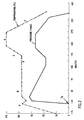
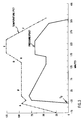
- the standard time/temperature/pressure profile ( Figure 1) is altered such that the removal of the unreacted volatile monomer is accomplished during, not before, the heat-up phase.
- the pressure of the reactor is maintained at the pressure observed after the exotherm phase, and an inert gas, for example, nitrogen, purge ("purge phase”; labelled “G” in the Figures) is maintained for a suitable time, preferably 20-30 minutes.
- the exotherm phase of the reaction is complete once the first initiator is practically consumed (i.e., 135 minutes after the start of the exothermic period). It is important that the removal of the unreacted volatile monomer occurs after the exotherm phase of the reaction at a high conversion of copolymer in order to achieve consistent molecular properties.
- the purging occurs immediately following the exotherm phase of the reaction and is followed by the heat-up phase.
- the reactants are first charged into the reaction vessel during the charge phase.
- the reaction is initiated and continues exothermically with an initial increase in temperature and pressure during the exotherm phase.
- the initial polymerization temperature of 95°C is maintained for approximately 130 minutes.
- the exotherm ends after approximately 135 minutes and the heat-up phase to 125°C begins immediately thereafter (i.e., there is no delay of 30 minutes formerly employed for the venting phase).
- the reactor is purged with an inert gas to remove the unreacted volatile monomer.
- the reactor temperature is maintained at 125°C (final polymerization temperature) for approximately 60 minutes (high temperature phase) before the cool-down phase. In effect, the time consumed by the venting phase of the standard profile of Figure 1 has been eliminated.
- a 100 gallon reactor was charged with material as follows: The Alkanol (sodium alkylnaphthalenesulfonate, available from E. I. Du Pont de Nemours) and tricalcium phosphate (TCP) were predispersed in 15 L of H2O for 30 minutes. This dispersion was then added to the remaining water. This final aqueous dispersion was charged into the reactor and then heated to 95°C.
- Alkanol sodium alkylnaphthalenesulfonate, available from E. I. Du Pont de Nemours
- TCP tricalcium phosphate
- the organic materials i.e., styrene, initiators, benzoyl peroxide (BPO) and oo-t-butyl-o- (2-ethylhexyl)monoperoxycarbonate (TBEC) were then mixed in a separate vessel.
- BPO benzoyl peroxide
- TBEC oo-t-butyl-o- (2-ethylhexyl)monoperoxycarbonate
- a polymer was prepared in a 100 gallon reactor in accordance with the procedure described in example 15 of the '108 patent.
- the depressurization/repressurization venting was replaced by an inert gas purge in accordance with the present invention.
- the following reactants were used in this Example. Styrene 105.3 kg Butadiene 15.4 kg BPO (78%) 4,290.g TBEC 550.1 g H20 163.9l TCP 1.927 kg Alkanol 49 g
- a polymer was prepared in a 100 gallon reactor in accordance with the procedure described in example 15 of the '108 patent.
- the depressurization/repressurization was replaced by an inert gas purge in accordance with the present invention.
- the purging procedure was performed during the heat-up to 125°C.
- the reactor pressure was noted and the pressure controller was set to the reactor pressure and the heating to 125°C was commenced.
- Nitrogen was admitted through a spray ball at a flow rate of 60 SCFH and after 30 minutes of purging the reactor vent valve was closed and the nitrogen flow was stopped.
- the polymerization was completed at 125°C as described in example 15 of the '108 patent, by maintaining at 125°C for another hour and then allowing the reactor to cool.
- Figure 3 represents the time/temperature/pressure profile for Example 2.
- a polymer was prepared in a 100 gallon reactor in accordance with the procedure described in example 15 of the '108 patent.
- the depressurization/repressurization was replaced by an inert gas purge in accordance with the present invention.
- the purging procedure was performed during the heat-up to 125°C.
- Figure 4 represents the time/temperature/pressure profile for Example 3.
- the methods of the present invention provide polymer product with characteristics commensurate with the process of the '108 patent without the associated process drawbacks.
Landscapes
- Chemical & Material Sciences (AREA)
- Health & Medical Sciences (AREA)
- Chemical Kinetics & Catalysis (AREA)
- Medicinal Chemistry (AREA)
- Polymers & Plastics (AREA)
- Organic Chemistry (AREA)
- Addition Polymer Or Copolymer, Post-Treatments, Or Chemical Modifications (AREA)
- Polymerisation Methods In General (AREA)
Applications Claiming Priority (2)
| Application Number | Priority Date | Filing Date | Title |
|---|---|---|---|
| US07/612,668 US5200485A (en) | 1990-11-14 | 1990-11-14 | Process for obtaining copolymers with a very low content residual butadiene using and inert gas purge |
| US612668 | 1990-11-14 |
Publications (3)
| Publication Number | Publication Date |
|---|---|
| EP0486301A2 EP0486301A2 (en) | 1992-05-20 |
| EP0486301A3 EP0486301A3 (en) | 1992-09-30 |
| EP0486301B1 true EP0486301B1 (en) | 1996-02-07 |
Family
ID=24454151
Family Applications (1)
| Application Number | Title | Priority Date | Filing Date |
|---|---|---|---|
| EP91310515A Expired - Lifetime EP0486301B1 (en) | 1990-11-14 | 1991-11-14 | A process of forming a copolymer |
Country Status (7)
| Country | Link |
|---|---|
| US (1) | US5200485A (enExample) |
| EP (1) | EP0486301B1 (enExample) |
| JP (1) | JP3037484B2 (enExample) |
| BR (1) | BR9104320A (enExample) |
| CA (1) | CA2049629C (enExample) |
| DE (1) | DE69116991T2 (enExample) |
| MX (1) | MX9101815A (enExample) |
Families Citing this family (2)
| Publication number | Priority date | Publication date | Assignee | Title |
|---|---|---|---|---|
| JP6095907B2 (ja) * | 2012-06-21 | 2017-03-15 | 水機工業株式会社 | 水門扉開閉装置 |
| CN106349414A (zh) * | 2015-07-16 | 2017-01-25 | 中国石油天然气股份有限公司 | 一种杂化树脂固体酸的氟化方法以及制得的产品和应用 |
Family Cites Families (10)
| Publication number | Priority date | Publication date | Assignee | Title |
|---|---|---|---|---|
| US2432386A (en) * | 1943-09-23 | 1947-12-09 | Goodrich Co B F | Distillation of volatile monomeric materials from aqueous polymer dispersions while reducing foam formation by the presence of a water-soluble weak inorganic acid |
| US3683511A (en) * | 1970-09-04 | 1972-08-15 | Firestone Tire & Rubber Co | Method of removing volatiles from an elastomer |
| US4092268A (en) * | 1974-06-05 | 1978-05-30 | Compagnie Generale Des Etablissements Michelin, Raison Sociale Michelin & Cie | Catalytic composition |
| DE2829807A1 (de) * | 1977-07-09 | 1979-01-25 | Nippon Oils & Fats Co Ltd | Verfahren zur herstellung von styrolpolymeren oder copolymeren von styrol |
| US4169828A (en) * | 1977-12-27 | 1979-10-02 | Arco Polymers, Inc. | Bead size distribution in the suspension polymerization of vinyl aromatic monomers |
| US4170699A (en) * | 1978-06-29 | 1979-10-09 | Arco Polymers, Inc. | Bead size distribution in the suspension polymerization of vinyl aromatic monomers in the presence of glutamic acid |
| US4525560A (en) * | 1979-05-18 | 1985-06-25 | Smith Richard L | Solution polymerization of conjugated dienes |
| US4558108A (en) * | 1982-12-27 | 1985-12-10 | Xerox Corporation | Aqueous suspension polymerization process |
| CA1249392A (en) * | 1982-12-27 | 1989-01-24 | Peter G. Odell | Aqueous suspension polymerization process |
| US5155193A (en) * | 1990-07-02 | 1992-10-13 | Xerox Corporation | Suspension polymerization processes |
-
1990
- 1990-11-14 US US07/612,668 patent/US5200485A/en not_active Expired - Lifetime
-
1991
- 1991-08-21 CA CA002049629A patent/CA2049629C/en not_active Expired - Fee Related
- 1991-10-07 BR BR919104320A patent/BR9104320A/pt not_active Application Discontinuation
- 1991-10-29 MX MX9101815A patent/MX9101815A/es not_active IP Right Cessation
- 1991-11-05 JP JP3288605A patent/JP3037484B2/ja not_active Expired - Fee Related
- 1991-11-14 EP EP91310515A patent/EP0486301B1/en not_active Expired - Lifetime
- 1991-11-14 DE DE69116991T patent/DE69116991T2/de not_active Expired - Fee Related
Also Published As
| Publication number | Publication date |
|---|---|
| CA2049629A1 (en) | 1992-05-15 |
| JPH04268306A (ja) | 1992-09-24 |
| CA2049629C (en) | 1997-01-07 |
| DE69116991D1 (de) | 1996-03-21 |
| MX9101815A (es) | 1992-07-08 |
| JP3037484B2 (ja) | 2000-04-24 |
| BR9104320A (pt) | 1992-06-23 |
| US5200485A (en) | 1993-04-06 |
| EP0486301A3 (en) | 1992-09-30 |
| DE69116991T2 (de) | 1996-09-19 |
| EP0486301A2 (en) | 1992-05-20 |
Similar Documents
| Publication | Publication Date | Title |
|---|---|---|
| US4558108A (en) | Aqueous suspension polymerization process | |
| US5093427A (en) | Copolymers of vinylidene fluoride and hexafluoropropylene and process for preparing the same | |
| Araujo et al. | Techniques for reducing residual monomer content in polymers: a review | |
| US4868259A (en) | Emulsion polymerization process | |
| US5200485A (en) | Process for obtaining copolymers with a very low content residual butadiene using and inert gas purge | |
| US9228045B2 (en) | Method for preparing a latex from a chlorinated vinylic polymer | |
| EP0115704B1 (en) | Aqueous suspension polymerization process | |
| EP0529927B1 (en) | A process for preparing a toner resin | |
| US5548043A (en) | Processes for producing bimodal toner resins | |
| EP0464734B1 (en) | Suspension polymerization processes and toner compositions thereof | |
| JP2002265503A (ja) | 分子量分布を重合過程中に調節する方法 | |
| US5177153A (en) | Suspension polymerization process for the preparation of polymeric material from gaseous and non-gaseous monomers | |
| US4713429A (en) | Method for production of copolymer of vinyl cyanide compound and aromatic vinyl compound | |
| JPS63278911A (ja) | 超低分子量ポリビニルアルコ−ルの製造法 | |
| EP0545947A4 (en) | Process for making ethanol solutions of alkyl half-esters of copolymers of maleic anhydride and a c 1?-c 4? alkyl vinyl ether | |
| US4354005A (en) | Method for controlling adduct formation in production of acrylonitrile-butadiene-styrene-acrylate copolymers | |
| EP0048084A2 (en) | Production by low temperature aqueous emulsion polymerisation of copolymers derived mainly from monomers of low water solubility, and use of the copolymers as hydrocarbon fuel additives | |
| JPH04268306A5 (enExample) | ||
| JP4294195B2 (ja) | トナー用樹脂の製造方法 | |
| JPH0310663B2 (enExample) | ||
| AU451384B2 (en) | "polymerisation process" | |
| JPS60231750A (ja) | 熱可塑性樹脂組成物の製造方法 | |
| CA1081892A (en) | Process for preparing high-impact vinyl aromatic polymers | |
| JPH04183703A (ja) | アルファ‐メチルスチレンとアクリロニトリルとのコポリマーの製造法 | |
| FR2800079A1 (fr) | Procede de fabrication de copolymeres styrene-acrylonitrile |
Legal Events
| Date | Code | Title | Description |
|---|---|---|---|
| PUAI | Public reference made under article 153(3) epc to a published international application that has entered the european phase |
Free format text: ORIGINAL CODE: 0009012 |
|
| AK | Designated contracting states |
Kind code of ref document: A2 Designated state(s): DE FR GB |
|
| PUAL | Search report despatched |
Free format text: ORIGINAL CODE: 0009013 |
|
| AK | Designated contracting states |
Kind code of ref document: A3 Designated state(s): DE FR GB |
|
| 17P | Request for examination filed |
Effective date: 19930225 |
|
| 17Q | First examination report despatched |
Effective date: 19940726 |
|
| GRAA | (expected) grant |
Free format text: ORIGINAL CODE: 0009210 |
|
| AK | Designated contracting states |
Kind code of ref document: B1 Designated state(s): DE FR GB |
|
| REF | Corresponds to: |
Ref document number: 69116991 Country of ref document: DE Date of ref document: 19960321 |
|
| ET | Fr: translation filed | ||
| PLBE | No opposition filed within time limit |
Free format text: ORIGINAL CODE: 0009261 |
|
| STAA | Information on the status of an ep patent application or granted ep patent |
Free format text: STATUS: NO OPPOSITION FILED WITHIN TIME LIMIT |
|
| 26N | No opposition filed | ||
| PGFP | Annual fee paid to national office [announced via postgrant information from national office to epo] |
Ref country code: FR Payment date: 19981110 Year of fee payment: 8 |
|
| PGFP | Annual fee paid to national office [announced via postgrant information from national office to epo] |
Ref country code: DE Payment date: 19981120 Year of fee payment: 8 |
|
| PG25 | Lapsed in a contracting state [announced via postgrant information from national office to epo] |
Ref country code: FR Free format text: LAPSE BECAUSE OF NON-PAYMENT OF DUE FEES Effective date: 20000731 |
|
| PG25 | Lapsed in a contracting state [announced via postgrant information from national office to epo] |
Ref country code: DE Free format text: LAPSE BECAUSE OF NON-PAYMENT OF DUE FEES Effective date: 20000901 |
|
| REG | Reference to a national code |
Ref country code: FR Ref legal event code: ST |
|
| REG | Reference to a national code |
Ref country code: GB Ref legal event code: IF02 |
|
| PGFP | Annual fee paid to national office [announced via postgrant information from national office to epo] |
Ref country code: GB Payment date: 20031112 Year of fee payment: 13 |
|
| PG25 | Lapsed in a contracting state [announced via postgrant information from national office to epo] |
Ref country code: GB Free format text: LAPSE BECAUSE OF NON-PAYMENT OF DUE FEES Effective date: 20041114 |
|
| GBPC | Gb: european patent ceased through non-payment of renewal fee |
Effective date: 20041114 |