EP0484353B2 - Substrate element with at least one integrated circuit, in particular a substrate element for inclusion in chip cards - Google Patents
Substrate element with at least one integrated circuit, in particular a substrate element for inclusion in chip cards Download PDFInfo
- Publication number
- EP0484353B2 EP0484353B2 EP90910564A EP90910564A EP0484353B2 EP 0484353 B2 EP0484353 B2 EP 0484353B2 EP 90910564 A EP90910564 A EP 90910564A EP 90910564 A EP90910564 A EP 90910564A EP 0484353 B2 EP0484353 B2 EP 0484353B2
- Authority
- EP
- European Patent Office
- Prior art keywords
- stiffening ring
- strip
- carrier element
- carrier substrate
- element according
- Prior art date
- Legal status (The legal status is an assumption and is not a legal conclusion. Google has not performed a legal analysis and makes no representation as to the accuracy of the status listed.)
- Expired - Lifetime
Links
Images

Classifications
-
- G—PHYSICS
- G06—COMPUTING OR CALCULATING; COUNTING
- G06K—GRAPHICAL DATA READING; PRESENTATION OF DATA; RECORD CARRIERS; HANDLING RECORD CARRIERS
- G06K19/00—Record carriers for use with machines and with at least a part designed to carry digital markings
- G06K19/06—Record carriers for use with machines and with at least a part designed to carry digital markings characterised by the kind of the digital marking, e.g. shape, nature, code
- G06K19/067—Record carriers with conductive marks, printed circuits or semiconductor circuit elements, e.g. credit or identity cards also with resonating or responding marks without active components
- G06K19/07—Record carriers with conductive marks, printed circuits or semiconductor circuit elements, e.g. credit or identity cards also with resonating or responding marks without active components with integrated circuit chips
- G06K19/077—Constructional details, e.g. mounting of circuits in the carrier
- G06K19/07745—Mounting details of integrated circuit chips
- G06K19/07747—Mounting details of integrated circuit chips at least one of the integrated circuit chips being mounted as a module
-
- G—PHYSICS
- G06—COMPUTING OR CALCULATING; COUNTING
- G06K—GRAPHICAL DATA READING; PRESENTATION OF DATA; RECORD CARRIERS; HANDLING RECORD CARRIERS
- G06K19/00—Record carriers for use with machines and with at least a part designed to carry digital markings
- G06K19/06—Record carriers for use with machines and with at least a part designed to carry digital markings characterised by the kind of the digital marking, e.g. shape, nature, code
- G06K19/067—Record carriers with conductive marks, printed circuits or semiconductor circuit elements, e.g. credit or identity cards also with resonating or responding marks without active components
- G06K19/07—Record carriers with conductive marks, printed circuits or semiconductor circuit elements, e.g. credit or identity cards also with resonating or responding marks without active components with integrated circuit chips
- G06K19/077—Constructional details, e.g. mounting of circuits in the carrier
- G06K19/07718—Constructional details, e.g. mounting of circuits in the carrier the record carrier being manufactured in a continuous process, e.g. using endless rolls
-
- G—PHYSICS
- G06—COMPUTING OR CALCULATING; COUNTING
- G06K—GRAPHICAL DATA READING; PRESENTATION OF DATA; RECORD CARRIERS; HANDLING RECORD CARRIERS
- G06K19/00—Record carriers for use with machines and with at least a part designed to carry digital markings
- G06K19/06—Record carriers for use with machines and with at least a part designed to carry digital markings characterised by the kind of the digital marking, e.g. shape, nature, code
- G06K19/067—Record carriers with conductive marks, printed circuits or semiconductor circuit elements, e.g. credit or identity cards also with resonating or responding marks without active components
- G06K19/07—Record carriers with conductive marks, printed circuits or semiconductor circuit elements, e.g. credit or identity cards also with resonating or responding marks without active components with integrated circuit chips
- G06K19/077—Constructional details, e.g. mounting of circuits in the carrier
- G06K19/0772—Physical layout of the record carrier
- G06K19/07728—Physical layout of the record carrier the record carrier comprising means for protection against impact or bending, e.g. protective shells or stress-absorbing layers around the integrated circuit
-
- G—PHYSICS
- G06—COMPUTING OR CALCULATING; COUNTING
- G06K—GRAPHICAL DATA READING; PRESENTATION OF DATA; RECORD CARRIERS; HANDLING RECORD CARRIERS
- G06K19/00—Record carriers for use with machines and with at least a part designed to carry digital markings
- G06K19/06—Record carriers for use with machines and with at least a part designed to carry digital markings characterised by the kind of the digital marking, e.g. shape, nature, code
- G06K19/067—Record carriers with conductive marks, printed circuits or semiconductor circuit elements, e.g. credit or identity cards also with resonating or responding marks without active components
- G06K19/07—Record carriers with conductive marks, printed circuits or semiconductor circuit elements, e.g. credit or identity cards also with resonating or responding marks without active components with integrated circuit chips
- G06K19/077—Constructional details, e.g. mounting of circuits in the carrier
- G06K19/07745—Mounting details of integrated circuit chips
-
- H—ELECTRICITY
- H10—SEMICONDUCTOR DEVICES; ELECTRIC SOLID-STATE DEVICES NOT OTHERWISE PROVIDED FOR
- H10W—GENERIC PACKAGES, INTERCONNECTIONS, CONNECTORS OR OTHER CONSTRUCTIONAL DETAILS OF DEVICES COVERED BY CLASS H10
- H10W70/00—Package substrates; Interposers; Redistribution layers [RDL]
- H10W70/60—Insulating or insulated package substrates; Interposers; Redistribution layers
- H10W70/699—Insulating or insulated package substrates; Interposers; Redistribution layers for flat cards, e.g. credit cards
-
- H—ELECTRICITY
- H10—SEMICONDUCTOR DEVICES; ELECTRIC SOLID-STATE DEVICES NOT OTHERWISE PROVIDED FOR
- H10W—GENERIC PACKAGES, INTERCONNECTIONS, CONNECTORS OR OTHER CONSTRUCTIONAL DETAILS OF DEVICES COVERED BY CLASS H10
- H10W72/00—Interconnections or connectors in packages
- H10W72/50—Bond wires
- H10W72/531—Shapes of wire connectors
- H10W72/5363—Shapes of wire connectors the connected ends being wedge-shaped
-
- H—ELECTRICITY
- H10—SEMICONDUCTOR DEVICES; ELECTRIC SOLID-STATE DEVICES NOT OTHERWISE PROVIDED FOR
- H10W—GENERIC PACKAGES, INTERCONNECTIONS, CONNECTORS OR OTHER CONSTRUCTIONAL DETAILS OF DEVICES COVERED BY CLASS H10
- H10W72/00—Interconnections or connectors in packages
- H10W72/50—Bond wires
- H10W72/541—Dispositions of bond wires
- H10W72/5445—Dispositions of bond wires being orthogonal to a side surface of the chip, e.g. parallel arrangements
-
- H—ELECTRICITY
- H10—SEMICONDUCTOR DEVICES; ELECTRIC SOLID-STATE DEVICES NOT OTHERWISE PROVIDED FOR
- H10W—GENERIC PACKAGES, INTERCONNECTIONS, CONNECTORS OR OTHER CONSTRUCTIONAL DETAILS OF DEVICES COVERED BY CLASS H10
- H10W72/00—Interconnections or connectors in packages
- H10W72/50—Bond wires
- H10W72/551—Materials of bond wires
- H10W72/552—Materials of bond wires comprising metals or metalloids, e.g. silver
- H10W72/5522—Materials of bond wires comprising metals or metalloids, e.g. silver comprising gold [Au]
-
- H—ELECTRICITY
- H10—SEMICONDUCTOR DEVICES; ELECTRIC SOLID-STATE DEVICES NOT OTHERWISE PROVIDED FOR
- H10W—GENERIC PACKAGES, INTERCONNECTIONS, CONNECTORS OR OTHER CONSTRUCTIONAL DETAILS OF DEVICES COVERED BY CLASS H10
- H10W72/00—Interconnections or connectors in packages
- H10W72/851—Dispositions of multiple connectors or interconnections
- H10W72/874—On different surfaces
- H10W72/884—Die-attach connectors and bond wires
-
- H—ELECTRICITY
- H10—SEMICONDUCTOR DEVICES; ELECTRIC SOLID-STATE DEVICES NOT OTHERWISE PROVIDED FOR
- H10W—GENERIC PACKAGES, INTERCONNECTIONS, CONNECTORS OR OTHER CONSTRUCTIONAL DETAILS OF DEVICES COVERED BY CLASS H10
- H10W74/00—Encapsulations, e.g. protective coatings
-
- H—ELECTRICITY
- H10—SEMICONDUCTOR DEVICES; ELECTRIC SOLID-STATE DEVICES NOT OTHERWISE PROVIDED FOR
- H10W—GENERIC PACKAGES, INTERCONNECTIONS, CONNECTORS OR OTHER CONSTRUCTIONAL DETAILS OF DEVICES COVERED BY CLASS H10
- H10W90/00—Package configurations
- H10W90/701—Package configurations characterised by the relative positions of pads or connectors relative to package parts
- H10W90/731—Package configurations characterised by the relative positions of pads or connectors relative to package parts of die-attach connectors
- H10W90/734—Package configurations characterised by the relative positions of pads or connectors relative to package parts of die-attach connectors between a chip and a stacked insulating package substrate, interposer or RDL
-
- H—ELECTRICITY
- H10—SEMICONDUCTOR DEVICES; ELECTRIC SOLID-STATE DEVICES NOT OTHERWISE PROVIDED FOR
- H10W—GENERIC PACKAGES, INTERCONNECTIONS, CONNECTORS OR OTHER CONSTRUCTIONAL DETAILS OF DEVICES COVERED BY CLASS H10
- H10W90/00—Package configurations
- H10W90/701—Package configurations characterised by the relative positions of pads or connectors relative to package parts
- H10W90/751—Package configurations characterised by the relative positions of pads or connectors relative to package parts of bond wires
- H10W90/754—Package configurations characterised by the relative positions of pads or connectors relative to package parts of bond wires between a chip and a stacked insulating package substrate, interposer or RDL
Definitions
- the present invention relates to a carrier element with at least an integrated circuit or semiconductor chip, especially for installation in so-called chip cards.
- Chip cards are increasingly used as identification, Credit or booking cards and the like.
- a semi-finished product as a carrier element used in the one provided with conductor tracks flexible carrier film one or more integrated Circuits mounted in the form of semiconductor crystals are.
- the contacting of the integrated circuits or Semiconductor chips with corresponding connection points on the flexible carrier film is usually done either by means of Bonding process (e.g. DE-OS 32 35 650) or using the direct contacting process (e.g. DE-AS 29 20 012).
- these carrier elements are shaped into suitably Cut-outs of the map material used. When pressing of chip card laminates and carrier elements depending on the process used, pressures up to 160 bar.
- the ribbon wires and the semiconductor chip usually with a cast or Provide masking compound.
- This casting or masking compound protects of course not just the ribbon wires but also the semiconductor chip.
- the carrier element with a semiconductor chip together with ribbon wires surrounding annular bounding frames to provide.
- This limiting ring for the masking compound usually consists of glass epoxy or PVC, i.e. H. the the same material as the card body. It there is therefore a risk that when pressing the Carrier elements with the chip card laminate damage the Semiconductor crystal occur.
- the stability of this Arrangement is also affected by the fact that Semiconductor crystal in a recess in the flexible Carrier film is arranged.
- Bounding frame for the sealing compound or covering compound at the same time as a reinforcement frame for the carrier element to train.
- This reinforcement frame is on the edge of the Carrier plate or the carrier element arranged and used to stiffen the carrier plate as a whole sufficiently.
- D. H. the backing plate is only through the stiffening ring stiffened to the extent that they still "required Flexibility ".
- Required flexibility means in this context that the ISO / DIN standard for Chip cards required charges, in particular Bending loads, not to destruction or impairment of function the chip card. Because the one from this State of the art known stiffening frame on the edge of Carrier element or the carrier plate are arranged, it is inevitable that with such bends the sensitive Semiconductor crystals are mechanically stressed.
- the object of the present invention is a carrier element for integrated circuits as well as a method to create its manufacture, in which the sensitive components are very well protected against mechanical loads and are rational and inexpensive production is possible. It is a further object of the present invention a chip card provided with such a carrier element to accomplish.
- the stiffening ring has a much higher or has greater bending stiffness than the flexible carrier substrate, i.e. the stiffening ring compared to the carrier substrate is completely stiff, can bend and torsion of the carrier substrate does not damage the from the stiffening ring of unclosed semiconductor crystal to lead.
- the only part of the area of the support element engaging reinforcement ring works in conjunction with the flexible Carrier substrate for all bending and torsion stresses of the carrier substrate as a warp resistant Cell and thereby protects the semiconductor crystal from mechanical Stresses.
- the reinforcement ring enclose the semiconductor crystal as closely as possible, to keep the rigid or rigid area as small as possible. The minimum necessary distance between the semiconductor crystal or between the semiconductor crystals and the inner edge of the reinforcement ring is used for the electrical Connection of the semiconductor crystal required space certainly.
- the bending stiffness of a body is essentially determined by its geometric shape and the material or more precisely by the elastic modulus of the material.
- the ideal shape for the reinforcement ring is circular, since then the attacking forces are optimally absorbed by the reinforcement ring.
- material with an elastic modulus of over 500 N / mm 2 is used.
- metals or metal alloys have the advantage that they are opposite to those in card making occurring temperatures and pressures (approx. 160 bar, approx. 180 ° C) are insensitive. In particular, metals retain the pressures and temperatures in question their dimensional stability, so that the semiconductor crystal during chip card manufacturing, d. H. during the pressing of the different laminate layers, is very well protected.
- the stiffening ring according to the present invention is natural still the function of a bounding box For the masking compound, no manufacturing requirements are met Disadvantages or additional effort associated.
- This Brands for optical recognition systems can for example in the form of pins protruding into the interior of the ring be executed.
- the carrier element according to the invention is particularly suitable for installation suitable in so-called chip cards.
- the thin carrier substrate can be pressed very well with the card laminates, so that unintentional removal of the semiconductor crystal almost impossible while using the card is.
- the support element is at least in the edge area according to Art a sandwich bonded to the card laminates. Will the Bending stiffness of the reinforcement ring chosen so that if the chip card is bent - in the context of normal use or as part of the ISO standard 7816 - the reinforcement ring not bent, that is how it works in the chip card integrated carrier elements continue to be like a torsion-resistant Cell and reliably protect the semiconductor crystal. In chip card production as well as when using cards occurring pressure and shear forces are essentially taken up by the stiffening ring and thus by Semiconductor chip kept away.
- the material for the stiffening ring is in shape a first band or flat band provided.
- This rolled up flat tape is unwound and with an adhesive layer provided so that a combination tape is formed.
- the adhesive layer can be used as a strapless tape in standard form Rolling are generated on the combination belt. Alternatively this can be done by spraying on the adhesive layer be generated on the first band.
- the one with an adhesive layer Combo tape is automatically fed to a punching tool through which the stiffening ring in the desired Form is punched out of the metal, but so that it in the tape remains.
- the combination band with the punched out stiffening ring is transferred using a handling machine that also in the form of an endless belt - second belt - automatically fed flexible carrier substrate positioned and the stiffening ring is made with the flexible support substrate pressed or glued.
- process step the second band with at least one integrated circuit equipped, which is electrically connected via the connection points becomes.
- Process step shown in detail the inside of the stiffening ring filled with a mask so that the Semiconductor crystal surrounded by the protective mask is.
- the support elements created in this way are still there in the form of a tape and can therefore be easily can be processed automatically.
- the carrier element 1 has a flexible carrier substrate in the form of a flexible carrier film 2, on which conductor tracks, not shown on one or both sides, are provided.
- the carrier substrate 2 can consist of polyimide, fiber-reinforced epoxy (EPG) or polyester.
- the conductor tracks produce electrical connections between contact areas 4 and connection points 6.
- the electrical contact to an integrated circuit or semiconductor chip 7 is made via the connection points 6 by means of bonded gold wires 3.
- the contact to the semiconductor chip 7 is later made via the contact areas 4 when the finished chip card is used. 1, the contact surfaces 4 are on one side of the flexible carrier film 2 and the connection points 6 on the other side of the flexible carrier film.
- the semiconductor chip or crystal 7 is also arranged on the carrier film 2 on the side with the connection points 6.
- a stiffening ring 8 surrounding the semiconductor chip or semiconductor crystal 7 is also fastened on this side of the flexible carrier film.
- the stiffening ring 8 covers only a part of the surface of the carrier substrate 2.
- the stiffening ring 8 consists of the metal alloy CuSn6 with a hardness of 195 HV. The main mechanical properties of this material are shown in the table below.
- CuSn6 hard resilient double spring hard Tensile strength R m in N / mm 2 480-580 550-650 min. 630 0.2% proof stress R p 0.2 in N / mm 2 min. 450 min. 510 min. 600 Elongation at break A 5 % min. 20th 10th 6 A 10 % min. 15 8th - Vickers hardness 160-190 180-210 min. 200 Brinell hardness 150-180 170-200 min. 190 Spring bending limit R FB in N / mm 2 at least 350 160-190 in N / mm 2 at least 370 180-210
- the stiffening ring 8 and the semiconductor crystal 7 are by means of an adhesive layer 10 on the flexible carrier film 2 attached.
- the inside of the stiffening ring (8) is with a masking compound 11 filled so that the semiconductor crystals 7 together with bonding wires 3 from the covering compound 11 are surrounded.
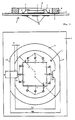
- Fig. 2 shows the carrier element, 1 of Fig. 1 from above.
- the Stiffening ring 8 has a thickness of approximately 0.4 mm and can therefore easily be used in chip cards with a standard thickness of 0.76 mm (ISO standard) can be integrated.
- the stiffening ring 8 has on the outside there are two opposite straight areas 12 and 13.
- the straight areas 12 and 13 allow or facilitate the orientation of the stiffening ring 8 on the carrier film 2, since they are brands or markings for optical detection systems of handling machines serve.
- the outer diameter Da of the stiffening ring 8 measured at these straight areas 12 and 13 is approx.
- the inner diameter Di of the stiffening ring is 8.4 mm at these points.
- the projections 14 and 15 serve primarily for orientation of fully automatic bond machines.
- projections 14 and 15 also increase stability the narrower stiffening ring in the straight areas 12 and 13 8.
- the outer dimension is there through the ISO standard given.
- the depth T of these projections is approximately 0.5 mm and their width B about 1.4 mm.
- the shape of the Stiffening ring 8 according to FIG. 2 has a sufficient one high bending stiffness on the other hand this is Shape optimized for use in chip cards in accordance with the ISO standard.
- Semiconductor chips can be placed in the stiffening ring 8 according to FIG. 2 use up to a base area of up to 5.7 x 5.7 mm.
- the provision of brands for optical recognition systems allows a rational production of the support element with large
- the carrier element 1 according to the invention is preferred made in tape form, d. H. a plurality of successive carrier elements is in the form of a Ribbon provided.
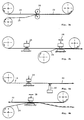
- Fig. 3 is used for explanation a first variant of a manufacturing process for the Support elements according to Fig. 1.
- the material for the stiffening ring 8th is in the form of a first volume 16.
- a double sided Adhesive tape 18 for forming the adhesive layer 10 will be provided.
- One side of the adhesive tape 18 is with covered with a protective film, not shown. Both tapes are in roll form.
- the two bands 16 and 18 are unrolled and fed to a pressing device 20. The The two tapes are brought together in such a way that the Side of the adhesive tape 18, which has no protective film glued to the first band 16 by the pressing device 20 becomes.
- the resulting combination tape 22 with the adhesive layer 10 can either be fed directly to a ring punch 24 or rolled up again and at a later date to be processed further.
- the ring punch 24 punches out of the Combination band 22 the stiffening ring 8 in the desired shape out.
- the ring punch 24 is, however, designed so that the Stiffening ring 8 remains in the combination band 22, so that processed the combination belt 22 with the stiffening ring 8 can be.
- the next step is the flexible in the form of a second band 26 Carrier film 2 merged with the combination tape 22 and the two bands 22 and 26 are relative to each other in one Positioning and pressing device 28 positioned so that the Stiffening ring 8 in the desired position over the connection points 6 comes to rest.
- the stiffening ring 8 from the combination band 22 pushed out and in the desired position with the second tape 26 glued This must be done beforehand, preferably between Ring punch 24 and feeding the second tape 26, the protective film still on the combination belt 22 is removed (not shown).
- the remaining combination tape 22 without stiffening ring 8 can be collected and the resulting support elements 1 with stiffening ring 8 in Form of an endless belt can either also be rolled up be or immediately the further processing, the equipping with the semiconductor crystal 7, are supplied.
- Fig. 4 shows a second variant of a method for manufacturing of the carrier elements according to Fig. 1.
- Fig. 4 are corresponding Provide components with the same reference numerals as in Fig. 3.
- the schematically shown in Fig. 4 The method differs from the method according to FIG. 3 only in that the adhesive layer 10 is not in shape a double-sided adhesive tape applied to the first tape is, but directly using an adhesive spray device 30 is applied to the first band 16. Since the adhesive layer 10 is then present without a protective film the adhesive layer 10 only after punching out the stiffening ring 8 performed in the ring punch 24.
- the one with the Combination tape 22 provided with adhesive layer 10 is then immediately the pressing and positioning device 28, the likewise the flexible carrier film 2 in the form of the second Band 26 is fed.
- the further process steps correspond to the method according to FIG. 3.
- Carrier elements 1 in the form of a ribbon are then also fully automatic with one or more semiconductor crystals 7 and the interior of the stiffening ring 8 with the semiconductor crystal 7 and connecting wires 3 then poured out with the covering compound 11. If the masking compound 11 is cured, if necessary, excess Masking compound sanded. Equipping the carrier film or carrier substrates 2 with the semiconductor crystals 7 by means of known methods or with known fully automatic Pick and place machines and bond machines. Pouring the inside of the stiffening ring 8 with the casting or covering compound 11 is done in a known manner. The resulting one or more semiconductor circuits equipped carrier elements 1 can then be separated and built into chip cards, for example. In The separation of the individually finished components is advantageously carried out Support elements only immediately before or at Installation in the chip cards.
- the support element described above is Particularly suitable for installation in chip cards according to the ISO standard and designed.
- the carrier elements according to the invention can of course also be used in other circuits and devices install, exposed to mechanical stress are.
- FIG. 5 shows a sectional view of a first embodiment an inventive chip card 36.
- the chip card 36 has a card body 37 with an integrated therein Carrier element 1 on which the integrated circuit 7 is glued on.
- the carrier element 1 with the semiconductor chip 7 is in a corresponding recess 38 of the card body 37 embedded.
- the top of the stiffening ring 8 will by a cover layer 40, which is part of the card body 37 is covered.
- the underside of the carrier element 1 and the Carrier film 2 is aligned with one side of chip card 36, see above that the contact surfaces 4 from this side of the chip card 36 are accessible.
- the chip card 50 also has a card body 52 into which the carrier element according to the invention 1 is integrated with IC.
- the card body 52 is made from four laminate layers, an upper cover layer 54, a middle layer 55, a leveling layer 56 and a lower cover layer 57 which is used in the manufacture of the Chip card 50 pressed under hot pressure to card body 52 become.
- the middle layer 55. the compensation layer 56 and the lower cover layer 57 have recesses which are together form a recess 58, which the carrier element 1 fills out.
- the top cover layer 54 covers the reinforcement ring 8.
- the middle layer then follows as the next laminate layer 55, whose thickness is less than the height of the reinforcement ring 8 and has a recess that the Cross section of the reinforcement ring 8 corresponds.
- the compensation layer 56 the thickness of which is equal to the thickness of the Carrier substrate 2 is.
- the compensation layer 56 has one Recess on which corresponds to the surface of the carrier element 1 and which is therefore larger than the recess in the Middle layer 55.
- the lower cover layer 57 the other side of the carrier element 1 and so that the carrier substrate 2 covers and only the contact surfaces 4 leaves freely accessible. It doesn't just make the whole thing Carrier element 1 sandwiched by laminate layers, but also not from the reinforcement ring 8 covered part of the flexible carrier substrate 2.
- the support element 1 is held in the card body 52 additionally improved by the fact that the Reinforcement ring 8 covers part of the carrier substrate 2 is arranged deeper in the finished card body 52 than the part of the carrier substrate covered by the reinforcing ring 8 2.
- This forms the of the stiffening ring 8th covered part of the carrier substrate 2 in a flat trough not covered by the stiffening ring 8 part of the carrier substrate 2.
- a particularly flexible carrier substrate 2 must be used.
- a film made of polyimide is particularly suitable for this because of their temperature stability up to 250 ° C and their high Flexibility.
- the thickness of the foils used is approx. 100 ⁇ m.
- Access to the semiconductor crystal embedded in the chip card can instead of over contact areas also done via induction loops. This has the advantage that upper and lower cover layers none Must have recesses, d. H. is the carrier element completely embedded in the card body.
- Carrier element with several arranged side by side Install stiffening rings in a chip card.
Landscapes
- Engineering & Computer Science (AREA)
- Computer Hardware Design (AREA)
- Microelectronics & Electronic Packaging (AREA)
- Physics & Mathematics (AREA)
- General Physics & Mathematics (AREA)
- Theoretical Computer Science (AREA)
- Credit Cards Or The Like (AREA)
- Structures Or Materials For Encapsulating Or Coating Semiconductor Devices Or Solid State Devices (AREA)
Abstract
Description
Die vorliegende Erfindung betrifft ein Trägerelement mit wenigstens einem integriertem Schaltkreis bzw. Halbleiter-Chip, insbesondere für den Einbau in sogenannte Chip-Karten.The present invention relates to a carrier element with at least an integrated circuit or semiconductor chip, especially for installation in so-called chip cards.
Chip-Karten finden immer breitere Verwendung als Identifikations-, Kredit- oder Buchungskarten und dergleichen. Um die Herstellung dieser Karten rationell und kostengünstig zu gestalten, wird als Trägerelement vorzugsweise ein Halbfabrikat verwendet, bei dem auf einer mit Leiterbahnen versehenen flexiblen Trägerfolie ein oder mehrere integrierte Schaltkreise in Form von Halbleiter-Kristallen montiert sind. Die Kontaktierung der integrierten Schaltkreise bzw. Halbleiter-Chips mit entsprechenden Anschlußpunkten auf der flexiblen Trägerfolie geschieht üblicherweise entweder mittels Bond-Verfahren (z.B. DE-OS 32 35 650) oder mittels Direktkontaktierungs-Verfahren (z.B. DE-AS 29 20 012). Bei der Kartenherstellung werden diese Trägerelemente in passend geformte Ausparungen des Kartenmaterials eingesetzt. Beim Verpressen von Chipkartenlaminaten und Trägerelementen treten je nach verwendetem Verfahren Drücke bis zu 160 bar auf. Dabei werden die empfindlichen integrierten Schaltkreise bzw. Halbleiter-Chips häüfig beschädigt. Auch die beim Gebrauch von Chip-Karten auftretenden Verbiegungen und daraus resultierende Biegekräfte können zu einer Beschädigung der Halbleiter-Chips führen. Um derartige Beschädigungen zu vermeiden bzw. zu reduzieren, ist es beispielsweise aus der DE-OS 36 39 630 bekannt, den bereits mit dem Trägerelement verbundenen Halbleiter-Chip durch eine Schutzfolie aus einem Material mit hohem elastischen Deformierungsvermögen abzudecken.Chip cards are increasingly used as identification, Credit or booking cards and the like. To the To make the production of these cards rational and inexpensive, is preferably a semi-finished product as a carrier element used in the one provided with conductor tracks flexible carrier film one or more integrated Circuits mounted in the form of semiconductor crystals are. The contacting of the integrated circuits or Semiconductor chips with corresponding connection points on the flexible carrier film is usually done either by means of Bonding process (e.g. DE-OS 32 35 650) or using the direct contacting process (e.g. DE-AS 29 20 012). In the Card making, these carrier elements are shaped into suitably Cut-outs of the map material used. When pressing of chip card laminates and carrier elements depending on the process used, pressures up to 160 bar. Here the sensitive integrated circuits or Semiconductor chips frequently damaged. Even when in use of bends and resulting therefrom Bending forces can damage the semiconductor chips to lead. To avoid such damage or to reduce it, for example from DE-OS 36 39 630 known, the one already connected to the carrier element Semiconductor chip through a protective film from a Cover material with high elastic deformability.
Durch die Verbiegungen beim Kartengebrauch kommt es auch immer wieder vor, daß an der Nahtstelle zwischen Halbleiter-Chip und Kartenmaterial Risse auftreten und unter extremen Bedingungen der gesamte Halbleiter-Kristall aus der Karte herausbricht. Um dies zu vermeiden ist es beispielsweise aus der EP-A 0 211 360 bekannt zwischen Halbleiter-Chip und Kartenmaterial eine dünne verstärkende Schicht, beispielsweise aus einem dünnen Netzgeflecht, vorzusehen.Because of the bends when using cards, it always happens again before that at the interface between the semiconductor chip and map material cracks occur and under extreme Conditions of the entire semiconductor crystal from the card breaks out. To avoid this, it is off, for example EP-A 0 211 360 known between semiconductor chip and card material a thin reinforcing layer, for example made of a thin mesh.
Wenn die Halbleiter-Kristalle bzw. Halbleiter-Chips durch Banden mit den entsprechenden Anschlußpunkten auf der flexiblen Trägerfolie verbunden werden, werden die Band-Drähte und der Halbleiter-Chip üblicherweise mit einer Guß- bzw. Abdeckmasse versehen. Diese Guß- oder Abdeckmasse schützt natürlich nicht nur die Band-Drähte sondern auch den Halbleiter-Chip. Um diese Gußmasse im flüssigen bzw. halbflüssigen Zustand gezielt aufbringen zu können, ist es beispielsweise aus der DE-OS 32 35 650 bzw. der EP-A-0 107 161 bekannt, das Trägerelement mit einem dem Halbleiter-Chip samt Band-Drähten umgebenden ringförmigen Begrenzungsrahmen zu versehen. Dieser Begrenzungsring für die Abdeckmasse besteht üblicherweise aus Glasepoxy oder PVC, d. h. dem gleichen Material aus dem auch der Kartenkörper besteht. Es besteht daher die Gefahr, daß beim Verpressen der Trägerelemente mit den Chipkartenlaminat Beschädigungen des Halbleiter-Kristalls auftreten. Die Stabilität dieser Anordnung wird auch dadurch beeinträchtigt, daß der Halbleiter-Kristall in einer Ausnehmung in der flexiblen Trägerfolie angeordnet ist.If the semiconductor crystals or semiconductor chips through Gangs with the corresponding connection points on the flexible Carrier foil are connected, the ribbon wires and the semiconductor chip usually with a cast or Provide masking compound. This casting or masking compound protects of course not just the ribbon wires but also the semiconductor chip. Around this casting compound in liquid or semi-liquid For example, to be able to apply the condition in a targeted manner from DE-OS 32 35 650 and EP-A-0 107 161 known, the carrier element with a semiconductor chip together with ribbon wires surrounding annular bounding frames to provide. This limiting ring for the masking compound usually consists of glass epoxy or PVC, i.e. H. the the same material as the card body. It there is therefore a risk that when pressing the Carrier elements with the chip card laminate damage the Semiconductor crystal occur. The stability of this Arrangement is also affected by the fact that Semiconductor crystal in a recess in the flexible Carrier film is arranged.
Aus der DE-OS 29 42 422 ist es bekannt, den Begrenzungsrahmen für die Verguß- bzw. Abdeckmasse gleichzeitig als Verstärkungsrahmen für das Trägerelement auszubilden. Dieser Verstärkungsrahmen ist am Rande der Trägerplatte bzw. des Trägerelements angeordnet und dient dazu, die Trägerplatte als Ganzes genügend zu versteifen. D. h. die Trägerplatte wird durch den Versteifungsring nur soweit versteift, daß sie dennoch die "erforderliche Biegsamkeit" aufweist. Erforderliche Biegsamkeit heißt in diesem Zusammenhang, daß die durch die ISO/DIN-Norm für die Chip-Karten geforderten Belastungen, insbesondere Biegebelastungen, nicht zu einer Zerstörung oder Funktionsbeeinträchtigung der Chip-Karte führen. Da die aus diesem Stand der Technik bekannten Versteifungsrahmen am Rande des Trägerelements bzw. der Trägerplatte angeordnet sind, ist es unvermeidlich, daß bei derartigen Biegungen die empfindlichen Halbleiterkristalle mechanisch beansprucht werden.From DE-OS 29 42 422 it is known that Bounding frame for the sealing compound or covering compound at the same time as a reinforcement frame for the carrier element to train. This reinforcement frame is on the edge of the Carrier plate or the carrier element arranged and used to stiffen the carrier plate as a whole sufficiently. D. H. the backing plate is only through the stiffening ring stiffened to the extent that they still "required Flexibility ". Required flexibility means in this context that the ISO / DIN standard for Chip cards required charges, in particular Bending loads, not to destruction or impairment of function the chip card. Because the one from this State of the art known stiffening frame on the edge of Carrier element or the carrier plate are arranged, it is inevitable that with such bends the sensitive Semiconductor crystals are mechanically stressed.
Schließlich ist aus der EP-A-0 231 937, von der der Anspruch
1 im Oberbegriff ausgeht, ein Trägerelement aus einem flexiblen
Trägersubstrat bekannt, bei dem der Halbleiter-Kristall
und die den Halbleiter-Kristall mit den Leiterbahnen
auf dem flexiblen Trägersubstrat verbindenden Bonddrähte
durch einen Versteifungsring aus rostfreiem Stahl umschlossen
sind. Die Stabilität dieser Anordnung wird jedoch dadurch
beeinträchtigt, daß der Halbleiter-Kristall in einer
Ausnehmung in der flexiblen Trägerfolie angeordnet ist.Finally, from EP-A-0 231 937, of which the
Aufgabe der vorliegenden Erfindung ist es, ein Trägerelement für integrierte Schaltkreise sowie ein Verfahren zu dessen Herstellung zu schaffen, bei dem die empfindlichen Bauteile sehr gut gegen mechanische Belastungen geschützt sind und eine rationelle und kostengünstige Herstellung möglich ist. Weiter ist es Aufgabe der vorliegenden Erfindung eine mit einem derartigen Trägerelement versehene Chip-Karte zu schaffen.The object of the present invention is a carrier element for integrated circuits as well as a method to create its manufacture, in which the sensitive components are very well protected against mechanical loads and are rational and inexpensive production is possible. It is a further object of the present invention a chip card provided with such a carrier element to accomplish.
Die Lösung dieser Aufgabe erfolgt durch die Merkmale der Ansprüche
1 bzw. 12 bzw. 15. This object is achieved by the features of the
Dadurch, daß der Versteifungsring eine wesentlich höhere bzw. größere Biegesteifigkeit aufweist als das flexible Trägersubstrat, d.h. der Versteifungsring im Vergleich zum Trägersubstrat völlig steif ist, können Biege- und Torsionsbeanspruchungen des Trägersubstrats nicht zur Beschädigung des von dem Versteifungsring unschlossenen Halbleiterkristalls führen. Der nur einen Teil der Fläche des Trägerelements einnehmende Verstärkungsring wirkt in Verbund mit dem flexiblen Trägersubstrat bei sämtlichen Biege- und Torsionsbeanspruchungen des Trägersubstrats als verwindungssteife Zelle und schützt dadurch den Halbleiter-Kristall vor mechanischen Beanspruchungen. Grundsätzlich sollte der Verstärkungsring den Halbleiterkristall möglichst eng umschließen, um den starren bzw. steifen Bereich möglichst klein zu halten. Der minimal notwendige Abstand zwischen dem Halbleiterkristall bzw. zwischen den Halbleiterkristallen und dem Innenrand des Verstärkungsringes wird durch den für die elektrische Verbindung des Halbleiterkristalls benötigten Raum bestimmt.Because the stiffening ring has a much higher or has greater bending stiffness than the flexible carrier substrate, i.e. the stiffening ring compared to the carrier substrate is completely stiff, can bend and torsion of the carrier substrate does not damage the from the stiffening ring of unclosed semiconductor crystal to lead. The only part of the area of the support element engaging reinforcement ring works in conjunction with the flexible Carrier substrate for all bending and torsion stresses of the carrier substrate as a warp resistant Cell and thereby protects the semiconductor crystal from mechanical Stresses. Basically, the reinforcement ring enclose the semiconductor crystal as closely as possible, to keep the rigid or rigid area as small as possible. The minimum necessary distance between the semiconductor crystal or between the semiconductor crystals and the inner edge of the reinforcement ring is used for the electrical Connection of the semiconductor crystal required space certainly.
Die Biegesteifigkeit eines Körpers wird im wesentlichen durch seine geometrische Form und das Material bzw. genauer durch den Elastizitätsmodul des Materials bestimmt. Die ideale Form für den Verstärkungsring ist kreisringförmig, da dann die angreifenden Kräfte optimal von dem Verstärkungsring aufgenommen werden. Um in jedem Falle eine genügend hohe Biegesteifigkeit des Versteifungsringes zu gewährleisten, wird bei einer bevorzugten Ausführungsform Material mit einem Elastizitätsmodul von über 500 N/mm2 verwendet.The bending stiffness of a body is essentially determined by its geometric shape and the material or more precisely by the elastic modulus of the material. The ideal shape for the reinforcement ring is circular, since then the attacking forces are optimally absorbed by the reinforcement ring. In order to ensure a sufficiently high bending stiffness of the stiffening ring in any case, in a preferred embodiment material with an elastic modulus of over 500 N / mm 2 is used.
Eine genügend hohe Biegesteifigkeit kann durch die Verwendung von geeigneten Metallen bzw. Metall-Legierungen gewährleistet werden. Darüberhinaus weisen Metalle noch den Vorteil auf, daß sie gegenüber den bei der Kartenherstellung auftretenden Temperaturen und Drücken (ca. 160 bar, ca. 180°C) unempfindlich sind. Insbesondere behalten Metalle bei den fraglichen Drücken und Temperaturen ihre Formstabilität, so daß der Halbleiterkristall während der Chip-Karten-Herstellung, d. h. während dem Verpressen der verschiedenen Laminatschichten, sehr gut geschützt ist.A sufficiently high bending stiffness can be achieved by using of suitable metals or metal alloys become. In addition, metals have the advantage that they are opposite to those in card making occurring temperatures and pressures (approx. 160 bar, approx. 180 ° C) are insensitive. In particular, metals retain the pressures and temperatures in question their dimensional stability, so that the semiconductor crystal during chip card manufacturing, d. H. during the pressing of the different laminate layers, is very well protected.
Darüberhinaus ist Metall fertigungstechnisch leicht zu handhaben. Als bevorzugte Materialen werden für den Ring die Legierungen CuSn6, 195 HV (HV = Härte nach Vikers) oder CrNi 17/7, 220 HV verwendet. In addition, metal is easy to handle in terms of production technology. The alloys are the preferred materials for the ring CuSn6, 195 HV (HV = hardness according to Vikers) or CrNi 17/7, 220 HV used.
Da der Versteifungsring gemäß der vorliegenden Erfindung natürlich nach wie vor auch die Funktion eines Begrenzungsrahmens für die Abdeckmasse erfüllt sind damit keinerlei fertigungstechnische Nachteile bzw. Mehraufwand verbunden. Wird der Versteifungsring zusätzlich mit Marken für optische Erkennungssysteme, z.B. von Handhabungsautomaten und Bondmaschinen, versehen, wird zum einen die vollautomatische Positionierung des Versteifungsringes auf der flexiblen Trägerfolie erleichtert bzw. ermöglicht und zum anderen dienen diese Marken bzw. Markierungen auch der Positionierung von vollautomatischen Bond-Maschinen bzw. Bond-Automaten. Diese Marken für optische Erkennungssysteme können beispielsweise in Form von in das Innere des Ringes vorspringende Zapfen ausgeführt sein.Since the stiffening ring according to the present invention is natural still the function of a bounding box For the masking compound, no manufacturing requirements are met Disadvantages or additional effort associated. Becomes the stiffening ring also with brands for optical detection systems, e.g. of handling machines and bonding machines, fully automatic positioning of the stiffening ring on the flexible carrier film facilitated or made possible and serving others these marks or markings also the positioning of fully automatic bond machines or bond machines. This Brands for optical recognition systems can for example in the form of pins protruding into the interior of the ring be executed.
Das erfindungsgemäße Trägerelement ist besonders zum Einbau in sogenannte Chip-Karten geeignet. Das dünne Trägersubstrat läßt sich sehr gut mit dem den Kartenlaminaten verpressen, so daß ein unbeabsichtigtes Herauslösen des Halbleiterkristalls während des Gebrauchs der Karte nahezu ausgeschlossen ist. Das Trägerelement ist zumindest im Randbereich nach Art eines Sandwich mit den Kartenlaminaten verbunden. Wird die Biegesteifigkeit des Verstärkungsringes so gewählt, daß sich bei Verbiegung der Chip-Karte - in Rahmen des üblichen Gebrauchs bzw. im Rahmen der ISO-Norm 7816 - der Verstärkungsring nicht verbiegt, so wirkt das oder die in die Chip-Karte integrierten Trägerelemente weiterhin wie eine verwindungssteife Zelle und schützen den Halbleiterkristall zuverlässig. Bei der Chip-Karten-Herstellung als auch beim Kartengebrauch auftretende Druck- und Scherkräfte werden im wesentlichen von dem Versteifungsring aufgenommen und somit vom Halbleiter-Chip ferngehalten.The carrier element according to the invention is particularly suitable for installation suitable in so-called chip cards. The thin carrier substrate can be pressed very well with the card laminates, so that unintentional removal of the semiconductor crystal almost impossible while using the card is. The support element is at least in the edge area according to Art a sandwich bonded to the card laminates. Will the Bending stiffness of the reinforcement ring chosen so that if the chip card is bent - in the context of normal use or as part of the ISO standard 7816 - the reinforcement ring not bent, that is how it works in the chip card integrated carrier elements continue to be like a torsion-resistant Cell and reliably protect the semiconductor crystal. In chip card production as well as when using cards occurring pressure and shear forces are essentially taken up by the stiffening ring and thus by Semiconductor chip kept away.
Bei dem erfindungsgemäßen Herstellungsverfahren nach Anspruch 15 wird das Material für den Versteifungsring in Form eines ersten Bandes bzw. Flachbandes bereitgestellt. Dieses aufgerollte Flachband wird abgewickelt und mit einer Klebeschicht versehen, so daß ein Kombiband entsteht. Die Klebeschicht kann als trägerloses Klebeband in Standardform durch Aufwalzen auf dem Kombiband erzeugt werden. Alternativ hierzu kann die Klebeschicht durch unmittelbares Aufsprühen auf das erste Band erzeugt werden. Das mit Klebeschicht versehene Kombiband wird automatisch einem Stanzwerkzeug zugeführt, durch das der Versteifungsring in der gewünschten Form aus dem Metall ausgestanzt wird, jedoch so daß er in dem Band verbleibt. Das Kombiband mit dem ausgestanzten Versteifungsring wird mittels eines Handhabungsautomaten über das ebenfalls in Form eines Endlosbandes - zweites Band - automatisch zugeführte flexible Trägersubstrat positioniert und der Versteifungsring wird mit dem flexiblen Trägersubstrat verpreßt bzw. verklebt. In einem weiteren in der Zeichnung nicht näher dargestellten Verfahrensschritt wird das zweite Band mit wenigstens einem integrierten Schaltkreis bestückt, der über die Anschlußpunkte elektrisch angeschlossen wird. Anschließend wird in einem ebenfalls nicht näher dargestellten Verfahrensschritt das Innere des Versteifungsrings mit einer Abdeckmaske ausgefüllt, so daß der Halbleiter-Kristall von der Abdeckmaske schützend umgeben ist. Die so entstehenden Trägerelemente liegen nach wie vor in Form eines Bandes vor und können somit ohne weiteres automatisch weiterverarbeitet werden.In the manufacturing method according to the invention according to claim 15 the material for the stiffening ring is in shape a first band or flat band provided. This rolled up flat tape is unwound and with an adhesive layer provided so that a combination tape is formed. The adhesive layer can be used as a strapless tape in standard form Rolling are generated on the combination belt. Alternatively this can be done by spraying on the adhesive layer be generated on the first band. The one with an adhesive layer Combo tape is automatically fed to a punching tool through which the stiffening ring in the desired Form is punched out of the metal, but so that it in the tape remains. The combination band with the punched out stiffening ring is transferred using a handling machine that also in the form of an endless belt - second belt - automatically fed flexible carrier substrate positioned and the stiffening ring is made with the flexible support substrate pressed or glued. In another in the Drawing is not shown process step the second band with at least one integrated circuit equipped, which is electrically connected via the connection points becomes. After that, neither will Process step shown in detail the inside of the stiffening ring filled with a mask so that the Semiconductor crystal surrounded by the protective mask is. The support elements created in this way are still there in the form of a tape and can therefore be easily can be processed automatically.
Die einzelnen Verfahrensschritte des erfindungsgemäßen Verfahrens sind im Sekundentakt ausführbar und erlauben somit eine kostengünstige Fertigung bei großen Stückzahlen.The individual process steps of the method according to the invention are executable every second and thus allow cost-effective production in large quantities.
Weitere Einzelheiten, Aspekte und Vorteile der vorliegenden Erfindung ergeben sich aus der nachfolgenden Beschreibung unter Bezugnahme auf die Zeichnungen. Further details, aspects and advantages of the present Invention result from the following description with reference to the drawings.
Es zeigt:
- Fig. 1
- Eine Schnittansicht einer bevorzugten Ausführungsform des Trägerelements mit IC;
- Fig. 2
- eine Aufsicht auf die Ausführungsform nach Fig. 1;
- Fig. 3
- eine schematische Darstellung einer ersten Variante eines Herstellungsverfahrens für die Trägerelemente nach Fig. 1;
- Fig. 4
- eine zweite Variante eines Herstellungsverfahrens für die Trägerelemente nach Fig. 1;
- Fig. 5
- einen Schnitt durch eine erste Ausführungsform einer Chip-Karte mit dem Trägerelement nach Fig. 1; und
- Fig. 6
- einen Schnitt durch eine weitere Ausführungsform einer Chip-Karte mit dem erfindungsgemäßen Trägerelement.
- Fig. 1
- A sectional view of a preferred embodiment of the carrier element with IC;
- Fig. 2
- a plan of the embodiment of FIG. 1;
- Fig. 3
- a schematic representation of a first variant of a manufacturing method for the carrier elements according to FIG. 1;
- Fig. 4
- a second variant of a manufacturing process for the carrier elements of FIG. 1;
- Fig. 5
- a section through a first embodiment of a chip card with the carrier element of FIG. 1; and
- Fig. 6
- a section through a further embodiment of a chip card with the carrier element according to the invention.
Das erfindungsgemäße Trägerelement 1 weist ein flexibles
Trägersubstrat in Form einer flexiblen Trägerfolie 2 auf,
auf der ein- oder beidseitig nicht dargestellte Leiterbahnen
vorgesehen sind. Das Trägersubstrat 2 kann aus Polyimid, faserverstärktem
Epoxy (EPG) oder Polyester bestehen. Die
Leiterbahnen stellen elektrische Verbindungen zwischen Kontaktflächen
4 und Anschlußpunkten 6 her. Über die Anschlußpunkte
6 wird mittels aufgebondeten Golddrähten 3 der elektrische
Kontakt zu einem integrierten Schaltkreis bzw. Halbleiter-Chip
7 hergestellt. Über die Kontaktflächen 4 wird
später beim Gebrauch der fertiggestellten Chip-Karte der
Kontakt zu dem Halbleiter-Chip 7 hergestellt. In dem Trägerelement
1 nach Fig. 1 liegen die Kontaktflächen 4 auf der
einen Seite der flexiblen Trägerfolie 2 und die Anschlußpunkte
6 auf der anderen Seite der flexiblen Trägerfolie.
Auf der Seite mit den Anschlußpunkten 6 ist auch der Halbleiter-Chip
bzw. -Kristall 7 auf der Trägerfolie 2 angeordnet.
Auf dieser Seite der flexiblen Trägerfolie ist auch ein
den Halbleiter-Chip bzw. Halbleiterkristall 7 umschließender
Versteifungsring 8 befestigt. Der Versteifungsring 8 überdeckt
lediglich einen Teil der Fläche des Trägersubstrats 2.
Der Versteifungsring 8 besteht aus der Metall-Legierung
CuSn6 mit einer Härte von 195 HV. Die wesentlichen mechanischen
Eigenschaften dieses Materials sind der nachfolgenden
Tabelle zu entnehmen.
Der Versteifungsring 8 und der Halbleiterkristall 7 sind
mittels einer Klebeschicht 10 auf der flexiblen Trägerfolie
2 befestigt. Das Innere des Versteifungsringes (8) ist mit
einer Abdeckmasse 11 ausgefüllt, so daß die Halbleiter-Kristalle
7 samt Bonddrähten 3 von der Abdeckmasse 11 schützend
umgeben sind.The
Fig. 2 zeigt das Trägerelement, 1 von Fig. 1 von oben. Der
Versteifungsring 8 weist eine Dicke von ca. 0,4 mm auf und
kann somit ohne weiteres in Chip-Karten mit einer Normdicke
von 0,76 mm (ISO-Norm) integriert werden. Der Versteifungsring
8 ist in seiner Grundform kreisringförmig mit einem inneren
Durchmesser von R1 = 4,5 mm und einem äußeren Durchmesser
von R2 = 6,0 mm. Der Versteifungsring 8 weist auf
seiner Außenseite zwei einander gegenüberliegende gerade Bereiche
12 und 13 auf. Die geraden Bereiche 12 und 13 ermöglichen
bzw. erleichtern die Orientierung des Versteifungsrings
8 auf der Trägerfolie 2, da sie als Marken bzw. Markierungen
für optische Erkennungsysteme von Handhabungsautomaten
dienen. Der Außendurchmesser Da des Versteifungsringes
8 gemessen an diesen geraden Bereichen 12 und 13 beträgt ca.
10,4 mm, der Innendurchmesser Di des Versteifungsringes beträgt
an diesen Stellen 8,4 mm. Auf der Innenseite des
Versteifungsringes 8, den geraden Bereichen 12 und 13 gegenüberliegend,
sind ebenfalls Marken für optische Erkennungssysteme
in Form von rechteckförmigen Vorsprüngen 14 und 15
vorgesehen. Die Vorsprünge 14 und 15 dienen in erster Linie
zur Orientierung von vollautomatischen Bond-Maschinen. Zusätzlich
erhöhen die Vorsprünge 14 und 15 auch die Stabilität
des in den geraden Bereichen 12 und 13 schmäleren Versteifungsrings
8. Das Außenmaß da ist durch die ISO-Norm
vorgegeben. Die Tiefe T dieser Vorsprünge beträgt dabei ca.
0,5 mm und ihre Breite B ca. 1,4 mm. Die Form des
Versteifungsringes 8 gemäß Fig. 2 weist zum einen eine genügend
hohe Biegesteifigkeit auf und zum anderen ist diese
Form für den Einsatz in Chip-Karten nach ISO-Norm optimiert.
In dem Versteifungsring 8 gemäß Fig. 2 lassen sich Halbleiter-Chips
bis zu einer Grundfläche bis zu 5,7 x 5,7 mm einsetzen.
Das Vorsehen von Marken für optische Erkennungssysteme
erlaubt eine rationelle Fertigung der Trägerelement
mit hohen Stückzahlen.Fig. 2 shows the carrier element, 1 of Fig. 1 from above. The
Das erfindungsgemäße Trägerelement 1 wird vorzugsweise
in Bandform hergestellt, d. h. eine Mehrzahl von
aufeinanderfolgenden Trägerelementen wird in Form eines
Flachbandes bereitgestellt. Fig. 3 dient der Erläuterung
einer ersten Variante eines Herstellungsverfahrens für die
Trägerelemente nach Fig. 1. Das Material für den Versteifungsring 8
liegt in Form eines ersten Bandes 16 vor. Ein doppelseitiges
Klebeband 18 zur Bildung der Klebeschicht 10
wird bereitgestellt. Eine Seite des Klebebandes 18 ist mit
einer nicht dargestellten Schutzfolie überzogen. Beide Bänder
liegen in Rollenform vor. Die beiden Bänder 16 und 18
werden abgerollt und einer Preßvorrichtung 20 zugeführt. Die
Zusammenführung der beiden Bänder erfolgt dabei so, daß die
Seite des Klebebandes 18, die keine Schutzfolie aufweist
durch die Preßvorrichtung 20 mit dem ersten Band 16 verklebt
wird. Das entstehende Kombi-Band 22 mit der Klebeschicht 10
kann entweder unmittelbar einer Ringstanze 24 zugeführt werden
oder wieder aufgerollt und zu einem späteren Zeitpunkt
weiter verarbeitet werden. Die Ringstanze 24 stanzt aus dem
Kombi-Band 22 den Versteifungsring 8 in der gewünschten Form
aus. Die Ringstanze 24 ist jedoch so ausgebildet, daß der
Versteifungsring 8 in dem Kombi-Band 22 verbleibt, so daß
das Kombi-Band 22 mit dem Versteifungsring 8 weiterverarbeitet
werden kann. In einem nächsten Verfahrensschritt wird
die in Form eines zweiten Bandes 26 vorliegende flexible
Trägerfolie 2 mit dem Kombi-Band 22 zusammengeführt und die
beiden Bänder 22 und 26 werden relativ zueinander in einer
Positionier- und Preßvorrichtung 28 so positioniert, daß der
Versteifungsring 8 in der gewünschten Lage über den Anschlußpunkten
6 zu liegen kommt. In einen weiteren Verfahrensschritt
wird der Versteifungsring 8 aus dem Kombi-Band
22 herausgedrückt und in der gewünschten Position mit den
zweiten Band 26 verklebt. Dazu muß vorher, vorzugsweise zwischen
Ringstanze 24 und dem Zuführen des zweiten Bandes 26,
die noch auf dem Kombi-Band 22 befindliche Schutzfolie entfernt
werden (nicht dargestellt). Das verbleibende Kombi-Band
22 ohne Versteifungsring 8 kann aufgesammelt werden und
die entstandenen Trägerelemente 1 mit Versteifungsring 8 in
Form eines Endlosbandes können entweder ebenfalls aufgerollt
werden oder unmittelbar der weiteren Verarbeitung, dem Bestücken
mit dem Halbleiterkristall 7, zugeführt werden.The
Fig. 4 zeigt eine zweite Variante eines Verfahrens zur Herstellung
der Trägerelemente nach Fig. 1. In Fig. 4 sind entsprechende
Komponenten mit den gleichen Bezugszeichen versehen
wie in Fig. 3. Das in Fig. 4 schematisch dargestellte
Verfahren unterscheidet sich von dem Verfahren gemäß Fig. 3
lediglich dadurch, daß die Klebeschicht 10 nicht in Form
eines doppelseitigen Klebebandes auf das erste Band aufgebracht
wird, sondern unmittelbar mittels einer Klebestoff-Sprühvorrichtung
30 auf das erste Band 16 aufgebracht wird.
Da die Klebeschicht 10 dann ohne Schutzfilm vorliegt, wird
die Klebeschicht 10 erst nach dem Ausstanzen des Versteifungsrings
8 in der Ringstanze 24 durchgeführt. Das mit der
Klebeschicht 10 versehene Kombi-Band 22 wird dann unmittelbar
der Preß- und Positioniervorrichtung 28 zugeführt, der
ebenfalls die flexible Trägerfolie 2 in Form des zweiten
Bandes 26 zugeführt wird. Die weiteren Verfahrensschritte
entsprechen dem Verfahren nach Fig. 3.Fig. 4 shows a second variant of a method for manufacturing
of the carrier elements according to Fig. 1. In Fig. 4 are corresponding
Provide components with the same reference numerals
as in Fig. 3. The schematically shown in Fig. 4
The method differs from the method according to FIG. 3
only in that the
Es sei betont, daß sämtliche Verfahrensschritte vollautomatisch
ohne jegliche Handarbeit durchgeführt werden. Anstatt
das Material für den Versteifungsring 8, die Trägerfolie,
etc. in Bandform zuzuführen, kann es auch mittels bekannter
Magazinanordnungen zugeführt werden.It should be emphasized that all process steps are fully automatic
without any manual work. Instead of
the material for the
Die nach dem Verfahren gemäß Fig. 3 bzw. 4 hergestellten
Trägerelemente 1 in Form eines Flachbandes werden dann ebenfalls
vollautomatisch mit einem oder mehreren Halbleiter-Kristalle
7 bestückt und das Innere des Versteifungsrings 8
mit dem Halbleiter-Kristall 7 und Anschlußdrähten 3 wird
dann mit der Abdeckmasse 11 ausgegossen. Wenn die Abdeckmasse
11 ausgehärtet ist, wird, sofern nötig, überschüssige
Abdeckmasse abgeschliffen. Das Bestücken der Trägerfolie
bzw. Trägersubstrate 2 mit den Halbleiterkristallen 7 geschieht
mittels bekannter Verfahren bzw. mit bekannten vollautomatischen
Bestückungsvorrichtungen und Bond-Maschinen.
Auch das Ausgießen des Inneren des Versteifungsrings 8 mit
der Guß- bzw. Abdeckmasse 11 geschieht in bekannter Weise.
Die so entstehenden mit einem oder mehreren Halbleiter-Schaltkreisen
bestückten Trägerelemente 1 können dann separiert
und beispielsweise in Chip-Karten eingebaut werden. In
vorteilhafter Weise erfolgt das Trennen der einzelnen fertigbestückten
Trägerelemente erst unmittelbar vor bzw. beim
Einbau in die Chip-Karten.The manufactured according to the method of FIG. 3 or 4
Das vorstehend beschriebene Trägerelement ist insbesondere für den Einbau in Chip-Karten nach ISO-Norm geeignet und ausgelegt. Die erfindungsgemäßen Trägerelemente lassen sich natürlich auch in andere Schaltungen und Vorrichtung einbauen, die mechanischen Beanspruchungen ausgesetzt sind.The support element described above is Particularly suitable for installation in chip cards according to the ISO standard and designed. The carrier elements according to the invention can of course also be used in other circuits and devices install, exposed to mechanical stress are.
Fig. 5 zeigt eine Schnittansicht einer ersten Ausführungsform
einer erfindungsgemäßen Chip-Karte 36. Die Chip-Karte
36 weist einen Kartenkörper 37 mit einem darin integrierten
Trägerelement 1 auf auf dem der integrierte Schaltkreis 7
aufgeklebt ist. Das Trägerelement 1 mit Halbleiter-Chip 7
ist in eine entsprechende Aussparung 38 des Kartenkörpers
37 eingebettet. Die Oberseite des Versteifungsrings 8 wird
von einer Abdeckschicht 40, die Teil des Kartenkörpers 37
ist, überzogen. Die Unterseite des Trägerelements 1 bzw. der
Trägerfolie 2 fluchtet mit einer Seite der Chip-Karte 36, so
daß die Kontaktflächen 4 von dieser Seite der Chip-Karte 36
zugänglich sind.5 shows a sectional view of a first embodiment
an
Fig. 6 zeigt schematisch eine bevorzugte weitere Ausführungsform
einer Chip-Karte 50. Auch die Chip-Karte 50 weist
einen Kartenkörper 52 auf, in den das erfindungsgemäße Trägerelement
1 mit IC integriert ist. Der Kartenkörper 52 besteht
aus vier Laminatschichten, einer oberen Deckschicht
54, einer Mittelschicht 55, einer Ausgleichsschicht 56 und
einer unteren Deckschicht 57, die bei der Herstellung der
Chip-Karte 50 unter Heißdruck zum Kartenkörper 52 verpreßt
werden. Die Mittelschicht 55. die Ausgleichsschicht 56 und
die untere Deckschicht 57 weisen Ausnehmungen auf, die zusammen
eine Aussparung 58 bilden, den das Trägerelement 1
ausfüllt. Die obere Deckschicht 54 überdeckt den Verstärkungsring
8. Dann folgt als nächste Laminatschicht die Mittelschicht
55, deren Dicke kleiner als die Höhe des Verstärkungsringes
8 ist und eine Ausnehmnung aufweist, die dem
Querschnitt des Verstärkungsringes 8 entspricht. Dann folgt
die Ausgleichsschicht 56, deren Dicke gleich der Dicke des
Trägersubstrats 2 ist. Die Ausgleichsschicht 56 weist eine
Ausnehmung auf, die der Fläche des Trägerelemnts 1 entspricht
und die somit größer ist als die Ausnehmung in der
Mittelschicht 55. Schließlich folgt noch die untere Deckschicht
57, die die andere Seite des Trägerelements 1 und
damit das Trägersubstrat 2 abdeckt und nur die Kontaktflächen
4 frei zugänglich läßt. Damit wird nicht nur das ganze
Trägerelement 1 sandwichartig durch Laminatschichten eingeschlossen,
sondern ebenso der nicht von dem Verstärkungsring
8 überdeckte Teil des flexiblen Trägersubstrats 2. 6 schematically shows a preferred further embodiment
a
Der Halt des Trägerelements 1 in dem Kartenkörper 52 wird
zusätzlich noch dadurch verbessert, daß der nicht von dem
Verstärkungsring 8 überdeckte Teil des Trägersubstrats 2
tiefer in dem fertigen Kartenkörper 52 angeordnet ist, als
der von dem Verstärkungsring 8 überdeckte Teil des Trägersubstrats
2. Damit bildet der von den Versteifungsring 8
überdeckte Teil des Trägersubstrat 2 eine flache Mulde im
nicht von dem Versteifungsring 8 überdeckten Teil des Trägersubstrats
2. Um die Anordnung nach Fig. 6 zu ermöglichen,
muß eine besonders flexibles Trägersubstrat 2 verwendet werden.
Besonders geeignet ist hierfür eine Folie aus Polyimid
wegen ihrer Temperaturstabilität bis 250°C und ihrer hohen
Flexibilität. Die Dicke der verwendeten Folien liegt bei ca.
100 um.The
Der Zugriff auf den in der Chip-karte eingebetteten Halbleiterkristall kann anstelle über Kontaktflächen auch über Induktionsschleifen erfolgen. Dies hat den Vorteil, daß obere und untere Deckschichten keinerlei Ausnehmungen aufweisen müssen, d. h. das Trägerelement ist vollständig in den Kartenkörper eingebettet.Access to the semiconductor crystal embedded in the chip card can instead of over contact areas also done via induction loops. this has the advantage that upper and lower cover layers none Must have recesses, d. H. is the carrier element completely embedded in the card body.
Es lassen sich auch mehrere Trägerelemente oder ein einzelnes Trägerelement mit mehreren nebeneinander angeordneten Versteifungsringen in eine Chip-Karte einbauen.Several carrier elements or a single element can also be used Carrier element with several arranged side by side Install stiffening rings in a chip card.
Claims (18)
- A carrier element comprising at least one integrated circuit (7) in the form of a semiconductor crystal, more particularly for inclusion in chip cards, comprisinga flexible carrier substrate (2), on the surface of which there are provided a number of contact surfaces (4) connected via printed conductors to junction points (6) for the integrated circuit (7), anda stiffening ring (8) being secured on the flexible carrier substrate (2), enclosing an inner partial surface of the carrier substrate (2) and being surrounded by a peripheral partial surface on its outer side, said integrated circuit (7) or integrated circuits being disposed on the inner partial surface,
characterised inthat at least the areas of the flexible carrier substrate (2) covered and surrounded by the stiffening ring (8) form a continuos plane surface,that the stiffening ring (8) has a much greater resistance to bending than the flexible carrier substrate (2) so that if the flexible carrier substrate (2) is bent the stiffening ring (8) does not bend,that the thickness of the stiffening ring (8) is smaller than its width, andthat the stiffening ring (8) acts as a torsion-resistant cell in conjunction with the flexible carrier substrate (2) and thus protects the semiconductor crystal (7) from mechanical stresses. - A carrier element according to claim 1, characterised in that the width of the stiffening ring (8) in direction of its diameter is about 1,5 mm and the thickness of the stiffening ring (8) is about 0,4 mm.
- A carrier element according to claim 1 or 2, characterised in that the stiffening ring (8) is circular.
- A carrier element according to any one of the preceding claims, characterised in that the material of which the stiffening ring (8) consists has a modulus of elasticity greater than 500 N/mm2.
- A carrier element according to any one of the preceding claims, characterised in that the stiffening ring (8) consists of metal or a metal alloy.
- A carrier element according to claim 5, characterised in that the stiffening ring (8) consists of CuSn6, 195 HV or CrNi 17/7, 220 HV.
- A carrier element according to any one of the preceding claims, characterised in that the stiffening ring (8) is adhered to the flexible carrier substrate (2).
- A carrier element according to any of the preceding claims, characterised in that the stiffening ring (8) has markings (12, 14) for optical recognition systems.
- A carrier element according to claim 8, characterised in that the markings (12, 14) comprise projections (14) in the form of pins pointing to the interior of the stiffening ring (8).
- A carrier element according to claim 8 or 9, characterised in that the markings (12, 14) comprise straight zones (12) at the outer edge of the stiffening ring (8).
- A carrier element according to any one of the preceding claims, characterised in that the flexible carrier substrate (2) consists of polyimide.
- A chip card comprising at least one integrated circuit disposed on a carrier element, characterised by a carrier element (1) according to any one of claims 1 to 11.
- A chip card according to claim 12, characterised in that it is an ISO-Standard chip card.
- A chip card according to any one of claims 12 to 13, characterised in that that part of the carrier substrate (2) which is surrounded and covered by the stiffening ring (8) forms a shallow trough in the remaining part of the carrier substrate (2) which is not surrounded and covered by the stiffening ring (8) so that the remaining part of the carrier substrate (2) is disposed more deeply in the chip card.
- A process for the production of a carrier element according to any one of claims 1 to 11 comprising the following steps:a) preparing the material for the stiffening ring (8) in the form of a first strip (16);b) preparing the flexible carrier substrate (2) with printed conductors, contact surfaces (4) and junction points (6) for integrated circuits in the form of a second strip (26);c) providing the first strip (16) with an adhesive coating (10) so as to form a combination strip (22);d) stamping the stiffening ring (8) out of the combination strip (22) in such manner that the thickness of the stiffening ring (8) is smaller than its width and that the stiffening ring (8) remains in the combination strip (22);e) bringing together the combination strip (22) with the stamped-out stiffening ring (8) and the second strip (26) and positioning the stiffening rings (8) in the combination strip (22) above the junction points (6) for integrated circuits on the second strip (26);f) separating the stiffening rings (8) from the combination strip (22) and sticking the positioned stiffening rings (8) to the second strip (26);g) providing the second strip (26) with at least one integrated circuit (7) and making the electrical connections between the junction points (6) and the integrated circuit; andh) filling the interior of the stiffening ring (8) with a masking compound (11).
- A process according to claim 15, characterised in that the steps c) and d) are changed over.
- A process according to claim 15 or 16, characterised in that in step c) a double-sided adhesive strip (18) is pressed to the first strip (16).
- A process according to claim 15 or 16, characterised in that in step c) the adhesive coating (10) is sprayed on to the first strip.
Priority Applications (1)
| Application Number | Priority Date | Filing Date | Title |
|---|---|---|---|
| AT90910564T ATE99439T1 (en) | 1989-07-24 | 1990-07-23 | CARRIER ELEMENT WITH AT LEAST ONE INTEGRATED CIRCUIT, IN PARTICULAR FOR INSTALLATION IN CHIP CARDS. |
Applications Claiming Priority (3)
| Application Number | Priority Date | Filing Date | Title |
|---|---|---|---|
| DE3924439 | 1989-07-24 | ||
| DE3924439A DE3924439A1 (en) | 1989-07-24 | 1989-07-24 | CARRIER ELEMENT WITH AT LEAST ONE INTEGRATED CIRCUIT, ESPECIALLY FOR INSTALLATION IN CHIP CARDS, AND METHOD FOR THE PRODUCTION OF THESE CARRIER ELEMENTS |
| PCT/DE1990/000559 WO1991001533A1 (en) | 1989-07-24 | 1990-07-23 | Substrate element with at least one integrated circuit, in particular a substrate element for inclusion in chip cards |
Publications (3)
| Publication Number | Publication Date |
|---|---|
| EP0484353A1 EP0484353A1 (en) | 1992-05-13 |
| EP0484353B1 EP0484353B1 (en) | 1993-12-29 |
| EP0484353B2 true EP0484353B2 (en) | 2000-11-29 |
Family
ID=6385706
Family Applications (1)
| Application Number | Title | Priority Date | Filing Date |
|---|---|---|---|
| EP90910564A Expired - Lifetime EP0484353B2 (en) | 1989-07-24 | 1990-07-23 | Substrate element with at least one integrated circuit, in particular a substrate element for inclusion in chip cards |
Country Status (5)
| Country | Link |
|---|---|
| EP (1) | EP0484353B2 (en) |
| DD (1) | DD298170A5 (en) |
| DE (2) | DE3924439A1 (en) |
| ES (1) | ES2064741T5 (en) |
| WO (1) | WO1991001533A1 (en) |
Cited By (1)
| Publication number | Priority date | Publication date | Assignee | Title |
|---|---|---|---|---|
| DE102008054932A1 (en) * | 2008-12-18 | 2010-07-01 | Infineon Technologies Ag | Power semiconductor module has base plate, which has assembly surface facing module interior, where power semiconductor circuit is provided with power semiconductor chip on assembly surface |
Families Citing this family (44)
| Publication number | Priority date | Publication date | Assignee | Title |
|---|---|---|---|---|
| CA2051836C (en) * | 1990-11-30 | 1996-07-23 | Richard Michael Flynn | Personal data card construction |
| DE9100665U1 (en) * | 1991-01-21 | 1992-07-16 | TELBUS Gesellschaft für elektronische Kommunikations-Systeme mbH, 85391 Allershausen | Carrier element for integrated semiconductor circuits, especially for installation in chip cards |
| FR2673039A1 (en) * | 1991-02-18 | 1992-08-21 | Em Microelectronic Marin Sa | Protected module for a card with microcircuits |
| DE4105869C2 (en) * | 1991-02-25 | 2000-05-18 | Edgar Schneider | IC card and method of making it |
| DE9113601U1 (en) * | 1991-10-31 | 1993-03-04 | Schneider, Edgar, 8057 Günzenhausen | Multifunctional protective shield for microelectronic circuits and sensors, especially for so-called chip cards |
| DE9114033U1 (en) * | 1991-11-12 | 1993-03-18 | Teltron GmbH, 99842 Ruhla | Programmable electronic potentiometer |
| DE4224103A1 (en) * | 1992-07-22 | 1994-01-27 | Manfred Dr Ing Michalk | Miniature housing with electronic components |
| CH686325A5 (en) * | 1992-11-27 | 1996-02-29 | Esec Sempac Sa | Electronic module and chip card. |
| DE4336501A1 (en) * | 1993-10-26 | 1995-04-27 | Giesecke & Devrient Gmbh | Process for the production of identity cards with electronic modules |
| DE4340847A1 (en) * | 1993-11-26 | 1995-06-01 | Optosys Gmbh Berlin | Chip module with chip on substrate material |
| JPH07214957A (en) * | 1994-01-31 | 1995-08-15 | Mitsubishi Electric Corp | IC card |
| DE4403753C1 (en) * | 1994-02-08 | 1995-07-20 | Angewandte Digital Elektronik | Combined chip card |
| EP0692771A3 (en) * | 1994-07-15 | 1997-07-16 | Shinko Name Plate Kabushiki Ka | Memory card and its manufacturing method |
| US5852289A (en) * | 1994-09-22 | 1998-12-22 | Rohm Co., Ltd. | Non-contact type IC card and method of producing the same |
| DE19509233A1 (en) * | 1995-03-19 | 1996-09-26 | Melzer Maschinenbau Gmbh | Process for the production of plastic cards containing electronic components |
| EP0766197A4 (en) * | 1995-04-13 | 1999-12-29 | Dainippon Printing Co Ltd | INTEGRATED CIRCUIT BOARD AND MODULE |
| FR2735257B1 (en) * | 1995-06-09 | 1997-08-29 | Solaic Sa | LAMINATED CARD WITH INTEGRATED CIRCUIT |
| DE19602436B4 (en) * | 1996-01-24 | 2006-09-14 | Infineon Technologies Ag | Method for mounting a frame on a carrier material and device for carrying out the method |
| DE19607212C1 (en) * | 1996-02-26 | 1997-04-10 | Richard Herbst | Prodn. of smart cards and data cards as composite injection moulding |
| DE19637215C2 (en) * | 1996-08-22 | 2001-03-01 | Pav Card Gmbh | Connection arrangement for producing a chip card |
| DE19654902C2 (en) * | 1996-03-15 | 2000-02-03 | David Finn | Smart card |
| DE19610507C2 (en) * | 1996-03-15 | 1997-12-04 | David Finn | Smart card |
| DE19623826C2 (en) * | 1996-06-14 | 2000-06-15 | Siemens Ag | Method for producing a carrier element for semiconductor chips |
| CN1156002C (en) * | 1996-06-14 | 2004-06-30 | 西门子公司 | method for manufacturing semiconductor chip carrier element |
| DE19632117C1 (en) * | 1996-08-08 | 1997-12-18 | Siemens Ag | Chip card for use with read/write station |
| DE19632813C2 (en) * | 1996-08-14 | 2000-11-02 | Siemens Ag | Method for producing a chip card module, chip card module produced using this method and combination chip card containing this chip card module |
| DE19640304C2 (en) | 1996-09-30 | 2000-10-12 | Siemens Ag | Chip module in particular for implantation in a chip card body |
| US6088901A (en) * | 1997-06-10 | 2000-07-18 | Siemens Aktiengesellschaft | Method for producing a carrier element for semiconductor chips |
| SE518572C2 (en) * | 1997-08-25 | 2002-10-22 | Ericsson Telefon Ab L M | Carrier element for a chip and chip module |
| FR2769110B1 (en) * | 1997-09-26 | 1999-12-03 | Gemplus Card Int | METHOD FOR MANUFACTURING AN ELECTRONIC MODULE OR LABEL, MODULE OR LABEL OBTAINED AND SUPPORT COMPRISING SUCH A MODULE OR LABEL |
| DE19803020C2 (en) | 1998-01-27 | 1999-12-02 | Siemens Ag | Chip card module for biometric sensors |
| FR2790850B1 (en) * | 1999-03-12 | 2004-02-27 | Gemplus Card Int | METHOD FOR MANUFACTURING PORTABLE ELECTRONIC DEVICE OF THE CHIP CARD TYPE |
| FR2799857A1 (en) * | 1999-10-14 | 2001-04-20 | Gemplus Card Int | METHOD FOR REINFORCING AN INTEGRATED SMART CARD CIRCUIT MODULE |
| EP1174821A1 (en) * | 2000-07-20 | 2002-01-23 | Sokymat S.A. | Transponder with reinforcing member |
| DE10111028A1 (en) * | 2001-03-07 | 2002-09-19 | Infineon Technologies Ag | Smart card module |
| DE10143108A1 (en) * | 2001-09-03 | 2003-04-03 | Infineon Technologies Ag | Chip card module and device for preventing bending of the chip module, which is based on a stiffening frame that is designed to bend in fixed positions, thus protecting the chip, when a bending force limit is exceeded |
| DE10200382B4 (en) * | 2002-01-08 | 2006-05-04 | Infineon Technologies Ag | Chip module for chip cards |
| DE102004056829A1 (en) * | 2004-11-24 | 2006-06-01 | Bundesdruckerei Gmbh | Support material and method for producing a value document |
| KR101032069B1 (en) * | 2007-03-23 | 2011-05-02 | 후지쯔 가부시끼가이샤 | Electronic devices, electronic devices on which electronic devices are mounted, articles equipped with electronic devices, and methods of manufacturing electronic devices |
| CN101636837B (en) * | 2007-03-23 | 2011-07-27 | 富士通株式会社 | Electronic device, electronic apparatus mounting electronic device, article mounting electronic device, and method for manufacturing electronic device |
| CN101636750B (en) * | 2007-03-23 | 2012-08-08 | 富士通株式会社 | Electronic device, electronic equipment in which electronic device is packaged, article to which electronic device is mounted, and electronic device manufacturing method |
| US7851334B2 (en) * | 2007-07-20 | 2010-12-14 | Infineon Technologies Ag | Apparatus and method for producing semiconductor modules |
| GB2584106B (en) * | 2019-05-21 | 2024-03-27 | Pragmatic Printing Ltd | Flexible electronic structure |
| US12543263B2 (en) | 2022-05-09 | 2026-02-03 | Linxens Holding | Pre-package for a printed circuit board for a smart card and method of forming same |
Citations (2)
| Publication number | Priority date | Publication date | Assignee | Title |
|---|---|---|---|---|
| JPS61145696A (en) † | 1984-12-19 | 1986-07-03 | Matsushita Electric Ind Co Ltd | Ic card |
| EP0201952A1 (en) † | 1985-04-12 | 1986-11-20 | Philips Composants | Method and device for manufacturing an electronic identification card |
Family Cites Families (14)
| Publication number | Priority date | Publication date | Assignee | Title |
|---|---|---|---|---|
| FR2337381A1 (en) * | 1975-12-31 | 1977-07-29 | Honeywell Bull Soc Ind | PORTABLE CARD FOR ELECTRICAL SIGNAL PROCESSING SYSTEM AND PROCESS FOR MANUFACTURING THIS CARD |
| FR2439478A1 (en) * | 1978-10-19 | 1980-05-16 | Cii Honeywell Bull | FLAT HOUSING FOR DEVICES WITH INTEGRATED CIRCUITS |
| DE2920012C2 (en) * | 1979-05-17 | 1988-09-29 | GAO Gesellschaft für Automation und Organisation mbH, 8000 München | Identification card with IC component and method for producing such an identification card |
| DE3029667A1 (en) * | 1980-08-05 | 1982-03-11 | GAO Gesellschaft für Automation und Organisation mbH, 8000 München | CARRIER ELEMENT FOR AN IC COMPONENT |
| DE3235650A1 (en) * | 1982-09-27 | 1984-03-29 | Philips Patentverwaltung Gmbh, 2000 Hamburg | INFORMATION CARD AND METHOD FOR THEIR PRODUCTION |
| DE3248385A1 (en) * | 1982-12-28 | 1984-06-28 | GAO Gesellschaft für Automation und Organisation mbH, 8000 München | ID CARD WITH INTEGRATED CIRCUIT |
| US4727246A (en) * | 1984-08-31 | 1988-02-23 | Casio Computer Co., Ltd. | IC card |
| FR2579798B1 (en) * | 1985-04-02 | 1990-09-28 | Ebauchesfabrik Eta Ag | METHOD FOR MANUFACTURING ELECTRONIC MODULES FOR MICROCIRCUIT CARDS AND MODULES OBTAINED ACCORDING TO THIS METHOD |
| FR2588695B1 (en) * | 1985-10-11 | 1988-07-29 | Eurotechnique Sa | PROCESS FOR THE MANUFACTURE OF A MICROBOX, MICROBOX WITH TOUCHING CONTACTS AND APPLICATION TO CARDS CONTAINING COMPONENTS |
| DE3602596A1 (en) * | 1986-01-29 | 1987-07-30 | Telefunken Electronic Gmbh | Centring device for the automatic processing of components of electronic devices |
| JP2502511B2 (en) * | 1986-02-06 | 1996-05-29 | 日立マクセル株式会社 | Method for manufacturing semiconductor device |
| JPH0517268Y2 (en) * | 1986-04-16 | 1993-05-10 | ||
| FR2599893B1 (en) * | 1986-05-23 | 1996-08-02 | Ricoh Kk | METHOD FOR MOUNTING AN ELECTRONIC MODULE ON A SUBSTRATE AND INTEGRATED CIRCUIT CARD |
| DE3623419A1 (en) * | 1986-07-11 | 1988-01-21 | Junghans Uhren Gmbh | METHOD FOR EQUIPPING A CABINET NETWORK FOR THE CIRCUIT HOLDER OF AN ELECTROMECHANICAL CLOCKWORK AND PARTLY ASSEMBLED CABINET NETWORK OF A CLOCKWORK CIRCUIT BRACKET |
-
1989
- 1989-07-24 DE DE3924439A patent/DE3924439A1/en not_active Ceased
-
1990
- 1990-07-23 WO PCT/DE1990/000559 patent/WO1991001533A1/en not_active Ceased
- 1990-07-23 EP EP90910564A patent/EP0484353B2/en not_active Expired - Lifetime
- 1990-07-23 ES ES90910564T patent/ES2064741T5/en not_active Expired - Lifetime
- 1990-07-23 DE DE90910564T patent/DE59004053D1/en not_active Expired - Fee Related
- 1990-07-24 DD DD90343044A patent/DD298170A5/en not_active IP Right Cessation
Patent Citations (2)
| Publication number | Priority date | Publication date | Assignee | Title |
|---|---|---|---|---|
| JPS61145696A (en) † | 1984-12-19 | 1986-07-03 | Matsushita Electric Ind Co Ltd | Ic card |
| EP0201952A1 (en) † | 1985-04-12 | 1986-11-20 | Philips Composants | Method and device for manufacturing an electronic identification card |
Non-Patent Citations (1)
| Title |
|---|
| "Einführung in die DIN-Normen", 8. Auflage, Teubner Verlag, S. 444, Tabelle 444.1 † |
Cited By (2)
| Publication number | Priority date | Publication date | Assignee | Title |
|---|---|---|---|---|
| DE102008054932A1 (en) * | 2008-12-18 | 2010-07-01 | Infineon Technologies Ag | Power semiconductor module has base plate, which has assembly surface facing module interior, where power semiconductor circuit is provided with power semiconductor chip on assembly surface |
| DE102008054932B4 (en) * | 2008-12-18 | 2011-12-01 | Infineon Technologies Ag | Power semiconductor module with stiffened base plate |
Also Published As
| Publication number | Publication date |
|---|---|
| EP0484353A1 (en) | 1992-05-13 |
| DE59004053D1 (en) | 1994-02-10 |
| DE3924439A1 (en) | 1991-04-18 |
| EP0484353B1 (en) | 1993-12-29 |
| DD298170A5 (en) | 1992-02-06 |
| WO1991001533A1 (en) | 1991-02-07 |
| ES2064741T5 (en) | 2001-02-16 |
| ES2064741T3 (en) | 1995-02-01 |
Similar Documents
| Publication | Publication Date | Title |
|---|---|---|
| EP0484353B1 (en) | Substrate element with at least one integrated circuit, in particular a substrate element for inclusion in chip cards | |
| EP0299530B1 (en) | Support for inclusion into identity cards | |
| DE102005058101B4 (en) | Chip card and method for producing a chip card | |
| EP0268830B1 (en) | Data carrier with integrated circuit and process for making the same | |
| DE69806515T2 (en) | ELECTRONIC DEVICE WITH DISPOSABLE CHIP AND METHOD FOR THE PRODUCTION THEREOF | |
| DE68921179T2 (en) | Electronic module with an integrated circuit for a small portable object, e.g. a card or key and manufacturing process for such modules. | |
| DE3153768C2 (en) | Plastics identity card with an internal integrated circuit | |
| DE2333813C3 (en) | Flat magnetic head arrangement with several flat magnetic head structures | |
| DE102004011702B4 (en) | Method for producing a card body for a contactless chip card | |
| DE3420051A1 (en) | DATA CARRIER WITH IC COMPONENT AND METHOD FOR PRODUCING SUCH A DATA CARRIER | |
| EP0723244A2 (en) | Record carrier with an electronic module | |
| CH686325A5 (en) | Electronic module and chip card. | |
| DE4122049A1 (en) | METHOD FOR INSTALLING A CARRIER ELEMENT | |
| DE4040770A1 (en) | DATA CARRIER WITH INTEGRATED CIRCUIT | |
| DE19610507C2 (en) | Smart card | |
| DE19623826C2 (en) | Method for producing a carrier element for semiconductor chips | |
| EP0568572B1 (en) | Support for integrated semiconductor circuits, especially for installation in chip boards | |
| EP0591668A1 (en) | Method of mounting semiconductor integrated circuits | |
| DE602004004647T2 (en) | METHOD FOR ASSEMBLING AN ELECTRONIC COMPONENT ON A SUBSTRATE | |
| DE19633654A1 (en) | Electronic micro-enclosures for an electronic memory card and method for producing the same | |
| DE10324043B4 (en) | Card-shaped electronic data carrier, functional insert for it and its manufacturing methods | |
| DE102014108916B4 (en) | Ribbon-shaped substrate for the production of chip carriers, electronic module with such a chip carrier, electronic device with such a module and method for producing a substrate | |
| EP1185954B1 (en) | Composite chip-carrier | |
| EP1925192B1 (en) | Laminated substrate for mounting electronic parts | |
| DE19929912A1 (en) | Carrier element for an IC chip |
Legal Events
| Date | Code | Title | Description |
|---|---|---|---|
| PUAI | Public reference made under article 153(3) epc to a published international application that has entered the european phase |
Free format text: ORIGINAL CODE: 0009012 |
|
| 17P | Request for examination filed |
Effective date: 19920224 |
|
| AK | Designated contracting states |
Kind code of ref document: A1 Designated state(s): AT BE CH DE ES FR GB IT LI NL |
|
| 17Q | First examination report despatched |
Effective date: 19920811 |
|
| GRAA | (expected) grant |
Free format text: ORIGINAL CODE: 0009210 |
|
| AK | Designated contracting states |
Kind code of ref document: B1 Designated state(s): AT BE CH DE ES FR GB IT LI NL |
|
| REF | Corresponds to: |
Ref document number: 99439 Country of ref document: AT Date of ref document: 19940115 Kind code of ref document: T |
|
| ITF | It: translation for a ep patent filed | ||
| GBT | Gb: translation of ep patent filed (gb section 77(6)(a)/1977) |
Effective date: 19940111 |
|
| REF | Corresponds to: |
Ref document number: 59004053 Country of ref document: DE Date of ref document: 19940210 |
|
| ET | Fr: translation filed | ||
| PLBI | Opposition filed |
Free format text: ORIGINAL CODE: 0009260 |
|
| 26 | Opposition filed |
Opponent name: GIESECKE & DEVRIENT GMBH Effective date: 19940928 |
|
| NLR1 | Nl: opposition has been filed with the epo |
Opponent name: GIESECKE & DEVRIENT GMBH |
|
| REG | Reference to a national code |
Ref country code: ES Ref legal event code: FG2A Ref document number: 2064741 Country of ref document: ES Kind code of ref document: T3 |
|
| PLAB | Opposition data, opponent's data or that of the opponent's representative modified |
Free format text: ORIGINAL CODE: 0009299OPPO |
|
| PGFP | Annual fee paid to national office [announced via postgrant information from national office to epo] |
Ref country code: CH Payment date: 19950807 Year of fee payment: 6 |
|
| R26 | Opposition filed (corrected) |
Opponent name: GIESECKE & DEVRIENT GMBH Effective date: 19940928 |
|
| NLR1 | Nl: opposition has been filed with the epo |
Opponent name: GIESECKE & DEVRIENT GMBH |
|
| PG25 | Lapsed in a contracting state [announced via postgrant information from national office to epo] |
Ref country code: LI Effective date: 19960731 Ref country code: CH Effective date: 19960731 |
|
| PLBL | Opposition procedure terminated |
Free format text: ORIGINAL CODE: EPIDOS OPPC |
|
| PLBM | Termination of opposition procedure: date of legal effect published |
Free format text: ORIGINAL CODE: 0009276 |
|
| PLAW | Interlocutory decision in opposition |
Free format text: ORIGINAL CODE: EPIDOS IDOP |
|
| D27C | Opposition proceedings terminated (deleted) | ||
| REG | Reference to a national code |
Ref country code: CH Ref legal event code: PL |
|
| APAC | Appeal dossier modified |
Free format text: ORIGINAL CODE: EPIDOS NOAPO |
|
| NLR2 | Nl: decision of opposition | ||
| APAC | Appeal dossier modified |
Free format text: ORIGINAL CODE: EPIDOS NOAPO |
|
| APAC | Appeal dossier modified |
Free format text: ORIGINAL CODE: EPIDOS NOAPO |
|
| APAE | Appeal reference modified |
Free format text: ORIGINAL CODE: EPIDOS REFNO |
|
| APAC | Appeal dossier modified |
Free format text: ORIGINAL CODE: EPIDOS NOAPO |
|
| PLAW | Interlocutory decision in opposition |
Free format text: ORIGINAL CODE: EPIDOS IDOP |
|
| PLAW | Interlocutory decision in opposition |
Free format text: ORIGINAL CODE: EPIDOS IDOP |
|
| PGFP | Annual fee paid to national office [announced via postgrant information from national office to epo] |
Ref country code: ES Payment date: 20000731 Year of fee payment: 11 |
|
| PUAH | Patent maintained in amended form |
Free format text: ORIGINAL CODE: 0009272 |
|
| STAA | Information on the status of an ep patent application or granted ep patent |
Free format text: STATUS: PATENT MAINTAINED AS AMENDED |
|
| 27A | Patent maintained in amended form |
Effective date: 20001129 |
|
| AK | Designated contracting states |
Kind code of ref document: B2 Designated state(s): AT BE CH DE ES FR GB IT LI NL |
|
| ITF | It: translation for a ep patent filed | ||
| REG | Reference to a national code |
Ref country code: CH Ref legal event code: AEN Free format text: AUFRECHTERHALTUNG DES PATENTES IN GEAENDERTER FORM |
|
| GBTA | Gb: translation of amended ep patent filed (gb section 77(6)(b)/1977) | ||
| ET3 | Fr: translation filed ** decision concerning opposition | ||
| NLR2 | Nl: decision of opposition | ||
| NLR3 | Nl: receipt of modified translations in the netherlands language after an opposition procedure | ||
| NLXE | Nl: other communications concerning ep-patents (part 3 heading xe) |
Free format text: PAT. BUL. 05/97 PAGE 742: THE DECISION OF WITHDRAWALL OPPOSITION SHOULD BE DELETED. |
|
| REG | Reference to a national code |
Ref country code: ES Ref legal event code: DC2A Kind code of ref document: T5 Effective date: 20010104 |
|
| PGFP | Annual fee paid to national office [announced via postgrant information from national office to epo] |
Ref country code: NL Payment date: 20010731 Year of fee payment: 12 Ref country code: AT Payment date: 20010731 Year of fee payment: 12 |
|
| PGFP | Annual fee paid to national office [announced via postgrant information from national office to epo] |
Ref country code: GB Payment date: 20010808 Year of fee payment: 12 |
|
| PGFP | Annual fee paid to national office [announced via postgrant information from national office to epo] |
Ref country code: BE Payment date: 20010810 Year of fee payment: 12 |
|
| PGFP | Annual fee paid to national office [announced via postgrant information from national office to epo] |
Ref country code: FR Payment date: 20010821 Year of fee payment: 12 |
|
| REG | Reference to a national code |
Ref country code: GB Ref legal event code: IF02 |
|
| PG25 | Lapsed in a contracting state [announced via postgrant information from national office to epo] |
Ref country code: GB Free format text: LAPSE BECAUSE OF NON-PAYMENT OF DUE FEES Effective date: 20020723 Ref country code: AT Free format text: LAPSE BECAUSE OF NON-PAYMENT OF DUE FEES Effective date: 20020723 |
|
| PG25 | Lapsed in a contracting state [announced via postgrant information from national office to epo] |
Ref country code: ES Free format text: LAPSE BECAUSE OF NON-PAYMENT OF DUE FEES Effective date: 20020724 |
|
| PG25 | Lapsed in a contracting state [announced via postgrant information from national office to epo] |
Ref country code: BE Free format text: LAPSE BECAUSE OF NON-PAYMENT OF DUE FEES Effective date: 20020731 |
|
| PGFP | Annual fee paid to national office [announced via postgrant information from national office to epo] |
Ref country code: DE Payment date: 20020925 Year of fee payment: 13 |
|
| BERE | Be: lapsed |
Owner name: *SCHNEIDER EDGAR Effective date: 20020731 |
|
| PG25 | Lapsed in a contracting state [announced via postgrant information from national office to epo] |
Ref country code: NL Free format text: LAPSE BECAUSE OF NON-PAYMENT OF DUE FEES Effective date: 20030201 |
|
| GBPC | Gb: european patent ceased through non-payment of renewal fee |
Effective date: 20020723 |
|
| PG25 | Lapsed in a contracting state [announced via postgrant information from national office to epo] |
Ref country code: FR Free format text: LAPSE BECAUSE OF NON-PAYMENT OF DUE FEES Effective date: 20030331 |
|
| NLV4 | Nl: lapsed or anulled due to non-payment of the annual fee |
Effective date: 20030201 |
|
| REG | Reference to a national code |
Ref country code: FR Ref legal event code: ST |
|
| PG25 | Lapsed in a contracting state [announced via postgrant information from national office to epo] |
Ref country code: DE Free format text: LAPSE BECAUSE OF NON-PAYMENT OF DUE FEES Effective date: 20040203 |
|
| REG | Reference to a national code |
Ref country code: ES Ref legal event code: FD2A Effective date: 20030811 |
|
| PG25 | Lapsed in a contracting state [announced via postgrant information from national office to epo] |
Ref country code: IT Free format text: LAPSE BECAUSE OF NON-PAYMENT OF DUE FEES;WARNING: LAPSES OF ITALIAN PATENTS WITH EFFECTIVE DATE BEFORE 2007 MAY HAVE OCCURRED AT ANY TIME BEFORE 2007. THE CORRECT EFFECTIVE DATE MAY BE DIFFERENT FROM THE ONE RECORDED. Effective date: 20050723 |
|
| APAH | Appeal reference modified |
Free format text: ORIGINAL CODE: EPIDOSCREFNO |