EP0479744B1 - Verfahren zur Reduzierung der Gefahr des schlechten Empfangs in einem zeitmultiplexen Funkübertragungssystem - Google Patents
Verfahren zur Reduzierung der Gefahr des schlechten Empfangs in einem zeitmultiplexen Funkübertragungssystem Download PDFInfo
- Publication number
- EP0479744B1 EP0479744B1 EP91850215A EP91850215A EP0479744B1 EP 0479744 B1 EP0479744 B1 EP 0479744B1 EP 91850215 A EP91850215 A EP 91850215A EP 91850215 A EP91850215 A EP 91850215A EP 0479744 B1 EP0479744 B1 EP 0479744B1
- Authority
- EP
- European Patent Office
- Prior art keywords
- information
- frame
- transmitted
- changed
- polarization direction
- Prior art date
- Legal status (The legal status is an assumption and is not a legal conclusion. Google has not performed a legal analysis and makes no representation as to the accuracy of the status listed.)
- Expired - Lifetime
Links
- 238000000034 method Methods 0.000 title claims description 10
- 230000010287 polarization Effects 0.000 claims description 29
- 230000005540 biological transmission Effects 0.000 claims description 9
- 108010076504 Protein Sorting Signals Proteins 0.000 description 24
- 239000006185 dispersion Substances 0.000 description 3
- 238000005562 fading Methods 0.000 description 2
- 230000001419 dependent effect Effects 0.000 description 1
- 230000000694 effects Effects 0.000 description 1
Images
Classifications
-
- H—ELECTRICITY
- H04—ELECTRIC COMMUNICATION TECHNIQUE
- H04B—TRANSMISSION
- H04B14/00—Transmission systems not characterised by the medium used for transmission
- H04B14/002—Transmission systems not characterised by the medium used for transmission characterised by the use of a carrier modulation
- H04B14/008—Polarisation modulation
-
- H—ELECTRICITY
- H04—ELECTRIC COMMUNICATION TECHNIQUE
- H04B—TRANSMISSION
- H04B7/00—Radio transmission systems, i.e. using radiation field
- H04B7/02—Diversity systems; Multi-antenna system, i.e. transmission or reception using multiple antennas
- H04B7/10—Polarisation diversity; Directional diversity
Definitions
- the present invention relates to a method for reducing in a digital time-multiplex mobile telephony system the risk of poor reception when transmitting from a fixed station to a mobile station, as a result of reflection of transmitted signals by different objects, wherein each information frame to be transmitted is divided into a plurality of information parts determined by the number of interleaving levels.
- a station for example a base station in a mobile telephony system, is equipped with two receiver antennas which are spaced appropriately apart.
- a so-called diversity effect is obtained in the fixed station with the aid of a suitable addition function of two received signals. This is based on the assumption that the probability of both antennas being located simultaneously in a zero point is small.
- each subscriber is divided into information sections, called information frames. These frames are normally called speech frames in speech transmission.
- information frames are normally called speech frames in speech transmission.
- the information in each such frame is divided into a specific number of signal sequences (bursts), which together with corresponding signal sequences from other subscribers form time slots in a plurality of mutually sequential TDMA-frames.
- each TDMA-frame includes information parts, i.e. signal sequences, from several subscribers.
- the number of signal sequences into which the information contained in each information frame is divided is determined by the number of so-called interleaving levels, the so-called interleaving depth in the channel code. In the GSM-system, the interleaving depth is equal to eight, i.e. the content of each information frame is divided into eight signal sequences.
- GB-A-222/820 discloses a polarization diversity radio communication system.
- the object of the present invention is to provide a method of the kind defined in the introduction which will avoid the problems caused by poor reception that results from the occurrence of so-called zero points, both in stations equipped with only one antenna and also in systems having relatively small cell radii and therewith relatively small time dispersion.
- This object is achieved by transmitting from the fixed station with a polarization direction which is changed stepwise between different parts of the information transmitted.
- the fading pattern around the receiver antenna of the mobile station will be changed in time and any occurrent zero points will move in the geography, even in systems having small time dispersion, for example in city environments.
- the polarization direction is changed for each new TDMA-frame in a GSM-system. It is therefore improbable that more than one signal sequence will be lost for a given subscriber.
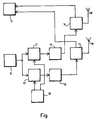
- the illustrated arrangement uses two antennas both for receiving and transmitting.
- the antennas are referenced 18 and 19 and, when receiving, signals received by the receivers are conducted to a receiving device 11, via two duplex filters 16 and 17.
- signals are generated in a transmission device 10, and are applied to two branches.
- the signals in the two branches are each conducted to a respective antenna 18, 19 via a respective amplitude modulator 12, 13, a respective power amplifier 14, 15, and a respective duplex filter 16, 17.
- the antennas are oriented so as to have different polarization directions therebetween.
- the polarization directions may differ by 90 degrees in relation to one another.
- the amplitude modulators are controlled by signals from a control means 20 and modulate the signals to power amplifiers so that the powers delivered to the two antennas are changed in relation to each other. This results in a change in the polarization direction of the resultant output signal.
- the amplitude should not be changed during an ongoing signal sequence. This is because such systems do not include an equalizer which can adapt to such changes.
- the polarization angle of the resultant signal is therefore changed after each TDMA-frame, by changing the amplitudes of the signals to the two antennas stepwise after each TDMA-frame.
- the changes are preferably made so that the polarization angle is changed 180/N degrees for each new TDMA-frame, where N is the interleaving depth in the channel code.
- N is equal to the number of signal sequences into which each information frame from a subscriber is divided. If the resultant polarization direction from the antennas is changed in this way, it is probable that at most only one signal sequence will be lost, even though the mobile station should be situated in a zero point for a given polarization direction, since the zero point will move for each new signal sequence.
- each information frame is divided into eight parts which are distributed on eight signal sequences. If each signal sequence has its own polarization angle, it is improbable that two such sequences will give rise to a zero point on the receiver. Transmission is therefore effected at eight different polarization angles. These angles may, for instance, be 0, 22.5, 45, 67.5, 90 degrees, etc. A single lost part of one information frame can be reconstructed in the receiver, with the aid of remaining signal sequences and a so-called error correcting code.
- the desired values of changes of the polarization angles between two TDMA-frames are obtained when the control means 20 delivers to the amplitude modulators 12 and 13 control signals which are proportional respectively to the sinus and cosinus of an angle which for each new TDMA-frame is changed to an extent which equals the desired change of the polarization angle.
- Time multiplex mobile telephony systems are also found in which the signal sequences are relatively long in comparison with the signal sequences of the GSM-system.
- systems are found in North America in which the interleaving depth is equal to two between the signal sequences, but where interleaving also occurs within each signal sequence.
- each information frame is divided into two parts, whereafter the second part of one frame and the first part of the next frame are transmitted in the same signal sequence.
- the interleaving depth is equal to four, the contents of said second and first parts are divided into two parts prior to transmission, whereafter these combined four parts are spread appropriately within the signal sequence. For instance, if half the signal sequence is lost, only a quarter of the two original information frames will be lost.
- each of the aforesaid four parts are transmitted with a respective polarization direction.
- four different polarization directions are needed in order for all parts of a signal sequence to be transmitted with different polarization directions.
- the number of different polarization directions shall be equal to the number of interleaving levels. This enables information parts to be transmitted with different polarization directions from one and the same information frame.
- the illustrated arrangement can be modified in several ways.
- separate antennas can be used for transmitting and receiving purposes.
- the fixed station may also be equipped with more than two antennas for transmission purposes, wherein all antennas have different polarization directions.
- Each of the antennas is supplied with signals which have mutually different amplitudes.
Landscapes
- Engineering & Computer Science (AREA)
- Computer Networks & Wireless Communication (AREA)
- Signal Processing (AREA)
- Mobile Radio Communication Systems (AREA)
- Radio Transmission System (AREA)
Claims (4)
- Verfahren zur Reduzierung des Risikos eines schlechten Empfangs als Folge einer Reflexion von übertragenen Signalen durch verschiedene Objekte beim Senden von einer festen Station an eine mobile Station in einem digitalen Zeitmultiplex-Mobilfunksystem, wobei jeder zu übertragende Informationsrahmen in eine Anzahl von Informationsteilen aufgeteilt ist, die durch die Anzahl von Verschachtelungsniveaus bestimmt sind,
dadurch gekennzeichnet, daß eine Übertragung von der festen Station mit einer Polarisationsrichtung durchgeführt wird, die schrittweise in solcher Weise geändert wird, daß alle Informationsteile von ein und dem gleichen Rahmen mit zueinander unterschiedlichen Polarisationsrichtungen übertragen werden; und daß die Anzahl von verschiedenen Polarisationsrichtungen mit der Anzahl von Verschachtelungsniveaus übereinstimmen. - Verfahren nach Anspruch 1, dadurch gekennzeichnet, daß beim Senden die voranstehend erwähnten Informationsteile von ein und dem gleichen Rahmen in einem jeweiligen TDMA-Rahmen enthalten sind; und daß die Polarisationsrichtung nach jedem TDMA-Rahmen verändert wird.
- Verfahren nach Anspruch 1, dadurch gekennzeichnet, daß die Polarisationsrichtung nach jedem übertragenen Informationsteil geändert wird.
- Verfahren nach einem der Ansprüche 1, 2 und 3, dadurch gekennzeichnet, daß eine Übertragung in der festen Station von wenigstens zwei Antennen (18, 19) bewirkt wird, die mit zueinander unterschiedlichen Polarisationsrichtungen ausgerichtet sind und an jede von diesen jeweilige Signale geliefert werden, die zueinander die gleiche Frequenz und zueinander den gleichen Informationsinhalt aufweisen, aber deren Amplituden in solcher Weise moduliert sind, daß die Polarisationsrichtung eines sich ergebenden Ausgangssignals von den Antennen in der voranstehend angegebenen Weise verändert wird.
Applications Claiming Priority (2)
| Application Number | Priority Date | Filing Date | Title |
|---|---|---|---|
| SE9003197 | 1990-10-05 | ||
| SE9003197A SE467385B (sv) | 1990-10-05 | 1990-10-05 | Foerfarande foer att minska risken foer daalig mottagning i ett mobiltelefonisystem |
Publications (2)
| Publication Number | Publication Date |
|---|---|
| EP0479744A1 EP0479744A1 (de) | 1992-04-08 |
| EP0479744B1 true EP0479744B1 (de) | 1995-05-10 |
Family
ID=20380579
Family Applications (1)
| Application Number | Title | Priority Date | Filing Date |
|---|---|---|---|
| EP91850215A Expired - Lifetime EP0479744B1 (de) | 1990-10-05 | 1991-09-05 | Verfahren zur Reduzierung der Gefahr des schlechten Empfangs in einem zeitmultiplexen Funkübertragungssystem |
Country Status (7)
| Country | Link |
|---|---|
| US (1) | US5267268A (de) |
| EP (1) | EP0479744B1 (de) |
| JP (1) | JP3151247B2 (de) |
| AU (1) | AU649271B2 (de) |
| CA (1) | CA2051738C (de) |
| DE (1) | DE69109601T2 (de) |
| SE (1) | SE467385B (de) |
Families Citing this family (10)
| Publication number | Priority date | Publication date | Assignee | Title |
|---|---|---|---|---|
| DE19546599C2 (de) * | 1995-12-13 | 1999-07-29 | Siemens Ag | Sendeeinrichtung |
| ES2149412T3 (es) * | 1996-09-20 | 2000-11-01 | Siemens Ag | Sistema de diversidad de polarizacion para comunicaciones moviles con configuracion adaptable de las caracteristicas de radiacion. |
| US6181920B1 (en) | 1997-10-20 | 2001-01-30 | Ericsson Inc. | Transmitter that selectively polarizes a radio wave |
| EP1169750A4 (de) * | 2000-01-21 | 2004-12-08 | Motorola Inc | Sytem und verfahren zur funkkommunikation mit polarisationsdiversität |
| DE60016592T2 (de) | 2000-09-20 | 2005-12-22 | Lucent Technologies Inc. | Funksystem, Antennenanordnung und Polarisationsmodulator zur Erzeugung eines Sendesignals mit veränderlicher Polarisation |
| EP1303059B1 (de) * | 2001-10-09 | 2006-08-23 | Lucent Technologies Inc. | Verfahren und Vorrichtung zum Erzeugen von einer Diversityübertragung in drahtlosen Kommunikationssystemen anhand von Antennenhopping-Sequenzen und/oder Polarisationshopping-Sequencen |
| JP2008271443A (ja) * | 2007-04-24 | 2008-11-06 | Brother Ind Ltd | 無線送信装置及び無線通信装置 |
| US8147049B2 (en) | 2008-11-20 | 2012-04-03 | Xerox Corporation | Waste phase change ink recycling |
| US8162465B2 (en) | 2008-11-20 | 2012-04-24 | Xerox Corporation | Waste phase change ink recycling |
| JP6228108B2 (ja) * | 2014-12-18 | 2017-11-08 | 株式会社日立製作所 | 無線通信システム |
Family Cites Families (5)
| Publication number | Priority date | Publication date | Assignee | Title |
|---|---|---|---|---|
| FR2215759A1 (de) * | 1973-01-26 | 1974-08-23 | Lafonta Paul | |
| JPS609239A (ja) * | 1983-06-27 | 1985-01-18 | Nippon Telegr & Teleph Corp <Ntt> | 符号伝送方式 |
| FR2609224B1 (fr) * | 1986-12-30 | 1989-04-07 | Thomson Csf | Dispositif et procede de transmission et/ou d'acquisition des donnees utilisant deux polarisations croisees d'une onde electromagnetique et dispositif d'enregistrement magnetique |
| JPH0744492B2 (ja) * | 1988-06-15 | 1995-05-15 | 松下電工株式会社 | 偏波ダイバーシチ無線通信方式 |
| JPH0624342B2 (ja) * | 1988-06-29 | 1994-03-30 | 日本電気株式会社 | アップリンク交差偏波補償装置 |
-
1990
- 1990-10-05 SE SE9003197A patent/SE467385B/sv not_active IP Right Cessation
-
1991
- 1991-09-05 EP EP91850215A patent/EP0479744B1/de not_active Expired - Lifetime
- 1991-09-05 DE DE69109601T patent/DE69109601T2/de not_active Expired - Lifetime
- 1991-09-18 CA CA002051738A patent/CA2051738C/en not_active Expired - Fee Related
- 1991-10-04 US US07/771,216 patent/US5267268A/en not_active Expired - Lifetime
- 1991-10-04 JP JP25805691A patent/JP3151247B2/ja not_active Expired - Fee Related
- 1991-10-04 AU AU85637/91A patent/AU649271B2/en not_active Ceased
Also Published As
| Publication number | Publication date |
|---|---|
| SE9003197L (sv) | 1992-04-06 |
| JP3151247B2 (ja) | 2001-04-03 |
| DE69109601T2 (de) | 1995-09-28 |
| US5267268A (en) | 1993-11-30 |
| SE9003197D0 (sv) | 1990-10-05 |
| CA2051738C (en) | 1999-11-16 |
| DE69109601D1 (de) | 1995-06-14 |
| SE467385B (sv) | 1992-07-06 |
| JPH04260227A (ja) | 1992-09-16 |
| AU8563791A (en) | 1993-04-29 |
| AU649271B2 (en) | 1994-05-19 |
| CA2051738A1 (en) | 1992-04-06 |
| EP0479744A1 (de) | 1992-04-08 |
Similar Documents
| Publication | Publication Date | Title |
|---|---|---|
| CN1077362C (zh) | 实现跳频的方法和基站设备 | |
| US7929922B2 (en) | Radio communication system, a transmitter and a receiver | |
| US5329548A (en) | Base station for a frequency hopping TDMA radio communication system | |
| EP1033819B1 (de) | Basisstation und übertragungsverfahren | |
| JPS6242537B2 (de) | ||
| EP0419429A1 (de) | Verfahren zur Reduzierung der Gefahr des schlechten Empfangs in einem zeitmultiplexen Funkübertragungssystem | |
| EP0763307A2 (de) | Diversitykombinator für antennen | |
| US5267268A (en) | Method for reducing the risk of poor reception in a mobile telephony system | |
| EP0761045B1 (de) | Verfahren zur erhöhung der qualität der verbindungen in einer zellularen funkübertragungsanordnung und basisstation dafür | |
| GB2057819A (en) | Digital radio system | |
| EP0976277B1 (de) | Verfahren zum erleichtern der sendeleistungsmessung und basisstation | |
| US6704345B1 (en) | Transmission/reception apparatus and transmission/reception method | |
| US6317610B1 (en) | Method of combining several signals, and base station | |
| JPS6328145A (ja) | 無線通信方式 | |
| WO2002003641A1 (en) | Cofdm transmitter with diversity and time delay | |
| FI106833B (fi) | Yhteydenmuodostusmenetelmä ja lähetinvastaanotin | |
| JPH044620A (ja) | 送信電力制御装置 | |
| JPH03274922A (ja) | 送信電力制御方式 | |
| JPS58184837A (ja) | 移動無線ダイバシテ−方式 |
Legal Events
| Date | Code | Title | Description |
|---|---|---|---|
| PUAI | Public reference made under article 153(3) epc to a published international application that has entered the european phase |
Free format text: ORIGINAL CODE: 0009012 |
|
| AK | Designated contracting states |
Kind code of ref document: A1 Designated state(s): DE FR GB IT |
|
| 17P | Request for examination filed |
Effective date: 19920901 |
|
| 17Q | First examination report despatched |
Effective date: 19940914 |
|
| GRAA | (expected) grant |
Free format text: ORIGINAL CODE: 0009210 |
|
| AK | Designated contracting states |
Kind code of ref document: B1 Designated state(s): DE FR GB IT |
|
| REF | Corresponds to: |
Ref document number: 69109601 Country of ref document: DE Date of ref document: 19950614 |
|
| ITF | It: translation for a ep patent filed | ||
| ET | Fr: translation filed | ||
| PLBE | No opposition filed within time limit |
Free format text: ORIGINAL CODE: 0009261 |
|
| STAA | Information on the status of an ep patent application or granted ep patent |
Free format text: STATUS: NO OPPOSITION FILED WITHIN TIME LIMIT |
|
| 26N | No opposition filed | ||
| REG | Reference to a national code |
Ref country code: GB Ref legal event code: IF02 |
|
| PGFP | Annual fee paid to national office [announced via postgrant information from national office to epo] |
Ref country code: GB Payment date: 20020828 Year of fee payment: 12 |
|
| PG25 | Lapsed in a contracting state [announced via postgrant information from national office to epo] |
Ref country code: GB Free format text: LAPSE BECAUSE OF NON-PAYMENT OF DUE FEES Effective date: 20030905 |
|
| GBPC | Gb: european patent ceased through non-payment of renewal fee | ||
| PG25 | Lapsed in a contracting state [announced via postgrant information from national office to epo] |
Ref country code: IT Free format text: LAPSE BECAUSE OF NON-PAYMENT OF DUE FEES;WARNING: LAPSES OF ITALIAN PATENTS WITH EFFECTIVE DATE BEFORE 2007 MAY HAVE OCCURRED AT ANY TIME BEFORE 2007. THE CORRECT EFFECTIVE DATE MAY BE DIFFERENT FROM THE ONE RECORDED. Effective date: 20050905 |
|
| PGFP | Annual fee paid to national office [announced via postgrant information from national office to epo] |
Ref country code: FR Payment date: 20100930 Year of fee payment: 20 |
|
| PGFP | Annual fee paid to national office [announced via postgrant information from national office to epo] |
Ref country code: DE Payment date: 20100929 Year of fee payment: 20 |
|
| REG | Reference to a national code |
Ref country code: DE Ref legal event code: R071 Ref document number: 69109601 Country of ref document: DE |
|
| REG | Reference to a national code |
Ref country code: DE Ref legal event code: R071 Ref document number: 69109601 Country of ref document: DE |
|
| PG25 | Lapsed in a contracting state [announced via postgrant information from national office to epo] |
Ref country code: DE Free format text: LAPSE BECAUSE OF EXPIRATION OF PROTECTION Effective date: 20110906 |