EP0473003A2 - Feststoff-Formulierungen - Google Patents
Feststoff-Formulierungen Download PDFInfo
- Publication number
- EP0473003A2 EP0473003A2 EP91113608A EP91113608A EP0473003A2 EP 0473003 A2 EP0473003 A2 EP 0473003A2 EP 91113608 A EP91113608 A EP 91113608A EP 91113608 A EP91113608 A EP 91113608A EP 0473003 A2 EP0473003 A2 EP 0473003A2
- Authority
- EP
- European Patent Office
- Prior art keywords
- additives
- solid
- fluidized bed
- solid formulations
- agrochemical active
- Prior art date
- Legal status (The legal status is an assumption and is not a legal conclusion. Google has not performed a legal analysis and makes no representation as to the accuracy of the status listed.)
- Withdrawn
Links
- 239000000203 mixture Substances 0.000 claims abstract description 75
- 239000007787 solid Substances 0.000 claims abstract description 63
- 238000009472 formulation Methods 0.000 claims abstract description 55
- 239000008187 granular material Substances 0.000 claims abstract description 43
- 239000000654 additive Substances 0.000 claims abstract description 31
- 238000002360 preparation method Methods 0.000 claims abstract description 13
- 230000000996 additive effect Effects 0.000 claims abstract description 11
- 239000002270 dispersing agent Substances 0.000 claims abstract description 11
- 239000003795 chemical substances by application Substances 0.000 claims abstract description 4
- 239000007791 liquid phase Substances 0.000 claims description 45
- 239000007790 solid phase Substances 0.000 claims description 34
- XLYOFNOQVPJJNP-UHFFFAOYSA-N water Substances O XLYOFNOQVPJJNP-UHFFFAOYSA-N 0.000 claims description 28
- 238000000034 method Methods 0.000 claims description 27
- 238000005507 spraying Methods 0.000 claims description 18
- 239000012868 active agrochemical ingredient Substances 0.000 claims description 17
- 239000000126 substance Substances 0.000 claims description 14
- IAYPIBMASNFSPL-UHFFFAOYSA-N Ethylene oxide Chemical group C1CO1 IAYPIBMASNFSPL-UHFFFAOYSA-N 0.000 claims description 13
- 239000002253 acid Substances 0.000 claims description 11
- 125000000217 alkyl group Chemical group 0.000 claims description 10
- 239000004480 active ingredient Substances 0.000 claims description 9
- 230000005484 gravity Effects 0.000 claims description 9
- 239000002245 particle Substances 0.000 claims description 9
- 125000004432 carbon atom Chemical group C* 0.000 claims description 6
- 238000000227 grinding Methods 0.000 claims description 6
- ROSDSFDQCJNGOL-UHFFFAOYSA-N Dimethylamine Chemical class CNC ROSDSFDQCJNGOL-UHFFFAOYSA-N 0.000 claims description 5
- 238000001035 drying Methods 0.000 claims description 5
- 238000007599 discharging Methods 0.000 claims description 3
- 239000013543 active substance Substances 0.000 abstract description 9
- 239000003905 agrochemical Substances 0.000 abstract description 6
- VYPSYNLAJGMNEJ-UHFFFAOYSA-N silicon dioxide Inorganic materials O=[Si]=O VYPSYNLAJGMNEJ-UHFFFAOYSA-N 0.000 description 24
- 239000007789 gas Substances 0.000 description 22
- IJGRMHOSHXDMSA-UHFFFAOYSA-N Atomic nitrogen Chemical compound N#N IJGRMHOSHXDMSA-UHFFFAOYSA-N 0.000 description 18
- 238000003756 stirring Methods 0.000 description 16
- PXMNMQRDXWABCY-UHFFFAOYSA-N 1-(4-chlorophenyl)-4,4-dimethyl-3-(1H-1,2,4-triazol-1-ylmethyl)pentan-3-ol Chemical compound C1=NC=NN1CC(O)(C(C)(C)C)CCC1=CC=C(Cl)C=C1 PXMNMQRDXWABCY-UHFFFAOYSA-N 0.000 description 14
- 239000000843 powder Substances 0.000 description 13
- WSFSSNUMVMOOMR-UHFFFAOYSA-N Formaldehyde Chemical compound O=C WSFSSNUMVMOOMR-UHFFFAOYSA-N 0.000 description 12
- 229910052757 nitrogen Inorganic materials 0.000 description 11
- 239000000377 silicon dioxide Substances 0.000 description 11
- -1 1,1,2,2-tetrachloroethyl-sulfenyl Chemical group 0.000 description 10
- 238000002156 mixing Methods 0.000 description 10
- 239000000047 product Substances 0.000 description 10
- 150000008055 alkyl aryl sulfonates Chemical class 0.000 description 9
- 241000196324 Embryophyta Species 0.000 description 8
- 239000000243 solution Substances 0.000 description 8
- 239000007788 liquid Substances 0.000 description 7
- UIIMBOGNXHQVGW-UHFFFAOYSA-M Sodium bicarbonate Chemical compound [Na+].OC([O-])=O UIIMBOGNXHQVGW-UHFFFAOYSA-M 0.000 description 6
- QOUYRDMWIPFIRB-UHFFFAOYSA-N formaldehyde;phenyl benzenesulfonate Chemical compound O=C.C=1C=CC=CC=1S(=O)(=O)OC1=CC=CC=C1 QOUYRDMWIPFIRB-UHFFFAOYSA-N 0.000 description 6
- 238000005469 granulation Methods 0.000 description 6
- 239000012071 phase Substances 0.000 description 6
- 235000013339 cereals Nutrition 0.000 description 5
- 230000003179 granulation Effects 0.000 description 5
- 238000004519 manufacturing process Methods 0.000 description 5
- YIPTXVFOZPQVLT-UHFFFAOYSA-N n,n-dimethylheptanamide Chemical compound CCCCCCC(=O)N(C)C YIPTXVFOZPQVLT-UHFFFAOYSA-N 0.000 description 5
- ZQNAEHHJUKGDDE-UHFFFAOYSA-N n,n-dimethyltridecanamide Chemical compound CCCCCCCCCCCCC(=O)N(C)C ZQNAEHHJUKGDDE-UHFFFAOYSA-N 0.000 description 5
- FBQQHUGEACOBDN-UHFFFAOYSA-N quinomethionate Chemical compound N1=C2SC(=O)SC2=NC2=CC(C)=CC=C21 FBQQHUGEACOBDN-UHFFFAOYSA-N 0.000 description 5
- 238000012360 testing method Methods 0.000 description 5
- LFQSCWFLJHTTHZ-UHFFFAOYSA-N Ethanol Chemical compound CCO LFQSCWFLJHTTHZ-UHFFFAOYSA-N 0.000 description 4
- WPPOGHDFAVQKLN-UHFFFAOYSA-N N-Octyl-2-pyrrolidone Chemical compound CCCCCCCCN1CCCC1=O WPPOGHDFAVQKLN-UHFFFAOYSA-N 0.000 description 4
- 238000007664 blowing Methods 0.000 description 4
- WSFSSNUMVMOOMR-NJFSPNSNSA-N methanone Chemical compound O=[14CH2] WSFSSNUMVMOOMR-NJFSPNSNSA-N 0.000 description 4
- DMLHJLWUADABON-UHFFFAOYSA-N n,n-dimethylnonanamide Chemical compound CCCCCCCCC(=O)N(C)C DMLHJLWUADABON-UHFFFAOYSA-N 0.000 description 4
- 239000000725 suspension Substances 0.000 description 4
- JOXIMZWYDAKGHI-UHFFFAOYSA-N toluene-4-sulfonic acid Chemical compound CC1=CC=C(S(O)(=O)=O)C=C1 JOXIMZWYDAKGHI-UHFFFAOYSA-N 0.000 description 4
- YMWUJEATGCHHMB-UHFFFAOYSA-N Dichloromethane Chemical compound ClCCl YMWUJEATGCHHMB-UHFFFAOYSA-N 0.000 description 3
- 150000007513 acids Chemical class 0.000 description 3
- 239000011230 binding agent Substances 0.000 description 3
- 235000014113 dietary fatty acids Nutrition 0.000 description 3
- QKIUAMUSENSFQQ-UHFFFAOYSA-N dimethylazanide Chemical compound C[N-]C QKIUAMUSENSFQQ-UHFFFAOYSA-N 0.000 description 3
- 239000000975 dye Substances 0.000 description 3
- 239000000194 fatty acid Substances 0.000 description 3
- 229930195729 fatty acid Natural products 0.000 description 3
- 239000012530 fluid Substances 0.000 description 3
- 238000010438 heat treatment Methods 0.000 description 3
- VHCNQEUWZYOAEV-UHFFFAOYSA-N metamitron Chemical compound O=C1N(N)C(C)=NN=C1C1=CC=CC=C1 VHCNQEUWZYOAEV-UHFFFAOYSA-N 0.000 description 3
- SEOYOGWLQZJPFI-UHFFFAOYSA-N n,n-dimethylundecanamide Chemical compound CCCCCCCCCCC(=O)N(C)C SEOYOGWLQZJPFI-UHFFFAOYSA-N 0.000 description 3
- 239000003960 organic solvent Substances 0.000 description 3
- 150000003839 salts Chemical class 0.000 description 3
- 229910000030 sodium bicarbonate Inorganic materials 0.000 description 3
- 235000017557 sodium bicarbonate Nutrition 0.000 description 3
- 239000002904 solvent Substances 0.000 description 3
- 230000002269 spontaneous effect Effects 0.000 description 3
- 239000007921 spray Substances 0.000 description 3
- BAZVSMNPJJMILC-UHFFFAOYSA-N triadimenol Chemical compound C1=NC=NN1C(C(O)C(C)(C)C)OC1=CC=C(Cl)C=C1 BAZVSMNPJJMILC-UHFFFAOYSA-N 0.000 description 3
- 239000000080 wetting agent Substances 0.000 description 3
- WURBVZBTWMNKQT-UHFFFAOYSA-N 1-(4-chlorophenoxy)-3,3-dimethyl-1-(1,2,4-triazol-1-yl)butan-2-one Chemical compound C1=NC=NN1C(C(=O)C(C)(C)C)OC1=CC=C(Cl)C=C1 WURBVZBTWMNKQT-UHFFFAOYSA-N 0.000 description 2
- VGPIBGGRCVEHQZ-UHFFFAOYSA-N 1-(biphenyl-4-yloxy)-3,3-dimethyl-1-(1,2,4-triazol-1-yl)butan-2-ol Chemical compound C1=NC=NN1C(C(O)C(C)(C)C)OC(C=C1)=CC=C1C1=CC=CC=C1 VGPIBGGRCVEHQZ-UHFFFAOYSA-N 0.000 description 2
- WKBPZYKAUNRMKP-UHFFFAOYSA-N 1-[2-(2,4-dichlorophenyl)pentyl]1,2,4-triazole Chemical compound C=1C=C(Cl)C=C(Cl)C=1C(CCC)CN1C=NC=N1 WKBPZYKAUNRMKP-UHFFFAOYSA-N 0.000 description 2
- MGNFYQILYYYUBS-UHFFFAOYSA-N 1-[3-(4-tert-butylphenyl)-2-methylpropyl]piperidine Chemical compound C=1C=C(C(C)(C)C)C=CC=1CC(C)CN1CCCCC1 MGNFYQILYYYUBS-UHFFFAOYSA-N 0.000 description 2
- ADZAXAKONDIBLY-UHFFFAOYSA-N 1-[4-(2-chloro-1,1,2-trifluoroethoxy)phenyl]-3-(4-phenyl-1,2,5-oxadiazol-3-yl)urea Chemical compound C1=CC(OC(F)(F)C(Cl)F)=CC=C1NC(=O)NC1=NON=C1C1=CC=CC=C1 ADZAXAKONDIBLY-UHFFFAOYSA-N 0.000 description 2
- YIKWKLYQRFRGPM-UHFFFAOYSA-N 1-dodecylguanidine acetate Chemical compound CC(O)=O.CCCCCCCCCCCCN=C(N)N YIKWKLYQRFRGPM-UHFFFAOYSA-N 0.000 description 2
- YTOPFCCWCSOHFV-UHFFFAOYSA-N 2,6-dimethyl-4-tridecylmorpholine Chemical compound CCCCCCCCCCCCCN1CC(C)OC(C)C1 YTOPFCCWCSOHFV-UHFFFAOYSA-N 0.000 description 2
- YAUCKEPYKXHCFF-UHFFFAOYSA-N 2-carbamothioylsulfanylethyl carbamodithioate;manganese Chemical compound [Mn].NC(=S)SCCSC(N)=S YAUCKEPYKXHCFF-UHFFFAOYSA-N 0.000 description 2
- JMZRZEXRYJUHEB-UHFFFAOYSA-N 2-carbamothioylsulfanylethyl carbamodithioate;zinc Chemical compound [Zn].NC(=S)SCCSC(N)=S JMZRZEXRYJUHEB-UHFFFAOYSA-N 0.000 description 2
- IRCMYGHHKLLGHV-UHFFFAOYSA-N 2-ethoxy-3,3-dimethyl-2,3-dihydro-1-benzofuran-5-yl methanesulfonate Chemical compound C1=C(OS(C)(=O)=O)C=C2C(C)(C)C(OCC)OC2=C1 IRCMYGHHKLLGHV-UHFFFAOYSA-N 0.000 description 2
- SBUKOHLFHYSZNG-UHFFFAOYSA-N 4-dodecyl-2,6-dimethylmorpholine Chemical compound CCCCCCCCCCCCN1CC(C)OC(C)C1 SBUKOHLFHYSZNG-UHFFFAOYSA-N 0.000 description 2
- RGHHSNMVTDWUBI-UHFFFAOYSA-N 4-hydroxybenzaldehyde Chemical compound OC1=CC=C(C=O)C=C1 RGHHSNMVTDWUBI-UHFFFAOYSA-N 0.000 description 2
- NSPMIYGKQJPBQR-UHFFFAOYSA-N 4H-1,2,4-triazole Chemical compound C=1N=CNN=1 NSPMIYGKQJPBQR-UHFFFAOYSA-N 0.000 description 2
- 0 CCCN(*)CCC Chemical compound CCCN(*)CCC 0.000 description 2
- 244000060011 Cocos nucifera Species 0.000 description 2
- 235000013162 Cocos nucifera Nutrition 0.000 description 2
- URDNHJIVMYZFRT-UHFFFAOYSA-N Diclobutrazol Chemical compound C1=NC=NN1C(C(O)C(C)(C)C)CC1=CC=C(Cl)C=C1Cl URDNHJIVMYZFRT-UHFFFAOYSA-N 0.000 description 2
- RTZKZFJDLAIYFH-UHFFFAOYSA-N Diethyl ether Chemical compound CCOCC RTZKZFJDLAIYFH-UHFFFAOYSA-N 0.000 description 2
- 206010013786 Dry skin Diseases 0.000 description 2
- LYCAIKOWRPUZTN-UHFFFAOYSA-N Ethylene glycol Chemical compound OCCO LYCAIKOWRPUZTN-UHFFFAOYSA-N 0.000 description 2
- DGAQECJNVWCQMB-PUAWFVPOSA-M Ilexoside XXIX Chemical compound C[C@@H]1CC[C@@]2(CC[C@@]3(C(=CC[C@H]4[C@]3(CC[C@@H]5[C@@]4(CC[C@@H](C5(C)C)OS(=O)(=O)[O-])C)C)[C@@H]2[C@]1(C)O)C)C(=O)O[C@H]6[C@@H]([C@H]([C@@H]([C@H](O6)CO)O)O)O.[Na+] DGAQECJNVWCQMB-PUAWFVPOSA-M 0.000 description 2
- UQSXHKLRYXJYBZ-UHFFFAOYSA-N Iron oxide Chemical compound [Fe]=O UQSXHKLRYXJYBZ-UHFFFAOYSA-N 0.000 description 2
- 229920001732 Lignosulfonate Polymers 0.000 description 2
- WYURNTSHIVDZCO-UHFFFAOYSA-N Tetrahydrofuran Chemical compound C1CCOC1 WYURNTSHIVDZCO-UHFFFAOYSA-N 0.000 description 2
- GWEVSGVZZGPLCZ-UHFFFAOYSA-N Titan oxide Chemical compound O=[Ti]=O GWEVSGVZZGPLCZ-UHFFFAOYSA-N 0.000 description 2
- FPIPGXGPPPQFEQ-OVSJKPMPSA-N all-trans-retinol Chemical compound OC\C=C(/C)\C=C\C=C(/C)\C=C\C1=C(C)CCCC1(C)C FPIPGXGPPPQFEQ-OVSJKPMPSA-N 0.000 description 2
- 235000012211 aluminium silicate Nutrition 0.000 description 2
- HUMNYLRZRPPJDN-UHFFFAOYSA-N benzaldehyde Chemical compound O=CC1=CC=CC=C1 HUMNYLRZRPPJDN-UHFFFAOYSA-N 0.000 description 2
- WPYMKLBDIGXBTP-UHFFFAOYSA-N benzoic acid Chemical compound OC(=O)C1=CC=CC=C1 WPYMKLBDIGXBTP-UHFFFAOYSA-N 0.000 description 2
- 230000004071 biological effect Effects 0.000 description 2
- LLEMOWNGBBNAJR-UHFFFAOYSA-N biphenyl-2-ol Chemical group OC1=CC=CC=C1C1=CC=CC=C1 LLEMOWNGBBNAJR-UHFFFAOYSA-N 0.000 description 2
- CRQQGFGUEAVUIL-UHFFFAOYSA-N chlorothalonil Chemical compound ClC1=C(Cl)C(C#N)=C(Cl)C(C#N)=C1Cl CRQQGFGUEAVUIL-UHFFFAOYSA-N 0.000 description 2
- 230000000052 comparative effect Effects 0.000 description 2
- 150000001875 compounds Chemical class 0.000 description 2
- 239000012141 concentrate Substances 0.000 description 2
- 239000007859 condensation product Substances 0.000 description 2
- 238000007796 conventional method Methods 0.000 description 2
- 239000006185 dispersion Substances 0.000 description 2
- 238000004090 dissolution Methods 0.000 description 2
- 150000004665 fatty acids Chemical class 0.000 description 2
- 230000000855 fungicidal effect Effects 0.000 description 2
- 239000000417 fungicide Substances 0.000 description 2
- RONFGUROBZGJKP-UHFFFAOYSA-N iminoctadine Chemical compound NC(N)=NCCCCCCCCNCCCCCCCCN=C(N)N RONFGUROBZGJKP-UHFFFAOYSA-N 0.000 description 2
- 238000011081 inoculation Methods 0.000 description 2
- 239000000155 melt Substances 0.000 description 2
- GTCAXTIRRLKXRU-UHFFFAOYSA-N methyl carbamate Chemical compound COC(N)=O GTCAXTIRRLKXRU-UHFFFAOYSA-N 0.000 description 2
- FOXFZRUHNHCZPX-UHFFFAOYSA-N metribuzin Chemical compound CSC1=NN=C(C(C)(C)C)C(=O)N1N FOXFZRUHNHCZPX-UHFFFAOYSA-N 0.000 description 2
- OGYFATSSENRIKG-UHFFFAOYSA-N pencycuron Chemical compound C1=CC(Cl)=CC=C1CN(C(=O)NC=1C=CC=CC=1)C1CCCC1 OGYFATSSENRIKG-UHFFFAOYSA-N 0.000 description 2
- 150000003904 phospholipids Chemical class 0.000 description 2
- BWHMMNNQKKPAPP-UHFFFAOYSA-L potassium carbonate Substances [K+].[K+].[O-]C([O-])=O BWHMMNNQKKPAPP-UHFFFAOYSA-L 0.000 description 2
- 239000003755 preservative agent Substances 0.000 description 2
- 230000001105 regulatory effect Effects 0.000 description 2
- 239000011435 rock Substances 0.000 description 2
- 229910052708 sodium Inorganic materials 0.000 description 2
- 239000011734 sodium Substances 0.000 description 2
- 239000008247 solid mixture Substances 0.000 description 2
- 238000009736 wetting Methods 0.000 description 2
- LDVVMCZRFWMZSG-OLQVQODUSA-N (3ar,7as)-2-(trichloromethylsulfanyl)-3a,4,7,7a-tetrahydroisoindole-1,3-dione Chemical compound C1C=CC[C@H]2C(=O)N(SC(Cl)(Cl)Cl)C(=O)[C@H]21 LDVVMCZRFWMZSG-OLQVQODUSA-N 0.000 description 1
- XGWIJUOSCAQSSV-ABAIWWIYSA-N (4r,5r)-5-(4-chlorophenyl)-n-cyclohexyl-4-methyl-2-oxo-1,3-thiazolidine-3-carboxamide Chemical compound S([C@@H]([C@H]1C)C=2C=CC(Cl)=CC=2)C(=O)N1C(=O)NC1CCCCC1 XGWIJUOSCAQSSV-ABAIWWIYSA-N 0.000 description 1
- XGWIJUOSCAQSSV-XHDPSFHLSA-N (S,S)-hexythiazox Chemical compound S([C@H]([C@@H]1C)C=2C=CC(Cl)=CC=2)C(=O)N1C(=O)NC1CCCCC1 XGWIJUOSCAQSSV-XHDPSFHLSA-N 0.000 description 1
- SFVAIECZMIFQIA-UHFFFAOYSA-N 1,3-dichloro-n-(2-chlorophenyl)-2h-1,2,4-triazin-5-amine Chemical compound ClN1NC(Cl)=NC(NC=2C(=CC=CC=2)Cl)=C1 SFVAIECZMIFQIA-UHFFFAOYSA-N 0.000 description 1
- RYHBNJHYFVUHQT-UHFFFAOYSA-N 1,4-Dioxane Chemical compound C1COCCO1 RYHBNJHYFVUHQT-UHFFFAOYSA-N 0.000 description 1
- PZBPKYOVPCNPJY-UHFFFAOYSA-N 1-[2-(allyloxy)-2-(2,4-dichlorophenyl)ethyl]imidazole Chemical compound ClC1=CC(Cl)=CC=C1C(OCC=C)CN1C=NC=C1 PZBPKYOVPCNPJY-UHFFFAOYSA-N 0.000 description 1
- CNFMJLVJDNGPHR-UHFFFAOYSA-N 1-cyclohexyl-4,4-dimethyl-2-(1,2,4-triazol-1-yl)pent-1-en-3-ol Chemical compound C1=NC=NN1C(C(O)C(C)(C)C)=CC1CCCCC1 CNFMJLVJDNGPHR-UHFFFAOYSA-N 0.000 description 1
- AXTGDCSMTYGJND-UHFFFAOYSA-N 1-dodecylazepan-2-one Chemical compound CCCCCCCCCCCCN1CCCCCC1=O AXTGDCSMTYGJND-UHFFFAOYSA-N 0.000 description 1
- FDLFMPKQBNPIER-UHFFFAOYSA-N 1-methyl-3-(3-methylphenoxy)benzene Chemical class CC1=CC=CC(OC=2C=C(C)C=CC=2)=C1 FDLFMPKQBNPIER-UHFFFAOYSA-N 0.000 description 1
- VKAMZEDHHWTTNZ-UHFFFAOYSA-N 1-octylazepan-2-one Chemical compound CCCCCCCCN1CCCCCC1=O VKAMZEDHHWTTNZ-UHFFFAOYSA-N 0.000 description 1
- XUJLWPFSUCHPQL-UHFFFAOYSA-N 11-methyldodecan-1-ol Chemical compound CC(C)CCCCCCCCCCO XUJLWPFSUCHPQL-UHFFFAOYSA-N 0.000 description 1
- 125000004201 2,4-dichlorophenyl group Chemical group [H]C1=C([H])C(*)=C(Cl)C([H])=C1Cl 0.000 description 1
- KIHJEJVWUXTXPZ-UHFFFAOYSA-N 2-(3,5-dichlorophenylcarbamoyl)-1,2-dimethylcyclopropane-1-carboxylic acid Chemical compound OC(=O)C1(C)CC1(C)C(=O)NC1=CC(Cl)=CC(Cl)=C1 KIHJEJVWUXTXPZ-UHFFFAOYSA-N 0.000 description 1
- VBSCXNZULFIXIJ-UHFFFAOYSA-N 2-[2-(2,4-dichlorophenyl)-2-prop-2-enoxyethyl]-1h-imidazole Chemical compound ClC1=CC(Cl)=CC=C1C(OCC=C)CC1=NC=CN1 VBSCXNZULFIXIJ-UHFFFAOYSA-N 0.000 description 1
- VYFCWUVTRWLLFW-UHFFFAOYSA-N 2-n-(trichloromethylsulfanyl)cyclohex-4-ene-1,2-dicarboxamide Chemical compound NC(=O)C1CC=CCC1C(=O)NSC(Cl)(Cl)Cl VYFCWUVTRWLLFW-UHFFFAOYSA-N 0.000 description 1
- NMWKWBPNKPGATC-UHFFFAOYSA-N 4,5,6,7-tetrachloro-2-benzofuran-1(3H)-one Chemical compound ClC1=C(Cl)C(Cl)=C2COC(=O)C2=C1Cl NMWKWBPNKPGATC-UHFFFAOYSA-N 0.000 description 1
- CDIJOYCNNFLOAX-UHFFFAOYSA-N 4-(trichloromethylsulfanyl)isoindole-1,3-dione Chemical compound ClC(Cl)(Cl)SC1=CC=CC2=C1C(=O)NC2=O CDIJOYCNNFLOAX-UHFFFAOYSA-N 0.000 description 1
- 125000001255 4-fluorophenyl group Chemical group [H]C1=C([H])C(*)=C([H])C([H])=C1F 0.000 description 1
- 244000215068 Acacia senegal Species 0.000 description 1
- 235000001674 Agaricus brunnescens Nutrition 0.000 description 1
- RGCKGOZRHPZPFP-UHFFFAOYSA-N Alizarin Natural products C1=CC=C2C(=O)C3=C(O)C(O)=CC=C3C(=O)C2=C1 RGCKGOZRHPZPFP-UHFFFAOYSA-N 0.000 description 1
- 239000005995 Aluminium silicate Substances 0.000 description 1
- 239000005711 Benzoic acid Substances 0.000 description 1
- LSNNMFCWUKXFEE-UHFFFAOYSA-M Bisulfite Chemical compound OS([O-])=O LSNNMFCWUKXFEE-UHFFFAOYSA-M 0.000 description 1
- 241000895523 Blumeria graminis f. sp. hordei Species 0.000 description 1
- OYPRJOBELJOOCE-UHFFFAOYSA-N Calcium Chemical compound [Ca] OYPRJOBELJOOCE-UHFFFAOYSA-N 0.000 description 1
- JBKVHLHDHHXQEQ-UHFFFAOYSA-N Caprolactam Natural products O=C1CCCCCN1 JBKVHLHDHHXQEQ-UHFFFAOYSA-N 0.000 description 1
- 239000005745 Captan Substances 0.000 description 1
- TWFZGCMQGLPBSX-UHFFFAOYSA-N Carbendazim Natural products C1=CC=C2NC(NC(=O)OC)=NC2=C1 TWFZGCMQGLPBSX-UHFFFAOYSA-N 0.000 description 1
- 239000005747 Chlorothalonil Substances 0.000 description 1
- 239000004375 Dextrin Substances 0.000 description 1
- 229920001353 Dextrin Polymers 0.000 description 1
- 239000005766 Dodine Substances 0.000 description 1
- 241000221787 Erysiphe Species 0.000 description 1
- VGGSQFUCUMXWEO-UHFFFAOYSA-N Ethene Chemical compound C=C VGGSQFUCUMXWEO-UHFFFAOYSA-N 0.000 description 1
- 239000005977 Ethylene Substances 0.000 description 1
- 239000005789 Folpet Substances 0.000 description 1
- 229920000084 Gum arabic Polymers 0.000 description 1
- 239000005661 Hexythiazox Substances 0.000 description 1
- 240000005979 Hordeum vulgare Species 0.000 description 1
- 235000007340 Hordeum vulgare Nutrition 0.000 description 1
- 239000005795 Imazalil Substances 0.000 description 1
- 239000005909 Kieselgur Substances 0.000 description 1
- WHXSMMKQMYFTQS-UHFFFAOYSA-N Lithium Chemical compound [Li] WHXSMMKQMYFTQS-UHFFFAOYSA-N 0.000 description 1
- FYYHWMGAXLPEAU-UHFFFAOYSA-N Magnesium Chemical compound [Mg] FYYHWMGAXLPEAU-UHFFFAOYSA-N 0.000 description 1
- 239000005802 Mancozeb Substances 0.000 description 1
- 239000005579 Metamitron Substances 0.000 description 1
- RRVIAQKBTUQODI-UHFFFAOYSA-N Methabenzthiazuron Chemical compound C1=CC=C2SC(N(C)C(=O)NC)=NC2=C1 RRVIAQKBTUQODI-UHFFFAOYSA-N 0.000 description 1
- 239000005583 Metribuzin Substances 0.000 description 1
- WHHNSIKOZDDUTR-UHFFFAOYSA-N O(C)C=1NC2=C(N1)C=CC=C2C(=O)N Chemical compound O(C)C=1NC2=C(N1)C=CC=C2C(=O)N WHHNSIKOZDDUTR-UHFFFAOYSA-N 0.000 description 1
- 239000005813 Penconazole Substances 0.000 description 1
- 239000005814 Pencycuron Substances 0.000 description 1
- 239000004372 Polyvinyl alcohol Substances 0.000 description 1
- ZLMJMSJWJFRBEC-UHFFFAOYSA-N Potassium Chemical compound [K] ZLMJMSJWJFRBEC-UHFFFAOYSA-N 0.000 description 1
- 239000005820 Prochloraz Substances 0.000 description 1
- 239000005822 Propiconazole Substances 0.000 description 1
- 239000005823 Propineb Substances 0.000 description 1
- HHUQPWODPBDTLI-UHFFFAOYSA-N Prothioconazole-desthio Chemical compound C1=NC=NN1CC(C1(Cl)CC1)(O)CC1=CC=CC=C1Cl HHUQPWODPBDTLI-UHFFFAOYSA-N 0.000 description 1
- 206010037888 Rash pustular Diseases 0.000 description 1
- ISRUGXGCCGIOQO-UHFFFAOYSA-N Rhoden Chemical compound CNC(=O)OC1=CC=CC=C1OC(C)C ISRUGXGCCGIOQO-UHFFFAOYSA-N 0.000 description 1
- 229910018540 Si C Inorganic materials 0.000 description 1
- 229920002472 Starch Polymers 0.000 description 1
- 239000005839 Tebuconazole Substances 0.000 description 1
- 239000005846 Triadimenol Substances 0.000 description 1
- CNFMJLVJDNGPHR-UKTHLTGXSA-N Triapenthenol Chemical compound C1=NC=NN1/C(C(O)C(C)(C)C)=C/C1CCCCC1 CNFMJLVJDNGPHR-UKTHLTGXSA-N 0.000 description 1
- HCHKCACWOHOZIP-UHFFFAOYSA-N Zinc Chemical compound [Zn] HCHKCACWOHOZIP-UHFFFAOYSA-N 0.000 description 1
- 239000000205 acacia gum Substances 0.000 description 1
- 235000010489 acacia gum Nutrition 0.000 description 1
- 230000000895 acaricidal effect Effects 0.000 description 1
- 239000000642 acaricide Substances 0.000 description 1
- 239000000853 adhesive Substances 0.000 description 1
- 230000001070 adhesive effect Effects 0.000 description 1
- 238000005054 agglomeration Methods 0.000 description 1
- 230000002776 aggregation Effects 0.000 description 1
- 150000001298 alcohols Chemical class 0.000 description 1
- 235000010443 alginic acid Nutrition 0.000 description 1
- 229920000615 alginic acid Polymers 0.000 description 1
- HFVAFDPGUJEFBQ-UHFFFAOYSA-M alizarin red S Chemical compound [Na+].O=C1C2=CC=CC=C2C(=O)C2=C1C=C(S([O-])(=O)=O)C(O)=C2O HFVAFDPGUJEFBQ-UHFFFAOYSA-M 0.000 description 1
- 125000002877 alkyl aryl group Chemical group 0.000 description 1
- 239000011717 all-trans-retinol Substances 0.000 description 1
- 235000019169 all-trans-retinol Nutrition 0.000 description 1
- 150000003863 ammonium salts Chemical class 0.000 description 1
- 239000007900 aqueous suspension Substances 0.000 description 1
- 125000003118 aryl group Chemical group 0.000 description 1
- 229960000892 attapulgite Drugs 0.000 description 1
- RIOXQFHNBCKOKP-UHFFFAOYSA-N benomyl Chemical compound C1=CC=C2N(C(=O)NCCCC)C(NC(=O)OC)=NC2=C1 RIOXQFHNBCKOKP-UHFFFAOYSA-N 0.000 description 1
- 235000010233 benzoic acid Nutrition 0.000 description 1
- MITFXPHMIHQXPI-UHFFFAOYSA-N benzoxaprofen Natural products N=1C2=CC(C(C(O)=O)C)=CC=C2OC=1C1=CC=C(Cl)C=C1 MITFXPHMIHQXPI-UHFFFAOYSA-N 0.000 description 1
- 229920001400 block copolymer Polymers 0.000 description 1
- 239000011575 calcium Substances 0.000 description 1
- 229910052791 calcium Inorganic materials 0.000 description 1
- 230000001914 calming effect Effects 0.000 description 1
- JHRWWRDRBPCWTF-OLQVQODUSA-N captafol Chemical compound C1C=CC[C@H]2C(=O)N(SC(Cl)(Cl)C(Cl)Cl)C(=O)[C@H]21 JHRWWRDRBPCWTF-OLQVQODUSA-N 0.000 description 1
- 229940117949 captan Drugs 0.000 description 1
- 239000006013 carbendazim Substances 0.000 description 1
- JNPZQRQPIHJYNM-UHFFFAOYSA-N carbendazim Chemical compound C1=C[CH]C2=NC(NC(=O)OC)=NC2=C1 JNPZQRQPIHJYNM-UHFFFAOYSA-N 0.000 description 1
- 239000000084 colloidal system Substances 0.000 description 1
- 238000000354 decomposition reaction Methods 0.000 description 1
- 238000011161 development Methods 0.000 description 1
- 235000019425 dextrin Nutrition 0.000 description 1
- GUJOJGAPFQRJSV-UHFFFAOYSA-N dialuminum;dioxosilane;oxygen(2-);hydrate Chemical compound O.[O-2].[O-2].[O-2].[Al+3].[Al+3].O=[Si]=O.O=[Si]=O.O=[Si]=O.O=[Si]=O GUJOJGAPFQRJSV-UHFFFAOYSA-N 0.000 description 1
- WURGXGVFSMYFCG-UHFFFAOYSA-N dichlofluanid Chemical compound CN(C)S(=O)(=O)N(SC(F)(Cl)Cl)C1=CC=CC=C1 WURGXGVFSMYFCG-UHFFFAOYSA-N 0.000 description 1
- 238000010790 dilution Methods 0.000 description 1
- 239000012895 dilution Substances 0.000 description 1
- 239000012990 dithiocarbamate Substances 0.000 description 1
- 239000003995 emulsifying agent Substances 0.000 description 1
- 239000000839 emulsion Substances 0.000 description 1
- 229960002125 enilconazole Drugs 0.000 description 1
- 150000002148 esters Chemical class 0.000 description 1
- BEFDCLMNVWHSGT-UHFFFAOYSA-N ethenylcyclopentane Chemical compound C=CC1CCCC1 BEFDCLMNVWHSGT-UHFFFAOYSA-N 0.000 description 1
- 150000002170 ethers Chemical class 0.000 description 1
- 238000011156 evaluation Methods 0.000 description 1
- 239000003337 fertilizer Substances 0.000 description 1
- 238000005243 fluidization Methods 0.000 description 1
- HKIOYBQGHSTUDB-UHFFFAOYSA-N folpet Chemical compound C1=CC=C2C(=O)N(SC(Cl)(Cl)Cl)C(=O)C2=C1 HKIOYBQGHSTUDB-UHFFFAOYSA-N 0.000 description 1
- 150000002334 glycols Chemical class 0.000 description 1
- 239000003630 growth substance Substances 0.000 description 1
- 150000008282 halocarbons Chemical class 0.000 description 1
- 239000004009 herbicide Substances 0.000 description 1
- 238000003898 horticulture Methods 0.000 description 1
- WGCNASOHLSPBMP-UHFFFAOYSA-N hydroxyacetaldehyde Natural products OCC=O WGCNASOHLSPBMP-UHFFFAOYSA-N 0.000 description 1
- 239000001023 inorganic pigment Substances 0.000 description 1
- 239000002917 insecticide Substances 0.000 description 1
- NLYAJNPCOHFWQQ-UHFFFAOYSA-N kaolin Chemical compound O.O.O=[Al]O[Si](=O)O[Si](=O)O[Al]=O NLYAJNPCOHFWQQ-UHFFFAOYSA-N 0.000 description 1
- 229920005610 lignin Polymers 0.000 description 1
- 229910052744 lithium Inorganic materials 0.000 description 1
- 239000011777 magnesium Substances 0.000 description 1
- 229910052749 magnesium Inorganic materials 0.000 description 1
- YKSNLCVSTHTHJA-UHFFFAOYSA-L maneb Chemical compound [Mn+2].[S-]C(=S)NCCNC([S-])=S YKSNLCVSTHTHJA-UHFFFAOYSA-L 0.000 description 1
- 229920000940 maneb Polymers 0.000 description 1
- 239000000463 material Substances 0.000 description 1
- 229910052751 metal Inorganic materials 0.000 description 1
- 239000002184 metal Substances 0.000 description 1
- 229920000609 methyl cellulose Polymers 0.000 description 1
- 125000002496 methyl group Chemical group [H]C([H])([H])* 0.000 description 1
- 235000010270 methyl p-hydroxybenzoate Nutrition 0.000 description 1
- 239000004292 methyl p-hydroxybenzoate Substances 0.000 description 1
- 239000001923 methylcellulose Substances 0.000 description 1
- 235000010981 methylcellulose Nutrition 0.000 description 1
- LXCFILQKKLGQFO-UHFFFAOYSA-N methylparaben Chemical compound COC(=O)C1=CC=C(O)C=C1 LXCFILQKKLGQFO-UHFFFAOYSA-N 0.000 description 1
- 229910052901 montmorillonite Inorganic materials 0.000 description 1
- 239000005645 nematicide Substances 0.000 description 1
- 235000010292 orthophenyl phenol Nutrition 0.000 description 1
- TWNQGVIAIRXVLR-UHFFFAOYSA-N oxo(oxoalumanyloxy)alumane Chemical compound O=[Al]O[Al]=O TWNQGVIAIRXVLR-UHFFFAOYSA-N 0.000 description 1
- 229910052625 palygorskite Inorganic materials 0.000 description 1
- QNGNSVIICDLXHT-UHFFFAOYSA-N para-ethylbenzaldehyde Natural products CCC1=CC=C(C=O)C=C1 QNGNSVIICDLXHT-UHFFFAOYSA-N 0.000 description 1
- 125000001997 phenyl group Chemical group [H]C1=C([H])C([H])=C(*)C([H])=C1[H] 0.000 description 1
- 239000001007 phthalocyanine dye Substances 0.000 description 1
- 230000003032 phytopathogenic effect Effects 0.000 description 1
- 229920000151 polyglycol Polymers 0.000 description 1
- 239000010695 polyglycol Substances 0.000 description 1
- 239000011118 polyvinyl acetate Substances 0.000 description 1
- 229920002689 polyvinyl acetate Polymers 0.000 description 1
- 229920002451 polyvinyl alcohol Polymers 0.000 description 1
- 239000001267 polyvinylpyrrolidone Substances 0.000 description 1
- 229920000036 polyvinylpyrrolidone Polymers 0.000 description 1
- 235000013855 polyvinylpyrrolidone Nutrition 0.000 description 1
- 229910052700 potassium Inorganic materials 0.000 description 1
- 239000011591 potassium Substances 0.000 description 1
- 229910000027 potassium carbonate Inorganic materials 0.000 description 1
- 235000011181 potassium carbonates Nutrition 0.000 description 1
- OTYBMLCTZGSZBG-UHFFFAOYSA-L potassium sulfate Chemical compound [K+].[K+].[O-]S([O-])(=O)=O OTYBMLCTZGSZBG-UHFFFAOYSA-L 0.000 description 1
- 229910052939 potassium sulfate Inorganic materials 0.000 description 1
- 235000011151 potassium sulphates Nutrition 0.000 description 1
- TVLSRXXIMLFWEO-UHFFFAOYSA-N prochloraz Chemical compound C1=CN=CN1C(=O)N(CCC)CCOC1=C(Cl)C=C(Cl)C=C1Cl TVLSRXXIMLFWEO-UHFFFAOYSA-N 0.000 description 1
- QXJKBPAVAHBARF-BETUJISGSA-N procymidone Chemical compound O=C([C@]1(C)C[C@@]1(C1=O)C)N1C1=CC(Cl)=CC(Cl)=C1 QXJKBPAVAHBARF-BETUJISGSA-N 0.000 description 1
- STJLVHWMYQXCPB-UHFFFAOYSA-N propiconazole Chemical compound O1C(CCC)COC1(C=1C(=CC(Cl)=CC=1)Cl)CN1N=CN=C1 STJLVHWMYQXCPB-UHFFFAOYSA-N 0.000 description 1
- KKMLIVYBGSAJPM-UHFFFAOYSA-L propineb Chemical compound [Zn+2].[S-]C(=S)NC(C)CNC([S-])=S KKMLIVYBGSAJPM-UHFFFAOYSA-L 0.000 description 1
- 235000010232 propyl p-hydroxybenzoate Nutrition 0.000 description 1
- 239000004405 propyl p-hydroxybenzoate Substances 0.000 description 1
- QELSKZZBTMNZEB-UHFFFAOYSA-N propylparaben Chemical compound CCCOC(=O)C1=CC=C(O)C=C1 QELSKZZBTMNZEB-UHFFFAOYSA-N 0.000 description 1
- 208000029561 pustule Diseases 0.000 description 1
- 239000010453 quartz Substances 0.000 description 1
- 229940100486 rice starch Drugs 0.000 description 1
- 150000004760 silicates Chemical class 0.000 description 1
- 229910010271 silicon carbide Inorganic materials 0.000 description 1
- 159000000000 sodium salts Chemical class 0.000 description 1
- 235000010199 sorbic acid Nutrition 0.000 description 1
- 239000004334 sorbic acid Substances 0.000 description 1
- 229940075582 sorbic acid Drugs 0.000 description 1
- 235000019698 starch Nutrition 0.000 description 1
- 239000008107 starch Substances 0.000 description 1
- 235000000346 sugar Nutrition 0.000 description 1
- NVBFHJWHLNUMCV-UHFFFAOYSA-N sulfamide Chemical compound NS(N)(=O)=O NVBFHJWHLNUMCV-UHFFFAOYSA-N 0.000 description 1
- BDHFUVZGWQCTTF-UHFFFAOYSA-M sulfonate Chemical compound [O-]S(=O)=O BDHFUVZGWQCTTF-UHFFFAOYSA-M 0.000 description 1
- 239000000454 talc Substances 0.000 description 1
- 229910052623 talc Inorganic materials 0.000 description 1
- YLQBMQCUIZJEEH-UHFFFAOYSA-N tetrahydrofuran Natural products C=1C=COC=1 YLQBMQCUIZJEEH-UHFFFAOYSA-N 0.000 description 1
- 239000004408 titanium dioxide Substances 0.000 description 1
- HYVWIQDYBVKITD-UHFFFAOYSA-N tolylfluanid Chemical compound CN(C)S(=O)(=O)N(SC(F)(Cl)Cl)C1=CC=C(C)C=C1 HYVWIQDYBVKITD-UHFFFAOYSA-N 0.000 description 1
- ILJSQTXMGCGYMG-UHFFFAOYSA-N triacetic acid Chemical compound CC(=O)CC(=O)CC(O)=O ILJSQTXMGCGYMG-UHFFFAOYSA-N 0.000 description 1
- XAIPTRIXGHTTNT-UHFFFAOYSA-N triflumuron Chemical compound C1=CC(OC(F)(F)F)=CC=C1NC(=O)NC(=O)C1=CC=CC=C1Cl XAIPTRIXGHTTNT-UHFFFAOYSA-N 0.000 description 1
- 239000011701 zinc Substances 0.000 description 1
- 229910052725 zinc Inorganic materials 0.000 description 1
Images
Classifications
-
- A—HUMAN NECESSITIES
- A01—AGRICULTURE; FORESTRY; ANIMAL HUSBANDRY; HUNTING; TRAPPING; FISHING
- A01N—PRESERVATION OF BODIES OF HUMANS OR ANIMALS OR PLANTS OR PARTS THEREOF; BIOCIDES, e.g. AS DISINFECTANTS, AS PESTICIDES OR AS HERBICIDES; PEST REPELLANTS OR ATTRACTANTS; PLANT GROWTH REGULATORS
- A01N43/00—Biocides, pest repellants or attractants, or plant growth regulators containing heterocyclic compounds
- A01N43/64—Biocides, pest repellants or attractants, or plant growth regulators containing heterocyclic compounds having rings with three nitrogen atoms as the only ring hetero atoms
- A01N43/647—Triazoles; Hydrogenated triazoles
- A01N43/653—1,2,4-Triazoles; Hydrogenated 1,2,4-triazoles
-
- A—HUMAN NECESSITIES
- A01—AGRICULTURE; FORESTRY; ANIMAL HUSBANDRY; HUNTING; TRAPPING; FISHING
- A01N—PRESERVATION OF BODIES OF HUMANS OR ANIMALS OR PLANTS OR PARTS THEREOF; BIOCIDES, e.g. AS DISINFECTANTS, AS PESTICIDES OR AS HERBICIDES; PEST REPELLANTS OR ATTRACTANTS; PLANT GROWTH REGULATORS
- A01N25/00—Biocides, pest repellants or attractants, or plant growth regulators, characterised by their forms, or by their non-active ingredients or by their methods of application, e.g. seed treatment or sequential application; Substances for reducing the noxious effect of the active ingredients to organisms other than pests
- A01N25/12—Powders or granules
- A01N25/14—Powders or granules wettable
-
- A—HUMAN NECESSITIES
- A01—AGRICULTURE; FORESTRY; ANIMAL HUSBANDRY; HUNTING; TRAPPING; FISHING
- A01N—PRESERVATION OF BODIES OF HUMANS OR ANIMALS OR PLANTS OR PARTS THEREOF; BIOCIDES, e.g. AS DISINFECTANTS, AS PESTICIDES OR AS HERBICIDES; PEST REPELLANTS OR ATTRACTANTS; PLANT GROWTH REGULATORS
- A01N43/00—Biocides, pest repellants or attractants, or plant growth regulators containing heterocyclic compounds
- A01N43/64—Biocides, pest repellants or attractants, or plant growth regulators containing heterocyclic compounds having rings with three nitrogen atoms as the only ring hetero atoms
- A01N43/707—1,2,3- or 1,2,4-triazines; Hydrogenated 1,2,3- or 1,2,4-triazines
-
- A—HUMAN NECESSITIES
- A01—AGRICULTURE; FORESTRY; ANIMAL HUSBANDRY; HUNTING; TRAPPING; FISHING
- A01N—PRESERVATION OF BODIES OF HUMANS OR ANIMALS OR PLANTS OR PARTS THEREOF; BIOCIDES, e.g. AS DISINFECTANTS, AS PESTICIDES OR AS HERBICIDES; PEST REPELLANTS OR ATTRACTANTS; PLANT GROWTH REGULATORS
- A01N47/00—Biocides, pest repellants or attractants, or plant growth regulators containing organic compounds containing a carbon atom not being member of a ring and having no bond to a carbon or hydrogen atom, e.g. derivatives of carbonic acid
- A01N47/08—Biocides, pest repellants or attractants, or plant growth regulators containing organic compounds containing a carbon atom not being member of a ring and having no bond to a carbon or hydrogen atom, e.g. derivatives of carbonic acid the carbon atom having one or more single bonds to nitrogen atoms
- A01N47/28—Ureas or thioureas containing the groups >N—CO—N< or >N—CS—N<
- A01N47/36—Ureas or thioureas containing the groups >N—CO—N< or >N—CS—N< containing the group >N—CO—N< directly attached to at least one heterocyclic ring; Thio analogues thereof
Definitions
- the present invention relates to new solid formulations based on agrochemical active ingredients, processes for producing the solid formulations and their use as plant treatment agents.
- the invention also relates to a new device for producing new granules.
- solid formulations according to the invention can be used very well as plant treatment agents and have excellent biological properties.
- the solid formulations according to the invention in each case exceed the biological properties of the corresponding previously known solid formulations.
- the solid formulations according to the invention based on 1- (4-chlorophenyl) -4,4-dimethyl-3- (1,2,4-triazol-1-yl-methyl) -pentan-3-ol better for combating phytopathogenic Mushrooms use as the solid formulations known from the prior art, which also contain this active ingredient.
- All solid substances suitable for plant treatment can be contained in the solid formulations according to the invention as agrochemical active substances. Both substances that are solid at room temperature and those that are liquid at room temperature can be used. The only requirement for the use of liquid components is that they can be applied to the solid support materials, if necessary with powdering.
- the active components can be soluble or insoluble in water. They must be stable to the extent that they do not undergo any noteworthy decomposition during the implementation of the process according to the invention and during the use of the resulting solid formulations.
- agrochemical substances are to be understood as active substances which can usually be used in crop protection. These preferably include insecticides, acaricides, nematicides, fungicides, herbicides, growth regulators and fertilizers. Examples of such active ingredients are: 1- (4-chlorophenyl) -4,4-dimethyl-3- (1,2,4-triazol-1-yl-methyl) -pentan-3-ol (tebuconazole), 1- (4-chlorophenoxy) -3,3-dimethyl- (1,2,4-triazol-1-yl) butan-2-ol (triadimenol), 1- (4-chlorophenoxy) -3,3-dimethyl- (1,2,4-triazol-1-yl) -butan-2-one (triadimphone), 1- (4-phenylphenoxy) -3,3-dimethyl- (1,2,4-triazol-1-yl) butan-2-ol (bitertanol),
- the 1- (4-chlorophenyl) -4,4-dimethyl-3- (1,2,4-triazol-1-yl-methyl) -pentan-3-ol of the formula is particularly preferred
- This active ingredient and its use as a fungicide are known (cf. EP-OS 0 040 345).
- the active ingredient of the formula (I) can be present in the solid formulations according to the invention either as the sole active component or as a mixture with other agrochemical active ingredients.
- N-alkyllactams of the formula (II) are: N-dodecyl caprolactam N-decyl caprolactam N-octyl caprolactam N-dodecyl pyrrolidone N-decyl pyrrolidone N-octyl pyrrolidone N-dodecyl valerolactam N-decyl valerolactam N-octyl valerolactam.
- alkylcarboxylic acid dimethylamides of the formula (III) known under the trade name Hallcomid, which consists on average of 5% of hexanecarboxylic acid dimethylamide, 50% octanecarboxylic acid dimethylamide, 40% decanecarboxylic acid dimethylamide and 5% of dodecanecarboxylic acid dimethylamide .
- suitable dispersants are all substances which can usually be used for such purposes and have corresponding surface-active properties.
- Preferred are lignin sulfonates, such as lithium, sodium, potassium, magnesium, calcium and ammonium salts of lignin sulfonic acid, furthermore condensation products from aryl or alkylarylsulfonic acids and formaldehyde, such as condensation products from sulfonated ditolyl ether and formaldehyde, and their salts, also ethylene oxide adducts and fatty acid esters or their salts.
- all solids with a large surface area and / or high absorbency that can usually be used in granules and powders are suitable as carrier substances.
- Natural rock powders such as kaolins, clays, talc, chalk, quartz, attapulgite, montmorillonite or diatomaceous earth, and synthetic rock powders, such as highly disperse silica, aluminum oxide and silicates, and furthermore salts, such as potassium sulfate, potassium carbonate and sodium hydrogen carbonate, are preferred.
- additives which may be contained in the solid formulations according to the invention, binders, preservatives, dyes, acids and granulating liquids are suitable.
- binders usually present in water-dispersible solid formulations can be contained as binders.
- preservatives which may be present in the solid formulations according to the invention are 2-hydroxybiphenyl, sorbic acid, p-hydroxybenzaldehyde, methyl p-hydroxybenzoate, benzaldehyde, benzoic acid and propyl p-hydroxybenzoate.
- Dyes which can be considered as additives are inorganic pigments such as iron oxide, titanium dioxide and ferrocyan blue, and organic dyes such as alizarin, azo and metal phthalocyanine dyes.
- Acids which can be considered as additives are p-toluenesulfonic acid.
- Organic solvents or mixtures of water and organic solvents can be present as granulating liquids in the solid formulations according to the invention.
- Preferred organic solvents here are alcohols, such as ethanol and glycol, halogenated hydrocarbons, such as methylene chloride and ethers, such as dioxane and tetrahydrofuran. Water is particularly preferred as the granulating liquid.
- the proportion of agrochemical active ingredients is generally between 5 and 90% by weight, preferably between 10 and 50% by weight.
- the proportion of additive is generally 5 to 75% by weight, preferably 10 to 70% by weight.
- the proportion of dispersant is generally between 1 and 30% by weight, preferably between 5 and 25% by weight, and the proportion of carrier is generally between 10 and 50% by weight, preferably between 15 and 45% by weight. -%.
- the additives are generally present in proportions between 10 and 70% by weight, preferably between 20 and 50% by weight, and the proportion of granulating liquid is generally between 0 and 3.5% by weight.
- a solution is first prepared from at least one agrochemical active substance and, if appropriate, additives in at least one additive.
- the components are stirred together at temperatures between 10 ° C. and 100 ° C., preferably between 20 ° C. and 90 ° C., so that a liquid phase is formed. Accordingly, the liquid phase is a melt or a real solution.
- a solid mixture is also prepared by adding at least one dispersant and optionally one or more agrochemical active ingredients and / or Additives mixed with at least one solid carrier in such a ratio that the resulting mixture is in the solid phase.
- This mixture of solids is homogenized by customary methods.
- the liquid and the solid phase are introduced separately into a fluidized bed granulator.
- the procedure is such that the solid, fine powder phase is introduced into the granulator through one or more feeds and fluidized with the aid of a gas stream.
- the liquid phase is sprayed into the granulator through one or more separate nozzles.
- the liquid phase is preferably added via one or more two-component nozzles which are designed such that the liquid phase is transported through a first feed line and a gas stream (atomizing gas) is fed in through a second feed line. Both streams meet at the nozzle end so that the liquid phase is sprayed into the fluidized bed in the form of small droplets with the aid of the atomizing gas and hits the particles of the solid phase there.
- post-granulation can be carried out by spraying on water.
- the granules can be dried using the fluidizing gas stream.
- the temperatures can be varied within a substantial range when carrying out the method according to variant (a). So you work with a liquid phase whose temperature is between 10 ° C and 100 ° C, preferably between 20 ° C and 90 ° C.
- the solid phase is fed in at temperatures between 10 ° C. and 50 ° C., preferably between 20 ° C. and 40 ° C.
- the temperature of the fluidizing gas stream is between 20 ° C and 250 ° C, preferably between 40 ° C and 200 ° C.
- the temperature of the atomizing gas stream entering through the two-component nozzle is between 0 ° C and 100 ° C, preferably between 10 ° C and 90 ° C.
- the finished granulate can be discharged from the granulator using conventional removal devices.
- Countercurrent gravity classifiers are preferably used.
- the product obtained can then be granulated and / or dried and / or ground.
- the process according to the invention can be carried out continuously or batchwise.
- the device for producing the granules according to the invention according to variant (a) is a fluidized bed granulator which differs from the previously known apparatuses of this type essentially in that the liquid phase and the fine powdery solid phase are fed separately into the fluidized bed will.
- One or more supply lines for the solid phase are located in the lower region of the fluidized bed, preferably in the side wall of the apparatus somewhat above the inflow floor.
- one or more two-substance nozzles are contained, which are preferably located in the inflow floor.
- the two-substance nozzles are designed so that the liquid phase is transported through a first feed line and a gas stream (atomizing gas) is fed in through a second feed line.
- One or more supply lines for introducing fluidizing gas are attached below the inflow floor.
- the device contains one or more counterflow gravity classifiers for discharging granulate.
- the counterflow gravity classifiers are preferably installed in the inflow floor. So-called zigzag classifiers are preferably used as countercurrent gravity classifiers.
- a solid mixture is first prepared by mixing at least one dispersant and, if appropriate, one or more agrochemical active ingredients and / or additives with at least one solid carrier in such a ratio that the resulting mixture is in the solid phase.
- This mixture of solids is homogenized and ground by conventional methods.
- a solution is prepared from at least one agrochemical active ingredient and, if appropriate, additives in at least one additive.
- the components at temperatures between 10 ° C and 100 ° C, preferably stirred between 20 ° C and 90 ° C so that a liquid phase is formed.
- the liquid phase is accordingly a melt or a real solution.
- the solid, finely powdered phase is placed in a mixer and sprayed with the liquid phase.
- the procedure is to spray the liquid phase into the mixer through one or more separate nozzles.
- the liquid phase is preferably added via one or more two-component nozzles which are designed such that the liquid phase is transported through a first feed line and a gas stream (atomizing gas) is fed in through a second feed line. Both streams meet at the end of the nozzle so that the liquid phase is sprayed into the mixer in the form of small droplets with the aid of the atomizing gas and hits the particles of the solid phase there.
- an aftertreatment can also be carried out by spraying water.
- the resulting solid formulation can be dried by customary methods.
- the temperatures can also be varied within a relatively wide range. So you work with a liquid phase, its temperature is between 10 ° C and 100 ° C, preferably between 20 ° and 90 ° C.
- the solid phase is kept at temperatures between 10 ° C and 50 ° C, preferably between 20 ° C and 40 ° C.
- the temperature of the atomizing gas stream entering through the two-component nozzle is between 0 ° C and 100 ° C, preferably between 10 ° C and 90 ° C.
- the process according to the invention can also be carried out continuously or batchwise when working according to variant (b).
- batch operations are carried out by charging the mixer in batches.
- the solid formulations according to the invention have high strength. They have a compact, microporous structure and are nevertheless spontaneously dispersible or soluble in water or other solvents.
- spontaneous dispersibility or solubility means that the particles generally completely disperse or dissolve in 0.1 to 5 minutes, preferably in 0.2 to 3 minutes.
- the solid formulations according to the invention contain one or more agrochemical active substances and can therefore be used by customary methods for treating plants in agriculture and horticulture.
- the solid formulations according to the invention are dispersed in water.
- the resulting dispersions can, if necessary, be applied to the plants and / or their habitat after prior dilution using conventional methods, e.g. by spraying, spraying or pouring.
- the application rates depend on the concentration of the dispersion, on the respective indication and on the active components contained.
- a fine powdery, solid phase is prepared by mixing 1200 g of an alkylarylsulfonate crosslinked with formaldehyde with 1170 g of highly disperse silica in a small ploughshare mixer at room temperature and homogenizing.
- the subsequent granulate production takes place in a fluidized bed granulator.
- the solid phase is introduced into the granulator and fluidized in an amount of 300 to 500 m3 / h by blowing in warm air at 25 ° C.
- the liquid phase at 60 ° C is sprayed into the fluidized bed with the help of air via a two-component nozzle.
- the spraying of the liquid phase is complete after 60 minutes.
- granulation is carried out by spraying on 1600 g of water at 50 ° C. and drying to a residual moisture of 1% by weight of water by heating the air introduced to 70 ° C.
- the resulting granulate is classified. In this way, 5 kg of granules with grain sizes in the range between 200 and 1,500 ⁇ m are obtained.
- a fine powdery, solid phase is prepared by mixing 1200 g of an alkylarylsulfonate crosslinked with formaldehyde with 1150 g of highly disperse silica in a small ploughshare mixer at room temperature and homogenizing.
- the subsequent granulate production takes place in a fluidized bed granulator.
- the solid phase is introduced into the granulator and fluidized in an amount of 300 to 500 m3 / h by blowing in warm air at 25 ° C.
- the liquid phase at 60 ° C is sprayed into the fluidized bed with the help of air via a two-component nozzle.
- the spraying of the liquid phase is complete after 60 minutes.
- granulation is carried out by spraying on 1600 g of water at 50 ° C. and heating up the introduced air 70 ° C to a residual moisture of 1 wt .-% water dried.
- the resulting granulate is classified. In this way, 5 kg of granules with grain sizes in the range between 200 and 1,500 ⁇ m are obtained.
- a fine powdery solid phase is prepared by mixing 6000 g of an alkylarylsulfonate crosslinked with formaldehyde with 6000 g of highly disperse silica in a small ploughshare mixer at room temperature and homogenizing.
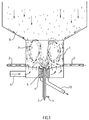
- the subsequent granulation is carried out in a granulating apparatus of the type shown in Figure 1.
- the solid phase is pneumatically introduced into the fluidized bed reactor via the feed lines 2 and fluidized in a quantity of 50 kg / h via the feed 6 by blowing in warm nitrogen at 80 ° C.
- the two-component nozzle 5 warms the 60 ° C. liquid phase sprayed with the help of nitrogen as atomizing gas.
- the product flows are regulated in such a way that the solid phase is fed into the reactor in an amount of 1.2 kg / h and the liquid phase in an amount of 1.8 kg / h.
- a finely powdery solid phase is produced by mixing 1000 g of rice starch and 1900 g of an alkylaryl sulfonate crosslinked with formaldehyde with 1900 g of highly disperse silica in a small ploughshare mixer at room temperature and homogenizing.
- the subsequent granulation is carried out in a granulating apparatus of the type shown in Figure 1.
- the solid phase is pneumatically introduced into the fluidized bed reactor via the feed lines 2 and fluidized by blowing 80 ° C warm nitrogen in an amount of 50 kg / h via the feed 6.
- the liquid phase at 60 ° C. is sprayed in via the two-component nozzle 5 using nitrogen as the atomizing gas.
- the product flows are regulated in such a way that the solid phase is fed into the reactor in an amount of 1.2 kg / h and the liquid phase in an amount of 1.8 kg / h.
- a fine powdery solid phase is prepared by mixing 156.5 g of highly disperse silica, 52.5 g of a diphenylsulfonic acid-formaldehyde condensate and 19.9 g of sodium dialkylnaphthyl sulfonate in a ploughshare mixer and homogenizing.
- the subsequent preparation of the solid formulation takes place in such a way that the liquid phase is sprayed onto the solid phase at 80 ° C., while stirring, through a nozzle into the mixer, which is present at room temperature. This gives 500 g of a granular solid formulation which is ground to a powder.
- a fine powdery solid phase is prepared by 18.32 g of 2-ethoxy-2,3-dihydro-3,3-dimethyl-5-benzofuranyl methane sulfonate, 18.60 g of 3-methoxycarbonyl-aminophenyl-N- (3'-methylphenyl) carbamate, 60.0 g diphenylsulfonic acid formaldehyde condensate, 30.0 g highly disperse silica and 6.44 g kaolin mixed in a ploughshare mixer at room temperature and homogenized.
- the subsequent preparation of the solid formulation takes place in such a way that the liquid phase is sprayed onto the solid phase at 80 ° C., while stirring, through a nozzle into the mixer, which is present at room temperature. This gives 300 g of a granular solid formulation which is ground to a powder.
- a fine powdery solid phase was prepared by mixing and homogenizing 4 kg of wetting agent based on alkylarylsulfonate, 20 kg of a diphenylsulfonic acid-formaldehyde condensate and 62.8 kg of highly disperse silica in a ploughshare mixer at room temperature.
- the subsequent preparation of the solid formulation is carried out by spraying the liquid phase onto the solid phase at 90.degree. C. while stirring through a nozzle into the mixer, which is present at room temperature. This gives 200 kg of a granular solid formulation which is ground to a powder.
- a fine powdery solid phase is produced by mixing and homogenizing 2 kg of wetting agent based on alkylarylsulfonate, 10 kg of a diphenylsulfonic acid-formaldehyde condensate and 31.7 kg of highly disperse silica in a ploughshare mixer at room temperature.
- the subsequent preparation of the solid formulation is carried out by spraying the liquid phase onto the solid phase at 90.degree. C. while stirring through a nozzle into the mixer, which is present at room temperature. This gives 100 kg of a granular solid formulation which is ground to a powder.
- a finely powdery solid phase is produced by mixing and homogenizing 2 kg of wetting agent based on alkylarylsulfonate, 10 kg of a diphenylsulfonic acid-formaldehyde condensate and 32.5 kg of highly disperse silica in a ploughshare mixer at room temperature.
- the subsequent preparation of the solid formulation is carried out by spraying the liquid phase onto the solid phase at 90.degree. C. while stirring through a nozzle into the mixer, which is present at room temperature. This gives 100 kg of a granular solid formulation which is ground to a powder.
- a fine powdery solid phase is produced by mixing and homogenizing 12 g of diphenylsulfonic acid-formaldehyde condensate and 36 g of highly disperse silica in a mixer at room temperature.
- the subsequent preparation of the solid formulation is carried out by spraying the liquid phase onto the solid phase at 90.degree. C. while stirring through a nozzle into the mixer, which is present at room temperature. This gives 100 g of a granular solid formulation which is ground to a powder.
- the premix obtained in this way is processed into granules in a commercially available fluidized bed granulator by moistening in each case 4.8 kg of powder in the fluidized bed with 1.5 liters of water within 21 minutes at room temperature and then by heating the supply air to 70 ° C. within Dries for 11 minutes so that the residual water content in the granules is about 1% by weight.
- the temperature of the granules remains below 40 ° C during this process.
- the resulting granulate is classified using a vibrating sieve cascade. In this way, 4.5 kg of granules with grain sizes in the range between 200 and 1,500 ⁇ m are obtained per batch.
- the suspension stability of the granules measured by the CIPAC method MT 168 is 84%.
- the wet sieve test carried out according to the CIPAC method MT 167 shows sieve residues of less than 0.005% on sieves with mesh sizes 315, 250 and 160 ⁇ m.
- a mixture of 2630 g of 1- (4-chlorophenyl) -4,4-dimethyl-3- (1,2,4-triazol-1-yl-methyl) -pentan-3-ol, 2,000 g of an alkylarylsulfonate crosslinked with formaldehyde , 300 g of phospholipid and 5070 g of sodium hydrogen carbonate are stirred into 10 kg of water with the aid of a toothed disk stirrer and comminuted with a toothed colloid mill. This is followed by fine grinding using a pearl mill, the throughput of which is 25 kg / h. You get one aqueous suspension with a solids content of 50% by weight. The viscosity of the suspension is about 65 mPas with a shear rate of 1,000 / sec; the average particle diameter is about 4 ⁇ m.
- the suspension thus produced is injected in a quantity of 7 kg / h into a fluidized bed reactor with a continuously sifting product discharge.
- a flow of nitrogen in an amount of 92 kg / h is used for fluidization.
- the temperature of the nitrogen stream is 90 ° C.
- a product temperature of below 40 ° C. is established in the fluid bed that forms.
- the discharged granulate has a grain size of approximately 0.4 mm.
- the granulate contains a residual moisture of 2.1% by weight of water.
- the suspension stability of the granules measured according to the CIPAC method MT 168 is 98%.
- the wet sieve test carried out according to the CIPAC method MT 167 shows no sieve residues on the sieves with the mesh sizes 315, 250 or 160 ⁇ m.
- the plants are placed in a greenhouse at a temperature of approx. 20 ° C and a relative humidity of approx. 80% in order to promote the development of mildew pustules.
- the evaluation takes place 7 or 14 days after the inoculation.
- Active substance formulations, active substance concentrations and test results are shown in the following table.
Landscapes
- Life Sciences & Earth Sciences (AREA)
- Health & Medical Sciences (AREA)
- General Health & Medical Sciences (AREA)
- Dentistry (AREA)
- Plant Pathology (AREA)
- Engineering & Computer Science (AREA)
- Pest Control & Pesticides (AREA)
- Agronomy & Crop Science (AREA)
- Wood Science & Technology (AREA)
- Zoology (AREA)
- Environmental Sciences (AREA)
- Toxicology (AREA)
- Agricultural Chemicals And Associated Chemicals (AREA)
- Glanulating (AREA)
Abstract
- A) mindestens einem agrochemischen Wirkstoff,
- B) mindestens einem Additiv aus den in der Beschreibung genannten Gruppen,
- C) mindestens einem Dispergiermittel,
- D) mindestens einem Trägerstoff sowie
- E) gegebenenfalls weiteren Wirkstoffen und/oder Zusatzstoffen,
Description
- Die vorliegende Erfindung betrifft neue Feststoff-Formulierungen auf Basis von agrochemischen Wirkstoffen, Verfahren zur Herstellung der Feststoff-Formulierungen und deren Verwendung als Pflanzenbehandlungsmittel. Die Erfindung betrifft außerdem eine neue Vorrichtung zur Herstellung neuer Granulate.
- Es ist bereits bekannt, daß agrochemische Wirkstoffe in Form von Feststoff-Formulierungen, wie Granulaten oder Pulvern, eingesetzt werden können. Die Wirksamkeit dieser Zubereitungen ist jedoch nicht immer vollkommen befriedigend. So ist sie z.B. in manchen Fällen schwächer als diejenige von entsprechenden Emulsionskonzentraten.
- Speziell ist schon bekannt, daß 1-(4-Chlorphenyl)-4,4-dimethyl-3-(1,2,4-triazol-1-yl-methyl)-pentan-3-ol fungizide Eigenschaften besitzt und in übliche Formulierungen überführt werden kann (vgl. EP-OS 0 040 345). So lassen sich auch Feststoff-Formulierungen, wie Granulate oder Pulver, herstellen, die den genannten Wirkstoff enthalten. Die Wirksamkeit und die Verträglichkeit dieser herkömmlichen Feststoff-Formulierungen ist aber nicht immer ganz befriedigend.
- Weiterhin wurde auch die Herstellung von Granulaten, die agrochemische Wirkstoffe enthalten, nach dem Wirbelschicht-Agglomerisations-Verfahren beschrieben (vgl. EP-OS 0 163 836). So sind nach dieser Methode auch Granulate zugänglich, in denen 1-(4-Chlorphenyl)-4,4-dimethyl-3-(1,2,4-triazol-1-yl-methyl)-pentan-3-ol als aktive Komponente vorhanden ist. Auch die Wirksamkeit dieser Formulierungen läßt jedoch in manchen Fällen zu wünschen übrig.
- Es wurden nun neue Feststoff-Formulierungen aus
- A) mindestens einem agrochemischen Wirkstoff,
- B) mindestens einem Additiv aus den Gruppen
- Polyethoxy-iso-tridecylalkohol mit durchschnittlich 6 Ethylenoxid-Einheiten pro Molekül, oder
- Alkylaryl-polyethoxyethanol-phosphorsäureester, oder
- der N-Alkyl-lactame der Formel

- R
- für Alkyl mit 6 bis 18 Kohlenstoffatomen steht und
- n
- für die Zahlen 3, 4 oder 5 steht,
- der Alkylcarbonsäure-dimethylamide der Formel

- R¹
- für Alkyl mit 5 bis 11 Kohlenstoffatomen steht,
- C) mindestens einem Dispergiermittel,
- D) mindestens einem Trägerstoff sowie
- E) gegebenenfalls weiteren Wirkstoffen und/oder Zusatzstoffen,
- Weiterhin wurde gefunden, daß sich die neuen Feststoff-Formulierungen herstellen lassen, indem man entweder
- a)
- eine Lösung aus mindestens einem agrochemischen Wirkstoff sowie gegebenenfalls Zusatzstoffen in mindestens einem Additiv aus den unter (B) genannten Gruppen und
- eine Mischung aus mindestens einem Dispergiermittel und mindestens einem Trägerstoff sowie gegebenenfalls weiteren agrochemischen Wirkstoffen und/oder Zusatzstoffen getrennt in einen Wirbelschichtgranulator einbringt, bis zum Entstehen eines körnigen Produktes granuliert und nach gegebenenfalls vorherigem Besprühen mit Wasser sowie anschließendem Trocknen das Granulat aus dem Wirbelschichtgranulator ausschleust, oder
- b)
- eine Mischung aus mindestens einem Dispergiermittel und mindestens einem Trägerstoff sowie gegebenenfalls agrochemischen Wirkstoffen und/oder Zusatzstoffen in einem Mischer vorlegt,
- eine Lösung aus mindestens einem agrochemischen Wirkstoff sowie gegebenenfalls Zusatzstoffen in mindestens einem Additiv aus den unter (B) genannten Gruppen bis zum Entstehen eines Produktes der gewünschten Korngröße einsprüht und
- die anfallende Feststoff-Formulierung nach gegebenenfalls vorherigem Besprühen mit Wasser sowie anschließendem Trocknen aus dem Mischer austrägt,
- Außerdem wurde gefunden, daß die erfindungsgemäßen Feststoff-Formulierungen sehr gut als Pflanzenbehandlungsmittel eingesetzt werden können und ausgezeichnete biologische Eigenschaften besitzen.
- Schließlich wurde eine neue Vorrichtung zur Herstellung neuer Granulate gefunden. Die Vorrichtung besteht im wesentlichen aus einem Wirbelschichtgranulator,
- der eine oder mehrere Zuleitungen zum Einbringen einer festen Phase in das Wirbelbett,
- eine oder mehrere Zweistoffdüsen zum Einbringen und zum Zerstäuben einer flüssigen Phase,
- eine oder mehrere Zuleitungen zum Einbringen von Fluidisierungsgas und
- einen oder mehrere Gegenstromschwerkraft-Sichter zum Austragen von Granulat
- Es ist als äußerst überraschend zu bezeichnen, daß die erfindungsgemäßen Feststoff-Formulierungen jeweils die biologischen Eigenschaften der entsprechenden bisher bekannten Feststoff-Formulierungen übertreffen. So lassen sich z.B. die erfindungsgemäßen Feststoff-Formulierungen auf Basis von 1-(4-Chlorphenyl)-4,4-dimethyl-3-(1,2,4-triazol-1-yl-methyl)-pentan-3-ol besser zur Bekämpfung von phytopathogenen Pilzen verwenden als die aus dem Stand der Technik bekannten Feststoff-Formulierungen, die ebenfalls diesen Wirkstoff enthalten.
- Als agrochemische Wirkstoffe können in den erfindungsgemäßen Feststoff-Formulierungen alle üblichen zur Pflanzenbehandlung geeigneten Substanzen enthalten sein. Dabei kommen sowohl Stoffe in Frage, die bei Raumtemperatur fest sind, als auch solche, die bei Raumtemperatur flüssig sind. Voraussetzung für den Einsatz flüssiger Komponenten ist lediglich, daß sie auf die festen Trägermaterialien gegebenenfalls unter Abpudern aufgezogen werden können. Die aktiven Komponenten können in Wasser löslich oder unlöslich sein. Sie müssen soweit stabil sein, daß sie während der Durchführung des erfindungsgemäßen Verfahrens und während der Anwendung der resultierenden Feststoff- Formulierungen keine nennenswerte Zersetzung erleiden.
- Unter agrochemischen Stoffen sind im vorliegenden Fall üblicherweise im Pflanzenschutz verwendbare Wirkstoffe zu verstehen. Hierzu gehören vorzugsweise Insektizide, Akarizide, Nematizide, Fungizide, Herbizide, Wachstumsregulatoren und Düngemittel. Als Beispiele für derartige Wirkstoffe seien im einzelnen genannt:
1-(4-Chlorphenyl)-4,4-dimethyl-3-(1,2,4-triazol-1-yl-methyl)-pentan-3-ol (Tebuconazole),
1-(4-Chlorphenoxy)-3,3-dimethyl-(1,2,4-triazol-1-yl)-butan-2-ol (Triadimenol),
1-(4-Chlorphenoxy)-3,3-dimethyl-(1,2,4-triazol-1-yl)-butan-2-on (Triadimefon),
1-(4-Phenyl-phenoxy)-3,3-dimethyl-(1,2,4-triazol-1-yl)-butan-2-ol (Bitertanol),
N,N-Dimethyl-N'-phenyl-(N'-fluordichlormethylthio)-sulfamid (Dichlofluanid),
N,N-Dimethyl-(N'-fluordichlormethylthio)-N'-(4-methyl-phenyl)-sulfamid (Tolylfluanid),
N-Trichlormethylmercapto-4-cyclohexen-1,2-dicarboxamid (Captan),
N-(1,1,2,2-Tetrachlorethyl-sulfenyl)-cis-4-cyclohexen-1,2-dicarboxamid (Captafol),
N-Trichlormethylthio-phthalimid (Folpet),
N-Dodecyl-guanidin-acetat (Dodine),
Tetrachlor-isophthalo-dinitril (Chlorothalonil),
4,5,6,7-Tetrachlorphthalid,
Zink-ethylen-bis-dithiocarbamat (Zineb),
Mangan-ethylen-bis-dithiocarbamat (Maneb),
Zink-ethylen-bis-dithiocarbamat/Mangan-ethylen-bis-dithiocarbamat (Mancozeb),
Zink-propylen-1,2-bis-dithiocarbamat (Propineb),
1-[3-(4-(1,1-Dimethylethyl)-phenyl)-2-methylpropyl]-piperidin (Fenpropidin),
N-Tridecyl-2,6-dimethyl-morpholin (Tridemorph),
N-Dodecyl-2,6-dimethyl-morpholin (Aldimorph),
2-[2-(2,4-Dichlorphenyl)-2-(2-propenyloxy)-ethyl]-imidazol (Imazalil),
N-[2-(2,4,6-Trichlorphenoxy)-ethyl]-N-propyl-1H-imidazol (Prochloraz),
1,2-Dimethyl-cyclopropan-1,2-dicarbonsäure-3,5-dichlorphenylimid (Procymidone),
2-Methoxycarbamoyl-benzimidazol (Carbendazim),
1-(Butylcarbamoyl)-2-benzimidazolmethylcarbamat (Benomyl),
2,4-Dichlor-6-(2'-chlorphenyl-amino)-1,3,4-triazin (Anilazine),
Bis-(8-Guanidino-octyl)-amin-triacetat (Guazatine),
1-(4-Chlorbenzyl)-1-cyclopentyl-3-phenyl-harnstoff (Pencycuron),
6-Methyl-2-oxo-1,3-dithiolo-[4,5-b]-chinoxalin (Chinomethionat),
trans-5-(4-Chlorphenyl)-N-cyclohexyl-4-methyl-2-oxo-3-thiazolidin-carboxamid (Hexythiazox),
1-(4-Fluorphenyl)-1-(1,2,4-triazol-1-yl-methyl)-2-(2-chlorphenyl)-oxiran,
2-(2,4-Dichlorphenyl)-1-(1,2,4-triazol-1-yl)-pentan (Penconazole),
1-[2-(2,4-Dichlorphenyl)-4-propyl-1,3-dioxolan-2-yl-methyl]-1H-(1,2,4-triazol) (Propiconazole),
1-(2-[2-Chlor-4-(4-chlorphenoxy)-phenyl]-4-methyl-(1,3-dioxolan-2-yl)-methyl]-1H-(1,2,4-triazol),
1-(2,4-Dichlorphenyl)-4,4-dimethyl-2-(1,2,4-triazol-1-yl)-pentan-3-ol (Diclobutrazol),
1-(2-Chlorphenyl)-2-(1-chlor-cycloprop-1-yl)-3-(1,2,4-triazol-1-yl)-propan-2-ol,
1-Cyclohexyl-4,4-dimethyl-3-hydroxy-2-(1,2,4-triazol-1-yl)-pent-1-en (Triapenthenol),
2-Isopropoxy-phenyl-N-methyl-carbamat,
4-Amino-6-(1,1-dimethyl-ethyl)-3-methylthio-1,2,4-triazin-5(4H)-on (Metribuzin),
3-Methyl-4-amino-6-phenyl-1,2,4-triazin-5(4H)-on (Metamitron),
N-Benzthiazolyl-N-methyl-N'-methylharnstoff,
3-Methoxycarbonyl-aminophenyl-N-(3'-methyl-phenyl)-carbamat,
N-(4-Trifluormethoxy-phenyl)-N'-(2-chlor-benzoyl)-harnstoff,
1-[4-(2-Chlor-1,1,2-trifluorethoxy)-phenyl]-3-(4-phenyl-1,2,5-oxadiazol-3-yl)-harnstoff,
2-Ethoxy-2,3-dihydro-3,3-dimethyl-5-benzofuranyl-methansulfonat. - Besonders bevorzugt ist das 1-(4-Chlorphenyl)-4,4-dimethyl-3-(1,2,4-triazol-1-yl-methyl)-pentan-3-ol der Formel

Dieser Wirkstoff und dessen Verwendung als Fungizid sind bekannt (vgl. EP-OS 0 040 345). - Der Wirkstoff der Formel (I) kann in den erfindungsgemäßen Feststoff-Formulierungen entweder als alleinige aktive Komponente oder auch im Gemisch mit weiteren agrochemischen Wirkstoffen enthalten sein.
- In den erfindungsgemäßen Feststoff-Formulierungen ist als Additiv mindestens einer der unter (B) aufgeführten Stoffe enthalten. Bevorzugt in Frage kommen
- Polyethoxy-iso-tridecylalkohol mit durchschnittlich 6 Ethylenoxid-Einheiten pro Molekül,
- Alkylaryl-polyethoxyethanol-phosphorsäureester, der unter der Bezeichnung "Blendex®" im Handel ist,
- N-Alkyl-lactame der Formel (II), in denen
- R
- für Alkyl mit 8 bis 14 Kohlenstoffatomen steht und
- n
- für die Zahlen 3, 4 oder 5 steht, und
- außerdem einzelne Alkylcarbonsäuredimethylamide der Formel (III) oder Gemische davon.
- Besonders bevorzugte N-Alkyl-lactame sind diejenigen Stoffe der Formel (II), in denen
- R
- für Alkyl mit 8, 10 oder 12 Kohlenstoffatomen steht und
- n
- für die Zahlen 3, 4 oder 5 steht.
- Als Beispiele für N-Alkyl-lactame der Formel (II) seien genannt:
N-Dodecyl-caprolactam
N-Decyl-caprolactam
N-Octyl-caprolactam
N-Dodecyl-pyrrolidon
N-Decyl-pyrrolidon
N-Octyl-pyrrolidon
N-Dodecyl-valerolactam
N-Decyl-valerolactam
N-Octyl-valerolactam. - Besonders bevorzugt ist auch das unter dem Handelsnamen Hallcomid bekannte Gemisch von Alkylcarbonsäure-dimethylamiden der Formel (III), das durchschnittlich zu 5 % aus Hexancarbonsäure-dimethylamid, 50 % Octancarbonsäure-dimethylamid, 40 % Decancarbonsäure-dimethylamid und 5 % aus Dodecancarbonsäure-dimethylamid besteht.
- Die in den erfindungsgemäßen Feststoff-Formulierungen vorhandenen Additive sind bekannt (vergl. J. Org. Chem. 18, 1087 (1953); Ann. Chem. 596, 203 (1955); J. Amer. Chem. Soc. 69, 715 (1947); DE-AS 1 160 268; EP-OS 0 077 078, WO 88/00 184 und Farm Chemicals Handbook 1990, C 44).
- Als Dispergiermittel kommen im Falle der erfindungsgemäßen Feststoff-Formulierungen alle für derartige Zwecke üblicherweise einsetzbaren Stoffe mit entsprechenden oberflächenaktiven Eigenschaften in Betracht. Bevorzugt sind Ligninsulfonate, wie Lithium-, Natrium-, Kalium-, Magnesium-, Calcium- und Ammonium-Salze der Ligninsulfonsäure, ferner Kondensationsprodukte aus Aryl- oder Alkylaryl- sulfonsäuren und Formaldehyd, wie Kondensationsprodukte aus sulfoniertem Ditolylether und Formaldehyd, und deren Salze, außerdem Ethylenoxid-Addukte und Fettsäureester bzw. deren Salze.
- Als Trägerstoffe kommen im Falle der erfindungsgemäßen Feststoff-Formulierungen alle üblicherweise in Granulaten und Pulvern verwendbaren Feststoffe mit großer Oberfläche und/oder hoher Saugfähigkeit in Frage. Bevorzugt sind natürliche Gesteinsmehle, wie Kaoline, Tonerden, Talkum, Kreide, Quarz, Attapulgit, Montmorillonit oder Diatomeenerde, und synthetische Gesteinsmehle, wie hochdisperse Kieselsäure, Aluminiumoxid und Silikate, und ferner Salze, wie Kaliumsulfat, Kaliumcarbonat und Natriumhydrogencarbonat.
- Als Zusatzstoffe, die in den erfindungsgemäßen Feststoff-Formulierungen enthalten sein könen, kommen Bindemittel, Konservierungsmittel, Farbstoffe, Säuren und Granulierflüssigkeiten in Betracht.
- Als Bindemittel können alle in wasserdispergierbaren Feststoff-Formulierungen üblicherweise vorhandenen Bindemittel (Kleber) enthalten sein. Vorzugsweise in Frage kommen dabei Methylcellulose, Zucker, Dextrin, Stärke, Alginate, Glykole, Polyvinylpyrrolidon, Ligninsulfonat, Gummiarabicum, Polyvinylalkohol und Polyvinylacetat.
- Beispiele für Konservierungsmittel, die in den erfindungsgemäßen Feststoff-Formulierungen enthalten sein können, sind 2-Hydroxybiphenyl, Sorbinsäure, p-Hydroxybenzaldehyd, p-Hydroxybenzoesäuremethylester, Benzaldehyd, Benzoesäure und p-Hydroxybenzoesäurepropylester.
- Als Farbstoffe, die als Zusatzstoffe in Betracht kommen, seien anorganische Pigmente, wie Eisenoxid, Titandioxid und Ferrocyanblau, und organische Farbstoffe, wie Alizarin-, Azo- und Metallphthalocyaninfarbstoffe genannt.
- Als Säuren, die als Zusatzstoffe in Betracht kommen, sei p-Toluolsulfonsäure genannt.
- Als Granulierflüssigkeiten können in den erfindungsgemäßen Feststoff-Formulierungen Wasser, organische Lösungsmittel oder Gemische aus Wasser und organischen Lösungsmitteln enthalten sein. Hierbei kommen als organische Lösungsmittel vorzugsweise Alkohole, wie Ethanol und Glycol, Halogenkohlenwasserstoffe, wie Methylenchlorid und Ether, wie Dioxan und Tetrahydrofuran in Betracht. Besonders bevorzugt ist Wasser als Granulierflüssigkeit.
- In den erfindungsgemäßen Feststoff-Formulierungen können die prozentualen Anteile der enthaltenen Komponenten innerhalb größerer Bereiche variiert werden. Der Anteil an agrochemischen Wirkstoffen liegt im allgemeinen zwischen 5 und 90 Gew.-%, vorzugsweise zwischen 10 und 50 Gew.-%. Der Anteil an Additiv beträgt im allgemeinen 5 bis 75 Gew.-%, vorzugsweise 10 bis 70 Gew.-%. Der Anteil an Dispergiermittel liegt im allgemeinen zwischen 1 und 30 Gew.-%, vorzugsweise zwischen 5 und 25 Gew.-%, und der Anteil an Trägerstoff liegt im allgemeinen zwischen 10 und 50 Gew.-%, vorzugsweise zwischen 15 und 45 Gew.-%. Die Zusatzstoffe sind im allgemeinen in Anteilen zwischen 10 und 70 Gew.-%, vorzugsweise zwischen 20 und 50 Gew.-% enthalten, und der Anteil an Granulierflüssigkeit liegt im allgemeinen zwischen 0 und 3,5 Gew.-%.
- Bei der Durchführung des erfindungsgemäßen Verfahrens nach den Varianten (a) oder (b) können vorzugsweise alle diejenigen Komponenten verwendet werdn, die bereits im Zusammenhang mit der Beschreibung der erfindungsgemäßen Feststoff-Formulierungen vorzugsweise genannt wurden.
- Zur Durchführung des erfindungsgemäßen Verfahrens nach der Variante (a) stellt man zunächst eine Lösung aus mindestens einem agrochemischen Wirkstoff sowie gegebenenfalls Zusatzstoffen in mindestens einem Additiv her. Dazu werden die Komponenten bei Temperaturen zwischen 10°C und 100°C, vorzugsweise zwischen 20°C und 90°C miteinander verrührt, so daß eine flüssige Phase entsteht. Bei der flüssigen Phase handelt es sich demgemäß um eine Schmelze oder eine echte Lösung.
- Ferner stellt man eine feste Mischung her, indem man mindestens ein Dispergiermittel sowie gegebenenfalls einen oder mehrere agrochemische Wirkstoffe und/oder Zusatzstoffe mit mindestens einem festen Trägerstoff in einem solchen Verhältnis vermengt, daß die resultierende Mischung in fester Phase vorliegt. Diese Feststoff-Mischung wird nach üblichen Verfahren homogenisiert.
- Zur Durchführung des erfindungsgemäßen Verfahrens nach der Variante (a) werden die flüssige und die feste Phase getrennt voneinander in einen Wirbelschichtgranulator eingebracht. Im allgemeinen geht man dabei so vor, daß man die feste, feinpulvrige Phase durch eine oder mehrere Zuführungen in den Granulator einleitet und mit Hilfe eines Gasstromes fluidisiert. Außerdem wird die flüssige Phase durch eine oder mehrere separate Düsen in den Granulator eingesprüht. Vorzugsweise erfolgt die Zugabe der flüssigen Phase über eine oder mehrere Zweistoff-Düsen, die so konstruiert sind, daß durch eine erste Zuleitung die flüssige Phase transportiert und durch eine zweite Zuleitung ein Gasstrom (Zerstäubungsgas) eingespeist wird. Beide Ströme treffen am Düsenende so aufeinander, daß die flüssige Phase mit Hilfe des Zerstäubungsgases in Form von kleinen Tröpfchen in das Wirbelbett gesprüht wird und dort auf die Partikel der festen Phase trifft.
- Gegebenenfalls kann durch Aufsprühen von Wasser eine Nachgranulierung vorgenommen werden. Zur Entfernung von Wasser und/oder anderen Lösungsmitteln kann das Granulat mit Hilfe des Fluidisiergasstromes getrocknet werden.
- Die Temperaturen können bei der Durchführung des erfindungsgemäßen Verfahrens nach der Variante (a) innerhalb eines größeren Bereiches variiert werden. So arbeitet man mit einer flüssigen Phase, deren Temperatur zwischen 10°C und 100°C, vorzugsweise zwischen 20°C und 90°C, liegt. Die feste Phase wird bei Temperaturen zwischen 10°C und 50°C, vorzugsweise zwischen 20°C und 40°C, eingespeist. Die Temperatur des Fluidisierungsgasstromes liegt zwischen 20°C und 250°C, vorzugsweise zwischen 40°C und 200°C. Die Temperatur des Zerstäubungsgasstromes, der durch die Zweistoffdüse eintritt, liegt zwischen 0°C und 100°C, vorzugsweise zwischen 10°C und 90°C.
- Zur Erzeugung des Wirbelbettes können alle üblicherweise für derartige Zwecke eingesetzten Gase verwendet werden. Vorzugsweise in Betracht kommen Luft oder Stickstoff.
- Zum Einsprühen der flüssigen Phase über eine oder mehrere Zweistoffdüsen können ebenfalls alle für derartige Zwecke üblichen Gase verwendet werden. Vorzugsweise in Frage kommen Luft oder Stickstoff.
- Das fertige Granulat kann über übliche Entnahme-Vorrichtungen aus dem Granulator ausgeschleust werden. Vorzugsweise verwendet man Gegenstrom-Schwerkraft-Sichter.
- Das erhaltene Produkt kann anschließend noch nachgranuliert und/oder getrocknet und/oder gemahlen werden.
- Das erfindungsgemäße Verfahren kann nach der Variante (a) kontinuierlich oder diskontinuierlich durchgeführt werden.
- Bei der Vorrichtung zur Herstellung der erfindungsgemäßen Granulate nach der Variante (a) handelt es sich um einen Wirbelschichtgranulator, der sich von den bisher bekannten Apparaten dieses Typs im wesentlichen dadurch unterscheidet, daß die flüssige Phase und die feinpulvrige feste Phase getrennt voneinander in das Wirbelbett eingespeist werden.
- Dabei befinden sich eine oder mehrere Zuleitungen für die feste Phase im unteren Bereich des Wirbelbettes, vorzugsweise in der Seitenwand der Apparatur etwas oberhalb des Anströmbodens. Zur Zufuhr der flüssigen Phase sind eine oder mehrere Zweistoff-Düsen enthalten, die sich vorzugsweise im Anströmboden befinden. Die Zweistoff-Düsen sind so konstruiert, daß durch eine erste Zuleitung die flüssige Phase transportiert und durch eine zweite Zuleitung ein Gasstrom (Zerstäubungsgas) eingespeist wird. Unterhalb des Anströmbodens sind eine oder mehrere Zuleitungen zum Einbringen von Fluidisierungsgas angebracht. Schließlich enthält die Vorrichtung einen oder mehrere Gegenstrom-Schwerkraft-Sichter zum Austragen von Granulat. Die Gegenstrom-Schwerkraft-Sichter sind vorzugsweise in den Anströmboden eingebaut. Als Gegenstrom-Schwerkraft- Sichter kommen vorzugsweise sogenannte Zick-Zack-Sichter in Frage.
- Zur Durchführung des erfindungsgemäßen Verfahrens nach der Variante (a) arbeitet man vorzugsweise in einem Wirbelschichtgranulator, wie er in Abbildung 1 schematisch dargestellt ist. In dieser Abbildung bedeuten
- 1 die Wand des Granulatorgefäßes,
- 2 die Zufuhr für die feste Phase,
- 3 die Zufuhr für die flüssige Phase,
- 4 die Zufuhr für das Zerstäubungsgas,
- 5 die Zweistoffdüse,
- 6 die Zufuhr für das Fluidisierungsgas,
- 7 das Wirbelbett,
- 8 die Beruhigungszone im Wirbelbett,
- 9 den Gegenstrom-Schwerkraft-Sichter und
- 10 die Entnahme-Vorrichtung für das Granulat.
- Zur Durchführung des erfindungsgemäßen Verfahrens nach der Variante (b) stellt man zunächst eine feste Mischung her, indem man mindestens ein Dispergiermittel sowie gegebenenfalls einen oder mehrere agrochemische Wirkstoffe und/oder Zusatzstoffe mit mindestens einem festen Trägerstoff in einem solchen Verhältnis vermengt, daß die resultierende Mischung in fester Phase vorliegt. Diese Feststoff-Mischung wird nach üblichen Verfahren homogenisiert und gemahlen.
- Ferner stellt man eine Lösung aus mindestens einem agrochemischen Wirkstoff sowie gegebenenfalls Zusatzstoffen in mindestens einem Additiv her. Dazu werden die Komponenten bei Temperaturen zwischen 10°C und 100°C, vorzugsweise zwischen 20°C und 90°C miteinander verrührt, so daß eine flüssige Phase entsteht. Bei der flüsigen Phase handelt es sich demgemäß um eine Schmelze oder eine echte Lösung.
- Zur Durchführung des erfindungsgemäßen Verfahrens nach der Variante (b) wird die feste, feinpulvrige Phase in einen Mischer gegeben und mit der flüssigen Phase besprüht. Im allgemeinen geht man dabei so vor, daß man die flüssige Phase durch eine oder mehrere separate Düsen in den Mischer einsprüht. Vorzugsweise erfolgt die Zugabe der flüssigen Phase über eine oder mehrere Zweistoff-Düsen, die so konstruiert sind, daß durch eine erste Zuleitung die flüssige Phase transportiert und durch eine zweite Zuleitung ein Gasstrom (Zerstäubungsgas) eingespeist wird. Beide Ströme treffen am Düsenende so aufeinander, daß die flüssige Phase mit Hilfe des Zerstäubungsgases in Form von kleinen Tröpfchen in den Mischer gesprüht wird und dort auf die Partikel der festen Phase trifft.
- Gegebenenfalls kann auch durch Aufsprühen von Wasser eine Nachbehandlung vorgenommen werden. Zur Entfernung von Wasser und/oder anderen Lösungsmitteln kann die entstehende Feststoff-Formulierung nach üblichen Methoden getrocknet werden.
- Auch bei der Durchführung des erfindungsgemäßen Verfahrens nach der Variante (b) können die Temperaturen innerhalb eines größeren Bereiches variiert werden. So arbeitet man mit einer flüssigen Phase, deren Temperatur zwischen 10°C und 100°C, vorzugsweise zwischen 20° und 90°C liegt. Die feste Phase wird auf Temperaturen zwischen 10°C und 50°C, vorzugsweise zwischen 20°C und 40°C gehalten. Die Temperatur des Zerstäubungsgasstromes, der durch die Zweistoff-Düse eintritt, liegt zwischen 0°C und 100°C, vorzugsweise zwischen 10°C und 90°C.
- Zum Einsprühen der flüssigen Phase in den Mischer über eine oder mehrere Düsen können wiederum alle für derartige Zwecke üblichen Gase verwendet werden. Vorzugsweise in Frage kommen Luft oder Stickstoff.
- Zur Durchführung des erfindungsgemäßen Verfahrens nach der Variante (b) kommen alle für derartige Zwecke üblichen Mischer in Betracht. Die entstehende Feststoff-Formulierung kann über übliche Entnahme-Vorrichtungen aus dem Mischer ausgetragen werden. Das erhaltene pulvrige oder körnige Produkt kann anschließend einer üblichen Mahlung oder Granulation unterworfen werden.
- Das erfindungsgemäße Verfahren kann auch beim Arbeiten nach der Variante (b) kontinuierlich oder diskontinuierlich durchgeführt werden. Im allgemeinen arbeitet man diskontinuierlich, indem man den Mischer chargenweise beschickt.
- Bei der Durchführung des erfindungsgemäßen Verfahrens nach der Variante (a) erhält man einheitlich geformte Granulate, während beim Arbeiten nach der Variante (b) pulverförmige oder körnige Produkte anfallen. Diese Produkte können durch Mahlen mit Hilfe von dazu üblichen Vorrichtungen zerkleinert werden.
- Die erfindungsgemäßen Feststoff-Formulierungen besitzen eine hohe Festigkeit. Sie weisen eine kompakte, mikroporöse Struktur auf und sind trotzdem in Wasser oder anderen Lösungsmitteln spontan dispergierbar bzw. löslich. Unter spontaner Dispergierbarkeit bzw. Löslichkeit ist im vorliegenden Fall zu verstehen, daß sich die Teilchen im allgemeinen in 0,1 bis 5 Minuten, vorzugsweise in 0,2 bis 3 Minuten, vollständig dispergieren bzw. lösen.
- Die erfindungsgemäßen Feststoff-Formulierungen enthalten einen oder mehrere agrochemische Wirkstoffe und lassen sich deshalb nach üblichen Methoden zur Pflanzenbehandlung in der Landwirtschaft und im Gartenbau einsetzen. Beispielsweise werden die erfindungsgemäßen Feststoff-Formulierungen in Wasser dispergiert. Die dabei entstehenden Dispersionen lassen sich gegebenenfalls nach vorherigem Verdünnen nach üblichen Methoden auf die Pflanzen und/oder deren Lebensraum ausbringen, also z.B. durch Spritzen, Sprühen oder Gießen. Die Aufwandmengen richten sich dabei nach der Konzentration der Dispersion, nach der jeweiligen Indikation und nach den enthaltenen aktiven Komponenten.
- Die Herstellung und die Verwendung der erfindungsgemäßen Feststoff-Formulierungen werden durch die folgenden Beispiele veranschaulicht.
- Zur Herstellung einer flüssigen Phase werden 930 g 1-(4-Chlorphenyl)-4,4-dimethyl-3-(1,2,4-triazol-1-yl-methyl)-pentan-3-ol (97 %ig) in 2700 g Polyethoxyisotridecylalkohol mit durchschnittlich 6 Ethylenoxid-Einheiten pro Molekül bei 60°C unter Rühren vollständig gelöst.
- Außerdem wird eine feinpulverige, feste Phase hergestellt, indem man 1200 g eines mit Formaldehyd vernetzten Alkylarylsulfonates mit 1170 g hochdisperser Kieselsäure in einem kleinen Pflugscharmischer bei Raumtemperatur vermengt und homogenisiert.
- Die anschließende Granulatherstellung erfolgt in einem Wirbelschichtgranulator. Dazu wird die feste Phase in den Granulator eingebracht und durch Einblasen von 25°C warmer Luft in einer Menge von 300 bis 500 m³/h fluidisiert. Gleichzeitig wird damit begonnen, die 60°C warme flüssige Phase über eine Zweistoffdüse mit Hilfe von Luft in das Wirbelbett einzusprühen. Das Einsprühen der flüssigen Phase ist nach 60 Minuten beendet. Danach wird durch Aufsprühen von 1600 g Wasser bei 50°C nachgranuliert und unter Erwärmung der eingeleiteten Luft auf 70°C bis zu einer Restfeuchte von 1 Gew.-% Wasser getrocknet. Das entstandene Granulat wird klassiert. Man erhält auf diese Weise 5 kg Granulat mit Korngrößen im Bereich zwischen 200 und 1.500 µm.
- Bei Zugabe von 1 kg dieses Granulates, welches 1,5 Gew.-% Wirkstoff enthält, zu 200 l Wasser erfolgt eine spontane Benetzung und eine vollständige Auflösung innerhalb von 10 Sekunden.
- Zur Herstellung einer flüssigen Phase werden 1550 g 1-(4-Chlorphenyl)-4,4-dimethyl-3-(1,2,4-triazol-1-yl-methyl)-pentan-3-ol (97 %ig) in einem Gemisch aus 900 g Polyethoxy-iso-tridecylalkohol mit durchschnittlich 6 Ethylenoxid-Einheiten pro Molekül und 1200 g Alkylarylpolyethoxy-ethanol-phosphorsäureester, der unter der Bezeichnung "Blendex®" im Handel ist, bei 60°C unter Rühren vollständig gelöst.
- Außerdem wird eine feinpulverige, feste Phase hergestellt, indem man 1200 g eines mit Formaldehyd vernetzten Alkylarylsulfonates mit 1150 g hochdisperser Kieselsäure in einem kleinen Pflugscharmischer bei Raumtemperatur vermengt und homogenisiert.
- Die anschließende Granulatherstellung erfolgt in einem Wirbelschichtgranulator. Dazu wird die feste Phase in den Granulator eingebracht und durch Einblasen von 25°C warmer Luft in einer Menge von 300 bis 500 m³/h fluidisiert. Gleichzeitig wird damit begonnen, die 60°C warme flüssige Phase über eine Zweistoffdüse mit Hilfe von Luft in das Wirbelbett einzusprühen. Das Einsprühen der flüssigen Phase ist nach 60 Minuten beendet. Danach wird durch Aufsprühen von 1600 g Wasser bei 50°C nachgranuliert und unter Erwärmung der eingeleiteten Luft auf 70°C bis zu einer Restfeuchte von 1 Gew,-% Wasser getrocknet. Das entstandene Granulat wird klassiert. Man erhält auf diese Weise 5 kg Granulat mit Korngrößen im Bereich zwischen 200 und 1.500 µm.
- Bei Zugabe von 1 kg dieses Granulates, welches 2,5 Gew.-% Wirkstoff enthält, zu 200 l Wasser erfolgt eine spontane Benetzung und eine vollständige Auflösung innerhalb von 10 Sekunden.
- Zur Herstellung einer flüssigen Phase werden 4640 g 1-(4-Chlorphenyl)-4,4-dimethyl-3-(1,2,4-triazol-1-yl-methyl)-pentan-3-ol (97 %ig) in 13360 g Polyethoxy-isotridecylalkohol mit durchschnittlich 6 Ethylenoxid-Einheiten pro Molekül bei 60°C unter Rühren vollständig gelöst.
- Außerdem wird eine feinpulverige feste Phase hergestellt, indem man 6000 g eines mit Formaldehyd vernetzten Alkylarylsulfonates mit 6000 g hochdisperser Kieselsäure in einem kleinen Pflugscharmischer bei Raumtemperatur vermengt und homogenisiert.
- Die anschließende Granulierung wird in einer Granulierapparatur des in Abbildung 1 dargestellten Typs durchgeführt. Dazu wird die feste Phase über die Zuleitungen 2 pneumatisch in den Wirbelschichtreaktor eingebracht und durch Einblasen von 80°C warmem Stickstoff in einer Menge von 50 kg/h über die Zufuhr 6 fluidisiert. Gleichzeitig wird über die Zweistoffdüse 5 die 60°C warme flüssige Phase mit Hilfe von Stickstoff als Zerstäubungsgas eingesprüht. Die Produktströme sind so geregelt, daß die feste Phase in einer Menge von 1,2 kg/h und die flüssige Phase in einer Menge von 1,8 kg/h in den Reaktor eingespeist werden. Aus dem sich bildenden Fließbett 7 werden 3 kg/h an Granulat mit einer mittleren Korngröße von 0,4 mm kontinuierlich über den Gegenstrom-Schwerkraft-Sichter 9 und die Entnahme-Vorrichtung 10 aus geschleust. Man erhält auf diese Weise 28 kg an Granulat mit einem Gehalt von 15,0 Gew.-% an 1-(4-Chlorphenyl)-4,4-dimethyl-3-(1,2,4-triazol-1-yl-methyl)-pentan-3-ol.
- Zur Herstellung einer flüssigen Phase werden 130 g 6-Methyl-2-oxo-1,3-dithiolo-[4,5b]-chinoxalin in 2500 g Polyethoxy-iso-tridecylalkohol mit durchschnittlich 6 Ethylenoxid-Einheiten pro Molekül und 2500 g N-Octylpyrrolidon bei 60°C unter Rühren vollständig gelöst.
- Außerdem wird eine feinpulverige feste Phase hergestellt, indem man 1000 g Reisstärke und 1900 g eines mit Formaldehyd vernetzten Alkylarylsulfonates mit 1900 g hochdisperser Kieselsäure in einem kleinen Pflugscharmischer bei Raumtemperatur vermengt und homogenisiert.
- Die anschließende Granulierung wird in einer Granulierapparatur des in Abbildung 1 dargestellten Typs durchgeführt. Dazu wird die feste Phase über die Zuleitungen 2 pneumatisch in den Wirbelschichtreaktor eingebracht und durch Einblasen von 80°C warmem Stickstoff in einer Menge von 50 kg/h über die Zufuhr 6 fluidisiert. Gleichzeitig wird über die Zweistoffdüse 5 die 60°C warme flüssige Phase mit Hilfe von Stickstoff als Zerstäubungsgas eingesprüht. Die Produktströme sind so geregelt, daß die feste Phase in einer Menge von 1,2 kg/h und die flüssige Phase in einer Menge von 1,8 kg/h in den Reaktor eingespeist werden. Aus dem sich bildenden Fließbett 7 werden 3 kg/h an Granulat mit einer mittleren Korngröße von 0,4 mm kontinuierlich über den Gegenstrom-Schwerkraft-Sichter 9 und die Entnahme-Vorrichtung 10 ausgeschleust. Man erhält auf diese Weise 9 kg an Granulat mit einem Gehalt von 1,3 Gew.-% an 6-Methyl-2-oxo-1,3-dithiolo-[4,5b]-chinoxalin.
- Zur Herstellung einer flüssigen Phase werden 101,56 g 1-(4-Chlorphenyl)-4,4-dimethyl-3-(1,2,4-triazol-1-yl-methyl)-pentan-3-ol, 7,54 g 6-Methyl-2-oxo-1,3-dithiolo-[4,5b]-chinoxalin, 104,5 g eines Gemisches von Alkylcarbonsäure-dimethylamiden, das durchschnittlich zu 5 % aus Hexancarbonsäure-dimethylamid, 50 % Octancarbonsäure-dimethylamid, 40 % Decancarbonsäure-dimethylamid und 5 % Dodecancarbonsäure-dimethylamid besteht, 52,5 g Polyethoxy-iso-tridecylalkohol mit durchschnittlich 6 Ethylenoxid-Einheiten pro Molekül und 5 g p-Toluolsulfonsäure bei 80°C unter Rühren vollständig gelöst.
- Außerdem wird eine feinpulverige feste Phase hergestellt, indem man 156,5 g hochdisperse Kieselsäure, 52,5 g eines Diphenyl-sulfonsäure-Formaldehyd-Kondensates und 19,9 g Natrium-dialkylnaphthyl-sulfonat in einem Pflugscharmischer bei Raumtemperatur vermengt und homogenisiert.
- Die anschließende Herstellung der Feststoff-Formulierung erfolgt in der Weise, daß man die flüssige Phase bei 80°C unter Rühren über eine Düse in den Mischer auf die feste Phase, die bei Raumtemperatur vorliegt, aufsprüht. Man erhält dadurch 500 g einer körnigen Feststoff-Formulierung, die zu einem Pulver vermahlen wird.
- Zur Herstellung einer flüssigen Phase werden 136,64 g 3-Methyl-4-amino-6-phenyl-1,2,4-triazin-5(4H)-on und 30,0 g Polyethoxy-iso-tridecylalkohol mit durchschnittlich 6 Ethylenoxid-Einheiten pro Molekül bei 80°C unter Rühren vollständig gelöst.
- Außerdem wird eine feinpulverige feste Phase hergestellt, indem man 18,32 g 2-Ethoxy-2,3-dihydro-3,3-dimethyl-5-benzofuranyl-methan-sulfonat, 18,60 g 3-Methoxycarbonyl-aminophenyl-N-(3'-methyl-phenyl)-carbamat, 60,0 g Diphenyl-sulfonsäure-Formaldehyd-kondensat, 30,0 g hochdisperse Kieselsäure und 6,44 g Kaolin in einem Pflugscharmischer bei Raumtemperatur vermengt und homogenisiert.
- Die anschließende Herstellung der Feststoff-Formulierung erfolgt in der Weise, daß man die flüssige Phase bei 80°C unter Rühren über eine Düse in den Mischer auf die feste Phase, die bei Raumtemperatur vorliegt, aufsprüht. Man erhält dadurch 300 g einer körnigen Feststoff-Formulierung, die zu einem Pulver vermahlen wird.
- Zur Herstellung einer flüssigen Phase werden 53,2 kg 1-(4-Chlorphenoxy)-3,3-dimethyl-(1,2,4-triazol-1-yl)-butan-2-on, 20 kg Polyethoxy-iso-tridecylalkohol mit durchschnittlich 6 Ethylenoxid-Einheiten pro Molekül, 20 kg N-Octyl-pyrrolidon und 20 kg eines Gemisches von Alkylcarbonsäure-dimethylamiden, das durchschnittlich zu 5 % aus Hexancarbonsäure-dimethylamid, 50 % Octancarbonsäure-dimethylamid, 40 % Decancarbonsäure-dimethylamid und 5 % Dodecancarbonsäure-dimethylamid besteht, bei 90°C unter Rühren vollständig gelöst.
- Außerdem wurd eine feinpulverige feste Phase hergestellt, indem man 4 kg Netzmittel auf Basis von Alkylarylsulfonat, 20 kg eines Diphenyl-sulfonsäure-Formaldehyd-Kondensates und 62,8 kg hochdisperse Kieselsäure in einem Pflugscharmischer bei Raumtemperatur vermengt und homogenisiert.
- Die anschließende Herstellung der Feststoff-Formulierung erfolgt in der Weise, daß man die flüssige Phase bei 90°C unter Rühren über eine Düse in den Mischer auf die feste Phase, die bei Raumtemperatur vorliegt, aufsprüht. Man erhält dadurch 200 kg einer körnigen Feststoff-Formulierung, die zu einem Pulver vermahlen wird.
- Zur Herstellung einer flüssigen Phase werden 26,3 kg 1-(4-Chlorphenoxy)-3,3-dimethyl-(1,2,4-triazol-1-yl)-butan-2-ol, 10 kg Polyethoxy-iso-tridecylalkohol mit durchschnittlich 6 Ethylenoxid-Einheiten pro Molekül, 10 kg N-Octyl-pyrrolidon und 10 kg eines Gemisches von Alkylcarbonsäure-dimethylamiden, das durchschnittlich zu 5 % aus Hexancarbonsäure-dimethylamid, 50 % Octancarbonsäure-dimethylamid, 40 % Decancarbonsäure-dimethylamid und 5 % Dodecancarbonsäure-dimethylamid besteht, bei 90°C unter Rühren vollständig gelöst.
- Außerdem wird eine feinpulverige feste Phase hergestellt, indem man 2 kg Netzmittel auf Basis von Alkylarylsulfonat, 10 kg eines Diphenyl-sulfonsäure-Formaldehyd-Kondensates und 31,7 kg hochdisperse Kieselsäure in einem Pflugscharmischer bei Raumtemperatur vermengt und homogenisiert.
- Die anschließende Herstellung der Feststoff-Formulierung erfolgt in der Weise, daß man die flüssige Phase bei 90°C unter Rühren über eine Düse in den Mischer auf die feste Phase, die bei Raumtemperatur vorliegt, aufsprüht. Man erhält dadurch 100 kg einer körnigen Feststoff-Formulierung, die zu einem Pulver vermahlen wird.
- Zur Herstellung einer flüssigen Phase werden 25,5 kg 1-(4-Chlorphenyl)-4,4-dimethyl-3-(1,2,4-triazol-1-yl-methyl)-pentan-3-ol, 10 kg Polyethoxy-iso-tridecylalkohol mit durchschnittlich 6 Ethylenoxid-Einheiten pro Molekül, 10 kg N-Octyl-pyrrolidon und 10 kg eines Gemisches von Alkylcarbonsäure-dimethylamiden, das durchschnittlich zu 5 % aus Hexancarbonsäure-dimethylamid, 50 % Octancarbonsäure-dimethylamid, 40 % Decancarbonsäure-dimethylamid und 5 % Dodecancarbonsäure-dimethylamid besteht, bei 90°C unter Rühren vollständig gelöst.
- Außerdem wird eine feinpulverige feste Phase hergestellt, indem man 2 kg Netzmittel auf Basis von Alkylarylsulfonat, 10 kg eines Diphenyl-sulfonsäure-Formaldehyd-Kondensates und 32,5 kg hochdisperse Kieselsäure in einem Pflugscharmischer bei Raumtemperatur vermengt und homogenisiert.
- Die anschließende Herstellung der Feststoff-Formulierung erfolgt in der Weise, daß man die flüssige Phase bei 90°C unter Rühren über eine Düse in den Mischer auf die feste Phase, die bei Raumtemperatur vorliegt, aufsprüht. Man erhält dadurch 100 kg einer körnigen Feststoff-Formulierung, die zu einem Pulver vermahlen wird.
- Zur Herstellung einer flüssigen Phase werden 10 g 1-[4-(2-Chlor-1,1,2-trifluorethoxy)-phenyl]-3-(4-phenyl- 1,2,5-oxadiazol-3-yl)-harnstoff, 30 g eines Emulgators auf Basis von Alkylarylpolyglykolether, 6 g eines Ethylenoxid-dimethylsiloxan-Block-Copolymers mit Si-C-Bindung, 6 g Kokosfettsäure-2-sulfethylester Natriumsalz mit 10 % freier Kokosfettsäure bei 90°C unter Rühren vollständig gelöst.
- Außerdem wird eine feinpulverige feste Phase hergestellt, indem man 12 g Diphenyl-sulfonsäure-Formaldehy-Kondensat und 36 g hochdisperse Kieselsäure in einem Mischer bei Raumtemperatur vermengt und homogenisiert.
- Die anschließende Herstellung der Feststoff-Formulierung erfolgt in der Weise, daß man die flüssige Phase bei 90°C unter Rühren über eine Düse in den Mischer auf die feste Phase, die bei Raumtemperatur vorliegt, aufsprüht. Man erhält dadurch 100 g einer körnigen Feststoff-Formulierung, die zu einem Pulver vermahlen wird.
- Ein Gemisch aus 2630 g 1-(4-Chlorphenyl)-4,4-dimethyl-3-(1,2,4-triazol-1-yl-methyl)-pentan-3-ol, 2.000 g eines mit Formaldehyd vernetzten Alkylarylsulfonates, 300 g Phospholipid und 5070 g Natriumhydrogencarbonat wird in einem Pflugscharmischer auf eine Teilchengröße von etwa 1 mm zerkleinert und homogenisiert. Danach wird das Gemisch mit Hilfe einer Luftstrahlmühle bis zu einer mittleren Teilchengröße von etwa 7 µm gemahlen und nochmals nachgemischt.
- Die so erhaltene Vormischung wird in einem handelsüblichen Wirbelschichtgranulator zu einem Granulat verarbeitet, indem man jeweils 4,8 kg Pulver in der Wirbelschicht innerhalb von 21 Minuten bei Raumtemperatur mit 1,5 Litern Wasser befeuchtet und anschließend durch Erwärmung der Zuluft auf 70°C innerhalb von 11 Minuten trocknet, so daß der Restwasser-Gehalt im Granulat etwa 1 Gew.-% beträgt. Die Temperatur des Granulates bleibt bei diesem Vorgang unterhalb von 40°C. Das resultierende Granulat wird durch Verwendung einer Schwingsiebkaskade klassiert. Man erhält auf diese Weise pro Ansatz 4,5 kg an Granulat mit Korngrößen im Bereich zwischen 200 und 1.500 µm.
- Die nach der CIPAC-Methode MT 168 gemessene Suspensionsstabilität des Granulates beträgt 84 %. Der nach der CIPAC-Methoder MT 167 durchgeführte Naßsiebtest ergibt auf den Sieben mit der Maschengröße 315, 250 bzw. 160 µm Siebrückstände von unter 0,005 %.
- Ein Gemisch aus 2630 g 1-(4-Chlorphenyl)-4,4-dimethyl-3-(1,2,4-triazol-1-yl-methyl)-pentan-3-ol, 2.000 g eines mit Formaldehyd vernetzten Alkylarylsulfonates, 300 g Phospholipid und 5070 g Natriumhydrogencarbonat wird mit Hilfe eines Zahnscheibenrührers in 10 kg Wasser eingerührt und mit einer Zahnkolloid-Mühle vorzerkleinert. Danach erfolgt eine Feinmahlung mit einer Perlmühle, deren Durchsatz 25 kg/h beträgt. Man erhält eine wäßrige Suspension mit einem Feststoffgehalt von 50 Gew.-%. Die Viskosität der Suspension beträgt etwa 65 mPas bei einem Schergefälle von 1.000/sec; der mittlere Teilchendurchmesser liegt bei etwa 4 µm.
- Die so hergestellte Suspension wird in einer Menge von 7 kg/h in einen Wirbelschichtreaktor mit kontinuierlichsichtendem Produktaustrag eingedüst. Zur Fluidisierung dient ein Stickstoffstrom in einer Menge von 92 kg/h. Die Temperatur des Stickstoffstromes beträgt 90°C. In dem sich bildenden Fließbett stellt sich eine Produkttemperatur von unterhalb 40°C ein. Das ausgetragene Granulat hat eine Korngröße von etwa 0,4 mm. Das Granulat enthält eine Restfeuchte von 2,1 Gew.-% Wasser.
- Die nach der CIPAC-Methode MT 168 gemessene Suspensionsstabilität des Granulates beträgt 98 %. Der nach der CIPAC-Methode MT 167 durchgeführte Naßsiebtest ergibt auf den Sieben mit der Maschengröße 315, 250 bzw. 160 µm keine Siebrückstände.
- In den nachfolgenden Verwendungsbeispielen wurden die hergestellten Granulate bezüglich ihrer biologischen Wirksamkeit getestet.
- Zur Herstellung einer zweckmäßigen Wirkstoffzubereitung vermischt man 1 Gew.-Teil des jeweiligen Granulates mit Wasser und verdünnt das entstehende Konzentrat mit Wasser auf die gewünschte Konzentration.
- Zur Prüfung auf kurative Wirksamkeit werden junge Pflanzen mit Sporen von Erysiphe graminis f.sp. hordei bestäubt. 48 Stunden nach der Inokulation werden die Pflanzen mit der Wirkstoffzubereitung taufeucht besprüht.
- Die Pflanzen werden in einem Gewächshaus bei einer Temperatur von ca. 20°C und einer relativen Luftfeuchtigkeit von ca. 80 % aufgestellt, um die Entwicklung von Mehltaupusteln zu begünstigen.
- Die Auswertung erfolgt 7 bzw. 14 Tage nach der Inokulation.
- Wirkstoff-Formulierungen, Wirkstoffkonzentrationen und Versuchsergebnisse gehen aus der folgenden Tabelle hervor.

Claims (4)
- Feststoff-Formulierungen bestehend ausA) mindestens einem agrochemischen Wirkstoff,B) mindestens einem Additiv aus den Gruppen- Polyethoxy-iso-tridecylalkohol mit durchschnittlich 6 Ethylenoxid-Einheiten pro Molekül, oder- Alkylaryl-polyethoxyethanol-phosphorsäureester, oder- der N-Alkyl-lactame der Formel
 R für Alkyl mit 6 bis 18 Kohlenstoffatomen steht undn für die Zahlen 3, 4 oder 5 steht,- der Alkylcarbonsäure-dimethylamide der Formel
 R¹ für Alkyl mit 5 bis 11 Kohlenstoffatomen steht,C) mindestens einem Dispergiermittel,D) mindestens einem Trägerstoff sowieE) gegebenenfalls weiteren Wirkstoffen und/oder Zusatzstoffen.
 - Verfahren zur Herstellung von Feststoff-Formulierungen gemäß Anspruch 1, dadurch gekennzeichnet, daß mana)- eine Lösung aus mindestens einem agrochemischen Wirkstoff sowie gegebenenfalls Zusatzstoffen in mindestens einem Additiv aus den unter (B) genannten Gruppen und- eine Mischung aus mindestens einem Dispergiermittel und mindestens einem Trägerstoff sowie gegebenenfalls weiteren agrochemischen Wirkstoffen und/oder Zusatzstoffengetrennt in einen Wirbelschichtgranulator einbringt, bis zum Entstehen eines körnigen Produktes granuliert und nach gegebenenfalls vorherigem Besprühen mit Wasser sowie anschließendem Trocknen das Granulat aus dem Wirbelschichtgranulator ausschleust, oderb)- eine Mischung aus mindestens einem Dispergiermittel und mindestens einem Trägerstoff sowie gegebenenfalls agrochemischen Wirkstoffen und/oder Zusatzstoffen in einem Mischer vorlegt,- eine Lösung aus mindestens einem agrochemischen Wirkstoff sowie gegebenenfalls Zusatzstoffen in mindestens einem Additiv aus den unter (B) genannten Gruppen bis zum Entstehen eines Produktes der gewünschten Korngröße einsprüht und- die anfallende Feststoff-Formulierung nach gegebenenfalls vorherigem Besprühen mit Wasser sowie anschließendem Trocknen aus dem Mischer austrägt,und gegebenenfalls anschließend die entstandenen Feststoff-Formulierungen mahlt.
- Verwendung von Feststoff-Formulierungen gemäß Anspruch 1 als Pflanzenbehandlungsmittel.
- Vorrichtung zur Herstellung von Granulaten, dadurch gekennzeichnet, daß die Vorrichtung aus einem Wirbelschichtgranulator besteht,- der eine oder mehrere Zuleitungen zum Einbringen einer festen Phase in das Wirbelbett,- eine oder mehrere Zweistoffdüsen zum Einbringen und zum Zerstäuben einer flüssigen Phase,- eine oder mehrere Zuleitungen zum Einbringen von Fluidisierungsgas und- einen oder mehrere Gegenstromschwerkraft-Sichter zum Austragen von Granulatenthält.
Priority Applications (1)
| Application Number | Priority Date | Filing Date | Title |
|---|---|---|---|
| EP96108865A EP0757891A3 (de) | 1990-08-24 | 1991-08-14 | Feststoff-Formulierungen |
Applications Claiming Priority (4)
| Application Number | Priority Date | Filing Date | Title |
|---|---|---|---|
| DE4026704 | 1990-08-24 | ||
| DE4026704 | 1990-08-24 | ||
| DE4120694A DE4120694A1 (de) | 1990-08-24 | 1991-06-22 | Feststoff-formulierungen |
| DE4120694 | 1991-06-22 |
Publications (2)
| Publication Number | Publication Date |
|---|---|
| EP0473003A2 true EP0473003A2 (de) | 1992-03-04 |
| EP0473003A3 EP0473003A3 (en) | 1992-04-22 |
Family
ID=25896165
Family Applications (2)
| Application Number | Title | Priority Date | Filing Date |
|---|---|---|---|
| EP96108865A Withdrawn EP0757891A3 (de) | 1990-08-24 | 1991-08-14 | Feststoff-Formulierungen |
| EP19910113608 Withdrawn EP0473003A3 (en) | 1990-08-24 | 1991-08-14 | Solidformulations |
Family Applications Before (1)
| Application Number | Title | Priority Date | Filing Date |
|---|---|---|---|
| EP96108865A Withdrawn EP0757891A3 (de) | 1990-08-24 | 1991-08-14 | Feststoff-Formulierungen |
Country Status (7)
| Country | Link |
|---|---|
| EP (2) | EP0757891A3 (de) |
| JP (1) | JPH04279502A (de) |
| AU (1) | AU641528B2 (de) |
| BR (1) | BR9103631A (de) |
| CA (1) | CA2049644A1 (de) |
| DE (1) | DE4120694A1 (de) |
| PT (1) | PT98682B (de) |
Cited By (11)
| Publication number | Priority date | Publication date | Assignee | Title |
|---|---|---|---|---|
| WO1993005652A1 (en) * | 1991-09-27 | 1993-04-01 | Kemira Agro Oy | A method of producing herbicidal granular products |
| FR2694161A1 (fr) * | 1992-07-31 | 1994-02-04 | Shell Int Research | Compositions fongicides comprenant un dérivé de 1-hydroxyéthyl azole et un alkoxylate d'un alcool aliphatique. |
| TR26493A (tr) * | 1991-10-31 | 1995-03-15 | Amsted Ind Inc | BIR DIREKSIYON KOLU DüZENEGI ICIN SAGLAMLASTIRIL- MIS BIR YAPI |
| EP0755626A1 (de) * | 1995-07-27 | 1997-01-29 | Micro Flo Company | Einkapselung mit Emulgatoren |
| TR28994A (tr) * | 1993-03-19 | 1997-07-21 | Kemira Oy | Herbisit (zararli ot öldürücü) etkili granüler ürünlerin elde edilmesi icin bir yöntem. |
| US5651975A (en) * | 1991-09-27 | 1997-07-29 | Harju-Jeanty; Pontus | Method for the preparation of herbicidal granular products comprising two separate phases |
| US6380135B1 (en) | 1996-09-03 | 2002-04-30 | Syngenta Crop Protection, Inc. | Agrochemical compositions |
| EP0753256B1 (de) * | 1995-07-13 | 2002-09-25 | Cfpi Nufarm | Neue feste Lagerungs- und Verkaufsform für Pflanzenschutzmittel und Mittel für ihre Herstellung |
| WO2003059066A1 (de) * | 2002-01-16 | 2003-07-24 | Bayer Cropscience Ag | Verwendung von alkoholethoxylaten als penetrationsförderer |
| WO2003090531A1 (de) * | 2002-04-24 | 2003-11-06 | Basf Aktiengesellschaft | Verwendung bestimmter alkoholalkoxylate als adjuvans für den agrotechnischen bereich |
| WO2009002810A1 (en) * | 2007-06-27 | 2008-12-31 | E. I. Du Pont De Nemours And Company | Solid formulations of carboxamide arthropodicides |
Families Citing this family (7)
| Publication number | Priority date | Publication date | Assignee | Title |
|---|---|---|---|---|
| DE4304405A1 (de) * | 1993-02-15 | 1994-08-18 | Bayer Ag | Verfahren zur kontinuierlichen Wirbelschichtagglomeration |
| AU737739B2 (en) * | 1994-11-04 | 2001-08-30 | Agriculture Victoria Services Pty Ltd | Wettable powder formulations |
| AUPM926794A0 (en) * | 1994-11-04 | 1994-12-01 | Daratech Pty Ltd | Herbicidal formulations |
| DE10307078A1 (de) * | 2003-02-19 | 2004-09-09 | Bayer Cropscience Gmbh | Verfahren zur Herstellung von wasserdispergierbaren Granulaten |
| DE10326231B4 (de) * | 2003-06-11 | 2016-04-07 | Glatt Ingenieurtechnik Gmbh | Verfahren zur Herstellung von Enzym-Granulaten |
| DE102004020840A1 (de) | 2004-04-27 | 2005-11-24 | Bayer Cropscience Ag | Verwendung von Alkylcarbonsäureamiden als Penetrationsförderer |
| KR100800437B1 (ko) * | 2006-08-22 | 2008-02-01 | 한국생명공학연구원 | 옥사다이아졸 유래아 유도체, 이의 제조방법 및 이를유효성분으로 함유하는 암 예방 및 치료용 약학적 조성물 |
Family Cites Families (10)
| Publication number | Priority date | Publication date | Assignee | Title |
|---|---|---|---|---|
| US3244502A (en) * | 1964-09-29 | 1966-04-05 | Hercules Glue Company Ltd | Agricultural spray adjuvant |
| NL6709022A (de) * | 1966-07-01 | 1968-01-02 | ||
| US4313847A (en) * | 1978-06-15 | 1982-02-02 | Ici Americas Inc. | Surfactant compositions |
| DE3542440A1 (de) * | 1985-11-30 | 1987-06-04 | Hoechst Ag | Neue wasserdispergierbare granulate |
| FR2601259B1 (fr) * | 1986-07-11 | 1990-06-22 | Rhone Poulenc Chimie | Nouvelles compositions tensio-actives a base d'esters phosphoriques leur procede de preparation et leur application a la formulation de matieres actives. |
| US4759877A (en) * | 1986-07-31 | 1988-07-26 | Hildreth E D | Non-ionic surfactant based detergent formulations with short chain amphoteric additives |
| WO1989000079A1 (en) * | 1987-07-01 | 1989-01-12 | Ici Australia Operations Proprietary Limited | Water dispersible granules |
| JPH01180803A (ja) * | 1988-01-12 | 1989-07-18 | Shionogi & Co Ltd | 安定な殺虫組成物 |
| JP2661709B2 (ja) * | 1988-07-08 | 1997-10-08 | ダウ・ケミカル日本株式会社 | 高活性な農薬水和剤の製法 |
| DE3909455A1 (de) * | 1989-03-22 | 1990-09-27 | Hoechst Ag | Verfahren zur herstellung von wasserdispergierbaren granulaten |
-
1991
- 1991-06-22 DE DE4120694A patent/DE4120694A1/de not_active Withdrawn
- 1991-07-23 AU AU81303/91A patent/AU641528B2/en not_active Ceased
- 1991-08-14 EP EP96108865A patent/EP0757891A3/de not_active Withdrawn
- 1991-08-14 PT PT98682A patent/PT98682B/pt not_active IP Right Cessation
- 1991-08-14 EP EP19910113608 patent/EP0473003A3/de not_active Withdrawn
- 1991-08-20 JP JP3231097A patent/JPH04279502A/ja active Pending
- 1991-08-21 CA CA002049644A patent/CA2049644A1/en not_active Abandoned
- 1991-08-23 BR BR919103631A patent/BR9103631A/pt not_active Application Discontinuation
Cited By (17)
| Publication number | Priority date | Publication date | Assignee | Title |
|---|---|---|---|---|
| WO1993005652A1 (en) * | 1991-09-27 | 1993-04-01 | Kemira Agro Oy | A method of producing herbicidal granular products |
| US5651975A (en) * | 1991-09-27 | 1997-07-29 | Harju-Jeanty; Pontus | Method for the preparation of herbicidal granular products comprising two separate phases |
| TR26493A (tr) * | 1991-10-31 | 1995-03-15 | Amsted Ind Inc | BIR DIREKSIYON KOLU DüZENEGI ICIN SAGLAMLASTIRIL- MIS BIR YAPI |
| FR2694161A1 (fr) * | 1992-07-31 | 1994-02-04 | Shell Int Research | Compositions fongicides comprenant un dérivé de 1-hydroxyéthyl azole et un alkoxylate d'un alcool aliphatique. |
| TR28994A (tr) * | 1993-03-19 | 1997-07-21 | Kemira Oy | Herbisit (zararli ot öldürücü) etkili granüler ürünlerin elde edilmesi icin bir yöntem. |
| EP0753256B1 (de) * | 1995-07-13 | 2002-09-25 | Cfpi Nufarm | Neue feste Lagerungs- und Verkaufsform für Pflanzenschutzmittel und Mittel für ihre Herstellung |
| EP0755626A1 (de) * | 1995-07-27 | 1997-01-29 | Micro Flo Company | Einkapselung mit Emulgatoren |
| US6380135B1 (en) | 1996-09-03 | 2002-04-30 | Syngenta Crop Protection, Inc. | Agrochemical compositions |
| WO2003059066A1 (de) * | 2002-01-16 | 2003-07-24 | Bayer Cropscience Ag | Verwendung von alkoholethoxylaten als penetrationsförderer |
| US7723268B2 (en) | 2002-01-16 | 2010-05-25 | Bayer Cropscience Ag | Use of alcohol ethoxylates as penetration enhancers |
| WO2003090531A1 (de) * | 2002-04-24 | 2003-11-06 | Basf Aktiengesellschaft | Verwendung bestimmter alkoholalkoxylate als adjuvans für den agrotechnischen bereich |
| EA011649B1 (ru) * | 2002-04-24 | 2009-04-28 | Басф Акциенгезельшафт | Композиция на основе алкоксилатов спиртов и их применение в качестве адъюванта в области агротехники |
| EP2181593A1 (de) * | 2002-04-24 | 2010-05-05 | Basf Se | Verwendung bestimmter Alkoholalkoxylate als Adjuvans für den agrotechnischen Bereich |
| EA015423B1 (ru) * | 2002-04-24 | 2011-08-30 | Басф Се | Применение определенных алкоксилатов спиртов в качестве адъюванта в области агротехники |
| US8129312B2 (en) | 2002-04-24 | 2012-03-06 | Basf Se | Use of defined alcohol alkoxylates as adjuvants in the agrotechnical field |
| US8877681B2 (en) | 2002-04-24 | 2014-11-04 | Basf Se | Use of specific alcohol alkoxylates as an adjuvant for agrotechnical applications |
| WO2009002810A1 (en) * | 2007-06-27 | 2008-12-31 | E. I. Du Pont De Nemours And Company | Solid formulations of carboxamide arthropodicides |
Also Published As
| Publication number | Publication date |
|---|---|
| BR9103631A (pt) | 1992-05-19 |
| JPH04279502A (ja) | 1992-10-05 |
| DE4120694A1 (de) | 1992-02-27 |
| PT98682B (pt) | 1999-01-29 |
| CA2049644A1 (en) | 1992-02-25 |
| AU8130391A (en) | 1992-02-27 |
| EP0757891A2 (de) | 1997-02-12 |
| PT98682A (pt) | 1992-07-31 |
| EP0473003A3 (en) | 1992-04-22 |
| EP0757891A3 (de) | 1997-06-04 |
| AU641528B2 (en) | 1993-09-23 |
Similar Documents
| Publication | Publication Date | Title |
|---|---|---|
| EP0453899B1 (de) | Verwendung von Alkylcarbonsäure-dimethylamiden als Kristallisationsinhibitoren | |
| EP0757891A2 (de) | Feststoff-Formulierungen | |
| EP0453915B1 (de) | Verwendung von N-Alkyl-lactamen als Kristallisationsinhibitoren | |
| EP0391168B1 (de) | Verwendung von N-Alkyl-lactamen als Kristallisationsinhibitoren | |
| US5230892A (en) | Solid formulations | |
| DE3246493A1 (de) | Verfahren zur herstellung von wasserdispergierbaren granulaten | |
| EP0113857A1 (de) | Herbizide Mittel | |
| HUP0401911A2 (hu) | Kártevőirtó készítmények és alkalmazásuk | |
| EP0224845B1 (de) | Neue wasserdispergierbare Granulate | |
| DE3910922C1 (de) | ||
| EP0388867B1 (de) | Verfahren zur Herstellung von wasserdispergierbaren Granulaten | |
| EP0048997B1 (de) | Fungizide Mittel, enthaltend heterocyclische Verbindungen und die Herstellung und Verwendung solcher Mittel | |
| DE69130048T3 (de) | Dispergierbare Granulatformulierung von Propanil | |
| EP2150116B1 (de) | Defoliant | |
| DE60014592T2 (de) | Granuläre wasserdispergierbare verbindungen und verfahren für ihre herstellung | |
| EP0437744B1 (de) | Fungizide Wirkstoffkombinationen | |
| EP0438712B1 (de) | Fungizide Wirkstoffkombinationen | |
| WO2003020027A1 (de) | Verwendung von calciumformiat in pflanzenbehandlungsmitteln | |
| EP0309893A2 (de) | Insektizides Mittel | |
| DE10059605A1 (de) | Fungizide Wirkstoffkombinationen | |
| EP1202627B1 (de) | Fungizide wirkstoffkombinationen | |
| DE3718695A1 (de) | Neue fungizide und ihre verwendung | |
| EP1467623B1 (de) | Verwendung von alkoholethoxylaten als penetrationsförderer | |
| DE69812501T2 (de) | Fungizide Zusammensetzungen | |
| DE3311894A1 (de) | Stabile zusammensetzungen auf der basis von fenarimol, ihre herstellung und verwendung |
Legal Events
| Date | Code | Title | Description |
|---|---|---|---|
| PUAI | Public reference made under article 153(3) epc to a published international application that has entered the european phase |
Free format text: ORIGINAL CODE: 0009012 |
|
| AK | Designated contracting states |
Kind code of ref document: A2 Designated state(s): BE CH DE DK ES FR GB IT LI NL |
|
| PUAL | Search report despatched |
Free format text: ORIGINAL CODE: 0009013 |
|
| AK | Designated contracting states |
Kind code of ref document: A3 Designated state(s): BE CH DE DK ES FR GB IT LI NL |
|
| 17P | Request for examination filed |
Effective date: 19920506 |
|
| 17Q | First examination report despatched |
Effective date: 19940426 |
|
| APAB | Appeal dossier modified |
Free format text: ORIGINAL CODE: EPIDOS NOAPE |
|
| APBJ | Interlocutory revision of appeal recorded |
Free format text: ORIGINAL CODE: EPIDOS IRAPE |
|
| STAA | Information on the status of an ep patent application or granted ep patent |
Free format text: STATUS: THE APPLICATION IS DEEMED TO BE WITHDRAWN |
|
| 18D | Application deemed to be withdrawn |
Effective date: 19990302 |