EP0458148A2 - Drehwinkelsensor - Google Patents
Drehwinkelsensor Download PDFInfo
- Publication number
- EP0458148A2 EP0458148A2 EP91107609A EP91107609A EP0458148A2 EP 0458148 A2 EP0458148 A2 EP 0458148A2 EP 91107609 A EP91107609 A EP 91107609A EP 91107609 A EP91107609 A EP 91107609A EP 0458148 A2 EP0458148 A2 EP 0458148A2
- Authority
- EP
- European Patent Office
- Prior art keywords
- output
- angle
- rotor
- analog
- resolver
- Prior art date
- Legal status (The legal status is an assumption and is not a legal conclusion. Google has not performed a legal analysis and makes no representation as to the accuracy of the status listed.)
- Granted
Links
Images





Classifications
-
- G—PHYSICS
- G01—MEASURING; TESTING
- G01D—MEASURING NOT SPECIALLY ADAPTED FOR A SPECIFIC VARIABLE; ARRANGEMENTS FOR MEASURING TWO OR MORE VARIABLES NOT COVERED IN A SINGLE OTHER SUBCLASS; TARIFF METERING APPARATUS; MEASURING OR TESTING NOT OTHERWISE PROVIDED FOR
- G01D5/00—Mechanical means for transferring the output of a sensing member; Means for converting the output of a sensing member to another variable where the form or nature of the sensing member does not constrain the means for converting; Transducers not specially adapted for a specific variable
- G01D5/12—Mechanical means for transferring the output of a sensing member; Means for converting the output of a sensing member to another variable where the form or nature of the sensing member does not constrain the means for converting; Transducers not specially adapted for a specific variable using electric or magnetic means
- G01D5/243—Mechanical means for transferring the output of a sensing member; Means for converting the output of a sensing member to another variable where the form or nature of the sensing member does not constrain the means for converting; Transducers not specially adapted for a specific variable using electric or magnetic means influencing the phase or frequency of AC
Definitions
- This invention relates to an angle of rotation detector which detects an angle of rotation using a resolver with one rotor and two stators.
- resolvers used to detect an angle of rotation were equipped with two stators, shown as 13 and 14 in Figure 5.
- Two sine waves, phase-shifted relative to each other at an electrical angle of 90°, as shown in Figure 6, are supplied to stators 13 and 14. This causes an excitation current to flow.
- the phase difference ⁇ between the output induced in a single rotor 15 and the excitation signal is obtained. This phase angle ⁇ is considered to be the angle of rotation.
- a conventional device for detecting angle of rotation using sine wave excitation is shown in Figure 7.
- This device consists of: oscillator 21; dividing circuit 22 to accept pulses from oscillator 21 and divide them; circuit 23, which generates a signal to start the timing; sine wave generator circuit 24 and cosine generator circuit 25, which generate, respectively, a sine wave and a cosine wave synchronously with the signal from circuit 23; driver circuits 26 and 27; resolver 28; output circuit 29, which derives the rotor output of resolver 28; low pass filter 30, which eliminates harmonics components from the output; comparator 31, which detects the zero-crossing point; counter 32, which counts the pulse signals from divider circuit 22 from the time the start signal is received until the detection of the zero-crossing point causes the stop signal to be input; and CPU 33.
- the conventional device just described to detect angle of rotation employs a sinusoidal excitation signal. It thus requires both a circuit to generate a sine wave and a circuit to generate a cosine wave. However, a circuit which can generate two such phase-shifted sine waves with good accuracy requires a large number of components, resulting in a relatively expensive device.
- an object of the present invention is to provide a rotational angle detector which uses a non-sinusoidal drive but does not employ a costly filter.
- the rotational angle detector of the invention detects angle of rotation using a resolver with one rotor or rotor coil and two stators or stator coils. It is equipped with a drive unit which supplies excitation signals phase-shifted by 90° from each other to the two stators.
- the rotational angle detector is further equipped with means to convert the output of the rotor from an analog to a digital signal and means to calculate the rotational angle of the resolver.
- the calculation device accepts the A/D signal and, by means of a Fourier transform computes the phase of a fixed or constant frequency component contained in the output of the rotor. From the fundamental frequency component of the transfer function between the excitation wave and the rotor output, which contains high frequency components, in particular, the harmonic components, the phase shift, which is the angle of rotation can be obtained.
- the device which performs the calculation accepts the signal from the A/D conversion device and performs a Fourier transform using data from alternate half-cycles of the drive waveform. In this way it computes the phase of the fixed frequency component contained in the rotor output waveform, thereby calculating the rotational angle of the resolver.
- the rotation detector can also have a means to sample the analog output of the rotor coil at each 1/4 period of the excitation signal and a means to calculate the rotational angle of the resolver by determining the phase difference between the excitation signal and the output of the A/D conversion device.
- the angle of rotation detector uses the calculation device to calculate the angle of rotation by means of straight line interpolation based on two output samples before and after the zero crossing of the output from the A/D conversion device.
- the angle of rotation detector can also use the calculation device to calculate the angle of rotation by means of determining the quotient of the two data points sampled successively and then calculating the inverse tangent of this quotient.
- the angle of rotation detector employs the calculation device, which includes a detector, to judge whether the outputs of the aforementioned A/D conversion device are above or below a specified value within the amplitude range for the rotor output, in which of the four quadrants of the cycle the rotor outputs lie.
- the detector also includes a means to determine the rotational angle of the resolver by calculating the inverse of the sine from the quadrant of the rotor output and the sampled data point.
- the rotation angle detector includes means to digitize the output of the rotor, which samples the output waveform at as few as two points which differ from each other but have a fixed time relationship with respect to the drive waveform, and outputs the data.
- the angle of rotation detector further includes means to store a previously measured relationship between the rotor output and its angle of rotation and a means to compare the output of the A/D conversion device with the reference data stored in the storage unit in order to determine the resolver's angle of rotation.
- the angle of rotation detector can include means to store as constants values which have been previously input for the amplitude and phase of the harmonic components of the excitation wave contained in the aforementioned rotor output and a means to calculate an inverse trigonometric function using the output of the A/D conversion device and the constants in order to determine the rotational angle of the resolver.
- the angle of rotation detector of the invention obviates the necessity of an expensive sine wave generator circuit (with a D/A converter and so on) such as was required by previous angle of rotation detectors. It also eliminates the need for an expensive low pass filter to remove harmonics. Because a calculation device built into an A/D converter is easy to obtain, this device is easier to build than its predecessors. Further, in the case where the angle calculation performed in the calculation device is completed during each half-cycle of the drive waveform, processing time is made available so that operations other than angle detection (data transmission, data display, comparison of data with a reference file, etc.) can be performed by the calculation device. This yields a high-capability angle of rotation detector. Additionally, the device has a low cost, the design can be simplified, and the angle of rotation can be detected with great accuracy.
- the Fourier transform is the method generally used to extract specified frequency components of a periodic function. This transform allows us to consider a function g (t) of time t to be a function of frequency f, in accordance with the calculation given below.
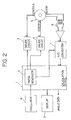
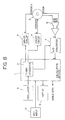
- FIGS 2 and 8 are block diagrams illustrating sample rotational angle detectors according to a first embodiment and a second embodiment, respectively.
- signals of rectangular waveform, phase-shifted by 90° relative to each other are output by timing generator 2 in calculation device 1, which consists of a CPU or some similar device.
- These signals e.g., signals a and b, are supplied to stators A and B in resolver 5 by way of driver circuits 3 and 4 respectively.
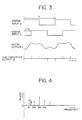
- the signals (a and b) which are supplied to stators A and B are shown in Figure 3.
- the induced signal c which originated in the rotor of resolver 5 and is output by way of output circuit 6 is sampled at specified sampling times, for example, in one embodiment, each 1/4 period in A/D converter 7. In the second embodiment, the induced signal can be sampled at each 1/8 period in A/D converter 7.
- Signal c is converted to digital signal d (See Figure 2) and supplied to calculation device 1, where it serves as the basis for the calculation of angle ⁇ .
- the angle of the rotor can be obtained by determining the phase difference between the excitation waveform and that of the rotor output.
- the angle of the rotor can be discovered by solving Equation (1) given above.
- Figure 8 shows the relationship between frequency and phase differences for the fundamental and higher frequencies.
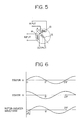
- Figure 4 shows the relationship between frequency and phase difference of the fundamental and higher frequencies for the first embodiment.
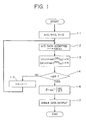
- Step 1-1 the output of A/D converter 7 is input as Ed(0) (Step 1-2).
- Ed(n) x cos (2 ⁇ n/m) is calculated and stored as Y r
- Ed(n) x -sin (2 ⁇ n/m) is calculated and stored as y i (Step 1-3).
- a judgment is made as to whether n ⁇ 8 (Step 1-4), and if the answer is "no," n is incremented by 1 (Step 1-5) and we return to Step 1-2.
- the real and imaginary parts of the fundamental frequency are calculated when the output of A/D converter 7 is input at each sampling time.
- an angle of rotation detector does not simply detect an angle. It must also transmit its result to the exterior as data, process displays and input, and perform operations to compare the detected value with a reference file.
- data are read in, the angle is determined, and calculations are performed during the half-cycle in which the excitation wave is generated. Other processing can be done during the remaining half-cycle. This allows the angle of rotation device to perform other processing simultaneously with angle detection.
- the rotor output is sampled, converted from an analog to a digital signal and transferred to a calculation device such as a CPU.
- the harmonics of the rotor output consist primarily of odd order sequence components. Using the phenomenon that the direction of phase shift corresponding to the revolution of the rotor differs according to the order of harmonic content, the sampling period is set at 1/4 of the period corresponding to the fundamental excitation frequency.
- A1sin(n ⁇ ⁇ 2 + ⁇ ) + A3sin ⁇ -(n ⁇ ⁇ 2 + ⁇ ) + ⁇ 3 ⁇ + A5sin ⁇ (n ⁇ ⁇ 2 + ⁇ ) + ⁇ 5 ⁇ + ... A1sin(n ⁇ ⁇ 2 + ⁇ ) - A3sin(n ⁇ ⁇ 2 + ⁇ ) ⁇ cos ⁇ 3 + A3 cos(n ⁇ ⁇ 2 + ⁇ ) ⁇ sin ⁇ 3 + A5 sin(n ⁇ ⁇ 2 + ⁇ 5) ⁇ cos ⁇ 5 + A5cos(n ⁇ ⁇ 2 + ⁇ ) ⁇ sin ⁇ 5 + ...
- Equation (3) which applies to the fundamental frequency only, we see that the amplitude has changed and an offset has appeared in the phase.
- the value of the amplitude be fixed. It is also general practice to correct the phase offset at the time the resolver is mounted so that it does not present an obstacle to the measurement of the angle.
- Step 11-1 the rise of the excitation wave is detected (Step 11-1), and variable n is set to 0 (Step 11-2).
- E0 The output of the A/D converter for that point is accepted and called E0.
- This datum is stored in A (Step 11-3).
- Step 11-6 the output of A/D converter 7 is accepted (Step 11-6) and called E1.
- Step 11-7 A judgment is made as to whether E n > 0 (Step 11-7).
- E n E1
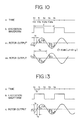
- the wave has crossed the zero crossing point and is now positive, as shown in Figure 10, the judgment in Step 11-7 will be YES.
- Step 11-3 of the flowchart shown in Figure 11 the data used will be E0, which will be assigned to A.
- Step 11-14 n will be incremented by 1, and with n equal to 1, we return to Step 11-3.
- datum E1 will be accepted and again assigned to A.
- the judgment of whether E n ⁇ 0 is made, the answer will be YES, as E1 is negative.
- Step 11-11 When t x + (n - 1) t s is calculated in Step 11-11, we get t x + 2t s , which becomes t x . Thus 2t s is added to the t x obtained in Step 11-10, which gives us the time t x needed to calculate angle ⁇ .
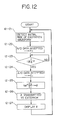
- the angle of rotation detector of this embodiment detects angle ⁇ by performing the operations shown in the flowchart in Figure 12 with calculation device 1 shown in Figure 2. It first detects the initial rise of the excitation waveform from stator A (Step 12-21). It then accepts the output from A/D converter 7 for that moment and stores it as E0 (Step 12-22). It determines whether or not a time t, which is equal to or more than 1/4 of the period T of the excitation signal, has elapsed since the detection of the initial rise (Step 12-23). At the point where 1/4 of the period has elapsed, it accepts the output of A/D converter 7 and stores it as E1 (Step 12-24).
- Step 12-25 From the data values E0 and E1 it computes tan ⁇ 1 E0/E1 to calculate angle ⁇ (Step 12-25). It transmits the data for ⁇ to the exterior (Step 12-26) and displays angle ⁇ on display 9 (Step 12-27).
- a circuit of the same design as that shown in Figure 1 accepts the output of A/D converter 7 each 1/4 period of the excitation signal, as in the previous embodiment.
- the amplitude K is a fixed value. It might be stored in the calculation device when the angle detector is shipped from the factory, and the amplitude can be checked at regular intervals and the value be newly stored as data.
- the rotational angle of the rotor can be determined from the single, clear data point which represents the time elapsed from the reference point of the excitation wave until after the zero crossing.
- Data after the zero crossing are not the only ones that can be used.
- Data before the zero crossing or a single data point just before or after a fixed value within the amplitude range is crossed can also be employed. In these cases, it is preferable to choose a point which can be specified as to which quadrant it falls into: 0 ⁇ /4; ⁇ /4 ⁇ /2; ⁇ /2 ⁇ 3 ⁇ /4; or 3 ⁇ /4 ⁇ 2 ⁇ . That is to say, observing in advance whether a given point falls into a specific quadrant will permit you to perform the calculation using a single data point, which will reduce the processing which must be performed by the calculation device.
- this method also simplifies other processing performed by the angle detector, such as transmission of data to the exterior and display of data. It enables us to realize an angle detector with a simple design and high capabilities.
- Step 14-31 the rise of the excitation wave is detected (Step 14-31), and the variable n is set to 0 (Step 14-32).
- the output of A/D converter 7 is accepted and stored in storage register A as E0 (Step 14-33).
- E0 the output of A/D converter 7
- Step 14-36 the output of A/D converter 7 is accepted and called E1 (Step 14-36).
- E1 > 0 (Step 14-37).
- Step 14-38 If the answer is YES, as pictured, then the zero crossing point falls between the previous sampling time and the current one. A judgment is made as to whether n is greater than 4 (Step 14-38). In the example, the answer is NO, so sin ⁇ 1E1/K is calculated, and time t y from the zero crossing point to the current sampling time is determined (Step 14-39). The next calculation is n x t s , in this case 1 x t s . From t s -t y we can determine time t x from the initial rise to the zero crossing point (Step 14-40). Then by solving 360 x t x /T we can determine angle ⁇ (Step 14-41), and we can display this value on display 8 (Step 14-42).
- Step 14-34 the judgment in Step 14-34 as to whether E0 ⁇ 0 will be YES.
- Step 14-35 n will go to 1, and in Step 14-36, the output of A/D converter 7 will be accepted as E1.
- E1 the judgment in Step 14-37 as to whether E n > 0 will be NO, and n will once again be incremented so that it will go to 2.
- Step 14-36 the output of A/D converter 7 will be accepted as E2. This E2 occurs after the zero crossing point, so it will be positive.
- Step 14-37 the judgment in Step 14-37 as to whether E n > 0 will be YES.
- the calculation in Step 14-40 will be 2 x t s - t y
- angle ⁇ can be determined by solving 360 x 2 x t s - t y /T.
- the output of A/D converter 7 will be accepted into storage register A as E1.
- E3 is accepted and stored (Step 14-36). Since this E3 is positive, the judgment rendered in Step 14-37 will be YES. Accordingly, t x will be calculated in Step 14-40 by solving 3 x t s - t1, and the phase angle ⁇ will be determined by solving 360 x (3 x t s x t1/T) (Step 14-41).
- an angle of rotation detector detects an angle of rotation using a resolver with one rotor coil and two stator coils. It is equipped with a drive unit which supplies excitation signals phase-shifted by 90° from each other to the two stators.
- a means to digitize the output of the rotor which means samples the output waveform at a minimum of two points which differ from each other but have a fixed time relationship with respect to the drive waveform outputs the data.
- a memory means is used to store previously measured relationships between rotor output and angle of rotation.
- the rotation angle detector also has a means to compare the output of the digitizing A/D conversion device with the reference data stored in the memory or other storage unit in order to determine the resolver's angle of rotation.
- This angle of rotation detector supplies excitation signals having a phase difference of 90° to two rotors. This causes a circular magnetic field to be generated in the rotors. An output signal is induced which has a phase shift corresponding to the rotational angle of the rotors. This output signal is digitized by the A/D conversion device and input into the comparison device. This device reads out an angle of rotation based upon the characteristic relationship between the rotor output and the angle of rotation which was stored in the storage device. In this way the rotor's angle of rotation is obtained.
- the memory means stores as constants values which have been previously input for the amplitude and phase of the harmonic components of the excitation wave contained in the rotor output.
- the calculating means includes means to calculate an inverse trigonometric function using the output of the digitizing A/D conversion device and the constants in order to determine the rotational angle of the resolver.
- a circular magnetic field is generated in the rotors by the out of phase excitation signals, as discussed above.
- An output signal is induced which has a phase shift corresponding to the rotational angle of the rotors.
- This output signal is input into the calculation device, where an inverse trigonometric calculation is performed based on the input signal from the A/D conversion device and the constants stored in the storage unit. In this way the rotational angle of the resolver is obtained.
- the relationship between the rotor and the angle of rotation i.e., how the rotor output relates to the angle of rotation, has been previously measured and is stored in memory 19.
- the output from A/D converter 7 is compared with the data stored in memory 19 by comparison unit 18 in calculation unit 1, and the angle data are output.
- A1, A3, and A5 are the amplitudes of the various components, and ⁇ 3, ⁇ 5, ... are the phase offsets between the fundamental frequency and each corresponding harmonic.
- the sampling points are fixed, and the amplitude and phase do not vary once the resolver and resolver cable are fixed.
- the values for E s corresponding to the various ⁇ can be measured, tabulated, and stored in the memory when the angle detector is shipped by the factory or when it is installed. Thereafter, the angle can be determined by comparing the output of the A/D converter with the reference data in the table.
- the embodiment described above is a circuit designed to realize this method of angle detection.
- the angle of rotation can be determined accurately without the need for a sine wave generator circuit or a low pass filter. As a result, the cost of the device can be held down. Data are sampled at as few as two points per cycle, which frees processing time in the calculation device for data display, key input, and comparison of observed data with reference data.
- the invention allows us to realize an angle of rotation detector with high capabilities and a simple design.
- Figure 17 is a block diagram of variation of the fourth embodiment of an angle of rotation detector according to this invention.
- the elements in the diagram labeled with numbers identical to those in Figure 15 represent the same circuits.
- the device in this embodiment differs from that shown in Figure 15 in the following ways: Instead of memory 19, which stores the table showing the relationship between angles of rotation and the A/D converter outputs, this device has memory 12, which stores ⁇ (K s1 2 + K c1 2), ⁇ (K s2 2 + K c2 2), ⁇ 1 and ⁇ 2 as constants.
- this device has trigonometric calculation unit 11, which determines angle ⁇ by performing a calculation on output E from A/D converter 7 and the constants stored in memory 12.
- values of transfer function from the amplitude wave to the A/D input
- These data are stored as constants in memory 12.
- the output E n of A/D converter 7 is also used in the above equation to calculate angle ⁇ .
- the angle of rotation can be determined accurately without the need for a sine wave generator circuit or a low pass filter. As a result, the cost of the device can be held down. Data are sampled at a minimum of two points per cycle, which frees processing time in the calculation device for data display, key input, and comparison of observed data with reference data.
- the invention allows us to realize an angle of rotation detector with high capabilities and a simple design.
Landscapes
- Physics & Mathematics (AREA)
- General Physics & Mathematics (AREA)
- Transmission And Conversion Of Sensor Element Output (AREA)
Applications Claiming Priority (8)
| Application Number | Priority Date | Filing Date | Title |
|---|---|---|---|
| JP11910290A JPH0415520A (ja) | 1990-05-09 | 1990-05-09 | 回転角度検出装置 |
| JP119101/90 | 1990-05-09 | ||
| JP11910190A JPH0415519A (ja) | 1990-05-09 | 1990-05-09 | 回転角度検出装置 |
| JP119102/90 | 1990-05-09 | ||
| JP12050490A JPH0416712A (ja) | 1990-05-10 | 1990-05-10 | 回転角度検出装置 |
| JP120504/90 | 1990-05-10 | ||
| JP123590/90 | 1990-05-14 | ||
| JP12359090A JPH0419511A (ja) | 1990-05-14 | 1990-05-14 | 回転角度検出装置 |
Publications (3)
| Publication Number | Publication Date |
|---|---|
| EP0458148A2 true EP0458148A2 (de) | 1991-11-27 |
| EP0458148A3 EP0458148A3 (en) | 1991-12-11 |
| EP0458148B1 EP0458148B1 (de) | 1996-08-28 |
Family
ID=27470564
Family Applications (1)
| Application Number | Title | Priority Date | Filing Date |
|---|---|---|---|
| EP91107609A Expired - Lifetime EP0458148B1 (de) | 1990-05-09 | 1991-05-10 | Drehwinkelsensor |
Country Status (5)
| Country | Link |
|---|---|
| US (1) | US5455498A (de) |
| EP (1) | EP0458148B1 (de) |
| AT (1) | ATE142013T1 (de) |
| DE (1) | DE69121631D1 (de) |
| ES (1) | ES2093653T3 (de) |
Cited By (3)
| Publication number | Priority date | Publication date | Assignee | Title |
|---|---|---|---|---|
| WO1996041211A1 (en) * | 1995-06-07 | 1996-12-19 | HE HOLDINGS, INC., doing business as, HUGHES ELECTRONICS | Software-based resolver-to-digital converter |
| US7764063B2 (en) * | 2003-10-23 | 2010-07-27 | Tamagawa Seiki Co., Ltd. | Brushless resolver and method of constructing the same |
| EP4431879A1 (de) * | 2023-03-16 | 2024-09-18 | Hamilton Sundstrand Corporation | Timer-basierte integrierte resolverdemodulation |
Families Citing this family (22)
| Publication number | Priority date | Publication date | Assignee | Title |
|---|---|---|---|---|
| JP3414893B2 (ja) * | 1995-07-12 | 2003-06-09 | オークマ株式会社 | 回転位置検出装置 |
| US5949359A (en) * | 1997-05-09 | 1999-09-07 | Kollmorgen Corporation | Variable reluctance resolver to digital converter |
| DE19729034A1 (de) * | 1997-07-08 | 1999-01-21 | Aloys Wobben | Synchrongenerator zum Einsatz bei Windenergieanlagen sowie Windenergieanlage |
| US6331759B1 (en) * | 1999-04-27 | 2001-12-18 | The Boeing Company | Pulse drive angle measurement system and method |
| JP2000337924A (ja) * | 1999-05-31 | 2000-12-08 | Minebea Co Ltd | R/dコンバータ |
| JP3460017B2 (ja) * | 1999-05-31 | 2003-10-27 | ミネベア株式会社 | R/dコンバータ |
| US6380658B1 (en) * | 1999-07-15 | 2002-04-30 | Delphi Technologies Inc. | Method and apparatus for torque ripple reduction in sinusoidally excited brushless permanent magnet motors |
| JP3436515B2 (ja) * | 2000-04-18 | 2003-08-11 | 株式会社ミツトヨ | 測定装置、信号出力方法および記憶媒体 |
| US6754610B2 (en) * | 2001-05-16 | 2004-06-22 | Raytheon Company | Digital signal processing of resolver rotor angle signals |
| JP2004279231A (ja) * | 2003-03-17 | 2004-10-07 | Minebea Co Ltd | R/dコンバータ |
| US7268710B1 (en) * | 2006-07-11 | 2007-09-11 | Hiwin Mikrosystems Corp. | Logic device for the transformation of the output of the RDC into series A-B pulses |
| US8030867B1 (en) * | 2006-07-29 | 2011-10-04 | Ixys Ch Gmbh | Sample and hold time stamp for sensing zero crossing of back electromotive force in 3-phase brushless DC motors |
| JP4950824B2 (ja) * | 2007-09-28 | 2012-06-13 | 株式会社東芝 | 回転機の制御装置、制御システムおよび制御方法 |
| CN101932948B (zh) * | 2007-12-07 | 2014-07-30 | 阿尔斯通技术有限公司 | 用于探测电机定子叠片组中的层间片短路的方法 |
| DE102010002695A1 (de) | 2010-03-09 | 2011-09-15 | Robert Bosch Gmbh | Verfahren zur Auswertung eines analogen Signals |
| US8766578B2 (en) | 2012-02-27 | 2014-07-01 | Canadian Space Agency | Method and apparatus for high velocity ripple suppression of brushless DC motors having limited drive/amplifier bandwidth |
| US9068861B2 (en) * | 2012-08-24 | 2015-06-30 | Hamilton Sundstrand Corporation | Resolver interface |
| US9651933B2 (en) * | 2012-10-10 | 2017-05-16 | Magna E-Car Systems Of America, Inc. | Peak detection circuit and method |
| KR101921839B1 (ko) * | 2014-08-25 | 2018-11-23 | 엔에스디 가부시끼가이샤 | 회전 검출장치 |
| TWI798331B (zh) * | 2018-02-02 | 2023-04-11 | 日商三共製作所股份有限公司 | 檢測移動體之運動之位置變化量的方法及裝置 |
| US11209290B2 (en) | 2018-07-09 | 2021-12-28 | Hamilton Sundstrand Corporation | Resolver/LVDT odd harmonic distortion compensation |
| US10801863B2 (en) * | 2019-01-14 | 2020-10-13 | Hamilton Sundstrand Corporation | High speed AC sensor phase measurement |
Family Cites Families (14)
| Publication number | Priority date | Publication date | Assignee | Title |
|---|---|---|---|---|
| US3671728A (en) * | 1970-10-05 | 1972-06-20 | Hughes Aircraft Co | Electronic repeater servo |
| US4095159A (en) * | 1975-12-09 | 1978-06-13 | Exo Elettronica Industriale S.R.L. | Electronic apparatus for automatic closed loop positioning of mobile members associated with an electromagnetic transducer with two pairs of windings |
| JPS576584A (en) * | 1980-06-12 | 1982-01-13 | Toshiba Mach Co Ltd | Controller for drive of synchronous motor |
| JPS5720814A (en) * | 1980-07-14 | 1982-02-03 | Fanuc Ltd | Method and device for error correcting method of position detecting circuit |
| JPS6041554B2 (ja) * | 1982-11-15 | 1985-09-17 | 東芝機械株式会社 | 誘導電動機の駆動制御装置 |
| JPH0230539B2 (ja) * | 1983-09-10 | 1990-07-06 | Fujitsu Ltd | Risanfuuriehenkansochi |
| FR2561738B1 (fr) * | 1984-03-26 | 1986-08-22 | Europ Propulsion | Procede et dispositif de reduction des vibrations des machines tournantes equipees d'une suspension magnetique active |
| USH104H (en) * | 1985-06-03 | 1986-08-05 | The United States Of America As Represented By The Secretary Of The Army | Digital resolver compensation technique |
| JPS62171100A (ja) * | 1986-01-23 | 1987-07-28 | 株式会社安川電機 | レゾルバ制御方法 |
| US4791575A (en) * | 1986-10-31 | 1988-12-13 | The Pratt & Whitney Company, Inc. | Method for generating axis control data for use in controlling a grinding machine and the like and system therefor |
| EP0285878B1 (de) * | 1987-03-18 | 1990-08-01 | Kabushiki Kaisha Toshiba | Drehbewegungsdetektor mit einem Synchro |
| FR2647205B1 (fr) * | 1989-05-19 | 1991-10-11 | Option | Procede et dispositif pour la determination de l'angle de rotation d'un element rotatif |
| US4962331A (en) * | 1989-07-13 | 1990-10-09 | Servo-Tek Products Company, Inc. | Rotatable control signal generator |
| JP3060525B2 (ja) * | 1990-11-02 | 2000-07-10 | 日本精工株式会社 | レゾルバ装置 |
-
1991
- 1991-05-09 US US07/697,335 patent/US5455498A/en not_active Expired - Lifetime
- 1991-05-10 DE DE69121631T patent/DE69121631D1/de not_active Expired - Lifetime
- 1991-05-10 EP EP91107609A patent/EP0458148B1/de not_active Expired - Lifetime
- 1991-05-10 AT AT91107609T patent/ATE142013T1/de not_active IP Right Cessation
- 1991-05-10 ES ES91107609T patent/ES2093653T3/es not_active Expired - Lifetime
Cited By (6)
| Publication number | Priority date | Publication date | Assignee | Title |
|---|---|---|---|---|
| WO1996041211A1 (en) * | 1995-06-07 | 1996-12-19 | HE HOLDINGS, INC., doing business as, HUGHES ELECTRONICS | Software-based resolver-to-digital converter |
| US5684719A (en) * | 1995-06-07 | 1997-11-04 | Hughes Electronics | Software-based resolver-to-digital converter |
| USRE37547E1 (en) | 1995-06-07 | 2002-02-12 | Raytheon Company | Software-based resolver-to-digital converter |
| US7764063B2 (en) * | 2003-10-23 | 2010-07-27 | Tamagawa Seiki Co., Ltd. | Brushless resolver and method of constructing the same |
| EP4431879A1 (de) * | 2023-03-16 | 2024-09-18 | Hamilton Sundstrand Corporation | Timer-basierte integrierte resolverdemodulation |
| US12388461B2 (en) | 2023-03-16 | 2025-08-12 | Hamilton Sundstrand Corporation | Timer-based resolver integral demodulation |
Also Published As
| Publication number | Publication date |
|---|---|
| ATE142013T1 (de) | 1996-09-15 |
| EP0458148A3 (en) | 1991-12-11 |
| US5455498A (en) | 1995-10-03 |
| DE69121631D1 (de) | 1996-10-02 |
| EP0458148B1 (de) | 1996-08-28 |
| ES2093653T3 (es) | 1997-01-01 |
Similar Documents
| Publication | Publication Date | Title |
|---|---|---|
| EP0458148A2 (de) | Drehwinkelsensor | |
| EP0978947B1 (de) | Resolversignalverarbeitungssystem | |
| US4539521A (en) | Magnetic field measuring device | |
| RU2182315C2 (ru) | Способ акустического измерения расхода текучей среды | |
| US5260650A (en) | Method and apparatus for detecting low rotational speeds using a resolver | |
| EP0702212A2 (de) | Vorrichtung zur Messung der Phasendifferenz und Massendurchflussmessgerät dafür | |
| US4795954A (en) | Resolver controlling method and apparatus | |
| JPS60119401A (ja) | コンデンサ型長さ・角度測定装置 | |
| US7088025B2 (en) | Variable-reluctance resolver and rotational angle sensor using same | |
| EP0241062A1 (de) | Winkellagendetektor | |
| US6552666B1 (en) | Phase difference detection device and method for a position detector | |
| RU2161773C2 (ru) | Устройство для определения угла | |
| EP1808671A1 (de) | Zeitdifferenz-messeinrichtung, messverfahren, distanzmesseinrichtung und distanzmessverfahren | |
| Attaianese et al. | A low cost resolver-to-digital converter | |
| US4542346A (en) | Wide-range lock-in amplifier | |
| US12320948B2 (en) | Asynchronous method for sampling signals in metal detectors | |
| US3720866A (en) | Method and system for determination of rotor angle of synchromechanism | |
| RU2086991C1 (ru) | Способ спектрального анализа сигнала | |
| JPH06109783A (ja) | Lcrテスタ | |
| JPH0651004A (ja) | 回路素子の定数測定装置 | |
| RU2065168C1 (ru) | Способ спектрального анализа сигнала | |
| JPH07239247A (ja) | 磁気エンコーダの信号処理装置 | |
| Tian et al. | Design and implementation of ISA card for rotary inductosyn signal processing based on AD2S1210 and CPLD | |
| JP2554472B2 (ja) | 回転位置検出器 | |
| JPH0415520A (ja) | 回転角度検出装置 |
Legal Events
| Date | Code | Title | Description |
|---|---|---|---|
| PUAI | Public reference made under article 153(3) epc to a published international application that has entered the european phase |
Free format text: ORIGINAL CODE: 0009012 |
|
| PUAL | Search report despatched |
Free format text: ORIGINAL CODE: 0009013 |
|
| 17P | Request for examination filed |
Effective date: 19910529 |
|
| AK | Designated contracting states |
Kind code of ref document: A2 Designated state(s): AT BE CH DE DK ES FR GB GR IT LI LU NL SE |
|
| AK | Designated contracting states |
Kind code of ref document: A3 Designated state(s): AT BE CH DE DK ES FR GB GR IT LI LU NL SE |
|
| 17Q | First examination report despatched |
Effective date: 19930720 |
|
| GRAH | Despatch of communication of intention to grant a patent |
Free format text: ORIGINAL CODE: EPIDOS IGRA |
|
| GRAH | Despatch of communication of intention to grant a patent |
Free format text: ORIGINAL CODE: EPIDOS IGRA |
|
| GRAA | (expected) grant |
Free format text: ORIGINAL CODE: 0009210 |
|
| AK | Designated contracting states |
Kind code of ref document: B1 Designated state(s): AT BE CH DE DK ES FR GB GR IT LI LU NL SE |
|
| PG25 | Lapsed in a contracting state [announced via postgrant information from national office to epo] |
Ref country code: NL Free format text: LAPSE BECAUSE OF FAILURE TO SUBMIT A TRANSLATION OF THE DESCRIPTION OR TO PAY THE FEE WITHIN THE PRESCRIBED TIME-LIMIT Effective date: 19960828 Ref country code: LI Effective date: 19960828 Ref country code: BE Effective date: 19960828 Ref country code: DK Effective date: 19960828 Ref country code: AT Effective date: 19960828 Ref country code: CH Effective date: 19960828 Ref country code: GR Free format text: LAPSE BECAUSE OF FAILURE TO SUBMIT A TRANSLATION OF THE DESCRIPTION OR TO PAY THE FEE WITHIN THE PRESCRIBED TIME-LIMIT Effective date: 19960828 Ref country code: FR Effective date: 19960828 |
|
| REF | Corresponds to: |
Ref document number: 142013 Country of ref document: AT Date of ref document: 19960915 Kind code of ref document: T |
|
| REF | Corresponds to: |
Ref document number: 69121631 Country of ref document: DE Date of ref document: 19961002 |
|
| ITF | It: translation for a ep patent filed | ||
| PG25 | Lapsed in a contracting state [announced via postgrant information from national office to epo] |
Ref country code: SE Effective date: 19961128 |
|
| PG25 | Lapsed in a contracting state [announced via postgrant information from national office to epo] |
Ref country code: DE Effective date: 19961129 |
|
| REG | Reference to a national code |
Ref country code: ES Ref legal event code: FG2A Ref document number: 2093653 Country of ref document: ES Kind code of ref document: T3 |
|
| EN | Fr: translation not filed | ||
| NLV1 | Nl: lapsed or annulled due to failure to fulfill the requirements of art. 29p and 29m of the patents act | ||
| REG | Reference to a national code |
Ref country code: CH Ref legal event code: PL |
|
| PG25 | Lapsed in a contracting state [announced via postgrant information from national office to epo] |
Ref country code: LU Free format text: LAPSE BECAUSE OF NON-PAYMENT OF DUE FEES Effective date: 19970531 |
|
| PLBE | No opposition filed within time limit |
Free format text: ORIGINAL CODE: 0009261 |
|
| STAA | Information on the status of an ep patent application or granted ep patent |
Free format text: STATUS: NO OPPOSITION FILED WITHIN TIME LIMIT |
|
| 26N | No opposition filed | ||
| REG | Reference to a national code |
Ref country code: GB Ref legal event code: IF02 |
|
| PGFP | Annual fee paid to national office [announced via postgrant information from national office to epo] |
Ref country code: ES Payment date: 20070524 Year of fee payment: 17 |
|
| PGFP | Annual fee paid to national office [announced via postgrant information from national office to epo] |
Ref country code: GB Payment date: 20070525 Year of fee payment: 17 |
|
| PGFP | Annual fee paid to national office [announced via postgrant information from national office to epo] |
Ref country code: IT Payment date: 20070528 Year of fee payment: 17 |
|
| GBPC | Gb: european patent ceased through non-payment of renewal fee |
Effective date: 20080510 |
|
| PG25 | Lapsed in a contracting state [announced via postgrant information from national office to epo] |
Ref country code: GB Free format text: LAPSE BECAUSE OF NON-PAYMENT OF DUE FEES Effective date: 20080510 |
|
| REG | Reference to a national code |
Ref country code: ES Ref legal event code: FD2A Effective date: 20080512 |
|
| PG25 | Lapsed in a contracting state [announced via postgrant information from national office to epo] |
Ref country code: IT Free format text: LAPSE BECAUSE OF NON-PAYMENT OF DUE FEES Effective date: 20080510 |
|
| PG25 | Lapsed in a contracting state [announced via postgrant information from national office to epo] |
Ref country code: ES Free format text: LAPSE BECAUSE OF NON-PAYMENT OF DUE FEES Effective date: 20080512 |