EP0457601A2 - Dünnfilm-Halbleiteranordnung und Verfahren zu ihrer Herstellung - Google Patents
Dünnfilm-Halbleiteranordnung und Verfahren zu ihrer Herstellung Download PDFInfo
- Publication number
- EP0457601A2 EP0457601A2 EP91304442A EP91304442A EP0457601A2 EP 0457601 A2 EP0457601 A2 EP 0457601A2 EP 91304442 A EP91304442 A EP 91304442A EP 91304442 A EP91304442 A EP 91304442A EP 0457601 A2 EP0457601 A2 EP 0457601A2
- Authority
- EP
- European Patent Office
- Prior art keywords
- thin film
- less
- mtorr
- silicon
- silicon thin
- Prior art date
- Legal status (The legal status is an assumption and is not a legal conclusion. Google has not performed a legal analysis and makes no representation as to the accuracy of the status listed.)
- Ceased
Links
Images


Classifications
-
- H—ELECTRICITY
- H10—SEMICONDUCTOR DEVICES; ELECTRIC SOLID-STATE DEVICES NOT OTHERWISE PROVIDED FOR
- H10D—INORGANIC ELECTRIC SEMICONDUCTOR DEVICES
- H10D30/00—Field-effect transistors [FET]
- H10D30/01—Manufacture or treatment
- H10D30/021—Manufacture or treatment of FETs having insulated gates [IGFET]
- H10D30/031—Manufacture or treatment of FETs having insulated gates [IGFET] of thin-film transistors [TFT]
- H10D30/0312—Manufacture or treatment of FETs having insulated gates [IGFET] of thin-film transistors [TFT] characterised by the gate electrodes
- H10D30/0314—Manufacture or treatment of FETs having insulated gates [IGFET] of thin-film transistors [TFT] characterised by the gate electrodes of lateral top-gate TFTs comprising only a single gate
-
- H—ELECTRICITY
- H10—SEMICONDUCTOR DEVICES; ELECTRIC SOLID-STATE DEVICES NOT OTHERWISE PROVIDED FOR
- H10D—INORGANIC ELECTRIC SEMICONDUCTOR DEVICES
- H10D30/00—Field-effect transistors [FET]
- H10D30/01—Manufacture or treatment
- H10D30/021—Manufacture or treatment of FETs having insulated gates [IGFET]
- H10D30/031—Manufacture or treatment of FETs having insulated gates [IGFET] of thin-film transistors [TFT]
- H10D30/0321—Manufacture or treatment of FETs having insulated gates [IGFET] of thin-film transistors [TFT] comprising silicon, e.g. amorphous silicon or polysilicon
-
- H—ELECTRICITY
- H10—SEMICONDUCTOR DEVICES; ELECTRIC SOLID-STATE DEVICES NOT OTHERWISE PROVIDED FOR
- H10D—INORGANIC ELECTRIC SEMICONDUCTOR DEVICES
- H10D30/00—Field-effect transistors [FET]
- H10D30/60—Insulated-gate field-effect transistors [IGFET]
- H10D30/67—Thin-film transistors [TFT]
- H10D30/6729—Thin-film transistors [TFT] characterised by the electrodes
- H10D30/673—Thin-film transistors [TFT] characterised by the electrodes characterised by the shapes, relative sizes or dispositions of the gate electrodes
- H10D30/6731—Top-gate only TFTs
-
- H—ELECTRICITY
- H10—SEMICONDUCTOR DEVICES; ELECTRIC SOLID-STATE DEVICES NOT OTHERWISE PROVIDED FOR
- H10D—INORGANIC ELECTRIC SEMICONDUCTOR DEVICES
- H10D30/00—Field-effect transistors [FET]
- H10D30/60—Insulated-gate field-effect transistors [IGFET]
- H10D30/67—Thin-film transistors [TFT]
- H10D30/674—Thin-film transistors [TFT] characterised by the active materials
- H10D30/6741—Group IV materials, e.g. germanium or silicon carbide
- H10D30/6743—Silicon
- H10D30/6745—Polycrystalline or microcrystalline silicon
-
- H—ELECTRICITY
- H10—SEMICONDUCTOR DEVICES; ELECTRIC SOLID-STATE DEVICES NOT OTHERWISE PROVIDED FOR
- H10P—GENERIC PROCESSES OR APPARATUS FOR THE MANUFACTURE OR TREATMENT OF DEVICES COVERED BY CLASS H10
- H10P14/00—Formation of materials, e.g. in the shape of layers or pillars
- H10P14/20—Formation of materials, e.g. in the shape of layers or pillars of semiconductor materials
- H10P14/24—Formation of materials, e.g. in the shape of layers or pillars of semiconductor materials using chemical vapour deposition [CVD]
-
- H—ELECTRICITY
- H10—SEMICONDUCTOR DEVICES; ELECTRIC SOLID-STATE DEVICES NOT OTHERWISE PROVIDED FOR
- H10P—GENERIC PROCESSES OR APPARATUS FOR THE MANUFACTURE OR TREATMENT OF DEVICES COVERED BY CLASS H10
- H10P14/00—Formation of materials, e.g. in the shape of layers or pillars
- H10P14/20—Formation of materials, e.g. in the shape of layers or pillars of semiconductor materials
- H10P14/29—Formation of materials, e.g. in the shape of layers or pillars of semiconductor materials characterised by the substrates
- H10P14/2901—Materials
-
- H—ELECTRICITY
- H10—SEMICONDUCTOR DEVICES; ELECTRIC SOLID-STATE DEVICES NOT OTHERWISE PROVIDED FOR
- H10P—GENERIC PROCESSES OR APPARATUS FOR THE MANUFACTURE OR TREATMENT OF DEVICES COVERED BY CLASS H10
- H10P14/00—Formation of materials, e.g. in the shape of layers or pillars
- H10P14/20—Formation of materials, e.g. in the shape of layers or pillars of semiconductor materials
- H10P14/29—Formation of materials, e.g. in the shape of layers or pillars of semiconductor materials characterised by the substrates
- H10P14/2901—Materials
- H10P14/2902—Materials being Group IVA materials
- H10P14/2905—Silicon, silicon germanium or germanium
-
- H—ELECTRICITY
- H10—SEMICONDUCTOR DEVICES; ELECTRIC SOLID-STATE DEVICES NOT OTHERWISE PROVIDED FOR
- H10P—GENERIC PROCESSES OR APPARATUS FOR THE MANUFACTURE OR TREATMENT OF DEVICES COVERED BY CLASS H10
- H10P14/00—Formation of materials, e.g. in the shape of layers or pillars
- H10P14/20—Formation of materials, e.g. in the shape of layers or pillars of semiconductor materials
- H10P14/29—Formation of materials, e.g. in the shape of layers or pillars of semiconductor materials characterised by the substrates
- H10P14/2901—Materials
- H10P14/2921—Materials being crystalline insulating materials
-
- H—ELECTRICITY
- H10—SEMICONDUCTOR DEVICES; ELECTRIC SOLID-STATE DEVICES NOT OTHERWISE PROVIDED FOR
- H10P—GENERIC PROCESSES OR APPARATUS FOR THE MANUFACTURE OR TREATMENT OF DEVICES COVERED BY CLASS H10
- H10P14/00—Formation of materials, e.g. in the shape of layers or pillars
- H10P14/20—Formation of materials, e.g. in the shape of layers or pillars of semiconductor materials
- H10P14/32—Formation of materials, e.g. in the shape of layers or pillars of semiconductor materials characterised by intermediate layers between substrates and deposited layers
- H10P14/3202—Materials thereof
- H10P14/3238—Materials thereof being insulating materials
-
- H—ELECTRICITY
- H10—SEMICONDUCTOR DEVICES; ELECTRIC SOLID-STATE DEVICES NOT OTHERWISE PROVIDED FOR
- H10P—GENERIC PROCESSES OR APPARATUS FOR THE MANUFACTURE OR TREATMENT OF DEVICES COVERED BY CLASS H10
- H10P14/00—Formation of materials, e.g. in the shape of layers or pillars
- H10P14/20—Formation of materials, e.g. in the shape of layers or pillars of semiconductor materials
- H10P14/34—Deposited materials, e.g. layers
- H10P14/3402—Deposited materials, e.g. layers characterised by the chemical composition
- H10P14/3404—Deposited materials, e.g. layers characterised by the chemical composition being Group IVA materials
- H10P14/3411—Silicon, silicon germanium or germanium
-
- H—ELECTRICITY
- H10—SEMICONDUCTOR DEVICES; ELECTRIC SOLID-STATE DEVICES NOT OTHERWISE PROVIDED FOR
- H10P—GENERIC PROCESSES OR APPARATUS FOR THE MANUFACTURE OR TREATMENT OF DEVICES COVERED BY CLASS H10
- H10P14/00—Formation of materials, e.g. in the shape of layers or pillars
- H10P14/20—Formation of materials, e.g. in the shape of layers or pillars of semiconductor materials
- H10P14/34—Deposited materials, e.g. layers
- H10P14/3438—Doping during depositing
- H10P14/3441—Conductivity type
- H10P14/3442—N-type
-
- H—ELECTRICITY
- H10—SEMICONDUCTOR DEVICES; ELECTRIC SOLID-STATE DEVICES NOT OTHERWISE PROVIDED FOR
- H10P—GENERIC PROCESSES OR APPARATUS FOR THE MANUFACTURE OR TREATMENT OF DEVICES COVERED BY CLASS H10
- H10P14/00—Formation of materials, e.g. in the shape of layers or pillars
- H10P14/20—Formation of materials, e.g. in the shape of layers or pillars of semiconductor materials
- H10P14/34—Deposited materials, e.g. layers
- H10P14/3438—Doping during depositing
- H10P14/3441—Conductivity type
- H10P14/3444—P-type
-
- Y—GENERAL TAGGING OF NEW TECHNOLOGICAL DEVELOPMENTS; GENERAL TAGGING OF CROSS-SECTIONAL TECHNOLOGIES SPANNING OVER SEVERAL SECTIONS OF THE IPC; TECHNICAL SUBJECTS COVERED BY FORMER USPC CROSS-REFERENCE ART COLLECTIONS [XRACs] AND DIGESTS
- Y10—TECHNICAL SUBJECTS COVERED BY FORMER USPC
- Y10S—TECHNICAL SUBJECTS COVERED BY FORMER USPC CROSS-REFERENCE ART COLLECTIONS [XRACs] AND DIGESTS
- Y10S148/00—Metal treatment
- Y10S148/15—Silicon on sapphire SOS
Definitions
- the present invention relates to a method of producing a thin film semi-conductor device, which is suitable for application in active matrix liquid crystal displays, SRAMS and the like, and to a thin film semi-conductor device produced by such a method.
- the screen size of liquid crystal displays and the resolution thereof are presently increasing with improvements in systems for driving liquid crystal displays from simple matrix systems to active matrix system.
- the active matrix system enables the formation of a liquid crystal display having several hundreds of thousands of pixels, and also allows a switching transistor to be formed for each of the pixels. As a result, a large volume of information can be displayed.
- Transparent insulating substrates such as melt quartz glass plates, glass plates and the like, all of which permit the formation of transparent displays, are used as substrates for various liquid crystal displays.
- Amorphous silicon or polycrystalline silicon is generally used as an active layer for a thin film transistor, polycrystalline silicon which shows a high operating speed being useful when a thin film transistor and a driving circuit are to be formed integrally.
- One such method comprises forming an active layer of a thin film semi-conductor device by depositing a silicon thin film at a deposition temperature which is raised near the highest possible process temperature (610°C to 640°C) and at a deposition pressure of 40 mTorr to 750 mTorr (Appl.Phys. Lett., 50 (26), P.1894 (1987)).
- Another such method comprises depositing a silicon thin film on an insulating substrate by low pressure chemical vapour deposition at a temperature of 570°C or less and then heating the film at a temperature of 640°C or less for twenty four hours to change the orientation and crystallinity of the deposited film (Japanese Laid Open Patent No. 63-307776).
- the method of depositing a silicon thin film serving as an active layer using conventional low pressure chemical vapour deposition at a raised temperature has the problem that the deposition temperature is too high in that a low priced glass substrate can only be employed if the highest temperature in the production process is about 600°C and the time that the highest temperature is sustained is limited to several hours or less. Also, when a thin film semi-conductor device is applied to a three dimensional LSI, SRAM or the like, the thin film semi-conductor device is preferably produced at a highest process temperature of 600°C or less for the protection of any lower layer transistors and connections.
- the process is not suitable for forming polycrystalline silicon thin films for active layers of semi-conductor devices and thus such films cannot be used as switching elements for liquid crystal displays nor can they be applied to three dimensional LSIs, SRAMS and the like.
- the present invention seeks to solve the above described problems, and to improve the characteristics of a silicon thin film for use in a thin film semi-conductor device produced by low pressure chemical vapour deposition.
- a method of producing a thin film semi-conductor device comprising forming an insulating layer on a surface of a substrate, and depositing a silicon thin film as an active layer above the insulating layer by low pressure chemical vapour deposition, characterised in that the low pressure chemical vapour deposition is effected using monosilane (SiH4) as a source gas and at a total reactor pressure of 15 mTorr or less or a silane partial pressure of 10 mTorr or less.
- SiH4 monosilane
- the film properties such as crystallinity, preferred orientation, optical properties and so on may be improved so that a thin film semi-conductor device having desirable characteristics may be produced reliably and economically.
- a thin film semi-conductor device comprising a substrate having at least the surface covered with an insulating material and a silicon film semi-conductor layer formed on one of the sides of said substrate so as to serve as an active layer of a transistor characterised in that said semiconductor layer comprises a silicon film having a refractive index of 4.06 or less for light of a wave length of 589.3 nm in air, a silicon film having a refractive index of 4.46 or more for light of a wave length of 308 nm in air or a silicon film having an extinction index of 0.81 or less at a wave length of 404.7 nm.
- a thin film semiconductor device comprising a substrate having at least a surface covered with an insulating material and a silicon film semi-conductor layer formed on one of the sides of said substrate so as to serve as an active layer of a transistor, characterised in that said semiconductor layer comprises a silicon film having a degree of crystallinity which reaches 40% or more when being measured by Raman spectroscopy.
- Figures 1 (a) to 1 (f) are sectional views showing steps in a process according to the present invention for producing a polycrystalline silicon thin film transistor in the form of an MIS-type field effect transistor.
- the substrate may comprise a three dimensional LSI formed on a silicon wafer.
- the substrate may also comprise a ceramic substrate such as a sintered alumina substrate (Al2O3), an aluminium nitride substrate (AlN), a silicon carbide substrate (SiC), or a graphite substrate or the like.
- a plate of a high melting point metal such as tungsten, molybdenum or the like can be used as a substrate.
- the quartz glass substrate is first immersed in 60% nitric acid, which is boiled for five minutes, and is then rinsed in pure water through which nitrogen gas is bubbled.
- a substance such as a metal or the like, which erodes or deteriorates in acid is used as a substrate, it is unnecessary to wash the substrate with nitric acid.
- Other effective methods of washing a substrate include washing with an organic solvent, such as acetone or methyl ethyl ketone (MEK) or the like, followed by rinsing with ethanol and then pure water; and washing with an aqueous solution containing an organic surfactant or a silicon containing surfactant and then rinsing with pure water.
- MEK methyl ethyl ketone
- a silicon dioxide (SiO2) film 102 having a thickness of 2000 ⁇ is then deposited as a protective under layer on the washed quartz substrate by an atmospheric pressure chemical vapour phase deposition process (APCVD process).
- the SiO2film 102 is required for stabilising the properties of a later deposited silicon thin film and also the performance of a thin film transistor comprising the silicon thin film.
- the protective film 102 has the function of preventing movable ions such as sodium ions and the like contained in the glass substrate 101, or in a sintering assistance material added to a ceramic plate if such is used as the substrate 101, from diffusing and mixing in the transistor portion.
- the SiO2 film 102 is necessary for ensuring insulating propeties.
- the protective film 102 corresponds to an inter-layer insulating film between transistors or connections.
- the substrate temperature during deposition of the SiO2 film 102 is 300°C.
- the SiO2film 102 is deposited by the APCVD process using 20% silane diluted with nitrogen at 600 sccm together with oxygen at 840 sccm. During this process, the deposition rate of the SiO2 film 102 is 3.9 ⁇ /sec.
- a silicon thin film 103 containing an impurity serving as a donor or acceptor is then deposited by a low pressure chemical vapour deposition process (low pressure CVD process) (see Figure 1 (a)).
- phosphorus is selected as the impurity for the purpose of forming an n-type transistor, but any one of the elements in Group V and VI other than phosphorus can be added as impurity in the case of an n-type transistor and any one of the elements in Group II and III such as boron or the like can be added as impurity in the case of a p-type transistor.
- the silicon thin film 103 containing the impurity forms the source and drain regions of the transistor.
- Methods of adding the impurity include the CVD process itself, a method of forming an intrinsic silicon film containing no impurity and then adding impurity by diffusion from a vapour phase or a solid phase in contact with the silicon film, and a method of implanting impurity ions into the intrinsic silicon film formed.
- the advantage of the later two methods, comprising forming an intrinsic silicon film and then diffusing an impurity therein or implanting impurity ions into the silicon film is that these enable the impurity to be added only to a desired portion of the intrinsic silicon film.
- both such methods enable a transistor to be produced having a gate electrode terminal and a source terminal or a drain terminal in self alignment. They also enable the formation of a silicon film having different portions containing different concentrations of the impurity and thus having different current densitites and specific resistances, thereby making it possible to cause a current to flow only through desired portions in the silicon film.
- the silicon thin film 103 containing the impurity is deposited to a thickness of 1500 ⁇ using a gas containing phosphine (PH3) and silane.
- a gas containing phosphine (PH3) and silane a gas containing phosphine (PH3) and silane.
- PH3 gas containing phosphine
- monosilane at 200 sccm, a helium-phosphine gas mixture, containing 99.5% helium and 0.5% phosphine, at 6 sccm, and helium at 100 sccm are passed through a low pressure CVD reactor having a volume of 184.5 l , the deposition temperature is 600°C, and the pressure in the reactor is 100 mTorr. At this time, the deposition rate is 29.6 ⁇ /min, and the sheet resistance immediately after the formation of the film is 2025 ⁇ /square.
- a resist is then formed on the silicon thin film 103, and the thin film is patterned using a plasma mixture containing carbon tetrafluoride (CF4) and oxygen (O2) to form source/drain regions 104 (see Figure 1 (b)).
- Impurities such as residual resist and the like are removed by washing by immersion in boiling nitric acid for five minutes, and the natural oxide film on the source/drain regions 104 is then removed by immersion in 1.67% hydrofluoric acid for twenty seconds.
- a silicon thin film for providing a channel portion 105 is formed by a low pressure CVD process (see Figure 1 (c)).
- the volume of the low pressure CVD reactor used for this deposition is 184.5 l , and a plurality of the substrates are placed in series horizontally near the reactor centre.
- Source gas and dilution gas such as helium, nitrogen, argon, hydrogen or the like, are introduced into the reactor as occasion demands through the lower portion thereof and are exhausted through the upper portion thereof.
- a heater divided into three zones is disposed outside the reactor so that a isothermal zone at a desired temperature can be formed substantially at the centre of the reactor by separate adjustment of the three zones.
- the length of the isothermal zone is about 350 mm and it shows a temperature deviation of, for example, 0.2°C or less when the set temperature is 600°C. If the intervals between the respective substrates inserted into the reactor is 10 mm, therefore, thirty five substrates can be treated during one batch. In this instance, seventeen substrates are placed in the isothermal zone at intervals of 20 mm.
- Evacuation of the reactor is performed by a rotary pump and a mechanical booster pump connected in series.
- the equilibrium pressure in the reactor is 5.05 mTorr when helium is caused to flow at 9 sccm, and is 25.2 mTorr when helium is caused to flow at 74 sccm.
- the equilibrium pressure in the reactor essentially changes linearly within the flow rate range between the above values, deviation from linearity occurs for a wide flow rate range.
- the equilibrium pressure is 56.56 mTorr when helium is caused to flow at 200 sccm, and the pressure is 186.04 mTorr when helium is caused to flow at 1 SLM.
- the equilibrium pressure changes linearly between the flow rate of 200 sccm and that of 1 LSM, the pressure dependence on the flow rate is different from that of the flow rate range between 9 sccm and 74 sccm.
- the pressure is measured by a capacitance manometer, which is not dependent on gas type.
- the substrate 101 having the source/drain regions 104 formed thereon but having no natural oxide surface film is immediately inserted into the low pressure CVD reactor so that the surface of the substrate faces downwards.
- the temperature in the reactor is between 395°C and 400°C, and a nitrogen atmosphere is maintained inside the reactor.
- a nitrogen curtain is formed in a region near the inlet of the reactor using nitrogen at about 6 SLM so as to minimise the flow of air in the reactor when the substrate is inserted into the reactor.
- the temperature in the reactor is increased from the insertion temperature of 400°C to the deposition temperature.
- the silicon thin film serving as the channel portion 105 is deposited at 600°C, and the time required for increasing the temperature is one hour.
- the time needed for increasing the temperature must be changed according to the deposition temperature. For example, about one hour and thirty minutes is required when the deposition temperature is 630°C, and as little as thirty five minutes can suffice when the deposition temperature is 550°C.
- the two pumps are operated, and inert gas or reducing gas having a purity of at least 99.99% is caused to flow continuously.
- Examples of a gas that can be used as the inert gas or reducing gas include a pure gas such as hydrogen, helium, nitrogen, neon, argon, xenon, krypton and the like and gas mixtures thereof.
- a pure gas such as hydrogen, helium, nitrogen, neon, argon, xenon, krypton and the like and gas mixtures thereof.
- the pressure within the reactor is kept at 80.8 ⁇ 1.3 mTorr with a 95% level of confidence. In this instance, the pressure in the reactor is 80.95 mTorr during the temperature rise.
- the silicon thin film for providing the channel portion 105 is deposited using a pre-determined amount of silane or a gas mixture containing silane and a dilution gas as a source gas. It is possible for the dilution gas to be the same gas as that employed during the temperature rise. In any case, the purity of each gas is preferably 99.999% or more. In this instance, the silicon thin film is deposited using a flow of silane with a purity of 99.999% or more at 10 sccm, but without using the dilution gas. During the deposition, the total pressure in the reactor is 8.54 mTorr.
- the partial pressure in the reactor is the sum of the partial pressure of the silane used as a source gas and the partial pressure of hydrogen which is a reaction product, the partial pressure cannot be precisely determined.
- the partial pressure is therefore roughly estimated from the equilibrium pressure in the reactor when inert helium gas is caused to flow at 10 sccm under identical conditions.
- the partial pressure of silane estimated by this method is 5.4 mTorr.
- the silicon thin film which forms the channel portion 105 is deposited to a thickness of 250 ⁇ at a deposition rate of 14.27 ⁇ /min.
- the thus deposited silicon thin film is then patterned with a resist and etched using a plasma mixture containing carbon tetrafluoride and oxygen to form the channel portion 105 (see Figure 1 (c)).
- the deposited silicon thin film is etched using a vacuum plasma of 15 Pa containing CF4and O2 in a ratio of 50 sccm : 100 sccm with the power being 700 W at an etching rate of 7.6 ⁇ /sec.
- a gate insulating film 106 is then deposited by the APCVD process (see Figure 1 (d)).
- the gate insulating film 106 is an SiO2 film, which is deposited to a thickness of 1500 ⁇ using a nitrogen/silane gas mixture containing 20% of silane at 300 sccm and oxygen at 420 sccm at a substrate temperature of 300°C.
- the deposition rate is 1.85 ⁇ /sec.
- the refractive index of the film is 1.455 for light of a wave length of 6328 ⁇ and the etching rate in an aqueous solution of 1.67% hydrofluoric acid at 25°C is 21.3 ⁇ /sec.
- a thin film serving as a gate electrode 107 is then deposited by sputtering, evaporation or a CVD process or the like.
- ITO indium tin oxide
- a metal material such as aluminium, chromium or the like, a silicon film, or a silicon metal compound or the like can be used as a material for the gate electrode.
- the gate electrode is formed (see Figure 1 (e)) and contact holes are then opened in the gate insulating film 106. Source and drain take off electrode terminals 108 are then formed by a sputtering process to complete the transistor (see Figure 1 (f)).
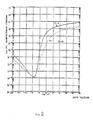
- FIG. 2 shows the V GS -I DS characteristic (2-a) of a sample thin film transistor (TFT) formed by the above described method.
- I DS is the source/ drain current
- V GS is the gate voltage
- the transistor channel portion had a length l of 10 ⁇ m and a width W of 10 ⁇ m.
- the thin film transistor had good characteristics with an on/off ratio greater than seven orders of magnitude.
- the effective electron mobility obtained from the saturation current region of the transistor was 3.9 cm2/v.s.
- a conventional thin film transistor formed according to the prior art by the same process as that employed above except for the step of depositing the silicon thin film providing the channel portion 105, will now be described.
- the time taken for increasing the temperature is one and a half hours, and helium having a purity of 99.9999% is continuously passed at 350 sccm during the temperature rise.
- the silicon thin film is deposited to a thickness of 250 ⁇ ° at a deposition temperature of 630°C with a silane flow rate of 150 sccm without using a dilution gas.
- FIG. 2 shows the V GS -I DS characteristic (2-b) of such a conventional thin film transistor which has the same size and is measured under the same conditions as the thin film transistor produced according to the invention.
- the on current I DS was 0.12 ⁇ A
- the off current I DS was 0.15 pA
- the on/off ratio was less than six orders of magnitude.
- the effective electron mobility determined from the saturation current region of the transistor was 2.4 cm2/v.s.
- FIG. 1 shows the effective electron mobility (determined from the saturation current region) of each of the thin film transistors as a function of the pressure in the reactor.
- Table 1 shows the silane partial pressure, estimated by using helium in place of silane, the deposition rate and the effective electron mobility for each sample. The errors shown in Figure 3 and Table 1 are estimations obtained with a 95% level of confidence.
- Another thin film transistor was formed by the process according to the invention.
- the time needed for increasing the temperature was one hour, and helium having a purity of more than 99.9999% was continuously passed at 350 sccm during the temperature rise.
- the silicon thin film was deposited to a thickness of 250 ⁇ using silane at 40 sccm diluted with helium at 710 sccm at a deposition temperature of 600°C.
- the total pressure in the reactor was 146.4 mTorr.
- the silane partial pressure calculated by using Dalton's law of partial pressure was 7.81 mTorr.
- the deposition rate was 24.7 ⁇ /min.
- the effective electron mobility determined from the saturation current region of the thin film transistor was 3.77 cm2/v.s.
- a comparison of sample 3-3 above with the present example shows that, when the silane partial pressure is 10 mTorr or less due to the use of a dilution gas, the effective mobility is improved by about 50% even if the pressure in the reactor is 15 mTorr or more, and a transistor having good characteristics can be obtained.
- SiO2 under layer films 102 were formed on both quartz glass substrates and single crystal silicon wafer substrates. Silicon thin film for providing the channel portions 105 was subsequently formed on each of the under layer films. The properties of the silicon thin film were then examined.
- the quartz glass used as a substrate had a diameter of 75 mm and a thickness of 1.2 mm.
- the single crystal silicon wafer had a [100] orientation, and was doped with phosphorus to provide an n-type semi-conductor.
- the resistivity of the wafer was 3.0 ⁇ cm.
- Each of the substrates was immersed in 60% boiling nitric acid for five minutes for the purpose of removing contaminant from the surface of each substrate, and then immersed in an aqueous solution of 5% hydrofluoric acid for ten seconds for the purpose of removing the natural oxide film formed on the surface of each substrate.
- the SiO2under layer film 102 was deposited to a thickness of 2000 ⁇ by the APCVD process.
- the deposition conditions were precisely the same as those for depositing the SiO2 under layer film 102 in the process described above.
- Each of the substrates was then heated in an atmosphere of nitrogen at 600°C for two hours.
- Properties such as refractive index, etching rate and so on and the thickness of the SiO2 film formed by the CVD process are generally changed by subsequent heat treatment; and changes in the properties of the SiO2 under layer film 102 affect the properties of the silicon thin film for providing the channel portion 105 deposited thereon.
- the heat treatment was performed for re-creating the thermal history to which the SiO2 under layer film 102 was subjected when the silicon thin film 103 containing impurity was formed.
- the silicon thin films for providing the channel portion 105 were deposited under the same conditions as those for forming the channel portion silicon thin film in the above described process.
- Each of the substrates was then immersed in boiling nitric acid for five minutes and then in an aqueous solution of 1.67% hydrofluoric acid for twenty seconds so as to clean the surface of the SiO2 film 102. During the immersion, approximately 400 ⁇ of the SiO2 film was removed. Each of the substrates was then rinsed for fifteen minutes in pure water with nitrogen bubbled through it and was dried by a spin dryer, after which the silicon thin film for providing the channel portions 105 was deposited on the SiO2 film 102 by low pressure CVD. The deposition was performed by the same low pressure CVD apparatus as that used for depositing the channel portion silicon thin film in the described process.
- silicon thin films were deposited under conditions the same as those used in Examples 1 and 2. Namely, after the substrates had been inserted into the reactor kept at a temperature of 395°C to 400°C, the temperature in the reactor was increased to the deposition temperature of 600°C over an interval of one hour. During the time that the reactor temperature was increased to the deposition temperature of 600°C, the mechanical booster pump and the rotary pump were operated, and helium having a purity of 99.9999% or more was passed at 350 sccm. Silicon films were deposited respectively under the same conditions as those employed in Examples 1, i.e.
- the silane flow rate was stepped by intervals of 15 sccm in the range of 10 sccm to 70 sccm without using a dilution gas, and under the same conditions as those employed in Example 2 i.e. silane at 40 sccm was diluted with helium at 710 sccm.
- the thickness of each of the deposited films was 250 ⁇ .
- the silicon thin films were deposited under the same conditions except insofar as increasing the reactor temperature was concerned and in that the thickness of the deposited film was varied.
- the reactor temperature was increased to 600°C from 400°C while passing nitrogen having a purity of more than 99.99% at 900 sccm whilst keeping the pressure in the reactor at about 160 mTorr; and the films were deposited to thicknesses of 5000 ⁇ ⁇ 250 ⁇ , 1000 ⁇ ⁇ 50 ⁇ and 1370 ⁇ ⁇ 30 ⁇ .
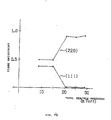
- the crystallographic orientation in the direction perpendicular to the substrate surface in each of the silicon thin films which were thus deposited to a thickness of 5000 ⁇ ⁇ 250 ⁇ were examined by x-ray diffraction. Namely, the volume ratio of orientation in each of the directions was determined from the measured x-ray diffraction intensities and compared to the diffraction intensity ratio of a silicon powder which was completely randomly oriented. The plane anisotropy was compared.
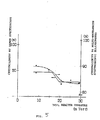
- the crystallinity of a sample of the silicon thin film having a thickness of 1000 ⁇ ⁇ 50 ⁇ was evaluated by laser Raman spectroscopy, and the crystallinity of samples of the silicon thin films having thicknesses of 1370 ⁇ ⁇ 30 ⁇ and 250 ⁇ , respectively, was evaluated by multi-wave length polarisation analysis (i.e. by multi-wave length spectroscopicellipsometry employing MOSS-ES4G apparatus produced by Sopra Co. Ltd., France).
- Figure 4 shows the relation between the pressure in the reactor and the plane anisotropy of the silicon thin film obtained by the low pressure CVD process.
- the silicon thin films were deposited at a pressure which is much lower than the 40 mTorr to 750 mTorr used in a conventional low pressure CVD process. It can be seen from Figure 4 that reflection from the [220] plane is essentially completely produced at a total pressure of about 20 mTorr, which reflection from the [111] plane becomes strong at a total pressure of 15 mTorr or less.
- the total pressure in the reactor in relation to the partial pressure of silane obtained by using helium in place of silane is shown in Table 1 above, and the silane partial pressure corresponding to a total pressure of 15 mTorr at which the plane anisotropy is changed is 10 mTorr.
- the orientation in the [111] plane can be increased by decreasing the silane partial pressure to 10 mTorr or less by dilution, by comparison with the orientation of 0.021 obtained in the [111] plane as shown in Figure 4 when the silane flow rate was 40 sccm without any dilution and the total reactor pressure was 21.1 mTorr.
- Figure 5 shows the degree of crystallinity of a sample having a thickness of 1370 ⁇ , measured by multi-wave length ellipsometry, and of a sample having a thickness of 1000 ⁇ , measured by laser Raman spectroscopy. Since different measurement principles, definitions of crystallinity and thicknesses are employed in the two methods, the absolute values are not in agreement with each other. However, Figure 5 shows stepwise changes in the degree of crystallinity in both cases at a total reactor pressure of 15 mTorr or a silane partial pressure of 10 mTorr.
- the silicon thin film was obtained by deposition using silane at 40 sccm which was diluted with helium at 710 sccm and the silane partial pressure was 7.81 mTorr
- the crystallinity measured by Raman spectroscopy was 41% and the crystallinity measured by multi-wave length spectroscopic ellipsometry was 91%.
- the refractive index and extinction index of the silicon thin films formed on an SiO2under layer film 102 on a silicon wafer substrate were also measured by multi-wave length spectroscopic ellipsometry (using MOSS-ES4G apparatus produced by Sopra Co. Ltd., France).
- the silicon thin films were deposited under the same conditions as those for depositing the channel portion silicon thin films to form transistors in Examples 1 and 2, and the thickness of the films was 250 ⁇ within the range of error. An estimation of the variation in thicknesses taking measurement error into account was 5.2 ⁇ with a 95% level of confidence.
- the properties of the same silicon thin films having the thickness of 250 ⁇ which were examined with respect to the transistor characteristics thereof in Examples 1 and 2 were thus also examined with respect to the optical characteristics thereof in the present Example.
- Table 2 shows the refractive index for light of 589.3 nm in air, the refractive index for light of 308 nm in air and the extinction index for light of 404.7 nm for the silicon thin films having a thickness of 250 ⁇ , all of which were measured by multi-wave length spectroscopic ellipsometry. Also shown is the crystallinity of the silicon thin film having a thickness of 1000 ⁇ , which was measured by Raman spectroscopy, and the effective mobilities shown in Examples 1 and 2, together with the total reactor pressure and the silane partial pressure for each of the samples.
- the present invention enables the production of a thin film semi-conductor device comprising a substrate having a surface covered with an insulating material and a silicon thin film formed on the substrate so as to serve as an active layer, wherein the effective mobility is improved by depositing the silicon thin film by a low pressure CVD process, wherein the total pressure in the reactor is 15 mTorr or less, or the silane partial pressure is 10 mTorr or less, in order to adjust the crystallinity and optical characteristics of the silicon thin film and give the silicon thin film a [111] preferred orientation.
- the present invention enables the production of a thin film semi-conductor device having good transistor characteristics, and has the advantages of increasing the performance of an active matrix liquid crystal display in which such a thin film transistor is used and decreasing the cost thereof, whilst also simplifying making LSI multi-layer integrated structures.
Landscapes
- Thin Film Transistor (AREA)
- Liquid Crystal (AREA)
Applications Claiming Priority (6)
| Application Number | Priority Date | Filing Date | Title |
|---|---|---|---|
| JP128745/90 | 1990-05-18 | ||
| JP128746/90 | 1990-05-18 | ||
| JP12874690 | 1990-05-18 | ||
| JP12874590 | 1990-05-18 | ||
| JP70879/91 | 1991-04-03 | ||
| JP7087991A JP3491903B2 (ja) | 1990-05-18 | 1991-04-03 | 薄膜半導体装置の製造方法 |
Publications (2)
| Publication Number | Publication Date |
|---|---|
| EP0457601A2 true EP0457601A2 (de) | 1991-11-21 |
| EP0457601A3 EP0457601A3 (en) | 1992-03-18 |
Family
ID=27300465
Family Applications (1)
| Application Number | Title | Priority Date | Filing Date |
|---|---|---|---|
| EP19910304442 Ceased EP0457601A3 (en) | 1990-05-18 | 1991-05-17 | Thin film semi-conductor device and method of producing same |
Country Status (3)
| Country | Link |
|---|---|
| US (1) | US5389580A (de) |
| EP (1) | EP0457601A3 (de) |
| JP (1) | JP3491903B2 (de) |
Cited By (2)
| Publication number | Priority date | Publication date | Assignee | Title |
|---|---|---|---|---|
| EP0516335A3 (en) * | 1991-05-31 | 1993-09-08 | American Telephone And Telegraph Company | Fabrication method in vertical transistor integration |
| CN104992926A (zh) * | 2015-07-24 | 2015-10-21 | 深圳市华星光电技术有限公司 | Ltps阵列基板及其制造方法 |
Families Citing this family (10)
| Publication number | Priority date | Publication date | Assignee | Title |
|---|---|---|---|---|
| US5444302A (en) * | 1992-12-25 | 1995-08-22 | Hitachi, Ltd. | Semiconductor device including multi-layer conductive thin film of polycrystalline material |
| KR100218500B1 (ko) * | 1995-05-17 | 1999-09-01 | 윤종용 | 실리콘막 및 그 제조 방법과 이를 포함하는 박막트랜지스터 및 그 제조방법 |
| WO1996039718A1 (en) * | 1995-06-06 | 1996-12-12 | Asahi Kasei Microsystems Co., Ltd. | Semiconductor device and method of production thereof |
| US6726955B1 (en) * | 2000-06-27 | 2004-04-27 | Applied Materials, Inc. | Method of controlling the crystal structure of polycrystalline silicon |
| KR100437765B1 (ko) * | 2001-06-15 | 2004-06-26 | 엘지전자 주식회사 | 고온용 기판을 이용한 박막트랜지스터 제조방법과 이를 이용한 표시장치의 제조방법 |
| KR100786873B1 (ko) * | 2006-09-26 | 2007-12-20 | 삼성에스디아이 주식회사 | 다결정 실리콘 기판의 결정화도 측정방법, 이를 이용한유기 발광 표시 장치의 제조방법 및 유기 발광 표시 장치 |
| US20080173877A1 (en) * | 2007-01-09 | 2008-07-24 | Kabushiki Kaisha Y.Y.L. | Semiconductor apparatus |
| KR100880155B1 (ko) * | 2007-08-13 | 2009-01-23 | 경희대학교 산학협력단 | 박막 트랜지스터 및 그 제조 방법 |
| US20110256385A1 (en) * | 2010-04-15 | 2011-10-20 | Seiko Epson Corporation | Bonding film-attached substrate and bonding film-attached substrate manufacturing method |
| JP2016171141A (ja) * | 2015-03-11 | 2016-09-23 | 旭化成株式会社 | 窒化物発光素子および窒化物発光素子の製造方法 |
Family Cites Families (3)
| Publication number | Priority date | Publication date | Assignee | Title |
|---|---|---|---|---|
| GB2193976B (en) * | 1986-03-19 | 1990-05-30 | Gen Electric Plc | Process for depositing a polysilicon film on a substrate |
| JPS63233564A (ja) * | 1987-03-23 | 1988-09-29 | Canon Inc | 接合型トランジスタの製造法 |
| JPH02208293A (ja) * | 1989-02-08 | 1990-08-17 | Kanazawa Univ | 多結晶シリコン膜の製造方法 |
-
1991
- 1991-04-03 JP JP7087991A patent/JP3491903B2/ja not_active Expired - Fee Related
- 1991-05-17 EP EP19910304442 patent/EP0457601A3/en not_active Ceased
-
1993
- 1993-12-27 US US08/173,265 patent/US5389580A/en not_active Expired - Lifetime
Non-Patent Citations (5)
| Title |
|---|
| APPLIED PHYSICS LETTERS. vol. 40, no. 6, 15 March 1982, NEW YORK US pages 534 - 535; R.TSU ET AL.: 'Critical volume fraction of crystallinity for conductivity percolation in phosphorus-doped Si:F:H alloys' * |
| APPLIED PHYSICS LETTERS. vol. 50, no. 26, 29 June 1987, NEW YORK US pages 1894 - 1896; D.B.MEAKIN ET AL.: 'High-performance thin-film transistors from optimized polycrystalline silicon films' * |
| IEEE ELECTRON DEVICE LETTERS. vol. 10, no. 8, August 1989, NEW YORK US pages 349 - 351; W.CZUBATYJ ET AL.: 'Low-Temperature Polycrystalline-Silicon TFT on 7059 Glass' * |
| IEEE TRANSACTIONS ON ELECTRON DEVICES. vol. 36, no. 2, February 1989, NEW YORK US pages 351 - 359; A.MIMURA ET AL.: 'High Performance Low-Temperature Poly-Si n-Channel FET's for LCD' * |
| JOURNAL OF APPLIED PHYSICS. vol. 63, no. 7, 1 April 1988, NEW YORK US pages 2260 - 2266; M.K.HATALIS ET AL.: 'Large grain polycristalline silicon by low-temperature annealing of low-pressure chemical vapor deposited amorphous silicon films' * |
Cited By (3)
| Publication number | Priority date | Publication date | Assignee | Title |
|---|---|---|---|---|
| EP0516335A3 (en) * | 1991-05-31 | 1993-09-08 | American Telephone And Telegraph Company | Fabrication method in vertical transistor integration |
| CN104992926A (zh) * | 2015-07-24 | 2015-10-21 | 深圳市华星光电技术有限公司 | Ltps阵列基板及其制造方法 |
| WO2017015970A1 (zh) * | 2015-07-24 | 2017-02-02 | 深圳市华星光电技术有限公司 | Ltps阵列基板及其制造方法 |
Also Published As
| Publication number | Publication date |
|---|---|
| EP0457601A3 (en) | 1992-03-18 |
| JP3491903B2 (ja) | 2004-02-03 |
| US5389580A (en) | 1995-02-14 |
| JPH04218928A (ja) | 1992-08-10 |
Similar Documents
| Publication | Publication Date | Title |
|---|---|---|
| US6338990B1 (en) | Method for fabricating thin-film transistor | |
| US5591989A (en) | Semiconductor device having first and second gate insulating films | |
| US4741964A (en) | Structure containing hydrogenated amorphous silicon and process | |
| EP0457601A2 (de) | Dünnfilm-Halbleiteranordnung und Verfahren zu ihrer Herstellung | |
| KR100481835B1 (ko) | 절연막 형성방법, 반도체장치 및 제조장치 | |
| JPH0658966B2 (ja) | 半導体素子 | |
| US5288527A (en) | Silicon nitride thin films with improved properties | |
| US7026200B2 (en) | Method for manufacturing a semiconductor device | |
| Parsons | Selective deposition of silicon by plasma‐enhanced chemical vapor deposition using pulsed silane flow | |
| KR100572809B1 (ko) | 반도체 디바이스 제조방법, 반도체 디바이스, 및 전계발광 디스플레이 디바이스 | |
| Kuo | A Self‐aligned, Trilayer, a‐Si: H Thin Film Transistor Prepared from Two Photomasks | |
| KR0179035B1 (ko) | 박막 반도체 장치 및 그 제조방법 | |
| JP3170533B2 (ja) | 薄膜状半導体装置の作製方法 | |
| JP3486420B2 (ja) | 薄膜半導体装置の製造方法 | |
| JP3530540B2 (ja) | 薄膜半導体装置の製造方法 | |
| JPH10223913A (ja) | 薄膜半導体装置の製造方法 | |
| JP3730185B2 (ja) | 薄膜トランジスタの製造方法 | |
| JPH09184905A (ja) | 遮光膜、遮光膜形成方法および液晶表示装置 | |
| JP2002050635A (ja) | 薄膜半導体装置の製造方法 | |
| JP3008486B2 (ja) | 薄膜半導体装置の製造方法 | |
| JP3038898B2 (ja) | 薄膜半導体装置の製造方法 | |
| KR100253722B1 (ko) | 박막 반도체 디바이스 | |
| KR940007455B1 (ko) | 액정표시장치의 박막트랜지스터 제조방법 | |
| JP3203772B2 (ja) | 半導体膜形成方法及び薄膜半導体装置の製造方法 | |
| JPH0664947B2 (ja) | 透明電極の製造方法 |
Legal Events
| Date | Code | Title | Description |
|---|---|---|---|
| PUAI | Public reference made under article 153(3) epc to a published international application that has entered the european phase |
Free format text: ORIGINAL CODE: 0009012 |
|
| AK | Designated contracting states |
Kind code of ref document: A2 Designated state(s): DE FR GB NL |
|
| PUAL | Search report despatched |
Free format text: ORIGINAL CODE: 0009013 |
|
| AK | Designated contracting states |
Kind code of ref document: A3 Designated state(s): DE FR GB NL |
|
| 17P | Request for examination filed |
Effective date: 19920819 |
|
| 17Q | First examination report despatched |
Effective date: 19940504 |
|
| STAA | Information on the status of an ep patent application or granted ep patent |
Free format text: STATUS: THE APPLICATION HAS BEEN REFUSED |
|
| 18R | Application refused |
Effective date: 19960322 |