EP0454015A1 - Hochtemperaturspeicherbatterie - Google Patents
Hochtemperaturspeicherbatterie Download PDFInfo
- Publication number
- EP0454015A1 EP0454015A1 EP91106415A EP91106415A EP0454015A1 EP 0454015 A1 EP0454015 A1 EP 0454015A1 EP 91106415 A EP91106415 A EP 91106415A EP 91106415 A EP91106415 A EP 91106415A EP 0454015 A1 EP0454015 A1 EP 0454015A1
- Authority
- EP
- European Patent Office
- Prior art keywords
- storage battery
- temperature storage
- battery according
- holder
- coarse
- Prior art date
- Legal status (The legal status is an assumption and is not a legal conclusion. Google has not performed a legal analysis and makes no representation as to the accuracy of the status listed.)
- Granted
Links
- 239000000463 material Substances 0.000 claims abstract description 50
- 210000000352 storage cell Anatomy 0.000 claims abstract description 22
- 239000000203 mixture Substances 0.000 claims abstract description 13
- 150000001875 compounds Chemical class 0.000 claims abstract description 5
- 239000011230 binding agent Substances 0.000 claims description 17
- 239000000945 filler Substances 0.000 claims description 17
- 229920005989 resin Polymers 0.000 claims description 17
- 239000011347 resin Substances 0.000 claims description 17
- 239000011521 glass Substances 0.000 claims description 15
- 239000006004 Quartz sand Substances 0.000 claims description 9
- VYPSYNLAJGMNEJ-UHFFFAOYSA-N Silicium dioxide Chemical compound O=[Si]=O VYPSYNLAJGMNEJ-UHFFFAOYSA-N 0.000 claims description 9
- 229920002050 silicone resin Polymers 0.000 claims description 8
- QXJJQWWVWRCVQT-UHFFFAOYSA-K calcium;sodium;phosphate Chemical compound [Na+].[Ca+2].[O-]P([O-])([O-])=O QXJJQWWVWRCVQT-UHFFFAOYSA-K 0.000 claims description 6
- 239000010431 corundum Substances 0.000 claims description 6
- 229910052593 corundum Inorganic materials 0.000 claims description 6
- 238000009413 insulation Methods 0.000 claims description 6
- 229920001187 thermosetting polymer Polymers 0.000 claims description 6
- 239000002245 particle Substances 0.000 claims description 5
- KXGFMDJXCMQABM-UHFFFAOYSA-N 2-methoxy-6-methylphenol Chemical compound [CH]OC1=CC=CC([CH])=C1O KXGFMDJXCMQABM-UHFFFAOYSA-N 0.000 claims description 3
- 229910052783 alkali metal Inorganic materials 0.000 claims description 3
- 150000001340 alkali metals Chemical class 0.000 claims description 3
- 239000000470 constituent Substances 0.000 claims description 3
- KZHJGOXRZJKJNY-UHFFFAOYSA-N dioxosilane;oxo(oxoalumanyloxy)alumane Chemical compound O=[Si]=O.O=[Si]=O.O=[Al]O[Al]=O.O=[Al]O[Al]=O.O=[Al]O[Al]=O KZHJGOXRZJKJNY-UHFFFAOYSA-N 0.000 claims description 3
- 229910052863 mullite Inorganic materials 0.000 claims description 3
- 230000000737 periodic effect Effects 0.000 claims description 3
- 239000005011 phenolic resin Substances 0.000 claims description 3
- 229920001568 phenolic resin Polymers 0.000 claims description 3
- FQENQNTWSFEDLI-UHFFFAOYSA-J sodium diphosphate Chemical compound [Na+].[Na+].[Na+].[Na+].[O-]P([O-])(=O)OP([O-])([O-])=O FQENQNTWSFEDLI-UHFFFAOYSA-J 0.000 claims description 3
- 229940048086 sodium pyrophosphate Drugs 0.000 claims description 3
- 239000000126 substance Substances 0.000 claims description 3
- 235000019818 tetrasodium diphosphate Nutrition 0.000 claims description 3
- 239000001577 tetrasodium phosphonato phosphate Substances 0.000 claims description 3
- BTBUEUYNUDRHOZ-UHFFFAOYSA-N Borate Chemical compound [O-]B([O-])[O-] BTBUEUYNUDRHOZ-UHFFFAOYSA-N 0.000 claims description 2
- BPQQTUXANYXVAA-UHFFFAOYSA-N Orthosilicate Chemical compound [O-][Si]([O-])([O-])[O-] BPQQTUXANYXVAA-UHFFFAOYSA-N 0.000 claims description 2
- 229910019142 PO4 Inorganic materials 0.000 claims description 2
- 239000000654 additive Substances 0.000 claims description 2
- 230000000996 additive effect Effects 0.000 claims description 2
- 238000004519 manufacturing process Methods 0.000 claims description 2
- NBIIXXVUZAFLBC-UHFFFAOYSA-K phosphate Chemical compound [O-]P([O-])([O-])=O NBIIXXVUZAFLBC-UHFFFAOYSA-K 0.000 claims description 2
- 239000010452 phosphate Substances 0.000 claims description 2
- 239000012811 non-conductive material Substances 0.000 claims 1
- 239000007767 bonding agent Substances 0.000 abstract 2
- 210000004027 cell Anatomy 0.000 description 19
- 238000010411 cooking Methods 0.000 description 3
- DGAQECJNVWCQMB-PUAWFVPOSA-M Ilexoside XXIX Chemical compound C[C@@H]1CC[C@@]2(CC[C@@]3(C(=CC[C@H]4[C@]3(CC[C@@H]5[C@@]4(CC[C@@H](C5(C)C)OS(=O)(=O)[O-])C)C)[C@@H]2[C@]1(C)O)C)C(=O)O[C@H]6[C@@H]([C@H]([C@@H]([C@H](O6)CO)O)O)O.[Na+] DGAQECJNVWCQMB-PUAWFVPOSA-M 0.000 description 2
- NINIDFKCEFEMDL-UHFFFAOYSA-N Sulfur Chemical compound [S] NINIDFKCEFEMDL-UHFFFAOYSA-N 0.000 description 2
- 239000011248 coating agent Substances 0.000 description 2
- 238000000576 coating method Methods 0.000 description 2
- 239000008187 granular material Substances 0.000 description 2
- 239000011810 insulating material Substances 0.000 description 2
- 229910052708 sodium Inorganic materials 0.000 description 2
- 239000011734 sodium Substances 0.000 description 2
- 229910052717 sulfur Inorganic materials 0.000 description 2
- 239000011593 sulfur Substances 0.000 description 2
- 229910052798 chalcogen Inorganic materials 0.000 description 1
- 150000001787 chalcogens Chemical class 0.000 description 1
- 238000010276 construction Methods 0.000 description 1
- 230000007797 corrosion Effects 0.000 description 1
- 238000005260 corrosion Methods 0.000 description 1
- 238000002425 crystallisation Methods 0.000 description 1
- 230000008025 crystallization Effects 0.000 description 1
- 230000002950 deficient Effects 0.000 description 1
- 238000009434 installation Methods 0.000 description 1
- 230000007257 malfunction Effects 0.000 description 1
- 239000011159 matrix material Substances 0.000 description 1
- 239000000155 melt Substances 0.000 description 1
- 229910052751 metal Inorganic materials 0.000 description 1
- 239000002184 metal Substances 0.000 description 1
- TWNQGVIAIRXVLR-UHFFFAOYSA-N oxo(oxoalumanyloxy)alumane Chemical compound O=[Al]O[Al]=O TWNQGVIAIRXVLR-UHFFFAOYSA-N 0.000 description 1
- 229920000642 polymer Polymers 0.000 description 1
- 239000000376 reactant Substances 0.000 description 1
- HYHCSLBZRBJJCH-UHFFFAOYSA-N sodium polysulfide Chemical compound [Na+].S HYHCSLBZRBJJCH-UHFFFAOYSA-N 0.000 description 1
- 239000007784 solid electrolyte Substances 0.000 description 1
- 239000007858 starting material Substances 0.000 description 1
Images

Classifications
-
- H—ELECTRICITY
- H01—ELECTRIC ELEMENTS
- H01M—PROCESSES OR MEANS, e.g. BATTERIES, FOR THE DIRECT CONVERSION OF CHEMICAL ENERGY INTO ELECTRICAL ENERGY
- H01M10/00—Secondary cells; Manufacture thereof
- H01M10/36—Accumulators not provided for in groups H01M10/05-H01M10/34
- H01M10/39—Accumulators not provided for in groups H01M10/05-H01M10/34 working at high temperature
- H01M10/3909—Sodium-sulfur cells
-
- H—ELECTRICITY
- H01—ELECTRIC ELEMENTS
- H01M—PROCESSES OR MEANS, e.g. BATTERIES, FOR THE DIRECT CONVERSION OF CHEMICAL ENERGY INTO ELECTRICAL ENERGY
- H01M50/00—Constructional details or processes of manufacture of the non-active parts of electrochemical cells other than fuel cells, e.g. hybrid cells
- H01M50/20—Mountings; Secondary casings or frames; Racks, modules or packs; Suspension devices; Shock absorbers; Transport or carrying devices; Holders
- H01M50/233—Mountings; Secondary casings or frames; Racks, modules or packs; Suspension devices; Shock absorbers; Transport or carrying devices; Holders characterised by physical properties of casings or racks, e.g. dimensions
- H01M50/24—Mountings; Secondary casings or frames; Racks, modules or packs; Suspension devices; Shock absorbers; Transport or carrying devices; Holders characterised by physical properties of casings or racks, e.g. dimensions adapted for protecting batteries from their environment, e.g. from corrosion
-
- Y—GENERAL TAGGING OF NEW TECHNOLOGICAL DEVELOPMENTS; GENERAL TAGGING OF CROSS-SECTIONAL TECHNOLOGIES SPANNING OVER SEVERAL SECTIONS OF THE IPC; TECHNICAL SUBJECTS COVERED BY FORMER USPC CROSS-REFERENCE ART COLLECTIONS [XRACs] AND DIGESTS
- Y02—TECHNOLOGIES OR APPLICATIONS FOR MITIGATION OR ADAPTATION AGAINST CLIMATE CHANGE
- Y02E—REDUCTION OF GREENHOUSE GAS [GHG] EMISSIONS, RELATED TO ENERGY GENERATION, TRANSMISSION OR DISTRIBUTION
- Y02E60/00—Enabling technologies; Technologies with a potential or indirect contribution to GHG emissions mitigation
- Y02E60/10—Energy storage using batteries
Definitions
- the invention relates to a cooking temperature storage battery according to the preamble of claim 1.
- Such high-temperature storage batteries which are made up of electrochemical storage cells based on alkali metal and chalcogen, are increasingly being used as an energy source for the electric drives of vehicles.
- the hitherto known cooking temperature storage batteries with electrochemical storage cells of the type mentioned above work at a temperature between 300 ° C to 350 ° C.
- thermal insulation In order to avoid heat losses, especially during the breaks of the high-temperature storage batteries, they are surrounded by thermal insulation. This is limited by a double-walled housing, the interior between the walls being evacuated and filled with an insulating material. The interior of the insulation is used to hold the memory cells.
- holders are provided. These are metal structures.
- the invention is therefore based on the object of demonstrating a high-temperature storage battery in which the disadvantages known from the prior art are prevented.
- the materials used to manufacture the bracket are corrosion-resistant to sodium, sulfur and sodium polysulfide. When assembling and operating the high-temperature storage battery, it also has a specific electrical resistance of greater than 108 ohm x cm. This is necessary because memory cells, the reactants of which are separated by a solid electrolyte, are sensitive to current loads in the cold, connected state.
- the mixture of a coarse-grained material with an organic or inorganic binder or by coating a coarse-grained material with such a binder creates a starting material with which a holder for storage cells is produced can withstand all forces occurring in the operating state of the high-temperature storage battery.
- the memory cells are embedded in the holder and are tightly and permanently enclosed by this.
- the hardened binder immediately surrounds not only the coarse-grained material, but also the storage cells, so that it is no longer possible to shake the storage cells loose after the binder has hardened.
- Corundum, hollow spherical corundum, quartz sand, mullite, glass spheres or hollow glass spheres are preferably used as the coarse-grained material. Materials that are similar to these materials can also be used as filler material. The same applies to electrically non-conductive oxides of elements from groups II, III, IV, IIIb and IVb of the chemical periodic table. Mixtures and compounds of these oxides are also suitable as filler material. It is also possible to use a mixture of the first-mentioned materials and the oxides.
- the particle size of the material serving as filler material is selected so that the average diameter is between 20 and 1000 ⁇ m. These are materials that are free-flowing at room temperature.
- Thermosetting resins in the form of silicone resin or phenolic resin or a mixture thereof are preferably used as binders. Special glasses can also be used as binders.
- the thermosetting resins and the glasses can be produced as granules. They are also free-flowing at room temperature. Due to their free-flowing properties, both the filler materials and the binders can be easily arranged around the memory cells and in the cavities between the memory cells.
- the pourability can be determined by granulating the Mixture or be improved by coating the coarse-grained material with the resin.
- the materials used as binders have the advantage that they show only a small shrinkage when hardened in a mixture with the filler materials mentioned.
- the gas evolution from the materials is so low when the cooking temperature storage battery is heated to its operating temperature that the gas can easily diffuse out of the storage cell block formed. This makes it possible to implement a high-temperature storage battery with good weight-related and electrical data.
- the binders are selected so that they start to melt when the high-temperature storage battery is put into operation and wet the coarse-grained material serving as filler material.
- glass such coarse-grained materials are used, from which those components dissolve that support the crystallization of the glass.
- resin when using resin, the polymer crosslinks after it melts, which then hardens.
- a block is produced from a concrete-like mass, in which the memory cells and the switching elements are embedded in such a way that a memory cell block is formed which completely fills the interior of the battery box.
- FIG. 1 shows a high-temperature storage battery 1 which is delimited by an insulation 3 which has a multiplicity of storage cells 4 in its interior 3R which are electrically connected to one another.
- the thermal insulation 3 is formed by a double-walled housing 2.
- a space 2R is provided between the inner and outer walls 2A and 2I thereof, which is filled with insulating material 10 and additionally evacuated.
- the memory cells 4 are combined to form a memory cell block or a cell matrix 4B.
- the storage cells 4 are arranged so that their longitudinal axes run parallel to one another and to a vertical plane. So that the memory cells 4 are held in this position even in the event of extreme external forces, as shown in FIG.
- This holder 5 is formed by a coarse-grained material serving as filler material, which is mixed with or coated with a thermosetting resin 7 or a glass.
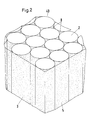
- this coarse-grained material 6 and the thermosetting resin 7 or a corresponding glass are arranged around the storage cells 4 and in the spaces 8 between the storage cells 4 so that all of the storage cells 4 are embedded all around in this material.
- the large-grain material 6 is corundum, hollow spherical corundum, quartz sand, mullite, glass spheres, hollow glass spheres or chemically similar materials.
- the use of electrically non-conductive oxides of elements of groups II, III, IV, IIIb and IVB of the chemical periodic table or mixtures of these oxides or non-conductive compounds thereof can also be used as coarse-grained material. The same applies to mixtures of the former material and such oxides and their compounds.
- the proportion of the coarse-grained material is 70-99%.
- This coarse-grained material 6, which serves as a filler, has an average diameter of 20 to 1000 ⁇ m.
- the remaining portion of the material arranged around the storage cells 4 and in the spaces 8 is preferably formed by a silicone resin 7 or a phenolic resin or a mixture thereof.
- the resin 7 can be arranged together with the coarse-grained material 6 in the form of granules around the storage cells 4 and in the spaces 8.
- the coarse-grained material 6 it is also possible to coat the coarse-grained material 6 with the resin 7.
- the resin 7 begins to melt and wets the filler material. With a further increase in temperature, the resin 7 crosslinks and hardens. It remains in this hardened state at an operating temperature of 300 to 350 ° C.
- the coarse-grained material 6 and the resin 7 are added with 0, 5 to 5% borate, silicate or phosphate of an alkali metal are added. This ensures that the solidified state of the resin 7 is increased or is maintained at values above 350 ° C.
- the holder 5 is formed by 70% quartz sand with an average particle size of 300 microns, 24% micro glass balls with an average diameter of 50 microns, and 5% silicone resin and 1% sodium pyrophosphate.
- An equally good cohesion of the memory cell block 4B can be achieved by using 88 to 90% quartz sand with the above-mentioned particle size, 1 to 12% silicone resin and 0.5 to 5% sodium pyrophosphate. The same applies if a mixture of quartz sand and aluminum oxide is used as filler material 7.
- a glass is chosen which glazes at 350 ° C or below and which crystallizes out due to the influence of constituents which are released from the filler material. Glasses can also be used, the softening point of which is below 350 ° C., and which is increased by constituents that detach from the filler material 6. In both cases, the filler materials 6 should be selected so that they contain suitable and detachable components.
- the holder 5 described above, made from a coarse-grained work material, a binder and possibly an additive to increase the strength, is not only suitable for holding together storage cells based on sodium and sulfur. Rather, the material described above can also be used for the holding together of memory cells based on NaFeCl2 or NaNiCl2.
Landscapes
- Chemical & Material Sciences (AREA)
- Chemical Kinetics & Catalysis (AREA)
- Electrochemistry (AREA)
- General Chemical & Material Sciences (AREA)
- Engineering & Computer Science (AREA)
- Manufacturing & Machinery (AREA)
- Secondary Cells (AREA)
- Battery Mounting, Suspending (AREA)
Abstract
Description
- Die Erfindung bezieht sich auf eine Kochtemperaturspeicherbatterie gemäß dem Oberbegriff des Patentanspruches 1.
- Solche Hochtemperaturspeicherbatterien, die aus elektrochemischen Speicherzellen auf der Basis von Alkalimetall und Chalkogen aufgebaut sind, werden in vermehrtem Maße als Energiequelle für die Elektroantriebe von Fahrzeugen eingesetzt. Die bis jetzt bekannten Kochtemperaturspeicherbatterien mit elektrochemischen Speicherzellen der oben genannten Bauart arbeiten bei einer Temperatur zwischen 300°C bis 350°C. Um Wärmeverluste, insbesondere in den Ruhepausen der Hochtemperaturspeicherbatterien zu vermeiden, sind diese von einer thermischen Isolierung umgeben. Diese wird durch ein doppelwandiges Gehäuse begrenzt, wobei der Innenraum zwischen den Wänden evakuiert und mit einem Isoliermaterial ausgefüllt ist. Der Innenraum der Isolierung dient zur Aufnahme der Speicherzellen. Um sicherzustellen, daß die Speicherzellen dauerhaft in der beim Einbau zugeordneten Position verbleiben, sind Halterungen vorgesehen. Es handelt sich hierbei um Metallkonstruktionen. Bei der Verwendung dieser Bauelemente müssen Kompromisse eingegangen werden zwischen der Steifigkeit der Konstruktion einerseits und dem Volumen und dem Gewicht derselben andererseits. Da aber die Energiedichte bezogen auf die Masse und das Volumen eine wichtige Kenngröße der Hochtemperaturspeicherbatterie ist, müssen gewöhnlich die Forderungen an die Bruchfestigkeit, die Stabilität unter Einwirkung von Zug- und Druckkräften auf die Halterungen reduziert werden. Den bekannten Halterungen fehlt zudem die erforderliche Isolation, die verhindert, daß das Potential beispielsweise einer defekten Speicherzelle der gesamten Halterung aufgeprägt wird.
- Der Erfindung liegt deshalb die Aufgabe zugrunde, eine Hochtemperaturspeicherbatterie aufzuzeigen, bei der die aus dem Stand der Technik bekannten Nachteile unterbunden werden.
- Diese Aufgabe wird erfindungsgemäß durch die Merkmale des Patentanspruches 1 gelöst.
- Die zur Herstellung der Halterung verwendeten Werkstoffe sind korrosionsbeständig gegenüber Natrium, Schwefel und Natriumpolysulfid. Sie weist beim Zusammenbau der Hochtemperaturspeicherbatterie und beim Betrieb derselben zudem einen spezifischen elektrischen Widerstand von größer 10⁸ Ohm x cm auf. Dies ist erforderlich, da Speicherzellen, deren Reaktanten durch einen Festelektrolyten getrennt sind, im kalten, verschalteten Zustand empfindlich gegen Strombelastungen sind. Durch das Gemisch aus einem grobkörnigen Werkstoff mit einem organischen oder anorganischen Bindemittel bzw. durch das Überziehen eines grobkörnigen Werkstoffs mit einem solchen Bindemittel wird ein Ausgangsmaterial geschaffen, mit dem eine Halterung für Speicherzellen hergestellt werden kann, die allen im Betriebszustand der Hochtemperaturspeicherbatterie auftretenden Kräfte Stand halten kann. Die Speicherzellen sind in die Halterung eingebettet, und werden von dieser eng und dauerhaft umschlossen. Das ausgehärtete Bindemittel umgibt nicht nur den grobkörnigen Werkstoff, sondern auch die Speicherzellen unmittelbar, so daß ein Losrütteln der Speicherzellen nach dem Aushärten des Bindemittels nicht mehr möglich ist. Als grobkörniger Werkstoff werden vorzugsweise Korund, Hohlkugelkorund, Quarzsand, Mullit, Glaskugeln, oder Glashohlkugeln verwendet. Werkstoffe, die diesen Materialien ähnlich sind, können ebenfalls als Füllermaterial verwendet werden. Das gleiche gilt für elektrisch nichtleitende Oxide von Elementen aus den Gruppen II, III, IV, IIIb und IVb des chemischen Periodensystems. Mischungen und Verbindungen dieser Oxide kommen ebenfalls als Füllermaterial in Frage. Die Verwendung einer Mischung aus den erstgenannten Materialen und den Oxiden ist ebenfalls möglich. Die Teilchengröße des als Füllermaterial dienenden Werkstoffs wird so gewählt, daß der mittlere Durchmesser zwischen 20 und 1000µm liegt. Es handelt sich hierbei um Materialien, die bei Zimmertemperatur rieselfähig sind. Als Bindemittel werden bevorzugt duroplastische Harze in Form von Silikonharz oder Phenolharz bzw. eine Mischung hiervon verwendet. Spezielle Gläser können ebenfalls als Bindemittel genutzt werden. Die duroplastischen Harze und die Gläser können als Granulate hergestellt werden. Sie sind bei Zimmertemperatur ebenfalls rieselfähig. Sowohl die Füllermaterialien als auch die Bindemittel lassen sich auf Grund ihrer Rieselfähigkeit problemlos um die Speicherzellen und in den Hohlräumen zwischen den Speicherzellen anordnen. Die Rieselfähigkeit kann durch Granulierung des Gemisches oder durch die Beschichtung des grobkörnigen Werkstoffs mit dem Harz verbessert werden. Die als Bindemittel verwendeten Werkstoffe weisen den Vorteil auf, daß sie beim Aushärten im Gemisch mit den erwähnten Füllermaterialien nur geringen Schwund zeigen. Die Gasentwicklung aus den Materialien ist beim Aufheizen der Kochtemperaturspeicherbatterie auf deren Betriebstemperatur so gering, daß das Gas problemlos aus dem gebildeten Speicherzellenblock ausdiffundieren kann. Hierdurch ist es möglich, eine Hochtemperaturspeicherbatterie mit guten gewichtsbezogenen und elektrischen Daten zu realisieren. Die Bindemittel sind so gewählt, daß sie bei der Inbetriebnahme der Hochtemperaturspeicherbatterie zu schmelzen beginnen und den als Füllermaterial dienenden grobkörnigen Werkstoff benetzen. Bei der Verwendung von Glas als Bindemittel werden solche grobkörnigen Werkstoffe verwendet, aus denen sich solche Bestandteile lösen, die das Auskristallisieren des Glases unterstützten. Bei der Verwendung von Harz als Bindemittel kommt es nach dem Schmelzen desselben zu einer Vernetzung des Polymers, das anschließend aushärtet. Sowohl bei der Verwendung von Glas als auch der Verwendung eines duroplastischen Harzes entsteht ein Block aus einer betonartigen Masse, in welche die Speicherzellen und die Schaltelemente so eingebettet sind, daß ein Speicherzellenblock gebildet wird, der den Innenbereich des Batteriekastens vollständig ausfüllt.
- Die Erfindung wird nachfolgend anhand von schematischen Zeichnungen näher erläutert. Es zeigen:
- Fig. 1
- eine Hochtemperaturspeicherbatterie,
- Fig. 2
- einen Speicherzellenblock, wie er in die Hochtemperaturspeicherbatterie gemäß Fig. 1 eingesetzt ist.
- Fig. 1 zeigt eine Hochtemperaturspeicherbatterie 1, die von einer Isolierung 3 begrenzt wird, die in ihrem Innenraum 3R eine Vielzahl von Speicherzellen 4 aufweist, welche elektrisch miteinander verschaltet sind. Die thermische Isolierung 3 wird durch ein doppelwandiges Gehäuse 2 gebildet. Zwischen dessen innerer und äußerer Wand 2A bzw. 2I ist ein Raum 2R vorgesehen, der mit Isoliermaterial 10 ausgefüllt und zusätzlich evakuiert ist. Die Speicherzellen 4 sind zu einem Speicherzellenblock bzw. einer Zellmatrix 4B zusammengefaßt. Beim Zusammenbau der Hochtemperaturspeicherbatterie 1 werden die Speicherzellen 4 so angeordnet, daß ihre Längsachsen zueinander und zu einer vertikalen Ebene parallel verlaufen. Damit die Speicherzellen 4 auch bei extremen Krafteinwirkungen von außen in dieser Position gehalten werden, sind sie, wie Fig. 2 zeigt, durch eine Halterung 5 dauerhaft zu dem oben erwähnten Speicherzellenblock 4B zusammengefügt. Diese Halterung 5 wird durch einen als Füllermaterial dienenden grobkörnigen Werkstoff gebildet, der mit einem duroplastischen Harz 7 bzw. einem Glas gemischt bzw. von diesem überzogen ist. Beim Zusammenbau der Hochtemperaturspeicherbatterie 1 wird dieser grobkörnige Werkstoff 6 und das duroplastische Harz 7 bzw. ein entsprechendes Glas um die Speicherzellen 4 herum und in den Zwischenräumen 8 zwischen den Speicherzellen 4 so angeordnet, daß alle Speicherzellen 4 rundum in dieses Material eingebettet sind. Bei dem großkörnigen Werkstoff 6 handelt es sich um Korund, Hohlkugelkorund, Quarzsand, Mullit, Glaskugeln, Glashohlkugeln oder chemisch ähnliche Werkstoffe. Die Verwendung von elektrisch nichtleitenden Oxiden von Elementen der Gruppen II, III, IV, IIIb und IVB des chemischen Periodensystems bzw. Gemische dieser Oxide oder nichtleitende Verbindungen hiervon können ebenfalls als grobkörniges Material genutzt werden. Das gleiche gilt für Gemische aus dem erstgenannten Material und solchen Oxiden und ihren Verbindungen. Der Anteil des grobkörnigen Werkstoffs beträgt 70-99%. Dieses als Füller dienende grobkörnige Material 6 weist einen mittleren Durchmesser von 20 bis 1000µm auf. Der übrige Anteil des um die Speicherzellen 4 und in den Zwischenräumen 8 angeordneten Materials wird vorzugsweise durch ein Silikonharz 7 oder ein Phenolharz bzw. einem Gemisch hiervon gebildet. Das Harz 7 kann zusammen mit dem grobkörnigen Material 6 in Form von Granulaten um die Speicherzellen 4 und in den Zwischenräumen 8 angeordnet werden. Es besteht auch die Möglichkeit, das grobkörnige Material 6 mit dem Harz 7 zu überziehen. Bei der Inbetriebnahme der Batterie, insbesondere beim ersten Aufheizen derselben beginnt das Harz 7 zu schmelzen und benetzt das Füllermaterial. Bei einer weiteren Erhöhung der Temperatur vernetzt das Harz 7 und härtet aus. Es bleibt bei einer Betriebstemperatur von 300 bis 350°C in diesem ausgehärteten Zustand. Um die Festigkeit des Harzes 7 zu erhöhen, oder um auch bei einer Erhöhung der Temperatur auf Werte weit über 350°C sicherzustellen, daß dieser ausgehärtete Zustand des Harzes 7 erhalten bleibt, wird dem grobkörnigen Werkstoff 6 und dem Harz 7 ein Zusatz an 0,5 bis 5% Borat, Silikat oder Phosphat eines Alkalimetalls beigemischt. Hierdurch wird sichergestellt, daß der verfestigte Zustand des Harzes 7 erhöht oder bei einer ungewollten Temperaturerhöhung auf Werte über 350 °C beibehalten bleibt, so daß die Speicherzellen 4 auch während oder nach einer solchen Betriebsstörung fest im Verbund des Speicherzellenblocks 4B gehalten werden. Bei einer bevorzugten Ausführungsform wird die Halterung 5 durch 70% Quarzsand mit einer mittleren Teilchengröße von 300 µm, 24% Mikroglaskugeln mit einem mittleren Durchmesser von 50 µm, sowie 5% Silikonharz und 1% Natriumpyrophosphat gebildet. Ein ebenso guter Zusammenhalt des Speicherzellenblocks 4B kann durch die Verwendung von 88 bis 90% Quarzsand mit der obenangegebenen Teilchengröße, 1 bis 12% Silikonharz und 0,5 bis 5% Natriumpyrophosphat erzielt werden. Das gleiche gilt, wenn als Füllermaterial 7 eine Mischung aus Quarzsand und Aluminiumoxid verwendet wird. Erfindungsgemäß besteht die Möglichkeit, das Harz 7 durch ein Glas zu ersetzen. Es wird hierfür ein Glas gewählt, das bei 350°C oder darunter glasiert und das durch den Einfluß von Bestandteilen, die sich aus dem Füllermaterial lösen, auskristallisiert. Es können auch Gläser verwendet werden, deren Erweichungspunkt unteralb von 350°C liegt, und der durch Bestandteile, die sich aus dem Füllermaterial 6 lösen, erhöht wird. In beiden Fällen sind die Füllermateialien 6 so zu wählen, daß sie hierfür geeignete und sich lösende Bestandteile enthalten. Die oben beschriebene Halterung 5, hergestellt aus einem grobkörnigen Werktoff, einem Bindemittel und gegebenenfalls einem Zusatz zur Erhöhung der Festigkeit, ist nicht nur geeignet Speicherzellen auf der Basis von Natrium und Schwefel zusammenzuhalten. Vielmehr kann das oben beschriebene Material auch für den Zusammenhalt von Speicherzellen auf der Basis von NaFeCl₂ oder NaNiCl₂ Verwendung finden.
Claims (12)
- Hochtemperaturspeicherbatterie mit einer thermischen Isolierung (3), in deren Innenraum (3R) die miteinander verschalteten Speicherzellen (4) angeordnet und über eine Halterung (5) zumindest zu einem Speicherzellenblock (4B) zusammengefaßt sind, dadurch gekennzeichnet, daß die Speicherzellen (4) wenigstens bereichsweise von einer aus einem elektrisch nichtleitenden Werkstoff gefertigten Halterung (5) umgeben und von dieser dauerhaft in der bei der Montage festgelegten Position gehalten sind.
- Hochtemperaturspeicherbatterie nach Anspruch 1, dadurch gekennzeichnet, daß die Halterung (5) wenigstens aus einem als Füllermaterial dienenden grobkörnigen Werkstoff (6) und mindestens einem anorganischen oder organischen Bindemittel (7) sowie gegenbenenfalls aus einem die Festigkeit fördernden Zusatz gebildet ist.
- Hochtemperaturspeicherbatterie nach einem der Ansprüche 1 bis 3, dadurch gekennzeichnet, daß das Füllermaterial (6) mit dem Bindemittel (7) vermischt oder mit diesem beschichtet ist.
- Hochtemperaturspeicherbatterie nach einem der Ansprüche 1 bis 3, dadurch gekennzeichnet, daß als grobkörniger Werkstoff (6) Korund, Hohlkugelkorund, Quarzsand, Mullit, Glaskugeln oder Glashohlkugeln vorgesehen ist.
- Hochtemperaturspeicherbatterie nach einem der Ansprüche 1 bis 4, dadurch gekennzeichnet, daß als grobkörniges Füllermaterial (6) elektrisch nichtleitende Oxide von Elementen der Gruppen II, III, IV, IIIb, IVb des chemischen Periodensystems oder Mischungen bzw. Verbindungen dieser Oxide vorgesehen sind.
- Hochtemperaturspeicherbatterie nach einem der Ansprüche 1 bis 5, dadurch gekennzeichnet, daß als Bindemittel (7) ein duroplastisches Harz in Form von Silikonharz oder Phenolharz oder eine Mischung aus beiden vorgesehen ist.
- Hochtemperaturspeicherbatterie nach einem der Ansprüche 1 bis 6, dadurch gekennzeichnet, daß als Bindemittel ein unterhalb oder bei 300°C glasierendes Glas vorgesehen ist, das mittels gelöster Bestandteile aus dem Füllermaterial (6) auskristallisiert.
- Hochtemperaturspeicherbatterie nach einem der Ansprüche 1 bis 6, dadurch gekennzeichnet, daß als Bindemittel ein Glas verwendet wird, dessen Erweichungspunkt unterhalb von 350°C liegt, und der durch Lösen von Bestandteilen aus dem grobkörnigen Werkstoff (6) auf eine Temperatur über 350°C anhebbar ist.
- Hochtemperaturspeicherbatterie nach einem der Ansprüche 1 bis 4, dadurch gekennzeichnet, daß die Halterung (5) aus 70% Quarzsand mit einer mittleren Teilchengröße von 300µm, 24% Mikroglaskugeln mit einer mittleren Teilchengröße von 50µm sowie einem Anteil von 6% Silikonharz gefertigt ist.
- Hochtemperaturspeicherbatterie nach Anspruch 9, dadurch gekennzeichnet, daß dem Quarzsand, den Mikroglaskugeln und dem Silikonharz 0,5 bis 5% Borat, Silikat oder Phosphat eines Alkalimetalls als Zusatz beigemicht sind.
- Hochtemperaturspeicherbatterie nach einem der Ansprüche 1 bis 4, dadurch gekennzeichnet, daß die-Halterung aus 88 bis 99% Quarzsand, 1 bis 12% Silikonharz und 0,5 bis 5% Natriumpyrophosphat hergestellt ist.
- Hochtemperaturspeicherbatterie nach einem der Ansprüche 1 bis 11, dadurch gekennzeichnet, daß die Halterung (5) während der Herstellung und während des Betriebs wenigstens einen spezifischen elektrischen Widerstand von 10⁴ Ohm x cm aufweist.
Applications Claiming Priority (2)
| Application Number | Priority Date | Filing Date | Title |
|---|---|---|---|
| DE4013268A DE4013268A1 (de) | 1990-04-26 | 1990-04-26 | Hochtemperaturspeicherbatterie |
| DE4013268 | 1990-04-26 |
Publications (2)
| Publication Number | Publication Date |
|---|---|
| EP0454015A1 true EP0454015A1 (de) | 1991-10-30 |
| EP0454015B1 EP0454015B1 (de) | 1994-09-07 |
Family
ID=6405105
Family Applications (1)
| Application Number | Title | Priority Date | Filing Date |
|---|---|---|---|
| EP91106415A Expired - Lifetime EP0454015B1 (de) | 1990-04-26 | 1991-04-22 | Hochtemperaturspeicherbatterie |
Country Status (4)
| Country | Link |
|---|---|
| US (1) | US5143803A (de) |
| EP (1) | EP0454015B1 (de) |
| JP (1) | JPH05251110A (de) |
| DE (2) | DE4013268A1 (de) |
Cited By (6)
| Publication number | Priority date | Publication date | Assignee | Title |
|---|---|---|---|---|
| WO1994011908A1 (en) * | 1992-11-12 | 1994-05-26 | Silent Power Gmbh Für Energiespeichertechnik | Improvements relating to batteries |
| WO2008104376A1 (de) * | 2007-02-27 | 2008-09-04 | Daimler Ag | Batteriegehäuse |
| WO2008104356A1 (de) * | 2007-02-27 | 2008-09-04 | Daimler Ag | Batteriegehäuse |
| WO2008104358A1 (de) * | 2007-02-27 | 2008-09-04 | Daimler Ag | Entlüftung von batteriegasen |
| US8233266B2 (en) | 2006-09-28 | 2012-07-31 | Siemens Aktiengesellschaft | Energy storage module |
| WO2019042698A1 (de) * | 2017-08-29 | 2019-03-07 | Carl Freudenberg Kg | Energiespeichersystem |
Families Citing this family (7)
| Publication number | Priority date | Publication date | Assignee | Title |
|---|---|---|---|---|
| US5578393A (en) * | 1995-03-10 | 1996-11-26 | United States Advanced Battery Consortium | Thermal contact sheet for high temperature batteries |
| CN104681753B (zh) * | 2013-11-26 | 2018-04-17 | 中国电子科技集团公司第十八研究所 | 锂电池用安全存储柜的制备方法 |
| WO2015110613A1 (en) * | 2014-01-23 | 2015-07-30 | Spark Racing Technology Sas | Protective battery casing |
| CN103872390B (zh) * | 2014-03-21 | 2016-01-20 | 国网上海市电力公司 | 一种钠硫电池模块 |
| DE102015203997A1 (de) * | 2015-03-05 | 2016-09-08 | Siemens Aktiengesellschaft | Füllmaterial und Abstandshalter bei Batterien |
| EP3580790B1 (de) | 2017-02-08 | 2024-01-24 | Elkem Silicones USA Corp. | Sekundärbatteriemodul mit verbessertem temperaturmanagement |
| US20220021046A1 (en) * | 2018-07-30 | 2022-01-20 | Cadenza Innovation, Inc. | Housing for Rechargeable Batteries |
Citations (3)
| Publication number | Priority date | Publication date | Assignee | Title |
|---|---|---|---|---|
| US2485397A (en) * | 1941-04-30 | 1949-10-18 | Burgess Battery Co | Dry cell and battery seal |
| US3784411A (en) * | 1971-07-06 | 1974-01-08 | Mallory & Co Inc P R | Electric cell battery with plastic webbing spacer for fast and complete epoxy encapsulation |
| EP0064738A1 (de) * | 1981-05-12 | 1982-11-17 | BROWN, BOVERI & CIE Aktiengesellschaft | Hochtemperaturbatterie |
Family Cites Families (4)
| Publication number | Priority date | Publication date | Assignee | Title |
|---|---|---|---|---|
| JPS4912329A (de) * | 1972-05-16 | 1974-02-02 | ||
| US3965741A (en) * | 1975-05-08 | 1976-06-29 | Campbell Soup Company | Time temperature indicator device and method |
| IL78893A (en) * | 1986-05-23 | 1991-08-16 | Univ Ramot | Electrochemical battery packaging |
| GB8715708D0 (en) * | 1987-07-03 | 1987-08-12 | Chloride Silent Power Ltd | Batteries |
-
1990
- 1990-04-26 DE DE4013268A patent/DE4013268A1/de not_active Withdrawn
-
1991
- 1991-04-22 EP EP91106415A patent/EP0454015B1/de not_active Expired - Lifetime
- 1991-04-22 DE DE59102790T patent/DE59102790D1/de not_active Expired - Fee Related
- 1991-04-24 JP JP3119169A patent/JPH05251110A/ja active Pending
- 1991-04-26 US US07/692,307 patent/US5143803A/en not_active Expired - Fee Related
Patent Citations (3)
| Publication number | Priority date | Publication date | Assignee | Title |
|---|---|---|---|---|
| US2485397A (en) * | 1941-04-30 | 1949-10-18 | Burgess Battery Co | Dry cell and battery seal |
| US3784411A (en) * | 1971-07-06 | 1974-01-08 | Mallory & Co Inc P R | Electric cell battery with plastic webbing spacer for fast and complete epoxy encapsulation |
| EP0064738A1 (de) * | 1981-05-12 | 1982-11-17 | BROWN, BOVERI & CIE Aktiengesellschaft | Hochtemperaturbatterie |
Cited By (7)
| Publication number | Priority date | Publication date | Assignee | Title |
|---|---|---|---|---|
| WO1994011908A1 (en) * | 1992-11-12 | 1994-05-26 | Silent Power Gmbh Für Energiespeichertechnik | Improvements relating to batteries |
| US8233266B2 (en) | 2006-09-28 | 2012-07-31 | Siemens Aktiengesellschaft | Energy storage module |
| WO2008104376A1 (de) * | 2007-02-27 | 2008-09-04 | Daimler Ag | Batteriegehäuse |
| WO2008104356A1 (de) * | 2007-02-27 | 2008-09-04 | Daimler Ag | Batteriegehäuse |
| WO2008104358A1 (de) * | 2007-02-27 | 2008-09-04 | Daimler Ag | Entlüftung von batteriegasen |
| WO2019042698A1 (de) * | 2017-08-29 | 2019-03-07 | Carl Freudenberg Kg | Energiespeichersystem |
| US11374279B2 (en) | 2017-08-29 | 2022-06-28 | Carl Freudenberg Kg | Energy storage system |
Also Published As
| Publication number | Publication date |
|---|---|
| US5143803A (en) | 1992-09-01 |
| DE59102790D1 (de) | 1994-10-13 |
| JPH05251110A (ja) | 1993-09-28 |
| EP0454015B1 (de) | 1994-09-07 |
| DE4013268A1 (de) | 1991-10-31 |
Similar Documents
| Publication | Publication Date | Title |
|---|---|---|
| EP0454015B1 (de) | Hochtemperaturspeicherbatterie | |
| EP2675765B1 (de) | DURCHFÜHRUNG, INSBESONDERE FÜR BATTERIEN UND VERFAHREN ZUM EINBRINGEN DER DURCHFÜHRUNG MITTELS ULTRASCHALLSCHWEIßEN IN EIN GEHÄUSE | |
| DE1671738C2 (de) | Galvanische Zelle | |
| DE69508714T2 (de) | Faserförmige Elektrode enthaltende Batterie | |
| EP2986573B1 (de) | Durchführung | |
| WO2011124347A1 (de) | Komponenten für batteriezellen mit anorganischen bestandteilen geringer thermischer leitfähigkeit | |
| DE3343159A1 (de) | Ionisch leitendes glas | |
| DE112018005861T5 (de) | Poröse keramikfasern zur unterstützung und verarbeitung von elektrolyten | |
| DE3718921C2 (de) | Verfahren zur Herstellung einer Kathode, eine nach diesem Verfahren erhältliche Kathode und Verwendung der Kathode in einer elektrochemischen Zelle | |
| DE2353378A1 (de) | Natriumborat-natriumhalogenid-glas | |
| DE102009056756A1 (de) | Material für Batterie-Elektroden, dieses enthaltende Batterie-Elektroden sowie Batterien mit diesen Elektroden und Verfahren zu dessen Herstellung | |
| DE69204502T2 (de) | Glasversiegelungswerkstoffe für Natrium-Schwefel-Batterien und damit hergestellte Batterien. | |
| DE102011003746A1 (de) | Ionenleitender Festkörperseparator | |
| DE102010023940A1 (de) | Verfahren zur Herstellung einer elektrochemischen Energiespeichereinrichtung und elektrochemische Energiespeichereinrichtung | |
| DE2720250B2 (de) | Separator für einen Bleiakkumulator | |
| DE102010013295A1 (de) | Komponenten für Batteriezellen mit anorganischen Bestandteilen geringer thermischer Leitfähigkeit | |
| DE102010013294A1 (de) | Komponenten für Batteriezellen mit anorganischen Bestandteilen geringer thermischer Leitfähigkeit | |
| EP4468459A1 (de) | Energiespeicher mit einer mehrzahl von energiespeicherelementen in form von zylindrischen rundzellen und verfahren zu dessen herstellung | |
| DE102010013293A1 (de) | Komponenten für Batteriezellen mit anorganischen Bestandteilen geringer thermischer Leitfähigkeit | |
| DE102013224111B4 (de) | Natriumbeständiges Fügeglas und dessen Verwendung, Fügeverbindung, Energiespeichereinrichtung und/oder Energieerzeugungseinrichtung | |
| DE3150702C2 (de) | Verfahren zur Herstellung einer elektrochemischen Speicherzelle sowie eine nach diesem Verfahren hergestellte Speicherzelle | |
| DE102011110943A1 (de) | Energiespeichervorrichtung | |
| EP0187305B1 (de) | Elektrochemische Speicherzelle | |
| AT275629B (de) | Wiederladbare Batteriezelle | |
| EP4496073A1 (de) | Klemmverbund mit einem zellhalter und einer mehrzahl von elektrochemischen energiespeicherelementen |
Legal Events
| Date | Code | Title | Description |
|---|---|---|---|
| PUAI | Public reference made under article 153(3) epc to a published international application that has entered the european phase |
Free format text: ORIGINAL CODE: 0009012 |
|
| AK | Designated contracting states |
Kind code of ref document: A1 Designated state(s): DE ES FR GB IT |
|
| 17P | Request for examination filed |
Effective date: 19920211 |
|
| 17Q | First examination report despatched |
Effective date: 19930512 |
|
| GRAA | (expected) grant |
Free format text: ORIGINAL CODE: 0009210 |
|
| AK | Designated contracting states |
Kind code of ref document: B1 Designated state(s): DE ES FR GB IT |
|
| PG25 | Lapsed in a contracting state [announced via postgrant information from national office to epo] |
Ref country code: ES Free format text: THE PATENT HAS BEEN ANNULLED BY A DECISION OF A NATIONAL AUTHORITY Effective date: 19940907 |
|
| ITF | It: translation for a ep patent filed | ||
| REF | Corresponds to: |
Ref document number: 59102790 Country of ref document: DE Date of ref document: 19941013 |
|
| GBT | Gb: translation of ep patent filed (gb section 77(6)(a)/1977) |
Effective date: 19940915 |
|
| ET | Fr: translation filed | ||
| PLBE | No opposition filed within time limit |
Free format text: ORIGINAL CODE: 0009261 |
|
| STAA | Information on the status of an ep patent application or granted ep patent |
Free format text: STATUS: NO OPPOSITION FILED WITHIN TIME LIMIT |
|
| 26N | No opposition filed | ||
| PGFP | Annual fee paid to national office [announced via postgrant information from national office to epo] |
Ref country code: GB Payment date: 19960130 Year of fee payment: 6 Ref country code: FR Payment date: 19960130 Year of fee payment: 6 |
|
| PGFP | Annual fee paid to national office [announced via postgrant information from national office to epo] |
Ref country code: DE Payment date: 19960229 Year of fee payment: 6 |
|
| PG25 | Lapsed in a contracting state [announced via postgrant information from national office to epo] |
Ref country code: GB Effective date: 19970422 |
|
| GBPC | Gb: european patent ceased through non-payment of renewal fee |
Effective date: 19970422 |
|
| PG25 | Lapsed in a contracting state [announced via postgrant information from national office to epo] |
Ref country code: FR Free format text: LAPSE BECAUSE OF NON-PAYMENT OF DUE FEES Effective date: 19971231 |
|
| PG25 | Lapsed in a contracting state [announced via postgrant information from national office to epo] |
Ref country code: DE Free format text: LAPSE BECAUSE OF NON-PAYMENT OF DUE FEES Effective date: 19980101 |
|
| REG | Reference to a national code |
Ref country code: FR Ref legal event code: ST |
|
| PG25 | Lapsed in a contracting state [announced via postgrant information from national office to epo] |
Ref country code: IT Free format text: LAPSE BECAUSE OF NON-PAYMENT OF DUE FEES;WARNING: LAPSES OF ITALIAN PATENTS WITH EFFECTIVE DATE BEFORE 2007 MAY HAVE OCCURRED AT ANY TIME BEFORE 2007. THE CORRECT EFFECTIVE DATE MAY BE DIFFERENT FROM THE ONE RECORDED. Effective date: 20050422 |