EP0446173B1 - Immunologischer Nachweis von Metolachlor - Google Patents
Immunologischer Nachweis von Metolachlor Download PDFInfo
- Publication number
- EP0446173B1 EP0446173B1 EP91810132A EP91810132A EP0446173B1 EP 0446173 B1 EP0446173 B1 EP 0446173B1 EP 91810132 A EP91810132 A EP 91810132A EP 91810132 A EP91810132 A EP 91810132A EP 0446173 B1 EP0446173 B1 EP 0446173B1
- Authority
- EP
- European Patent Office
- Prior art keywords
- metolachlor
- process according
- cells
- monoclonal antibodies
- antigen
- Prior art date
- Legal status (The legal status is an assumption and is not a legal conclusion. Google has not performed a legal analysis and makes no representation as to the accuracy of the status listed.)
- Expired - Lifetime
Links
- 0 CCc1cc(O*C)cc(C)c1N(*)Cl Chemical compound CCc1cc(O*C)cc(C)c1N(*)Cl 0.000 description 5
Classifications
-
- C—CHEMISTRY; METALLURGY
- C07—ORGANIC CHEMISTRY
- C07C—ACYCLIC OR CARBOCYCLIC COMPOUNDS
- C07C233/00—Carboxylic acid amides
- C07C233/01—Carboxylic acid amides having carbon atoms of carboxamide groups bound to hydrogen atoms or to acyclic carbon atoms
- C07C233/16—Carboxylic acid amides having carbon atoms of carboxamide groups bound to hydrogen atoms or to acyclic carbon atoms having the nitrogen atom of at least one of the carboxamide groups bound to a carbon atom of a hydrocarbon radical substituted by singly-bound oxygen atoms
- C07C233/24—Carboxylic acid amides having carbon atoms of carboxamide groups bound to hydrogen atoms or to acyclic carbon atoms having the nitrogen atom of at least one of the carboxamide groups bound to a carbon atom of a hydrocarbon radical substituted by singly-bound oxygen atoms with the substituted hydrocarbon radical bound to the nitrogen atom of the carboxamide group by a carbon atom of a six-membered aromatic ring
- C07C233/25—Carboxylic acid amides having carbon atoms of carboxamide groups bound to hydrogen atoms or to acyclic carbon atoms having the nitrogen atom of at least one of the carboxamide groups bound to a carbon atom of a hydrocarbon radical substituted by singly-bound oxygen atoms with the substituted hydrocarbon radical bound to the nitrogen atom of the carboxamide group by a carbon atom of a six-membered aromatic ring having the carbon atom of the carboxamide group bound to a hydrogen atom or to a carbon atom of an acyclic saturated carbon skeleton
-
- C—CHEMISTRY; METALLURGY
- C12—BIOCHEMISTRY; BEER; SPIRITS; WINE; VINEGAR; MICROBIOLOGY; ENZYMOLOGY; MUTATION OR GENETIC ENGINEERING
- C12P—FERMENTATION OR ENZYME-USING PROCESSES TO SYNTHESISE A DESIRED CHEMICAL COMPOUND OR COMPOSITION OR TO SEPARATE OPTICAL ISOMERS FROM A RACEMIC MIXTURE
- C12P21/00—Preparation of peptides or proteins
-
- C—CHEMISTRY; METALLURGY
- C07—ORGANIC CHEMISTRY
- C07C—ACYCLIC OR CARBOCYCLIC COMPOUNDS
- C07C323/00—Thiols, sulfides, hydropolysulfides or polysulfides substituted by halogen, oxygen or nitrogen atoms, or by sulfur atoms not being part of thio groups
- C07C323/10—Thiols, sulfides, hydropolysulfides or polysulfides substituted by halogen, oxygen or nitrogen atoms, or by sulfur atoms not being part of thio groups containing thio groups and singly-bound oxygen atoms bound to the same carbon skeleton
- C07C323/11—Thiols, sulfides, hydropolysulfides or polysulfides substituted by halogen, oxygen or nitrogen atoms, or by sulfur atoms not being part of thio groups containing thio groups and singly-bound oxygen atoms bound to the same carbon skeleton having the sulfur atoms of the thio groups bound to acyclic carbon atoms of the carbon skeleton
- C07C323/12—Thiols, sulfides, hydropolysulfides or polysulfides substituted by halogen, oxygen or nitrogen atoms, or by sulfur atoms not being part of thio groups containing thio groups and singly-bound oxygen atoms bound to the same carbon skeleton having the sulfur atoms of the thio groups bound to acyclic carbon atoms of the carbon skeleton the carbon skeleton being acyclic and saturated
-
- C—CHEMISTRY; METALLURGY
- C07—ORGANIC CHEMISTRY
- C07K—PEPTIDES
- C07K16/00—Immunoglobulins [IG], e.g. monoclonal or polyclonal antibodies
- C07K16/44—Immunoglobulins [IG], e.g. monoclonal or polyclonal antibodies against material not provided for elsewhere, e.g. haptens, metals, DNA, RNA, amino acids
-
- Y—GENERAL TAGGING OF NEW TECHNOLOGICAL DEVELOPMENTS; GENERAL TAGGING OF CROSS-SECTIONAL TECHNOLOGIES SPANNING OVER SEVERAL SECTIONS OF THE IPC; TECHNICAL SUBJECTS COVERED BY FORMER USPC CROSS-REFERENCE ART COLLECTIONS [XRACs] AND DIGESTS
- Y10—TECHNICAL SUBJECTS COVERED BY FORMER USPC
- Y10S—TECHNICAL SUBJECTS COVERED BY FORMER USPC CROSS-REFERENCE ART COLLECTIONS [XRACs] AND DIGESTS
- Y10S436/00—Chemistry: analytical and immunological testing
- Y10S436/815—Test for named compound or class of compounds
-
- Y—GENERAL TAGGING OF NEW TECHNOLOGICAL DEVELOPMENTS; GENERAL TAGGING OF CROSS-SECTIONAL TECHNOLOGIES SPANNING OVER SEVERAL SECTIONS OF THE IPC; TECHNICAL SUBJECTS COVERED BY FORMER USPC CROSS-REFERENCE ART COLLECTIONS [XRACs] AND DIGESTS
- Y10—TECHNICAL SUBJECTS COVERED BY FORMER USPC
- Y10S—TECHNICAL SUBJECTS COVERED BY FORMER USPC CROSS-REFERENCE ART COLLECTIONS [XRACs] AND DIGESTS
- Y10S530/00—Chemistry: natural resins or derivatives; peptides or proteins; lignins or reaction products thereof
- Y10S530/807—Hapten conjugated with peptide or protein
Definitions
- the present invention relates to monoclonal antibodies which are characterized by a high selectivity and affinity for metolachlor and which are therefore in excellent way for use in a rapid and rapid immunoassay effective detection of metolachlor.
- Another aspect of the present invention relates to hybridoma cell lines, said produce monoclonal antibodies and immunological methods for detection of metolachlor using said monoclonal antibodies and the im Test kits that can be used as part of this detection method.
- Metolachlor is a widely used herbicide that is used for crop protection purposes is used, in particular for the selective control of various wild grasses in Maize, cotton, potato, sorghum and sugar beet crops.
- the metolachlor is 2-chloro-6'-ethyl-N- (2-methoxy-1-methylethyl) acet-O-toluidide [see: The Pesticide Manual, 8th Edition, ed. by C.R. Worthing and S.B. Walker, The British Crop Protection Council, Thornton Heath CR4 7QG, UK, 1987, pages 568 and 569].
- Polyclonal antisera are very heterogeneous in their composition, i.e. they contain a variety of different antibodies with different epitopes of each Antigen react. This heterogeneous composition of polyclonal antisera is coming by the fact that when a test animal is immunized with a certain Antigen always stimulates several antibody-producing cell clones at the same time each of which recognizes a different epitope on the antigen molecule and therefore different antibodies are produced from the stimulated cell clones.
- hybrid somatic cell lines haemas
- hybridoma / monoclonal antibody technology is based on the Observation that when two somatic cells merge, the resulting Hybrid cell has characteristic features of both parent types.
- Each of these hybrid cell lines synthesizes a homogeneous immunoglobulin that represents only a single representative of the large number of possible antibodies that can be synthesized by an animal in response to an antigen in vivo .
- Monoclonal antibodies that are now produced against a wide range of antigens are primarily well-established in and from medical diagnostics indispensable.
- the present invention thus relates primarily to monoclonal antibodies and their derivatives, which have a high specificity and affinity for metolachlor and which has essentially no cross-reactivity with the best known metolachlor analogues, in particular, however, no cross-reactivity with the metolachlor analogue Show alachlor.
- Monoclonals are particularly preferred in the context of the present invention
- derivatives of monoclonal antibodies are understood to mean, for example, antibody fragments which still have the high specificity and affinity for the antigenic determinants of metolachlor, and also radioactively labeled monoclonal antibodies which, for example, contain radioactive iodine ( 125 I, 131 I), carbon ( 14 C) sulfur ( 35 S), tritium ( 3 H) or the like are labeled, conjugates of monoclonal antibodies with biotin or avidin, with enzymes, such as horseradish peroxidase, alkaline phosphatase, ⁇ -D-galactosidase, glucose oxidase, glucoamylase, carboxylic acid anhydrase, acetylcholinester , Lysozyme, malate dehydrogenase or glucose-6-phosphate dehydrogenase, furthermore conjugates of monoclonal antibodies with bioluminescent (eg luciferase), chemiluminescent
- the percentage of cross-reactivity in the context of this invention is intended to be represented by the following relationship: (Metolachlor concentration for 50% inhibition / concentration of the metolachlor analogs for 50% inhibition) x 100.
- a 50% inhibition can, for example, with the help of a competitive ELISA assay (see Example 8). This then corresponds to that, for example Antigen concentration that leads to a 50% inhibition of antibody binding to the Carrier-bound antigen leads.
- Another object of the present invention relates to hybridoma cell lines, which synthesize the previously characterized monoclonal antibodies and preferably secrete into the surrounding medium.
- the present invention relates to a hybridoma cell line, the one produces monoclonal antibodies that have high specificity and affinity for Metolachlor and which has essentially no cross-reactivity with the best known, structurally related compounds, but in particular none Cross-reactivity with alachlor shows.
- a hybridoma cell line which has a monoclonal antibody is particularly preferred synthesized and secreted into the surrounding medium, which has a high specificity and Has affinity for metolachlor and cross-reactivity with the best known, structurally related metolachlor analogs of ⁇ 10%, but in particular of ⁇ 2% and very particularly preferably of ⁇ 0.1%.
- a hybridoma cell line which is the most characteristic is very particularly preferred Features of ECACC 9002 1701, as well as their clones and subclones.
- variants and mutants of those previously characterized hybridoma cell lines that arise spontaneously or artificially with Known processes can be produced and still the characteristic ones Have properties of the starting material, i.e. who are still able to to produce antibodies or derivatives thereof according to the invention and into the surrounding To secrete medium.
- the present invention also includes methods for producing said Hybridoma cell lines and method for producing said monoclonal antibodies.
- Cloning and subcloning of hybridoma cell lines are to be understood as hybridomas which by repeated cloning from the original clone and the still Features of the starting clone essential to the invention.
- Another object of this invention relates to a method for immunological Detection of metolachlor e.g. in soil, water or air samples as well as in biological material, such as in vegetable or animal extracts, under Use of the monoclonal antibodies according to the invention.
- a competitive ELISA which is used as can be used directly or as an indirect immunoassay.
- Also part of the present invention are means for the qualitative and quantitative determination of metolachlor in the form of ready-to-use test kits, which at least one of the monoclonal antibodies according to the invention as a reagent included and for use in field conditions for fast and reliable detection of metolachlor are suitable.
- the monoclonal antibodies according to the invention are produced with the aid of methods known per se, which are essentially based on the methods developed by Koehler and Milstein ( Nature, 256: 495-497, 1975).
- the target substance to be analyzed is metolachlor
- monoclonal antibodies are designed to be a relatively small and simple Is a molecule that after application in a test animal alone is not able to trigger a corresponding immune response there must be before the actual one Immunization preparatory measures are taken first.
- hapten molecules can attach to high molecular weight compounds (Carrier molecules) are conjugated, whereby they complete in their properties Antigens become comparable, i.e. they now have the ability to fire one Immune response.
- Some of the antibodies produced in the course of the immunization reaction are then in able to react with specific epitopes on the hapten molecule independently whether the hapten molecule alone or still coupled to the Carrier molecule is present.
- Hapten which is frequently used in the following, it is intended to be used in the Invention primarily the metolachlor molecule used for immunization be understood.
- the metolachlor which acts as a hapten is therefore used before Immunization of laboratory animals on a high molecular weight carrier coupled, which is suitable for said metolachlor to have a complete antigenic activity to lend.
- Suitable carrier molecules are primarily within the scope of this invention to understand macromolecular compounds that are freely accessible reactive groups for have the coupling reaction with the hapten and are able to by Coupling to the hapten to give it an immunogenic potency or else to strengthen existing immunogenicity.
- Macromolecular compounds are particularly preferred in the context of this invention, which contain freely accessible reactive amino groups.
- lysine-rich proteins with a molecular weight between 10,000 and 1,500,000, such as. "Bovine Serum Albumin” (BSA: MG 66,200), Human Serum Albumin (HSA ,; MG 58,000) or “Keyhole Limpet Hemocyanin” (KLH; MG> 1,000,000), the are commercially available and are therefore available in any quantity.
- BSA Bovine Serum Albumin
- HSA Human Serum Albumin
- KLH Keyhole Limpet Hemocyanin
- Macromolecular compounds can be used as carrier molecules, provided that they are fulfill the above requirements, e.g. "Porcine Thyroglobulin", B2 Microglobulin, hemocyanin, immunoglobulins, toxins (cholera, tetanus, Diphtheria toxin and others), polysaccharides, lipopolysaccharides, natural or synthetic Polyadenylic and polyuridylic acids, polyalanyl and polylysine polypeptides or Cell membrane components, such as treated with formalin or glutaraldehyde Erythrocyte cell membranes.
- Porcine Thyroglobulin B2 Microglobulin, hemocyanin, immunoglobulins, toxins (cholera, tetanus, Diphtheria toxin and others), polysaccharides, lipopolysaccharides, natural or synthetic Polyadenylic and polyuridylic acids, polyalanyl and polylysine polypeptides or Cell membrane components, such as treated with
- the purified IgG fraction against mouse IgG (H + L) from rabbits according to the method described by H Kawamura and JA Berzofsky ( J. Immunol 136: 58, 1986), for example, is also suitable for use as a carrier molecule in the process according to the invention.
- the conjugation of the hapten to the carrier molecule can either be direct or else preferably take place via a pontic, which may first be connected to the Hapten molecule is attached.
- the coupling of the substance to be analyzed to the carrier molecule must be done in one In such a way that the relevant structural elements of the target substances are freely accessible remain and are therefore able to trigger a specific immune response, i.e. the Induction of specific antibodies.
- bridge members for a conjugation of the hapten (metolachlor) to the Carrier molecules are primarily compounds that have at least one or contain several reactive groups that are able to react with the free to interact with accessible reactive groups of the carrier molecule.
- Bridge members that contain between 3 and 10 bridge carbon atoms and that as reactive Group (s) one or more reactive groups, e.g. Amino, carboxyl or Own SH group (s).
- reactive Group e.g. Amino, carboxyl or Own SH group (s).
- reactive groups can be known per se with the help Process with the reactive groups of the hapten and carrier molecule for reaction brought to form a hapten-carrier conjugate.
- dialdehydes e.g. glutardialdehyde
- the conjugation of the hapten can to the carrier molecule by oxidation with free SH groups of the carrier be performed.
- Bridge members with a carboxyl group which are formed with the aid of water-binding agents, such as a carbodiimide, preferably N, N'-dicyclohexylcarbodiimide a free amino group of the carrier molecule can be linked.
- water-binding agents such as a carbodiimide, preferably N, N'-dicyclohexylcarbodiimide a free amino group of the carrier molecule
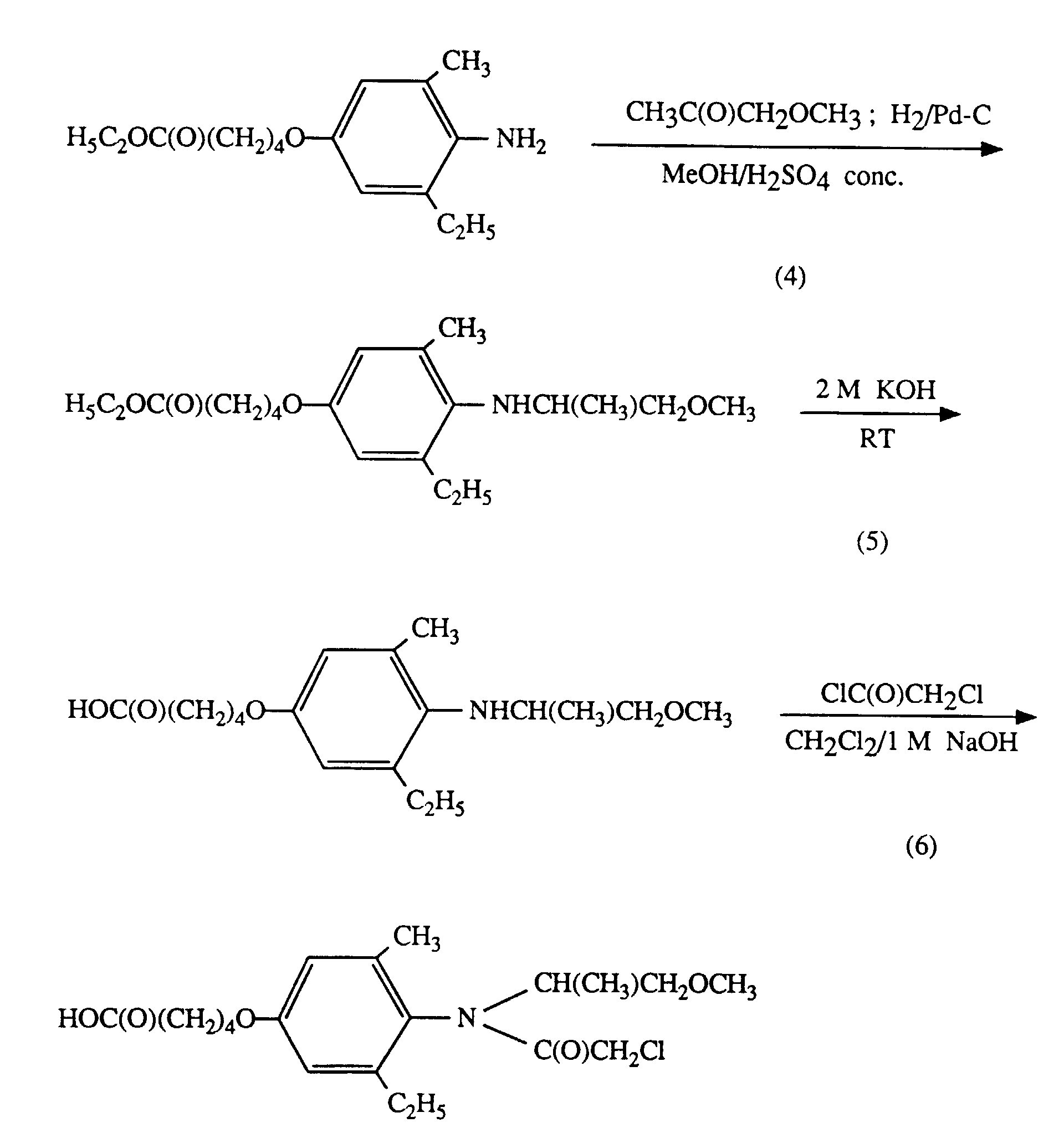
- Metolachloro derivatives of the formula I which are capable of coupling to a carrier molecule can be prepared by adding a compound of the formula II wherein R and n have the meanings given under formula I, expediently N-acylated in a reaction-inert solvent, preferably under mild conditions [-10 ° C. to + 30 ° C.] with a chloroacetic acid derivative capable of N-acylation.
- Reactive chloroacetic acid derivatives come as N-acylating agents
- Acid halides e.g. Chloroacetic acid chlorides and bromides
- esters and anhydrides in Consideration.
- suitable binder e.g. organic bases like Trialkylamines [trimethylamine, triethylamine, etc.], pyridine and pyrimidine bases or inorganic bases such as oxides, hydroxides [e.g. NaOH or KOH], bicarbonates, Carbonates or hydrides of alkali and alkaline earth metals.
- organic bases like Trialkylamines [trimethylamine, triethylamine, etc.]
- pyridine and pyrimidine bases or inorganic bases such as oxides, hydroxides [e.g. NaOH or KOH], bicarbonates, Carbonates or hydrides of alkali and alkaline earth metals.
- 4-dialkylaminopyridines can be used as catalysts.
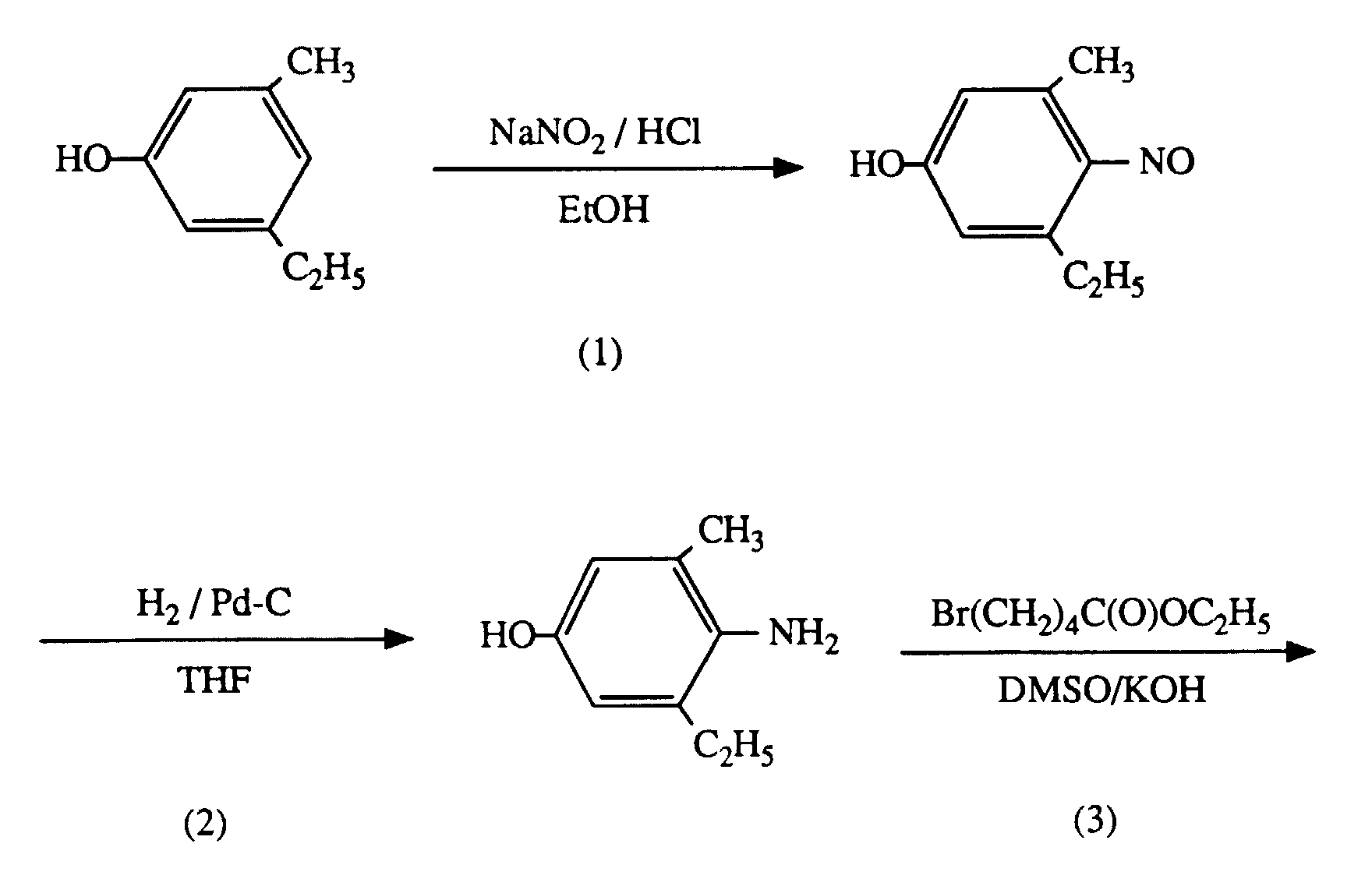
- Metolachlor derivative is the N-chloroacetyl-N- (1-methyl-2-methoxyethyl) -2-methyl-4- (4'-hydroxycarbonylbutoxy) -6-ethylaniline, this as described in detail below is, in a 6-step process starting from 3-ethyl-4-nitroso-5-methylphenol can be manufactured.
- the starting phenol is known or can be analogously produce known structure-like phenols.
- the resulting metolachlor derivative capable of coupling is new and is establishing itself this specific coupling ability is a valuable starting material in the manufacture monoclonal antibody with metolachlor specificity. It is therefore an important one Part of the present invention.
- the actual coupling reaction is preferably carried out with the aid of active ester method.
- the metolachlor derivative is initially in a suitable Solubilized solvent.
- Aprotic solvents are particularly suitable Solvents that have a low evaporation rate, e.g. N, N-dimethylformamide (DMF) or dimethyl sulfoxide (DMSO).
- the carboxyl groups are then derivatized to an active ester by the previously solubilized metolachlor derivative e.g. with N-hydroxysuccinimide, N-hydroxysulfosuccinimide, N, N'-dicyclohexylcarbodiimide or N, N'-carbonyldiimidazole or is reacted with derivatives of these compounds.
- metolachlor derivative e.g. with N-hydroxysuccinimide, N-hydroxysulfosuccinimide, N, N'-dicyclohexylcarbodiimide or N, N'-carbonyldiimidazole or is reacted with derivatives of these compounds.
- the active ester is then separated from the reaction mixture and becomes BSA or KLH admitted. After an incubation period of 0.1 to 12 hours, preferably 3 to 5 The precipitate is removed for hours. The supernatant can then if necessary Interposition of further cleaning steps for the actual immunization reaction be used.
- the donor animals are immunized by applying the haptens coupled to a high molecular weight carrier molecule. Is particularly preferred a 2 to 3 times application, but in particular at intervals of 7 to 30 days from 12 to 16 days.
- the preferred form of application in the context of the present invention is injection, which can be carried out either intravenously, intraperitoneally or subcutaneously.
- a combination of subcutaneous and intraperitoneal injection is preferred.
- the antigen metalolachlor conjugate
- a suitable buffer such as, for example, a PBS buffer which contains one of the adjuvants commonly used.
- the use of Freund's adjuvant is particularly preferred in the context of this invention.
- the donor animals killed and a spleen cell suspension is made.
- the isolated spleen cells are placed in a suitable buffer (e.g. a BSS buffer) and in the form until they fuse with suitable myeloma cells stored in a cell suspension.
- a suitable buffer e.g. a BSS buffer
- tumor cells which cannot themselves produce monoclonal antibodies, such as, for example, SP2 / 0-Ag14 (Shulman et al, 1978) or X63-Ag8.653, which greatly simplifies the analysis of the resulting fusion products becomes.
- SP2 / 0-Ag14 Shulman et al, 1978
- X63-Ag8.653 which greatly simplifies the analysis of the resulting fusion products becomes.
- the spleen cells are in a 2 to 20-fold excess in relation to the myeloma cells.
- the fusion of spleen and myeloma cells is carried out in a special fusion medium performed, which has a composition that is intended for the intended cell fusion provides optimal conditions.
- Said fusion medium is preferably a buffer solution which one of the fusion promoters commonly used for the fusion of cells contains, such as Sendai viruses or other paramyxoviruses, possibly in UV-inactivated form, calcium ions, surface-active lipids, e.g. Lysolecithin or polyethylene glycol.
- Particularly preferred in the context of this invention is Use of polyethylene glycol (PEG), in particular polyethylene glycol (PEG) with an average MG of 600 to 6000, and in a concentration of 30% to 60%. A PEG concentration of 40% -50% is particularly preferred.
- the optimal one Fusion temperature is between 18 ° C and 39 ° C. One is particularly preferred Temperature of 37 ° C.
- the fused antibody-producing hybrid cells are selected with the aid of methods known per se. There are various options for reading out successful fusion events (hybrid cells) from the 2 types of parent cells. One million and more cells from each parent type are routinely used in the fusion protocol. Since the fusion does not occur at a 100% frequency, it can be a difficult task to separate the fusion products from the large number of unfused or self-fused parent cells.
- the hybridoma cells are formed by fusion more short-lived Antibody producing (spleen) B cells as well as long-lived myeloma cells.
- the desired result is a long-lasting cell line that produces antibodies. Since the In principle, spleen cells can only have a limited lifespan in culture just wait until all non-merged and all merged with themselves Spleen cells have died. Then, however, the task still remains long-lived antibody-producing cells from the long-lived non-antibody-producing cells To separate cells.
- hypoxanthine guanine phosphoribosyl transferase HGPRT
- This enzyme is part of the purine "Salvage Pathway" in mammalian cells. These cells are also able to synthesize purines de novo .
- Purine antimetabolites e.g. the 8-azaguanine, which is structurally very similar to the purine guanine is similar and can therefore replace it in some of its normal reactions.
- Azaguanine is incorporated into the DNA, which affects the normal Growth behavior and ultimately leads to cell death. Because Azaguanin over the "Salvage Pathway" needs to be replaced, all those cells that do not have HGPRT Possess activity, do not utilize azaguanine and therefore grow in its presence.
- HAT medium which contains hypoxanthine, aminopterin and thymidine (HAT medium) as components.
- Aminopterin is an antimetabolite that inhibits de novo purine synthesis and the methylation of deoxyuridylate to thymidylate.
- hypoxanthine can act as an auxiliary trace in the event aminopterin blocks de novo purine synthesis, while thymidine eliminates the need for methylation of deoxyuridylate.
- the myeloma cells are preferably resistant to azaguanine and sensitive towards aminopterin, i.e. they are HGPRT negative.
- fusion of the cells and cultivation in a HAT medium they can be successful fused cells are selected because the myeloma cells responsible for the Proliferation are responsible for growing only in the presence of HGPRT activity can and this activity must be supplied by the HGPRT-positive cell line.
- the HGPRT-positive antibody-producing cell lines are in this medium not killed though. But they only survive for a certain time and are not in the Able to proliferate.
- the fused Hybrid cells in the presence of previously untreated from the peritoneum non-immunized experimental animals isolated macrophages, so-called "feeder cells", cultured.
- feeder cells isolated macrophages
- the cultivation of the fused is particularly preferred in the context of this invention Hybrid cells on microtiter plates.
- the cell suspension obtained after the fusion is applied to the individual wells distributed on a microtiter plate and for a period of 7 to 30 days under suitable, conditions promoting the growth of the fused hybrid cells (e.g. HAT / HT media) cultivated.
- suitable, conditions promoting the growth of the fused hybrid cells e.g. HAT / HT media
- Positive hybrid cell cultures are then preferred using known methods but isolated with the help of the limiting dilution method and then in suitable culture media.
- the supernatants of the grown cell clones are also due to the formation of Antibodies checked.
- Hybridoma cell clones according to the invention for the formation of suitable monoclonal Antibodies are preferably made using one of the commonly used for this purpose immunoassays used, e.g. an enzyme-linked immunoassay or an Radioimmunoassay.
- Another object of the present invention relates to the production of monoclonal antibodies using methods known per se, which are characterized in that the hybridoma cell lines according to the invention characterized in more detail above, or else clones or subclones thereof, which synthesize the antibodies according to the invention and secrete them into the surrounding medium, cultivated in vitro or in vivo using known methods.
- the in vitro cultivation of the hybridoma cells according to the invention takes place in suitable cultivation media, in particular in the commonly used, standardized culture media such as, for example, Dulbecco's Modified Eagle Medium (DMEM) or RPMI 1640 medium, which may be by adding mammalian sera, such as, for example, fetal Calf serum, or can be supplemented with growth-promoting additives and trace elements.
- suitable cultivation media in particular in the commonly used, standardized culture media such as, for example, Dulbecco's Modified Eagle Medium (DMEM) or RPMI 1640 medium, which may be by adding mammalian sera, such as, for example, fetal Calf serum, or can be supplemented with growth-promoting additives and trace elements.
- DMEM Dulbecco's Modified Eagle Medium
- RPMI 1640 medium which may be by adding mammalian sera, such as, for example, fetal Calf serum, or can be supplemented with growth-promoting additives and trace elements.
- Isolation of the monoclonal antibodies preferably begins with precipitation the immunoglobulin fraction from the respective supernatants of the hybridoma cultures, e.g. with the help of ammonium sulfate. Further refurbishment and Cleaning steps known to those skilled in the art and which for example the use of chromatographic methods, e.g. Gel filtration, Ion exchange chromatography, DEAE cellulose chromatography, protein A or Include immunoaffinity chromatography.
- chromatographic methods e.g. Gel filtration, Ion exchange chromatography, DEAE cellulose chromatography, protein A or Include immunoaffinity chromatography.
- antibody-producing hybridoma cell clones in to inject appropriate mammals that are developing antibody-producing Induce tumors in the treated animals. After a period of The antibodies can be removed from the body fluids of the thus treated for 1 to 3 weeks Animals are isolated.
- a hybridoma cell clone according to the invention is injected intraperitoneally into female Balb / c mice which have optionally been pretreated with a hydrocarbon such as, for example, pristan.
- a hydrocarbon such as, for example, pristan.
- the ascites fluid is collected and stored until further processing.
- the isolation of the monoclonal antibodies is carried out in an exactly analogous manner to the previously described isolation from the supernatants of hybridomas cultivated in vitro .
- Another object of the present invention relates to the use of Antibodies according to the invention in one of the customary immunoassays for detection of metolachlor and to differentiate metolachlor from structural related compounds, but especially compared to the metolachlor analog Alachlor in soil, air and water samples and, if necessary, in extracts Plants or other biological material.
- the monoclonal antibodies according to the invention can thus in all known Immunoassays are used that are based on the specific binding between antigen and build the appropriate monoclonal antibody, e.g. in one Radioimmunassay (RIA), an enzyme-linked immunoassay (ELISA), one Immunofluorescence test etc.
- RIA Radioimmunassay
- ELISA enzyme-linked immunoassay
- Immunofluorescence test etc.
- the monoclonal antibody according to the invention can be used as such or else can be used in the form of a radioactively labeled derivative.
- All can Modifications of the RIA test known today for the detection of these Target substances relevant to the invention can be used, e.g. an RIA test in homogeneous or solid phase, a heterogeneous RIA test and a single or double ('Sandwich') RIA test with direct or indirect (competitive) detection of the Antigen.
- an enzyme-linked Immunoassays e.g. an enzyme-linked Immunoassays.
- the principle of the competitive immunoassay is based on competition between one labeled or an antigen bound to a solid support and a free antigen Antigen around the relevant binding sites on the antibody molecule.
- a solid carrier material that is suitable for binding the antigen or the antibody the plastic surface of a microtiter plate or one Test tube, the surface of spheres made of polystyrene, polypropylene, polyvinyl chloride, Glass or plastic or the surface of filter paper, dextran, cellulose or Strips of nitrocellulose or similar materials.
- the binding to the support material by simple adsorption or optionally after previous activation of the carrier material with e.g. Glutaraldehyde or Cyanogen bromide can be mediated.
- the ELISA assay is based either on the use of an enzyme-linked Derivatives of the antibody according to the invention or of known ones Enzyme-coupled antibodies, which are an epitope of an antibody according to the invention recognize and bind to it.
- an indirect one is particularly preferred ELISA assays, in which one of the previously described carrier materials is initially used an antigen, especially a conjugate of hapten and a high molecular weight Carrier molecule such as BSA or KLH, is coated.
- Preferred within the present invention is a conjugate concentration of 10 ng / 100 ul buffer to 200 ng / 100 ⁇ l buffer, preferably from 30 ng / 100 ⁇ l buffer to 100 ng / 100 ⁇ l buffer and whole particularly preferably from 40 ng / 100 ul buffer to 60 ng / 100 ul buffer.
- the carrier-bound antigen is then incubated with a test solution that contains the antigen to be detected and one of the antibodies according to the invention.
- the Antigen to be detected can be either in free form or as a component a water or soil sample.
- an enzyme-labeled antibody the monoclonal according to the invention Detects antibodies and binds to them.
- an enzyme-labeled Antibody is a phosphatase-labeled goat anti-sheep immunoglobulin, or a corresponding goat anti-mouse antibodies that can be obtained commercially.
- the amount of the bound antibody protein can be determined using a Enzyme-substrate reaction, e.g. determine using spectroscopic methods.
- Also preferred in the context of this invention is a direct ELISA test based on the Competition of labeled and free antigen for that of one of the previous ones Antibody is based on the carrier materials mentioned.
- the labeling of the antigen can be carried out with the aid of known methods using the markers usually used in immunological diagnostics.
- the amount of free antigen present in a particular sample can then be very high simply be determined based on the decrease in labeled antigen, the greater the more free antigen is in the sample.
- the present invention further relates to means for the qualitative and quantitative Determination of metolachlor in the form of a test kit, in addition to those according to the invention monoclonal antibodies and / or their derivatives, possibly also others monoclonal or polyclonal antibodies, but especially labeled monoclonal or polyclonal antibodies, and other additives can contain.
- Test kits which are based on one of the commonly used immunoassays based, selected from the group consisting from radioimmunoassay, enzyme-linked immunoassay and chemiluminescence assay.
- ELISA enzyme-linked one direct or indirect immunoassay
- Backing materials that are used in the context of the present invention may include primarily insoluble polymeric materials selected from the group consisting of Group consisting of polystyrene, polyethylene, polypropylene, polyester, polyacrylonitrile, Polyvinyl chloride, polyacrylamide, nitrocellulose, cross-linked dextran, fluorinated resins, Agarose, cross-linked agarose, polysaccharides, etc. But there are also others Materials conceivable, such as Glass, metal, nylon-based mesh, etc.
- carrier materials mentioned above in detail can vary widely be designed and depending on the specific target Use very different forms. These include for example bowls, spheres, plates, rods, cells, vials, tubes, fibers, Networks, etc.
- Microtiter plates made of transparent plastic materials e.g. Polyvinyl chloride or Polystyrene
- the uncoated or with one of the antibodies according to the invention, with free antigen or an antigen conjugate can be coated.
- beads, tubes or rods made of polystyrene and polystyrene latex, where the surrounding latex material is separated from the polystyrene particles by centrifugation can be.
- markers or Indicators with the help of which the existence of a complex formation reaction, in particular, however, to demonstrate an immune response, which preferably leads to an Antigen-antibody complex or leads to a ligand-receptor complex, wherein in addition to qualitative and possibly quantitative statements about what is to be demonstrated Antigens are possible. Both individual atoms and Also consider molecules that either directly or indirectly contribute to the generation of a detectable signal can be involved. These markers or indicators can either directly with the antigen to be detected or with one of the monoclonal antibodies according to the invention may be linked or incorporated therein available.
- These separately present compounds are preferably a second antibody molecule, which can be of both monoclonal and polyclonal origin, a complement protein or fragments thereof, S.aureus protein A, etc.
- a second antibody molecule which can be of both monoclonal and polyclonal origin, a complement protein or fragments thereof, S.aureus protein A, etc.
- These separate compounds specifically recognize and bind to a receptor molecule , such as the antigen to be detected or one of the monoclonal antibodies according to the invention, but preferably to a receptor molecule which is in the form of a complex.
- the following list of possible Markers or indicators are only intended to serve the wide variety of usable To illustrate substances and reagents by way of example, without, however, the Restrict the subject matter of the invention in any way.
- Suitable markers or indicators can be found, for example, within the group of radioactive elements.
- those elements are preferred that either emit y rays themselves, such as 124 J, 125 J, 128 J, 132 J, 51 Cr, or else induce an emission of these rays, such as 11 C, 18 F, 13 N.
- ⁇ -steel such as 111 In, 14 C and 3 H are suitable.
- fluorochromes are selected from the group consisting of fluorescein isocyanate, fluorescein isothiocyanate, 5-dimethylamino-1-naphthalenesulfonyl chloride, Tetramethylrhodamine isothiocyanate, lissamine, rhodamine 8200 sulfonyl chloride, etc.
- Marker or indicator substances e.g. Horseradish peroxidase, alkaline Phosphatase, ⁇ -D-galactosidase, glucose oxidase, glucoamylase, carboxylic anhydrase, Acetylcholinesterase, lysozyme, malate dehydrogenase, glucose-6-phosphate dehydrogenase, etc.
- enzymes e.g. Horseradish peroxidase, alkaline Phosphatase, ⁇ -D-galactosidase, glucose oxidase, glucoamylase, carboxylic anhydrase, Acetylcholinesterase, lysozyme, malate dehydrogenase, glucose-6-phosphate dehydrogenase, etc.
- enzymes e.g. Horseradish peroxidase, alkaline Phosphatase, ⁇ -D-galactosidase, glucose oxid
- Reagents which lead to a color reaction are particularly preferred.
- Horseradish peroxidase is an example of hydrogen peroxide, which in Combination with an additional, oxidized dye precursor such as Diaminobenzidine or o-phenylenediamine, leads to a brown or yellow color.
- glucose oxidase as a marker can, for example 2,2'-Azino-di- (3-ethyl-benzothiazoline-6-sulfonic acid) [ABTS] used as the substrate will.
- Another object of the present invention thus relates to the use of Test kits containing at least one of the monoclonal antibodies according to the invention Contain reagent for fast and effective, qualitative and / or quantitative Detection of metolachlor and differentiation of metolachlor from the best known, structurally related compounds, but especially compared to the Metolachlor analogues alachlor.
- DMSO dimethyl sulfoxide
- step 2 500 ml of dimethyl sulfoxide (DMSO) are placed at room temperature and under vigorous stirring 52.1 g (338.6 mmol) of the 3-ethyl-4-amino-5-methylphenol prepared according to step 2 added in small portions.
- the mixture is cooled to 15 ° C.
- 33.5 g (507.9 mmol) of aqueous 85% potassium hydroxide solution are added dropwise, so that the reaction temperature does not exceed 20 ° C.
- you leave a period of 70 minutes was 82.7 ml (507.9 mmol) of 5-bromovaleric acid ethyl ester dropwise, keeping the reaction temperature at 25 ° C.
- this is mixed with 130 ml of 4M hydrochloric acid and Given ice and stirred well.
- the aqueous mixture is washed with diethyl ether.
- aqueous phase is then made alkaline with 2M NaOH, extracted with diethyl ether, the ether phase washed twice with water and then with saturated sodium chloride solution, dried over sodium sulfate and concentrated. 67.5 g of a viscous oil are obtained, which is purified by vacuum distillation. Yield 31.7 g (33.7% of theory), bp 151-152 ° C / 10 -2 torr.
- the catalyst is filtered off; the residue taken up in diethyl ether; the ether phase with successively sodium bicarbonate solution, Washed ice water and saturated saline, over sodium sulfate dried and evaporated. Yield 29 g (75.9% of theory) in the form of a viscous, light brown oils.
- the metolachlor derivative prepared according to Example 1 is conjugated either to "Bovine Serum Albumine”(BSA; Fluka) or to "Keyhole Limpet Hemocyanin”(KLH; Calbiochem) using the activated ester method (Kulkarni et al ., 1981).
- the carboxyl group of the derivative is solubilized in N, N-dimethylformamide (DMF) (8 mg / 200 ⁇ l) at room temperature and then with a 4 molar excess of ⁇ -hydroxysuccinimide (9.1 mg / 200 ⁇ l DMF) and N, N '-Dicyclohexylcarbodiimid (16 mg / 200 ul DMF) added.
- DMF N, N-dimethylformamide
- ⁇ -hydroxysuccinimide 9.1 mg / 200 ⁇ l DMF
- N, N '-Dicyclohexylcarbodiimid (16 mg / 200 ul DMF) added.
- the reaction mixture is first stirred at 22 ° C. for 1 hour and then at 4 ° C. for 18 hours.
- the white precipitate formed in the reaction is centrifuged for 3 minutes 12,000 g removed at room temperature and the activated ester subsequently to BSA or KLH (24 mg) was given previously in 5.4 ml of a phosphate-buffered saline [PBS buffer, 0.01 M sodium phosphate and 0.145 M NaCl, pH 7.0] have been solubilized is.
- PBS buffer 0.01 M sodium phosphate and 0.145 M NaCl, pH 7.0
- the molar ratio of [derivative] / [BSA] is approx. 55/1 (8 mg derivative / 24 mg BSA).
- the precipitate formed is removed by centrifugation for 10 minutes at 2,000 g at 4 ° C. and the remaining supernatant with the protein conjugate is extensively dialyzed against PBS [containing 3 mM NaN 3 ] before it is then is used for the immunization experiments.
- the molar ratio of metolachlor to BSA is approx. 23: 1.
- mice Groups of 5 female BALB / c mice (Sisseln animal farm, Switzerland) each are between 4 and 6 weeks old, receive 3 series of intraperitoneal or subcutaneous injections with KLH-conjugated metolachlor (50 ⁇ g / injection).
- the first injection contains 0.1 ml of the conjugate in PBS, which is in a ratio of 1: 1 mixed with 0.1 ml of Freund's complete adjuvant.
- Blood serum is withdrawn from the test animals 1 week after the last injection and the blood titer was determined using an ELISA test, with the microtiter plates previously coated with BSA-conjugated hapten (see section 6).
- the fur and the upper abdominal skin are then cut sterile without injuring the peritoneum.
- a sterile 5 ml plastic syringe and a sterile 18-needle 4 ml BSS (without Ca 2+ and Mg 2+ ) and 1 ml air are injected into the abdominal cavity.
- the previously injected BSS buffer is withdrawn from the peritoneum and placed in a sterile falcon tube. This procedure is repeated 2 more times.
- the macrophages obtained in this way are cooled with ice and then twice with 20 each ml BSS washed.
- the macrophages are each 10 min. At 300 g and a temperature of 5 ° C. centrifuged. The pellet is then resuspended in 50 ml HAT medium and the Cell suspension distributed on 4 Costar plates with a total of 24 wells (0.5 ml / well).
- the macrophages prepared in this way are then stored in an incubator at a temperature of 37 ° C. and a CO 2 concentration of 6%.
- myeloma cell line Sp 2 / O-Ag 14 is a myeloma cell line which does not itself secrete antibodies and which is described in M. Shulman et al . (1978). This myeloma cell line can be obtained from the "American Type Culture Collection" in Rockville, Maryland.
- the myeloma cells are preferably cultivated in T. 175 "Falcon” bottles (Beckton & Dickenson).
- the culture medium (RPMI 1640) is replaced by fresh RPMI 1640 medium.
- the Sp 2/0 Ag 14 cells are harvested, placed in a sterile 50 ml plastic tube and centrifuged for 10 min at 300 g and a temperature of 5 ° C. (MSE centrifuge, model Chilspin, UK). After centrifugation, the supernatant is drawn off and discarded. The cells are washed twice with approx. 30 ml BSS buffer (Ca 2+ and Mg 2+ free) (10 min. At 300 g, 5 ° C) and then resuspended in 5 ml BSS.
- the previously immunized Balb / c mouse is killed by breaking the neck and the spleen is sterile taken.
- the mouse is briefly immersed in 70% ethanol and with sterile Cutlery prepared.
- the spleen is carefully removed and placed on a fine nylon net placed. There it is finely cut with scissors and then with the help of a 5 ml Syringe plunger carefully pushed through the net without too many cells to destroy.
- the network is rinsed with BSS throughout the process.
- the cell suspension obtained in this way is placed in 50 ml plastic tubes and added for 10 minutes 300 g and a temperature of 5 ° C centrifuged (MSE centrifuge, model Chilspin; UK). The cells are then washed twice with 20 ml BSS each (10 min .; 300 g; 5 ° C; MES Chilspin) and the cell pellet is centrifuged in 10 ml BSS resuspended.
- the spleen cells are left on ice until fusion with Sp 2 / O-Ag14 myeloma cells.
- the ratio of myeloma cells to spleen cells should be 1:10 for the fusion.
- Spleen cells (in BSS buffer) and Sp 2 / O-Ag14 myeloma cells (in BSS buffer) are combined in the stated ratio and centrifuged for 10 minutes at 300 g and a temperature of 5 ° C. (MSE centrifuge, model Chilspin).
- MSE centrifuge, model Chilspin The pellet is resuspended in BSS buffer and the suspension is then centrifuged again. The pellet is carefully stirred and placed in a 37 ° C water bath.
- 1 ml of prewarmed and sterile PEG-4000 (MERCK) is then added dropwise to the cells over a period of 60 seconds, the entire batch being constantly agitated.
- the cells are then shaken for a further 30 seconds before 5 ml of a previously heated BSS buffer (without Ca 2+ , Mg 2+ ) are also added dropwise over a period of about 5 minutes with constant stirring.
- the cells fused in the manner described are then centrifuged off (10 min .; 300 g; 20 ° C., MSE centrifuge, model Chilspin), the supernatant is drawn off and discarded.
- the cell pellet is resuspended in 50 ml HAT medium and the cell suspension obtained in this way is distributed over the prepared 4 Costar plates (microtiter plates with 24 wells, diameter per well 24 mm; total area for cell growth 2.0 cm 2 ) (0.5 ml / well) .
- the Costar plates are incubated at a temperature of 37 ° C and at a CO 2 concentration of 6%.
- HAT medium On the 1st day after the cell fusion, 1 ml of HAT medium per well becomes Culture plates added. A microscopic examination is carried out 3 to 4 days after the cell fusion Control of the fused cells. At the same time, the used medium is extracted and replaced with 1 ml of fresh HAT medium. After another 3 days (6-7 days after cell fusion) the culture medium is changed again. From the 7th to the 10th day after cell fusion, each well is microscopically searched for hybrids and 2 the medium is renewed up to 3 times a week.
- the HAT medium can pass through there HT medium to be replaced.
- the supernatant from washed hybrid cultures (at least 10% of the wells) is lifted off with a sterile Pasteur pipette and tested for the presence of antibodies.
- the cells of a positive well are dissolved using a pipette and transferred to a tube in 1 ml of medium. An aliquot is then taken to determine the number of cells and stained with FDA (dilution 2 with FDA: 50 ⁇ l 1: cells + 50 ⁇ l dye). The preferred cell number is 10 5 to 10 6 cells / ml.
- the hybrid cells are then diluted in a ratio of 1: 100 with HT medium (for example 100 ⁇ l cells + 9.9 ml HT medium).
- HT medium 25 ml of HT medium are placed in two 50 ml falcon tubes and 5 ml of one Macrophage suspension made up to a total of 30 ml per tube.
- the macrophages are previously isolated from a mouse and resuspended in 10 ml HT medium (cf. Section 3.1).
- the hybrid cells are in these Falcon tubes containing the macrophages diluted until a cell density of (i) 270 cells / 30 ml or (ii) 90 cells / 30 ml is reached is. Then these approaches are made on Costar plates (microtiter plates with 96 Wells), with 200 ⁇ l added to each well. This matches with a cell count of (i) 1.8 cells / well or (ii) 0.6 cells / well. Per Dilution requires 1.5 microtiter plates in this way.
- the individual wells are checked microscopically and the Wells containing cell clones are recorded.
- Example 7 Expansion of the hybridoma cells in the mouse
- mice Female Balb / c mice (20 g-25 g) (Sisseln animal farm, CH) are pretreated with 0.3 ml Pristan oil (Aldrich Chemical), which is injected intraperitoneally. 1 to 3 weeks after the Pristan application, the mice are given a second injection (0.2 ml Pristan oil, ip). Simultaneously with this second injection, the animals receive 2 x 10 6 hybridoma cells in 0.2 ml PBS.
- Pristan oil Aldrich Chemical
- the ascites fluid resulting from this treatment is collected at 800 g centrifuged and stored at a temperature of -20 ° C. After thawing centrifuged the ascites fluid at 30,000 g for 1 hour. The top layer that mainly contains lipids is removed. Then the protein concentration determined and adjusted to a value of 10 mg / ml by adding PBS.
- the immunoglobulin G fraction (IgG) is obtained by adding 0.9 Volumes of a saturated ammonium sulfate solution precipitated at 0 ° C. After 1 Hour, the IgG fraction is pelleted by centrifugation at 22,000 g for one hour. The pellet is then in 20 nM Tris-HCl buffer, pH 7.9, the 50 mM NaCl contains, dissolved and dialyzed against the same buffer overnight at 4 ° C.
- the IgG fraction is further processed with the help of a Anion exchange chromatography on a DE-52 diethylaminoethyl cellulose (Whatman) pillar.
- the sample is diluted 1: 2 (v / v) with 20 mM Tris-HCl, pH 7.9 until a final NaCl concentration of 25 mM is reached and 10 mg protein / ml gel are applied applied the column. Elution is achieved by increasing the NaCl concentration from 25 mM to 200 mM (linear gradient). In general, the elution takes place monoclonal antibody in the range of 80 mM NaCl.
- the fractions are dialyzed against PBS overnight at a temperature of 4 ° C and stored at -70 ° C.
- the degree of purity is determined using a sodium dodecyl sulphate Polyacrylamide gel electrophoresis (SDS-PAGE) determined, as well as by isoelectric Focusing.
- the degree of purity is> 90%.
- the detection of metolachlor is carried out using a two-stage, competitive ELISA tests using an enzyme-labeled second antibody.
- BSA-conjugated hapten is first in a 50 mM sodium carbonate buffer (pH 9.6) (200 ng BSA-conjugated hapten / 100 ⁇ l sodium carbonate buffer) on microtiter plates (e.g. Dynatech, type M 129A) adsorbed and overnight at a temperature of 4 ° C incubated. It has been shown that by reducing the conjugate [BSA / hapten] concentration from 200 ng / 100 ⁇ l sodium carbonate buffer to 50 ng / 100 ⁇ l sodium carbonate buffer the sensitivity of the assay due to an improved coating can be increased almost 5 times.
- the remaining free binding sites of the solid support material are then through Blocked addition of BSA in the form of a 1% solution. After two hours of incubation at The plates are washed again at 22 ° C. with PBS-Tween (0.1%).
- 50 ⁇ l of the previously purified monoclonal antibodies (0.2 ⁇ g / ml) or the The supernatant of the cell clones (in a dilution of 1:15) is a) with 950 ⁇ l Standard solution containing an increasing proportion of metolachlor or metolachlor analogues contains, b) with water samples containing metolachlor or c) containing water Incubated soil extracts. (All dilutions are made in PBS-Tween).
- Microtiter plates [Dynatech M 129A] are coated with monoclonal antibody [eg MAb 4082-25-4; 75 ng / 100 ⁇ l 50 mM sodium carbonate buffer, pH 9.6] coated and incubated overnight at a temperature of 4 ° C. The plates are then washed 5 times with 0.1% (v / v) PBS-Tween and then incubated for 2 hours with PBS enriched with 1% (w / v) BSA in order to block the binding sites which are still free. After washing again, 150 ⁇ l of a standard solution are added to the wells of the microtiter plates, which contain increasing amounts of metolachlor in 0.1% (v / v) PBS-Tween.
- monoclonal antibody eg MAb 4082-25-4; 75 ng / 100 ⁇ l 50 mM sodium carbonate buffer, pH 9.6
- the plates are then washed 5 times with 0.1% (v / v) PBS-Tween and
- a calibration curve is first created (Fig. 1), with B / Bo x 100 being plotted against the concentration of inhibitor.
- Bo means absorption capacity measured without adding a metolachlorin inhibitor to the antibody, and B absorption capacity when adding differently concentrated metolachlor inhibitors).
- the I 50 value indicates the concentration of the antigen at which the antibody binding to the solid phase is inhibited by 50%.
- the I 50 value is determined with the aid of an ENZFITTER (Leatherbarrow, Elsevier-Biosoft) curve calculation program specially adapted to the existing conditions, based on a 4-parameter logistic curve (Raab GM, 1983).
- ENZFITTER Leatherbarrow, Elsevier-Biosoft
- Both assays are able to detect metolachlor in the ppb range.
- the direct ELISA is slightly less sensitive than the indirect one, but it is much faster.
- the I 50 values are 1.0 ng / ml for the direct and 0.6 ng / ml for the indirect ELISA.
- the detection range for metolachlor in buffer is between 0.1 ng / ml and 10 ng / ml, whereby the minimum detection limit is defined as the concentration that is required to achieve a percentage increase in the bound antibodies that corresponds to twice the standard deviation of the blank value.
- the coefficient of variation for repeat determinations in the 1 ppb range is 11% (20 determinations).
- the cross reactivity of MAb 4082-25-4 can be determined using an indirect competitive ELISA can be determined. As Table 1 shows, one finds a weak one Cross reactivity of 1.4% with the structurally very close hydroxy metabolite [Compound A] of metolachlor. The other metabolites show no cross-reactivities [ ⁇ 0.1%].
- the monoclonal antibody does not bind to other chloroacetanilide herbicides and related connections such as Alachlor, Furalaxyl and Matalaxyl [ ⁇ 0.1%].
- Hybridoma cell lines [4082-25-4] were used by the International Depository recognized 'European Collection of Animal Cell Cultures' (ECACC) in Salisbury, UK, according to the requirements of the Budapest Treaty for the International Recognition of the deposit of microorganisms for the purpose of patenting, under the deposit number ECACC 9002 1701. An explanation of The viability of the deposited samples is determined by the said International Depository made out.
- RPMI 1640 (Seromed) with the following additives: Calf serum 15% L-glutamine 4 mM Gentamicin 0.01% Sodium pyruvate 1 mm 2-mercaptoethanol 50 ⁇ M insulin 5 ⁇ M Transferrin 5 ⁇ M Selenium (ITS) 5 ⁇ M
- Cross-reactivity of the best known metolachlor analogues with MAb 4082-25-4 [The metolachlor analogs A to N are shown in Table 2 using their formula].
- connection I 50 [ng / ml]
Landscapes
- Chemical & Material Sciences (AREA)
- Organic Chemistry (AREA)
- Health & Medical Sciences (AREA)
- Life Sciences & Earth Sciences (AREA)
- General Health & Medical Sciences (AREA)
- Genetics & Genomics (AREA)
- Molecular Biology (AREA)
- Biochemistry (AREA)
- Biophysics (AREA)
- Wood Science & Technology (AREA)
- Medicinal Chemistry (AREA)
- Proteomics, Peptides & Aminoacids (AREA)
- Engineering & Computer Science (AREA)
- Zoology (AREA)
- Immunology (AREA)
- Chemical Kinetics & Catalysis (AREA)
- Microbiology (AREA)
- General Chemical & Material Sciences (AREA)
- Biotechnology (AREA)
- Bioinformatics & Cheminformatics (AREA)
- General Engineering & Computer Science (AREA)
- Preparation Of Compounds By Using Micro-Organisms (AREA)
- Micro-Organisms Or Cultivation Processes Thereof (AREA)
- Pharmaceuticals Containing Other Organic And Inorganic Compounds (AREA)
- Measuring Or Testing Involving Enzymes Or Micro-Organisms (AREA)
- Peptides Or Proteins (AREA)
- Organic Low-Molecular-Weight Compounds And Preparation Thereof (AREA)
- Medicines Containing Antibodies Or Antigens For Use As Internal Diagnostic Agents (AREA)
Description
All die genannten Verfahren zum Nachweis synthetischer Herbizide sind jedoch mit zahlreichen Nachteilen verbunden. So müssen beispielsweise für die Bestimmung von Metolachlor in Bodenproben mittels GC oder HPLC vor der Durchführung der eigentlichen chromatographischen Analyse aufwendige Reinigungs- und Aufkonzentrierungsschritte zwischengeschaltet werden.
Auch für den immunologischen Nachweis von Atrazin ist bereits ein Verfahren beschrieben (US-P 4,530,786), das jedoch, wie auch die zuvor genannten Methoden, auf der Verwendung polyklonaler Antiseren beruht, die aus Tieren gewonnen werden, welche zuvor mit einem entsprechenden Antigen immunisiert wurden.
Um diese Nachteile der polyklonalen Antiseren zu überwinden wurden in jüngster Zeit vermehrt Anstrengungen unternommen auch für den Agrarsektor monoklonale Antikörper zu entwickeln. So berichten Schlaeppi et al (1989) über die Herstellung und Verwendung monoklonaler Antiköprer gegen Atrazin und Hydroxyatrazin in einem Enzym-gekoppelten Immunassay. Die Herstellung monoklonaler Antikörper gegen Metolachlor, die eine ausreichend hohe Affinität gegenüber der Zielsubstanz aufweisen und damit geeignet sind für den erfindungsgemässen Einsatz in einem der bekannten Immunoassays, ist dagegen bisher nicht gelungen.
(Metolachlorkonzentration für 50 % Hemmung/Konzentration der Metolachloranalogen für 50 % Hemmung) x 100.


Das Antigen (Metolachlor-konjugat) liegt in diesem Fall in einem geeigneten Puffer vor, wie z.B. einem PBS-Puffer, der eines der üblicherweise verwendeten Adjuvantien enthält. Besonders bevorzugt im Rahmen dieser Erfindung ist die Verwendung von Freund's Adjuvans.
Für das Auslesen erfolgreicher Fusionsereignisse (Hybridzellen) aus den 2 Typen von Elternzellen existieren verschiedene Möglichkeiten. Routinemässig werden eine Million und mehr Zellen von jedem Elterntyp in dem Fusionsprotokoll verwendet. Da die Fusion nicht mit einer 100 %igen Frequenz erfolgt, kann es zu einem schwierigen Unterfangen werden, die Fusionsprodukte von der grossen Ueberzahl nicht fusionierter oder mit sich selbst fusionierter Eltern zellen abzutrennen.
Ein bis drei Wochen nach der Injektion des Hybridoma-Zellklons wird die Ascitesflüssigkeit gesammelt und bis zur weiteren Aufbereitung aufbewahrt.
Bevorzugt im Rahmen der vorliegenden Erfindung ist die Verwendung eines Enzym-Markers wie z.B. der alkalischen Phosphatase, der mit dem nachzuweisenden Antigen verknüpft wird.
Der Reaktionsansatz wird zunächst 1 Stunde bei 22°C und anschliessend 18 Stunden bei 4°C gerührt.
Die Platten werden dann 5 mal mit 0.1 % (v/v) PBS-Tween gewaschen und anschliessend für 2 Stunden mit PBS, das mit 1% (w/v) BSA angereichert ist, inkubiert um die noch freien Bindungsstellen zu blockieren. Nach erneutem Waschen werden jeweils 150 µl einer Standardlösung in die Vertiefungen der Mikrotiterplatten gegeben, die steigende Mengen an Metolachlor in 0.1 % (v/v) PBS-Tween enthalten. Es folgt eine 1 stündige Inkubation bei einer Temperatur von 22°C.
Anschliessend werden pro Vertiefung 50 µl des Hapten-Enzym [alkalische Phosphatase]-Konjugates [2 µg/ml] zugegeben und die Inkubation wird für eine weitere Stunde fortgesetzt. Nach erneutem Waschen wird in jede Vertiefung 150 µl des p-Nitrophenyl-phosphat Substrates in einer Konzentration von 1 mg/ml in Diethanolamin Puffer [1 mM, pH 9.8, angereichert mit 0.5 mM MgCl2• 6H2O] zugegeben. Nach 2 stündiger Inkubation bei 22°C im Dunkeln wird die Absorption bei 405 nm bestimmt.
Dieser Antikörper wurde dazu verwendet zwei kompetitive Immunoassays zu entwickeln. Einer dieser Assays basiert auf der Verwendung von Mikrotiterplatten, die mit BSA-Hapten-Konjugat beschichtet sind sowie von Enzym-markierten Ziegen/anti-Maus Antikörpern [indirekter ELISA].
Der zweite Assay verwendet Hapten-Enzym-Konjugate sowie Antikörper-beschichtete Mikrotiterplatten [direkter ELISA].
| Kälberserum | 15 % |
| L-Glutamin | 4 mM |
| Gentamicin | 0.01% |
| Natrium-Pyruvat | 1 mM |
| 2-Mercaptoethanol | 50 µM |
| Insulin | 5 µM |
| Transferrin | 5 µM |
| Selen (ITS) | 5 µM |
| Hypoxanthin 680 | 5.0 mg/l |
| Aminopterin | 8.8 mg/l |
| Thymidin | 193.8 mg/l |
| Hypoxanthin 680 | 5.0 mg/l |
| Thymidin | 193.8 mg/l |
| KCl | 7.3 mM |
| NaCl | 116.0 mM |
| NaHCO3 | 26.0 mM |
| NaH2PO4• 2H2O | 1.0 mM |
| Glucose | 5.5 mM |
| Phenolrot | 48.0 µM |
| Na2CO3 | 477.0 mg |
| NaHCO3 | 879.0 mg |
| NaN3 | 1.8 mg |
| ad 300 ml H2O |
| NaCl | 8.5 g |
| Na2HPO4• 2H2O | 1.28 g |
| NaH2PO4• 2H2O | 0.436 |
| ad 1000 ml H2O |
| BSA | 5.0 g |
| NaN3 (0.5 M) | 3.0 ml |
| ad 500 ml PBS |
| Diethanolamin | 97.0 ml |
| NaN3 (0.5 M) | 6.0 ml |
| MgCl2• 6H2O | 100.0 mg |
| ad 1000 ml H2O, Einstellen des pH-Wertes auf pH 9.8 mit HCl conc. |
| Kreuzreaktivität der bekanntesten Metolachlor-Analogen mit MAb 4082-25-4 [Die Metolachloranalogen A bis N sind in Tabelle 2 anhand ihrer Formel wiedergegeben]. | ||
| Verbindung | I50 [ng/ml] | Kreuzreaktivität [%] |
| Metolachlor | 0.6 | 100 |
| Alachlor | > 1000 | < 0.1 |
| A | 43 | 1.4 |
| B | > 1000 | < 0.1 |
| C | > 1000 | < 0.1 |
| D | > 1000 | < 0.1 |
| E | > 1000 | < 0.1 |
| F | > 1000 | < 0.1 |
| G | > 1000 | < 0.1 |
| H | > 1000 | < 0.1 |
| I | > 1000 | < 0.1 |
| J | > 1000 | < 0.1 |
| K | > 1000 | < 0.1 |
| L | > 1000 | < 0.1 |
| M | > 1000 | < 0.1 |
| N | > 1000 | < 0.1 |

Claims (41)
- Eine Hybridomazellinie, die einen für Metolachlor spezifischen monoklonalen Antikörper produziert, dadurch gekennzeichnet, dass die Kreuzreaktivitäten des Antikörpers mit den in Tabelle 1 angegebenen, strukturell verwandten Metolachlor-analogen < 2% beträgt.
- Eine Hybridomazellinie gemäss Anspruch 1, die einen monoklonalen Antikörper produziert, der das in Tabelle 1 wiedergegebene Kreuzreaktivitätsmuster aufweist.
- Eine Hybridomazellinie gemäss Anspruch 1, welche die kennzeichnenden Charakteristika von ECACC 9002 1701 besitzt.
- Ein für Metolachlor spezifischer monoklonaler Antikörper und Derivate davon, die eine Kreuzreaktivität mit den in Tabelle 1 angegebenen, strukturell verwandten Metolachloranalogen von < 2% zeigen.
- Monoklonaler Antikörper und Derivate davon gemäss Anspruch 4, die das in Tabelle 1 wiedergegebene Kreuzreaktivitätsmuster aufweisen.
- Monoklonaler Antikörper und Derivate davon gemäss Anspruch 4, die von einer Hybridomazellinie gemäss einem der Ansprüche 1 bis 3 produziert werden.
- Monoklonaler Antikörper und Derivate davon gemäss Anspruch 4, der von einer Hybridomazellinie produziert wird, welche die kennzeichnenden Charakteristika von ECACC 9002 1701 besitzt.
- Verfahren zur Herstellung einer Hybridomazellinie gemäss Anspruch 1, dadurch gekennzeichnet, dass mana) ein Metolachlorderivat synthetisiert und mit einem Carriermolekül konjugiertb) ein Donor-Tier mit besagtem Konjugat immunisiertc) eine immunkompetente B-Zelle aus dem immunisierten Donor-Tier isoliertd) besagte immunkompetente B-Zelle mit einer zur kontinuierlichen Zellteilung befähigten Tumorzellinie fusioniert.e) das entstehende Fusionsprodukt isoliert, in einem geeigneten Kulturmedium kultiviert und anschliessend positive Hybridzellen kloniert undf) die klonierten Hybridzellen auf die Bildung monoklonaler Antikörper hin untersucht und diejenigen selektioniert, welche mit den in Tabelle 1 aufgeführten Metolachlorderivaten < 2% kreuzreagieren.
- Verfahren gemäss Anspruch 8, dadurch gekennzeichnet, dass es sich bei besagtem Metolachlorderivat um eine Verbindung der Formel (I) handelt,welche in 4 Stellung zur Aminofunktion des Metolachlor eine R-(CH2)n-O-Gruppierung aufweist, worin
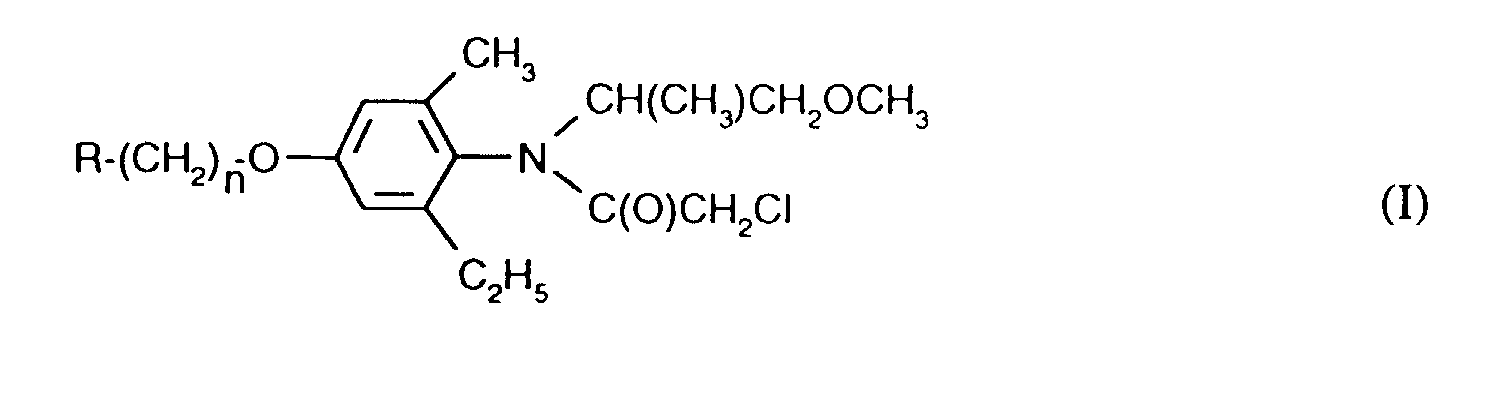 R für COOH, NH2 oder SH steht undn eine ganze Zahl von 1 bis 10 repräsentiert.
 - Verfahren gemäss Anspruch 8, dadurch gekennzeichnet, dass man als Carriermolekül makromolekulare Verbindungen verwendet, die frei zugängliche reaktive Gruppen für die Kupplungsreaktion mit einem geeigneten Metolachlorderivat aufweisen und die in der Lage sind besagtem Metolachlor eine immunogene Potenz zu verleihen.
- Verfahren gemäss Anspruch 10, dadurch gekennzeichnet, dass man ein lysinreiches Protein mit einem Molekulargewicht zwischen 10'000 und 1'500'000 verwendet.
- Verfahren gemäss Anspruch 10, dadurch gekennzeichnet, dass man ein Protein ausgewählt aus der Gruppe bestehend aus "Bovine Serum Albumin" (BSA), "Keyhole Limpet Hemocyanin" (KLH), Humanes Serumalbumin (HSA), "Porcine Thyroglobulin", B2 Microglobulin, Hemocyanin, Immunoglobuline; Toxine; Polysaccharide; Lipopolysaccharide; natürliche oder synthetische Polyadenyl- und Polyuridylsäuren; Polyalanyl- und Polylysin-Polypeptide; oder Zellmembrankomponenten verwendet.
- Verfahren gemäss Anspruch 8, dadurch gekennzeichnet, dass die Konjugation des Metolachlor an das Carriermolekül direkt erfolgt.
- Verfahren gemäss Anspruch 8, dadurch gekennzeichnet, dass die Konjugation des Metolachlor an das Carriermolekül über ein Brückenglied (Spacer) erfolgt.
- Verfahren gemäss Anspruch 14, dadurch gekennzeichnet, dass besagtes Brückenglied eine oder mehrere reaktive Gruppen besitzt, die in der Lage sind mit den reaktiven Gruppen des Carriermoleküls in Wechselwirkung zu treten.
- Verfahren gemäss Anspruch 15, dadurch gekennzeichnet, dass es sich bei besagten reaktiven Gruppen um Carboxyl-, Amino- oder SH-Gruppen handelt.
- Verfahren gemäss Anspruch 8, dadurch gekennzeichnet, dass die Kupplungsreaktion mit Hilfe der aktiven Estermethode durchgeführt wird.
- Verfahren gemäss Anspruch 8, dadurch gekennzeichnet, dass die Immunisierung der Donor-Tiere durch ein- bis mehrmalige Applikation von Carrier-gebundenem Metolachlor erfolgt.
- Verfahren gemäss Anspruch 18, dadurch gekennzeichnet, dass die Applikation in Form einer intravenösen, intra peritonealen oder subcutanen Injektion oder einer Kombination davon erfolgt.
- Verfahren gemäss Anspruch 8, dadurch gekennzeichnet, dass man für die Fusion immunkompetenter Zellen aus dem Donor-Tier Tumorzellinien verwendet, die selbst keine monoklonalen Antikörper produzieren.
- Verfahren gemäss Anspruch 20, dadurch gekennzeichnet, dass man Myelomazellinien verwendet, die die kennzeichnenden Charakteristika von Sp2/O-Ag14 oder X63-Ag8.653 besitzen.
- Verfahren gemäss Anspruch 8, dadurch gekennzeichnet, dass man als Fusionsmedium eine Pufferlösung verwendet, die eines der üblicherweise für die Fusionierung von Zellen verwendeten Fusionspromotoren enthält ausgewählt aus der Gruppe bestehend aus: Sendai Viren oder andere Paramyxoviren, Calcium-Ionen, oberflächenaktive Lipide oder Polyethylenglykol.
- Verfahren gemäss Anspruch 22, dadurch gekennzeichnet, dass es sich bei besagten Fusionspromotoren um Polyethylenglykol mit einem mittleren Molekulargewicht von 600 bis 6000 handelt.
- Verfahren gemäss Anspruch 23, dadurch gekennzeichnet, dass die Polyethylenglykolkonzentration im Fusionssmedium 30 % - 60 % beträgt.
- Verfahren gemäss Anspruch 8, dadurch gekennzeichnet, dass man für die Selektion fusionierte Hybridzellen das HAT-Selektionsmedium verwendet.
- Verfahren gemäss Anspruch 8, dadurch gekennzeichnet, dass man die Hybridzellen in Gegenwart von isolierten Makrophagen ("Feederzellen") kultiviert.
- Verfahren gemäss Anspruch 8, dadurch gekennzeichnet, dass man positive, monoklonale Antikörper produzierende Hybridzellkulturen mit Hilfe des limitierenden Verdünnungsverfahrens vereinzelt und anschliessend in geeigneten Kultivierungsmedien kloniert.
- Verfahren gemäss Anspruch 8, dadurch gekennzeichnet, dass man die gemäss Anspruch 8 klonierten Hybridoma- Zellklone mit Hilfe eines Immunoassays auf die Bildung geeigneter monoklonaler Antikörper hin untersucht.
- Verfahren gemäss Anspruch 28, dadurch gekennzeichnet, dass man einen Enzym-gekoppelten Immunassay oder einen Radioimmunassay verwendet.
- Verfahren zur Herstellung monoklonaler Antikörper, dadurch gekennzeichnet, dass man die gemäss einem der Ansprüche 8 bis 28 hergestellten Hybridomazellinien in vivo oder in vitro mit Hilfe bekannter Verfahren kultiviert und die produzierten monoklonalen Antikörper isoliert.
- Verfahren gemäss Anspruch 30, dadurch dadurch gekennzeichnet, dass man eine in vitro-Kultivierung in geeigneten Kultivierungsmedien durchführt.
- Verfahren gemäss Anspruch 31, dadurch gekennzeichnet, dass man standardisierte Kulturmedien verwendet ausgewählt aus der Gruppe bestehend aus "Dulbecco's Modified Eagle Medium" (DMEM) oder RPMI 1640, die gegebenenfalls durch Zugabe von Säuger-Seren, durch wachstumsfördernde Zusätze oder durch Spurenelemente ergänzt werden können.
- Verfahren gemäss Anspruch 30, dadurch gekennzeichnet, dass man besagte monoklonale Antikörper durch Expansion der gemäss einem der Ansprüche 8 bis 29 hergestellten Hybridomazellinien in einem Donor-Tier in vivo produziert.
- Verfahren zum immunologischen Nachweis von Metolachlor, dadurch gekennzeichnet, dass man einen monoklonalen Antikörper der Ansprüche 4 bis 7 in einem der bekannten Immunassays verwendet.
- Verfahren gemäss Anspruch 34, dadurch gekennzeichnet, dass es sich um einen kompetitiven Immunassay handelt.
- Verfahren gemäss Anspruch 34, dadurch gekennzeichnet, dass es sich bei besagtem Immunassay um einen Radioimmunassay (RIA), einen enzymgekoppelten Assay (ELISA) oder einen Chemilumineszenzassay handelt.
- Verfahren gemäss Anspruch 36, dadruch gekennzeichnet, dass es sich bei besagtem enzymgekoppelten Assay um einen indirekten ELISA handelt.
- Verfahren gemäss Anspruch 36, dadruch gekennzeichnet, dass es sich bei besagtem enzymgekoppelten Assay um einen direkten ELISA handelt.
- Mittel zum immunologischen Nachweis von Metolachlor in Form eines gebrauchsfertigen Test-Kits, dadurch gekenn zeichnet, dass besagter Test-Kit neben den üblicherweise verwendeten Trägermaterialien, Reagentien und sonstigen Zusätzen mindestens einen monoklonalen Antikörper gemäss einem der Ansprüche 4 bis 7 als Reagenz enthält.
- Metolachlorderivat der Formel (I) zur Verwendung in einem Verfahren gemäss Anspruch 8zur Kupplung an ein Trägermolekül, welches in 4 Stellung zur Aminofunktion des Metolachlor eine R-(CH2)n-O- Gruppierung aufweist, worin
 R für COOH, NH2 oder SH steht undn eine ganze Zahl von 1 bis 10 repräsentiert.
 - Verfahren zur Herstellung eines zur Kupplung an ein Trägermolekül befähigten Metolachlorderivats der Formel Izur Verwendung in einem Verfahren gemäss Anspruch 8, welche in 4 Stellung zur Aminofunktion des Metolachlor eine R-(CH2)n-O- Gruppierung aufweist, worin
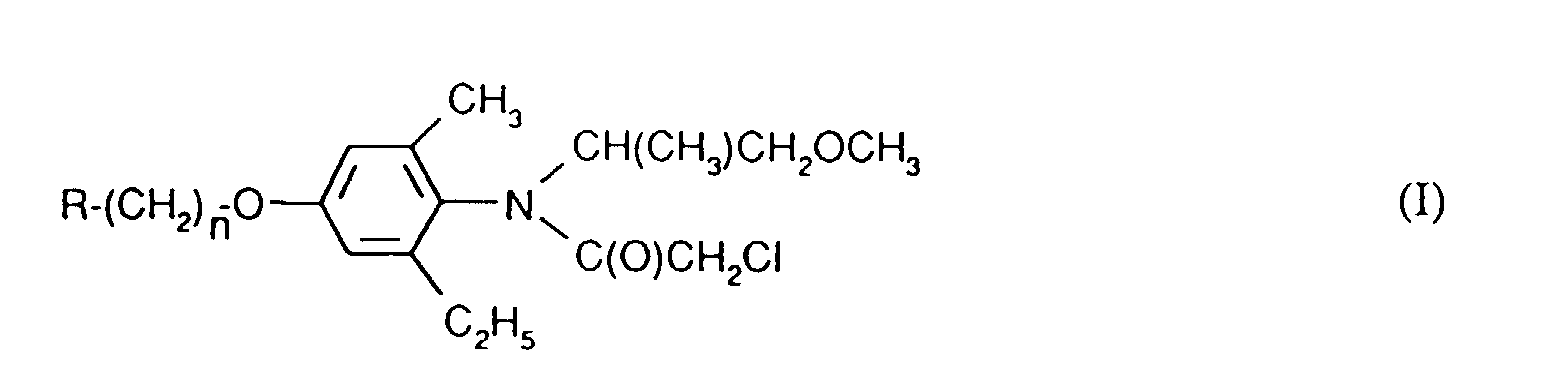 dadurch gekennzeichnet, dass man eine Verbindung der Formel IIR für COOH, NH2 oder SH steht undn eine ganze Zahl von 1 bis 10 repräsentiert,worin R und n die unter Formel I angegebenen Bedeutungen haben, in einem reaktionsinerten Lösungsmittel, unter milden Bedingungen bei einer Temperatur von -10 C bis + 30 C mit einem zur N-Acylierung befähigten Chloressigsäurederivat N-acyliert.
Applications Claiming Priority (6)
| Application Number | Priority Date | Filing Date | Title |
|---|---|---|---|
| CH76290 | 1990-03-09 | ||
| CH76290 | 1990-03-09 | ||
| CH762/90 | 1990-03-09 | ||
| CH337890 | 1990-10-23 | ||
| CH3378/90 | 1990-10-23 | ||
| CH337890 | 1990-10-23 |
Publications (3)
| Publication Number | Publication Date |
|---|---|
| EP0446173A2 EP0446173A2 (de) | 1991-09-11 |
| EP0446173A3 EP0446173A3 (en) | 1992-04-29 |
| EP0446173B1 true EP0446173B1 (de) | 1999-07-14 |
Family
ID=25685602
Family Applications (1)
| Application Number | Title | Priority Date | Filing Date |
|---|---|---|---|
| EP91810132A Expired - Lifetime EP0446173B1 (de) | 1990-03-09 | 1991-02-28 | Immunologischer Nachweis von Metolachlor |
Country Status (12)
| Country | Link |
|---|---|
| US (1) | US5576188A (de) |
| EP (1) | EP0446173B1 (de) |
| JP (1) | JPH04218366A (de) |
| KR (1) | KR910016937A (de) |
| AT (1) | ATE182172T1 (de) |
| AU (1) | AU636964B2 (de) |
| BR (1) | BR9100924A (de) |
| CA (1) | CA2037752A1 (de) |
| DE (1) | DE59109139D1 (de) |
| HU (1) | HU211054B (de) |
| IL (1) | IL97350A (de) |
| NZ (1) | NZ237356A (de) |
Families Citing this family (9)
| Publication number | Priority date | Publication date | Assignee | Title |
|---|---|---|---|---|
| US6958148B1 (en) | 1998-01-20 | 2005-10-25 | Pericor Science, Inc. | Linkage of agents to body tissue using microparticles and transglutaminase |
| US6919076B1 (en) | 1998-01-20 | 2005-07-19 | Pericor Science, Inc. | Conjugates of agents and transglutaminase substrate linking molecules |
| US6221545B1 (en) | 1999-09-09 | 2001-04-24 | Imation Corp. | Adhesives for preparing a multilayer laminate featuring an ink-bearing surface bonded to a second surface |
| US6232505B1 (en) | 2000-03-03 | 2001-05-15 | Acro Chemical Technology, L.P. | Methoxyacetone preparation |
| US6376718B1 (en) | 2000-11-17 | 2002-04-23 | Arco Chemical Technology, L.P. | Dehydrogenation of alkylene glycol ethers to ether ketones and aldehydes |
| EP3891201A1 (de) | 2018-12-06 | 2021-10-13 | Dow Global Technologies LLC | Wässrige polyurethandispersionen und deren herstellung |
| CN113671054A (zh) * | 2020-05-14 | 2021-11-19 | 益诺思生物技术海门有限公司 | 异丙甲草胺于口鼻吸入染毒系统中的浓度的测定方法 |
| CN112462070B (zh) * | 2020-11-13 | 2023-07-11 | 北京望尔生物技术有限公司 | 一种检测甲草胺的试纸条及其应用 |
| CN114316059B (zh) * | 2021-12-31 | 2023-04-07 | 华南农业大学 | 特异性抗异丙甲草胺碳手性抗体的可变区序列及其重组全长抗体的制备 |
Family Cites Families (1)
| Publication number | Priority date | Publication date | Assignee | Title |
|---|---|---|---|---|
| BR8901881A (pt) * | 1988-04-22 | 1989-11-28 | Monsanto Co | Anticorpos,antigeno para cultivar anticorpos contra haptenos,processo imunoquimico e estojo de ensaio |
-
1991
- 1991-02-25 IL IL9735091A patent/IL97350A/en not_active IP Right Cessation
- 1991-02-28 DE DE59109139T patent/DE59109139D1/de not_active Expired - Fee Related
- 1991-02-28 EP EP91810132A patent/EP0446173B1/de not_active Expired - Lifetime
- 1991-02-28 AT AT91810132T patent/ATE182172T1/de not_active IP Right Cessation
- 1991-03-07 CA CA002037752A patent/CA2037752A1/en not_active Abandoned
- 1991-03-07 NZ NZ237356A patent/NZ237356A/en unknown
- 1991-03-07 BR BR919100924A patent/BR9100924A/pt not_active Application Discontinuation
- 1991-03-08 AU AU72768/91A patent/AU636964B2/en not_active Ceased
- 1991-03-08 KR KR1019910003863A patent/KR910016937A/ko not_active Abandoned
- 1991-03-08 HU HU91767A patent/HU211054B/hu not_active IP Right Cessation
- 1991-03-08 JP JP3069128A patent/JPH04218366A/ja active Pending
-
1994
- 1994-12-20 US US08/359,689 patent/US5576188A/en not_active Expired - Fee Related
Non-Patent Citations (1)
| Title |
|---|
| FENG ET AL.: "A GENERAL METHOD FOR DEVELOPING IMMUNOASSAYS TO CHLOROACETANILIDE HERBICIDES", AGRIC.FOOD CHEM.,, vol. 40, 1992, pages 211 - 214 * |
Also Published As
| Publication number | Publication date |
|---|---|
| AU636964B2 (en) | 1993-05-13 |
| US5576188A (en) | 1996-11-19 |
| BR9100924A (pt) | 1991-11-05 |
| ATE182172T1 (de) | 1999-07-15 |
| IL97350A (en) | 1995-05-26 |
| CA2037752A1 (en) | 1991-09-10 |
| IL97350A0 (en) | 1992-05-25 |
| HUT61590A (en) | 1993-01-28 |
| AU7276891A (en) | 1991-09-12 |
| EP0446173A2 (de) | 1991-09-11 |
| HU211054B (en) | 1995-10-30 |
| HU910767D0 (en) | 1991-09-30 |
| JPH04218366A (ja) | 1992-08-07 |
| DE59109139D1 (de) | 1999-08-19 |
| EP0446173A3 (en) | 1992-04-29 |
| NZ237356A (en) | 1993-10-26 |
| KR910016937A (ko) | 1991-11-05 |
Similar Documents
| Publication | Publication Date | Title |
|---|---|---|
| DE3301249C2 (de) | ||
| DE60031570T2 (de) | Immunoassay für neonicotinylinsektizide | |
| DE68913402T2 (de) | Antikörper mit hoher Affinität für Methamphetamine sowie geeignetes Immunogen für seine Herstellung. | |
| EP0260610A2 (de) | Monoklonale Antikörper gegen humanen Tumonekrosefaktor (TNF) und deren Verwendung | |
| DE3687884T2 (de) | Monoklonale antikoerper und verfahren zum nachweis von pilzpathogenen. | |
| EP0446173A2 (de) | Immunologischer Nachweis von Metolachlor | |
| EP0549525B1 (de) | Monoklonale Antikörper gegen Sulfonylharnstoffherbiziden und ihre Verwendung zum Nachweis | |
| EP0365818B1 (de) | Immunologischer Nachweis von Atrazin und Atrazinderivaten | |
| EP0463998B1 (de) | Immunologisches Nachweisverfahren für Triasulfuron | |
| DE69329935T2 (de) | Haptene, tracer, immunogene und antikörper für carbazol - und dibenzofuran - derivate | |
| DE69009644T2 (de) | Verfahren zum Nachweis einer biologischen Substanz mit Hilfe von Liganden. | |
| DE69427850T2 (de) | Monoklonaler antikörper gegen mucoglykoprotein | |
| US6465194B2 (en) | Monoclonal antibodies to 4,4′-dinitrocarbanilide and a method for analyzing for the drug nicarbazin | |
| DE69124294T2 (de) | Monoklonale Antikörper gegen Mycosphaerella-Arten | |
| DE3218269A1 (de) | Verfahren zur herstellung von monoklonalen antikoerpern gegen prostaglandine und die verwendung der antikoerper zur bestimmung der prostaglandine | |
| DE4031283A1 (de) | Hybridzellinien zur herstellung monoklonaler antikoerper gegen bromnicotinsaeure und 1-methyl-10 (alpha)-methoxydihydrolysergol | |
| DD230880B1 (de) | Verfahren zur herstellung monoklonaler antikoerper fuer die humane kappa-kette | |
| DD293606A5 (de) | Verfahren zur herstellung von monoklonalen antikoerpern gegen clavibacter michiganensis subspecies michiganensis (smith) davis, gillaspie, vidaver u. harris | |
| DD271709A1 (de) | Verfahren zur herstellung monoklonaler antikoerper gegen pmsg | |
| DD230881B1 (de) | Verfahren zur herstellung monoklonaler antikoerper gegen die humane lambda-kette | |
| DD251156A1 (de) | Verfahren zur gewinnung von hapten-spezifischen monoklonalen antikoerpern | |
| DD292273A5 (de) | Verfahren zur herstellung von heteromyelomzellinien | |
| DD296698A5 (de) | Verfahren zur herstellung monoklonaler antikoerper gegen gonadotrope hormone | |
| DD236113A1 (de) | Verfahren zur herstellung von 5-bormsalizyl-4'-chloranilid-o-glykosiden |
Legal Events
| Date | Code | Title | Description |
|---|---|---|---|
| PUAI | Public reference made under article 153(3) epc to a published international application that has entered the european phase |
Free format text: ORIGINAL CODE: 0009012 |
|
| 17P | Request for examination filed |
Effective date: 19910304 |
|
| AK | Designated contracting states |
Kind code of ref document: A2 Designated state(s): AT BE CH DE DK ES FR GB GR IT LI LU NL SE |
|
| PUAL | Search report despatched |
Free format text: ORIGINAL CODE: 0009013 |
|
| AK | Designated contracting states |
Kind code of ref document: A3 Designated state(s): AT BE CH DE DK ES FR GB GR IT LI LU NL SE |
|
| 17Q | First examination report despatched |
Effective date: 19941223 |
|
| RAP1 | Party data changed (applicant data changed or rights of an application transferred) |
Owner name: NOVARTIS AG |
|
| GRAG | Despatch of communication of intention to grant |
Free format text: ORIGINAL CODE: EPIDOS AGRA |
|
| GRAG | Despatch of communication of intention to grant |
Free format text: ORIGINAL CODE: EPIDOS AGRA |
|
| GRAH | Despatch of communication of intention to grant a patent |
Free format text: ORIGINAL CODE: EPIDOS IGRA |
|
| RAP1 | Party data changed (applicant data changed or rights of an application transferred) |
Owner name: NOVARTIS-ERFINDUNGEN VERWALTUNGSGESELLSCHAFT M.B.H |
|
| RAP1 | Party data changed (applicant data changed or rights of an application transferred) |
Owner name: NOVARTIS AG Owner name: NOVARTIS-ERFINDUNGEN VERWALTUNGSGESELLSCHAFT M.B. |
|
| GRAH | Despatch of communication of intention to grant a patent |
Free format text: ORIGINAL CODE: EPIDOS IGRA |
|
| GRAA | (expected) grant |
Free format text: ORIGINAL CODE: 0009210 |
|
| AK | Designated contracting states |
Kind code of ref document: B1 Designated state(s): AT BE CH DE DK ES FR GB GR IT LI LU NL SE |
|
| PG25 | Lapsed in a contracting state [announced via postgrant information from national office to epo] |
Ref country code: SE Free format text: THE PATENT HAS BEEN ANNULLED BY A DECISION OF A NATIONAL AUTHORITY Effective date: 19990714 Ref country code: GR Free format text: LAPSE BECAUSE OF NON-PAYMENT OF DUE FEES Effective date: 19990714 Ref country code: FR Free format text: LAPSE BECAUSE OF FAILURE TO SUBMIT A TRANSLATION OF THE DESCRIPTION OR TO PAY THE FEE WITHIN THE PRESCRIBED TIME-LIMIT Effective date: 19990714 Ref country code: GB Free format text: LAPSE BECAUSE OF FAILURE TO SUBMIT A TRANSLATION OF THE DESCRIPTION OR TO PAY THE FEE WITHIN THE PRESCRIBED TIME-LIMIT Effective date: 19990714 Ref country code: ES Free format text: THE PATENT HAS BEEN ANNULLED BY A DECISION OF A NATIONAL AUTHORITY Effective date: 19990714 Ref country code: NL Free format text: LAPSE BECAUSE OF FAILURE TO SUBMIT A TRANSLATION OF THE DESCRIPTION OR TO PAY THE FEE WITHIN THE PRESCRIBED TIME-LIMIT Effective date: 19990714 Ref country code: IT Free format text: LAPSE BECAUSE OF FAILURE TO SUBMIT A TRANSLATION OF THE DESCRIPTION OR TO PAY THE FEE WITHIN THE PRE;WARNING: LAPSES OF ITALIAN PATENTS WITH EFFECTIVE DATE BEFORE 2007 MAY HAVE OCCURRED AT ANY TIME BEFORE 2007. THE CORRECT EFFECTIVE DATE MAY BE DIFFERENT FROM THE ONE RECORDED.SCRIBED TIME-LIMIT Effective date: 19990714 |
|
| REF | Corresponds to: |
Ref document number: 182172 Country of ref document: AT Date of ref document: 19990715 Kind code of ref document: T |
|
| REG | Reference to a national code |
Ref country code: CH Ref legal event code: EP |
|
| REF | Corresponds to: |
Ref document number: 59109139 Country of ref document: DE Date of ref document: 19990819 |
|
| PG25 | Lapsed in a contracting state [announced via postgrant information from national office to epo] |
Ref country code: DK Free format text: LAPSE BECAUSE OF FAILURE TO SUBMIT A TRANSLATION OF THE DESCRIPTION OR TO PAY THE FEE WITHIN THE PRESCRIBED TIME-LIMIT Effective date: 19991014 |
|
| EN | Fr: translation not filed | ||
| NLV1 | Nl: lapsed or annulled due to failure to fulfill the requirements of art. 29p and 29m of the patents act | ||
| GBV | Gb: ep patent (uk) treated as always having been void in accordance with gb section 77(7)/1977 [no translation filed] |
Effective date: 19990714 |
|
| PG25 | Lapsed in a contracting state [announced via postgrant information from national office to epo] |
Ref country code: LU Free format text: LAPSE BECAUSE OF NON-PAYMENT OF DUE FEES Effective date: 20000228 Ref country code: BE Free format text: LAPSE BECAUSE OF NON-PAYMENT OF DUE FEES Effective date: 20000228 Ref country code: AT Free format text: LAPSE BECAUSE OF NON-PAYMENT OF DUE FEES Effective date: 20000228 |
|
| PG25 | Lapsed in a contracting state [announced via postgrant information from national office to epo] |
Ref country code: LI Free format text: LAPSE BECAUSE OF NON-PAYMENT OF DUE FEES Effective date: 20000229 Ref country code: CH Free format text: LAPSE BECAUSE OF NON-PAYMENT OF DUE FEES Effective date: 20000229 |
|
| PLBE | No opposition filed within time limit |
Free format text: ORIGINAL CODE: 0009261 |
|
| 26N | No opposition filed | ||
| BERE | Be: lapsed |
Owner name: NOVARTIS-ERFINDUNGEN VERWALTUNGSGESELLSCHAFT M.B. Effective date: 20000228 Owner name: NOVARTIS A.G. Effective date: 20000228 |
|
| REG | Reference to a national code |
Ref country code: CH Ref legal event code: PL |
|
| PG25 | Lapsed in a contracting state [announced via postgrant information from national office to epo] |
Ref country code: DE Free format text: LAPSE BECAUSE OF NON-PAYMENT OF DUE FEES Effective date: 20001201 |