EP0444515B1 - Als Demulgatoren von Öl-in-Wasser-Emulsionen geeignete Kondensationsprodukte - Google Patents
Als Demulgatoren von Öl-in-Wasser-Emulsionen geeignete Kondensationsprodukte Download PDFInfo
- Publication number
- EP0444515B1 EP0444515B1 EP91102446A EP91102446A EP0444515B1 EP 0444515 B1 EP0444515 B1 EP 0444515B1 EP 91102446 A EP91102446 A EP 91102446A EP 91102446 A EP91102446 A EP 91102446A EP 0444515 B1 EP0444515 B1 EP 0444515B1
- Authority
- EP
- European Patent Office
- Prior art keywords
- oil
- water emulsions
- precondensate
- weight
- condensation products
- Prior art date
- Legal status (The legal status is an assumption and is not a legal conclusion. Google has not performed a legal analysis and makes no representation as to the accuracy of the status listed.)
- Expired - Lifetime
Links
- XLYOFNOQVPJJNP-UHFFFAOYSA-N water Substances O XLYOFNOQVPJJNP-UHFFFAOYSA-N 0.000 title claims description 21
- 239000000839 emulsion Substances 0.000 title claims description 15
- 239000007859 condensation product Substances 0.000 title description 12
- 239000003795 chemical substances by application Substances 0.000 title 1
- XSQUKJJJFZCRTK-UHFFFAOYSA-N Urea Chemical compound NC(N)=O XSQUKJJJFZCRTK-UHFFFAOYSA-N 0.000 claims description 16
- 150000001875 compounds Chemical class 0.000 claims description 9
- 239000004202 carbamide Substances 0.000 claims description 8
- 150000003672 ureas Chemical class 0.000 claims description 8
- UFHFLCQGNIYNRP-UHFFFAOYSA-N Hydrogen Chemical compound [H][H] UFHFLCQGNIYNRP-UHFFFAOYSA-N 0.000 claims description 4
- 125000004432 carbon atom Chemical group C* 0.000 claims description 4
- 239000001257 hydrogen Substances 0.000 claims description 4
- 229910052739 hydrogen Inorganic materials 0.000 claims description 4
- 238000004519 manufacturing process Methods 0.000 claims description 3
- 125000004178 (C1-C4) alkyl group Chemical group 0.000 claims description 2
- 150000002431 hydrogen Chemical class 0.000 claims description 2
- 125000004400 (C1-C12) alkyl group Chemical group 0.000 claims 1
- 125000003837 (C1-C20) alkyl group Chemical group 0.000 claims 1
- 125000003358 C2-C20 alkenyl group Chemical group 0.000 claims 1
- IJGRMHOSHXDMSA-UHFFFAOYSA-N Atomic nitrogen Chemical compound N#N IJGRMHOSHXDMSA-UHFFFAOYSA-N 0.000 description 16
- GSEJCLTVZPLZKY-UHFFFAOYSA-N Triethanolamine Chemical compound OCCN(CCO)CCO GSEJCLTVZPLZKY-UHFFFAOYSA-N 0.000 description 13
- 230000015572 biosynthetic process Effects 0.000 description 12
- 238000003786 synthesis reaction Methods 0.000 description 12
- QGZKDVFQNNGYKY-UHFFFAOYSA-N Ammonia Chemical compound N QGZKDVFQNNGYKY-UHFFFAOYSA-N 0.000 description 10
- 235000013877 carbamide Nutrition 0.000 description 10
- SLINHMUFWFWBMU-UHFFFAOYSA-N Triisopropanolamine Chemical compound CC(O)CN(CC(C)O)CC(C)O SLINHMUFWFWBMU-UHFFFAOYSA-N 0.000 description 9
- 238000009833 condensation Methods 0.000 description 9
- 230000005494 condensation Effects 0.000 description 9
- 239000010779 crude oil Substances 0.000 description 9
- 229910052757 nitrogen Inorganic materials 0.000 description 8
- 239000003921 oil Substances 0.000 description 7
- QTBSBXVTEAMEQO-UHFFFAOYSA-N Acetic acid Chemical compound CC(O)=O QTBSBXVTEAMEQO-UHFFFAOYSA-N 0.000 description 6
- 238000006243 chemical reaction Methods 0.000 description 6
- 150000001412 amines Chemical class 0.000 description 5
- 229910021529 ammonia Inorganic materials 0.000 description 5
- ACVYVLVWPXVTIT-UHFFFAOYSA-N phosphinic acid Chemical compound O[PH2]=O ACVYVLVWPXVTIT-UHFFFAOYSA-N 0.000 description 5
- 229920000570 polyether Polymers 0.000 description 5
- 238000003756 stirring Methods 0.000 description 5
- 239000004721 Polyphenylene oxide Substances 0.000 description 4
- 239000003054 catalyst Substances 0.000 description 4
- 238000001816 cooling Methods 0.000 description 4
- 230000002378 acidificating effect Effects 0.000 description 3
- 239000007864 aqueous solution Substances 0.000 description 3
- 239000002904 solvent Substances 0.000 description 3
- OYQLXDCDTCVBIJ-UHFFFAOYSA-N 11-methyldodecylurea Chemical compound CC(C)CCCCCCCCCCNC(N)=O OYQLXDCDTCVBIJ-UHFFFAOYSA-N 0.000 description 2
- XGEGHDBEHXKFPX-UHFFFAOYSA-N N-methyl urea Chemical compound CNC(N)=O XGEGHDBEHXKFPX-UHFFFAOYSA-N 0.000 description 2
- 125000000217 alkyl group Chemical group 0.000 description 2
- 238000006555 catalytic reaction Methods 0.000 description 2
- 238000000034 method Methods 0.000 description 2
- 239000000203 mixture Substances 0.000 description 2
- 239000007764 o/w emulsion Substances 0.000 description 2
- 238000002360 preparation method Methods 0.000 description 2
- 230000035484 reaction time Effects 0.000 description 2
- 150000003839 salts Chemical class 0.000 description 2
- ISIJQEHRDSCQIU-UHFFFAOYSA-N tert-butyl 2,7-diazaspiro[4.5]decane-7-carboxylate Chemical compound C1N(C(=O)OC(C)(C)C)CCCC11CNCC1 ISIJQEHRDSCQIU-UHFFFAOYSA-N 0.000 description 2
- 125000000008 (C1-C10) alkyl group Chemical group 0.000 description 1
- 0 *N(*)C(N*=C)=O Chemical compound *N(*)C(N*=C)=O 0.000 description 1
- XMKLTEGSALONPH-UHFFFAOYSA-N 1,2,4,5-tetrazinane-3,6-dione Chemical compound O=C1NNC(=O)NN1 XMKLTEGSALONPH-UHFFFAOYSA-N 0.000 description 1
- AQSQFWLMFCKKMG-UHFFFAOYSA-N 1,3-dibutylurea Chemical compound CCCCNC(=O)NCCCC AQSQFWLMFCKKMG-UHFFFAOYSA-N 0.000 description 1
- ZWAVGZYKJNOTPX-UHFFFAOYSA-N 1,3-diethylurea Chemical compound CCNC(=O)NCC ZWAVGZYKJNOTPX-UHFFFAOYSA-N 0.000 description 1
- AWHORBWDEKTQAX-UHFFFAOYSA-N 1,3-dipropylurea Chemical compound CCCNC(=O)NCCC AWHORBWDEKTQAX-UHFFFAOYSA-N 0.000 description 1
- VZSRBBMJRBPUNF-UHFFFAOYSA-N 2-(2,3-dihydro-1H-inden-2-ylamino)-N-[3-oxo-3-(2,4,6,7-tetrahydrotriazolo[4,5-c]pyridin-5-yl)propyl]pyrimidine-5-carboxamide Chemical compound C1C(CC2=CC=CC=C12)NC1=NC=C(C=N1)C(=O)NCCC(N1CC2=C(CC1)NN=N2)=O VZSRBBMJRBPUNF-UHFFFAOYSA-N 0.000 description 1
- XUGUGGFZFUIRAE-UHFFFAOYSA-N 2-ethylhexylurea Chemical compound CCCCC(CC)CNC(N)=O XUGUGGFZFUIRAE-UHFFFAOYSA-N 0.000 description 1
- CLJIICXJWWTSQM-UHFFFAOYSA-N 7-methyloctylurea Chemical compound CC(C)CCCCCCNC(N)=O CLJIICXJWWTSQM-UHFFFAOYSA-N 0.000 description 1
- MVRPEHNGDMSSMV-PDBXOOCHSA-N CC\C=C/C\C=C/C\C=C/CCCCCCCCNC(N)=O Chemical compound CC\C=C/C\C=C/C\C=C/CCCCCCCCNC(N)=O MVRPEHNGDMSSMV-PDBXOOCHSA-N 0.000 description 1
- LFQSCWFLJHTTHZ-UHFFFAOYSA-N EtOH Substances CCO LFQSCWFLJHTTHZ-UHFFFAOYSA-N 0.000 description 1
- VGGSQFUCUMXWEO-UHFFFAOYSA-N Ethene Chemical compound C=C VGGSQFUCUMXWEO-UHFFFAOYSA-N 0.000 description 1
- JOYRKODLDBILNP-UHFFFAOYSA-N Ethyl urethane Chemical compound CCOC(N)=O JOYRKODLDBILNP-UHFFFAOYSA-N 0.000 description 1
- 239000005977 Ethylene Substances 0.000 description 1
- RYECOJGRJDOGPP-UHFFFAOYSA-N Ethylurea Chemical compound CCNC(N)=O RYECOJGRJDOGPP-UHFFFAOYSA-N 0.000 description 1
- MGJKQDOBUOMPEZ-UHFFFAOYSA-N N,N'-dimethylurea Chemical compound CNC(=O)NC MGJKQDOBUOMPEZ-UHFFFAOYSA-N 0.000 description 1
- WZMWUHXWOFTOTH-HZJYTTRNSA-N [(9z,12z)-octadeca-9,12-dienyl]urea Chemical compound CCCCC\C=C/C\C=C/CCCCCCCCNC(N)=O WZMWUHXWOFTOTH-HZJYTTRNSA-N 0.000 description 1
- XILUVFYUONGHAD-KTKRTIGZSA-N [(z)-octadec-9-enyl]urea Chemical compound CCCCCCCC\C=C/CCCCCCCCNC(N)=O XILUVFYUONGHAD-KTKRTIGZSA-N 0.000 description 1
- 238000010521 absorption reaction Methods 0.000 description 1
- 239000002253 acid Substances 0.000 description 1
- 150000007513 acids Chemical class 0.000 description 1
- 125000003342 alkenyl group Chemical group 0.000 description 1
- 125000002947 alkylene group Chemical group 0.000 description 1
- AZDRQVAHHNSJOQ-UHFFFAOYSA-N alumane Chemical class [AlH3] AZDRQVAHHNSJOQ-UHFFFAOYSA-N 0.000 description 1
- CNWSQCLBDWYLAN-UHFFFAOYSA-N butylurea Chemical compound CCCCNC(N)=O CNWSQCLBDWYLAN-UHFFFAOYSA-N 0.000 description 1
- 229910052799 carbon Inorganic materials 0.000 description 1
- 125000003262 carboxylic acid ester group Chemical group [H]C([H])([*:2])OC(=O)C([H])([H])[*:1] 0.000 description 1
- 150000001735 carboxylic acids Chemical class 0.000 description 1
- 229920006317 cationic polymer Polymers 0.000 description 1
- 150000001805 chlorine compounds Chemical class 0.000 description 1
- WRNOAELBRPKVHC-UHFFFAOYSA-N dodecylurea Chemical compound CCCCCCCCCCCCNC(N)=O WRNOAELBRPKVHC-UHFFFAOYSA-N 0.000 description 1
- 230000000694 effects Effects 0.000 description 1
- 239000003995 emulsifying agent Substances 0.000 description 1
- NKOHYPZTBAEGGO-UHFFFAOYSA-N hexadecylurea Chemical compound CCCCCCCCCCCCCCCCNC(N)=O NKOHYPZTBAEGGO-UHFFFAOYSA-N 0.000 description 1
- 125000004836 hexamethylene group Chemical group [H]C([H])([*:2])C([H])([H])C([H])([H])C([H])([H])C([H])([H])C([H])([H])[*:1] 0.000 description 1
- 238000002347 injection Methods 0.000 description 1
- 239000007924 injection Substances 0.000 description 1
- 229910052500 inorganic mineral Inorganic materials 0.000 description 1
- 229910052751 metal Inorganic materials 0.000 description 1
- 239000002184 metal Substances 0.000 description 1
- KQVLODRFGIKJHZ-UHFFFAOYSA-N methylenediurea Chemical compound NC(=O)NCNC(N)=O KQVLODRFGIKJHZ-UHFFFAOYSA-N 0.000 description 1
- 239000011707 mineral Substances 0.000 description 1
- GJNDMSSZEBNLPU-UHFFFAOYSA-N octadecylurea Chemical compound CCCCCCCCCCCCCCCCCCNC(N)=O GJNDMSSZEBNLPU-UHFFFAOYSA-N 0.000 description 1
- 239000002332 oil field water Substances 0.000 description 1
- 239000008385 outer phase Substances 0.000 description 1
- RGSFGYAAUTVSQA-UHFFFAOYSA-N pentamethylene Natural products C1CCCC1 RGSFGYAAUTVSQA-UHFFFAOYSA-N 0.000 description 1
- 125000004817 pentamethylene group Chemical group [H]C([H])([*:2])C([H])([H])C([H])([H])C([H])([H])C([H])([H])[*:1] 0.000 description 1
- 239000000047 product Substances 0.000 description 1
- QQONPFPTGQHPMA-UHFFFAOYSA-N propylene Natural products CC=C QQONPFPTGQHPMA-UHFFFAOYSA-N 0.000 description 1
- 125000004805 propylene group Chemical group [H]C([H])([H])C([H])([*:1])C([H])([H])[*:2] 0.000 description 1
- ZQZJKHIIQFPZCS-UHFFFAOYSA-N propylurea Chemical compound CCCNC(N)=O ZQZJKHIIQFPZCS-UHFFFAOYSA-N 0.000 description 1
- 238000000746 purification Methods 0.000 description 1
- 238000000926 separation method Methods 0.000 description 1
- 239000000243 solution Substances 0.000 description 1
- 239000000126 substance Substances 0.000 description 1
- IPOBMWQSKXACEW-UHFFFAOYSA-N tetradecylurea Chemical compound CCCCCCCCCCCCCCNC(N)=O IPOBMWQSKXACEW-UHFFFAOYSA-N 0.000 description 1
- 125000000383 tetramethylene group Chemical group [H]C([H])([*:1])C([H])([H])C([H])([H])C([H])([H])[*:2] 0.000 description 1
- XJDNKRIXUMDJCW-UHFFFAOYSA-J titanium tetrachloride Chemical compound Cl[Ti](Cl)(Cl)Cl XJDNKRIXUMDJCW-UHFFFAOYSA-J 0.000 description 1
- 239000007762 w/o emulsion Substances 0.000 description 1
Classifications
-
- C—CHEMISTRY; METALLURGY
- C08—ORGANIC MACROMOLECULAR COMPOUNDS; THEIR PREPARATION OR CHEMICAL WORKING-UP; COMPOSITIONS BASED THEREON
- C08G—MACROMOLECULAR COMPOUNDS OBTAINED OTHERWISE THAN BY REACTIONS ONLY INVOLVING UNSATURATED CARBON-TO-CARBON BONDS
- C08G71/00—Macromolecular compounds obtained by reactions forming a ureide or urethane link, otherwise, than from isocyanate radicals in the main chain of the macromolecule
-
- C—CHEMISTRY; METALLURGY
- C09—DYES; PAINTS; POLISHES; NATURAL RESINS; ADHESIVES; COMPOSITIONS NOT OTHERWISE PROVIDED FOR; APPLICATIONS OF MATERIALS NOT OTHERWISE PROVIDED FOR
- C09K—MATERIALS FOR MISCELLANEOUS APPLICATIONS, NOT PROVIDED FOR ELSEWHERE
- C09K23/00—Use of substances as emulsifying, wetting, dispersing, or foam-producing agents
- C09K23/16—Amines or polyamines
Definitions
- the invention also relates to a process for the preparation of the condensation products and their use as demulsifiers of oil-in-water emulsions.
- Oil-in-water emulsions are produced in large quantities during the production and further processing of crude oil, the continuous outer phase depending on the proportions of water to oil, the natural emulsifier system contained in the oil and the history of the origin of the emulsion.
- the majority of the crude oil is produced as a water-in-oil emulsion and has to be split by adding chemical demulsifiers.
- the separated salt water still contains certain amounts of residual oil, with oil-in-water emulsions preferably forming.
- Oil-in-water emulsions occur to an even greater extent during the further processing of the crude oil in the fields and in the refineries.
- the amount of emulsified crude oil in the oil-in-water emulsions can be up to 5%.
- special demulsifiers so-called deoilers, are used, which are mostly cationic polymers, such as those e.g. be described in DE-34 04 538. Typical products are also described in U.S. Patents 3,528,928, 4,333,947 and 3,893,615.
- US Pat. Nos. 4,179,396 and 4,383,933 also describe deoilers made from aluminum salts or titanium tetrachloride and alkanolamine condensates, which have optionally been partially acylated or quaternized.
- quaternized and low molecular weight alkanolamine polycondensates are also known as deoilers, which have been obtained by catalytic reaction with ZnCl 2 / acetic acid or Al 2 (SO 4 ) 3 / acetic acid.
- US Pat. Nos. 4,440,362 and 4,459,220 block polycondensates which are obtained by condensation of triethanolamine polycondensates and triisopropanolamine polycondensates prepared separately by catalytic reaction with Lewis or mineral acids are described.
- the condensation products defined at the outset which are superior to the known deoilers in terms of their universal applicability and splitting speed. They contain no metal salts, especially chlorides, which can have a corrosive effect.
- the demulsifiers according to the invention contain no carboxylic acid ester groups which are disadvantageous in terms of their effectiveness.
- the precondensates A used for the preparation of the condensation products according to the invention are expediently prepared in such a way that the trialkanolamines I, preferably triethanolamine or triisopropanolamine N [CH 2 -CH (CH 3 ) -OH] 3 , or mixtures of several trialkanolamines, in the presence condensed by acidic catalysts at elevated temperatures.
- the acidic catalysts used are preferably phosphorous acid (H 3 PO 3 ) and / or hypophosphorous acid (H 3 PO 2 ).
- the acidic catalysts, calculated as 100%, are advantageously used in an amount of 0.05 to 2% by weight, preferably 0.1 to 1% by weight, based on the trialkanolamine to be condensed.
- condensation temperatures of 120 to 280 ° C, preferably 150 to 260 ° C, in particular 180 to 240 ° C are used.
- the reaction time is generally 1 to 10 hours, preferably 4 to 8 hours.
- the condensation is expediently carried out by varying the temperature and / or reaction time in such a way that the viscosity when using triethanolamine for the triethanolamine polyether obtained is in the range from 10,000 to 100,000 mPa ⁇ s, preferably 20,000 to 50,000 mPa ⁇ s, for triisopropanolamine polyether Range is from 100,000 to 1,000,000 mPas, preferably 200,000 to 600,000 mPas, and for a mixed condensate of preferably equimolar amounts of triethanolamine and triisopropanolamine is in the range from 80,000 to 400,000 mPas, preferably 100,000 to 300,000 mPas (measured in undiluted condition at 20 ° C).
- the precondensates A obtained are reacted with one or more compounds IIa to IIb to give the condensation products according to the invention.
- R 1 is an alkyl group, preferably those in which R 1 is a C 1 to C 10 alkyl group, in particular a C 1 to C 4 alkyl group.
- Examples include ureas such as urea, N-methylurea, N-ethylurea, N-propylurea, N-butylurea, N, N'-dimethylurea, N, N'-diethylurea, N, N'-dipropylurea, N, N'-dibutylurea, N- (2-ethylhexyl) urea, N-iso-nonylurea, N-iso-tridecylurea, N-laurylurea, N-myristylurea, N-palmitylurea, N-stearylurea, N-oleylurea, N- Linolylurea, N-Linolenylurea. Monosubstituted ureas are preferred, and unsubstituted urea in particular.
- Examples of compounds of the general formula IIb are bisureas such as methylene diurea, ethylene 1,2-diurea, propylene 1,3-diurea, butylene 1,4-diurea, pentamethylene 1,5-diurea, hexamethylene 1,6 diurea.
- Bis ureas with an alkylene bridge R 4 having 1 to 10 carbon atoms are preferred.
- reaction of a precondensate of triethanolamine with the compounds IIa and IIb is generally carried out at temperatures from 100 to 210.degree. C., preferably 140 to 200.degree. C., expediently without solvent up to a viscosity of generally 20,000 to 300,000 mPa ⁇ s, preferably 28,000 up to 150,000 mPas.
- reaction of a precondensate of triisopropanolamine with the compounds IIa and IIb generally takes place at temperatures from 100 to 210.degree. C., preferably 140 to 200.degree. C., advantageously without a solvent, up to a viscosity of generally more than 500,000 mPa ⁇ s.
- reaction of a precondensate from a mixture of triethanolamine and triisopropanolamine, preferably in a molar ratio of 1: 1, with the compounds IIa and IIb generally takes place at temperatures from 100 to 210 ° C., preferably 140 to 200 ° C., advantageously without solvent up to a viscosity of generally more than 300,000 mPa ⁇ s.
- condensation products according to the invention are expediently added to the oil-in-water emulsions in order to break the emulsion in amounts of 1 to 100 ppm by weight, preferably 1 to 30 ppm by weight, in particular 2 to 10 ppm by weight.
- the percentages used in the synthesis examples and the application example relate to the weight, unless stated otherwise.
- the viscosities were measured in a rotary viscometer (Haake, Rotavisco) at 20 ° C.
- the use of the demulsifier according to the invention shows particularly good results with a dosage in the range from 2.5 to 10 ppm by weight.
Landscapes
- Chemical & Material Sciences (AREA)
- Organic Chemistry (AREA)
- Health & Medical Sciences (AREA)
- Chemical Kinetics & Catalysis (AREA)
- Medicinal Chemistry (AREA)
- Polymers & Plastics (AREA)
- Engineering & Computer Science (AREA)
- Materials Engineering (AREA)
- Organic Low-Molecular-Weight Compounds And Preparation Thereof (AREA)
- Compositions Of Macromolecular Compounds (AREA)
- Colloid Chemistry (AREA)
- Processes Of Treating Macromolecular Substances (AREA)
Description
- Die vorliegende Erfindung betrifft als Demulgatoren von öl-in-Wasser-Emulsionen geeignete Kondensationsprodukte aus
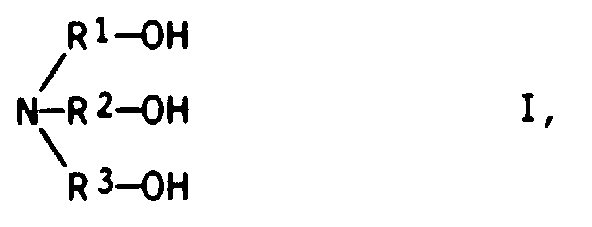
- A) einem Präkondensat aus einem oder mehreren Trialkanolaminen der allgemeinen Formel I
- B) 0,1 bis 30 Gew.-%, bezogen auf das Präkondensat, einer oder mehrerer der folgenden Verbindungen II:
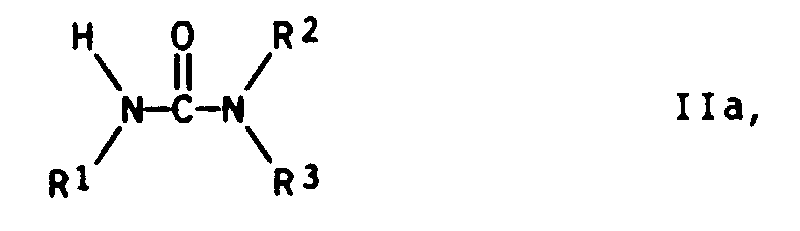
- a) Harnstoff oder einem Harnstoffderivat der allgemeinen Formel IIa
- b) einem Harnstoffderivat der allgemeinen Formel IIb

- R1
- Wasserstoff, eine C1- bis C20-Alkylgruppe oder eine C2- bis C20-Alkenylgruppe,
- R2 und R3
- gleich oder verschieden sein können und Wasserstoff oder eine C1- bis C4-Alkylgruppe,
- R4
- eine C1- bis C12-Alkylengruppe
- a) Harnstoff oder einem Harnstoffderivat der allgemeinen Formel IIa
- Außerdem betrifft die Erfindung ein Verfahren zur Herstellung der Kondensationsprodukte und deren Verwendung als Demulgatoren von Öl-in-Wasser-Emulsionen.
- Bei der Förderung und Weiterverarbeitung von Rohöl fallen in großen Mengen Öl-in-Wasser-Emulsionen an, wobei die kontinuierliche äußere Phase von den Mengenverhältnissen Wasser zu Öl, dem natürlichen, im Öl enthaltenen Emulgatorsystem und der Entstehungsgeschichte der Emulsion abhängt. Bei der Förderung fällt der größte Teil des Rohöls als Wasser-in-Öl-Emulsion an und muß durch Zugabe chemischer Demulgatoren gespalten werden. Das abgetrennte Salzwasser enthält noch gewisse Mengen Restöl, wobei sich bevorzugt Öl-in-Wasser-Emulsionen bilden.
- In noch stärkerem Maße treten Öl-in-Wasser-Emulsionen während der Weiterverarbeitung des Rohöls auf den Feldern und in den Raffinerien auf. Die Menge an emulgiertem Rohöl in den Öl-in-Wasser-Emulsionen kann bis zu 5 % betragen. Zur Abtrennung dieses Restölgehaltes werden spezielle Demulgatoren, sogenannte Deoiler, verwendet, wobei es sich meist um kationische Polymere handelt, wie sie z.B. in DE-34 04 538 beschrieben werden. Typische Produkte werden ebenfalls in den US-Patentschriften 3 528 928, 4 333 947 und 3 893 615 beschrieben.
- Die Abtrennung von Restölmengen ist für die Ölfeldwasserklärung und -aufbereitung aus ökologischen und technischen Gründen notwendig, da beispielsweise bei der Verwendung des Wassers zur Sekundärförderung durch Wasserfluten Restölmengen im Wasser den Einpreßdruck erhöhen würden.
- Aus der US-Patentschrift 2 407 895 ist ein Verfahren zur Spaltung von Öl-in-Wasser-Emulsionen mit vergleichsweise niedermolekularen Kondensaten aus Alkanolaminen, hergestellt durch Kondensation in Gegenwart basischer Katalysatoren bekannt.
- In den US-Patentschriften 4 179 396 und 4 383 933 werden weiter Deoiler aus Aluminiumsalzen oder Titantetrachlorid und Alkanolamin-Kondensaten beschrieben, die gegebenenfalls teilweise acyliert oder quaterniert worden sind.
- Aus den US-Patentschriften 4 505 839 und 4 731 481 sind außerdem quaternierte und niedermolekulare Alkanolamin-Polykondensate als Deoiler bekannt, die durch katalytische Umsetzung mit ZnCl2/Essigsäure oder Al2(SO4)3/Essigsäure erhalten worden sind.
- Weiter werden in den US-Patentschriften 4 404 362 und 4 459 220 Block-Polykondensate, die durch Kondensation von getrennt durch katalytische Umsetzung mit Lewis- oder Mineralsäuren hergestellten Triethanolamin-Polykondensaten und Triisopropanolamin-Polykondensaten erhalten werden, beschrieben.
- Die bekannten Demulgatoren sind jedoch nicht befriedigend.
- Demgemäß wurden die eingangs definierten Kondensationsprodukte gefunden, die an universeller Anwendbarkeit und Spaltgeschwindigkeit den bekannten Deoilern überlegen sind. Sie enthalten keine Metallsalze, insbesondere Chloride, die korrosionsfördernd wirken können. Im Gegensatz zu Deoilern, die durch Kondensation in Gegenwart von Carbonsäuren erhalten worden sind, enthalten die erfindungsgemäßen Demulgatoren keine für die Wirksamkeit nachteiligen Carbonsäureester-Gruppen.
- Bevorzugt und besonders wirksam sind solche Kondensationsprodukte, bei denen als Präkondensate A Trialkanolaminpolyether, erhältlich durch Kondensation von einem oder mehreren Trialkanolaminen der allgemeinen Formel I

- Die für die Herstellung der erfindungsgemäßen Kondensationsprodukte verwendeten Präkondensate A werden zweckmäßig in der Weise hergestellt, daß man die Trialkanolamine I, vorzugsweise Triethanolamin oder Triisopropanolamin N[CH2-CH(CH3)-OH]3, oder Gemische von mehreren Trialkanolaminen, in Gegenwart von sauren Katalysatoren bei erhöhten Temperaturen kondensiert. Als saure Katalysatoren verwendet man vorzugsweise phosphorige Säure (H3PO3) und/oder unterphosphorige Säure (H3PO2). Die sauren Katalysatoren werden, gerechnet als 100 %, zweckmäßig in einer Menge von 0,05 bis 2 Gew.-%, vorzugsweise 0,1 bis 1 Gew.-%, bezogen auf das zu kondensierende Trialkanolamin eingesetzt.
- Im allgemeinen werden Kondensationstemperaturen von 120 bis 280°C, vorzugsweise 150 bis 260°C, insbesondere 180 bis 240°C angewandt. Die Reaktionsdauer beträgt im allgemeinen 1 bis 10 Stunden, vorzugsweise 4 bis 8 Stunden. Zweckmäßig wird die Kondensation durch Variation der Temperatur und/oder Reaktionsdauer in der Weise durchgeführt, daß die Viskosität beim Einsatz von Triethanolamin für den erhaltenen Triethanolaminpolyether im Bereich von 10.000 bis 100.000 mPa·s, vorzugsweise 20.000 bis 50.000 mPa·s liegt, für Triisopropanolaminpolyether im Bereich von 100.000 bis 1.000.000 mPa·s, vorzugsweise 200.000 bis 600.000 mPa·s, liegt und für ein Mischkondensat aus bevorzugt äquimolaren Mengen Triethanolamin und Triisopropanolamin im Bereich von 80.000 bis 400.000 mPa·s, vorzugsweise 100.000 bis 300.000 mPa·s, liegt (jeweils gemessen in unverdünntem Zustand bei 20°C).
- Die erhaltenen Präkondensate A werden mit einer oder mehreren Verbindungen IIa bis IIb zu den erfindungsgemäßen Kondensationsprodukten umgesetzt.
- Als Verbindungen der allgemeinen Formel IIa

- Als Beispiele seien genannt Harnstoffe wie Harnstoff, N-Methylharnstoff, N-Ethylharnstoff, N-Propylharnstoff, N-Butylharnstoff, N,N'-Dimethylharnstoff, N,N'-Diethylharnstoff, N,N'-Dipropylharnstoff, N,N'-Dibutylharnstoff, N-(2-Ethylhexyl)harnstoff, N-iso-Nonylharnstoff, N-iso-Tridecylharnstoff, N-Laurylharnstoff, N-Myristylharnstoff, N-Palmitylharnstoff, N-Stearylharnstoff, N-Oleylharnstoff, N-Linolylharnstoff, N-Linolenylharnstoff. Bevorzugt werden monosubstituierte Harnstoffe, und vor allem unsubstituierter Harnstoff.
- Beispiele für Verbindungen der allgemeinen Formel IIb sind Bisharnstoffe wie Methylendiharnstoff, Ethylen-1,2-diharnstoff, Propylen-1,3-diharnstoff, Butylen-1,4-diharnstoff, Pentamethylen-1,5-diharnstoff, Hexamethylen-1,6-diharnstoff. Bevorzugt werden Bisharnstoffe mit einer Alkylenbrücke R4 mit 1 bis 10 C-Atomen.
- Die Umsetzung eines Präkondensats aus Triethanolamin mit den Verbindungen IIa und IIb erfolgt im allgemeinen bei Temperaturen von 100 bis 210°C, vorzugsweise 140 bis 200°C, zweckmäßig ohne Lösungsmittel bis zu einer Viskosität von im allgemeinen 20.000 bis 300.000 mPa·s, vorzugsweise 28.000 bis 150.000 mPa·s.
- Die Umsetzung eines Präkondensats aus Triisopropanolamin mit den Verbindungen IIa und IIb erfolgt im allgemeinen bei Temperaturen von 100 bis 210°C, vorzugsweise 140 bis 200°C, zweckmäßig ohne Lösungsmittel bis zu einer Viskosität von im allgemeinen mehr als 500.000 mPa·s.
- Die Umsetzung eines Präkondensats aus einem Gemisch von Triethanolamin und Triisopropanolamin, vorzugsweise im molaren Verhältnis 1:1, mit den Verbindungen IIa und IIb erfolgt im allgemeinen bei Temperaturen von 100 bis 210°C, vorzugsweise 140 bis 200°C, zweckmäßig ohne Lösungsmittel bis zu einer Viskosität von im allgemeinen mehr als 300.000 mPa·s.
- Die erfindungsgemäßen Kondensationsprodukte werden den Öl-in-Wasser-Emulsionen zum Brechen der Emulsion zweckmäßig in Mengen von 1 bis 100 Gew.-ppm, vorzugsweise 1 bis 30 Gew.-ppm, insbesondere 2 bis 10 Gew.-ppm, zugesetzt.
- Die in den Synthesebeispielen und dem Anwendungsbeispiel verwendeten Prozentangaben beziehen sich auf das Gewicht, wenn nicht anders angegeben. Die Viskositäten wurden in einem Rotationsviskosimeter (Haake, Rotavisco) bei 20°C gemessen.
- 1788 g Triethanolamin und 12 g unterphosphorige Säure (50%ige wäßrige Lösung) wurden unter Rühren und Durchleiten eines schwachen Stickstoffstroms auf 225 bis 230°C erwärmt. Das bei der Reaktion gebildete Wasser wurde abdestilliert. Nach 7 bis 8 Stunden wurde die Kondensation bei einer Viskosität von 21.000 mPa·s durch Kühlung auf Raumtemperatur abgebrochen. Es wurden 1492 g Triethanolamin-Kondensat erhalten (Aminzahl: 7,69 mmol/g).
- 130 g dieses Triethanolaminpolyethers wurden mit 3,0 g Harnstoff (entsprechend 5 mol-%) unter Rühren und Stickstoff auf 170 bis 180°C erwärmt und bis zur Beendigung der Ammoniakentwicklung 6 Stunden bei dieser Temperatur gehalten. Das so erhaltene Urethan hatte eine Viskosität von 41.000 bis 45.000 mPa·s.
- 260 g eines Triethanolamin-Präkondensats (Aminzahl: 7,69 mmol/g) der Viskosität 19.900, hergestellt wie in Synthesebeispiel 1, und 10,1 g Hexamethylen-1,6-diharnstoff (entsprechend 2,5 mol-%) wurden unter Stickstoff 2 Stunden bei 160°C und danach 4 Stunden bei 180°C bis zur Beendigung der Ammoniakentwicklung gerührt. Die Viskosität des resultierenden Kondensationsproduktes betrug 63.000 mPa·s.
- 131,2 g eines Triethanolamin-Präkondensats (Aminzahl: 7,62 mmol/g) der Viskosität 20.400 mPa·s, hergestellt wie in Synthesebeispiel 1, und 36,3 g iso-Tridecylharnstoff (entsprechend 15 mol-%) wurden unter Stickstoff 1,5 Stunden bei 165°C und anschließend 5 Stunden bei 180°C bis zur Beendigung der Ammoniakentwicklung gerührt. Die Viskosität des Kondensationsproduktes betrug 34.800 mPa·s.
- 670,5 g Triethanolamin und 860,7 g Triisopropanolamin (jeweils 4,5 mol) wurden zusammen mit 9,0 g unterphosphoriger Säure (50%ige wäßrige Lösung) unter Durchleiten eines schwachen Stickstoffstroms bei 220°C gerührt. Das bei der Reaktion gebildete Wasser wurde abdestilliert. Nach 7 bis 8 Stunden wurde die Kondensation bei einer Viskosität von 174.600 mPa·s durch Kühlung auf Raumtemperatur abgebrochen. Man erhielt 1332 g Mischkondensat (Aminzahl: 6,46 mmol/g).
- 309,6 g dieses Mischkondensats wurden mit 6,0 g Harnstoff (entsprechend 5 mol-%) unter Rühren und Stickstoff auf 170 bis 180°C erwärmt und bis zur Beendigung der Ammoniakentwicklung 5 Stunden bei dieser Temperatur gehalten. Das erhaltene Kondensationsprodukt hatte eine Viskosität von 383.000 mPa·s.
- 1530 g Triisopropanolamin und 8,0 g unterphosphorige Säure (50%ige wäßrige Lösung) wurden analog den Synthesebeispielen 1 und 4 unter Rühren und Durchleiten eines schwachen Stickstoffstroms auf 200 bis 225°C erwärmt. Das bei der Reaktion gebildete Wasser wurde abdestilliert. Die Kondensation wurde bei einer Viskosität von 390.000 mPa·s durch Kühlung auf Raumtemperatur abgebrochen.
- 359,6 g dieses Triisopropanolamin-Präkondensats (Aminzahl: 5,56 mmol/g) wurden mit 6,0 g Harnstoff (entsprechend 5 mol-%) unter Rühren und unter Stickstoff auf 170 bis 180°C erwärmt und bis zur Beendigung der Ammoniakentwicklung 5 Stunden bei dieser Temperatur gehalten. Beim Abkühlen auf Raumtemperatur wurde das Kondensationsprodukt fest.
- 1000 mg eines Röhöls wurden in 1 l Wasser mit Hilfe eines Ultra-Turrax-Gerätes bei 10.000 UPM (Umdrehungen pro Minute) dispergiert. Anschließend wurden jeweils 150 ml der erhaltenen Öl-in-Wasser-Emulsion in einen 250-ml-Tropftrichter übergeführt und mit einer 2,5 gew.-%igen Dosierlösung des gemäß Synthesebeispiel 1 erhaltenen Demulgators versetzt. Es wurden Dosierungen des Demulgators von 1, 2,5, 5, und 10 Gew.-ppm., bezogen auf die Öl-in-Wasser-Emulsion, verwendet. Die mit dem Demulgator versetzte Rohölemulsion wurde im Tropftrichter jeweils 50mal kräftig geschüttelt und 10 Minuten absitzen lassen. Danach wurd der Restrohölgehalt in einer unten aus dem Tropftrichter entnommenen Wasserprobe bestimmt. Die Bestimmung erfolgte durch photometrische Bestimmung des Restöls (IR-Absorption) in einem CCl4-Extrakt der entnommenen Wasserprobe (Horiba-Gerät).
- Die Versuchsergebnisse sind in der folgenden Tabelle aufgelistet:
Demulgator Dosierung des Demulgators Restrohölgehalt mit Harnstoff vernetzter Tri- ethanolpolyether gemäß Synthese- beispiel 1 1 Gew.-ppm 112 Gew.-ppm 2,5 " 65 " 5 " 60 " 10 " 58 " Rohölgehalt (Blindwert) der nicht behandelten Emulsion 967 Gew.-ppm - Die erfindungsgemäße Verwendung des Demulgators zeigt besonders gute Ergebnisse bei einer Dosierung im Bereich von 2,5 bis 10 Gew.-ppm.
Claims (3)
- Als Demulgatoren von Öl-in-Wasser-Emulsionen geeignete Kondensationsprodukte ausA) einem Präkondensat aus einem oder mehreren Trialkanolaminen der allgemeinen Formel I
 B) 0,1 bis 30 Gew.-%, bezogen auf das Präkondensat, einer oder mehrerer der folgenden Verbindungen II:a) Harnstoff oder einem Harnstoffderivat der allgemeinen Formel IIa
 b) einem Harnstoffderivat der allgemeinen Formel IIb
 R1 Wasserstoff, eine C1- bis C20-Alkylgruppe oder eine C2- bis C20-Alkenylgruppe,R2 und R3 gleich oder verschieden sein können und Wasserstoff oder eine C1- bis C4-Alkylgruppe undR4 eine C1- bis C12-Alkylengruppebedeuten.
 - Verfahren zur Herstellung der Kondensationsprodukte gemäß Anspruch 1, dadurch gekennzeichnet, daß man ein Präkondensat A aus einem oder mehreren Trialkanolaminen I mit einer oder mehreren Verbindungen B in einer Menge von 0,1 bis 30 Gew.-%, bezogen auf das Präkondensat, umsetzt.
- Verwendung der Kondensationsprodukte gemäß Anspruch 1 oder 2 als Demulgatoren von Öl-in-Wasser-Emulsionen.
Applications Claiming Priority (2)
| Application Number | Priority Date | Filing Date | Title |
|---|---|---|---|
| DE4006255A DE4006255A1 (de) | 1990-02-28 | 1990-02-28 | Als emulgatoren von oel-in-wasser-emulsionen geeignete kondensationsprodukte |
| DE4006255 | 1990-02-28 |
Publications (2)
| Publication Number | Publication Date |
|---|---|
| EP0444515A1 EP0444515A1 (de) | 1991-09-04 |
| EP0444515B1 true EP0444515B1 (de) | 1997-11-26 |
Family
ID=6401121
Family Applications (1)
| Application Number | Title | Priority Date | Filing Date |
|---|---|---|---|
| EP91102446A Expired - Lifetime EP0444515B1 (de) | 1990-02-28 | 1991-02-20 | Als Demulgatoren von Öl-in-Wasser-Emulsionen geeignete Kondensationsprodukte |
Country Status (6)
| Country | Link |
|---|---|
| US (1) | US5234626A (de) |
| EP (1) | EP0444515B1 (de) |
| CA (1) | CA2037208A1 (de) |
| DE (2) | DE4006255A1 (de) |
| DK (1) | DK0444515T3 (de) |
| NO (1) | NO179212C (de) |
Cited By (1)
| Publication number | Priority date | Publication date | Assignee | Title |
|---|---|---|---|---|
| WO2022129368A1 (en) | 2020-12-16 | 2022-06-23 | Basf Se | Alkoxylated polymeric n-(hydroxyalkyl)amine as wetting agents and as a component of defoamer compositions |
Families Citing this family (9)
| Publication number | Priority date | Publication date | Assignee | Title |
|---|---|---|---|---|
| RU2230039C1 (ru) * | 2003-08-05 | 2004-06-10 | Ульяновский государственный технический университет | Способ разложения отработанных эмульсионных смазочно-охлаждающих жидкостей |
| US20050095830A1 (en) * | 2003-10-17 | 2005-05-05 | Applied Materials, Inc. | Selective self-initiating electroless capping of copper with cobalt-containing alloys |
| RU2251566C1 (ru) * | 2004-02-18 | 2005-05-10 | Государственное образовательное учреждение высшего профессионального образования "Ульяновский государственный технический университет" | Способ разложения отработанных эмульсионных смазочно-охлаждающих жидкостей |
| DE102005006030A1 (de) * | 2005-02-09 | 2006-08-10 | Basf Ag | Hyperverzweigte Polymere als Demulgatoren zum Spalten von Rohölemulsionen |
| EP2197941B1 (de) * | 2007-10-09 | 2011-05-25 | Basf Se | Verwendung hochfunktioneller, hochverzweigter polyetheraminpolyole zur beschichtung von oberflächen |
| JP2011503284A (ja) * | 2007-11-09 | 2011-01-27 | ザ プロクター アンド ギャンブル カンパニー | アルコキシル化ポリアルカノールアミンを有する洗浄組成物 |
| ES2567256T3 (es) * | 2007-11-09 | 2016-04-21 | Basf Se | Polialcanolaminas alcoxiladas |
| BRPI0907986A2 (pt) | 2008-03-04 | 2015-08-04 | Basf Se | Uso de polialcanolaminas para quebrar emulsões óleo-água |
| US11274180B2 (en) | 2017-03-09 | 2022-03-15 | Basf Se | Use of hydrophobically modified polyalkanolamines as wax inhibitors, pour point depressant and additive for lubricants |
Citations (2)
| Publication number | Priority date | Publication date | Assignee | Title |
|---|---|---|---|---|
| US2407895A (en) * | 1944-10-05 | 1946-09-17 | Petrolite Corp | Processes for resolving oil-in-water emulsions |
| EP0223064A1 (de) * | 1985-10-22 | 1987-05-27 | BASF Aktiengesellschaft | Verfahren zur Nachbehandlung von Reaktivfärbungen auf Cellulosefasern |
Family Cites Families (17)
| Publication number | Priority date | Publication date | Assignee | Title |
|---|---|---|---|---|
| US3528928A (en) * | 1969-01-13 | 1970-09-15 | Petrolite Corp | Process of breaking oil-in-water emulsions |
| US3897208A (en) * | 1969-06-09 | 1975-07-29 | Ici America Inc | Textile treating compositions, process of treating textiles, and textile articles |
| DE2043086A1 (de) * | 1970-08-31 | 1972-03-30 | Henkel & Cie GmbH, 4000 Dusseldorf | Schwachschaumendes Wasch , Reimgungs und Enthartungsmittel |
| US4179396A (en) * | 1978-02-23 | 1979-12-18 | Nalco Chemical Company | Single addition organic-inorganic blend emulsion breaking composition |
| GB2069481B (en) * | 1980-02-13 | 1983-07-27 | Farmos Oy | Substituted imidazole derivatives |
| US4303780A (en) * | 1980-02-26 | 1981-12-01 | Petrolite Corporation | Ureylenes and uses thereof |
| US4383933A (en) * | 1981-01-30 | 1983-05-17 | Petrolite Corporation | Organo titanium complexes |
| US4505839A (en) * | 1981-05-18 | 1985-03-19 | Petrolite Corporation | Polyalkanolamines |
| US4731481A (en) * | 1981-05-18 | 1988-03-15 | Petrolite Corporation | Polyalkanolamines |
| US4840748A (en) * | 1981-05-18 | 1989-06-20 | Petrolite Corporation | Polyalkanolamines |
| US4778813A (en) * | 1981-07-07 | 1988-10-18 | Buckman Laboratories International, Inc. | Polymeric quaternary ammonium compounds, their preparation and use |
| US4384951A (en) * | 1981-12-02 | 1983-05-24 | Texaco Canada Resources, Ltd. | Demulsification of bitumen emulsions using polyureas |
| US4404362A (en) * | 1981-12-14 | 1983-09-13 | Petrolite Corporation | Block polymers of alkanolamines |
| US4459220A (en) * | 1981-12-14 | 1984-07-10 | Petrolite Corporation | Block polymers of alkanolamines as demulsifiers for O/W emulsions |
| DE3206459A1 (de) * | 1982-02-23 | 1983-09-01 | Hoechst Ag, 6230 Frankfurt | Quaternaere vernetzungsprodukte von xylylendichloriden mit triaethanolaminkondensaten und deren verwendung |
| US4506081A (en) * | 1982-09-02 | 1985-03-19 | Buckman Laboratories, Inc. | Polymeric quaternary ammonium compounds and their uses |
| DE3829974A1 (de) * | 1988-09-03 | 1990-03-15 | Basf Ag | Quaternierte kondensationsprodukte |
-
1990
- 1990-02-28 DE DE4006255A patent/DE4006255A1/de not_active Withdrawn
-
1991
- 1991-02-11 US US07/827,170 patent/US5234626A/en not_active Expired - Lifetime
- 1991-02-20 EP EP91102446A patent/EP0444515B1/de not_active Expired - Lifetime
- 1991-02-20 DE DE59108893T patent/DE59108893D1/de not_active Expired - Lifetime
- 1991-02-20 DK DK91102446.1T patent/DK0444515T3/da active
- 1991-02-27 NO NO910795A patent/NO179212C/no unknown
- 1991-02-27 CA CA002037208A patent/CA2037208A1/en not_active Abandoned
Patent Citations (2)
| Publication number | Priority date | Publication date | Assignee | Title |
|---|---|---|---|---|
| US2407895A (en) * | 1944-10-05 | 1946-09-17 | Petrolite Corp | Processes for resolving oil-in-water emulsions |
| EP0223064A1 (de) * | 1985-10-22 | 1987-05-27 | BASF Aktiengesellschaft | Verfahren zur Nachbehandlung von Reaktivfärbungen auf Cellulosefasern |
Cited By (1)
| Publication number | Priority date | Publication date | Assignee | Title |
|---|---|---|---|---|
| WO2022129368A1 (en) | 2020-12-16 | 2022-06-23 | Basf Se | Alkoxylated polymeric n-(hydroxyalkyl)amine as wetting agents and as a component of defoamer compositions |
Also Published As
| Publication number | Publication date |
|---|---|
| US5234626A (en) | 1993-08-10 |
| NO179212C (no) | 1996-08-28 |
| NO910795L (no) | 1991-08-29 |
| NO910795D0 (no) | 1991-02-27 |
| NO179212B (no) | 1996-05-20 |
| EP0444515A1 (de) | 1991-09-04 |
| DK0444515T3 (da) | 1997-12-29 |
| CA2037208A1 (en) | 1991-08-29 |
| DE4006255A1 (de) | 1991-08-29 |
| DE59108893D1 (de) | 1998-01-08 |
Similar Documents
| Publication | Publication Date | Title |
|---|---|---|
| EP0441198B1 (de) | Verwendung von Trialkanolaminpolyethern als Demulgatoren von Öl-in-Wasser-Emulsionen | |
| DE2227546C3 (de) | Verwendung von oxalkylierten PoIyalkylenpolyaminen zur SchneUentwässening von Rohölen | |
| DE69025404T2 (de) | Zyklische amidokarboxyoberflächenaktive verbindungen, herstellung und deren verwendung | |
| DE2229514B2 (de) | Verfahren zur Förderung von Kondensations- und/oder Äquilibrierungsreaktionen von Organosiliciumverbindungen | |
| DE1543300A1 (de) | N-(sek.-Alkyl)-tert.-Aminverbindungen | |
| EP0074592A2 (de) | Bisamide, Verfahren zu deren Herstellung und deren Verwendung | |
| EP0087147B1 (de) | Quaternäre Vernetzungsprodukte von Xylylendichloriden mit Triäthanolaminkondensaten und deren Verwendung | |
| EP0444515A1 (de) | Als Demulgatoren von Öl-in-Wasser-Emulsionen geeignete Kondensationsprodukte | |
| DE2840112C2 (de) | Wassermischbare Korrosionsschutzmittel und Verfahren zur Verhinderung der Korrosion von Eisenmetallen | |
| EP0209850B1 (de) | Oxalkylierte Polyesteramine,Verfahren zu deren Herstellung und deren Verwendung | |
| EP0065191A1 (de) | Inhibitoren gegen die Korrosion von H2S und CO2 in Wasser-in-Öl-Emulsionen | |
| EP1069147A2 (de) | Korrosionsinhibitoren mit verbesserter Wasserlöslichkeit | |
| DE68918470T2 (de) | Quaternäre Quinoliniumverbindungen. | |
| DE3300866C2 (de) | ||
| DE1695306A1 (de) | Verfahren zur Herstellung von Maleimiden | |
| EP0772602B1 (de) | Verfahren zur herstellung 1,3-disubstituierter imidazolidinone | |
| DE69218448T2 (de) | Verwendung eines triethanolaminproduktgemische | |
| EP0074621A2 (de) | Kationische Ethylenoxid-Propylenoxid- bzw. Ethylenoxid-Butylenoxid-Polymere, Verfahren zu deren Herstellung und deren Verwendung | |
| EP0144738B1 (de) | Bernsteinsäure-mono-dialkylamide als wasserlösliche Korrosionsschutzmittel | |
| DE69602770T2 (de) | Verfahren zur Herstellung von 4,4'-Methylen-bis-(dibutyl-dithiocarbamat) | |
| EP0074077B1 (de) | Bisimidazoline, Verfahren zu deren Herstellung und deren Verwendung | |
| EP0216280B1 (de) | Verwendung von Alkenylbernsteinsäurehalbamiden als Korrosionsschutzmittel | |
| EP0001436B1 (de) | Verfahren zur Herstellung von Polyalkylenpolyaminen | |
| US2568745A (en) | Demulsifying composition and process for breaking an oil-in-water emulsion | |
| DE2725780C2 (de) |
Legal Events
| Date | Code | Title | Description |
|---|---|---|---|
| PUAI | Public reference made under article 153(3) epc to a published international application that has entered the european phase |
Free format text: ORIGINAL CODE: 0009012 |
|
| 17P | Request for examination filed |
Effective date: 19910702 |
|
| AK | Designated contracting states |
Kind code of ref document: A1 Designated state(s): BE DE DK FR GB IT NL |
|
| 17Q | First examination report despatched |
Effective date: 19940429 |
|
| GRAH | Despatch of communication of intention to grant a patent |
Free format text: ORIGINAL CODE: EPIDOS IGRA |
|
| GRAH | Despatch of communication of intention to grant a patent |
Free format text: ORIGINAL CODE: EPIDOS IGRA |
|
| GRAA | (expected) grant |
Free format text: ORIGINAL CODE: 0009210 |
|
| AK | Designated contracting states |
Kind code of ref document: B1 Designated state(s): BE DE DK FR GB IT NL |
|
| REG | Reference to a national code |
Ref country code: DK Ref legal event code: T3 |
|
| GBT | Gb: translation of ep patent filed (gb section 77(6)(a)/1977) |
Effective date: 19971205 |
|
| REF | Corresponds to: |
Ref document number: 59108893 Country of ref document: DE Date of ref document: 19980108 |
|
| ITF | It: translation for a ep patent filed | ||
| ET | Fr: translation filed | ||
| PLBE | No opposition filed within time limit |
Free format text: ORIGINAL CODE: 0009261 |
|
| STAA | Information on the status of an ep patent application or granted ep patent |
Free format text: STATUS: NO OPPOSITION FILED WITHIN TIME LIMIT |
|
| 26N | No opposition filed | ||
| PGFP | Annual fee paid to national office [announced via postgrant information from national office to epo] |
Ref country code: FR Payment date: 19990128 Year of fee payment: 9 |
|
| PGFP | Annual fee paid to national office [announced via postgrant information from national office to epo] |
Ref country code: DK Payment date: 19990202 Year of fee payment: 9 |
|
| PGFP | Annual fee paid to national office [announced via postgrant information from national office to epo] |
Ref country code: GB Payment date: 19990216 Year of fee payment: 9 |
|
| PGFP | Annual fee paid to national office [announced via postgrant information from national office to epo] |
Ref country code: NL Payment date: 19990218 Year of fee payment: 9 |
|
| PGFP | Annual fee paid to national office [announced via postgrant information from national office to epo] |
Ref country code: BE Payment date: 19990224 Year of fee payment: 9 |
|
| PGFP | Annual fee paid to national office [announced via postgrant information from national office to epo] |
Ref country code: DE Payment date: 19990225 Year of fee payment: 9 |
|
| PG25 | Lapsed in a contracting state [announced via postgrant information from national office to epo] |
Ref country code: DE Free format text: LAPSE BECAUSE OF THE APPLICANT RENOUNCES Effective date: 19991223 |
|
| PG25 | Lapsed in a contracting state [announced via postgrant information from national office to epo] |
Ref country code: GB Free format text: LAPSE BECAUSE OF NON-PAYMENT OF DUE FEES Effective date: 20000220 Ref country code: DK Free format text: LAPSE BECAUSE OF NON-PAYMENT OF DUE FEES Effective date: 20000220 |
|
| PG25 | Lapsed in a contracting state [announced via postgrant information from national office to epo] |
Ref country code: BE Free format text: LAPSE BECAUSE OF NON-PAYMENT OF DUE FEES Effective date: 20000228 |
|
| BERE | Be: lapsed |
Owner name: BASF A.G. Effective date: 20000228 |
|
| PG25 | Lapsed in a contracting state [announced via postgrant information from national office to epo] |
Ref country code: NL Free format text: LAPSE BECAUSE OF NON-PAYMENT OF DUE FEES Effective date: 20000901 |
|
| GBPC | Gb: european patent ceased through non-payment of renewal fee |
Effective date: 20000220 |
|
| PG25 | Lapsed in a contracting state [announced via postgrant information from national office to epo] |
Ref country code: FR Free format text: LAPSE BECAUSE OF NON-PAYMENT OF DUE FEES Effective date: 20001031 |
|
| NLV4 | Nl: lapsed or anulled due to non-payment of the annual fee |
Effective date: 20000901 |
|
| REG | Reference to a national code |
Ref country code: DK Ref legal event code: EBP |
|
| REG | Reference to a national code |
Ref country code: FR Ref legal event code: ST |
|
| PG25 | Lapsed in a contracting state [announced via postgrant information from national office to epo] |
Ref country code: IT Free format text: LAPSE BECAUSE OF NON-PAYMENT OF DUE FEES;WARNING: LAPSES OF ITALIAN PATENTS WITH EFFECTIVE DATE BEFORE 2007 MAY HAVE OCCURRED AT ANY TIME BEFORE 2007. THE CORRECT EFFECTIVE DATE MAY BE DIFFERENT FROM THE ONE RECORDED. Effective date: 20050220 |