EP1069147A2 - Korrosionsinhibitoren mit verbesserter Wasserlöslichkeit - Google Patents
Korrosionsinhibitoren mit verbesserter Wasserlöslichkeit Download PDFInfo
- Publication number
- EP1069147A2 EP1069147A2 EP00112733A EP00112733A EP1069147A2 EP 1069147 A2 EP1069147 A2 EP 1069147A2 EP 00112733 A EP00112733 A EP 00112733A EP 00112733 A EP00112733 A EP 00112733A EP 1069147 A2 EP1069147 A2 EP 1069147A2
- Authority
- EP
- European Patent Office
- Prior art keywords
- oder
- eine
- free
- und
- group
- Prior art date
- Legal status (The legal status is an assumption and is not a legal conclusion. Google has not performed a legal analysis and makes no representation as to the accuracy of the status listed.)
- Granted
Links
Classifications
-
- C—CHEMISTRY; METALLURGY
- C08—ORGANIC MACROMOLECULAR COMPOUNDS; THEIR PREPARATION OR CHEMICAL WORKING-UP; COMPOSITIONS BASED THEREON
- C08G—MACROMOLECULAR COMPOUNDS OBTAINED OTHERWISE THAN BY REACTIONS ONLY INVOLVING UNSATURATED CARBON-TO-CARBON BONDS
- C08G65/00—Macromolecular compounds obtained by reactions forming an ether link in the main chain of the macromolecule
- C08G65/02—Macromolecular compounds obtained by reactions forming an ether link in the main chain of the macromolecule from cyclic ethers by opening of the heterocyclic ring
- C08G65/32—Polymers modified by chemical after-treatment
- C08G65/321—Polymers modified by chemical after-treatment with inorganic compounds
- C08G65/324—Polymers modified by chemical after-treatment with inorganic compounds containing oxygen
-
- C—CHEMISTRY; METALLURGY
- C08—ORGANIC MACROMOLECULAR COMPOUNDS; THEIR PREPARATION OR CHEMICAL WORKING-UP; COMPOSITIONS BASED THEREON
- C08G—MACROMOLECULAR COMPOUNDS OBTAINED OTHERWISE THAN BY REACTIONS ONLY INVOLVING UNSATURATED CARBON-TO-CARBON BONDS
- C08G65/00—Macromolecular compounds obtained by reactions forming an ether link in the main chain of the macromolecule
- C08G65/02—Macromolecular compounds obtained by reactions forming an ether link in the main chain of the macromolecule from cyclic ethers by opening of the heterocyclic ring
- C08G65/26—Macromolecular compounds obtained by reactions forming an ether link in the main chain of the macromolecule from cyclic ethers by opening of the heterocyclic ring from cyclic ethers and other compounds
- C08G65/2603—Macromolecular compounds obtained by reactions forming an ether link in the main chain of the macromolecule from cyclic ethers by opening of the heterocyclic ring from cyclic ethers and other compounds the other compounds containing oxygen
- C08G65/2606—Macromolecular compounds obtained by reactions forming an ether link in the main chain of the macromolecule from cyclic ethers by opening of the heterocyclic ring from cyclic ethers and other compounds the other compounds containing oxygen containing hydroxyl groups
- C08G65/2609—Macromolecular compounds obtained by reactions forming an ether link in the main chain of the macromolecule from cyclic ethers by opening of the heterocyclic ring from cyclic ethers and other compounds the other compounds containing oxygen containing hydroxyl groups containing aliphatic hydroxyl groups
-
- C—CHEMISTRY; METALLURGY
- C08—ORGANIC MACROMOLECULAR COMPOUNDS; THEIR PREPARATION OR CHEMICAL WORKING-UP; COMPOSITIONS BASED THEREON
- C08G—MACROMOLECULAR COMPOUNDS OBTAINED OTHERWISE THAN BY REACTIONS ONLY INVOLVING UNSATURATED CARBON-TO-CARBON BONDS
- C08G65/00—Macromolecular compounds obtained by reactions forming an ether link in the main chain of the macromolecule
- C08G65/02—Macromolecular compounds obtained by reactions forming an ether link in the main chain of the macromolecule from cyclic ethers by opening of the heterocyclic ring
- C08G65/32—Polymers modified by chemical after-treatment
- C08G65/329—Polymers modified by chemical after-treatment with organic compounds
- C08G65/333—Polymers modified by chemical after-treatment with organic compounds containing nitrogen
- C08G65/33303—Polymers modified by chemical after-treatment with organic compounds containing nitrogen containing amino group
-
- C—CHEMISTRY; METALLURGY
- C08—ORGANIC MACROMOLECULAR COMPOUNDS; THEIR PREPARATION OR CHEMICAL WORKING-UP; COMPOSITIONS BASED THEREON
- C08G—MACROMOLECULAR COMPOUNDS OBTAINED OTHERWISE THAN BY REACTIONS ONLY INVOLVING UNSATURATED CARBON-TO-CARBON BONDS
- C08G65/00—Macromolecular compounds obtained by reactions forming an ether link in the main chain of the macromolecule
- C08G65/02—Macromolecular compounds obtained by reactions forming an ether link in the main chain of the macromolecule from cyclic ethers by opening of the heterocyclic ring
- C08G65/32—Polymers modified by chemical after-treatment
- C08G65/329—Polymers modified by chemical after-treatment with organic compounds
- C08G65/333—Polymers modified by chemical after-treatment with organic compounds containing nitrogen
- C08G65/33303—Polymers modified by chemical after-treatment with organic compounds containing nitrogen containing amino group
- C08G65/33317—Polymers modified by chemical after-treatment with organic compounds containing nitrogen containing amino group heterocyclic
-
- C—CHEMISTRY; METALLURGY
- C23—COATING METALLIC MATERIAL; COATING MATERIAL WITH METALLIC MATERIAL; CHEMICAL SURFACE TREATMENT; DIFFUSION TREATMENT OF METALLIC MATERIAL; COATING BY VACUUM EVAPORATION, BY SPUTTERING, BY ION IMPLANTATION OR BY CHEMICAL VAPOUR DEPOSITION, IN GENERAL; INHIBITING CORROSION OF METALLIC MATERIAL OR INCRUSTATION IN GENERAL
- C23F—NON-MECHANICAL REMOVAL OF METALLIC MATERIAL FROM SURFACE; INHIBITING CORROSION OF METALLIC MATERIAL OR INCRUSTATION IN GENERAL; MULTI-STEP PROCESSES FOR SURFACE TREATMENT OF METALLIC MATERIAL INVOLVING AT LEAST ONE PROCESS PROVIDED FOR IN CLASS C23 AND AT LEAST ONE PROCESS COVERED BY SUBCLASS C21D OR C22F OR CLASS C25
- C23F11/00—Inhibiting corrosion of metallic material by applying inhibitors to the surface in danger of corrosion or adding them to the corrosive agent
- C23F11/08—Inhibiting corrosion of metallic material by applying inhibitors to the surface in danger of corrosion or adding them to the corrosive agent in other liquids
- C23F11/10—Inhibiting corrosion of metallic material by applying inhibitors to the surface in danger of corrosion or adding them to the corrosive agent in other liquids using organic inhibitors
- C23F11/14—Nitrogen-containing compounds
- C23F11/145—Amides; N-substituted amides
-
- C—CHEMISTRY; METALLURGY
- C23—COATING METALLIC MATERIAL; COATING MATERIAL WITH METALLIC MATERIAL; CHEMICAL SURFACE TREATMENT; DIFFUSION TREATMENT OF METALLIC MATERIAL; COATING BY VACUUM EVAPORATION, BY SPUTTERING, BY ION IMPLANTATION OR BY CHEMICAL VAPOUR DEPOSITION, IN GENERAL; INHIBITING CORROSION OF METALLIC MATERIAL OR INCRUSTATION IN GENERAL
- C23F—NON-MECHANICAL REMOVAL OF METALLIC MATERIAL FROM SURFACE; INHIBITING CORROSION OF METALLIC MATERIAL OR INCRUSTATION IN GENERAL; MULTI-STEP PROCESSES FOR SURFACE TREATMENT OF METALLIC MATERIAL INVOLVING AT LEAST ONE PROCESS PROVIDED FOR IN CLASS C23 AND AT LEAST ONE PROCESS COVERED BY SUBCLASS C21D OR C22F OR CLASS C25
- C23F11/00—Inhibiting corrosion of metallic material by applying inhibitors to the surface in danger of corrosion or adding them to the corrosive agent
- C23F11/08—Inhibiting corrosion of metallic material by applying inhibitors to the surface in danger of corrosion or adding them to the corrosive agent in other liquids
- C23F11/10—Inhibiting corrosion of metallic material by applying inhibitors to the surface in danger of corrosion or adding them to the corrosive agent in other liquids using organic inhibitors
- C23F11/14—Nitrogen-containing compounds
- C23F11/149—Heterocyclic compounds containing nitrogen as hetero atom
-
- C—CHEMISTRY; METALLURGY
- C23—COATING METALLIC MATERIAL; COATING MATERIAL WITH METALLIC MATERIAL; CHEMICAL SURFACE TREATMENT; DIFFUSION TREATMENT OF METALLIC MATERIAL; COATING BY VACUUM EVAPORATION, BY SPUTTERING, BY ION IMPLANTATION OR BY CHEMICAL VAPOUR DEPOSITION, IN GENERAL; INHIBITING CORROSION OF METALLIC MATERIAL OR INCRUSTATION IN GENERAL
- C23F—NON-MECHANICAL REMOVAL OF METALLIC MATERIAL FROM SURFACE; INHIBITING CORROSION OF METALLIC MATERIAL OR INCRUSTATION IN GENERAL; MULTI-STEP PROCESSES FOR SURFACE TREATMENT OF METALLIC MATERIAL INVOLVING AT LEAST ONE PROCESS PROVIDED FOR IN CLASS C23 AND AT LEAST ONE PROCESS COVERED BY SUBCLASS C21D OR C22F OR CLASS C25
- C23F11/00—Inhibiting corrosion of metallic material by applying inhibitors to the surface in danger of corrosion or adding them to the corrosive agent
- C23F11/08—Inhibiting corrosion of metallic material by applying inhibitors to the surface in danger of corrosion or adding them to the corrosive agent in other liquids
- C23F11/10—Inhibiting corrosion of metallic material by applying inhibitors to the surface in danger of corrosion or adding them to the corrosive agent in other liquids using organic inhibitors
- C23F11/173—Macromolecular compounds
Definitions
- the present invention relates to an additive and a method for Corrosion inhibition in facilities for conveying and transporting Hydrocarbons in oil production and processing.
- FR-A-2 407 258 describes amides of carboxymethylated oligomeric polyethylene glycol monoalkyl ethers of the structure RO (CH 2 CH 2 O) n CH 2 CONR 1 R 2 , where R is an aliphatic radical with 8-20 carbon atoms or one with a C 8 -C 12 - Alkyl radical is substituted phenyl radical and R 1 and R 2 are hydrogen or alkyl radicals with at least 3 carbon atoms and their use as a corrosion protection agent, detergent additive or anti-pollution additive for fuels.
- these amides no longer have any free amino functions and are less effective than the products according to the invention.
- the object of the present invention was to find anticorrosive agents which good or improved corrosion protection also improved water solubility compared to the anti-corrosion agents of the prior art.
- amidamines / imidazolines show the are obtainable from the reaction of polyglycol ether carboxylic acids with polyamines, these properties.
- Another object of the invention is the use of those defined Compounds as a corrosion inhibitor.
- R 1 denotes a C 8 -C 24 , in particular a C 12 -C 18 alkyl or alkenyl radical. If R 1 stands for an aromatic radical, then a phenyl radical with alkyl substitution between 4 and 12 carbon atoms is preferred.
- A preferably represents an ethylene or propylene radical, in particular one Ethylene residue.
- X preferably denotes a number from 1 to 30, in particular 2 to 15.
- Y is preferably 1 or 2, preferably 1.
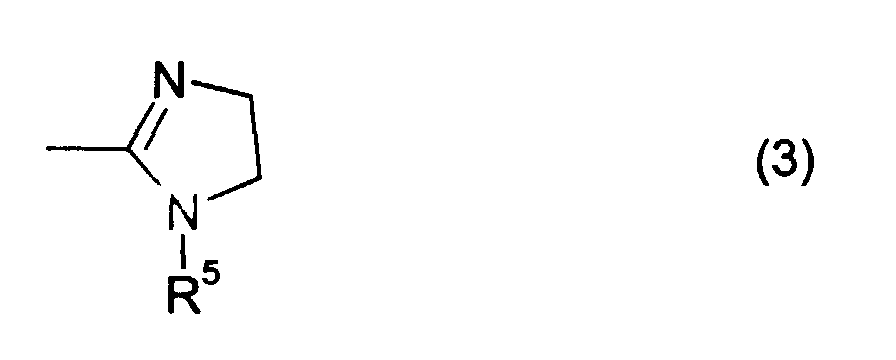
- the substituent R 2 must have a free primary or secondary amino group. In one embodiment, this can be done by one of the substituents R 3 , R 4 or R 5 being hydrogen. If R 2 stands for formula 2, then R 3 and R 4 cannot simultaneously represent hydrogen. If R 2 stands for formula 3, then R 5 can denote hydrogen.
- the radicals R 3 / R 4 or R 5 can represent hydrocarbon chains which contain at least one free primary or secondary amino group.
- the hydrocarbon chains mentioned comprise 1 to 10 primary and / or secondary amino groups.
- the hydrocarbon chains also preferably contain 1 to 30, in particular 1 to 20, carbon atoms.
- the hydrocarbon chains can contain further heteroatoms. If they contain further heteroatoms, oxygen is preferred.
- the compounds according to the invention as defined above can be prepared by condensation from ether carboxylic acids of the structure R 1 -O (AO) x - (CH 2 ) y -COOH with polyamines with at least one primary or secondary amino function.
- the underlying ether carboxylic acids can be prepared in known ways either by reacting a C 4 -C 30 alcohol or alkylphenol reacted with ethylene oxide and / or propylene oxide, preferably with ethylene oxide and then oxidizing the terminal CH 2 OH function to give the carboxylic acid or by alkylation with chloroacetic acid derivatives according to Williamson's Ether synthesis can be made.
- Suitable basic alcohols are C 4 -C 30 fatty alcohols such as butanol, isobutanol, pentanol, hexanol, n-octanol, dodecanol, tetradecanol, hexadecanol, octadecanol and fatty alcohol cuts of natural or synthetic origin such as oleyl alcohol, stearyl alcohol, behenyl alcohol and oxo alcohols of various chain lengths.
- Branched alcohols such as 2-ethylhexanol, isononyl alcohol, isodecanol, isotridecanol or isooctadecanol and alkylphenols with a C 1 -C 12 -alkyl radical such as nonylphenol are also suitable.
- alkylene oxides such as ethylene oxide, propylene oxide or Butylene oxide or mixtures thereof converted to the corresponding glycol ether, ethylene oxide is particularly preferred.
- the products are preferred with 1-30 mol Alkylene oxide, preferably 2-15 mol of alkylene oxide.
- the ether carboxylic acid can pass through from these alkylene glycol monoalkyl ethers Oxidation with atmospheric oxygen in the presence of catalysts or through Oxidation with hypochlorite or chlorite with or without catalysts produced become.
- the alkylation of the glycol ethers with is particularly preferred Chloroacetic acid derivatives, preferably with sodium chloroacetate and sodium hydroxide solution the Williamson method.
- the free carboxylic acid is made from the alkaline Alkylation mixture by acidification with mineral acid (hydrochloric, sulfuric acid) and Heat above the cloud point and separate the organic phase.
- the amides or imidazolines according to the invention are made from these Ether carboxylic acids by heating with polyamines and distilling off water manufactured.
- the molar ratio between ether carboxylic acid and polyamine is chosen so that not all available nitrogen atoms are converted into amides, so that free amino groups are retained in the end product.
- Suitable amines are alkylamines with a minimum of 2 and a maximum of approx. 10 Nitrogen atoms. Examples include ethylenediamine, 2-aminoethylethanolamine, Propylene diamine, diethylene triamine, dipropylene triamine, triethylene tetramine, Tetraethylene pentamine, pentaethylene hexamine and technical sections of these amines. Cyclic polyamines such as aminoethylpiperazine, piperazine or Bis (aminoethyl) piperazine or 3-morpholinopropylamine are suitable.
- the condensation of ether carboxylic acid and polyamine can be with and without Catalysts are carried out, the reaction temperature here is Temperature range from 100-220 ° C, preferably between 140-200 ° C.
- the reaction water can be separated off by applying a vacuum (up to approx. 1 mbar). This is particularly necessary if you have high levels of imidazoline in the Wants to reach the end product.
- the products according to the invention then fall as yellowish to brown, clear oils.
- the products according to the invention can be used alone or in combination with others known corrosion inhibitors are used. In general you get so much use the corrosion inhibitor according to the invention that one under given adequate protection against corrosion under the given conditions. Typical Use concentrations based on 100% active substance are 5-100 ppm, preferably 10-30 ppm. Also particularly suitable as corrosion inhibitors Mixtures of the products according to the invention with other known from the literature Corrosion inhibitors, such as amidamines and / or imidazolines from fatty acids and Polyamines and their salts, quaternary ammonium salts, oxethylated / oxpropylated amines, amphoglycinates and propionates or Betain.
- Corrosion inhibitors such as amidamines and / or imidazolines from fatty acids and Polyamines and their salts, quaternary ammonium salts, oxethylated / oxpropylated amines, amphoglycinates and propionates or Betain.
- Vacuum was applied and a further 88.8 g of an amine / water mixture were obtained as distillate at 22 mbar within 2 h. After cooling, the remaining dark oil was filtered. 498.8 g of a brown, clear oil with an acid number of 2.9 mg KOH / g, base nitrogen 2.09% and a viscosity of 243 mPas at 20 ° C. were obtained.
Landscapes
- Chemical & Material Sciences (AREA)
- Organic Chemistry (AREA)
- Polymers & Plastics (AREA)
- Health & Medical Sciences (AREA)
- Chemical Kinetics & Catalysis (AREA)
- Medicinal Chemistry (AREA)
- Engineering & Computer Science (AREA)
- General Chemical & Material Sciences (AREA)
- Materials Engineering (AREA)
- Mechanical Engineering (AREA)
- Metallurgy (AREA)
- Inorganic Chemistry (AREA)
- Lubricants (AREA)
- Preventing Corrosion Or Incrustation Of Metals (AREA)
- Organic Low-Molecular-Weight Compounds And Preparation Thereof (AREA)
- Anti-Oxidant Or Stabilizer Compositions (AREA)
Abstract
- R1
- verzweigtes oder unverzweigtes C4-C30-Alkyl, -Alkenyl oder -Alkylaryl,
- A
- C2-C4-Alkylen,
- x
- eine ganze Zahl von 1 bis 100,
- y
- 1, 2, 3 oder 4,
- R2
- ein Rest ausgewählt aus Strukturen der Formeln 2 und 3
Description
- R1
- verzweigtes oder unverzweigtes C4-C30-Alkyl, -Alkenyl oder -Alkylaryl,
- A
- C2-C4-Alkylen,
- x
- eine ganze Zahl von 1 bis 100,
- y
- 1, 2, 3 oder 4,
- R2
- ein Rest ausgewählt aus Strukturen der Formeln 2 und 3

| Beispiel | Schutz |
| 1 | 81-84 |
| 2 | 82-85 |
| 3 | 81-83 |
| 4 | 82-85 |
| 5 | 80-82 |
| 6 | 84-87 |
| 7 | 86-88 |
| Beispiel | Schutz nach | ||
| 10 min | 30 min | 60 min | |
| 1 | 4,6 | 67,8 | 93,1 |
| 2 | 31,4 | 70,6 | 84,3 |
| 3 | 78,2 | 87,4 | 90,8 |
| 83,7 | 90,1 | 92,4 | |
| 4 | 83,9 | 93,8 | 96,3 |
| 76,2 | 91,3 | 94,6 | |
| 5 | 86,1 | 92,6 | 94,8 |
| 85,4 | 91,3 | 94,1 | |
| 6 | 85,1 | 92,1 | 94,1 |
| 90,9 | 95,3 | 96,2 | |
| 7 | 81,3 | 86,5 | 90,8 |
Claims (6)
- Verbindungen der Formel 1
- R1
- verzweigtes oder unverzweigtes C4-C30-Alkyl, -Alkenyl oder -Alkylaryl,
- A
- C2-C4-Alkylen,
- x
- eine ganze Zahl von 1 bis 100,
- y
- 1, 2, 3 oder 4,
- R2
- ein Rest ausgewählt aus Strukturen der Formeln 2 und 3
worin einer der Reste R3 und R4 eine Kohlenwasserstoffkette bedeutet, welche wenigstens eine freie NH- oder NH2-Gruppe aufweist, und der andere Rest Wasserstoff oder eine Kohlenwasserstoffkette bedeutet, welche wenigstens eine freie NH- oder NH2-Gruppe aufweist und R5 Wasserstoff oder eine Kohlenwasserstoffkette bedeutet, welche wenigstens eine freie NH- oder NH2-Gruppe aufweist.
- Verbindungen gemäß Anspruch 1, worin A für eine Ethylen- oder Propylenrest steht.
- Verbindungen gemäß Anspruch 1 und/oder 2, worin X für eine ganze Zahl von 1 bis 30 steht.
- Verbindungen gemäß einem oder mehreren der Ansprüche 1 bis 3, worin R1 für einen C12-C18-Alkyl- oder Alkenylrest steht.
- Verbindungen gemäß einem oder mehreren der Ansprüche 1 bis 4, worin y für 1 steht.
- Verwendung von Verbindungen gemäß Anspruch 1 bis 5 als Korrosionsinhibitoren.
Applications Claiming Priority (2)
| Application Number | Priority Date | Filing Date | Title |
|---|---|---|---|
| DE19930683A DE19930683B4 (de) | 1999-07-02 | 1999-07-02 | Korrosionsinhibitoren mit verbesserter Wasserlöslichkeit |
| DE19930683 | 1999-07-02 |
Publications (3)
| Publication Number | Publication Date |
|---|---|
| EP1069147A2 true EP1069147A2 (de) | 2001-01-17 |
| EP1069147A3 EP1069147A3 (de) | 2003-08-13 |
| EP1069147B1 EP1069147B1 (de) | 2006-03-08 |
Family
ID=7913519
Family Applications (1)
| Application Number | Title | Priority Date | Filing Date |
|---|---|---|---|
| EP00112733A Expired - Lifetime EP1069147B1 (de) | 1999-07-02 | 2000-06-16 | Korrosionsinhibitoren mit verbesserter Wasserlöslichkeit |
Country Status (4)
| Country | Link |
|---|---|
| US (1) | US6372918B1 (de) |
| EP (1) | EP1069147B1 (de) |
| DE (2) | DE19930683B4 (de) |
| NO (1) | NO325406B1 (de) |
Cited By (1)
| Publication number | Priority date | Publication date | Assignee | Title |
|---|---|---|---|---|
| EP1449940A1 (de) * | 2003-02-24 | 2004-08-25 | Clariant GmbH | Korrosions- und Gashydratinhibitoren mit verbesserter Wasserlöslichkeit und erhöhter biologischer Abbaubarkeit |
Families Citing this family (13)
| Publication number | Priority date | Publication date | Assignee | Title |
|---|---|---|---|---|
| DE10123210C1 (de) * | 2001-05-12 | 2002-10-02 | Clariant Gmbh | Ethercarbonsäuren auf Basis von alkoxylierter Mercaptobenzthiazole |
| DE10134226A1 (de) | 2001-07-13 | 2003-02-06 | Clariant Gmbh | Korrosionsinhibitoren mit verbesserter Wasserlöslichkeit und erhöhter Filmpersistenz |
| DE10307728B4 (de) | 2003-02-24 | 2005-09-22 | Clariant Gmbh | Korrosions-und Gashydratinhibitoren mit verbesserter Wasserlöslichkeit und erhöhter biologischer Abbaubarkeit und derartige Verbindungen |
| DE10307730B3 (de) | 2003-02-24 | 2004-11-11 | Clariant Gmbh | Verwendung von Verbindungen als Korrosions- und Gashydratinhibitoren mit verbesserter Wasserlöslichkeit und erhöhter biologischer Abbaubarkeit und diese Verbindungen |
| DE10307725B4 (de) | 2003-02-24 | 2007-04-19 | Clariant Produkte (Deutschland) Gmbh | Korrosions-und Gashydratinhibitoren mit verbesserter Wasserlöslichkeit und erhöhter biologischer Abbaubarkeit |
| US20050227007A1 (en) * | 2004-04-08 | 2005-10-13 | Bradley Alexander Z | Volatile copper(I) complexes for deposition of copper films by atomic layer deposition |
| DE102004048778B3 (de) | 2004-10-07 | 2006-06-22 | Clariant Gmbh | Korrosions-und Gashydratinhibitoren mit erhöhter biologischer Abbaubarkeit und verminderter Toxizität |
| US20080269348A1 (en) * | 2006-11-07 | 2008-10-30 | Phil Skolnick | Novel Arylbicyclo[3.1.0]Hexylamines And Methods And Compositions For Their Preparation And Use |
| DE102007041217B3 (de) * | 2007-08-31 | 2009-04-30 | Clariant International Limited | Verwendung von Zusammensetzungen als Korrosionsinhibitoren enthaltend amphotere Tenside und die Zusammensetzungen |
| DE102007041204B3 (de) * | 2007-08-31 | 2009-04-30 | Clariant International Limited | Verwendung von Zusammensetzung als Korrosionsinhibitoren enthaltend anionische Tenside und die Zusammensetzungen |
| DE102007041215B3 (de) * | 2007-08-31 | 2009-04-30 | Clariant International Limited | Verwendung von Zusammensetzungen als Korrosionsinhibitoren enthaltend nichtionische Tenside und die Zusammensetzungen |
| DE102007041216B3 (de) * | 2007-08-31 | 2009-04-30 | Clariant International Limited | Verwendung von Zusammensetzungen als Korrosionsinhibitoren enthaltend kationische Tenside und die Zusammensetzungen |
| WO2023183460A1 (en) | 2022-03-22 | 2023-09-28 | Innospec Fuel Specialities Llc | Compositions, methods and uses |
Family Cites Families (10)
| Publication number | Priority date | Publication date | Assignee | Title |
|---|---|---|---|---|
| USRE23227E (en) * | 1950-05-09 | Processes fob preventing corrosion | ||
| US2211001A (en) * | 1937-03-18 | 1940-08-13 | Gen Aniline & Film Corp | Oxalkyl derivatives of imidazolines |
| US2267965A (en) * | 1939-07-18 | 1941-12-30 | Carbide & Carbon Chem Corp | Hydroxyalkyl glyoxalidines |
| US2695884A (en) * | 1952-04-10 | 1954-11-30 | Petrolite Corp | Process for breaking petroleum emulsions |
| US2917376A (en) * | 1955-08-03 | 1959-12-15 | Petrolite Corp | Fuel oil composition |
| US4044034A (en) * | 1975-07-22 | 1977-08-23 | The Miranol Chemical Company, Inc. | Nitrogenous condensation products |
| FR2407258A1 (fr) * | 1977-10-26 | 1979-05-25 | Rhone Poulenc Ind | Nouvelles compositions de carburants contenant au moins un amide d'un acide alkylpolyglycol-carboxylique derive d'alcools en c8-c20 polyoxyethyles |
| US4144034A (en) * | 1978-03-27 | 1979-03-13 | Texaco Inc. | Polyether-maleic anhydride reaction product containing motor fuel composition |
| US5154841A (en) * | 1988-12-21 | 1992-10-13 | The Procter & Gamble Company | Process for preparing substituted imidazoline fabric conditioning compounds |
| US5393464A (en) * | 1993-11-02 | 1995-02-28 | Martin; Richard L. | Biodegradable corrosion inhibitors of low toxicity |
-
1999
- 1999-07-02 DE DE19930683A patent/DE19930683B4/de not_active Expired - Fee Related
-
2000
- 2000-06-16 EP EP00112733A patent/EP1069147B1/de not_active Expired - Lifetime
- 2000-06-16 DE DE50012336T patent/DE50012336D1/de not_active Expired - Fee Related
- 2000-06-30 NO NO20003419A patent/NO325406B1/no not_active IP Right Cessation
- 2000-06-30 US US09/607,819 patent/US6372918B1/en not_active Expired - Fee Related
Cited By (1)
| Publication number | Priority date | Publication date | Assignee | Title |
|---|---|---|---|---|
| EP1449940A1 (de) * | 2003-02-24 | 2004-08-25 | Clariant GmbH | Korrosions- und Gashydratinhibitoren mit verbesserter Wasserlöslichkeit und erhöhter biologischer Abbaubarkeit |
Also Published As
| Publication number | Publication date |
|---|---|
| EP1069147A3 (de) | 2003-08-13 |
| DE19930683B4 (de) | 2005-02-10 |
| DE19930683A1 (de) | 2001-01-18 |
| NO20003419D0 (no) | 2000-06-30 |
| US6372918B1 (en) | 2002-04-16 |
| NO325406B1 (no) | 2008-04-21 |
| NO20003419L (no) | 2001-01-03 |
| DE50012336D1 (de) | 2006-05-04 |
| EP1069147B1 (de) | 2006-03-08 |
Similar Documents
| Publication | Publication Date | Title |
|---|---|---|
| EP1069147B1 (de) | Korrosionsinhibitoren mit verbesserter Wasserlöslichkeit | |
| DE69411499T2 (de) | Biologisch abbaubare Korrosionsinhibitoren mit niedriger Toxizität | |
| EP1979508B1 (de) | Korrosionsinhibitoren mit erhöhter biologischer abbaubarkeit und verminderter toxizität | |
| EP2031092A2 (de) | Amphotere Tenside enthaltende Korrosionsinhibitoren | |
| EP1412555B1 (de) | Korrosionsinhibitoren mit verbesserter wasserlöslichkeit und erhöhter filmpersistenz | |
| DE3411846A1 (de) | Korrosionsinhibitor-loesung und ihre anwendung | |
| DE10307728A1 (de) | Korrosions-und Gashydratinhibitoren mit verbesserter Wasserlöslichkeit und erhöhter biologischer Abbaubarkeit | |
| DE3144013A1 (de) | "arbeitsfluessigkeit" | |
| DE10307730B3 (de) | Verwendung von Verbindungen als Korrosions- und Gashydratinhibitoren mit verbesserter Wasserlöslichkeit und erhöhter biologischer Abbaubarkeit und diese Verbindungen | |
| EP0320769A2 (de) | Gegebenenfalls quaternierte Fettsäureester von oxyalkylierten Alkyl-alkylendiaminen | |
| DE69225023T2 (de) | Amin-Addukte als Korrosionsinhibitoren | |
| EP0212265A1 (de) | Quaternäre oxalkylierte Polykondensate, Verfahren zu deren Herstellung und deren Verwendung | |
| DE102004048778B3 (de) | Korrosions-und Gashydratinhibitoren mit erhöhter biologischer Abbaubarkeit und verminderter Toxizität | |
| EP2828419B1 (de) | Wässrige oberflächenaktive und korrosionsschützende zubereitung sowie ölhaltiges, wassermischbares emulsionskonzentrat für die behandlung von metalloberflächen | |
| DE102007041204B3 (de) | Verwendung von Zusammensetzung als Korrosionsinhibitoren enthaltend anionische Tenside und die Zusammensetzungen | |
| EP0269887A2 (de) | Verzweigte, quaternäre Polyoxalkylenmischpolyester, Verfahren zu ihrer Herstellung und ihre Verwendung | |
| EP0332897A2 (de) | Reaktionsprodukte aus Borsäure und Alkanoletheraminen und deren Verwendung als Korrosionsschutzmittel | |
| EP0074077B1 (de) | Bisimidazoline, Verfahren zu deren Herstellung und deren Verwendung | |
| EP0054143B1 (de) | Verwendung von Polyhydroxy-polyalkylen-polyamin-Salzen von Maleinamidsäuren als Korrosionsschutzmittel in Wasser-in-Öl-Emulsionen | |
| EP0359048A2 (de) | Amindoamin-Salze von Alkenylbernsteinsäurederivaten, Verfahren zu deren Herstellung und deren Verwendung als Korrosionsinhibitoren | |
| DE3300874A1 (de) | Bernsteinsaeurederivate als korrosionsschutzmittel | |
| DE102007041215B3 (de) | Verwendung von Zusammensetzungen als Korrosionsinhibitoren enthaltend nichtionische Tenside und die Zusammensetzungen | |
| EP2318568B1 (de) | Korrosionsinhibitoren mit erhöhter biologischer abbaubarkeit und verminderter toxizität | |
| EP2242872B1 (de) | Korrosionsinhibitoren mit erhöhter biologischer abbaubarkeit und verminderter toxizität | |
| EP0037949B1 (de) | Mischung aus einem Zink-Alkanolamin-Mischsalz und ihre Verwendung als Korrosionsschutzadditiv |
Legal Events
| Date | Code | Title | Description |
|---|---|---|---|
| PUAI | Public reference made under article 153(3) epc to a published international application that has entered the european phase |
Free format text: ORIGINAL CODE: 0009012 |
|
| AK | Designated contracting states |
Kind code of ref document: A2 Designated state(s): AT BE CH CY DE DK ES FI FR GB GR IE IT LI LU MC NL PT SE |
|
| AX | Request for extension of the european patent |
Free format text: AL;LT;LV;MK;RO;SI |
|
| PUAL | Search report despatched |
Free format text: ORIGINAL CODE: 0009013 |
|
| AK | Designated contracting states |
Designated state(s): AT BE CH CY DE DK ES FI FR GB GR IE IT LI LU MC NL PT SE |
|
| AX | Request for extension of the european patent |
Extension state: AL LT LV MK RO SI |
|
| RIC1 | Information provided on ipc code assigned before grant |
Ipc: 7C 08G 65/333 B Ipc: 7C 23F 11/173 B Ipc: 7C 08G 65/329 A Ipc: 7C 23F 11/14 B Ipc: 7C 08G 65/324 B Ipc: 7C 08G 65/26 B |
|
| 17P | Request for examination filed |
Effective date: 20040213 |
|
| AKX | Designation fees paid |
Designated state(s): DE FR GB IT NL |
|
| 17Q | First examination report despatched |
Effective date: 20050329 |
|
| GRAP | Despatch of communication of intention to grant a patent |
Free format text: ORIGINAL CODE: EPIDOSNIGR1 |
|
| GRAS | Grant fee paid |
Free format text: ORIGINAL CODE: EPIDOSNIGR3 |
|
| GRAA | (expected) grant |
Free format text: ORIGINAL CODE: 0009210 |
|
| AK | Designated contracting states |
Kind code of ref document: B1 Designated state(s): DE FR GB IT NL |
|
| REG | Reference to a national code |
Ref country code: GB Ref legal event code: FG4D Free format text: NOT ENGLISH |
|
| RAP2 | Party data changed (patent owner data changed or rights of a patent transferred) |
Owner name: CLARIANT PRODUKTE (DEUTSCHLAND) GMBH |
|
| NLT2 | Nl: modifications (of names), taken from the european patent patent bulletin |
Owner name: CLARIANT PRODUKTE (DEUTSCHLAND) GMBH Effective date: 20060315 |
|
| REF | Corresponds to: |
Ref document number: 50012336 Country of ref document: DE Date of ref document: 20060504 Kind code of ref document: P |
|
| GBT | Gb: translation of ep patent filed (gb section 77(6)(a)/1977) |
Effective date: 20060607 |
|
| ET | Fr: translation filed | ||
| PLBE | No opposition filed within time limit |
Free format text: ORIGINAL CODE: 0009261 |
|
| STAA | Information on the status of an ep patent application or granted ep patent |
Free format text: STATUS: NO OPPOSITION FILED WITHIN TIME LIMIT |
|
| 26N | No opposition filed |
Effective date: 20061211 |
|
| PGFP | Annual fee paid to national office [announced via postgrant information from national office to epo] |
Ref country code: NL Payment date: 20090427 Year of fee payment: 10 |
|
| PGFP | Annual fee paid to national office [announced via postgrant information from national office to epo] |
Ref country code: IT Payment date: 20090428 Year of fee payment: 10 Ref country code: FR Payment date: 20090427 Year of fee payment: 10 |
|
| PGFP | Annual fee paid to national office [announced via postgrant information from national office to epo] |
Ref country code: DE Payment date: 20090530 Year of fee payment: 10 Ref country code: GB Payment date: 20090527 Year of fee payment: 10 |
|
| REG | Reference to a national code |
Ref country code: NL Ref legal event code: V1 Effective date: 20110101 |
|
| GBPC | Gb: european patent ceased through non-payment of renewal fee |
Effective date: 20100616 |
|
| REG | Reference to a national code |
Ref country code: FR Ref legal event code: ST Effective date: 20110228 |
|
| PG25 | Lapsed in a contracting state [announced via postgrant information from national office to epo] |
Ref country code: IT Free format text: LAPSE BECAUSE OF NON-PAYMENT OF DUE FEES Effective date: 20100616 |
|
| PG25 | Lapsed in a contracting state [announced via postgrant information from national office to epo] |
Ref country code: DE Free format text: LAPSE BECAUSE OF NON-PAYMENT OF DUE FEES Effective date: 20110101 |
|
| PG25 | Lapsed in a contracting state [announced via postgrant information from national office to epo] |
Ref country code: NL Free format text: LAPSE BECAUSE OF NON-PAYMENT OF DUE FEES Effective date: 20110101 Ref country code: FR Free format text: LAPSE BECAUSE OF NON-PAYMENT OF DUE FEES Effective date: 20100630 |
|
| PG25 | Lapsed in a contracting state [announced via postgrant information from national office to epo] |
Ref country code: GB Free format text: LAPSE BECAUSE OF NON-PAYMENT OF DUE FEES Effective date: 20100616 |