EP0442022A2 - Verfahren zum Formen von Ferritschichten - Google Patents
Verfahren zum Formen von Ferritschichten Download PDFInfo
- Publication number
- EP0442022A2 EP0442022A2 EP90105545A EP90105545A EP0442022A2 EP 0442022 A2 EP0442022 A2 EP 0442022A2 EP 90105545 A EP90105545 A EP 90105545A EP 90105545 A EP90105545 A EP 90105545A EP 0442022 A2 EP0442022 A2 EP 0442022A2
- Authority
- EP
- European Patent Office
- Prior art keywords
- oxidation
- reduction potential
- solution
- substrate
- particulate
- Prior art date
- Legal status (The legal status is an assumption and is not a legal conclusion. Google has not performed a legal analysis and makes no representation as to the accuracy of the status listed.)
- Granted
Links
Images
Classifications
-
- H—ELECTRICITY
- H01—ELECTRIC ELEMENTS
- H01F—MAGNETS; INDUCTANCES; TRANSFORMERS; SELECTION OF MATERIALS FOR THEIR MAGNETIC PROPERTIES
- H01F41/00—Apparatus or processes specially adapted for manufacturing or assembling magnets, inductances or transformers; Apparatus or processes specially adapted for manufacturing materials characterised by their magnetic properties
- H01F41/14—Apparatus or processes specially adapted for manufacturing or assembling magnets, inductances or transformers; Apparatus or processes specially adapted for manufacturing materials characterised by their magnetic properties for applying magnetic films to substrates
- H01F41/24—Apparatus or processes specially adapted for manufacturing or assembling magnets, inductances or transformers; Apparatus or processes specially adapted for manufacturing materials characterised by their magnetic properties for applying magnetic films to substrates from liquids
-
- H—ELECTRICITY
- H01—ELECTRIC ELEMENTS
- H01F—MAGNETS; INDUCTANCES; TRANSFORMERS; SELECTION OF MATERIALS FOR THEIR MAGNETIC PROPERTIES
- H01F1/00—Magnets or magnetic bodies characterised by the magnetic materials therefor; Selection of materials for their magnetic properties
- H01F1/01—Magnets or magnetic bodies characterised by the magnetic materials therefor; Selection of materials for their magnetic properties of inorganic materials
- H01F1/03—Magnets or magnetic bodies characterised by the magnetic materials therefor; Selection of materials for their magnetic properties of inorganic materials characterised by their coercivity
- H01F1/032—Magnets or magnetic bodies characterised by the magnetic materials therefor; Selection of materials for their magnetic properties of inorganic materials characterised by their coercivity of hard-magnetic materials
- H01F1/10—Magnets or magnetic bodies characterised by the magnetic materials therefor; Selection of materials for their magnetic properties of inorganic materials characterised by their coercivity of hard-magnetic materials non-metallic substances, e.g. ferrites, e.g. [(Ba,Sr)O(Fe2O3)6] ferrites with hexagonal structure
- H01F1/11—Magnets or magnetic bodies characterised by the magnetic materials therefor; Selection of materials for their magnetic properties of inorganic materials characterised by their coercivity of hard-magnetic materials non-metallic substances, e.g. ferrites, e.g. [(Ba,Sr)O(Fe2O3)6] ferrites with hexagonal structure in the form of particles
- H01F1/111—Magnets or magnetic bodies characterised by the magnetic materials therefor; Selection of materials for their magnetic properties of inorganic materials characterised by their coercivity of hard-magnetic materials non-metallic substances, e.g. ferrites, e.g. [(Ba,Sr)O(Fe2O3)6] ferrites with hexagonal structure in the form of particles with a non-magnetic core
Definitions
- the present invention relates to a method of forming a ferrite coatings, particularly on particulate or fibrous substrate.
- a method for forming a ferrite coatings on a substrate has been known, for example, as disclosed in Japanese Provisional Patent Publication No. 65085/1988 in which an oxidizer solution and a ferrous ion solution are added to a deoxidized solution containing particulate and/or fibrous substrates to form a thin ferrite coatings on the particulate and/or fibrous substrates.
- an oxidizer solution and a ferrous ion solution are added to a deoxidized solution containing particulate and/or fibrous substrates to form a thin ferrite coatings on the particulate and/or fibrous substrates.
- by-products are liable to be formed and stable and controlled magnetic film could be obtained with difficulty.
- the present invention provides a method for forming a ferrite coatings on a substrate, which comprises:
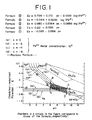
- Fig. 1 is a pH-oxidation-reduction potential graph showing the range (net portion) in which the ferrite coatings obtained in the present invention can be obtained.
- the substrate to be used in the present invention is not particularly limited, but may be preferably fine particulate and fibrous substrates.
- the present inventor has found it important how to control ferrous ions not adsorbed on particulate and/or fibrous substrate surface in a solution at a level of small amount, and accomplished an invention of obtaining a stable and controlled ferrite coatings by controlling pH and an oxidation-reduction potential within a certain range.
- particulates with relatively greater particulate sizes are small in amount of ferrous ions adsorbed, and the amount of the ferrous ions in the solution has great influence on generation of by-products.
- Particulates may be preferably those having an average particle size of 100 ⁇ m or less. For those over 100 ⁇ m, formation of ferrite coatings becomes slow, whereby by-products are liable to be formed.
- particulates mean those shaped in spheres, amorphous shapes and plates. Also, selective formation of a ferrite coatings may be conceivable on fibrous substrate, and in fact, such selective formation has been confirmed. Also in the case of fibrous substrate, those with diameters of 100 ⁇ m may be preferably utilized.
- Particulates or fibrous substrates may be formed from any kind of material.
- they may be formed from such base materials as resins, metals, metal oxides, organic pigments, celluloses, ceramics, etc.
- resins, metal oxides (including pigments, etc.), ceramics, organic pigments may be considered as preferred ones.
- fibrous substrates natural fibers, synthetic fibers or inorganic fibers can be employed.
- the aqueous solution in the present invention may be an aqueous solution of a pH buffering agent, for example, an organic acid salt such as ammonium acetate, preferably an aqueous solution under deoxidized state.
- Ferrous ions are supplied into the aqueous solution in the form of salts such as hydrochlorides, sulfates, acetates, etc.
- the aqueous ferrous ion solution may also contain other metal ions together with ferrous ions.
- the coating is obtained as the spinel ferrite containing only ferrous ions, namely the film of the magnetite Fe3O4.
- other transition metal ions M n+ may include zinc, cobalt, nickel, manganese, copper, vanadium, antimony, lithium, molybdenum, titanium, rubidium, magnesium, aluminum, silicon, chromium, tin, calcium, cadmium, indium, etc.
- cobalt ferrite When M is cobalt, cobalt ferrite (CoxFe3xO4) is obtained, while when it is nickel, nickel ferrite (NixFe3xO4) is obtained, and when M comprises plural kinds, a mixed crystal ferrite is obtained.
- These metal species other than ferrous ions are also supplied into the aqueous solution in the form of respective water-soluble salts.
- oxidizers examples include nitrites, nitrates, hydrogen peroxide, organic peroxides, perchloric acid or dissolved oxygen water, etc.
- nitrites examples include hydrogen peroxide, organic peroxides, perchloric acid or dissolved oxygen water, etc.
- the pH of the aqueous solution is controlled to pH 6 to 11 by suitably selecting the kinds of anions and metal ions existing in the aqueous solution, but preferably within the range from 6.5 to 10.
- a buffer such as ammonium acetate, sodium acetate, etc., or a salt having the buffering effect may be also added.
- the oxidation-reduction potential is controlled between the line 1 and the line 2 in the pH - oxidation-reduction potential graph shown in Fig. 1. Therefore, by controlling pH and oxidation-reduction potential within the portion specified by A, B, C and D shown in the pH - oxidation-reduction potential graph (Fig. 1), a desired ferrite coatings can be obtained.
- the temperature condition for implementing the reaction of the present invention may be within the range not higher than the boiling temperature of the aqueous solution, but preferably within the range from 60 to 90 °C.
- the reaction may be carried out preferably under deoxidized atmosphere. Under the condition where a large amount of oxygen exists, unnecessary oxidation reaction will undesirably proceed. For example, it is preferred to carry out the reaction under nitrogen atmosphere. Similarly, oxygen is also removed from the ferrous ion solution and the oxidizer solution to make a deoxidized aqueous solution.
- the particulate substrates to be used in the present invention may be used as such, but may be also subjected to the pre-treatment practiced in a plate-shaped product such as magnetic disc, etc. such as plasma treatment, alkali treatment, acid treatment, physical treatment, etc. When these treatments are practiced, wettability with the aqueous solution can be improved to give a uniform film.
- a preferred method of the present invention is to first suspend the particulate substrates in deoxidized water, and in this case, if necessary, affinity of the particulate substrates for water may be improved by deoxidizing with nitrogen gas or adding an additive such as surfactant, etc.
- a pH buffering agent, etc. is mixed for control of pH to set pH to a desired value.
- a ferrous ion solution and an oxidizer solution are added into the above suspension.
- oxidation-reduction potential pH are controlled within constant ranges at predetermined values.
- Oxidation-reduction potential is controlled by varying the dropwise addition rate of the oxidizer solution or the ferrous ion solution.
- Control of pH is performed by adding suitably an alkali solution such as ammonia solution, etc.
- pH - oxidation-reduction potential should be subject to the fixed point control.
- the ferrite coatings thickness can be extremely preferably controlled by the amount of metal ions added dropwise.
- the particulate substrates with ferrite coatings obtained are separated by filtration to give the desired product.
- the product may be also dried after separation depending on the purpose.
- the ferrous ion solution and the oxidizer solution are added into the suspension under control of oxidation-reduction potential with Fe2+/Fe3+.
- the amount of the oxidizer solution added is made constant, if the amount of ferrous ion solution is made larger, the Fe2+ concentration in the solution is enhanced, and the oxidation-reduction potential drops. In this case, the Fe2+ concentration not adsorbed on the surfaces is enhanced, whereby by-products formed at other places than on particulate surfaces are increased. On the other hand, if the amount of Fe2+ added dropwise is made smaller, there becomes substantially no Fe2+ existing in the solution, whereby the oxidation-reduction potential is elevated to enhance the concentration of the oxidizer.
- the oxidation-reduction potential in the solution in the present invention depends on pH, ferrite ion concentration, kind and concentration of oxidizer, but is also different depending on the temperature, kinds, concentrations of metal ions of other metal ions and deoxidized state, and therefore it is possible to obtain a desired saturated magnetization amount by setting suitably the control potential.
- the electrode for measuring oxidation-reduction potential for the purpose of causing no unnecessary oxidation-reduction reaction to occur at the electrode, it is preferred to use an inert, electroconductive substance such as platinum, stainless steel, etc.
- the steps of the present invention can effect coating of a ferrite coatings on the surfaces of particulate substrates very selectively according to a simple method to give a coated product not found up to date having a desired saturated magnetization amount up to 92 emu/g, preferably in the range of about 1 to 60 emu/g.
- the ferrite coated product of the present invention can be preferably used varieous uses, for example, those having about 1 to 20 emu/g in the saturation magnetization amount can be employed as a pigment for a paint or an ink, those having about 20 to 30 emu/g for a toner and those having about 30 to 60 emu/g for medical use such as immunoassay or particulate selection.
- the ferrite coated product of the present invention can be applied to various uses. For example, by applying ferrite coatings on toner or carrier for electrophotography, prevention of scattering of toner and use of a resin material with lower softening point is rendered possible. Also, applications of the particulates coated with a ferrite coatings to a display material (e.g. magnetic display), a recording material (magnetography), etc. are also conceivable. Also, the ferrite coatings can be also mixed into coating materials, inks, resin moldings, etc. Further, applications in medical field are also possible, and a particulate medicament can be coated with ferrite and the coated product induced with a magnet into the disease portion of a patient, thereby exhibiting excellent pharmaceutical effect.
- a display material e.g. magnetic display
- magnetography magnetography
- the ferrite coatings can be also mixed into coating materials, inks, resin moldings, etc. Further, applications in medical field are also possible, and a particulate medicament can be coated with
- the oxidation-reduction potential of this solution was set to -470 mV and the addition amount of the ferrous ion solution was controlled by addition rate.
- the pH value was maintained constant during this course.
- particulates of titanium oxide were encapsulated with magnetite. Virtually no magnetite particulates as by-products were formed.
- the particulates were separated by filtration and rinsed with water. The color of the produced magnetite plated titanium oxide was gray.
- a product with yellowish color can be obtained by adding metal ions other than of iron, such as Zn or Ni.
- This type of product is applicable to various purposes such as paints or cosmetics.
- Example 2 A pH value was maintained constant during this course and an oxidation-reduction potential was also maintained -470 mV as in Example 1. After approx. 20 minutes had passed, polystyrene particulates were encapsulated with magnetite. Virtually no magnetite particulates as by-products were formed. The magnetite plated polystyrene particulates were filtered out and rinsed with water. The color of obtained magnetite capsuled polystyrene particulates was black.
- the reactor vessel was heated to 70 °C, thereby a 100 ml ferrous ion solution containing 10 g of FeCl2, 2 g of NiCl2 and deionized water and a solution prepared by dissolving 20 g of sodium nitrite in one liter of deionized water already deoxidized were supplied to the reactor vessel at a rate of 5 ml/min.
- a pH value was maintained constant during this course.
- An oxidation-reduction potential was also maintained -470 mV as generally described in Example 1 and NiCl2 did not effect on the oxidation-reduction potential.
- polystyrene particulates encapsulated with Ni-ferrite were formed.
- Ni-ferrite particulates Virtually no Ni-ferrite particulates as by-products were formed.
- the Ni-ferrite plated polystyrene particulates were filtered out and rinsed with water.
- the color of obtained Ni-ferrite capsuled polystyrene particulates was brown.
- the products obtained in Examples 2 and 3 may be applied to various fields such as magnetic toners, magnetic display, cosmetics, powder paints, charge-preventive fillers, magnetic printing materials and the like.
- the magnetite plated glass fiber can be widely used for various purposes such as for charge-preventive fillers or improvement of dispersibility of glass fibers.
- a solution of ferrous ions of 30 % by weight prepared by dissolving previously FeCl2 in a deoxidized deionized water was commenced to be supplied at a rate of 10 ml/min., and further a 15 % by weight solution of sodium nitrite dissolved in deoxidized deionized water was supplied at a rate of 1 ml/min. During this period, pH was maintained constant. Also, the ferrous ion solution was supplied so that the controlled oxidation-reduction potential in the solution was maintained constantly at a value of -480 mV.
- Example 5 was repeated except that the oxidation-reduction potential in Example 5 was changed to -300 mV.
- Example 5 was repeated except that the pH and the oxidation-reduction potential in Example 5 were changed to 9.5 and -500 mV.
- Example 5 was repeated except that the pH and the oxidation-reduction potential in Example 5 were changed to 9.0 and -350 mV.
- Example 5 was repeated except that the polystyrene particulates in Example 5 were changed to TiO2 particulates (the same as Example 1).
- the average value of 5 samples obtained is as follows. Average value: 10.0 emu/g.
- Example 6 was repeated except that the polystyrene particulates in Example 6 were changed to glass cut fibers (the same as Example 4).
- the average value of 5 samples obtained is as follows. Average value: 23.1 emu/g.
- Example 5 was repeated except that the rate of Fe2+ supplied was changed to 30 and 60 ml/min.
- the average values of 5 samples obtained are as follows.
- Example 5 was repeated except that the rates of Fe2+ and NO2 ⁇ supplied were changed to 60 ml/min of Fe2+ and 3 or 5 ml/min. of NO2 ⁇ .
- the average values of 5 samples obtained are as follows.
- Example 5 was repeated except that the pH in Example 5 was changed to pH 7.5 on initiation, and pH 9.5 on completion.
- Example 5 was repeated except that the pH in Example 5 was changed to 5.5.
- Example 5 was repeated except that the pH in Example 5 was changed to 11.5.
- Example 5 was repeated except that the pH and the oxidation-reduction potential in Example 5 were changed to pH 6.5 and an oxidation-reduction potential of -550 mV.
- Example 5 was repeated except that the pH in Example 5 was changed to 6.5 and no control of oxidation-reduction potential was done.
Landscapes
- Engineering & Computer Science (AREA)
- Power Engineering (AREA)
- Manufacturing & Machinery (AREA)
- Compounds Of Iron (AREA)
- Paints Or Removers (AREA)
- Hard Magnetic Materials (AREA)
- Developing Agents For Electrophotography (AREA)
- Pigments, Carbon Blacks, Or Wood Stains (AREA)
Applications Claiming Priority (2)
| Application Number | Priority Date | Filing Date | Title |
|---|---|---|---|
| JP31504/90 | 1990-02-14 | ||
| JP2031504A JPH03237019A (ja) | 1990-02-14 | 1990-02-14 | フェライト被覆方法 |
Publications (3)
| Publication Number | Publication Date |
|---|---|
| EP0442022A2 true EP0442022A2 (de) | 1991-08-21 |
| EP0442022A3 EP0442022A3 (en) | 1992-05-13 |
| EP0442022B1 EP0442022B1 (de) | 1994-09-07 |
Family
ID=12333058
Family Applications (1)
| Application Number | Title | Priority Date | Filing Date |
|---|---|---|---|
| EP90105545A Expired - Lifetime EP0442022B1 (de) | 1990-02-14 | 1990-03-23 | Verfahren zum Formen von Ferritschichten |
Country Status (6)
| Country | Link |
|---|---|
| US (1) | US5215782A (de) |
| EP (1) | EP0442022B1 (de) |
| JP (1) | JPH03237019A (de) |
| AU (1) | AU617936B2 (de) |
| CA (1) | CA2012996C (de) |
| DE (1) | DE69012308T2 (de) |
Cited By (1)
| Publication number | Priority date | Publication date | Assignee | Title |
|---|---|---|---|---|
| US5342608A (en) * | 1992-03-19 | 1994-08-30 | Nippon Paint Co., Ltd. | Gas containing contrast agent particles having external magnetic layer |
Families Citing this family (7)
| Publication number | Priority date | Publication date | Assignee | Title |
|---|---|---|---|---|
| US5736349A (en) * | 1989-09-29 | 1998-04-07 | Nippon Paint Co., Ltd. | Magnetic particle and immunoassay using the same |
| US5384158A (en) * | 1993-05-04 | 1995-01-24 | National Science Council | Method for preparing a magnetic recording medium |
| US6022619A (en) * | 1998-01-15 | 2000-02-08 | Kuhn; Hans H. | Textile composite with iron oxide film |
| WO2008081917A1 (ja) * | 2007-01-05 | 2008-07-10 | Tokyo Institute Of Technology | 球状フェライトナノ粒子及びその製造方法 |
| EP3075374A4 (de) | 2013-11-29 | 2017-05-03 | MTG Co., Ltd. | Wässriges hautpflegemittel |
| CN113087532B (zh) * | 2021-03-04 | 2022-10-14 | 电子科技大学 | 一种高性能NiZn铁氧体薄膜的制备方法 |
| JP2023169575A (ja) * | 2022-05-17 | 2023-11-30 | Dic株式会社 | リキッドインキ組成物、及びそれを用いた印刷物並びにラミネート積層体 |
Family Cites Families (6)
| Publication number | Priority date | Publication date | Assignee | Title |
|---|---|---|---|---|
| US4113658A (en) * | 1967-04-14 | 1978-09-12 | Stamicarbon, N.V. | Process for homogeneous deposition precipitation of metal compounds on support or carrier materials |
| NL6917431A (en) * | 1969-11-20 | 1971-05-24 | Permanently magnetisable material | |
| US4440713A (en) * | 1982-09-30 | 1984-04-03 | International Business Machines Corp. | Process for making fine magnetic ferrite powder and dense ferrite blocks |
| DE3435698A1 (de) * | 1984-09-28 | 1986-04-03 | Basf Ag, 6700 Ludwigshafen | Verfahren zur herstellung von feinteiligem isotropen ferritpulver mit spinellstruktur |
| JPH076072B2 (ja) * | 1986-08-08 | 1995-01-25 | 日本ペイント株式会社 | フエライト膜の形成方法 |
| JPS6365085A (ja) * | 1986-09-05 | 1988-03-23 | Nippon Paint Co Ltd | 粒子または繊維状物のフエライト被覆方法 |
-
1990
- 1990-02-14 JP JP2031504A patent/JPH03237019A/ja active Pending
- 1990-03-23 US US07/498,133 patent/US5215782A/en not_active Expired - Fee Related
- 1990-03-23 DE DE69012308T patent/DE69012308T2/de not_active Expired - Fee Related
- 1990-03-23 CA CA002012996A patent/CA2012996C/en not_active Expired - Fee Related
- 1990-03-23 EP EP90105545A patent/EP0442022B1/de not_active Expired - Lifetime
- 1990-03-23 AU AU52185/90A patent/AU617936B2/en not_active Ceased
Cited By (1)
| Publication number | Priority date | Publication date | Assignee | Title |
|---|---|---|---|---|
| US5342608A (en) * | 1992-03-19 | 1994-08-30 | Nippon Paint Co., Ltd. | Gas containing contrast agent particles having external magnetic layer |
Also Published As
| Publication number | Publication date |
|---|---|
| DE69012308D1 (de) | 1994-10-13 |
| EP0442022A3 (en) | 1992-05-13 |
| CA2012996A1 (en) | 1991-08-14 |
| CA2012996C (en) | 1998-09-01 |
| AU5218590A (en) | 1991-08-15 |
| US5215782A (en) | 1993-06-01 |
| JPH03237019A (ja) | 1991-10-22 |
| EP0442022B1 (de) | 1994-09-07 |
| DE69012308T2 (de) | 1995-02-23 |
| AU617936B2 (en) | 1991-12-05 |
Similar Documents
| Publication | Publication Date | Title |
|---|---|---|
| US4911957A (en) | Method of forming ferrite film on particles or fibers | |
| Sugimoto et al. | Formation of uniform spherical magnetite particles by crystallization from ferrous hydroxide gels | |
| US4837046A (en) | Method for forming ferrite film | |
| EP0111869B1 (de) | Verfahren zur Bildung eines Ferritfilmes | |
| Abe et al. | High speed deposition of high‐quality ferrite films from aqueous solution at low temperatures (≤ 90° C) | |
| EP0442022B1 (de) | Verfahren zum Formen von Ferritschichten | |
| US3756866A (en) | Method and manufacturing magnetic alloy particles having selective coercivity | |
| US3905841A (en) | Method of improving dispersability of small metallic magnetic particles in organic resin binders | |
| JP2631753B2 (ja) | フェライト被覆方法 | |
| JP2661914B2 (ja) | コバルトを含有する針状磁性酸化鉄の製造方法 | |
| JPS6120302A (ja) | 強磁性粉末とその製造方法 | |
| EP0515748B1 (de) | Verfahren zur Herstellung von nadelförmigen Goethit-Teilchen und nadelförmigen magnetischen Eisenoxid-Teilchen | |
| JPS62207875A (ja) | 金属めつきされた無機粒子粉末の製造方法 | |
| JPH04357119A (ja) | 針状磁性酸化鉄粒子粉末の製造法 | |
| JPH0146561B2 (de) | ||
| JP2970706B2 (ja) | 針状磁性酸化鉄粒子粉末の製造法 | |
| KR910009210B1 (ko) | 레피도크로사이트의 제조방법 | |
| JPH05152114A (ja) | 本質的に鉄から成る針状強磁性金属粉末の安定化方法 | |
| JPH0285302A (ja) | 鉄を基質にした針状合金粉末、並びにその製造法及び使用法 | |
| JP2852459B2 (ja) | 紡錘形を呈した鉄を主成分とする金属磁性粒子粉末の製造法 | |
| JPS63242930A (ja) | 紡錘形を呈した鉄を主成分とする金属磁性粒子粉末の製造法 | |
| JPH0371379B2 (de) | ||
| JPS63183616A (ja) | 磁気記録媒体用磁性粉末 | |
| JPH0625704A (ja) | 耐食性に優れた金属磁性粉の製造方法 | |
| JPS59132420A (ja) | 磁気記録用金属磁性粉末の製造法 |
Legal Events
| Date | Code | Title | Description |
|---|---|---|---|
| PUAI | Public reference made under article 153(3) epc to a published international application that has entered the european phase |
Free format text: ORIGINAL CODE: 0009012 |
|
| AK | Designated contracting states |
Kind code of ref document: A2 Designated state(s): DE FR GB NL |
|
| PUAL | Search report despatched |
Free format text: ORIGINAL CODE: 0009013 |
|
| AK | Designated contracting states |
Kind code of ref document: A3 Designated state(s): DE FR GB NL |
|
| 17P | Request for examination filed |
Effective date: 19920708 |
|
| 17Q | First examination report despatched |
Effective date: 19930917 |
|
| GRAA | (expected) grant |
Free format text: ORIGINAL CODE: 0009210 |
|
| AK | Designated contracting states |
Kind code of ref document: B1 Designated state(s): DE FR GB NL |
|
| REF | Corresponds to: |
Ref document number: 69012308 Country of ref document: DE Date of ref document: 19941013 |
|
| ET | Fr: translation filed | ||
| PLBE | No opposition filed within time limit |
Free format text: ORIGINAL CODE: 0009261 |
|
| STAA | Information on the status of an ep patent application or granted ep patent |
Free format text: STATUS: NO OPPOSITION FILED WITHIN TIME LIMIT |
|
| 26N | No opposition filed | ||
| REG | Reference to a national code |
Ref country code: GB Ref legal event code: IF02 |
|
| PGFP | Annual fee paid to national office [announced via postgrant information from national office to epo] |
Ref country code: FR Payment date: 20020312 Year of fee payment: 13 |
|
| PGFP | Annual fee paid to national office [announced via postgrant information from national office to epo] |
Ref country code: GB Payment date: 20020327 Year of fee payment: 13 |
|
| PGFP | Annual fee paid to national office [announced via postgrant information from national office to epo] |
Ref country code: NL Payment date: 20020328 Year of fee payment: 13 |
|
| PGFP | Annual fee paid to national office [announced via postgrant information from national office to epo] |
Ref country code: DE Payment date: 20020404 Year of fee payment: 13 |
|
| PG25 | Lapsed in a contracting state [announced via postgrant information from national office to epo] |
Ref country code: GB Free format text: LAPSE BECAUSE OF NON-PAYMENT OF DUE FEES Effective date: 20030323 |
|
| PG25 | Lapsed in a contracting state [announced via postgrant information from national office to epo] |
Ref country code: NL Free format text: LAPSE BECAUSE OF NON-PAYMENT OF DUE FEES Effective date: 20031001 Ref country code: DE Free format text: LAPSE BECAUSE OF NON-PAYMENT OF DUE FEES Effective date: 20031001 |
|
| GBPC | Gb: european patent ceased through non-payment of renewal fee |
Effective date: 20030323 |
|
| PG25 | Lapsed in a contracting state [announced via postgrant information from national office to epo] |
Ref country code: FR Free format text: LAPSE BECAUSE OF NON-PAYMENT OF DUE FEES Effective date: 20031127 |
|
| NLV4 | Nl: lapsed or anulled due to non-payment of the annual fee |
Effective date: 20031001 |
|
| REG | Reference to a national code |
Ref country code: FR Ref legal event code: ST |