EP0440211B1 - Steuergerät zur Steuerung des Luftkraftstoffverhältnisses für einen Fahrzeugmotor - Google Patents
Steuergerät zur Steuerung des Luftkraftstoffverhältnisses für einen Fahrzeugmotor Download PDFInfo
- Publication number
- EP0440211B1 EP0440211B1 EP91101229A EP91101229A EP0440211B1 EP 0440211 B1 EP0440211 B1 EP 0440211B1 EP 91101229 A EP91101229 A EP 91101229A EP 91101229 A EP91101229 A EP 91101229A EP 0440211 B1 EP0440211 B1 EP 0440211B1
- Authority
- EP
- European Patent Office
- Prior art keywords
- air
- engine
- operation mode
- fuel ratio
- fuel
- Prior art date
- Legal status (The legal status is an assumption and is not a legal conclusion. Google has not performed a legal analysis and makes no representation as to the accuracy of the status listed.)
- Expired - Lifetime
Links
- 239000000446 fuel Substances 0.000 title claims description 90
- 239000000203 mixture Substances 0.000 claims description 54
- 238000002347 injection Methods 0.000 claims description 12
- 239000007924 injection Substances 0.000 claims description 12
- 239000002826 coolant Substances 0.000 claims description 9
- 230000003247 decreasing effect Effects 0.000 claims 1
- 238000002485 combustion reaction Methods 0.000 description 25
- 239000000498 cooling water Substances 0.000 description 25
- 238000012937 correction Methods 0.000 description 12
- 230000006870 function Effects 0.000 description 6
- 238000001816 cooling Methods 0.000 description 3
- 239000007858 starting material Substances 0.000 description 2
- 230000001133 acceleration Effects 0.000 description 1
- 230000002457 bidirectional effect Effects 0.000 description 1
- 238000004891 communication Methods 0.000 description 1
- 230000001419 dependent effect Effects 0.000 description 1
- 238000011161 development Methods 0.000 description 1
- 230000018109 developmental process Effects 0.000 description 1
- 238000010586 diagram Methods 0.000 description 1
- 230000005611 electricity Effects 0.000 description 1
- 238000005259 measurement Methods 0.000 description 1
- 238000000034 method Methods 0.000 description 1
- 238000012545 processing Methods 0.000 description 1
- 238000010792 warming Methods 0.000 description 1
Images


Classifications
-
- F—MECHANICAL ENGINEERING; LIGHTING; HEATING; WEAPONS; BLASTING
- F02—COMBUSTION ENGINES; HOT-GAS OR COMBUSTION-PRODUCT ENGINE PLANTS
- F02D—CONTROLLING COMBUSTION ENGINES
- F02D41/00—Electrical control of supply of combustible mixture or its constituents
- F02D41/02—Circuit arrangements for generating control signals
- F02D41/04—Introducing corrections for particular operating conditions
- F02D41/06—Introducing corrections for particular operating conditions for engine starting or warming up
- F02D41/062—Introducing corrections for particular operating conditions for engine starting or warming up for starting
- F02D41/065—Introducing corrections for particular operating conditions for engine starting or warming up for starting at hot start or restart
-
- F—MECHANICAL ENGINEERING; LIGHTING; HEATING; WEAPONS; BLASTING
- F02—COMBUSTION ENGINES; HOT-GAS OR COMBUSTION-PRODUCT ENGINE PLANTS
- F02D—CONTROLLING COMBUSTION ENGINES
- F02D41/00—Electrical control of supply of combustible mixture or its constituents
- F02D41/02—Circuit arrangements for generating control signals
- F02D41/04—Introducing corrections for particular operating conditions
- F02D41/06—Introducing corrections for particular operating conditions for engine starting or warming up
- F02D41/068—Introducing corrections for particular operating conditions for engine starting or warming up for warming-up
-
- F—MECHANICAL ENGINEERING; LIGHTING; HEATING; WEAPONS; BLASTING
- F02—COMBUSTION ENGINES; HOT-GAS OR COMBUSTION-PRODUCT ENGINE PLANTS
- F02D—CONTROLLING COMBUSTION ENGINES
- F02D41/00—Electrical control of supply of combustible mixture or its constituents
- F02D41/02—Circuit arrangements for generating control signals
- F02D41/14—Introducing closed-loop corrections
- F02D41/1438—Introducing closed-loop corrections using means for determining characteristics of the combustion gases; Sensors therefor
- F02D41/1473—Introducing closed-loop corrections using means for determining characteristics of the combustion gases; Sensors therefor characterised by the regulation method
- F02D41/1475—Regulating the air fuel ratio at a value other than stoichiometry
-
- F—MECHANICAL ENGINEERING; LIGHTING; HEATING; WEAPONS; BLASTING
- F02—COMBUSTION ENGINES; HOT-GAS OR COMBUSTION-PRODUCT ENGINE PLANTS
- F02D—CONTROLLING COMBUSTION ENGINES
- F02D2200/00—Input parameters for engine control
- F02D2200/50—Input parameters for engine control said parameters being related to the vehicle or its components
- F02D2200/501—Vehicle speed
Definitions
- the present invention relates to an air-fuel ratio control device for a vehicle engine according to the preamble of claim 1.
- a generic air-fuel ratio control device is disclosed in the JP-A-59 196 932. This control device determines the air-fuel ratio by use of the vehicle speed in addition to the temperature of the engine cooling water after an engine startup. If either the vehicle speed or the cooling water temperature exceeds a respective predetermined value, the air-fuel ratio is switched over from rich to lean mixture. However, there might arise operation conditions in which the air-fuel ratio is not conveniently set. Therefore misfires and an unstable combustion could occur.
- lean burn engines Engines which are operated on a lean air-fuel mixture having an air-fuel ratio higher than a stoichiometric ratio in the main operating range of the engines are known as lean burn engines.
- the lean burn engines are operated on a lean air-fuel mixture, and when acceleration or high load operations are required, the air-fuel ratio of the mixture on which the engine is operated is switched to the stoichiometric ratio or lower (rich) ratio, so that a high engine performance can be obtained without a worsening of the exhaust emissions and fuel efficiency.
- a lean-burn engine is operated on a stoichiometric air-fuel mixture during warming up, and the air-fuel ratio is switched to the lean condition after the engine is fully warmed up.
- the timing at which the air-fuel ratio is switched to the lean mixture ratio i.e., the completion of the engine warm up, is usually determined by detecting the temperature of the engine coolant, such as cooling water.
- JP-A 58-48727 discloses an engine operated on a stoichiometric air-fuel ratio mixture when the temperature of the engine cooling water is lower than the predetermined value, and when the temperature of the cooling water reaches the predetermined value, the air-fuel ratio is switched to lean ratio.
- the actual factor which influences the condition of the combustion in the cylinders is the wall temperature of the combustion chamber, not the cooling water temperature, and therefore, if the air-fuel ratio of the mixture is determined by the cooling water temperature only, in some cases a stable combustion cannot be obtained. For example, if the engine is stopped after being fully warmed up, and then restarted within a relatively short time, sometimes the combustion becomes unstable and misfires occur. This is caused by the difference in the cooling speeds of the cooling water and the wall of the combustion chamber. Namely, due to a high specific heat, the cooling speed of the cooling water is low but the cooling speed of the wall of the combustion chamber is relatively high.
- the air-fuel ratio control device can prevent an inappropriate changeover to a lean air-fuel mixture when the wall temperature of the combustion chamber is low, and thus can prevent the occurrence of misfires and an unstable combustion.
- Fig. 1 illustrates an embodiment of the air-fuel ratio control device according to the present invention.
- reference numeral 10 represents a cylinder block of an engine
- 12 is a cylinder bore.
- each cylinder of the engine is provided with two intake ports 12a, 12b and two exhaust ports 14a, 14b, and inlet valves 16a, 16b and exhaust valves 18a, 18b are provided at the respective ports, 12a, 12b and 14a, 14b.
- the first inlet port 12a is formed as a helical port which deflects the inlet air flow to thereby generate a swirl in the cylinder.
- the second inlet port 12b is formed as a conventional straight type inlet port.
- the inlet ports 12a and 12b are connected to a surge tank 22 and a throttle valve 24 via an intake air passage 20, and a fuel injector 26 is mounted on the intake air passage 20 near each cylinder.
- the exhaust ports 14a and 14b are connected to an exhaust manifold 28.
- Reference numeral 30 represents a distributor which supplies high voltage electricity to spark plugs (not shown) at the respective cylinders.
- Each straight type inlet port 12b is equipped with a swirl control valve 32 which is in either the open or closed position.
- the swirl control valve 32 When the swirl control valve 32 is in the closed position, the straight port 12b is closed and all of the inlet air flows into the engine cylinder through the helical port 12a. Accordingly, the inlet air flow forms a strong swirl in the engine cylinder, and thus a stable combustion of the lean air-fuel mixture can be obtained.
- the swirl control valve 32 is in the open position, the inlet air flows into the cylinder through both of the inlet ports 12a, 12b, whereby the volume of the inlet air is increased.
- the swirl control valve 32 comprises a valve plate 32a connected to an actuator 38 via a lever 34 and a rod 36.
- the actuator 38 comprises a diaphragm 40, and spring 41 biasing the diaphragm downward.
- a negative pressure is introduced to the upper side of the diaphragm 40
- the diaphragm 40 and the rod 36 are moved upward against the force of the spring 41 and the swirl control valve 32 is moved to the open position.
- the swirl control valve 32 is urged downward to the closed position, by the spring 41.
- the chamber formed at the upper side of the diaphragm 40 is connected to the pressure port 22a formed on the surge tank 22 via a timing control valve 42, a solenoid operated three-way valve 44, and a check valve 46.
- the timing control valve 42 includes an orifice 42a and a check valve 42b arranged in parallel to each other.
- the timing control valve 42 maintains the opening speed of the swirl control valve 32 at an appropriate level by controlling the speed of the introduction of the atmospheric air to the upper side of the diaphragm 40.
- the check valve 46 maintains the negative pressure on the upper side of the diaphragm 40 when the pressure in the surge tank 22 becomes higher.
- the solenoid operated three way valve 44 comprises three ports 44a, 44b and 44c.
- the port 44a When the solenoid is de-energized, the port 44a is communicated with the port 44c, and the upper side of the diaphragm 40 is open to the pressure port 22a of the surge tank 22.
- the solenoid when the solenoid is energized, the port 44a is communicated to the port 44b, and the upper side of the diaphragm 40 is open to the atmosphere, through a filter 48 and the orifice 42a of the timing control valve 42.
- An electronic control unit 50 is provided to control the swirl control valve 32 by energizing and de-energizing the solenoid of the three way valve 44.
- the electronic control unit 50 is constructed as a digital computer which comprises a ROM (read only memory) 52, a RAM (random access memory) 53, a CPU (central processing unit) 54, an input port 55 and an output port 56.
- the ROM 52, the RAM 33, the CPU 54, the input port 55 and the output port 56 are interconnected by a bidirectional bus 51.
- the electronic control unit 50 also controls the amount of fuel injected by a fuel injector 26 and the ignition timing according to the invention. Accordingly, the output port 56 of the electronic control unit 50 is connected to the fuel injector 26 and the solenoid operated three way valve 44, via a corresponding drive circuit 60 and 61, and to the distributor 30 via a ignition circuit 62.
- An absolute pressure sensor 72 which generates an output voltage proportional to the absolute pressure PM in the surge tank 22, is mounted on the surge tank 22, and the output voltage of the absolute pressure sensor 72 is input to the input port 55 via an AD convertor 64.
- Crank angle sensors 74 and 76 are mounted on the distributor 30.
- the first crank angle sensor 74 detects a reference position of the crank shaft rotation and generates a pulse signal at, for example, each 720 degrees rotation of the crank shaft.
- the second crank angle sensor 76 detects the rotation angle of the crank shaft and generates a pulse signal at, for example, each 30 degrees rotation of the crank shaft.
- crank angle sensors 74, 76 are input to the input port 55, and the engine speed NE is calculated from the pulse output by the crank angle sensor 76 to the CPU 54.
- a throttle sensor 79 is mounted on the throttle valve 24 and generates an output voltage proportional to the degree of opening of the throttle valve 24.
- the output of the throttle sensor 79 is input to the input port 55 via an AD converter 65.
- Reference numeral 80 indicates a starter switch which transmits a start signal to the input port 55 when the starting motor (not shown) of the engine is energized.
- the electronic control unit 50 is provided with a builtin clock 54a, which generates a clock pulse for the CPU 54. When the startup of the engine is completed, the electronic control unit 50 starts to count the pulses of the clock 54a, to thereby measure the time elapsed after startup.
- a speed sensor 82 generates an output voltage proportional to a speed of the vehicle driven by the engine.
- a coolant temperature sensor 84 which generates an output voltage proportional to the cooling water temperature, is mounted on the engine.
- the outputs of the speed sensor 82 and the coolant temperature sensor 84 are input to the input port 55 via corresponding AD converters 66 and 67.
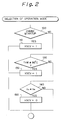
- Fig. 2 illustrates the routine for selecting the operation mode of the engine, i.e., the air-fuel ratio of the air-fuel mixture supplied to the engine.
- This routine is processed by the electronic control unit 50 as a part of the main routine for controlling the engine.
- step 100 it is determined whether the engine is being started. It is determined that the engine is being started when a startup signal is transmitted from the starter switch 80 and the engine speed is lower than a predetermined value (for example, 400 rpm). If the engine is being started, the routine proceeds to step 110, in which a flag XSCV is set.
- the flag XSCV represents the operation mode of the engine, and when the flag XSCV is set, the engine is switched to operate on a rich air-fuel mixture.
- step 120 it is determined whether the cooling water temperature THW is lower than the predetermined value (for example, 80°C).
- the cooling water temperature is calculated from the output of the coolant temperature sensor 84.
- step 140 it is determined whether the vehicle speed Va detected by the speed sensor 82 is lower than a value V0.
- the value V0 is determined as a function of the time T0 after the completion of the startup of the engine.
- the time T0 is measured by counting the clock pulses of the clock 54a.
- Fig. 3 shows a typical relationship of the value V0 and the time T0. In this embodiment, the relationship of V0 and T0 in Fig. 3 is stored in the ROM 52 in the form of a numeric table.
- the speed V0 is determined from the table by the CPU 54.
- the flag XSCV is reset in step 150, and when the flag XSCV is reset, the engine is switched to operate on a lean air-fuel mixture. If the vehicle speed Va is less than V0 , the routine is ended without changing the setting of the flag XSCV.
- this routine always selects the rich mixture operation mode during engine startup, and does not switch to the lean mixture operation mode unless the vehicle speed Va become higher than or equal to V0 , even if the cooling water temperature is higher than the predetermined value.
- value V0 is lowered at the time T0 , and becomes zero after a predetermined time has elapsed (for example, 300 secs). Therefore, after this predetermined time has elapsed and the cooling water temperature is higher than the predetermined value, the operation mode is automatically switched to a lean mixture operation, regardless of the vehicle speed Va.
- V0 is considered to be a parameter related to the wall temperature of the combustion chamber of the engine. It is considered that the wall temperature of the combustion chamber is a function of the time after startup and an accumulated value of engine operation load after startup.
- the vehicle speed can be conveniently used as a parameter indicating the accumulated value of the engine operation load, as it represents the total work done by the engine for accelerating the vehicle from a standstill to a certain speed.
- parameters which relate to the accumulated engine operation load for example, parameters such as accumulated values of the engine revolutions, of the intake manifold pressure, or the total amount of fuel injected can be used, but the engine revolutions and the intake manifold pressure are widely varied during the engine operation, and due to these variations, the accumulated values of these parameters include relatively large errors. Also, the total amount of the injected fuel is largely influenced by the cooling water temperature, and a complicated correction process is required for the calculation. The vehicle speed can be conveniently and reliably used because these problems do not arise when estimating the wall temperature of the combustion chamber thereby.
- step 140 of Fig. 2 once the vehicle speed Va exceeds the value Va and the operation mode is switched to the lean mixture mode, a switching of the operation mode (i.e., from the lean mixture mode to the rich mixture mode) does not occur even if the vehicle speed Va becomes lower than the value V0.
- Fig. 4 illustrates the routine for switching the position of the swirl control valve according to the selected operation mode. This routine is processed by the electronic control unit 50 by sequential interruptions at predetermined intervals.
- step 180 it is determined whether the flag XSCV is set.
- the flag XSCV represents the selected operation mode and is set or reset by the routine in Fig. 2.
- step 185 the solenoid of the three way valve 44 is de-energized.
- the solenoid when the solenoid is de-energized, the pressure port 22a of the surge tank 22 is in communication with the upper side of the diaphragm 40 of the actuator 38, via the check valve 42b, and therefore, the diaphragm 40 is moved upward against the force exerted by the spring 41.
- This movement of the diaphragm 40 causes the swirl control valve 32 to move to the closed position, and when the swirl control valve 32 is in the closed position, the negative pressure in the actuator 38 is maintained by the check valve 46, and thus the swirl control valve 32 is held in the closed position even when the pressure in the surge tank 22 becomes higher.
- step 190 the solenoid of the three way valve 44 is de-energized and the upper side of the diaphragm 40 of the actuator 38 is then open to the atmosphere through the filter 48 and the check valve 42a of the timing control valve 42. Accordingly, the diaphragm 40 is urged downward by the spring 41 and the swirl control valve 32 is moved to the open position.
- the opening speed of the swirl control valve 32 is appropriately controlled by the orifice 42a, and the closing speed thereof is maintained by the check valve 42b.
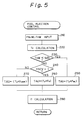
- Fig. 5 illustrates the routine for determining the amount of the fuel to be injected, to adjust the air-fuel ratio of the mixture in accordance with the operation mode selected by the routine in Fig. 2. This routine is processed immediately before the fuel is injected, when the crank angle detected by the sensors 74, 76 reaches a predetermined angle.
- step 210 the intake air manifold pressure (the pressure in the surge tank 22) PM, the engine speed NE, the cooling water temperature THW are read by the sensors 72, 76, 84, respectively, and in step 220, a standard amount of fuel injection Tp is determined as a function of the manifold pressure PM and the engine speed NE.
- the standard amount Tp is stored in the ROM 52 of the electronic control unit 50, in the form of a numeric table. Note that if the standard amount TP is provided, the air-fuel ratio becomes stochiometric ratio.
- step 230 it is determined whether the cooling water temperature THW is lower than a predetermined temperature (for example, 50°C).
- a corrected amount of fuel injection TAU is determined by multiplying a correction factor FWL with the standard amount of fuel injection Tp.
- the correction factor FWL is determined as a function of the cooling water temperature, which is stored in the ROM 52 in the form of a numeric table.
- the purpose of the correction factor FWL is to make the air-fuel ratio of the mixture rich so that a stable combustion is obtained when the cooling water temperature is low. Note that the correction factor is larger than the value "1.0".
- the fuel injection time T i is calculated on the basis of the determined TAU, and the fuel injector 26 is opened for the time T i so that the required amount of fuel TAU is injected.
- step 240 it is determined whether the flag XSCV is set.
- the corrected amount of fuel injection TAU is decided in step 260 by multiplying a rich mixture correction factor F s with the standard amount of fuel injection Tp.
- the rich mixture correction factor F s is a constant or variable value used to set the corrected amount of fuel injection so that the air-fuel ratio of the mixture becomes lower (richer) than or equal to stoichiometric air-fuel ratio. Note that the correction factor is equal to or larger than the value "1.0".
- the corrected amount of fuel injection TAU is determined in step 270 by multiplying a lean mixture correction factor F LFAN with the standard amount of fuel injection Tp.
- the lean mixture correction factor F LEAN is a constant or variable value used to set the corrected amount of fuel injection TAU so that the air-fuel ratio of the mixture becomes higher than the stoichiometric air-fuel ratio. Note that the lean mixture correction factor F LEAN has the value that is smaller than the value "1.0".
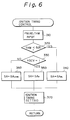
- Fig. 6 illustrates the routine for selecting the ignition timing in accordance with the operation mode selected by the routine in Fig. 2. This routine is processed by the electronic control unit 50 as a part of the main routine for controlling the engine.
- steps 310, 320, 330 correspond to steps 210, 220, 230 in Fig. 5.
- a cold condition ignition timing SA WL is selected as an ignition timing setting SA.
- SA WL is a function of PM, NE and THW, which is stored in ROM 52 in the form of a numeric table, and provides an ignition timing suitable for the rich mixture established by the correction factor F WL in step 250 of Fig. 5.
- SA S (step 350) and SA LEAN (step 360) are selected as the ignition timing setting SA, in accordance with the setting of the flag XSCV.
- SA S and SA LEAN are the functions of PM and NE, and provide an ignition timing suitable for the rich mixture established by step 260 and the lean mixture established by step 270 in Fig. 2 respectively. Since the air-fuel ratio of the mixture and the ignition timing, as well as the position of the swirl control valve, are switched in accordance with the operation mode selected by the routine in Fig. 2, a stable combustion can be obtained with both a rich and a lean mixture.
- the operation mode is not switched to the operation on the lean air-fuel mixture unless it is judged that the wall temperature of the combustion chamber is high enough to support a stable combustion with the lean air-fuel mixture. Therefore, the misfires caused by an inappropriate switching to lean mixture when the engine is restarted at a high cooling water temperature can be prevented, and a stable operation of the engine is assured under all operating conditions.
- An air-fuel ratio control device for a vehicle engine by which the air-fuel ratio of the air-fuel mixture supplied to a vehicle engine is changed to a lean mixture when the engine coolant temperature is higher than a predetermined value and the vehicle speed is higher than a value determined by a time elapsed after engine startup.
Landscapes
- Engineering & Computer Science (AREA)
- Chemical & Material Sciences (AREA)
- Combustion & Propulsion (AREA)
- Mechanical Engineering (AREA)
- General Engineering & Computer Science (AREA)
- Electrical Control Of Air Or Fuel Supplied To Internal-Combustion Engine (AREA)
Claims (9)
- Steuergerät zur Steuerung des Luft-Kraftstoffverhältnisses für einen Fahrzeugmotor mit folgenden Bauteilen einer Vorrichtung (84) zum Erfassen einer Temperatur einer Motorkühlung,
einer Betriebsmodusauswahlvorrichtung (50) zur Auswahl von Betriebsmodi des Motors, wobei die Betriebsmodusauswahlvorrichtung (50) einen Betriebsmodus mit fettem Gemisch auswählt, in dem der Motor mit einem fetten Luft-Kraftstoffgemisch mit einem Luft-Kraftstoffverhältnis kleiner oder gleich dem stöchiometrischen Verhältnis betrieben wird, wenn die Motorkühlungstemperatur geringer als ein vorbestimmter Wert ist, und wobei die Betriebsmodusauswahlvorrichtung (50) einen Betriebsmodus mit magerem Gemisch auswählt, in dem der Motor mit einem mageren Luft-Kraftstoffgemisch mit einem Luft-Kraftstoffverhältnis größer als das stöchiometrische Verhältnis betrieben wird,
wenn die Kühltemperatur größer als der vorbestimmte Wert ist,
einer Luft-Kraftstoffverhältnissetzvorrichtung (26, 44) zum Einstellen eines Luft-Kraftstoffverhältnisses eines Luft-Kraftstoffgemisches in Übereinstimmung mit dem Betriebsmodus,
der durch die Betriebsmodusauswahlvorrichtung (50) ausgewählt ist,
einer Anlaßerfassungsvorrichtung (80, 55) zum Erfassen eines Anlassens (100) des Motors,
einer Geschwindigkeitserfassungsvorrichtung (82) zum Erfassen einer Geschwindigkeit eines durch den Motor angetriebenen Fahrzeugs und
einer Verhinderungsvorrichtung (54) zum Verhindern einer Auswahl des Magergemischbetriebsmodus durch die Betriebsmodusauswahlvorrichtung während einer Zeitspanne vom Anlassen (100) des Motors bis die Geschwindigkeit (Va) des Fahrzeugs einen vorbestimmten Wert (V₀) erreicht,
gekennzeichnet durch
einer Zeitmeßvorrichtung (54a) zum Messen einer Zeit, die nach dem Abschluß des Anlassens (100) des Motors verstrichen ist, wobei der vorbestimmte Wert (V₀) der Fahrzeuggeschwindigkeit als eine abfallende Funktion der Zeit bestimmt wird, die nach dem Abschluß des Anlassens (100) des Motors verstrichen ist. - Steuergerät zur Steuerung des Luft-Kraftstoffverhältnisses nach Anspruch 1, dadurch gekennzeichnet, daß der vorbestimmte Wert (V₀) der Fahrzeuggeschwindigkeit zu Null wird, nachdem eine vorbestimmte Zeit seit dem Abschluß des Anlassens des Motors verstrichen ist.
- Steuergerät zur Steuerung des Luft-Kraftstoffverhältnisses nach Anspruch 1, dadurch gekennzeichnet, daß die Anlaßerfassungsvorrichtung (80, 55) bestimmt, daß das Motoranlassen abgeschlossen ist, wenn die Motordrehzahl einen vorbestimmten Wert erreicht, nachdem das Motoranlassen gestartet wurde.
- Steuergerät zur Steuerung des Luft-Kraftstoffverhältnisses nach Anspruch 3, dadurch gekennzeichnet, daß die Betriebsmodusauswahlvorrichtung (50) einen Betriebsmodus mit fettem Gemisch während des Anlassens des Motors unabhängig von der Motorkühlungstemperatur auswählt.
- Steuergerät zur Steuerung des Luft-Kraftstoffverhältnisses nach Anspruch 1, dadurch gekennzeichnet, daß, wenn die Geschwindigkeit des Fahrzeuges einmal den vorbestimmten Wert (V₀) erreicht hat, die Verhinderungsvorrichtung (54) nicht die Auswahl des Magergemischmodus verhindert, selbst wenn die Geschwindigkeit des Fahrzeugs danach geringer als der vorbestimmte Wert (V₀) wird.
- Steuergerät zur Steuerung des Luft-Kraftstoffverhältnisses nach Anspruch 1, dadurch gekennzeichnet, daß die Luft-Kraftstoffverhältnissetzvorrichtung (26, 44) Kraftstoffeinspritzvorrichtungen (26) und eine Kraftstoffeinspritzsteuervorrichtung (60) umfaßt, die einen Betrag des Kraftstoffes steuert, der dazu benötigt wird, ein Luft-Kraftstoffverhältnis in Übereinstimmung mit dem durch die Betriebsmodusauswahlvorrichtung (50) ausgewählten Betriebsmodus zu erhalten.
- Steuergerät zur Steuerung des Luft-Kraftstoffverhältnisses nach Anspruch 4, dadurch gekennzeichnet, daß die Luft-Kraftstoffverhältnissetzvorrichtung (26, 44) desweiteren eine Zündzeitpunktssteuervorrichtung umfaßt, die einen Zündzeitpunkt in Übereinstimmung mit dem durch die Betriebsmodusauswahlvorrichtung (50) ausgewählten Betriebsmodus steuert.
- Steuergerät zur Steuerung des Luft-Kraftstoffverhältnisses nach Anspruch 7, dadurch gekennzeichnet, daß die Luft-Kraftstoffverhältnissetzvorrichtung (26, 44) weiterhin eine Vorrichtung zum Erzeugen eines Einlaßluftwirbels innerhalb der Motorzylinder umfaßt, wenn der Betriebsmodus mit magerem Gemisch durch die Betriebsmodusauswahlvorrichtung (50) ausgewählt ist.
- Steuergerät zur Steuerung des Luft-Kraftstoffverhältnisses nach Anspruch 8, dadurch gekennzeichnet, daß die Vorrichtung zum Erzeugen eines Einlaßluftwirbels schraubenförmige Kanäle (12a) und geradlinige Kanäle (12b) der Motorzylinder für Einlaßluft und Wirbelsteuerventile (32) umfaßt, die Einlaßluftdurchtritte zu den geraden Kanälen (12b) schließen, wenn der Betriebsmodus mit magerem Gemisch ausgewählt ist, so daß Einlaßluft zum Motor in die Motorzylinder nur durch die schraubenförmigen Kanäle (12a) strömt.
Applications Claiming Priority (2)
| Application Number | Priority Date | Filing Date | Title |
|---|---|---|---|
| JP2018971A JPH03225045A (ja) | 1990-01-31 | 1990-01-31 | 内燃機関の空燃比制御装置 |
| JP18971/90 | 1990-01-31 |
Publications (3)
| Publication Number | Publication Date |
|---|---|
| EP0440211A2 EP0440211A2 (de) | 1991-08-07 |
| EP0440211A3 EP0440211A3 (en) | 1993-03-03 |
| EP0440211B1 true EP0440211B1 (de) | 1995-12-27 |
Family
ID=11986532
Family Applications (1)
| Application Number | Title | Priority Date | Filing Date |
|---|---|---|---|
| EP91101229A Expired - Lifetime EP0440211B1 (de) | 1990-01-31 | 1991-01-30 | Steuergerät zur Steuerung des Luftkraftstoffverhältnisses für einen Fahrzeugmotor |
Country Status (4)
| Country | Link |
|---|---|
| US (1) | US5092297A (de) |
| EP (1) | EP0440211B1 (de) |
| JP (1) | JPH03225045A (de) |
| DE (1) | DE69115722T2 (de) |
Families Citing this family (6)
| Publication number | Priority date | Publication date | Assignee | Title |
|---|---|---|---|---|
| JP3005818B2 (ja) * | 1990-12-25 | 2000-02-07 | 本田技研工業株式会社 | エンジンの始動燃料供給量制御装置 |
| JP2737426B2 (ja) * | 1991-03-08 | 1998-04-08 | 日産自動車株式会社 | 内燃機関の燃料噴射制御装置 |
| DE4433299A1 (de) * | 1994-09-19 | 1996-03-21 | Bosch Gmbh Robert | Verfahren und Vorrichtung zur Leerlaufeinstellung einer Brennkraftmaschine |
| DE19755299A1 (de) * | 1997-12-12 | 1999-06-17 | Man Nutzfahrzeuge Ag | Verfahren zur NO¶x¶-Reduzierung an gemischverdichtenden Brennkraftmaschinen |
| JP3952733B2 (ja) * | 2001-10-22 | 2007-08-01 | 日産自動車株式会社 | ディーゼルエンジンの排気浄化制御装置 |
| JP4840244B2 (ja) * | 2007-04-26 | 2011-12-21 | 株式会社デンソー | 空燃比制御装置及びエンジン制御システム |
Family Cites Families (12)
| Publication number | Priority date | Publication date | Assignee | Title |
|---|---|---|---|---|
| JPS5848727A (ja) * | 1981-09-09 | 1983-03-22 | Toyota Motor Corp | 内燃機関の空燃比制御装置 |
| JPS59162329A (ja) * | 1983-03-07 | 1984-09-13 | Nippon Carbureter Co Ltd | エンジンの燃料制御方法 |
| JPS59170431A (ja) * | 1983-03-18 | 1984-09-26 | Toyota Motor Corp | 内燃機関の空燃比制御方法 |
| JPS59196932A (ja) * | 1983-04-25 | 1984-11-08 | Nissan Motor Co Ltd | 内燃機関の空燃比制御装置 |
| US4594986A (en) * | 1984-01-20 | 1986-06-17 | Mazda Motor Corporation | Fuel supply arrangement for internal combustion engine |
| JPS60211651A (ja) * | 1984-04-05 | 1985-10-24 | Matsushita Electric Ind Co Ltd | 磁気記録再生装置 |
| JPS60230532A (ja) * | 1984-04-28 | 1985-11-16 | Toyota Motor Corp | 内燃機関の空燃比制御装置 |
| JPH0674761B2 (ja) * | 1985-01-25 | 1994-09-21 | スズキ株式会社 | 燃料噴射制御方法 |
| JPH07116964B2 (ja) * | 1986-02-14 | 1995-12-18 | 本田技研工業株式会社 | 内燃エンジンの始動後燃料供給制御方法 |
| DE3609600C2 (de) * | 1986-03-21 | 2001-05-23 | Bosch Gmbh Robert | Verfahren zur Heißstartanhebung bei Brennkraftmaschinen |
| JPS639649A (ja) * | 1986-06-30 | 1988-01-16 | Nissan Motor Co Ltd | 内燃機関の空燃比制御装置 |
| JPH0751905B2 (ja) * | 1986-12-27 | 1995-06-05 | 本田技研工業株式会社 | 内燃エンジンの始動後燃料供給制御方法 |
-
1990
- 1990-01-31 JP JP2018971A patent/JPH03225045A/ja active Pending
-
1991
- 1991-01-28 US US07/646,663 patent/US5092297A/en not_active Expired - Fee Related
- 1991-01-30 DE DE69115722T patent/DE69115722T2/de not_active Expired - Fee Related
- 1991-01-30 EP EP91101229A patent/EP0440211B1/de not_active Expired - Lifetime
Also Published As
| Publication number | Publication date |
|---|---|
| DE69115722D1 (de) | 1996-02-08 |
| EP0440211A2 (de) | 1991-08-07 |
| DE69115722T2 (de) | 1996-05-30 |
| JPH03225045A (ja) | 1991-10-04 |
| US5092297A (en) | 1992-03-03 |
| EP0440211A3 (en) | 1993-03-03 |
Similar Documents
| Publication | Publication Date | Title |
|---|---|---|
| US4403584A (en) | Method and apparatus for optimum control for internal combustion engines | |
| KR900006875B1 (ko) | 내연기관의 제어장치 | |
| US5979397A (en) | Control apparatus for direct injection spark ignition type internal combustion engine | |
| US5586537A (en) | Fuel property detecting apparatus for internal combustion engines | |
| US5499607A (en) | Fuel characteristic detecting system for internal combustion engine | |
| US5881552A (en) | Control system for internal combustion engines and control system for vehicles | |
| US4444168A (en) | Engine idling speed control method and apparatus | |
| CN108612594B (zh) | 内燃机怠速转速控制 | |
| US5934247A (en) | Engine deceleration control device | |
| EP0924420B1 (de) | Drehmomentregler für eine Brennkraftmaschine | |
| US4457282A (en) | Electronic control for fuel injection | |
| US4785785A (en) | Fuel injection control device for an internal combustion engine with throttle opening detection means | |
| EP0440173B1 (de) | Verfahren und Gerät zur Steuerung des Drehmoments einer Brennkraftmaschine | |
| EP1284363B1 (de) | Zündzeitpunktsteuervorrichtung für einen Verbrennungsmotor | |
| US5092297A (en) | Air-fuel ratio control device for a vehicle engine | |
| JPH09250387A (ja) | 内燃機関の燃料噴射制御方法 | |
| US4915078A (en) | Fuel injection control device of an internal combustion engine | |
| EP0447765B1 (de) | Steuergerät zur Steuerung des Luft-Kraftstoff-Gemisches für eine Brennkraftmaschine | |
| EP1167730B1 (de) | Vorrichtung zur regelung der drehzahl einer brennkraftmaschine | |
| JP3466192B2 (ja) | 内燃機関の燃料調量用制御装置 | |
| US4785779A (en) | Internal combustion engine control apparatus | |
| EP0161611B1 (de) | Verfahren und Gerät zur Steuerung des Luft-Kraftstoffverhältnisses in einer Innenbrennkraftmaschine | |
| JP2000136737A (ja) | 内燃機関の逆回転防止装置 | |
| JPH0430358Y2 (de) | ||
| JP3850632B2 (ja) | 内燃機関の燃料噴射制御装置 |
Legal Events
| Date | Code | Title | Description |
|---|---|---|---|
| PUAI | Public reference made under article 153(3) epc to a published international application that has entered the european phase |
Free format text: ORIGINAL CODE: 0009012 |
|
| 17P | Request for examination filed |
Effective date: 19910130 |
|
| AK | Designated contracting states |
Kind code of ref document: A2 Designated state(s): DE FR GB |
|
| PUAL | Search report despatched |
Free format text: ORIGINAL CODE: 0009013 |
|
| AK | Designated contracting states |
Kind code of ref document: A3 Designated state(s): DE FR GB |
|
| 17Q | First examination report despatched |
Effective date: 19931210 |
|
| GRAA | (expected) grant |
Free format text: ORIGINAL CODE: 0009210 |
|
| AK | Designated contracting states |
Kind code of ref document: B1 Designated state(s): DE FR GB |
|
| REF | Corresponds to: |
Ref document number: 69115722 Country of ref document: DE Date of ref document: 19960208 |
|
| ET | Fr: translation filed | ||
| PLBE | No opposition filed within time limit |
Free format text: ORIGINAL CODE: 0009261 |
|
| STAA | Information on the status of an ep patent application or granted ep patent |
Free format text: STATUS: NO OPPOSITION FILED WITHIN TIME LIMIT |
|
| 26N | No opposition filed | ||
| PGFP | Annual fee paid to national office [announced via postgrant information from national office to epo] |
Ref country code: FR Payment date: 19980109 Year of fee payment: 8 |
|
| PGFP | Annual fee paid to national office [announced via postgrant information from national office to epo] |
Ref country code: GB Payment date: 19980121 Year of fee payment: 8 |
|
| PGFP | Annual fee paid to national office [announced via postgrant information from national office to epo] |
Ref country code: DE Payment date: 19980206 Year of fee payment: 8 |
|
| PG25 | Lapsed in a contracting state [announced via postgrant information from national office to epo] |
Ref country code: GB Free format text: LAPSE BECAUSE OF NON-PAYMENT OF DUE FEES Effective date: 19990130 |
|
| GBPC | Gb: european patent ceased through non-payment of renewal fee |
Effective date: 19990130 |
|
| PG25 | Lapsed in a contracting state [announced via postgrant information from national office to epo] |
Ref country code: FR Free format text: LAPSE BECAUSE OF NON-PAYMENT OF DUE FEES Effective date: 19990930 |
|
| PG25 | Lapsed in a contracting state [announced via postgrant information from national office to epo] |
Ref country code: DE Free format text: LAPSE BECAUSE OF NON-PAYMENT OF DUE FEES Effective date: 19991103 |
|
| REG | Reference to a national code |
Ref country code: FR Ref legal event code: ST |