EP0435673A2 - Leistungsquelleneinrichtung für Wechselstromlichtbogenschweissen zum Liefern von mit beliebiger Wellenform Schweisswechselstrom - Google Patents
Leistungsquelleneinrichtung für Wechselstromlichtbogenschweissen zum Liefern von mit beliebiger Wellenform Schweisswechselstrom Download PDFInfo
- Publication number
- EP0435673A2 EP0435673A2 EP90314333A EP90314333A EP0435673A2 EP 0435673 A2 EP0435673 A2 EP 0435673A2 EP 90314333 A EP90314333 A EP 90314333A EP 90314333 A EP90314333 A EP 90314333A EP 0435673 A2 EP0435673 A2 EP 0435673A2
- Authority
- EP
- European Patent Office
- Prior art keywords
- signal
- current
- direct
- outputted
- reference signal
- Prior art date
- Legal status (The legal status is an assumption and is not a legal conclusion. Google has not performed a legal analysis and makes no representation as to the accuracy of the status listed.)
- Granted
Links
Images








Classifications
-
- B—PERFORMING OPERATIONS; TRANSPORTING
- B23—MACHINE TOOLS; METAL-WORKING NOT OTHERWISE PROVIDED FOR
- B23K—SOLDERING OR UNSOLDERING; WELDING; CLADDING OR PLATING BY SOLDERING OR WELDING; CUTTING BY APPLYING HEAT LOCALLY, e.g. FLAME CUTTING; WORKING BY LASER BEAM
- B23K9/00—Arc welding or cutting
- B23K9/095—Monitoring or automatic control of welding parameters
- B23K9/0956—Monitoring or automatic control of welding parameters using sensing means, e.g. optical
Definitions
- the present invention relates to a power source apparatus for an alternating-current arc welding, and more particularly, to a power source apparatus for an alternating-current arc welding which supplies an alternating-current welding current having any waveform to a load of the alternating-current arc welding by switching a current outputted from a direct-current power source.
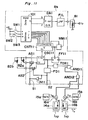
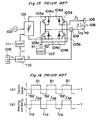
- Fig. 15 shows a power source for an alternating-current arc welding which supplies an alternating-current welding current to a welding load of the alternating-current arc welding by switching an output current outputted from a direct-current power source using a switching device.
- a direct-current power source 101 generates a predetermined output of an alternating-current power source 102, and there is provided a switching circuit comprising switching transistors 103a to 103d and diodes 104a to 104d.
- the switching transistors 103a to 103d are electrically connected in a bridge form to each other, and the diodes 104a to 104d are electrically connected in parallel to respective transistors 103a to 103d, respectively, so that the conducting direction of each of the diodes 104a to 104b becomes opposite to that of each of the transistors 103a to 103d.
- a welding electrode 105 for an alternating-current arc welding and a work 106 are connected to the direct-current power source 101 through the switching circuit. Further, there is provided a polarity switching controller 107 for controlling a pair of transistors 103a and 103b and a pair of transistors 103c and 103d so as to alternately turn on and off a pair of transistors 103a and 103b and a pair of transistors 103c and 103d.
- a welding current setting circuit 108 for generating a reference signal Ir corresponding to a set welding current and outputting it to an error amplifier 110, and a welding current detector 109 for detecting a welding current Io flowing between the work 106 and the switching circuit and outputting a detection signal If corresponding to the welding current Io.
- the reference signal Ir outputted from the welding current setting circuit 108 is compared with the detection signal If outputted from the welding current detector 109, and then, the controller 111 controls the output voltage outputted from the direct-current power source 101 in such a direction that the difference signal ⁇ I decreases toward zero so as to keep a constant output voltage outputted from the direct-current power source 101, namely, so that the welding current Io corresponds to the reference signal Ir.
- control signals S1 and S2 are alternately supplied to either a pair of transistors 103a and 103b or a pair of transistors 103c and 103d, so that a pair of transistors 103a and 103b is turned on while a pair of transistors 103c and 103d is turned off for a time interval, and a pair of transistors 103a and 103b is turned off while a pair of transistors 103c and 103d is turned on for another time interval.
- a welding current Isp having a straight polarity flows in a direction from the work 106 toward the welding electrode 105.
- a welding current Irp having a reverse polarity flows in a direction from the welding electrode 105 toward the work 106.
- Fig. 16 is a timing chart of the control signals S1 and S2 and the welding current Io.
- the welding current Io becomes an alternating-current of a rectangular pulse wave changing according to turning on and off of the control signals S1 and S2.
- the welding current Io steeply changes upon switching the polarity of the voltage supplied to the welding electrode 105 and the work 106, and then, there is such an advantage that it becomes easy to perform refiring of the arc which has been extinguished once.
- the output voltage applied to the welding electrode 105 and the work 106 becomes substantially a complete rectangular pulse wave, the arc is extinguished rapidly and the arc is reproduced rapidly upon switching the polarity, and also the change in the welding current Io is relatively large. Therefore, a large arc sounds so that an extremely large noise occurs, resulting in deterioration in the working environment.
- the welding current Io changes rapidly, the arc force changes rapidly. Therefore, a molten metal of the work 106 vibrates violently, and then, it is difficult for the above-mentioned power source to be applied to a precise welding.
- An essential object of the present invention is to provide a power source apparatus for an alternating-current arc welding capable of supplying an alternating-current welding current having any waveform to a welding load without any large noise upon performing the alternating-current arc welding.
- Another object of the present invention is to provide a power source apparatus for an alternating-current arc welding capable of supplying an alternating-current welding current having any waveform to a welding load without any vibration of the molten metal of the work upon performing the alternating-current arc welding.
- a further object of the present invention is to provide a power source apparatus for an alternating-current arc welding which is applicable to a precise alternating-current arc welding.
- a power source apparatus for an alternating-current arc welding comprising: reference signal generating means for periodically generating a reference signal having a predetermined waveform; direct-current power source means for outputting a current periodically changing in response to said reference signal, said outputted current having a waveform corresponding to that of said reference signal; and switching means for supplying an alternating-current welding current to a welding load so as to sequentially change the polarity of said welding current from a straight polarity to a reverse polarity and from the reverse polarity to the straight polarity in synchronization with said reference signal by switching said current outputted from said power source in response to said reference signal.
- the above-mentioned power source apparatus further comprises: current detecting means for detecting said welding current to be supplied to said welding load and outputting a detection signal corresponding to said detected welding current; and difference signal generating means for generating a difference signal corresponding to a difference between said reference signal and said detection signal, wherein said direct-current power source means outputs said current periodically changing in response to said difference signal.
- said reference signal of one period outputted from said signal generating means is composed of a first signal for a first time interval and a second signal for a second time interval which are continuously outputted, said first signal gradually increases at the beginning of said first time interval and said first signal gradually decreases at the end of said first time interval, and said second signal gradually increases at the beginning of said second time interval and said second signal gradually decreases at the end of said second time interval.
- said direct-current power source means comprises: first rectifying means for rectifying an alternating-current outputted from an external alternating-current power source; a pulse width modulator for generating control signals, each control signal having a width modulated in response to said reference signal; a high frequency invertor for converting the output of said first rectifying means into a high frequency alternating-current in response to said control signal generated by said pulse width modulator; a transformer for converting the high frequency alternating-current voltage outputted from said high frequency invertor into a predetermined voltage suitable for said alternating-current arc welding; and second rectifying means for rectifying said voltage outputted from said transformer and said rectified voltage to said switching means.
- said reference signal generating means comprises: a bipolar signal generator for generating a bipolar signal periodically changing, said bipolar signal having a predetermined waveform; a direct-current signal generator for generating a variable direct-current signal having either a positive polarity or a negative polarity, said direct-current signal generator including an adjusting device for adjusting the level of said variable direct-current signal so as to adjust a ratio of a time interval of a positive polarity of said welding current to that of a negative polarity thereof; an adder for adding said bipolar signal generated by said bipolar signal generator and said direct-current signal outputted from said direct-current signal generator, and outputting a signal of said addition result; and a rectifier circuit for full-wave rectifying said signal outputted from said adder and outputting a direct-current periodically changing as said reference signal.
- said reference signal generating means comprises: a bipolar signal generator for generating a bipolar signal periodically changing, said bipolar signal having a predetermined waveform; a first direct-current signal generator for generating a variable direct-current signal having either a positive polarity or a negative polarity, said first direct-current signal generator including an adjusting device for adjusting the level of said variable direct-current signal so as to adjust a ratio of a time interval of a positive polarity of said welding current to that of a negative polarity thereof; a first adder for adding said bipolar signal generated by said bipolar signal generator and said direct-current signal outputted from said direct-current signal generator, and outputting a signal of said addition result; a rectifier circuit for full-wave rectifying said signal outputted from said first adder; a second direct-current signal generator for generating a variable direct-current signal having either a positive polarity or a negative polarity, said second
- said reference signal generating means comprises: a bipolar signal generator for generating a bipolar signal periodically changing, said bipolar signal having a predetermined waveform; a first amplifier for amplifying said bipolar signal generated by said bipolar signal generator with a variable gain, said first amplifier including an adjusting device for adjusting said gain thereof; a second amplifier for amplifying said bipolar signal outputted from said bipolar signal generator with a variable gain, said second amplifier including another adjusting device for adjusting said gain thereof; and a third amplifier for adding the outputs of said first and second amplifiers with the same polarities as each other, amplifying said added signal and outputting an amplified signal as the reference signal, and a ratio of a time interval of a positive polarity of said welding current to that of a negative polarity thereof is adjusted by adjusting said gains of said first and second amplifiers using said adjusting devices.
- said reference signal generating means comprises: a bipolar signal generator for generating a bipolar signal periodically changing, said bipolar signal having a predetermined waveform; a first amplifier for amplifying said bipolar signal generated by said bipolar signal generator with a variable gain, said first amplifier including an adjusting device for adjusting said gain thereof; a second amplifier for amplifying said bipolar signal outputted from said bipolar signal generator with a variable gain, said second amplifier including another adjusting device for adjusting said gain thereof; a direct-current signal generator for generating a variable direct-current signal, said direct-current signal generator including an adjusting device for adjusting the level of said variable direct-current signal so as to adjust the minimum value of said welding current; and a third amplifier for adding the outputs of said first and second amplifiers and said direct-current signal generator with the same polarities as each other, amplifying said added signal and outputting an amplified signal as the reference signal, and a ratio of a
- said reference signal generating means comprises: a periodic signal generator for generating a periodic signal periodically changing, said periodic signal having a predetermined waveform; and an amplifier for amplifying said periodic signal generated by said periodic signal generator with a gain of: (an average value of a rectangular wave signal when the waveform of said periodic signal is the rectangular wave signal) / (an average value of a periodic signal of any waveform having a peak value which is equal to the instantaneous value of the rectangular wave signal), and outputting the amplified signal as the reference signal.
- said reference signal generating means comprises: a periodic signal generator for generating a periodic signal periodically changing, said periodic signal having a predetermined waveform; and an amplifier for amplifying said periodic signal generated by said periodic signal generator with a gain of: (an effective value of a rectangular wave signal when the waveform of said periodic signal is the rectangular wave signal) / (an effective value of a periodic signal of any waveform having a peak value which is equal to the instantaneous value of the rectangular wave signal), and outputting the amplified signal as the reference signal.
- said reference signal generating means comprises: a current detecting circuit for detecting an average value of said welding current to be supplied to said welding load and outputting a detection signal corresponding to said detected average value thereof; a current setting means for setting an average value of a welding current to be set and outputting a setting signal corresponding to said average value thereof; an error amplifier for subtracting said setting signal outputted from said current setting means, from said detection signal outputted from said current detecting circuit, and outputting a difference signal corresponding to a difference between these signals; and a signal generator for generating a periodic signal periodically changing, said periodic signal having a predetermined waveform and a peak value determined by said difference signal outputted from said error amplifier.
- said reference signal generating means comprises: a current detecting circuit for detecting an effective value of said welding current to be supplied to said welding load and outputting a detection signal corresponding to said detected effective value thereof; a current setting means for setting an effective value of a welding current to be set and outputting a setting signal corresponding to said effective value thereof; an error amplifier for subtracting said setting signal outputted from said current setting means, from said detection signal outputted from said current detecting circuit, and outputting a difference signal corresponding to a difference between these signals; and a signal generator for generating a periodic signal periodically changing, said periodic signal having a predetermined waveform and a peak value determined by said difference signal outputted from said error amplifier.
- said reference signal generating means comprises: storage means for storing a group of digital data of said reference signal; reading means for reading a group of said digital data stored by said storage means sequentially in a predetermined order with a predetermined speed, repeatedly, a time interval from the beginning of reading a group of said digital data to the end thereof corresponding to one period of said welding current to be supplied to said welding load; converting means for converting said digital data read by said reading means into an analogue signal; and low-pass filter means for rejecting a high frequency component of said analogue signal outputted from said converting means and outputting a filtered analogue signal as the reference signal to said direct-current power source means.
- the waveform of the welding current can be obtained so that the welding current decreases gradually before and after switching the polarity of the welding current, a noise caused upon extinguishment and reproduction of an alternating-current arc can be lowered, and then, the working environment can be prevented from deteriorating.
- Fig. 1 is a schematic block diagram showing a power source for an alternating-current arc welding of a first preferred embodiment according to the present invention.
- a direct-current power source 1 including a direct-current voltage source generates a predetermined direct-current output voltage from an alternating-current voltage outputted from an alternating-current power source 2 such as a commercial alternating-current power source, and there is provided a switching circuit comprising switching transistors 3a to 3d and diodes 4a to 4d.
- the switching transistors 3a to 3d are electrically connected in a bridge form to each other. Namely, both the collectors of the transistors 3a and 3d are connected to a positive output terminal of the direct-current power source 1, and both the emitters of the transistors 3c and 3b are connected to a negative output terminal of the direct-current power source 1.
- the emitter of the transistor 3a is connected to the collector of the transistor 3c, and the emitter of the transistor 3d is connected to the collector of the transistor 3b.
- the diodes 4a to 4d are electrically connected in parallel to the transistors 3a to 3d, respectively, so that the conducting direction of each of the diodes 4a to 4b becomes opposite to that of each of the transistors 3a to 3d.
- a welding electrode 5 for an welding alternating-current arc welding and a work 6 are connected to the direct-current power source 1 through the switching circuit. Namely, the emitter of the transistor 3d and the collector of the transistor 3b are connected to the welding electrode 5, and the emitter of the transistor 3a and the collector of the transistor 3c are connected to the work 6 through a welding current detector 9 for detecting an alternating-current welding current Io flowing between the welding electrode 5 and the work 6 and outputting to an error amplifier 10 a detection signal If corresponding to an instantaneous value of the welding current Io to be supplied to the welding electrode 5 and the work 6.
- a switching controller 7 for controlling a pair of transistors 3a and 3b and a pair of transistors 3c and 3d by alternately outputting control signals S1 and S2 according to a control signal S0 outputted from a control signal generator 12, so as to alternately turn on and off a pair of transistors 3a and 3b and a pair of transistors 3c and 3d.
- control signal S1 is applied to respective bases of the transistors 3a and 3b
- the control signal S2 is applied to respective bases of the transistors 3c and 3d.
- a reference signal generator 8 for generating a reference signal Ir corresponding to a set welding current and outputting it to the error amplifier 10 and the control signal generator 12, wherein the reference signal generator 8 comprises a welding current setting circuit 81 for setting a welding current Io and outputting a signal corresponding to the set welding current to a signal generator 83, a time interval setting circuit 82 for setting a time interval of the straight polarity of the welding current Io and a time interval of the reverse polarity thereof and outputting signals corresponding to the set time intervals to the signal generator 83, and the signal generator 83 for generating a reference signal Ir in response to the signals outputted from the setting circuits 81 and 82.
- the control signal generator 12 generates a control signal S0 synchronizing to a pulsating period of the reference signal Ir in response to the reference signal Ir, and outputs it to the switching controller 7. It is to be noted that the control signal S0 becomes a timing signal for generating the control signals S1 and S2 in the switching controller 7.
- an auxiliary circuit 13 for applying a relatively high voltage in synchronization to switching the polarity of the output voltage to be applied to the welding electrode 5 and the work 6 in order to enable refiring of the arc which has been extinguished once upon switching the polarity of the output voltage to be applied to the welding load circuit.
- the auxiliary circuit 13 is electrically connected between the welding electrode 5 and the work 6.
- the reference signal Ir outputted from the reference signal generator 8 becomes a minimum value Irmin at timings of the beginning and the end of each of a time interval Tsp of the straight polarity and a time interval Trp of the reverse polarity, and the reference signal Ir becomes a maximum value Irmax at a middle timing of each of the time interval Tsp of the straight polarity and the time interval Trp of the reverse polarity.
- Fig. 2 is a timing chart showing the reference signal Ir outputted form the reference signal generator 8, the control signal S0 outputted from the control signal generator 12, the control signals S1 and S2 outputted from the switching controller 7, and the welding current Io.
- the output current outputted from the direct-current power source 1 is determined in response to the reference signal Ir.
- the welding current Io has a current waveform corresponding to the reference signal Ir periodically changing between the maximum value Irmax and the minimum value Irmin, and the switching controller 7 generates the control signals S1 and S2, alternately, in synchronization to a period of the minimum value Irmin of the welding current Io which changes periodically. Therefore, as shown in Fig. 2, the welding current Io becomes an alternating-current whose polarity is inverted at timings of the minimum welding current
- the reference signal Ir gradually increases at the beginning of the time interval of the straight polarity thereof and gradually decreases at the end thereof, and the reference signal Ir gradually increases at the beginning of the time interval of the reverse polarity thereof and gradually decreases at the end thereof. Since the welding current Io changes corresponding to the reference signal Ir as described above, the welding current Io gradually increases at the beginning of the time interval of the straight polarity thereof and gradually decreases at the end thereof, and also, the welding current Io gradually decreases at the beginning of the time interval of the reverse polarity thereof and gradually increases at the end thereof.
- the minimum value Irmin of the reference signal Ir at the timing when the polarity of the output voltage is reversed is properly predetermined, the above-mentioned rapid change in the arc voltage is prevented, and then, the noise decreases. Further, since the arc force changes gradually accompanying with this, the molten metal of the work 6 can be prevented from vibrating violently.
- the maximum value of the reference signal Ir for the time interval Tsp is substantially the same as that for the time interval Trp.
- the maximum value Irmax of the reference signal Ir for the time interval Tsp may be substantially different from that for the time interval Trp.
- the waveform of the reference signal Ir for the time interval Tsp may be substantially different from that for the time interval Trp.
- any direct-current power source capable of determining the output current according to the reference signal Ir, such as a power source for controlling a phase of an alternating-current outputted from an alternating-current power source using a thyristor so as to control the output current, or a power source for rectifying an alternating-current outputted from an alternating-current power source and adjusting the output current using analogue transistors or a chopper circuit.
- a power source comprising a rectifier circuit for rectifying an alternating-current and outputting a direct-current, a high frequency invertor for converting the direct-current into a high frequency alternating-current, and another rectifier circuit for rectifying the high frequency alternating-current and outputting a direct-current.
- Fig. 3 is a schematic block diagram showing a power source for an alternating-current arc welding of a second preferred embodiment according to the present invention, wherein the power source is characterized in that a direct-current power source 1 comprises a high frequency invertor INV1. As is apparent from Fig. 3, the power source is constituted in a manner similar to that shown in Fig. 1, except for the direct-current power source 1.
- the direct-current power source 1 comprises a first rectifier circuit REC1 for rectifying an alternating-current supplied from the alternating-current power source 2 such as a commercial power source, a high frequency invertor INV1 for converting the output current outputted from the rectifier circuit REC1 into a high frequency alternating-current, a transformer T1 for converting the high frequency alternating-current voltage outputted from the inverter INV1 into an alternating-current voltage suitable for an alternating-current arc welding, and a second rectifier circuit REC2 for rectifying the alternating-current outputted from the transformer T1 and outputting the rectified current to the above-mentioned switching circuit.
- a first rectifier circuit REC1 for rectifying an alternating-current supplied from the alternating-current power source 2 such as a commercial power source
- a high frequency invertor INV1 for converting the output current outputted from the rectifier circuit REC1 into a high frequency alternating-current
- a transformer T1 for converting the high frequency alternating
- the invertor INV1 comprises four switching transistors 201 to 204 which are electrically connected in a bridge form.
- TI denotes input terminals of the invertors INV1 and TO denotes output terminals thereof.
- a pulse switching control signal S11 outputted from an invertor controller 11a is inputted to respective bases of the transistors 201 and 202, and a pulse switching control signal S12 outputted from the invertor controller 11a is inputted to respective bases of the transistors 203 and 204.
- the output current outputted from the invertor INV1 is adjusted by the invertor controller 11a composed of a pulse width modulator for generating the pulse switching signals S11 and S12, each signal having a predetermined frequency and a pulse width which is modulated corresponding to the difference signal ⁇ I, in response to the difference signal ⁇ I outputted from the error amplifier 10.
- the pulse width modulator of the invertor controller 11a is preferably constituted by a digital integrated circuit of model ⁇ PC494 manufactured by NEC Corp..
- the operation frequency of the invertor INV1 or the operation frequency of the invertor controller 11a is set so as to be sufficiently higher than the switching frequency of the above-mentioned switching circuit composed of the transistors 3a to 3d.
- the above operation frequency thereof is set at a high frequency higher than 10 KHz, the reference signal Ir outputted from the reference signal generator 8 can be faithfully reproduced corresponding to the pulsating instantaneous value of the welding current Io which changes periodically.
- a hard oxide film is formed on a surface of the work 6 of a material such as an aluminium or the like.
- a time interval of the reverse polarity while the welding electrode 5 has a potential of a positive polarity and the work 6 has a potential of a negative polarity has an important role.
- a range for removing the oxide film (referred to as a cleaning width hereinafter) is determined by an electric power which is supplied to the welding load circuit for the time interval of the reverse polarity.
- the cleaning width so as to be larger than a width of a produced bead by a value larger than a predetermined value
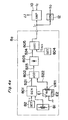
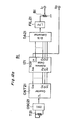
- Fig. 4a is a schematic block diagram showing a reference signal generator 8a to be used for the power source of the preferred embodiments.
- the reference signal generator 8a is characterized in that the above-mentioned RP power ratio can be adjusted and the above-mentioned cleaning width can be adjusted.
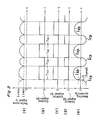
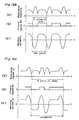
- Fig. 4b is a timing chart of respective signals S21 to S24, a reference signal Ir and a control signal S0 shown in Fig. 4a.
- a signal generator 801 generates a bipolar signal S21 of a predetermined waveform having a period T corresponding to a signal outputted from the period setting circuit 82 and a peak value predetermined by the welding current setting circuit 81 composed of a variable resistor, and outputs the bipolar signal S21 to a first input terminal of an adder 802.
- direct-current power sources E1 and E2 for respectively outputting output voltages V E1 and V E2 are connected in series, and the connecting point between the negative output terminal of the power sources E1 and the positive output terminal of the power source E2 is connected to ground. Further, both ends of a variable resistor VR1 is connected between the positive output terminal of the power source E1 and the negative output terminal of the power source E2, and a sliding terminal of the variable resistor VR1 is connected to a second input terminal of the adder 802.
- a circuit composed of the direct-current power sources E1 and E2 and the variable resistor VR1 constitutes a direct-current power source for generating a direct-current voltage signal S22 variable between the voltage +V E1 and the voltage -V E2 which acts as an adjusting device for adjusting the ratio of the positive welding current to the negative welding current, such as an RP ratio. Therefore, the circuit composed of the direct-current power sources E1 and E2 and the variable resistor VR1 is referred to as an RP ratio adjusting device hereinafter.
- the adder 802 adds the bipolar signal S21 outputted from the signal generator 801 and the direct-current voltage signal S22 outputted from the RP ratio adjusting device, and outputs to a full-wave rectifier circuit 803 an alternating-current voltage signal S23 of the addition result which is biased toward either the positive voltage side or the negative voltage side as shown in (c) of Fig. 4b.
- the full-wave rectifier circuit 803 rectifies the biased alternating-current signal S23, and outputs the rectified voltage to a first input terminal of an adder 805.
- a minimum welding current setting circuit 804 sets a minimum welding current Imin and outputs a signal corresponding to the minimum welding current Imin to a second input terminal of the adder 805.
- the adder 805 adds the rectified voltage outputted from the full-wave rectifier circuit 803 and the signal outputted from the minimum welding current setting circuit 804, and outputs the reference signal Ir of the addition result to the error amplifier 10 and the control signal generator 12.
- the bipolar signal S21 outputted from the signal generator 801 is added to the direct-current voltage signal S22 outputted from the RP ratio adjusting device by the adder 802, and then, the added signal S23 is rectified by the full-wave rectifier circuit 803, resulting in a pulsating direct-current voltage signal S24, as shown in Fig. 4b.
- the welding current Io becomes too low at a timing of the voltage signal S24 of zero and in the vicinity thereof if the voltage signal S24 is used as the reference signal Ir.
- the alternating-current arc may be cut.
- a direct-current voltage signal corresponding to a minimum welding current Imin necessary for maintaining and reproducing the arc so that the arc can be prevented from being cut is applied to the adder 805 by the minimum welding current setting circuit 804, and then, there is obtained the reference signal Ir of the sum of the voltage signal S24 and the voltage signal outputted from the minimum welding current setting circuit 804.
- the ratio of the positive peak value to the negative peak value of the reference signal Ir for setting the welding current Io can be altered by adjusting the variable resistor VR1.
- a gain-variable amplifier for amplifying the positive signal of the bipolar signal S21
- another gain-variable amplifier for amplifying the negative signal of the bipolar signal S21
- an adder for adding the amplified signals outputted from both the amplifiers so that the amplified signals to be added have the same polarity, namely, after inverting one of the amplified signals.
- a reference signal generator 8b of this type will be described hereinafter.
- Fig. 5a is a schematic block diagram showing the reference signal generator 8b of this type to be used for the power source of the preferred embodiments
- Fig. 5b is a timing chart of respective signals S31 to S33 and the reference signal Ir shown in Fig. 5a.
- the signal generator 801 generates a bipolar signal S31 having a period set by the period setting circuit 82 and a signal level set by the welding current setting circuit 81, and outputs the bipolar signal S31 to an inverted input terminal of an operational amplifier OP1 through an input resistor R1 and to an inverted input terminal of an operational amplifier OP2 through an input resistor R2.
- An amplifier circuit 806 comprises the operational amplifier OP1 having a non-inverted input terminal connected to ground, the input resistor R1, a diode D1 connected between the inverted input terminal and the output terminal of the operational amplifier OP1, a diode D2 for clipping the positive amplified output signal thereof with the diode D1, and a variable resistor VR2 for adjusting a gain G1 of the amplifier circuit 806.
- An amplifier circuit 807 comprises the operational amplifier OP2 having a non-inverted input terminal connected to ground, the input resistor R2, a diode D3 connected between the inverted input terminal and the output terminal of the operational amplifier OP2, a diode D4 for clipping the negative amplified output signal with the diode D3, and a variable resistor VR3 for adjusting a gain G2 of the amplifier circuit 807.
- the positive signal of the bipolar signal S31 is amplified with a gain G1 by the amplifier circuit 806, and then, the amplified signal S32 is outputted to an inverted input terminal of an operational amplifier OP3 through an input resistor R3.
- the negative signal of the bipolar signal S31 is amplified with a gain G2 which is different from the gain G1 by the amplifier circuit 807, and then, the amplified signal S33 is outputted to a non-inverted input terminal of an operational amplifier OP3 through an input resistor R4.
- An amplifier circuit 808 comprises the operational amplifier OP3, the input resistors R3 and R4, an input resistor R7, a resistor R5 connected between the non-inverted input terminal of the operational amplifier OP3 and ground, and a feed back resistor R6 connected between the inverted input terminal and the output terminal of the operational amplifier OP3.
- the amplifier circuit 808 adds and amplifies the amplified signals S32 and S33 and the signal corresponding to the minimum welding current Imin which is outputted from a minimum welding current setting circuit 804 so that all the signals to be added have the same polarities, and outputs the added and amplified signal as the reference signal Ir.
- respective variable resistors VR2 and VR3 of the amplifier circuits 806 and 807 constitute an adjusting device for adjusting the ratio of the positive peak value to the negative peak value of the reference signal Ir.
- One of the variable resistors VR2 and VR3 may be set to a fixed resistor, and another thereof may be set to a semi-fixed resistor. Further, there may be provided a mechanism for interlocking the variable resistors VR2 and VR3 so as to simultaneously adjust both the variable resistors VR2 and VR3, respectively, in directions opposite to each other.
- the welding current Io is often represented by an average value or an effective value.
- the signal generator 801 generates a bipolar signal S31 having a peak level set by the welding current setting circuit 81. Therefore, there is preferably provided a reference signal generator for generating a signal having a peak value in response to data of a specified average value or a specified effective value.
- the level of the welding current can be specified by either an average value or an effective value. Also, even though the waveform of the welding current Io is altered, the same average or effective value as that of the waveform thereof before alteration can be obtained.
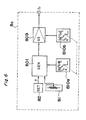
- Fig. 6 is a schematic block diagram showing a reference signal generator 8c of this type to be used for the power source of the preferred embodiments.
- a signal generator 801 comprises a switch 810a for selecting one of signals having various kinds of waveforms, and generates a periodic signal having the selected waveform (referred to as a periodic signal hereinafter) and outputs it as the reference signal Ir through an amplifier 809 whose amplification factors can be altered or switched.
- the amplifier 809 comprises a switch 810b for selecting one of amplification factors G3, which is interlocked with the switch 810a.
- the signal generator 801 when the switch 810a is switched over to a-contact, the signal generator 801 generates a sine wave signal. When the switch 810a is switched over to b-contact, the signal generator 801 generates a triangular wave signal. When the switch 810a is switched over to c-contact, the signal generator 801 generates a rectangular wave signal. Further, when the switch 810b is switched over to a-contact, the amplification factor G3 of the amplifier 809 is set at ⁇ /2. When the switch 810b is switched over to b-contact, the amplification factor G3 of the amplifier 809 is set at two.
- the amplification factor G3 of the amplifier 809 is set at one.
- the average value of the reference signal Ir does not change, resulting in no change in the average value of the welding current Io depending on the waveform thereof.
- the signal generator 801 when the switch 810a is switched over to a-contact, the signal generator 801 generates a sine wave signal. When the switch 810a is switched over to b-contact, the signal generator 801 generates a triangular wave signal. When the switch 810a is switched over to c-contact, the signal generator 801 generates a rectangular wave signal. Further, when the switch 810b is switched over to a-contact, the amplification factor G3 of the amplifier 809 is set at ⁇ 2. When the switch 810b is switched over to b-contact, the amplification factor G3 of the amplifier 809 is set at ⁇ 3.
- the amplification factor G3 of the amplifier 809 is set at one.
- the effective value of the reference signal Ir does not change, resulting in no change in the effective value of the welding current Io depending on the waveform thereof.
- the amplification factor G3 of the amplifier 809 when switching both the switches 810a and 810b interlocking them so that the amplification factor G3 thereof becomes: (an average value of a rectangular wave signal when the waveform of the periodic signal is the rectangular wave signal) / (an average value of a periodic signal of any waveform having a peak value which is equal to the instantaneous value of the rectangular wave signal).
- the amplification factor G3 of the amplifier 809 when switching both the switches 810a and 810b interlocking them so that the amplification factor G3 thereof becomes: (an effective value of a rectangular wave signal when the waveform of the periodic signal is the rectangular wave signal) / (an effective value of a periodic signal of any waveform having a peak value which is equal to the instantaneous value of the rectangular wave signal).
- Fig. 7 is a schematic block diagram showing a reference signal generator 8d to be used for the power source of the preferred embodiments.
- the reference signal generator 8d is characterized in generating the reference signal Ir so that the average value of the welding current Io does not change depending on the waveform of the reference signal Ir.
- a welding current setting circuit 811 for setting an average value Isa of the welding current Io and outputting a signal corresponding to the set average value Isa thereof to an error amplifier 813, and an average value calculator 812 for calculating the average value of the welding current Io in response to the detection signal If outputted from the welding current detector 9 and outputting a signal corresponding to the calculated average value Ia to the error amplifier 813.
- the integrator 814 integrates the difference signal ⁇ I and outputs the integrated signal corresponding to a peak value of the welding current Io to be set, to the signal generator 801.
- the signal generator 801 generates a periodic signal, having a peak value set by the signal outputted from the integrator 814, and a time interval Tsp of the straight polarity and a time interval Trp of the reverse polarity which are set by the time interval setting circuit 82.
- the reference signal Ir is generated so that the average value of the welding current Io coincides with the average value Isa which is set by the welding current setting circuit 811. Therefore, even though the waveform of the reference signal Ir generated by the signal generator 801 is altered to any waveform, the average value of the welding current Io which changes periodically does not change.
- the average value calculator 812 calculates the average value Ia of the welding current Io in response to the detection signal If outputted from the welding current detector 9.
- the average value calculator 812 may calculates the average value Ia thereof in response to the reference signal Ir outputted from the signal generator 801.
- an effective value calculator for calculating the effective value of the welding current Io in response to the detection signal If may be used in stead of the average value calculator 812.
- the signal generator 801 thereof there can be used a circuit for dividing an alternating-current voltage outputted from a commercial alternating-current power source and generating a sine wave signal, or an oscillator which are well known to those skilled in the art.
- the following circuit may be used.
- data of the instantaneous values of respective waveforms of the reference signal Ir are stored in a ROM as a group of digital data, and then, these data are read out from the ROM so as to obtain data of one period thereof. Then, the length of one period is determined by the speed at which a group of data are read out from the ROM.
- Fig. 8 is a schematic block diagram showing a reference signal generator 8e to be used for the power source of the preferred embodiments.
- a pulse oscillator OSC1 generates a pulse signal having a frequency set by a variable resistor 82a while a low level signal is inputted from an output terminal Q of an R-S type flip-flop FF1 to a control terminal R thereof, and outputs the generated pulse signal from an outputs terminal thereof to an input terminal CL of a counter CNT1.
- a pulse oscillator OSC2 generates a pulse signal having a frequency set by a variable resistor 82b while a low level signal is inputted from an output terminal Q of an R-S type flip-flop FF2 to a control terminal R thereof, and outputs the generated pulse signal from an outputs terminal thereof to an input terminal CL of a counter CNT2.
- each of the flip-flops FF1 and FF2 When each of the flip-flops FF1 and FF2 is set at a leading edge of a signal inputted to a set terminal S thereof, the signal outputted from the output terminal Q thereof is inverted from the high level to the low level. Further, when each of the flip-flops FF1 and FF2 is reset at a leading edge of a signal inputted to a reset terminal R thereof, the signal outputted from the output terminal Q is inverted from the low level to the high level.
- the counters CNT1 counts a pulse signal outputted from the output terminal OUT of the pulse oscillator OSC1, and then, outputs data of the count value from the output terminals Q0 to Q8 thereof to respective first input terminals of OR gates OR1 to OR8 and a monostable multivibrator MM1.
- the counters CNT2 counts a pulse signal outputted from the output terminal OUT of the pulse oscillator OSC2, and then, outputs data of the count value from the output terminals Q0 to Q8 thereof to respective second input terminals of the OR gates OR1 to OR8 and a monostable multivibrator MM1.
- the monostable multivibrator MM1 is triggered in response to a signal outputted from the output terminal Q8 of the counter CNT1, and a signal outputted from the output terminal of the monostable multivibrator MM1 is outputted to respective reset terminals R of the counter CNT1 and the flip-flop FF1 and the set terminal S of the flip-flop FF2.
- the monostable multivibrator MM2 is triggered in response to a signal outputted from the output terminal Q8 of the counter CNT2, and a signal outputted from the output terminal of the monostable multivibrator MM2 is outputted to respective reset terminals R of the counter CNT2 and the flip-flop FF2 and the set terminal S of the flip-flop FF1.
- the output terminals of the OR gates OR1 to OR8 are respectively connected to address terminals 0 to 7 of a ROM 101 for storing plural groups of data of reference signals Ir which are predetermined as plural tables.
- the address terminals 8 to 10 of the ROM 101 are respectively connected to a voltage source +E through waveform selection switches SW1 to SW3 for selecting one of the above-mentioned plural tables, or one of three kinds of reference signals Ir.
- the D/A converter DA1 converts data outputted from the ROM 101 into an analogue signal, and outputs the converted analogue signal to a variable resistor 81 through a low-pass filter FIL, wherein the low-pass filter FIL is provided for rejecting a high frequency component from the analogue signal outputted from the D/A converter DA1 so as to convert it into an analogue signal which gradually changes.
- the variable resistor 81 is provided for adjusting the signal level of the reference signal Ir to be outputted.
- the pulse oscillator OSC1 when the signal outputted from the output terminal Q of the flip-flop FF1 is inverted from the high level to the low level, the pulse oscillator OSC1 starts in generating a pulse signal having a frequency set by the variable resistor 82a.
- the pulse signal of the pulse oscillator OSC1 is supplied to the input terminal CL of the counter CNT1 and is counted by the counter CNT1, and then, data of the count value are outputted therefrom to the address terminals of the ROM 101 through the OR gates OR1 to OR8.
- the ROM 101 outputs data of the reference signal Ir which is specified by the data outputted from the counter CNT1 among one group of the data of the reference signals Ir which is selected by the waveform selection switches SW1 to SW3, and then, the data outputted from the ROM 101 are converted into an analogue signal by the D/A converter DA1.
- the analogue signal outputted from the D/A converter DA1 changes in a form of steps every time a pulse signal is outputted from the pulse oscillator OSC1.
- the high frequency component of the analogue signal changing in a form of steps is rejected by the low-pass filter FIL so that the analogue signal thereof changes gradually, and the level of the filtered analogue signal is adjusted by the variable resistor 81.
- the level-adjusted analogue signal is outputted as the reference signal Ir for controlling the welding current Io.
- the monostable multivibrator MM1 is triggered, and then, the signal outputted from the monostable multivibrator MM1 becomes the high level for a predetermined time interval.
- the high level output signal of the monostable multivibrator MM1 is inputted to the reset terminal R of the counter CNT1, and then, the counter CNT1 is reset. Simultaneously, the high level output signal of the monostable multivibrator MM1 is inputted to the reset terminal R of the flip-flop FF1 and the set terminal S of the flip-flop FF2.
- the flip-flop FF1 is reset so that the signal outputted from the output terminal Q thereof is inverted from the low level to the high level, and then, the pulse oscillator OSC1 stops generating the pulse signal.
- the flip-flop FF2 in response to the high level signal of the monostable multivibrator MM1, the flip-flop FF2 is set so that the signal outputted from the output terminal Q thereof is inverted from the high level to the low level, and then, the pulse oscillator OSC2 starts in generating a pulse signal having a frequency set by the variable resistor 82b.
- the pulse signal outputted from the pulse oscillator OSC2 is counted by the counter CNT2, and data of the count value of the counter CNT2 are outputted to the address terminals of the ROM 101 through the OR gates OR1 to OR8.
- the ROM 101 outputs data of the reference signal Ir which is specified by the data outputted from the counter CNT2 among one group of the data of the reference signals Ir which is selected by the waveform selection switches SW1 to SW3, and then, the data outputted from the ROM 101 are outputted through the D/A converter DA1 and the low-pass filter FIL as the reference signal Ir which changes gradually.
- counting of the counter CNT2 is performed every time a pulse signal is outputted from the pulse oscillator OSC2, and then, the reference signal Ir changes.
- the monostable multivibrator MM2 is triggered, and then, the signal outputted from the monostable multivibrator MM2 becomes the high level for a predetermined time interval. Then, the counter CNT2 and the flip-flop FF2 are reset, and also the flip-flop FF1 is set again, resulting in the start state of this process of the reference signal generator 8e.
- a time interval from a timing when the output signal Q of the flip-flop FF1 is inverted from the high level to the low level to a timing when it returned to the high level again, or a time interval while the pulse oscillator OSC1 generates the pulse signal corresponds to the time interval of the straight polarity.
- a time interval from a timing when the output signal Q of the flip-flop FF2 is inverted from the high level to the low level to a timing when it is returned to the high level again corresponds to the time interval of the reverse polarity. Therefore, the output signal Q of the flip-flop FF1 can be used as the polarity switching control signal S2 for representing the time interval of the reverse polarity shown in Figs. 1 and 3.
- the output signal Q of the flip-flop FF2 can be used as the polarity switching control signal S1 for representing the time interval of the straight polarity shown in Figs. 1 and 3.
- an output signal Q of the flip-flop FF1 may be used as the control signal S1
- an output signal Q of the flip-flop FF2 may be used as the control signal S2.
- the inverted signal may be used as the control signal S1.
- the inverted signal may be used as the control signal S2.
- the variable resistor 82a is provided for setting a frequency of the pulse signal generated by the pulse oscillator OSC1, and the output signal Q8 of the counter CNT1 becomes the high level when the counter CNT1 has counted a predetermined number of pulse signals. Therefore, as the frequency of the pulse signal is set at a higher value, the time interval until the output signal Q8 thereof becomes the high level becomes shorter. On the other hand, as the frequency of the pulse signal is set at a lower value, the time interval thereof becomes longer. Accordingly, the variable resistor 82a is used as an adjusting device for setting the length of the time interval of the straight polarity of the welding current Io. On the other hand, the variable resistor 82b is used as an adjusting device for setting the length of the time interval of the reverse polarity of the welding current Io.
- variable resistors 82a and 82b may be set to a fixed resistor. Further, both the variable resistors 82a and 82b may be interlocked so that the resistance of the variable resistor 82a changes in a changing direction opposite to that of the resistance of the variable resistor 82b.
- variable resistor 81 corresponds to the welding current setting circuit 81 shown in the preferred embodiment of Fig. 1.
- control signal generator 12 and the switching controller 7 can be omitted since the control signals S1 and S2 are outputted from the flip-flops FF2 and FF1, respectively.
- the counters CNT1 and CNT2 each having the output terminals Q0 to Q8 of nine bits are used.
- the bit number of the output terminals of each of the counters CNT1 and CNT2 becomes smaller, the height of each changing step of the digital data of the reference signal Ir becomes larger, resulting in deterioration in the waveform of the reference signal Ir.
- the bit number of the output terminals of each of the counters CNT1 and CNT2 becomes larger, the height of each changing step of the digital data of the reference signal Ir becomes smaller, resulting in the reference signal Ir which changes more gradually. In this case, there is such an disadvantage that the necessary memory capacity of the ROM 101 becomes larger.
- the waveform selection switches SW1 to SW3 are switched every half-wave of the reference signal Ir or the welding current Io.
- the high level output signal of the monostable multivibrator MM2 is applied to the set terminal S of the flip-flop FF1 so as to set flip-flop FF1
- the high level output signal of the monostable multivibrator MM1 is applied to the set terminal S of the flip-flop FF2 so as to set the flip-flop FF2.
- the present invention is limited to this.
- the output signal Q of the flip-flop FF1 may be applied to the set terminal S of the flip-flop FF2
- the output signal Q of the flip-flop FF2 may be applied to the set terminal S of the flip-flop FF1.
- Fig. 9 is a schematic block diagram showing a reference signal generator 8f of another type to be used for the power source of the preferred embodiments.
- the same components as those shown in Fig. 8 are denoted by the same numerals as those shown in Fig. 8.
- the reference signal generator 8f is characterized in that there is provided two AND gates AND1 and AND2 and two invertors IN1 and IN2, and further, there is provided two current sensors 14a and 14b, two current setting circuits 15a and 15b, and two comparators 16a and 16b. The different points between the reference signal generators 8e and 8f will be described below.
- Each of the current sensors 14a and 14b is preferably composed of a current transformer and a half-wave rectifier of a diode.
- the current sensor 14a detects the welding current Isp having a straight polarity supplied to the welding electrode 5 and the work 6, and outputs a signal corresponding to the above welding current Isp.
- the current sensor 14b detects the welding current Irp having a reverse polarity supplied thereto, and outputs a signal corresponding to the above welding current Irp.
- the current setting circuit 15a is provided for setting a welding current value of the straight polarity, and outputs a reference signal Vsp corresponding to the set welding current value of the straight polarity to the comparator 16a.
- the current setting circuit 15b is provided for setting a welding current value of the reverse polarity, and outputs a reference signal Vrp corresponding to the set welding current value of the reverse polarity to the comparator 16b.
- the comparator 16a compares the signal outputted from the current sensor 14a with the reference signal Vsp outputted from the current setting circuit 15a. Then, if Isp ⁇ Vsp, the comparator 16a outputs a high level signal to the first input terminal of the AND gate AND1. On the other hand, if Isp ⁇ Vsp, the comparator 16a outputs a low level signal thereto. Further, the comparator 16b compares the signal outputted from the current sensor 14b with the reference signal Vrp outputted from the current setting circuit 15b. Then, if Irp ⁇ Vrp, the comparator 16b outputs a high level signal to the first input terminal of the AND gate AND2. On the other hand, if Irp ⁇ Vrp, the comparator 16b outputs a low level signal thereto.
- the output signal Q of the flip-flop FF1 is inputted to the second input terminal of the AND gate AND1, and also is outputted through an invertor IN1 as the control signal S1.
- the output signal Q of the flip-flop FF2 is inputted to the second input terminal of the AND gate AND2, and also is outputted through an invertor IN2 as the control signal S2. Further, when both signals inputted to the input terminals of the AND gate AND1 become the high level, the AND gate AND1 outputs a high level signal to the set terminal S of the flip-flop FF2. Otherwise, the AND gate AND1 outputs a low level signal thereto.
- the control signal S1 for representing the time interval of the straight polarity which is obtained after inverting the output signal Q of the flip-flop FF1 is inverted from the high level to the low level, however, the welding current Isp of the straight polarity can not be zero soon since there is an inductance in a welding load circuit including the welding electrode 5 and the work 6. At that time, the welding current Isp decreases according to the time constant of the welding load circuit thereof.
- the welding current Isp is detected as described above, and thereafter, when Isp ⁇ Vsp, the AND gate AND1 is opened so that the high level signal is applied to the set terminal S of the flip-flop FF2. Then, the flip-flop FF2 is set so that the output signal Q thereof is inverted from the high level to the low level, and then, the pulse oscillator OSC2 starts in generating the pulse signal so that the control signal S2 for representing the time interval of the reverse polarity and the reference signal Ir are outputted. At the end of the time interval of the reverse polarity, the time interval of the straight polarity is not started until Irp ⁇ Vrp.
- the above-mentioned switching circuit operates so that a welding current Io having an opposite polarity flows.
- the output signal Q of the flip-flop FF1 or the output signal Q of the flip-flop FF2 is preferably used as the control signal S1
- the output signal Q of the flip-flop FF2 or the output signal Q of the flip-flop FF1 is preferably used as the control signal S2.
- the pulse oscillators OSC1 and OSC2 for respective time intervals of the straight polarity and the reverse polarity, there is provided the pulse oscillators OSC1 and OSC2, the flip-flops FF1 and FF2, the counters CNT1 and CNT2, and the monostable multivibrators MM1 and MM2, and then, the control signals S1 and S2 are obtained from two systems corresponding to respective time intervals.
- the present invention is not limited to this, the following reference signal generators 8g and 8h shown in Figs. 10 and 11 may be used.
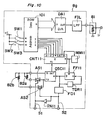
- Fig. 10 is a schematic block diagram showing the reference signal generator 8g of this type to be used for the power source of the preferred embodiments.
- the same components as those shown in Figs. 8 and 9 are denoted by the same numerals as those shown in Figs. 8 and 9.
- a pulse oscillator OSC11 which acts in a manner similar to that of each of the pulse oscillators OSC1 and OSC2, a flip-flop FF11 which acts in a manner similar to that of each of the flip-flops FF1 and FF2, a counter CNT11 which acts in a manner similar to that of each of the counters CNT1 and CNT2, and a monostable multivibrator MM11 which acts in a manner similar to that of each of the monostable multivibrators MM1 and MM2.
- the ROM 101, the waveform selection switches SW1 to SW3, the D/A converter DA1 and the low-pass filter FIL are electrically connected in a manner similar to that of those shown in Figs. 8 and 9.
- Respective one ends of the variable resistors 82a and 82b are connected to the frequency control terminal T1 of the pulse oscillator OSC11. Another end of the variable resistor 82a is connected through an analogue switch AS1 to the frequency control terminal T2 of the pulse oscillator OSC11, and another end of the variable resistor 82b is connected through an analogue switch AS2 to the frequency control terminal T2 of the pulse oscillator OSC11. There is provided a timer TDR1 for counting a predetermined reset time of the counter CNT11, which is preferably preset at about several microseconds.
- the timer TDR1 In response to the output signal Q of the flip-flop FF11, the timer TDR1 starts in counting the predetermined reset time at a leading edge of the output signal Q thereof, and thereafter, when counting thereof is completed, the timer TDR1 outputs the high level signal to the set terminal S of the flip-flop FF11.
- the flip-flop FF11 outputs the output signal Q to the reset terminal R of the pulse oscillator OSC11, the timer TDR1 and a 1/2 frequency divider FD1.
- the frequency divider FD1 divides the frequency of the output signal Q of the flip-flop FF11 by two, namely, converts the output signal Q of the flip-flop FF11 into a pulse signal so that the frequency of the converted pulse signal becomes half the frequency of the output signal Q thereof, and outputs the converted signal to the above-mentioned switching circuit as the control signal S2, to the control terminal of the analogue switch AS2.
- the frequency divider FD1 outputs the converted signal through the control terminal of the analogue switch AS1, and to the above-mentioned switching circuit as the control signal S1.
- the pulse oscillator OSC11 generates a pulse signal having a frequency set by a variable resistor 82a or 82b. Namely, when the analogue switch AS1 is closed while the control signal S1 becomes the high level, the frequency of the pulse oscillator OSC11 is set by the variable resistor 82a. On the other hand, when the analogue switch AS2 is closed while the control signal S2 becomes the high level, the frequency of the pulse oscillator OSC11 is set by the variable resistor 82b.
- the pulse oscillator OSC11 starts in generating a pulse signal, and outputs it to the input terminal CL of the counter CNT11. Then, the pulse signal is counted by the counter CNT11, and then, data of the count value thereof which change every time a pulse signal is outputted are outputted from the output terminals Q0 to Q8 thereof to the address terminals 0 to 7 of the ROM 101.
- the ROM 101 In response to the data of the count value, the ROM 101 outputs data of the reference signal Ir which is specified by the data of the count value among one group of the data of the reference signals Ir which is selected by the waveform selection switches SW1 to SW3.
- the data of the reference signal Ir read out from the ROM 101 are converted into an analogue signal by the D/A converter DA1, and then, the high frequency component of the converted analogue signal is rejected by the low-pass filter FIL so as to output an analogue signal which changes gradually.
- the level of the filtered analogue signal is adjusted by the variable resistor 81, and then, the level-adjusted analogue signal is outputted as the reference signal Ir.
- the monostable multivibrator MM11 is triggered so that the output signal thereof becomes the high level.
- the high level output signal of the monostable multivibrator MM11 is inputted to the reset terminal R of the counter CNT11 so as to reset the counter CNT11, and simultaneously, the high level output signal of the monostable multivibrator MM11 is applied to the reset terminal R of the flip-flop FF11.
- the flip-flop FF11 is reset so that the output signal Q thereof is inverted from the low level to the high level, resulting in stop of oscillation of the pulse generator OSC11.
- the high level output signal Q is applied to the set terminal S of the flip-flop FF11 so as to set the flip-flop FF11 again. Then, the output signal Q of the flip-flop FF11 is inverted from the high level to the low level. Since it is necessary to complete the reset of the counter CNT11 until the output signal Q is inverted from the high level to the low level, the timer TDR1 is set at the predetermined reset time which is slightly longer than a time required for resetting the counter CNT11. Normally, the above predetermined reset time is smaller than about several microseconds.
- the flip-flop FF11 is set by the timer TDR1 so that the output signal Q thereof becomes the low level
- the pulse oscillator OSC11 starts in generating a pulse signal again, and then, the pulse signal is counted by the counter CNT11.
- the data of the count value of the counter CNT11 are outputted to the address terminals of the ROM 101.
- the data of the reference signal Ir are read out from the ROM 101, and then, the reference signal Ir is outputted.
- a time interval from a timing when the output signal Q of the flip-flop FF11 is inverted from the high level to the low level to a timing when it is returned to the high level again, or a time interval while the pulse oscillator OSC11 generates the pulse signal is determined by the variable resistor 82a or 82b which is connected to the frequency control terminals T1 and T2 of the pulse oscillator OSC11.
- the frequency of the output signal Q of the flip-flop FF11 is divided by the frequency divider FD1 so as to output a pulse signal having half the frequency of the output signal Q thereof, as the control signal S2 for representing the time interval of the reverse polarity. Further, the control signal S2 is inverted by the invertor IN11, and then, the inverted signal is outputted as the control signal S1 for representing the time interval of the straight polarity.
- the analogue switches AS1 and AS2 are alternately closed in response to the control signals S1 and S2, thereby selecting one of the variable resistors 82a and 82b for setting the time intervals of the straight polarity and the reverse polarity, respectively.
- Fig. 11 is a schematic block diagram showing the reference signal generator 8h of another type to be used for the power source of the preferred embodiments.
- the same components as those shown in Figs. 8 to 10 are denoted by the same numerals as those shown in Figs. 8 to 10.
- the reference signal generator 8h is a combination of the reference signal generators 8f and 8g shown in Figs. 9 and 10. Namely, there is further provided two AND gates AND11 and AND12 in the reference signal generator 8h in addition to the composition of the reference signal generator 8g, and also there is provided the current sensors 14a and 14b, the current setting circuits 15a and 15b, and the comparators 16a and 16b, which are shown in Fig. 9.
- the signal outputted from the comparator 16a is inputted to the first input terminal of the AND gate AND12, and the signal outputted from the comparator 16b is inputted to the second input terminal of the AND gate AND12.
- the signal outputted from the AND gate AND12 is inputted to the first input terminal of the AND gate AND11.
- the signal outputted from the timer TDR1 is inputted to the second input terminal of the AND gate AND11, and the signal outputted from the AND gate AND11 is inputted to the set terminal S of the flip-flop FF11.
- the monostable multivibrator MM11 when counting of the counter CNT11 is completed and the output signal Q8 thereof becomes the high level, the monostable multivibrator MM11 is triggered so as to reset the flip-flop FF11. Then, the output signal Q of the flip-flop FF11 is inverted from the low level to the high level, resulting in stop of oscillation of the pulse generator OSC11. At that time, the control signal S1 for representing the time interval of the straight polarity is inverted from the high level to the low level.
- the welding current Isp of the straight polarity can not be zero soon since there is an inductance of the welding load circuit including the welding electrode 5 and the work 6, and then, the welding current Isp thereof deceases according to the time constant of the welding load circuit.
- the pulse oscillator OSC11 starts in generating a pulse signal again, and the control signal S2 having the high level for representing the time interval of the reverse polarity is outputted, and the reference signal Ir is outputted from the reference signal generator 8h.
- the time interval of the straight polarity is not started until Irp ⁇ Vrp.
- control signals S1 and S2 which have levels opposite to each other may be generated from the output signal Q of the flip-flop FF11.
- the above-mentioned switching circuit can be operated so that a welding current Io of an opposite polarity flows after the welding current Io certainly becomes the predetermined threshold current.
- reference signal generators 8e to 8h shown in Figs. 8 to 11 can be used as the signal generator 801 shown in Figs. 4a, 5a, 6 and 7.
- Fig. 12a is a schematic block diagram showing a reference signal generator 8i of a further type to be used for the power source of the preferred embodiments.
- the reference signal generator 8i comprises a ROM 121 for storing data of digital signals composed of a reference signal Ir and a polarity switching signal S0. Namely, a predetermined bit of the digital signal is outputted as a polarity switching control signal S0, and the polarity of the output voltage to be outputted from the power source for the alternating-current arc welding is switched depending on the polarity switching control signal S0.
- a pulse oscillator OSC21 for generating a pulse signal having a frequency set by a frequency setting circuit T21 of a variable resistor, and outputs the generated pulse signal to an input terminal CL of a counter CNT21.
- the counter CNT21 counts the number of the pulse signals outputted from the pulse oscillator OSC21, and outputs data of the count value from output terminals Q0 to Qm to address terminals A0 to Am of the ROM 121.
- the ROM 121 stores data D0 to Dn-1 of the reference signal Ir and data Dn of the polarity switching control signal S0 at respective addresses A0 to Am.
- the ROM 121 outputs data D0 to Dn-1 of the above-mentioned digital signal which are stored at the address specified by the data of the count value thereof to an D/A converter DA21, and also outputs data Dn as the polarity switching control signal S0.
- the D/A converter DA21 converts the data D0 to Dn-1 into an analogue signal, and outputs it to a low-pass filter FIL21.
- the low-pass filter FIL21 converts the converted analogue signal outputted from the D/A converter DA21 into an analogue signal which changes gradually, and outputs it to both ends of the variable resistor 81 for adjusting the output level of the reference signal Ir, wherein the variable resistor 81 corresponds to a welding current setting circuit for setting the level of the welding current Io.
- the counter CNT21 has the output terminals Q0 to Q5 of six bits
- the ROM 121 has the data terminals D0 to D7 of eight bits.
- data D8 of "0” is stored at each of binary addresses of "000000” to "001111”
- data D8 of "1” is stored at each of the other binary addresses of "010000" to "111111”.
- the data stored at the address of "000000” to "111111” are read out from the ROM 121, sequentially, by one address.
- the counter CNT21 counts the pulse signal outputted from the pulse oscillator OSC21, repeatedly, with a period which is a time interval while the data stored at the address of "000000" to "111111" are sequentially read out from the ROM 121.
- the polarity switching control signal S0 becomes the low level for a time interval from the beginning of one period to a first quarter of one period, and it becomes the high level for another time interval after the first quarter of one period to the end thereof.
- the ratio of the time interval of the reverse polarity of the welding current Io to the time interval of the straight polarity thereof becomes 1 : 3.
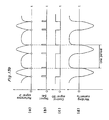
- Fig. 12b is a timing chart of the reference signal Ir, the polarity switching control signal S0 and the welding current Io in this case.
- any instantaneous value of the welding current Io can be obtained by storing data corresponding thereto in the ROM 121, and the lengths of the time intervals of the straight polarity and the reverse polarity can be determined by the most significant bit D8 of the data to be stored in the ROM 121.
- the polarity of the welding current Io is switched once within one period thereof.
- the polarity of the welding current Io can be switched plural times within one period thereof, as shown in Fig. 12c.
- Fig. 13a is a schematic block diagram showing a reference signal generator 8j to be used for the power source of the preferred embodiments.
- the same components as those shown in Fig. 12a are denoted by the same numerals as those shown in Fig. 12a.
- the reference signal generator 8j shown in Fig. 13a is characterized in that there is provided a polarity control data setting circuit DT21, a digital comparator DCP21, and a T type flip-flop FF21 in addition to the composition of the reference signal generator 8i shown in Fig. 12a.
- the polarity control data setting circuit DT21 the same polarity control data for representing switching of the polarity of the welding current Io as those stored in the ROM 121 are set, and the polarity control data are outputted to the digital comparator DCP21.
- data of "00000000” are stored as the polarity control data in the ROM 121 while the polarity control data of "00000000” are set in the polarity control data setting circuit DT21.
- the digital comparator DCP21 compares the data outputted from the ROM 121 with the polarity control data outputted from the polarity control data setting circuit DT21. If these data coincide with each other, the digital comparator DCP21 outputs the high level signal S41 to the flip-flop FF21. Otherwise, the digital comparator DCP21 outputs the low level signal S41 thereto.
- the flip-flop FF21 outputs the high level signal or the low level signal as the polarity switching control signal S0, alternately, every time the signal outputted from the digital comparator DCP21 becomes the high level.
- polarity switching control data corresponding to timings when the polarity of the welding current Io is to be switched
- data other than data of the reference signal Ir For example, when data of the reference signal Ir range from "00000000” to "10000000”, data of "00000000” or "11111111” are stored in the ROM 121 in order to represent the switching of the polarity of the welding current Io, while the same data as these data are set in the polarity switching control data setting circuit DT21.
- the pulse signal outputted from the pulse oscillator OSC21 is counted by the counter CNT21, and data of the count value of the counter CNT21 are outputted to the address terminals of the ROM 121. Thereafter, data stored at an address specified by the count value thereof are read out from the ROM 121, and then, the read data are converted into an analogue signal by the D/A converter DA21.
- the converted analogue signal is converted into an analogue signal which changes gradually by the low-pass filter FIL21, and the level of the analogue signal is adjusted by the level setting circuit 81 of the variable resistor. Thereafter, the level-adjusted analogue signal is outputted as the reference signal Ir.
- the data outputted from the ROM 121 are also inputted to the digital comparator DCP21, and then, they are compared with the polarity control data outputted from the polarity control data setting circuit DT21 by the digital comparator DCP21.
- the output signal of the flip-flop FF21 is inverted, namely, the polarity switching control signal S0 is inverted.
- Fig. 13b is a timing chart of the reference signal Ir, the signal S41, the polarity switching control signal S0 and the welding current Io in the reference signal generator 8j in the case of the polarity control data of "00000000".
- any instantaneous value of the welding current Io can be obtained by storing data corresponding thereto in the ROM 121, and the lengths of the time intervals of the straight polarity and the reverse polarity can be determined by the polarity control data stored in the ROM 121 and set in the polarity control data setting circuit DT21.
- the polarity of the welding current Io is switched once within one period thereof.
- the polarity of the welding current Io can be switched plural times within one period thereof, by storing the polarity control data at plural addresses of the ROM 121.
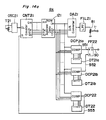
- Fig. 14a is a schematic block diagram showing a reference signal generator 8k of another type to be used for the power source of the preferred embodiments.
- the same components as those shown in Figs. 12a and 13a are denoted by the same numerals as those shown in Figs. 12a and 13a.
- the reference signal generator 8k shown in Fig. 14a there is provided three digital comparators DCP21a, DCP21b and DCP22, and three data setting circuits DT21a, DT21b and DT22, and an R-S type flip-flop FF22 in addition to the composition of the reference signal generator 8i shown in Fig. 12a.
- the reference signal generator 8k is characterized in that polarity control data for representing a timing when the polarity of the welding current Io is switched from the straight polarity to the reverse polarity are different from polarity control data for representing a timing when the polarity of the welding current Io is switched from the reverse polarity to the straight polarity, and these polarity control data are set in the data setting circuits DT21a and DT21b. It is to be noted that data for representing the end of one period are set in the data setting circuit DT22.
- the digital comparators DCP21a and DCP21b respectively connected to the data setting circuits DT21a and DT21b, and the flip-flop FF22 which is reset by the high level signal outputted from the digital comparator DCP21a and is set by the high level signal outputted from the digital comparator DCP21b.
- the above-mentioned two polarity control data are stored in predetermined addresses of the ROM 121, and also the data for representing the end of one period are stored at a predetermined address of the ROM 121.
- the data setting circuit DT22 In order to detect the end of one period, there is provided the data setting circuit DT22 and the digital comparator DCP22.
- the output signal of the digital comparator DCP22 is outputted to the reset terminal R of the counter CNT21.
- the ROM 121 stores data of eight bits, and the data of the reference signal Ir range from "00000000" to "00111111".
- Data of "01111111” are stored at a predetermined address of the ROM 121 and are set in the data setting DT21a as the polarity control data for representing a timing of switching the polarity from the straight polarity to the reverse polarity.
- Data of "10111111” are stored at a predetermined address of the ROM 121 and are set in the data setting DT21b as the polarity control data for representing a timing of switching the polarity from the reverse polarity to the straight polarity.
- Data of "11111111” are stored at a predetermined address of the ROM 121 and are set in the data setting DT22 as the control data for representing a timing of the end of one period.
- a timing when the polarity of the welding current Io is switched from the straight polarity to the reverse polarity, a timing when the polarity thereof is switched from the reverse polarity to the straight polarity and a timing of the end of one period thereof can be set at any time, respectively.
- the welding current Io having any waveform can be obtained.
- the counter CNT21 is reset when the control data for representing the end of one period are read out from the ROM 121, there can be used any relationship between the bit number of the output terminals of the counter CNT21 and the number of the addresses of the ROM 121. Further, since the count value of the counter CNT21 until it is reset can be altered by changing the control data to be set in the data setting circuit DT22, there is such an advantage that there can be altered the precision of the data of the reference signal Ir stored in the ROM 121 and the period of the output voltage to be applied to the welding electrode 5 and the work 6 or the welding current Io.
- each of the data setting circuits for setting predetermined digital data used in the present preferred embodiments is preferably a digital dip switch.
- the controller 11 controls the direct-current power source 1 in response to the difference signal ⁇ I.
- the controller 11 may control the direct-current power source 1 in response to the reference signal Ir.
- the controller 11a controls the invertor INV1 of the direct-current power source 1 in response to the difference signal ⁇ I.
- the controller 11a may control the invertor INV1 of the direct-current power source 1 in response to the reference signal Ir.
- the direct-current power source 1 is a current source.
- the present invention is not limited to this, the direct-current power source 1 may be a voltage source.
Landscapes
- Engineering & Computer Science (AREA)
- Physics & Mathematics (AREA)
- Plasma & Fusion (AREA)
- Mechanical Engineering (AREA)
- Arc Welding Control (AREA)
- Generation Of Surge Voltage And Current (AREA)
Applications Claiming Priority (4)
| Application Number | Priority Date | Filing Date | Title |
|---|---|---|---|
| JP343572/89 | 1989-12-28 | ||
| JP34357289 | 1989-12-28 | ||
| JP2113249A JP3003159B2 (ja) | 1989-12-28 | 1990-04-28 | 交流アーク溶接用電源 |
| JP113249/90 | 1990-04-28 |
Publications (4)
| Publication Number | Publication Date |
|---|---|
| EP0435673A2 true EP0435673A2 (de) | 1991-07-03 |
| EP0435673A3 EP0435673A3 (en) | 1992-02-19 |
| EP0435673B1 EP0435673B1 (de) | 1995-09-27 |
| EP0435673B2 EP0435673B2 (de) | 1999-05-06 |
Family
ID=26452242
Family Applications (1)
| Application Number | Title | Priority Date | Filing Date |
|---|---|---|---|
| EP90314333A Expired - Lifetime EP0435673B2 (de) | 1989-12-28 | 1990-12-27 | Leistungsquelleneinrichtung für Wechselstromlichtbogenschweissen zum Liefern von mit beliebiger Wellenform Schweisswechselstrom |
Country Status (4)
| Country | Link |
|---|---|
| US (1) | US5220151A (de) |
| EP (1) | EP0435673B2 (de) |
| JP (1) | JP3003159B2 (de) |
| DE (1) | DE69022703T3 (de) |
Cited By (6)
| Publication number | Priority date | Publication date | Assignee | Title |
|---|---|---|---|---|
| AT1002U1 (de) * | 1993-09-15 | 1996-09-25 | Fronius Schweissmasch | Schweissgerät und verfahren zur herstellung eines vorbestimmbaren stromverlaufes für ein schweissgerät |
| RU2147979C1 (ru) * | 1999-04-07 | 2000-04-27 | Совместное российско-итальянское предприятие "Гамем" | Источник питания для дуговой сварки на основе высокочастотного инвертора |
| WO2001071053A1 (de) * | 2000-03-24 | 2001-09-27 | Werner Jung | Verfahren zur erzeugung eines materialauftrags auf einer oberfläche |
| US6489592B2 (en) | 1999-06-21 | 2002-12-03 | Lincoln Global, Inc. | Tandem electrode welder and method of welding with two electrodes |
| DE10028820C5 (de) * | 2000-03-24 | 2004-09-16 | Werner Jung | Verfahren zur Erzeugung eines Materialauftrags auf einer Oberfläche |
| EP1671737A3 (de) * | 2004-12-14 | 2007-05-23 | Newfrey LLC | Verfahren und Netzteil zum Erzeugen eines elektrischen Lichtbogenstromes sowie Anlage zum Kurzzeit-Lichtbogenbolzenschweissen |
Families Citing this family (35)
| Publication number | Priority date | Publication date | Assignee | Title |
|---|---|---|---|---|
| CA2095301C (en) * | 1992-05-18 | 1997-11-11 | Guy G. Cline | Control system for alternating current tig welder |
| US5444356A (en) * | 1994-03-03 | 1995-08-22 | Miller Electric Mfg. Co. | Buck converter having a variable output and method for buck converting power with a variable output |
| US5466905A (en) * | 1994-04-05 | 1995-11-14 | General Electric Company | Low electric D.C., low time rate polarity reversing arc welding method |
| JPH10286671A (ja) * | 1997-04-11 | 1998-10-27 | Kobe Steel Ltd | 消耗電極式交流パルスアーク溶接装置 |
| JP3809983B2 (ja) * | 1998-02-12 | 2006-08-16 | 日立ビアメカニクス株式会社 | 消耗電極式の交流ガスシールド溶接装置 |
| US6177651B1 (en) * | 1998-06-11 | 2001-01-23 | Illinois Tool Works Inc. | Method and apparatus for producing welding power |
| RU2172058C1 (ru) * | 2000-10-04 | 2001-08-10 | Общество с ограниченной ответственностью Научно-производственный центр "ПромЭл-2000" | Мощный источник питания постоянного тока |
| US6717107B1 (en) * | 2001-05-29 | 2004-04-06 | Lincoln Global, Inc. | Two stage welder and method of operating same |
| BR0308219A (pt) * | 2002-03-06 | 2004-12-21 | Lincoln Global Inc | Máquina de soldar de dois estágios e método de operar a mesma |
| US6847008B2 (en) | 2003-01-17 | 2005-01-25 | Lincoln Global, Inc. | Electric arc welding system |
| RU2256999C2 (ru) * | 2003-08-12 | 2005-07-20 | Шевчук Александр Сергеевич | Источник постоянного напряжения |
| US7053334B2 (en) * | 2004-03-01 | 2006-05-30 | Lincoln Global, Inc. | Electric arc welder system with waveform profile control |
| US8759715B2 (en) * | 2004-10-06 | 2014-06-24 | Lincoln Global, Inc. | Method of AC welding with cored electrode |
| US8704135B2 (en) | 2006-01-20 | 2014-04-22 | Lincoln Global, Inc. | Synergistic welding system |
| US7842903B2 (en) | 2005-10-31 | 2010-11-30 | Lincoln Global, Inc. | Short arc welding system |
| US7166817B2 (en) * | 2004-04-29 | 2007-01-23 | Lincoln Global, Inc. | Electric ARC welder system with waveform profile control for cored electrodes |
| US9333580B2 (en) * | 2004-04-29 | 2016-05-10 | Lincoln Global, Inc. | Gas-less process and system for girth welding in high strength applications |
| US20070221643A1 (en) * | 2004-04-29 | 2007-09-27 | Lincoln Global, Inc. | Gas-less process and system for girth welding in high strength applications including liquefied natural gas storage tanks |
| US20050276085A1 (en) * | 2004-06-15 | 2005-12-15 | Winn Jackie L | Current control for inductive weld loads |
| US8581147B2 (en) * | 2005-03-24 | 2013-11-12 | Lincoln Global, Inc. | Three stage power source for electric ARC welding |
| US8785816B2 (en) * | 2004-07-13 | 2014-07-22 | Lincoln Global, Inc. | Three stage power source for electric arc welding |
| US9956639B2 (en) * | 2005-02-07 | 2018-05-01 | Lincoln Global, Inc | Modular power source for electric ARC welding and output chopper |
| US8269141B2 (en) | 2004-07-13 | 2012-09-18 | Lincoln Global, Inc. | Power source for electric arc welding |
| DE102004056021A1 (de) * | 2004-11-16 | 2006-06-01 | Newfrey Llc, Newark | Verfahren und Vorrichtung zum Kurzzeit-Lichtbogenschweißen |
| US9855620B2 (en) | 2005-02-07 | 2018-01-02 | Lincoln Global, Inc. | Welding system and method of welding |
| US9647555B2 (en) * | 2005-04-08 | 2017-05-09 | Lincoln Global, Inc. | Chopper output stage for arc welder power source |
| US7989732B2 (en) * | 2005-06-15 | 2011-08-02 | Lincoln Global, Inc. | Method of AC welding using a flux cored electrode |
| CN102123812B (zh) * | 2009-04-08 | 2013-06-12 | 松下电器产业株式会社 | 电弧焊接方法及电弧焊接装置 |
| AU2010206053B2 (en) | 2009-07-31 | 2014-08-07 | ResMed Pty Ltd | Wire Heated Tube with Temperature Control System, Tube Type Detection, and Active Over Temperature Protection for Humidifier for Respiratory Apparatus |
| RU2413599C1 (ru) * | 2009-08-31 | 2011-03-10 | Федеральное Государственное Унитарное Предприятие "Государственный Рязанский Приборный Завод" | Источник питания сварочной дуги постоянного тока |
| CN102470474B (zh) * | 2010-02-23 | 2015-07-08 | 松下电器产业株式会社 | 交流电弧焊接方法及交流电弧焊接装置 |
| NZ794445A (en) * | 2013-02-01 | 2024-05-31 | ResMed Pty Ltd | Wire heated tube with temperature control system for humidifier for respiratory apparatus |
| JP7106799B2 (ja) * | 2018-06-15 | 2022-07-27 | 株式会社ダイヘン | 溶接電源装置 |
| JP7426561B2 (ja) * | 2019-05-23 | 2024-02-02 | パナソニックIpマネジメント株式会社 | インバータ溶接機 |
| CN113809943B (zh) * | 2021-09-30 | 2024-02-06 | 华南理工大学 | 基于无桥pfc的llc数字化焊接电源系统及控制方法 |
Family Cites Families (11)
| Publication number | Priority date | Publication date | Assignee | Title |
|---|---|---|---|---|
| US3300683A (en) * | 1964-01-06 | 1967-01-24 | Boeing Co | Welding apparatus |
| IT1046752B (it) * | 1974-10-25 | 1980-07-31 | Maile C | Saliatrice elettrica ad arco in corrente continua ad organi statici |
| SE438615B (sv) * | 1976-04-28 | 1985-04-29 | Thermal Dynamics Corp | Bagsvetsapparat |
| GB1546211A (en) * | 1976-05-12 | 1979-05-23 | Tri Electronics Ab | Current unit for arc welding |
| US4503316A (en) * | 1981-08-13 | 1985-03-05 | Kabushiki Kaisha Kobe Seiko Sho | DC Welding power supply system |
| ATA386782A (de) * | 1982-10-21 | 1984-05-15 | Fronius Schweissmasch | Geregeltes schaltnetzgeraet zum gleich- und/oder wechselstromlichtbogenschweissen |
| US4521672A (en) * | 1981-10-27 | 1985-06-04 | Miller Electric Manufacturing Company | Electronic welding apparatus |
| SE438109B (sv) * | 1983-11-28 | 1985-04-01 | Esab Ab | Stromkella for ljusbagsvetsning |
| US4665299A (en) * | 1984-09-28 | 1987-05-12 | Mitsubishi Denki Kabushiki Kaisha | Arc welding power source with response delay compensating control |
| JP2666315B2 (ja) * | 1988-01-18 | 1997-10-22 | 株式会社ダイヘン | 消耗電極ガスシールド交流アーク溶接方法及び装置 |
| US4876433A (en) * | 1988-06-29 | 1989-10-24 | Hitachi Seiko, Ltd. | Inverter controlled-type power source for arc welding |
-
1990
- 1990-04-28 JP JP2113249A patent/JP3003159B2/ja not_active Expired - Fee Related
- 1990-12-27 DE DE69022703T patent/DE69022703T3/de not_active Expired - Fee Related
- 1990-12-27 EP EP90314333A patent/EP0435673B2/de not_active Expired - Lifetime
- 1990-12-28 US US07/635,855 patent/US5220151A/en not_active Expired - Fee Related
Cited By (11)
| Publication number | Priority date | Publication date | Assignee | Title |
|---|---|---|---|---|
| AT1002U1 (de) * | 1993-09-15 | 1996-09-25 | Fronius Schweissmasch | Schweissgerät und verfahren zur herstellung eines vorbestimmbaren stromverlaufes für ein schweissgerät |
| US6956185B2 (en) | 1998-11-27 | 2005-10-18 | Lincoln Global, Inc. | Tandem electrode welder and method of welding with two electrodes |
| RU2147979C1 (ru) * | 1999-04-07 | 2000-04-27 | Совместное российско-итальянское предприятие "Гамем" | Источник питания для дуговой сварки на основе высокочастотного инвертора |
| US6489592B2 (en) | 1999-06-21 | 2002-12-03 | Lincoln Global, Inc. | Tandem electrode welder and method of welding with two electrodes |
| EP1063044A3 (de) * | 1999-06-21 | 2003-07-30 | Lincoln Global, Inc. | Verfahren und Vorrichtung zum Schweissen mittels zwei Elektroden |
| US6683278B2 (en) | 1999-06-21 | 2004-01-27 | Lincoln Global, Inc. | Tandem electrode welder and method of welding with two electrodes |
| US7022942B2 (en) | 1999-06-21 | 2006-04-04 | Lincoln Global, Inc. | Tandem electrode welder and method of welding with two electrodes |
| US7166818B2 (en) | 1999-06-21 | 2007-01-23 | Lincoln Global, Inc. | Tandem electrode welder and method of welding with two electrodes |
| WO2001071053A1 (de) * | 2000-03-24 | 2001-09-27 | Werner Jung | Verfahren zur erzeugung eines materialauftrags auf einer oberfläche |
| DE10028820C5 (de) * | 2000-03-24 | 2004-09-16 | Werner Jung | Verfahren zur Erzeugung eines Materialauftrags auf einer Oberfläche |
| EP1671737A3 (de) * | 2004-12-14 | 2007-05-23 | Newfrey LLC | Verfahren und Netzteil zum Erzeugen eines elektrischen Lichtbogenstromes sowie Anlage zum Kurzzeit-Lichtbogenbolzenschweissen |
Also Published As
| Publication number | Publication date |
|---|---|
| EP0435673B2 (de) | 1999-05-06 |
| JP3003159B2 (ja) | 2000-01-24 |
| EP0435673A3 (en) | 1992-02-19 |
| DE69022703T3 (de) | 1999-09-30 |
| US5220151A (en) | 1993-06-15 |
| DE69022703D1 (de) | 1995-11-02 |
| EP0435673B1 (de) | 1995-09-27 |
| JPH03226377A (ja) | 1991-10-07 |
| DE69022703T2 (de) | 1996-06-13 |
Similar Documents
| Publication | Publication Date | Title |
|---|---|---|
| US5220151A (en) | Power source apparatus for an alternating-current arc welding capable of supplying an alternating-current welding current having any waveform | |
| US6930279B2 (en) | Electric arc welder and method for controlling the welding process of the welder | |
| JP4418892B2 (ja) | 電気アーク溶接機及び溶接機の溶接工程をコントロールする方法 | |
| US5258968A (en) | Tracking error signal generating device for preventing offset of the generated tracking error signal | |
| US4647754A (en) | Consumable electrode type pulse arc welding machine | |
| JPS58151964A (ja) | アーク溶接用電子的電源 | |
| JPS6119344B2 (de) | ||
| US4510367A (en) | Wire-cut electric discharge machine | |
| JPH02201760A (ja) | ディジタルオーディオテープレコーダーのatf制御装置 | |
| SE461617B (sv) | Toppdetektorkrets | |
| EP0921635B1 (de) | Leistungsverstärker | |
| JPH0954122A (ja) | 停電検出装置 | |
| JPH01293985A (ja) | インバータ式抵抗溶接機 | |
| JPH0115352B2 (de) | ||
| JPH02237469A (ja) | Pwm制御による電源装置 | |
| JPH05329710A (ja) | 放電加工装置 | |
| JPH0260089B2 (de) | ||
| JPH06229777A (ja) | センサのオフセット調整装置 | |
| JPH0571355B2 (de) | ||
| JPH0542367A (ja) | ガスシールドアーク溶接電源の出力制御方法 | |
| JPH03163913A (ja) | 電源変動検出回路 | |
| JPS62267084A (ja) | 消耗電極式パルス溶接用電源 | |
| JPH0579437B2 (de) | ||
| JPH0673090B2 (ja) | 無効電力補償装置の制御装置 | |
| JPS61266178A (ja) | ア−ク溶接用電源 |
Legal Events
| Date | Code | Title | Description |
|---|---|---|---|
| PUAI | Public reference made under article 153(3) epc to a published international application that has entered the european phase |
Free format text: ORIGINAL CODE: 0009012 |
|
| 17P | Request for examination filed |
Effective date: 19901228 |
|
| AK | Designated contracting states |
Kind code of ref document: A2 Designated state(s): DE GB IT |
|
| PUAL | Search report despatched |
Free format text: ORIGINAL CODE: 0009013 |
|
| AK | Designated contracting states |
Kind code of ref document: A3 Designated state(s): DE GB IT |
|
| 17Q | First examination report despatched |
Effective date: 19921014 |
|
| GRAA | (expected) grant |
Free format text: ORIGINAL CODE: 0009210 |
|
| AK | Designated contracting states |
Kind code of ref document: B1 Designated state(s): DE GB IT |
|
| REF | Corresponds to: |
Ref document number: 69022703 Country of ref document: DE Date of ref document: 19951102 |
|
| ITF | It: translation for a ep patent filed | ||
| PLBQ | Unpublished change to opponent data |
Free format text: ORIGINAL CODE: EPIDOS OPPO |
|
| PLBI | Opposition filed |
Free format text: ORIGINAL CODE: 0009260 |
|
| PLBF | Reply of patent proprietor to notice(s) of opposition |
Free format text: ORIGINAL CODE: EPIDOS OBSO |
|
| 26 | Opposition filed |
Opponent name: EWM HIGH-TECH PRECISION SCHWEISSTECHNIK GMBH Effective date: 19960627 |
|
| PLBF | Reply of patent proprietor to notice(s) of opposition |
Free format text: ORIGINAL CODE: EPIDOS OBSO |
|
| PLAW | Interlocutory decision in opposition |
Free format text: ORIGINAL CODE: EPIDOS IDOP |
|
| PLAW | Interlocutory decision in opposition |
Free format text: ORIGINAL CODE: EPIDOS IDOP |
|
| PUAH | Patent maintained in amended form |
Free format text: ORIGINAL CODE: 0009272 |
|
| STAA | Information on the status of an ep patent application or granted ep patent |
Free format text: STATUS: PATENT MAINTAINED AS AMENDED |
|
| 27A | Patent maintained in amended form |
Effective date: 19990506 |
|
| AK | Designated contracting states |
Kind code of ref document: B2 Designated state(s): DE GB IT |
|
| REG | Reference to a national code |
Ref country code: GB Ref legal event code: IF02 |
|
| PGFP | Annual fee paid to national office [announced via postgrant information from national office to epo] |
Ref country code: GB Payment date: 20031224 Year of fee payment: 14 |
|
| PGFP | Annual fee paid to national office [announced via postgrant information from national office to epo] |
Ref country code: DE Payment date: 20040108 Year of fee payment: 14 |
|
| PG25 | Lapsed in a contracting state [announced via postgrant information from national office to epo] |
Ref country code: GB Free format text: LAPSE BECAUSE OF NON-PAYMENT OF DUE FEES Effective date: 20041227 |
|
| PG25 | Lapsed in a contracting state [announced via postgrant information from national office to epo] |
Ref country code: DE Free format text: LAPSE BECAUSE OF NON-PAYMENT OF DUE FEES Effective date: 20050701 |
|
| GBPC | Gb: european patent ceased through non-payment of renewal fee |
Effective date: 20041227 |
|
| PG25 | Lapsed in a contracting state [announced via postgrant information from national office to epo] |
Ref country code: IT Free format text: LAPSE BECAUSE OF NON-PAYMENT OF DUE FEES;WARNING: LAPSES OF ITALIAN PATENTS WITH EFFECTIVE DATE BEFORE 2007 MAY HAVE OCCURRED AT ANY TIME BEFORE 2007. THE CORRECT EFFECTIVE DATE MAY BE DIFFERENT FROM THE ONE RECORDED. Effective date: 20051227 |