EP0431297A1 - Verfahren zum Aufkohlen von Werkstücken - Google Patents
Verfahren zum Aufkohlen von Werkstücken Download PDFInfo
- Publication number
- EP0431297A1 EP0431297A1 EP90120312A EP90120312A EP0431297A1 EP 0431297 A1 EP0431297 A1 EP 0431297A1 EP 90120312 A EP90120312 A EP 90120312A EP 90120312 A EP90120312 A EP 90120312A EP 0431297 A1 EP0431297 A1 EP 0431297A1
- Authority
- EP
- European Patent Office
- Prior art keywords
- carbon
- bath
- mass transfer
- carburizing
- curve
- Prior art date
- Legal status (The legal status is an assumption and is not a legal conclusion. Google has not performed a legal analysis and makes no representation as to the accuracy of the status listed.)
- Withdrawn
Links
- 238000005255 carburizing Methods 0.000 title claims description 17
- 238000000034 method Methods 0.000 title claims description 12
- OKTJSMMVPCPJKN-UHFFFAOYSA-N Carbon Chemical compound [C] OKTJSMMVPCPJKN-UHFFFAOYSA-N 0.000 claims abstract description 76
- 229910052799 carbon Inorganic materials 0.000 claims abstract description 76
- 150000003839 salts Chemical class 0.000 claims abstract description 30
- 238000012546 transfer Methods 0.000 claims abstract description 27
- 239000012190 activator Substances 0.000 claims abstract description 7
- 229910000831 Steel Inorganic materials 0.000 claims abstract description 6
- 239000010959 steel Substances 0.000 claims abstract description 6
- 238000009792 diffusion process Methods 0.000 claims description 10
- XEEYBQQBJWHFJM-UHFFFAOYSA-N Iron Chemical compound [Fe] XEEYBQQBJWHFJM-UHFFFAOYSA-N 0.000 description 2
- 238000004364 calculation method Methods 0.000 description 2
- 238000013459 approach Methods 0.000 description 1
- WDIHJSXYQDMJHN-UHFFFAOYSA-L barium chloride Chemical compound [Cl-].[Cl-].[Ba+2] WDIHJSXYQDMJHN-UHFFFAOYSA-L 0.000 description 1
- 229910001626 barium chloride Inorganic materials 0.000 description 1
- 239000003245 coal Substances 0.000 description 1
- 238000004590 computer program Methods 0.000 description 1
- 238000011161 development Methods 0.000 description 1
- 229910052742 iron Inorganic materials 0.000 description 1
- 238000005259 measurement Methods 0.000 description 1
- 230000035515 penetration Effects 0.000 description 1
- 239000000126 substance Substances 0.000 description 1
Images
Classifications
-
- C—CHEMISTRY; METALLURGY
- C23—COATING METALLIC MATERIAL; COATING MATERIAL WITH METALLIC MATERIAL; CHEMICAL SURFACE TREATMENT; DIFFUSION TREATMENT OF METALLIC MATERIAL; COATING BY VACUUM EVAPORATION, BY SPUTTERING, BY ION IMPLANTATION OR BY CHEMICAL VAPOUR DEPOSITION, IN GENERAL; INHIBITING CORROSION OF METALLIC MATERIAL OR INCRUSTATION IN GENERAL
- C23C—COATING METALLIC MATERIAL; COATING MATERIAL WITH METALLIC MATERIAL; SURFACE TREATMENT OF METALLIC MATERIAL BY DIFFUSION INTO THE SURFACE, BY CHEMICAL CONVERSION OR SUBSTITUTION; COATING BY VACUUM EVAPORATION, BY SPUTTERING, BY ION IMPLANTATION OR BY CHEMICAL VAPOUR DEPOSITION, IN GENERAL
- C23C8/00—Solid state diffusion of only non-metal elements into metallic material surfaces; Chemical surface treatment of metallic material by reaction of the surface with a reactive gas, leaving reaction products of surface material in the coating, e.g. conversion coatings, passivation of metals
- C23C8/40—Solid state diffusion of only non-metal elements into metallic material surfaces; Chemical surface treatment of metallic material by reaction of the surface with a reactive gas, leaving reaction products of surface material in the coating, e.g. conversion coatings, passivation of metals using liquids, e.g. salt baths, liquid suspensions
- C23C8/42—Solid state diffusion of only non-metal elements into metallic material surfaces; Chemical surface treatment of metallic material by reaction of the surface with a reactive gas, leaving reaction products of surface material in the coating, e.g. conversion coatings, passivation of metals using liquids, e.g. salt baths, liquid suspensions only one element being applied
- C23C8/44—Carburising
- C23C8/46—Carburising of ferrous surfaces
Definitions
- the invention relates to a method for carburizing steel workpieces in one or two salt baths up to a certain marginal carbon content and a certain carburizing depth by displaying the carbon curve and delivering the workpieces when the desired values are reached, the carbon curve being derived from the parameters of bath temperature and carbon level of the bath and mass transfer number is calculated, the bath temperature is measured and the carbon level is determined using a known indicator.
- Carburizing in salt baths is a long-known method to improve the surface of iron and steel workpieces in terms of their mechanical and chemical properties. For this, a certain edge carbon content and a certain carburization depth in the workpiece are required.
- the workpieces to be carburized are placed in a salt bath in which a certain constant supply of carbon is present at a certain temperature, the bath temperature using a suitable temperature measuring device and the carbon supply provided by the salt bath, for example can be determined with a film sample measurement as carbon level.
- the carbon that is released in the salt bath diffuses through the salt melt to the workpiece surface and within the workpiece itself from the edge into the interior of the workpiece.
- the speed at which the carbon reaches the workpiece surface from the salt bath and is made available there for diffusion into the workpiece is described by the mass transfer number, whereby the mass transfer number cannot be determined directly as a measured variable.
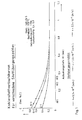
- the carbon distribution from the edge of the workpiece to the core of the workpiece can be represented by the carbon curve.
- the course of carbon after a certain treatment time describes the local concentration of the carbon that has diffused in over the depth of penetration.
- the aim of a carburizing treatment of steels in a salt bath is to set a defined carburizing depth in addition to a defined marginal carbon content by means of a suitable treatment. So far, it has only been possible to predict the exact treatment time for setting the target values, marginal carbon content and carburization depth empirically, since for a precise calculation of the carbon curve with a suitable diffusion model by means of a process computer, in addition to the known parameters of temperature and carbon level, the mass transfer number must also be known.
- the carbon curve can be calculated for different treatment times, so that the workpieces can be removed from the salt bath in a targeted manner.
- the activator content in the salt bath is preferably adjusted so that a mass transfer number ⁇ of 0.1 ⁇ 10 ⁇ 7 to 3 ⁇ 10 ⁇ 7 [m ⁇ sec ⁇ 1] results.
- the respective desired marginal carbon content and the desired carburization depth can be calculated and set in advance by calculating the carbon curve as a function of the treatment time.
- a specific carbon content is first set in a carburizing bath and then a desired carburizing depth is set in a diffusion bath, the carburizing bath being set to a high carbon level and mass transfer numbers between 1.5 ⁇ 10 ⁇ and 3.0 ⁇ 10 ⁇ 7 [m ⁇ sec ⁇ 1] and the diffusion bath can be set to mass transfer numbers between 0.1 ⁇ 10 ⁇ 7 and 1.5 ⁇ 10 ⁇ 7 [m ⁇ sec ]1].
- the workpiece is first carburized in a first salt bath with a high carbon level and a large mass transfer number in the range between 1.5 ⁇ 10 ⁇ 7 and 3 ⁇ 10 ⁇ 7 [m ⁇ sec ⁇ 1], the mass transfer number again being calculated from the equation , and then treated in a diffusion treatment in a second salt bath with a low mass transfer number in the range 0.1-10 ⁇ 7 to 1.5 ⁇ 10 ⁇ 7 [m ⁇ sec ⁇ 1] and a carbon supply corresponding to the desired marginal carbon content, so that the specified edge carbon content, the specified carburization depth and the horizontal carbon profile at the workpiece edge can be set precisely.
- the carbon curve can be determined depending on the treatment times, so that the desired carbon curve in the workpiece can be produced in a simple manner.
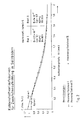
- Figure 2 shows the carbon curve for the two-step process, with the carbon content in the edge area of a workpiece and the distance from the surface on the abscissa axis. It shows a curve 1, which represents the carbon curve of a workpiece made of 16MnCr5 after a treatment time of 4 hours at 950 ° C. in a first salt bath I with a high carbon supply and a mass transfer number of 2.5 ⁇ 10 ⁇ 7 [m ⁇ sec ⁇ 1] .
- Curve 2 shows the carbon curve that occurs after the subsequent diffusion treatment after a treatment time of 35 minutes at 905 ° C. in a second salt bath II with a lower carbon supply and a mass transfer number of 1 ⁇ 10 ⁇ 7 [m ⁇ sec ⁇ 1].
- the carbon profile obtained in salt bath I shows a large carburization depth after the end of the treatment, but the high marginal carbon content is undesirable since it would lead to a decrease in the hardness of the rim.
- a lower marginal carbon content is set by carbon diffusion inside, with the horizontal carbon curve in the marginal area ensuring optimal hardness distribution at the edge of the workpiece.
- the desired carbon flow is set by the treatment times that are required in the individual baths. With knowledge of the bath temperatures, the carbon level and by calculating the mass transfer numbers of the individual salt baths with a computer program that simulates the carburization of the workpiece in the salt bath on a process computer, these treatment times can be calculated in advance.
Landscapes
- Chemical & Material Sciences (AREA)
- Chemical Kinetics & Catalysis (AREA)
- Engineering & Computer Science (AREA)
- Materials Engineering (AREA)
- Mechanical Engineering (AREA)
- Metallurgy (AREA)
- Organic Chemistry (AREA)
- Solid-Phase Diffusion Into Metallic Material Surfaces (AREA)
Applications Claiming Priority (2)
| Application Number | Priority Date | Filing Date | Title |
|---|---|---|---|
| DE3940426 | 1989-12-07 | ||
| DE19893940426 DE3940426C1 (enExample) | 1989-12-07 | 1989-12-07 |
Publications (1)
| Publication Number | Publication Date |
|---|---|
| EP0431297A1 true EP0431297A1 (de) | 1991-06-12 |
Family
ID=6394967
Family Applications (1)
| Application Number | Title | Priority Date | Filing Date |
|---|---|---|---|
| EP90120312A Withdrawn EP0431297A1 (de) | 1989-12-07 | 1990-10-23 | Verfahren zum Aufkohlen von Werkstücken |
Country Status (3)
| Country | Link |
|---|---|
| EP (1) | EP0431297A1 (enExample) |
| JP (1) | JPH03188257A (enExample) |
| DE (1) | DE3940426C1 (enExample) |
Cited By (1)
| Publication number | Priority date | Publication date | Assignee | Title |
|---|---|---|---|---|
| DE102017210597A1 (de) * | 2017-06-23 | 2018-12-27 | Zf Friedrichshafen Ag | Tiefenwirksames Karbonitrieren |
Families Citing this family (3)
| Publication number | Priority date | Publication date | Assignee | Title |
|---|---|---|---|---|
| RU2152453C1 (ru) * | 1999-04-20 | 2000-07-10 | Открытое акционерное общество "УралЛУКтрубмаш" | Способ химико-термической обработки внутренней поверхности труб в расплаве цианатов и устройство для его осуществления |
| DE102005023574B4 (de) * | 2004-11-25 | 2009-10-01 | Damasko, Petra | Verfahren zum Herstellen eines Funktionselementes für Armbanduhren mit gehärteter Oberfläche |
| DE102007059229A1 (de) | 2007-11-19 | 2009-05-20 | Konrad Damasko | Verfahren zum Herstellen eines Bauteils mit gehärteter Oberfläche |
Citations (1)
| Publication number | Priority date | Publication date | Assignee | Title |
|---|---|---|---|---|
| US2342104A (en) * | 1942-02-05 | 1944-02-22 | Du Pont | Manufacture of light armor plate |
-
1989
- 1989-12-07 DE DE19893940426 patent/DE3940426C1/de not_active Expired - Lifetime
-
1990
- 1990-10-23 EP EP90120312A patent/EP0431297A1/de not_active Withdrawn
- 1990-11-29 JP JP32612690A patent/JPH03188257A/ja not_active Ceased
Patent Citations (1)
| Publication number | Priority date | Publication date | Assignee | Title |
|---|---|---|---|---|
| US2342104A (en) * | 1942-02-05 | 1944-02-22 | Du Pont | Manufacture of light armor plate |
Non-Patent Citations (1)
| Title |
|---|
| CHEMICAL ABSTRACTS, Band 81, 1974, Seite 280, Zusammenfassung Nr. 124811g, Columbus, Ohio, US; L. SIKETIC: "New salt baths for carburization with constant carbon contents. Ceconstant treatment", & ZAST. MATER. 1973, 21(9-10), 225-7 * |
Cited By (1)
| Publication number | Priority date | Publication date | Assignee | Title |
|---|---|---|---|---|
| DE102017210597A1 (de) * | 2017-06-23 | 2018-12-27 | Zf Friedrichshafen Ag | Tiefenwirksames Karbonitrieren |
Also Published As
| Publication number | Publication date |
|---|---|
| JPH03188257A (ja) | 1991-08-16 |
| DE3940426C1 (enExample) | 1991-06-13 |
Similar Documents
| Publication | Publication Date | Title |
|---|---|---|
| De et al. | Static strain aging behavior of ultra low carbon bake hardening steel | |
| DE69406357T2 (de) | Verfahren zum Nitrocarbrineren von Stahl | |
| DE69803389T2 (de) | Verfahren zur behandlung von produkten aus austenitischem, rostfreiem stahl | |
| DE351138T1 (de) | Dns-sequenzierung. | |
| DE2419716A1 (de) | Eisenteil und verfahren zum auftragen eines ueberzugs, der bestaendig gegen verschleiss, fressen und korrosion ist und der die schlagfestigkeit und die haftbarkeit von schmierfilmen verbessert | |
| DE1521660B2 (enExample) | ||
| EP2881492B1 (de) | Verfahren zur Aufkohlung eines Tiefziehartikels oder eines Stanzbiegeartikels aus austenitischem nichtrostendem Edelstahl | |
| DE3940426C1 (enExample) | ||
| DE69323617T2 (de) | Nitrierter nichtrostender Stahl | |
| DE60113554T2 (de) | Werkzeug einer abkantbiegepresse mit gehärteten oberflächen | |
| DE102013107100A1 (de) | Verschleißfestes, zumindest teilweise unbeschichtetes Stahlteil | |
| DE2534372A1 (de) | Verfahren zur oberflaechenbehandlung von stahl und dabei erhaltene stahlkoerper | |
| EP0232929B1 (de) | Verfahren zur Erleichterung der Kaltumformung von Edelstahl | |
| DE1546070A1 (de) | Verfahren zur Vorbehandlung von Stahlblechen oder plattierten Stahlblechen zum Zwecke des Phosphatierens | |
| DE2622900B2 (de) | Verfahren zur herstellung von stahlblech mit staerken zwischen 0,01 und 0,5 mm | |
| DE2315165A1 (de) | Verfahren zum nitrieren eisenhaltiger teile | |
| DE2727744C2 (enExample) | ||
| DE909777C (de) | Verfahren zur Bestimmung der Diffusionseigenschaften und der Ausgangskonzentration des diffundierenden Stoffes in Diffusionsmitteln sowie des Diffusionsbeiwertes | |
| DE69017296T2 (de) | Verfahren und Vorrichtung zur Wärmebehandlung von Metallband. | |
| DE60217250T2 (de) | Durchlaufglühverfahren zum Erzeugen einer verbesserten Oberflächenerscheinung | |
| Greßmann | Fe-C and Fe-N compound layers: Growth kinetics and microstructure | |
| DE750438C (de) | Verfahren und Vorrichtungen zur Bestimmung der Diffusionseigenschaften eines Stoffesund der Ausgangskonzentration des diffundierenden Stoffes im Diffusionsmittel | |
| DE3142359A1 (de) | Verfahren und vorrichtung zur waermebehandlung von werkstuecken | |
| DE883543C (de) | Verfahren zur Erzeugung von Oberflaechenschichten grosser Abnutzungs-festigkeit auf Gegenstaenden aus Eisenlegierungen | |
| DE2627147A1 (de) | Verfahren zur herstellung von stahlblech mit schmiereigenschaften |
Legal Events
| Date | Code | Title | Description |
|---|---|---|---|
| PUAI | Public reference made under article 153(3) epc to a published international application that has entered the european phase |
Free format text: ORIGINAL CODE: 0009012 |
|
| 17P | Request for examination filed |
Effective date: 19901023 |
|
| AK | Designated contracting states |
Kind code of ref document: A1 Designated state(s): AT BE CH DE DK ES FR GB GR IT LI LU NL SE |
|
| 17Q | First examination report despatched |
Effective date: 19930201 |
|
| STAA | Information on the status of an ep patent application or granted ep patent |
Free format text: STATUS: THE APPLICATION HAS BEEN WITHDRAWN |
|
| 18W | Application withdrawn |
Withdrawal date: 19930616 |