EP0426316B1 - Doppelsieb-Kornklassierungsvorrichtung und Verfahren - Google Patents
Doppelsieb-Kornklassierungsvorrichtung und Verfahren Download PDFInfo
- Publication number
- EP0426316B1 EP0426316B1 EP90311097A EP90311097A EP0426316B1 EP 0426316 B1 EP0426316 B1 EP 0426316B1 EP 90311097 A EP90311097 A EP 90311097A EP 90311097 A EP90311097 A EP 90311097A EP 0426316 B1 EP0426316 B1 EP 0426316B1
- Authority
- EP
- European Patent Office
- Prior art keywords
- frame
- screens
- stand
- motors
- pair
- Prior art date
- Legal status (The legal status is an assumption and is not a legal conclusion. Google has not performed a legal analysis and makes no representation as to the accuracy of the status listed.)
- Expired - Lifetime
Links
- 238000004513 sizing Methods 0.000 title claims description 71
- 239000002245 particle Substances 0.000 title claims description 65
- 238000000034 method Methods 0.000 title description 30
- 239000000463 material Substances 0.000 claims description 48
- 230000033001 locomotion Effects 0.000 claims description 35
- 230000000712 assembly Effects 0.000 claims description 9
- 238000000429 assembly Methods 0.000 claims description 9
- 239000000725 suspension Substances 0.000 claims description 9
- 125000006850 spacer group Chemical group 0.000 claims description 5
- 230000001360 synchronised effect Effects 0.000 claims description 5
- 239000004927 clay Substances 0.000 description 9
- 235000000396 iron Nutrition 0.000 description 8
- 238000000926 separation method Methods 0.000 description 6
- 229910000746 Structural steel Inorganic materials 0.000 description 5
- 238000012545 processing Methods 0.000 description 5
- 239000005995 Aluminium silicate Substances 0.000 description 4
- 235000012211 aluminium silicate Nutrition 0.000 description 4
- NLYAJNPCOHFWQQ-UHFFFAOYSA-N kaolin Chemical compound O.O.O=[Al]O[Si](=O)O[Si](=O)O[Al]=O NLYAJNPCOHFWQQ-UHFFFAOYSA-N 0.000 description 4
- 238000004519 manufacturing process Methods 0.000 description 4
- VYPSYNLAJGMNEJ-UHFFFAOYSA-N Silicium dioxide Chemical compound O=[Si]=O VYPSYNLAJGMNEJ-UHFFFAOYSA-N 0.000 description 3
- 238000010276 construction Methods 0.000 description 2
- 230000009977 dual effect Effects 0.000 description 2
- 239000007921 spray Substances 0.000 description 2
- XLYOFNOQVPJJNP-UHFFFAOYSA-N water Substances O XLYOFNOQVPJJNP-UHFFFAOYSA-N 0.000 description 2
- CWYNVVGOOAEACU-UHFFFAOYSA-N Fe2+ Chemical compound [Fe+2] CWYNVVGOOAEACU-UHFFFAOYSA-N 0.000 description 1
- 229910019142 PO4 Inorganic materials 0.000 description 1
- KWYUFKZDYYNOTN-UHFFFAOYSA-M Potassium hydroxide Chemical compound [OH-].[K+] KWYUFKZDYYNOTN-UHFFFAOYSA-M 0.000 description 1
- 239000000654 additive Substances 0.000 description 1
- 230000000996 additive effect Effects 0.000 description 1
- 229910001570 bauxite Inorganic materials 0.000 description 1
- 230000005540 biological transmission Effects 0.000 description 1
- 238000012993 chemical processing Methods 0.000 description 1
- 238000004140 cleaning Methods 0.000 description 1
- 239000003245 coal Substances 0.000 description 1
- 230000007423 decrease Effects 0.000 description 1
- 230000003247 decreasing effect Effects 0.000 description 1
- 238000005553 drilling Methods 0.000 description 1
- 238000005516 engineering process Methods 0.000 description 1
- 239000012530 fluid Substances 0.000 description 1
- PCHJSUWPFVWCPO-UHFFFAOYSA-N gold Chemical compound [Au] PCHJSUWPFVWCPO-UHFFFAOYSA-N 0.000 description 1
- 239000010931 gold Substances 0.000 description 1
- 229910052737 gold Inorganic materials 0.000 description 1
- 229910052500 inorganic mineral Inorganic materials 0.000 description 1
- 238000003780 insertion Methods 0.000 description 1
- 230000037431 insertion Effects 0.000 description 1
- 239000011707 mineral Substances 0.000 description 1
- 235000010755 mineral Nutrition 0.000 description 1
- 239000003129 oil well Substances 0.000 description 1
- 230000003534 oscillatory effect Effects 0.000 description 1
- 239000010452 phosphate Substances 0.000 description 1
- NBIIXXVUZAFLBC-UHFFFAOYSA-K phosphate Chemical compound [O-]P([O-])([O-])=O NBIIXXVUZAFLBC-UHFFFAOYSA-K 0.000 description 1
- 229940072033 potash Drugs 0.000 description 1
- BWHMMNNQKKPAPP-UHFFFAOYSA-L potassium carbonate Substances [K+].[K+].[O-]C([O-])=O BWHMMNNQKKPAPP-UHFFFAOYSA-L 0.000 description 1
- 235000015320 potassium carbonate Nutrition 0.000 description 1
- 239000004576 sand Substances 0.000 description 1
- 239000010865 sewage Substances 0.000 description 1
- 239000000377 silicon dioxide Substances 0.000 description 1
- 239000007787 solid Substances 0.000 description 1
- 239000002351 wastewater Substances 0.000 description 1
Images


Classifications
-
- B—PERFORMING OPERATIONS; TRANSPORTING
- B07—SEPARATING SOLIDS FROM SOLIDS; SORTING
- B07B—SEPARATING SOLIDS FROM SOLIDS BY SIEVING, SCREENING, SIFTING OR BY USING GAS CURRENTS; SEPARATING BY OTHER DRY METHODS APPLICABLE TO BULK MATERIAL, e.g. LOOSE ARTICLES FIT TO BE HANDLED LIKE BULK MATERIAL
- B07B1/00—Sieving, screening, sifting, or sorting solid materials using networks, gratings, grids, or the like
- B07B1/42—Drive mechanisms, regulating or controlling devices, or balancing devices, specially adapted for screens
-
- B—PERFORMING OPERATIONS; TRANSPORTING
- B07—SEPARATING SOLIDS FROM SOLIDS; SORTING
- B07B—SEPARATING SOLIDS FROM SOLIDS BY SIEVING, SCREENING, SIFTING OR BY USING GAS CURRENTS; SEPARATING BY OTHER DRY METHODS APPLICABLE TO BULK MATERIAL, e.g. LOOSE ARTICLES FIT TO BE HANDLED LIKE BULK MATERIAL
- B07B1/00—Sieving, screening, sifting, or sorting solid materials using networks, gratings, grids, or the like
- B07B1/46—Constructional details of screens in general; Cleaning or heating of screens
Definitions
- the invention relates to screen apparatus and methods for sizing particles of a material, and in particular to an apparatus and method which sizes and separates particles of a material by motorized vibration of an inclined screen. More particularly, the invention relates to such an apparatus and method for sizing and separating particles of a material which utilizes motorized vibration of a pair of inclined screens to achieve increased particle sizing efficiency.
- Sizing equipment is commonly used in a variety of industrial processes including mineral processing of coal, kaolin, bauxite, taconite, gold, phosphate, potash, and silica sand, as well as in chemical processing, pulp and paper processing, food processing, waste water and sewage treatment, and oil well drilling fluid cleaning.
- Equipment of the type intended for sizing and separating particles of a material usually includes a stand, a frame movably suspended on the stand, an inclined elongated screen of usually approximately 2.44m (eight feet) mounted on the frame, and one or more motors mounted on the frame for vibrating the frame and attached screen. A material is deposited on the upper end of the inclined vibrating screen, which sizes and separates particles of the material as it moves down the screen.
- DE-A-2 749 592 in which motors are mounted near the sides of a frame for vibrating the frame
- DE-A-3 043 497 in which motors are mounted near the top of a frame for causing the frame to vibrate.
- Objectives of the present invention include providing a dual-screen particle sizing apparatus and method which increases the efficiency of particle sizing and separating operations.
- Another objective of the invention is to provide such a dual-screen particle sizing apparatus and method in which gross changes in the slope of the screens can be effected for use of the apparatus in many different particle sizing applications.
- a further objective of the invention is to provide such a dual-screen particle sizing apparatus and method in which small changes in the slope of the screens can be effected for generally equalizing the rate of movement of a material on each of the screens.
- Still another objective of the invention is to provide such a dual-screen particle sizing apparatus and method in which one or more motors, depending on the application, provides the necessary vibrating motion to the pair of screens for efficient particle sizing and separation of a material.
- a still further objective of the invention is to provide such a dual-screen particle sizing apparatus and method in which water spray equipment and techniques can be used in combination with the apparatus and method of the invention, if necessary.
- Another objective of the invention is to provide such a dual-screen particle sizing apparatus and method in which the screens can be quickly and easily replaced due to wear, or the need for a different mesh screen for use in another application.
- a further objective of the invention is to provide such a dual-screen particle sizing apparatus and method which is durable in use, and relatively inexpensive to manufacture, operate and maintain.
- An apparatus for sizing and separating particles of a material including, a stand, a frame, means attached to the stand and the frame for movably suspending the frame on the stand, motor means for vibrating said frame, and a pair of inclined screens mounted on the frame, so that upon actuating the motor means and supplying a material onto upper ends of the screens, the vibrating frame vibrates the attached screens which size and separate particles of the material is known from WO89/08501.
- an apparatus for sizing and separating particles of a material including:
- an apparatus comprising a stand, a frame having a pair of ends and an intermediate portion, suspension means attached to the stand and the frame for movably suspending the frame on the stand, motor means mounted on the frame for vibrating said frame, and a pair of inclined screens mounted on the frame, said screens each sloping downwardly from the intermediate portion of the frame toward a respective one of the ends of said frame, said use being characterized by the steps of:
- Sizing apparatus 1 comprises a stand indicated generally at 2, a frame indicated generally at 3, a plurality of suspension assemblies each indicated generally at 4, a vibrator motor indicated generally at 5, and a pair of screens collectively referred to as 6 and individually as 6a and 6b.
- Stand 2 comprises a generally rectangular-shaped base portion 10 and a pair of upright pillar beams 11.
- Base portion 10 includes a pair of spaced, parallel, elongated side I-beams 12, and a pair of spaced, parallel, elongated end channel beams 13 which extend between and are connected to the ends of I-beams 12 to form a sturdy base portion 10. Pillar beams 11 are mounted on the intermediate portion of I-beams 12 in a spaced parallel relationship.
- a pair of opposed brackets 14 are mounted on the top ends of pillar beams 11 and extend inwardly therefrom.
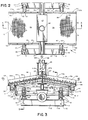
- Frame 3 is generally rectangular-shaped and includes a pair of side support assemblies 22 (FIGS. 1 and 3-4).
- Each side support assembly 22 (FIG. 3) comprises a horizontal bottom angle iron 23, a pair of upright angle irons 24 which are attached to the ends of bottom angle iron 23, and a pair of inclined top angle irons 25 which are attached at one of their ends to and extend upwardly from the top end of upright angle irons 24 and are attached to each other at their other end.
- Pairs of spaced, parallel, elongated upper and lower end angle irons 20 and 21, respectively, extend between and are connected to the ends of side support assemblies 22 to form a sturdy frame 3.
- a pair of spaced, parallel, elongated side channel support beams 26 extend between and are connected to upright angle irons 24 of side support assemblies 22.
- a pair of transverse suspension pipes 27 extend between and are mounted in aligned pairs of openings 28 and 32 formed in the ends of side channel support beams 26 and in attached support plates 33, respectively.
- An end cap 29 formed with a central opening 30 is mounted within each end of suspension pipes 27.
- An axle 31 is mounted within opening 30 of each end cap 29 and extends outwardly therefrom.
- each assembly 4 includes a bottom spring pad 40 which are removably mounted on each end of side I-beams 12 of stand 2 by bolts 41 and nuts 47 (FIG. 5).
- a top spring pad 42 is mounted on the outer end of each axle 31 and is vertically aligned with its respective bottom spring pad 40. More particularly, each top spring pad 42 is formed with a vertically extending axle block 43.
- a horizontal opening 44 is formed in axle block 43 for receiving the outer end of axle 31 to mount top spring pad 42 on the axle.
- a usual coil spring 45 is removably captured between each aligned pair of top and bottom spring pads 42 and 40 for securely movably suspending frame 3 on stand 2.
- a pair of spacer plates 46 can be inserted between a certain pair of the bottom spring pads 40 and side I-beams 12 of stand 2, for slight adjustment of the slope of inclined angle irons 25 of frame 2, as will be described in detail below in the description of the operation of sizing apparatus 1.
- Motor 5 is mounted on a pair of motor base members 50, which in turn are mounted on and depend from a transverse channel member 51 which extends between and is connected to inclined angle irons 25 of frame 2, so that the shaft of the motor is positioned horizontally, and extends transversely with respect to frame 3 (FIGS. 3 and 4).
- Motor 5 is of the type which is well-known in the sizing equipment art, and transmits a high frequency, high gravitational force, generally vertical elliptical vibrating motion to frame 2 through motor base members 50 and channel member 51.
- An example of a suitable motor 5 which could be used with dual-screen sizing apparatus 1 is the rotary electric vibrator motor manufactured by Bulk Equipment Systems Technology, Inc. of Cleveland, OH, and identified as Model BE-11440-4.
- a pair of screen boxes hereinafter collectively referred to as 55 and individually as 55a and 55b, are removably mounted on frame 3 (FIGS. 1-4). Since screen boxes 55a and 55b are similar, only the construction of screen box 55a is described herein.
- Screen box 55a includes a pair of spaced, parallel, elongated side walls 56, a pair of spaced, parallel, elongated upper and lower end walls 57 and 58, respectively, which extend between and are connected to the ends of side walls 56, and a bottom catch tray 59 which extends between and is connected to the lower end of the side walls and end walls.
- Catch tray 59 is formed with a chute 60 in its lower end which terminates in an outlet opening 61.
- An elongated angle iron 62 is attached to the outer surface of each side wall 56 of screen box 55a, and is removably attached to inclined angle irons 25 of frame 3 by bolts 63 and nuts 53 (FIG. 6) for securely removably mounting screen box 55a on the frame.
- a pair of screens 6 preferably each being approximately four feet in length and having a width of 1.22m (four feet), are incorporated in apparatus 1 (FIGS. 1-4).
- Screens 6 generally are within the range of 4 mesh and 500 mesh and preferably are suitable for both wet and dry sizing operations. This is in contrast to most prior art sizing equipment having single 2.44m by 1.22m (eight foot by four foot) long screens. It has been discovered that most separation of a material will occur within the first four feet of its movement on a vibrating screen. Thus, two four foot long screens as opposed to one eight foot long screen as found in the prior art, approximately doubles the output of a sizing apparatus.
- Screens 6a and 6b are removably mounted in screen boxes 55a and - 55b, respectively. More specifically, the screens are supported within boxes 55 by a plurality of spaced, inwardly extending brackets 64 (FIG. 6) which are attached to the inside surface of side walls 56 and end walls 57-58 of the boxes. Screens 6 preferably are pretensioned framed screens, although adjustable tension hook strip screens can be used if desired without effecting the concept of the invention.
- Vibrator motor 5 is actuated and transmits a high frequency, high gravitational force, generally elliptical vibrating motion to frame 3 and attached screens 6.
- the gravitational force is generally within the range of 6 and 9 Gs. More specifically, the upper ends of screens 6a and 6b vibrate in a generally vertical elliptic motion as illustrated by arrow E in FIG. 3, and the lower ends of the screens also vibrate in a generally vertical elliptic motion as illustrated by arrows A and B, respectively.
- a material to be processed such as kaolin clay indicated generally at 68, which is used as an additive in plastic and paper manufacturing, is supplied to inlet opening 66 of feed box 65.
- the clay 68 travels through the feed box and passes out of outlet openings 67a and 67b and onto the upper ends of vibrating screens 6a and 6b, respectively.
- the clay material then travels downwardly on screens 6, with undesirable larger size particles 69 remaining on the screens and dropping off the lower ends of the screens for removal.
- Desirable smaller size particles 70 pass downwardly through screens 6 and onto catch trays 59 of screen boxes 55 and out of chute 60, for further use in plastic or paper processing.
- the generally vertical elliptical motion transmitted to each of the screens is in opposite directions as shown in FIG. 3 and described above. More particularly, the elliptic motion of screen 6a indicated by arrow A is concurrent to the downward slope of the screen and the direction of movement of the clay thereon. On the other hand, the elliptic motion of screen 6b indicated by arrow B is countercurrent to the downward slope of the screen and the direction of movement of the clay thereon. This condition causes the clay to travel faster down screen 6a than it does down screen 6b, which lowers the efficiency of the particle sizing operation.
- spacer plates 46 are inserted between I-beams 12 and bottom spring pads 40 of the pair of suspension assemblies 4 adjacent to the lower end of screen 6a.
- This insertion of spacers decreases the slope of inclined angle iron 25 of frame 3 positioned below screen 6a, and increases the slope of inclined angle iron 25 positioned below screen 6b.
- the slope of screen 6a is decreased and the slope of screen 6b is increased which serves to generally equalize the rate of movement of the clay thereon which increases the efficiency of the particle sizing operation.
- sizing apparatus 1 is a versatile apparatus which can be effectively used in many different particle sizing operations.
- the manner of mounting the screens within the screen boxes enables the screens to be quickly and easily replaced if they are worn, or when the need for a different mesh screen arises such as when another material is being sized.
- the efficient 1.22m (four foot) length of the screens still is long enough for use of water spray equipment and techniques in combination with the apparatus and method of the present invention, if necessary.
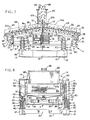
- a second embodiment of the improved dual-screen particle sizing apparatus of the invention is indicated generally at 80, and is shown in FIGS. 7 and 8.
- Sizing apparatus 80 and the method in which it is used is similar to sizing apparatus 1 and method in most respects, except that apparatus 80 incorporates a pair of vibrator motors indicated generally at 81 and 82.
- Each motor 81 and 82 is mounted on a motor base member 83, which in turn is mounted on and extends outwardly of a transverse channel member 84 so that the shafts of the motors are positioned vertically and rotate in opposite directions.
- Channel member 84 extends between and is connected to an opposed pair of plates 85 which are attached to side channel support beams 26 of frame 3.
- Motors 81 and 82 are of synchronous frequency and each is similar to motor 5 of sizing apparatus 1 described above, but together transmit a high frequency, high gravitational force, generally horizontal linear vibrating motion to frame 2 through motor base members 83, channel member 84 and plates 85, as illustrated by double arrow Z in FIG. 8.
- Such a horizontal, linear or "back-and-forth" motion is desirable for applications where the material to be processed contains heavy, oversize solid particles 69 which tend to block screens 6 of sizing apparatus 80 and interfere with the passage of desirable smaller particles 70 therethrough.
- the horizontal linear motion transmitted to screens 6 causes the undesirable oversize particles 69 to move quickly along the top of the screens so that more screen area is available for passage of the desirable smaller particles 70.
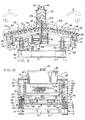
- a third embodiment of the dual-screen particle sizing apparatus is indicated generally at 90, and is shown in FIGS. 9 and 10.
- Sizing apparatus 90 and method also is similar to sizing apparatus 1 and the method in which it is used in most respects, except that apparatus 90 incorporates three vibrator motors indicated generally at 91, 92 and 93.
- Each motor 91-93 is mounted on a motor base member 94, which in turn is mounted on and extends outwardly of a transverse channel member 95 so that the shaft of motors 91 and 92 are positioned vertically and rotate in opposite directions, and the shaft of motor 93 is positioned horizontally, and extends transversely with respect to frame 3.
- Channel member 95 extends between and is connected to an opposed pair of plates 96 which are attached to side channel support beams 26 of frame 3.
- Motors 91-93 are of synchronous frequency and each is similar to motor 5 of sizing apparatus 1 described above, but together transmit a high frequency, high gravitational force, generally amplified inclined elliptical vibrating motion to frame 3 through motor base members 94, channel member 95 and plates 96, as illustrated by ellipses X and Y in FIG. 9.
- Still another motion, illustrated by dot-dash symbols C and D of FIG. 9, can be transmitted to frame 3 by generally doubling the frequency of motor 93 over that of motors 91 and 92.
- the result is the transmission of a high frequency, high gravitational force, generally amplified pulsating vibrating motion to frame 3.
- the motion illustrated by ellipses X and Y is desirable for processing sticky materials, and the motion illustrated by symbols C and D can be effectively used for operations requiring extremely accurate particle sizing.
- the main feature of the dual-screen particle sizing apparatus and method of the present invention is the manner in which a pair of screens each having a length of 1.22m (four feet) are mounted on the vibrating frame, in contrast to prior art particle sizing apparatus which utilize a single screen having a length of 2.44m (eight feet).
- the 1.22m (four foot) length of the dual screens provides sufficient length for sizing and separation of the material to occur, and substantially increases the throughput of the particle sizing operation over prior art apparatus.
- Another important feature is the manner in which one or more economical motors provides the necessary vibratory motion to the screens to achieve efficient sizing and separation for different material applications, wherein spacers are used to make small adjustments to the slope of the screens for generally equalizing the rate of movement of a material down the screen to overcome the differences in rate caused by the vibratory motion of the motors in apparatus 1 and 90.
- Other important features include the manner in which the screen boxes can be replaced so that the sizing apparatus can be used in different applications requiring different slopes of the screens, and also the manner in which the screens can be quickly and easily replaced due to wear or when the application calls for a different mesh screen.
- the dual-screen particle sizing apparatus and method of the present invention is durable in use and relatively inexpensive to manufacture, operate and maintain.
- the dual screen particle sizing apparatus and method is simplified, provides an effective, safe, inexpensive, and efficient apparatus and method which achieves all the enumerated objectives, provides for eliminating difficulties encountered with prior apparatus and methods, and solves problems and obtains new results in the art.
Landscapes
- Combined Means For Separation Of Solids (AREA)
Claims (6)
- Eine Vorrichtung zur Klassierung und Sortierung von Teilchen eines Materials, wobei die genannte Vorrichtung umfaßt:a) ein Gestell (2);b) einen Rahmen (3);c) an dem Gestell (2) und dem Rahmen (3) angebrachte Mittel (4) zur beweglichen Aufhängung des Rahmens (3) an dem Gestell;d) Motor-Mittel (5), um den genannten Rahmen (3) in Vibrationen zu versetzen; unde) ein Paar von geneigten Sieben (6), die auf dem Rahmen (3) angeordnet sind, so daß nach Betätigung der Motor-Mittel (5) und dem Zuführen eines Materials auf die oberen Enden der Siebe (6) der vibrierende Rahmen (3) die angebrachten Siebe (6) in Vibration versetzt, welche die Teilchen des Materials klassieren und sortieren;in welcher die genannten Motor-Mittel (5) auf dem Rahmen (3) angeordnet sind; und das genannte Paar von Sieben (6) seitlich angeordnet ist, wobei ein jedes der genannten Siebe von einem mittleren Abschnitt des Rahmens (3) aus in Richtung zu jeweils einem von einem Paar von Enden des genannten Rahmens (3) nach abwärts schräg abfallend verläuft,
dadurch gekennzeichnet,
daß die Motor-Mittel aus einer Mehrzahl von Motoren bestehen, die erste, zweite und dritte Motoren (91, 92, 93) aufweisen, welche an dem mittleren Abschnitt und unterhalb des mittleren Abschnittes des Rahmens (3) angeordnet sind; wobei die Wellen der ersten und zweiten Motoren (91, 92) vertikal angeordnet sind und in entgegengesetzten Richtungen rotieren, und wobei die Welle des dritten Motors (93) horizontal angeordnet ist und sich in der Querrichtung in Bezug auf den Rahmen (3) erstreckt; wobei die Motoren (91, 92, 93) synchrone Frequenzen aufweisen; und wobei die Motoren (91, 92, 93) eine eine hohe Frequenz und eine hohe Schwerkraft aufweisende, im allgemeinen verstärkte, geneigte, elliptische Vibrationsbewegung auf den Rahmen (3) und die angebrachten Siebe (6) übertragen. - Eine Vorrichtung zur Klassierung und Sortierung von Teilchen eines Materials, wobei die genannte Vorrichtung aufweist:a) ein Gestell (2);b) einen Rahmen (3);c) an dem Gestell (2) und dem Rahmen (3) angebrachte Mittel (4) zur beweglichen Aufhängung des Rahmens (3) an dem Gestell;d) Motor-Mittel (5), um den genannten Rahmen (3) in Vibrationen zu versetzen; unde) ein Paar von geneigten Sieben (6), die auf dem Rahmen (3) angeordnet sind, so daß nach Betätigung der Motor-Mittel (5) und dem Zuführen eines Materials auf die oberen Enden der Siebe (6) der vibrierende Rahmen (3) die angebrachten Siebe (6) in Vibration versetzt, welche die Teilchen des Materials klassieren und sortieren;in welcher die genannten Motor-Mittel (5) auf dem Rahmen (3) angeordnet sind; und das genannte Paar von Sieben (6) seitlich angeordnet ist, wobei ein jedes der genannten Siebe von einem mittleren Abschnitt des Rahmens (3) aus in Richtung zu jeweils einem von einem Paar von Enden des genannten Rahmens (3) nach abwärts schräg abfallend verläuft,
dadurch gekennzeichnet,
daß die Motor-Mittel aus einer Mehrzahl von Motoren bestehen, die erste, zweite und dritte Motoren (91, 92, 93) umfassen, welche an dem mittleren Abschnitt und unterhalb des mittleren Abschnittes des Rahmens (3) angeordnet sind; wobei die Wellen der ersten und zweiten Motoren (91, 92) vertikal angeordnet sind und in entgegengesetzten Richtungen rotieren, und wobei die Welle des dritten Motors (93) horizontal angeordnet ist und sich in der Querrichtung in Bezug auf den Rahmen (3) erstreckt; wobei die ersten und zweiten Motoren (91, 92) synchrone Frequenzen aufweisen, und wobei der dritte Motor (93) eine Frequenz aufweist, die im allgemeinen das Doppelte der Frequenz des genannten ersten und des genannten zweiten Motors (91, 92) ist; und wobei die Motoren (91, 92, 93) eine eine hohe Frequenz und eine hohe Schwerkraft aufweisende, im allgemeinen verstärkte, pulsierende, Vibrations-Bewegung auf den Rahmen (3) und die angebrachten Siebe (6) übertragen. - Die Vorrichtung gemäß einem der Ansprüche 1 oder 2,
dadurch gekennzeichnet,
daß die an dem Gestell (2) und dem Rahmen (3) angebrachten Mittel zur beweglichen Aufhängung des Rahmens (3) an dem Gestell aus einem Paar von Schraubenfeder-Aufhängungs-Anordnungen (4) bestehen, welche in einer voneinander beabstandeten Beziehung an dem Gestell (2) angrenzend an ein jedes des Paares von Enden des Rahmens (3) angeordnet sind; und in welcher ein Paar von Abstandsstücken (46) zwischen das Gestell (2) und eine gewisse des Paares von Aufhängungs-Anordnungen (4) einsetzbar ist, um die Neigung der Siebe (6) einzustellen, um die Bewegungsgeschwindigkeit eines Materials auf einem jeden der Siebe (6) im wesentlichen gleichmäßig zu machen. - Die Vorrichtung gemäß einem der vorhergehenden Ansprüche,
dadurch gekennzeichnet,
daß der Rahmen (3) im wesentlichen rechteckförmig ausgebildet ist; in welcher ein jedes der Siebe (6) in lösbarer Weise in einem Sieb-Kasten (55a, 55b) angeordnet ist, der in lösbarer Weise an dem Rahmen (3) befestigt ist; in welcher jeder der Sieb-Kästen (55a, 55b) ein Auffangblech oder einen Auffangboden (59) umfaßt, das oder der unterhalb des Siebes angeordnet ist, um die klassierten Teilchen, die durch das genannte Sieb hindurchgehen, aufzunehmen und zu einer Stelle zu führen, die von den Teilchen entfernt ist, die nicht durch das Sieb hindurchgehen; in welcher ein jedes der Siebe (6) an dem Rahmen (3) mit einer Schrägneigung angeordnet ist, die im allgemeinen zwischen 3° und 60° beträgt; in welcher ein jedes der Siebe (6) ungefähr 1,22 m x 1,22 m (4 Fuß x 4 Fuß) mißt; in welcher die Siebweite oder Siebgröße der Siebe im allgemeinen zwischen 4 und 500 Öffnungen pro 25,4 mm (lineares inch) beträgt; in welcher das Gestell (2) einen Grund-Abschnitt (10) und ein Paar von gegenseitig beabstandeten, sich parallel und vertikal erstreckenden Pfosten oder Säulen (11) aufweist; und in welcher ein Beschickungs-kasten (65) auf den Pfosten oder Säulen (11) des Gestelles (2) in Nachbarschaft zu den und oberhalb der oberen Enden der Siebe (6) angeordnet ist. - Eine Vorrichtung zum Klassieren von Teilchen eines Materials, gemäß einem der vorhergehenden Ansprüche, in welcher die genannten Siebe (6) eine Länge von ungefähr 1,22 m (4 Fuß) aufweisen.
- Eine Anwendung einer Vorrichtung gemäß einem der vorhergehenden Ansprüche, um Teilchen eines Materials zu klassieren und zu sortieren, gekennzeichnet durch die Schritte:a) Betätigen der Motor-Mittel (5);b) Versetzen des Rahmens (3) und der angebrachten Siebe (6) in eine vibrierende Bewegung, wobei eine Vibrationsbewegung zu dem Rahmen (3) durch die Motor-Mittel (5) übertragen wird;c) Zuführen eines Materials auf die oberen Enden der vibrierenden Siebe(6);d) Klassieren und Sortieren von Teilchen des Materials, wenn sich die Teilchen entlang der Siebe (6) in Richtung zu den Enden des Rahmens (3) hin bewegen; unde) Einstellen der Schrägneigung der Siebe (6), um im wesentlichen die Bewegungsgeschwindigkeit eines Materials auf einem jeden der Siebe (6) gleichmäßig zu machen.
Applications Claiming Priority (4)
| Application Number | Priority Date | Filing Date | Title |
|---|---|---|---|
| US43077589A | 1989-11-02 | 1989-11-02 | |
| US430775 | 1989-11-02 | ||
| US07/458,307 US5100539A (en) | 1989-11-02 | 1989-12-28 | Dual-screen particle sizing apparatus and method |
| US458307 | 1989-12-28 |
Publications (2)
| Publication Number | Publication Date |
|---|---|
| EP0426316A1 EP0426316A1 (de) | 1991-05-08 |
| EP0426316B1 true EP0426316B1 (de) | 1995-03-15 |
Family
ID=27028748
Family Applications (1)
| Application Number | Title | Priority Date | Filing Date |
|---|---|---|---|
| EP90311097A Expired - Lifetime EP0426316B1 (de) | 1989-11-02 | 1990-10-10 | Doppelsieb-Kornklassierungsvorrichtung und Verfahren |
Country Status (7)
| Country | Link |
|---|---|
| US (1) | US5100539A (de) |
| EP (1) | EP0426316B1 (de) |
| JP (1) | JPH03174283A (de) |
| AU (1) | AU636399B2 (de) |
| BR (1) | BR9005473A (de) |
| CA (1) | CA2027511A1 (de) |
| DE (1) | DE69017835T2 (de) |
Families Citing this family (33)
| Publication number | Priority date | Publication date | Assignee | Title |
|---|---|---|---|---|
| US5462673A (en) * | 1993-12-15 | 1995-10-31 | Triton Engineering Services Company | Cleaning system for vibratory screening devices |
| US5614094A (en) * | 1994-05-13 | 1997-03-25 | Deister Machine Co., Inc. | Vibrating screen unit |
| JP2660664B2 (ja) * | 1994-07-11 | 1997-10-08 | 新キャタピラー三菱株式会社 | 作業用自走車の掘削篩い選別装置 |
| US5501343A (en) * | 1994-08-19 | 1996-03-26 | The Read Corporation | Soil feeding apparatus with interruptor and method |
| KR100327393B1 (ko) * | 1999-11-13 | 2002-03-13 | 장재영 | 폐레미콘의 골재선별 재활용장치 |
| US6439393B1 (en) | 2000-02-14 | 2002-08-27 | Bruce K. Zeller | Method and apparatus for separating excavated material |
| US6837380B2 (en) * | 2001-06-28 | 2005-01-04 | Stoner Randall K | Low clearance dual-screen particle sorter |
| JP4538349B2 (ja) | 2005-03-17 | 2010-09-08 | 富士通株式会社 | 電源装置および電源システム |
| CN100352564C (zh) * | 2005-09-15 | 2007-12-05 | 上海交通大学 | 全状态在线可调式种子重力筛选机 |
| US9033156B2 (en) * | 2006-12-21 | 2015-05-19 | M-I L.L.C. | Electromagnetic separation for shakers |
| KR100858378B1 (ko) | 2007-03-12 | 2008-09-17 | (주)금광 이 엔 지 | 역 경사면을 갖는 이물질 선별 진동스크린 |
| US20090206011A1 (en) * | 2008-02-20 | 2009-08-20 | Cudahy George F | Vibrating Screen Apparatus |
| CN105019840A (zh) * | 2015-07-22 | 2015-11-04 | 成都来宝石油设备有限公司 | 一种石油钻井液筛除设备 |
| BR102016004243B1 (pt) * | 2016-02-26 | 2019-11-05 | Tmsa Tecnologia Em Movimentacao S A | máquina para limpeza de grãos |
| US10493491B2 (en) * | 2016-05-02 | 2019-12-03 | Tabor Machine Company, Llc | Spring seat |
| CN105772395B (zh) * | 2016-05-11 | 2019-06-28 | 济南中燃科技发展有限公司 | 一种双质体垂直振动反共振筛 |
| JOP20190082A1 (ar) | 2016-10-14 | 2019-04-14 | Dirrick Corp | أجهزة وطرق وأنظمة للفرز الإهتزازي |
| US11052427B2 (en) | 2016-10-14 | 2021-07-06 | Derrick Corporation | Apparatuses, methods, and systems for vibratory screening |
| USD890236S1 (en) * | 2019-02-07 | 2020-07-14 | Derrick Corporation | Vibratory screening machine |
| US11525239B2 (en) * | 2018-04-30 | 2022-12-13 | Vermeer Manufacturing Company | Shaker assemblies having positioning devices |
| CN108636791B (zh) * | 2018-05-15 | 2020-11-17 | 舒城桢玥绿丰园农民专业合作社 | 茶叶筛分装置 |
| CN108889601A (zh) * | 2018-07-11 | 2018-11-27 | 张松 | 一种中药材筛选装置 |
| NL2022846B1 (en) * | 2019-04-01 | 2020-10-08 | Pharmafilter B V | Separator and method of separating. |
| CN111014009B (zh) * | 2019-12-12 | 2022-03-11 | 山西宝泰药业有限责任公司 | 一种化工制药用筛选机 |
| CN111940286B (zh) * | 2020-08-10 | 2023-04-18 | 新疆星宇建设工程有限公司 | 一种建筑施工用摇摆式砂石筛选装置 |
| CN112474276B (zh) * | 2020-11-10 | 2022-03-11 | 西湖兄弟粮油加工厂 | 一种有机大米生产加工用渣滓辅助筛选设备 |
| CN113546841B (zh) * | 2021-07-23 | 2022-07-19 | 濮阳市规划建筑设计研究院 | 一种建筑工程用砂石快速滤杂装置 |
| CN113712068B (zh) * | 2021-11-02 | 2022-02-15 | 山东鲁沾水产品有限公司 | 一种具有收集组件的海产品加工设备 |
| CN114084388B (zh) * | 2021-11-22 | 2023-03-24 | 湛江港(集团)股份有限公司 | 一种防物料粘连的硫酸钾钙镁灌包用供料系统 |
| CN114472149A (zh) * | 2022-02-11 | 2022-05-13 | 左德奎 | 一种煤炭筛选清洗装置 |
| CN114833060A (zh) * | 2022-04-02 | 2022-08-02 | 重庆正川饲料有限公司 | 一种多级分选的饲料加工用饲料颗粒筛选装置 |
| CN114789134B (zh) * | 2022-04-19 | 2023-06-09 | 中电建安徽长九新材料股份有限公司 | 一种环保振动筛及其筛选方法 |
| CN118719543B (zh) * | 2024-08-29 | 2024-11-15 | 甘肃同君堂药业有限公司 | 一种中药材饮片自动化炮制筛选装置 |
Family Cites Families (24)
| Publication number | Priority date | Publication date | Assignee | Title |
|---|---|---|---|---|
| US419113A (en) * | 1890-01-07 | salmon | ||
| US2819796A (en) * | 1958-01-14 | edwards | ||
| DE609277C (de) * | 1932-09-18 | 1935-03-08 | Ind Akt Ges | Schwingendes Sieb |
| US2053895A (en) * | 1934-03-28 | 1936-09-08 | Burmeister Louis | Scalping apparatus |
| US2628718A (en) * | 1950-07-21 | 1953-02-17 | James O Dockins | Seed cleaner and grader |
| FR1300968A (fr) * | 1961-07-01 | 1962-08-10 | Crible vibrant de pente réglable | |
| US3666095A (en) * | 1970-02-02 | 1972-05-30 | Fmc Corp | Vibrating screen for fine screening of liquids |
| US3703236A (en) * | 1970-07-31 | 1972-11-21 | Fmc Corp | Vibrator mounting |
| DE2150714A1 (de) * | 1971-10-12 | 1973-04-19 | Miag Muehlenbau & Ind Gmbh | Siebmaschine |
| US4062768A (en) * | 1972-11-14 | 1977-12-13 | Locker Industries Limited | Sieving of materials |
| US4082657A (en) * | 1976-01-19 | 1978-04-04 | Gage Ernest L | Separator apparatus |
| US4107035A (en) * | 1977-05-02 | 1978-08-15 | The Young Industries, Inc. | Three-plane balance gyro sifter |
| DE2749592A1 (de) * | 1977-11-05 | 1979-05-10 | Licentia Gmbh | Schwingsieb mit mehrachsigen schwingungen in der siebebene |
| DE2919500C3 (de) * | 1979-05-15 | 1982-04-15 | Bühler-Miag GmbH, 3300 Braunschweig | Austauschbares Plansieb für Siebmaschinen |
| GB2078554A (en) * | 1980-05-20 | 1982-01-13 | Sizer Richard Ltd | A Machine for Cleaning and/or Grading Seeds |
| DE3043497C2 (de) * | 1980-11-18 | 1984-08-30 | IBAG-Vertrieb GmbH, 6730 Neustadt | Schwingende Siebmaschine |
| US4351719A (en) * | 1981-02-19 | 1982-09-28 | Morbark Industries, Inc. | Vibrating screen apparatus |
| DE3109319C2 (de) * | 1981-03-12 | 1983-12-22 | Vsesojuznyj gosudarstvennyj naučno-issledovatel'skij i proektnyj institut asbestovoj promyšlennosti, Asbest, Sverdlovskaja oblast' | Mehrsiebapparat |
| CA1173405A (en) * | 1981-10-16 | 1984-08-28 | Cecil T. Humphrey | Dual frequency screen for classifying granular material |
| SU1025462A1 (ru) * | 1982-02-18 | 1983-06-30 | Ивановский Ордена "Знак Почета" Энергетический Институт Им. В.И.Ленина | Вибрационный грохот |
| GB8406725D0 (en) * | 1984-03-15 | 1984-04-18 | Bootham North Eng Ltd | Separator |
| US4576713A (en) * | 1984-07-19 | 1986-03-18 | Carter-Day Company | Feed stream splitter for multiple deck screening machine |
| WO1989008501A1 (fr) * | 1988-03-10 | 1989-09-21 | Bühler-Miag Gmbh | Procede et dispositif pour moudre et separer le grain |
| US4906356A (en) * | 1988-09-30 | 1990-03-06 | General Kinematics Corporation | Material classifying apparatus |
-
1989
- 1989-12-28 US US07/458,307 patent/US5100539A/en not_active Expired - Fee Related
-
1990
- 1990-10-10 EP EP90311097A patent/EP0426316B1/de not_active Expired - Lifetime
- 1990-10-10 DE DE69017835T patent/DE69017835T2/de not_active Expired - Fee Related
- 1990-10-12 CA CA002027511A patent/CA2027511A1/en not_active Abandoned
- 1990-10-15 AU AU64599/90A patent/AU636399B2/en not_active Ceased
- 1990-10-29 BR BR909005473A patent/BR9005473A/pt not_active Application Discontinuation
- 1990-11-02 JP JP2298757A patent/JPH03174283A/ja active Pending
Also Published As
| Publication number | Publication date |
|---|---|
| CA2027511A1 (en) | 1991-05-03 |
| DE69017835D1 (de) | 1995-04-20 |
| DE69017835T2 (de) | 1995-09-28 |
| EP0426316A1 (de) | 1991-05-08 |
| JPH03174283A (ja) | 1991-07-29 |
| AU636399B2 (en) | 1993-04-29 |
| BR9005473A (pt) | 1991-09-17 |
| AU6459990A (en) | 1991-05-09 |
| US5100539A (en) | 1992-03-31 |
Similar Documents
| Publication | Publication Date | Title |
|---|---|---|
| EP0426316B1 (de) | Doppelsieb-Kornklassierungsvorrichtung und Verfahren | |
| US7111739B2 (en) | Wet fine particle sizing and separating apparatus | |
| US6679386B2 (en) | Low-density particle sizing apparatus and method | |
| CN210546258U (zh) | 一种石墨筛选落料装置 | |
| US3070230A (en) | Apparatus for separating materials | |
| US2874841A (en) | Oscillatable separator means | |
| US5336408A (en) | Apparatus for separating particles from a fluid stream | |
| JPS58196875A (ja) | 分級装置並びに分級方法 | |
| US4855039A (en) | Vibrating screen | |
| JPS63500018A (ja) | 一体形配分・分離装置付ふるい分け装置 | |
| US5397002A (en) | Variable control screen apparatus | |
| EP1013348A1 (de) | Sieblose vibrationstrennvorrichtung | |
| CN220611323U (zh) | 一种干式物料超精细分级设备 | |
| SU1789302A1 (ru) | Сито грохота | |
| RU2061558C1 (ru) | Способ фильтрации растворов или жидких сред с твердыми примесями и устройство для его осуществления | |
| EP0534040B1 (de) | Verfahren und Vorrichtung zum Sieben von körnigen Materialien | |
| CN100503048C (zh) | 干式振动高梯度磁选机 | |
| SU1532093A1 (ru) | Виброфрикционный сепаратор | |
| RU2142859C1 (ru) | Способ и устройство для пневмообогащения сырья, содержащего тяжелые минералы и металлы | |
| CA1115663A (en) | Tandem transversely vibrated inclined bed liquid treated stratifiers | |
| SU1335329A2 (ru) | Многоситовый грохот | |
| RU2011419C1 (ru) | Магнитный сепаратор | |
| US1629812A (en) | Apparatus for and method of screening pulp | |
| SU804005A1 (ru) | Гидрогрохот | |
| SU1342532A1 (ru) | Вибрационный грохот |
Legal Events
| Date | Code | Title | Description |
|---|---|---|---|
| PUAI | Public reference made under article 153(3) epc to a published international application that has entered the european phase |
Free format text: ORIGINAL CODE: 0009012 |
|
| AK | Designated contracting states |
Kind code of ref document: A1 Designated state(s): DE FR GB IT |
|
| 17P | Request for examination filed |
Effective date: 19911025 |
|
| 17Q | First examination report despatched |
Effective date: 19921201 |
|
| GRAA | (expected) grant |
Free format text: ORIGINAL CODE: 0009210 |
|
| AK | Designated contracting states |
Kind code of ref document: B1 Designated state(s): DE FR GB IT |
|
| PG25 | Lapsed in a contracting state [announced via postgrant information from national office to epo] |
Ref country code: IT Free format text: LAPSE BECAUSE OF FAILURE TO SUBMIT A TRANSLATION OF THE DESCRIPTION OR TO PAY THE FEE WITHIN THE PRE;WARNING: LAPSES OF ITALIAN PATENTS WITH EFFECTIVE DATE BEFORE 2007 MAY HAVE OCCURRED AT ANY TIME BEFORE 2007. THE CORRECT EFFECTIVE DATE MAY BE DIFFERENT FROM THE ONE RECORDED.SCRIBED TIME-LIMIT Effective date: 19950315 Ref country code: FR Effective date: 19950315 |
|
| REF | Corresponds to: |
Ref document number: 69017835 Country of ref document: DE Date of ref document: 19950420 |
|
| EN | Fr: translation not filed | ||
| PG25 | Lapsed in a contracting state [announced via postgrant information from national office to epo] |
Ref country code: GB Effective date: 19951010 |
|
| PLBE | No opposition filed within time limit |
Free format text: ORIGINAL CODE: 0009261 |
|
| STAA | Information on the status of an ep patent application or granted ep patent |
Free format text: STATUS: NO OPPOSITION FILED WITHIN TIME LIMIT |
|
| 26N | No opposition filed | ||
| GBPC | Gb: european patent ceased through non-payment of renewal fee |
Effective date: 19951010 |
|
| PG25 | Lapsed in a contracting state [announced via postgrant information from national office to epo] |
Ref country code: DE Effective date: 19960702 |