EP0411536B1 - Verfahren und Vorrichtung zur Herstellung von Pellets - Google Patents
Verfahren und Vorrichtung zur Herstellung von Pellets Download PDFInfo
- Publication number
- EP0411536B1 EP0411536B1 EP90114592A EP90114592A EP0411536B1 EP 0411536 B1 EP0411536 B1 EP 0411536B1 EP 90114592 A EP90114592 A EP 90114592A EP 90114592 A EP90114592 A EP 90114592A EP 0411536 B1 EP0411536 B1 EP 0411536B1
- Authority
- EP
- European Patent Office
- Prior art keywords
- strands
- feed rolls
- support
- strand
- fixed blade
- Prior art date
- Legal status (The legal status is an assumption and is not a legal conclusion. Google has not performed a legal analysis and makes no representation as to the accuracy of the status listed.)
- Expired - Lifetime
Links
Images
Classifications
-
- B—PERFORMING OPERATIONS; TRANSPORTING
- B29—WORKING OF PLASTICS; WORKING OF SUBSTANCES IN A PLASTIC STATE IN GENERAL
- B29B—PREPARATION OR PRETREATMENT OF THE MATERIAL TO BE SHAPED; MAKING GRANULES OR PREFORMS; RECOVERY OF PLASTICS OR OTHER CONSTITUENTS OF WASTE MATERIAL CONTAINING PLASTICS
- B29B9/00—Making granules
- B29B9/02—Making granules by dividing preformed material
- B29B9/06—Making granules by dividing preformed material in the form of filamentary material, e.g. combined with extrusion
-
- Y—GENERAL TAGGING OF NEW TECHNOLOGICAL DEVELOPMENTS; GENERAL TAGGING OF CROSS-SECTIONAL TECHNOLOGIES SPANNING OVER SEVERAL SECTIONS OF THE IPC; TECHNICAL SUBJECTS COVERED BY FORMER USPC CROSS-REFERENCE ART COLLECTIONS [XRACs] AND DIGESTS
- Y10—TECHNICAL SUBJECTS COVERED BY FORMER USPC
- Y10S—TECHNICAL SUBJECTS COVERED BY FORMER USPC CROSS-REFERENCE ART COLLECTIONS [XRACs] AND DIGESTS
- Y10S83/00—Cutting
- Y10S83/906—Chip making
-
- Y—GENERAL TAGGING OF NEW TECHNOLOGICAL DEVELOPMENTS; GENERAL TAGGING OF CROSS-SECTIONAL TECHNOLOGIES SPANNING OVER SEVERAL SECTIONS OF THE IPC; TECHNICAL SUBJECTS COVERED BY FORMER USPC CROSS-REFERENCE ART COLLECTIONS [XRACs] AND DIGESTS
- Y10—TECHNICAL SUBJECTS COVERED BY FORMER USPC
- Y10T—TECHNICAL SUBJECTS COVERED BY FORMER US CLASSIFICATION
- Y10T83/00—Cutting
- Y10T83/04—Processes
- Y10T83/0405—With preparatory or simultaneous ancillary treatment of work
- Y10T83/0443—By fluid application
-
- Y—GENERAL TAGGING OF NEW TECHNOLOGICAL DEVELOPMENTS; GENERAL TAGGING OF CROSS-SECTIONAL TECHNOLOGIES SPANNING OVER SEVERAL SECTIONS OF THE IPC; TECHNICAL SUBJECTS COVERED BY FORMER USPC CROSS-REFERENCE ART COLLECTIONS [XRACs] AND DIGESTS
- Y10—TECHNICAL SUBJECTS COVERED BY FORMER USPC
- Y10T—TECHNICAL SUBJECTS COVERED BY FORMER US CLASSIFICATION
- Y10T83/00—Cutting
- Y10T83/04—Processes
- Y10T83/0515—During movement of work past flying cutter
-
- Y—GENERAL TAGGING OF NEW TECHNOLOGICAL DEVELOPMENTS; GENERAL TAGGING OF CROSS-SECTIONAL TECHNOLOGIES SPANNING OVER SEVERAL SECTIONS OF THE IPC; TECHNICAL SUBJECTS COVERED BY FORMER USPC CROSS-REFERENCE ART COLLECTIONS [XRACs] AND DIGESTS
- Y10—TECHNICAL SUBJECTS COVERED BY FORMER USPC
- Y10T—TECHNICAL SUBJECTS COVERED BY FORMER US CLASSIFICATION
- Y10T83/00—Cutting
- Y10T83/263—With means to apply transient nonpropellant fluent material to tool or work
-
- Y—GENERAL TAGGING OF NEW TECHNOLOGICAL DEVELOPMENTS; GENERAL TAGGING OF CROSS-SECTIONAL TECHNOLOGIES SPANNING OVER SEVERAL SECTIONS OF THE IPC; TECHNICAL SUBJECTS COVERED BY FORMER USPC CROSS-REFERENCE ART COLLECTIONS [XRACs] AND DIGESTS
- Y10—TECHNICAL SUBJECTS COVERED BY FORMER USPC
- Y10T—TECHNICAL SUBJECTS COVERED BY FORMER US CLASSIFICATION
- Y10T83/00—Cutting
- Y10T83/465—Cutting motion of tool has component in direction of moving work
- Y10T83/4766—Orbital motion of cutting blade
- Y10T83/4795—Rotary tool
- Y10T83/4847—With cooperating stationary tool
-
- Y—GENERAL TAGGING OF NEW TECHNOLOGICAL DEVELOPMENTS; GENERAL TAGGING OF CROSS-SECTIONAL TECHNOLOGIES SPANNING OVER SEVERAL SECTIONS OF THE IPC; TECHNICAL SUBJECTS COVERED BY FORMER USPC CROSS-REFERENCE ART COLLECTIONS [XRACs] AND DIGESTS
- Y10—TECHNICAL SUBJECTS COVERED BY FORMER USPC
- Y10T—TECHNICAL SUBJECTS COVERED BY FORMER US CLASSIFICATION
- Y10T83/00—Cutting
- Y10T83/647—With means to convey work relative to tool station
- Y10T83/6579—With means to press work to work-carrier
Definitions
- the present invention relates to a process and apparatus for producing pellets according to the precharacterising portions of claims 1 and 3 respectively.
- a strand cutter comprising feed rolls, a fixed blade and a rotary blade is generally used for cutting strand-shaped articles, which are obtained by melt extruding a thermoplastic resin or extruding a solution thereof through a die plate into an liquid, into pellets having a length of 1.0 to 5.0 mm.
- the cutter can well cut strands having a hardness or rigidity of some degree, but it can hardly cut soft and flexible strands into pellets having no obliquely cut surface and having a uniform cut length.
- Japanese Patent Kohyo No. 500169/1981 discloses a process which comprises using an apparatus in which the upper one of a pair of feed rolls is located a little ahead of the lower one, and passing strands through the two rolls to a support having at the top thereof a fixed blade and cutting them into pellets.
- This apparatus cannot cut flexible strands into uniform pellets either.
- US-A-3837781 discloses a device for cooling and granulating strands of plastic material discharged from an extruder comprising a belt conveyor having lengthwise grooves on the conveyor band.
- This known device further comprises a pressure roller having circumferential counter grooves on the roller for pressing their strands into the lengthwise counter grooves on the conveyor band.
- EP-A-0143944 discloses a device for cooling and granulating extruded thermoplastic synthetic resin comprising upper and lower feed rolls and a belt conveyor slanted down forward for feeding strands to a support having a fixed blade thereof and a rotary blade for cutting said strands.
- KUNSTSTOFFE vol. 76, number 5, May 1986, page 418, "Automatisch einfädelnder Stranggranulierer” discloses a device for granulating polymer strands which automatically introduces the strands between two belt conveyors pinching the strands between them.
- This known device further comprises an upper and lower feed roll and a drying device disposed between the upper and lower feed rolls and the two belt conveyors and a fixed blade and a rotary blade for cutting the strands.
- EP-A-0243732 discloses a fixed blade for a device for granulating which cooperates with a rotary blade.
- DE-U-8600491 discloses a device for granulating strands of thermoplastic synthetic resin in which water is used for cooling the strands. This water is applied to the strands between a feeding funnel and a cutting means comprising a fixed blade and a rotary blade.
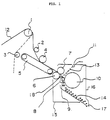
- the present inventors had intensively studied to solve the above-described problems and, as a result, found that, in intoducing many strands into the feed rolls while laying them transversely parallel, it is effective to mount a belt conveyer slanted down forward just before the pair of feed rolls and a press roll for pressing the strands on the slanted conveyer.
- the use of a conveyer as a means for introducing strands into a strand cutter is known.
- the strands tend to bend in the directions different from the moving direction of the belt or overlap with each other on the belt, and hence the direct introduction of such strands between the upper and lower feed rolls results in the deviation of the strands from the feed rolls or the twist of the strands themselves.
- a belt conveyer which is slanted down forward, with a press roll mounted thereon, it is possible to place the ends of the strands parallel with the advancing direction on the belt conveyer, to disintegrate, the strands which have overlapped on the belt into parallelly laid strands by the press roll, and to introduce the strands smoothly as they are between the upper and lower feed rolls.
- the inclined angle of the belt conveyer to the horizontal plane is at least 20°, preferably at least 30°, and not more than 80° in practical use. It is preferred that the speed of the belt conveyer be a little lower than the take-up speed of the upper and lower feed rolls.
- the raw materials for the belt of the belt conveyer there can be used various rubbers and flexible resins such as polyvinyl alcohol.
- the press roll press the strands on the belt conveyer by use of the weight of the roll itself, spring pressure or air pressure. In this case, however, too large pressing force of the press roll will cause a failure in introducing strands between the press roll and the belt, formation of deformed strands or the like.
- the press roll be adjusted for the purpose of selecting an appropriate force. Furthermore, it is effective that the press roll be so mounted that the clearance between the press roll and the belt conveyer will be equal to or a little smaller than the maximum length of the strand cross section for the purpose of the smooth introduction between the roll and conveyer without fail.
- the present inventors further found that the horizontal and vertical vibration of the strands can be minimized by, when the strands having passed between the upper and lower feed rolls are introduced to a support having a fixed blade on the head thereof, spraying a liquid onto the strand from above the support, thereby permitting the strands to be cut smoothly with a rotary blade.
- Water or an organic liquid which does not exert bad influences on the strands, or mixtures of water and this liquid can be used as the spraying liquid.
- the amount sprayed may be such that the surfaces of the strands are fully moisted, and too much amount will disturb strand movement by the liquid flow, which is not preferred. It is therefore desired that the amount sprayed be adjustable judging from the strand movement. It is also preferred that spraying direction be radial and perpendicular to the strand movement.
- pellets having a straight cut surface and an extremely uniform cut length can be obtained by introducing strands between the upper and lower feed roll using a belt conveyer slanted down forward with a press roll mounted thereon and then passing the strands to a support having a fixed blade on the head thereof, and, thereafter, cutting the strands with a rotary blade while spraying a liquid from above the support.
- a belt conveyer slanted down forward with a press roll mounted thereon and then passing the strands to a support having a fixed blade on the head thereof, and, thereafter, cutting the strands with a rotary blade while spraying a liquid from above the support.
- the upper one of the two feed rolls is located a little ahead of the lower one and the tangential plane at the contact point of the upper and lower rolls crosses the upper surface of a support having a fixed blade at the head thereof which is mounted between the lower roll and a rotary blade; in addition, the distance between the contact point of the upper and lower feed rolls and the end of the fixed blade is adjusted to not more than 70 mm, preferably not more than 60 mm.
- the upper surface of the support as referred to herein also includes, in the case where a scraper is equipped between the lower feed roll and the support and plays a role as support, the upper surface of the scraper.
- An example of the particularly preferred strands used in the present invention is such a flexible resin strand that will, when placed on a horizontal table and pulled out of the end of the table by 10 cm, hang down by its weight at 20°C so that the height from the tip end of the strand to the horizontal plane of the horizontal table will be 3 to 9 cm.
- Examples of the raw material for these strands are various thermoplastic resins, elastomers and rubbers, among which preferred is an ethylene-vinyl alcohol copolymer.
- the present invention is particularly suitable for obtaining pellets from strands having a thick diameter.
- the diameter is at least 1 mm, preferably at least 2 mm and not more than 5 mm, preferably not more than 4 mm.
- the length of the pellet is 1 to 8 mm, preferably 1 to 5 mm.
- a solution comprising 31 parts of an ethylene-vinyl alcohol copolymer having an ethylene content of 32 mol% and a saponification degree of vinyl acetate component of 99 mol%, 46 parts of methanol and 23 parts of water was extruded through a die with 50 holes having a pore size of 4 mm into a mixed liquid of water and methanol (10 wt%) at 20°C to coagulate into strands.
- a piece of the thus-obtained strands is sampled by about 20 cm in length and this sample was placed on a horizontal table, while extending out of the end of the table by 10 cm, and allowed to hang at 20°C. The height from the tip end of the strand to the horizontal plane of the table was 6.1 cm.
- the strand bundle was arranged parrallelly after passing through press roll 4 of the belt conveyer, and extremely smoothly introduced between upper and lower feed rolls without forming twist of the bundle at all before the feed rolls. Furthermore, the pellets obtained by cutting with the strand cutter had no obliquely cut surface at all and had an average cut length of 3.3 mm and a standard deviation of length of 0.30 mm.
- Example 2 The same procedure as in Example 1 was followed except for changing the position of upper feed roll 7 such that the tangential section at the contact point of the feed rolls 6 and 7 would cross the upper surface of scraper 18 to give pellets articles having an average cut length of 3.2 mm and a standard deviation of length of 0.11 mm.
- the press roll equipped on the belt conveyer in Example 1 was removed and then a strand bundle was introduced.
- the strands on the belt when introduced as they were between the feed rolls of the strand cutter, formed a twist of the strands before the feed rolls, thereby generating horizontal and vertical vibration between the feed rolls and the rotary blade.
- the pellets obtained had obliquely cut surface and had a standard deviation of length of 0.70 mm.
- Example 2 The same procedure as in Example 1 was followed except for positioning the belt conveyer horizontally to give a result that part of the strand bundle is placed on the belt of the belt conveyer while being folded in the direction other than the moving direction of the belt, turned the way aside and did not enter between the press roll and the belt, and hence could not be introduced into the strand cutter.
- Example 2 The same procedure as in Example 1 was followed except that water was not sprayed between the upper and lower feed rolls and the rotary blade to give pellets, which had many obliquely cut surfaces and had an average cut length of 3.4 mm and a standard deviation of 0.60 mm.
Landscapes
- Engineering & Computer Science (AREA)
- Mechanical Engineering (AREA)
- Processing And Handling Of Plastics And Other Materials For Molding In General (AREA)
Claims (5)
- Verfahren zur Herstellung von Pellets (14), das die Schritte aufweist: Einführen von Strängen (12) zwischen obere und untere Vorschubrollen (7, 6) unter Verwendung eines sich vorwärts nach unten neigenden Förderers (5), dann Einführen der Stränge (12) auf eine Auflage (8) mit einer ortsfesten Klinge (9) auf ihrem Kopfteil und Schneiden der Stränge (12) mit einer rotierenden Klinge (10), dadurch gekennzeichnet, daß es weiter die Schritte aufweist: Verwenden eines Bandförderers (5) zum Einführen der Stränge (12), Drücken der Stränge (12) auf den Bandförderer (5) durch eine Preßwalze (4) und Sprühen einer Flüssigkeit (13) von oberhalb der Auflage (8) auf die Stränge (12), während die Stränge (12) geschnitten werden.
- Verfahren zur Herstellung von Pellets nach Anspruch 1, wobei der Strang (12) ein Harzstrang ist, der, wenn er derart auf einen Tisch gelegt wird, daß sein Ende um 10 cm über das Ende des Tisches hinausragt, durch sein Gewicht nach unten hängt, wobei die Höhe des äußersten Endes des Strangs gegen die Horizontalebene des Tisches 3 bis 9 cm ist.
- Vorrichtung zur Herstellung von Pellets, die aufweist: obere und untere Vorschubrollen (7, 6) und einen sich vorwärts nach unten neigenden Förderer (5) zum Zuführen von Strängen (12) an eine Auflage (8) mit einer ortsfesten Klinge (9) auf ihrem Kopfteil und einer rotierenden Klinge (10) zum Schneiden der Stränge (12), gekennzeichnet dadurch, daß der Förderer ein Bandförderer (5) ist, und durch eine Preßwalze (4) zum Drücken der Stränge auf den Bandförderer (5) und eine Sprühdüse (11) zum Sprühen von Flüssigkeit (13) von oberhalb der Auflage (8) auf die Stränge (12).
- Vorrichtung zur Herstellung von Pellets nach Anspruch 3, wobei die Tangentialebene am Berührungspunkt der oberen und unteren Vorschubrollen (7, 6) die obere Oberfläche der Auflage (8) mit der ortsfesten Klinge (9) auf ihrem Kopfteil schneidet.
- Vorrichtung zur Herstellung von Pellets nach Anspruch 3 oder 4, wobei der Abstand zwischen dem Berührungspunkt der beiden oberen und unteren Vorschubrollen (7, 6) und dem Kopfteil der ortsfesten Klinge (9) der Auflage (8) nicht mehr als 70 mm beträgt.
Applications Claiming Priority (2)
| Application Number | Priority Date | Filing Date | Title |
|---|---|---|---|
| JP1199606A JPH0613175B2 (ja) | 1989-07-31 | 1989-07-31 | ペレツトの製造法 |
| JP199606/89 | 1989-07-31 |
Publications (3)
| Publication Number | Publication Date |
|---|---|
| EP0411536A2 EP0411536A2 (de) | 1991-02-06 |
| EP0411536A3 EP0411536A3 (en) | 1991-05-29 |
| EP0411536B1 true EP0411536B1 (de) | 1995-11-08 |
Family
ID=16410660
Family Applications (1)
| Application Number | Title | Priority Date | Filing Date |
|---|---|---|---|
| EP90114592A Expired - Lifetime EP0411536B1 (de) | 1989-07-31 | 1990-07-30 | Verfahren und Vorrichtung zur Herstellung von Pellets |
Country Status (4)
| Country | Link |
|---|---|
| US (1) | US5146822A (de) |
| EP (1) | EP0411536B1 (de) |
| JP (1) | JPH0613175B2 (de) |
| DE (1) | DE69023410T2 (de) |
Families Citing this family (20)
| Publication number | Priority date | Publication date | Assignee | Title |
|---|---|---|---|---|
| DE4209373C1 (de) * | 1992-03-23 | 1993-07-01 | Automatik Apparate-Maschinenbau Gmbh, 8754 Grossostheim, De | |
| US5545025A (en) * | 1994-10-03 | 1996-08-13 | Katsu Manufacturing Co., Ltd. | Cooled pellet making machine |
| EP0830068B1 (de) * | 1995-06-05 | 2001-07-11 | The Pillsbury Company | Indexiergerät zur genauen bewegung von einem nahrungsmittel entlang einer produktionslinie |
| AU3905997A (en) * | 1996-08-09 | 1998-03-06 | Tanimura & Antle, Inc. | Process and apparatus for field dicing/disinfecting produce and bulk bagging/cooling for extended shelf life |
| EP0862944A1 (de) * | 1997-03-07 | 1998-09-09 | Ciba SC Holding AG | Verfahren und Vorrichtung zum Herstellen von Granulat aus Produktsträngen |
| JP4104095B2 (ja) * | 1998-10-22 | 2008-06-18 | 日本合成化学工業株式会社 | エチレン−酢酸ビニル共重合体ケン化物ペレット |
| US6686405B1 (en) | 1999-07-23 | 2004-02-03 | Kuraray Co., Ltd. | Process for producing ethylene-vinyl alcohol copolymer resin, process for producing pellets and resin pellets |
| US6838029B2 (en) | 2001-01-19 | 2005-01-04 | Kuraray Co., Ltd. | Method for producing ethylene-vinyl alcohol copolymer resin |
| JP4441844B2 (ja) * | 2002-10-25 | 2010-03-31 | 東洋紡績株式会社 | 絞りしごき缶被覆用フィルムロール及びその製造方法 |
| US7124972B2 (en) * | 2003-09-04 | 2006-10-24 | Scheer Bay Limited Partnership | System and apparatus for manufacturing thermoplastic micropellets |
| DE102007027543A1 (de) * | 2006-11-27 | 2008-05-29 | Bühler AG | Stranggranulationsverfahren und -vorrichtung sowie daraus hergestellte Granulate |
| DE102007027418A1 (de) | 2007-06-14 | 2008-12-18 | Rieter Automatik Gmbh | Stranggranulator zum Granulieren von Kunststoffsträngen |
| DE102007044201A1 (de) * | 2007-09-17 | 2009-03-19 | Rieter Automatik Gmbh | Vorrichtung zum Granulieren von Kunststoffsträngen |
| DE202007014782U1 (de) * | 2007-10-23 | 2009-03-05 | Rieter Automatik Gmbh | Stranggranulierungsvorrichtung |
| DE102007050592A1 (de) * | 2007-10-23 | 2009-04-30 | Rieter Automatik Gmbh | Stranggießvorrichtung zur Erzeugung von Granulatkörnern aus Kunststoffmaterial und Verfahren zu deren Betrieb |
| WO2015098772A1 (ja) | 2013-12-27 | 2015-07-02 | 日本合成化学工業株式会社 | エチレンービニルエステル系共重合体ケン化物の成形材料 |
| WO2015107957A1 (ja) | 2014-01-14 | 2015-07-23 | 日本合成化学工業株式会社 | エチレンービニルエステル系共重合体ケン化物を用いた成形材料 |
| CN106573704B (zh) | 2014-07-29 | 2019-03-26 | 日本合成化学工业株式会社 | 乙烯-乙烯基酯系共聚物皂化物或其树脂组合物的颗粒组的包装体 |
| WO2017211898A1 (de) * | 2016-06-09 | 2017-12-14 | Maag Automatik Gmbh | Kunststoffstranggranulator mit lärmschutz |
| JP2025038561A (ja) * | 2023-09-07 | 2025-03-19 | 株式会社タナカ | ペレタイザ |
Family Cites Families (14)
| Publication number | Priority date | Publication date | Assignee | Title |
|---|---|---|---|---|
| US2808884A (en) * | 1954-04-05 | 1957-10-08 | Pacific Mills | Apparatus for producing staple fibers from continuous strands of textile fibers |
| US2978942A (en) * | 1957-02-21 | 1961-04-11 | Congoleum Nairn Inc | Dicing machine having spaced transverse cutters associated with rotary slitters |
| US2975483A (en) * | 1959-02-19 | 1961-03-21 | Du Pont | Process for producing polymeric pellets by cutting surface cooled strands |
| CH374826A (de) * | 1959-10-16 | 1964-01-31 | Lonza Ag | Maschine zum Granulieren von Kunststoffbändern |
| DE1924913A1 (de) * | 1969-01-21 | 1970-07-30 | Laroche & Fils Constr Mec | Schneidemaschine fuer Tabakblaetter,Gewebe,Textilfaden,Textilfasern oder aehnliches Schnittgut |
| DE2161067C2 (de) * | 1971-12-09 | 1973-09-20 | Fa. Werner & Pfleiderer, 7000 Stuttgart | Vorrichtung zum Abkühlen von aus einem Extruder austretenden Kunststoff strängen |
| DE2627263C2 (de) * | 1976-06-18 | 1978-08-10 | Automatik Apparate-Maschinenbau H. Hench Gmbh, 8754 Grossostheim | Vorrichtung zum Abkühlen und Granulieren von Strängen aus thermoplastischen Kunststoffen |
| DE2901018C2 (de) * | 1979-01-12 | 1981-12-03 | C.F. Scheer & Cie Gmbh & Co, 7000 Stuttgart | Granulator zum Granulieren von Kunststoffsträngen |
| US4528157A (en) * | 1983-02-15 | 1985-07-09 | Automatik Apprate-Maschinenbau H. Hench Gmbh | Feeding of molten strands to a discharge trough |
| DE3336032C2 (de) * | 1983-10-04 | 1985-12-12 | AUTOMATIK Apparate-Maschinenbau GmbH, 8754 Großostheim | Vorrichtung zum Abkühlen, Trocknen und Granulieren von Strängen aus thermoplastischen Kunststoffen |
| DE3600567C1 (de) * | 1986-01-10 | 1987-05-07 | Automatik App Maschb Gmbh | Vorrichtung zum Granulieren von Straengen aus thermoplastischen Kunststoffen |
| DE8600491U1 (de) * | 1986-01-10 | 1987-06-19 | AUTOMATIK Apparate-Maschinenbau GmbH, 8754 Großostheim | Vorrichtung zum Granulieren von Strängen aus thermoplastischen Kunststoffen |
| DE3611179C1 (de) * | 1986-04-03 | 1987-11-26 | Automatik App Maschb Gmbh | Messerleiste,insbesondere zum Granulieren von Kunststoffstraengen |
| DE3726606A1 (de) * | 1987-08-11 | 1989-03-02 | Guenter Hartig | Vorrichtung zum zufuehren und abkuehlen von straengen aus thermoplastischen kunststoffen |
-
1989
- 1989-07-31 JP JP1199606A patent/JPH0613175B2/ja not_active Expired - Fee Related
-
1990
- 1990-07-30 EP EP90114592A patent/EP0411536B1/de not_active Expired - Lifetime
- 1990-07-30 DE DE69023410T patent/DE69023410T2/de not_active Expired - Fee Related
-
1991
- 1991-09-09 US US07/758,534 patent/US5146822A/en not_active Expired - Lifetime
Also Published As
| Publication number | Publication date |
|---|---|
| JPH0361507A (ja) | 1991-03-18 |
| DE69023410T2 (de) | 1996-04-25 |
| US5146822A (en) | 1992-09-15 |
| EP0411536A3 (en) | 1991-05-29 |
| JPH0613175B2 (ja) | 1994-02-23 |
| EP0411536A2 (de) | 1991-02-06 |
| DE69023410D1 (de) | 1995-12-14 |
Similar Documents
| Publication | Publication Date | Title |
|---|---|---|
| EP0411536B1 (de) | Verfahren und Vorrichtung zur Herstellung von Pellets | |
| US5265507A (en) | Process for producing pellets | |
| US4537610A (en) | Method and apparatus for producing chopped strands | |
| US3429211A (en) | Apparatus for trimming the neck of hollow plastic articles | |
| US6766721B2 (en) | Just-in-time bulk rubber bale processor | |
| EP0302621B1 (de) | Lochplatte für die Unterwassergranulierung von Kunststoffsträngen mit hoher Schmelzströmungsgeschwindigkeit | |
| US3837781A (en) | Device for cooling and granulating strands of plastic material discharged from an extruder | |
| US2975483A (en) | Process for producing polymeric pellets by cutting surface cooled strands | |
| US6592350B1 (en) | Underwater pelletizer with separator | |
| WO2009052979A1 (de) | Stranggiessvorrichtung zur erzeugung von granulatkörnern aus kunststoffmaterial und verfahren zu deren betrieb | |
| EP0128967A1 (de) | Verfahren und Vorrichtung zum Schneiden und Schweissen thermoplastischer Filme oder Folien | |
| US5617768A (en) | Trimmer for removing scraping from tops of plastic bottles | |
| US6426026B1 (en) | Process for pelletizing ultra-high melt flow polymers | |
| US2887725A (en) | Manufacturing thermoplastic pellets | |
| CN105455049B (zh) | 一种蟹肉棒全自动生产系统及其生产方法 | |
| US4080136A (en) | Apparatus for dispensing metered charges of material | |
| US2746086A (en) | Method of manufacturing thermoplastic pellets | |
| PL85161B1 (de) | ||
| CA2051643A1 (en) | Continuous feed thermoforming method and apparatus | |
| US4009237A (en) | Process for producing shaped synthetic resin articles varying in shape of longitudinal section | |
| JPH0550429A (ja) | ペレタイザー | |
| CA1120226A (en) | Process and apparatus for manufacturing flat plastic net | |
| GB1590231A (en) | Method of manufacturing stakes | |
| CN209955064U (zh) | 一种塑料加工用高速冷却切料装置 | |
| EP0501689B1 (de) | Kombiniertes Spinn- und Entwässerungsverfahren |
Legal Events
| Date | Code | Title | Description |
|---|---|---|---|
| PUAI | Public reference made under article 153(3) epc to a published international application that has entered the european phase |
Free format text: ORIGINAL CODE: 0009012 |
|
| AK | Designated contracting states |
Kind code of ref document: A2 Designated state(s): DE FR GB IT |
|
| PUAL | Search report despatched |
Free format text: ORIGINAL CODE: 0009013 |
|
| AK | Designated contracting states |
Kind code of ref document: A3 Designated state(s): DE FR GB IT |
|
| 17P | Request for examination filed |
Effective date: 19911007 |
|
| 17Q | First examination report despatched |
Effective date: 19930720 |
|
| GRAA | (expected) grant |
Free format text: ORIGINAL CODE: 0009210 |
|
| AK | Designated contracting states |
Kind code of ref document: B1 Designated state(s): DE FR GB IT |
|
| REF | Corresponds to: |
Ref document number: 69023410 Country of ref document: DE Date of ref document: 19951214 |
|
| ITF | It: translation for a ep patent filed | ||
| ET | Fr: translation filed | ||
| PLBE | No opposition filed within time limit |
Free format text: ORIGINAL CODE: 0009261 |
|
| STAA | Information on the status of an ep patent application or granted ep patent |
Free format text: STATUS: NO OPPOSITION FILED WITHIN TIME LIMIT |
|
| 26N | No opposition filed | ||
| REG | Reference to a national code |
Ref country code: GB Ref legal event code: IF02 |
|
| PGFP | Annual fee paid to national office [announced via postgrant information from national office to epo] |
Ref country code: DE Payment date: 20070726 Year of fee payment: 18 |
|
| PGFP | Annual fee paid to national office [announced via postgrant information from national office to epo] |
Ref country code: GB Payment date: 20070725 Year of fee payment: 18 |
|
| PGFP | Annual fee paid to national office [announced via postgrant information from national office to epo] |
Ref country code: IT Payment date: 20070730 Year of fee payment: 18 |
|
| PGFP | Annual fee paid to national office [announced via postgrant information from national office to epo] |
Ref country code: FR Payment date: 20070710 Year of fee payment: 18 |
|
| GBPC | Gb: european patent ceased through non-payment of renewal fee |
Effective date: 20080730 |
|
| PG25 | Lapsed in a contracting state [announced via postgrant information from national office to epo] |
Ref country code: DE Free format text: LAPSE BECAUSE OF NON-PAYMENT OF DUE FEES Effective date: 20090203 |
|
| REG | Reference to a national code |
Ref country code: FR Ref legal event code: ST Effective date: 20090331 |
|
| PG25 | Lapsed in a contracting state [announced via postgrant information from national office to epo] |
Ref country code: GB Free format text: LAPSE BECAUSE OF NON-PAYMENT OF DUE FEES Effective date: 20080730 |
|
| PG25 | Lapsed in a contracting state [announced via postgrant information from national office to epo] |
Ref country code: FR Free format text: LAPSE BECAUSE OF NON-PAYMENT OF DUE FEES Effective date: 20080731 Ref country code: IT Free format text: LAPSE BECAUSE OF NON-PAYMENT OF DUE FEES Effective date: 20080730 |