EP0406296B1 - Verfahren zur sequenzanalyse von dna - Google Patents
Verfahren zur sequenzanalyse von dna Download PDFInfo
- Publication number
- EP0406296B1 EP0406296B1 EP89904168A EP89904168A EP0406296B1 EP 0406296 B1 EP0406296 B1 EP 0406296B1 EP 89904168 A EP89904168 A EP 89904168A EP 89904168 A EP89904168 A EP 89904168A EP 0406296 B1 EP0406296 B1 EP 0406296B1
- Authority
- EP
- European Patent Office
- Prior art keywords
- dna
- sequencing
- solid support
- target dna
- strand
- Prior art date
- Legal status (The legal status is an assumption and is not a legal conclusion. Google has not performed a legal analysis and makes no representation as to the accuracy of the status listed.)
- Revoked
Links
- 238000012163 sequencing technique Methods 0.000 title claims abstract description 69
- 238000000034 method Methods 0.000 title claims abstract description 48
- 108020004414 DNA Proteins 0.000 claims abstract description 81
- 108091034117 Oligonucleotide Proteins 0.000 claims abstract description 40
- 102000053602 DNA Human genes 0.000 claims abstract description 19
- 239000007787 solid Substances 0.000 claims abstract description 19
- 238000000926 separation method Methods 0.000 claims abstract description 9
- 239000013612 plasmid Substances 0.000 claims description 29
- 238000003752 polymerase chain reaction Methods 0.000 claims description 22
- 125000000524 functional group Chemical group 0.000 claims description 20
- JLCPHMBAVCMARE-UHFFFAOYSA-N [3-[[3-[[3-[[3-[[3-[[3-[[3-[[3-[[3-[[3-[[3-[[5-(2-amino-6-oxo-1H-purin-9-yl)-3-[[3-[[3-[[3-[[3-[[3-[[5-(2-amino-6-oxo-1H-purin-9-yl)-3-[[5-(2-amino-6-oxo-1H-purin-9-yl)-3-hydroxyoxolan-2-yl]methoxy-hydroxyphosphoryl]oxyoxolan-2-yl]methoxy-hydroxyphosphoryl]oxy-5-(5-methyl-2,4-dioxopyrimidin-1-yl)oxolan-2-yl]methoxy-hydroxyphosphoryl]oxy-5-(6-aminopurin-9-yl)oxolan-2-yl]methoxy-hydroxyphosphoryl]oxy-5-(6-aminopurin-9-yl)oxolan-2-yl]methoxy-hydroxyphosphoryl]oxy-5-(6-aminopurin-9-yl)oxolan-2-yl]methoxy-hydroxyphosphoryl]oxy-5-(6-aminopurin-9-yl)oxolan-2-yl]methoxy-hydroxyphosphoryl]oxyoxolan-2-yl]methoxy-hydroxyphosphoryl]oxy-5-(5-methyl-2,4-dioxopyrimidin-1-yl)oxolan-2-yl]methoxy-hydroxyphosphoryl]oxy-5-(4-amino-2-oxopyrimidin-1-yl)oxolan-2-yl]methoxy-hydroxyphosphoryl]oxy-5-(5-methyl-2,4-dioxopyrimidin-1-yl)oxolan-2-yl]methoxy-hydroxyphosphoryl]oxy-5-(5-methyl-2,4-dioxopyrimidin-1-yl)oxolan-2-yl]methoxy-hydroxyphosphoryl]oxy-5-(6-aminopurin-9-yl)oxolan-2-yl]methoxy-hydroxyphosphoryl]oxy-5-(6-aminopurin-9-yl)oxolan-2-yl]methoxy-hydroxyphosphoryl]oxy-5-(4-amino-2-oxopyrimidin-1-yl)oxolan-2-yl]methoxy-hydroxyphosphoryl]oxy-5-(4-amino-2-oxopyrimidin-1-yl)oxolan-2-yl]methoxy-hydroxyphosphoryl]oxy-5-(4-amino-2-oxopyrimidin-1-yl)oxolan-2-yl]methoxy-hydroxyphosphoryl]oxy-5-(6-aminopurin-9-yl)oxolan-2-yl]methoxy-hydroxyphosphoryl]oxy-5-(4-amino-2-oxopyrimidin-1-yl)oxolan-2-yl]methyl [5-(6-aminopurin-9-yl)-2-(hydroxymethyl)oxolan-3-yl] hydrogen phosphate Polymers Cc1cn(C2CC(OP(O)(=O)OCC3OC(CC3OP(O)(=O)OCC3OC(CC3O)n3cnc4c3nc(N)[nH]c4=O)n3cnc4c3nc(N)[nH]c4=O)C(COP(O)(=O)OC3CC(OC3COP(O)(=O)OC3CC(OC3COP(O)(=O)OC3CC(OC3COP(O)(=O)OC3CC(OC3COP(O)(=O)OC3CC(OC3COP(O)(=O)OC3CC(OC3COP(O)(=O)OC3CC(OC3COP(O)(=O)OC3CC(OC3COP(O)(=O)OC3CC(OC3COP(O)(=O)OC3CC(OC3COP(O)(=O)OC3CC(OC3COP(O)(=O)OC3CC(OC3COP(O)(=O)OC3CC(OC3COP(O)(=O)OC3CC(OC3COP(O)(=O)OC3CC(OC3COP(O)(=O)OC3CC(OC3COP(O)(=O)OC3CC(OC3CO)n3cnc4c(N)ncnc34)n3ccc(N)nc3=O)n3cnc4c(N)ncnc34)n3ccc(N)nc3=O)n3ccc(N)nc3=O)n3ccc(N)nc3=O)n3cnc4c(N)ncnc34)n3cnc4c(N)ncnc34)n3cc(C)c(=O)[nH]c3=O)n3cc(C)c(=O)[nH]c3=O)n3ccc(N)nc3=O)n3cc(C)c(=O)[nH]c3=O)n3cnc4c3nc(N)[nH]c4=O)n3cnc4c(N)ncnc34)n3cnc4c(N)ncnc34)n3cnc4c(N)ncnc34)n3cnc4c(N)ncnc34)O2)c(=O)[nH]c1=O JLCPHMBAVCMARE-UHFFFAOYSA-N 0.000 claims description 16
- YBJHBAHKTGYVGT-ZKWXMUAHSA-N (+)-Biotin Chemical compound N1C(=O)N[C@@H]2[C@H](CCCCC(=O)O)SC[C@@H]21 YBJHBAHKTGYVGT-ZKWXMUAHSA-N 0.000 claims description 12
- 239000000126 substance Substances 0.000 claims description 12
- 238000002844 melting Methods 0.000 claims description 8
- 230000008018 melting Effects 0.000 claims description 8
- 108091028043 Nucleic acid sequence Proteins 0.000 claims description 7
- 229960002685 biotin Drugs 0.000 claims description 6
- 235000020958 biotin Nutrition 0.000 claims description 6
- 239000011616 biotin Substances 0.000 claims description 6
- 108010090804 Streptavidin Proteins 0.000 claims description 4
- 108090001008 Avidin Proteins 0.000 claims description 2
- 230000003321 amplification Effects 0.000 claims 1
- 238000003199 nucleic acid amplification method Methods 0.000 claims 1
- 125000003396 thiol group Chemical group [H]S* 0.000 claims 1
- 108020004682 Single-Stranded DNA Proteins 0.000 abstract description 5
- 239000013615 primer Substances 0.000 description 37
- HEMHJVSKTPXQMS-UHFFFAOYSA-M Sodium hydroxide Chemical compound [OH-].[Na+] HEMHJVSKTPXQMS-UHFFFAOYSA-M 0.000 description 30
- 239000000203 mixture Substances 0.000 description 29
- 238000006243 chemical reaction Methods 0.000 description 26
- FAPWRFPIFSIZLT-UHFFFAOYSA-M Sodium chloride Chemical compound [Na+].[Cl-] FAPWRFPIFSIZLT-UHFFFAOYSA-M 0.000 description 22
- 239000012634 fragment Substances 0.000 description 22
- 239000007790 solid phase Substances 0.000 description 18
- 239000002773 nucleotide Substances 0.000 description 17
- 239000013598 vector Substances 0.000 description 17
- TWRXJAOTZQYOKJ-UHFFFAOYSA-L Magnesium chloride Chemical compound [Mg+2].[Cl-].[Cl-] TWRXJAOTZQYOKJ-UHFFFAOYSA-L 0.000 description 16
- 108010063086 avidin-agarose Proteins 0.000 description 16
- 125000003729 nucleotide group Chemical group 0.000 description 16
- 239000000872 buffer Substances 0.000 description 15
- 239000006228 supernatant Substances 0.000 description 13
- ZHNUHDYFZUAESO-UHFFFAOYSA-N Formamide Chemical compound NC=O ZHNUHDYFZUAESO-UHFFFAOYSA-N 0.000 description 12
- RGWHQCVHVJXOKC-SHYZEUOFSA-J dCTP(4-) Chemical compound O=C1N=C(N)C=CN1[C@@H]1O[C@H](COP([O-])(=O)OP([O-])(=O)OP([O-])([O-])=O)[C@@H](O)C1 RGWHQCVHVJXOKC-SHYZEUOFSA-J 0.000 description 12
- NHVNXKFIZYSCEB-XLPZGREQSA-N dTTP Chemical compound O=C1NC(=O)C(C)=CN1[C@@H]1O[C@H](COP(O)(=O)OP(O)(=O)OP(O)(O)=O)[C@@H](O)C1 NHVNXKFIZYSCEB-XLPZGREQSA-N 0.000 description 12
- HAAZLUGHYHWQIW-KVQBGUIXSA-N dGTP Chemical compound C1=NC=2C(=O)NC(N)=NC=2N1[C@H]1C[C@H](O)[C@@H](COP(O)(=O)OP(O)(=O)OP(O)(O)=O)O1 HAAZLUGHYHWQIW-KVQBGUIXSA-N 0.000 description 11
- 239000000499 gel Substances 0.000 description 11
- 239000011780 sodium chloride Substances 0.000 description 11
- 238000000137 annealing Methods 0.000 description 10
- SUYVUBYJARFZHO-RRKCRQDMSA-N dATP Chemical compound C1=NC=2C(N)=NC=NC=2N1[C@H]1C[C@H](O)[C@@H](COP(O)(=O)OP(O)(=O)OP(O)(O)=O)O1 SUYVUBYJARFZHO-RRKCRQDMSA-N 0.000 description 10
- SUYVUBYJARFZHO-UHFFFAOYSA-N dATP Natural products C1=NC=2C(N)=NC=NC=2N1C1CC(O)C(COP(O)(=O)OP(O)(=O)OP(O)(O)=O)O1 SUYVUBYJARFZHO-UHFFFAOYSA-N 0.000 description 10
- QKNYBSVHEMOAJP-UHFFFAOYSA-N 2-amino-2-(hydroxymethyl)propane-1,3-diol;hydron;chloride Chemical compound Cl.OCC(N)(CO)CO QKNYBSVHEMOAJP-UHFFFAOYSA-N 0.000 description 8
- 239000011543 agarose gel Substances 0.000 description 8
- 238000011534 incubation Methods 0.000 description 8
- 229910001629 magnesium chloride Inorganic materials 0.000 description 8
- 238000001712 DNA sequencing Methods 0.000 description 6
- 102000004190 Enzymes Human genes 0.000 description 6
- 108090000790 Enzymes Proteins 0.000 description 6
- 238000013459 approach Methods 0.000 description 6
- XLYOFNOQVPJJNP-UHFFFAOYSA-N water Substances O XLYOFNOQVPJJNP-UHFFFAOYSA-N 0.000 description 6
- 239000002585 base Substances 0.000 description 5
- 238000003776 cleavage reaction Methods 0.000 description 5
- 239000005546 dideoxynucleotide Substances 0.000 description 5
- 238000001962 electrophoresis Methods 0.000 description 5
- 239000000463 material Substances 0.000 description 5
- 108091008146 restriction endonucleases Proteins 0.000 description 5
- 238000005406 washing Methods 0.000 description 5
- 239000003155 DNA primer Substances 0.000 description 4
- 239000007984 Tris EDTA buffer Substances 0.000 description 4
- 239000007983 Tris buffer Substances 0.000 description 4
- 239000002253 acid Substances 0.000 description 4
- 150000007513 acids Chemical class 0.000 description 4
- 238000000246 agarose gel electrophoresis Methods 0.000 description 4
- 230000008901 benefit Effects 0.000 description 4
- 108010005774 beta-Galactosidase Proteins 0.000 description 4
- 238000001514 detection method Methods 0.000 description 4
- 238000010348 incorporation Methods 0.000 description 4
- 238000003780 insertion Methods 0.000 description 4
- 230000037431 insertion Effects 0.000 description 4
- 230000003993 interaction Effects 0.000 description 4
- 238000002372 labelling Methods 0.000 description 4
- 239000011541 reaction mixture Substances 0.000 description 4
- 230000007017 scission Effects 0.000 description 4
- KCXVZYZYPLLWCC-UHFFFAOYSA-N EDTA Chemical compound OC(=O)CN(CC(O)=O)CCN(CC(O)=O)CC(O)=O KCXVZYZYPLLWCC-UHFFFAOYSA-N 0.000 description 3
- 238000000211 autoradiogram Methods 0.000 description 3
- 102000005936 beta-Galactosidase Human genes 0.000 description 3
- 239000012876 carrier material Substances 0.000 description 3
- 238000010276 construction Methods 0.000 description 3
- 238000010828 elution Methods 0.000 description 3
- 238000002360 preparation method Methods 0.000 description 3
- LENZDBCJOHFCAS-UHFFFAOYSA-N tris Chemical compound OCC(N)(CO)CO LENZDBCJOHFCAS-UHFFFAOYSA-N 0.000 description 3
- 238000011144 upstream manufacturing Methods 0.000 description 3
- OAKPWEUQDVLTCN-NKWVEPMBSA-N 2',3'-Dideoxyadenosine-5-triphosphate Chemical compound C1=NC=2C(N)=NC=NC=2N1[C@H]1CC[C@@H](CO[P@@](O)(=O)O[P@](O)(=O)OP(O)(O)=O)O1 OAKPWEUQDVLTCN-NKWVEPMBSA-N 0.000 description 2
- CSCPPACGZOOCGX-UHFFFAOYSA-N Acetone Chemical compound CC(C)=O CSCPPACGZOOCGX-UHFFFAOYSA-N 0.000 description 2
- 229920000936 Agarose Polymers 0.000 description 2
- 108010014303 DNA-directed DNA polymerase Proteins 0.000 description 2
- 102000016928 DNA-directed DNA polymerase Human genes 0.000 description 2
- LFQSCWFLJHTTHZ-UHFFFAOYSA-N Ethanol Chemical compound CCO LFQSCWFLJHTTHZ-UHFFFAOYSA-N 0.000 description 2
- 101100297420 Homarus americanus phc-1 gene Proteins 0.000 description 2
- 102000003960 Ligases Human genes 0.000 description 2
- 108090000364 Ligases Proteins 0.000 description 2
- 239000004793 Polystyrene Substances 0.000 description 2
- 108020004511 Recombinant DNA Proteins 0.000 description 2
- HDRRAMINWIWTNU-NTSWFWBYSA-N [[(2s,5r)-5-(2-amino-6-oxo-3h-purin-9-yl)oxolan-2-yl]methoxy-hydroxyphosphoryl] phosphono hydrogen phosphate Chemical compound C1=2NC(N)=NC(=O)C=2N=CN1[C@H]1CC[C@@H](COP(O)(=O)OP(O)(=O)OP(O)(O)=O)O1 HDRRAMINWIWTNU-NTSWFWBYSA-N 0.000 description 2
- ARLKCWCREKRROD-POYBYMJQSA-N [[(2s,5r)-5-(4-amino-2-oxopyrimidin-1-yl)oxolan-2-yl]methoxy-hydroxyphosphoryl] phosphono hydrogen phosphate Chemical compound O=C1N=C(N)C=CN1[C@@H]1O[C@H](COP(O)(=O)OP(O)(=O)OP(O)(O)=O)CC1 ARLKCWCREKRROD-POYBYMJQSA-N 0.000 description 2
- 239000011324 bead Substances 0.000 description 2
- 238000001816 cooling Methods 0.000 description 2
- 239000013601 cosmid vector Substances 0.000 description 2
- 238000007405 data analysis Methods 0.000 description 2
- 238000013500 data storage Methods 0.000 description 2
- URGJWIFLBWJRMF-JGVFFNPUSA-N ddTTP Chemical compound O=C1NC(=O)C(C)=CN1[C@@H]1O[C@H](COP(O)(=O)OP(O)(=O)OP(O)(O)=O)CC1 URGJWIFLBWJRMF-JGVFFNPUSA-N 0.000 description 2
- 238000002474 experimental method Methods 0.000 description 2
- 238000010438 heat treatment Methods 0.000 description 2
- 229920003023 plastic Polymers 0.000 description 2
- 239000004033 plastic Substances 0.000 description 2
- 229920002401 polyacrylamide Polymers 0.000 description 2
- 229920002223 polystyrene Polymers 0.000 description 2
- 108090000623 proteins and genes Proteins 0.000 description 2
- 239000012429 reaction media Substances 0.000 description 2
- 230000010076 replication Effects 0.000 description 2
- 238000012360 testing method Methods 0.000 description 2
- DGVVWUTYPXICAM-UHFFFAOYSA-N β‐Mercaptoethanol Chemical compound OCCS DGVVWUTYPXICAM-UHFFFAOYSA-N 0.000 description 2
- OPIFSICVWOWJMJ-AEOCFKNESA-N 5-bromo-4-chloro-3-indolyl beta-D-galactoside Chemical compound O[C@@H]1[C@@H](O)[C@@H](O)[C@@H](CO)O[C@H]1OC1=CNC2=CC=C(Br)C(Cl)=C12 OPIFSICVWOWJMJ-AEOCFKNESA-N 0.000 description 1
- 229920001817 Agar Polymers 0.000 description 1
- 0 CC[C@@](C)[C@@](C)[C@]1C(C)CC(CC)*1 Chemical compound CC[C@@](C)[C@@](C)[C@]1C(C)CC(CC)*1 0.000 description 1
- 230000006820 DNA synthesis Effects 0.000 description 1
- 108090000204 Dipeptidase 1 Proteins 0.000 description 1
- 241000588724 Escherichia coli Species 0.000 description 1
- 102100034343 Integrase Human genes 0.000 description 1
- 239000005662 Paraffin oil Substances 0.000 description 1
- 108091000080 Phosphotransferase Proteins 0.000 description 1
- 108010021757 Polynucleotide 5'-Hydroxyl-Kinase Proteins 0.000 description 1
- 102000008422 Polynucleotide 5'-hydroxyl-kinase Human genes 0.000 description 1
- 108010092799 RNA-directed DNA polymerase Proteins 0.000 description 1
- 101000702488 Rattus norvegicus High affinity cationic amino acid transporter 1 Proteins 0.000 description 1
- 229920002684 Sepharose Polymers 0.000 description 1
- 108010088160 Staphylococcal Protein A Proteins 0.000 description 1
- 241000191967 Staphylococcus aureus Species 0.000 description 1
- 239000008272 agar Substances 0.000 description 1
- 239000003513 alkali Substances 0.000 description 1
- 125000003275 alpha amino acid group Chemical group 0.000 description 1
- BFNBIHQBYMNNAN-UHFFFAOYSA-N ammonium sulfate Chemical compound N.N.OS(O)(=O)=O BFNBIHQBYMNNAN-UHFFFAOYSA-N 0.000 description 1
- 229910052921 ammonium sulfate Inorganic materials 0.000 description 1
- 235000011130 ammonium sulphate Nutrition 0.000 description 1
- 238000005349 anion exchange Methods 0.000 description 1
- 230000001580 bacterial effect Effects 0.000 description 1
- RWCCWEUUXYIKHB-UHFFFAOYSA-N benzophenone Chemical compound C=1C=CC=CC=1C(=O)C1=CC=CC=C1 RWCCWEUUXYIKHB-UHFFFAOYSA-N 0.000 description 1
- 239000012965 benzophenone Substances 0.000 description 1
- 230000015572 biosynthetic process Effects 0.000 description 1
- 238000009835 boiling Methods 0.000 description 1
- UDSAIICHUKSCKT-UHFFFAOYSA-N bromophenol blue Chemical compound C1=C(Br)C(O)=C(Br)C=C1C1(C=2C=C(Br)C(O)=C(Br)C=2)C2=CC=CC=C2S(=O)(=O)O1 UDSAIICHUKSCKT-UHFFFAOYSA-N 0.000 description 1
- 239000003153 chemical reaction reagent Substances 0.000 description 1
- 238000010367 cloning Methods 0.000 description 1
- 239000011248 coating agent Substances 0.000 description 1
- 238000000576 coating method Methods 0.000 description 1
- 230000000295 complement effect Effects 0.000 description 1
- 150000001875 compounds Chemical class 0.000 description 1
- 239000012050 conventional carrier Substances 0.000 description 1
- 238000007796 conventional method Methods 0.000 description 1
- 230000008878 coupling Effects 0.000 description 1
- 238000010168 coupling process Methods 0.000 description 1
- 238000005859 coupling reaction Methods 0.000 description 1
- XUJNEKJLAYXESH-UHFFFAOYSA-N cysteine Natural products SCC(N)C(O)=O XUJNEKJLAYXESH-UHFFFAOYSA-N 0.000 description 1
- 238000011157 data evaluation Methods 0.000 description 1
- 238000004925 denaturation Methods 0.000 description 1
- 230000036425 denaturation Effects 0.000 description 1
- 238000010218 electron microscopic analysis Methods 0.000 description 1
- 238000005516 engineering process Methods 0.000 description 1
- 238000012869 ethanol precipitation Methods 0.000 description 1
- VOZRXNHHFUQHIL-UHFFFAOYSA-N glycidyl methacrylate Chemical compound CC(=C)C(=O)OCC1CO1 VOZRXNHHFUQHIL-UHFFFAOYSA-N 0.000 description 1
- 238000003505 heat denaturation Methods 0.000 description 1
- 230000003100 immobilizing effect Effects 0.000 description 1
- 230000000977 initiatory effect Effects 0.000 description 1
- 230000001678 irradiating effect Effects 0.000 description 1
- BPHPUYQFMNQIOC-NXRLNHOXSA-N isopropyl beta-D-thiogalactopyranoside Chemical compound CC(C)S[C@@H]1O[C@H](CO)[C@H](O)[C@H](O)[C@H]1O BPHPUYQFMNQIOC-NXRLNHOXSA-N 0.000 description 1
- 238000012177 large-scale sequencing Methods 0.000 description 1
- 239000007788 liquid Substances 0.000 description 1
- 238000011068 loading method Methods 0.000 description 1
- 239000011159 matrix material Substances 0.000 description 1
- 238000012986 modification Methods 0.000 description 1
- 230000004048 modification Effects 0.000 description 1
- 238000010369 molecular cloning Methods 0.000 description 1
- 102000039446 nucleic acids Human genes 0.000 description 1
- 108020004707 nucleic acids Proteins 0.000 description 1
- 150000007523 nucleic acids Chemical class 0.000 description 1
- 239000002245 particle Substances 0.000 description 1
- 238000010647 peptide synthesis reaction Methods 0.000 description 1
- 102000020233 phosphotransferase Human genes 0.000 description 1
- 239000013600 plasmid vector Substances 0.000 description 1
- 238000002264 polyacrylamide gel electrophoresis Methods 0.000 description 1
- 229920000642 polymer Polymers 0.000 description 1
- 230000008569 process Effects 0.000 description 1
- 108090000765 processed proteins & peptides Proteins 0.000 description 1
- 238000012545 processing Methods 0.000 description 1
- 238000000746 purification Methods 0.000 description 1
- 230000002285 radioactive effect Effects 0.000 description 1
- 238000011160 research Methods 0.000 description 1
- 238000007480 sanger sequencing Methods 0.000 description 1
- 102000012498 secondary active transmembrane transporter activity proteins Human genes 0.000 description 1
- 108040003878 secondary active transmembrane transporter activity proteins Proteins 0.000 description 1
- 238000011451 sequencing strategy Methods 0.000 description 1
- ACZRDWVARWLTRG-LTAAQSAZSA-N sodium;4-[(e)-[4-(ethylamino)-3-methylphenyl]-(4-ethylimino-3-methylcyclohexa-2,5-dien-1-ylidene)methyl]-6-hydroxybenzene-1,3-disulfonic acid Chemical compound [Na+].C1=C(C)C(NCC)=CC=C1C(\C=1C(=CC(=C(O)C=1)S(O)(=O)=O)S(O)(=O)=O)=C\1C=C(C)C(=NCC)C=C/1 ACZRDWVARWLTRG-LTAAQSAZSA-N 0.000 description 1
- 238000010532 solid phase synthesis reaction Methods 0.000 description 1
- 239000000243 solution Substances 0.000 description 1
- 238000001179 sorption measurement Methods 0.000 description 1
- 238000010561 standard procedure Methods 0.000 description 1
- 238000003786 synthesis reaction Methods 0.000 description 1
- 229920001221 xylan Polymers 0.000 description 1
- 150000004823 xylans Chemical class 0.000 description 1
Images




Classifications
-
- C—CHEMISTRY; METALLURGY
- C12—BIOCHEMISTRY; BEER; SPIRITS; WINE; VINEGAR; MICROBIOLOGY; ENZYMOLOGY; MUTATION OR GENETIC ENGINEERING
- C12Q—MEASURING OR TESTING PROCESSES INVOLVING ENZYMES, NUCLEIC ACIDS OR MICROORGANISMS; COMPOSITIONS OR TEST PAPERS THEREFOR; PROCESSES OF PREPARING SUCH COMPOSITIONS; CONDITION-RESPONSIVE CONTROL IN MICROBIOLOGICAL OR ENZYMOLOGICAL PROCESSES
- C12Q1/00—Measuring or testing processes involving enzymes, nucleic acids or microorganisms; Compositions therefor; Processes of preparing such compositions
- C12Q1/68—Measuring or testing processes involving enzymes, nucleic acids or microorganisms; Compositions therefor; Processes of preparing such compositions involving nucleic acids
- C12Q1/6869—Methods for sequencing
- C12Q1/6874—Methods for sequencing involving nucleic acid arrays, e.g. sequencing by hybridisation
-
- C—CHEMISTRY; METALLURGY
- C12—BIOCHEMISTRY; BEER; SPIRITS; WINE; VINEGAR; MICROBIOLOGY; ENZYMOLOGY; MUTATION OR GENETIC ENGINEERING
- C12Q—MEASURING OR TESTING PROCESSES INVOLVING ENZYMES, NUCLEIC ACIDS OR MICROORGANISMS; COMPOSITIONS OR TEST PAPERS THEREFOR; PROCESSES OF PREPARING SUCH COMPOSITIONS; CONDITION-RESPONSIVE CONTROL IN MICROBIOLOGICAL OR ENZYMOLOGICAL PROCESSES
- C12Q1/00—Measuring or testing processes involving enzymes, nucleic acids or microorganisms; Compositions therefor; Processes of preparing such compositions
- C12Q1/68—Measuring or testing processes involving enzymes, nucleic acids or microorganisms; Compositions therefor; Processes of preparing such compositions involving nucleic acids
- C12Q1/6806—Preparing nucleic acids for analysis, e.g. for polymerase chain reaction [PCR] assay
-
- C—CHEMISTRY; METALLURGY
- C12—BIOCHEMISTRY; BEER; SPIRITS; WINE; VINEGAR; MICROBIOLOGY; ENZYMOLOGY; MUTATION OR GENETIC ENGINEERING
- C12Q—MEASURING OR TESTING PROCESSES INVOLVING ENZYMES, NUCLEIC ACIDS OR MICROORGANISMS; COMPOSITIONS OR TEST PAPERS THEREFOR; PROCESSES OF PREPARING SUCH COMPOSITIONS; CONDITION-RESPONSIVE CONTROL IN MICROBIOLOGICAL OR ENZYMOLOGICAL PROCESSES
- C12Q1/00—Measuring or testing processes involving enzymes, nucleic acids or microorganisms; Compositions therefor; Processes of preparing such compositions
- C12Q1/68—Measuring or testing processes involving enzymes, nucleic acids or microorganisms; Compositions therefor; Processes of preparing such compositions involving nucleic acids
- C12Q1/6869—Methods for sequencing
Definitions
- the invention is related to a method of sequencing DNA using a solid phase bound DNA template.
- Sequencing can be divided into the following five operations, which all must be automated to enable large scale projects: (i) template preparation, (ii) sequence reactions, (iii) electrophoresis, (iv) detection of specific fragments and (v) data storage and analysis. Except of data storage and analysis, most sequencing is at present carried out manually, causing considerable investments in operator time.
- Solid phase methods have proven to be very useful in molecular biology, in areas such as peptide synthesis, peptide sequencing and DNA synthesis. A large number of instruments are commercially available utilizing this technique.
- the advantage with a solid phase approach is usually a combination of good yields, reproducable reactions and easy automation due to ease of separation of the solid phase from the reaction solution.
- a desired DNA sequence is selectively incorporated into a double stranded plasmid or phage vector.
- a functional group with affinity for a certain substance is incorporated into the desired strand of the vector DNA. This substance is bound to a solid phase and when the vector is brought into contact with the solid phase it is immobilized via interaction between the functional group and the substance.
- the vector is then subjected to melting and the non-bound DNA strand is thereafter eluted under suitable conditions.
- the double stranded DNA can be any vector, such as a plasmid or a phage, that can provide suitable cloning sites for incorporation of target DNA and also restriction sites for linearization.
- plasmid vectors especially designed and constructed for use according to the present invention are plasmids pRIT27 and pRIT28, described in the experimental part.
- phage vectors such as Lambda or cosmid vectors can also be used.
- the desired DNA sequence could vary considerably in length, from a few base pairs up to a least 30-40 thousand base pairs, depending on the application.
- the DNA sequence is selectively incorporated into the vector using recombinant DNA techniques known per se.
- the functional group could be any compound which can be incorporated into deoxynucleotides and which has a strong interaction to a substance which can be immobilized on a solid-support. The interaction between the two components must be stable through the whole procedure. Examples of such groups are biotin - avidin, biotin - streptavidin, and cystein - thiol groups.
- Incorporation of the functional group A into the vector DNA must be performed in such a way that the functional site is not affected.
- a functional group for binding is 11-biotin-dUTP.
- the vector must be linearized, and this can be done by suitable restriction enzymes, such as BstEII, BglII (plasmid pRIT27) or NotI (pRIT28).
- suitable restriction enzymes such as BstEII, BglII (plasmid pRIT27) or NotI (pRIT28).
- the incorporation of the functional group can be accomplished by a DNA polymerase, such as Klenow, T7 or reverse transcriptase (Pharmacia, Sweden), if a 5'-protruding end exists after linearisation. It is also possible to incorporate the functional group into the vector by ligation with a suitable oligonucleotide synthesized with the functional group.
- the immobilization process may be performed in a conventional manner, either batch-wise with the substance-coupled carrier slurried in a suitable medium or on a column of the activated carrier.
- Any conventional carrier material such as beads e.g. Sepharose®beads, (Pharmacia, Sweden)), filters, capillaries, or plastic dipsticks (e.g. polystyrene strips) and microtitre wells to which the substance can be sufficiently coupled for the present purposes, may be used.
- the methods for coupling or immobilizing a functional group to such carrier material are well-known and need not be described in any detail herein. It is also possible to use adsorption of the substance to surfaces of microtiter wells as a means for coating.
- Release or melting of the non-bound DNA strand from the carrier material may be effected by conventional methods, such as 0.15 M NaOH or temperature increase.
- the choice of melting conditions must, of course, be made with regard to the particular functional group-substance interaction as well as the choice of carrier material.
- a valuable initial step in method of the present invention is thus to provide an immobilized single stranded recombinant DNA fragment suitable for DNA sequencing.
- An example of such a procedure is schematically outline in Fig. 1.
- the target DNA is cloned into the multi-linker region of the sequencing vector.
- the plasmid is linearised with a restriction enzyme and the protrusions are filled in using deoxynucleotide(s) with at least one of them derivatized to contain the functional group.
- restriction with a second enzyme, the mixture is contacted with a solid support containing a substance with affinity for the functional group. This leads to directed immobilization of the DNA fragments containing the functional group.
- Single stranded DNA is obtained by melting the strands, either by alkali or heat treatment, and simultaneous elution of the non-functional strand.
- a general sequencing primer is annealed to the resulting immobilized single stranded template and the sequencing reaction is performed under standard conditions (Sanger et al (1977)).
- the extended oligonucleotides can be labelled using different strategies, most notably isotopes or fluoresence which are incorporated either during the extension or as a labelled primer.
- the newly synthesized labelled oligonucleotides are eluted by another melting step leaving the template available for the next sequencing reaction.
- the annealing and extension is repeated to obtain specific fragments for all four nucleotides and the four samples are loaded on a sequencing gel.
- Another useful element in the invention is the provision of templates for sequencing using biotinylated oligonucleotide and partial restriction enzyme cleavage reactions to obtain DNA fragments of different lengths with a biotin in one end of the fragment and an oligo-nucleotide complimentary to a sequencing primer in the other end.
- An example on such procedure is schematically outlined in Fig. 2.
- the target DNA is cloned into the multi-linker region of the sequencing vector.
- the plasmid is linearized with SfiI and partially cleaved with Sau3A to yield fragments of different lengths.
- Two general oligonucleotides sfiI and Sau3A are ligated to the DNA fragments.
- the oligonucleotide that ligates to one of the SfiI recognized protruding ends carries the functional group and the oligonucleotide that ligates to the Sau3A protruding ends contains a primer annealing sequence.
- the mixture is separated by agarose or polyacrylamide gel electrophoresis and by using radioactive, fluorescent or alternative methods, fragments containing the SfiI oligonucleotide are visualized.
- the bands represent DNA fragments containing in one end of the oligonucleotide the functional group and in the other end the Sau3A oligo-nucleotide incorporated into a specific Sau3A site.
- the DNA is immobilized by contact with a solid support containing a substance with affinity for the functional group.
- the sequencing is therefore carried out as described above (Fig. 1) except that a general sequencing primer (GSPIII) is used which is complimentary to the Sau3A oligonucleotide incorporated to the 3'-end of the immobilized fragment.
- GSPIII general sequencing primer
- the immobilized single stranded DNA for sequencing may also be produced by the polymerase chain reaction (PCR) technique whereby relatively small amounts of the DNA to be sequenced, for example genomic DNA, can be greatly amplified enzymically and according to a modification, also immobilized an a solid support.
- PCR polymerase chain reaction
- two oligonucleotide primers are selected which hybridise to respective sequences at or near the 5'-ends of the coding and non-coding strands of the DNA to be amplified; after annealing to hybridise the primers to the target DNA, polymerisation is then effected using a suitable polymerase to produce a copy of each of the coding and non-coding strands incorporating the primers whereupon strand separation is effected, eg.g by conventional melting for example at 90°C.
- the separated new strands together with the original strands can serve as templates for a further cycle of annealing, polymerisation and strand separation. It will be seen that if this procedure is continued through a number of repeated cycles, the target DNA will be amplified exponentially while other DNA present will largely be unaffected. Recently, a thermophilic polymerase has become available, Taq 1, which can withstand the melting temperature needed for strand separation, thus avoiding the need to add polymerase at each repeat of the cycle as when using the Klenow polymerase used originally in PCR.
- the amplified DNA will be produced with means for immobilisation.
- the PCR technique can produce directly immobilized single stranded DNA ready for sequencing and may produce this directly from a bacterial colony by a method which is easy to automate and does not involve restriction cleavages and plasmid purification.
- a particular advantage of the use of a solid support in any of the reactions here concerned is the ease of separation from the reaction medium.
- the reaction medium can be readily removed by washing and a different polymerase introduced in an optimal buffer to begin the sequencing stage, e.g.
- the optimal concentrations of nucleotides and dideoxynucleotides can be maintained for sequencing by the Sanger method, independently of the concentrations used in the PCR step.
- the possiblity of rigorous washing of the immobilized DNA provides more reproducible results in the sequencing stage.
- the so-called 'walking primer' technique is facilitated in Sanger sequencing whereby a primer can be used to sequence the first 500 base pairs of a long DNA molecule and after washing, the unchanged immobilized DNA is annealed to a primer initiating sequencing of the next 500 base pairs (using sequence information from the first stage), this procedure being continued until the whole DNA molecule has been sequenced.
- Fig. 1 is a schematic drawing of the basic concept of the solid-phase sequencing using the biotin-avidin system. Note that depending on the choice of enzymes A and B, both fragments will or will not be immobilized.
- Fig. 2 is a schematic drawing of the basic concept to use a biotinylated oligonucleotide to sequence fragments obtained after partial cleavage with a restriction enzyme such as Sau3A.
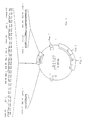
- Fig. 3 shows the sequencing vector, pRIT27.
- the nucleotide sequence and the deduced amino acid sequence in the multi-linker region is shown as well as the sequence of the synthetic linkers inserted in the flanking regions.
- Fig. 4 shows the result of immobilization of biotinylized, double stranded pRIT27, end-labelled with 32p. The amount of label bound to 1 ul of avidin agarose after 30 minutes of incubation at room temperature is shown.
- Fig. 5 shows the autoradiographs of sequencing gels with samples obtained by solid-phase sequencing.
- A labelling using 35S-dATP during the extension.
- B labelling using 32P end-labelled sequencing primer. Also shown is the expected sequence.
- Fig. 6 shows the sequencing vector, pRIT28.
- the nucleotide sequence of the synthetic linkers inserted in the flanking regions a-e are shown. Abbreviations are as in Fig. 3.
- Enzymes were obtained from Parmacia Sweden, and were used according to the suppliers recommendations. DNA manipulations were according to standard procedures (Maniatis, 1982). 11-bio-dUTP was obtained from Bethesda Res. Labs. (US) and avidin agarose was obtained from Sigma Chemicals.
- Plasmid pTZ18 (Pharmacia AB, Sweden) was partially digested with BglI and the synthetic oligonucleotide 5'-CCATGACAATGGAGTGCTGGTTACCGATATCGAA-3' (and its complementary sequnce) was inserted.
- This synthetic fragment contains Bst XI, BstEII and Eco RV recognition sequences.
- the reading frame was changed in the last part of the lacz'-gene but the colour of the colonies remained blue, if E,coli strain RRI 15 (Maniatis et al (1982)) IPTG/X-gal, selection was used (Maniatis et al (1982)).
- This construction designated pSSl, was digested with Eco RI and Hind III, and a synthetic oligonucleotide 5'-AATTCGGCCAGCACGGCCGGCTCAGGTGACCA-3' was inserted.
- the Eco R and Hind III sites were thus destroyed and a sequence of Sfi I, Eco RI, Pst I, Hind III, Sfi I sites were created.
- This insertion changed the colour of the colonies from blue to white, due to fram-shift in the lac Z'-gene.
- the new Eco RI and Hind III recognition sequences were used to insert a M13 mp 18 multi-linker, restoring the correct frame in the lac Z'-gene giving back blue colonies.
- the capacity of the avidin agarose was determined by a saturation experiment. Avidin agarose was mixed with increasing amounts of labelled and biotinylated plasmid DNA and the amount of immobilized labelled material was determined. The result (Fig. 4) demonstrates that several ug of DNA can be bound to each ul of avid agarose, suggesting that the capacity of the matrix is sufficiently high to allow sequencing reactions in a reasonable scale.
- the immobilized biotinylated double stranded DNA was converted into single stranded form by incubation at 37°C with 0.15 M NaOH for 15 minutes.
- the avidin agarose gel, with immobilized template DNA was subsequently washed with 0.15 M NaOH and water. Sequencing reactions were performed using both 35S labelled dATP and 32P end labelled primer.
- 1 ug of the plasmid immobilized on 1 ul avidin agarose gel were mixed with equimolar amounts of the primer in a buffer, containing 10 mM Tris HCl (pH 7.5) 10 mM MgCl2, 100 ug/ml BSA and 100 mM NaCl at a total volume of 10 ul.
- the mixture was incubated for 1 h at 60°C and allowed to cool to room temperature. The supernatant was removed and the above described buffer, with addition of 1 ul BSA (1 mg/ml), was added, together with 1 ul Klenow polymerase and 5 ul of the respective nucleotide mix; for the 35S protocol was 0.5 ul 35S-dATP (12.5 uCi/ul) also added. In both cases the reaction mixtures, at a total volume of 10 ul, were incubated 20 min at 37°C.
- Amix 62.5 uM dCTP, dGTP, dTTP; 25 uM ddATP.
- Cmix 83 uM dGTP, dTTP; 4 uM dCTP; 50 uM ddCTP.
- Gmix 83 uM dCTP, dTTP; 4 uM dGTP; 150 uM ddGTP.
- Tmix 83 uM dCTP, dGTP: 4 uM dTTP; 125 uM ddTTP.
- For the 32p-labelled primer the following nucleotide mixes were used.
- Amix 83 uM dCTP, dGTP, dTTP; 4 uM dATP; 50 uM ddATP.
- Cmix 83 uM dATP, dGTP, dTTP; 4 uM dCTP; 50 uM ddCTP.
- Gmix 83 uM dATP, dCTP, dTTP; 4 uM dGTP; 50 uM ddGTP.
- Tmix 83 uM dATP, dCTP, dGTP; 4 uM dTTP; 50 uM ddTTP.
- the sequencing reactions were performed using a protocol involving labelling of the specific fragments with 35S during extention.
- a nucleotide mix was used containing, in addition to the standard nucleotides, the 35S-labelled dATP and one of the dideoxy nucleotides.
- a plasmid was used, consisting of pRIT27 containing an insert derived from the multi-linker region of M13 mp 18.
- a RIT primer (Olson et al, 1986), complimentary to a region immediately downstream from the multi-linker region, was used to initiate the extensions. Equimolar amounts of immobilized single stranded DNA and RIT primer were mixed, incubated for 1 hour at 60°C and allowed to cool to room temperature. The supernatant was removed and the primer extension was started with the appropriated nucleotide mix in a total volume of 10 ul, followed by a chase reaction (Sanger et al (1977)) to extend fragments not terminated with a dideoxy nucleotide.
- Fig. 5A An autoradiogram of DNA fragments separated by electrophoresis is presented in Fig. 5A, which also shows the expected sequence of the plasmid used. Clearly readable sequences are obtained, which correlates well with the expected ones. The strong band at the top of the sequence represents run off transcripts at the Eco RI site at the 5' end of the immobilized template.
- Plasmid pSSl (see above) was partially digested with PvuII and a synthetic oligonucleotide linker 5'-GGCCAGGGAGGCCAGATCTGAGCGGCCGCTGCTG-3' (and its complimentary sequence) was inserted. This fragment contains SfiI, BglII, EcoB and NotI recognition sequences. The PvuII site used for the insertion was destroyed simultaneously. The resulting plasmid denoted pRIT28 (Fig. 6), is suitable for solid-phase sequencing using the approach outline in Fig. 2.
- a crucial step in the strategy outline in Fig. 2 is the ligation of specific oligonucleotides to plasmid DNA linearized with enzymes giving a 3' protruding end (such as SfiI, BstNl etc) and 5' protruding end (such as Sau3A, TaqI etc).
- enzymes giving a 3' protruding end (such as SfiI, BstNl etc) and 5' protruding end (such as Sau3A, TaqI etc).
- two synthetic oligonucleotides were synthesized and ligated to pRIT28 cleaved with SfiI or BamHl.
- the synthetic SfiI oligonucleotide (5'-TGATCAGGG-3') is in the 3'-end complimentary to one of the strands of pRIT28 after cleavage with SfiI, while the synthetic BamHl oligonucleotide (5'-GATCAG CCTTATGTTCATTAG-3') is in the 5'-end complimentary to the 5'-protruding ends of DNA cleaved with Sau3A, BamHl etc.
- the ligation mixture was analyzed by 1% agarose gel electrophoresis, before and after ligation. A successful incorporation of oligonucleotide in the DNA vector will terminate further ligation between plasmids or circulization of plasmids. This can be observed by comparing the agarose gel pattern of ligation mixtures.
- the synthetic Sau3A oligonucleotide (3'-GATTAC TTTGTATTCCGACTAG-5') was kinased with T4 polynucleotide kinase in a kinase buffer containing 50 mM Tris pH B, 50 mM MgCl2, 100 mM DTT and 10 mM ATP.
- 500 ng of pRIT28 was digested with BamHl and mixed with approx. 150 ng of the kinased oligonucleotide.
- the mixture was incubated at 14°C over night with ligase and a buffer containing 40 mM Tris pH 7.4, 10 mM MgCl2, 1.0 mM DTT and 0,2 mM ATP. After incubation the mixture was loaded on a 1% agarose gel.
- Solid-phase sequencing using the concept schematically outlined in figure 1 was performed except that the target sequence was amplified by the PCR technique before immobilization by biotin to avidin agarose.
- Plasmid pRIT27 containing a synthetic human proinuslin gene fragment was transformed in to E.coli strain RR1 M15 and plated on agar medium.
- a single colony was picked up with a sterilised Pasteur pipette and suspended in 10ul PCR buffer, consisting of 67 mM Tris-HCl, pH 10.00, 16.6 mM (NH4)2SO4, 6.7 mM MgCl2,10 mM ⁇ -mercaptoethanol and 170 ug/ml BSA.
- the sample was heated to 95°C for 5 min and, after cooling to room temperature, neutralized by the addition of 1 ul of a 10 x PCR buffer, pH 7.0.
- the PCR was performed with two oligonucleotide primers complimentary to a region upstream, (biotin-CCATGATTACGAATTTAATAC-3') and downstream (5'-TTCGATA TCGGTAACCAGCACTCCATGTCATGG-3'), respectively, of the multi-linker region.
- the upstream primer was biotinylated in the 5'-end as described by the manufacturers (Pharmacia , Sweden).
- the reaction micture (100 ul) consisted of the above described PCR buffer, pH 8.8, 1uM each of the primers, 200 uM each of dATP, dCTP, and dTTP and the above described 10 ul of lysed sample.
- Two units of TaqI-polymerase (Amersham, England) was added and temperature cycle reactions were carried out using a Techne programmable Dri-Block PHC-1 (Techne, UK). Each cycle included a heat denaturation step at 92°C for 1 min, followed by annealing of primers to the DNA for 2 min at 50°C, and DNA chain extension with TaqI-polymerase for 1 min at 72°C.
- the reaction mixture were covered with a drop of parafin oil.
- Sequencing reactions were performed using a fluorescent end-labelled sequencing primer (5'-CGTTGTAA AACGGCCAGT-3'), complimentary to a region immediately downstream from the multi-linker region. 2 pmole of the sequencing primer were mixed with the avidin agarose immobilized template DNA in a buffer containing 10 mM Tris-HCl (pH 7.5) 10 mM MgCl2, 100 ug/ml BSA and 100 mM NaCl to a total volume of 10 ul. The annealing mixture was heated at 65°C and allowed to cool to room temperature.
- a fluorescent end-labelled sequencing primer 5'-CGTTGTAA AACGGCCAGT-3'
- Staphylococcus aureus SA113 was grown as single colonies on TBAB-plates. A single colony was picked with a sterilized Pasteur pipette and suspended in 10ul PCR buffer, consisting of 67 mM Tris-HCl, pH 10.0, 16.6 mM (NH4)SO4, 6.7 mM MgCl2, 10 mM ⁇ -mercaptoethanol and 170 ul/ml BSA. The sample was lysed by heating at 95°C for 5 min and, after cooling to room temperature, neutralized by the addition of 1 ul of a 10 x PCR buffer, pH 7.0.
- the PCR was performed with two oligonucleotide primers complimentary to the Staphylococcal protein A gene.
- One primer was biotinylated at the 5'-end (biotin-AATAGCGTGATTTTGCGGT-3'), the second primer (GACCACCGCATT-GTGGACGTGACCGGCAGCAAAATG-5'), contains, at the 5'-end, a specif handle sequence not complimentary to the DNA template; this handle sequence creates a primer annealing seuence.
- the reaction mixture (100ul) consisted of the above described PCR buffer, pH 8.8 l uM each of the primers, 200 uM each of dATP, dCTP, dGTP and dTTP and the above described 10 ul of lysed sample.
- Two units of TaqI-polymerase (Amersham, England) were added and temperature cycle reactions were carried out using a Techne programmable Dri-Block PHC-1 (Techne, UK). Each cycle included a head denaturation step at 92°C for 1 min, followed by annealing of primers to the DNA for 2 min at 50°C, and DNA chain extension with TaqI-polymerase for 1 min at 72°C.
- the reaction mixture was overlaid with a drop of paraffin oil.
- Polystyrene microtiter plates (Costar, USA) were surface grafted with 0.2 M glycidyl methacrylate and 2M benzophenone, in acetone by UV irradiating for 2 minutes. (K. Almer et.al, Polymer Chamistry 26 , 1988, 2099-21110). 25 ug Streptavidin (Amersham, UK) in a TE buffer, at a total volume of 10 ul was applied to each well and the microtiter plate was incubated over night at 42°C. After removing the supernatant, the wells were incubated with BSA, 100 ug/ml in TE-buffer, overnight at a total volume of 10 ul and 42°C. The supernatant was removed and the wells subsequently washed with 1 X TE.
- Sequencing reactions were performed using a 32P end-labelled sequencing primer (5'-GTAAAACGGCCAGT-3'), complimentary to a region immediately downstream from the multi-linker region. 2 pmole of the sequencing primer were mixed with the avidin agarose with immobilized template DNA in a buffer containing 10 mM Tris-HCl (pH 7.5) 10 mM MgCl2, 200 ug ml BSA and 100 mM NaCl at a total volume of 10 ul. The annealing mixture was heated to 65°C and allowed to cool to room temperature.
- a 32P end-labelled sequencing primer 5'-GTAAAACGGCCAGT-3'
- the supernatant was removed and 4.2 ul of nucleotide mixture (see below) were added together with 2 ul DTT/NaCl mixture (0.03 M DTT/0.25 mM NaCl) and 1 unit of T7-polymerase (Pharmacia, Sweden), in a buffer consisting of 10 mM Tris-HCl (pH 7.5), 10 mM MgCl2, 100 ug/ml BSA and 100 mM NaCl. The volume was adjusted to 10 ul and the microtiter plate were incubated 10 minutes at 37°C.
- the following nucleotide mixture was used; 80 uM each of dATP, dCTP, dGTP, dTTP and 6.3 uM of respectively ddNTP and 50 mM NaCl and 40 mM Tris-HCl pH 7.5. After completed extension reactions the supernatant was removed and the microtiter wells were washed with H2O. The newly synthesized oligonucleotide were eluted using 3 ul of a formamide/sequencing dye mixture consisting of deionized formamide containing 10 mM EDTA, pH 7.5 0.3% (w/v) xylan cyanol FF and 0.3% (w/v) Bromphenol Blue. After 15 min incubation at 37°C the supernatant was removed and diluted with 3 ul H2O.
Landscapes
- Chemical & Material Sciences (AREA)
- Life Sciences & Earth Sciences (AREA)
- Proteomics, Peptides & Aminoacids (AREA)
- Organic Chemistry (AREA)
- Zoology (AREA)
- Wood Science & Technology (AREA)
- Health & Medical Sciences (AREA)
- Engineering & Computer Science (AREA)
- Analytical Chemistry (AREA)
- Microbiology (AREA)
- Immunology (AREA)
- Molecular Biology (AREA)
- Biotechnology (AREA)
- Biophysics (AREA)
- Physics & Mathematics (AREA)
- Biochemistry (AREA)
- Bioinformatics & Cheminformatics (AREA)
- General Engineering & Computer Science (AREA)
- General Health & Medical Sciences (AREA)
- Genetics & Genomics (AREA)
- Chemical Kinetics & Catalysis (AREA)
- Measuring Or Testing Involving Enzymes Or Micro-Organisms (AREA)
Claims (11)
- Ein Verfahren zur Sequenzierung von Target DNA, worin die DNA in doppelsträngiger Form auf einem festen Träger über ein Ende eines der beiden Stränge davon immobilisiert bereitgestellt wird und hiernach der Strangtrennung unter-zogen wird, wobei der nicht anhaftende Strang vor der Sequenzierung des immobilisierten Stranges entfernt wird.
- Ein Verfahren gemäass Anspruch 1, in der die Strangtrennung durch Schmelzen erfolgt.
- Ein Verfahren gemäss Anspruch 1 oder 2, worin eine funktionelle Gruppe, die an einen festen Träger binden kann, lediglich an einem Ende von einem der Stränge der doppelsträngigen Target-DNA eingeführt wird.
- Ein Verfahren gemäss einem der Ansprüche 1 bis 3, worin ein die doppelsträngige Target-DNA enthaltendes Plasmid, an einer Restriktionsstelle ausserhalb der Target-DNA-Sequenz gespalten wird, eine funktionelle Gruppe an zumindest einem Ende eingeführt und lediglich an einen Strang gebunden wird, wobei die funktionalisierte DNA auch an einer weiteren Restriktionsstelle ausserhalb der Target-DNA-Sequenz geschnitten wird, und die gewünschte funktionalisierte Target-DNA mit einem festen Träger in Kontakt gebracht wird, der eine Substanz mit Affinität zu dieser funktionellen Gruppe trägt.
- Ein Verfahren gemäss einem der vorgehenden Ansprüche 1 bis 3, worin ein die doppelsträngige Target-DNA enthaltendes Plasmid, an einer Restriktionsstelle ausserhalb der Target DNA-Sequenz und an einer oder mehreren Restriktionsstellen innerhalb dieser Sequenz gesschnitten wird, Oligonukleotide an beide Enden von zumindest dem zu sequenzierenden Target DNA-Strang geknüpft werden, wobei eines dieser Oligonukleotide eine funktionelle Gruppe trägt, die zu Bindung an einen festen Träger befähigt ist und das andere Oligonukleotid in der Lage ist, an einen universellen Sequenzierungs-Primer zu hybridisieren.
- Ein Verfahren gemäss einem der Ansprüche 1 bis 3, worin die immobilisierte, doppelsträngige DNA durch die Polymerase-Kettenreaktionsmethode unter Verwendung von zumindest einem Oligonukleotid-Primer, der an einen festen Träger gebunden ist oder Mittel zur Verknüpfung an einen festen Träger trägt, gebildet wird.
- Ein Verfahren gemäss Anspruch 6, worin die immobilisierte, doppelsträngige DNA durch Vermehrung von genomischer DNA durch die Polymerase-Kettenreaktion gebildet wird.
- Ein Verfahren gemäss einem der Ansprüche 1 bis 7, worin die Sequenzierung mit Hilfe der Maxam-Gilbert-Methode durchgeführt wird.
- Ein Verfahren gemäss einem der Ansprüche 1 bis 8, worin die Sequenzierung mit Hilfe der Sanger-Methode durchgeführt wird.
- Ein Verfahren gemäss einem der vorgehenden Ansprüche, worin die funktionelle Gruppe eine Biotin-, Avidin-, Strepta-vidin- oder Thiolgruppe ist und der feste Träger sich hieran bindende Gruppen trägt.
- Ein Verfahren gemäss einem der vorgehenden Ansprüche, worin der feste Träger in Teilchenform vorliegt oder ein Mikrotiterbehälter ist.
Priority Applications (1)
| Application Number | Priority Date | Filing Date | Title |
|---|---|---|---|
| AT89904168T ATE91156T1 (de) | 1988-03-23 | 1989-03-22 | Verfahren zur sequenzanalyse von dna. |
Applications Claiming Priority (2)
| Application Number | Priority Date | Filing Date | Title |
|---|---|---|---|
| SE8801070 | 1988-03-23 | ||
| SE8801070A SE8801070D0 (sv) | 1988-03-23 | 1988-03-23 | Method for immobilizing a dna sequence on a solid support |
Publications (2)
| Publication Number | Publication Date |
|---|---|
| EP0406296A1 EP0406296A1 (de) | 1991-01-09 |
| EP0406296B1 true EP0406296B1 (de) | 1993-06-30 |
Family
ID=20371796
Family Applications (1)
| Application Number | Title | Priority Date | Filing Date |
|---|---|---|---|
| EP89904168A Revoked EP0406296B1 (de) | 1988-03-23 | 1989-03-22 | Verfahren zur sequenzanalyse von dna |
Country Status (7)
| Country | Link |
|---|---|
| US (1) | US5405746A (de) |
| EP (1) | EP0406296B1 (de) |
| JP (1) | JP3068144B2 (de) |
| AU (1) | AU633252B2 (de) |
| DE (1) | DE68907407T2 (de) |
| SE (1) | SE8801070D0 (de) |
| WO (1) | WO1989009282A1 (de) |
Families Citing this family (129)
| Publication number | Priority date | Publication date | Assignee | Title |
|---|---|---|---|---|
| JPS5570425A (en) * | 1978-11-22 | 1980-05-27 | Kawasaki Yukou Kk | Bulging machine of electro-hydraulic control system |
| DE3816934A1 (de) * | 1988-05-18 | 1989-11-23 | Ramalho Ortigao Jose Flavio | Neue sequenzierungsmethode fuer einzel- oder doppelstraengige nucleinsaeuren an fester phase |
| US5817797A (en) * | 1988-06-01 | 1998-10-06 | The United States Of America As Represented By The Department Of Health And Human Services | Sequencing DNA; a modification of the polymerase chain reaction |
| WO1990006045A2 (en) * | 1988-11-21 | 1990-06-14 | Dynal As | Nucleic acid probes |
| US5512439A (en) * | 1988-11-21 | 1996-04-30 | Dynal As | Oligonucleotide-linked magnetic particles and uses thereof |
| IL92474A (en) * | 1988-11-29 | 1994-04-12 | Orion Yhtymae Oy | Reaction method and combination for determining nucleotide sequences |
| US5302509A (en) * | 1989-08-14 | 1994-04-12 | Beckman Instruments, Inc. | Method for sequencing polynucleotides |
| WO1991011533A1 (en) * | 1990-01-26 | 1991-08-08 | E.I. Du Pont De Nemours And Company | Method for isolating primer extension products from template-directed dna polymerase reactions |
| US6013431A (en) | 1990-02-16 | 2000-01-11 | Molecular Tool, Inc. | Method for determining specific nucleotide variations by primer extension in the presence of mixture of labeled nucleotides and terminators |
| WO1991015599A1 (en) * | 1990-04-05 | 1991-10-17 | Amrad Corporation Limited | A method for detecting dna |
| US5387505A (en) * | 1990-05-04 | 1995-02-07 | Eastman Kodak Company | Preparation and isolation of single-stranded biotinylated nucleic acids by heat avidin-biotin cleavage |
| US5712125A (en) * | 1990-07-24 | 1998-01-27 | Cemv Bioteknik Ab | Competitive PCR for quantitation of DNA |
| CA2055755A1 (en) * | 1990-11-22 | 1992-05-23 | Toshihiko Kishimoto | Method of immobilizing single-stranded dna on carrier at terminal |
| US6004744A (en) | 1991-03-05 | 1999-12-21 | Molecular Tool, Inc. | Method for determining nucleotide identity through extension of immobilized primer |
| FR2673953B1 (fr) * | 1991-03-13 | 1995-12-15 | Bioprobe Systems Sa | Procede de sequencage non radioactif d'adn. |
| EP0533952A4 (en) * | 1991-04-15 | 1993-07-07 | Sumitomo Electric Industries, Ltd. | Process for separating or extracting nucleic acid from specimen containing the same |
| EP0517361A1 (de) * | 1991-05-30 | 1992-12-09 | Amoco Corporation | Methode zum Nachweis und zur Identifizierung pathogener Organismen unter Verwendung zielgerichteter Sequenzen als Detektoren |
| CA2114124A1 (en) * | 1991-07-24 | 1993-02-04 | Keith Gregg | Single step amplification and sequencing of nucleic acids |
| WO1993009250A1 (en) * | 1991-11-01 | 1993-05-13 | Adelaide Children's Hospital | Solid phase amplification process |
| GB9127415D0 (en) * | 1991-12-24 | 1992-02-19 | Swordfish Int Ltd | Solid support bound detection and diagnostic system |
| CA2126748A1 (en) * | 1991-12-24 | 1993-06-25 | Tepnel Medical Limited | Manipulating nucleic acid sequences |
| GB9210176D0 (en) * | 1992-05-12 | 1992-06-24 | Cemu Bioteknik Ab | Chemical method |
| US6436635B1 (en) | 1992-11-06 | 2002-08-20 | Boston University | Solid phase sequencing of double-stranded nucleic acids |
| US5795714A (en) | 1992-11-06 | 1998-08-18 | Trustees Of Boston University | Method for replicating an array of nucleic acid probes |
| CA2153387A1 (en) | 1993-01-07 | 1994-07-21 | Hubert Koester | Dna sequencing by mass spectrometry |
| US6194144B1 (en) | 1993-01-07 | 2001-02-27 | Sequenom, Inc. | DNA sequencing by mass spectrometry |
| US5605798A (en) | 1993-01-07 | 1997-02-25 | Sequenom, Inc. | DNA diagnostic based on mass spectrometry |
| CA2158642A1 (en) * | 1993-03-19 | 1994-09-29 | Hubert Koster | Dna sequencing by mass spectrometry via exonuclease degradation |
| AU707391B2 (en) * | 1994-05-28 | 1999-07-08 | Tepnel Medical Limited | Producing copies of nucleic acids |
| US5641658A (en) * | 1994-08-03 | 1997-06-24 | Mosaic Technologies, Inc. | Method for performing amplification of nucleic acid with two primers bound to a single solid support |
| US6090592A (en) * | 1994-08-03 | 2000-07-18 | Mosaic Technologies, Inc. | Method for performing amplification of nucleic acid on supports |
| US5604097A (en) | 1994-10-13 | 1997-02-18 | Spectragen, Inc. | Methods for sorting polynucleotides using oligonucleotide tags |
| USRE43097E1 (en) | 1994-10-13 | 2012-01-10 | Illumina, Inc. | Massively parallel signature sequencing by ligation of encoded adaptors |
| US5830655A (en) * | 1995-05-22 | 1998-11-03 | Sri International | Oligonucleotide sizing using cleavable primers |
| US5700642A (en) * | 1995-05-22 | 1997-12-23 | Sri International | Oligonucleotide sizing using immobilized cleavable primers |
| US5763175A (en) * | 1995-11-17 | 1998-06-09 | Lynx Therapeutics, Inc. | Simultaneous sequencing of tagged polynucleotides |
| US5780231A (en) * | 1995-11-17 | 1998-07-14 | Lynx Therapeutics, Inc. | DNA extension and analysis with rolling primers |
| US5962228A (en) * | 1995-11-17 | 1999-10-05 | Lynx Therapeutics, Inc. | DNA extension and analysis with rolling primers |
| US5830657A (en) * | 1996-05-01 | 1998-11-03 | Visible Genetics Inc. | Method for single-tube sequencing of nucleic acid polymers |
| AU2320597A (en) | 1996-03-19 | 1997-10-10 | Molecular Tool, Inc. | Method for determining the nucleotide sequence of a polynucleotide |
| US5846727A (en) * | 1996-06-06 | 1998-12-08 | Board Of Supervisors Of Louisiana State University And Agricultural & Mechanical College | Microsystem for rapid DNA sequencing |
| GB9620209D0 (en) | 1996-09-27 | 1996-11-13 | Cemu Bioteknik Ab | Method of sequencing DNA |
| US6133436A (en) * | 1996-11-06 | 2000-10-17 | Sequenom, Inc. | Beads bound to a solid support and to nucleic acids |
| EP0954612A2 (de) | 1996-11-06 | 1999-11-10 | Sequenom, Inc. | Dna-diagnostik mittels massenspektrometrie |
| US6291164B1 (en) | 1996-11-22 | 2001-09-18 | Invitrogen Corporation | Methods for preventing inhibition of nucleic acid synthesis by pyrophosphate |
| CA2274587A1 (en) * | 1996-12-10 | 1998-06-18 | Genetrace Systems Inc. | Releasable nonvolatile mass-label molecules |
| GB9626815D0 (en) | 1996-12-23 | 1997-02-12 | Cemu Bioteknik Ab | Method of sequencing DNA |
| US6046005A (en) * | 1997-01-15 | 2000-04-04 | Incyte Pharmaceuticals, Inc. | Nucleic acid sequencing with solid phase capturable terminators comprising a cleavable linking group |
| US5876936A (en) * | 1997-01-15 | 1999-03-02 | Incyte Pharmaceuticals, Inc. | Nucleic acid sequencing with solid phase capturable terminators |
| EP1591541B1 (de) | 1997-04-01 | 2012-02-15 | Illumina Cambridge Limited | Verfahren zur Vervielfältigung von Nukleinsäuren |
| EP0972082A4 (de) * | 1997-04-04 | 2007-04-25 | Caliper Life Sciences Inc | Biochemische analysatoren, die als geschlossenes system arbeiten |
| US6391622B1 (en) * | 1997-04-04 | 2002-05-21 | Caliper Technologies Corp. | Closed-loop biochemical analyzers |
| US6235471B1 (en) | 1997-04-04 | 2001-05-22 | Caliper Technologies Corp. | Closed-loop biochemical analyzers |
| US6143496A (en) | 1997-04-17 | 2000-11-07 | Cytonix Corporation | Method of sampling, amplifying and quantifying segment of nucleic acid, polymerase chain reaction assembly having nanoliter-sized sample chambers, and method of filling assembly |
| US6326489B1 (en) | 1997-08-05 | 2001-12-04 | Howard Hughes Medical Institute | Surface-bound, bimolecular, double-stranded DNA arrays |
| CA2305449A1 (en) | 1997-10-10 | 1999-04-22 | President & Fellows Of Harvard College | Replica amplification of nucleic acid arrays |
| US6511803B1 (en) | 1997-10-10 | 2003-01-28 | President And Fellows Of Harvard College | Replica amplification of nucleic acid arrays |
| US6485944B1 (en) | 1997-10-10 | 2002-11-26 | President And Fellows Of Harvard College | Replica amplification of nucleic acid arrays |
| US6548021B1 (en) | 1997-10-10 | 2003-04-15 | President And Fellows Of Harvard College | Surface-bound, double-stranded DNA protein arrays |
| AR021833A1 (es) | 1998-09-30 | 2002-08-07 | Applied Research Systems | Metodos de amplificacion y secuenciacion de acido nucleico |
| EP1121469A2 (de) * | 1998-10-12 | 2001-08-08 | Attomol GmbH Molekulare Diagnostika | Verfahren und kit zum direkten nachweis von nukleotidsequenzen, aminosäuresequenzen oder antigenen |
| JP4638043B2 (ja) | 1998-12-14 | 2011-02-23 | パシフィック バイオサイエンシーズ オブ カリフォルニア, インコーポレイテッド | ポリメラーゼ合成による、単一分子の核酸の配列決定のためのシステムおよび方法 |
| AU3150400A (en) * | 1999-01-25 | 2000-08-07 | Biochip Technologies Gmbh | Immobilization of molecules on surfaces via polymer brushes |
| DE19935302A1 (de) * | 1999-07-28 | 2001-02-08 | Aventis Pharma Gmbh | Konjugate und Verfahren zu deren Herstellung sowie deren Verwendung zum Transport von Molekülen über biologische Membranen |
| US7244559B2 (en) * | 1999-09-16 | 2007-07-17 | 454 Life Sciences Corporation | Method of sequencing a nucleic acid |
| US7211390B2 (en) * | 1999-09-16 | 2007-05-01 | 454 Life Sciences Corporation | Method of sequencing a nucleic acid |
| US6309836B1 (en) * | 1999-10-05 | 2001-10-30 | Marek Kwiatkowski | Compounds for protecting hydroxyls and methods for their use |
| JP2001147230A (ja) | 1999-11-19 | 2001-05-29 | Hitachi Software Eng Co Ltd | バイオチップ読取装置及び標識試薬 |
| US6500620B2 (en) | 1999-12-29 | 2002-12-31 | Mergen Ltd. | Methods for amplifying and detecting multiple polynucleotides on a solid phase support |
| US6376191B1 (en) | 2000-03-22 | 2002-04-23 | Mergen, Ltd. | Microarray-based analysis of polynucleotide sequence variations |
| EP1598432A3 (de) * | 2000-07-31 | 2006-06-07 | Agilent Technologies, Inc. | Array-basierende Methoden zur Synthese von Nukleinsäuregemischen |
| US7597878B2 (en) | 2000-09-19 | 2009-10-06 | Li-Cor, Inc. | Optical fluorescent imaging |
| ATE356222T1 (de) | 2000-10-06 | 2007-03-15 | Univ Columbia | Massives parallelverfahren zur dekodierung von dna und rna |
| US9708358B2 (en) | 2000-10-06 | 2017-07-18 | The Trustees Of Columbia University In The City Of New York | Massive parallel method for decoding DNA and RNA |
| CN1481441A (zh) * | 2000-10-20 | 2004-03-10 | 斯坦福大学受托管理委员会 | 根据瞬时电信号表征样品中分子间相互作用和运动的方法和设备 |
| AR031640A1 (es) | 2000-12-08 | 2003-09-24 | Applied Research Systems | Amplificacion isotermica de acidos nucleicos en un soporte solido |
| ATE538380T1 (de) * | 2001-01-23 | 2012-01-15 | Harvard College | Nukleinsäure-programmierbare protein-arrays |
| US20020102596A1 (en) * | 2001-01-31 | 2002-08-01 | Davis Lloyd Mervyn | Methods for detecting interaction of molecules with surface-bound reagents |
| US20050009022A1 (en) * | 2001-07-06 | 2005-01-13 | Weiner Michael P. | Method for isolation of independent, parallel chemical micro-reactions using a porous filter |
| US20030054396A1 (en) * | 2001-09-07 | 2003-03-20 | Weiner Michael P. | Enzymatic light amplification |
| US6956114B2 (en) | 2001-10-30 | 2005-10-18 | '454 Corporation | Sulfurylase-luciferase fusion proteins and thermostable sulfurylase |
| US20050124022A1 (en) * | 2001-10-30 | 2005-06-09 | Maithreyan Srinivasan | Novel sulfurylase-luciferase fusion proteins and thermostable sulfurylase |
| US6902921B2 (en) * | 2001-10-30 | 2005-06-07 | 454 Corporation | Sulfurylase-luciferase fusion proteins and thermostable sulfurylase |
| GB0129012D0 (en) | 2001-12-04 | 2002-01-23 | Solexa Ltd | Labelled nucleotides |
| US7057026B2 (en) | 2001-12-04 | 2006-06-06 | Solexa Limited | Labelled nucleotides |
| US20040014101A1 (en) * | 2002-05-03 | 2004-01-22 | Pel-Freez Clinical Systems, Inc. | Separating and/or identifying polymorphic nucleic acids using universal bases |
| EP2607369B1 (de) | 2002-08-23 | 2015-09-23 | Illumina Cambridge Limited | Modifizierte Nucleotide zur Polynucleotidsequenzierung |
| US11008359B2 (en) | 2002-08-23 | 2021-05-18 | Illumina Cambridge Limited | Labelled nucleotides |
| US7414116B2 (en) | 2002-08-23 | 2008-08-19 | Illumina Cambridge Limited | Labelled nucleotides |
| US20040197793A1 (en) * | 2002-08-30 | 2004-10-07 | Arjang Hassibi | Methods and apparatus for biomolecule detection, identification, quantification and/or sequencing |
| US7005518B2 (en) | 2002-10-25 | 2006-02-28 | Li-Cor, Inc. | Phthalocyanine dyes |
| CA2513889A1 (en) † | 2003-01-29 | 2004-08-19 | 454 Corporation | Double ended sequencing |
| US7575865B2 (en) * | 2003-01-29 | 2009-08-18 | 454 Life Sciences Corporation | Methods of amplifying and sequencing nucleic acids |
| CA2531105C (en) | 2003-07-05 | 2015-03-17 | The Johns Hopkins University | Method and compositions for detection and enumeration of genetic variations |
| WO2005042764A2 (en) | 2003-10-28 | 2005-05-12 | Dynal Biotech Llc | Primers, methods and kits for amplifying or detecting human leukocyte antigen alleles |
| ES2432040T3 (es) * | 2004-01-28 | 2013-11-29 | 454 Life Sciences Corporation | Amplificación de ácido nucleico con emulsión de flujo continuo |
| US20050260653A1 (en) * | 2004-04-14 | 2005-11-24 | Joshua Labaer | Nucleic-acid programmable protein arrays |
| US20060078889A1 (en) * | 2004-10-08 | 2006-04-13 | Arindam Bhattacharjee | Array-based methods for producing ribonucleic acids |
| US7977119B2 (en) * | 2004-12-08 | 2011-07-12 | Agilent Technologies, Inc. | Chemical arrays and methods of using the same |
| US20060269934A1 (en) * | 2005-03-16 | 2006-11-30 | Applera Corporation | Compositions and methods for clonal amplification and analysis of polynucleotides |
| US7604940B1 (en) | 2005-03-16 | 2009-10-20 | Applied Biosystems, Llc | Compositions and methods for analyzing isolated polynucleotides |
| US20070026439A1 (en) * | 2005-07-15 | 2007-02-01 | Applera Corporation | Fluid processing device and method |
| GB0514935D0 (en) | 2005-07-20 | 2005-08-24 | Solexa Ltd | Methods for sequencing a polynucleotide template |
| GB0514910D0 (en) | 2005-07-20 | 2005-08-24 | Solexa Ltd | Method for sequencing a polynucleotide template |
| GB0517097D0 (en) | 2005-08-19 | 2005-09-28 | Solexa Ltd | Modified nucleosides and nucleotides and uses thereof |
| US7955864B2 (en) * | 2005-08-22 | 2011-06-07 | Life Technologies Corporation | Device and method for making discrete volumes of a first fluid in contact with a second fluid, which are immiscible with each other |
| US20070099195A1 (en) * | 2005-11-02 | 2007-05-03 | Huang Xiaohua C | Methods and compositions for separating nucleic acids from a solid support |
| EP1987159B2 (de) | 2006-02-08 | 2020-08-12 | Illumina Cambridge Limited | Verfahren zur sequenzierung einer polynukleotidmatrize |
| US8178316B2 (en) * | 2006-06-29 | 2012-05-15 | President And Fellows Of Harvard College | Evaluating proteins |
| US8399188B2 (en) | 2006-09-28 | 2013-03-19 | Illumina, Inc. | Compositions and methods for nucleotide sequencing |
| US7754429B2 (en) | 2006-10-06 | 2010-07-13 | Illumina Cambridge Limited | Method for pair-wise sequencing a plurity of target polynucleotides |
| DE112007002932B4 (de) | 2006-12-01 | 2015-08-06 | The Trustees Of Columbia University In The City Of New York | Vierfarben DNA-Sequenzierung mittels Synthese unter Verwendung von abspaltbaren, reversiblen, fluoreszierenden Nucleotidterminatoren |
| WO2008093098A2 (en) | 2007-02-02 | 2008-08-07 | Illumina Cambridge Limited | Methods for indexing samples and sequencing multiple nucleotide templates |
| US9115163B2 (en) | 2007-10-19 | 2015-08-25 | The Trustees Of Columbia University In The City Of New York | DNA sequence with non-fluorescent nucleotide reversible terminators and cleavable label modified nucleotide terminators |
| EP4310194A3 (de) | 2007-10-19 | 2024-10-16 | The Trustees of Columbia University in the City of New York | Entwurf und synthese von spaltbaren fluoreszierenden nukleotiden als reversible terminatoren zur dna-sequenzierung durch synthese |
| US12060554B2 (en) | 2008-03-10 | 2024-08-13 | Illumina, Inc. | Method for selecting and amplifying polynucleotides |
| GB0806041D0 (en) * | 2008-04-03 | 2008-05-14 | Genomica S A | Method for detection of herpesvirus in test sample |
| WO2010011944A2 (en) | 2008-07-25 | 2010-01-28 | Wagner Richard W | Protein screeing methods |
| WO2010038042A1 (en) | 2008-10-02 | 2010-04-08 | Illumina Cambridge Ltd. | Nucleic acid sample enrichment for sequencing applications |
| ES2595055T3 (es) | 2009-08-25 | 2016-12-27 | Illumina, Inc. | Métodos para seleccionar y amplificar polinucleótidos |
| EP2475787A2 (de) * | 2009-09-07 | 2012-07-18 | Caerus Molecular Diagnostics Incorporated | Sequenzbestimmung durch anwendung entgegengesetzter kräfte |
| US8182994B2 (en) | 2009-09-15 | 2012-05-22 | Illumina Cambridge Limited | Centroid markers for image analysis of high denisty clusters in complex polynucleotide sequencing |
| US9968901B2 (en) | 2012-05-21 | 2018-05-15 | The Scripps Research Institute | Methods of sample preparation |
| US10648026B2 (en) | 2013-03-15 | 2020-05-12 | The Trustees Of Columbia University In The City Of New York | Raman cluster tagged molecules for biological imaging |
| KR102230831B1 (ko) | 2013-03-15 | 2021-03-22 | 일루미나 케임브리지 리미티드 | 변형된 뉴클레오사이드 또는 뉴클레오타이드 |
| AU2015315103B2 (en) | 2014-09-09 | 2022-01-27 | Igenomx International Genomics Corporation | Methods and compositions for rapid nucleic acid library preparation |
| EP3475706B1 (de) | 2016-06-27 | 2021-08-11 | Juno Therapeutics, Inc. | Mhc-e-beschränkte epitopen, bindungsmoleküle, und zugehörige verfahren und verwendungen |
| US20200182884A1 (en) | 2016-06-27 | 2020-06-11 | Juno Therapeutics, Inc. | Method of identifying peptide epitopes, molecules that bind such epitopes and related uses |
| WO2019089982A1 (en) | 2017-11-01 | 2019-05-09 | Juno Therapeutics, Inc. | Method of assessing activity of recombinant antigen receptors |
Family Cites Families (7)
| Publication number | Priority date | Publication date | Assignee | Title |
|---|---|---|---|---|
| US4734363A (en) * | 1984-11-27 | 1988-03-29 | Molecular Diagnostics, Inc. | Large scale production of DNA probes |
| AU606043B2 (en) * | 1985-03-28 | 1991-01-31 | F. Hoffmann-La Roche Ag | Detection of viruses by amplification and hybridization |
| EP0206411A3 (de) * | 1985-06-17 | 1988-10-05 | The Board Of Trustees Of The University Of Illinois | Umkehrphasenchromatographie zur Sequenzierung von Oligonukleotiden |
| EP0224126A3 (de) * | 1985-11-25 | 1989-02-01 | The University of Calgary | Kovalent gekoppelte komplementäre Oligodeoxynukleotide zur Verwendung als "Primer Linkers" bei Sequenzierung von Nukleinsäuren |
| US4851331A (en) * | 1986-05-16 | 1989-07-25 | Allied Corporation | Method and kit for polynucleotide assay including primer-dependant DNA polymerase |
| GB8613476D0 (en) * | 1986-06-04 | 1986-07-09 | London Hospital Med Coll | Method of sequencing nucleic acids |
| IL92474A (en) * | 1988-11-29 | 1994-04-12 | Orion Yhtymae Oy | Reaction method and combination for determining nucleotide sequences |
-
1988
- 1988-03-23 SE SE8801070A patent/SE8801070D0/xx unknown
-
1989
- 1989-03-22 JP JP1503793A patent/JP3068144B2/ja not_active Expired - Lifetime
- 1989-03-22 DE DE89904168T patent/DE68907407T2/de not_active Revoked
- 1989-03-22 AU AU33602/89A patent/AU633252B2/en not_active Expired
- 1989-03-22 WO PCT/GB1989/000304 patent/WO1989009282A1/en not_active Ceased
- 1989-03-22 EP EP89904168A patent/EP0406296B1/de not_active Revoked
-
1993
- 1993-09-22 US US08/124,628 patent/US5405746A/en not_active Expired - Lifetime
Non-Patent Citations (1)
| Title |
|---|
| CHEMICAL ABSTRACTS, vol. 104, no. 21, 26 May 1986 (Columbus, Ohio, US)., A. ROSENTHAL et al., page 311, abstract no. 182737s; * |
Also Published As
| Publication number | Publication date |
|---|---|
| DE68907407T2 (de) | 1993-11-18 |
| WO1989009282A1 (en) | 1989-10-05 |
| US5405746A (en) | 1995-04-11 |
| JP3068144B2 (ja) | 2000-07-24 |
| DE68907407D1 (de) | 1993-08-05 |
| AU633252B2 (en) | 1993-01-28 |
| JPH04500902A (ja) | 1992-02-20 |
| EP0406296A1 (de) | 1991-01-09 |
| AU3360289A (en) | 1989-10-16 |
| SE8801070D0 (sv) | 1988-03-23 |
Similar Documents
| Publication | Publication Date | Title |
|---|---|---|
| US5405746A (en) | Method of sequencing DNA | |
| Stahl et al. | Solid phase DNA sequencing using the biotin-avidin system | |
| JP2695045B2 (ja) | Dnaサイクル配列決定法 | |
| Hultman et al. | Direct solid phase sequencing of genomic and plasmid DNA using magnetic beads as solid support | |
| JP3793570B2 (ja) | ハイブリッド形成による位置配列決定 | |
| EP1594981B1 (de) | Zweiendige sequenzierung | |
| US5484701A (en) | Method for sequencing DNA using biotin-strepavidin conjugates to facilitate the purification of primer extension products | |
| EP0385410A2 (de) | Partiell doppelsträngiges Oligonukleotid und Verfahren zu seiner Bildung | |
| JP3872812B2 (ja) | 段階連結および切断によるdna配列決定 | |
| US5366877A (en) | Restriction/ligation labeling for primer initiated multiple copying of DNA ssequences | |
| US6124092A (en) | Multiplex polynucleotide capture methods and compositions | |
| US5756285A (en) | DNA cycle sequencing | |
| JP2766003B2 (ja) | ヌクレオチドシークエンス決定方法およびシークエンス決定用キット | |
| EP0502011B1 (de) | Verfahren zum klonieren und reagenziensatz | |
| WO2019209946A1 (en) | Sequential paired-end sequencing | |
| CN1127887A (zh) | Dna分离、分级分离和分析方法及其系统 | |
| JPH09508268A (ja) | 核酸の配列決定 | |
| WO1989006285A1 (fr) | Procede de detection d'un acide nucleique cible dans un specimen | |
| US5985556A (en) | DNA sequencing method and DNA sample preparation method | |
| Hultman et al. | Approaches to solid phase DNA sequencing | |
| EP0268647A1 (de) | Verfahren zur sequenzanalyse von nukleinsäuren | |
| WO1992003575A1 (en) | Method for preparing, isolating and sequencing polynucleotides | |
| JP2786857B2 (ja) | 検体中の目的核酸の検出法 | |
| EP0417161A4 (en) | Solid-phase sequencing method for single- and double-stranded nucleic acids |
Legal Events
| Date | Code | Title | Description |
|---|---|---|---|
| PUAI | Public reference made under article 153(3) epc to a published international application that has entered the european phase |
Free format text: ORIGINAL CODE: 0009012 |
|
| 17P | Request for examination filed |
Effective date: 19900920 |
|
| AK | Designated contracting states |
Kind code of ref document: A1 Designated state(s): AT BE CH DE FR GB IT LI LU NL SE |
|
| EL | Fr: translation of claims filed | ||
| 17Q | First examination report despatched |
Effective date: 19920407 |
|
| DET | De: translation of patent claims | ||
| RAP1 | Party data changed (applicant data changed or rights of an application transferred) |
Owner name: CEMU BIOTEKNIK AB |
|
| GRAA | (expected) grant |
Free format text: ORIGINAL CODE: 0009210 |
|
| ITF | It: translation for a ep patent filed | ||
| AK | Designated contracting states |
Kind code of ref document: B1 Designated state(s): AT BE CH DE FR GB IT LI LU NL SE |
|
| REF | Corresponds to: |
Ref document number: 91156 Country of ref document: AT Date of ref document: 19930715 Kind code of ref document: T |
|
| REF | Corresponds to: |
Ref document number: 68907407 Country of ref document: DE Date of ref document: 19930805 |
|
| ET | Fr: translation filed | ||
| PLBI | Opposition filed |
Free format text: ORIGINAL CODE: 0009260 |
|
| EPTA | Lu: last paid annual fee | ||
| 26 | Opposition filed |
Opponent name: ORION-YHTYMAE OY Effective date: 19940330 |
|
| NLR1 | Nl: opposition has been filed with the epo |
Opponent name: ORION-YHTYMAE OY. |
|
| EAL | Se: european patent in force in sweden |
Ref document number: 89904168.5 |
|
| PGFP | Annual fee paid to national office [announced via postgrant information from national office to epo] |
Ref country code: SE Payment date: 19960229 Year of fee payment: 8 |
|
| PGFP | Annual fee paid to national office [announced via postgrant information from national office to epo] |
Ref country code: LU Payment date: 19960301 Year of fee payment: 8 |
|
| PGFP | Annual fee paid to national office [announced via postgrant information from national office to epo] |
Ref country code: GB Payment date: 19960313 Year of fee payment: 8 Ref country code: BE Payment date: 19960313 Year of fee payment: 8 |
|
| PGFP | Annual fee paid to national office [announced via postgrant information from national office to epo] |
Ref country code: FR Payment date: 19960319 Year of fee payment: 8 |
|
| PGFP | Annual fee paid to national office [announced via postgrant information from national office to epo] |
Ref country code: AT Payment date: 19960329 Year of fee payment: 8 |
|
| PGFP | Annual fee paid to national office [announced via postgrant information from national office to epo] |
Ref country code: NL Payment date: 19960331 Year of fee payment: 8 |
|
| PGFP | Annual fee paid to national office [announced via postgrant information from national office to epo] |
Ref country code: CH Payment date: 19960425 Year of fee payment: 8 |
|
| PGFP | Annual fee paid to national office [announced via postgrant information from national office to epo] |
Ref country code: DE Payment date: 19960429 Year of fee payment: 8 |
|
| RDAH | Patent revoked |
Free format text: ORIGINAL CODE: EPIDOS REVO |
|
| RDAG | Patent revoked |
Free format text: ORIGINAL CODE: 0009271 |
|
| STAA | Information on the status of an ep patent application or granted ep patent |
Free format text: STATUS: PATENT REVOKED |
|
| REG | Reference to a national code |
Ref country code: CH Ref legal event code: PL |
|
| GBPR | Gb: patent revoked under art. 102 of the ep convention designating the uk as contracting state |
Free format text: 960804 |
|
| 27W | Patent revoked |
Effective date: 19960804 |
|
| NLR2 | Nl: decision of opposition |