EP0404967B1 - Rekombinantes c-terminal alpha amidatierungsenzym von menschlischem thyroidursprung - Google Patents
Rekombinantes c-terminal alpha amidatierungsenzym von menschlischem thyroidursprung Download PDFInfo
- Publication number
- EP0404967B1 EP0404967B1 EP90901894A EP90901894A EP0404967B1 EP 0404967 B1 EP0404967 B1 EP 0404967B1 EP 90901894 A EP90901894 A EP 90901894A EP 90901894 A EP90901894 A EP 90901894A EP 0404967 B1 EP0404967 B1 EP 0404967B1
- Authority
- EP
- European Patent Office
- Prior art keywords
- amino acid
- cdna
- enzyme
- terminal
- cht201
- Prior art date
- Legal status (The legal status is an assumption and is not a legal conclusion. Google has not performed a legal analysis and makes no representation as to the accuracy of the status listed.)
- Expired - Lifetime
Links
- 102000004190 Enzymes Human genes 0.000 title claims abstract description 193
- 108090000790 Enzymes Proteins 0.000 title claims abstract description 193
- 210000001685 thyroid gland Anatomy 0.000 title abstract description 22
- 210000004899 c-terminal region Anatomy 0.000 claims abstract description 111
- 150000001413 amino acids Chemical class 0.000 claims abstract description 68
- 238000000034 method Methods 0.000 claims abstract description 68
- 108090000623 proteins and genes Proteins 0.000 claims abstract description 68
- 230000000694 effects Effects 0.000 claims abstract description 47
- 239000013604 expression vector Substances 0.000 claims abstract description 23
- 238000004519 manufacturing process Methods 0.000 claims abstract description 11
- 239000013612 plasmid Substances 0.000 claims description 107
- 125000003275 alpha amino acid group Chemical group 0.000 claims description 95
- 210000003527 eukaryotic cell Anatomy 0.000 claims description 13
- 210000001236 prokaryotic cell Anatomy 0.000 claims description 8
- 102000004169 proteins and genes Human genes 0.000 abstract description 59
- 108090000765 processed proteins & peptides Proteins 0.000 abstract description 42
- DHMQDGOQFOQNFH-UHFFFAOYSA-N Glycine Chemical compound NCC(O)=O DHMQDGOQFOQNFH-UHFFFAOYSA-N 0.000 abstract description 10
- 239000004471 Glycine Substances 0.000 abstract description 4
- 239000002299 complementary DNA Substances 0.000 description 230
- 108020004414 DNA Proteins 0.000 description 101
- 239000012634 fragment Substances 0.000 description 90
- 238000010276 construction Methods 0.000 description 56
- LFQSCWFLJHTTHZ-UHFFFAOYSA-N Ethanol Chemical compound CCO LFQSCWFLJHTTHZ-UHFFFAOYSA-N 0.000 description 51
- 241000588724 Escherichia coli Species 0.000 description 48
- 239000002773 nucleotide Substances 0.000 description 34
- 125000003729 nucleotide group Chemical group 0.000 description 34
- 239000000243 solution Substances 0.000 description 32
- 241001302584 Escherichia coli str. K-12 substr. W3110 Species 0.000 description 26
- FAPWRFPIFSIZLT-UHFFFAOYSA-M Sodium chloride Chemical compound [Na+].[Cl-] FAPWRFPIFSIZLT-UHFFFAOYSA-M 0.000 description 26
- QKNYBSVHEMOAJP-UHFFFAOYSA-N 2-amino-2-(hydroxymethyl)propane-1,3-diol;hydron;chloride Chemical compound Cl.OCC(N)(CO)CO QKNYBSVHEMOAJP-UHFFFAOYSA-N 0.000 description 24
- 210000004027 cell Anatomy 0.000 description 24
- 239000002244 precipitate Substances 0.000 description 23
- 108091032973 (ribonucleotides)n+m Proteins 0.000 description 21
- XEKOWRVHYACXOJ-UHFFFAOYSA-N Ethyl acetate Chemical compound CCOC(C)=O XEKOWRVHYACXOJ-UHFFFAOYSA-N 0.000 description 21
- KDXKERNSBIXSRK-UHFFFAOYSA-N Lysine Natural products NCCCCC(N)C(O)=O KDXKERNSBIXSRK-UHFFFAOYSA-N 0.000 description 19
- 239000000203 mixture Substances 0.000 description 19
- 239000000758 substrate Substances 0.000 description 19
- 239000003298 DNA probe Substances 0.000 description 16
- 239000002609 medium Substances 0.000 description 16
- 108020003215 DNA Probes Proteins 0.000 description 15
- 241000269368 Xenopus laevis Species 0.000 description 14
- KCXVZYZYPLLWCC-UHFFFAOYSA-N EDTA Chemical compound OC(=O)CN(CC(O)=O)CCN(CC(O)=O)CC(O)=O KCXVZYZYPLLWCC-UHFFFAOYSA-N 0.000 description 13
- 238000004458 analytical method Methods 0.000 description 13
- 102000004196 processed proteins & peptides Human genes 0.000 description 13
- 108091008146 restriction endonucleases Proteins 0.000 description 13
- 239000011780 sodium chloride Substances 0.000 description 13
- 239000000872 buffer Substances 0.000 description 12
- 108091034057 RNA (poly(A)) Proteins 0.000 description 11
- DBMJMQXJHONAFJ-UHFFFAOYSA-M Sodium laurylsulphate Chemical compound [Na+].CCCCCCCCCCCCOS([O-])(=O)=O DBMJMQXJHONAFJ-UHFFFAOYSA-M 0.000 description 11
- 238000006243 chemical reaction Methods 0.000 description 11
- 239000011541 reaction mixture Substances 0.000 description 11
- XLYOFNOQVPJJNP-UHFFFAOYSA-N water Substances O XLYOFNOQVPJJNP-UHFFFAOYSA-N 0.000 description 11
- ZHNUHDYFZUAESO-UHFFFAOYSA-N Formamide Chemical compound NC=O ZHNUHDYFZUAESO-UHFFFAOYSA-N 0.000 description 10
- 239000006228 supernatant Substances 0.000 description 10
- 238000013519 translation Methods 0.000 description 10
- 229920001817 Agar Polymers 0.000 description 9
- PEDCQBHIVMGVHV-UHFFFAOYSA-N Glycerine Chemical compound OCC(O)CO PEDCQBHIVMGVHV-UHFFFAOYSA-N 0.000 description 9
- 125000000539 amino acid group Chemical group 0.000 description 9
- 238000002360 preparation method Methods 0.000 description 9
- 239000000047 product Substances 0.000 description 9
- 108020004635 Complementary DNA Proteins 0.000 description 8
- 238000003776 cleavage reaction Methods 0.000 description 8
- 239000012153 distilled water Substances 0.000 description 8
- 230000007017 scission Effects 0.000 description 8
- 239000013598 vector Substances 0.000 description 8
- 241000283690 Bos taurus Species 0.000 description 7
- 239000000020 Nitrocellulose Substances 0.000 description 7
- 238000003556 assay Methods 0.000 description 7
- 238000012258 culturing Methods 0.000 description 7
- 229920001220 nitrocellulos Polymers 0.000 description 7
- 239000002243 precursor Substances 0.000 description 7
- 125000002924 primary amino group Chemical group [H]N([H])* 0.000 description 7
- CIWBSHSKHKDKBQ-JLAZNSOCSA-N Ascorbic acid Chemical compound OC[C@H](O)[C@H]1OC(=O)C(O)=C1O CIWBSHSKHKDKBQ-JLAZNSOCSA-N 0.000 description 6
- 241001452028 Escherichia coli DH1 Species 0.000 description 6
- 108700026244 Open Reading Frames Proteins 0.000 description 6
- HEMHJVSKTPXQMS-UHFFFAOYSA-M Sodium hydroxide Chemical compound [OH-].[Na+] HEMHJVSKTPXQMS-UHFFFAOYSA-M 0.000 description 6
- 239000008272 agar Substances 0.000 description 6
- AIYUHDOJVYHVIT-UHFFFAOYSA-M caesium chloride Chemical compound [Cl-].[Cs+] AIYUHDOJVYHVIT-UHFFFAOYSA-M 0.000 description 6
- 239000013613 expression plasmid Substances 0.000 description 6
- 239000012074 organic phase Substances 0.000 description 6
- 239000000523 sample Substances 0.000 description 6
- 206010062767 Hypophysitis Diseases 0.000 description 5
- 210000004102 animal cell Anatomy 0.000 description 5
- 239000007864 aqueous solution Substances 0.000 description 5
- ARUVKPQLZAKDPS-UHFFFAOYSA-L copper(II) sulfate Chemical compound [Cu+2].[O-][S+2]([O-])([O-])[O-] ARUVKPQLZAKDPS-UHFFFAOYSA-L 0.000 description 5
- 229910000366 copper(II) sulfate Inorganic materials 0.000 description 5
- 238000009396 hybridization Methods 0.000 description 5
- 210000003635 pituitary gland Anatomy 0.000 description 5
- HEDRZPFGACZZDS-UHFFFAOYSA-N Chloroform Chemical compound ClC(Cl)Cl HEDRZPFGACZZDS-UHFFFAOYSA-N 0.000 description 4
- 108020004705 Codon Proteins 0.000 description 4
- 238000001712 DNA sequencing Methods 0.000 description 4
- 241001524679 Escherichia virus M13 Species 0.000 description 4
- 230000004988 N-glycosylation Effects 0.000 description 4
- 108091028043 Nucleic acid sequence Proteins 0.000 description 4
- ISWSIDIOOBJBQZ-UHFFFAOYSA-N Phenol Chemical compound OC1=CC=CC=C1 ISWSIDIOOBJBQZ-UHFFFAOYSA-N 0.000 description 4
- VMHLLURERBWHNL-UHFFFAOYSA-M Sodium acetate Chemical compound [Na+].CC([O-])=O VMHLLURERBWHNL-UHFFFAOYSA-M 0.000 description 4
- 108091081024 Start codon Proteins 0.000 description 4
- RGWHQCVHVJXOKC-SHYZEUOFSA-J dCTP(4-) Chemical compound O=C1N=C(N)C=CN1[C@@H]1O[C@H](COP([O-])(=O)OP([O-])(=O)OP([O-])([O-])=O)[C@@H](O)C1 RGWHQCVHVJXOKC-SHYZEUOFSA-J 0.000 description 4
- 229960000789 guanidine hydrochloride Drugs 0.000 description 4
- PJJJBBJSCAKJQF-UHFFFAOYSA-N guanidinium chloride Chemical compound [Cl-].NC(N)=[NH2+] PJJJBBJSCAKJQF-UHFFFAOYSA-N 0.000 description 4
- 238000002955 isolation Methods 0.000 description 4
- 108020004999 messenger RNA Proteins 0.000 description 4
- 239000001632 sodium acetate Substances 0.000 description 4
- 235000017281 sodium acetate Nutrition 0.000 description 4
- 238000003756 stirring Methods 0.000 description 4
- 102000012410 DNA Ligases Human genes 0.000 description 3
- 108010061982 DNA Ligases Proteins 0.000 description 3
- 241000829100 Macaca mulatta polyomavirus 1 Species 0.000 description 3
- 108010021757 Polynucleotide 5'-Hydroxyl-Kinase Proteins 0.000 description 3
- 102000008422 Polynucleotide 5'-hydroxyl-kinase Human genes 0.000 description 3
- 108020004511 Recombinant DNA Proteins 0.000 description 3
- 238000007112 amidation reaction Methods 0.000 description 3
- 239000008346 aqueous phase Substances 0.000 description 3
- 235000010323 ascorbic acid Nutrition 0.000 description 3
- 239000011668 ascorbic acid Substances 0.000 description 3
- 230000015572 biosynthetic process Effects 0.000 description 3
- 229920002678 cellulose Polymers 0.000 description 3
- 239000001913 cellulose Substances 0.000 description 3
- 238000005119 centrifugation Methods 0.000 description 3
- 230000029087 digestion Effects 0.000 description 3
- 238000001502 gel electrophoresis Methods 0.000 description 3
- 125000003630 glycyl group Chemical group [H]N([H])C([H])([H])C(*)=O 0.000 description 3
- ZJYYHGLJYGJLLN-UHFFFAOYSA-N guanidinium thiocyanate Chemical compound SC#N.NC(N)=N ZJYYHGLJYGJLLN-UHFFFAOYSA-N 0.000 description 3
- 230000002209 hydrophobic effect Effects 0.000 description 3
- 238000011534 incubation Methods 0.000 description 3
- 239000012160 loading buffer Substances 0.000 description 3
- 239000012071 phase Substances 0.000 description 3
- 230000004481 post-translational protein modification Effects 0.000 description 3
- 238000012545 processing Methods 0.000 description 3
- 238000012163 sequencing technique Methods 0.000 description 3
- 238000012360 testing method Methods 0.000 description 3
- USFZMSVCRYTOJT-UHFFFAOYSA-N Ammonium acetate Chemical compound N.CC(O)=O USFZMSVCRYTOJT-UHFFFAOYSA-N 0.000 description 2
- 239000005695 Ammonium acetate Substances 0.000 description 2
- 125000001433 C-terminal amino-acid group Chemical group 0.000 description 2
- OYPRJOBELJOOCE-UHFFFAOYSA-N Calcium Chemical compound [Ca] OYPRJOBELJOOCE-UHFFFAOYSA-N 0.000 description 2
- 102000016938 Catalase Human genes 0.000 description 2
- 108010053835 Catalase Proteins 0.000 description 2
- 108091026890 Coding region Proteins 0.000 description 2
- 102000053602 DNA Human genes 0.000 description 2
- 108010066072 DNA modification methylase EcoRI Proteins 0.000 description 2
- RTZKZFJDLAIYFH-UHFFFAOYSA-N Diethyl ether Chemical compound CCOCC RTZKZFJDLAIYFH-UHFFFAOYSA-N 0.000 description 2
- 241000701959 Escherichia virus Lambda Species 0.000 description 2
- 241000206602 Eukaryota Species 0.000 description 2
- 108060002716 Exonuclease Proteins 0.000 description 2
- 108091005904 Hemoglobin subunit beta Proteins 0.000 description 2
- 101000741445 Homo sapiens Calcitonin Proteins 0.000 description 2
- TWRXJAOTZQYOKJ-UHFFFAOYSA-L Magnesium chloride Chemical compound [Mg+2].[Cl-].[Cl-] TWRXJAOTZQYOKJ-UHFFFAOYSA-L 0.000 description 2
- CSNNHWWHGAXBCP-UHFFFAOYSA-L Magnesium sulfate Chemical compound [Mg+2].[O-][S+2]([O-])([O-])[O-] CSNNHWWHGAXBCP-UHFFFAOYSA-L 0.000 description 2
- 108010052285 Membrane Proteins Proteins 0.000 description 2
- 102000018697 Membrane Proteins Human genes 0.000 description 2
- JOCBASBOOFNAJA-UHFFFAOYSA-N N-tris(hydroxymethyl)methyl-2-aminoethanesulfonic acid Chemical compound OCC(CO)(CO)NCCS(O)(=O)=O JOCBASBOOFNAJA-UHFFFAOYSA-N 0.000 description 2
- 108091092724 Noncoding DNA Proteins 0.000 description 2
- 241000283973 Oryctolagus cuniculus Species 0.000 description 2
- 239000007994 TES buffer Substances 0.000 description 2
- 238000002835 absorbance Methods 0.000 description 2
- 238000007605 air drying Methods 0.000 description 2
- 230000002862 amidating effect Effects 0.000 description 2
- 230000009435 amidation Effects 0.000 description 2
- 235000019257 ammonium acetate Nutrition 0.000 description 2
- 229940043376 ammonium acetate Drugs 0.000 description 2
- AVKUERGKIZMTKX-NJBDSQKTSA-N ampicillin Chemical compound C1([C@@H](N)C(=O)N[C@H]2[C@H]3SC([C@@H](N3C2=O)C(O)=O)(C)C)=CC=CC=C1 AVKUERGKIZMTKX-NJBDSQKTSA-N 0.000 description 2
- 229960000723 ampicillin Drugs 0.000 description 2
- 229960005070 ascorbic acid Drugs 0.000 description 2
- 238000000376 autoradiography Methods 0.000 description 2
- 238000010805 cDNA synthesis kit Methods 0.000 description 2
- 239000011575 calcium Substances 0.000 description 2
- 229910052791 calcium Inorganic materials 0.000 description 2
- 229940041514 candida albicans extract Drugs 0.000 description 2
- 125000003178 carboxy group Chemical group [H]OC(*)=O 0.000 description 2
- 230000000295 complement effect Effects 0.000 description 2
- 238000004925 denaturation Methods 0.000 description 2
- 230000036425 denaturation Effects 0.000 description 2
- 230000008021 deposition Effects 0.000 description 2
- 238000005516 engineering process Methods 0.000 description 2
- 238000012869 ethanol precipitation Methods 0.000 description 2
- 102000013165 exonuclease Human genes 0.000 description 2
- 238000000855 fermentation Methods 0.000 description 2
- 230000004151 fermentation Effects 0.000 description 2
- 239000012737 fresh medium Substances 0.000 description 2
- 230000013595 glycosylation Effects 0.000 description 2
- 238000006206 glycosylation reaction Methods 0.000 description 2
- 229940045644 human calcitonin Drugs 0.000 description 2
- 238000000338 in vitro Methods 0.000 description 2
- 239000002054 inoculum Substances 0.000 description 2
- PHTQWCKDNZKARW-UHFFFAOYSA-N isoamylol Chemical compound CC(C)CCO PHTQWCKDNZKARW-UHFFFAOYSA-N 0.000 description 2
- 244000005700 microbiome Species 0.000 description 2
- 230000004048 modification Effects 0.000 description 2
- 238000012986 modification Methods 0.000 description 2
- 102000035118 modified proteins Human genes 0.000 description 2
- 108091005573 modified proteins Proteins 0.000 description 2
- 238000010369 molecular cloning Methods 0.000 description 2
- 210000004897 n-terminal region Anatomy 0.000 description 2
- 238000004806 packaging method and process Methods 0.000 description 2
- 230000001766 physiological effect Effects 0.000 description 2
- 229920000642 polymer Polymers 0.000 description 2
- 238000011160 research Methods 0.000 description 2
- 239000000126 substance Substances 0.000 description 2
- 239000000725 suspension Substances 0.000 description 2
- 238000001890 transfection Methods 0.000 description 2
- 239000012138 yeast extract Substances 0.000 description 2
- 102000040650 (ribonucleotides)n+m Human genes 0.000 description 1
- 241000014654 Adna Species 0.000 description 1
- 108010088751 Albumins Proteins 0.000 description 1
- 102000009027 Albumins Human genes 0.000 description 1
- 239000004475 Arginine Substances 0.000 description 1
- 241000972773 Aulopiformes Species 0.000 description 1
- 108091003079 Bovine Serum Albumin Proteins 0.000 description 1
- 101100007328 Cocos nucifera COS-1 gene Proteins 0.000 description 1
- VMQMZMRVKUZKQL-UHFFFAOYSA-N Cu+ Chemical compound [Cu+] VMQMZMRVKUZKQL-UHFFFAOYSA-N 0.000 description 1
- MYMOFIZGZYHOMD-UHFFFAOYSA-N Dioxygen Chemical compound O=O MYMOFIZGZYHOMD-UHFFFAOYSA-N 0.000 description 1
- NWEGIYMHTZXVBP-OCCSQVGLSA-N Dtyr-Val-Gly Chemical compound [O-]C(=O)CNC(=O)[C@H](C(C)C)NC(=O)[C@H]([NH3+])CC1=CC=C(O)C=C1 NWEGIYMHTZXVBP-OCCSQVGLSA-N 0.000 description 1
- 229920001917 Ficoll Polymers 0.000 description 1
- 108010010803 Gelatin Proteins 0.000 description 1
- 102000003886 Glycoproteins Human genes 0.000 description 1
- 108090000288 Glycoproteins Proteins 0.000 description 1
- 239000007836 KH2PO4 Substances 0.000 description 1
- VLJNHYLEOZPXFW-BYPYZUCNSA-N L-prolinamide Chemical group NC(=O)[C@@H]1CCCN1 VLJNHYLEOZPXFW-BYPYZUCNSA-N 0.000 description 1
- 239000004472 Lysine Substances 0.000 description 1
- GHAZCVNUKKZTLG-UHFFFAOYSA-N N-ethyl-succinimide Natural products CCN1C(=O)CCC1=O GHAZCVNUKKZTLG-UHFFFAOYSA-N 0.000 description 1
- HDFGOPSGAURCEO-UHFFFAOYSA-N N-ethylmaleimide Chemical compound CCN1C(=O)C=CC1=O HDFGOPSGAURCEO-UHFFFAOYSA-N 0.000 description 1
- 108010076504 Protein Sorting Signals Proteins 0.000 description 1
- MEFKEPWMEQBLKI-AIRLBKTGSA-N S-adenosyl-L-methioninate Chemical compound O[C@@H]1[C@H](O)[C@@H](C[S+](CC[C@H](N)C([O-])=O)C)O[C@H]1N1C2=NC=NC(N)=C2N=C1 MEFKEPWMEQBLKI-AIRLBKTGSA-N 0.000 description 1
- 229960001570 ademetionine Drugs 0.000 description 1
- 238000010640 amide synthesis reaction Methods 0.000 description 1
- 150000001412 amines Chemical class 0.000 description 1
- 239000012062 aqueous buffer Substances 0.000 description 1
- 239000012431 aqueous reaction media Substances 0.000 description 1
- ODKSFYDXXFIFQN-UHFFFAOYSA-N arginine Natural products OC(=O)C(N)CCCNC(N)=N ODKSFYDXXFIFQN-UHFFFAOYSA-N 0.000 description 1
- 229940072107 ascorbate Drugs 0.000 description 1
- 230000001851 biosynthetic effect Effects 0.000 description 1
- 238000010804 cDNA synthesis Methods 0.000 description 1
- 244000309466 calf Species 0.000 description 1
- 239000006285 cell suspension Substances 0.000 description 1
- 238000005352 clarification Methods 0.000 description 1
- 238000010367 cloning Methods 0.000 description 1
- 239000012228 culture supernatant Substances 0.000 description 1
- 210000004748 cultured cell Anatomy 0.000 description 1
- 230000007423 decrease Effects 0.000 description 1
- 229910001882 dioxygen Inorganic materials 0.000 description 1
- BNIILDVGGAEEIG-UHFFFAOYSA-L disodium hydrogen phosphate Chemical compound [Na+].[Na+].OP([O-])([O-])=O BNIILDVGGAEEIG-UHFFFAOYSA-L 0.000 description 1
- 229910000397 disodium phosphate Inorganic materials 0.000 description 1
- 235000019800 disodium phosphate Nutrition 0.000 description 1
- 239000012149 elution buffer Substances 0.000 description 1
- 230000001747 exhibiting effect Effects 0.000 description 1
- 239000012894 fetal calf serum Substances 0.000 description 1
- 230000001605 fetal effect Effects 0.000 description 1
- 239000008273 gelatin Substances 0.000 description 1
- 229920000159 gelatin Polymers 0.000 description 1
- 235000019322 gelatine Nutrition 0.000 description 1
- 235000011852 gelatine desserts Nutrition 0.000 description 1
- PCHJSUWPFVWCPO-UHFFFAOYSA-N gold Chemical compound [Au] PCHJSUWPFVWCPO-UHFFFAOYSA-N 0.000 description 1
- 229910052737 gold Inorganic materials 0.000 description 1
- 239000010931 gold Substances 0.000 description 1
- 239000001963 growth medium Substances 0.000 description 1
- 238000005304 joining Methods 0.000 description 1
- 238000002372 labelling Methods 0.000 description 1
- 229910001629 magnesium chloride Inorganic materials 0.000 description 1
- 229910052943 magnesium sulfate Inorganic materials 0.000 description 1
- 235000019341 magnesium sulphate Nutrition 0.000 description 1
- 238000002156 mixing Methods 0.000 description 1
- 238000006011 modification reaction Methods 0.000 description 1
- 229910000402 monopotassium phosphate Inorganic materials 0.000 description 1
- 235000019796 monopotassium phosphate Nutrition 0.000 description 1
- QCOXCILKVHKOGO-UHFFFAOYSA-N n-(2-nitramidoethyl)nitramide Chemical compound [O-][N+](=O)NCCN[N+]([O-])=O QCOXCILKVHKOGO-UHFFFAOYSA-N 0.000 description 1
- 238000006386 neutralization reaction Methods 0.000 description 1
- 230000003472 neutralizing effect Effects 0.000 description 1
- 239000008363 phosphate buffer Substances 0.000 description 1
- 230000001817 pituitary effect Effects 0.000 description 1
- 229920001184 polypeptide Polymers 0.000 description 1
- 239000001267 polyvinylpyrrolidone Substances 0.000 description 1
- 229920000036 polyvinylpyrrolidone Polymers 0.000 description 1
- 235000013855 polyvinylpyrrolidone Nutrition 0.000 description 1
- GNSKLFRGEWLPPA-UHFFFAOYSA-M potassium dihydrogen phosphate Chemical compound [K+].OP(O)([O-])=O GNSKLFRGEWLPPA-UHFFFAOYSA-M 0.000 description 1
- 125000001500 prolyl group Chemical group [H]N1C([H])(C(=O)[*])C([H])([H])C([H])([H])C1([H])[H] 0.000 description 1
- 230000000717 retained effect Effects 0.000 description 1
- 235000019515 salmon Nutrition 0.000 description 1
- 229920006395 saturated elastomer Polymers 0.000 description 1
- 238000012216 screening Methods 0.000 description 1
- 239000012679 serum free medium Substances 0.000 description 1
- 239000001509 sodium citrate Substances 0.000 description 1
- 238000000527 sonication Methods 0.000 description 1
- 241000894007 species Species 0.000 description 1
- 239000011550 stock solution Substances 0.000 description 1
- 239000013589 supplement Substances 0.000 description 1
- HRXKRNGNAMMEHJ-UHFFFAOYSA-K trisodium citrate Chemical compound [Na+].[Na+].[Na+].[O-]C(=O)CC(O)(CC([O-])=O)C([O-])=O HRXKRNGNAMMEHJ-UHFFFAOYSA-K 0.000 description 1
- 229940038773 trisodium citrate Drugs 0.000 description 1
- GPRLSGONYQIRFK-MNYXATJNSA-N triton Chemical compound [3H+] GPRLSGONYQIRFK-MNYXATJNSA-N 0.000 description 1
- 210000005253 yeast cell Anatomy 0.000 description 1
Images

















Classifications
-
- C—CHEMISTRY; METALLURGY
- C12—BIOCHEMISTRY; BEER; SPIRITS; WINE; VINEGAR; MICROBIOLOGY; ENZYMOLOGY; MUTATION OR GENETIC ENGINEERING
- C12N—MICROORGANISMS OR ENZYMES; COMPOSITIONS THEREOF; PROPAGATING, PRESERVING, OR MAINTAINING MICROORGANISMS; MUTATION OR GENETIC ENGINEERING; CULTURE MEDIA
- C12N15/00—Mutation or genetic engineering; DNA or RNA concerning genetic engineering, vectors, e.g. plasmids, or their isolation, preparation or purification; Use of hosts therefor
- C12N15/09—Recombinant DNA-technology
- C12N15/11—DNA or RNA fragments; Modified forms thereof; Non-coding nucleic acids having a biological activity
- C12N15/52—Genes encoding for enzymes or proenzymes
-
- C—CHEMISTRY; METALLURGY
- C12—BIOCHEMISTRY; BEER; SPIRITS; WINE; VINEGAR; MICROBIOLOGY; ENZYMOLOGY; MUTATION OR GENETIC ENGINEERING
- C12N—MICROORGANISMS OR ENZYMES; COMPOSITIONS THEREOF; PROPAGATING, PRESERVING, OR MAINTAINING MICROORGANISMS; MUTATION OR GENETIC ENGINEERING; CULTURE MEDIA
- C12N9/00—Enzymes; Proenzymes; Compositions thereof; Processes for preparing, activating, inhibiting, separating or purifying enzymes
- C12N9/0004—Oxidoreductases (1.)
- C12N9/0071—Oxidoreductases (1.) acting on paired donors with incorporation of molecular oxygen (1.14)
-
- C—CHEMISTRY; METALLURGY
- C12—BIOCHEMISTRY; BEER; SPIRITS; WINE; VINEGAR; MICROBIOLOGY; ENZYMOLOGY; MUTATION OR GENETIC ENGINEERING
- C12N—MICROORGANISMS OR ENZYMES; COMPOSITIONS THEREOF; PROPAGATING, PRESERVING, OR MAINTAINING MICROORGANISMS; MUTATION OR GENETIC ENGINEERING; CULTURE MEDIA
- C12N9/00—Enzymes; Proenzymes; Compositions thereof; Processes for preparing, activating, inhibiting, separating or purifying enzymes
- C12N9/14—Hydrolases (3)
- C12N9/78—Hydrolases (3) acting on carbon to nitrogen bonds other than peptide bonds (3.5)
- C12N9/80—Hydrolases (3) acting on carbon to nitrogen bonds other than peptide bonds (3.5) acting on amide bonds in linear amides (3.5.1)
-
- C—CHEMISTRY; METALLURGY
- C12—BIOCHEMISTRY; BEER; SPIRITS; WINE; VINEGAR; MICROBIOLOGY; ENZYMOLOGY; MUTATION OR GENETIC ENGINEERING
- C12Y—ENZYMES
- C12Y114/00—Oxidoreductases acting on paired donors, with incorporation or reduction of molecular oxygen (1.14)
- C12Y114/17—Oxidoreductases acting on paired donors, with incorporation or reduction of molecular oxygen (1.14) with reduced ascorbate as one donor, and incorporation of one atom of oxygen (1.14.17)
- C12Y114/17003—Peptidylglycine monooxygenase (1.14.17.3)
Definitions
- the present invention relates to recombinant C-terminal ⁇ -amidating enzymes of human thyroid origin and precursors thereof, DNAs coding for these polypeptides, plasmids containing the DNA, host cells transformed with the plasmid, and a process for the production of the enzyme using the transformed cells.
- One post-translational modification characteristic of eukaryotic cells of peptides or proteins is a modification reaction wherein an ⁇ -position of a carboxy terminal (C-terminal) of a peptide or protein is amidated, i.e., -COOH is converted to -CONH2 , and it is known that many physiologically active peptides or proteins have been subjected to such modification, and that, in some cases the above-mentioned modification of the peptide or protein is essential to the physiological activity thereof.
- a conversion of the proline amide residue at the C-terminal of natural-type human calcitonin to proline residue decreases the physiological activity thereof to 1/1,600 of the original activity.
- the precursor of the C-terminal ⁇ -amidated peptide as a substrate for a C-terminal ⁇ -amidating enzyme is a peptide or protein represented by a general formula R-X-Gly, wherein R represents an amino acid sequence of the N-terminal side of the peptide or protein, X represents an amino acid residue which is to be ⁇ -amidated at the C-terminal thereof, and Gly represents a glycine residue.
- Mizuno et al. succeeded in isolating a C-terminal ⁇ -amidating enzyme in a homogeneous and pure form from a skin of Xenopus laevis (see Mizuno, K. et al., Biochem. Biophys. Res. Commun. 137 , 984-991, 1988, and EP 0249412 A3 corresponding to Japanese Patent Application No. 61-131089) and further succeeded in determining an entire primary amino acid sequence of the C-terminal ⁇ -amidating enzyme of a skin of Xenopus laevis origin by obtaining and sequencing cDNA; see Mizuno, K. et al., Biochem. Biophys. Res. Commun. 148 , 546-552, 1987.
- the present invention provides novel C-terminal ⁇ -amidating enzymes and a process for the production thereof, as well as cloned genes and expression vectors useful for the production process.
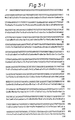
- Preferred embodiments of the enzyme and the derivative thereof are, for example, a C-terminal ⁇ -amidating enzyme or biologically active derivative maintaining the enzyme activity thereof comprising an amino acid sequence starting at the 37th Pro and terminating at the 378th Lys in the amino acid sequence shown in Fig. 1; a C-terminal ⁇ -amidating enzyme or biologically active derivative maintaining the enzyme activity thereof and having an amino acid sequence starting at an amino acid present between the first Met, inclusive, and the 37th Pro, inclusive, and terminating at an amino acid present between the 378th Lys, inclusive, and the 974th ser, inclusive, in Fig.
- a C-terminal ⁇ -amidating enzyme or biologically active derivative maintaining the enzyme activity thereof and having an amino acid sequence starting at an amino acid present between the first Met, inclusive, and the 37th Pro, inclusive, and terminating at an amino acid present between the 378th Lys, inclusive, and the 974th Ser, inclusive in Fig. 1, and having an additional C-terminal amino acid or amino acid sequence consisting of up to ten amino acids; a C-terminal ⁇ -amidating enzyme or biologically active derivative maintaining the enzyme activity thereof and having an amino acid sequence starting at an amino acid present between the first Met, inclusive, and the 37th Pro, inclusive, and terminating at an amino acid present between the 378th Lys, inclusive, and the 866th Ser, inclusive, in Fig.
- a C-terminal ⁇ -amidating enzyme or biologically active derivative maintaining the enzyme activity thereof and having an amino acid sequence starting at an amino acid present between the first Met, inclusive, and the 37th Pro, inclusive, and terminating at an amino acid present between the 378th Lys, inclusive, and the 866th Ser, inclusive, in Fig. 3, and having an additional C-terminal amino acid or amino acid sequence consisting of up to ten amino acids.
- the present invention also provides a process for the production of the above-mentioned C-terminal ⁇ -amidating enzyme or biologically active derivatives thereof, comprising the steps of:
- the present invention also provides genes coding for the above-mentioned C-terminal ⁇ -amidating enzyme or biologically active derivative thereof.
- the present invention further provides plasmids and phage vectors containing the above-mentioned gene.
- the present invention provides prokaryotic cells transfected with the plasmid or eukaryotic cells transfected with the plasmid.
- the present inventors have already succeeded in isolating two kinds of cDNAs coding for C-terminal ⁇ -amidating enzymes, from the skin of Xenopus laevis , which were cloned in plasmids pXA 457 and pXA 799.
- E. coli DH1/pXA799 containing the plasmid pXA799 was deposited with the Fermentation Research Institute, Agency of Industrial Science and Technology (FRI), 1-3, Tsukuba-shi 1-chome, Ibaraki-ken, 301 Japan, as FERM BP-1586, on December 3, 1987; (Japanese Patent Publication No. 1-104168; EP 0299790 A2).
- the C-terminal ⁇ -amidating enzyme catalyzes a conversion of a peptide or protein represented by the formula: R-X-Gly wherein X is an amino acid to be ⁇ -terminal ⁇ -amidated, Gly represents glycine and R represents the remaining part of the peptide or protein, to a peptide or protein represented by the formula: R-X-NH2.
- the present C-terminal ⁇ -amidating enzyme includes, in addition to native enzymes of human thyroid gland origin, modified enzymes wherein one or more than one amino acid on an amino acid sequence of the native enzyme is replaced by one or more than one different amino acid, wherein one or more than one amino acid is added to the amino acid sequence of the native enzyme, or wherein one or more than one amino acid is deleted from the amino acid sequence of the native enzyme, white maintaining the above-mentioned enzyme activity.
- RNA was prepared from human thyroid gland, and from the total RNA, poly(A) RNA was prepared using an oligo(dT) cellulose column. Next, the poly (A) RNA was used to prepared a cDNA according to a procedure of Gubler et al. (Gubler; V. and Hoffman. B. J., Gene 25 , 263, 1983), and the cDNA thus obtained was used to prepare a ⁇ gtII phage cDNA library.
- a plasmid pXA799 containing cDNA coding for a C-terminal ⁇ -amidating enzyme of Xenopus laevis was digested with ApaI and DraI, and the resulting ApaI-DraI DNA fragment of about 2.8 kb was labeled with ( ⁇ -32P]dCTP by nick translation to prepare a DNA probe.
- the above-mentioned ⁇ gtII cDNA library was screened using the DNA probe, to obtain phage clones ⁇ gt11chT28 and ⁇ gt11ch40. As a result of analysis of these two clones, it was found that these clones do not contain a cDNA coding for the entire C-terminal ⁇ -amidating enzyme.
- a phage ⁇ gt10 cDNA library was prepared from the above-mentioned poly (A) RNA, by the same procedure as described above.
- the ⁇ gt10 cDNA library was screened using the above-mentioned ApaI-PraI DNA probe derived from pXA799, to obtain a phage clone ⁇ gt10ch T2.
- the cDNA library was again screened using a DNA probe derived from a cDNA region in the above-mentioned ⁇ gt11chT28 clone, to obtain a phage clone ⁇ gt10chT201.
- the cDNA library was screened using a DNA probe which was a labeled SmaI-XhoI DNA fragment corresponding to a region from the 35th G to the 425th A in the ⁇ gt10ch201, to obtain a phage clone ⁇ gt10ch101.
- the phage DNAs obtained as described above i.e., ⁇ gt11chT28, ⁇ gt11chT40, ⁇ gt10chT201, ⁇ gt10chT2, and ⁇ gt10chT101, were cleaved with various restriction enzymes to prepare their restriction enzyme cleavage maps.
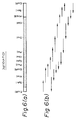
- the maps for cDNA regions in the phages ⁇ gt10chT201, ⁇ gt10chT2, and ⁇ gt10chT101 are shown in Figs. 4(a), 5(a), and 6(a), respectively.
- each DNA fragment prepared by cleaving the ⁇ gt10chT201, ⁇ gt10chT2, and ⁇ gt10chT101 with various restriction enzymes was subcloned in M13 phage to determine the nucleotide sequence, according to a procedure of Sanger et al. (Sanger, F. et al., Proc. Natl. Acad. Sci. U.S.A. 34 , 5463-5467, 1977), and an entire nucleotide sequence of the cDNA region in the phage clone was assembled according to a strategy shown in Figs. 4(b), 5(b) or 6(b).
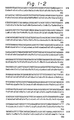
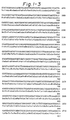
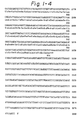
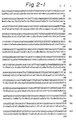
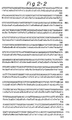
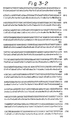
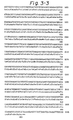
- the nucleotide sequences of the cDNA region in the phage clones ⁇ gt10chT201, ⁇ gt10chT2, and ⁇ gt10chT101 are shown in Figs. 1, 2, and 3, respectively.
- chT2 cDNA The analysis of the cDNA region in a phage clone ⁇ gt10chT2 (designated chT2 cDNA) revealed the following:
- the chT2 cDNA was an incomplete cDNA in that the chT2 cDNA lacks a 5'-terminal region corresponding to the 5'-terminal region up to the codon for the 90th Ile (see Figs. 2 and 7).
- the chT201-type enzyme contains two N-glycosylation sites and that the chT201-type enzyme contains one N-glycosylation site, because one of the two possible N-glycosylation sites in the ch201-type enzyme is present in the additional region consisting of 107 amino acids not present in the chT2-type enzyme.
- C-terminal ⁇ -amidating enzyme derivatives are expressed in prokaryotic cells such as E. coli cells
- the position of the N-terminus in the chT201 cDNA, chT2 cDNA or chT101 cDNA should be chosen.
- Eipper et al. (Eipper, B. et al., Mol. Endo. 1 , 777-790, 1987) cloned cDNA coding for a C-terminal ⁇ -amidating enzyme of bovine origin, and determined a primary amino acid sequence of the enzyme.
- a processing site of a protein encoded by the chT201 cDNA or chT101 cDNA is between the 30th Arg and the 31th Phe, or between the 36th Arg and the 37th Pro.
- the enzyme derivatives were designed such that the N-terminus thereof was at the 31th Phe or the 37th Pro in the amino acid sequence shown in Figs. 1 or 3.
- the enzyme derivatives were designed such that the C-termini thereof were at different sites in the amino acid sequence shown in Figs.
- DNAs coding for chT201-type enzyme derivatives were constructed from the chT201 cDNA; and DNAs coding for chT101-type enzyme derivatives were constructed by joining a 5'-terminal side of the chT201 cDNA and a 3'-terminal side of the chT2 cDNA rather than from the chT101 cDNA, from the viewpoint of convenience of the construction.
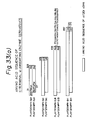
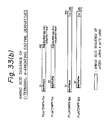
- Figures 33(a) and 33(b) schematically represent enzyme derivatives designed for the expression in E. coli .
- the enzyme derivatives (chT201-type derivatives) shown in Fig. 33(a) start at the 31th Phe or 37th Pro and end at the 323th Ala, the 378th Lys, the 434th Asp or 857th Ile in the amino acid sequence shown in Fig. 1; although all derivatives have at their N-terminus an additional Met corresponding to a translation start codon, and at their C-terminus, some derivatives have an additional amino acid or amino acid sequence derived from a multicloning site present in a plasmid used for the construction of corresponding expression vectors.
- the C-terminal additional amino acid and amino acid sequence are shown outside the boxes in Fig. 33(a).
- the enzyme derivatives (chT101-type derivatives) shown in Fig. 33(b) start at the 31th Phe or the 37th Pro and end at the 461th Ala or the 750th Ile in the amino acid sequence shown in Fig. 3; although all derivatives have an additional amino acid Met corresponding to a translation start codon, at their N-terminus, and at their C-terminus, some derivatives have an additional amino acid or amino acid sequence derived from a multicloning site present in a plasmid used to construct corresponding expression vectors.
- the C-terminal additional amino acid and amino acid sequence are shown outside the boxes in Fig. 33(b).
- expression vectors P L chT201 MPF-Sph, P L chT201 MPF-Sal, P L chT201 MPF-S/B, P L chT201 MPF-Bcl, P L chT201 MFK-Sph, P L chT210 MFK-Sal, P L chT201 MFK-S/B, and P L chT201 MFK-Bcl were constructed for the expression of the chT201-type derivatives
- P L chT2 MPF-Pst, P L chT2 MPF-Bcl, P L chT2 MFK-Pst, and P L ch MFK-Bcl were constructed for the expression of the chT101 type derivatives.
- the enzyme derivatives are identified by the names of the expression vectors.
- These expression vectors contain a cDNA coding for the chT201-type protein derived from chT201 cDNA, or cDNA coding for the chT101-type protein derived from chT201 cDNA and chT2 cDNA under the control of a P L promoter of ⁇ phage origin.
- These expression vectors were constructed from the phage clones ⁇ gt10chT201 and ⁇ gt10chT2, commercially available plasmids pUC18 and pUC19, and a plasmid pUCP L CI. Note, E.
- E. coli SBM305 E. coli SBM305
- FRI FRI under the Budapest treaty as FERM BP-2240
- a construction process for the pUCP L CI is described in Japanese Patent Application No. 62-306867 (EP 0299790 A2).
- E. coli W3110 was transformed to obtain the corresponding transformants, W3110/P L chT201 MPF-Sph, W3110/P L chT201 MPF-Sal, W3110/P L chT201 MPF-S/B, W3110/P L chT201 MPF-Bcl, W3110/P L chT201 MFK-Sph, W3110/P L chT201 MFK-Sal, W3110/P L chT201 MFK-S/B, W3110/P L chT201 MFK-Bcl, W3110/P L chT2 MPF-Pst, W3110/P L chT2 MPF-Bcl, W3110/P L chT2 MFK-Pst, and W3110/P L chT2 MFK-Bcl.
- transformants were separately cultured in a conventional medium to obtain cultured cells, which were sonicated to recover an expression product in a precipitated fraction.
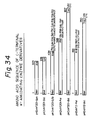
- chT201-type enzyme derivatives starting at the first amino acid Met and ending at the 323rd Ala, the 378th Lys, the 434th Asp, the 568th Ala or the 857th Ile in the amino acid sequence shown in Fig. 1, and chT101-type enzyme derivatives starting at the first Met and ending at the 461th Ala or the 750th Ile in the amino acid sequence in Fig. 3, (although some derivatives have an additional amino acid or amino acid sequence) were designed.
- These enzyme derivatives are schematically shown in Fig. 34. In this Figure, the additional amino acid and amino acid sequences derived from multicloning site present in a plasmid used for the construction of expression vectors are shown outside the boxes.
- expression plasmids pKDchT201-Sph, pKDchT201-Sal, pKDchT201-S/B, pKDchT201-Pst, pKDchT201-Bcl, pKDchT201-Pst, and pKDchT2-Bcl were constructed from the phage clones ⁇ gt10chT201 and ⁇ gt10chT2, commercially available plasmids pUC18 and pUC19, and a plasmid pKD.
- E. coli transformed with the plasmid pKD was designated as E.
- the enzyme derivatives are identified by the names of the expression vectors. These expression vectors contain a cDNA insert coding for a desired enzyme derivative under the control of the early promoter derived from SV40 virus. Further, these expression vectors were used to transfect animal cells such as COSl cells, and the transfected cells cultured in a conventional medium. The desired enzyme derivative was then recovered from a culture medium.
- a C-terminal ⁇ -amidating enzyme activity is assayed to confirm that a protein expressed in a transfected host is a C-terminal ⁇ -amidating enzyme, and that when a C-terminal ⁇ -amidating enzyme acts on the substrate thereof, an amidated peptide or protein is produced.
- E. coli cells are disrupted and the disruptant is centrifuged to obtain a precipitate containing a major portion of the expression product, the precipitate is solubilized with 6 M guanidine hydrochloride, and the solution thus obtained is dialyzed to obtain an assay sample.
- Enzyme activity is assayed by using a reaction wherein a substrate generally represented by R-X-Gly is converted to R-X-NH2 , for example, a reaction wherein a synthetic substrate [125I] -Ac-Tyr-Phe-Gly is converted to [125I] -Ac-Tyr-Phe-NH2.
- a labeled substrate (labeled R-X-Gly) is subjected to a reaction with a test enzyme solution in Tris-HCl buffer, to this reaction mixture are added Tris-HCl buffer and ethyl acetate, and after mixing, the whole is centrifuged to separate an organic phase and an aqueous phase. Since a major portion of the unreacted labeled substrate (labeled R-X-Gly) remains in an aqueous phase, and an amidated labeled products (labeled R-X-NH2) transfers to an organic phase, the substrate and the product can be easily separated.
- a C-terminal ⁇ -amidating enzyme of the present invention was assayed using synthetic peptide [125I] -Ac-Tyr-Phe-Gly as a substrate according to the following procedure.
- [125I] -Ac-Tyr-Phe-Gly (1 pmole, 70,000-150,000 cpm) was incubated with an enzyme preparation, in a final volume of 250 ⁇ l containing 0.2 M Tris-HCl buffer (pH 7.0), 2 ⁇ M CuSO4 , 0.25 mM ascorbic acid, 25 ⁇ g catalase (Boehringer), 0.1% Lubrol (PX type, Nakarai Chemicals).
- the reaction mixture was kept at 37°C for 1 to 4 hours, and then 0.75 ml of 1 M Tris-HCl buffer (pH 7.0) and 2 ml of the organic phase of an ethyl acetate/water mixture was added.
- the two phases were mixed vigorously in a Vortex mixer, and after centrifugation at 3000 rpm for 3 mins, the organic phase thus separated was transferred to another test tube.
- the radioactivity in the organic and aqueous layers was measured by a gamma scintillation counter.
- the yield of conversion is calculated from the ratio of the radioactivity in an organic phase such as an ethyl acetate phase to the total radioactivity.
- one unit is defined as the enzyme activity that gives fifty percent conversion of 1 p mole substrate, such as [125I] -Ac-Try-Phe-Gly, to [125I] -Ac-Tyr-Phe-NH2 for 1 hour.
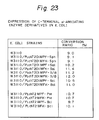
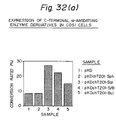
- the C-terminal ⁇ -amidating enzyme activity provided by culturing the above-mentioned various transformants and transfectant is shown in Figs. 23, 32(a), and 32(b). In these Figures, the enzyme activity is expressed in the conversion ratio of substrate to amidated product.
- the present invention includes any chT201-type enzyme derivative having an amino acid sequence which starts at any amino acid selected from the first amino acid Met to the 37th Pro and terminates at any amino acid selected from the 378th Lys to the 974th Ser, in the amino acid sequence shown in Fig. 1.
- the present chT201-type enzyme derivatives include those schematically shown in Fig. 33(a) and Fig. 34, except for those provided by P L chT201 MFK-Sph, P L chT201 MPF-Sph and pKDT201-Sph, in addition to native enzyme starting from the first Met and ending at the 974th Ser.
- the present chT201-type enzyme derivatives should not be limited to the above-mentioned particular derivatives. Since all tested derivatives which terminate at the 378th Lys, the 434th Asp or the 857th Ile exhibit the desired enzyme activity, it can be reasonably believed that any derivative which terminates at any amino acid between the 378th Lys to the 974th Ser will provide the desired enzyme activity. These derivatives can be easily obtained by constructing an expression vector containing a shortened cDNA insert. The shortened cDNA fragment can be easily prepared by a conventional procedure, such as exonuclease digestion.
- the present invention includes any chT101-type enzyme derivatives having an amino acid sequence which starts at any amino acid selected from the first amino acid Met to the 37th Pro and terminates at any amino acid selected from the 378th Lys to the 866th Ser, in the amino acid sequence shown in Fig. 3. More specifically, the present chT101-type enzyme derivatives include those schematically shown in Fig. 33(b) and Fig. 34, in addition to native enzyme starting at the first Met and ending at the 866th Ser in Fig. 3. Nevertheless, the present chT101-type enzyme derivative should not be limited to the above-mentioned particular derivatives.
- the present enzyme derivatives can have an additional amino acid or amino acid sequence consisting of about up to ten amino acids, which is not present in the native sequence.
- the additional amino acid or amino acid sequence is indispensably introduced by a multicloning site present in a vector used to construct an expression vector.
- the present enzyme products can be used for the preparation of ⁇ -amidated peptide.
- a substrate peptide having a glycine residue at the C-terminal thereof is incubated with one of the present enzyme products in an aqueous reaction medium, preferably in an aqueous buffer such as Tris-HCl, at a pH of about 6 to 7, and at a temperature of about 37°C, for a time sufficient to convert a substantial amount of the starting peptide to a corresponding C-terminal ⁇ -amidated peptide.
- the present enzymes can be used to produce physiologically active peptides having a C-terminal ⁇ -amide from precursor peptides having glycine at the C-terminal thereof, which precursor peptide may be produced by a recombinant DNA technique, chemical methods, or isolated from a natural source.
- the present invention discloses in detail a process for the production of a C-terminal ⁇ -amidating enzyme using the cDNA in an E. coli host, and animal cells
- the present cDNA can be used to express the target enzyme in another host, such as yeast cells.
- RNA total RNA
- 10 ml/2 g the tissue of NETS solution 100 mM Tris-HCl, pH 9.0, 100 mM NaCl, 10 mM EDTA, 5% SDS
- the disruptant was centrifuged at 3000 rpm for 20 minutes to obtain an aqueous layer, the residual phenol layer was mixed with the NETS solution, and the mixture was centrifuged as described above to obtain an aqueous layer.
- the aqueous layers were combined, to the combined aqueous layer was added the same volume of CHCl3 , and the mixture was centrifuged at 3000 rpm for 20 minutes to obtain an aqueous solution; to which was added two volumes of ethanol, and the mixture then allowed to stand at -20°C overnight to form an ethanol precipitate.
- the mixture was centrifuged at 3000 rpm and 4°C for 30 minutes to recover the precipitate, which was then washed with 80% ethanol and dried under vacuum.
- the dried precipitate was redissolved in 1 ml/g the tissue of guanidine thiocyanate solution (4.2 M guanidine thiocyanate, 0.1 M sodium acetate, 5 mM EDTA, pH 5.0), 4 ml of CsCl solution (5 M CsCl, 0.1 M sodium acetate, 5 mM EDTA, pH 5.0) was put into a SW40TI centrifugation tube, and the guanidine thiocyanate solution of the precipitate was overlaid on the CsCl solution in the tube.
- RNA precipitate at the bottom of the tube was washed with 80% ethanol, and the precipitate was dissolved in 500 ⁇ l of ETS solution (10 mM Tris-HCl, pH 7.5, 10 mM EDTA, 0.5% SDS). Then to the solution was added the same volume of the PC9, and after stirring, the mixture was centrifuged at 10,000 rpm for 5 minutes to obtain an aqueous layer. To the aqueous layer was added the same volume of ethyl ether, and after stirring, the mixture was centrifuged at 10,000 rpm for one minute to obtain an aqueous solution.
- ETS solution 10 mM Tris-HCl, pH 7.5, 10 mM EDTA, 0.5% SDS
- oligo (dT) cellulose column was used to prepare poly(a) RNA.
- 0.5 g of oligo (dT) cellulose was packed to the column, which was washed with 10 ml of distilled water and 10 ml of 10 N NaOH, 5 mM EDTA, and the column was then thoroughly washed with distilled water.
- the column was equilibrated with 10 ml of a 1X loading buffer (20 mM Tris-HCl, pH 7.6, 0.5 M NaCl, 1 mM EDTA, 0.1% SDS), 7 mg of the total RNA in 13.5 ml of distilled water was heated at 65°C for 5 minutes, to the solution was added the same volume of 2x loading buffer, and the mixture then applied to the column.
- a flow-through fraction was heated again at 65°C for 5 minutes and again applied to the column.
- the column was washed with 4 ml of the loading buffer and 4 ml of 20 mM Tris-HCl (pH 7.6), 0.1 M NaCl, 1 mM EDTA and 0.1% SDS.
- the poly(A) RNA was then eluted with 4 ml of a elution buffer (10 mM Tris-HCl, pH 7.5, 1 mM EDTA, 0.05% SDS), and to the eluted fraction was added one tenth volume of 2 M sodium acetate (pH 5.0) and two volume of ethanol to recover the poly(A) RNA, whereby 144 ⁇ g of poly(A) RNA was obtained from 7 mg of the total RNA.
- a elution buffer 10 mM Tris-HCl, pH 7.5, 1 mM EDTA, 0.05% SDS
- a double-stranded cDNA was prepared using an Amersham cDNA synthesis kit.
- the double-stranded cDNA was cloned to the ⁇ gtII phage, to prepare a cDNA library according to the following procedure.
- the precipitate was redissolved in 100 ⁇ l of 1x TE solution (10 mM Tris-HCl, pH 7.5, 1 mM EDTA), and an ethanol precipitation was carried out with 4 M ammonium acetate.
- the ethanol precipitate was dried and redissolved in 10 ⁇ l of distilled water, to the solution were added 4 ⁇ l of 5x EcoRI methylase buffer (400 mM Tris-HCl, pH 8.0, 40 mM EDTA, 8 mM DTT), 2 ⁇ l of 800 ⁇ M S-adenosylmethionine, 0.4 ⁇ l of EcoRI methylase (100: Takara Shuzo, Japan, and 3.6 ⁇ l of distilled water.
- the reaction mixture was incubated at 37°C for 10 minutes, and to the reaction mixture was added the same volume of PC9, and after stirring, the mixture was centrifuged at 13,000 rpm for 10 minutes to obtain an aqueous solution. After the addition of one tenth volume of 3 M sodium acetate and two volume of ethanol, the mixture was allowed to stand at -80°C for 30 minutes to form a precipitate. The mixture was then centrifuged to separate the precipitate, which was washed with 80% ethanol and dried.
- the mixture was heated at 65°C for 10 minutes, to inactivate the enzyme, and after the addition of 10 ⁇ l of 20 mM Tris-HCl (pH 7.5), 100 mM NaCl, and then 2 ⁇ l of EcoRI (20 units), the reaction mixture was incubated at 37°C for 5 hours. After the incubation, the reaction mixture was treated with PC9, and adjusted to a final volume of 30 ⁇ l by adding 1x TE. The mixture was applied to a Biogel A50 m column (0.5 x 25 cm) equilibrated with TES buffer (10 mM Tris-HCl, pH 7.5, 1 mM EDTA, 50 mM NaCl) and eluted with a TES buffer.
- TES buffer 10 mM Tris-HCl, pH 7.5, 1 mM EDTA, 50 mM NaCl
- a main peak fraction was obtained, and to the fraction was added 0.5 ⁇ g of phage ⁇ gtII which had been cleaved with EcoRI and then 5'-dephosphorylated (Pharmacia), and an ethanol precipitation was carried out.
- To the precipitate were added 1.5 ⁇ l of 10x ligation buffer, 8 ⁇ l of distilled water, 1.5 ⁇ l of 0.1 M DTT, 1.5 ⁇ l of 10 mM ATP, and 1.5 ⁇ l of T4 DNA ligase (7.5 units), and the reaction mixture was incubated at 12°C overnight.
- reaction mixture 5 ⁇ l was subjected to in vitro ⁇ phage packaging, using a Giga pack gold from Strategene, and as a result, a cDNA library of a human thyroid gland origin consisting of about 500,000 clones was obtained.
- E. coli VCS 257 (derived from supF; Maniatis, T. et al., Molecular Cloning, 1982, Cold Spring Harbor) was cultured in TB medium (10 g/l of Bactotrypron, 5 g/l of NaCl, pH 7.5) at 37°C overnight to prepare an inoculum. 40 ml of TB medium was inoculated with one hundredth of the inoculum, and culturing was carried out at 30°C overnight. The culture was centrifuged at 3000 rpm for 10 minutes, and after discarding the supernatant, to the precipitated cells was added 16 ml of 10 mM MgSO4.
- the cDNA library phage was added to the cell suspension, in an amount of 500,000 pfu (plaque forming units), and the whole was allowed to stand at 37°C for 20 minutes.
- To the culture was added 30 ml of NZY soft agar medium (10 g/l NZ amine, 5 g/l NaCl, 5 g/l yeast extract, 2 g/l MgSo4 ⁇ 7H2O and 10 g/l agar, pH 7.5), and the mixture was overlaid on an NZY medium containing 1.5% agar, in a petri dish (23 x 23 cm).
- SM buffer 50 ml of 5.8 g/l NaCl, 2 g/l MgSo4 ⁇ 7H2O, 1 M Tris-HCl, pH 7.5; 2% gelatin 5 ml/l
- the SM buffer containing phages was recovered as a phage stock solution. This producure enabled an amplified cDNA library containing 4 x 10¹¹ pfu/ml phages to be prepared.
- a DNA probe was prepared by completely digesting plasmid pXA 799 containing a cDNA coding for an entire Xenopus laevis C-terminal ⁇ -amidating enzyme with restriction enzymes ApaI and DraI, and isolating an ApaI-DraI DNA fragment of about 2.8 kb containing an entire coding region, by agar gel electrophoresis.
- the ApaI-DraI DNA fragment was radiolabeled with [ ⁇ -32P]dCTP, by nick translation.
- E. coli cells prepared by overnight culture and 150000 pfu of ⁇ gtII phage were mixed with 25 ml of a soft agar NZY medium, and the mixture was overlaid on a 23 x 23 cm NZY agar medium in a petri dish, and incubated at 37°C overnight to form plaques.
- Six petri dishes were prepared.
- a nitrocellulose filter (22 x 22 cm; Shleicher & Schnell) was put on the agar medium for 5 minutes, and then the nitrocellulose filter was put on an alkaline denaturation solution (0.1 N NaOH, 1.5 M NaCl) for 10 minutes, and thereafter, on a neutralizing buffer (0.5 M Tris-HCl, pH 7.5, 1.5 M NaCl) for 10 minutes.
- a restriction enzyme cleavage map was prepared, cleaved with various restriction enzymes, and the resulting DNA fragments were subcloned in M13 phage to determine the nucleotide sequence, using a Takara DNA sequencing kit (Takara Shuzo, Japan) according to the dideoxy termination method (Sanger, F. et al., Pro. Natl. Acad. Sci. V.S.A. 34 , 5463-5467, 1977).
- the ⁇ gt11ch28 contained a cDNA insert coding for a protein similar to a central portion of a protein encoded by the pXA799; and the ⁇ gt11ch40 contained a cDNA insert coding for a protein similar to a C-terminal half of protein encoded by the pXA 799 (See Fig. 7). Therefore, it was assumed that both the ⁇ gt11chT28 and ⁇ gt11ch40 partially encode a C-terminal ⁇ -amidating enzyme of human thyroid origin.
- Example 4 ⁇ g of the poly(A) RNA prepared in Example 1 was used to prepare double-stranded cDNA using a cDNA synthesis kit (Pharmacia).
- the resulting double-stranded cDNA and 3 ⁇ g of ⁇ gt10 phage (Strategene) were ligated, using a T4 DNA ligase, at 12°C overnight, and subjected to in vitro packaging.
- a ⁇ gt10 cDNA library comprising about 2 x 10⁶ clones was obtained.
- Example 5 Isolation of phage clones ⁇ gt10chT2, ⁇ gt10chT201 and ⁇ gt10chT101 containing cDNA coding for desired enzyme
- an additional DNA probe was prepared by cleaving the above-prepared ⁇ gt11chT28 with EcoRI to obtain a 0.7 kb EcoRI DNA fragment, which was then radiolabeled with [ ⁇ -32P]dCTP by nick translation.
- the formed plaques were transferred to a nitrocellulose filter, which was then subjected to alkaline denaturation, neutralization, air drying at 80°C under a reduced pressure, and baking for 90 minutes, as described in Example 3. (2).
- the nitrocellulose filter was put into a polymer sack, to which 50 ml of the above-mentioned prehybridization solution additionally containing 20% formamide was introduced.
- the sack was incubated at 37°C for 3 hours, and after discarding the solution 10,000,000 cpm of the ApaI-DraI DNA probe and 10 ml of the prehybridization solution containing 20% formamide were introduced into the sack, which was then incubated at 37°C overnight.
- the filter was twice washed is 500 ml of 3 x SSC solution containing 0.1% SDS, and then twice washed with a 0.1 x SSC solution containing 0.1% SDS, at 37°C. After air drying, the filter was subjected to autoradiography, and as a results one positive clone which hybridized with the ApaI-DraI probe derived from pXA 799 was obtained, and was designated ⁇ gt10chT2.
- Phage DNAs were prepared for three clones thus obtained by a conventional procedure, and to test the length of cDNA insert, each phage DNA was digested with EcoRI.
- the ⁇ gt10chT2 provided two DNA fragments of about 2.4 kb and 0.4 kb, showing that the 2.8 kb cDNA had been inserted.
- the ⁇ gt10chT201 provided three DNA fragment of about 2.2 kb, 0.8 kb, and 0.7 kb, respectively, showing that the 3.7 kb cDNA had been inserted.
- the ⁇ gt10chT201 and ⁇ gt10chT2 phage DNAs were digested with various restriction enzymes, and the resulting fragments were separated by agar gel electrophoresis to prepare restriction enzyme cleavage maps of cDNA regions. The results are shown in Fig. 4(a) and Fig. 5(a).
- the DNA fragments were subcloned in M13 phage, and the nucleotide sequence was determined by using a Takara DNA sequencing kit (Takara Shuzo, Japan) and a Sequanase (TM) DNA sequencing kit (United States Biochemical Corporation), according to the dideoxy termination method.
- chT201 cDNA The Nucleotide sequence of cDNA in the phage clone ⁇ gt10chT201 (abbreviated as chT201 cDNA) is shown in Fig. 1; and the nucleotide sequence of cDNA in the ⁇ gt10chT2 (abbreviated as chT2 cDNA) is shown in Fig. 2.
- the chT201 cDNA has a length of about 3.7 kb, and is a full length cDNA including a 5'-terminal non-coding region, a long reading frame, and a 3'-terminal non-coding region.
- the chT2 cDNA appears to lack the 5'-terminal region of a full length cDNA.
- the chT201 cDNA contains 321 extra nucleotides coding for 107 amino acids, which are absent from the chT2 cDNA.
- the chT201 cDNA contains 321 nucleotides coding for 107 amino acids, which are absent from the cDNA in pXA 799.
- chT201 cDNA As discussed above, the comparison of chT201 cDNA with chT2 cDNA suggested the presence of two types of C-terminal ⁇ -amidating enzymes of human thyroid gland origin, i.e., an enzyme encoded by chT201 cDNA having 321 additional nucleotides, and an enzyme encoded by chT2 cDNA not having the 321 nucleotides.
- the chT2 cDNA lacks the 5-terminal portion of a postulated full length cDNA, and accordingly, to obtain a chT2-type full length cDNA, the ⁇ gt10 cDNA library was again screened.
- a DNA probe was prepared by cleaving the chT201 cDNA with SmaI and XhoI to obtain a 380 bp DNA fragment comprising a 5'-noncoding region and 5'-terminal side coding region, and labeling the DNA fragment with [ ⁇ -32P]dCTP by nick translation. Plaque hybridization was carried out according to the procedure described in Example 5. (2), using 1,280,000 clones of the ⁇ gt10 cDNA library, the 380 bp DNA probe, and the prehybridization solution containing 50% formamide, to obtain one positive clone. The clone was designated as ⁇ gt10chT101.
- Phage DNA of ⁇ gt10ch101 was prepared by a conventional procedure, and the length of the cDNA insert in the ⁇ g10chT101 (abbreviated as chT101 cDNA) was determined by cleaving the phage DNA. As a result, the cleavage provided three cDNA fragments of 0.7 kb, 0.9 kb, and 2.6 kb, showing that the ⁇ gt10chT101 clone contains the 4.2 kb cDNA insert.
- the ⁇ gt10chT101 phage DNA was cleaved with various restriction enzymes, and the resulting fragments were separated by agar gel electrophoresis to prepare a restriction enzyme cleavage map of chT101 cDNA.
- the result is shown in Fig. 6(a).
- the DNA fragments were subcloned in M13 phage, and a nucleotide sequence was determined using a Sequanase (TM) DNA sequencing kit according to the dideoxy termination method.
- the strategy for the sequencing is shown in Fig. 6(b).
- the nucleotide sequence of chT101 cDNA, and a corresponding amino acid sequence, are shown in Fig. 3.
- the chT101 cDNA consists of three EcoRI fragments of 2.6 kg, 0.9 kb, and 0.9 kb, since the 0.9 kb cDNA fragment does not encode a C-terminal ⁇ -amidating enzyme, the nucleotide sequence of the 0.9 kb cDNA fragment is excluded from Fig. 3. As seen from a comparison of the nucleotide sequences shown in Figs. 2 and 3, both the chT101 cDNA and chT2 cDNA encode the same enzyme, although the chT101 cDNA encodes the entire enzyme and the chT2 cDNA encodes the same enzyme but lacking its N-terminal portion.
- Figure 7 shows the relationship between pXA 799 cDNA, chT210 cDNA, chT2 cDNA, chT101 cDNA, chT40 cDNA, and chT28 cDNA.
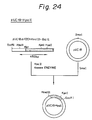
- Example 6 Construction of E.coli vector expressing chT201-type protein derivatives, P L chT201 MPF-Sph, P L chT201 MPF-S/B, P L chT201 MPF-Sal and P L chT201 MPF-Bcl
- expression vectors P L chT201 MPF-Sph, P L chT201 MPF-S/B, P L ch201 MPF-SalI, and P L chT201 MPF-Bcl, as well as E. coli W3110 transformed with the expression vector were prepared as follows.
- the ⁇ chT201 phage DNA was cleaved with HindIII and BglII to isolate aDNA fragment of about 5 kb comprising an entire coding region of the chT201 cDNA and a part of the ⁇ gt10 phage.
- pUC18 was cleaved with HindIII and Bam HI. Both DNA fragments were ligated to construct an intermediate plasmid pUC18chT201 HindIII-BglII, which was used to transform E. coli , and the transformant was designated as E. coli SBM302, and deposited with the FRI under the Budapest Treaty as FERM BP-2237, on January 11, 1989.
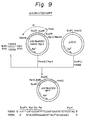
- the plasmid pUC18chT201 HindIII-BglII was cleaved with KpnI and HindIII, to isolate a KpnI-HindIII DNA fragment (E1), and a DNA fragment YSO53 was synthesized having a 5'-EcoRI end, a translation start codon ATG, codons for the 37th Pro to the 43th Leu and a 3'-KpnI end, in this order. Further, a complementary DNA fragment YSO54 was synthesized.
- the DNA fragments YSO53 and YSO54 were 5'-phosphorylated using a T4 polynucleotide kinase and ATP, and annealed at 65°C for 10 minutes to prepare the double-stranded DNA fragment shown in Fig. 9.
- pUC19 was cleaved with EcoRI and HindIII.
- the synthetic DNA fragment, the E1 fragment, and the linearized pUC19 were ligated and used to transform E. coli W3110, to obtain a plasmid P L chT201 MPF-Sph and corresponding transformant E. coli W3110/P L chT201 MPF-Sph.
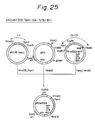
- the plasmid pUC18chT201 HindIII-BglII was cleaved with XhoI and Sau3A1 (cleaving cDNA at 1439th position) to obtain a DNA fragment E4, and the plasmid pUC19chT201 MPF was cleaved with EcoRI and XhoI to obtain a DNA fragment E5.
- the plasmid pUCP L -CI was cleaved with EcoRI and BamHI.
- the DNA fragments E4 and E5, and the linearized pUCP L -CI were ligated and used to transform E. coli W3110 to obtain a plasmid P L chT201 MPF-S/B and corresponding transformant E. coli W3110/P L chT201 MPF-S/B.
- the ⁇ chT201 phage DNA was cleaved with EcoRI to obtain a 0.73 kb EcoRI DNA fragment.
- pUC19 was cleaved with EcoRI.
- the 0.73 kb EcoRI DNA fragment and the linearlized pUC19 were ligated an dused to transform E. coli JM109, to obtain a plasmid pUC19chT201-EcoRI 0.7 and corresponding transformant E. coli JM109/pUC19chT201-EcoRI 0.7.
- the plasmid pUC19chT201-EcoRI 0.7 was cleaved with EcoRI and HinfI (cleaving cDNA at 1250 position) to obtain a DNA fragment E6.
- EcoRI and HinfI cleaving cDNA at 1250 position
- a DNA fragment YSO59 having an Hinf cohesive end at its 5'-end, and a DNA fragment YSO60 complementary to the YSO59 and having a SalI cohesive end at its 5'-end were synthesized.
- the YSO59 and YSO60 were 5'-phosphorylated using a T4 polynucleotide kinase and ATP, and annealed at 65°C for 10 minutes.
- pUC18 was cleaved with EcoRI and SalI.
- the annealed YSO59 and YSO60, the E6 DNA fragment, and the linearlized pUC18 were ligated and used to transform E. coli JM109, to obtain a plasmid pUC18-Sal and corresponding transformant E. coli JM109/pUC18-Sal.
- P L chT201 MPF-Sph was cleaved with BstEII and then partially digested with EcoRI, to obtain an EcoRI-BstEII DNA fragment E7.
- pUC18-Sal was cleaved with SalI and BstEII to obtain a BstEII-SalI DNA fragment E8.
- pUCP L -CI was cleaved with EcoRI and SalI.
- the DNA fragments E7 and E8, and the linearized pUC18 were ligated and used to transform E. coli W3110, whereby a plasmid P L chT201 MPF-Sal and corresponding transformant E. coli W3110/P L chT201 were obtained.
- P L chT201 MFF-S/B was cleaved with XhoI (cleaving cDNA at 421 position) and BamHI to obtain an XhoI-BamHI DNA fragment E9.
- pUC18chT201 HindIII-BglII was cleaved with XhoI and BclI (cleaving cDNA at 2707 position) to obtain an XhoI-BclI DNA fragment E10.
- the DNA fragments E9 and E10 were ligated and used to transformant E. coli W3110, whereby a plasmid P L chT201 MPF-Bcl and corresponding transformant E. coli W3110/P L chT201 MPF-Bcl were obtained.
- Example 7 Construction of E. coli vector expressing chT201-type protein derivatives, P L chT201 MFK-Sph, P L chT201 MFK-S/B, P L chT201 MFK Sal and PLchT201 MFK-Bcl
- expression vectors P L chT201 MFK-Sal, P L chT201 MFK-S/B, P L chT201 MFK-Sal and P L ch201 MFK-Bcl, and corresponding E. coli W3110 transformants were prepared as follows.
- a first plasmid pUC19chT201 MFK was constructed.
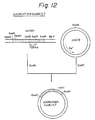
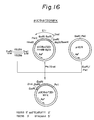
- These synthetic DNA fragments were 5'-phosphorylated using a T4 polynucleotide kinase and ATP, and annealed at 65°C for 10 minutes to prepare a double-stranded DNA fragment shown in Fig. 16.
- the plasmid pUC18chT201 HindIII-BglII was cleaved with PstI (cleaving cDNA at 1844 position) and DraI (cleaving cDNA at 233 position) to obtain a PstI-DraI DNA fragment E11.
- the synthetic DNA fragment, the DNA fragment E11, and the linearized pUC19 were ligated and used to transform E. coli JM109, whereby a plasmid pUC19ch201 MFK and corresponding transformant E. coli JM109/pUC19chT201 MFK were obtained.
- P L chT201 MPF-Sph was cleaved with SphI and XhoI to obtain an SphI-XhoI DNA fragment E12.
- the plasmid pUC19chT201 MFK was cleaved with EcoRI and XhoI to obtain an EcoRI-XhoI DNA fragment E13
- pUCP L CI was cleaved with EcoRI and SphI.
- the DNA fragments E12 and E13, and the linearized pUCP L CI were ligated and used to transform E. coli W3110, whereby a plasmid P L chT201 MFK-Sph and corresponding transformant E. coli W3110/P L chT201 MFK-Sph were obtained.
- P L chT201 MPF-S/B was cleaved with XhoI and BamHI to obtain an XhoI-BamHI DNA fragment E14.
- the plasmid pUC19chT201 MFK was cleaved with EcoRI and XhoI to obtain an EcoRI-XhoI DNA fragment E15.
- pUCP L CI was cleaved with EcoRI and BamHI.
- the DNA fragments E14 and E15, and the linearized pUCP L CI were ligated and used to transform E. coli W3110, whereby a plasmid P L chT201 MFK-S/B and corresponding transformant E. coli W3110/P L chT201 MFK-S/B were obtained.
- P L chT201 MPF-Sal was cleaved with XhoI and PstI to obtain an XhoI-PstI DNA fragment E16.
- P L chT201 MFK-S/B were cleaved with XhoI and PstI to obtain an XhoI-PstI DNA fragment E17.
- the DNA fragments E16 and E17 were ligated and used to transform E. coli W3110, whereby a plasmid P L chT201 MFK-Sal and corresponding transformant E. coli W3110/P L chT201 MFK-Sal were obtained.
- P L chT20 MPF-S/B was cleaved with XhoI and BamHI to obtain an XhoI-BamHI DNA fragment E18.
- pUC18chT201 HindIII-BglII was cleaved with XhoI and BclI to obtain an XhoI-BclI DNA fragment E19.
- the DNA fragments E18 and E19 were ligated and used to transform E. coli W3110, whereby a plasmid P L chT201 MFK-Bcl and corresponding transformant E. coli W3110/P L chT201 MFK-Bcl were obtained.
- Example 8 Construction of E. coli vectors expressing chT101-type protein derivatives, P L chT2 MPF-Pst, P L chT2 MFK-Pst, P L chT2 MPF-Bcl and P L chT2 MFK-Bcl
- the chT2 cDNA lacks the N-terminal coding region
- the lacking region of chT2 cDNA can be supplemented with a corresponding region of chT201 cDNA, to construct a cDNA identical with the chT101 cDNA.
- the chT2 cDNA and chT201 cDNA were used.
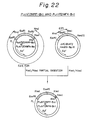
- P L chT201 MPF-Bcl was cleaved with XhoI and PstI to obtain an XhoI-PstI DNA fragment E20.
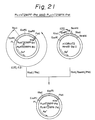
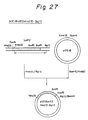
- pUC18chT2 HindIII-BglII constructed in Example 10. (4) (see, Fig. 27) was cleaved with XhoI, BamHI and PstI to obtain an XhoI-PstI DNA fragment E22.
- the DNA fragments E20 and E22 were ligated and used to transform E. coli W3110, whereby a plasmid P L chT2 MPF-Pst and corresponding transformant E. coli W3110/P L ch2 MFK-Pst were obtained.
- E. coli transformants prepared as above W3110/P L chT 201 MPF-Sph, W3110/P L chT201 MPF-Sal, W3110/P L chT201 MPF-S/B, W3110/P L chT201 MPF-Bcl, W3110/P L chT201 MFK-Sph, W3110/P L chT201 MFK-Sal, W3110/P L chT201 MFK-S/B, W3110/P L chT201 MFK-Bcl, W3110/P L chT2 MPF-Pst, W3110/P L chT2 MFK-Pst, W3110/P L chT2 MPF-Bcl, and W3110/P L chT2 MFK-Bcl were separately cultured in a Super broth supplemented with 50 ⁇ g/ml ampicillin, at 32°C overnight.
- E. coli W3110 (not transformed) was cultured in Super broth not containing ampicillin, at 32°C overnight.
- the Super broth medium was prepared by dissolving 24 g of a yeast extract, 12 g of trypton, 5 ml of glycerol, and 100 ml of a 1 M phosphate buffer (pH 7.6) in water, to a total volume of 1 liter.
- the culture was inoculated to 5 ml of a fresh medium having the same composition to 0.01 OD/ml at 660 nm, and culturing was carried out at 32°C until the absorbance at 660 nm become 0.3 OD/ml.
- the cultured broth having an absorbance of 5 OD at 660 nm was centrifuged at 13,000 rpm for 2 minutes, to collect cells, the supernatant was discorded, the cells were suspended in 300 ⁇ l of PBS(-) (0.8% NaCl, 0.02% KCl, 0.15% Na2HPO4 and KH2PO4) containing 0.1% Triton, and the suspension was subjected to sonication to disrupt the cells. The disruptant was centrifuged at 13,000 rpm for two minutes, the supernatant was discarded, and the precipitate was suspended in 300 ⁇ l of PBS (-).
- the suspension was centrifuged at 13,000 rpm for two minutes, and the supernatant was discorded.
- the precipitate was dissolved in 500 ⁇ l of 6M guanidine hydrochloride (containing 10 mM Tris-HCl, pH 7.0, and 50 ⁇ M CuSO4) and the solution was sonicated.
- the solutions was dialyzed against 4 M guanidine hydrochloride (containing 10 mM Tris-HCl, pH 7.0, and 50 ⁇ M CuSO4) for one hour, and hereafter, the dialyzate was again dialyzed against 2 M guanidine hydrochloride (containing 10 mM Tris-HCl, pH 7.0, 50 ⁇ M CuSO4), overnight.
- the dialyzate was assayed to determine the C-terminal ⁇ -amidating activity.
- the assay was carried out according to Mizuno et al., B.B.R.C. 137 , 984-991, 1986, as follows. Namely, 25 ⁇ l of the sample was diluted with water to a total volume of 100 ⁇ l, to this solution were added 25 ⁇ l of 10 mM N-ethylmaleimide, 25 ⁇ l of 10 mM ascorbic acid, 25 ⁇ l of 200 ⁇ M CuSO4 , 1.25 ⁇ l of 20 mg/ml catalase, 25 ⁇ l of 1% rubrol, 2 pmol of [125I]-Ac-Tyr-Phe-Gly (170,000 cpm), and 50 ⁇ l of 1M Tris-HCl (pH 7.0), and the reaction mixture was incubated at 37°C for 24 hours.
- Example 10 Construction of animal cell expression plasmids pKDchT201-Sph, pKDchT201-Sal, pKDchT201-S/B, pKDch201-Pst, pKDchT201-Bcl, pKDchT2-Pst and pKDchT2-Bcl
- plasmids pKDchT201-Sph, pKDchT201-Sal, pKDchT201-S/B, pKDchT201-Pst, and pKDchT201-Bcl for expression of chT201-type C-terminal ⁇ -amidating enzyme derivatives
- pKDchT2-Pst and pKDchT2-Bcl for expression of chT2-type C-terminal ⁇ -amidating enzyme derivatives
- plasmids contained cDNA insert coding for a protein starting from the first amino acid in the amino acid sequence shown in Fig. 1 (or Fig. 3), and terminating at a different amino acid in the amino acid sequence shown in Fig. 1 or that shown in Fig. 3.
- These plasmids also contained an SV 40 (Simian Virus 40) early promoter, an intron derived from a rabbit ⁇ -globin gene responsible for splicing an RNA and addition of poly A, a cDNA coding for a desired enzyme derivative under the control of the SV40 early promoter, and a poly A addition signal derived from a rabbit ⁇ -globin gene, in this order.
- SV 40 Sesimian Virus 40
- E. coli SBM 303 containing the plasmid pKD used for construction of the above-mentioned expression plasmids was deposited with the FRI under the Budapest treaty as FERM BP-2238, on January 11, 1989.
- the plasmid pUC18chT201 HindIII-BglII was cleaved with HpaII to obtain a 453 bp DNA fragment, which was then filled in using Krenow enzyme in the presence of dNTPs to make the ends blunt.
- the plasmid pUC18 was cleaved with SmaI.
- the 453 bp DNA and the linearized pUC18 were ligated and used to transform E. coli JM 109, whereby a plasmid pUC18-HpaII was obtained.
- the plasmid pUC18 HpaII was cleaved with KpnI and HindIII to obtain a DNA fragment C1
- the P L chT201 MPF-Sph was cleaved with KpnI and HindIII to obtain DNA fragment C2.
- pKD was cleaved with HindIII.
- the DNA fragments C1 and C2, and the linearized plasmid pKD were ligated and used to transform E. coli DH1, whereby a plasmid pKDchT201-Sph was obtained.
- the plasmid pUC18chT201 HindIII-BglII was cleaved with PstI and XhoI to obtain a DNA fragment C6.
- pKDchT201 MPF-Sal was completely digested, with XhoI, and then partially digested with PstI, to obtain a DNA fragment C7.
- the DNA fragments C6 and C7 were ligated and used to transform E. coli DH1, whereby a plasmid pKDchT201-Pst was obtained.
- the ⁇ gt10chT2 phage DNA was cleaved with HindIII and BglII to obtain a DNA fragment containing a chT2 cDNA coding region and a portion of the ⁇ gt10 phage.
- pUC18 was cleaved with HindIII and BamHI.
- the DNA fragment from the ⁇ gt10chT2, and the linearized pUC18 were ligated and used to transform E. coli JM109, whereby a plasmid pUC18chT2 HindIII-BglII was obtained.
- E. coli transformed with the plasmid pUC18chT2 HindIII-BglII was designated as E. coli SBM304, and deposited with the FRI under the Budapest treaty as FERM BP-2239, on January 11, 1989.
- pUC18 HpaII was cleaved with HindIII and SspI to obtain a DNA fragment C8
- the plasmid pUC18chT2 HindIII-BglII was cleaved with HindIII and SspI to obtain a DNA fragment C9.
- pUC118 was cleaved with HindIII.
- the DNA fragments C8 and C9, and the linearized pUC118 were ligated and used to transform E. coli JM109, whereby a plasmid pUC118chT201-chT2 was obtained.
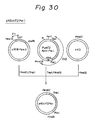
- the plasmid pUC18chT2 HindIII-BglII was cleaved with KpnI and PstI to obtain a DNA fragment c10, and the plasmid pUCP L CI was cleaved with KpnI.
- the DNA fragment C10 and the linearized pUCP L CI were ligated and used to transform E. coli JM109, whereby a plasmid P L chT2 KpnI-PstI was obtained.
- the plasmid pUC18 HpaII was cleaved with HindIII and SsPI to obtain a DNA fragment C11
- the plasmid P L chT2 KpnI-PstI was cleaved with SspI and HindIII to obtain a DNA fragment C12.
- the plasmid pKD was cleaved with HindIII.
- the DNA fragments C11 and C12, and the linearized pKD were ligated and used to transform E. coli DH1, whereby a plasmid pKDchT2-Pst was obtained.
- the plasmid pUC118chT201-chT2 was cleaved with HindIII and BclI to obtain a DNA fragment C13, and the plasmid pUCP L CI was cleaved with BamHI and HindIII to obtain a DNA fragment C14. Further, the plasmid pKD was cleaved with HindIII. Next, the DNA fragments C13 and C14, and the linearized pKD, were ligated and used to transform E. coli DH1, whereby a plasmid pKDchT2-Bcl was obtained.
- Plasmids pKD, pKDchT201-Sph, pKDchT201-Sal, pKDchT201-S/B, pKDchT201-Bcl, pKDchT201-Pst, pKDchT2-Pst and pKDchT2-Bcl were prepared from corresponding E. coli transformants by a conventional procedure, 30 ⁇ g of each plasmid DNA was precipitated by ethanol, and the ethanol precipitate was washed with 80% ethanol and dried under vacuum.
- the dried DNA was dissolved in 720 ⁇ l of sterile distilled water, and to this solution was added 720 ⁇ l of an A buffer of a Cell Phect transfection kit (Pharmacia), and the whole was thoroughly mixed and allowed to stand at a room temperature for 10 minutes. Next, 1440 ⁇ l of B buffer of the same kit was added, and the whole was thoroughly mixed and allowed to stand at a room temperature for 15 minutes, whereby a calcium phosphate-DNA complex was formed.
- a Cell Phect transfection kit Pharmacia
- COSl cells were cultured overnight in 30 medium at a concentration of 7.5 x 10⁵ cell/10 cm petri dish, and after adding 10 ml of fresh medium per petri dish, further cultured for 4 hours.
- the petri dish was washed with 8 ml of a medium, 10 ml of the medium was added to the petri dish, and culturing was carried out for 3 days.
- the medium was Dulbecco's MEM containing 10% fetal calf serum (Flow Lab.), and culturing was carried out at 37°C in an atmosphere of 50% CO2.
- the supernatant was obtained and centrifuged at 15000 rpm for 4 minutes to obtain a supernatant, and the C-terminal ⁇ -amidating activity of the supernatant was determined by an assay.
- the assay was carried out according to Mizuno et al. (supra), and the conversion of [125I]-Ac-Tyr-Phe-Gly to [125I]-Ac-Tyr-Phe-NH4 was measured. The result is shown in Figs. 32(A) and 32(B). This result was obtained by reacting 100 ⁇ l of the supernatant for 16 hours.
- both proteins encoded by chT201 DNA and chT2 cDNA respectively have a C-terminal ⁇ -amidating enzyme activity; and (2) The activity is provided not only by a protein having a full length primary amino acid sequence encoded by chT201 cDNA or chT2 cDNA, but also by a shortened protein having a portion of an amino acid sequence encloded by the chT201 cDNA or chT2 cDNA.
- the expression vector such as pKDchT201-Bcl, pKDchT2-Bcl, pKDchT201-Pst, pKDcht2-Pst, pKDchT201-S/B, and pKDchT201-Sal coding for a C-terminal truncated protein derivative, when introduced to COSl cells, exhibited a significant C-terminal ⁇ -amidating enzyme activity in a culture supernatant.
- C-terminal ⁇ -amidating enzyme can be produced using cloned cDNA derived from human thyroid origin. Accordingly, C-terminal amidated peptides or proteins, which are useful and important in the pharmaceutical or medical field and other industrial fields, can be economically produced.
Landscapes
- Health & Medical Sciences (AREA)
- Life Sciences & Earth Sciences (AREA)
- Genetics & Genomics (AREA)
- Chemical & Material Sciences (AREA)
- Engineering & Computer Science (AREA)
- Organic Chemistry (AREA)
- Zoology (AREA)
- Wood Science & Technology (AREA)
- Bioinformatics & Cheminformatics (AREA)
- Biomedical Technology (AREA)
- General Engineering & Computer Science (AREA)
- General Health & Medical Sciences (AREA)
- Molecular Biology (AREA)
- Biochemistry (AREA)
- Biotechnology (AREA)
- Microbiology (AREA)
- Medicinal Chemistry (AREA)
- Physics & Mathematics (AREA)
- Biophysics (AREA)
- Plant Pathology (AREA)
- Enzymes And Modification Thereof (AREA)
- Micro-Organisms Or Cultivation Processes Thereof (AREA)
- Preparation Of Compounds By Using Micro-Organisms (AREA)
- Peptides Or Proteins (AREA)
Claims (10)
- Verfahren zur Herstellung eines den C-Terminus α-amidierenden Enzyms, wobei das Enzym eine Aminosäuresequenz nach der in Fig. 1 gezeigten von der Position 37 (Pro) bis zur Position 378 (Lys) umfaßt, oder eines Derivats mit dieser Sequenz, das die Enzymaktivität beibehält, wobei das Verfahren umfaßt:(a) Züchten prokaryotischer oder eukaryotischer Zellen, die mit einem Expressionsvektor transformiert sind, der ein Gen enthält, das dieses Enzym codiert, wodurch das Enzym produziert wird, und(b) Gewinnung des Enzyms aus der Kultur.
- Verfahren nach Anspruch 1, wobei das C-terminal α-amidierende Enzym eine Aminosäuresequenz nach der in Fig. 1 gezeigten aufweist, die bei einer Aminosäure von der Position 1 (Met) bis einschließlich zur Position 37 (Pro) beginnt und bei einer Aminosäure von der Position 378 (Lys) bis einschließlich zur Position 974 (Ser) endet, oder eines Derivats dieser Sequenz, das die Enzymaktivität beibehält.
- Verfahren nach Anspruch 1, wobei das C-terminal α-amidierende Enzym eine Aminosäuresequenz nach der in Fig. 1 gezeigten aufweist, die bei einer Aminosäure von der Position 1 (Met) bis einschließlich zur Position 37 (Pro) beginnt, sich bis zu einer Aminosäure von der Position 378 (Lys) bis zur Position 974 (Ser) fortsetzt, und eine zusätzliche C-terminale Sequenz aus 1 bis 10 Aminosäuren aufweist.
- Verfahren zur Herstellung eines C-terminal α-amidierenden Enzyms, wobei das Enzym eine Aminosäuresequenz nach der in Fig. 3 gezeigten von der Position 37 (Pro) bis zur Position 378 (Lys) umfaßt, oder eines Derivats dieser Sequenz, das die Enzymaktivität beibehält, wobei das Verfahren umfaßt:(a) Züchten prokaryotischer oder eukaryotischer Zellen, die mit einem Expressionsvektor transformiert sind, der ein Gen enthält, das dieses Enzym codiert, wodurch das Enzym produziert wird, und(b) Gewinnung des Enzyms aus der Kultur.
- Verfahren nach Anspruch 4, wobei das C-terminal α-amidierende Enzym eine Aminosäuresequenz nach der in Fig. 3 gezeigten aufweist, die bei einer Aminosäure von der Position 1 (Met) bis einschließlich zur Position 37 (Pro) beginnt und bei einer Aminosäure von der Position 378 (Lys) bis einschließlich zur Position 866 (Ser) endet, oder eines Derivats dieser Sequenz, das die Enzymaktivität beibehält.
- Verfahren nach Anspruch 4, wobei das C-terminal α-amidierende Enzym eine Aminosäuresequenz nach der in Fig. 3 gezeigten aufweist, die bei einer Aminosäure von der Position 1 (Met) bis einschließlich zur Position 37 (Pro) beginnt, sich bis zu einer Aminosäure von der Position 378 (Lys) bis zur Position 866 (Ser) fortsetzt und eine zusätzliche C-terminale Sequenz aus 1 bis 10 Aminosäuren aufweist.
- Prokaryotische oder eukaryotische Zellen, die durch Transformation mit einem Plasmid infiziert sind, das ein Gen einführt, das ein C-terminal α-amidierendes Enzyms codiert, das nach einem der Verfahren hergesellt wurde, die in einem der Ansprüche 1 bis 6 beschrieben sind.
Applications Claiming Priority (3)
| Application Number | Priority Date | Filing Date | Title |
|---|---|---|---|
| JP5878/89 | 1989-01-17 | ||
| JP1005878A JP2845468B2 (ja) | 1989-01-17 | 1989-01-17 | ヒト甲状腺由来C―末端α―アミド化酵素 |
| PCT/JP1990/000042 WO1990008190A1 (en) | 1989-01-17 | 1990-01-17 | RECOMBINANT C-TERMINAL α-AMIDATING ENZYME OF HUMAN THYROID ORIGIN |
Publications (2)
| Publication Number | Publication Date |
|---|---|
| EP0404967A1 EP0404967A1 (de) | 1991-01-02 |
| EP0404967B1 true EP0404967B1 (de) | 1995-11-02 |
Family
ID=11623165
Family Applications (1)
| Application Number | Title | Priority Date | Filing Date |
|---|---|---|---|
| EP90901894A Expired - Lifetime EP0404967B1 (de) | 1989-01-17 | 1990-01-17 | Rekombinantes c-terminal alpha amidatierungsenzym von menschlischem thyroidursprung |
Country Status (10)
| Country | Link |
|---|---|
| EP (1) | EP0404967B1 (de) |
| JP (1) | JP2845468B2 (de) |
| KR (1) | KR970001567B1 (de) |
| AT (1) | ATE129744T1 (de) |
| AU (1) | AU631843B2 (de) |
| CA (1) | CA2024279C (de) |
| DE (1) | DE69023284T2 (de) |
| DK (1) | DK0404967T3 (de) |
| ES (1) | ES2078964T3 (de) |
| WO (1) | WO1990008190A1 (de) |
Families Citing this family (4)
| Publication number | Priority date | Publication date | Assignee | Title |
|---|---|---|---|---|
| US6319685B1 (en) | 1984-09-27 | 2001-11-20 | Unigene Laboratories, Inc. | Alpha-amidating enzyme compositions and processes for their production and use |
| US5789234A (en) * | 1987-08-14 | 1998-08-04 | Unigene Laboratories, Inc. | Expression systems for amidating enzyme |
| CN1069699C (zh) * | 1997-04-16 | 2001-08-15 | 中国科学院上海生物化学研究所 | 一种活性重组酰胺化酶及其对多肽的酰胺化修饰应用 |
| JP5931738B2 (ja) * | 2009-12-01 | 2016-06-08 | ノヴォ ノルディスク アー/エス | 新規のペプチジルアルファ−ヒドロキシグリシンアルファ−アミド化リアーゼ |
Family Cites Families (2)
| Publication number | Priority date | Publication date | Assignee | Title |
|---|---|---|---|---|
| US4708934A (en) * | 1984-09-27 | 1987-11-24 | Unigene Laboratories, Inc. | α-amidation enzyme |
| JPH0775541B2 (ja) * | 1986-06-07 | 1995-08-16 | 壽之 松尾 | C末端アミド化酵素及びその製造方法 |
-
1989
- 1989-01-17 JP JP1005878A patent/JP2845468B2/ja not_active Expired - Fee Related
-
1990
- 1990-01-17 AU AU49493/90A patent/AU631843B2/en not_active Ceased
- 1990-01-17 CA CA002024279A patent/CA2024279C/en not_active Expired - Fee Related
- 1990-01-17 AT AT90901894T patent/ATE129744T1/de not_active IP Right Cessation
- 1990-01-17 KR KR1019900702040A patent/KR970001567B1/ko not_active Expired - Fee Related
- 1990-01-17 DE DE69023284T patent/DE69023284T2/de not_active Expired - Fee Related
- 1990-01-17 EP EP90901894A patent/EP0404967B1/de not_active Expired - Lifetime
- 1990-01-17 DK DK90901894.7T patent/DK0404967T3/da active
- 1990-01-17 ES ES90901894T patent/ES2078964T3/es not_active Expired - Lifetime
- 1990-01-17 WO PCT/JP1990/000042 patent/WO1990008190A1/en not_active Ceased
Also Published As
| Publication number | Publication date |
|---|---|
| JPH02190183A (ja) | 1990-07-26 |
| DK0404967T3 (da) | 1995-12-04 |
| JP2845468B2 (ja) | 1999-01-13 |
| AU631843B2 (en) | 1992-12-10 |
| CA2024279C (en) | 2000-07-11 |
| DE69023284T2 (de) | 1996-03-28 |
| CA2024279A1 (en) | 1990-07-18 |
| WO1990008190A1 (en) | 1990-07-26 |
| ES2078964T3 (es) | 1996-01-01 |
| KR910700345A (ko) | 1991-03-14 |
| DE69023284D1 (de) | 1995-12-07 |
| AU4949390A (en) | 1990-08-13 |
| ATE129744T1 (de) | 1995-11-15 |
| KR970001567B1 (ko) | 1997-02-11 |
| EP0404967A1 (de) | 1991-01-02 |
Similar Documents
| Publication | Publication Date | Title |
|---|---|---|
| US5541098A (en) | Urate oxidase activity protein, recombinant gene coding therefor, expression vector, micro-organisms and transformed cells | |
| CZ283648B6 (cs) | Způsob výroby proapolipoproteinu A-I lidského původu | |
| US4987070A (en) | Use of a 97 amino acid leader sequence from the E. coli B-galactosidase gene for the production of hanp and hptc as fusion proteins | |
| US6262232B1 (en) | Recombinant C-terminal α-amidating enzyme | |
| JP2571119B2 (ja) | 細胞膜結合型アルデヒド脱水素酸素の構造遺伝子、これを含むプラスミド、形質転換した酢酸菌及び酢酸発酵法 | |
| HU215948B (hu) | Eljárás urát-oxidáz aktivitással rendelkező protein, azt kódoló gén, expressziós vektor és mikroorganizmusok előállítására | |
| US5863783A (en) | Cloning and expression of DNA molecules encoding arabinan-degrading enzymes of fungal origin | |
| US5908772A (en) | Gene encoding lacto-N-biosidase | |
| EP0404967B1 (de) | Rekombinantes c-terminal alpha amidatierungsenzym von menschlischem thyroidursprung | |
| Li et al. | Homologous expression of recombinant cellobiose dehydrogenase in Phanerochaete chrysosporium | |
| JPH05199882A (ja) | ビリルビンオキシダーゼの製造法 | |
| WO1990008194A1 (en) | PROCESS FOR PRODUCTION OF C-TERMINAL α-AMIDATED PEPTIDE | |
| EP0570096B1 (de) | Ornithin-Carbamoyl-Transferase Gen und seine Verwendung als Gen-Marker in einem Expression-System für die Herstellung von Proteinen bei Basidiomyceten | |
| US5187078A (en) | Plasma-type glutathione peroxidase gene and application of the same | |
| US5989887A (en) | Cloning and expression of DNA molecules incoding arabinan-degrading enzymes of fungal origin | |
| US5821083A (en) | Recombinant C-terminal α-amidating enzyme | |
| JP2581527B2 (ja) | C−末端α−アミド化酵素をコードする遺伝子 | |
| EP0385451B1 (de) | Cytochrom-C-Gen aus einer Wasserstoffbakterie | |
| JPH01231888A (ja) | アミド化酵素及びその製造方法 | |
| JPH07284388A (ja) | 切断されたヒトコレステロール7α−ヒドロキシラーゼ、その製造法およびその使用法 | |
| JPH02219570A (ja) | ヒト5―リポキシゲナーゼの製造方法 | |
| JPH06292571A (ja) | アルケンモノオキシゲナーゼ、これをコードする遺伝子及び形質転換微生物並びにアルケンのエポキシ化方法 |
Legal Events
| Date | Code | Title | Description |
|---|---|---|---|
| PUAI | Public reference made under article 153(3) epc to a published international application that has entered the european phase |
Free format text: ORIGINAL CODE: 0009012 |
|
| AK | Designated contracting states |
Kind code of ref document: A1 Designated state(s): AT BE CH DE DK ES FR GB IT LI LU NL SE |
|
| 17P | Request for examination filed |
Effective date: 19901219 |
|
| 17Q | First examination report despatched |
Effective date: 19940308 |
|
| GRAA | (expected) grant |
Free format text: ORIGINAL CODE: 0009210 |
|
| AK | Designated contracting states |
Kind code of ref document: B1 Designated state(s): AT BE CH DE DK ES FR GB IT LI LU NL SE |
|
| REF | Corresponds to: |
Ref document number: 129744 Country of ref document: AT Date of ref document: 19951115 Kind code of ref document: T |
|
| REG | Reference to a national code |
Ref country code: DK Ref legal event code: T3 |
|
| REF | Corresponds to: |
Ref document number: 69023284 Country of ref document: DE Date of ref document: 19951207 |
|
| ET | Fr: translation filed | ||
| REG | Reference to a national code |
Ref country code: ES Ref legal event code: FG2A Ref document number: 2078964 Country of ref document: ES Kind code of ref document: T3 |
|
| ITF | It: translation for a ep patent filed | ||
| REG | Reference to a national code |
Ref country code: CH Ref legal event code: NV Representative=s name: E. BLUM & CO. PATENTANWAELTE |
|
| PLBE | No opposition filed within time limit |
Free format text: ORIGINAL CODE: 0009261 |
|
| STAA | Information on the status of an ep patent application or granted ep patent |
Free format text: STATUS: NO OPPOSITION FILED WITHIN TIME LIMIT |
|
| 26N | No opposition filed | ||
| REG | Reference to a national code |
Ref country code: GB Ref legal event code: IF02 |
|
| REG | Reference to a national code |
Ref country code: GB Ref legal event code: 732E |
|
| REG | Reference to a national code |
Ref country code: CH Ref legal event code: PUE Owner name: DAIICHI SUNTORY PHARMA CO., LTD. Free format text: SUNTORY LTD#NO. 1-40 DOJIMAHAMA 2-CHOME#KITA-KU/OSAKA-SHI/OSAKA (JP) -TRANSFER TO- DAIICHI SUNTORY PHARMA CO., LTD.#7-2, KOJIMACHI 5-CHOME#CHIYODA-KU, TOKYO (JP) Ref country code: CH Ref legal event code: NV Representative=s name: ARNOLD & SIEDSMA AG |
|
| REG | Reference to a national code |
Ref country code: FR Ref legal event code: TP |
|
| PGFP | Annual fee paid to national office [announced via postgrant information from national office to epo] |
Ref country code: NL Payment date: 20050103 Year of fee payment: 16 |
|
| PGFP | Annual fee paid to national office [announced via postgrant information from national office to epo] |
Ref country code: SE Payment date: 20050107 Year of fee payment: 16 |
|
| PGFP | Annual fee paid to national office [announced via postgrant information from national office to epo] |
Ref country code: FR Payment date: 20050110 Year of fee payment: 16 |
|
| PGFP | Annual fee paid to national office [announced via postgrant information from national office to epo] |
Ref country code: GB Payment date: 20050112 Year of fee payment: 16 Ref country code: AT Payment date: 20050112 Year of fee payment: 16 |
|
| PGFP | Annual fee paid to national office [announced via postgrant information from national office to epo] |
Ref country code: LU Payment date: 20050113 Year of fee payment: 16 Ref country code: DE Payment date: 20050113 Year of fee payment: 16 |
|
| PGFP | Annual fee paid to national office [announced via postgrant information from national office to epo] |
Ref country code: DK Payment date: 20050114 Year of fee payment: 16 |
|
| PGFP | Annual fee paid to national office [announced via postgrant information from national office to epo] |
Ref country code: CH Payment date: 20050117 Year of fee payment: 16 |
|
| PGFP | Annual fee paid to national office [announced via postgrant information from national office to epo] |
Ref country code: ES Payment date: 20050211 Year of fee payment: 16 |
|
| PGFP | Annual fee paid to national office [announced via postgrant information from national office to epo] |
Ref country code: BE Payment date: 20050419 Year of fee payment: 16 |
|
| PG25 | Lapsed in a contracting state [announced via postgrant information from national office to epo] |
Ref country code: GB Free format text: LAPSE BECAUSE OF NON-PAYMENT OF DUE FEES Effective date: 20060117 Ref country code: AT Free format text: LAPSE BECAUSE OF NON-PAYMENT OF DUE FEES Effective date: 20060117 |
|
| PG25 | Lapsed in a contracting state [announced via postgrant information from national office to epo] |
Ref country code: SE Free format text: LAPSE BECAUSE OF NON-PAYMENT OF DUE FEES Effective date: 20060118 Ref country code: ES Free format text: LAPSE BECAUSE OF NON-PAYMENT OF DUE FEES Effective date: 20060118 |
|
| PG25 | Lapsed in a contracting state [announced via postgrant information from national office to epo] |
Ref country code: LU Free format text: LAPSE BECAUSE OF NON-PAYMENT OF DUE FEES Effective date: 20060131 Ref country code: LI Free format text: LAPSE BECAUSE OF NON-PAYMENT OF DUE FEES Effective date: 20060131 Ref country code: FR Free format text: LAPSE BECAUSE OF NON-PAYMENT OF DUE FEES Effective date: 20060131 Ref country code: DK Free format text: LAPSE BECAUSE OF NON-PAYMENT OF DUE FEES Effective date: 20060131 Ref country code: CH Free format text: LAPSE BECAUSE OF NON-PAYMENT OF DUE FEES Effective date: 20060131 Ref country code: BE Free format text: LAPSE BECAUSE OF NON-PAYMENT OF DUE FEES Effective date: 20060131 |
|
| PGFP | Annual fee paid to national office [announced via postgrant information from national office to epo] |
Ref country code: IT Payment date: 20060131 Year of fee payment: 17 |
|
| PG25 | Lapsed in a contracting state [announced via postgrant information from national office to epo] |
Ref country code: NL Free format text: LAPSE BECAUSE OF NON-PAYMENT OF DUE FEES Effective date: 20060801 Ref country code: DE Free format text: LAPSE BECAUSE OF NON-PAYMENT OF DUE FEES Effective date: 20060801 |
|
| REG | Reference to a national code |
Ref country code: DK Ref legal event code: EBP |
|
| REG | Reference to a national code |
Ref country code: CH Ref legal event code: PL |
|
| EUG | Se: european patent has lapsed | ||
| GBPC | Gb: european patent ceased through non-payment of renewal fee |
Effective date: 20060117 |
|
| NLV4 | Nl: lapsed or anulled due to non-payment of the annual fee |
Effective date: 20060801 |
|
| REG | Reference to a national code |
Ref country code: FR Ref legal event code: ST Effective date: 20060929 |
|
| REG | Reference to a national code |
Ref country code: ES Ref legal event code: FD2A Effective date: 20060118 |
|
| BERE | Be: lapsed |
Owner name: *DAIICHI SUNTORY PHARMA CO. LTD Effective date: 20060131 |
|
| PG25 | Lapsed in a contracting state [announced via postgrant information from national office to epo] |
Ref country code: IT Free format text: LAPSE BECAUSE OF NON-PAYMENT OF DUE FEES Effective date: 20070117 |